

Synergistic insights into human health from aptamer- and antibody-based proteomic profiling
Open accessThe DOI matches its Crossref record; 67 of the 67 references it cites were found in a registry or an index.
Abstract
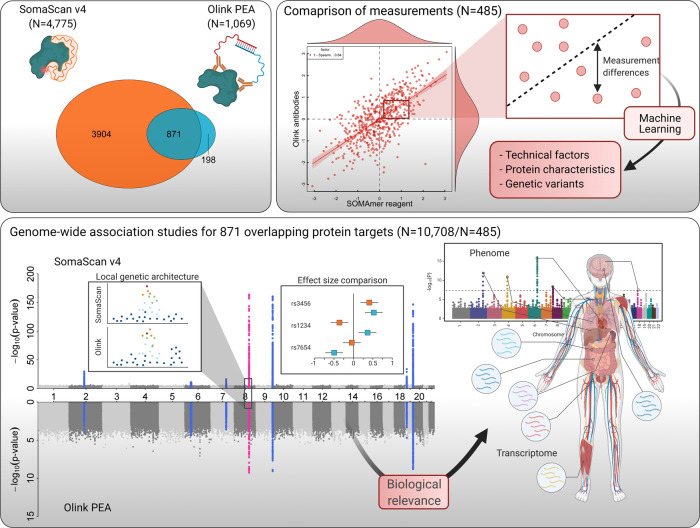
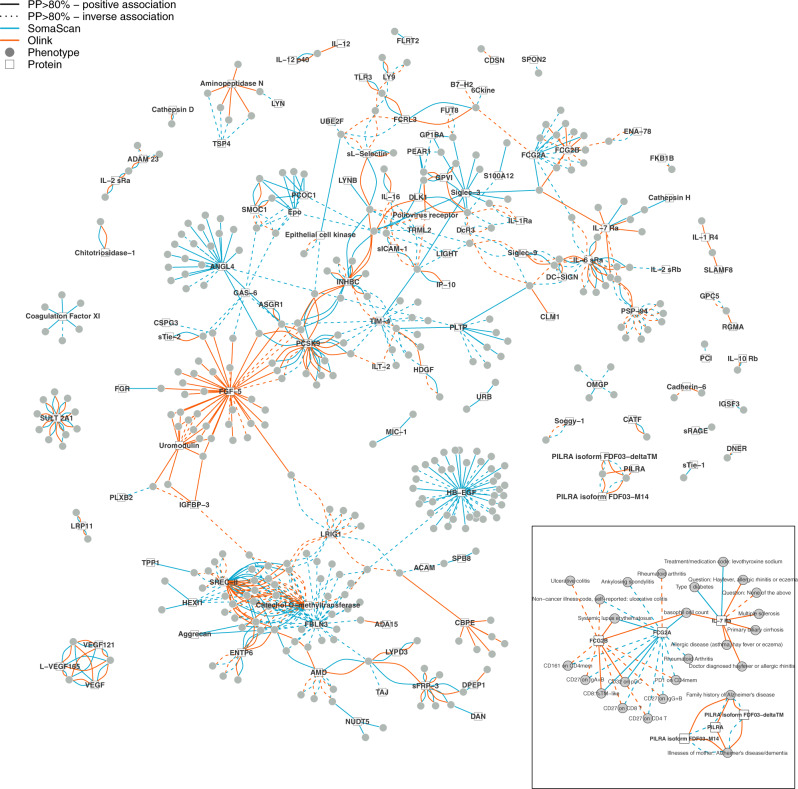
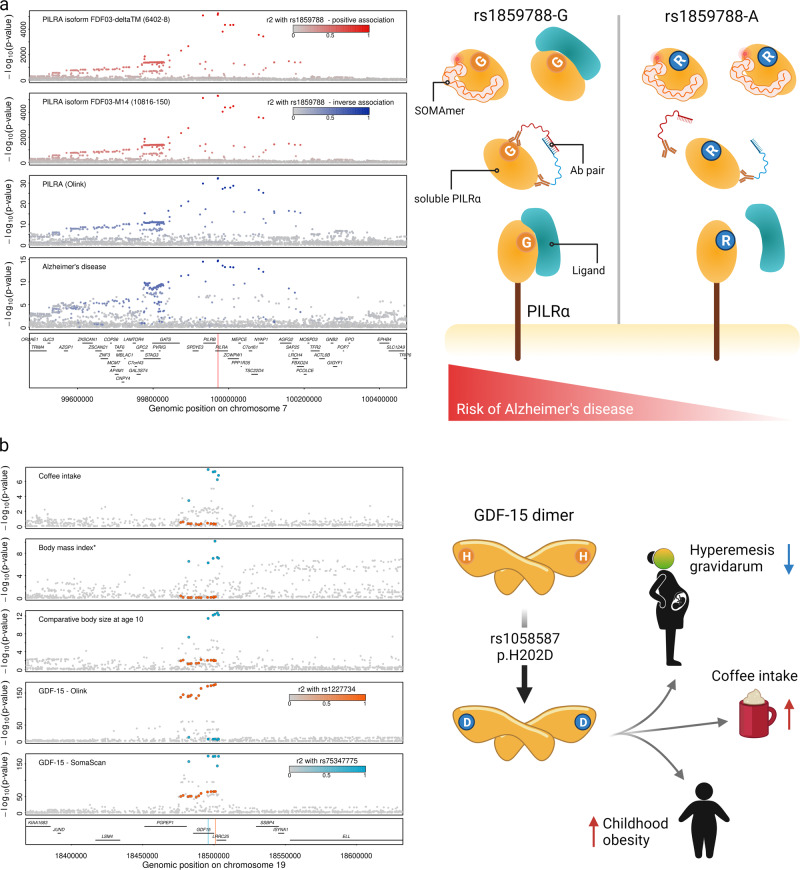
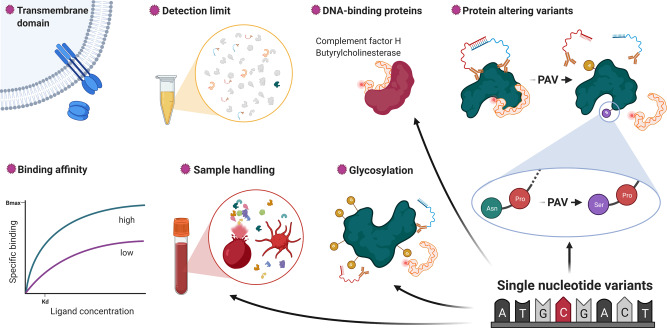
Affinity-based proteomics has enabled scalable quantification of thousands of protein targets in blood enhancing biomarker discovery, understanding of disease mechanisms, and genetic evaluation of drug targets in humans through protein quantitative trait loci (pQTLs). Here, we integrate two partly complementary techniques—the aptamer-based SomaScan ® v4 assay and the antibody-based Olink assays—to systematically assess phenotypic consequences of hundreds of pQTLs discovered for 871 protein targets across both platforms. We create a genetically anchored cross-platform proteome-phenome network comprising 547 protein–phenotype connections, 36.3% of which were only seen with one of the two platforms suggesting that both techniques capture distinct aspects of protein biology. We further highlight discordance of genetically predicted effect directions between assays, such as for PILRA and Alzheimer’s disease. Our results showcase the synergistic nature of these technologies to better understand and identify disease mechanisms and provide a benchmark for future cross-platform discoveries.
Overview
The claims and statistics of this paper haven’t been checked yet.
Free: it reads the open-access text and checks the first 5 claims that cite a source we can check. Create a free account to check every claim.
Integrity signals
Registry
Cites
Statistics
Figures
Verification
Claims the paper makes
The claims and statistics of this paper haven’t been checked yet.
Free: it reads the open-access text and checks the first 5 claims that cite a source we can check. Create a free account to check every claim.
Claims other papers make about this one
Each is checked against this paper’s own text: does it say what the citing paper says it does?
The source backs part of the claim, not all of it — or backs it for a different population, condition or comparison.
In the citing paper
“The detection of a cis-pQTL for a given protein measure is often used as a metric to confirm on-target affinity-probe binding12,15,16; existing studies comparing SomaScan and Olink measures have established that the detection of a cis-pQTL is a strong predictor of inter-platform correlation coefficients for a given protein12,15,16.”
From Cross-ancestry comparison of aptamer and antibody protein measures (2026) · cites this paper as [16]
Experimental — accuracy not yet measuredThe source backs part of the claim, not all of it — or backs it for a different population, condition or comparison.
In the citing paper
“This protein showed strong platform-discordant measures (Pearson’s r = -0.35) across the present and prior studies16,17 (Fig. 4A).”
From Cross-ancestry comparison of aptamer and antibody protein measures (2026) · cites this paper as [16]
Experimental — accuracy not yet measuredThe source backs part of the claim, not all of it — or backs it for a different population, condition or comparison.
In the citing paper
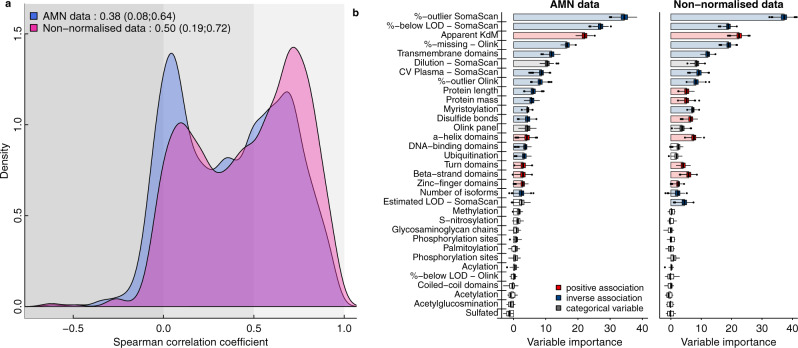
“One prior study demonstrated that biological (such as presence of a trans-membrane domain, protein length) and technical factors (percentage of outlier or below limit of detection protein measures, etc.) can explain this wide range of correlation coefficients16.”
From Cross-ancestry comparison of aptamer and antibody protein measures (2026) · cites this paper as [16]
Experimental — accuracy not yet measuredThe source backs part of the claim, not all of it — or backs it for a different population, condition or comparison.
In the citing paper
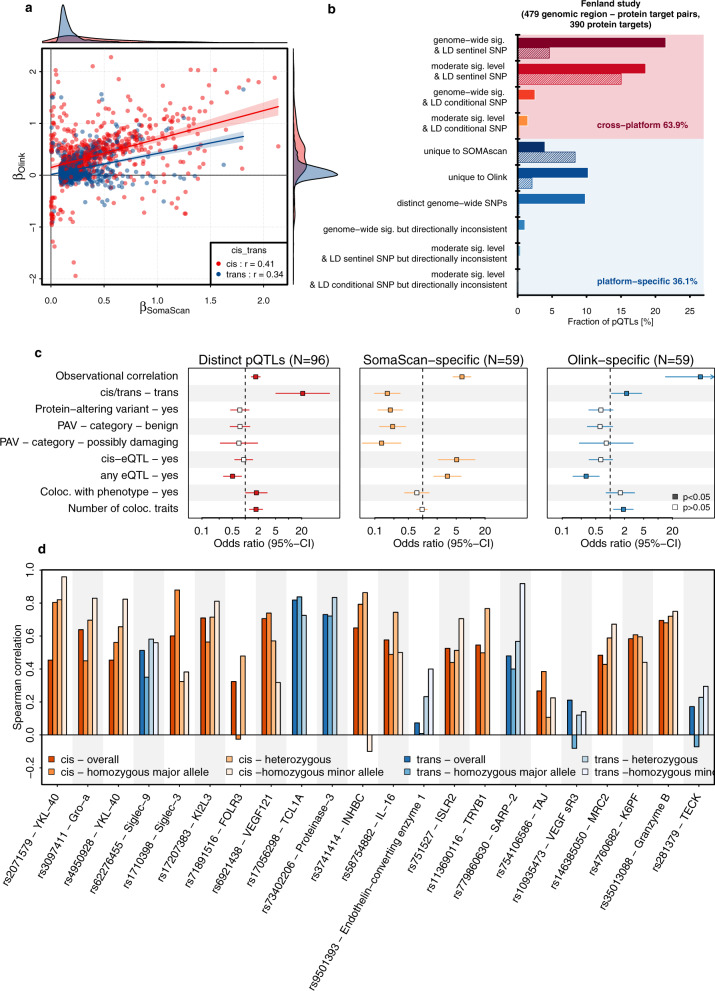
“We observed similar proportions of protein measures associated with any cis-pQTL on each platform (39% SomaScan, 48% Olink), with more distinct cis-pQTL identified for Olink overall (for the set of 2157 proteins measured on both platforms), consistent with single-ancestry genetic comparisons of earlier versions of SomaScan and Olink platforms12,16,17.”
From Cross-ancestry comparison of aptamer and antibody protein measures (2026) · cites this paper as [16]
Experimental — accuracy not yet measuredThe source backs part of the claim, not all of it — or backs it for a different population, condition or comparison.
In the citing paper
“Here, and across prior studies, cis-pQTL presence/absence is thought to provide one predictor of on-target protein measures12,15,16.”
From Cross-ancestry comparison of aptamer and antibody protein measures (2026) · cites this paper as [16]
Experimental — accuracy not yet measured
5 more claims about this paper
Create a free account to see every claim other papers make about this one.
Self-check
Percentages, sums and reported differences re-computed from the paper’s own numbers.
The self-check needs the paper’s full text.
Citations
Cites
Sudlow, C., Gallacher, J., Allen, N., Beral, V., Burton, P., Danesh, J., Downey, P., Elliott, P., Green, J., Landray, M., et al. (2015) · PLOS Medicine · doi:10.1371/journal.pmed.1001779 · Cited by 12,728
The UK Biobank resource with deep phenotyping and genomic data
Bycroft, C., Freeman, C., Petkova, D., Band, G., Elliott, L. T., Sharp, K., Motyer, A., Vukcevic, D., Delaneau, O., O’Connell, J., et al. (2018) · Nature · doi:10.1038/s41586-018-0579-z · Cited by 8,876
The Ensembl Variant Effect Predictor
McLaren, W., Gil, L., Hunt, S. E., Riat, H. S., Ritchie, G. R. S., Thormann, A., Flicek, P., & Cunningham, F. (2016) · Genome Biology · doi:10.1186/s13059-016-0974-4 · Cited by 8,099
Feature Selection with the Boruta Package
Kursa, M. B., & Rudnicki, W. R. (2010) · Journal of Statistical Software · doi:10.18637/jss.v036.i11 · Cited by 5,659
The GTEx Consortium atlas of genetic regulatory effects across human tissues
The GTEx Consortium, Aguet, F., Anand, S., Ardlie, K. G., Gabriel, S., Getz, G. A., Graubert, A., Hadley, K., Handsaker, R. E., Huang, K. H., et al. (2020) · Science · doi:10.1126/science.aaz1776 · Cited by 5,547
METAL: fast and efficient meta-analysis of genomewide association scans
Willer, C. J., Li, Y., & Abecasis, G. R. (2010) · Bioinformatics · doi:10.1093/bioinformatics/btq340 · Cited by 5,205
Giambartolomei, C., Vukcevic, D., Schadt, E. E., Franke, L., Hingorani, A. D., Wallace, C., & Plagnol, V. (2014) · PLoS Genetics · doi:10.1371/journal.pgen.1004383 · Cited by 4,261
Self-citationBuniello, A., MacArthur, J. A. L., Cerezo, M., Harris, L. W., Hayhurst, J., Malangone, C., McMahon, A., Morales, J., Mountjoy, E., Sollis, E., et al. (2019) · Nucleic Acids Research · doi:10.1093/nar/gky1120 · Cited by 4,000
A reference panel of 64,976 haplotypes for genotype imputation
the Haplotype Reference Consortium (2016) · Nature Genetics · doi:10.1038/ng.3643 · Cited by 2,836
A comprehensive map of molecular drug targets
Santos, R., Ursu, O., Gaulton, A., Bento, A. P., Donadi, R. S., Bologa, C. G., Karlsson, A., Al-Lazikani, B., Hersey, A., Oprea, T. I., et al. (2017) · Nature Reviews Drug Discovery · doi:10.1038/nrd.2016.230 · Cited by 2,427
Cited by
Items 201–237 of 237
Additional file 2 of Proteomics for heart failure risk stratification: a systematic review
Kuku, K. O., Oyetoro, R. O., Hashemian, M., Livinski, A. A., Shearer, J. J., Joo, J., Psaty, B. M., Levy, D. A., Ganz, P., & Roger, V. L. (2024) · Figshare · doi:10.6084/m9.figshare.26672724
Gadd, D. A., Smith, H. M., Mullin, D. S., Chybowska, O., Hillary, R. F., Kimenai, D. M., Bernabeu, E., Cheng, Y., Fawns‐Ritchie, C., Campbell, A., et al. (2024) · Figshare · doi:10.6084/m9.figshare.26981928
Plasma Proteomics and Sensitive Imaging Biomarkers of Vascular Brain InjuryPreprint
Yang, Q., Guðmundsdóttir, V., McGrath, E. R., Sargurupremraj, M., Zhu, Y., Maillard, P., CHEN, Z.-Z., Satizábal, C. L., Tahir, U. A., Beiser, A., et al. (2026) · medRxiv · doi:10.64898/2026.01.19.26344369
Beneath the Surface: Unraveling the Proteomics of Diabetes-Related Heart Failure
Kardys, I. (2026) · Circulation Heart Failure · doi:10.1161/circheartfailure.126.014166 · Cited by 1
APOE and Proteomics in Chronic Inflammation
Shvetcov, A., & Finney, C. A. (2026) · Springer eBooks · doi:10.1007/978-3-031-52641-1_82-1
Epigenome-wide association study of blood proteome in the Atherosclerosis Risk in Communities study
Li, Y., Surapaneni, A., Rodriguez-Hernandez, Z., Schlosser, P., Rhee, E. P., Boerwinkle, E., Yu, B., Grove, M. L., Ruggles, K. V., Coresh, J., et al. (2026) · Human Genetics and Genomics Advances · doi:10.1016/j.xhgg.2026.100585
Odden, M. C., Liu, X., Shah, A. M., Yang, Y., Lamberson, V., Brody, J. A., Sitlani, C. M., Huber, M. P., Kalani, R., Shojaie, A., et al. (2026) · Atherosclerosis · doi:10.1016/j.atherosclerosis.2026.120705
Toward large-scale mass spectrometry-based omics for clinical applications
Arad, M., & Foster, L. J. (2026) · Expert Review of Proteomics · doi:10.1080/14789450.2026.2646657
“These techniques rely on affinity (antibody or aptamer) to harness the longstanding advances in sequencing technologies [44].”
Discovery and validation of molecular biomarkers contributing to the risk of coronary artery disease
Nikpay, M. (2026) · Nutrition Metabolism and Cardiovascular Diseases · doi:10.1016/j.numecd.2026.104759
Plasma proteomics improves prediction of recurrent cardiovascular eventsPreprint
Liu, Y., Foguet, C., Ben-Eghan, C., Persyn, E., Richards, M., Wu, Z., Lambert, S. A., Butterworth, A. S., Wood, A., Angelantonio, E. D., et al. (2026) · medRxiv · doi:10.64898/2026.04.14.26350861
Colocalization and discordance between plasma and brain protein quantitative trait lociPreprint
Cheng, Y., Zhang, W., & Lu, T. (2026) · bioRxiv (Cold Spring Harbor Laboratory) · doi:10.64898/2026.05.01.722237
Li, L., Alaa, A., Tan, Y., Demirel, İ., Friedman, S. F., Zha, Q., Trac, R. P., Trac, R. P., Taylor, K. D., Yu, B., et al. (2026) · bioRxiv (Cold Spring Harbor Laboratory) · doi:10.64898/2026.05.05.723059 · Cited by 1
Proteomic Biomarkers in VTE: From Discovery to Clinical Translation
Cai, T., Ho, P., & Wang, J. (2026) · Journal of Clinical Medicine · doi:10.3390/jcm15103745
APOE and Proteomics in Chronic Inflammation
Shvetcov, A., & Finney, C. A. (2026) · Springer eBooks · doi:10.1007/978-3-031-96089-5_82
Liu, P. J., Ferguson, H., Gushterov, N., Kessler, B. M., Liu, G., Halner, A., Hankey, L., Kaneva, I., Dupalliwar, M., Syed, J., et al. (2026) · Communications Medicine · doi:10.1038/s43856-026-01701-8
Aberrant STAT signaling and T cell dysregulation define a targetable pediatric sepsis endotype
Lindell, R. B., Sayed, S. U., Campos, J. S., Sheetz, S. A., Babu, A., Knight, M., Mauracher, A. A., Hay, C., Conrey, P. E., Fitzgerald, J. C., et al. (2026) · Journal of Clinical Investigation · doi:10.1172/jci202867 · Cited by 2
“It will also benefit from validation across multiple proteomics platforms, as aptamer-based and antibody-based approaches are susceptible to both technical and genetic variation among samples (88).”
Karagkouni, D., Brake, M. A., Patell, R. D., Falanga, A., Marchetti, M., Russo, L., Mantha, S., Neuberg, D. S., Chiasakul, T., Carrier, M., et al. (2026) · Science Translational Medicine · doi:10.1126/scitranslmed.adu7160
Rasmussen, D. K., Marschall, P. L., Hyeon, L. S., Storm, T., Jakobsen, T. S., Wu, Q., Askou, A. L., Fenton, R. A., Corydon, T., Mahajan, V. B., et al. (2026) · bioRxiv (Cold Spring Harbor Laboratory) · doi:10.64898/2026.06.26.734689
The PRIDE Affinity-Proteomics Archive (PRIDE-AP): Making Affinity Proteomics Data FAIRPreprint
Kundu, D. J., Larrea, A., Kamatchinathan, S., Bandla, C., John, N. S., Madhusoodanan, N., Hewapathirana, S., Brown-Harry, B., Bai, J., Nevola, K. T., et al. (2026) · Research Square · doi:10.21203/rs.3.rs-10288827/v1
Short-term, Long-term, and Genetic Determinants of Human Plasma Proteome VariabilityPreprint
Benacom, D., Specht, A., Nicholas, J. C., Guillard, R., Gillman, M. G., Dubin, R. F., Ganz, P., Rotter, J. I., Taylor, K. D., Rich, S. S., et al. (2026) · bioRxiv (Cold Spring Harbor Laboratory) · doi:10.64898/2026.07.30.741635
“More broadly, cross-platform concordance with Olink offers partial reassurance, but systematic comparisons show discrepancies can be substantial, probe-639 dependent, and biologically complex 5,112 .”
Proteomics of aging: biomarkers for physiological systems and diseases
Luo, Y., Xiao, Y.-L., Chen, J.-H., Wang, H., Luo, S., Dong, H., & Huang, R.-P. (2026) · Frontiers in Aging · doi:10.3389/fragi.2026.1895104
“…changes in protein conformation, proteolytic processing, sequence variation, or age-associated PTMs may alter binding affinity, producing apparent abundance shifts that do not necessarily reflect true protein concentration (Santos and Lindner, 2017; Pietzner et al., 2021; Sissala et al., 2025).”
InfluentialEvaluation of procedures for normalizing and analyzing SomaScan proteomics assay
Galanakis, M., Srikantapuram, M., Ladelund, S., Izarzugaza, J. M. G., Bendtsen, K. M., Maretty, L., Geybels, M. S., & Valkenborg, D. (2026) · Scientific Reports · doi:10.1038/s41598-026-67717-1
“ANML distorting biological signal is corroborated by previous research that showed ANML substantially reduces correlation with Olink’s proximity extension assay 14 .”
Han, S. S., Surapaneni, A., Schmidt, I. M., Yun, D., Ma, X., Moon, K. C., Srivastava, A., Pálsson, R., Stillman, I. E., Waikar, S. S., et al. (2026) · Clinical Journal of the American Society of Nephrology · doi:10.2215/cjn.0000001191
Guvatova, Z. G., Kobelyatskaya, A. A., Gorbunov, A., Pudova, E. A., & Moskalev, A. (2026) · International Journal of Molecular Sciences · doi:10.3390/ijms27177580
“Where head-to-head comparisons exist, the two affinity platforms predict clinical endpoints about equally well while disagreeing substantially about which individual proteins carry the signal [50–52].”
InfluentialGenomic Architecture of Migraine: A Multi-ancestry GWAS Meta-analysis of 2.5 Million ParticipantsPreprint
Overstreet, C., Galimberti, M., Hasan, K. T., Beck, S. L., Hirsch, J., Sariya, S., Ferolito, B. R., Zhou, Y., Zhang, Y., Weinheimer, E. I., et al. (2026) · medRxiv · doi:10.64898/2026.08.28.26361638
Mao, Y., Jiang, Y., Wu, T., Li, P., Li, Y., Sun, W. Y., & Kong, X. (2026) · Hypertension · doi:10.1161/hypertensionaha.126.26937
Carrasco-Zanini, J., Andrade, J., Pietzner, M., Kousathanas, A., Jacobsen, J. O. B., Lord, J., Telugu, N. S., Diecke, S., Mülleder, M., Bierbaum, D., et al. (2026) · Science Translational Medicine · doi:10.1126/scitranslmed.aeb1331
Self-citationAnandraj Vaithy, K., Shukla, A., Bhengra, A., Venuturumilli, R., Aara, F., & Gusani, J. (2026) · Cureus · doi:10.7759/cureus.116199
“Created by the authors using Microsoft PowerPoint (Microsoft Corporation, Redmond, Washington, United States), based on sources [25-27].”
Papatziamou, D., Singh, A., Makwana, M. V., & Patel, S. K. (2026) · Biochimica et Biophysica Acta (BBA) - Proteins and Proteomics · doi:10.1016/j.bbapap.2026.141180
Knuckey, K. M., Timmins, S., Pham, A., Tan, M. E., Groves, P., Lutzky, V. P., Rai, S. K., Carew, A. M., Chambers, D. C., & Apte, S. H. (2026) · Biomolecules · doi:10.3390/biom16101396
“Cross-platform comparison with Olink demonstrated substantial target-dependent variation in agreement between assays, with better agreement for protein targets that had previously undergone orthogonal validation by mass spectrometry or immunoassay [30].”
Okojie, O., Checa-Ros, A., & D’Marco, L. (2026) · Proteomes · doi:10.3390/proteomes14040051
“Large-scale proteogenomic comparative maps show that a substantial fraction of these genetic signals fail to replicate across alternative platforms due to localized binding artifacts [54].”
Proteomic Signatures in Major Depressive Disorder and Depression Symptom Subtypes
Watson, K. T., Bot, M., Kosti, I., Milaneschi, Y., Evers, A. G., Rasgon, N., Nikolich, K., Lehallier, B., Schatzberg, A. F., & Penninx, B. W. J. H. (2026) · American Journal of Psychiatry · doi:10.1176/appi.ajp.20250891 · Cited by 2
Zeng, X., Abrahamson, E. E., Balogun, W. G., Kofler, J., Paljug, W. R., Pivtoraiko, V. N., Ikonomović, M. D., & Karikari, T. K. (2026) · medRxiv · doi:10.64898/2026.10.04.26361149
Systemic proteomic dynamics of acute exercise reveal genetic links to health and disease
Kurgan, N., Larsen, J. K., Jespersen, N. Z., Díez-Obrero, V., Svenstrup, V., Moreno‐Justicia, R., Heywood, S. E., Lindqvist, C. B., Ottander, L., Samodova, D., et al. (2026) · Nature Metabolism · doi:10.1038/s42255-026-01621-w · Cited by 7
“Although we provide orthogonal support for the plasma proteomic findings, most newly identified exerkines were not measured on a second platform and should be confirmed by targeted MS or immunoassay before extensive functional follow-up 29,49,50 .”
Circulating Immune and Cancer Driver Gene Biomarkers Precede Prostate Cancer Diagnosis by over 10 yr
Huang, Z., Parsaeian, M., Viallon, V., Wang, Z., Papier, K., Desai, T., Chan, W. C., Collister, J. A., Breeur, M., Tong, T. Y. N., et al. (2026) · European Urology · doi:10.1016/j.eururo.2026.08.014 · Cited by 1
Proteomics Approaches Used to Investigate Age Related Macular Degeneration
Njoku, V., Metaliaj, A., Darie, C. C., Blenkinsop, T., & Radu, A. (2026) · Advances in experimental medicine and biology · doi:10.1007/978-3-032-29437-1_21
Chen, H., Wang, R., Zhao, Z., Wang, X., & Hu, X. (2026) · Genes · doi:10.3390/genes17111324
Metadata
- Authors
- Pietzner, M., Wheeler, E., Carrasco-Zanini, J., Kerrison, N. D., Oerton, E., Koprulu, M., Luan, J., Hingorani, A. D., Williams, S. A., Wareham, N. J., & Langenberg, C.
- Affiliations
- University of Cambridge (GB)
- Health Data Research UK (GB)
- Corresponding author
- Langenberg, Claudia
- ORCID
- Venue
- Nature Communications
- Published
- 2021-11-24
- Volume
- 12
- Issue
- 1
- Pages
- 6822-6822
- ISSN
- 2041-1723 (ISSN-L)
- PMC
- PMC8613205
- OpenAlex
- W3212460220
- Semantic Scholar
- a15b545a66caf9a17b93262cd49d4092ba235110
- Cited by
- 234
- References
- 67
- Citations by year
- 2026: 55 · 2025: 49 · 2024: 55 · 2023: 44 · 2022: 29 · 2021: 2
- FWCI
- 18.50
- Type
- journal article
- Language
- en
- Open access
- gold
- doi.org
- Licence
- cc-by
- creativecommons.org/licenses/by/4.0 (tdm)
- creativecommons.org/licenses/by/4.0 (vor)
- Locations
- Nature Communications (publishedVersion, cc-by)
- PubMed Central (publishedVersion, cc-by)
- PubMed (publishedVersion)
- RePEc: Research Papers in Economics (submittedVersion)
- DOAJ (DOAJ: Directory of Open Access Journals) (submittedVersion, cc-by-sa)
- UCL Discovery (University College London) (submittedVersion)
- Queen Mary Research Online (Queen Mary University of London) (submittedVersion, cc-by)
- Apollo (University of Cambridge) (submittedVersion)
- Apollo (University of Cambridge) (submittedVersion, cc-by)
- Apollo
- Apollo (cc-by)
- Funders
- Wellcome Trust
- UK Research and Innovation (MR/V033867/1)
- National Institute for Health and Care Research (MC_UU_12015/1, NIHR202383)
- British Heart Foundation (AA/18/6/34223)
- University of Cambridge (00001)
- Cambridge Trust
- Medical Research Council (MC_UU_12015/1, MC_PC_13046, MC_UU_12015, MR/V033867/1)
- Topics
- Life Sciences › Biochemistry, Genetics and Molecular Biology › Genetics › Genetic Associations and Epidemiology
- Life Sciences › Biochemistry, Genetics and Molecular Biology › Molecular Biology › Advanced Biosensing Techniques and Applications
- Physical Sciences › Chemistry › Spectroscopy › Advanced Proteomics Techniques and Applications
- Keywords
- protein quantitative trait loci, pQTL, aptamer-based proteomics, SomaScan, Alzheimer's disease, biomarker discovery, disease mechanisms
- MeSH terms
- Adult, Alzheimer Disease, Antibodies, Female, Humans, Male, Membrane Glycoproteins, Middle Aged, Phenotype, Receptors, Immunologic, Cohort Studies, Proteome, Protein Interaction Mapping, Quantitative Trait Loci, Proteomics, Aptamers, Peptide, Protein Interaction Maps
About these checks
Registry, retraction, Cites and statistics results are computed, not judged, with one exception: a printed reference that no index lists is read once by a model before it counts as a citation error. Claims are extracted by a model and kept only when their quote appears verbatim in the text; each cited source is then checked, with a model’s help, for whether it says what the claim relies on. Those verdicts can be wrong — read the claim’s quote and the cited source before relying on one.
Statistics and arithmetic are recomputed, not judged.
Confidence bands are shown only for fields calibrated on our annotated test set. None is calibrated yet, so no band is shown.
What counts as a claim ›How we measure confidence ›How we check this ›
Are you an author, or do you see a problem with this page? Request a review
Data sources
Bibliographic data: Semantic Scholar, OpenAlex, Crossref.
Contains information from the Semantic Scholar Academic Graph Datasets, made available under the ODC Attribution License (ODC-BY 1.0).
Semantic Scholar’s data is described in: Kinney, R., et al. (2023). The Semantic Scholar Open Data Platform. arXiv:2301.10140.
