

Interstitial boron-triggered electron-deficient Os aerogels for enhanced pH-universal hydrogen evolution
Open accessThe DOI matches its Crossref record; 76 of the 76 references it cites were found in a registry or an index; 18 of the 46 sources its claims cite were checked for support.
Abstract
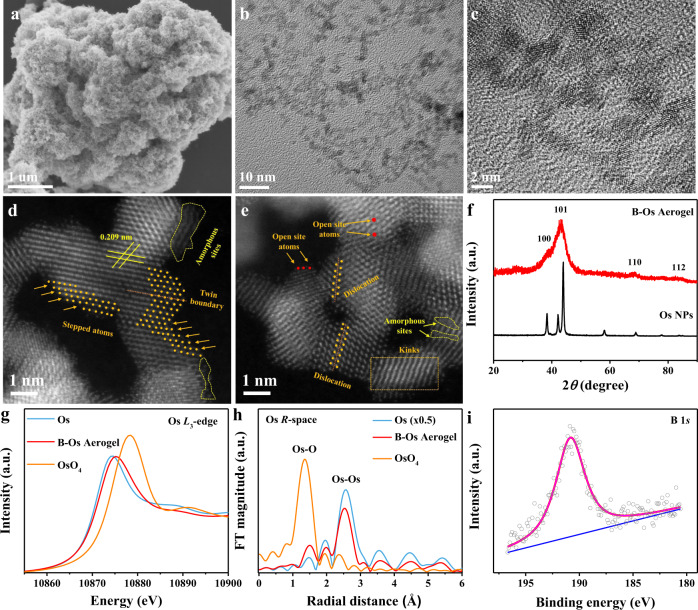
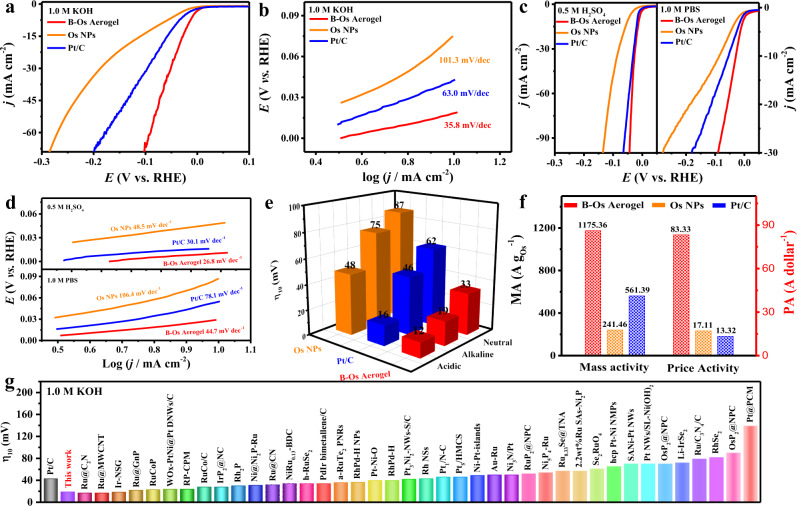
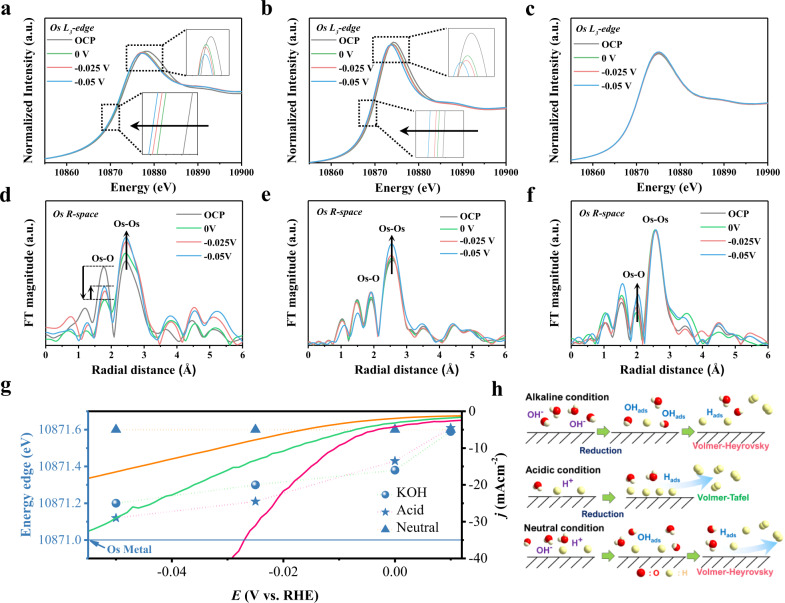
AbstractDeveloping high-performance electrocatalysts for hydrogen evolution reaction (HER) is crucial for sustainable hydrogen production, yet still challenging. Here, we report boron-modulated osmium (B-Os) aerogels with rich defects and ultra-fine diameter as a pH-universal HER electrocatalyst. The catalyst shows the small overpotentials of 12, 19, and 33 mV at a current density of 10 mA cm−2 in acidic, alkaline, and neutral electrolytes, respectively, as well as excellent stability, surpassing commercial Pt/C. Operando X-ray absorption spectroscopy shows that interventional interstitial B atoms can optimize the electron structure of B-Os aerogels and stabilize Os as active sites in an electron-deficient state under realistic working conditions, and simultaneously reveals the HER catalytic mechanisms of B-Os aerogels in pH-universal electrolytes. The density functional theory calculations also indicate introducing B atoms can tailor the electronic structure of Os, resulting in the reduced water dissociation energy and the improved adsorption/desorption behavior of hydrogen, which synergistically accelerate HER.
Overview
CoChat Summary
TL;DR
Boron-modulated osmium (B-Os) aerogels with ~1.7 nm nanowires and abundant defects act as pH-universal hydrogen evolution electrocatalysts, outperforming commercial Pt/C. Interstitial B tunes Os to an electron-deficient state, lowers the water dissociation barrier, and optimizes hydrogen adsorption/desorption.
Key findings
- B-Os aerogels require only 12, 19, and 33 mV overpotentials at 10 mA cm−2 in acidic, alkaline, and neutral electrolytes, respectively, with Tafel slopes of 26.8, 35.8, and 44.7 mV dec−1.
- In 1.0 M KOH at 100 mV overpotential, B-Os aerogels show a mass activity of 1175.36 A gOs−1 and a price activity of 83.33 A dollar−1, which is 6.3 times higher than commercial Pt/C (13.32 A dollar−1).
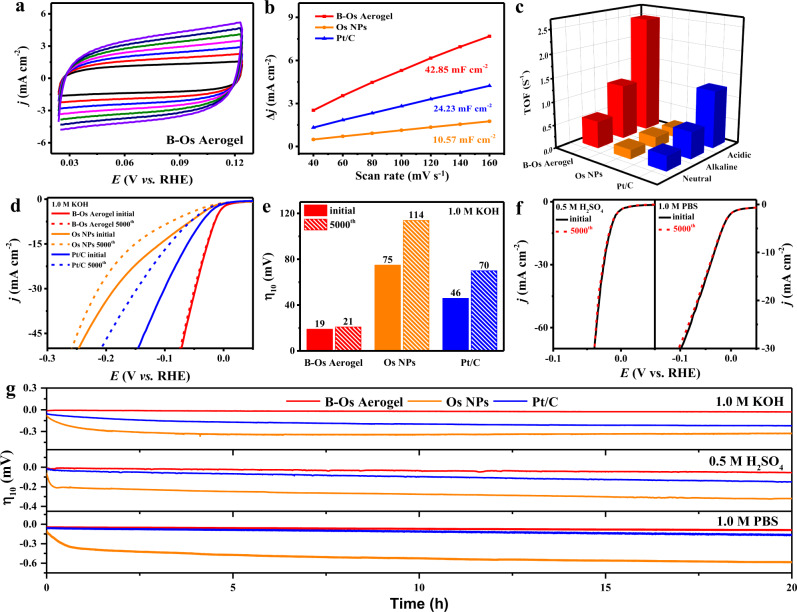
- Stability tests show a negligible 2 mV negative shift after 5000 cycles in 1.0 M KOH for B-Os aerogels, versus 39 mV for Os NPs and 24 mV for Pt/C; negligible decay is also observed after 20 h chronoamperometry in pH-universal electrolytes.
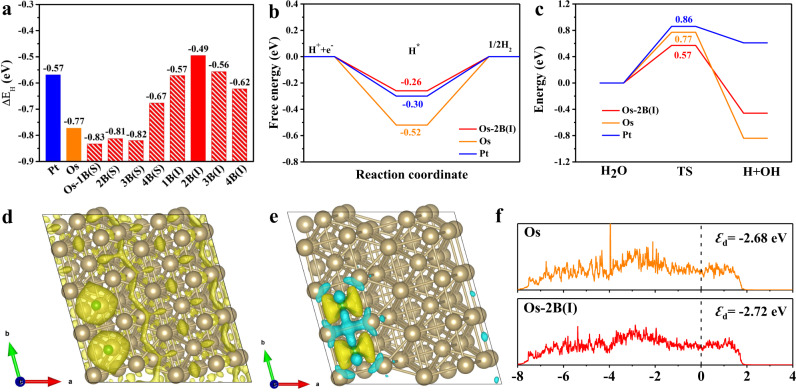
- DFT indicates interstitial B doping lowers the water dissociation barrier to 0.57 eV for Os-2B(I), compared with 0.77 eV for Os and 0.86 eV for Pt, and gives a ΔGH* of −0.26 eV; B gains 0.07 e from adjacent Os atoms.
Methods
- B-Os aerogels were synthesized by a NaBH4-induced gelation process from OsCl3, with NaBH4 serving as both reducing agent and boron dopant; NaBH4 concentration was varied to produce Os(B)−1 to Os(B)−4.
- Characterization used SEM, TEM, ACTEM, BET, XPS, XRD, and ICP-OES; electrochemical measurements used a three-electrode cell in 1.0 M KOH, 0.5 M H2SO4, and 1.0 M PBS, with LSV, CV, chronoamperometry, and TOF calculations.
- Operando Os L3-edge XAS was recorded in transmission mode, and DFT calculations used VASP with PBE, a 550 eV cutoff, Pt(111), Os(101), and Os-B(101) slab models, and nudged elastic band calculations for water dissociation.
Limitations
- The paper does not state explicit limitations.
- Evident from the text: DFT uses idealized slab models for Pt(111), Os(101), and Os-B(101) with up to four B dopants, which may not fully capture the defect-rich aerogel structure.
- Evident from the text: operando XAS probes only the Os L3-edge under specific electrolyte conditions, and stability testing is limited to 5000 cycles and 20 h chronoamperometry rather than long-term practical operation.
Model-written summary. Check it against the paper before relying on it.
Integrity signals
Registry
Cites
Statistics
Figures
Verification
Claims the paper makes
10 Valid · 6 Not valid · 6 Not checked · 107 Own results and interpretations
The cited sources that could be checked couldn’t confirm or dispute this claim.
In the paper
“This phenomenon is ascribed to a shift of electron density from metallic Os to local B atoms with high electronegativity39.”
§ Interstitial boron-triggered electron-deficient Os aerogels for enhanced pH-universal hydrogen evolution > Results > Synthesis and characterization of B-Os aerogels
What the sources say
- Could not verifycites [39] Li H Scalable neutral H2O2 electrosynthesis by platinum diphosphide nanocrystals by regulating oxygen reduction reaction pathways Nat. Commun. 2020 11 1 12 32764644 PMC7411044 sourceExperimental — accuracy not yet measured
The Results sections discuss U1-related transcriptome changes and cancer-cell migration, not XANES or electron transfer between osmium and boron. Searches for the claimed electron-density shift and for XANES, osmium, and boron found no passage addressing the claim; our copy therefore cannot verify it. (LLM, conf=0.78)
plainstates a cause- Asserted: passes — The authors put it forward as true.
- Checkable: passes — It can be checked against evidence.
- Load-bearing: passes — The paper’s conclusions depend on it.
- Based: passes — The paper gives a reason why it holds.
- Could not verify
The cited sources support only part of this claim — read each source’s verdict below.
In the paper
“metal-heteroatom alloying is regarded as one of the most useful pathways to further improve the catalytic performance by redistributing the electron density of catalysts and optimizing the adsorption energy of the reactant species on the catalyst surface30–34.”
§ Interstitial boron-triggered electron-deficient Os aerogels for enhanced pH-universal hydrogen evolution > Introduction
What the sources say
- Not checked — no full text of the sourcecites [30] Jose V Highly efficient oxygen reduction reaction activity of N-doped carbon-cobalt boride heterointerfaces Adv. Energy Mater. 2021 11 2100157 source
- Partly supportedcites [31] Song J A review on fundamentals for designing oxygen evolution electrocatalysts Chem. Soc. Rev. 2020 49 2196 2214 32133479 sourceExperimental — accuracy not yet measured
Section 2.2.1 says that incorporating other elements into oxide lattices can optimize the binding energies of OER intermediates and improve activity. Section 2.3.2 says metal substitution can redistribute electronic density. These passages support the proposed mechanism, but they discuss substitution in oxides rather than metal–heteroatom alloying specifically; page numbers were not available in our copy. (LLM, conf=0.84)
- Not checked — no full text of the sourcecites [32] Wang Y Wang S Lou XW Dispersed nickel cobalt oxyphosphide nanoparticles confined in multichannel hollow carbon fibers for photocatalytic CO2 reduction Angew. Chem. Int. Ed. 2019 58 17236 17240 31507030 source
- Not checked — no full text of the sourcecites [33] Zhou Y Dopant-induced electron localization drives CO2 reduction to C2 hydrocarbons Nat. Chem. 2018 10 974 980 30013194 source
- Not checked — no full text of the sourcecites [34] Jiang B Zhang XG Jiang K Wu DY Cai WB Boosting formate production in electrocatalytic CO2 reduction over wide potential window on Pd surfaces J. Am. Chem. Soc. 2018 140 2880 2889 29409320 source
boostedstates a cause- Asserted: passes — The authors put it forward as true.
- Checkable: passes — It can be checked against evidence.
- Load-bearing: passes — The paper’s conclusions depend on it.
- Based: passes — The paper gives a reason why it holds.
The cited sources support only part of this claim — read each source’s verdict below.
In the paper
“Os and B are therefore confirmed to form interstitial nanocrystals, similar to previous reports45,46.”
§ Interstitial boron-triggered electron-deficient Os aerogels for enhanced pH-universal hydrogen evolution > Results > Synthesis and characterization of B-Os aerogels
What the sources say
- Partly supportedcites [45] Chan CWA Interstitial modification of palladium nanoparticles with boron atoms as a green catalyst for selective hydrogenation Nat. Commun. 2014 5 1 10 25523894 sourceExperimental — accuracy not yet measured
The Synthesis and characterization section reports boron in the interstitial sites of palladium nanoparticles, not osmium nanocrystals. It supports the interstitial-boron aspect of the claim but not the Os–B pairing. (LLM, conf=0.87)
- Not checked — no full text of the sourcecites [46] Jiang K Xu K Zou S Cai WB B-doped Pd catalyst: boosting room-temperature hydrogen production from formic acid-formate solutions J. Am. Chem. Soc. 2014 136 4861 4864 24635163 source
boostedstates an association- Asserted: passes — The authors put it forward as true.
- Checkable: passes — It can be checked against evidence.
- Load-bearing: passes — The paper’s conclusions depend on it.
- Based: passes — The paper gives a reason why it holds.
- Partly supported
The cited sources support only part of this claim — read each source’s verdict below.
In the paper
“the suboptimum activity under alkaline and neutral conditions resulted from the slow dynamics of water dissolution step (H2O→H*+OH−)”
§ Interstitial boron-triggered electron-deficient Os aerogels for enhanced pH-universal hydrogen evolution > Introduction
What the sources say
- Partly supportedcites [8] Kweon DH Ruthenium anchored on carbon nanotube electrocatalyst for hydrogen production with enhanced Faradaic efficiency Nat. Commun. 2020 11 1278 32152312 PMC7062887 sourceExperimental — accuracy not yet measured
The Results section (page unavailable) reports that Ru@MWCNT outperforms Pt/C in alkaline solution and associates Ru’s higher activity with faster water dissociation. This supports a relative limitation of Pt/C under alkaline conditions, but the paper does not establish slow water dissociation as the cause of Pt’s activity or extend that explanation to neutral conditions. (LLM, conf=0.84)
- Not checked — no full text of the sourcecites [9] Roger I Shipman MA Symes MD Earth-abundant catalysts for electrochemical and photoelectrochemical water splitting Nat. Rev. Chem. 2017 1 1 13 source
- Not checked — no full text of the sourcecites [10] Subbaraman R Enhancing hydrogen evolution activity in water splitting by tailoring Li+-Ni(OH)2-Pt interfaces Science 2011 334 1256 1260 22144621 source
plainstates a cause- Asserted: passes — The authors put it forward as true.
- Checkable: passes — It can be checked against evidence.
- Load-bearing: passes — The paper’s conclusions depend on it.
- Based: passes — The paper gives a reason why it holds.
- Partly supported
The cited sources support only part of this claim — read each source’s verdict below.
In the paper
“in contrast to Au24, Ag25, Pd13, Pt26 and their alloy aerogels27,28 that have been extensively studied, the preparation and application of monometallic Ir, Rh, Ru, Os and their alloy aerogels are rarely reported15,29.”
§ Interstitial boron-triggered electron-deficient Os aerogels for enhanced pH-universal hydrogen evolution > Introduction
What the sources say
- Not checked — no full text of the sourcecites [15] Du R Emerging noble metal aerogels: state of the art and a look forward Matter 2019 1 39 56 source
- Partly supportedcites [29] Du R Engineering self-supported noble metal foams toward electrocatalysis and beyond Adv. Energy Mater. 2019 10 1901945 sourceExperimental — accuracy not yet measured
The Oxygen Evolution Reaction section (page unavailable) says Ru- and Ir-based gels are much harder to form than Au- and Pd-based gels. The review also discusses numerous Au, Ag, Pd and Pt aerogels, but the cited passages do not establish that preparations and applications of Rh- and Os-based aerogels, or alloys of all four metals, are rarely reported. (LLM, conf=0.82)
plain- Asserted: passes — The authors put it forward as true.
- Checkable: passes — It can be checked against evidence.
- Load-bearing: passes — The paper’s conclusions depend on it.
- Based: passes — The paper gives a reason why it holds.
79 more claims · 4 with their cited sources checked
Create a free account to see all 129 claims and to verify the 1 reference still open.
- Probably not a substantial claim. 8
- It may state two separate claims as one. 37
- The quote only partly states this claim. 1
Claims other papers make about this one
Each is checked against this paper’s own text: does it say what the citing paper says it does?
The source backs part of the claim, not all of it — or backs it for a different population, condition or comparison.
In the citing paper
“The excellent stability of Co AG-Rh500 may be ascribed to the advantages of robust structure and a large number of amorphous sites of aerogel [36,48].”
From Better than Pt in all-pH media: A charge transfer modulating hydrogen adsorption in cobalt-rhodium alloy aerogel to boost hydrogen evolution (2023) · cites this paper as [36]
Experimental — accuracy not yet measuredThe cited source says what the claim attributes to it.
In the citing paper
“the resultant B‐Os aerogel catalyst delivers better HER performances than Pt/C in three different electrolytes (acidic, alkaline, and neutral conditions).”
Self-check
Percentages, sums and reported differences re-computed from the paper’s own numbers.
Each contradiction between two passages listed here was confirmed by an independent check.
Rated minor: it would not touch a result — a value no result rests on, a p-value that stays on the same side of the significance level, or a conflict that is clerical, resolved elsewhere in the paper, or outside its own findings.
In the paper
§ Interstitial boron-triggered electron-deficient Os aerogels for enhanced pH-universal hydrogen evolution > Results > Synthesis and characterization of B-Os aerogels
“Os and B are therefore confirmed to form interstitial nanocrystals, similar to previous reports45,46.”
§ Interstitial boron-triggered electron-deficient Os aerogels for enhanced pH-universal hydrogen evolution > Results > Synthesis and characterization of B-Os aerogels
“The positive shift peak at 1.53 Å in the B-Os aerogel clarified the effect of B substitution compared with the Os-O peak at 1.35 Å in Os-O4.”
Citations
Cites
Generalized Gradient Approximation Made Simple
Perdew, J. P., Burke, K., & Ernzerhof, M. (1996) · Physical Review Letters · doi:10.1103/physrevlett.77.3865 · Cited by 215,824
Efficient iterative schemes for ab initio total-energy calculations using a plane-wave basis set
Kresse, G., & Furthmüller, J. (1996) · Physical Review B · doi:10.1103/physrevb.54.11169 · Cited by 123,652
Projector augmented-wave method
Blöchl, P. E. (1994) · Physical Review B · doi:10.1103/physrevb.50.17953 · Cited by 92,732
From ultrasoft pseudopotentials to the projector augmented-wave method
Kresse, G., & Joubert, D. (1999) · Physical Review B · doi:10.1103/physrevb.59.1758 · Cited by 85,307
Double-slit photoelectron interference in strong-field ionization of the neon dimer
Kunitski, M., Eicke, N., Huber, P., Köhler, J., Zeller, S., Voigtsberger, J., Schlott, N., Henrichs, K., Sann, H., Trinter, F., et al. (2019) · Nature Communications · doi:10.1038/s41467-018-07882-8 · Cited by 8,162
Double-slit photoelectron interference in strong-field ionization of the neon dimer
Kunitski, M., Eicke, N., Huber, P., Köhler, J., Zeller, S., Voigtsberger, J., Schlott, N., Henrichs, K., Sann, H., Trinter, F., et al. (2019) · Institutional Repository of Leibniz Universität Hannover (Leibniz Universität Hannover) · doi:10.15488/5174 · Cited by 8,161
In situ click chemistry generation of cyclooxygenase-2 inhibitors
Bhardwaj, A., Kaur, J., Wuest, M., & Wuest, F. (2017) · Nature Communications · doi:10.1038/s41467-016-0009-6 · Cited by 7,448
U1 snRNP regulates cancer cell migration and invasion in vitro
Oh, J.-M., Venters, C. C., Di, C., Pinto, A. M., Wan, L., Younis, I., Cai, Z., Arai, C., So, B. R., Duan, J., et al. (2020) · Nature Communications · doi:10.1038/s41467-019-13993-7 · Cited by 7,157
Trends in the exchange current for hydrogen evolution
Nørskov, J. K., Bligaard, T., Logadottir, A., Kitchin, J. R., Chen, J. G., Pandelov, S., & Stimming, U. (2005) · Journal of The Electrochemical Society · doi:10.1149/1.1856988 · Cited by 6,121
Anomalous collapses of Nares Strait ice arches leads to enhanced export of Arctic sea ice
Moore, G. W. K., Howell, S. E. L., Brady, M., Xu, X., & McNeil, K. (2021) · Nature Communications · doi:10.1038/s41467-020-20314-w · Cited by 5,155
Cited by
Zhu, Y., Klingenhof, M., Gao, C., Koketsu, T., Weiser, G., Pi, Y., Liu, S., Sui, L., Hou, J., Li, J., et al. (2024) · Nature Communications · doi:10.1038/s41467-024-45654-9 · Cited by 444
Chen, D., Lu, R., Yu, R., Dai, Y., Zhao, H., Wu, D., Wang, P., Zhu, J., Pu, Z., Chen, L., et al. (2022) · Angewandte Chemie International Edition · doi:10.1002/anie.202208642 · Cited by 312
Do, V.-H., & Lee, J.-M. (2022) · ACS Nano · doi:10.1021/acsnano.2c08919 · Cited by 292
Self-citationLiu, Y., Chen, Y., Tian, Y., Sakthivel, T., Liu, H., Guo, S., Zeng, H., & Dai, Z. (2022) · Advanced Materials · doi:10.1002/adma.202203615 · Cited by 267
Do, V., Prabhu, P., Jose, V., Yoshida, T., Zhou, Y., Miwa, H., Kaneko, T., Uruga, T., Iwasawa, Y., & Lee, J. (2023) · Advanced Materials · doi:10.1002/adma.202208860 · Cited by 254
Self-citationHigh‐Entropy Alloy Aerogels: A New Platform for Carbon Dioxide Reduction
Li, H., Huang, H., Chen, Y., Lai, F., Fu, H., Zhang, L., Zhang, N., Bai, S., & Liu, T. (2023) · Advanced Materials · doi:10.1002/adma.202209242 · Cited by 242
Du, Y., Li, B., Xu, G., & Wang, L. (2023) · InfoMat · doi:10.1002/inf2.12377 · Cited by 222
Wang, L., Song, L., Yang, Z., Chang, Y., Hu, F., Li, L., Li, L., Chen, H., & Peng, S. (2023) · Advanced Functional Materials · doi:10.1002/adfm.202210322 · Cited by 173
Activating Amorphous Ru Metallenes Through Co Integration for Enhanced Water Electrolysis
Jose, V., Do, V., Prabhu, P., Peng, C., Chen, S., Zhou, Y., Lin, Y., & Lee, J. (2023) · Advanced Energy Materials · doi:10.1002/aenm.202301119 · Cited by 167
Self-citationShen, S., Li, Q., Zhang, H., Yang, D., Gong, J., Gu, L., Gao, T., & Zhong, W. (2025) · Advanced Materials · doi:10.1002/adma.202500595 · Cited by 167
Mao, Q., Deng, K., Yu, H., Xu, Y., Wang, Z., Li, X., Wang, L., & Wang, H. (2022) · Advanced Functional Materials · doi:10.1002/adfm.202201081 · Cited by 149
Janus electronic state of supported iridium nanoclusters for sustainable alkaline water electrolysis
Liu, Y., Li, L., Wang, L., Li, N., Zhao, X., Chen, Y., Sakthivel, T., & Dai, Z. (2024) · Nature Communications · doi:10.1038/s41467-024-47045-6 · Cited by 189
Lan, J. X., Wei, Z., Lu, Y., Chen, D., Zhao, S., Chan, T., & Tan, Y. (2023) · Nature Communications · doi:10.1038/s41467-023-38603-5 · Cited by 179
Nicole, S. L. D., Li, Y., Xie, W., Wang, G., & Lee, J. (2023) · Small · doi:10.1002/smll.202206844 · Cited by 132
Self-citationRecent Advances on Single‐Atom Catalysts for CO 2 Reduction
Liu, L., Li, M., Chen, F., & Huang, H. (2022) · Small Structures · doi:10.1002/sstr.202200188 · Cited by 144
Liao, H., Ni, G., Tan, P., Liu, Y., Chen, K., Wang, G., Liu, M., & Pan, J. (2022) · Applied Catalysis B: Environmental · doi:10.1016/j.apcatb.2022.121713 · Cited by 128
Mao, Q., Mu, X., Deng, K., Yu, H., Wang, Z., Xu, Y., Li, X., Wang, L., & Wang, H. (2023) · Advanced Functional Materials · doi:10.1002/adfm.202304963 · Cited by 127
Atomically Dispersed MoO x on Rhodium Metallene Boosts Electrocatalyzed Alkaline Hydrogen Evolution
Wu, J., Fan, J., Zhao, X., Wang, Y., Wang, D., Liu, H., Gu, L., Zhang, Q., Zheng, L., Singh, D. J., et al. (2022) · Angewandte Chemie International Edition · doi:10.1002/anie.202207512 · Cited by 123
Zhang, H., Li, N., Gao, S., Chen, A., Qian, Q., Kong, Q., Xia, B. Y., & Hu, G. (2024) · eScience · doi:10.1016/j.esci.2024.100311 · Cited by 149
Prabhu, P., Do, V.-H., Peng, C. K., Hu, H., Chen, S.-Y., Choi, J.-H., Lin, Y.-G., & Lee, J.-M. (2023) · ACS Nano · doi:10.1021/acsnano.3c02066 · Cited by 117
Self-citationAuCu nanofibers for electrosynthesis of urea from carbon dioxide and nitrite
Liu, S., Yin, S., Wang, Z., Xu, Y. P., Li, X., Wang, L., & Wang, H. (2022) · Cell Reports Physical Science · doi:10.1016/j.xcrp.2022.100869 · Cited by 133
Deng, Y., Xiao, S., Zheng, Y., Rong, X., Bai, M., Tang, Y., Ma, T., Cheng, C., & Zhao, C. (2022) · Chemical Engineering Journal · doi:10.1016/j.cej.2022.138514 · Cited by 112
State-of-the-art single-atom catalysts in electrocatalysis: From fundamentals to applications
Humayun, M., Israr, M. Q., Khan, A., & Bououdina, M. (2023) · Nano Energy · doi:10.1016/j.nanoen.2023.108570 · Cited by 109
Yusuf, B. A., Yaseen, W., Xie, M., Zayyan, R. S., Muhammad, A. I., Nankya, R., Xie, J., & Xu, Y. (2022) · Advances in Colloid and Interface Science · doi:10.1016/j.cis.2022.102811 · Cited by 108
Yu, J., Gao, R., Guo, X., Nguyen, N. T., Wu, L., & Wang, L. (2024) · Angewandte Chemie International Edition · doi:10.1002/anie.202415975 · Cited by 158
Xie, J., Wang, F., Zhou, Y., Dong, Y., Chai, Y., & Dong, B. (2023) · Nano-Micro Letters · doi:10.1007/s40820-023-01253-9 · Cited by 107
Li, J., Zhang, J., Zhang, J., Pan, K., Xu, H., Chen, H., Liu, G., Wu, N., Yuan, C., & Liu, X. (2023) · Journal of Materials Chemistry A · doi:10.1039/d3ta04199a · Cited by 100
Tuning Coordination Structures of Zn Sites Through Symmetry‐Breaking Accelerates Electrocatalysis
Sun, Y., Fan, W., Li, Y., Sui, N. L. D., Zhu, Z., Zhou, Y., & Lee, J. (2023) · Advanced Materials · doi:10.1002/adma.202306687 · Cited by 99
Self-citationLiu, S., Cui, L., Yin, S., Ren, H., Wang, Z., Xu, Y. P., Li, X., Wang, L., & Wang, H. (2022) · Applied Catalysis B: Environmental · doi:10.1016/j.apcatb.2022.121876 · Cited by 91
Han, P., Yang, X., Wu, L., Jia, H., Chen, J., Shi, W., Cheng, G., & Luo, W. (2023) · Advanced Materials · doi:10.1002/adma.202304496 · Cited by 90
Chen, Y., Li, G., Mu, W., Wan, X., Lu, D., Gao, J., & Wen, D. (2023) · Analytical Chemistry · doi:10.1021/acs.analchem.2c05613 · Cited by 96
Liu, Y., Bu, X., Liu, R., Feng, M., Zhang, Z., He, M., Huang, J. C., & Zhou, Y. (2024) · Chemical Engineering Journal · doi:10.1016/j.cej.2024.148780 · Cited by 96
Khalafallah, D., Qiao, F., Liu, C., Wang, J., Zhang, Y., Wang, J., Zhang, Q., & Notten, P. H. L. (2023) · Coordination Chemistry Reviews · doi:10.1016/j.ccr.2023.215405 · Cited by 94
Influencing electrocatalytic processes through topographically disordered atomic sites
Prabhu, P., & Lee, J.-M. (2023) · Chem Catalysis · doi:10.1016/j.checat.2023.100621 · Cited by 84
Self-citationBoron-Doped Platinum-Group Metals in Electrocatalysis: A Perspective
Li, H., Qin, X., Zhang, X., Jiang, K. P., & Cai, W. (2022) · ACS Catalysis · doi:10.1021/acscatal.2c04358 · Cited by 82
Deng, K., Lian, Z., Wang, W., Yu, J., Mao, Q., Yu, H., Wang, Z., Wang, L., & Wang, H. (2024) · Applied Catalysis B: Environmental · doi:10.1016/j.apcatb.2024.124047 · Cited by 107
Zhang, Y., Guo, P., Guo, S., Xin, X., Wang, Y., Huang, W., Wang, M., Yang, B., Sobrido, A. J., Ghasemi, J. B., et al. (2022) · Angewandte Chemie International Edition · doi:10.1002/anie.202209703 · Cited by 82
Closed‐Loop Recyclable High‐Performance Polyimine Aerogels Derived from Bio‐Based Resources
Wang, C., Eisenreich, F., & Tomović, Ž. (2022) · Advanced Materials · doi:10.1002/adma.202209003 · Cited by 89
Huo, W., Wang, S., Dominguez-Gutierrez, F. J., Ren, K., Kurpaska, Ł., Fang, F., Papanikolaou, S., Kim, H. S., & Jiang, J. (2023) · Materials Research Letters · doi:10.1080/21663831.2023.2224397 · Cited by 84
Silambarasan, P., Pokhrel, I., Muhammad, U. S. K., Shao, X., Han, Y., Kim, M.-S., & Lee, H. (2024) · ACS Materials Letters · doi:10.1021/acsmaterialslett.4c00587 · Cited by 85
Efficient ethylene electrosynthesis through C–O cleavage promoted by water dissociation
Liang, Y., Li, F., Miao, R. K., Hu, S., Ni, W., Zhang, S., Liu, Y., Bai, Y., Wan, H., Ou, P., et al. (2024) · Nature Synthesis · doi:10.1038/s44160-024-00568-8 · Cited by 106
Deng, K., Lian, Z., Wang, W., Yu, J., Yu, H., Wang, Z., Xu, Y. P., Wang, L., & Wang, H. (2023) · Small · doi:10.1002/smll.202305000 · Cited by 81
Well‐defined nanostructures of high entropy alloys for electrocatalysis
Chen, J., Ren, L., Chen, X., Wang, Q., Chen, C., Fan, J., Wang, S., Binas, V. D., & Shen, S. (2024) · Exploration · doi:10.1002/exp.20230036 · Cited by 98
Do, V., & Lee, J. (2025) · Advanced Materials · doi:10.1002/adma.202417516 · Cited by 89
Self-citationDo, V.-H., Prabhu, P., Li, Y., Xie, W., Kidkhunthod, P., Wang, G., Wang, X., & Lee, J.-M. (2023) · Joule · doi:10.1016/j.joule.2023.07.009 · Cited by 73
Self-citationSun, Y., Wu, W., Yu, L., Xu, S., Zhang, Y., Yu, L., Xia, B., Ding, S., Li, M., Jiang, L., et al. (2022) · Carbon Energy · doi:10.1002/cey2.263 · Cited by 89
Self-citationOperando elucidation of hydrogen production mechanisms on sub-nanometric high-entropy metallenes
Li, Y., Peng, C., Sun, Y., Sui, N. L. D., Chang, Y., Chen, S., Zhou, Y., Lin, Y., & Lee, J. (2024) · Nature Communications · doi:10.1038/s41467-024-54589-0 · Cited by 95
Self-citationZhu, J., Sun, X., Feng, N., Zhao, B., Qiu, M., Xu, J., & Luo, W. (2025) · Journal of the American Chemical Society · doi:10.1021/jacs.5c16177 · Cited by 97
Gu, C.-C., Xu, F., Zhu, W.-K., Wu, R.-J., Deng, L., Zou, J., Weng, B., & Zhu, R. (2023) · Chemical Communications · doi:10.1039/d3cc01970e · Cited by 68
Prabhu, P., Do, V.-H., Yoshida, T., Zhou, Y., Ariga-Miwa, H., Kaneko, T., Uruga, T., Iwasawa, Y., & Lee, J.-M. (2024) · ACS Nano · doi:10.1021/acsnano.3c10219 · Cited by 67
Self-citationHe, Q., Zhou, Y., Mou, L.-H., Wu, C., Liu, D., Ge, B., Jiang, J., & Song, L. (2025) · Energy & Environmental Science · doi:10.1039/d4ee05356g · Cited by 76
Versatile Janus Architecture for Electrocatalytic Applications
Sui, N. L. D., & Lee, J. (2023) · Small · doi:10.1002/smll.202205940 · Cited by 65
Self-citationAlloy Catalysts for Electrocatalytic CO2 Reduction
Liu, L., Akhoundzadeh, H., Li, M., & Huang, H. (2023) · Small Methods · doi:10.1002/smtd.202300482 · Cited by 72
Huang, Y., Li, X., Shen, P. K., Yang, C., & Zhu, J. (2024) · ACS Materials Letters · doi:10.1021/acsmaterialslett.3c01494 · Cited by 63
Mao, Q., Wang, W., Deng, K., Yu, H., Wang, Z., Xu, Y. P., Li, X., Wang, L., & Wang, H. (2023) · Journal of Energy Chemistry · doi:10.1016/j.jechem.2023.06.005 · Cited by 60
Magnetic Field‐Assisted Water Splitting: Mechanism, Optimization Strategies, and Future Perspectives
Ma, S., Fu, Q., Han, J., Yao, T., Wang, X., Zhang, Z., Xu, P., & Song, B. (2024) · Advanced Functional Materials · doi:10.1002/adfm.202316544 · Cited by 79
Liu, J., Xie, J., Wang, R., Liu, B., Meng, X., Xu, X., Tang, B., Cai, Z., & Zou, J. (2022) · Chemical Engineering Journal · doi:10.1016/j.cej.2022.137961 · Cited by 67
Yang, L., Sun, G., Fu, H., & Zhang, L. (2023) · Chemical Engineering Journal · doi:10.1016/j.cej.2023.145052 · Cited by 61
Li, Y., Kidkhunthod, P., Zhou, Y., Wang, X., & Lee, J. (2022) · Advanced Functional Materials · doi:10.1002/adfm.202205985 · Cited by 59
Self-citationHan, D., Hao, L., Chang, M., Dong, J. X., Gao, Y., & Zhang, Y. (2022) · Journal of Colloid and Interface Science · doi:10.1016/j.jcis.2022.12.026 · Cited by 59
Rare‐Earth–Modified Metal–Organic Frameworks and Derivatives for Photo/Electrocatalysis
Fan, C., Dong, W., Saira, Y., Tang, Y., Fu, G., & Lee, J. (2023) · Small · doi:10.1002/smll.202302738 · Cited by 65
Self-citationMao, Q., Wang, W., Wu, Y., Yang, R., Deng, K., Yu, H., Wang, Z., Wang, L., & Wang, H. (2024) · Advanced Functional Materials · doi:10.1002/adfm.202404648 · Cited by 62
Electrosynthesis of Urea on High‐Density Ga─Y Dual‐Atom Catalyst via Cross‐Tuning
Chen, D., Cai, Y., Xiao, Y. F., Wang, C., Li, Y., Ma, K., Xiao, D., Wang, H., Lee, C., Zhang, L., et al. (2025) · Advanced Materials · doi:10.1002/adma.202420593 · Cited by 65
Self-citationLiu, S., Zhang, H., Yu, H., Deng, K., Wang, Z., Xu, Y. P., Wang, L., & Wang, H. (2023) · Small · doi:10.1002/smll.202300388 · Cited by 54
Xie, F., Wang, Z., Kao, C., Lan, J. X., Lu, Y., & Tan, Y. (2024) · Angewandte Chemie International Edition · doi:10.1002/anie.202407661 · Cited by 57
Long, H., Wang, P., Wang, X., Chen, F., & Yu, H. (2022) · Applied Surface Science · doi:10.1016/j.apsusc.2022.154457 · Cited by 50
Deng, B., Wu, Z., Feng, E., Ma, L., Wang, Z., Chen, J., Eddy, L., Lathem, A., Wang, T., Chen, W., et al. (2025) · Journal of the American Chemical Society · doi:10.1021/jacs.5c00071 · Cited by 56
Multi-site electrocatalysts for hydrogen production under neutral conditions
Wang, Z., Zhou, J., Shi, Y., Luo, L., Li, H., Zhou, Q., Wang, C., Xing, Z., Yang, Z., & Yu, Y. (2026) · Chemical Society Reviews · doi:10.1039/d5cs00881f · Cited by 74
Mo-Doped Ni3S2 Nanosheet Arrays for Overall Water Splitting
Gao, Y., He, W.-J., Cao, D., Wang, F., Li, Y., Hao, Q., Liu, C., & Liu, H. (2023) · ACS Applied Nano Materials · doi:10.1021/acsanm.3c00398 · Cited by 47
Self-citationHaider, S. N.-U.-Z., Qureshi, W. A., Ali, R. N., Rao, S., Naveed, A., Ali, A., Yaseen, M., Liu, Q., & Yang, J. (2023) · Advances in Colloid and Interface Science · doi:10.1016/j.cis.2023.103068 · Cited by 53
CuNi Aerogels with Suppressed Water Activation for Efficient Nucleophilic Methanol Electrooxidation
Fang, Q., Ye, S., Zheng, L., Wang, H., Hu, L., Gu, W., Wang, L., Shi, L., & Zhu, C. (2024) · ACS Catalysis · doi:10.1021/acscatal.4c01596 · Cited by 48
Wu, S., Liu, X., Mao, H., Cui, T., Li, B., Zhou, G., & Wang, L. (2023) · Applied Catalysis B: Environmental · doi:10.1016/j.apcatb.2023.122634 · Cited by 47
Lai, F., Shang, H., Jiao, Y., Chen, X., Zhang, T., & Liu, X. (2024) · Interdisciplinary materials · doi:10.1002/idm2.12172 · Cited by 106
Huu, H., Tekalgne, M. A., Tran, V. A., Le, Q. V., Cho, J. H., Ahn, . H., & Kim, S. Y. (2022) · Fuel · doi:10.1016/j.fuel.2022.125468 · Cited by 46
Recent Advances in Revealing the Electrocatalytic Mechanism for Hydrogen Energy Conversion System
Cai, M., Zhang, Y., He, P., & Zhang, Z. (2024) · Small · doi:10.1002/smll.202405008 · Cited by 48
Boron‐Induced Interstitial Effects Drive Water Oxidation on Ordered Ir−B Compounds
Chen, D., Yu, R., Zhao, H., Jiao, J., Mu, X. Q., Yu, J., & Mu, S. C. (2024) · Angewandte Chemie International Edition · doi:10.1002/anie.202407577 · Cited by 47
Lu, Y., Zhao, Z., Liu, X., Yu, X., Li, W., Pei, C., Park, H. S., Kim, J. K., & Pang, H. (2024) · Advanced Science · doi:10.1002/advs.202413245 · Cited by 55
Tan, Y., Zhang, Z., Wu, W., Chen, S., Chen, W., & Cheng, N. (2023) · Applied Catalysis B: Environmental · doi:10.1016/j.apcatb.2023.122684 · Cited by 49
Self-citationIr nanodots decorated Ni3Fe nanoparticles for boosting electrocatalytic water splitting
Li, Y., Miao, Y.-C., Yang, C. G., Chang, Y., Su, Y., Yan, H. J., & Xu, S. (2022) · Chemical Engineering Journal · doi:10.1016/j.cej.2022.138548 · Cited by 46
Self-citationZhu, J., Xia, F., Guo, Y., Lu, R., Gong, L., Chen, D., Wang, P., Chen, L., Yu, J., Wu, J., et al. (2022) · ACS Catalysis · doi:10.1021/acscatal.2c03102 · Cited by 45
Strategies Toward High Selectivity, Activity, and Stability of Single‐Atom Catalysts
Ren, Y., Wang, J., Zhang, M., Wang, Y., Cao, Y., Kim, D. H., Liu, Y., & Lin, Z. (2024) · Small · doi:10.1002/smll.202308213 · Cited by 47
Ionic Liquid‐Assisted Electrocatalytic NO Reduction to NH3 by P‐Doped MoS2
Wei, T., Bao, H., Wang, X., Zhang, S., Liu, Q., Luo, J., & Liu, X. (2022) · ChemCatChem · doi:10.1002/cctc.202201411 · Cited by 44
Lu, Z., Yang, H. D., Qi, G., Liu, Q., Feng, L., Zhang, H., Luo, J., & Liu, X. (2023) · Small · doi:10.1002/smll.202308841 · Cited by 49
Ma, W., Li, W., Zhang, H., & Wang, Y. (2023) · International Journal of Hydrogen Energy · doi:10.1016/j.ijhydene.2023.03.095 · Cited by 45
Liu, G., Liu, S., Li, X., Lv, H., Qu, H., Quan, Q., Lu, H., Cui, X., Zhou, X., Jiang, L., et al. (2024) · Nano Energy · doi:10.1016/j.nanoen.2024.109442 · Cited by 42
Polyethyleneimine-functionalized PdOs bimetallene for enhanced oxygen reduction
Wang, Z., Xu, S., Li, M., Deng, K., Yu, H., Xu, Y. P., Li, X., Wang, H., & Wang, L. (2023) · Chemical Communications · doi:10.1039/d3cc00221g · Cited by 41
Yang, Z., Hui, J., Fan, W., Liu, P., Zhang, C.-Y., Dong, S., & Yang, Z. (2024) · Journal of Energy Chemistry · doi:10.1016/j.jechem.2024.09.045 · Cited by 38
Boosting Formate Electrooxidation by Heterostructured PtPd Alloy and Oxides Nanowires
Wang, T., Sun, L., Ai, X., Chen, P., Chen, Y., & Wang, X. (2024) · Advanced Materials · doi:10.1002/adma.202403664 · Cited by 47
Superlattices in Ru Metallene Nanobelts for Robust Hydrogen Evolution
Deng, K., Yu, J., Mao, Q., Yang, R., Yu, H., Wang, Z., Wang, J., Wang, L., & Wang, H. (2025) · Advanced Functional Materials · doi:10.1002/adfm.202420728 · Cited by 44
Partial Exsolution Enables Superior Bifunctionality of Ir@SrIrO3 for Acidic Overall Water Splitting
Zhao, L., Tao, Z., You, M., Xiao, H., Wang, S., Ma, W., Huang, Y., He, B., & Chen, Q. H. (2024) · Advanced Science · doi:10.1002/advs.202309750 · Cited by 49
Luo, X., Zhao, S., Luo, Z., Li, S., Zhao, X. D., Fang, Q., Wei, X., Wang, H., Wang, C., Zhu, Z., et al. (2023) · Chemical Engineering Journal · doi:10.1016/j.cej.2023.142184 · Cited by 40
Advanced Development of High‐Entropy Alloys in Catalytic Applications
Zhu, Z., Li, Z., Liu, Z., Gu, C., Zhang, Q., & Wang, L. (2025) · Small Methods · doi:10.1002/smtd.202500411 · Cited by 59
Liu, B., Wang, S., Feng, R., Ni, Y., Song, F., & Liu, Q. (2022) · ACS Applied Materials & Interfaces · doi:10.1021/acsami.2c09271 · Cited by 37
Sun, Z., Shi, W., Pei, C.-L., Russell, C. K., Cheng, D., Sun, Z.-Q., & Gong, J.-L. (2022) · Applied Catalysis B: Environmental · doi:10.1016/j.apcatb.2022.121642 · Cited by 35
Liu, M., Liu, Z., Chen, W., Liu, Z., Li, Z., Pi, X., Du, Q., Lai, X., Xia, Y., & Li, Y. (2023) · Inorganic Chemistry · doi:10.1021/acs.inorgchem.3c01375 · Cited by 37
Self-citationLi, Q., Fu, X., Li, H., Xiao, Z., Xu, G., Chen, D., Li, C., Jin, W., Ma, T., Wu, Z., et al. (2024) · Advanced Functional Materials · doi:10.1002/adfm.202408517 · Cited by 49
Recent advances in nonmetallic modulation of palladium-based electrocatalysts
Wang, C., Jiang, X., Wang, Y., Tang, Y., Zhou, J., & Fu, G. (2023) · Chemical Synthesis · doi:10.20517/cs.2022.34 · Cited by 35
Hydrogen Spillover Effect in Electrocatalysis: Delving into the Mysteries of the Atomic Migration
Gaur, A., Sharma, J., & Han, H. (2024) · Energy & environment materials · doi:10.1002/eem2.12761 · Cited by 39
Ultra‐Stiff yet Super‐Elastic Graphene Aerogels by Topological Cellular Hierarchy
Xia, Y., Qin, H., Tong, W., Qi, Y., Li, K., Liu, Y., Xu, Z. Y., Liu, Y., Pang, K., Gao, C., et al. (2024) · Advanced Materials · doi:10.1002/adma.202417462 · Cited by 43
WS 2 Moiré Superlattices Supporting Au Nanoclusters and Isolated Ru to Boost Hydrogen Production
Chen, D., Gao, T., Wei, Z., Wang, M., Ma, Y., Xiao, D., Cao, C., Lee, C., Liu, P., Wang, D., et al. (2024) · Advanced Materials · doi:10.1002/adma.202410537 · Cited by 42
Metadata
- Authors
- Li, Y., Peng, C.-K., Hu, H., Chen, S.-Y., Choi, J.-H., Lin, Y.-G., & Lee, J.-M.
- Affiliations
- Nanyang Technological University (SG)
- National Yang Ming Chiao Tung University (TW)
- Soochow University (CN)
- National Synchrotron Radiation Research Center (TW)
- Corresponding author
- Choi, Jin-Ho
- Lin, Yan-Gu
- Lee, Jong-Min
- Venue
- Nature Communications
- Published
- 2022-03-03
- Volume
- 13
- Issue
- 1
- Pages
- 1143-1143
- ISSN
- 2041-1723 (ISSN-L)
- PMC
- PMC8894469
- OpenAlex
- W4221025973
- Semantic Scholar
- 9d0063f946489eb160c84c25ea3f185759db4da3
- Cited by
- 291
- References
- 76
- Citations by year
- 2026: 21 · 2025: 56 · 2024: 65 · 2023: 95 · 2022: 54
- FWCI
- 12.16
- Type
- journal article
- Language
- en
- Open access
- gold
- doi.org
- Licence
- cc-by
- creativecommons.org/licenses/by/4.0 (tdm)
- creativecommons.org/licenses/by/4.0 (vor)
- Locations
- Nature Communications (publishedVersion, cc-by)
- PubMed Central (publishedVersion, cc-by)
- PubMed (publishedVersion)
- RePEc: Research Papers in Economics (submittedVersion)
- DOAJ (DOAJ: Directory of Open Access Journals) (submittedVersion, cc-by-sa)
- DR-NTU (Nanyang Technological University) (submittedVersion, cc-by)
- Funders
- National Natural Science Foundation of China (52071225, 11874044)
- Shanghai Educational Development Foundation
- Ministry of Science and Technology, Taiwan (MOST108-2112-M213-002-MY3, MOST 108-, MOST110-2634-F009-026)
- Topics
- Physical Sciences › Energy › Renewable Energy, Sustainability and the Environment › Electrocatalysts for Energy Conversion
- Physical Sciences › Energy › Renewable Energy, Sustainability and the Environment › CO2 Reduction Techniques and Catalysts
- Physical Sciences › Materials Science › Materials Chemistry › Hydrogen Storage and Materials
- Keywords
- hydrogen evolution reaction, boron doping, interstitial boron, pH-universal electrocatalysts, defect-rich catalysts, hydrogen sorption, operando X-ray absorption spectroscopy, electrocatalyst stability, platinum-free electrocatalysts
About these checks
Registry, retraction, Cites and statistics results are computed, not judged, with one exception: a printed reference that no index lists is read once by a model before it counts as a citation error. Claims are extracted by a model and kept only when their quote appears verbatim in the text; each cited source is then checked, with a model’s help, for whether it says what the claim relies on. Those verdicts can be wrong — read the claim’s quote and the cited source before relying on one.
The claim verdicts this report counts are experimental: their accuracy is not yet measured.
A language model drew the claims from the paper on 2026-10-11, under version 3 of the claim definition (model deepseek-v4.1-flash, prompt extract-v3).
A second model labelled each claim on 2026-10-11 (model jev-1.13-20260917, definition revision gold-guideline-v0.2).
Cited sources are checked with a language model’s help (gpt-6-sol).
Statistics and arithmetic are recomputed, not judged.
Confidence bands are shown only for fields calibrated on our annotated test set. None is calibrated yet, so no band is shown.
What counts as a claim ›How we measure confidence ›How we check this ›
Are you an author, or do you see a problem with this page? Request a review
Data sources
Bibliographic data: Semantic Scholar, OpenAlex, Crossref.
Contains information from the Semantic Scholar Academic Graph Datasets, made available under the ODC Attribution License (ODC-BY 1.0).
Semantic Scholar’s data is described in: Kinney, R., et al. (2023). The Semantic Scholar Open Data Platform. arXiv:2301.10140.
