

Gut microbiota-bile acid crosstalk contributes to the rebound weight gain after calorie restriction in mice
Open accessThe DOI matches its Crossref record; 57 of the 57 references it cites were found in a registry or an index.
Abstract
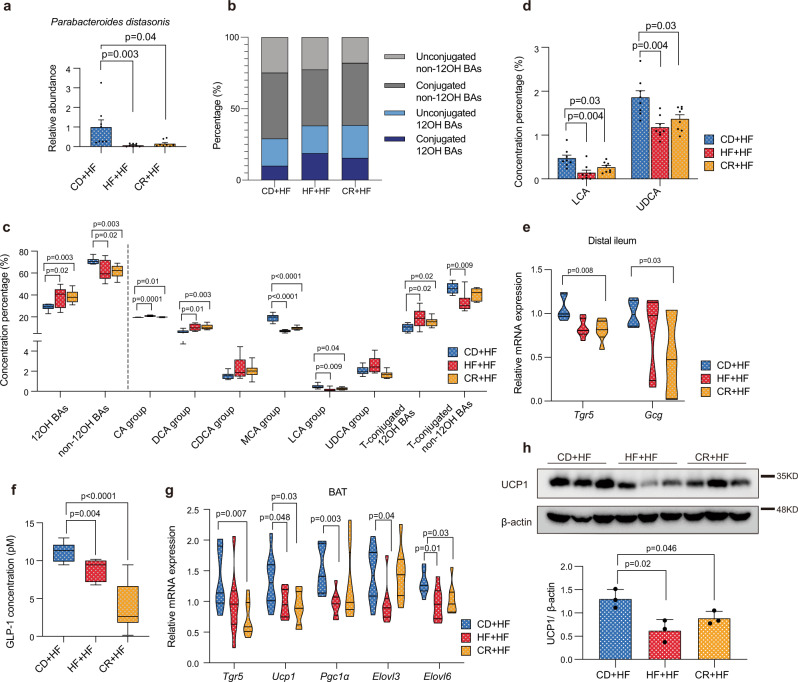
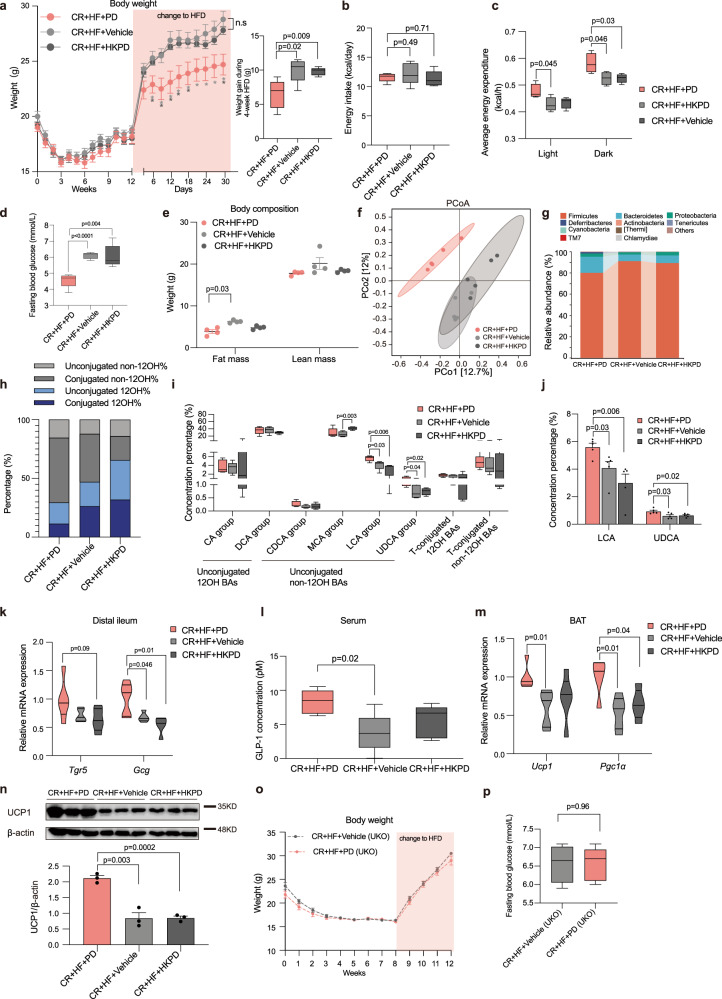
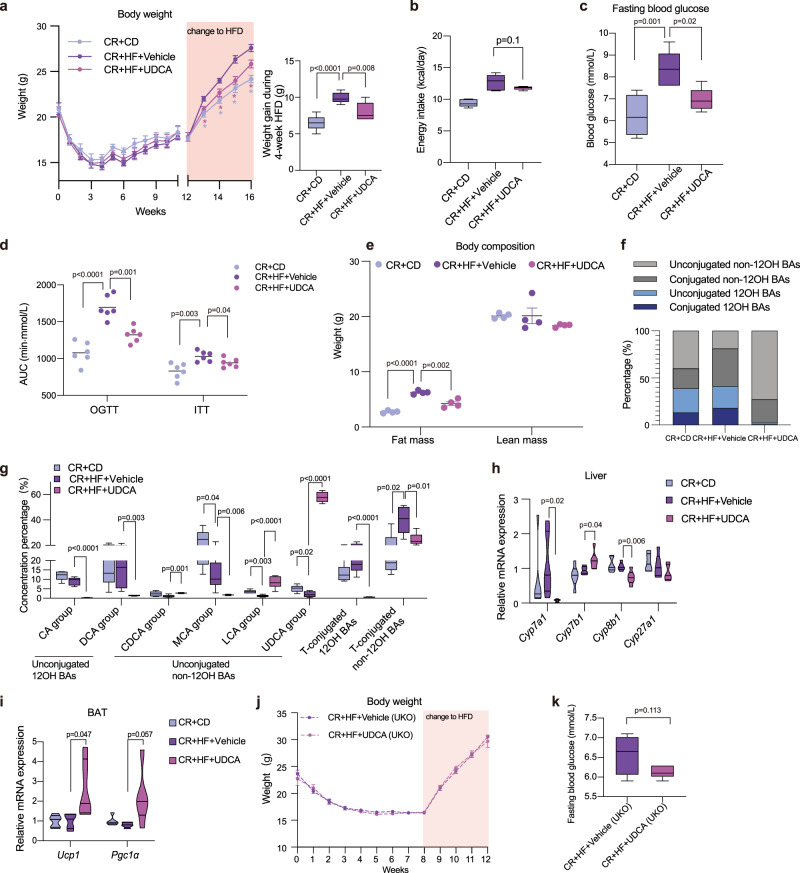
Calorie restriction (CR) and fasting are common approaches to weight reduction, but the maintenance is difficult after resuming food consumption. Meanwhile, the gut microbiome associated with energy harvest alters dramatically in response to nutrient deprivation. Here, we reported that CR and high-fat diet (HFD) both remodeled the gut microbiota with similar microbial composition, Parabacteroides distasonis was most significantly decreased after CR or HFD. CR altered microbiota and reprogramed metabolism, resulting in a distinct serum bile acid profile characterized by depleting the proportion of non-12α-hydroxylated bile acids, ursodeoxycholic acid and lithocholic acid. Downregulation of UCP1 expression in brown adipose tissue and decreased serum GLP-1 were observed in the weight-rebound mice. Moreover, treatment with Parabacteroides distasonis or non-12α-hydroxylated bile acids ameliorated weight regain via increased thermogenesis. Our results highlighted the gut microbiota-bile acid crosstalk in rebound weight gain and Parabacteroides distasonis as a potential probiotic to prevent rapid post-CR weight gain.
Overview
The claims and statistics of this paper haven’t been checked yet.
Free: it reads the open-access text and checks the first 5 claims that cite a source we can check. Create a free account to check every claim.
Integrity signals
Registry
Cites
Statistics
Figures
Verification
Claims the paper makes
The claims and statistics of this paper haven’t been checked yet.
Free: it reads the open-access text and checks the first 5 claims that cite a source we can check. Create a free account to check every claim.
Claims other papers make about this one
Each is checked against this paper’s own text: does it say what the citing paper says it does?
The source backs part of the claim, not all of it — or backs it for a different population, condition or comparison.
In the citing paper
“Additionally, adipose tissue plays a critical role in weight regulation, influenced by factors such as cellular stress, inflammation, extracellular matrix alterations, and adiponectin secretion [97, 98].”
From Comparing caloric restriction regimens for effective weight management in adults: a systematic review and network meta-analysis (2024) · cites this paper as [97]
Experimental — accuracy not yet measuredThe source backs part of the claim, not all of it — or backs it for a different population, condition or comparison.
In the citing paper
“while reciprocal interactions among gut microbes can also re-regulate metabolism processes [97].”
From Comparing caloric restriction regimens for effective weight management in adults: a systematic review and network meta-analysis (2024) · cites this paper as [97]
Experimental — accuracy not yet measured
Self-check
Percentages, sums and reported differences re-computed from the paper’s own numbers.
The self-check needs the paper’s full text.
Citations
Cites
An obesity-associated gut microbiome with increased capacity for energy harvest
Turnbaugh, P. J., Ley, R. E., Mahowald, M. A., Magrini, V., Mardis, E. R., & Gordon, J. I. (2006) · Nature · doi:10.1038/nature05414 · Cited by 12,444
Diet rapidly and reproducibly alters the human gut microbiome
David, L. A., Maurice, C. F., Carmody, R. N., Gootenberg, D. B., Button, J. E., Wolfe, B. E., Ling, A. V., Devlin, A. S., Varma, Y., Fischbach, M. A., et al. (2014) · Nature · doi:10.1038/nature12820 · Cited by 10,100
Caloric Restriction Delays Disease Onset and Mortality in Rhesus Monkeys
Colman, R. J., Anderson, R. M., Johnson, S. C., Kastman, E. K., Kosmatka, K. J., Beasley, T. M., Allison, D. B., Cruzen, C., Simmons, H. A., Kemnitz, J. W., et al. (2009) · Science · doi:10.1126/science.1173635 · Cited by 2,277
Bile acid-microbiota crosstalk in gastrointestinal inflammation and carcinogenesis
Jia, W., Xie, G., & Jia, W. (2018) · Nature Reviews Gastroenterology & Hepatology · doi:10.1038/nrgastro.2017.119 · Cited by 1,924
Self-citationFasting: molecular mechanisms and clinical applications
Longo, V. D., & Mattson, M. P. (2014) · Cell Metabolism · doi:10.1016/j.cmet.2013.12.008 · Cited by 1,425
Long-term weight-loss maintenance: a meta-analysis of US studies
Anderson, J. W., Konz, E. C., Frederich, R. C., & Wood, C. L. (2001) · The American Journal of Clinical Nutrition · doi:10.1093/ajcn/74.5.579 · Cited by 1,351
Wang, K., Liao, M., Zhou, N., Bao, L., Ma, K., Zheng, Z., Wang, Y., Liu, C., Wang, W., Wang, J., et al. (2019) · Cell Reports · doi:10.1016/j.celrep.2018.12.028 · Cited by 1,158
Self-citationFasting, Circadian Rhythms, and Time-Restricted Feeding in Healthy Lifespan
Longo, V. D., & Panda, S. (2016) · Cell Metabolism · doi:10.1016/j.cmet.2016.06.001 · Cited by 1,013
Connecting dysbiosis, bile-acid dysmetabolism and gut inflammation in inflammatory bowel diseases
Duboc, H., Rajca, S., Rainteau, D., Benarous, D., Maubert, M.-A., Quervain, E., Thomas, G., Barbu, V., Humbert, L., Despras, G., et al. (2013) · Gut · doi:10.1136/gutjnl-2012-302578 · Cited by 930
Huang, F., Zheng, X., Ma, X., Jiang, R., Zhou, W., Zhou, S., Zhang, Y., Lei, S., Wang, S., Kuang, J., et al. (2019) · Nature Communications · doi:10.1038/s41467-019-12896-x · Cited by 789
Self-citation
Cited by
Items 101–192 of 192
Shiu, W.-C., Chen, B.-Y., Ku, Y.-W., & Chen, P. (2024) · Journal of Functional Foods · doi:10.1016/j.jff.2024.106129 · Cited by 10
Wang, J., Ma, L., An, Y., Ge, Y., Xu, D., & Mao, E. (2025) · Pharmaceuticals · doi:10.3390/ph18050763 · Cited by 11
“The decrease in the abundance of commensal Parabacteroides distasonis caused cecal 7-ketoDCA depletion, while the concentration of 12 α -hydroxylated BAs (CA, DCA, and derivatives) increased in the serum and liver in non-sepsis calorie-restricted mice [56].”
Self-citationGlobal hotspots and trends in tea anti-obesity research: a bibliometric analysis from 2004 to 2024
Liu, S., Fan, B., Li, X., & Sun, G. (2024) · Frontiers in Nutrition · doi:10.3389/fnut.2024.1496582 · Cited by 9
“Research has also shown that theabrownins elevate the abundance of Desulfovibrio and Clostridium, which are involved in the synthesis of secondary bile acids that activate the intestinal FXR signaling pathway by enhancing 7 α -dehydroxylation, thus ameliorating lipid metabolic disorders (137, 138).”
The alleviation by wheat and oat dietary fiber alone or combined of T2DM symptoms in db / db mice
Liu, X., Pang, S., Song, G., Wang, Y., Fang, W. Y., & Qi, W. (2025) · Food & Function · doi:10.1039/d4fo04037f · Cited by 11
Sun, X., Wang, C., Liu, X., Li, Y., Ren, Z., Yang, X., & Liu, Y. (2025) · Journal of Animal Science and Biotechnology/Journal of animal science and biotechnology · doi:10.1186/s40104-025-01280-z · Cited by 9
“Bile acids are amphiphilic molecules synthesized from cholesterol in the liver that play a crucial role in regulating lipid homeostasis [1].”
Self-citationXu, X., Mo, K., Cui, C., Lan, Y., Ling, L., Xu, J., Li, L., & Huang, X. (2024) · Frontiers in Veterinary Science · doi:10.3389/fvets.2024.1396051 · Cited by 9
Liu, W., Wang, J., Gao, Q., Shen, W., Weng, P., Wu, Z., Qin, W., & Liu, Y. (2024) · Journal of Functional Foods · doi:10.1016/j.jff.2024.106410 · Cited by 9
Self-citationAnavi, S., Tsybina-Shimshilashvili, N., Zandani, G., Hovav, R. H., Sela, N., Nyska, A., & Madar, Z. (2023) · Frontiers in Nutrition · doi:10.3389/fnut.2023.1205377 · Cited by 9
Microbiota-metabolome interplay in depression: Metabolic insights and diagnostic potential
Zhao, M., Liu, P., Pan, M., Guo, Y., Sun, T., Ren, Z., Zheng, X., Li, M., Chao, X., Wang, J., et al. (2026) · Cell Reports Medicine · doi:10.1016/j.xcrm.2025.102574 · Cited by 8
Self-citationAn Insight into the Exploration of Antibiotic Resistance Genes in Calorie Restricted Diet Fed Mice
Fan, X., Lu, Y., Zhao, Y., Miao, H., Qi, K., & Wang, R. (2023) · Nutrients · doi:10.3390/nu15143198 · Cited by 7
“The gut microbiota under CR are deprived of 40–60% of nutrients and thus will shift towards favoring bacteria that can more efficiently harvest energy and depleting organisms that are less efficient [34].”
BackgroundSanye tablet regulates gut microbiota and bile acid metabolism to attenuate hepatic steatosis
Qi, Y., Du, S., Li, W., Qiu, X., Zhou, F., Bai, L., Zhang, B., Mi, Z.-X., Qian, W., Li, L., et al. (2025) · Journal of Ethnopharmacology · doi:10.1016/j.jep.2025.119514 · Cited by 7
Self-citationCai, Y., Xu, J., & Wang, B. (2025) · Phytotherapy Research · doi:10.1002/ptr.70068 · Cited by 7
A gut feeling for drugs that have metabolic benefits
Zhang, E., Agua, A., & Huang, W. (2023) · Nature Communications · doi:10.1038/s41467-023-40167-3 · Cited by 7
Wang, T., Xie, J., Liu, H., Tang, Q., Huang, J., Chen, J., Xiao, J., Cao, Y., Xiao, H., & Liu, X. (2025) · Food Bioscience · doi:10.1016/j.fbio.2025.106097 · Cited by 6
Liu, Y., Wang, Y., Wei, F., Chai, L., & Wang, H. (2024) · The Science of The Total Environment · doi:10.1016/j.scitotenv.2024.173795 · Cited by 6
Guo, C., He, S., Barz, M. L., Binda, S., & Wang, H. (2024) · Molecular Nutrition & Food Research · doi:10.1002/mnfr.202300672 · Cited by 6
Shou, D., Quan, Y., Cheng, J., Yang, S. Q., Chen, J. W., Li, Y. Q., Huang, C., Chen, H. T., & Zhou, Y. (2024) · Journal of Digestive Diseases · doi:10.1111/1751-2980.13306 · Cited by 5
“25 – 27 It was also notably reduced in high-fat diet (HFD)-induced NAFLD mice, suggesting its potential as a probiotic.”
Self-citationDukaew, N., Noppakun, K., Thongkumkoon, P., Takuathung, M. N., Inpan, R., Kongta, N., Suyayai, N., Manoree, C., & Koonrungsesomboon, N. (2025) · Archives of Pharmacal Research · doi:10.1007/s12272-025-01549-x · Cited by 5
“For Parabacteroides goldsteinii , it has been observed that Parabacteroides species contribute to bile acid metabolism, which can impact drug absorption and bioavailability (Li et al. 2022), potentially affecting the pharmacokinetics of drugs such as TAC.”
Xu, Y., Zhang, F., Ke, Z., Lin, Y., Zhang, Y., Liu, Y., Zhang, Y. Y., Xu, J., & Liu, Y. (2025) · Liver International · doi:10.1111/liv.70130 · Cited by 5
“OH BAs has been associated with more severe inflammatory responses and oxidative stress levels [41, 43].”
Li, X., Perino, A., Sulc, J., Jalil, A., von Alvensleben, G., Morel, J., Wang, Q., Rapin, A., Li, H., Schoonjans, K., et al. (2025) · Nature Communications · doi:10.1038/s41467-025-67680-x · Cited by 5
“Chronic high-fat diet (HFD) feeding can also shift the BA composition in different tissues 9,18,19 .”
Yun, L., Li, S., Zhao, T., Zhang, J., Siriwattananon, L., & Zhang, M. (2025) · Food Research International · doi:10.1016/j.foodres.2025.118226 · Cited by 5
Rice-fish symbiosis improves the muscle nutrition and intestinal flora diversity of tilapia
Zhu, Y., Ji, Y., Zhou, X., He, X., Xue, X., Zhang, J., Tang, H., Ya, Z., & Zhang, C. (2024) · Israeli Journal of Aquaculture - Bamidgeh · doi:10.46989/001c.118696 · Cited by 5
Hyocholic acid: A novel therapeutic strategy for metabolic syndrome
Rong, B., Zhang, Q., Zhang, X., Zhang, N., Shen, Z., Pang, Y., Lin, X. K., Liu, D., & Yang, X. (2024) · The Innovation Life · doi:10.59717/j.xinn-life.2024.100093 · Cited by 5
Significance of neuroendocrine systems and the gut-brain axis (GBA) in the regulation of obesity
Zhao, H., Li, Y., Cheng, R., Wang, Y., Ma, L., & Chen, W. (2026) · PeerJ · doi:10.7717/peerj.20400 · Cited by 5
Self-citationSun, Y., Qu, Y., Yang, Z. Z., Lv, B., Wang, G., Fan, K. C., Wang, Y., Pan, J., Du, Z., & Yu, Y. (2025) · Frontiers in Pharmacology · doi:10.3389/fphar.2025.1569856 · Cited by 4
Niu, Y., Yu, H., Yan, Z.-H., & Yan, X. (2024) · Journal of Nutrition · doi:10.1016/j.tjnut.2024.04.033 · Cited by 4
Toxicological evaluation of porcine bile powder in Kunming mice and Sprague–Dawley rats
Wu, L., Wang, J., Lei, J., Ge, K., Qu, C., Liu, J., Huang, F., Sun, D., Chao, X., Chen, T., et al. (2024) · Frontiers in Pharmacology · doi:10.3389/fphar.2024.1424940 · Cited by 4
Self-citationEnzyme-Driven LC–HRMS Approach for Specific Recognition of 12α-Hydroxy Bile Acids
Zhao, A., Zheng, J., Chen, C., Liu, L., & Xin, G.-Z. (2024) · Analytical Chemistry · doi:10.1021/acs.analchem.4c00676 · Cited by 4
Self-citationSong, X., Zhang, L., Sun, J., Zhang, X., Li, D., Hu, X., & Chen, F. (2024) · Food Bioscience · doi:10.1016/j.fbio.2024.104546 · Cited by 3
Xu, C.-Y., Zheng, Z., Yang, K. Y., Wu, R., Cao, J., & Duan, J. (2025) · World Journal of Gastroenterology · doi:10.3748/wjg.v31.i43.112483 · Cited by 3
Xu, J., Xu, H., Yang, F., Xie, Y., Cai, F., Mao, S., Lu, M., Zhuang, H., & Hua, Z. (2024) · MedComm · doi:10.1002/mco2.641 · Cited by 3
“24 More needs to be learned about the link between lipid metabolism and inflammatory responses and gut microbiota involved in this dietary strategy.”
BackgroundInfluentialHou, G., Zhang, G., Zheng, Y., Zhang, S., Federici, M., Meng, P., Wang, F., Zhang, B., Jannini, E. A., & Yuan, J. (2025) · Andrology · doi:10.1111/andr.70099 · Cited by 3
“36,37 This study found that pre-treatment abundance of Parabacteroides_distasonis correlated positively with CGIC scores, possibly because reduced inflammation increases central nervous system 5-HT synthesis, which synergizes with dapoxetine’s effects.”
Zheng, Z., Pang, Q., Luo, X., Fang, T., Duan, J., & Cao, J. (2022) · Frontiers in Physiology · doi:10.3389/fphys.2022.878505 · Cited by 3
Zhang, X., Zhong, A., Liu, Y., Zou, J., Gu, M., Zhu, X., Xu, H., & Yin, S. (2026) · mSystems · doi:10.1128/msystems.00163-26 · Cited by 2
Diet and Childhood Obesity: The Mediating Role of the Gut Microbiota
Zhang, S., Wang, B., Chen, Z., Lyu, J., Fan, F., & Han, F. (2026) · International Journal for Vitamin and Nutrition Research · doi:10.31083/ijvnr41881 · Cited by 2
Gut Microbiota–Host Crosstalk: Decoding Mechanisms and Therapeutic Opportunities
Zhang, M. M., Chen, Z. F., Zhao, X., Liu, S., Jiao, P., Guo, Y., Wang, C., Zhang, H., Chen, R., Li, Y. P., et al. (2026) · Engineering · doi:10.1016/j.eng.2026.06.005 · Cited by 2
Self-citationZhang, R., Xie, X., Liu, J., Pan, R., Huang, Y., & Du, Y. (2024) · Life Sciences · doi:10.1016/j.lfs.2024.123259 · Cited by 2
Pang, L., Liu, Y., Yuan, C., Ju, Y., Wu, J., Cheng, M., Jin, S., Fan, Y., Zhang, H., Wang, Y., et al. (2025) · International Journal of Microbiology · doi:10.1155/ijm/2273986 · Cited by 2
Joldrichsen, M. R., Kim, E., Steiner, H. E., Jeong, Y. J., Premanandan, C., Hsueh, W. A., Ziouzenkova, O., Cormet‐Boyaka, E., & Boyaka, P. N. (2024) · bioRxiv (Cold Spring Harbor Laboratory) · doi:10.1101/2024.03.29.587349 · Cited by 2
A cross‐omics data analysis strategy for metabolite‐microbe pair identification
Sun, T., Sun, D., Kuang, J., Chao, X., Guo, Y., Li, M., & Chen, T. (2024) · PROTEOMICS · doi:10.1002/pmic.202400035 · Cited by 1
“Interactions between the metabolome and the microbiome were prevalent in nature [1, 2] or in living organisms [3–5].”
Self-citationZhang, H., Tong, J., Wang, L., Tan, Y., Qin, X., Li, D., Hao, Z., Guo, J., Liu, T., Zhou, J., et al. (2025) · Journal of the Science of Food and Agriculture · doi:10.1002/jsfa.70083 · Cited by 1
“42 An imbalance in the gut microbiota is linked to the development of obesity 43 and metabolic disorders.”
Nian, H., Li, Y., Chen, Z., & Cui, L. (2025) · Phytomedicine Plus · doi:10.1016/j.phyplu.2025.100860 · Cited by 1
Self-citationJiang, M., Ling, C.-J., Qian, S.-C., Zhai, J.-N., Huang, J.-Y., Su, K., Wu, X., Han, Q.-Z., & Wang, L. (2025) · Frontiers in Nutrition · doi:10.3389/fnut.2025.1598933 · Cited by 1
“Notably, reduced circulating levels of specific BAs may contribute to rebound weight gain following calorie restriction (12).”
InfluentialMa, Y., Li, J., Liu, S., Yu, W., Sang, Y., & Wang, X. (2025) · Food Bioscience · doi:10.1016/j.fbio.2025.108156 · Cited by 1
Bile Acid Sequestration Attenuates Desulfovibrio-Induced Hepatic Injury
Yang, S., Zhou, L., Dong, J., Wang, S., Xue, Y., Ren, Y., & Geng, Y. (2025) · Microorganisms · doi:10.3390/microorganisms14010079 · Cited by 1
“Beyond their digestive role, BAs function as key signaling molecules in metabolic regulation [3,4].”
Self-citationWang, L., Liang, C., Yu, J., Zhang, Y., Li, H., Hu, Y., Liu, W., Qu, X., Xie, W., Wang, X., et al. (2026) · Food Research International · doi:10.1016/j.foodres.2026.119257 · Cited by 1
Bile acid metabolism and signaling in human and animal health: A One Health perspective
Li, L., Liu, S., Cao, Z., Cao, Y., Wu, S., Deng, L., Yao, J., & Zhang, J. (2026) · iMetaOmics. · doi:10.1002/imo2.70123 · Cited by 1
“Supplementation with Parabacteroides distasonis or UDCA restores thermogenesis and counteracts weight regain [103].”
Yu, L., Luo, K., He, D., Yu, G., Yu, Y., Yao, H. L., Sun, C., & Wu, X. (2026) · Foods · doi:10.3390/foods15162774 · Cited by 1
“Regulation of bile acid signaling through FXR and TGR5 pathways has been recognized as a crucial interface between gut microbiota and host metabolic homeostasis [60,61].”
Zhang, M., Le, G., Liu, K., Liu, Y., Zhao, G., Kwok, L. Y., Sun, Z., Sun, Z., & Zhang, W. (2026) · Advanced Science · doi:10.1002/advs.77664 · Cited by 2
“Together, these results nominate bile acid, lactate, and amino acid-related features as candidate correlates of the body-composition pattern [ 47, 48 ].”
Health Effects of Diets (High-Fiber Diet and Intermittent Fasting) on Experimental Animals
Abdulkreem, G. H., Al-Azzawi, F. F., & Fadhil, N. J. (2023) · International Journal of Agriculture and Animal Production · doi:10.55529/ijaap.36.18.31 · Cited by 1
Xie, L., Luo, R., Shen, X., Wang, W., Cheng, Y., Wang, Y., & Wang, Y. (2025) · Journal of Functional Foods · doi:10.1016/j.jff.2025.106877 · Cited by 1
Gou, X., Chen, Y., Zong, Y., Huang, X., Shen, Y., Wang, L., Liu, Y., He, Y., Jia, J., Zhang, X., et al. (2025) · iScience · doi:10.1016/j.isci.2025.112856 · Cited by 1
“26 Similarly, this study detected significant alterations in gut fungal composition among individuals with DMA, identifying specific fungal genera linked to the condition.”
Castro, H., Gaytán, Y. G. J., Urías-Orona, V., & Ramírez-Garza, S. L. (2025) · RESPYN Revista de Salud Pública y Nutrición · doi:10.29105/respyn24.3-886 · Cited by 1
Rahimi, F. (2022) · Preprints.org · doi:10.20944/preprints202206.0430.v1
Rahimi, F. (2022) · Preprints.org · doi:10.20944/preprints202206.0430.v2
Gut Microbiome and Brown Adipose Tissue
Moreno‐Navarrete, J. M. (2023) · Endocrinology · doi:10.1007/978-3-031-08115-6_6-1
Health Effects of Diets (High-Fiber Diet and Intermittent Fasting) on Experimental Animals
Abdulkreem, G. H., Al-Azzawi, F. F., & Fadhil, N. J. (2023) · International Journal of Agriculture and Animal Production · doi:10.55529/ijaap.36.17.30
Gut Microbiome and Brown Adipose Tissue
Moreno‐Navarrete, J. M. (2024) · Endocrinology · doi:10.1007/978-3-031-35064-1_6
Thomas, S. P., Askarian, F., Kousha, A., Suzuki, E., Tsai, C. M., Liu, C., Nizet, V., Dorrestein, P. C., & Tsunoda, S. M. (2024) · bioRxiv (Cold Spring Harbor Laboratory) · doi:10.1101/2024.01.31.578215
“50–52 The identification of novel bile acids associated with weight may help to untangle the mechanism behind weight gain after antibiotic exposure.”
BackgroundYang, G. (2024) · Frontiers research topics · doi:10.3389/978-2-8325-5476-0
Li, Z., Li, W. H., Xu, F., Lai, Y., Yin, X., Xiao, X., Xing, X., & Yang, X. (2025) · Food Science and Human Wellness · doi:10.26599/fshw.2025.9250652
Pharmacotherapy of Energy Metabolism in Obesity
Ussher, J. R. (2025) · Frontiers Media SA eBooks · doi:10.3389/978-2-8325-6300-7
Li, B., Xu, W., Wang, W., Mao, M., Huang, X., & Zhang, E. (2025) · Frontiers in Microbiology · doi:10.3389/fmicb.2025.1667088
Wang, C., Liu, B., Yang, X., Chen, X., Wang, S., Zhang, X., & Liu, M. (2025) · Biomolecules · doi:10.3390/biom15111514
“Dietary interventions such as calorie restriction and fasting regimens can reverse metabolic dysfunction by enhancing energy consumption (fatty acid oxidation) and metabolic reprogramming at molecular levels [4,5,7,28].”
Self-citationWang, Z., Sun, Y., Zhu, T., Li, J., Qian, C., Wang, M., & Fan, Y. (2025) · Letters in Drug Design & Discovery · doi:10.1016/j.lddd.2025.100175
Zhang, Y., Gao, Y., Li, C., Zhang, Y., Lu, Y., Ye, J., & Liu, X. (2024) · Figshare · doi:10.6084/m9.figshare.26322744
Zhang, Y., Gao, Y., Li, C., Zhang, Y., Lu, Y., Ye, J., & Liu, X. (2024) · Figshare · doi:10.6084/m9.figshare.26322689
Huang, Y., Wang, Z., Ye, B., MA, J. H., Ji, S., Sheng, W., Ye, S., Ou, Y., Peng, Y., Yang, X., et al. (2023) · Figshare · doi:10.6084/m9.figshare.23647481
Huang, Y., Wang, Z., Ye, B., MA, J. H., Ji, S., Sheng, W., Ye, S., Ou, Y., Peng, Y., Yang, X., et al. (2023) · Figshare · doi:10.6084/m9.figshare.23647487
Huang, Y., Wang, Z., Ye, B., MA, J. H., Ji, S., Sheng, W., Ye, S., Ou, Y., Peng, Y., Yang, X., et al. (2023) · Figshare · doi:10.6084/m9.figshare.23647484
Ishizaka, A., Koga, M., Mizutani, T., Suzuki, Y., Matano, T., & Yotsuyanagi, H. (2024) · Figshare · doi:10.6084/m9.figshare.26753023
Zakaria, D. (2025) · AMS Dottorato Institutional Doctoral Theses Repository (University of Bologna) · doi:10.48676/unibo/amsdottorato/12448
Petakh, P., Halabitska, I., Petrecka, H., Huber, W., & Kamyshnyi, O. (2026) · The Journal of Nutritional Biochemistry · doi:10.1016/j.jnutbio.2026.110267
Yuan, H., Chan, Y., Chen, G., Xu, L., Zhang, C., Tang, G., Feng, Y., & Wang, N. (2026) · Food Frontiers · doi:10.1002/fft2.70275
Xin, Z., Chen, S., Ren, R., Liu, J., Xiang, S., Han, Y., Ge, L., Zhou, Y., Sun, J., & Wang, X. (2026) · Journal of Integrative Agriculture · doi:10.1016/j.jia.2026.04.025 · Cited by 1
Lithocholic acid alleviates fatty liver in mice and non-human primate macaques
Qu, Q., Chen, Y., Shen, G., Huang, X., Li, F.-H., Wang, X., Zhang, C., Wei, Z., Xie, L., Wu, J., et al. (2026) · Life Metabolism · doi:10.1093/lifemeta/loag023
Hyodeoxycholic acid ameliorates tacrolimus-induced diabetes by modulating the FXR-FGF15 axis
Hu, N., Qian, M., Liu, Y., Jiang, Z., Xu, C., Zhang, W., & Jiang, J. (2026) · Frontiers in Pharmacology · doi:10.3389/fphar.2026.1865237
“Increasing evidence suggests that BAs regulate glycolipid metabolism through receptor binding, mediating the development of metabolic diseases (Jia et al., 2018; Li et al., 2022).”
Ye, J., Huang, Y., Fouad, A. M., Sai, Z., El‐Senousey, H. K., Gou, Z., 张厂, Jiang, Z., Jiang, S., & Ruan, D. (2026) · Poultry Science · doi:10.1016/j.psj.2026.107650
Zaufel, A., Sun, W., Pastore, N., Taschler, U., Wagner, C., Hackl, H., Sommer, J., Silbert-Wagner, D., Hengstler, J. G., Begher‐Tibbe, B., et al. (2026) · Science Advances · doi:10.1126/sciadv.aee1905
“OH BAs reduce serum lipid levels in the context of mTORC1 suppression ( 65 ), protect from obesity ( 66 , 67 ), and correlate with improved outcomes from dietary interventions and enhanced insulin sensitivity ( 15 , 68 , 69 ).”
Rihmayuwainilla, F., Syafa’ah, I., & Qorib, M. F. (2025) · Jurnal Medika Hutama · doi:10.66940/jmh.v7i1
He, S., Li, X., Zhou, M., Jing, B. Q., 夏春森, Duan, J., Li, H., & Luff, A. (2026) · Molecular Nutrition & Food Research · doi:10.1002/mnfr.70598
Hyocholic acid: a primary bile acid regulating lifespan immunometabolism
Jia, W., & Zheng, X. (2026) · Trends in Endocrinology and Metabolism · doi:10.1016/j.tem.2026.09.016
Self-citationA microbiome-bile acid axis mediates protection from chronic liver disease in females
Li, M., Kuang, J., Chen, T., Ding, K., Chen, Y., Jiao, F., Li, Y., Luo, P., Xia, L., Zhang, H., et al. (2026) · Cell · doi:10.1016/j.cell.2026.09.048
Self-citationZhang, H., Cui, Y., Wu, K., Yin, X., Liu, X., Liu, J., Xue, Y., Ye, Z., Li, F., Li, X., et al. (2026) · Journal of Agricultural and Food Chemistry · doi:10.1021/acs.jafc.6c12370
Self-citationRodríguez-Arellano, S. N., González-Gómez, J. P., Aguirre-Sánchez, J. R., Gómez‐Gil, B., Barrón‐Cabrera, E., Cháidez, C., & Vergara-Jiménez, M. D. J. (2026) · Nutrients · doi:10.3390/nu18213508
Pei, L., Liu, W., Liu, L., Wang, X., Jiang, L., Chen, Z., Wang, Q., Wang, P., & Xu, H. (2023) · doi:10.3389/fnut.2023.1237237.s001
Yang, X., Xue, C., Chen, K., Gao, D., Wang, H., & Tang, C. (2024) · doi:10.3389/fphar.2023.1339744.s001
Anavi-Cohen, S., Tsybina-Shimshilashvili, N., Zandani, G., Hovav, R., Sela, N., Nyska, A., & Madar, Z. (2023) · doi:10.3389/fnut.2023.1205377.s002
Gao, R., Meng, X., Xue, Y., Mao, M., Liu, Y., Tian, X., Sui, B., Li, X., & Zhang, P. (2022) · doi:10.3389/fphar.2022.1027212.s001
Liu, Y., Zhang, Y., Guo, C., Li, M., Wang, Y., & Zhang, L. (2024) · doi:10.3389/fcimb.2024.1402329.s003
Self-citationLin, L., Tang, R., Liu, Y., Li, Z., Li, H., & Yang, H. (2024) · doi:10.3389/fphar.2024.1415844.s001
Metadata
- Authors
- Li, M., Wang, S., Li, Y., Zhao, M., Kuang, J., Liang, D., Wang, J., Wei, M., Rajani, C., Ma, X., Tang, Y., Ren, Z., Chen, T., Zhao, A., Hu, C., Shen, C., Jia, W., Liu, P., Zheng, X., & Jia, W.
- Affiliations
- Shanghai Jiao Tong University (CN)
- Hong Kong Baptist University (HK)
- University of Hawaii Cancer Center (US)
- East China Normal University (CN)
- Corresponding author
- Jia, Weiping
- Zheng, Xiaojiao
- Jia, Wei
- ORCID
- Venue
- Nature Communications
- Published
- 2022-04-19
- Volume
- 13
- Issue
- 1
- Pages
- 2060-2060
- ISSN
- 2041-1723 (ISSN-L)
- PMC
- PMC9018700
- OpenAlex
- W4224239131
- Semantic Scholar
- 3e616461118d9d3d95296c95b78d639b36976ad7
- Cited by
- 175
- References
- 57
- Citations by year
- 2026: 18 · 2025: 38 · 2024: 59 · 2023: 43 · 2022: 17
- FWCI
- 12.89
- Type
- journal article
- Language
- en
- Open access
- gold
- doi.org
- Licence
- cc-by
- creativecommons.org/licenses/by/4.0 (tdm)
- creativecommons.org/licenses/by/4.0 (vor)
- Locations
- Nature Communications (publishedVersion, cc-by)
- PubMed Central (publishedVersion, cc-by)
- PubMed (publishedVersion)
- RePEc: Research Papers in Economics (submittedVersion)
- DOAJ (DOAJ: Directory of Open Access Journals) (submittedVersion, cc-by-sa)
- Funders
- National Natural Science Foundation of China (31972935, 82122012, 81974073)
- National Cancer Institute (P30CA071789)
- Topics
- Life Sciences › Biochemistry, Genetics and Molecular Biology › Molecular Biology › Gut microbiota and health
- Health Sciences › Medicine › Physiology (medical) › Dietary Effects on Health
- Life Sciences › Neuroscience › Endocrine and Autonomic Systems › Regulation of Appetite and Obesity
- Keywords
- caloric restriction, weight regain, gut microbiota, bile acids, Parabacteroides distasonis, high-fat diet, ursodeoxycholic acid, lithocholic acid, UCP1, brown adipose tissue thermogenesis, glucagon-like peptide-1, probiotics, energy metabolism
- MeSH terms
- Gastrointestinal Microbiome, Animals, Bile Acids and Salts, Mice, Inbred C57BL, Weight Gain, Caloric Restriction, Bacteroidetes, Mice, Diet, High-Fat
About these checks
Registry, retraction, Cites and statistics results are computed, not judged, with one exception: a printed reference that no index lists is read once by a model before it counts as a citation error. Claims are extracted by a model and kept only when their quote appears verbatim in the text; each cited source is then checked, with a model’s help, for whether it says what the claim relies on. Those verdicts can be wrong — read the claim’s quote and the cited source before relying on one.
Statistics and arithmetic are recomputed, not judged.
Confidence bands are shown only for fields calibrated on our annotated test set. None is calibrated yet, so no band is shown.
What counts as a claim ›How we measure confidence ›How we check this ›
Are you an author, or do you see a problem with this page? Request a review
Data sources
Bibliographic data: Semantic Scholar, OpenAlex, Crossref.
Contains information from the Semantic Scholar Academic Graph Datasets, made available under the ODC Attribution License (ODC-BY 1.0).
Semantic Scholar’s data is described in: Kinney, R., et al. (2023). The Semantic Scholar Open Data Platform. arXiv:2301.10140.
