

Augmented tactile-perception and haptic-feedback rings as human-machine interfaces aiming for immersive interactions
Open accessThe DOI matches its Crossref record; 70 of the 70 references it cites were found in a registry or an index.
Abstract
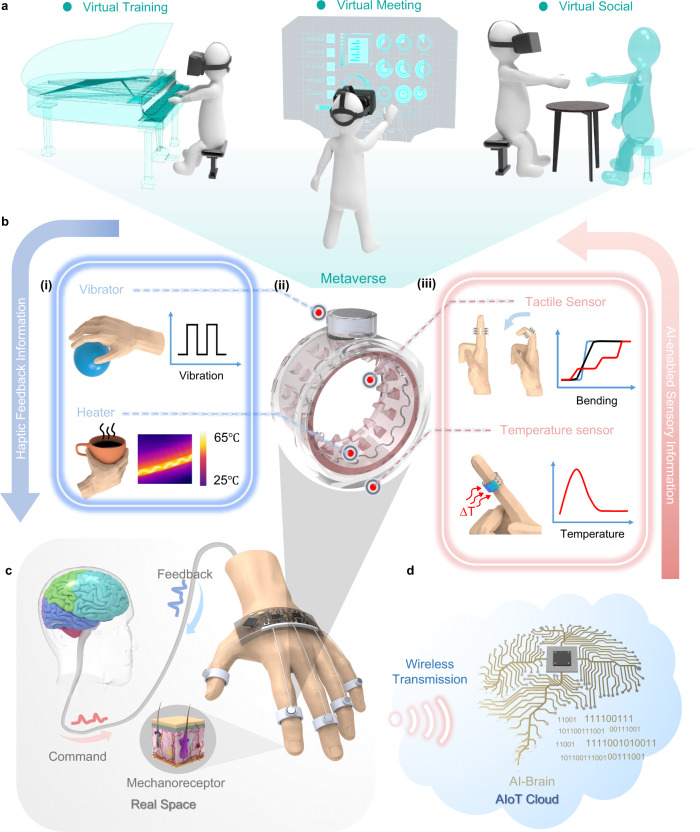
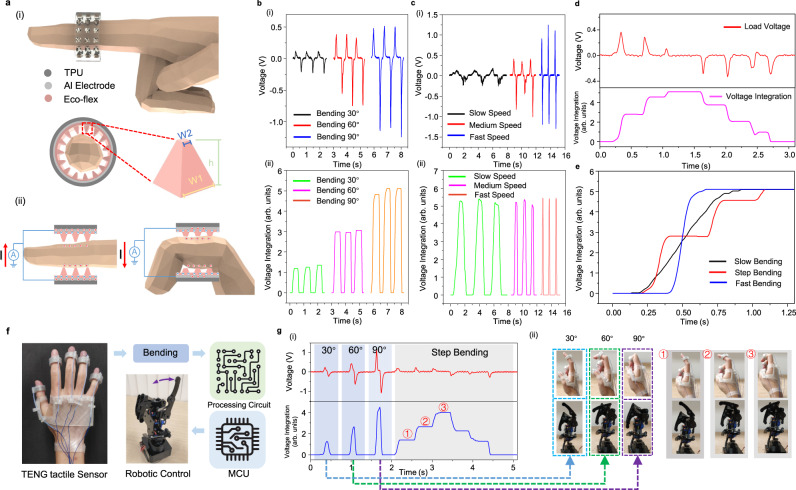
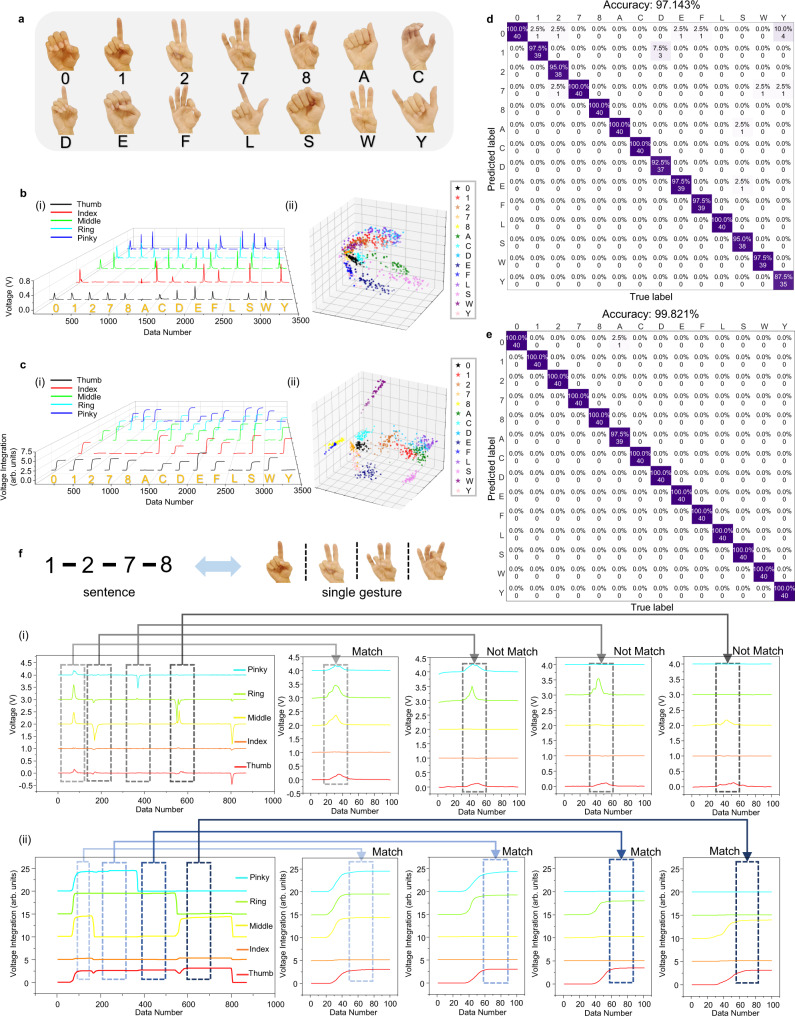
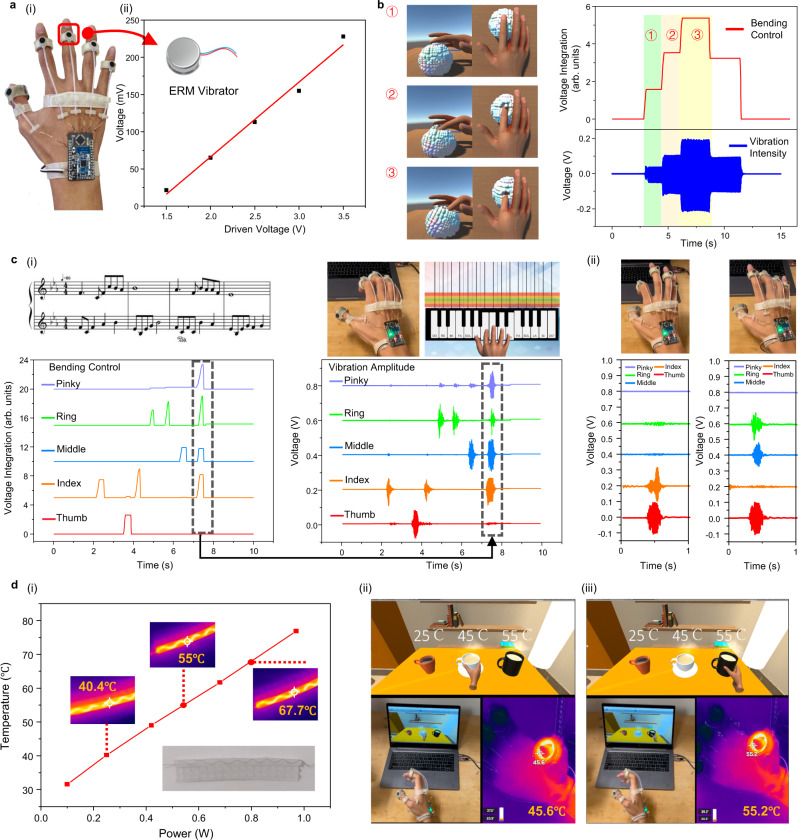
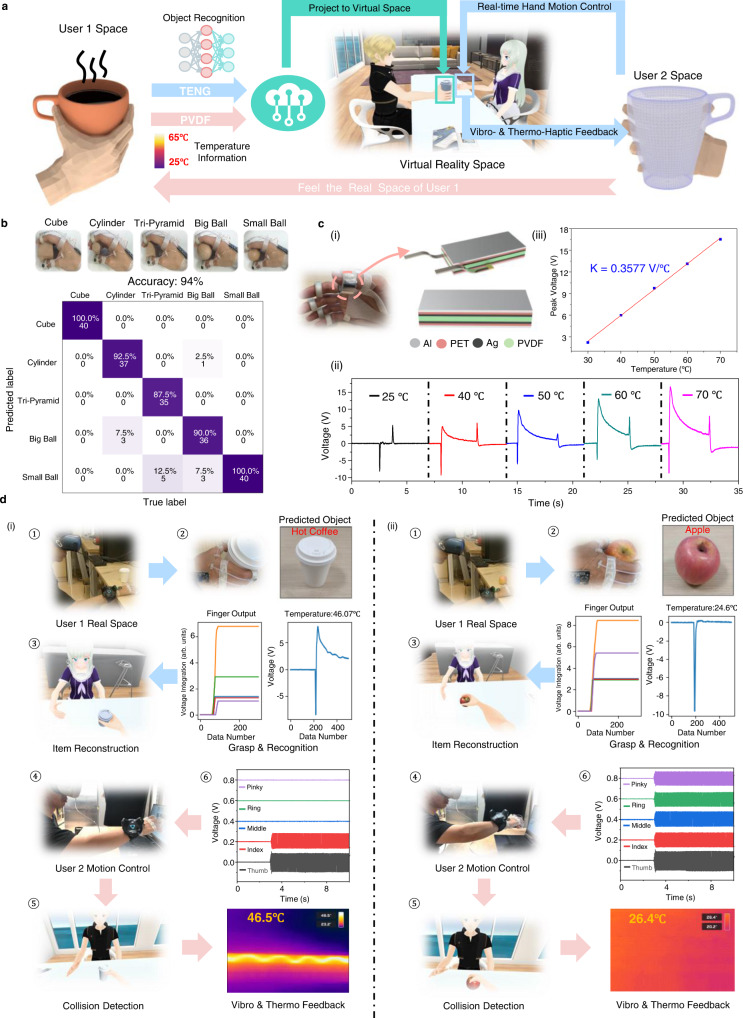
Advancements of virtual reality technology pave the way for developing wearable devices to enable somatosensory sensation, which can bring more comprehensive perception and feedback in the metaverse-based virtual society. Here, we propose augmented tactile-perception and haptic-feedback rings with multimodal sensing and feedback capabilities. This highly integrated ring consists of triboelectric and pyroelectric sensors for tactile and temperature perception, and vibrators and nichrome heaters for vibro- and thermo-haptic feedback. All these components integrated on the ring can be directly driven by a custom wireless platform of low power consumption for wearable/portable scenarios. With voltage integration processing, high-resolution continuous finger motion tracking is achieved via the triboelectric tactile sensor, which also contributes to superior performance in gesture/object recognition with artificial intelligence analysis. By fusing the multimodal sensing and feedback functions, an interactive metaverse platform with cross-space perception capability is successfully achieved, giving people a face-to-face like immersive virtual social experience.
Overview
The claims and statistics of this paper haven’t been checked yet.
Free: it reads the open-access text and checks the first 5 claims that cite a source we can check. Create a free account to check every claim.
Integrity signals
Registry
Cites
Statistics
Figures
Verification
Claims the paper makes
The claims and statistics of this paper haven’t been checked yet.
Free: it reads the open-access text and checks the first 5 claims that cite a source we can check. Create a free account to check every claim.
Claims other papers make about this one
Each is checked against this paper’s own text: does it say what the citing paper says it does?
In the citing paper
“Additionally, immersive interactions in virtual reality (Fig. 1g, h) 50,51 and driver behavior monitoring in intelligent vehicles (Fig. 1i) [52][53][54] rely on HMIP technology to accurately capture complex motion intentions.”
From Recent advances in intelligent wearable systems: from multiscale biomechanical features towards human motion intent prediction (2026) · cites this paper as [51]
Self-check
Percentages, sums and reported differences re-computed from the paper’s own numbers.
The self-check needs the paper’s full text.
Citations
Cites
Vision based hand gesture recognition for human computer interaction: a survey
Rautaray, S. S., & Agrawal, A. (2015) · Artificial Intelligence Review · doi:10.1007/s10462-012-9356-9 · Cited by 1,526
Learning the signatures of the human grasp using a scalable tactile glove
Sundaram, S., Kellnhofer, P., Li, Y., Zhu, J.-Y., Torralba, A., & Matusik, W. (2019) · Nature · doi:10.1038/s41586-019-1234-z · Cited by 1,162
Conductive Fiber‐Based Ultrasensitive Textile Pressure Sensor for Wearable Electronics
Lee, J., Kwon, H., Seo, J., Shin, S., Koo, J. H., Pang, C., Son, S., Kim, J. H., Jang, Y. H., Kim, D. E., et al. (2015) · Advanced Materials · doi:10.1002/adma.201500009 · Cited by 1,152
3D Virtual worlds and the metaverse: Current status and future possibilities
Dionisio, J. D. N., III, W. G. B., & Gilbert, R. (2013) · ACM Computing Surveys · doi:10.1145/2480741.2480751 · Cited by 1,151
Skin-integrated wireless haptic interfaces for virtual and augmented reality
Yu, X., Xie, Z., Yu, Y., Lee, J., Vazquez-Guardado, A., Luan, H., Ruban, J., Ning, X., Akhtar, A., Li, D., et al. (2019) · Nature · doi:10.1038/s41586-019-1687-0 · Cited by 1,025
Self-citationSign-to-speech translation using machine-learning-assisted stretchable sensor arrays
Zhou, Z., Chen, K., Li, X., Zhang, S., Wu, Y., Zhou, Y., Meng, K., Sun, C., He, Q., Fan, W., et al. (2020) · Nature Electronics · doi:10.1038/s41928-020-0428-6 · Cited by 841
Pyroelectric materials and devices for energy harvesting applications
Bowen, C. R., Taylor, J., LeBoulbar, E., Zabek, D., Chauhan, A., & Vaish, R. (2014) · Energy Environ. Sci. · doi:10.1039/c4ee01759e · Cited by 836
Highly Stretchable and Transparent Metal Nanowire Heater for Wearable Electronics Applications
Hong, S., Lee, H., Lee, J., Kwon, J., Han, S., Suh, Y. D., Cho, H., Shin, J., Yeo, J., & Ko, S. H. (2015) · Advanced Materials · doi:10.1002/adma.201500917 · Cited by 788
Pyroelectric Nanogenerators for Harvesting Thermoelectric Energy
Yang, Y., Guo, W., Pradel, K. C., Zhu, G., Zhou, Y., Zhang, Y., Hu, Y., Lin, L., & Wang, Z. L. (2012) · Nano Letters · doi:10.1021/nl3003039 · Cited by 784
Zhu, M., Sun, Z., Zhang, Z., Shi, Q., He, T., Liu, H., Chen, T., & Lee, C. (2020) · Science Advances · doi:10.1126/sciadv.aaz8693 · Cited by 784
Self-citation
Cited by
Items 101–200 of 626
Jiang, C., Xu, W., Li, Y., Yu, Z., Wang, L., Hu, X., Xie, Z., Liu, Q., Yang, B., Wang, X., et al. (2024) · Nature Communications · doi:10.1038/s41467-024-53654-y · Cited by 63
Zhu, Y., Zhao, T., Sun, F., Jia, C., Ye, H., Jiang, Y., Wang, K., Huang, C., Xie, Y., & Mao, Y. (2023) · Nano Energy · doi:10.1016/j.nanoen.2023.108520 · Cited by 61
Zou, J., Ma, Y., Liu, C., Xie, Y., Dai, X., Li, X., Li, S., Peng, S., Yang, Y., Wang, S., et al. (2024) · InfoMat · doi:10.1002/inf2.12545 · Cited by 61
Permeable Bioelectronics toward Biointegrated Systems
Lee, S., Liang, X., Kim, J. S., Yokota, T., Fukuda, K., & Someya, T. (2024) · Chemical Reviews · doi:10.1021/acs.chemrev.3c00823 · Cited by 63
Li, Y., Sun, Z., Huang, M., Sun, L., Liu, H., & Lee, C. (2024) · Advanced Energy and Sustainability Research · doi:10.1002/aesr.202400116 · Cited by 61
Self-citationLu, X. F., Tan, H., Zhang, H., Wang, W., Xie, S., Yue, T., & Chen, F. (2025) · Nature Communications · doi:10.1038/s41467-025-56169-2 · Cited by 61
“Considering that hands are the main expression carrier of non-driving behaviors and the progress TENGs have made in fi nger movement tracking 42 – 44 , hand gesture recognition 45 – 48 , sign language recognition 49,50 , tactile perception 51 – 53 , etc. TENGs, with their high sensitivity and…”
Wang, A., Gao, Z., Wu, S., Wei, Y., Lu, B., Shi, J. M., Shen, L., Liu, Y., Sun, X., & Wen, Z. (2025) · Advanced Science · doi:10.1002/advs.202502797 · Cited by 61
A Wearable Multidimensional Motion Sensor for AI-Enhanced VR Sports
Guo, Z. H., Zhang, Z., An, K., He, T., Sun, Z., Pu, X., & Lee, C. (2023) · Research · doi:10.34133/research.0154 · Cited by 60
Self-citationYang, B., Cheng, J., Qu, X., Song, Y., Yang, L., Shen, J., Bai, Z., & Ji, L. (2025) · Advanced Science · doi:10.1002/advs.202408689 · Cited by 59
Advances in materials for haptic skin electronics
Gao, Y., Yao, K., Jia, S., Huang, Y., Zhao, G., Zhang, B., Liu, Y., & Yu, X. (2024) · Matter · doi:10.1016/j.matt.2024.06.010 · Cited by 58
Zhou, Q., Geng, Z., Yang, L., Shen, B., Kan, Z., Yu, Q. M., Hu, S., Dong, B., Bai, X., Xu, L. H., et al. (2023) · Advanced Science · doi:10.1002/advs.202207663 · Cited by 56
Advances in olfactory augmented virtual reality towards future metaverse applications
Zhang, Z., Guo, X., & Lee, C. (2024) · Nature Communications · doi:10.1038/s41467-024-50261-9 · Cited by 56
Self-citationZhou, J. W., Liu, Y., Zhuo, F., Chen, H., Cao, H., Fu, Y., Xie, J., & Duan, H. (2023) · Chemical Engineering Journal · doi:10.1016/j.cej.2023.147790 · Cited by 55
Duan, S., Wei, X., Zhao, F., Yang, H., Wang, Y., Chen, P., Hong, J., Xiang, S., Luo, M., Shi, Q., et al. (2023) · Advanced Science · doi:10.1002/advs.202304121 · Cited by 53
Liang, Q., Zhang, D., He, T., Zhang, Z., Wang, H., Chen, S., & Lee, C. (2023) · ACS Nano · doi:10.1021/acsnano.3c08739 · Cited by 53
Self-citationHumanoid electronic-skin technology for the era of Artificial Intelligence of Things
Zhang, H., Hong, J., Zhu, J., Duan, S., Xia, M., Chen, J., Sun, B., Xi, M., Gao, F., Xiao, Y., et al. (2025) · Matter · doi:10.1016/j.matt.2025.102136 · Cited by 53
Self-citationA skin-like multimodal haptic interface
Sun, Z., Zhang, Z., & Lee, C. (2023) · Nature Electronics · doi:10.1038/s41928-023-01093-w · Cited by 53
Self-citationFlexible microfluidic triboelectric sensor for gesture recognition and information encoding
Ge, X., Gao, Z., Zhang, L., Ji, H., Yi, J., Jiang, P., Li, Z., Shen, L., Sun, X., & Wen, Z. (2023) · Nano Energy · doi:10.1016/j.nanoen.2023.108541 · Cited by 53
Deep‐learning enabled smart insole system aiming for multifunctional foot‐healthcare applications
Tian, Y., Zhang, L., Zhang, C., Bao, B., Li, Q., Wang, L., Song, Z., & Li, D. (2023) · Exploration · doi:10.1002/exp.20230109 · Cited by 52
Fang, P., Zhu, M., Zeng, Z., Lu, W., Wang, F., Zhang, L., Chen, T., & Sun, L. (2023) · Advanced Functional Materials · doi:10.1002/adfm.202310254 · Cited by 52
Self-citationEasy‐To‐Wear Auxetic SMA Knot‐Architecture for Spatiotemporal and Multimodal Haptic Feedbacks
Oh, S., Song, T., Mahato, M., Kim, J., Yoo, H., Lee, M., Khan, M., Yeo, W., & Oh, I. (2023) · Advanced Materials · doi:10.1002/adma.202304442 · Cited by 53
Bridging the digital–physical divide using haptic and wearable technologies
Qi, J., Yu, L., Khoo, E. T., Ng, K. W., Gao, Y., Kow, A. W. C., Yeo, J. C., & Lim, C. T. (2024) · Nature Electronics · doi:10.1038/s41928-024-01325-7 · Cited by 51
“In metaverse applications, there are many other devices that can perceive contact pressure, such as smart clothing made of piezoresistive fibres 98 , smart rings 32 and gloves 45 incorporated with triboelectric protrusions.”
A flexible skin-mounted haptic interface for multimodal cutaneous feedback
Kang, B., Zavanelli, N., Sue, G. N., Patel, D. K., Oh, S., Oh, S., Vinciguerra, M. R., Wieland, J., Wang, W., & Majidi, C. (2025) · Nature Electronics · doi:10.1038/s41928-025-01443-w · Cited by 52
Ji, J., Luo, H., Su, J., Wang, S., Chen, X., & Song, J. (2025) · Proceedings of the National Academy of Sciences · doi:10.1073/pnas.2519693122 · Cited by 53
Wang, S., Wu, Y., Pu, M., Xu, M., Zhang, R., Yu, C., Li, X., Ma, X., Su, Y., Tai, H., et al. (2023) · Small · doi:10.1002/smll.202305706 · Cited by 50
Modeling in tribology: Recent advances, applications, and open questions
Pastewka, L., Vakis, A. I., Eder, S. J., Aghababaei, R., Almqvist, A., Carbone, G., Chandross, M., Dini, D., Ehrich, H. J., Ewen, J. P., et al. (2025) · Tribology International · doi:10.1016/j.triboint.2025.111326 · Cited by 50
Wei, Y., Hao, R., Hong, X., Guo, S., Lu, D., Li, H., Zhao, W., Tang, Z., Zhou, C., Cao, W., et al. (2026) · ACS Nano · doi:10.1021/acsnano.6c03325 · Cited by 50
Bechinie, C., Zafari, S., Kröninger, L., Puthenkalam, J., & Tscheligi, M. (2024) · Procedia Computer Science · doi:10.1016/j.procs.2024.01.156 · Cited by 49
Duan, S., Lin, Y., Shi, Q., Wei, X., Zhu, D., Hong, J., Xiang, S., Yuan, W., Shen, G., & Wu, J. (2024) · Advanced Fiber Materials · doi:10.1007/s42765-024-00434-4 · Cited by 49
“Gesture recognition enabled by sensors and computational models is of great value in human–machine interactions [1, 2], health monitoring [1, 3], Metaverse [4, 5], and the study of cognitive neuroscience [6].”
A Programmable Electronic Skin with Event‐Driven In‐Sensor Touch Differential and Decision‐Making
Cao, Z., Xu, Y., Yu, S., Huang, Z., Hu, Y., Lin, W., Wang, H., Luo, Y., Zheng, Y., Chen, Z., et al. (2024) · Advanced Functional Materials · doi:10.1002/adfm.202412649 · Cited by 49
An innovative biomimetic technology: Memristors mimic human sensation
Wang, K., Wang, M., Sun, B. T., Yang, C. S., Cao, Z., Wu, T., Gao, K., Ma, H., Yan, W., Wang, H., et al. (2025) · Nano Energy · doi:10.1016/j.nanoen.2025.110698 · Cited by 50
Guo, D., Dong, S., Wang, Q., Yu, H., Kim, E., Xu, Q., Sung, H., Yao, Z., Li, Y., & Kim, N. (2023) · Chemical Engineering Journal · doi:10.1016/j.cej.2023.146464 · Cited by 48
Intelligent Sensing Technologies Based on Flexible Wearable Sensors: A Review
Nong, H., Jin, M., Pan, C., Zhou, H., Zhang, C., Pan, X., Chen, Y., Wei, X., Lu, Y., Zhao, K., et al. (2024) · IEEE Sensors Journal · doi:10.1109/jsen.2024.3405173 · Cited by 49
“This system finds application in sign language translation [119], enhancing communication between sign language users and nonusers.”
BackgroundDai, N., Guan, X., Lu, C., Zhang, K., Xu, S., Lei, I. M., Li, G., Zhong, Q., Fang, P., & Zhong, J. (2023) · ACS Nano · doi:10.1021/acsnano.3c05507 · Cited by 47
Jung, K., Kim, S., Oh, S., & Yoon, S. H. (2024) · Virtual Reality · doi:10.1007/s10055-023-00910-z · Cited by 47
“The most effective vibrotactile frequency for human perception lies between 130 and 230 Hz Sun et al. (2022).”
Object pop-up: Can we infer 3D objects and their poses from human interactions alone?
Petrov, I. A., Marin, R., Chibane, J., & Pons‐Moll, G. (2023) · IEEE Computer Society Conference on Computer Vision and Pattern Recognition/Proceedings - IEEE Computer Society Conference on Computer Vision and Pattern Recognition/Proceedings · doi:10.1109/cvpr52729.2023.00458 · Cited by 47
“Recent works also involve more sophisticated devices [52,53], while they are still far from applicability.”
BackgroundWu, P., Zhao, C., Cui, E., Xu, S., Liu, T., Wang, F., Lee, C., & Mu, X. (2024) · International Journal of Extreme Manufacturing · doi:10.1088/2631-7990/ad5bc6 · Cited by 46
“TENG, is particularly adept at harvesting weak mechanical energy from sources such as wind [5–8], sound [9– 12], small vibrations [13–16], temperature changes [17–21], and human movement [22–27], thereby leading the field owing to its cost-effectiveness, high output, and adaptability.”
BackgroundSelf-citationAdaptative two-phase thermal circulation system for complex-shaped electronic device cooling
Xu, W., Cui, J., Ma, Y., Hu, Z., Qi, Y., Li, X., Zhong, Y., Luo, T., Chu, X., Wu, L., et al. (2025) · Nature Communications · doi:10.1038/s41467-025-56960-1 · Cited by 48
“However, compact and complex device con fi gurations hinder the effective integration of thermal management components 48 .”
Aloudat, M. Z., Aboumadi, A., Soliman, A., Al-Mohammed, H. A., Al-Ali, M. S., Mahgoub, A., Barhamgi, M., & Yaacoub, E. E. (2025) · IEEE Access · doi:10.1109/access.2025.3555753 · Cited by 46
Liu, X., Li, Y., Li, Y., Zheng, X., Jingjing, G., Sun, T., Sung, H., Chernogor, L., Cao, M., Xu, T. X., et al. (2025) · Advanced Functional Materials · doi:10.1002/adfm.202506158 · Cited by 46
Zheng, Y., Liu, H., Wang, J., Cui, T., Zhu, J., & Gui, Z. (2023) · Advanced Fiber Materials · doi:10.1007/s42765-023-00344-x · Cited by 44
Jung, Y.-H., An, J., Hyeon, D. Y., Wang, H. S., Kim, I., Jeong, C. K., Park, K., Lee, P. S., & Lee, K. J. (2023) · Advanced Functional Materials · doi:10.1002/adfm.202309316 · Cited by 45
Wang, S., Wang, X., Wang, S., Yu, W. P., Yu, L., Hou, L., Tang, Y., Zhang, Z., Yao, N., Cao, C., et al. (2023) · Advanced Intelligent Systems · doi:10.1002/aisy.202200412 · Cited by 43
Zhang, Y., Liu, Q., Ren, W., Song, Y., Luo, H., Han, Y., He, L., Wu, X., & Wang, Z. (2023) · Research · doi:10.34133/research.0172 · Cited by 42
“As an indispensable component of the burgeoning smart wearables such as electronic skins [11], wearable devices [12,13], soft robots [14], and human–machine interfaces [15], tactile sensors with comparable or even superior sensing capabilities than natural human skin or animal sensory organs have attracted enormous at…”
BackgroundProgress in self-powered sensors—Moving toward artificial intelligent and neuromorphic system
Wen, F., Wang, C., & Lee, C. (2023) · Nano Research · doi:10.1007/s12274-023-5879-4 · Cited by 42
Self-citationZhang, D., Xu, Z., Wang, Z., Cai, H., Wang, J., & Li, K. (2023) · Chemical Engineering Journal · doi:10.1016/j.cej.2023.147075 · Cited by 42
Kumar, V., Parvin, N., Joo, S. W., Mandal, T. K., & Park, S. (2025) · Nano Energy · doi:10.1016/j.nanoen.2025.110805 · Cited by 42
Wei, C., Lin, W., Wang, L., Cao, Z., Huang, Z., Liao, Q., Guo, Z., Su, Y., Zheng, Y., Liao, X., et al. (2023) · Nano-Micro Letters · doi:10.1007/s40820-023-01176-5 · Cited by 42
“To accurately recognize touch location, large-scale integrations of sensing pixels were common methods [38–41], which resulted in the overall stiffness of IE devices.”
MethodPerceived Realism of Virtual Textures Rendered by a Vibrotactile Wearable Ring Display
Friesen, R. F., & Vardar, Y. (2023) · IEEE Transactions on Haptics · doi:10.1109/toh.2023.3304899 · Cited by 41
“Relocated feedback has proven promising for several types of haptic interactions [8], particularly when using squeeze or shear forces as intelligible cues of contact and softness of virtual objects [9], [10], [11].”
BackgroundInjection‐on‐Skin Granular Adhesive for Interactive Human–Machine Interface
Kim, S., Jang, J., Kang, K., Jin, S., Choi, H., Son, D., & Shin, M. (2023) · Advanced Materials · doi:10.1002/adma.202307070 · Cited by 41
Cao, V. A., Phan, V. Q., Nguyen, N. K., Kim, M., Van, P. C., Hiếu, N. M., Kim, S. Y., & Nah, J. (2025) · Nano Energy · doi:10.1016/j.nanoen.2025.110706 · Cited by 41
A triboelectric tactile sensor with flower-shaped holes for texture recognition
Xing, P., An, S., Wu, Y., Gui, L., Liu, S., Wang, J., Cheng, Y., Zhang, Y., & Pu, X. (2023) · Nano Energy · doi:10.1016/j.nanoen.2023.108758 · Cited by 41
VisTac Toward a Unified Multimodal Sensing Finger for Robotic Manipulation
Athar, S., Patel, G., Xu, Z., Qiu, Q., & She, Y. (2023) · IEEE Sensors Journal · doi:10.1109/jsen.2023.3310918 · Cited by 41
“Numerous types of tactile sensors have been developed over the years, utilizing principles including capacitance, electromagnetic, piezoelectric, triboelectric, pyroelectric, resistance, strain gauge, and ultrasonic [8], [9], [10], [11], [12], [13], [14], [15], [16].”
BackgroundSensing-actuating integrated asymmetric multilayer hydrogel muscle for soft robotics
Zhou, Y., Zhao, Y., Zhao, D., Guan, X., Zhang, K., Pi, Y., & Zhong, J. (2025) · Microsystems & Nanoengineering · doi:10.1038/s41378-025-00884-9 · Cited by 41
“These robotics have the potential to monitor various properties of the objects they interact with, such as roughness 10 , temperature 11 , weight 12 , and surface components 13 .”
Park, S. U., Lee, H. K., Kim, H. B., Kim, D., Kim, W., Joo, J., Kim, B., Lee, B. W., Jung, Y. H., Park, S., et al. (2025) · Nature Communications · doi:10.1038/s41467-025-63644-3 · Cited by 38
Hong, J., Wei, X., Zhang, H., Xiao, Y., Meng, C., Chen, Y., Li, J., Li, L., Lee, S., Shi, Q., et al. (2024) · International Journal of Extreme Manufacturing · doi:10.1088/2631-7990/ad878b · Cited by 37
“…realize more functions than the aforementioned TENG-PENG combo sensors in achieving static mechanical signal sensing [109–115], temperature sensing [21, 114–119], humidity sensing [121], or self-powering with higher energy density [122–124 Piezoresistive sensors exhibit the capability of…”
InfluentialGuo, Y., Li, K., Yue, W., Kim, N., Li, Y., Shen, G., & Lee, J. (2024) · Nano-Micro Letters · doi:10.1007/s40820-024-01545-8 · Cited by 37
“Gesture recognition, acknowledged as an intuitive and nat-ural mode of communication, interprets intentional hand movements to convey significant information and has garnered substantial attention in the field of human–machine interaction [1–3].”
BackgroundYe, L., Tang, Z., Feng, J., Jiang, Y., Tang, X.-G., Zhou, Y., Xing, X., & Gao, J. (2025) · Chemical Engineering Journal · doi:10.1016/j.cej.2025.164866 · Cited by 37
Construction metaverse: Application framework and adoption barriers
Chen, Z., Chen, J., Chen, Y., & Pedrycz, W. (2024) · Automation in Construction · doi:10.1016/j.autcon.2024.105422 · Cited by 37
Zhao, Y. (2024) · Heliyon · doi:10.1016/j.heliyon.2024.e38008 · Cited by 36
“Sun et al. (2022) [17] examined the profound influence of AI technology on the artistic creation process and the presentation form of works focusing on the relationship among artists, audiences, and markets.”
BackgroundYan, C., Jiang, S., Wang, Y., Deng, J., Wang, X., Chen, Z., Chen, T., Huang, H., & Wu, H. (2024) · Nano Energy · doi:10.1016/j.nanoen.2024.110425 · Cited by 36
Self-powered sensing for health monitoring and robotics
Liu, S., Guo, W., Zhao, X.-H., Tang, X., & Sun, Q. (2025) · Soft Science · doi:10.20517/ss.2024.65 · Cited by 36
Triboelectric nanogenerators for self-powered sensors and other applications
Lee, C., Qin, Y., & Wang, Y. (2025) · MRS Bulletin · doi:10.1557/s43577-025-00877-z · Cited by 37
Self-citationRen, J., Huang, X., Han, R., Sun, Y., Chen, G., Li, Q., & Zhou, Z. G. (2025) · Advanced Functional Materials · doi:10.1002/adfm.202512937 · Cited by 36
Kim, S., Cho, W., Hwang, J., & Kim, J. (2022) · Nano Energy · doi:10.1016/j.nanoen.2022.108109 · Cited by 36
Trends in Flexible Sensing Technology in Smart Wearable Mechanisms–Materials–Applications
Wang, S., Zhai, H., Zhang, Q., Hu, X., Li, Y., Xiong, X., Ma, R., Wang, J., Chang, Y., & Wu, L. (2025) · Nanomaterials · doi:10.3390/nano15040298 · Cited by 35
“Sun et al. [132] have introduced augmented tactile haptic rings (ATH-Rings), which, empowered by machine learning analysis, are capable of continuous finger motion detection and sign language translation applications, as shown in Figure 14c.”
Sun, Y., Chen, T., Li, D., Li, H., Ji, T., Wang, F., Sun, L., Lee, C., & Liu, H. (2025) · Advanced Materials · doi:10.1002/adma.202502203 · Cited by 35
Self-citationLee, K., Gul, O., Kwon, Y., Jeong, J., Cho, S., Ahn, J., Yu, J., Kim, C.-M., Lee, D., Han, H., et al. (2025) · Advanced Functional Materials · doi:10.1002/adfm.202519859 · Cited by 36
Jin, Z., Dong, S., Liu, X., Zheng, X., Jingjing, G., Sung, H.-K., Chernogor, L., Yao, Z., Li, Y., & Li, Y. (2025) · Chemical Engineering Journal · doi:10.1016/j.cej.2025.166137 · Cited by 35
Wu, J., Li, Y., Duan, S., Wang, Z., Jing, X., Lin, Y., Zhu, D., Lei, W., Shi, Q., & Tao, L. (2023) · Research · doi:10.34133/research.0106 · Cited by 34
“The sensor stability is susceptible to mechanical deformation because of the current mainstream temperature sensing mechanism, including the thermally sensitive resistor [1], the temperature-sensitive conductive polymers [2,3], pyroelectric materials [4], and the luminescent materials [5].”
BackgroundZhang, Y., Li, Z., Xu, Z., Xiao, M., Yuan, Y., Jia, X., Shi, R., Zhang, L., & Wan, P. (2024) · Aggregate · doi:10.1002/agt2.566 · Cited by 34
Recent Advances in Nanomaterial‐Based Biosignal Sensors
Kim, M., Hong, S., Khan, R., Park, J. J., In, J. B., & Ko, S. H. (2024) · Small · doi:10.1002/smll.202405301 · Cited by 35
Ultrasensitive multi-degree-of-freedom piezoionic sensor via synergistic hydrogel-ion interactions
Fang, Y., Ouyang, H., Cheng, Y., Zhou, Y., Shi, L., Sun, J., Ho, G. W., & Wang, R. (2025) · Nature Communications · doi:10.1038/s41467-025-67613-8 · Cited by 34
“22 to 24).”
Gao, X., Yin, L., Tian, S., Huang, Y., & Ji, Q. (2024) · IEEE Sensors Journal · doi:10.1109/jsen.2024.3374762 · Cited by 34
“Reproduced from [203] with permission. the psychological health and treatment of ASD [188].”
BackgroundMethodLiu, M., Dai, Z., Zhao, Y., Ling, H., Sun, L., Lee, C., Zhu, M., & Chen, T. (2024) · ACS Applied Materials & Interfaces · doi:10.1021/acsami.4c11050 · Cited by 33
Self-citationFlexible and Wearable Tactile Sensors for Intelligent Interfaces
Cui, X., Zhang, W. Y., Lv, M., Huang, T., Xi, J., & Yuan, Z. (2025) · Materials · doi:10.3390/ma18174010 · Cited by 34
“…tactile system for VR applications via incorporating TENG tactile sensors for continuous bending detection, flexible pyroelectric sensors for temperature sensing, eccentric rotat-Materials ing mass vibrators for vibration feedback, and nickel–chromium alloy wires for thermal feedback [116].”
Haptic interface with multimodal tactile sensing and feedback for human–robot interaction
Kang, M., Gang, C.-G., Ryu, S.-K., Kim, H.-J., Jeon, D.-Y., & Pyo, S. (2024) · Micro and Nano Systems Letters · doi:10.1186/s40486-024-00199-w · Cited by 33
“This limitation has been further highlighted by recent efforts to integrate temperature feedback, such as in the work by Sun et al., who used NiCr heaters in a multisensory haptic system to deliver temperature sensations along with pressure feedback [17].”
BackgroundMethodMass-production of biomimetic fur knitted triboelectric fabric for smart home and healthcare
Shen, Y., Chen, C.-Y., Chen, L., Shang, L., Wang, T., Wang, K., Zhao, Y., Hou, R., Cong, H., Jiang, G., et al. (2024) · Nano Energy · doi:10.1016/j.nanoen.2024.109510 · Cited by 33
Soft wearable thermo+touch haptic interface for virtual reality
Lee, S., Jang, S., & Cha, Y. (2024) · iScience · doi:10.1016/j.isci.2024.111303 · Cited by 32
“35,39 In this paper, we propose a novel-design soft wearable ther-motouch haptic interface (T 2 HI) that can provide both touch and thermal stimulation independently and simultaneously, in addition to the visual feedback of VR (Figure 1).”
A Systematic Review on Hand Exoskeletons From the Mechatronics Aspect
Li, H., & Cheng, L. (2024) · IEEE/ASME Transactions on Mechatronics · doi:10.1109/tmech.2024.3500585 · Cited by 32
“These sensors can be designed with multiple functions, including neuromuscular sensing [196], [197], feedback interfaces [198], [199], [200], real-time movement monitoring [194], [202], and interaction with external devices [201], expanding the capabilities of wearable robotics.”
Lu, W., Fang, P., Zhu, M., Zhu, Y.-R., Fan, X., Zhu, T., Zhou, X., Wang, F., Chen, T., & Sun, L. (2023) · Advanced Intelligent Systems · doi:10.1002/aisy.202200453 · Cited by 33
Self-citationOpen Metaverse: Issues, Evolution, and Future
Chen, Z., Gan, W., Sun, J., Wu, J., & Yu, P. S. (2024) · International World Wide Web Conference (WWW) · doi:10.1145/3589335.3651898 · Cited by 32
“…Forthereasonthat theMetaverse needs to realize ultra-large-scale user connection and interaction in the development stage, it is necessary to put into operation a large-scale infrastructure, so the early construction process requires capable companies to invest in huge investment and development.”
Recent advances in triboelectric tactile sensors for robot hand
Noor, A., Sun, M., Zhang, X., Li, S., Dong, F., Wang, Z., Si, J., Zou, Y., & Xu, M. (2024) · Materials Today Physics · doi:10.1016/j.mtphys.2024.101496 · Cited by 31
Lu, J., Zhang, K., Hazarika, D., Xu, L., Li, J., Wu, J., Shah, M. N., Jin, H., Dong, S., Huang, Y., et al. (2024) · Advanced Energy and Sustainability Research · doi:10.1002/aesr.202300237 · Cited by 31
Xu, J., Zhai, X., Chen, N., Ghani, U., Starčič, A. I., & Xin, J. (2025) · Education Sciences · doi:10.3390/educsci15070900 · Cited by 30
A miniaturized array microneedle tactile sensor for intelligent object recognition
An, Z., Wu, Z., Hu, Y., Han, C., Cao, Z. M., Zhou, H., & Chen, Y. (2024) · Nano Energy · doi:10.1016/j.nanoen.2024.109567 · Cited by 30
Water droplets play a role in Internet of Things applications
Wen, F., & Lee, C. (2024) · Droplet · doi:10.1002/dro2.133 · Cited by 29
“42 46 The development of soft elastomer-based microfluidic templates encapsulating a conductive liquid has led to the creation of sensors that are highly flexible, durable, and sensitive.”
Self-citationChen, X., Zhou, J., Huang, J., Liu, J., Nie, L., & Zhu, Y. (2025) · Advanced Functional Materials · doi:10.1002/adfm.202524652 · Cited by 29
Multimaterial 3D printed soft robots with embedded actuation and sensing
Zhu, Z., Wang, D., Zhang, M., Dong, L., Yu, Q., Jiang, C., Zhu, X., Chen, M., Zhou, K., & Gu, G. (2025) · Science Advances · doi:10.1126/sciadv.adz2928 · Cited by 29
“Pioneering examples include self-powered electrotactile gloves ( 52 , 53 ) and a closed-loop drone interaction system integrating vision, vibration, and electrical stimulation feedback ( 54 ).”
Kim, J., Hwang, G. W., Song, M., Lim, D., Kim, J., Choi, J., Lee, Y. S., Kim, D. W., Yang, T., & Pang, C. (2023) · Advanced Functional Materials · doi:10.1002/adfm.202311167 · Cited by 29
Intelligent sensory systems toward soft robotics
Luo, Z., Cheng, W., Zhao, T., & Xiang, N. (2024) · Applied Materials Today · doi:10.1016/j.apmt.2024.102122 · Cited by 31
Aspects of 6th generation sensing technology: from sensing to sense
Mazumdar, H., Khondakar, K. R., Das, S., & Kaushik, A. K. (2024) · Frontiers in Nanotechnology · doi:10.3389/fnano.2024.1434014 · Cited by 29
“…of devices like smartphones, UAVs, and sensors into IoT networks involves Smart Sensing Innovation Towards 6G, (A) Smart Ring [Adapted from (Sun et al., 2022)]; (B) Smart Bandage [Adapted from (Meng et al., 2024)]; (C) Quantum Lab-on-a-Chip [Adapted from (Allert et al., 2022)]; (D) Living…”
BackgroundTowards a mixed human–machine creativity
Farina, M., Pedrycz, W., & Lavazza, A. (2024) · Journal of Cultural Cognitive Science · doi:10.1007/s41809-024-00146-6 · Cited by 30
“It is worth noting that much of the scholarship surrounding the use of AI across numerous creative contexts, such as writing, has already argued that the strength of AI is not automation but of human augmentation (Guzman, 2018; Sun et al., 2022).”
Jeong, J., Kang, M., Song, Y., & Pyo, S. (2024) · Advanced Intelligent Systems · doi:10.1002/aisy.202400578 · Cited by 28
An intelligent humidity sensing system for human behavior recognition
Yang, H., Guo, Q., Chen, G., Zhao, Y., Shi, M., Zhou, N., Huang, C., & Mao, H. (2025) · Microsystems & Nanoengineering · doi:10.1038/s41378-024-00863-6 · Cited by 28
Chen, S., Jia, Y., Duan, B., Liu, T.-L., Wang, Q., Xiao, X., Nithianandam, P., Tian, X., Yang, C., Wu, C., et al. (2025) · Science Advances · doi:10.1126/sciadv.adr4797 · Cited by 28
“Despite the great success, most existing HMIs focus on biophysical inputs and outputs such as electrophysiological, haptic, audio, and visual signals ( 7 , 12 – 21 ).”
Advanced nanomaterials for health monitoring and diagnostics in next-generation wearable sensors
Chandran, M., Veerapandian, M., Dhanasekaran, B., Govindaraju, S., & Yun, K. (2025) · Materials Science and Engineering R Reports · doi:10.1016/j.mser.2025.101015 · Cited by 29
Oh, M., Kim, E., Lee, J., Jeong, I., Kim, E., Paek, J., Lee, T., Kim, D., An, S., Kim, S., et al. (2025) · Advanced Sensor Research · doi:10.1002/adsr.202500028 · Cited by 28
Feng, K. L., Lei, M., Wang, X., Zhou, B., & Xu, Q. (2023) · Advanced Intelligent Systems · doi:10.1002/aisy.202300291 · Cited by 28
Sahoo, S. K., & Choudhury, B. B. (2023) · Journal of Decision Analytics and Intelligent Computing · doi:10.31181/10001122023s · Cited by 28
Metadata
- Authors
- Sun, Z., Zhu, M., Shan, X., & Lee, C.
- Affiliations
- National University of Singapore (SG)
- Agency for Science, Technology and Research (SG)
- Corresponding author
- Lee, Chengkuo
- Venue
- Nature Communications
- Published
- 2022-09-05
- Volume
- 13
- Issue
- 1
- Pages
- 5224-5224
- ISSN
- 2041-1723 (ISSN-L)
- PMC
- PMC9445040
- OpenAlex
- W4294677009
- Semantic Scholar
- 1111bab7ad7ca5d988212dd9c6c60bc4d8786fe7
- Cited by
- 532
- References
- 70
- Citations by year
- 2026: 79 · 2025: 164 · 2024: 160 · 2023: 120 · 2022: 9
- FWCI
- 32.87
- Type
- journal article
- Language
- en
- Open access
- gold
- doi.org
- Licence
- cc-by
- creativecommons.org/licenses/by/4.0 (tdm)
- creativecommons.org/licenses/by/4.0 (vor)
- Locations
- Nature Communications (publishedVersion, cc-by)
- PubMed Central (publishedVersion, cc-by)
- PubMed (publishedVersion)
- RePEc: Research Papers in Economics (submittedVersion)
- DOAJ (DOAJ: Directory of Open Access Journals) (submittedVersion, cc-by-sa)
- Funders
- National University of Singapore (A-0005947-20-00)
- National Key Research and Development Program of China (2019YFB2004800, R‐2020‐S‐002)
- Topics
- Physical Sciences › Engineering › Biomedical Engineering › Advanced Sensor and Energy Harvesting Materials
- Life Sciences › Neuroscience › Cognitive Neuroscience › Tactile and Sensory Interactions
- Physical Sciences › Engineering › Mechanical Engineering › Teleoperation and Haptic Systems
- Keywords
- wearable devices, virtual reality, somatosensory perception, gesture recognition, multimodal sensing, metaverse
- MeSH terms
- Haptic Technology, Artificial Intelligence, Feedback, Humans, Touch, Touch Perception
About these checks
Registry, retraction, Cites and statistics results are computed, not judged, with one exception: a printed reference that no index lists is read once by a model before it counts as a citation error. Claims are extracted by a model and kept only when their quote appears verbatim in the text; each cited source is then checked, with a model’s help, for whether it says what the claim relies on. Those verdicts can be wrong — read the claim’s quote and the cited source before relying on one.
Statistics and arithmetic are recomputed, not judged.
Confidence bands are shown only for fields calibrated on our annotated test set. None is calibrated yet, so no band is shown.
What counts as a claim ›How we measure confidence ›How we check this ›
Are you an author, or do you see a problem with this page? Request a review
Data sources
Bibliographic data: Semantic Scholar, OpenAlex, Crossref.
Contains information from the Semantic Scholar Academic Graph Datasets, made available under the ODC Attribution License (ODC-BY 1.0).
Semantic Scholar’s data is described in: Kinney, R., et al. (2023). The Semantic Scholar Open Data Platform. arXiv:2301.10140.
