

Augmented tactile-perception and haptic-feedback rings as human-machine interfaces aiming for immersive interactions
Open accessThe DOI matches its Crossref record; 70 of the 70 references it cites were found in a registry or an index.
Abstract
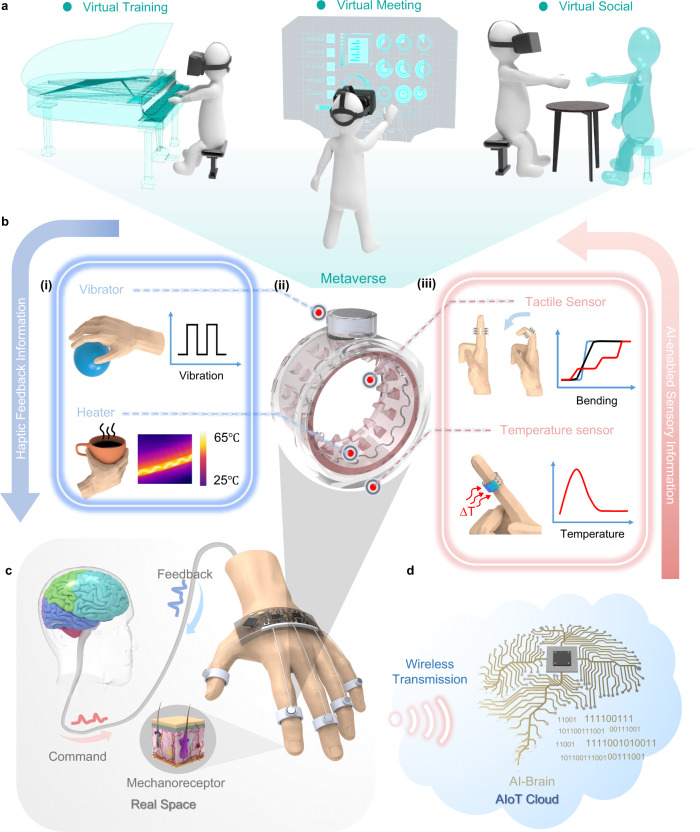
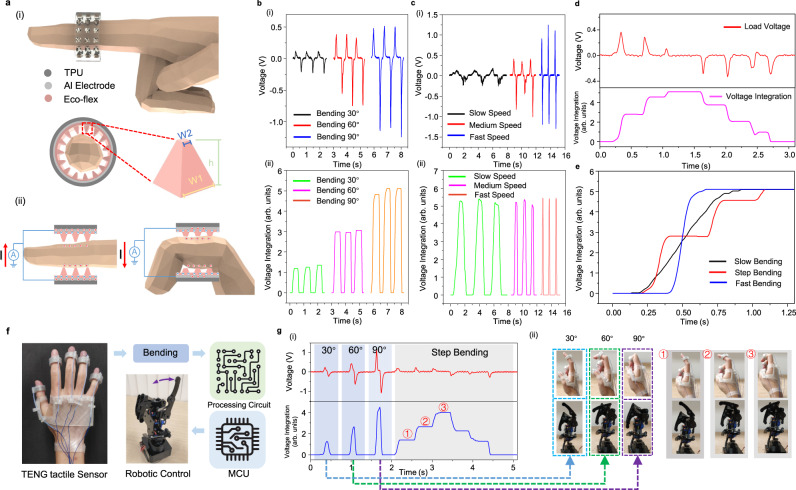
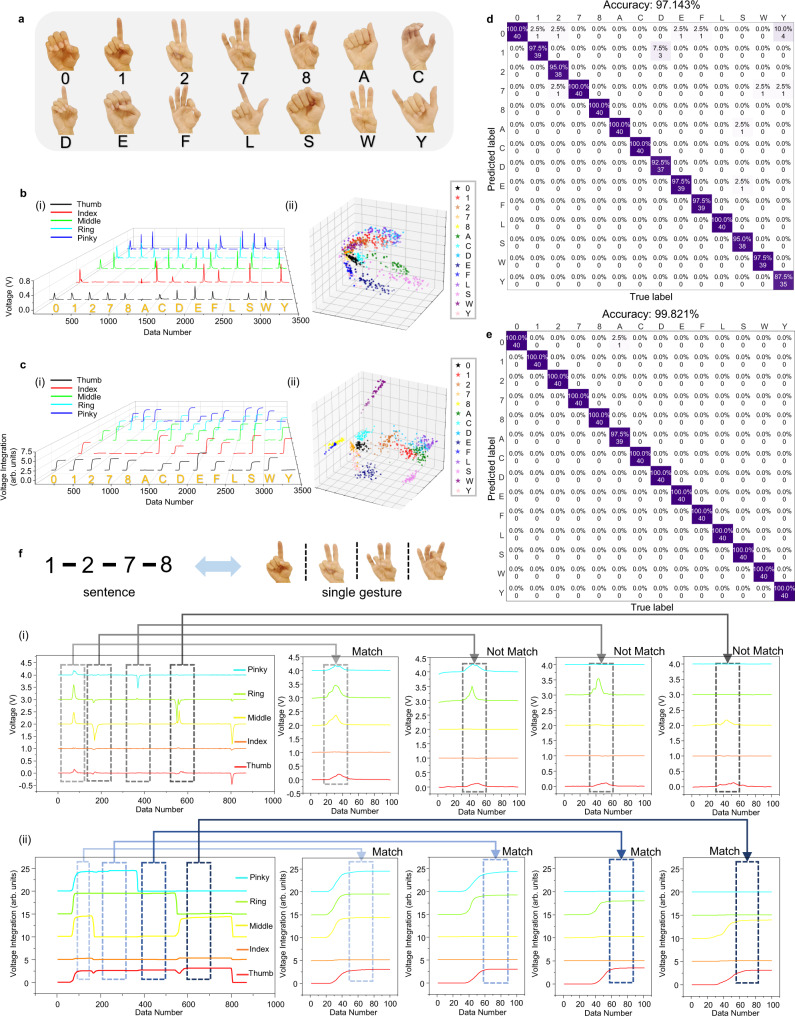
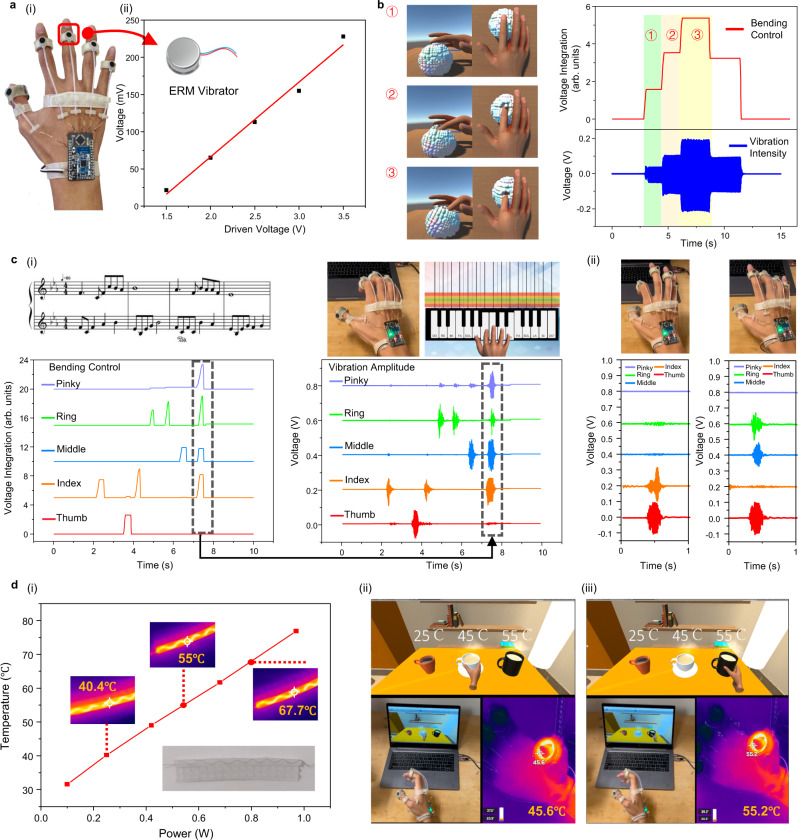
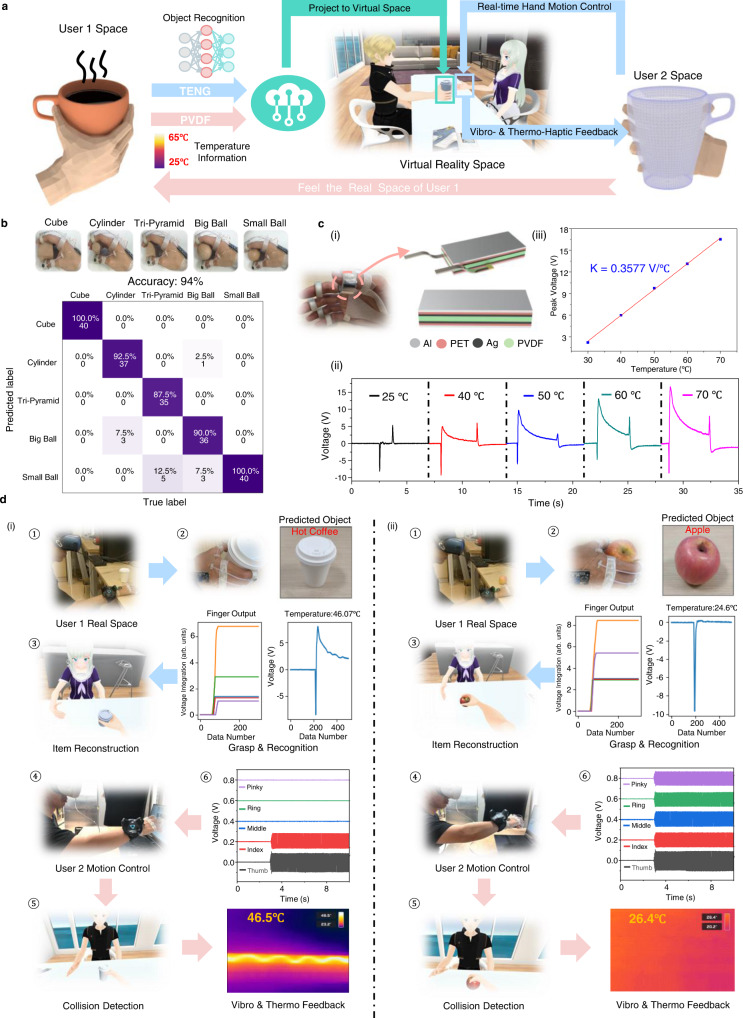
Advancements of virtual reality technology pave the way for developing wearable devices to enable somatosensory sensation, which can bring more comprehensive perception and feedback in the metaverse-based virtual society. Here, we propose augmented tactile-perception and haptic-feedback rings with multimodal sensing and feedback capabilities. This highly integrated ring consists of triboelectric and pyroelectric sensors for tactile and temperature perception, and vibrators and nichrome heaters for vibro- and thermo-haptic feedback. All these components integrated on the ring can be directly driven by a custom wireless platform of low power consumption for wearable/portable scenarios. With voltage integration processing, high-resolution continuous finger motion tracking is achieved via the triboelectric tactile sensor, which also contributes to superior performance in gesture/object recognition with artificial intelligence analysis. By fusing the multimodal sensing and feedback functions, an interactive metaverse platform with cross-space perception capability is successfully achieved, giving people a face-to-face like immersive virtual social experience.
Overview
The claims and statistics of this paper haven’t been checked yet.
Free: it reads the open-access text and checks the first 5 claims that cite a source we can check. Create a free account to check every claim.
Integrity signals
Registry
Cites
Statistics
Figures
Verification
Claims the paper makes
The claims and statistics of this paper haven’t been checked yet.
Free: it reads the open-access text and checks the first 5 claims that cite a source we can check. Create a free account to check every claim.
Claims other papers make about this one
Each is checked against this paper’s own text: does it say what the citing paper says it does?
In the citing paper
“Additionally, immersive interactions in virtual reality (Fig. 1g, h) 50,51 and driver behavior monitoring in intelligent vehicles (Fig. 1i) [52][53][54] rely on HMIP technology to accurately capture complex motion intentions.”
From Recent advances in intelligent wearable systems: from multiscale biomechanical features towards human motion intent prediction (2026) · cites this paper as [51]
Self-check
Percentages, sums and reported differences re-computed from the paper’s own numbers.
The self-check needs the paper’s full text.
Citations
Cites
Vision based hand gesture recognition for human computer interaction: a survey
Rautaray, S. S., & Agrawal, A. (2015) · Artificial Intelligence Review · doi:10.1007/s10462-012-9356-9 · Cited by 1,526
Learning the signatures of the human grasp using a scalable tactile glove
Sundaram, S., Kellnhofer, P., Li, Y., Zhu, J.-Y., Torralba, A., & Matusik, W. (2019) · Nature · doi:10.1038/s41586-019-1234-z · Cited by 1,162
Conductive Fiber‐Based Ultrasensitive Textile Pressure Sensor for Wearable Electronics
Lee, J., Kwon, H., Seo, J., Shin, S., Koo, J. H., Pang, C., Son, S., Kim, J. H., Jang, Y. H., Kim, D. E., et al. (2015) · Advanced Materials · doi:10.1002/adma.201500009 · Cited by 1,152
3D Virtual worlds and the metaverse: Current status and future possibilities
Dionisio, J. D. N., III, W. G. B., & Gilbert, R. (2013) · ACM Computing Surveys · doi:10.1145/2480741.2480751 · Cited by 1,151
Skin-integrated wireless haptic interfaces for virtual and augmented reality
Yu, X., Xie, Z., Yu, Y., Lee, J., Vazquez-Guardado, A., Luan, H., Ruban, J., Ning, X., Akhtar, A., Li, D., et al. (2019) · Nature · doi:10.1038/s41586-019-1687-0 · Cited by 1,025
Self-citationSign-to-speech translation using machine-learning-assisted stretchable sensor arrays
Zhou, Z., Chen, K., Li, X., Zhang, S., Wu, Y., Zhou, Y., Meng, K., Sun, C., He, Q., Fan, W., et al. (2020) · Nature Electronics · doi:10.1038/s41928-020-0428-6 · Cited by 841
Pyroelectric materials and devices for energy harvesting applications
Bowen, C. R., Taylor, J., LeBoulbar, E., Zabek, D., Chauhan, A., & Vaish, R. (2014) · Energy Environ. Sci. · doi:10.1039/c4ee01759e · Cited by 836
Highly Stretchable and Transparent Metal Nanowire Heater for Wearable Electronics Applications
Hong, S., Lee, H., Lee, J., Kwon, J., Han, S., Suh, Y. D., Cho, H., Shin, J., Yeo, J., & Ko, S. H. (2015) · Advanced Materials · doi:10.1002/adma.201500917 · Cited by 788
Pyroelectric Nanogenerators for Harvesting Thermoelectric Energy
Yang, Y., Guo, W., Pradel, K. C., Zhu, G., Zhou, Y., Zhang, Y., Hu, Y., Lin, L., & Wang, Z. L. (2012) · Nano Letters · doi:10.1021/nl3003039 · Cited by 784
Zhu, M., Sun, Z., Zhang, Z., Shi, Q., He, T., Liu, H., Chen, T., & Lee, C. (2020) · Science Advances · doi:10.1126/sciadv.aaz8693 · Cited by 784
Self-citation
Cited by
Items 601–626 of 626
Bachini, L., Gicquel, G., & Marchal, M. (2026) · ACM Symposium on Applied Perception · doi:10.1145/3821409.3821466
LibreVibPen: Enhancing Stylus Interaction with Real-Time Haptic Feedback on Large Touch Screens
Jiang, S., He, J., Cao, R., Zhen, Y., & Pan, Y. (2026) · Communications in computer and information science · doi:10.1007/978-981-92-3991-7_15
Ai, C., Jiang, S., Wu, C., Zhou, Y., Xu, C., Chen, K., Dai, Q., Jiang, C., Shi, Y., & Li, Y. (2026) · International Journal of Extreme Manufacturing · doi:10.1088/2631-7990/aea5fb
Zhang, Y., Fengman, H., He, T., Luo, Q., Lin, J., Xu, Q., Guo, C., Chai, X., Wang, Y., Wu, T., et al. (2026) · Nature Communications · doi:10.1038/s41467-026-77600-2
A haptic feedback architecture for bionic teleoperation blade cleaning tasks
Luo, Z., Qin, X., Zheng, C., Zhang, B., Wang, Z., Zhang, Y., & Wang, L. (2026) · Robotics and Computer-Integrated Manufacturing · doi:10.1016/j.rcim.2026.103433
Nie, B., Wang, M., Wang, J., Cui, T., Chen, H., Zhao, X., Qiu, J., Hu, H., & Wei, R. (2026) · ACS Applied Polymer Materials · doi:10.1021/acsapm.6c02861
Fiber Bragg grating-based artificial skin for robotic tactile perception
Leong, C. Y. (n.d.) · PolyU Institutional Research Archive (Hong Kong Polytechnic University)
Ultra-thin haptic touchscreen via resonant operation of rear-mounted disc-type actuator arrays
Duong, Q. V., Her, N., & Choi, S. T. (2026) · Journal of Mechanical Science and Technology · doi:10.1007/s12206-026-0934-1
“…integrating vision, sound, and haptics have been widely adopted in various touch-input surfaces, ranging from mobile devices [1, 2] and tablets [3] to factory human-machine interfaces (HMIs) [4, 5] and home appliances [6], providing more intuitive and realistic interactions with displayed contents.”
Kim, H., Eom, T., Lee, Y., Manshaii, F., Ha, M., Chen, J., & Jeong, C. K. (2026) · Progress in Materials Science · doi:10.1016/j.pmatsci.2026.101856
Cross-Subject Aligned Contrastive Learning for sEMG Gesture Recognition
Akbari, A., Shahrbabak, Z. M., Haftador, M. A., & Jahed, M. (2026) · doi:10.1109/icee70628.2026.11710652
“Some workers employ exoskeletons to reduce their risk of musculoskeletal injuries on the workplace [5, 6], while others use gesture-controlled displays to alter medical pictures while maintaining a sterile operating room [7, 8].”
The role of a streamer as a sensory proxy in live streaming commerce
Senadheera, B. (2025) · Otago University Research Archive (University of Otago)
He, Q., Cho, H., Yun, J.-H., Kim, I., & Kim, D. (2026) · Small · doi:10.1002/smll.76226
Direct‐Printed Textile Circuits for Smart Gloves With Enhanced Integration
Wu, H., Ren, H., Zhi, S., Huang, X., Guo, J., Li, S., Cao, L., Wang, Z., Ni, Y., He, Z., et al. (2026) · Advanced Engineering Materials · doi:10.1002/adem.71290
Liu, L., Ouyang, Z., Zhang, M., Yao, J., Jia, X., Zhang, P., Han, B., Gu, Y., & Xu, Y. (2026) · Advanced Functional Materials · doi:10.1002/adfm.79109
He, Y., Liu, J., Chen, H., Yuan, Y., Huang, Y., Jiang, J., Li, W., Lin, L., Hongyan, Y., Zou, L., et al. (2026) · Sensors and Actuators A Physical · doi:10.1016/j.sna.2026.118661
Haptic Technology in Networked Digital Applications: A Literature Review
Hlaing, N. W., Chandran, T., & Ramly, A. M. (2026) · Journal of Informatics and Web Engineering · doi:10.33093/jiwe.2026.5.3.5
Neural network-based piezoelectric haptic interaction system with integrated perception and feedback
Huang, C., Zheng, Y., Gong, Z., Xu, H., Hu, J., Fu, X., Deng, C., & Hu, H. (2026) · Nano Research · doi:10.26599/nr.2026.94909253
Dong, L., Yang, Y., & Dong, W. (2026) · Renewable and Sustainable Energy Reviews · doi:10.1016/j.rser.2026.117618
He, Y., Chen, Z., Ma, W., Zhang, X., Wu, Y., Xu, Q., Lei, Y., Qian, F., Zhou, Z., Zhang, T., et al. (2026) · Advanced Materials Technologies · doi:10.1002/admt.71424
Shi, Y., Feng, C., Xu, Z., Liang, Y., Liu, X., Yuan, X., Luo, J., Zhang, J., Qin, Y., & Shen, G. (2026) · Advanced Functional Materials · doi:10.1002/adfm.79266
Li, J., Yin, G., Sun, Z., Li, C., Mo, Y., Gu, C., Zhang, X., Wang, S., Xu, X., Liu, R., et al. (2026) · Small · doi:10.1002/smll.76374
Self-citationMachine learning-driven intelligent flexible pressure sensors—review
Shen, X., Cao, S., Zhang, X., Liu, Z., Liu, X., & Wang, H. (2026) · Journal of Materials Science · doi:10.1007/s10853-026-13921-3
“…HSVM Intelligent gesture recognition [91] Enhanced tactile perception and tactile feed-back ring PCA,SVM Gesture recognition and object recognition [92] Wearable pressure strain combination sensing system DT Continuous fetal movement detection [93] Health monitoring system based on Pyralux…”
RingIO: An Eyes-Free Smart Ring with Inputs via Touch and Outputs via Touch
Chien, L., & Lopes, P. (2026) · ACM Symposium on User Interface Software and Technology (UIST) · doi:10.1145/3830398.3830588
“Vibrations can also provide spatial or directional feed-back [1, 42].”
Beyond Dense Sensing: Biomechanically-Guided Hand Pose Reconstruction from Reduced Observations
Yao, C., Li, C., 宋晔婷, Liu, H., & Ban, X. (2026) · ACM Symposium on User Interface Software and Technology (UIST) · doi:10.1145/3830398.3830490
Li, J., & Sun, D. (2026) · Fibers · doi:10.3390/fib14110128
Yoo, H., Cho, S. H., Kang, K., Jang, Y. J., Yang, C.-M., & Lee, D. (2026) · Advanced Intelligent Systems · doi:10.1002/aisy.70615
Metadata
- Authors
- Sun, Z., Zhu, M., Shan, X., & Lee, C.
- Affiliations
- National University of Singapore (SG)
- Agency for Science, Technology and Research (SG)
- Corresponding author
- Lee, Chengkuo
- Venue
- Nature Communications
- Published
- 2022-09-05
- Volume
- 13
- Issue
- 1
- Pages
- 5224-5224
- ISSN
- 2041-1723 (ISSN-L)
- PMC
- PMC9445040
- OpenAlex
- W4294677009
- Semantic Scholar
- 1111bab7ad7ca5d988212dd9c6c60bc4d8786fe7
- Cited by
- 532
- References
- 70
- Citations by year
- 2026: 79 · 2025: 164 · 2024: 160 · 2023: 120 · 2022: 9
- FWCI
- 32.87
- Type
- journal article
- Language
- en
- Open access
- gold
- doi.org
- Licence
- cc-by
- creativecommons.org/licenses/by/4.0 (tdm)
- creativecommons.org/licenses/by/4.0 (vor)
- Locations
- Nature Communications (publishedVersion, cc-by)
- PubMed Central (publishedVersion, cc-by)
- PubMed (publishedVersion)
- RePEc: Research Papers in Economics (submittedVersion)
- DOAJ (DOAJ: Directory of Open Access Journals) (submittedVersion, cc-by-sa)
- Funders
- National University of Singapore (A-0005947-20-00)
- National Key Research and Development Program of China (2019YFB2004800, R‐2020‐S‐002)
- Topics
- Physical Sciences › Engineering › Biomedical Engineering › Advanced Sensor and Energy Harvesting Materials
- Life Sciences › Neuroscience › Cognitive Neuroscience › Tactile and Sensory Interactions
- Physical Sciences › Engineering › Mechanical Engineering › Teleoperation and Haptic Systems
- Keywords
- wearable devices, virtual reality, somatosensory perception, gesture recognition, multimodal sensing, metaverse
- MeSH terms
- Haptic Technology, Artificial Intelligence, Feedback, Humans, Touch, Touch Perception
About these checks
Registry, retraction, Cites and statistics results are computed, not judged, with one exception: a printed reference that no index lists is read once by a model before it counts as a citation error. Claims are extracted by a model and kept only when their quote appears verbatim in the text; each cited source is then checked, with a model’s help, for whether it says what the claim relies on. Those verdicts can be wrong — read the claim’s quote and the cited source before relying on one.
Statistics and arithmetic are recomputed, not judged.
Confidence bands are shown only for fields calibrated on our annotated test set. None is calibrated yet, so no band is shown.
What counts as a claim ›How we measure confidence ›How we check this ›
Are you an author, or do you see a problem with this page? Request a review
Data sources
Bibliographic data: Semantic Scholar, OpenAlex, Crossref.
Contains information from the Semantic Scholar Academic Graph Datasets, made available under the ODC Attribution License (ODC-BY 1.0).
Semantic Scholar’s data is described in: Kinney, R., et al. (2023). The Semantic Scholar Open Data Platform. arXiv:2301.10140.
