

Augmented tactile-perception and haptic-feedback rings as human-machine interfaces aiming for immersive interactions
Open accessThe DOI matches its Crossref record; 70 of the 70 references it cites were found in a registry or an index.
Abstract
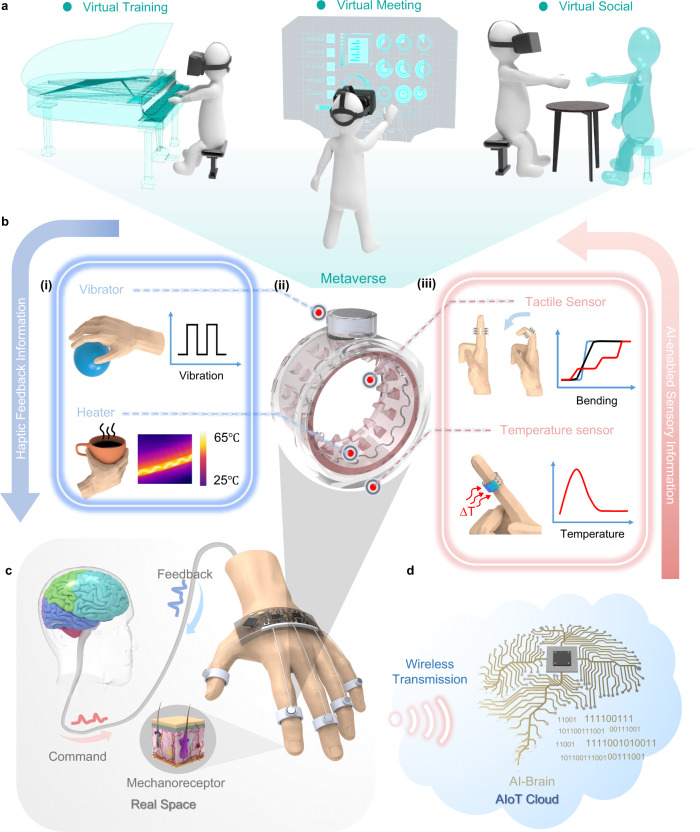
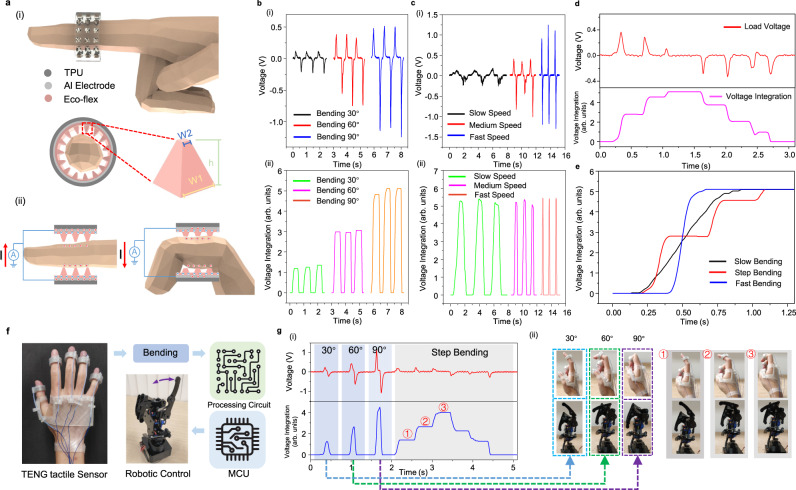
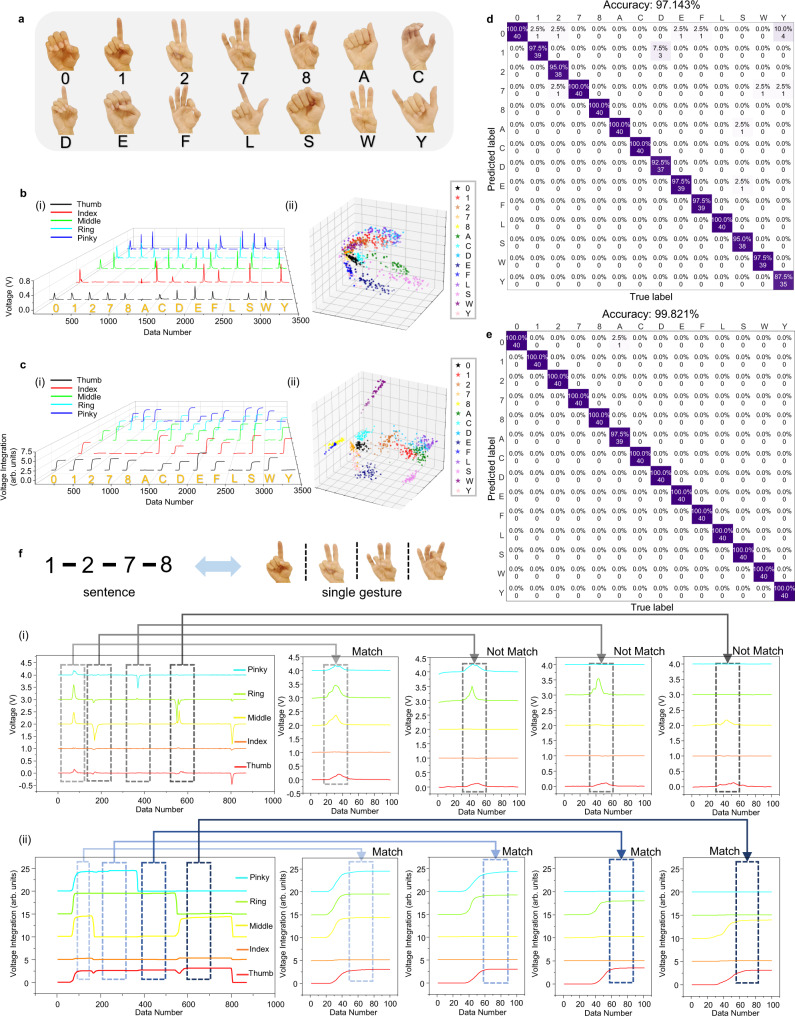
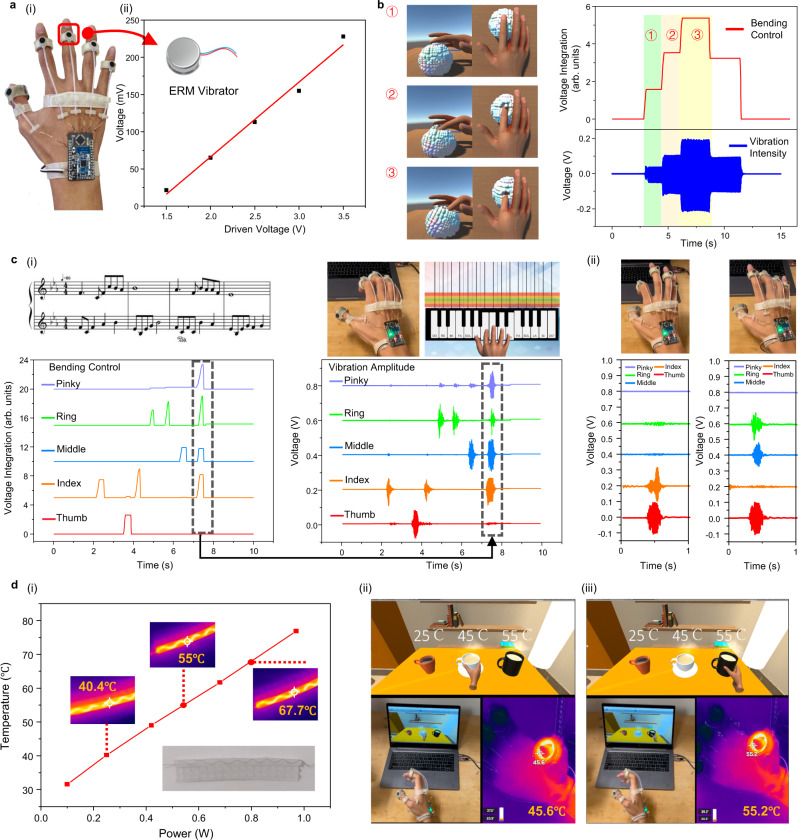
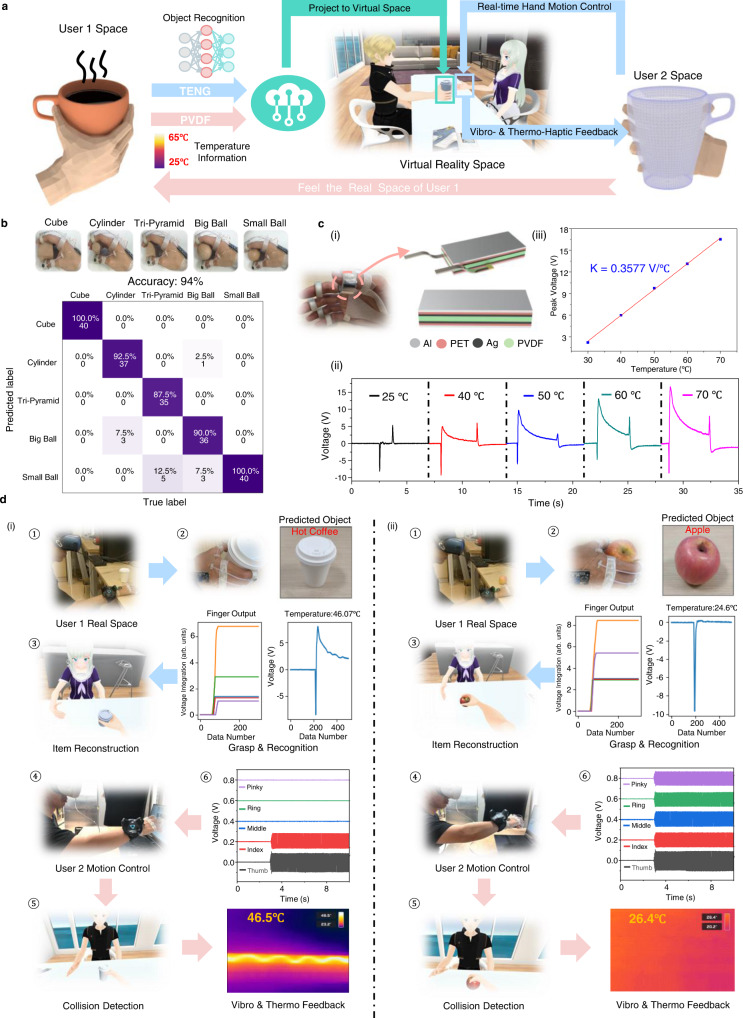
Advancements of virtual reality technology pave the way for developing wearable devices to enable somatosensory sensation, which can bring more comprehensive perception and feedback in the metaverse-based virtual society. Here, we propose augmented tactile-perception and haptic-feedback rings with multimodal sensing and feedback capabilities. This highly integrated ring consists of triboelectric and pyroelectric sensors for tactile and temperature perception, and vibrators and nichrome heaters for vibro- and thermo-haptic feedback. All these components integrated on the ring can be directly driven by a custom wireless platform of low power consumption for wearable/portable scenarios. With voltage integration processing, high-resolution continuous finger motion tracking is achieved via the triboelectric tactile sensor, which also contributes to superior performance in gesture/object recognition with artificial intelligence analysis. By fusing the multimodal sensing and feedback functions, an interactive metaverse platform with cross-space perception capability is successfully achieved, giving people a face-to-face like immersive virtual social experience.
Overview
The claims and statistics of this paper haven’t been checked yet.
Free: it reads the open-access text and checks the first 5 claims that cite a source we can check. Create a free account to check every claim.
Integrity signals
Registry
Cites
Statistics
Figures
Verification
Claims the paper makes
The claims and statistics of this paper haven’t been checked yet.
Free: it reads the open-access text and checks the first 5 claims that cite a source we can check. Create a free account to check every claim.
Claims other papers make about this one
Each is checked against this paper’s own text: does it say what the citing paper says it does?
In the citing paper
“Additionally, immersive interactions in virtual reality (Fig. 1g, h) 50,51 and driver behavior monitoring in intelligent vehicles (Fig. 1i) [52][53][54] rely on HMIP technology to accurately capture complex motion intentions.”
From Recent advances in intelligent wearable systems: from multiscale biomechanical features towards human motion intent prediction (2026) · cites this paper as [51]
Self-check
Percentages, sums and reported differences re-computed from the paper’s own numbers.
The self-check needs the paper’s full text.
Citations
Cites
Vision based hand gesture recognition for human computer interaction: a survey
Rautaray, S. S., & Agrawal, A. (2015) · Artificial Intelligence Review · doi:10.1007/s10462-012-9356-9 · Cited by 1,526
Learning the signatures of the human grasp using a scalable tactile glove
Sundaram, S., Kellnhofer, P., Li, Y., Zhu, J.-Y., Torralba, A., & Matusik, W. (2019) · Nature · doi:10.1038/s41586-019-1234-z · Cited by 1,162
Conductive Fiber‐Based Ultrasensitive Textile Pressure Sensor for Wearable Electronics
Lee, J., Kwon, H., Seo, J., Shin, S., Koo, J. H., Pang, C., Son, S., Kim, J. H., Jang, Y. H., Kim, D. E., et al. (2015) · Advanced Materials · doi:10.1002/adma.201500009 · Cited by 1,152
3D Virtual worlds and the metaverse: Current status and future possibilities
Dionisio, J. D. N., III, W. G. B., & Gilbert, R. (2013) · ACM Computing Surveys · doi:10.1145/2480741.2480751 · Cited by 1,151
Skin-integrated wireless haptic interfaces for virtual and augmented reality
Yu, X., Xie, Z., Yu, Y., Lee, J., Vazquez-Guardado, A., Luan, H., Ruban, J., Ning, X., Akhtar, A., Li, D., et al. (2019) · Nature · doi:10.1038/s41586-019-1687-0 · Cited by 1,025
Self-citationSign-to-speech translation using machine-learning-assisted stretchable sensor arrays
Zhou, Z., Chen, K., Li, X., Zhang, S., Wu, Y., Zhou, Y., Meng, K., Sun, C., He, Q., Fan, W., et al. (2020) · Nature Electronics · doi:10.1038/s41928-020-0428-6 · Cited by 841
Pyroelectric materials and devices for energy harvesting applications
Bowen, C. R., Taylor, J., LeBoulbar, E., Zabek, D., Chauhan, A., & Vaish, R. (2014) · Energy Environ. Sci. · doi:10.1039/c4ee01759e · Cited by 836
Highly Stretchable and Transparent Metal Nanowire Heater for Wearable Electronics Applications
Hong, S., Lee, H., Lee, J., Kwon, J., Han, S., Suh, Y. D., Cho, H., Shin, J., Yeo, J., & Ko, S. H. (2015) · Advanced Materials · doi:10.1002/adma.201500917 · Cited by 788
Pyroelectric Nanogenerators for Harvesting Thermoelectric Energy
Yang, Y., Guo, W., Pradel, K. C., Zhu, G., Zhou, Y., Zhang, Y., Hu, Y., Lin, L., & Wang, Z. L. (2012) · Nano Letters · doi:10.1021/nl3003039 · Cited by 784
Zhu, M., Sun, Z., Zhang, Z., Shi, Q., He, T., Liu, H., Chen, T., & Lee, C. (2020) · Science Advances · doi:10.1126/sciadv.aaz8693 · Cited by 784
Self-citation
Cited by
Items 501–600 of 626
Adaptive Live Tactile Streaming With Scalable Coding for Immersive Communications
Song, J., Gao, Y., Wu, D., & Zhou, L. (2025) · IEEE Transactions on Mobile Computing · doi:10.1109/tmc.2025.3628449 · Cited by 1
“With the miniaturization and integration of tactile devices, the density of tactile points is expected to increase exponentially [9].”
Haptic Reproduction of Virtual Textures Based on Ultrasonic Interference Principle
Chen, S., Feng, W. J., Liu, A., Wang, Y., Li, K., Ru, W., Feng, K., Zhang, S., & Yang, N. (2025) · Applied Sciences · doi:10.3390/app152111742 · Cited by 1
Lin, S., Sun, C., Huang, Y., Cheng, B., Luo, H., Zhu, M., Chen, T., Wang, F., & Sun, L. (2025) · Advanced Materials Technologies · doi:10.1002/admt.202501844 · Cited by 1
“Sun et al. implement a haptic feedback loop that can provide people with a face-to-face immersive virtual social experience through friction electric sensors, which enables gesture recognition with the assistance of deep learning [ 36 ].”
Self-citationParikesit, A. A., Ansori, A. N. M., Kharisma, V. D., Purnobasuki, H., & Nugraha, Y. (2025) · International review of cytology · doi:10.1016/bs.ircmb.2025.11.004 · Cited by 1
A Flexible Wearable Electret Haptic Actuator for Human–Machine Interaction
Wan, H., Feng, R., Chen, Y., Wang, X., Chen, H., Chen, T., Li, W., Chen, Z., Liu, Z., Jiao, J., et al. (2025) · IEEE Transactions on Industrial Electronics · doi:10.1109/tie.2025.3621596 · Cited by 1
“I N virtual reality (VR) and augmented reality (AR) environments, the transmission of tactile information has been proven to effectively enhance the immersive experience of interactions [1], [2].”
Bio‐inspired Displays: Toward Intelligent Systems With Active Perception and Adaptive Interfaces
Yang, W., Peng, Y., Zou, Z., Zhang, J., Guo, T., ZHANG, Y., Yan, Q., Wu, C., & Zhou, X. (2026) · Advanced Materials · doi:10.1002/adma.202521854 · Cited by 2
Ryu, G., Lee, J., Na, H., Seol, I., Lee, J., Kim, K., & Lee, W. G. (2026) · Advanced Materials Technologies · doi:10.1002/admt.202502160 · Cited by 1
Yao, X., Yan, Y., Zhong, Y., & Wang, L. (2026) · International Journal of Information Technologies and Systems Approach · doi:10.4018/ijitsa.402023 · Cited by 1
Son, J., Kang, J. H., Park, J., Ku, Y.-G., Lee, Y., Kim, J., Kim, M., Lee, J. H., Shin, J., Song, M., et al. (2026) · Advanced Science · doi:10.1002/advs.75103 · Cited by 1
Ji, H., Li, Y., Zhang, Y., Zhang, H., Hu, X., & Luo, Y. (2026) · CHI Conference on Human Factors in Computing Systems · doi:10.1145/3772318.3791751 · Cited by 1
Textile emitter for AI-enhanced human–machine interaction
Sun, Y., Cui, X., Kong, G., Li, J. B., Chen, X., Xu, J., Xu, C., Jin, P., Hou, T., Pan, H., et al. (2026) · National Science Review · doi:10.1093/nsr/nwag231 · Cited by 1
Low-Channel EMG Gesture Recognition via Sparse-To-Dense Representation Learning
Kim, K. K., & Bao, Z. (2026) · IEEE International Conference on Acoustics Speech and Signal Processing · doi:10.1109/icassp55912.2026.11463598 · Cited by 1
Yang, W., Ouyang, L., Guo, Y., Han, M., & Luo, S. (2026) · Journal of Materials Chemistry A · doi:10.1039/d6ta01923d · Cited by 1
A Flexible Vibrotactile Interface for Immersive Metaverse Interaction
Liu, J., Wang, X., Ke, P., Li, J., Chen, H., Yuan, H., & Jiao, J. (2026) · ACS Applied Materials & Interfaces · doi:10.1021/acsami.6c04893 · Cited by 1
Ma, W., Wu, H., Ding, S., Zhang, R., Trần, V. T., Chen, X., Sun, G., An, J., & Duan, X. (2026) · International Journal of Extreme Manufacturing · doi:10.1088/2631-7990/ae6e02 · Cited by 1
“As the window for communications between users and devices, conventional bulky and rigid VR/AR interfaces are facing challenges in precisely perceiving human activities due to their constrained portability and comfortability [4] .”
Ding, W., Chen, W., Chen, G., Chen, Y., Xia, X., Kang, W., Liu, Z., Li, Y., & Yang, W. (2026) · International Journal of Smart and Nano Materials · doi:10.1080/19475411.2026.2672486 · Cited by 1
Origami‐Mediated Low‐Voltage Electret Soft Robotic Actuators for Human‐Machine Haptic Interfaces
Chen, H., He, Y., Liu, J., Yuan, Y., Li, J., Qian, Y., Wang, K., Jiao, J., & Yeow, C. (2026) · Advanced Science · doi:10.1002/advs.75712 · Cited by 1
Simulation of Tilt Sensor for Hand Motion Capture, Expression, and Haptic Feedback
Chen, C., Zhan, F., Tian, B., Zhou, Y., Wang, Y., Qiang, X., Mao, M., Wang, L., & Song, G. (2026) · Advanced Functional Materials · doi:10.1002/adfm.76275 · Cited by 1
“In the context of gesture recognition, sensors typically capture variations in contact area resulting from finger bending or palm sliding, thereby realizing real-time monitoring of hand movements and mapping these motions to control interfaces in virtual reality (VR) or robotic systems [23–26].”
Prasanna, A. P. S., Anithkumar, M., Sundhar, A. S. R., Bincy, T. S., Park, K.-I., Alluri, N. R., & Kim, S.-J. (2026) · Chemical Engineering Journal · doi:10.1016/j.cej.2026.178140 · Cited by 1
Zhao, H., Qu, X., Yang, B., Cheng, T., Cheng, X., Li, M., Tang, B., Kang, X., Lai, Z., Shen, J., et al. (2026) · Advanced Functional Materials · doi:10.1002/adfm.76572 · Cited by 1
“Second, feedback mapping strategies are underdeveloped—the relationship between tactile features and stimulation parameters remains simplistic, resulting in limited dimensionality and naturalness of the feedback [43–49].”
Bioinspired heliconical auxetic biofibers for intelligent biomechanical surveillance
Zhou, Y., Wang, X., Wang, Y., Xie, L., Qiang, Y., Wang, W., Li, L., Yue, O., & Liu, X. (2026) · Science Advances · doi:10.1126/sciadv.aed6233 · Cited by 1
“S20 and table S3) ( 31 , 46 – 48 ).”
Wei, X., Wang, M., Li, Y., Wang, X., Tao, J., Yan, M., Zheng, B., Dong, J., & Zheng, H. (2026) · Chemical Engineering Journal · doi:10.1016/j.cej.2026.178584 · Cited by 1
Transforming static interfaces into tactile channels with steerable transdermal foci
Liu, Q., Tang, Y., Luo, J., Xue, W., Lin, Z., Liu, Z., Luo, M., Wang, J., Ma, X., Pan, J., et al. (2026) · Science Advances · doi:10.1126/sciadv.aef2372 · Cited by 1
“However, existing ways to deliver information through these interfaces typically rely on simple actuators such as linear resonant actuators, eccentric rotating mass motors, or thermal regulators that provide only single-point or low-resolution information ( 20 – 23 ).”
Lee, E.-I., Kang, C.-Y., Hwang, K., Kim, J., & Park, J. (2026) · Advanced Science · doi:10.1002/advs.76616 · Cited by 1
Microfluidic-enabled stretchable thermoelectric device array for multimodal haptic interfaces
Cheng, D., Huang, Z., Chen, T., Xie, H., Yang, L., Wang, Y., Ji, J., Liu, J., Jiang, Y., Wu, T., et al. (2026) · Microsystems & Nanoengineering · doi:10.1038/s41378-026-01384-0 · Cited by 1
“Human skin constitutes a natural multisensory interface for haptics, leveraging its dense network of subdermal thermoreceptors and mechanoreceptors as innate biological gateways 3 – 5 .”
Wang, L., Chen, Z., Liu, S., Ding, Y., Li, D. K., Zhang, Z., Huang, Z. S., Song, Y., Zhou, H., & Tian, Y. (2026) · Advanced Functional Materials · doi:10.1002/adfm.76947 · Cited by 1
“With the continuous progress of wearable electronic devices [1, 2], soft robotics [3, 4], and immersive interaction technologies [5], flexible sensors that can work stably under large deformation conditions have become indispensable front-end devices connecting human motion information with digital…”
Bistable haptic textiles for immersive somatosensory augmentation and sensory substitution
Zhang, Z., Chen, S., Yang, Z., Emu, L., Wei, P., Jia, C., Liu, Y., Yan, W., Lu, Y., Huang, Y., et al. (2026) · Nature Sensors · doi:10.1038/s44460-026-00120-5 · Cited by 1
“27 and 28).”
Li, J., Yin, G., Gu, C., Mo, Y., Li, C., Wang, S., Zhang, X., Xu, X., Guo, Z., & Wei, S. (2026) · Chemical Engineering Journal · doi:10.1016/j.cej.2026.181086 · Cited by 1
Kim, S., Lim, G.-Y., Kim, S., & Lee, J. (2023) · Fashion & Textile Research Journal · doi:10.5805/sfti.2023.25.3.398 · Cited by 1
Recent advances in hand movement rehabilitation system and related strategies
Wang, D., Meng, C., Wang, M., Liu, D., Liu, T., & Guo, S. (2023) · Mechatronics Technology · doi:10.55092/mt20230003 · Cited by 1
Introduction to Haptic Systems
Kim, S., & Lee, D. Y. (2024) · KAIST research series · doi:10.1007/978-981-99-8598-2_1 · Cited by 1
Metaverse-Driven Advances in Immersive VR Experiences for Behaviour Analysis and Skill Development
Gupta, N., Sharma, K., Kumar, S., & Kumar, P. (2024) · Advances in e-business research series · doi:10.4018/979-8-3693-2422-6.ch010 · Cited by 1
Thermosensitive wearable sensing technologies with intelligent robotics
Tiwari, N., & Lazzari, M. (2024) · Device · doi:10.1016/j.device.2024.100362 · Cited by 1
Transforming Problematic Employees into Contributing Members: A Strategic Framework
Jesus, J. B. (2025) · ASEAN Journal of Management & Innovation · doi:10.14456/ajmi.2025.16 · Cited by 1
Nakhle, F. (2023) · UnitusOpen (Tuscia University) · Cited by 1
Triboelectric Nanogenerator as Wearable Sensing Devices
Wen, F., He, T., Yang, Y., Wang, C., & Lee, C. (2023) · Springer eBooks · doi:10.1007/978-3-031-05722-9_42-1
Self-citationResearch on a flexible optical tactile sensor based on a liquid lens structure
Hu, R., Yang, H., Wang, L., & Fan, L. (2023) · Advanced Sensor Systems and Applications · doi:10.1117/12.2686776
“Among them, the optical tactile sensor has the advantages of no electromagnetic interference, simple structure, low power consumption, wide dynamic range, and high resolution 13,14 .”
BackgroundA shadow enabled non-invasive probe for multi-feature intelligent liquid surveillance system
Lian, L., Zhang, Q., Li, W., Wang, B., & Liang, Q. (2023) · Nanoscale · doi:10.1039/d3nr04983c
A Porous SEBS-Based Breathable Triboelectric Nanogenerator for Human Gesture Recognition
Shrestha, K., Pradhan, G. B., Raza, M. S., & Park, J. Y. (2024) · IEEE International Conference on Micro Electro Mechanical Systems (MEMS) · doi:10.1109/mems58180.2024.10439365
E-Learning and Surgery: The Value of Sharing Knowledge
Luna, M. R. R., & Perretta, S. (2023) · New paradigms in healthcare · doi:10.1007/978-3-031-47623-5_3
The Interface of Minds Human-Machine Interaction in the Digital Age
Vanisri, K., & Padhy, P. C. (2024) · Advances in computational intelligence and robotics book series · doi:10.4018/979-8-3693-2015-0.ch002
Object classification based on impulse response analysis using vibration propagation
Nozawa, T., & Sawada, H. (2024) · SICE Journal of Control Measurement and System Integration · doi:10.1080/18824889.2024.2377865
Development of Triboelectric Nanoenergy and Nanosystem (Tribo-NENS)
Lee, C., Sun, Z., & Zhang, Z. (2024) · IEEE International Conference on Nanotechnology (IEEE-NANO) · doi:10.1109/nano61778.2024.10628879
“[ 25] Reproduced with permission, Copyright 2022, Springer Nature.”
BackgroundMethodSelf-citationRole of ZnO Capping Layer for Stability in Silver-nanowire-based Functional Heater Arrays
Kim, S., Lee, D., Liu, Q., Jin, M., Hou, B., Park, S., Kim, J.-Y., Um, D., & Kim, C.-I. (2024) · Sensors and Materials · doi:10.18494/sam5137
Active Mechanical Haptics Constructed with Curved Origami
Zhang, Z., & Jiang, H. (2024) · Wiley eBooks · doi:10.1002/9783527842308.ch14
Sankar, B., Dhuraisamy, A. K., Sindhu, S., & Rajath, S. (2024) · International Conference on Computing, Communication and Networking Technologies (ICCCNT) · doi:10.1109/icccnt61001.2024.10724103
Liu, M., Chen, T., & Zhu, M. (2025) · Lecture notes in mechanical engineering · doi:10.1007/978-981-96-1191-1_34
Self-citationShu, L., Yao, H., Liu, J., Xiong, Q., Mingyu, T., Wang, J., Wu, X., Ma, Y., Lin, C., Lin, Y., et al. (2025) · Research Square · doi:10.21203/rs.3.rs-6453539/v1
Li, Y., Xu, X., He, P., Zhao, W., Li, Z., & Yang, J. (2025) · Lecture notes in electrical engineering · doi:10.1007/978-981-96-5314-0_50
The Future of Tactile Haptics: Emerging Technologies and Novel Applications
Vito, P. D. C. S., Macdonald, S. A., Wilson, G., Freeman, E., & Brewster, S. A. (2025) · Springer eBooks · doi:10.1007/978-3-319-27648-9_117-1
Developing and Analyzing a Novel Multimodal Stroke Rehabilitation System for Stroke Patients
Alsheikhy, A. A., Shawly, T., Said, Y., & Alazzam, M. B. (2025) · Journal of Disability Research · doi:10.57197/jdr-2025-0670
Thermo-Haptics in Virtual Reality
Juneja, S. K. (2025) · Indian Journal of Computer Science and Technology · doi:10.59256/indjcst.20250402045
Oraif, I., & Aldaghri, A. A. (2025) · Preprints.org · doi:10.20944/preprints202509.1419.v1
Reducing Pain and Improving Mobility Using Haptic Patch Technology: Results of the RESTORE Study
Fason, J., Hurwitz, P. L., & Gudin, J. A. (2025) · Pain and Therapy · doi:10.1007/s40122-025-00780-0
“Past research has shown that haptic VTT generates a feedback response to tactile sensations through bidirectional communication [4–6].”
Chen, Z., Fu, Y., Deng, C., Zhao, C., Liu, Z., Chen, Y., Yan, H., Chen, Z., Lin, L., & Zheng, G. (2025) · Advanced Functional Materials · doi:10.1002/adfm.202518269
TouchWalker: Real-Time Avatar Locomotion from Touchscreen Finger Walking
Park, G., Yi, J., Rhee, T. J., Kim, K. K., & Lee, Y. (2025) · Proceedings - International Symposium on Mixed and Augmented Reality, ISMAR · doi:10.1109/ismar67309.2025.00068
“…tactile feedback—such as vibrotactile and thermal stimuli—can signifi-cantly enhance immersive virtual experiences by supporting continuous perception and realistic touch interaction [25], while Li et al. show that kinesthetic gloves can significantly strengthen user-avatar association [18].”
Audio, Vibrotactile, and Visual Augmentation of an Electric Guitar: A Pilot Study
Paté, A., Cambourian, P., Berthaut, F., & Légal, B. (2024) · Computer Music Journal · doi:10.1162/comj.a.681
M-Ring: A Lightweight Ring for Gesture Interaction and User Authentication With Multimodal Fusion
Chen, S., Cheng, Y., Tan, Y., Tang, C., Zheng, Q., Zou, Y., Leung, V. C. M., & Wu, K. (2025) · IEEE Internet of Things Journal · doi:10.1109/jiot.2025.3637178
“Noteworthy is that although studies like ATH-Rings [42] have achieved ultrahigh accuracy, they rely on bulky multimodal sensor arrays in a glove form factor and do not incorporate user authentication.”
Synthesis and Characterization of All-polymer Electrically Conductive Hydrogels
Nguyen, D. M. (2024) · Library, Museums and Press - UDSpace (University of Delaware) · doi:10.58088/6g0m-6977
Durukan, M. B. (2023) · OpenMETU (Middle East Technical University)
Wearable Fabric Electrotactile System for VR with Surround-Inhibitory Electrodes Units
Yao, H., Li, D., Zhang, W., Xiong, Q., Luo, Y., Lin, C., Wang, J., Liu, J., Mingyu, T., Wu, X., et al. (2026) · Cyborg and Bionic Systems · doi:10.34133/cbsystems.0515
“In recent years, many studies have been devoted to the integration of tactile feedback into virtual experiences [ 4 , 10 – 15 ].”
Fu, K., Zhao, J., Deng, J., Zhao, C., Wang, X., & Qiu, L. (2026) · IEEE Sensors Journal · doi:10.1109/jsen.2026.3652555
“…open-loop configuration, failing to provide users with truly natural human–computer tactile feedback, which consequently limits the fidelity of bidirectional interaction and restricts the system’s effectiveness in scenarios requiring precise operations and high-accuracy feedback [32], [33], [34].”
(2026) · Elsevier eBooks · doi:10.1016/b978-0-44-327410-7.00040-5
Digitalizing olfactory and tactile senses with 6G
Parichenko, A., Sousa, B. G., Nuthalapati, S., Yin, C., Gao, Y., Riemenschneider, L., Rosenkranz, R., Huang, S., Li, S.-C., Altinsoy, M. E., et al. (2026) · Elsevier eBooks · doi:10.1016/b978-0-44-327410-7.00028-4
Luo, Z., Qin, X., Wang, Z., Zhang, B., Zheng, C., Liu, D., & Li, J. (2026) · Procedia CIRP · doi:10.1016/j.procir.2025.09.028
Teng, J., Cho, S., & Zhang, S. (2026) · The Visual Computer · doi:10.1007/s00371-026-04426-w
Zou, X., Li, X. X., Zhang, J., Chan, C. P. Y., Zhao, Z., & Lai, K. W. C. (2025) · IEEE International Conference on Nano/Molecular Medicine and Engineering (NANOMED) · doi:10.1109/nanomed68094.2025.11431485
Heterogeneous-Sensing Bionic Skin for 3-D Force-Vector Measurement and Slip Characterization
Liu, F., Yang, C., Yang, W., Li, S., Zheng, H., Zhao, H., Li, H., & Xia, H. (2026) · IEEE Transactions on Instrumentation and Measurement · doi:10.1109/tim.2026.3676101
“Because E-skin may encounter complex multidimensional mechanical forces and multiphysics field coupling environments in practical applications [17], the development of multimodal sensing technologies and improvement of the overall performance remain key research topics [18], [19], [20].”
Advanced Simulation: The End of the Sandbox
Yassin, A. (2026) · IntechOpen eBooks · doi:10.5772/intechopen.1014573
Exploring immersion through a fMRI-compatible multi-finger handheld haptic display
Byun, J., Hwang, J., Chung, Y., Jeong, H., Kim, J., & Kim, K. (2026) · PLoS ONE · doi:10.1371/journal.pone.0343297
“I understand the limitations of sample size; however, this is not an adequate reason not to conduct fMRI analysis to modern analysis standards.”
Smart AR-Based Sign Language Recognition System for Real-Time Communication and Translation
Singh, P., Kaur, K. P., & Samriti (2026) · International Conference on Intelligent Data Communication Technologies and Internet of Things (IDCIoT) · doi:10.1109/idciot67589.2026.11455761
“[2] Most of these systems can only recognise single gestures, not full sentences, and they often lack easy to use interfaces.”
Wang, H., Shi, J. Y., Huang, Y., Jiang, S., Wang, K., Wu, K., & Che, G. (2026) · Polymer · doi:10.1016/j.polymer.2026.129960
Scalvini, F. (2024) · theses.fr (ABES) · doi:10.70675/124e9e0ez3d6fz4222zb982zae7427d8fe28
Direct Resolution of Three-Dimensional Gaze for Spatial Interaction via a Smart Contact LensPreprint
Ren, T., Jia, X., Zhao, B., Yin, J., Li, H., Pan, J., Xu, Z., Wang, Z., Tao, L., & Yang, Y. (2026) · Research Square · doi:10.21203/rs.3.rs-9214452/v1
Virtual reality in psychological interventions for mood disorders: a scoping review
Wang, Y., Yang, K., Yang, T., Xu, P., Lin, M., Fan, Y., & Tao, Y. (2026) · BMC Psychiatry · doi:10.1186/s12888-026-08088-9
Bedard, A. E. (2026) · Digital Commons - LIU Promoting Scholarship and Creative Work of LIU Students, Faculty, and Staff (Long Island University)
Virtual Reality Simulation in Disaster Nursing Education and Training: A Scoping Review
Li, F., Wang, Y., Cui, Y., Xie, H., Benxian, X., Wang, Y., Peng, J., & Han, R. (2026) · Journal of Clinical Nursing · doi:10.1111/jocn.70358
Xuan, G., Zhao, X., Xiulong, Y., Jiaxin, Y., & Miaomiao, C. (2026) · Theory and Practice of Science and Technology · doi:10.47297/taposatwsp2633-456927.20260702
He, J., Jiang, S., Su, H., Cao, R., Zhen, Y., & Pan, Y. (2026) · CCF Transactions on Pervasive Computing and Interaction · doi:10.1007/s42486-026-00228-0
Jin, J., Mao, C., Liu, W., Li, Y., Mei, D., & Wang, Y. (2026) · Nature Communications · doi:10.1038/s41467-026-73973-6
“15), which proves good durability for the pixel sensing array.”
Bincy, T. S., Prasanna, A. P. S., Anithkumar, M., Madhuri, B. S., Sundhar, A. S. R., & Kim, S.-J. (2026) · Advanced Composites and Hybrid Materials · doi:10.1007/s42114-026-01910-8
“Due to their versatile modes of operation, TENGs have been widely employed as mechano-electric transducers in various sensing and interactive applications, such as wearables [2], human-machine interaction systems [3], haptic interfaces [4], AR/VR technology [5], and healthcare [6].”
Cai, Z., & Zhang, A. (2026) · Micromachines · doi:10.3390/mi17060694
Robot-Assisted Oral Examination: Challenges and Innovations
Ge, Y., Wang, W., Zhao, T., Liu, D., Fan, S., Liu, P., Li, W., Sun, H., & Liu, X. (2026) · International Dental Journal · doi:10.1016/j.identj.2026.109670
Susanti, R., & Rahman, R. (2025) · Journal of Humanities Research Sustainability · doi:10.70177/jhrs.v2i3.2244
A Low Voltage‐Powered Flexible Electroosmotic Actuator for Wearable Haptics
Fu, X., Liu, J., Gao, J., Xu, J., Huang, J. Y., & Liu, K. (2026) · Small · doi:10.1002/smll.74308
Higoshi, H., Satoshi, U., Yamashita, K., & Shigemune, H. (2026) · Nano Energy · doi:10.1016/j.nanoen.2026.112165
Chen, X., Shu, Y., Tang, X., Zang, K., Dai, J., & Li, Y. (2026) · Displays · doi:10.1016/j.displa.2026.103598
An Over 10 7 Cycles Non‐Contact Vector Angle Sensor
Liu, G., Song, H., Wei, Y., Chen, X., Wang, Y., Li, C., Qiu, W., Li, X. J., Wang, Z., & Pan, L. (2026) · Advanced Functional Materials · doi:10.1002/adfm.77043
Sense the Machine: Using Multi-Modal Cues for Providing Intelligent Guidance
Zafari, S., Kröninger, L., Puthenkalam, J., & Tscheligi, M. (2026) · ACM Transactions on Interactive Intelligent Systems · doi:10.1145/3830236
“This setup reproduces the iterative problem-solving and precision adjustment aspects typical of industrial parameter tuning, while remaining practical for controlled user studies.”
Badalov, K., Kim, J., Koh, K. X., Ooi, K. C., Tseng, H. A., Hung, P. C. K., & Yoon, Y. (2026) · Enterprise Information Systems · doi:10.1080/17517575.2026.2688388
Flexible tactile sensors: Five core challenges and system-level integration bottlenecks
Chen, Y., Wang, Z., Liu, Z., Gao, P., Yi, X., Zhao, S., Zhang, Z., Zhang, S., & Liu, S. (2026) · Chemical Engineering Journal · doi:10.1016/j.cej.2026.179651
Kong, G., Zhang, L., & Kim, J. (2026) · International Journal of Pattern Recognition and Artificial Intelligence · doi:10.1142/s0218001426400252
Sobue, M., Kon, S., Mizoguchi, I., Yem, V., & Kajimoto, H. (2026) · Lecture notes in computer science · doi:10.1007/978-3-032-32350-7_6
Flexible Tactile Actuator Arrays With Integrated Electroosmotic Pumps for Wearable Haptic Systems
Yu, H., & Bae, J. (2026) · Advanced Materials Technologies · doi:10.1002/admt.71205
A Cross-Domain Orthogonal Spherical Interface for Bidirectional Haptic Human Robot InteractionPreprint
Ding, W., Li, S., Li, X. J., Liang, C., 叶悬冰, Hou, W., Lin, Z., Jiao, C., He, M., Li, J., et al. (2026) · Research Square · doi:10.21203/rs.3.rs-10403008/v1
Body-coupled self-powered piezoresistive sensing for human-machine interaction
Ma, G., Zhang, T., Ma, K., Xiong, S., Zhang, M., Gu, C., Ba, K., Li, J., & Yu, B. (2026) · Chemical Engineering Journal · doi:10.1016/j.cej.2026.180434
Perception‐Feedback Mapping Strategies for Flexible Human–Machine Interfaces
Yang, R., Xu, S., Pang, W., & Zhang, Y. (2026) · Advanced Materials · doi:10.1002/adma.74589
Bhatt, S., & Das, D. (2026) · Management Review Quarterly · doi:10.1007/s11301-026-00624-x
Metadata
- Authors
- Sun, Z., Zhu, M., Shan, X., & Lee, C.
- Affiliations
- National University of Singapore (SG)
- Agency for Science, Technology and Research (SG)
- Corresponding author
- Lee, Chengkuo
- Venue
- Nature Communications
- Published
- 2022-09-05
- Volume
- 13
- Issue
- 1
- Pages
- 5224-5224
- ISSN
- 2041-1723 (ISSN-L)
- PMC
- PMC9445040
- OpenAlex
- W4294677009
- Semantic Scholar
- 1111bab7ad7ca5d988212dd9c6c60bc4d8786fe7
- Cited by
- 532
- References
- 70
- Citations by year
- 2026: 79 · 2025: 164 · 2024: 160 · 2023: 120 · 2022: 9
- FWCI
- 32.87
- Type
- journal article
- Language
- en
- Open access
- gold
- doi.org
- Licence
- cc-by
- creativecommons.org/licenses/by/4.0 (tdm)
- creativecommons.org/licenses/by/4.0 (vor)
- Locations
- Nature Communications (publishedVersion, cc-by)
- PubMed Central (publishedVersion, cc-by)
- PubMed (publishedVersion)
- RePEc: Research Papers in Economics (submittedVersion)
- DOAJ (DOAJ: Directory of Open Access Journals) (submittedVersion, cc-by-sa)
- Funders
- National University of Singapore (A-0005947-20-00)
- National Key Research and Development Program of China (2019YFB2004800, R‐2020‐S‐002)
- Topics
- Physical Sciences › Engineering › Biomedical Engineering › Advanced Sensor and Energy Harvesting Materials
- Life Sciences › Neuroscience › Cognitive Neuroscience › Tactile and Sensory Interactions
- Physical Sciences › Engineering › Mechanical Engineering › Teleoperation and Haptic Systems
- Keywords
- wearable devices, virtual reality, somatosensory perception, gesture recognition, multimodal sensing, metaverse
- MeSH terms
- Haptic Technology, Artificial Intelligence, Feedback, Humans, Touch, Touch Perception
About these checks
Registry, retraction, Cites and statistics results are computed, not judged, with one exception: a printed reference that no index lists is read once by a model before it counts as a citation error. Claims are extracted by a model and kept only when their quote appears verbatim in the text; each cited source is then checked, with a model’s help, for whether it says what the claim relies on. Those verdicts can be wrong — read the claim’s quote and the cited source before relying on one.
Statistics and arithmetic are recomputed, not judged.
Confidence bands are shown only for fields calibrated on our annotated test set. None is calibrated yet, so no band is shown.
What counts as a claim ›How we measure confidence ›How we check this ›
Are you an author, or do you see a problem with this page? Request a review
Data sources
Bibliographic data: Semantic Scholar, OpenAlex, Crossref.
Contains information from the Semantic Scholar Academic Graph Datasets, made available under the ODC Attribution License (ODC-BY 1.0).
Semantic Scholar’s data is described in: Kinney, R., et al. (2023). The Semantic Scholar Open Data Platform. arXiv:2301.10140.
