

Augmented tactile-perception and haptic-feedback rings as human-machine interfaces aiming for immersive interactions
Open accessThe DOI matches its Crossref record; 70 of the 70 references it cites were found in a registry or an index.
Abstract
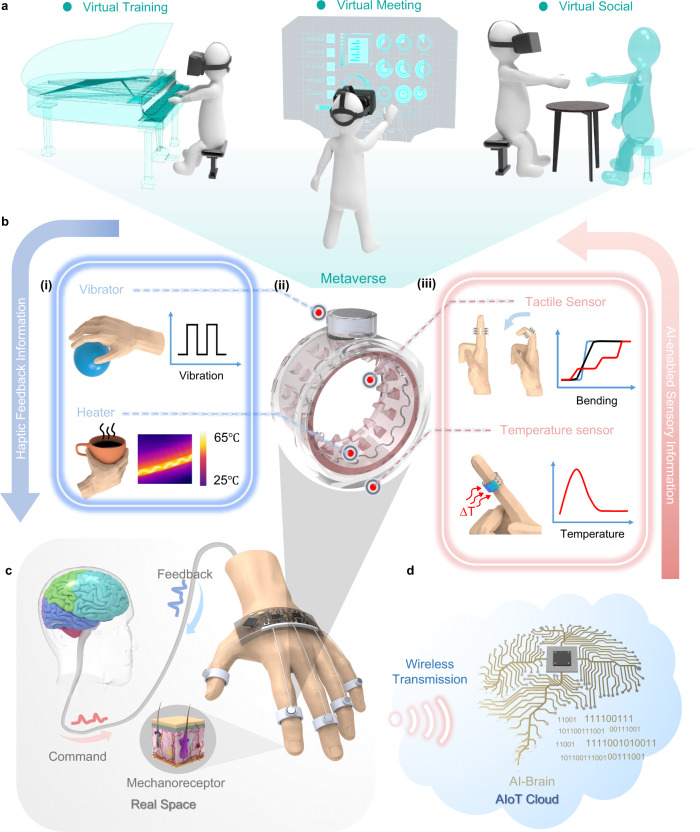
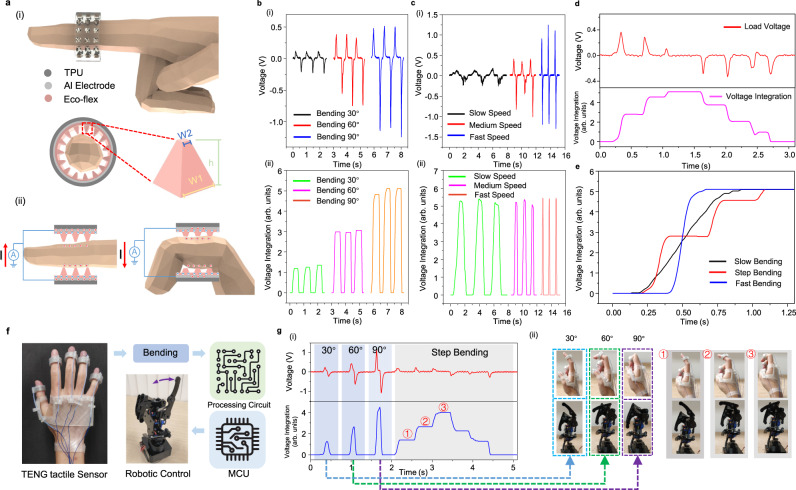
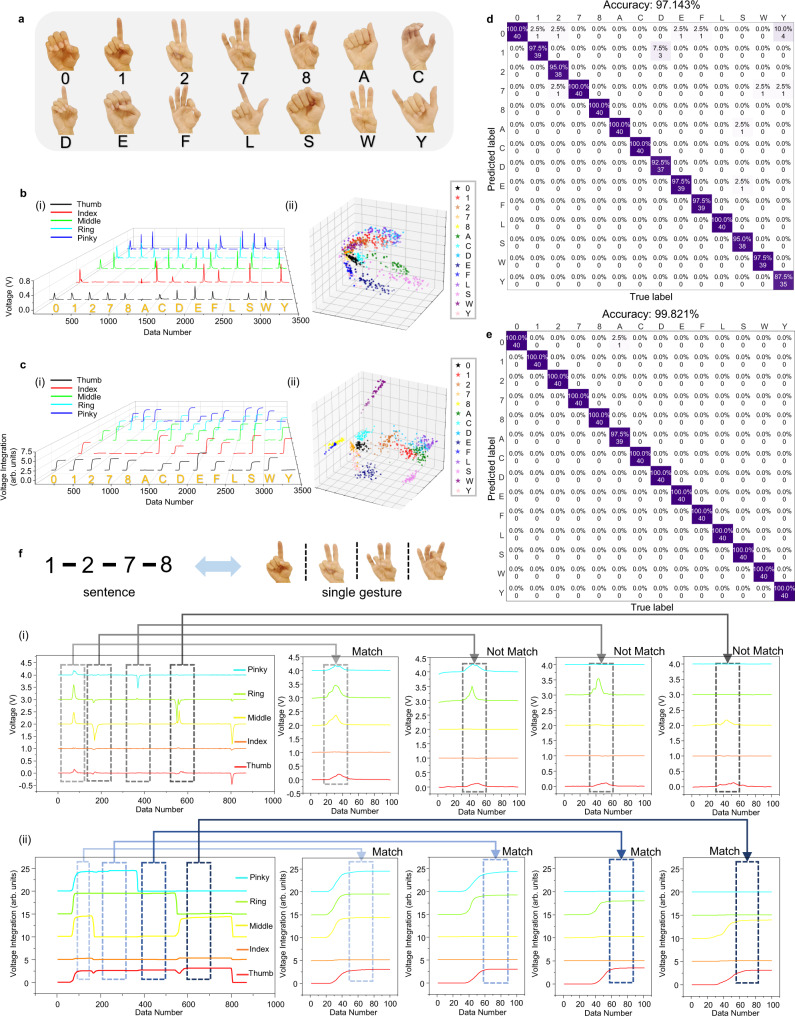
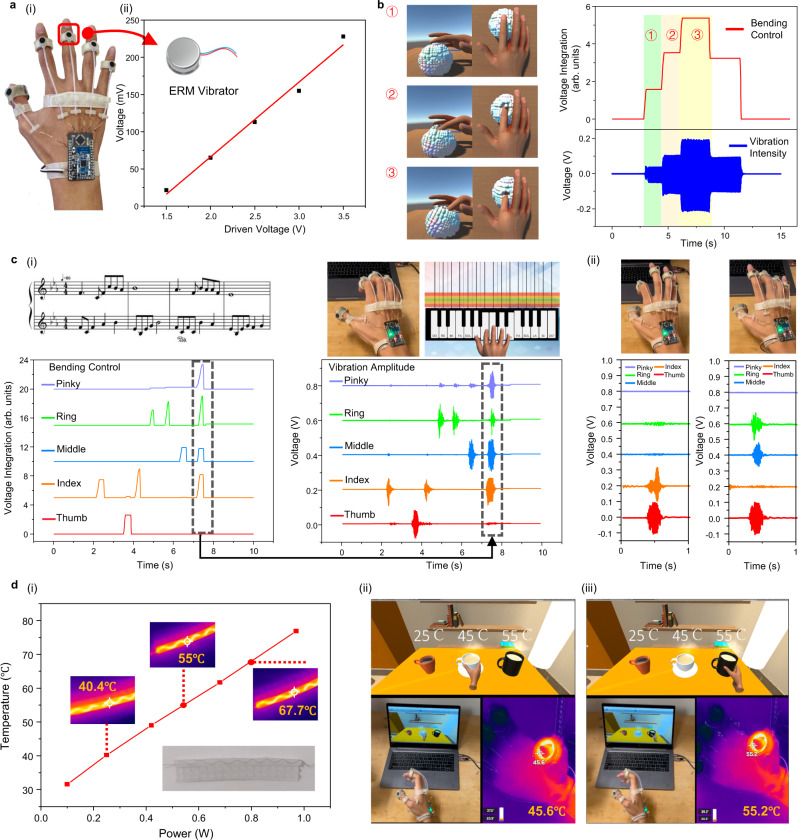
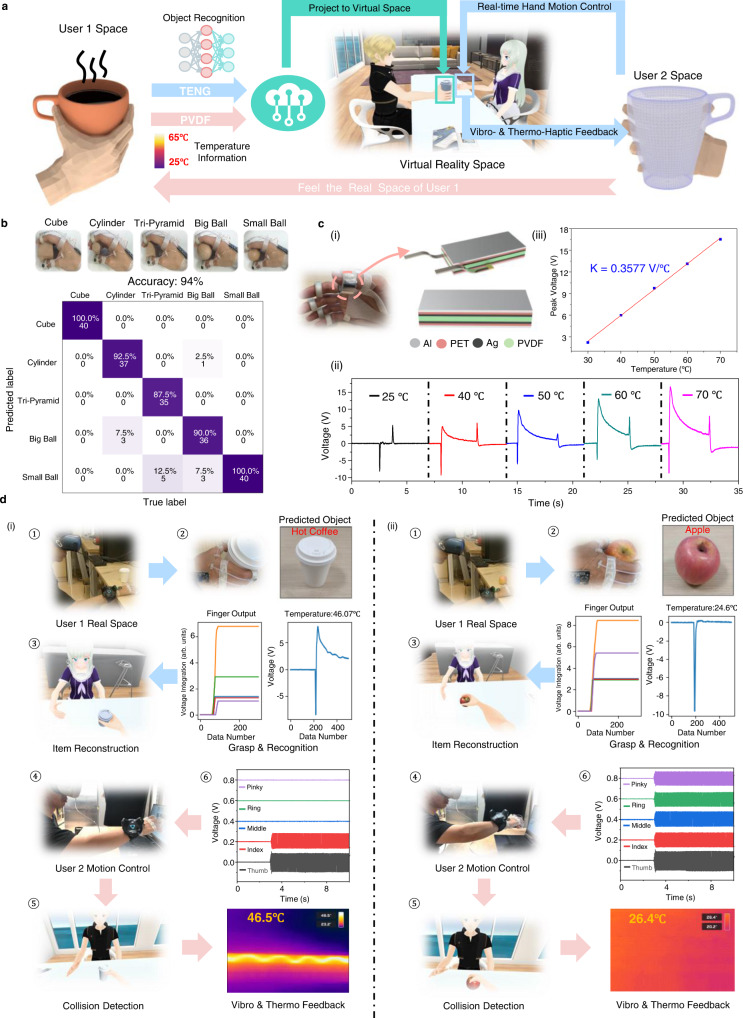
Advancements of virtual reality technology pave the way for developing wearable devices to enable somatosensory sensation, which can bring more comprehensive perception and feedback in the metaverse-based virtual society. Here, we propose augmented tactile-perception and haptic-feedback rings with multimodal sensing and feedback capabilities. This highly integrated ring consists of triboelectric and pyroelectric sensors for tactile and temperature perception, and vibrators and nichrome heaters for vibro- and thermo-haptic feedback. All these components integrated on the ring can be directly driven by a custom wireless platform of low power consumption for wearable/portable scenarios. With voltage integration processing, high-resolution continuous finger motion tracking is achieved via the triboelectric tactile sensor, which also contributes to superior performance in gesture/object recognition with artificial intelligence analysis. By fusing the multimodal sensing and feedback functions, an interactive metaverse platform with cross-space perception capability is successfully achieved, giving people a face-to-face like immersive virtual social experience.
Overview
The claims and statistics of this paper haven’t been checked yet.
Free: it reads the open-access text and checks the first 5 claims that cite a source we can check. Create a free account to check every claim.
Integrity signals
Registry
Cites
Statistics
Figures
Verification
Claims the paper makes
The claims and statistics of this paper haven’t been checked yet.
Free: it reads the open-access text and checks the first 5 claims that cite a source we can check. Create a free account to check every claim.
Claims other papers make about this one
Each is checked against this paper’s own text: does it say what the citing paper says it does?
In the citing paper
“Additionally, immersive interactions in virtual reality (Fig. 1g, h) 50,51 and driver behavior monitoring in intelligent vehicles (Fig. 1i) [52][53][54] rely on HMIP technology to accurately capture complex motion intentions.”
From Recent advances in intelligent wearable systems: from multiscale biomechanical features towards human motion intent prediction (2026) · cites this paper as [51]
Self-check
Percentages, sums and reported differences re-computed from the paper’s own numbers.
The self-check needs the paper’s full text.
Citations
Cites
Vision based hand gesture recognition for human computer interaction: a survey
Rautaray, S. S., & Agrawal, A. (2015) · Artificial Intelligence Review · doi:10.1007/s10462-012-9356-9 · Cited by 1,526
Learning the signatures of the human grasp using a scalable tactile glove
Sundaram, S., Kellnhofer, P., Li, Y., Zhu, J.-Y., Torralba, A., & Matusik, W. (2019) · Nature · doi:10.1038/s41586-019-1234-z · Cited by 1,162
Conductive Fiber‐Based Ultrasensitive Textile Pressure Sensor for Wearable Electronics
Lee, J., Kwon, H., Seo, J., Shin, S., Koo, J. H., Pang, C., Son, S., Kim, J. H., Jang, Y. H., Kim, D. E., et al. (2015) · Advanced Materials · doi:10.1002/adma.201500009 · Cited by 1,152
3D Virtual worlds and the metaverse: Current status and future possibilities
Dionisio, J. D. N., III, W. G. B., & Gilbert, R. (2013) · ACM Computing Surveys · doi:10.1145/2480741.2480751 · Cited by 1,151
Skin-integrated wireless haptic interfaces for virtual and augmented reality
Yu, X., Xie, Z., Yu, Y., Lee, J., Vazquez-Guardado, A., Luan, H., Ruban, J., Ning, X., Akhtar, A., Li, D., et al. (2019) · Nature · doi:10.1038/s41586-019-1687-0 · Cited by 1,025
Self-citationSign-to-speech translation using machine-learning-assisted stretchable sensor arrays
Zhou, Z., Chen, K., Li, X., Zhang, S., Wu, Y., Zhou, Y., Meng, K., Sun, C., He, Q., Fan, W., et al. (2020) · Nature Electronics · doi:10.1038/s41928-020-0428-6 · Cited by 841
Pyroelectric materials and devices for energy harvesting applications
Bowen, C. R., Taylor, J., LeBoulbar, E., Zabek, D., Chauhan, A., & Vaish, R. (2014) · Energy Environ. Sci. · doi:10.1039/c4ee01759e · Cited by 836
Highly Stretchable and Transparent Metal Nanowire Heater for Wearable Electronics Applications
Hong, S., Lee, H., Lee, J., Kwon, J., Han, S., Suh, Y. D., Cho, H., Shin, J., Yeo, J., & Ko, S. H. (2015) · Advanced Materials · doi:10.1002/adma.201500917 · Cited by 788
Pyroelectric Nanogenerators for Harvesting Thermoelectric Energy
Yang, Y., Guo, W., Pradel, K. C., Zhu, G., Zhou, Y., Zhang, Y., Hu, Y., Lin, L., & Wang, Z. L. (2012) · Nano Letters · doi:10.1021/nl3003039 · Cited by 784
Zhu, M., Sun, Z., Zhang, Z., Shi, Q., He, T., Liu, H., Chen, T., & Lee, C. (2020) · Science Advances · doi:10.1126/sciadv.aaz8693 · Cited by 784
Self-citation
Cited by
Items 301–400 of 626
Skin-Integrated Soft Wearable XR Interfaces for Seamless and Realistic User Experience
Pyun, K. R., Park, J. J., Ahn, J., Lee, Y. S., Kim, H., Kim, J., Yoon, S., Ha, K.-H., Seo, D., Rogers, J. A., et al. (2025) · Chemical Reviews · doi:10.1021/acs.chemrev.4c00966 · Cited by 13
Xia, K., Yang, S., Qiang, D., Prendergast, O. D., Xu, Z., Reddyhoff, T., & Yu, M. (2026) · eScience · doi:10.1016/j.esci.2026.100630 · Cited by 13
Recent Advances in Materials, Designs and Applications of Skin Electronics
Yao, K., Yang, Y., Wu, P., Zhao, G., Wang, L., & Yu, X. (2022) · IEEE Open Journal of Nanotechnology · doi:10.1109/ojnano.2022.3218960 · Cited by 13
“[86] proposed augmented tactile-perception and haptic-feedback”
BackgroundPotentials of the Metaverse for Robotized Applications in Industry 4.0 and Industry 5.0
Kaigom, E. G. (2024) · Procedia Computer Science · doi:10.1016/j.procs.2024.02.005 · Cited by 13
Yang, N., Fan, C., Chen, H., Tang, M., Hu, J., & Zhang, Z. (2024) · Chemical Engineering Journal · doi:10.1016/j.cej.2024.156512 · Cited by 13
Xue, Y., Weng, Z., Xiang, Q., Liao, N., & Xue, W. (2024) · Ceramics International · doi:10.1016/j.ceramint.2024.10.059 · Cited by 12
Xu, X., Gao, F., Tian, L., Yang, Z.-Y., Yu, Z., Shang, J., Li, R., & Li, X. (2025) · Matter · doi:10.1016/j.matt.2025.102265 · Cited by 12
Low-voltage wearable tactile display with thermo-pneumatic actuation
Mazzotta, A., Taccola, S., Cesini, I., Sanchez, M., Harris, R. A., & Mattoli, V. (2025) · npj Flexible Electronics · doi:10.1038/s41528-025-00426-3 · Cited by 12
“For example, in virtual realityapplications -ranging from healthcare to gaming and augmented reality - 3,27,76 users often interact with digital objects by touching or grasping them.”
Ding, S., Xu, F., Jie, C., Liang, S., Zhang, H., & Huang, W. (2026) · Progress in Materials Science · doi:10.1016/j.pmatsci.2026.101733 · Cited by 12
MXene-Based Bilayer Structures with Multiresponsive Actuating and Sensing Multifunctions
Song, P., Ma, J.-N., Ma, B., Wang, K., Zhang, D., Li, Q., Wang, H., & Sang, S. (2024) · ACS Applied Nano Materials · doi:10.1021/acsanm.4c01111 · Cited by 12
Triboelectric encoders for accurate and durable wearable motion sensing
Wang, T., Li, C., Gao, Z., Wang, Z., Min, G., Wang, W. K., Shang, Y., & Tang, W. (2024) · Device · doi:10.1016/j.device.2024.100525 · Cited by 12
Zou, X., Li, X., Zhang, J., Pan, Q., Yang, Z., & Lai, K. W. C. (2024) · Cell Reports Physical Science · doi:10.1016/j.xcrp.2024.102287 · Cited by 12
Wang, B., Zhao, J., Ni, F., Qiu, L., & Wang, X. (2024) · ACS Applied Materials & Interfaces · doi:10.1021/acsami.4c20660 · Cited by 12
Tang, C., Wang, P., Li, Z., Zhong, S., Yang, L., & Li, G. (2024) · Neural Regeneration Research · doi:10.4103/nrr.nrr-d-24-00613 · Cited by 11
“Before the emergence of neural interfaces, non-invasive alternatives like electrotactile or vibrotactile feedback were developed to restore sensation (Wu et al., 2018; D’Anna et al., 2019; Zollo et al., 2019; Zhu et al., 2020; Sun et al., 2022).”
A critical review on printed electronics and its application
Roy, S., Lakshmi Priya, K., Vasudevan, R., & Chandrasekaran, S. (2025) · Nanotechnology · doi:10.1088/1361-6528/adbcb4 · Cited by 11
“Among them haptic sensor can be featured in high sophisticated brain–machine interfa-cing and futuristic gaming application [152].”
Portable and Self-Powered Sensing AI-Enabled Mask for Emotional Recognition in Virtual Reality
He, D., Chen, H., Zhao, X., Fan, C., Xiong, K., Zhang, Y., & Zhang, Z. (2025) · ACS Applied Materials & Interfaces · doi:10.1021/acsami.5c01936 · Cited by 11
Body‐Coupled Multifunctional Human‐Machine Interfaces with Double Spiral Electrode Structure
Ma, G., Pu, L., Gu, C., Shen, H., Meng, F., Ma, K., Wang, D., Liu, L., Wang, C., Ba, K., et al. (2025) · Advanced Functional Materials · doi:10.1002/adfm.202424979 · Cited by 11
Bioinspired Self‐Assembled Gradient‐Structured Dual‐Modal Sensor with Extended Range and Durability
Gao, Y., Yang, J., Luo, Y., Zhang, X., Gao, H., Li, L., Zhang, J., Sun, T., Zu, G., Zhou, Y., et al. (2025) · Advanced Functional Materials · doi:10.1002/adfm.202507079 · Cited by 11
Tao, J., Huang, J., Tong, J., Xu, J., Ma, S., Bao, R., Wu, X., Ding, S., & Pan, C. (2025) · Advanced Functional Materials · doi:10.1002/adfm.202514646 · Cited by 11
Thabet, S., Ateya, A. A., ELAffendi, M. A., & Abo-Zahhad, M. M. (2025) · Future Internet · doi:10.3390/fi17110494 · Cited by 11
Faruk, O., Islam, M. R., Pradhan, G. B., Bhatta, T., Asaduzzaman, M., Samad, A. A., Alam, M. S., Lim, S. J., & Park, J. Y. (2025) · Advanced Functional Materials · doi:10.1002/adfm.202527394 · Cited by 11
“Among various bodyparts,thehumanhandhasmoreintricatesensoryandmotor nerves, which enable the fingers to perform complex actions in real environments, enabling expressive and sophisticated communication through gestures and finger motions [1, 5–7].”
Microsensor‐Internalized Fibers as Autonomously Controllable Soft Actuators
Lee, Y., Won, J., Kim, D., & Park, S. (2024) · Small · doi:10.1002/smll.202409742 · Cited by 11
De, S. J., & Chattopadhyay, M. (2024) · AIS Transactions on Human-Computer Interaction · doi:10.17705/1thci.00213 · Cited by 11
Cheng, S., Yang, C., Wang, Q., Canumalla, A., & Li, J. (2025) · Materials Horizons · doi:10.1039/d5mh00488h · Cited by 11
Interactive wearable digital devices for blind and partially sighted people
Xue, W., Ren, Y., Tang, Y. W., Gong, Z., Zhang, T., Chen, Z., Dong, X., Ma, X., Wang, Z., Xu, H., et al. (2025) · Nature Reviews Electrical Engineering · doi:10.1038/s44287-025-00170-w · Cited by 10
Triaxial tactile sensing for next-gen robotics and wearable devices
Yun, G., & Hu, Z. (2025) · Smart Materials and Devices · doi:10.70401/smd.2025.0012 · Cited by 10
Wang, T., Gao, Z., Li, C., Min, G., Xu, K., Zhao, E., Wang, W. K., & Tang, W. (2025) · Materials Science and Engineering R Reports · doi:10.1016/j.mser.2025.101113 · Cited by 10
Sun, Y., Li, D., Yang, R., Zhou, Z., Ji, T., Lu, B., Sun, L., & Liu, H. (2025) · Soft Science · doi:10.20517/ss.2025.68 · Cited by 10
Skin-conformal electronics for intelligent gesture recognition
Lee, I., Shin, H., Cho, H., Choi, J.-G., Wang, G., & Park, S. (2025) · Nature Reviews Electrical Engineering · doi:10.1038/s44287-025-00215-0 · Cited by 11
Microstructure engineering for tactile-enabled embodied intelligence
Pang, H., Hua, Q., & Shen, G. (2026) · Materials Horizons · doi:10.1039/d5mh01906k · Cited by 10
Su, H., Wang, H., Sang, D., Kumar, S., Xiao, D., Sun, J., & Wang, Q. (2026) · Biosensors · doi:10.3390/bios16010058 · Cited by 10
“For instance, the time delay between tactile and temperature signals may lead to a 3–5% decrease in the object recognition accuracy of ATH-Ring [102].”
InfluentialHu, Q., Xiao, L., Zhang, P., Zhang, Q., Liu, G., Qin, X., Yin, Z., Li, X., Wang, Y., & Jiang, H. (2026) · Advanced Science · doi:10.1002/advs.202520586 · Cited by 11
Li, D., Yu, L., Sun, Y., Huo, W., Ji, T., Zhou, Z., Lei, Z., Jiang, F., Liu, Y., Zhang, W., et al. (2026) · Soft Science · doi:10.20517/ss.2025.83 · Cited by 10
Powering and Sensing Advances in TENGs for Self‐Powered Sensing Systems Design
Ye, C., Zhang, R., Sun, H., & Liu, S. (2026) · Small · doi:10.1002/smll.202514433 · Cited by 10
Ra, Y., Cho, S., Guo, X., Choi, D., & Lee, C. (2026) · Nano-Micro Letters · doi:10.1007/s40820-026-02263-z · Cited by 10
“Sun et al. developed a augmented tactile perception and haptic feedback rings with multimodal sensing and mutual feedback capabilities [172].”
Self-citationGe, C., Li, R., Zhou, L., An, X., Duan, Z., Chen, J., Li, Y., Zhang, S., Hu, P., Wang, Z., et al. (2023) · Advanced Intelligent Systems · doi:10.1002/aisy.202200398 · Cited by 10
A self-powered and self-sensing wave energy harvesting system for the sea-crossing bridge
Zhou, J., Tang, H., Zeng, L., Zhang, Z., Zhao, J., Li, A., Kong, L., Tang, M., & Hu, Y. (2024) · Materials Today Nano · doi:10.1016/j.mtnano.2024.100500 · Cited by 10
Lu, X. D., Gong, Y., Zhang, H., Tan, H., Zheng, Q., Xu, L. J., Jin, T., Li, L., Zhang, Q., Yue, T., et al. (2024) · Advanced Functional Materials · doi:10.1002/adfm.202405321 · Cited by 10
A Force-Thermal-Magnetic Trimodal Flexible Sensor for Ultrafine Recognition of Metallic Materials
Peng, L., Xu, J., Yuan, S., Li, S., Deng, S., Zhu, H., Fu, L., Zhang, T., & Li, T. (2024) · ACS Applied Materials & Interfaces · doi:10.1021/acsami.4c17296 · Cited by 10
Thin and Flexible Breeze-Sense Generators for Non-Contact Haptic Feedback in Virtual Reality
Zhang, K., Liu, J. Z., Zhou, Y., Li, Z., Zhao, D., Guan, X., Lan, T., Gong, Y., Zhou, B., & Zhong, J. (2025) · Nano-Micro Letters · doi:10.1007/s40820-025-01670-y · Cited by 10
“Lee et al. employed vibration and Joule heat to enhance realism in the metaverse [39].”
Sensory Fiber-Based Electronic Device as Intelligent and Natural User Interface
Wei, X., Xiang, S., Meng, C., Chen, Z., Cao, S., Hong, J., Duan, S., Liu, L., Zhang, H., Shi, Q., et al. (2025) · Advanced Fiber Materials · doi:10.1007/s42765-025-00524-x · Cited by 10
Bioinspired programmable cilia array for enhanced tactile perception
Li, M., Hou, Z., Mou, Y., Xu, Y., Wu, X., Qiu, Y., Zeng, Y., Luo, S., Chen, S., & Lu, D. (2025) · Nano Energy · doi:10.1016/j.nanoen.2025.110924 · Cited by 10
EXTENDED REALITY IN INDUSTRY: PAST, PRESENT AND FUTURE PERSPECTIVES
Spadoni, E., Bordegoni, M., Carulli, M., & Ferrise, F. (2023) · Proceedings of the Design Society · doi:10.1017/pds.2023.185 · Cited by 10
“It is worth pointing out that the sense of touch is one of the most interesting senses in the Metaverse (Sun et al., 2022).”
BackgroundChen, S., Peng, C., Yang, B., Lin, J., Zhou, L., Jiang, Z., Liu, Z., Liu, Y., & Tang, L. (2026) · npj Artificial Intelligence · doi:10.1038/s44387-026-00083-5 · Cited by 9
Embodied Perception, Interaction, and Cognition for Wearable Robotics: A Survey
Wu, X., Liang, J., Yu, Y., Li, G., Yen, G. G., & Yu, H. (2024) · IEEE Transactions on Cognitive and Developmental Systems · doi:10.1109/tcds.2024.3463194 · Cited by 9
“Furthermore, augmented tactile-perception and haptic-feedback rings with multimodal sensing and feedback capabilities are proposed in [151].”
Zhang, Q., Li, Z., Li, Z., Jin, T., Zheng, Q., Xu, L. J., Zhang, Q., Peng, Y., & Lee, C. (2025) · Nano Energy · doi:10.1016/j.nanoen.2025.110946 · Cited by 9
“[32] to address the continuous contact-separation motion, we propose a method of adding a sliding TENG (S-TENG) on the lateral side of the M-SF-TENG for bending direction identification, as shown in Fig.”
Self-citationZhang, Q., Pang, Z., Lu, R., He, H., Ziemann, U., & Gao, Z. (2025) · Neural Plasticity · doi:10.1155/np/9100284 · Cited by 9
“More importantly, integrating sensor technology with neuromodulation techniques holds promise for noninvasively targeting multiple neural circuits and providing personalized, precise rehabilitation plans through closed loop stimulation paradigms [134].”
Stretchable multimodal sensor arrays for hardness perception in bionic skin
Ji, J., Huang, Z., Xie, H., Wang, Y., Chen, T., Yang, L., Jiang, Y., Liu, J., Cheng, D., Wu, T., et al. (2025) · Nano Research · doi:10.26599/nr.2025.94907759 · Cited by 9
Yang, Z., Gao, F., Yu, F., Tian, L., Xu, X., Zhang, Y., Li, X., Shang, J. K., Li, R., Yu, Z., et al. (2026) · Advanced Functional Materials · doi:10.1002/adfm.202525831 · Cited by 9
Irregular situations in real-world intelligent systems
Mishra, A., & Kim, S. (2023) · Advances in computers · doi:10.1016/bs.adcom.2023.04.006 · Cited by 9
Triboelectric nanogenerator powered dielectric elastomer: Mechanism and applications
Wang, D., Liu, Z., Dong, X., Zhang, D., & Chen, X. (2023) · Chemical Physics Letters · doi:10.1016/j.cplett.2023.140795 · Cited by 9
Grid-free touch recognition on arbitrary surface using triboelectric vibration sensor
Shi, C., Ye, T., Li, X., Li, S., Mao, K., Guo, W., Zhou, J., Zhang, X., Xue, R., & Ren, Y. (2024) · Nano Energy · doi:10.1016/j.nanoen.2024.109419 · Cited by 9
Garai, M., Nguyen, V. H., Mahato, M., Oh, S., Saatchi, D., Yoo, H., Ali, S. S., Lam, D. V., Taseer, A. K., & Oh, I. (2024) · Advanced Functional Materials · doi:10.1002/adfm.202406603 · Cited by 9
Zhang, A., Wang, Y., Ma, Y., Jia, Q., Li, L., Zhang, Y., Zhang, Y., & Zhang, W. (2025) · Chemical Engineering Journal · doi:10.1016/j.cej.2025.159938 · Cited by 9
Liu, Y., Han, L., Lv, S., Jiang, T., Duan, M., Guo, H., Li, Y., Xie, Q., Chen, Y., Wang, D., et al. (2025) · Research · doi:10.34133/research.0714 · Cited by 9
A general strategy for manufacturing flexible synaptic transistors with high mechanical stability
Zhuang, B., Wang, X., An, C., Wang, C., Liu, L., Chen, H., Guo, T., & Hu, W. (2023) · Science China Materials · doi:10.1007/s40843-022-2408-7 · Cited by 9
Tactile Features of Human Finger Contact Motor Primitives
Tian, Q., Liu, J., Liu, K., & Guo, S. (2023) · IEEE Transactions on Haptics · doi:10.1109/toh.2023.3332402 · Cited by 9
“During the process, the collected tactile data not only encode the patterns of touch actions but also serve as criteria for evaluating the fidelity of the robot’s recreated actions concerning the original experienced tactile sensations [41], [42].”
BackgroundBuilding an Inclusive Metaverse: Opening Doors to a Brighter Digital Future
Bedard, A., & Zhang, Q. (2023) · Lecture notes in computer science · doi:10.1007/978-3-031-48041-6_23 · Cited by 9
Akbar, A. A., & Stefanie, A. (2023) · Emitor Jurnal Teknik Elektro · doi:10.23917/emitor.v1i1.21095 · Cited by 9
Meta-Services in Industry 5.0: A New Paradigm of Intelligent Services in Metaverses
Lyu, Y., Li, L., Jing, Z., Liang, Y., Wang, R., & Wang, F. (2024) · IEEE Transactions on Systems Man and Cybernetics Systems · doi:10.1109/tsmc.2024.3373656 · Cited by 9
“D) imaging [8], [51], haptic feedback [52], etc.”
Bae, K., Sim, S., Kang, Y., & Kim, J. (2025) · ACS Nano · doi:10.1021/acsnano.5c12667 · Cited by 8
Metaverse dynamics: enhancing trust, information sharing, and sustainable supply chain resilience
Guan, M., Lim, A., & Keoy, K. H. (2025) · Supply Chain Management An International Journal · doi:10.1108/scm-02-2025-0122 · Cited by 8
Hou, T., Chen, C., Guo, R., He, S., & Zi, Y. (2025) · Nature Communications · doi:10.1038/s41467-025-66792-8 · Cited by 8
“With advancements in arti fi cial intelligence, numerous sophisticated robots have been equipped with advanced tactile sensors, enabling them to execute accurate operations and facilitate human-like interactions with the environment 3,4 .”
Khadka, S., & Das, S. (2026) · Augmented Humans International Conference (AHs) · doi:10.1145/3795011.3795019 · Cited by 8
Recent Advances in Cutaneous Haptic Interfaces: A Review
Li, X., Guo, Y. C., Li, C., Zhang, Y., Zheng, Y., Wang, R., Yu, X., Ding, W., & Tong, Q. (2026) · SmartSys · doi:10.1002/sys3.70018 · Cited by 8
Shen, D., Luo, H., Zhao, G., Han, Z., Yang, Z., Le, X., Su, Y., Ma, R., & Zhu, L. (2026) · Science Advances · doi:10.1126/sciadv.aee7050 · Cited by 8
“Human-machine interfaces (HMIs), essential for augmenting the functionality of augmented reality ( 1 , 2 ) and virtual reality (VR) ( 3 , 4 ) systems, provide users with various interactive sensations through feedback from hand or fingertip movements ( 5 , 6 ).”
A Multi-Layered Origami Tactile Sensory Ring for Wearable Biomechanical Monitoring
Karmakar, R. S., Lin, H.-F., Huang, J., Chao, J., Liao, Y., & Lu, Y. (2024) · Biosensors · doi:10.3390/bios15010008 · Cited by 8
“In recent years, several studies were reported with regards to tactile sensing rings and their applications [66,67].”
Liu, S., Duan, X., Wen, J. L., Tian, Q., Shi, L., Dong, S., & Peng, L. (2025) · Electronics · doi:10.3390/electronics14122469 · Cited by 8
Yu, X., Liu, R., Nkenyereye, L., Wang, Z., & Ren, Y. (2024) · IEEE Transactions on Consumer Electronics · doi:10.1109/tce.2024.3373435 · Cited by 8
“Augmented reality technology, through AR glasses and smartphone apps, merges digital information with the real world, creating unique ways of interaction [4], [5].”
BackgroundXu, J. B., Feng, H., Cao, J., Zhang, B., Bao, W., Wang, L., Yin, Y., Li, H., & Zhu, G. (2023) · Nano Energy · doi:10.1016/j.nanoen.2023.108522 · Cited by 8
Zhou, D., Globa, A., & McLaughlan, R. (2025) · Lecture notes in computer science · doi:10.1007/978-3-031-92707-2_28 · Cited by 7
Liu, W., & Wang, Z. (2025) · SAGE Open · doi:10.1177/21582440251395477 · Cited by 7
“Advancements such as haptic feedback systems and neural interfaces are expected to enhance learners’ immersive experiences, offering more authentic sensory interactions for artistic practice (Tang et al., 2024; Sun et al., 2022).”
Multi-material co-extrusion for precise 3D printing of miniaturized wearable TENG sensors
Kwak, M., Lee, M., & Lee, H. (2025) · Nano Energy · doi:10.1016/j.nanoen.2025.111593 · Cited by 7
Lei, H., 谢灵杰, Qin, X., Sun, G., Huang, P., Wang, W., Lu, B., Yan, J., Wang, Y., Liu, Y. W. Q., et al. (2026) · Microsystems & Nanoengineering · doi:10.1038/s41378-025-01107-x · Cited by 7
Li, J., Li, J., Ding, Z., Chen, S., Yang, K., Ren, L., Liu, Y., & Ren, L. (2026) · Chemical Engineering Journal · doi:10.1016/j.cej.2026.177827 · Cited by 7
Porous conductive composite as piezoresistive sensors for smart safety helmet
Kim, S., Yeonhee, H. E. O., Jung, H., Yoo, J., Kim, J., & Park, Y. (2024) · Composites Science and Technology · doi:10.1016/j.compscitech.2024.110985 · Cited by 7
A Magnetic Soft Device for Tactile Haptic Actuation of the Fingertip
Costrell, S., Alam, M., Klatzky, R. L., McHenry, M. E., Walker, L. M., & Martinez, M. O. (2023) · IEEE World Haptics Conference (WHC) · doi:10.1109/whc56415.2023.10224478 · Cited by 7
“As this value is several orders of magnitude lower than the reported moduli range for other commonly used elastomers [33], Equation 4 indicates that this elastomer can be expected to produce a greater transfer of force compared to soft materials generally used in haptic studies, such as Ecoflex and Dragon Skin [35, 36…”
BackgroundPeper, J., & Kalivas, J. H. (2024) · Applied Spectroscopy · doi:10.1177/00037028241280669 · Cited by 7
“Recent advancements in IVR technology have expanded its sensory engagement beyond visual stimuli to include tactile feedback (through haptics), 16 – 18 sound using soni fi cation strategies, 19 – 21 and even olfactory feedback, 22,23 aiming to fully immerse the user into a virtual domain that…”
Enhancing Immersion and Presence in the Metaverse With Over-the-Air Brain-Computer Interface
Hieu, N. Q., Hoang, D. T., Nguyen, D. N., Nguyen, V., Xiao, Y. L., & Dutkiewicz, E. (2024) · IEEE Transactions on Wireless Communications · doi:10.1109/twc.2024.3470108 · Cited by 7
“To further enhance the user experience, the work in [5] proposed a multimodal sensing and feedback platform that could not only detect the finger motion of the users but also send haptic feedback such as vibration and heat to the users from the Metaverse.”
Force Cue Presentation by Electrical Stimulation to Lateral Side of the Finger
Nakayama, S., Ushiyama, K., & Kajimoto, H. (2024) · Lecture notes in computer science · doi:10.1007/978-3-031-70061-3_16 · Cited by 7
A Tetherless Soft Robotic Wearable Haptic Human Machine Interface for Robot Teleoperation
Thakur, S., Armas, N. D., Adegite, J. O., Pandey, R., Mead, J., Rao, P. M., & Onal, C. D. (2024) · IEEE/RSJ International Conference on Intelligent Robots and Systems (IROS) · doi:10.1109/iros58592.2024.10802410 · Cited by 7
“These haptic devices function as interactive interfaces for users in virtual environments in a wearable form factor [7][8].”
Wang, S., Liu, B., Feng, X., Pan, R., Cai, Y., Zhang, R., Pu, M., Ma, X., Li, X., Tai, H., et al. (2023) · Advanced Sensor Research · doi:10.1002/adsr.202200086 · Cited by 7
Touch Cannot Attentionally Select Signals Based on Feature Binding
Kuroki, S., & Nishida, S. (2024) · IEEE Transactions on Haptics · doi:10.1109/toh.2024.3367944 · Cited by 6
“As tactile systems are surprisingly sensitive to a wide variety of features, state-of-the-art approaches in robotics and tactile communication systems have proposed ways to combine and present multiple features in order to make the most of their richness [49], [50], [51], [52], [53].”
A Flexible Detachable Capacitive Sensor Based on Nonparallel Electrodes for Joints Angle Measurement
Huang, L., Zhao, Z., Zhang, P., Wang, J., Li, Y., Bu, X., Wang, S., Jiang, Y., & Zhang, Y. (2024) · IEEE Transactions on Instrumentation and Measurement · doi:10.1109/tim.2024.3386206 · Cited by 6
Generating multimodal textures with a soft hydro-pneumatic haptic ring
Cozcolluela, A. S., Wösten, K., & Vardar, Y. (2026) · International Journal of Human-Computer Studies · doi:10.1016/j.ijhcs.2026.103814 · Cited by 6
Yang, J., Seo, M., Jo, M., Choi, K., Lee, J., Chung, M., Koo, B., Yoo, J., & Yoon, J. (2025) · Advanced Electronic Materials · doi:10.1002/aelm.202400980 · Cited by 6
Diao, Z., Yamashita, H., & Abe, M. (2025) · Scientific Reports · doi:10.1038/s41598-025-01578-y · Cited by 6
“Incorporating Z-axis control with an integrated haptic feedback system 33,34 could provide real-time tactile perception of probe-surface interactions, enabling safer three-dimensional manipulation.”
Integrated Haptic Feedback with Augmented Reality to Improve Pinching and Fine Moving of Objects
Hamad, J., Bianchi, M., & Ferrari, V. (2025) · Applied Sciences · doi:10.3390/app15137619 · Cited by 6
Material Classification Using Visio-Tactile Sensor for Haptic Feedback Generation
Shuvo, M. G. R., Coleman, S., Kerr, D., & Quinn, J. (2025) · Communications in computer and information science · doi:10.1007/978-3-032-00986-9_24 · Cited by 6
Watkins, A., Ghosh, R., Chow, E., & Sarkar, N. (2026) · Communications Engineering · doi:10.1038/s44172-026-00817-y · Cited by 6
Noor, A., Li, Y., Tang, G., Yu, G., Dai, X., Peng, Q., Chen, H., Xu, P., Iqbal, R., Du, T., et al. (2025) · Materials Today Physics · doi:10.1016/j.mtphys.2025.101889 · Cited by 6
Kumar, V., Hwang, G. H., & Park, S. (2025) · Synthetic Metals · doi:10.1016/j.synthmet.2025.118027 · Cited by 6
Artificial skin sensation for neuroprosthetic hands
Li, Y., Li, T., Zhang, T., & Liu, Z. (2025) · FlexMat. · doi:10.1002/flm2.70019 · Cited by 6
Xu, M., Zhu, Y., Chen, Z., Fu, Y., Zhu, Z., Fan, T., Tang, Z., Li, Y., & Fu, S. (2025) · ACS Applied Materials & Interfaces · doi:10.1021/acsami.5c20611 · Cited by 6
Zhou, D., & Globa, A. (2026) · International Journal of Human-Computer Interaction · doi:10.1080/10447318.2025.2603632 · Cited by 6
“The younger adult (YA) cohort ( n ¼ 10) served as a reference comparator group, comprising participants aged 18–40 without age-related constraints (Fermoselle et al., 2020; Sun et al., 2022).”
Zheng, Y., Wang, J., Cui, T., Wang, J., Chen, Y., Ou, M., Hu, Y., & Gui, Z. (2026) · Carbohydrate Polymers · doi:10.1016/j.carbpol.2026.125025 · Cited by 6
Borucka, J., & Picchio, F. (2026) · npj Heritage Science · doi:10.1038/s40494-026-02395-w · Cited by 6
Wu, Y., Bao, K., Liang, J., Li, Z., Shi, Y., Tang, R., Xu, K. J., Wei, M., Chen, Z., Jian, J., et al. (2025) · Small Methods · doi:10.1002/smtd.202500727 · Cited by 6
Social XR: Designing An Extended Reality Application for Interaction in Long-Distance Relationships
Zhou, D., Deng, Y., Globa, A., Davies, R., Hu, Y. '., Wu, R.-X., Fu, L., & Quigley, A. J. (2024) · Australian Conference on Human-Computer Interaction (OzCHI) · doi:10.1145/3726986.3727035 · Cited by 6
Modulating the Perceived Softness of Real Objects Through Wearable Haptics
Fani, S., Ciotti, S., Pagnanelli, G., Moscatelli, A., Pra, Y. D., & Bianchi, M. (2023) · IEEE Transactions on Haptics · doi:10.1109/toh.2023.3271825 · Cited by 6
“To this aim, human studies for comparing the performance of our approach with non-Feel-through tAR [10], [11], [12] are also envisioned.”
BackgroundResult
Metadata
- Authors
- Sun, Z., Zhu, M., Shan, X., & Lee, C.
- Affiliations
- National University of Singapore (SG)
- Agency for Science, Technology and Research (SG)
- Corresponding author
- Lee, Chengkuo
- Venue
- Nature Communications
- Published
- 2022-09-05
- Volume
- 13
- Issue
- 1
- Pages
- 5224-5224
- ISSN
- 2041-1723 (ISSN-L)
- PMC
- PMC9445040
- OpenAlex
- W4294677009
- Semantic Scholar
- 1111bab7ad7ca5d988212dd9c6c60bc4d8786fe7
- Cited by
- 532
- References
- 70
- Citations by year
- 2026: 79 · 2025: 164 · 2024: 160 · 2023: 120 · 2022: 9
- FWCI
- 32.87
- Type
- journal article
- Language
- en
- Open access
- gold
- doi.org
- Licence
- cc-by
- creativecommons.org/licenses/by/4.0 (tdm)
- creativecommons.org/licenses/by/4.0 (vor)
- Locations
- Nature Communications (publishedVersion, cc-by)
- PubMed Central (publishedVersion, cc-by)
- PubMed (publishedVersion)
- RePEc: Research Papers in Economics (submittedVersion)
- DOAJ (DOAJ: Directory of Open Access Journals) (submittedVersion, cc-by-sa)
- Funders
- National University of Singapore (A-0005947-20-00)
- National Key Research and Development Program of China (2019YFB2004800, R‐2020‐S‐002)
- Topics
- Physical Sciences › Engineering › Biomedical Engineering › Advanced Sensor and Energy Harvesting Materials
- Life Sciences › Neuroscience › Cognitive Neuroscience › Tactile and Sensory Interactions
- Physical Sciences › Engineering › Mechanical Engineering › Teleoperation and Haptic Systems
- Keywords
- wearable devices, virtual reality, somatosensory perception, gesture recognition, multimodal sensing, metaverse
- MeSH terms
- Haptic Technology, Artificial Intelligence, Feedback, Humans, Touch, Touch Perception
About these checks
Registry, retraction, Cites and statistics results are computed, not judged, with one exception: a printed reference that no index lists is read once by a model before it counts as a citation error. Claims are extracted by a model and kept only when their quote appears verbatim in the text; each cited source is then checked, with a model’s help, for whether it says what the claim relies on. Those verdicts can be wrong — read the claim’s quote and the cited source before relying on one.
Statistics and arithmetic are recomputed, not judged.
Confidence bands are shown only for fields calibrated on our annotated test set. None is calibrated yet, so no band is shown.
What counts as a claim ›How we measure confidence ›How we check this ›
Are you an author, or do you see a problem with this page? Request a review
Data sources
Bibliographic data: Semantic Scholar, OpenAlex, Crossref.
Contains information from the Semantic Scholar Academic Graph Datasets, made available under the ODC Attribution License (ODC-BY 1.0).
Semantic Scholar’s data is described in: Kinney, R., et al. (2023). The Semantic Scholar Open Data Platform. arXiv:2301.10140.
