

The DOI matches its Crossref record; 23 of the 24 references it cites were found in a registry or an index.
Effectiveness of COVID-19 vaccines against Omicron and Delta hospitalisation, a test negative case-control study
Open accessPublished version of a preprint
Abstract
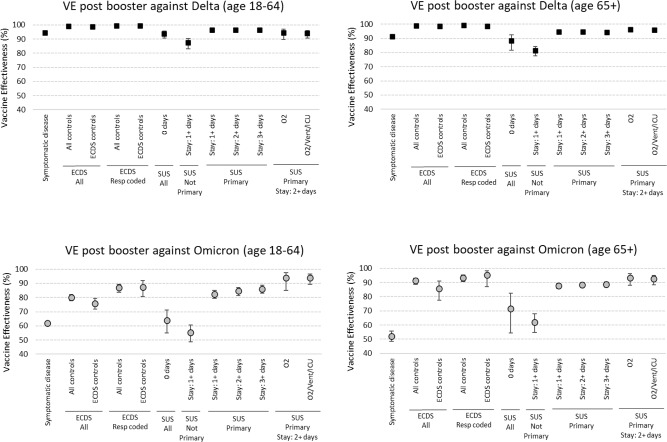
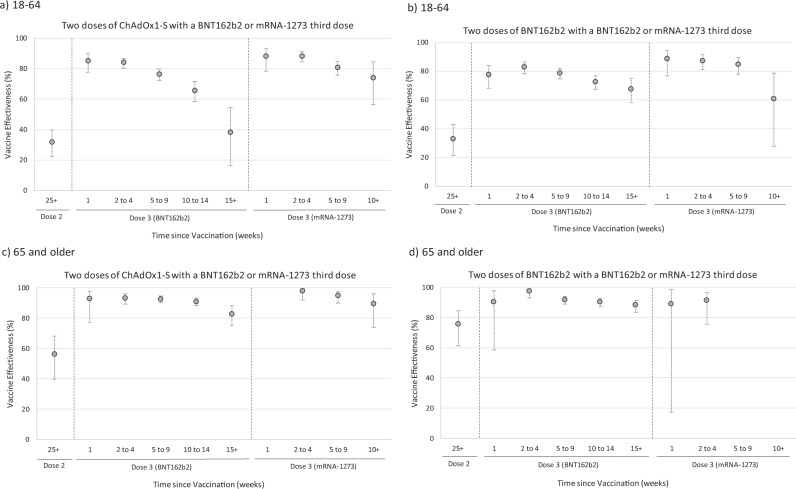
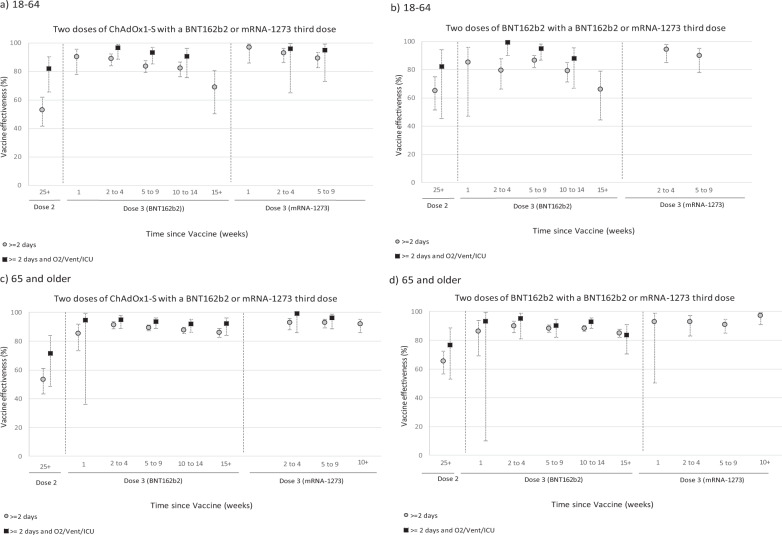
The Omicron variant has been associated with reduced vaccine effectiveness (VE) against mild disease with rapid waning. Meanwhile Omicron has also been associated with milder disease. Protection against severe disease has been substantially higher than protection against infection with previous variants. We used a test-negative case-control design to estimate VE against hospitalisation with the Omicron and Delta variants using PCR testing linked to hospital records. We investigated the impact of increasing the specificity and severity of hospitalisation definitions on VE. Among 18–64-year-olds using cases admitted via emergency care, VE after a 3rd dose peaked at 82.4% and dropped to 53.6% by 15+ weeks after the 3rd dose; using all admissions for > = 2 days stay with a respiratory code in the primary diagnostic field VE ranged from 90.9% to 67.4%; further restricting to those on oxygen/ventilated/intensive care VE ranged from 97.1% to 75.9%. Among 65+ year olds the equivalent VE estimates were 92.4% to 76.9%; 91.3% to 85.3% and 95.8% to 86.8%. Here we show that with milder Omicron disease contamination of hospitalisations with incidental cases is likely to reduce VE estimates. VE estimates increase, and waning is reduced, when specific hospitalisation definitions are used.
Overview
The claims and statistics of this paper haven’t been checked yet.
Run the check — free, no account needed. It reads the open-access text and checks the sources it cites.
Integrity signals
Registry
Cites
Statistics
Figures
Verification
Claims the paper makes
The claims and statistics of this paper haven’t been checked yet.
Run the check — free, no account needed. It reads the open-access text and checks the sources it cites.
Claims other papers make about this one
Each is checked against this paper’s own text: does it say what the citing paper says it does?
The cited source says what the claim attributes to it.
In the citing paper
“and infections would be more affected by true waning of VE [37,41].”
From Assessing COVID-19 vaccine effectiveness against Omicron subvariants: Report from a meeting of the World Health Organization (2023) · cites this paper as [41]
The cited source says what the claim attributes to it.
In the citing paper
“Additionally, a larger percentage of hospitalizations during the Omicron period likely had incidental, rather than causal, infections with SARS-CoV-2”
From Assessing COVID-19 vaccine effectiveness against Omicron subvariants: Report from a meeting of the World Health Organization (2023) · cites this paper as [41]
The cited source says what the claim attributes to it.
In the citing paper
“Since VE is lower against infection than against severe diseases (i.e. a decoupling of VE against infection and VE against severe disease) [15,17,18], VE against severe disease via hospitalization outcome would be underestimated.”
The check wasn’t confident either way, so it gives no verdict — never disputed.
In the citing paper
“To estimate VE against progression from oxygen use to mechanical ventilation or death among COVID-19 patients, additional adjustments were made for use of antivirals, monoclonal antibody therapy, steroids, anti-inflammatory drugs (tocilizumab or baricitinib), anticoagulation, and proning. These potential confounders were determined a priori based on published reports [8,9,15,17].”
From COVID-19 vaccine effectiveness against severe COVID-19 requiring oxygen therapy, invasive mechanical ventilation, and death in Japan: A multicenter case-control study (MOTIVATE study) (2024) · cites this paper as [17]
Experimental — accuracy not yet measured
Self-check
Percentages, sums and reported differences re-computed from the paper’s own numbers.
The self-check needs the paper’s full text.
Citations
Cites
Effectiveness of Covid-19 Vaccines against the B.1.617.2 (Delta) Variant
Lopez Bernal, J., Andrews, N., Gower, C., Gallagher, E., Simmons, R., Thelwall, S., Stowe, J., Tessier, E., Groves, N., Dabrera, G., et al. (2021) · New England Journal of Medicine · doi:10.1056/nejmoa2108891 · Cited by 2,889
Self-citationEffectiveness of COVID-19 vaccines against the Omicron (B.1.1.529) variant of concern
Andrews, N., Stowe, J., Kirsebom, F., Toffa, S., Rickeard, T., Gallagher, E., Gower, C., Kall, M., Groves, N., O’Connell, A.-M., et al. (2021) · doi:10.1101/2021.12.14.21267615 · Cited by 2,420
Self-citationLopez Bernal, J., Andrews, N., Gower, C., Robertson, C., Stowe, J., Tessier, E., Simmons, R., Cottrell, S., Roberts, R., O’Doherty, M., et al. (2021) · BMJ · doi:10.1136/bmj.n1088 · Cited by 1,389
Self-citationCele, S., Jackson, L., Khoury, D. S., Khan, K., Moyo-Gwete, T., Tegally, H., San, J. E., Cromer, D., Scheepers, C., Amoako, D., et al. (2021) · doi:10.1101/2021.12.08.21267417 · Cited by 1,333
Nyberg, T., Ferguson, N. M., Nash, S. G., Webster, H. H., Flaxman, S., Andrews, N., Hinsley, W., Bernal, J. L., Kall, M., Bhatt, S., et al. (2022) · The Lancet · doi:10.1016/s0140-6736(22)00462-7 · Cited by 1,221
Self-citationNyberg, T., Ferguson, N. M., Nash, S., Webster, H. H., Flaxman, S. R., Andrews, N. J., Hinsley, W. R., Bernal, J. L., Kall, M. M., Bhatt, S., et al. (2022) · Northumbria Research Link (Northumbria University) · doi:10.17863/cam.81883 · Cited by 1,129
Self-citationSARS-CoV-2 Omicron-B.1.1.529 leads to widespread escape from neutralizing antibody responses
Dejnirattisai, W., Huo, J., Zhou, D., Zahradník, J., Supasa, P., Liu, C., Duyvesteyn, H. M. E., Ginn, H. M., Mentzer, A. J., Tuekprakhon, A., et al. (2022) · Cell · doi:10.1016/j.cell.2021.12.046 · Cited by 930
Duration of Protection against Mild and Severe Disease by Covid-19 Vaccines
Andrews, N., Tessier, E., Stowe, J., Gower, C., Kirsebom, F., Simmons, R., Gallagher, E., Thelwall, S., Groves, N., Dabrera, G., et al. (2022) · New England Journal of Medicine · doi:10.1056/nejmoa2115481 · Cited by 807
Self-citationEffectiveness of BNT162b2 Vaccine against Omicron Variant in South Africa
Collie, S., Champion, J., Moultrie, H., Bekker, L.-G., & Gray, G. (2022) · New England Journal of Medicine · doi:10.1056/nejmc2119270 · Cited by 600
Effectiveness of mRNA-1273 against SARS-CoV-2 omicron and delta variants
Tseng, H. F., Ackerson, B. K., Luo, Y., Sy, L. S., Talarico, C. A., Tian, Y., Bruxvoort, K. J., Tubert, J. E., Florea, A., Ku, J. H., et al. (2022) · doi:10.1101/2022.01.07.22268919 · Cited by 541
Andrews, N., Stowe, J., Kirsebom, F., Toffa, S., Sachdeva, R., Gower, C., Ramsay, M., & Lopez Bernal, J. (2022) · Nature Medicine · doi:10.1038/s41591-022-01699-1 · Cited by 453
Self-citationReduced Neutralization of SARS-CoV-2 Omicron Variant by Vaccine Sera and Monoclonal Antibodies
Wilhelm, A., Widera, M., Grikscheit, K., Toptan, T., Schenk, B., Pallas, C., Metzler, M., Kohmer, N., Hoehl, S., Helfritz, F. A., et al. (2021) · doi:10.1101/2021.12.07.21267432 · Cited by 440
Thompson, M. G., Natarajan, K., Irving, S. A., Rowley, E. A., Griggs, E. P., Gaglani, M., Klein, N. P., Grannis, S. J., DeSilva, M. B., Stenehjem, E., et al. (2022) · MMWR. Morbidity and Mortality Weekly Report · doi:10.15585/mmwr.mm7104e3 · Cited by 398
Population Immunity and Covid-19 Severity with Omicron Variant in South Africa
Madhi, S. A., Kwatra, G., Myers, J. E., Jassat, W., Dhar, N., Mukendi, C. K., Nana, A. J., Blumberg, L., Welch, R., Ngorima-Mabhena, N., et al. (2022) · New England Journal of Medicine · doi:10.1056/nejmoa2119658 · Cited by 387
Effect of mRNA Vaccine Boosters against SARS-CoV-2 Omicron Infection in Qatar
Abu-Raddad, L. J., Chemaitelly, H., Ayoub, H. H., AlMukdad, S., Yassine, H. M., Al-Khatib, H. A., Smatti, M. K., Tang, P., Hasan, M. R., Coyle, P., et al. (2022) · New England Journal of Medicine · doi:10.1056/nejmoa2200797 · Cited by 380
Buchan, S. A., Chung, H., Brown, K. A., Austin, P. C., Fell, D. B., Gubbay, J. B., Nasreen, S., Schwartz, K. L., Sundaram, M. E., Tadrous, M., et al. (2022) · JAMA Network Open · doi:10.1001/jamanetworkopen.2022.32760 · Cited by 356
COVID-19 vaccine effectiveness against the omicron (BA.2) variant in England
Kirsebom, F. C. M., Andrews, N., Stowe, J., Toffa, S., Sachdeva, R., Gallagher, E., Groves, N., O'Connell, A.-M., Chand, M., Ramsay, M., et al. (2022) · The Lancet Infectious Diseases · doi:10.1016/s1473-3099(22)00309-7 · Cited by 182
Self-citationTartof, S. Y., Slezak, J. M., Puzniak, L., Hong, V. X., Xie, F., Ackerson, B. K., Valluri, S. R., Jódar, L., & McLaughlin, J. M. (2022) · The Lancet Respiratory Medicine · doi:10.1016/s2213-2600(22)00101-1 · Cited by 151
Hansen, C. H., Schelde, A. B., Moustsen-Helm, I. R., Emborg, H.-D., Krause, T. G., Mølbak, K., & Valentiner-Branth, P. (2021) · doi:10.1101/2021.12.20.21267966 · Cited by 133
Hyams, C. J., Marlow, R. D., Maseko, Z., King, J., Ward, L., Fox, K., Heath, R., Tuner, A., Friedrich, Z., Morrison, L., et al. (2021) · The Lancet Infectious Diseases · doi:10.1016/s1473-3099(21)00330-3 · Cited by 132
Feikin, D. R., Abu-Raddad, L. J., Andrews, N., Davies, M.-A., Higdon, M. M., Orenstein, W. A., & Patel, M. K. (2022) · Vaccine · doi:10.1016/j.vaccine.2022.04.069 · Cited by 83
Self-citationFillmore, N. R., La, J., Zheng, C., Doron, S., Do, N., Monach, P. A., & Branch‐Elliman, W. (2022) · Infection Control and Hospital Epidemiology · doi:10.1017/ice.2022.13 · Cited by 43
Nyberg, T., Ferguson, N. M., Nash, S., Webster, H. H., Flaxman, S. R., Andrews, N. J., Hinsley, W. R., Bernal, J. L., Kall, M. M., Bhatt, S., et al. (2022) · SSRN Electronic Journal · doi:10.2139/ssrn.4025932 · Cited by 30
Self-citation
Research works printed but not linked: 3
- World Health Organization. COVID-19 Weekly Epidemiological Update, Edition 82 (World Health Organization, 2022).
- Wilhelm, A. et al. Limited neutralisation of the SARS-CoV-2 Omicron subvariants BA.1 and BA.2 by convalescent and vaccine serum and monoclonal antibodies. EBioMedicine. 82, 104158 (2022). · DOI · Paper page
- Andrews, N. et al. Duration of protection against mild and severe disease by Covid-19 vaccines. New Engl. J. Med. 386, 340–350 (2022). · DOI · Paper page
Cited by
Sorted by citations
COVID-19 vaccine effectiveness against the omicron (BA.2) variant in England
Kirsebom, F. C. M., Andrews, N., Stowe, J., Toffa, S., Sachdeva, R., Gallagher, E., Groves, N., O'Connell, A.-M., Chand, M., Ramsay, M., et al. (2022) · The Lancet Infectious Diseases · doi:10.1016/s1473-3099(22)00309-7 · Cited by 182
Self-citationLewnard, J. A., McLaughlin, J. M., Malden, D. E., Hong, V. X., Puzniak, L., Ackerson, B. K., Lewin, B. J., Kim, J. S., Shaw, S. F., Takhar, H. S., et al. (2023) · The Lancet Infectious Diseases · doi:10.1016/s1473-3099(23)00118-4 · Cited by 152
Adams, K., Rhoads, J. P., Surie, D., Gaglani, M., Ginde, A. A., McNeal, T., Talbot, H. K., Casey, J. D., Zepeski, A., Shapiro, N. I., et al. (2022) · BMJ · doi:10.1136/bmj-2022-072065 · Cited by 115
Tseng, H. F., Ackerson, B. K., Bruxvoort, K. J., Sy, L. S., Tubert, J. E., Lee, G. S., Ku, J. H., Florea, A., Luo, Y., Qiu, S., et al. (2023) · Nature Communications · doi:10.1038/s41467-023-35815-7 · Cited by 105
Metadata
- Authors
- Stowe, J., Andrews, N., Kirsebom, F., Ramsay, M., & Bernal, J. L.
- Affiliations
- UK Health Security Agency (GB)
- London School of Hygiene & Tropical Medicine (GB)
- National Institute for Health and Care Research (GB)
- Corresponding author
- Stowe, Julia
- Venue
- Nature Communications
- Published
- 2022-09-30
- Volume
- 13
- Issue
- 1
- Pages
- 5736-5736
- ISSN
- 2041-1723 (ISSN-L)
- PMC
- PMC9523190
- OpenAlex
- W4298145582
- Cited by
- 166
- References
- 24
- Citations by year
- 2026: 7 · 2025: 19 · 2024: 43 · 2023: 67 · 2022: 30
- FWCI
- 19.40
- Type
- journal article
- Language
- en
- Open access
- gold
- doi.org
- Locations
- Nature Communications (publishedVersion, cc-by)
- medRxiv (acceptedVersion, cc-by-nc-nd)
- PubMed Central (publishedVersion, cc-by)
- PubMed (publishedVersion)
- RePEc: Research Papers in Economics (submittedVersion)
- DOAJ (DOAJ: Directory of Open Access Journals) (submittedVersion, cc-by-sa)
- Topics
- Health Sciences › Medicine › Infectious Diseases › SARS-CoV-2 and COVID-19 Research
- Physical Sciences › Mathematics › Modeling and Simulation › COVID-19 epidemiological studies
- Health Sciences › Medicine › Infectious Diseases › COVID-19 Clinical Research Studies
- Keywords
- COVID-19 vaccines, vaccine effectiveness, Omicron variant, Delta variant, hospitalization, waning vaccine effectiveness, test-negative case-control design, third dose, older adults, emergency department admission
- MeSH terms
- COVID-19, SARS-CoV-2, COVID-19 Vaccines, Hospitalization, Humans, Oxygen, Vaccination, Case-Control Studies
About these checks
Registry, retraction, Cites and statistics results are computed, not judged, with one exception: a printed reference that no index lists is read once by a model before it counts as a citation error. Claims are extracted by a model and kept only when their quote appears verbatim in the text; each cited source is then checked, with a model’s help, for whether it says what the claim relies on. Those verdicts can be wrong — read the claim’s quote and the cited source before relying on one.
Statistics and arithmetic are recomputed, not judged.
Confidence bands are shown only for fields calibrated on our annotated test set. None is calibrated yet, so no band is shown.
What counts as a claim ›How we measure confidence ›How we check this ›
Are you an author, or do you see a problem with this page? Request a review
