

Hardware-aware training for large-scale and diverse deep learning inference workloads using in-memory computing-based accelerators
Open accessThe DOI matches its Crossref record; 92 of the 95 references it cites were found in a registry or an index; 15 of the 38 sources its claims cite were checked for support.
Abstract
Analog in-memory computing-a promising approach for energy-efficient acceleration of deep learning workloads-computes matrix-vector multiplications but only approximately, due to nonidealities that often are non-deterministic or nonlinear. This can adversely impact the achievable inference accuracy. Here, we develop an hardware-aware retraining approach to systematically examine the accuracy of analog in-memory computing across multiple network topologies, and investigate sensitivity and robustness to a broad set of nonidealities. By introducing a realistic crossbar model, we improve significantly on earlier retraining approaches. We show that many larger-scale deep neural networks-including convnets, recurrent networks, and transformers-can in fact be successfully retrained to show iso-accuracy with the floating point implementation. Our results further suggest that nonidealities that add noise to the inputs or outputs, not the weights, have the largest impact on accuracy, and that recurrent networks are particularly robust to all nonidealities.
Overview
CoChat Summary
TL;DR
The paper develops a hardware-aware retraining framework for analog in-memory computing (AIMC) and shows that many large DNNs, including CNNs, RNNs, and transformers, can be brought to iso-accuracy or near-iso-accuracy on a realistic PCM-based crossbar model. Across 11 benchmarks, five reached the paper’s 99% iso-accuracy target, and the average accuracy gap fell from 11.3% to 1.1% at 1 h after programming.
Key findings
- The benchmark covered 11 medium- to large-scale DNNs spanning image classification, speech-to-text, and NLP, with model sizes from 0.3M to 108M parameters, depths up to 121 layers, and crossbar utilization from 4% to 86%.
- With hardware-aware (HWA) retraining, the normalized accuracies at 1 h after programming were all above 97%, and 5/11 workloads reached the paper’s 99% iso-accuracy target.
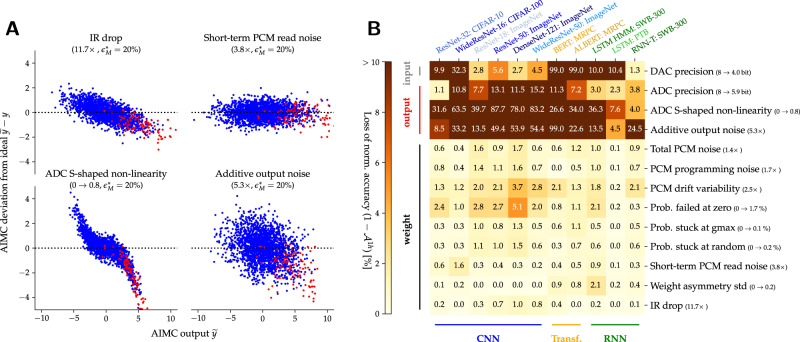
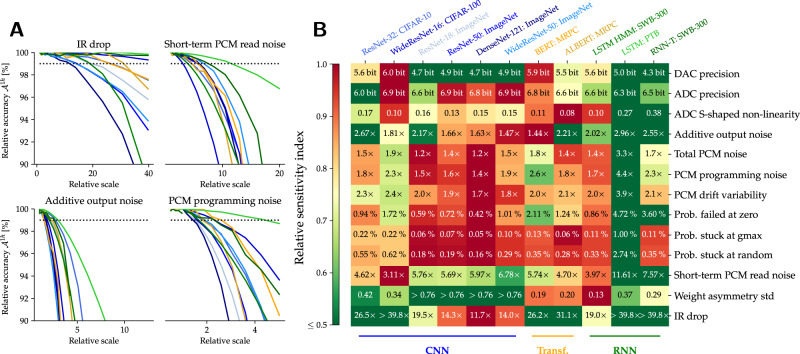
- Among the tested nonidealities, those that add noise to inputs or outputs had the largest impact on DNN accuracy, including ADC/DAC resolution, additive output noise, and S-shaped ADC nonlinearity.
- CNNs were the most sensitive topology and RNNs the least sensitive; some RNNs and transformers remained near iso-accuracy even after long-term PCM drift, while HWA-trained models for Speech-SWB300 and LSTM-PTB stayed iso-accurate out to 1 year.
Methods
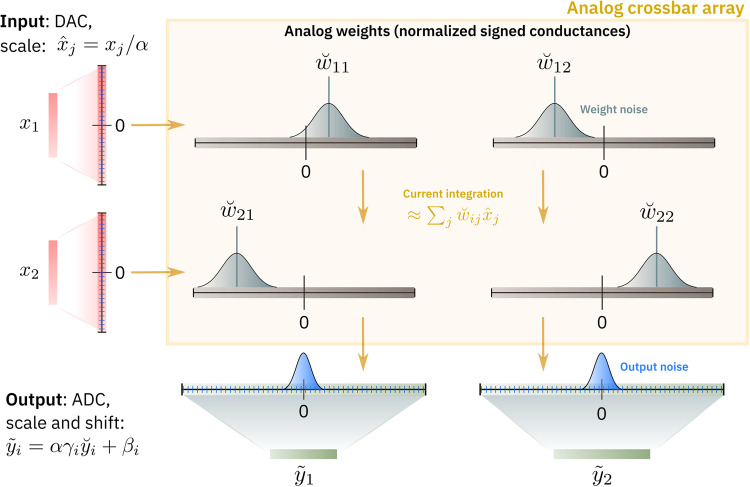
- The authors built a standardized AIMC crossbar simulation model for PCM-based hardware, incorporating dynamic-range limits, programming errors, drift, read noise, output noise, DAC/ADC quantization, and IR-drop; they used a 512 × 512 tile size and 8-bit quantization by default.
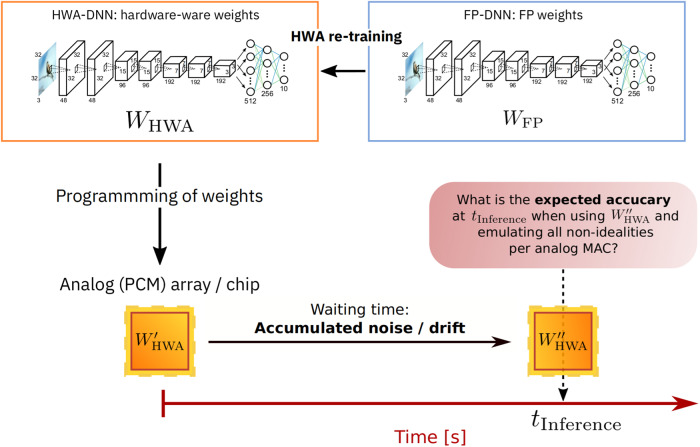
- They HWA-retrained 11 DNNs starting from FP-trained models, using SGD with noise injection and learned peripheral scaling factors for inputs and outputs; evaluation was done at delays of 1 s, 1 h, 1 day, and 1 year after programming.
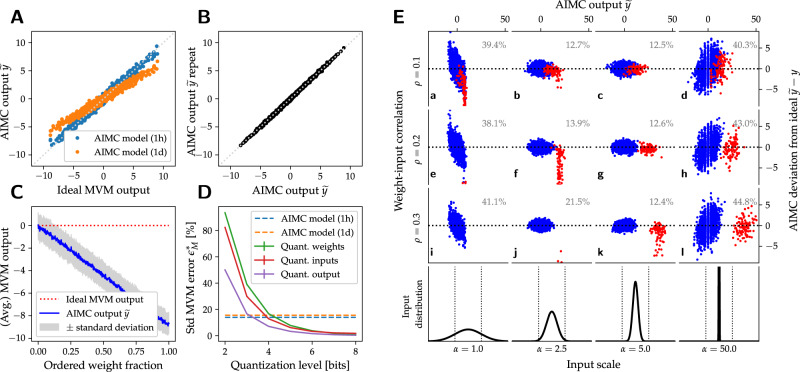
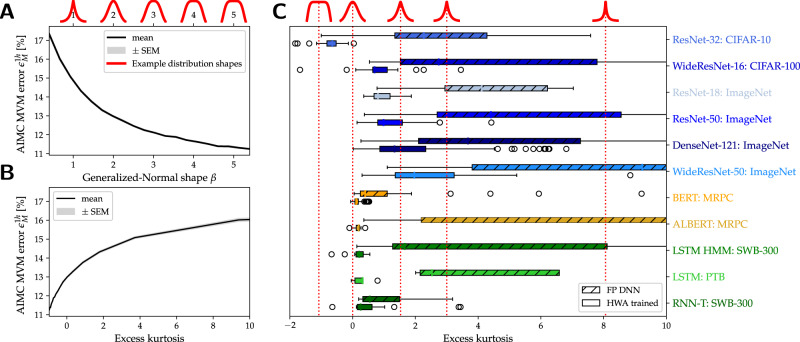
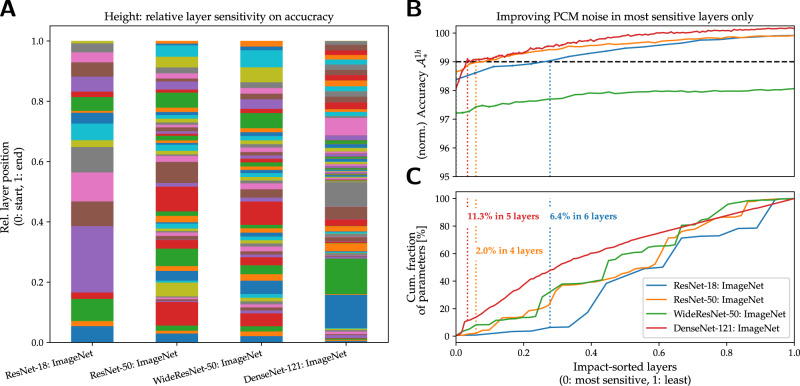
- They performed sensitivity analyses by stress-testing individual nonidealities, ranking layers by sensitivity in large CNNs, and measuring MVM error as relative deviation from ideal matrix-vector multiplication.
Limitations
- The authors state that the results are simulated and that the larger-scale DNN iso-accuracy results remain to be verified in hardware in future.
- They note that the model uses simplifications and abstractions, including Gaussian noise assumptions and an approximate IR-drop calculation, and therefore cannot replace ultimate hardware verification.
- Evidence from the text: some results depend on a PCM-specific calibration, so transferability to non-PCM devices is not direct, although the authors say the framework can be adapted.
Model-written summary. Check it against the paper before relying on it.
Integrity signals
Registry
Cites
Statistics
Figures
Verification
Claims the paper makes
10 Valid · 3 Not valid · 6 Not checked · 81 Own results and interpretations
The cited sources support only part of this claim — read each source’s verdict below.
In the paper
“Weight-quantization into as few as 2–4 bits can often be tolerated without significant accuracy reduction8,19,20.”
§ Hardware-aware training for large-scale and diverse deep learning inference workloads using in-memory computing-based accelerators > Introduction
What the sources say
- Supportedcites [8] Choi, J. et al. Pact: parameterized clipping activation for quantized neural networks. Preprint at https://arxiv.org/abs/1805.06085 (2018). source
The Abstract (p. 1) says 4-bit weights and activations achieved accuracy comparable to full precision across several models and datasets. The ResNet18 results in C.2 (p. 14) also show 2-bit weights with accuracy comparable to the full-precision baseline. The claim’s “can often” wording allows for variation across models. (LLM, conf=0.88)
- Partly supportedcites [19] Krishnamoorthi, R. Quantizing deep convolutional networks for efficient inference: a whitepaper. Preprint at https://arxiv.org/abs/1806.08342 (2018). sourceExperimental — accuracy not yet measured
Section 3.2.4 (p. 22) reports that, for most networks, fine-tuned 4-bit weights achieved accuracy within 5% of 8-bit quantization, with activations kept at 8 bits. This supports the 4-bit portion under those conditions, but the cited passages do not establish comparable accuracy for 2-bit weights. (LLM, conf=0.88)
- Partly supportedcites [20] Nagel, M. et al. A white paper on neural network quantization. Preprint at https://arxiv.org/abs/2106.08295 (2021). sourceExperimental — accuracy not yet measured
The Experiments (p. 24) show that 4-bit weight quantization can preserve accuracy closely for several models, including BERT-base, particularly with 8-bit activations or per-channel quantization. The cited passages do not establish the same result for weights as low as 2 bits, and they report larger accuracy drops for some models at 4 bits. (LLM, conf=0.86)
plain- Asserted: passes — The authors put it forward as true.
- Checkable: passes — It can be checked against evidence.
- Load-bearing: passes — The paper’s conclusions depend on it.
- Based: passes — The paper gives a reason why it holds.
- Supported
The sources with a verdict support this claim; the rest weren’t checked yet, have no full text we could read, or their verdicts aren’t rated yet.
In the paper
“In terms of AIMC workload execution latency and system mapping51, CNNs are already less well-suited for resistive crossbar arrays due to the uneven temporal reuse between layers and spatial under-utilization of the large analog tiles by the small kernel matrices (see Table 1), although some optimization and mapping tricks52 are available.”
§ Hardware-aware training for large-scale and diverse deep learning inference workloads using in-memory computing-based accelerators > Results > HWA training improves AIMC accuracy for all DNNs
What the sources say
- Not checked — no full text of the sourcecites [51] Jain S A heterogeneous and programmable compute-in-memory accelerator architecture for analog-ai using dense 2-d mesh IEEE Trans. Very Large Scale Integr. (VLSI) Syst. 2023 31 114 127 10.1109/TVLSI.2022.3221390 source
- Supportedcites [52] Rasch MJ Gokmen T Rigotti M Haensch W RAPA-ConvNets: modified convolutional networks for accelerated training on architectures with analog arrays Front. Neurosci. 2019 13 753 10.3389/fnins.2019.00753 31417340 PMC6682637 source
The Introduction says ConvNets do not map favorably onto analog-array hardware because convolution kernel matrices are typically small while the number of matrix-vector operations can be very large, especially in early layers. Its Figure 1 caption also shows that analog-array computing time varies across layers, supporting the claim about uneven temporal use. (LLM, conf=0.88)
plainstates a cause- Asserted: passes — The authors put it forward as true.
- Checkable: passes — It can be checked against evidence.
- Load-bearing: passes — The paper’s conclusions depend on it.
- Based: passes — The paper gives a reason why it holds.
The sources with a verdict support this claim; the rest weren’t checked yet, have no full text we could read, or their verdicts aren’t rated yet.
In the paper
“For evaluation times teval long after NVM programming, the conductance drift Eq. (8) can be compensated in the digital domain without any expensive re-programming36,73.”
§ Hardware-aware training for large-scale and diverse deep learning inference workloads using in-memory computing-based accelerators > Methods > AIMC standardized evaluation model
What the sources say
- Not checked — no full text of the sourcecites [36] Ambrogio, S. et al. Reducing the impact of phase-change memory conductance drift on the inference of large-scale hardware neural networks. in IEEE International Electron Devices Meeting, 1–4 (IEEE, 2019). source
- Supportedcites [73] Le Gallo M Sebastian A Cherubini G Giefers H Eleftheriou E Compressed sensing with approximate message passing using in-memory computing IEEE Trans. Electron. Devices 2018 65 4304 4312 10.1109/TED.2018.2865352 source
The Physical Implementation section describes periodic calibration that compensates for a global conductance shift, with the correction performed in a control unit or digital circuitry. It also says the matrix is programmed only once; the Discussion explains that subsequent reconstruction uses read operations rather than reprogramming. The support is for this global-drift calibration, not necessarily every form of device drift. (LLM, conf=0.88)
plainstates a cause- Asserted: passes — The authors put it forward as true.
- Checkable: passes — It can be checked against evidence.
- Load-bearing: passes — The paper’s conclusions depend on it.
- Based: passes — The paper gives a reason why it holds.
Every source the paper cites for this claim was checked and supports it.
In the paper
“We have tried distilling with the FP model as a teacher (similar to ref. 71) and found some benefits when HWA training time is limited.”
§ Hardware-aware training for large-scale and diverse deep learning inference workloads using in-memory computing-based accelerators > Discussion
What the sources say
- Supportedcites [71] Zhou, C., Kadambi, P., Mattina, M. & Whatmough, P. N. Noisy machines: understanding noisy neural networks and enhancing robustness to analog hardware errors using distillation. Preprint at https://arxiv.org/pdf/2001.04974.pdf (2020). source
The citation is attached to the method the citing authors imitate — distillation with the full-precision model as teacher — and our copy states exactly that: Section 5.1 (p. 6) proposes 'a noise free clean model as the teacher to train a noisy student network', and Section 5.2 (p. 8) confirms 'In the distillation retraining runs, the full-precision clean model with an accuracy of 93.87% is used as the teacher'. The same section (5.2, p. 9-10; Discussion, p. 10) reports the benefit of that distillation for hardware-aware retraining under noise, and Section 5.1 (p. 7) notes the teacher-initialised student 'can be considered as a warm start to accelerate retraining', consistent with the citing sentence's limited-training-time framing. The 'found some benefits when HWA training time is limited' result itself is the citing authors' own experiment, not a claim about this source. (LLM, conf=0.88)
plainstates a possible cause- Asserted: passes — The authors put it forward as true.
- Checkable: passes — It can be checked against evidence.
- Load-bearing: unclear — It is unclear whether the paper’s conclusions depend on it.
- Based: passes — The paper gives a reason why it holds.
- Supported
Every source the paper cites for this claim was checked and supports it.
In the paper
“We verified the effectiveness of our HWA training approach on the very same DNNs used in a previous study38 and found, on average, a >10% decrease in AIMC test error for long teval times.”
§ Hardware-aware training for large-scale and diverse deep learning inference workloads using in-memory computing-based accelerators > Methods > AIMC hardware-aware DNN training
What the sources say
- Supportedcites [38] Joshi V Accurate deep neural network inference using computational phase-change memory Nat. Commun. 2020 11 1 13 10.1038/s41467-020-16108-9 32424184 PMC7235046 source
Citation 38 identifies the previous study whose DNNs the citing authors reused; the >10% decrease is presented as the citing authors’ own finding, not as a result of this source. The source’s Results, “Problem statement” (page unavailable), identifies its DNNs as ResNet-32 on CIFAR-10 and ResNet-34 on ImageNet. (LLM, conf=0.90)
plainstates a cause- Asserted: passes — The authors put it forward as true.
- Checkable: passes — It can be checked against evidence.
- Load-bearing: passes — The paper’s conclusions depend on it.
- Based: passes — The paper gives a reason why it holds.
- Supported
64 more claims
Create a free account to see all 100 claims and to verify the 1 reference still open.
- Probably not a substantial claim. 15
- It may state two separate claims as one. 17
- The quote only partly states this claim. 1
Citations
Cites
Deep Residual Learning for Image Recognition
He, K., Zhang, X., Ren, S., & Sun, J. (2016) · 2016 IEEE Conference on Computer Vision and Pattern Recognition (CVPR) · doi:10.1109/cvpr.2016.90 · Cited by 235,474
ImageNet: A large-scale hierarchical image database
Deng, J., Dong, W., Socher, R., Li, L.-J., Li, K., & Fei-Fei, L. (2009) · 2009 IEEE Conference on Computer Vision and Pattern Recognition · doi:10.1109/cvpr.2009.5206848 · Cited by 65,333
PyTorch: An Imperative Style, High-Performance Deep Learning Library
Paszke, A., Gross, S., Massa, F., Lerer, A., Bradbury, J., Chanan, G., Killeen, T., Lin, Z., Gimelshein, N., Antiga, L., et al. (2019) · arXiv · doi:10.48550/arxiv.1912.01703 · Cited by 31,473
Learning Multiple Layers of Features from Tiny Images
Krizhevsky, A. (2024) · doi:10.57702/zp44cu3g · Cited by 23,395
Advances in neural information processing systems 7
Cios, K., & Shields, M. (1997) · Neurocomputing · doi:10.1016/s0925-2312(97)90018-7 · Cited by 22,059
Distilling the Knowledge in a Neural Network
Hinton, G., Vinyals, O., & Dean, J. (2015) · arXiv · doi:10.48550/arxiv.1503.02531 · Cited by 14,204 · cited 1×
“In knowledge distillation [29], an already trained “teacher” model augments the usual one-hot labels with expected class probabilities, which can drive a “student” model to a good solution more rapidly than when training only with the one-hot label vectors.”
BackgroundHan, S., Mao, H., & Dally, W. J. (2015) · arXiv · doi:10.48550/arxiv.1510.00149 · Cited by 4,662
XNOR-Net: ImageNet Classification Using Binary Convolutional Neural Networks
Rastegari, M., Ordonez, V., Redmon, J., & Farhadi, A. (2016) · Lecture Notes in Computer Science · doi:10.1007/978-3-319-46493-0_32 · Cited by 4,408 · cited 1×
“…DNN training and/or inference 2 – 4 , by approximating matrix-vector multiplications (MVMs) and other arithmetic with custom fl oating-point representations such as b fl oat16 5 or DLFloat 6 , or with reduced-precision fi xed-point arithmetic to quantize synaptic weights and activations 7 – 10 .”
BackgroundGLUE: A Multi-Task Benchmark and Analysis Platform for Natural Language Understanding
Wang, A., Singh, A., Michael, J., Hill, F., Levy, O., & Bowman, S. (2018) · Proceedings of the 2018 EMNLP Workshop BlackboxNLP: Analyzing and Interpreting Neural Networks for NLP · doi:10.18653/v1/w18-5446 · Cited by 4,222
Efficient Processing of Deep Neural Networks: A Tutorial and Survey
Sze, V., Chen, Y.-H., Yang, T.-J., & Emer, J. S. (2017) · Proceedings of the IEEE · doi:10.1109/jproc.2017.2761740 · Cited by 4,215 · cited 1×
“Numerous hardware concepts have been introduced to accelerate DNN training and/or inference 2 – 4 , by approximating matrix-vector multiplications (MVMs) and other arithmetic with custom fl oating-point representations such as b fl oat16 5 or DLFloat 6 , or with reduced-precision fi xed-point…”
Background
Research works printed but not linked: 8
- Hubara, I., Courbariaux, M., Soudry, D., El-Yaniv, R. & Bengio, Y. Quantized neural networks: Training neural networks with low precision weights and activations. The Journal of Machine Learning Research1, 6869–6898 (2017).
- Srivastava N Hinton G Krizhevsky A Sutskever I Salakhutdinov R Dropout: a simple way to prevent neural networks from overfitting J. Mach. Learn. Res. 2014 15 1929 1958
- Wager, S., Wang, S. & Liang, P. Dropout training as adaptive regularization. Advances in neural information processing systems26, (2013).
- Noh, H., You, T., Mun, J. & Han, B. Regularizing deep neural networks by noise: its interpretation and optimization. in Proceedings of the 31st International Conference on Neural Information Processing Systems, NIPS’17, (Red Hook, NY, USA) 5115–5124 (Curran Associates Inc., 2017).
- Rakin, A. S., He, Z. & Fan, D. Parametric noise injection: trainable randomness to improve deep neural network robustness against adversarial attack. in Proceedings of the IEEE/CVF Conference on Computer Vision and Pattern Recognition 588–597 (IEEE, 2018).
- Wan, L., Zeiler, M., Zhang, S., Le Cun, Y. & Fergus, R. Regularization of neural networks using drop connect. in Proceedings of the 30th International Conference on Machine Learning (eds Dasgupta, S. & McAllester, D.) Vol. 28 of Proceedings of Machine Learning Research, 1058–1066 (PMLR, 2013).
- Glorot, X. & Bengio, Y. Understanding the difficulty of training deep feedforward neural networks. in Proceedings of the Thirteenth International Conference on Artificial Intelligence and Statistics 249–256 (JMLR Workshop and Conference Proceedings, 2010).
- Godfrey, J. J. & Holliman, E. Switchboard-1 release 2 ldc97s62. 926, 927 (1997).
Cited by
Items 101–182 of 182
Kang, J., Hong, S., Kim, S., & Kim, S. (2025) · Advanced Intelligent Systems · doi:10.1002/aisy.202500150 · Cited by 1
Deng, M., Li, B., Ma, M., Deng, W., Zeng, X., Wang, Y., & Huang, X. (2025) · Physiological Measurement · doi:10.1088/1361-6579/adfda9 · Cited by 1
Zhenhao, J. I. A. O., Chen, X., Tao, H. O. N. G., Li, S., Li, X., Dai, W., Chengcai, T. U., & Song, Z. (2026) · Journal of Systems Architecture · doi:10.1016/j.sysarc.2026.103683 · Cited by 1
Zhou, R., Do, H.-S., & Lee, J. (2026) · International Journal of Extreme Manufacturing · doi:10.1088/2631-7990/ae366f · Cited by 2
“This method is considered a very promising approach to simultaneously secure the practicality and versatility of neuromorphic operations by complementing hardware imperfections at the software level [136] .”
Learned adaptive properties for mitigation of weight perturbations in embedded spiking networks
Luca, S., Xiao, T. P., Chance, F. S., Agarwal, S., Teeter, C., & Chapman, G. W. (2026) · Frontiers in Neuroscience · doi:10.3389/fnins.2026.1766765 · Cited by 1
“Neural networks are good candidates for analog computation, because they are algorithmically robust to certain forms of non-idealities, such as small weight perturbations, quantized weights, and quantized activations (Rasch et al., 2023).”
Phase‐Change Memory for Cryogenic In‐Memory Computing
Lombardo, D., Gautam, S., Ferraris, A., Gallo, M. L., Bragaglia, V., Sebastian, A., & Sarwat, S. G. (2026) · Advanced Functional Materials · doi:10.1002/adfm.202525704 · Cited by 5
Self-citationVacancy oscillating mode in amorphous binary oxide film by terahertz time domain spectroscopy
Liu, H., Huang, H., Yu, H., Gong, Z., Yu, F., Zhang, Z., Tan, Z. T. Z., Cao, J., Liu, H., Xue, K., et al. (2026) · Opto-Electronic Advances · doi:10.29026/oea.2026.250217 · Cited by 1
Tactile and Visual Artificial Synaptic Devices: Progress and Challenges
Chen, Z., Chen, C. P., & Huang, Y. (2026) · Electronic Materials · doi:10.3390/electronicmat7020008 · Cited by 2
“To mitigate the severe performance degradation caused by hardware non-idealities such as non-linearity, asymmetry, and variability (Challenge 4), device–algorithm co-design has emerged as a crucial system-level solution [50].”
Ferro, E., Ottaviano, A., Lammie, C., İslamoğlu, G., Garofalo, A., Conti, F., Boesch, T., Benini, L., Sebastian, A., & Boybat, I. (2026) · IEEE Transactions on Circuits and Systems I Regular Papers · doi:10.1109/tcsi.2026.3692104 · Cited by 1
“Lastly, the limited analog computation precision in ACIM tiles may be insu ffi cient for certain applications, requiring system-level solutions, such as precision-aware mapping strategies, to ensure target accuracy [22], [23], [24], [25].”
InfluentialSelf-citationSong, X., Qin, Z., Wang, S., Gu, Y., Liu, J., Zhou, Q., Fan, J., An, J., Chen, J., Wang, J., et al. (2026) · Nano Letters · doi:10.1021/acs.nanolett.6c00850 · Cited by 2
Marium, S. M., & Chen, S. (2026) · Microelectronics · doi:10.3390/microelectronics2020010 · Cited by 1
Recent progress of nitride materials for nonvolatile memory and neuromorphic applications
Ahmad, I., Lee, D., Kim, T., Chae, M., Ali, M., & Kim, H. (2026) · Applied Physics Reviews · doi:10.1063/5.0310756 · Cited by 1
Convergence of Soft Electronics and Artificial Intelligence: From Materials to Intelligent Systems
Park, H., Choi, G., Yoon, S., Lee, D., & Ko, S. H. (2026) · Nano-Micro Letters · doi:10.1007/s40820-026-02265-x · Cited by 7
Check-QZP: A Lightweight Checkpoint Mechanism for Deep Learning Frameworks
Lee, S., Moon, G., Lee, C., Kim, H., An, D., & Kang, D. H. (2024) · Applied Sciences · doi:10.3390/app14198848 · Cited by 1
Research on Inference and Training Acceleration of Large Language Model
Chen, Q. (2024) · International Conference on Computer Information Science and Artificial Intelligence (CISAI) · doi:10.1145/3703187.3703238 · Cited by 1
“…deep learning models in a range of tasks, their inherent complexity and substantial storage requirements present significant challenges to deployment in real-time applications, particularly in resource-constrained environments such as video surveillance systems and autonomous vehicles [6].”
Analog-AI Hardware Accelerators for Low-Latency Transformer-Based Language Models (Invited)
Burr, G. W., Tsai, H.-Y. S., Boybat, I., Simon, W., Büchel, J., Vasilopoulos, A., Narayanan, P., Fasoli, A., Hosokawa, K., Gallo, M. L., et al. (2025) · Custom Integrated Circuits Conference · doi:10.1109/cicc63670.2025.10983594 · Cited by 1
“In fact, starting with a model trained to high-accuracy with FP32, HWA training can greatly enhance the robustness of a variety of deep neural networks (DNNs) including recurrent neural networks (RNNs), Transformers and Convolutional neural networks (CNNs) [32, 30].”
Self-citationHaidar, A., Ntinas, V. G., & Tetzlaff, R. (2025) · IEEE International Conference on Artificial Intelligence Circuits and Systems (AICAS) · doi:10.1109/aicas64808.2025.11173140 · Cited by 2
“Mat. in [14]), which is considered as benchmark setup in AIHWKIT for any ANN application.”
Model quantization for computing-in-memory: a survey
Sun, S., Bai, J., Chen, H., Deng, K., Xie, Z., Li, J., Cao, B., Zhang, H., Kang, W., & Zhao, W. S. (2025) · Science China Information Sciences · doi:10.1007/s11432-024-4522-8 · Cited by 3
Efficient transformer adaptation for analog in-memory computing via low-rank adapters
Li, C., Ferro, E., Lammie, C., Gallo, M. L., Boybat, I., & Rajendran, B. (2026) · Neuromorphic Computing and Engineering · doi:10.1088/2634-4386/ae405e · Cited by 6
“Second, while pre-trained transformer models generalize remarkably well across a wide range of nat-ural language processing tasks due to extensive training on large and diverse corpora [14], conventional AHWA training methodologies typically optimize performance for only one task at a time [12].”
Self-citationHuang, P., Chen, K., Wang, C., & Liu, W. (2024) · Authorea · doi:10.22541/au.172114780.09329212/v1
Improving model robustness to weight noise via consistency regularization
Hou, Y., Zhang, Q., Wang, N., & Wu, H. (2024) · Machine Learning Science and Technology · doi:10.1088/2632-2153/ad734a
Analog AI as a Service: A Cloud Platform for In-Memory Computing
Maghraouir, K. E., Tran, K., Ruby, K., Godoy, B., Murray, J., Gallo, M. L., Deshane, T., Gonzalez, P., Moreda, D., Benmeziane, H., et al. (2024) · IEEE International Conference on Software Services Engineering (SSE) · doi:10.1109/sse62657.2024.00019
“These tiles can be used for simulating training with analog tiles [10], simulating the effect of noise during inference, and hardware-aware training [11].”
BackgroundMethodSelf-citationCapacitor Minimization in Analog Synapses for Efficient and Compact Binarized SNNs
Yayla, M., Wei, M., Thomann, S., Mema, A., Yang, C.-L., Chen, J.-J., & Amrouch, H. (2025) · IEEE transactions on circuits and systems for artificial intelligence. · doi:10.1109/tcasai.2025.3536379
“One approach to mitigating non-linearity and reduced reliability due to reduced membrane capacitance is to develop a circuit model that supports hardware-aware training [14], [15], [16].”
Narimanjahan, B., Khademzadeh, A., & Reza, A. (2024) · Sharq. · doi:10.61186/itrc.16.4.9
Machine Learning Model Training Acceleration and Optimization Methods for Large-scale Datasets
Li, X., Feng, H., Pan, T., & Wu, X. (2024) · International Conference on Distributed Systems, Computer Networks and Cybersecurity (ICDSCNC) · doi:10.1109/icdscnc62492.2024.10939849
Jiao, Z., Chen, X., Hong, T., Dai, W., Tu, C., Li, S., Chen, H., & Song, Z. (2024) · IEEE High Performance Extreme Computing Conference · doi:10.1109/hpec62836.2024.10938478
“Rasch et al. [10] proposed hardware-aware training methods that accommodate the nonideal characteristics of PCM, achieving inference accuracy comparable to floating-point operations.”
Edge Training and Inference with Analog ReRAM Technology for Hand Gesture Recognition
Clerico, V., Dutta, A., Falcone, D. F., Choi, W., Galetta, M., Stecconi, T., Horváth, A., Varzandeh, S., Offrein, B. J., Kaboli, M., et al. (2025) · IEEE International Symposium on Circuits and Systems proceedings · doi:10.1109/iscas56072.2025.11043770 · Cited by 2
“To define the FP baseline model, we performed hardware-aware tuning of the weights to inject noise and make the network more resilient to weight variations [24].”
A framework for analog-digital mixed-precision neural network training and inference
Vasilopoulos, A., Boulharts, E., Lammie, C., Büchel, J., Benmeziane, H., Gallo, M. L., & Sebastian, A. (2025) · IEEE International Symposium on Circuits and Systems proceedings · doi:10.1109/iscas56072.2025.11043537 · Cited by 2
“It is well substantiated in the literature that the effective deployment of NNs in AIMC hardware requires the networks to be trained in an analog hardware-aware (HWA) manner [11], [12].”
Self-citationLISP: Learning In-Camera Signal Processing for Lightweight Computer Vision
Sun, Y., Zhu, W., Ji, X., & Xu, W. (2025) · International Conference on Computer and Communication Systems (ICCCS) · doi:10.1109/icccs65393.2025.11069734
“It utilizes search algorithms to automatically develop a compact network architecture for resource-constrained device and platform [28, 29, 30].”
A ReRAM-Based Adaptive Binary Neural Network Accelerator for Efficient Inference
Dang, P., Huang, B., & Li, H. (2025) · International Symposium of Electronics Design Automation (ISEDA) · doi:10.1109/iseda65950.2025.11100389 · Cited by 1
“In DNNs, convolution (CONV) and matrix-vector multiplication (MVM) are two key compute-intensive operations [13, 14].”
ALoRA: Hardware-Aware Fine Tuning for Photonic Large Neural Networks
Taniguchi, T., Nakajima, M., Ikeda, K., Hashimoto, T., & Kawakami, S. (2025) · OptoElectronics and Communications Conference and International Conference on Photonics in Switching and Computing (OECC/PSC) · doi:10.23919/oecc/psc62146.2025.11109873 · Cited by 1
“For mitigating the error, we also demonstrate a hardware-aware fine-tuning method named “Analog Low-Rank Adaption” (ALoRA), inspired by a recent efficient three fine-tuning algorithm: QAT (Quantized-Aware Training) [10], NAT (Noise-Aware Training) [11], and LoRA (Low-Rank Adaptation) [12, 13].”
SOLO: Spatial Online Learning at Once for Spiking Neural NetworksPreprint
Lee, S., Moon, H., Yoon, M., et al. (2025) · SSRN Electronic Journal · doi:10.2139/ssrn.5413758
Lin, T., Singh, T. H., & Huang, P.-T. (2025) · Integrated Circuits and Systems · doi:10.23919/ics.2025.3612817
OptiRange: An Efficient ReRAM-Based PIM Accelerator with ADC Resolution Optimization
Jeon, S.-W., Ji, G., Kim, Y., Park, Y., Kim, S., & Ryu, S. (2025) · doi:10.1109/iccad66269.2025.11240769
“Hardware-aware training [10], [11] with noise injection can improve robustness, but it cannot fully eliminate residual errors or retention-induced drift.”
SAGE: Saliency-Aware Grouping for Efficient Mapping of LLMs on Analog Compute-in-Memory
Hou, Y. T., Liu, Z., Gagnon, G., Tsai, H.-Y. S., Maghraoui, K. E., Burr, G. W., & Liu, L. (2025) · doi:10.1109/iccad66269.2025.11240907 · Cited by 1
“Prior hardware-aware training techniques [31], [39] can mitigate these effects but are computationally expensive and impractical for billion-scale LLMs.”
InfluentialSelf-citationAnalyzing Embedded Non-Volatile Memory and Technology Optimizations for In-Memory Computing
Deaville, P., Zhang, B., & Verma, N. (2025) · IEEE Journal of Solid-State Circuits · doi:10.1109/jssc.2025.3632212
“Furthermore, recent works have explored algorithmic approaches to managing SNR toward workload-level accuracy [25], [45], [46], [47], [48].”
Kiener, M., Bozenhard, J., Kutyniok, G., & Nyholm, S. R. (2025) · AI and Ethics · doi:10.1007/s43681-025-00884-5 · Cited by 2
“Although the do not themselves provide any normative assessment of analog versus digital computing, they highlight important technical aspects for an ethical analysis [14, 30, 38].”
Cost-efficient Processing-in-Memory Architecture with Training-free and Universal Error Compensation
Yun, M., Min, J. G., Oh, S., Choi, J., Lee, J., Je, M., & Lee, Y. (2025) · International Symposium on Low Power Electronics and Design (ISLPED) · doi:10.1109/islped65674.2025.11261781 · Cited by 1
Zhong, D. (2025) · Discover Electronics · doi:10.1007/s44291-025-00142-2
“Noise-aware training injects sampled device errors during back-propagation and can restore accuracy on small CNNs [11], yet retraining is expensive and hardware-specific.”
Tutorial: Hardware-Aware Compilation and Simulation for In-Memory Computing
Khan, A. A., Benmeziane, H., Farzaneh, H., et al. (2025) · International Conference on Compilers, Architecture, and Synthesis for Embedded Systems (CASES) · doi:10.1145/3742872.3758333
“This is primarily due to two reasons: (i) IMC is often performed in the analog domain using non-volatile memory devices, and thus, is subject to circuit non-idealities and device noise, e.g., temporal variations, some of which are inherently stochastic [2, 3].”
Self-citationSakemi, Y., Awano, H., & Morie, T. (2025) · IEICE Transactions on Fundamentals of Electronics Communications and Computer Sciences · doi:10.1587/transfun.2025gci0001 · Cited by 2
Stochastic Gradient Adjustment: Single-Pulse In-Memory Training on Phase-Change Memory Chips
Zhenhao, J. I. A. O., Xiaogang, C. H. E. N., Tao, H. O. N. G., Li, S., Xi, L. I., Chengcai, T. U., Dai, W., & Zhitang, S. O. N. G. (2026) · IEICE Transactions on Fundamentals of Electronics Communications and Computer Sciences · doi:10.1587/transfun.2025eal2094
Haidar, A., Abdelsamad, A., Yang, H., Ntinas, V. G., & Tetzlaff, R. (2025) · International Congress of Mathematicans · doi:10.1109/icm66518.2025.11322501
“Mat. in [18]), the trained models are tested at 12 fixed inference times ranging from 20 seconds to 5 years after programming: For each t ∈ T inf , we apply the PCM drift model to the weights (Eq.”
GraphFlow-PIM: Annotated Execution Graphs of DNN Workloads across Diverse PIM Configurations
Marium, S. M., & Chen, S. (2025) · IEEE International Conference on ASIC (ASICON) · doi:10.1109/asicon66040.2025.11326443
“Other optimization approaches [5], [6] also fall short, lacking robustness and interpretability essential for real-world deployment.”
Holla, A., Mukherjee, M., Mukherjee, A., & Roy, K. (2026) · IEEE Journal on Emerging and Selected Topics in Circuits and Systems · doi:10.1109/jetcas.2026.3665635
“Hardware-aware re-training in these cases is therefore necessary to prevent significant accuracy degradation [18], [19], [20].”
Let Analog Be Analog: Principles for Designing Analog Accelerators
Feinberg, B., Xiao, T. P., Bennett, C. H., & Agarwal, S. (2026) · IEEE Micro · doi:10.1109/mm.2026.3666132
Large–Small Model Synergy for High-Recall and Efficient UAV-based Aerial Surveillance
Dong, L., Zhao, W., Zheng, L., Liu, Y., & Shi, X. (2025) · International Conference on Artificial Intelligence, Human-Computer Interaction and Robotics (AIHCIR) · doi:10.1109/aihcir67580.2025.11404852 · Cited by 1
“As depicted in Figure 1, we employ a hardware-aware Neural Architecture Search (NAS) guided by Bayesian optimization (BO) to jointly optimize algorithmic performance and FPGA resource usage [6]–[8].”
Joint Hardware-Workload Co-Optimization for In-Memory Computing Accelerators
Krestinskaya, O., Fouda, M. E., Eltawil, A. M., & Salama, K. N. (2026) · IEEE Access · doi:10.1109/access.2026.3671360 · Cited by 2
“It should be noted that the models were not retrained using a hardware-aware training approach [59], since such retraining is time-consuming, would considerably increase the search time, and falls outside the scope of this work.”
Benmeziane, H., Lammie, C., Boybat, I., Rasch, M. J., Gallo, M. L., Vasilopoulos, A., Tsai, H.-Y. S., Burr, G. W., Narayanan, V., Maghraoui, K. E., et al. (2026) · Nature Communications · doi:10.1038/s41467-026-71071-1 · Cited by 1
Self-citationKong, Z., Lan, J., Li, H., Yang, Z., Dong, W.-K., He, J., Lyu, H., Wang, X., Zhu, Y., Jain, S., et al. (2026) · IEEE Electron Device Letters · doi:10.1109/led.2026.3680336 · Cited by 1
“Even if the linear approximation introduces small nonlinear errors, the deterministic relationship in equation (1) allows these systematic deviations to be characterized and absorbed through post-training calibration [13] or hardware-aware retraining [14].”
Efficient Hardware-aware Neural Architecture Search for Edge Computing
Benmeziane, H. (2023) · theses.fr (ABES) · doi:10.70675/12a3f1afza163z4f13zb3cfz9a3425c3d45d · Cited by 2
Synaptic uncertainty for in-memory computing
Bonnet, D. (2024) · theses.fr (ABES) · doi:10.70675/5d34cb96z0f54z44b0zb3aez48f1fbf1e560
Exploring learning techniques for edge AI taking advantage of non-volatile memories
Martemucci, M. (2024) · theses.fr (ABES) · doi:10.70675/ec79fa4cz56b6z4c04z86b9zd771c8285800 · Cited by 1
Choi, S., Choi, J. H., & Kim, S. (2026) · IEEE Electron Devices Technology & Manufacturing Conference (EDTM) · doi:10.1109/edtm65772.2026.11498028
“Hardware-aware (HWA) training [9] was applied to mitigate this loss with the same AIMC configurations.”
Madala, N. S., Khafajeh, H., Khurana, P., Sivajothi, E., Prabhu, V., & Kumar, C. V. (2026) · International Conference on Data Science, Agents & Artificial Intelligence (ICDSAAI) · doi:10.1109/icdsaai69492.2026.11505091
“Second, frequent data transfer between memory and computing units can dominate the system power profile, exhausting battery reserves and causing thermal limitations that decrease sustained performance [3].”
SALMON: Self-Adaptive Learning Model on Neuromorphic Hardware
Cho, Y. W., Lee, S., & Kim, S. (2026) · IEEE Transactions on Neural Networks and Learning Systems · doi:10.1109/tnnls.2026.3687785
“In recent advancements, hardware-aware weight mapping approaches have enhanced system robustness [38].”
Unified matrix-parallel outer-product updates for pretrained deployment and on-device adaptationPreprint
Lee, J., Lee, I.-S., Lee, K. H., Koo, R., Im, J., Park, S., Ko, J., Hwang, J., Ryu, S., & Lee, K. H. (2026) · Research Square · doi:10.21203/rs.3.rs-9144413/v1
A 194.6-TOPS/W Pipelined All Current-Domain Mixed-Signal Compute in Memory in 28-nm CMOS
Cherukuri, S., Kidambi, N. V., Wang, W.-C., et al. (2026) · IEEE Solid-State Circuits Letters · doi:10.1109/lssc.2026.3697990
“As summarized in Table I, by utilizing hardware-aware training (HAT) to embed the ACIM error models directly into the training process [10], the end-to-end inference accuracy is successfully restored to within 0.2% of the ideal digital baseline.”
InfluentialX-Sim: An Accurate and Scalable Simulator for Memristive Computing-in-Memory Accelerators
Stavrakakis, K., Smeele, B., Arapidis, E., Spyrou, T., Gebregiorgis, A., Wong, S., Gaydadjiev, G. N., & Hamdioui, S. (2026) · Design, Automation, and Test in Europe · doi:10.23919/date69613.2026.11539379
“The result is a circular dependency that rules out closed-form solutions [11].”
Late Breaking Results: Input Loss Curvature as a Predictor of Sample Vulnerability to Hardware-Noise
Sharma, D., Ravikumar, D., Ho, C.-H., Kodge, S., & Roy, K. (2026) · Design, Automation, and Test in Europe · doi:10.23919/date69613.2026.11539272
HILAL: Hessian-Informed Layer Allocation for Heterogeneous Analog–Digital Inference
Bessalah, A., Abdelmoumen, H., Benatchba, K., & Benmeziane, H. (2026) · Design, Automation, and Test in Europe · doi:10.23919/date69613.2026.11539316
“This observation aligns with prior findings that staged adaptation improves resilience in AIMC training pipelines [10], [20].”
Mishu, S. J., Datta, G., Sharifi, S., & Banad, Y. M. (2026) · IEEE Dallas Circuits and Systems Conference (DCAS) · doi:10.1109/dcas69364.2026.11544868
“(ii) Drift-aware training/lightweight adaptation improves robustness by injecting drift/noise during training and, when needed, fine-tuning a small subset of parameters (e.g., biases or per-layer scales) using a compact calibration set [17].”
Memristive devices for memory and computing
Fan, W. (2026) · Nature Materials · doi:10.1038/s41563-026-02635-1
Farias, M., Martins, W. S., & Kung, H. T. (2026) · IEEE International Symposium on Circuits and Systems proceedings · doi:10.1109/iscas66217.2026.11562844
“…nonidealities—such as sneak paths [5]–[8], process-voltage-temperature variations [9], [10], stuck-at faults [11]–[14], conductance drift [15], [16], and parasitic resistance (PR) [17]–[19]—which degrade inference accuracy and restrict computational parallelism in large-scale workloads [20], [21].”
A Sparsity-Aware Reconfigurable Sensing-Quantization Circuit for RRAM-Based Analog Compute-in-Memory
Chen, Z., Ding, H., Yang, Y., Zhang, H., Li, J., Zhao, S., Fu, Y., Wang, Z., & Cai, Y. (2026) · IEEE International Symposium on Circuits and Systems proceedings · doi:10.1109/iscas66217.2026.11562807
A Data-Driven Framework for Modeling Non-Idealities in Analog In-Memory Computing Hardware
Vasilopoulos, A., Kersting, B., Büchel, J., Sebastian, A., & Gallo, M. L. (2026) · IEEE Journal on Emerging and Selected Topics in Circuits and Systems · doi:10.1109/jetcas.2026.3705427
“1d, produced from the hardware-calibrated model described in [27].”
Self-citationTITAN: A TIny Trained Approximation Network for Synchronization in Multi-RAT Systems
Murthy, P., Rajapakshe, O. P., Saha, D., et al. (2026) · doi:10.1109/dyspan69846.2026.11571146
“The actual gain depends on underlying hardware in use and efficient hardware-software co-designing [14], [15].”
Fault Resilience in Memristor Crossbar: Sensitivity-Driven Mapping for Neural Accelerators
Sahil, Rathor, K. K., Raj, U., Sethi, B., Thangkhiew, P. L., & Yadav, D. N. (2026) · Communications in computer and information science · doi:10.1007/978-3-032-27120-4_3
Ji, X., & Namba, K. (2026) · IEEE Access · doi:10.1109/access.2026.3712886
“Rasch et al. [19] proposed hardware-aware training techniques for large-scale and diverse inference workloads, achieving improved robustness across multiple DNN architectures on in-memory computing accelerators.”
CIM-FI: A HW-Aware Fault Injection Framework for Digital Compute-In-Memory DNN Accelerators
Chaidos, P., Maras, A., Spyrou, T., Gebregiorgis, A., Hamdioui, S., Soudris, D., & Xydis, S. (2026) · IEEE International On-Line Testing Symposium (IOLTS) · doi:10.1109/iolts69666.2026.11633664
“Beyond this, accuracy levels in a given DNN are dependent not only on the network architecture and training scheme, but also on the characteristics and reliability of the target HW platform [10].”
Impact of memory device precision in analog combinatorial optimization solvers
Hizzani, M., Yang, M.-J., Heittmann, A., Hutchinson, G. H., Strukov, D., & Strachan, J. P. (2026) · npj Unconventional Computing · doi:10.1038/s44335-026-00082-4
Liu, Y., Sun, L. C., Zeng, R., Huang, M. C. Y., & Wu, H. X. (2026) · International Symposium on Low Power Electronics and Design (ISLPED) · doi:10.1145/3816440.3818580
“As a result, data movement has become a primary bottleneck [8–11].”
Pyo, S. G. (2026) · Micromachines · doi:10.3390/mi17091032
“Rasch et al. [80] developed a hardware-aware retraining methodology that systematically evaluates analog in-memory computing accuracy across diverse deep-learning topologies (convolutional, recurrent, and transformer networks) by explicitly modeling crossbar-level non-idealities, showing that many…”
Lin, Z., Li, R., Wang, Y., Gao, K., Cao, Z., Liu, W., Sun, B. T., Geng, L., & Han, C. Y. (2026) · Neurocomputing · doi:10.1016/j.neucom.2026.135047
Rossetti, D., Xu, Y., Asselta, L., Yang, J. J., Williams, R. S., & Corinto, F. (2026) · Advanced Electronic Materials · doi:10.1002/aelm.70580
Electro-optical memristors: from the origin to device implementation
Rashid, M. U., Khan, S. A., Tahir, Z., & Kim, Y. S. (2026) · Nanoscale · doi:10.1039/d6nr01032f
Xu, L., Huang, M., Funni, S. D., Cha, J. J., & Yildiz, B. (2026) · ACS Nano · doi:10.1021/acsnano.6c09861
Qi, Y. (2026) · Multiscale and Multidisciplinary Modeling Experiments and Design · doi:10.1007/s41939-026-01271-1
“…such brittleness is compounded sometimes by the inescapable nonidealities in devices and arrays (e.g. variability of conductance, drift, read/write noise), which encourages nonideality-sensitive or hardware-sensitive retraining methods in the literature (Zhang et al. 2023; Rasch et al. 2023).”
Lee, J., Solomon, P. M., Gong, N., Fagbohungbe, O. I., Wilson, R., Ando, T., & Kim, S. (2026) · Science Advances · doi:10.1126/sciadv.aee7134
Space Data Centers (SDCs): Rethinking Computing Infrastructure Beyond Earth
Ahmed, S. T., Farahani, B., Chakrabarty, K., & Firouzi, F. (2026) · IEEE International Conference on Omni-layer Intelligent Systems (COINS) · doi:10.1109/coins69995.2026.11715566
“Following hardware-aware training practices [18], the noise-aware component injects Gaussian noise into the effective weight during every forward pass while training, that is, on the tensor that will actually be programmed onto the array.”
Metadata
- Authors
- Rasch, M. J., Mackin, C., Le Gallo, M., Chen, A., Fasoli, A., Odermatt, F., Li, N., Nandakumar, S. R., Narayanan, P., Tsai, H., Burr, G. W., Sebastian, A., & Narayanan, V.
- Affiliations
- IBM (United States) (US)
- IBM Research - Almaden (US)
- IBM Research - Zurich (CH)
- Corresponding author
- Rasch, Malte J.
- ORCID
- Venue
- Nature Communications
- Published
- 2023-08-30
- Volume
- 14
- Issue
- 1
- Pages
- 5282-5282
- ISSN
- 2041-1723 (ISSN-L)
- PMC
- PMC10469175
- OpenAlex
- W4386293192
- Semantic Scholar
- 083e52983cd99b5726e3db8eb476aecc061bbf3b
- Cited by
- 213
- References
- 81
- Citations by year
- 2026: 83 · 2025: 70 · 2024: 46 · 2023: 14
- FWCI
- 15.35
- Type
- journal article
- Language
- en
- Open access
- gold
- doi.org
- Licence
- cc-by
- creativecommons.org/licenses/by/4.0 (tdm)
- creativecommons.org/licenses/by/4.0 (vor)
- Locations
- Nature Communications (publishedVersion, cc-by)
- PubMed Central (publishedVersion, cc-by)
- PubMed (publishedVersion)
- arXiv (Cornell University) (submittedVersion, cc-by)
- RePEc: Research Papers in Economics (submittedVersion)
- DOAJ (DOAJ: Directory of Open Access Journals) (submittedVersion, cc-by-sa)
- arXiv (Cornell University) (cc-by)
- Funders
- Rensselaer Polytechnic Institute
- Topics
- Physical Sciences › Engineering › Electrical and Electronic Engineering › Advanced Memory and Neural Computing
- Physical Sciences › Computer Science › Computer Vision and Pattern Recognition › Advanced Neural Network Applications
- Physical Sciences › Computer Science › Hardware and Architecture › Parallel Computing and Optimization Techniques
- Keywords
- analog in-memory computing, deep learning inference, non-idealities, inference accuracy, energy-efficient accelerators, recurrent neural networks, transformer models, convolutional neural networks, matrix-vector multiplication
About these checks
Registry, retraction, Cites and statistics results are computed, not judged, with one exception: a printed reference that no index lists is read once by a model before it counts as a citation error. Claims are extracted by a model and kept only when their quote appears verbatim in the text; each cited source is then checked, with a model’s help, for whether it says what the claim relies on. Those verdicts can be wrong — read the claim’s quote and the cited source before relying on one.
The claim verdicts this report counts are experimental: their accuracy is not yet measured.
A language model drew the claims from the paper on 2026-10-10, under version 3 of the claim definition (model deepseek-v4.1-flash, prompt extract-v3).
A second model labelled each claim on 2026-10-10 (model jev-1.13-20260917, definition revision gold-guideline-v0.2).
Cited sources are checked with a language model’s help (gpt-6-sol and qwen3.8-omni-flash).
Statistics and arithmetic are recomputed, not judged.
Confidence bands are shown only for fields calibrated on our annotated test set. None is calibrated yet, so no band is shown.
What counts as a claim ›How we measure confidence ›How we check this ›
Are you an author, or do you see a problem with this page? Request a review
Data sources
Bibliographic data: Semantic Scholar, OpenAlex, Crossref.
Contains information from the Semantic Scholar Academic Graph Datasets, made available under the ODC Attribution License (ODC-BY 1.0).
Semantic Scholar’s data is described in: Kinney, R., et al. (2023). The Semantic Scholar Open Data Platform. arXiv:2301.10140.
