

Hardware-aware training for large-scale and diverse deep learning inference workloads using in-memory computing-based accelerators
Open accessThe DOI matches its Crossref record; 92 of the 95 references it cites were found in a registry or an index; 15 of the 38 sources its claims cite were checked for support.
Abstract
Analog in-memory computing-a promising approach for energy-efficient acceleration of deep learning workloads-computes matrix-vector multiplications but only approximately, due to nonidealities that often are non-deterministic or nonlinear. This can adversely impact the achievable inference accuracy. Here, we develop an hardware-aware retraining approach to systematically examine the accuracy of analog in-memory computing across multiple network topologies, and investigate sensitivity and robustness to a broad set of nonidealities. By introducing a realistic crossbar model, we improve significantly on earlier retraining approaches. We show that many larger-scale deep neural networks-including convnets, recurrent networks, and transformers-can in fact be successfully retrained to show iso-accuracy with the floating point implementation. Our results further suggest that nonidealities that add noise to the inputs or outputs, not the weights, have the largest impact on accuracy, and that recurrent networks are particularly robust to all nonidealities.
Overview
CoChat Summary
TL;DR
The paper develops a hardware-aware retraining framework for analog in-memory computing (AIMC) and shows that many large DNNs, including CNNs, RNNs, and transformers, can be brought to iso-accuracy or near-iso-accuracy on a realistic PCM-based crossbar model. Across 11 benchmarks, five reached the paper’s 99% iso-accuracy target, and the average accuracy gap fell from 11.3% to 1.1% at 1 h after programming.
Key findings
- The benchmark covered 11 medium- to large-scale DNNs spanning image classification, speech-to-text, and NLP, with model sizes from 0.3M to 108M parameters, depths up to 121 layers, and crossbar utilization from 4% to 86%.
- With hardware-aware (HWA) retraining, the normalized accuracies at 1 h after programming were all above 97%, and 5/11 workloads reached the paper’s 99% iso-accuracy target.
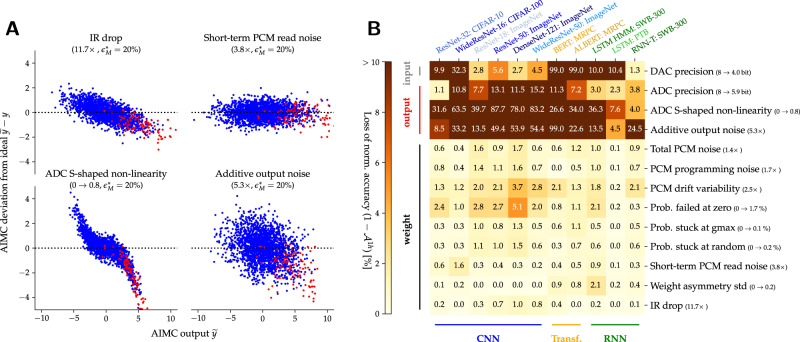
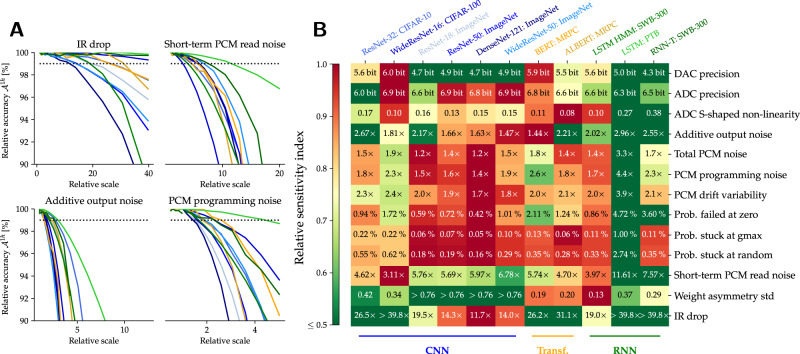
- Among the tested nonidealities, those that add noise to inputs or outputs had the largest impact on DNN accuracy, including ADC/DAC resolution, additive output noise, and S-shaped ADC nonlinearity.
- CNNs were the most sensitive topology and RNNs the least sensitive; some RNNs and transformers remained near iso-accuracy even after long-term PCM drift, while HWA-trained models for Speech-SWB300 and LSTM-PTB stayed iso-accurate out to 1 year.
Methods
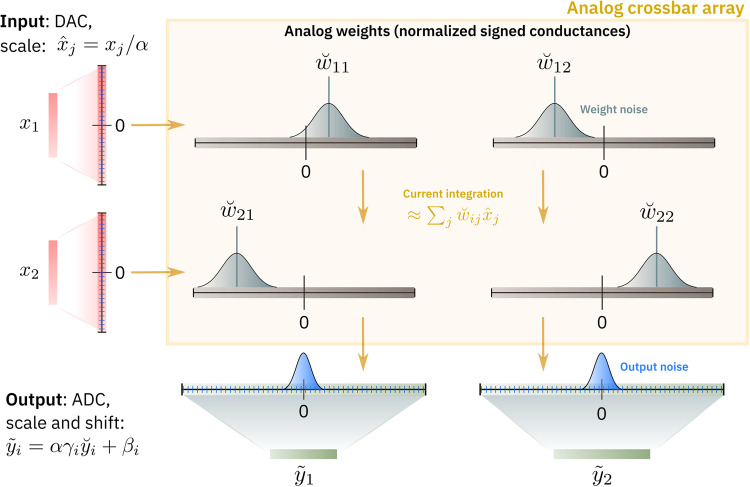
- The authors built a standardized AIMC crossbar simulation model for PCM-based hardware, incorporating dynamic-range limits, programming errors, drift, read noise, output noise, DAC/ADC quantization, and IR-drop; they used a 512 × 512 tile size and 8-bit quantization by default.
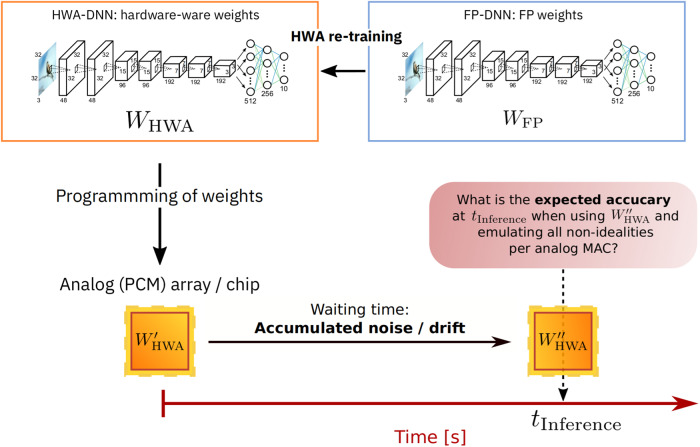
- They HWA-retrained 11 DNNs starting from FP-trained models, using SGD with noise injection and learned peripheral scaling factors for inputs and outputs; evaluation was done at delays of 1 s, 1 h, 1 day, and 1 year after programming.
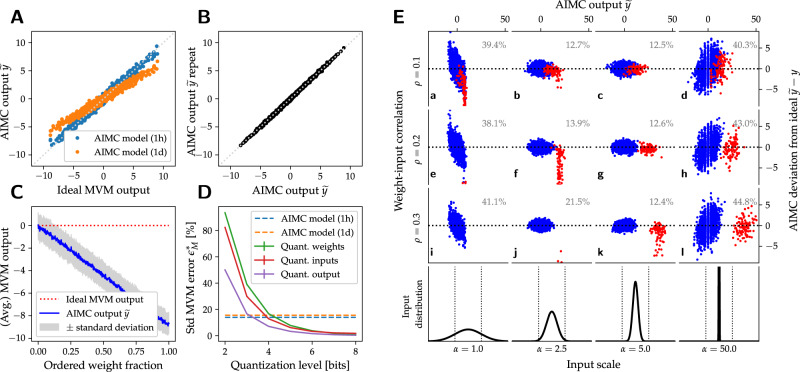
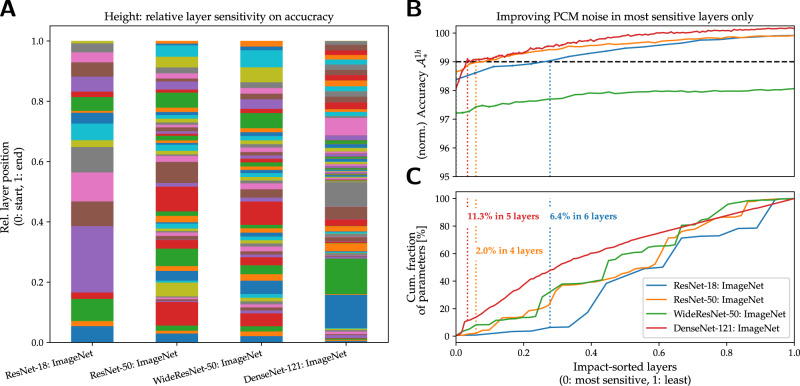
- They performed sensitivity analyses by stress-testing individual nonidealities, ranking layers by sensitivity in large CNNs, and measuring MVM error as relative deviation from ideal matrix-vector multiplication.
Limitations
- The authors state that the results are simulated and that the larger-scale DNN iso-accuracy results remain to be verified in hardware in future.
- They note that the model uses simplifications and abstractions, including Gaussian noise assumptions and an approximate IR-drop calculation, and therefore cannot replace ultimate hardware verification.
- Evidence from the text: some results depend on a PCM-specific calibration, so transferability to non-PCM devices is not direct, although the authors say the framework can be adapted.
Model-written summary. Check it against the paper before relying on it.
Integrity signals
Registry
Cites
Statistics
Figures
Verification
Claims the paper makes
10 Valid · 3 Not valid · 6 Not checked · 81 Own results and interpretations
The cited sources support only part of this claim — read each source’s verdict below.
In the paper
“Weight-quantization into as few as 2–4 bits can often be tolerated without significant accuracy reduction8,19,20.”
§ Hardware-aware training for large-scale and diverse deep learning inference workloads using in-memory computing-based accelerators > Introduction
What the sources say
- Supportedcites [8] Choi, J. et al. Pact: parameterized clipping activation for quantized neural networks. Preprint at https://arxiv.org/abs/1805.06085 (2018). source
The Abstract (p. 1) says 4-bit weights and activations achieved accuracy comparable to full precision across several models and datasets. The ResNet18 results in C.2 (p. 14) also show 2-bit weights with accuracy comparable to the full-precision baseline. The claim’s “can often” wording allows for variation across models. (LLM, conf=0.88)
- Partly supportedcites [19] Krishnamoorthi, R. Quantizing deep convolutional networks for efficient inference: a whitepaper. Preprint at https://arxiv.org/abs/1806.08342 (2018). sourceExperimental — accuracy not yet measured
Section 3.2.4 (p. 22) reports that, for most networks, fine-tuned 4-bit weights achieved accuracy within 5% of 8-bit quantization, with activations kept at 8 bits. This supports the 4-bit portion under those conditions, but the cited passages do not establish comparable accuracy for 2-bit weights. (LLM, conf=0.88)
- Partly supportedcites [20] Nagel, M. et al. A white paper on neural network quantization. Preprint at https://arxiv.org/abs/2106.08295 (2021). sourceExperimental — accuracy not yet measured
The Experiments (p. 24) show that 4-bit weight quantization can preserve accuracy closely for several models, including BERT-base, particularly with 8-bit activations or per-channel quantization. The cited passages do not establish the same result for weights as low as 2 bits, and they report larger accuracy drops for some models at 4 bits. (LLM, conf=0.86)
plain- Asserted: passes — The authors put it forward as true.
- Checkable: passes — It can be checked against evidence.
- Load-bearing: passes — The paper’s conclusions depend on it.
- Based: passes — The paper gives a reason why it holds.
- Supported
The sources with a verdict support this claim; the rest weren’t checked yet, have no full text we could read, or their verdicts aren’t rated yet.
In the paper
“In terms of AIMC workload execution latency and system mapping51, CNNs are already less well-suited for resistive crossbar arrays due to the uneven temporal reuse between layers and spatial under-utilization of the large analog tiles by the small kernel matrices (see Table 1), although some optimization and mapping tricks52 are available.”
§ Hardware-aware training for large-scale and diverse deep learning inference workloads using in-memory computing-based accelerators > Results > HWA training improves AIMC accuracy for all DNNs
What the sources say
- Not checked — no full text of the sourcecites [51] Jain S A heterogeneous and programmable compute-in-memory accelerator architecture for analog-ai using dense 2-d mesh IEEE Trans. Very Large Scale Integr. (VLSI) Syst. 2023 31 114 127 10.1109/TVLSI.2022.3221390 source
- Supportedcites [52] Rasch MJ Gokmen T Rigotti M Haensch W RAPA-ConvNets: modified convolutional networks for accelerated training on architectures with analog arrays Front. Neurosci. 2019 13 753 10.3389/fnins.2019.00753 31417340 PMC6682637 source
The Introduction says ConvNets do not map favorably onto analog-array hardware because convolution kernel matrices are typically small while the number of matrix-vector operations can be very large, especially in early layers. Its Figure 1 caption also shows that analog-array computing time varies across layers, supporting the claim about uneven temporal use. (LLM, conf=0.88)
plainstates a cause- Asserted: passes — The authors put it forward as true.
- Checkable: passes — It can be checked against evidence.
- Load-bearing: passes — The paper’s conclusions depend on it.
- Based: passes — The paper gives a reason why it holds.
The sources with a verdict support this claim; the rest weren’t checked yet, have no full text we could read, or their verdicts aren’t rated yet.
In the paper
“For evaluation times teval long after NVM programming, the conductance drift Eq. (8) can be compensated in the digital domain without any expensive re-programming36,73.”
§ Hardware-aware training for large-scale and diverse deep learning inference workloads using in-memory computing-based accelerators > Methods > AIMC standardized evaluation model
What the sources say
- Not checked — no full text of the sourcecites [36] Ambrogio, S. et al. Reducing the impact of phase-change memory conductance drift on the inference of large-scale hardware neural networks. in IEEE International Electron Devices Meeting, 1–4 (IEEE, 2019). source
- Supportedcites [73] Le Gallo M Sebastian A Cherubini G Giefers H Eleftheriou E Compressed sensing with approximate message passing using in-memory computing IEEE Trans. Electron. Devices 2018 65 4304 4312 10.1109/TED.2018.2865352 source
The Physical Implementation section describes periodic calibration that compensates for a global conductance shift, with the correction performed in a control unit or digital circuitry. It also says the matrix is programmed only once; the Discussion explains that subsequent reconstruction uses read operations rather than reprogramming. The support is for this global-drift calibration, not necessarily every form of device drift. (LLM, conf=0.88)
plainstates a cause- Asserted: passes — The authors put it forward as true.
- Checkable: passes — It can be checked against evidence.
- Load-bearing: passes — The paper’s conclusions depend on it.
- Based: passes — The paper gives a reason why it holds.
Every source the paper cites for this claim was checked and supports it.
In the paper
“We have tried distilling with the FP model as a teacher (similar to ref. 71) and found some benefits when HWA training time is limited.”
§ Hardware-aware training for large-scale and diverse deep learning inference workloads using in-memory computing-based accelerators > Discussion
What the sources say
- Supportedcites [71] Zhou, C., Kadambi, P., Mattina, M. & Whatmough, P. N. Noisy machines: understanding noisy neural networks and enhancing robustness to analog hardware errors using distillation. Preprint at https://arxiv.org/pdf/2001.04974.pdf (2020). source
The citation is attached to the method the citing authors imitate — distillation with the full-precision model as teacher — and our copy states exactly that: Section 5.1 (p. 6) proposes 'a noise free clean model as the teacher to train a noisy student network', and Section 5.2 (p. 8) confirms 'In the distillation retraining runs, the full-precision clean model with an accuracy of 93.87% is used as the teacher'. The same section (5.2, p. 9-10; Discussion, p. 10) reports the benefit of that distillation for hardware-aware retraining under noise, and Section 5.1 (p. 7) notes the teacher-initialised student 'can be considered as a warm start to accelerate retraining', consistent with the citing sentence's limited-training-time framing. The 'found some benefits when HWA training time is limited' result itself is the citing authors' own experiment, not a claim about this source. (LLM, conf=0.88)
plainstates a possible cause- Asserted: passes — The authors put it forward as true.
- Checkable: passes — It can be checked against evidence.
- Load-bearing: unclear — It is unclear whether the paper’s conclusions depend on it.
- Based: passes — The paper gives a reason why it holds.
- Supported
Every source the paper cites for this claim was checked and supports it.
In the paper
“We verified the effectiveness of our HWA training approach on the very same DNNs used in a previous study38 and found, on average, a >10% decrease in AIMC test error for long teval times.”
§ Hardware-aware training for large-scale and diverse deep learning inference workloads using in-memory computing-based accelerators > Methods > AIMC hardware-aware DNN training
What the sources say
- Supportedcites [38] Joshi V Accurate deep neural network inference using computational phase-change memory Nat. Commun. 2020 11 1 13 10.1038/s41467-020-16108-9 32424184 PMC7235046 source
Citation 38 identifies the previous study whose DNNs the citing authors reused; the >10% decrease is presented as the citing authors’ own finding, not as a result of this source. The source’s Results, “Problem statement” (page unavailable), identifies its DNNs as ResNet-32 on CIFAR-10 and ResNet-34 on ImageNet. (LLM, conf=0.90)
plainstates a cause- Asserted: passes — The authors put it forward as true.
- Checkable: passes — It can be checked against evidence.
- Load-bearing: passes — The paper’s conclusions depend on it.
- Based: passes — The paper gives a reason why it holds.
- Supported
64 more claims
Create a free account to see all 100 claims and to verify the 1 reference still open.
- Probably not a substantial claim. 15
- It may state two separate claims as one. 17
- The quote only partly states this claim. 1
Citations
Cites
Deep Residual Learning for Image Recognition
He, K., Zhang, X., Ren, S., & Sun, J. (2016) · 2016 IEEE Conference on Computer Vision and Pattern Recognition (CVPR) · doi:10.1109/cvpr.2016.90 · Cited by 235,474
ImageNet: A large-scale hierarchical image database
Deng, J., Dong, W., Socher, R., Li, L.-J., Li, K., & Fei-Fei, L. (2009) · 2009 IEEE Conference on Computer Vision and Pattern Recognition · doi:10.1109/cvpr.2009.5206848 · Cited by 65,333
PyTorch: An Imperative Style, High-Performance Deep Learning Library
Paszke, A., Gross, S., Massa, F., Lerer, A., Bradbury, J., Chanan, G., Killeen, T., Lin, Z., Gimelshein, N., Antiga, L., et al. (2019) · arXiv · doi:10.48550/arxiv.1912.01703 · Cited by 31,473
Learning Multiple Layers of Features from Tiny Images
Krizhevsky, A. (2024) · doi:10.57702/zp44cu3g · Cited by 23,395
Advances in neural information processing systems 7
Cios, K., & Shields, M. (1997) · Neurocomputing · doi:10.1016/s0925-2312(97)90018-7 · Cited by 22,059
Distilling the Knowledge in a Neural Network
Hinton, G., Vinyals, O., & Dean, J. (2015) · arXiv · doi:10.48550/arxiv.1503.02531 · Cited by 14,204 · cited 1×
“In knowledge distillation [29], an already trained “teacher” model augments the usual one-hot labels with expected class probabilities, which can drive a “student” model to a good solution more rapidly than when training only with the one-hot label vectors.”
BackgroundHan, S., Mao, H., & Dally, W. J. (2015) · arXiv · doi:10.48550/arxiv.1510.00149 · Cited by 4,662
XNOR-Net: ImageNet Classification Using Binary Convolutional Neural Networks
Rastegari, M., Ordonez, V., Redmon, J., & Farhadi, A. (2016) · Lecture Notes in Computer Science · doi:10.1007/978-3-319-46493-0_32 · Cited by 4,408 · cited 1×
“…DNN training and/or inference 2 – 4 , by approximating matrix-vector multiplications (MVMs) and other arithmetic with custom fl oating-point representations such as b fl oat16 5 or DLFloat 6 , or with reduced-precision fi xed-point arithmetic to quantize synaptic weights and activations 7 – 10 .”
BackgroundGLUE: A Multi-Task Benchmark and Analysis Platform for Natural Language Understanding
Wang, A., Singh, A., Michael, J., Hill, F., Levy, O., & Bowman, S. (2018) · Proceedings of the 2018 EMNLP Workshop BlackboxNLP: Analyzing and Interpreting Neural Networks for NLP · doi:10.18653/v1/w18-5446 · Cited by 4,222
Efficient Processing of Deep Neural Networks: A Tutorial and Survey
Sze, V., Chen, Y.-H., Yang, T.-J., & Emer, J. S. (2017) · Proceedings of the IEEE · doi:10.1109/jproc.2017.2761740 · Cited by 4,215 · cited 1×
“Numerous hardware concepts have been introduced to accelerate DNN training and/or inference 2 – 4 , by approximating matrix-vector multiplications (MVMs) and other arithmetic with custom fl oating-point representations such as b fl oat16 5 or DLFloat 6 , or with reduced-precision fi xed-point…”
BackgroundSpecAugment: A Simple Data Augmentation Method for Automatic Speech Recognition
Park, D. S., Chan, W., Zhang, Y., Chiu, C.-C., Zoph, B., Cubuk, E. D., & Le, Q. V. (2019) · Interspeech 2019 · doi:10.21437/interspeech.2019-2680 · Cited by 3,558
Memory devices and applications for in-memory computing
Sebastian, A., Le Gallo, M., Khaddam-Aljameh, R., & Eleftheriou, E. (2020) · Nature Nanotechnology · doi:10.1038/s41565-020-0655-z · Cited by 2,289 · cited 1×
“(7)–(14) in “Methods”) assumes that each array or “tile” approximates MVM ey≈Wx, where digital inputs are converted with a digital-”
MethodSelf-citationFully hardware-implemented memristor convolutional neural network
Yao, P., Wu, H., Gao, B., Tang, J., Zhang, Q., Zhang, W., Yang, J. J., & Qian, H. (2020) · Nature · doi:10.1038/s41586-020-1942-4 · Cited by 2,179 · cited 2×
“Some prior works propose using on-chip or chip-in-the-loop training methods 38,43,49,55,61 , which can greatly increase the attainable accuracy by addressing the speci fi c fabrication variations found on that particular chip.”
BackgroundCourbariaux, M., Hubara, I., Soudry, D., El-Yaniv, R., & Bengio, Y. (2016) · arXiv · doi:10.48550/arxiv.1602.02830 · Cited by 2,106
Equivalent-accuracy accelerated neural-network training using analogue memory
Ambrogio, S., Narayanan, P., Tsai, H., Shelby, R. M., Boybat, I., di Nolfo, C., Sidler, S., Giordano, M., Bodini, M., Farinha, N. C. P., et al. (2018) · Nature · doi:10.1038/s41586-018-0180-5 · Cited by 1,151
Self-citationNeuromorphic computing using non-volatile memory
Burr, G. W., Shelby, R. M., Sebastian, A., Kim, S., Kim, S., Sidler, S., Virwani, K., Ishii, M., Narayanan, P., Fumarola, A., et al. (2017) · Advances in Physics: X · doi:10.1080/23746149.2016.1259585 · Cited by 1,107
Self-citationA compute-in-memory chip based on resistive random-access memory
Wan, W., Kubendran, R., Schaefer, C., Eryilmaz, S. B., Zhang, W., Wu, D., Deiss, S., Raina, P., Qian, H., Gao, B., et al. (2022) · Nature · doi:10.1038/s41586-022-04992-8 · Cited by 943 · cited 2×
“Some prior works propose using on-chip or chip-in-the-loop training methods 38,43,49,55,61 , which can greatly increase the attainable accuracy by addressing the speci fi c fabrication variations found on that particular chip.”
BackgroundGoodfellow, I. J., Warde-Farley, D., Mirza, M., Courville, A., & Bengio, Y. (2013) · arXiv · doi:10.48550/arxiv.1302.4389 · Cited by 935
Parallel programming of an ionic floating-gate memory array for scalable neuromorphic computing
Fuller, E. J., Keene, S. T., Melianas, A., Wang, Z., Agarwal, S., Li, Y., Tuchman, Y., James, C. D., Marinella, M. J., Yang, J. J., et al. (2019) · Science · doi:10.1126/science.aaw5581 · Cited by 756 · cited 1×
“…AIMC weight precision is impacted by various nonidealities, including thermal and 1/f noise, randomization during physical switching induced by electrical and thermal fl uctuations, material inhomogenities 30 , and device-to-device variability introduced during device fabrication or operation.”
BackgroundQuantizing deep convolutional networks for efficient inference: A whitepaper
Krishnamoorthi, R. (2018) · arXiv · doi:10.48550/arxiv.1806.08342 · Cited by 753
Deep physical neural networks trained with backpropagation
Wright, L. G., Onodera, T., Stein, M. M., Wang, T., Schachter, D. T., Hu, Z., & McMahon, P. L. (2022) · Nature · doi:10.1038/s41586-021-04223-6 · Cited by 727 · cited 1×
“Some prior works propose using on-chip or chip-in-the-loop training methods 38,43,49,55,61 , which can greatly increase the attainable accuracy by addressing the speci fi c fabrication variations found on that particular chip.”
BackgroundPACT: Parameterized Clipping Activation for Quantized Neural Networks
Choi, J., Wang, Z., Venkataramani, S., Chuang, P. I.-J., Srinivasan, V., & Gopalakrishnan, K. (2018) · arXiv · doi:10.48550/arxiv.1805.06085 · Cited by 703 · cited 3×
“In practice, QAT is known to have limits, and MVM minimum-precision requirements vary across each DNN topology.”
BackgroundCnvlutin: ineffectual-neuron-free deep neural network computing
Albericio, J., Judd, P., Hetherington, T., Aamodt, T., Jerger, N. E., & Moshovos, A. (2016) · ACM SIGARCH Computer Architecture News · doi:10.1145/3007787.3001138 · Cited by 614
GLUE: A Multi-Task Benchmark and Analysis Platform for Natural Language Understanding
Wang, A., Singh, A., Michael, J., Hill, F., Levy, O., & Bowman, S. R. (2018) · arXiv · doi:10.48550/arxiv.1804.07461 · Cited by 562
Gokmen, T., & Vlasov, Y. (2016) · Frontiers in Neuroscience · doi:10.3389/fnins.2016.00333 · Cited by 491 · cited 1×
“…instance, because of the sequential nature of layers of a deep network, shallower but wider layersshouldgenerally be preferable for AIMC, since higher utilization of large matrices stored on the crossbar arrays does not signi fi cantly change the runtime 52,63 and helps improve energy ef fi ciency.”
BackgroundAccurate deep neural network inference using computational phase-change memory
Joshi, V., Le Gallo, M., Haefeli, S., Boybat, I., Nandakumar, S. R., Piveteau, C., Dazzi, M., Rajendran, B., Sebastian, A., & Eleftheriou, E. (2020) · Nature Communications · doi:10.1038/s41467-020-16108-9 · Cited by 490 · cited 10×
“In previous studies, noise has been injected in multiple ways, such as output 38,40 , input 38 , or weight noise 38,41 .”
BackgroundMethodInfluentialSelf-citationAn overview of phase-change memory device physics
Le Gallo, M., & Sebastian, A. (2020) · Journal of Physics D: Applied Physics · doi:10.1088/1361-6463/ab7794 · Cited by 460 · cited 1×
“In many materials, such as phase-change memory (PCM) 22,23 , resistive random-access memory (ReRAM) 24,25 , conductive bridge RAM (CBRAM) 26,27 , or electro-chemical random-access memory (ECRAM) 28,29 , these conductances are effectively continuous physical quantities, and stored weights are not…”
BackgroundSelf-citationThe Penn Treebank: An Overview
Taylor, A., Marcus, M., & Santorini, B. (2003) · Text, Speech and Language Technology · doi:10.1007/978-94-010-0201-1_1 · Cited by 414
Recent Progress in Phase-ChangeMemory Technology
Burr, G. W., BrightSky, M. J., Sebastian, A., Cheng, H.-Y., Wu, J.-Y., Kim, S., Sosa, N. E., Papandreou, N., Lung, H.-L., Pozidis, H., et al. (2016) · IEEE Journal on Emerging and Selected Topics in Circuits and Systems · doi:10.1109/jetcas.2016.2547718 · Cited by 393 · cited 1×
“In many materials, such as PCM [9, 45], resistive random-access memory”
BackgroundSelf-citationAccurate deep neural network inference using computational phase-change memory
Joshi, V., Gallo, M. L., Haefeli, S., Boybat, I., Nandakumar, S. R., Piveteau, C., Dazzi, M., Rajendran, B., Sebastian, A., & Eleftheriou, E. S. (2020) · RePEc: Research Papers in Economics · doi:10.3929/ethz-b-000416797 · Cited by 379
Self-citationCompute Trends Across Three Eras of Machine Learning
Sevilla, J., Heim, L., Ho, A., Besiroglu, T., Hobbhahn, M., & Villalobos, P. (2022) · 2022 International Joint Conference on Neural Networks (IJCNN) · doi:10.1109/ijcnn55064.2022.9891914 · Cited by 363 · cited 9×
“(1) and (2) together with hardware-calibrated PCM”
BackgroundInfluentialPeng, X., Huang, S., Luo, Y., Sun, X., & Yu, S. (2019) · 2019 IEEE International Electron Devices Meeting (IEDM) · doi:10.1109/iedm19573.2019.8993491 · Cited by 359
A White Paper on Neural Network Quantization
Nagel, M., Fournarakis, M., Amjad, R. A., Bondarenko, Y., van Baalen, M., & Blankevoort, T. (2021) · arXiv · doi:10.48550/arxiv.2106.08295 · Cited by 323 · cited 2×
“Weight-quantization into as few as 2-4 bits can often be tolerated without significant accuracy reduction [42, 15, 54].”
BackgroundOptimization of Conductance Change in Pr1–xCaxMnO3-Based Synaptic Devices for Neuromorphic Systems
Jang, J.-W., Park, S., Burr, G. W., Hwang, H., & Jeong, Y.-H. (2015) · IEEE Electron Device Letters · doi:10.1109/led.2015.2418342 · Cited by 310 · cited 1×
“…AIMC weight precision is impacted by various nonidealities, including thermal and 1/f noise, randomization during physical switching induced by electrical and thermal fl uctuations, material inhomogenities 30 , and device-to-device variability introduced during device fabrication or operation.”
BackgroundSelf-citationLe Gallo, M., Khaddam-Aljameh, R., Stanisavljevic, M., Vasilopoulos, A., Kersting, B., Dazzi, M., Karunaratne, G., Brändli, M., Singh, A., Müller, S. M., et al. (2023) · Nature Electronics · doi:10.1038/s41928-023-01010-1 · Cited by 310
Self-citationAccelerator-friendly neural-network training: Learning variations and defects in RRAM crossbar
Chen, L., Li, J., Chen, Y., Deng, Q., Shen, J., Liang, X., & Jiang, L. (2017) · Design, Automation & Test in Europe Conference & Exhibition (DATE), 2017 · doi:10.23919/date.2017.7926952 · Cited by 245 · cited 2×
“That said, effective AIMC weight-precision is impacted by various nonidealities, including thermal and 1/f noise, randomization during physical switching induced by electrical and thermal fluctuations, material inhomogenities [14], and device-to-device variability introduced during device fabrication or operation.”
BackgroundChen, A. (2013) · IEEE Transactions on Electron Devices · doi:10.1109/ted.2013.2246791 · Cited by 230 · cited 1×
“In a physical crossbar, however, IR-drops imposed by finite wire resistance cause the bitline voltage to vary [13], especially as instantaneous currents get large.”
BackgroundSelf-citationCnvlutin: Ineffectual-Neuron-Free Deep Neural Network Computing
Albericio, J., Judd, P., Hetherington, T., Aamodt, T., Jerger, N. E., & Moshovos, A. (2016) · 2016 ACM/IEEE 43rd Annual International Symposium on Computer Architecture (ISCA) · doi:10.1109/isca.2016.11 · Cited by 226
A Programmable Heterogeneous Microprocessor Based on Bit-Scalable In-Memory Computing
Jia, H., Valavi, H., Tang, Y., Zhang, J., & Verma, N. (2020) · IEEE Journal of Solid-State Circuits · doi:10.1109/jssc.2020.2987714 · Cited by 224 · cited 1×
“Numerous hardware concepts have been introduced to accelerate DNN training and/or inference [77, 35, 68], by approximating MVMs and other arithmetic with custom floating-point representations such as bfloat16 [84] or DLFloat [2], or with reduced-precision fixed-point arithmetic to quantize synaptic weights and activat…”
MethodNanosecond protonic programmable resistors for analog deep learning
Onen, M., Émond, N., Wang, B., Zhang, D., Ross, F. M., Li, J., Yildiz, B., & del Alamo, J. A. (2022) · Science · doi:10.1126/science.abp8064 · Cited by 187 · cited 1×
“…materials, such as phase-change memory (PCM) 22,23 , resistive random-access memory (ReRAM) 24,25 , conductive bridge RAM (CBRAM) 26,27 , or electro-chemical random-access memory (ECRAM) 28,29 , these conductances are effectively continuous physical quantities, and stored weights are not quantized.”
BackgroundXue, C.-X., Chiu, Y.-C., Liu, T.-W., Huang, T.-Y., Liu, J.-S., Chang, T.-W., Kao, H.-Y., Wang, J.-H., Wei, S.-Y., Lee, C.-Y., et al. (2020) · Nature Electronics · doi:10.1038/s41928-020-00505-5 · Cited by 181 · cited 1×
“And if necessary, what degree of improved device-to-device uniformity might be required — through better NVM-device fabrication — inorder for AIMCto succeed on all DNN models?”
BackgroundMNSIM: Simulation Platform for Memristor-based Neuromorphic Computing System
Xia, L., Li, B., Tang, T., Gu, P., Chen, P.-Y., Yu, S., Cao, Y., Wang, Y., Xie, Y., & Yang, H. (2017) · IEEE Transactions on Computer-Aided Design of Integrated Circuits and Systems · doi:10.1109/tcad.2017.2729466 · Cited by 171
High-Performance Mixed-Signal Neurocomputing With Nanoscale Floating-Gate Memory Cell Arrays
Merrikh-Bayat, F., Guo, X., Klachko, M., Prezioso, M., Likharev, K. K., & Strukov, D. B. (2018) · IEEE Transactions on Neural Networks and Learning Systems · doi:10.1109/tnnls.2017.2778940 · Cited by 167 · cited 1×
“While naive direct weight-quantization invariably leads to DNN accuracy loss, original model accuracies can often be recovered when DNNs are retrained in a quantization-aware manner, even for aggressive reductions in precision.”
BackgroundTraining Deep Convolutional Neural Networks with Resistive Cross-Point Devices
Gokmen, T., Onen, M., & Haensch, W. (2017) · Frontiers in Neuroscience · doi:10.3389/fnins.2017.00538 · Cited by 162
ECRAM as Scalable Synaptic Cell for High-Speed, Low-Power Neuromorphic Computing
Tang, J., Bishop, D., Kim, S., Copel, M., Gokmen, T., Todorov, T., Shin, S., Lee, K.-T., Solomon, P., Chan, K., et al. (2018) · 2018 IEEE International Electron Devices Meeting (IEDM) · doi:10.1109/iedm.2018.8614551 · Cited by 161
Mixed-Signal Computing for Deep Neural Network Inference
Murmann, B. (2021) · IEEE Transactions on Very Large Scale Integration (VLSI) Systems · doi:10.1109/tvlsi.2020.3020286 · Cited by 160 · cited 1×
“This enables approximate MVM computation directly in-memory, by applying activation vectors (as voltages or pulse durations) to the crossbar array, and then reading out analog physical quantities (instantaneous current or accumulated charge) [52, 12, 53].”
MethodA Flexible and Fast PyTorch Toolkit for Simulating Training and Inference on Analog Crossbar Arrays
Rasch, M. J., Moreda, D., Gokmen, T., Le Gallo, M., Carta, F., Goldberg, C., El Maghraoui, K., Sebastian, A., & Narayanan, V. (2021) · 2021 IEEE 3rd International Conference on Artificial Intelligence Circuits and Systems (AICAS) · doi:10.1109/aicas51828.2021.9458494 · Cited by 160 · cited 2×
“Here, clip b a ð x Þ constrains z between minimum a and maximum b , α is a scalar, per-crossbar value which determines the usable input range.”
BackgroundMethodSelf-citationKhaddam-Aljameh, R., Stanisavljevic, M., Fornt Mas, J., Karunaratne, G., Brändli, M., Liu, F., Singh, A., Müller, S. M., Egger, U., Petropoulos, A., et al. (2022) · IEEE Journal of Solid-State Circuits · doi:10.1109/jssc.2022.3140414 · Cited by 144
Self-citationRxNN: A Framework for Evaluating Deep Neural Networks on Resistive Crossbars
Jain, S., Sengupta, A., Roy, K., & Raghunathan, A. (2021) · IEEE Transactions on Computer-Aided Design of Integrated Circuits and Systems · doi:10.1109/tcad.2020.3000185 · Cited by 137 · cited 3×
“Some aspectsofour AIMCcrossbar model have been investigated individually in earlier studies, such as the effect of ADC/DAC quantization, IR-drop, and general read noise 55 – 57 , as well as data-dependent long-term noise 38 .”
BackgroundMethodProgramming algorithms for multilevel phase-change memory
Papandreou, N., Pozidis, H., Pantazi, A., Sebastian, A., Breitwisch, M., Lam, C., & Eleftheriou, E. (2011) · 2011 IEEE International Symposium of Circuits and Systems (ISCAS) · doi:10.1109/iscas.2011.5937569 · Cited by 124 · cited 1×
“These issues cause both MVM read-out [56] and the writing or programming of the conductances [60, 79, 51] to be erroneous and non-deterministic.”
BackgroundSelf-citationKhaddam-Aljameh, R., Stanisavljevic, M., Fornt Mas, J., Karunaratne, G., Braendli, M., Liu, F., Singh, A., Müller, S. M., Egger, U., Petropoulos, A., et al. (2021) · 2021 Symposium on VLSI Circuits · doi:10.23919/vlsicircuits52068.2021.9492362 · Cited by 124
Self-citationAI Accelerator Survey and Trends
Reuther, A., Michaleas, P. W., Jones, M. P., Gadepally, V. N., Samsi, S., & Kepner, J. (2021) · IEEE High Performance Extreme Computing Conference · doi:10.1109/hpec49654.2021.9622867 · Cited by 124 · cited 1×
“Numerous hardware concepts have been introduced to accelerate DNN training and/or inference [77, 35, 68], by approximating MVMs and other arithmetic with custom floating-point representations such as bfloat16 [84] or DLFloat [2], or with reduced-precision fixed-point arithmetic to quantize synaptic weights and activat…”
MethodDLFloat: A 16-b Floating Point Format Designed for Deep Learning Training and Inference
Agrawal, A., Mueller, S. M., Fleischer, B., Sun, X. N., Wang, N., Choi, J., & Gopalakrishnan, K. (2019) · IEEE Symposium on Computer Arithmetic (ARITH) · doi:10.1109/arith.2019.00023 · Cited by 113 · cited 1×
“…to accelerate DNN training and/or inference 2 – 4 , by approximating matrix-vector multiplications (MVMs) and other arithmetic with custom fl oating-point representations such as b fl oat16 5 or DLFloat 6 , or with reduced-precision fi xed-point arithmetic to quantize synaptic weights and…”
BackgroundAI and ML Accelerator Survey and Trends
Reuther, A., Michaleas, P., Jones, M., Gadepally, V., Samsi, S., & Kepner, J. (2022) · 2022 IEEE High Performance Extreme Computing Conference (HPEC) · doi:10.1109/hpec55821.2022.9926331 · Cited by 109
Statistics of Resistance Drift Due to Structural Relaxation in Phase-Change Memory Arrays
Boniardi, M., Ielmini, D., Lavizzari, S., Lacaita, A. L., Redael, A., & Pirovano, A. (2010) · IEEE Transactions on Electron Devices · doi:10.1109/ted.2010.2058771 · Cited by 106 · cited 1×
“Worse yet, conductances can evolve over time after programming [6, 4, 7].”
BackgroundAgrawal, A., Lee, S. K., Silberman, J., Ziegler, M., Kang, M., Venkataramani, S., Cao, N., Fleischer, B., Guillorn, M., Cohen, M., et al. (2021) · 2021 IEEE International Solid- State Circuits Conference (ISSCC) · doi:10.1109/isscc42613.2021.9365791 · Cited by 106 · cited 1×
“For instance, the fi rst and last layers of convolutional neural networks (CNNs) are invariably implemented with high precision FP, even instudies claiming CNN iso-accuracy at very low fi xed-point precision 7,8 .”
BackgroundUsing the IBM analog in-memory hardware acceleration kit for neural network training and inference
Gallo, M. L., Lammie, C., Büchel, J., Carta, F., Fagbohungbe, O. I., Mackin, C., Tsai, H.-Y. S., Narayanan, V., Sebastian, A., Maghraoui, K. E., et al. (2023) · APL Machine Learning · doi:10.1063/5.0168089 · Cited by 102
Self-citationCompressed Sensing With Approximate Message Passing Using In-Memory Computing
Le Gallo, M., Sebastian, A., Cherubini, G., Giefers, H., & Eleftheriou, E. (2018) · IEEE Transactions on Electron Devices · doi:10.1109/ted.2018.2865352 · Cited by 99 · cited 1×
“8 can be compensated in the digital domain without any expensive re-programming [46, 4].”
BackgroundSelf-citation(2020) · neural information processing systems · Cited by 92
Narayanan, P., Ambrogio, S., Okazaki, A., Hosokawa, K., Tsai, H., Nomura, A., Yasuda, T., Mackin, C., Lewis, S. C., Friz, A., et al. (2021) · IEEE Transactions on Electron Devices · doi:10.1109/ted.2021.3115993 · Cited by 85
Self-citationALD-based confined PCM with a metallic liner toward unlimited endurance
Kim, W., BrightSky, M., Masuda, T., Sosa, N., Kim, S., Bruce, R., Carta, F., Fraczak, G., Cheng, H. Y., Ray, A., et al. (2016) · 2016 IEEE International Electron Devices Meeting (IEDM) · doi:10.1109/iedm.2016.7838343 · Cited by 78
Ambrogio, S., Gallot, M., Spoon, K., Tsai, H., Mackin, C., Wesson, M., Kariyappa, S., Narayanan, P., Liu, C.-C., Kumar, A., et al. (2019) · 2019 IEEE International Electron Devices Meeting (IEDM) · doi:10.1109/iedm19573.2019.8993482 · Cited by 76
Self-citationJain, S., Tsai, H., Chen, C.-T., Muralidhar, R., Boybat, I., Frank, M. M., Woźniak, S., Stanisavljevic, M., Adusumilli, P., Narayanan, P., et al. (2023) · IEEE Transactions on Very Large Scale Integration (VLSI) Systems · doi:10.1109/tvlsi.2022.3221390 · Cited by 76
Self-citationMNSIM: Simulation Platform for Memristor-based Neuromorphic Computing System
Xia, L., Li, B., Tang, T., Gu, P., Yin, X., Huangfu, W., Chen, P.-Y., Yu, S., Cao, Y., Wang, Y., et al. (2016) · Proceedings of the 2016 Design, Automation & Test in Europe Conference & Exhibition (DATE) · doi:10.3850/9783981537079_0549 · Cited by 75
ReRAM-based synaptic device for neuromorphic computing
Jang, J.-W., Park, S., Jeong, Y.-H., & Hwang, H. (2014) · 2014 IEEE International Symposium on Circuits and Systems (ISCAS) · doi:10.1109/iscas.2014.6865320 · Cited by 67 · cited 1×
“(ReRAM) [33, 34], conductive-bridge RAM (CBRAM) [49, 21], or electro-chemical randomaccess memory (ECRAM) [47, 59], these conductances are effectively continuous physical quantities, and stored weights are not quantized.”
BackgroundAI hardware acceleration with analog memory: Microarchitectures for low energy at high speed
Chang, H.-Y., Narayanan, P., Lewis, S. C., Farinha, N. C. P., Hosokawa, K., Mackin, C., Tsai, H., Ambrogio, S., Chen, A., & Burr, G. W. (2019) · IBM Journal of Research and Development · doi:10.1147/jrd.2019.2934050 · Cited by 62 · cited 2×
“As a ‘non-von Neumann’ architecture, AIMC performs MVM operations at the location of the stored weights, in a highly-parallel, fast, and energy-efficient manner [12] – but only approximately.”
BackgroundMethodSelf-citationOptimised weight programming for analogue memory-based deep neural networks
Mackin, C., Rasch, M. J., Chen, A., Timcheck, J., Bruce, R. L., Li, N., Narayanan, P., Ambrogio, S., Le Gallo, M., Nandakumar, S. R., et al. (2022) · Nature Communications · doi:10.1038/s41467-022-31405-1 · Cited by 57 · cited 1×
“That said, our HWA training approach could readily be combined with more sophisticated online compensation methods, with on-chip or chip-in-the-loop training, or with morethanone device pair used per weight, including optimization of how weights are assigned across these conductances 62 .”
MethodSelf-citationMultilevel phase-change memory
Papandreou, N., Pantazi, A., Sebastian, A., Breitwisch, M., Lam, C., Pozidis, H., & Eleftheriou, E. S. (2010) · IEEE International Conference on Electronics, Circuits and Systems (ICECS) · doi:10.1109/icecs.2010.5724687 · Cited by 54
Self-citationAnalog Matrix Processor for Edge AI Real-Time Video Analytics
Fick, L., Skrzyniarz, S., Parikh, M., Henry, M. B., & Fick, D. (2022) · 2022 IEEE International Solid- State Circuits Conference (ISSCC) · doi:10.1109/isscc42614.2022.9731773 · Cited by 53 · cited 1×
“Although some promising, small-sized DNN prototype demonstrations exist [83, 39, 86, 20, 57, 5, 88], it remains unclear how robust the AIMC deployment of realistically-sized AI workloads will be.”
BackgroundShakeout: A New Regularized Deep Neural Network Training Scheme
Kang, G., Li, J., & Tao, D. (2016) · Proceedings of the AAAI Conference on Artificial Intelligence · doi:10.1609/aaai.v30i1.10202 · Cited by 52
TxSim: Modeling Training of Deep Neural Networks on Resistive Crossbar Systems
Roy, S., Sridharan, S., Jain, S., & Raghunathan, A. (2021) · IEEE Transactions on Very Large Scale Integration (VLSI) Systems · doi:10.1109/tvlsi.2021.3063543 · Cited by 52 · cited 1×
“We chose to intentionally ignore static crossbar effects that would change the conductance value systematically [31, 69], since read-write-verify conductance programming can readily adapt to such effects.”
MethodTsai, H., Ambrogio, S., Mackin, C., Narayanan, P., Shelby, R. M., Rocki, K., Chen, A., & Burr, G. W. (2019) · 2019 Symposium on VLSI Technology · doi:10.23919/vlsit.2019.8776519 · Cited by 47 · cited 2×
“These issues cause both MVM read-out [56] and the writing or programming of the conductances [60, 79, 51] to be erroneous and non-deterministic.”
BackgroundSelf-citationNoise-Resilient DNN: Tolerating Noise in PCM-Based AI Accelerators via Noise-Aware Training
Kariyappa, S., Tsai, H., Spoon, K., Ambrogio, S., Narayanan, P., Mackin, C., Chen, A., Qureshi, M., & Burr, G. W. (2021) · IEEE Transactions on Electron Devices · doi:10.1109/ted.2021.3089987 · Cited by 45 · cited 6×
“[36, 24, 38]), and has been one of the hallmarks of HWA training for AIMC.”
BackgroundMethodInfluentialSelf-citationPrecision of synaptic weights programmed in phase-change memory devices for deep learning inference
Nandakumar, S. R., Boybat, I., Han, J., Ambrogio, S., Adusumilli, P., Bruce, R. L., BrightSky, M. J., Rasch, M. J., Gallo, M. L., & Sebastian, A. (2020) · Technical digest - International Electron Devices Meeting/Technical digest · doi:10.1109/iedm13553.2020.9371990 · Cited by 42 · cited 1×
“where g(teval) is the conductance measured at time teval after the programming (assumed to complete at t0 = 20s [55]) and ν is the drift coefficient.”
BackgroundSelf-citationPrecision of bit slicing with in-memory computing based on analog phase-change memory crossbars
Le Gallo, M., Nandakumar, S. R., Ciric, L., Boybat, I., Khaddam-Aljameh, R., Mackin, C., & Sebastian, A. (2022) · Neuromorphic Computing and Engineering · doi:10.1088/2634-4386/ac4fb7 · Cited by 42 · cited 1×
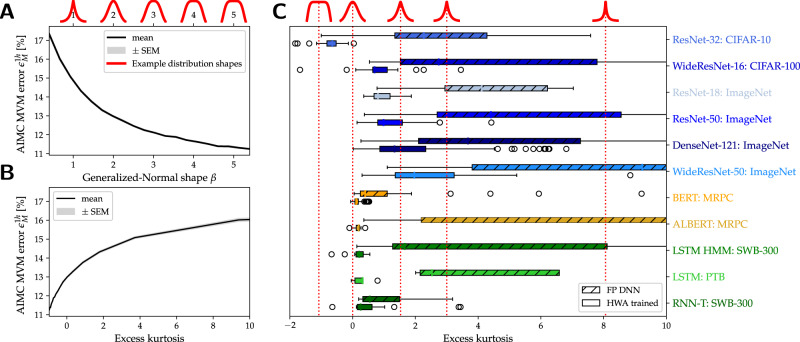
“B Datafrom( A ) is replotted as a function of the (excess) kurtosis of the distribution.”
BackgroundSelf-citationWeight Programming in DNN Analog Hardware Accelerators in the Presence of NVM Variability
Mackin, C., Tsai, H., Ambrogio, S., Narayanan, P., Chen, A., & Burr, G. W. (2019) · Advanced Electronic Materials · doi:10.1002/aelm.201900026 · Cited by 41 · cited 1×
“These issues cause both MVM read-out 31 and the writing or programming of the conductances 32 – 34 to be erroneous and non-deterministic.”
BackgroundSelf-citationEmbedding-Based Speaker Adaptive Training of Deep Neural Networks
Cui, X., Goel, V., & Saon, G. (2017) · Interspeech (USB) · doi:10.21437/interspeech.2017-460 · Cited by 41
Improved Synaptic Behavior of CBRAM Using Internal Voltage Divider for Neuromorphic Systems
Lim, S., Kwak, M., & Hwang, H. (2018) · IEEE Transactions on Electron Devices · doi:10.1109/ted.2018.2857494 · Cited by 40 · cited 2×
“In many materials, such as phase-change memory (PCM) 22,23 , resistive random-access memory (ReRAM) 24,25 , conductive bridge RAM (CBRAM) 26,27 , or electro-chemical random-access memory (ECRAM) 28,29 , these conductances are effectively continuous physical quantities, and stored weights are not quantized.”
BackgroundThe marriage of training and inference for scaled deep learning analog hardware
Gokmen, T., Rasch, M. J., & Haensch, W. (2019) · 2019 IEEE International Electron Devices Meeting (IEDM) · doi:10.1109/iedm19573.2019.8993573 · Cited by 37 · cited 4×
“[36, 38, 24]), we set out to retrain these 11 DNNs in a hardware-aware (HWA) manner.”
BackgroundMethodInfluentialSelf-citationPhase-Change Memory Models for Deep Learning Training and Inference
Nandakumar, S. R., Boybat, I., Joshi, V., Piveteau, C., Le Gallo, M., Rajendran, B., Sebastian, A., & Eleftheriou, E. (2019) · 2019 26th IEEE International Conference on Electronics, Circuits and Systems (ICECS) · doi:10.1109/icecs46596.2019.8964852 · Cited by 34
Self-citationBurr, G. W., Sebastian, A., Ando, T., & Hänsch, W. (2021) · IEEE Spectrum · doi:10.1109/mspec.2021.9641759 · Cited by 33
Self-citationTraining Large-scale Artificial Neural Networks on Simulated Resistive Crossbar Arrays
Rasch, M. J., Gokmen, T., & Hänsch, W. (2019) · IEEE Design and Test · doi:10.1109/mdat.2019.2952341 · Cited by 30
Self-citationZhou, C., Kadambi, P., Mattina, M., & Whatmough, P. N. (2020) · arXiv · doi:10.48550/arxiv.2001.04974 · Cited by 27
Spoon, K., Tsai, H., Chen, A., Rasch, M. J., Ambrogio, S., Mackin, C., Fasoli, A., Friz, A. M., Narayanan, P., Stanisavljevic, M., et al. (2021) · Frontiers in Computational Neuroscience · doi:10.3389/fncom.2021.675741 · Cited by 26 · cited 1×
“A number of previous studies have shown that noise-aware training — simple injection of noise onto weights or activations during DNN training — can make DNNs more robust for AIMC deployment 33,38 – 42 .”
BackgroundSelf-citationAdaptive Gaussian Noise Injection Regularization for Neural Networks
Li, Y., & Liu, F. (2016) · International Symposium on Neural Networks · doi:10.1007/978-3-030-64221-1_16 · Cited by 24 · cited 1×
“Similarly, other studies seeking to prevent overfitting or to enhance robustness to adversarial attacks have injected noise into standard floating-point training as a regularization technique ([74, 81, 26, 37, 58, 63, 48]).”
BackgroundBruce, R. L., Sarwat, S. G., Boybat, I., Cheng, C.-W., Kim, W., Nandakumar, S. R., Mackin, C., Philip, T., Liu, Z., Brew, K., et al. (2021) · 2021 IEEE International Reliability Physics Symposium (IRPS) · doi:10.1109/irps46558.2021.9405191 · Cited by 23 · cited 1×
“Whereas QAT gets challenging as precision is deterministically reduced, MVM approximation in AIMC is tied to non-deterministic signal-to-noise ratio.”
BackgroundSelf-citationYang, X., Wu, C., Li, M., & Chen, Y. (2022) · Advanced Intelligent Systems · doi:10.1002/aisy.202200029 · Cited by 22 · cited 1×
“Thus more realistic and standardized AIMC crossbar models — which can support comparison of AIMC accuracy for hardware-aware trained DNN models across studies — are needed.”
MethodA Power-efficient Bidirectional Potentiostat-based Readout IC for Wide-range Electrochemical Sensing
Tsai, J.-H., Chen, Y., & Liao, Y. (2018) · IEEE International Symposium on Circuits and Systems proceedings · doi:10.1109/iscas.2018.8351107 · Cited by 20
Gradient descent-based programming of analog in-memory computing cores
Büchel, J., Vasilopoulos, A., Kersting, B., Odermatt, F., Brew, K., Ok, I., Choi, S., Saraf, I., Chan, V., Philip, T., et al. (2022) · 2022 International Electron Devices Meeting (IEDM) · doi:10.1109/iedm45625.2022.10019486 · Cited by 18
Self-citationRasch, M. J., Gokmen, T., Rigotti, M., & Haensch, W. (2019) · Frontiers in Neuroscience · doi:10.3389/fnins.2019.00753 · Cited by 14 · cited 1×
“Our results here indicate that AIMC noise-robustness issues will pose additional challenges when implementing CNNs onto AIMC systems.”
BackgroundSelf-citationIBM/aihwkit: IBM Analog Hardware Acceleration Kit 0.6.0
Rodríguez, D. M., Rasch, M. J., Maghraoui, K. E., kkvtran, pablocarmona, Carta, F., Duran, I., Ali, A., Büchel, J., Lammie, C., et al. (2022) · Zenodo (CERN European Organization for Nuclear Research) · doi:10.5281/zenodo.6555046 · Cited by 4
Self-citationGradient descent-based programming of analog in-memory computing cores
Büchel, J., Sebastian, A., Kersting, B., Odermatt, F., Brew, K., Ok, I., Choi, S., Vasilopoulos, A., Chan, V., Philip, T., et al. (2023) · Proceedings of the Neuromorphic Materials, Devices, Circuits and Systems · doi:10.29363/nanoge.neumatdecas.2023.031 · Cited by 1
Self-citationUsing the IBM Analog In-Memory Hardware Acceleration Kit for Neural Network Training and Inference
Gallo, M. L., Lammie, C., Buechel, J., et al. (2023) · arXiv · doi:10.48550/arxiv.2307.09357
IBM/aihwkit: IBM Analog Hardware Acceleration Kit 0.8.0
Rodríguez, D. M., Rasch, M. J., Carta, F., et al. (2023) · Zenodo · doi:10.5281/zenodo.8148598
Self-citationCompute Trends Across Three Eras of Machine Learning
Sevilla, J., Heim, L., Ho, A., et al. (2022) · arXiv · doi:10.48550/arxiv.2202.05924
Research works printed but not linked: 8
- Hubara, I., Courbariaux, M., Soudry, D., El-Yaniv, R. & Bengio, Y. Quantized neural networks: Training neural networks with low precision weights and activations. The Journal of Machine Learning Research1, 6869–6898 (2017).
- Srivastava N Hinton G Krizhevsky A Sutskever I Salakhutdinov R Dropout: a simple way to prevent neural networks from overfitting J. Mach. Learn. Res. 2014 15 1929 1958
- Wager, S., Wang, S. & Liang, P. Dropout training as adaptive regularization. Advances in neural information processing systems26, (2013).
- Noh, H., You, T., Mun, J. & Han, B. Regularizing deep neural networks by noise: its interpretation and optimization. in Proceedings of the 31st International Conference on Neural Information Processing Systems, NIPS’17, (Red Hook, NY, USA) 5115–5124 (Curran Associates Inc., 2017).
- Rakin, A. S., He, Z. & Fan, D. Parametric noise injection: trainable randomness to improve deep neural network robustness against adversarial attack. in Proceedings of the IEEE/CVF Conference on Computer Vision and Pattern Recognition 588–597 (IEEE, 2018).
- Wan, L., Zeiler, M., Zhang, S., Le Cun, Y. & Fergus, R. Regularization of neural networks using drop connect. in Proceedings of the 30th International Conference on Machine Learning (eds Dasgupta, S. & McAllester, D.) Vol. 28 of Proceedings of Machine Learning Research, 1058–1066 (PMLR, 2013).
- Glorot, X. & Bengio, Y. Understanding the difficulty of training deep feedforward neural networks. in Proceedings of the Thirteenth International Conference on Artificial Intelligence and Statistics 249–256 (JMLR Workshop and Conference Proceedings, 2010).
- Godfrey, J. J. & Holliman, E. Switchboard-1 release 2 ldc97s62. 926, 927 (1997).
Cited by
Hardware implementation of memristor-based artificial neural networks
Aguirre, F., Sebastian, A., Le Gallo, M., Song, W., Wang, T., Yang, J. J., Lu, W., Chang, M.-F., Ielmini, D., Yang, Y., et al. (2024) · Nature Communications · doi:10.1038/s41467-024-45670-9 · Cited by 564
“To avoid this loss of accuracy, hardware-aware training methods, in which device non-idealities are incorporated during training have been proposed in the literature 189,190 .”
Self-citationLe Gallo, M., Khaddam-Aljameh, R., Stanisavljevic, M., Vasilopoulos, A., Kersting, B., Dazzi, M., Karunaratne, G., Brändli, M., Singh, A., Müller, S. M., et al. (2023) · Nature Electronics · doi:10.1038/s41928-023-01010-1 · Cited by 310
Self-citationMemristor-based hardware accelerators for artificial intelligence
Huang, Y., Ando, T., Sebastian, A., Chang, M., Yang, J. J., & Xia, Q. (2024) · Nature Reviews Electrical Engineering · doi:10.1038/s44287-024-00037-6 · Cited by 196
“The multicore chip has demonstrated an inference accuracy nearly equivalent to software-based implementations with two widely employed ANN models, residual neural networks (ResNet) and LSTM. Combining the concepts of multicore within a chip and multichip setups, an RNN with over 45 million weights has been deployed ac…”
InfluentialSelf-citationUsing the IBM analog in-memory hardware acceleration kit for neural network training and inference
Gallo, M. L., Lammie, C., Büchel, J., Carta, F., Fagbohungbe, O. I., Mackin, C., Tsai, H.-Y. S., Narayanan, V., Sebastian, A., Maghraoui, K. E., et al. (2023) · APL Machine Learning · doi:10.1063/5.0168089 · Cited by 102
Self-citationPhase-Change Memory for In-Memory Computing
Syed, G. S., Gallo, M. L., & Sebastian, A. (2025) · Chemical Reviews · doi:10.1021/acs.chemrev.4c00670 · Cited by 98
Self-citation
Metadata
- Authors
- Rasch, M. J., Mackin, C., Le Gallo, M., Chen, A., Fasoli, A., Odermatt, F., Li, N., Nandakumar, S. R., Narayanan, P., Tsai, H., Burr, G. W., Sebastian, A., & Narayanan, V.
- Affiliations
- IBM (United States) (US)
- IBM Research - Almaden (US)
- IBM Research - Zurich (CH)
- Corresponding author
- Rasch, Malte J.
- ORCID
- Venue
- Nature Communications
- Published
- 2023-08-30
- Volume
- 14
- Issue
- 1
- Pages
- 5282-5282
- ISSN
- 2041-1723 (ISSN-L)
- PMC
- PMC10469175
- OpenAlex
- W4386293192
- Cited by
- 213
- References
- 81
- Citations by year
- 2026: 83 · 2025: 70 · 2024: 46 · 2023: 14
- FWCI
- 15.35
- Type
- journal article
- Language
- en
- Open access
- gold
- doi.org
- Licence
- cc-by
- creativecommons.org/licenses/by/4.0 (tdm)
- creativecommons.org/licenses/by/4.0 (vor)
- Locations
- Nature Communications (publishedVersion, cc-by)
- PubMed Central (publishedVersion, cc-by)
- PubMed (publishedVersion)
- arXiv (Cornell University) (submittedVersion, cc-by)
- RePEc: Research Papers in Economics (submittedVersion)
- DOAJ (DOAJ: Directory of Open Access Journals) (submittedVersion, cc-by-sa)
- arXiv (Cornell University) (cc-by)
- Funders
- Rensselaer Polytechnic Institute
- Topics
- Physical Sciences › Engineering › Electrical and Electronic Engineering › Advanced Memory and Neural Computing
- Physical Sciences › Computer Science › Computer Vision and Pattern Recognition › Advanced Neural Network Applications
- Physical Sciences › Computer Science › Hardware and Architecture › Parallel Computing and Optimization Techniques
- Keywords
- analog in-memory computing, deep learning inference, non-idealities, inference accuracy, energy-efficient accelerators, recurrent neural networks, transformer models, convolutional neural networks, matrix-vector multiplication
About these checks
Registry, retraction, Cites and statistics results are computed, not judged, with one exception: a printed reference that no index lists is read once by a model before it counts as a citation error. Claims are extracted by a model and kept only when their quote appears verbatim in the text; each cited source is then checked, with a model’s help, for whether it says what the claim relies on. Those verdicts can be wrong — read the claim’s quote and the cited source before relying on one.
The claim verdicts this report counts are experimental: their accuracy is not yet measured.
A language model drew the claims from the paper on 2026-10-10, under version 3 of the claim definition (model deepseek-v4.1-flash, prompt extract-v3).
A second model labelled each claim on 2026-10-10 (model jev-1.13-20260917, definition revision gold-guideline-v0.2).
Cited sources are checked with a language model’s help (gpt-6-sol and qwen3.8-omni-flash).
Statistics and arithmetic are recomputed, not judged.
Confidence bands are shown only for fields calibrated on our annotated test set. None is calibrated yet, so no band is shown.
What counts as a claim ›How we measure confidence ›How we check this ›
Are you an author, or do you see a problem with this page? Request a review
Data sources
Bibliographic data: Semantic Scholar, OpenAlex, Crossref.
Contains information from the Semantic Scholar Academic Graph Datasets, made available under the ODC Attribution License (ODC-BY 1.0).
Semantic Scholar’s data is described in: Kinney, R., et al. (2023). The Semantic Scholar Open Data Platform. arXiv:2301.10140.
