

Hardware-aware training for large-scale and diverse deep learning inference workloads using in-memory computing-based accelerators
Open accessThe DOI matches its Crossref record; 92 of the 95 references it cites were found in a registry or an index; 15 of the 38 sources its claims cite were checked for support.
Abstract
Analog in-memory computing-a promising approach for energy-efficient acceleration of deep learning workloads-computes matrix-vector multiplications but only approximately, due to nonidealities that often are non-deterministic or nonlinear. This can adversely impact the achievable inference accuracy. Here, we develop an hardware-aware retraining approach to systematically examine the accuracy of analog in-memory computing across multiple network topologies, and investigate sensitivity and robustness to a broad set of nonidealities. By introducing a realistic crossbar model, we improve significantly on earlier retraining approaches. We show that many larger-scale deep neural networks-including convnets, recurrent networks, and transformers-can in fact be successfully retrained to show iso-accuracy with the floating point implementation. Our results further suggest that nonidealities that add noise to the inputs or outputs, not the weights, have the largest impact on accuracy, and that recurrent networks are particularly robust to all nonidealities.
Overview
CoChat Summary
TL;DR
The paper develops a hardware-aware retraining framework for analog in-memory computing (AIMC) and shows that many large DNNs, including CNNs, RNNs, and transformers, can be brought to iso-accuracy or near-iso-accuracy on a realistic PCM-based crossbar model. Across 11 benchmarks, five reached the paper’s 99% iso-accuracy target, and the average accuracy gap fell from 11.3% to 1.1% at 1 h after programming.
Key findings
- The benchmark covered 11 medium- to large-scale DNNs spanning image classification, speech-to-text, and NLP, with model sizes from 0.3M to 108M parameters, depths up to 121 layers, and crossbar utilization from 4% to 86%.
- With hardware-aware (HWA) retraining, the normalized accuracies at 1 h after programming were all above 97%, and 5/11 workloads reached the paper’s 99% iso-accuracy target.
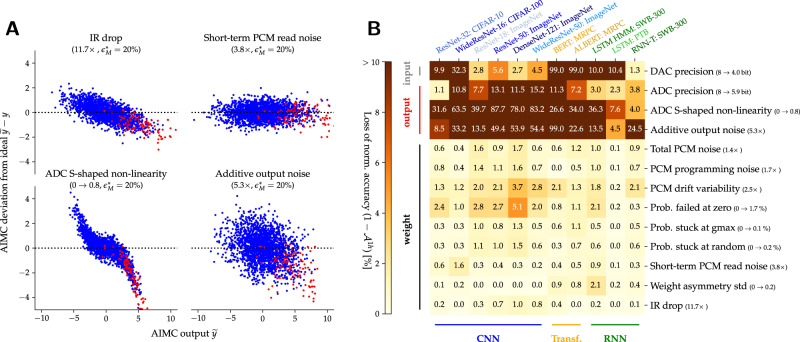
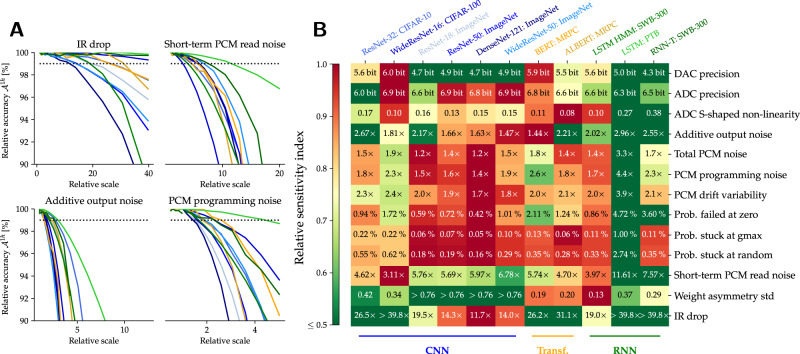
- Among the tested nonidealities, those that add noise to inputs or outputs had the largest impact on DNN accuracy, including ADC/DAC resolution, additive output noise, and S-shaped ADC nonlinearity.
- CNNs were the most sensitive topology and RNNs the least sensitive; some RNNs and transformers remained near iso-accuracy even after long-term PCM drift, while HWA-trained models for Speech-SWB300 and LSTM-PTB stayed iso-accurate out to 1 year.
Methods
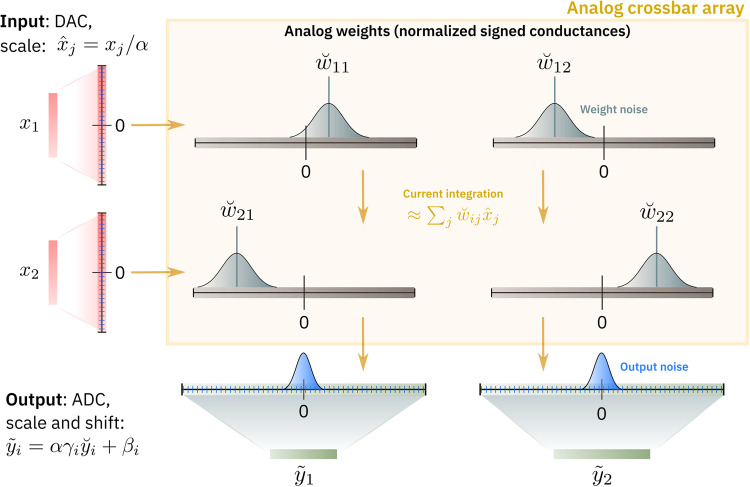
- The authors built a standardized AIMC crossbar simulation model for PCM-based hardware, incorporating dynamic-range limits, programming errors, drift, read noise, output noise, DAC/ADC quantization, and IR-drop; they used a 512 × 512 tile size and 8-bit quantization by default.
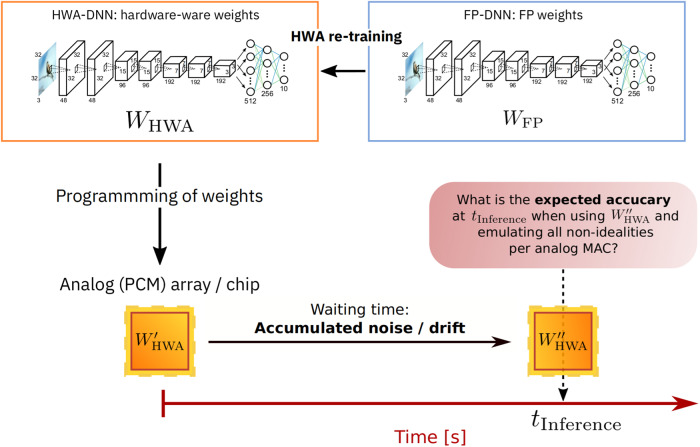
- They HWA-retrained 11 DNNs starting from FP-trained models, using SGD with noise injection and learned peripheral scaling factors for inputs and outputs; evaluation was done at delays of 1 s, 1 h, 1 day, and 1 year after programming.
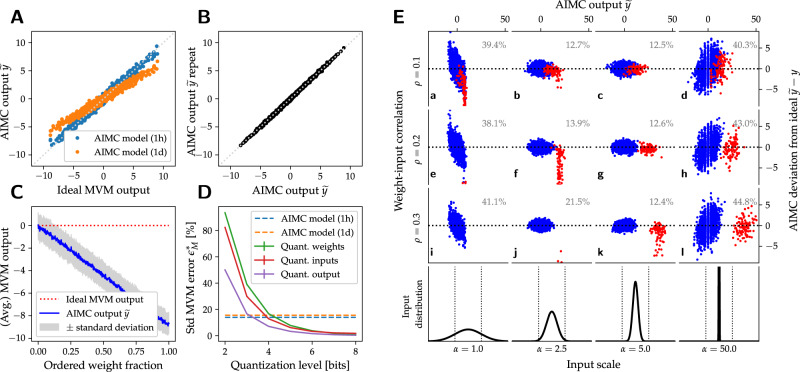
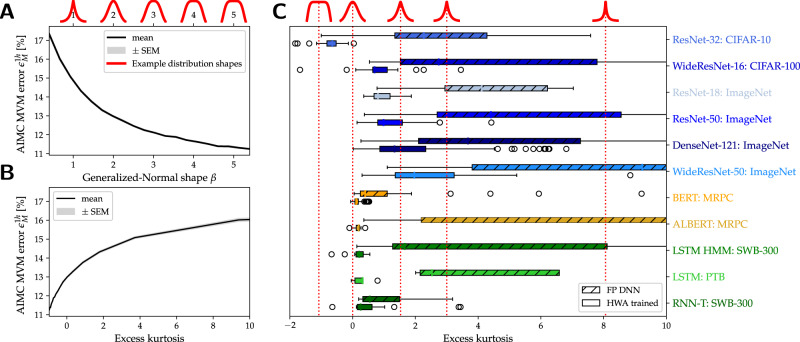
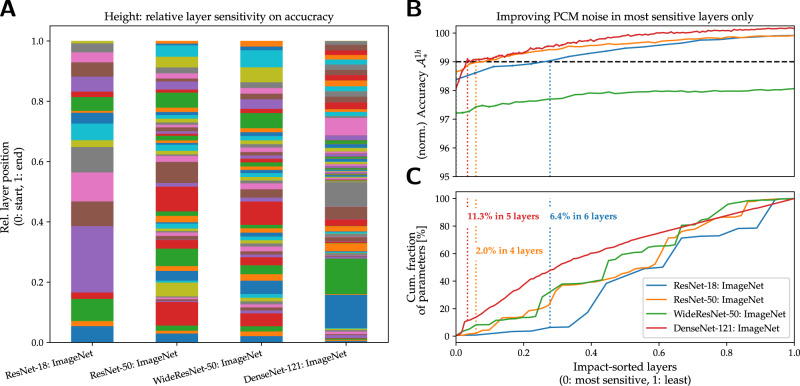
- They performed sensitivity analyses by stress-testing individual nonidealities, ranking layers by sensitivity in large CNNs, and measuring MVM error as relative deviation from ideal matrix-vector multiplication.
Limitations
- The authors state that the results are simulated and that the larger-scale DNN iso-accuracy results remain to be verified in hardware in future.
- They note that the model uses simplifications and abstractions, including Gaussian noise assumptions and an approximate IR-drop calculation, and therefore cannot replace ultimate hardware verification.
- Evidence from the text: some results depend on a PCM-specific calibration, so transferability to non-PCM devices is not direct, although the authors say the framework can be adapted.
Model-written summary. Check it against the paper before relying on it.
Integrity signals
Registry
Cites
Statistics
Figures
Verification
Claims the paper makes
10 Valid · 3 Not valid · 6 Not checked · 81 Own results and interpretations
The cited sources support only part of this claim — read each source’s verdict below.
In the paper
“Weight-quantization into as few as 2–4 bits can often be tolerated without significant accuracy reduction8,19,20.”
§ Hardware-aware training for large-scale and diverse deep learning inference workloads using in-memory computing-based accelerators > Introduction
What the sources say
- Supportedcites [8] Choi, J. et al. Pact: parameterized clipping activation for quantized neural networks. Preprint at https://arxiv.org/abs/1805.06085 (2018). source
The Abstract (p. 1) says 4-bit weights and activations achieved accuracy comparable to full precision across several models and datasets. The ResNet18 results in C.2 (p. 14) also show 2-bit weights with accuracy comparable to the full-precision baseline. The claim’s “can often” wording allows for variation across models. (LLM, conf=0.88)
- Partly supportedcites [19] Krishnamoorthi, R. Quantizing deep convolutional networks for efficient inference: a whitepaper. Preprint at https://arxiv.org/abs/1806.08342 (2018). sourceExperimental — accuracy not yet measured
Section 3.2.4 (p. 22) reports that, for most networks, fine-tuned 4-bit weights achieved accuracy within 5% of 8-bit quantization, with activations kept at 8 bits. This supports the 4-bit portion under those conditions, but the cited passages do not establish comparable accuracy for 2-bit weights. (LLM, conf=0.88)
- Partly supportedcites [20] Nagel, M. et al. A white paper on neural network quantization. Preprint at https://arxiv.org/abs/2106.08295 (2021). sourceExperimental — accuracy not yet measured
The Experiments (p. 24) show that 4-bit weight quantization can preserve accuracy closely for several models, including BERT-base, particularly with 8-bit activations or per-channel quantization. The cited passages do not establish the same result for weights as low as 2 bits, and they report larger accuracy drops for some models at 4 bits. (LLM, conf=0.86)
plain- Asserted: passes — The authors put it forward as true.
- Checkable: passes — It can be checked against evidence.
- Load-bearing: passes — The paper’s conclusions depend on it.
- Based: passes — The paper gives a reason why it holds.
- Supported
The sources with a verdict support this claim; the rest weren’t checked yet, have no full text we could read, or their verdicts aren’t rated yet.
In the paper
“In terms of AIMC workload execution latency and system mapping51, CNNs are already less well-suited for resistive crossbar arrays due to the uneven temporal reuse between layers and spatial under-utilization of the large analog tiles by the small kernel matrices (see Table 1), although some optimization and mapping tricks52 are available.”
§ Hardware-aware training for large-scale and diverse deep learning inference workloads using in-memory computing-based accelerators > Results > HWA training improves AIMC accuracy for all DNNs
What the sources say
- Not checked — no full text of the sourcecites [51] Jain S A heterogeneous and programmable compute-in-memory accelerator architecture for analog-ai using dense 2-d mesh IEEE Trans. Very Large Scale Integr. (VLSI) Syst. 2023 31 114 127 10.1109/TVLSI.2022.3221390 source
- Supportedcites [52] Rasch MJ Gokmen T Rigotti M Haensch W RAPA-ConvNets: modified convolutional networks for accelerated training on architectures with analog arrays Front. Neurosci. 2019 13 753 10.3389/fnins.2019.00753 31417340 PMC6682637 source
The Introduction says ConvNets do not map favorably onto analog-array hardware because convolution kernel matrices are typically small while the number of matrix-vector operations can be very large, especially in early layers. Its Figure 1 caption also shows that analog-array computing time varies across layers, supporting the claim about uneven temporal use. (LLM, conf=0.88)
plainstates a cause- Asserted: passes — The authors put it forward as true.
- Checkable: passes — It can be checked against evidence.
- Load-bearing: passes — The paper’s conclusions depend on it.
- Based: passes — The paper gives a reason why it holds.
The sources with a verdict support this claim; the rest weren’t checked yet, have no full text we could read, or their verdicts aren’t rated yet.
In the paper
“For evaluation times teval long after NVM programming, the conductance drift Eq. (8) can be compensated in the digital domain without any expensive re-programming36,73.”
§ Hardware-aware training for large-scale and diverse deep learning inference workloads using in-memory computing-based accelerators > Methods > AIMC standardized evaluation model
What the sources say
- Not checked — no full text of the sourcecites [36] Ambrogio, S. et al. Reducing the impact of phase-change memory conductance drift on the inference of large-scale hardware neural networks. in IEEE International Electron Devices Meeting, 1–4 (IEEE, 2019). source
- Supportedcites [73] Le Gallo M Sebastian A Cherubini G Giefers H Eleftheriou E Compressed sensing with approximate message passing using in-memory computing IEEE Trans. Electron. Devices 2018 65 4304 4312 10.1109/TED.2018.2865352 source
The Physical Implementation section describes periodic calibration that compensates for a global conductance shift, with the correction performed in a control unit or digital circuitry. It also says the matrix is programmed only once; the Discussion explains that subsequent reconstruction uses read operations rather than reprogramming. The support is for this global-drift calibration, not necessarily every form of device drift. (LLM, conf=0.88)
plainstates a cause- Asserted: passes — The authors put it forward as true.
- Checkable: passes — It can be checked against evidence.
- Load-bearing: passes — The paper’s conclusions depend on it.
- Based: passes — The paper gives a reason why it holds.
Every source the paper cites for this claim was checked and supports it.
In the paper
“We have tried distilling with the FP model as a teacher (similar to ref. 71) and found some benefits when HWA training time is limited.”
§ Hardware-aware training for large-scale and diverse deep learning inference workloads using in-memory computing-based accelerators > Discussion
What the sources say
- Supportedcites [71] Zhou, C., Kadambi, P., Mattina, M. & Whatmough, P. N. Noisy machines: understanding noisy neural networks and enhancing robustness to analog hardware errors using distillation. Preprint at https://arxiv.org/pdf/2001.04974.pdf (2020). source
The citation is attached to the method the citing authors imitate — distillation with the full-precision model as teacher — and our copy states exactly that: Section 5.1 (p. 6) proposes 'a noise free clean model as the teacher to train a noisy student network', and Section 5.2 (p. 8) confirms 'In the distillation retraining runs, the full-precision clean model with an accuracy of 93.87% is used as the teacher'. The same section (5.2, p. 9-10; Discussion, p. 10) reports the benefit of that distillation for hardware-aware retraining under noise, and Section 5.1 (p. 7) notes the teacher-initialised student 'can be considered as a warm start to accelerate retraining', consistent with the citing sentence's limited-training-time framing. The 'found some benefits when HWA training time is limited' result itself is the citing authors' own experiment, not a claim about this source. (LLM, conf=0.88)
plainstates a possible cause- Asserted: passes — The authors put it forward as true.
- Checkable: passes — It can be checked against evidence.
- Load-bearing: unclear — It is unclear whether the paper’s conclusions depend on it.
- Based: passes — The paper gives a reason why it holds.
- Supported
Every source the paper cites for this claim was checked and supports it.
In the paper
“We verified the effectiveness of our HWA training approach on the very same DNNs used in a previous study38 and found, on average, a >10% decrease in AIMC test error for long teval times.”
§ Hardware-aware training for large-scale and diverse deep learning inference workloads using in-memory computing-based accelerators > Methods > AIMC hardware-aware DNN training
What the sources say
- Supportedcites [38] Joshi V Accurate deep neural network inference using computational phase-change memory Nat. Commun. 2020 11 1 13 10.1038/s41467-020-16108-9 32424184 PMC7235046 source
Citation 38 identifies the previous study whose DNNs the citing authors reused; the >10% decrease is presented as the citing authors’ own finding, not as a result of this source. The source’s Results, “Problem statement” (page unavailable), identifies its DNNs as ResNet-32 on CIFAR-10 and ResNet-34 on ImageNet. (LLM, conf=0.90)
plainstates a cause- Asserted: passes — The authors put it forward as true.
- Checkable: passes — It can be checked against evidence.
- Load-bearing: passes — The paper’s conclusions depend on it.
- Based: passes — The paper gives a reason why it holds.
- Supported
64 more claims
Create a free account to see all 100 claims and to verify the 1 reference still open.
- Probably not a substantial claim. 15
- It may state two separate claims as one. 17
- The quote only partly states this claim. 1
Citations
Cites
Deep Residual Learning for Image Recognition
He, K., Zhang, X., Ren, S., & Sun, J. (2016) · 2016 IEEE Conference on Computer Vision and Pattern Recognition (CVPR) · doi:10.1109/cvpr.2016.90 · Cited by 235,474
ImageNet: A large-scale hierarchical image database
Deng, J., Dong, W., Socher, R., Li, L.-J., Li, K., & Fei-Fei, L. (2009) · 2009 IEEE Conference on Computer Vision and Pattern Recognition · doi:10.1109/cvpr.2009.5206848 · Cited by 65,333
PyTorch: An Imperative Style, High-Performance Deep Learning Library
Paszke, A., Gross, S., Massa, F., Lerer, A., Bradbury, J., Chanan, G., Killeen, T., Lin, Z., Gimelshein, N., Antiga, L., et al. (2019) · arXiv · doi:10.48550/arxiv.1912.01703 · Cited by 31,473
Learning Multiple Layers of Features from Tiny Images
Krizhevsky, A. (2024) · doi:10.57702/zp44cu3g · Cited by 23,395
Advances in neural information processing systems 7
Cios, K., & Shields, M. (1997) · Neurocomputing · doi:10.1016/s0925-2312(97)90018-7 · Cited by 22,059
Distilling the Knowledge in a Neural Network
Hinton, G., Vinyals, O., & Dean, J. (2015) · arXiv · doi:10.48550/arxiv.1503.02531 · Cited by 14,204 · cited 1×
“In knowledge distillation [29], an already trained “teacher” model augments the usual one-hot labels with expected class probabilities, which can drive a “student” model to a good solution more rapidly than when training only with the one-hot label vectors.”
BackgroundHan, S., Mao, H., & Dally, W. J. (2015) · arXiv · doi:10.48550/arxiv.1510.00149 · Cited by 4,662
XNOR-Net: ImageNet Classification Using Binary Convolutional Neural Networks
Rastegari, M., Ordonez, V., Redmon, J., & Farhadi, A. (2016) · Lecture Notes in Computer Science · doi:10.1007/978-3-319-46493-0_32 · Cited by 4,408 · cited 1×
“…DNN training and/or inference 2 – 4 , by approximating matrix-vector multiplications (MVMs) and other arithmetic with custom fl oating-point representations such as b fl oat16 5 or DLFloat 6 , or with reduced-precision fi xed-point arithmetic to quantize synaptic weights and activations 7 – 10 .”
BackgroundGLUE: A Multi-Task Benchmark and Analysis Platform for Natural Language Understanding
Wang, A., Singh, A., Michael, J., Hill, F., Levy, O., & Bowman, S. (2018) · Proceedings of the 2018 EMNLP Workshop BlackboxNLP: Analyzing and Interpreting Neural Networks for NLP · doi:10.18653/v1/w18-5446 · Cited by 4,222
Efficient Processing of Deep Neural Networks: A Tutorial and Survey
Sze, V., Chen, Y.-H., Yang, T.-J., & Emer, J. S. (2017) · Proceedings of the IEEE · doi:10.1109/jproc.2017.2761740 · Cited by 4,215 · cited 1×
“Numerous hardware concepts have been introduced to accelerate DNN training and/or inference 2 – 4 , by approximating matrix-vector multiplications (MVMs) and other arithmetic with custom fl oating-point representations such as b fl oat16 5 or DLFloat 6 , or with reduced-precision fi xed-point…”
Background
Research works printed but not linked: 8
- Hubara, I., Courbariaux, M., Soudry, D., El-Yaniv, R. & Bengio, Y. Quantized neural networks: Training neural networks with low precision weights and activations. The Journal of Machine Learning Research1, 6869–6898 (2017).
- Srivastava N Hinton G Krizhevsky A Sutskever I Salakhutdinov R Dropout: a simple way to prevent neural networks from overfitting J. Mach. Learn. Res. 2014 15 1929 1958
- Wager, S., Wang, S. & Liang, P. Dropout training as adaptive regularization. Advances in neural information processing systems26, (2013).
- Noh, H., You, T., Mun, J. & Han, B. Regularizing deep neural networks by noise: its interpretation and optimization. in Proceedings of the 31st International Conference on Neural Information Processing Systems, NIPS’17, (Red Hook, NY, USA) 5115–5124 (Curran Associates Inc., 2017).
- Rakin, A. S., He, Z. & Fan, D. Parametric noise injection: trainable randomness to improve deep neural network robustness against adversarial attack. in Proceedings of the IEEE/CVF Conference on Computer Vision and Pattern Recognition 588–597 (IEEE, 2018).
- Wan, L., Zeiler, M., Zhang, S., Le Cun, Y. & Fergus, R. Regularization of neural networks using drop connect. in Proceedings of the 30th International Conference on Machine Learning (eds Dasgupta, S. & McAllester, D.) Vol. 28 of Proceedings of Machine Learning Research, 1058–1066 (PMLR, 2013).
- Glorot, X. & Bengio, Y. Understanding the difficulty of training deep feedforward neural networks. in Proceedings of the Thirteenth International Conference on Artificial Intelligence and Statistics 249–256 (JMLR Workshop and Conference Proceedings, 2010).
- Godfrey, J. J. & Holliman, E. Switchboard-1 release 2 ldc97s62. 926, 927 (1997).
Cited by
Hardware implementation of memristor-based artificial neural networks
Aguirre, F., Sebastian, A., Le Gallo, M., Song, W., Wang, T., Yang, J. J., Lu, W., Chang, M.-F., Ielmini, D., Yang, Y., et al. (2024) · Nature Communications · doi:10.1038/s41467-024-45670-9 · Cited by 564
“To avoid this loss of accuracy, hardware-aware training methods, in which device non-idealities are incorporated during training have been proposed in the literature 189,190 .”
Self-citationLe Gallo, M., Khaddam-Aljameh, R., Stanisavljevic, M., Vasilopoulos, A., Kersting, B., Dazzi, M., Karunaratne, G., Brändli, M., Singh, A., Müller, S. M., et al. (2023) · Nature Electronics · doi:10.1038/s41928-023-01010-1 · Cited by 310
Self-citationMemristor-based hardware accelerators for artificial intelligence
Huang, Y., Ando, T., Sebastian, A., Chang, M., Yang, J. J., & Xia, Q. (2024) · Nature Reviews Electrical Engineering · doi:10.1038/s44287-024-00037-6 · Cited by 196
“The multicore chip has demonstrated an inference accuracy nearly equivalent to software-based implementations with two widely employed ANN models, residual neural networks (ResNet) and LSTM. Combining the concepts of multicore within a chip and multichip setups, an RNN with over 45 million weights has been deployed ac…”
InfluentialSelf-citationUsing the IBM analog in-memory hardware acceleration kit for neural network training and inference
Gallo, M. L., Lammie, C., Büchel, J., Carta, F., Fagbohungbe, O. I., Mackin, C., Tsai, H.-Y. S., Narayanan, V., Sebastian, A., Maghraoui, K. E., et al. (2023) · APL Machine Learning · doi:10.1063/5.0168089 · Cited by 102
Self-citationPhase-Change Memory for In-Memory Computing
Syed, G. S., Gallo, M. L., & Sebastian, A. (2025) · Chemical Reviews · doi:10.1021/acs.chemrev.4c00670 · Cited by 98
Self-citationStrategic Development of Memristors for Neuromorphic Systems: Low‐Power and Reconfigurable Operation
Lee, J. W., Han, J., Kang, B., Hong, Y. J., Lee, S., & Jeon, I. (2025) · Advanced Materials · doi:10.1002/adma.202413916 · Cited by 81
Resistive Switching Devices for Neuromorphic Computing: From Foundations to Chip Level Innovations
Mohanan, K. U. (2024) · Nanomaterials · doi:10.3390/nano14060527 · Cited by 54
“Apart from attempts at compressing neural network architectures [179], RRAM weight mapping algorithms [180], noise-aware training algorithm [181,182] and fault mitigation algorithms [183] have been reported with much success in recent literature.”
MethodFast and robust analog in-memory deep neural network training
Rasch, M. J., Carta, F., Fagbohungbe, O. I., & Gokmen, T. (2024) · Nature Communications · doi:10.1038/s41467-024-51221-z · Cited by 75
“32 for a discussion), or computing other layers such as af fi ne transforms of normalization layers, skip connections, activation functions, that are all part of modern DNNs.”
InfluentialSelf-citationNeural architecture search for in-memory computing-based deep learning accelerators
Krestinskaya, O., Fouda, M. E., Benmeziane, H., Maghraoui, K. E., Sebastian, A., Lu, W. D., Lanza, M., Li, H. H., Kurdahi, F. J., Fahmy, S. A., et al. (2024) · Nature Reviews Electrical Engineering · doi:10.1038/s44287-024-00052-7 · Cited by 47
Self-citationBabu, A., & Mandal, D. (2024) · ACS Applied Energy Materials · doi:10.1021/acsaem.3c02642 · Cited by 36
Rapid learning with phase-change memory-based in-memory computing through learning-to-learn
Ortner, T., Petschenig, H., Vasilopoulos, A., Renner, R., Brglez, Š., Limbacher, T., Piñero-Fuentes, E., Linares-Barranco, A., Pantazi, A., & Legenstein, R. A. (2025) · Nature Communications · doi:10.1038/s41467-025-56345-4 · Cited by 46
A ferroelectric–memristor memory for both training and inference
Martemucci, M., Rummens, F., Malot, Y., Hirtzlin, T., Guille, O., Martin, S., Carabasse, C., Vincent, A. F., Saïghi, S., Grenouillet, L., et al. (2025) · Nature Electronics · doi:10.1038/s41928-025-01454-7 · Cited by 56
“This is equivalent to the transfer from three 1T–1C cells with sizes 4 S min , 2 S min and S min , respectively (Supplementary Note 6).”
InfluentialHoa, P. V., Bình, N. A., Hong, P. V., An, N. N., Thảo, G. T. P., Hanh, N. C., Ngo, P. T. T., & Bui, D. T. (2024) · Earth Science Informatics · doi:10.1007/s12145-024-01285-8 · Cited by 32
A dual-domain compute-in-memory system for general neural network inference
Wang, Z., Yu, R., Jia, Z., He, Z., Yang, T., Gao, B., Li, Y., Hu, Z., Hao, Z., Liu, Y., et al. (2025) · Nature Electronics · doi:10.1038/s41928-024-01315-9 · Cited by 35
“It is probable that this improvement in accuracy stems from two factors: (1) the enhancing layers effectively mitigated the noise introduced in the previous layers and (2) they increased the parameter count of the network, thereby enhancing its fitting capability 39 .”
A full-stack memristor-based computation-in-memory system with software-hardware co-development
Yu, R., Wang, Z., Liu, Q., Gao, B., Hao, Z., Guo, T., Ding, S., Zhang, J., Qin, Q., Wu, D. M., et al. (2025) · Nature Communications · doi:10.1038/s41467-025-57183-0 · Cited by 36
“On the one hand, we fi nd that the conventional of fl ine training methods, such as hardware-aware training (HAT) 29 , relied on the precise computing models of the hardware inference process.”
Hyperspectral in-memory computing with optical frequency combs and programmable optical memories
Honari-Latifpour, M., Park, B. J., Yamamoto, Y., & Suh, M. (2024) · Optica · doi:10.1364/optica.522378 · Cited by 26
Vasilopoulos, A., Büchel, J., Kersting, B., Lammie, C., Brew, K. W., Choi, S., Philip, T. M., Saulnier, N., Narayanan, V., Gallo, M. L., et al. (2023) · IEEE Transactions on Electron Devices · doi:10.1109/ted.2023.3321014 · Cited by 23
“8(e) show that MSF outperforms MF by 0.28%, and reduces the variance, despite the fact that larger networks are more resilient to device noise [29].”
BackgroundInfluentialSelf-citationSafe, secure and trustworthy compute-in-memory accelerators
Wang, Z., Wu, Y., Park, Y., & Lu, W. D. (2024) · Nature Electronics · doi:10.1038/s41928-024-01312-y · Cited by 20
“In general, CIM systems are developed to primarily target model inference tasks with limited on-chip retraining capabilities to compensate for non-idealities in devices and circuits 35,67 .”
Differential Phase Change Memory (PCM) Cell for Drift-Compensated In-Memory Computing
Pistolesi, L., Ravelli, L., Glukhov, A., Herranz, A. D. G., López‐Vallejo, M., Carissimi, M., Pasotti, M., Rolandi, P. L., Redaelli, A., Martín, I. M., et al. (2024) · IEEE Transactions on Electron Devices · doi:10.1109/ted.2024.3480898 · Cited by 20
“While analog IMC has been demonstrated to have high energy efficiency, which is essential for edge-computing applications [25], suitable approaches for mapping and training deep neural networks (DNNs) to ensure high accuracy are still under investigation [26], [27].”
Large-scale crossbar arrays based on three-terminal MoS2 memtransistors
Schranghamer, T. F., Pannone, A., Kumar, J. M., Baiju, D. K. T., Chen, C., Knight, T. V. M., Tadekawa, S., Haines, E., Ordoñez, R. C., Hayashi, C. K., et al. (2025) · Nature Communications · doi:10.1038/s41467-025-64536-2 · Cited by 27
“A comprehensive comparison of this work with existing 2D literature 14,30,48 – 54 is provided in Supplementary Note 4.”
A Low-Power Hierarchical CNN Hardware Accelerator for Bearing Fault Diagnosis
Liang, Y.-P., Hsu, Y., & Chung, C.-C. (2024) · IEEE Transactions on Instrumentation and Measurement · doi:10.1109/tim.2024.3351229 · Cited by 16
“To address the nondeterministic results in processing in-memory technology, a framework was introduced in [28] to systematically evaluate the accuracy of analog in-memory computing across various network topologies.”
MethodAn 8-bit 20.7 TOPS/W Multilevel Cell ReRAM Macro With ADC-Assisted Bit-Serial Processing
Correll, J. M., Jie, L., Song, S., Lee, S., Zhu, J., Tang, W., Wormald, L. D., Erhardt, J., Breil, N., Quon, R. A., et al. (2025) · IEEE Journal of Solid-State Circuits · doi:10.1109/jssc.2025.3540114 · Cited by 18
“However, modern computing workloads leveraging QAT demand at least 4-bit weight quantization and 8-bit input/output quantization [2], [3].”
The design of analogue in-memory computing tiles
Singh, A., Gallo, M. L., Vasilopoulos, A., Luquin, J., Narayanan, P., Burr, G. W., & Sebastian, A. (2025) · Nature Electronics · doi:10.1038/s41928-025-01537-5 · Cited by 22
“The goal of an IMC tile is to perform MVM operations on Perspective https://doi.org/10.1038/s41928-025-01537-5 is the analysis of DNN model accuracy in the presence of analogue noise, quantization effects and other imperfections present during the MVM operations 21 .”
InfluentialSelf-citationAnalogNAS: A Neural Network Design Framework for Accurate Inference with Analog In-Memory Computing
Benmeziane, H., Lammie, C., Boybat, I., Rasch, M. J., Gallo, M. L., Tsai, H.-Y. S., Muralidhar, R., Niar, S., Ouarnoughi, H., Narayanan, V., et al. (2023) · IEEE International Conference on Edge Computing and Communications (EDGE) · doi:10.1109/edge60047.2023.00045 · Cited by 25
“gence and has been used for HWA training of standard DNNs with hardware-calibrated device noise and drift models [22].”
MethodSelf-citationThe inherent adversarial robustness of analog in-memory computing
Lammie, C., Büchel, J., Vasilopoulos, A., Gallo, M. L., & Sebastian, A. (2025) · Nature Communications · doi:10.1038/s41467-025-56595-2 · Cited by 20
“However,Hardware-Aware(HWA)training,wheretheDNNis made robust via the injection of weight noise during the training process, has been found to recover much of the accuracy loss 11,12 .”
Self-citationProgress and challenges of phase change memory for in-memory computing
Su, X., Guo, Z., Zhang, G., Tsai, H.-Y. S., & Li, N. (2025) · Current Opinion in Solid State and Materials Science · doi:10.1016/j.cossms.2025.101225 · Cited by 15
Self-citationSun, S., You, Z., Ji, Y., et al. (2025) · Journal of Materials Chemistry C · doi:10.1039/d5tc02381e · Cited by 12
Moitra, A., Bhattacharjee, A., Li, Y., Kim, Y., & Panda, P. (2024) · Applied Physics Reviews · doi:10.1063/5.0211040 · Cited by 19
“Recently, the AIHWKit toolkit from IBM offers statistical empirical models for emulating device-level and parasistic resistive non-idealities for PCM crossbars in PyTorch 143,144 .”
MethodBhattacharjee, A., Moitra, A., & Panda, P. (2023) · IEEE Journal on Emerging and Selected Topics in Circuits and Systems · doi:10.1109/jetcas.2023.3327748 · Cited by 14
“Please note that although in this work, we employ a standard IMC hardware-aware training method, we believe that including more matured hardware-aware training methods [33], [34], [35] will further improve the performance accuracies of the crossbar-mapped DNN architectures.”
MethodAnalogue speech recognition based on physical computing
Zolfagharinejad, M., Büchel, J., Cassola, L., Kinge, S., Sarwat, S. G., Sebastian, A., & van der Wiel, W. G. (2025) · Nature · doi:10.1038/s41586-025-09501-1 · Cited by 40
“The training includes a standard and a hardware-aware (HWA) retraining phase to enhance the network model’s resilience to AIMC noise 42 .”
Self-citationBhattacharjee, A., Moitra, A., Kim, Y., Venkatesha, Y., & Panda, P. (2023) · ACM Great Lakes Symposium on VLSI (GLSVLSI) · doi:10.1145/3583781.3590241 · Cited by 15
“In recent years, several noise models [2, 19, 26] and crossbar-realistic DNN accuracy evaluation frameworks (Neurosim [17], RxNN [10], GenieX [6], Memtorch [13]) have been proposed that are integrated with hardware-aware re-training or fine-tuning of GPU-trained DNN weights, to mitigate performance losses during infer…”
BackgroundDesign of Analog-AI Hardware Accelerators for Transformer-based Language Models (Invited)
Burr, G. W., Tsai, H.-Y. S., Simon, W., Boybat, I., Ambrogio, S., Ho, C.-E., Liou, Z.-W., Rasch, M. J., Büchel, J., Narayanan, P., et al. (2023) · Technical digest - International Electron Devices Meeting/Technical digest · doi:10.1109/iedm45741.2023.10413767 · Cited by 22
“…leading to DNN results at high throughput, high energy-efficiency, and low-latency – delivered at-or near the software-equivalent DNN accuracy [18] and chip-testing [19], plus new results for HWA training of RoBERTa-base. exhibited by the original DNN model (as implemented on a CPU or GPU…”
MethodSelf-citationProbabilistic photonic computing for AI
Brückerhoff‐Plückelmann, F., Ovvyan, A. P., Varri, A., Borras, H., Klein, B., Meyer, L., Wright, C. D., Bhaskaran, H., Sarwat, S. G., Sebastian, A., et al. (2025) · Nature Computational Science · doi:10.1038/s43588-025-00800-1 · Cited by 26
“Hardware-aware training, which incorporates simulation or experimental data from devices, is gaining traction as a robust solution 94,95 .”
Self-citationImproving the Accuracy of Analog-Based In-Memory Computing Accelerators Post-Training
Lammie, C., Vasilopoulos, A., Büchel, J., Camposampiero, G., Gallo, M. L., Rasch, M. J., & Sebastian, A. (2024) · IEEE International Symposium on Circuits and Systems proceedings · doi:10.1109/iscas58744.2024.10558540 · Cited by 18
“This usually requires the tiling of layer weights, which further increases training complexity [16].”
BackgroundMethodInfluentialSelf-citationKwak, H., Choi, J., Han, S., Kim, E. H., Kim, C. H., Solomon, P. M., Lee, J.-Y., Kim, D., Shin, B., Lee, D., et al. (2025) · Nature Communications · doi:10.1038/s41467-025-58004-0 · Cited by 14
“This approach minimizes the need for data transfer between memory and processor units and performs massively parallel computation in analog, enabling large computation acceleration while consuming less energy 6 .”
CiMBA: Accelerating Genome Sequencing Through On-Device Basecalling via Compute-in-Memory
Simon, W., Boybat, I., Kodra, R., Ferro, E., Singh, G., Alser, M., Jain, S., Tsai, H.-Y. S., Burr, G. W., Mutlu, O., et al. (2025) · IEEE Transactions on Parallel and Distributed Systems · doi:10.1109/tpds.2025.3550811 · Cited by 11
“Any additional affine scaling [48] is implemented via this one set of scaling parameters.”
InfluentialSelf-citationU-SWIM: Universal Selective Write-Verify for Computing-in-Memory Neural Accelerators
Yan, Z., Hu, X. S., & Shi, Y. (2024) · IEEE Transactions on Computer-Aided Design of Integrated Circuits and Systems · doi:10.1109/tcad.2024.3352496 · Cited by 9
“We do not compare U-SWIM with hardware-aware training methods [21], [22] and methods that accelerates the write-verify process [23], [24] because U-SWIM is orthogonal to these methods and thus they can be used together to offer an even better solution.”
MethodHuang, P., Gong, B., Chen, K., & Wang, C. (2024) · Electronics · doi:10.3390/electronics13153034 · Cited by 8
Physical mechanisms and integration design of memristors
Wang, M., Wang, K., Sun, B. T., Zhou, G., Cao, Z., Gao, K., Ren, F., Chen, X., Li, X., & Shao, J. (2025) · Materials Today Nano · doi:10.1016/j.mtnano.2025.100628 · Cited by 16
Error-aware probabilistic training for memristive neural networks
Liu, J., Lü, J., Tang, S., Zhou, R., Ma, H., Lyu, B., Tian, Y., Shi, T., & Liu, Q. (2025) · Nature Communications · doi:10.1038/s41467-025-66240-7 · Cited by 17
“We further compare EaPU with other distinct memristor training approaches using AIHWKit, including Tika-Takav2 (TTv2) 55 , chopped-TTv2 (c-TTv2) 56 , and hardware-aware training (Hwa) 11 .”
InfluentialLiu, Z., Fang, Y., Liu, Q., Tian, B., & Zhao, C. (2026) · Nano-Micro Letters · doi:10.1007/s40820-025-02028-0 · Cited by 21
“At the device statistics level, device-to-device variability, cycle-to-cycle stochasticity, update nonlinearity and asymmetry, limited state count, retention drift, and endurance spread accumulate over thousands to millions of cells and directly erode learning accuracy and convergence [162].”
Lin, Y., Yang, D., Wang, Z., Zhen, W., Yu, T., Xue, F., Wei, H., & Sun, L. (2026) · Nature Communications · doi:10.1038/s41467-026-70594-x · Cited by 24
“However, conventional von Neumann architectures 20 – 22 , which physi-callyseparate memoryand computation, suffer from increasinglyhigh energy consumption and latency 22 – 24 .”
Deep learning software stacks for analogue in-memory computing-based accelerators
Lammie, C., Benmeziane, H., Simon, W., Ferro, E., Vasilopoulos, A., Büchel, J., Gallo, M. L., Boybat, I., & Sebastian, A. (2025) · Nature Reviews Electrical Engineering · doi:10.1038/s44287-025-00187-1 · Cited by 11
“…can be modelled 30 , and although the effect of these on accuracy can be mitigated using different techniques (such as hardware-aware (HWA) training 31 , post-placement calibration methods and chip-in-the-loop retraining; Box 1), AIMC tiles remain unsuitable for particularly sensitive operations.”
Self-citationAchieving high precision in analog in-memory computing systems
Mannocci, P., Larelli, G., Bonomi, M., & Ielmini, D. (2026) · npj Unconventional Computing · doi:10.1038/s44335-025-00044-2 · Cited by 15
“…have been proposed to mitigate the impact of device-and array-level nonidealities, including hardware-aware training of neural networks 62,73 , differential schemes for drift cancellation 58,72 , and mitigation schemes for IR drop 61,63,64 , allowing partial restoration of the nominal…”
Measurement-driven neural-network training for integrated magnetic tunnel junction arrays
Borders, W. A., Madhavan, A., Daniels, M. W., Georgiou, V., Lueker-Boden, M., Santos, T., Braganca, P. M., Stiles, M. D., McClelland, J. J., & Hoskins, B. D. (2024) · Physical Review Applied · doi:10.1103/physrevapplied.21.054028 · Cited by 13
Frank, M. M., Li, N., Rasch, M. J., Jain, S., Chen, C.-T., Muralidhar, R., Han, J., Narayanan, V., Philip, T. M., Brew, K. W., et al. (2023) · IEEE International Reliability Physics Symposium proceedings · doi:10.1109/irps48203.2023.10117874 · Cited by 10
“When subjecting a half-normal initial normalized conductance distribution fG(t0) measured at time t0 = 20 s after programming [31], [37], [38], [45] to drift according to this model, the distribution fG(t) narrows while retaining a similar shape, with very limited additional peaking near zero (Fig.”
BackgroundMethodSelf-citationJunaid, M., Aliev, H., Park, S., Kim, H., Yoo, H., & Sim, S. (2024) · Sensors · doi:10.3390/s24072145 · Cited by 14
“This complexity is primarily attributed to the use of floating-point operations [17].”
BackgroundDemonstration of transformer-based ALBERT model on a 14nm analog AI inference chip
Chen, A., Ambrogio, S., Narayanan, P., Okazaki, A., Mackin, C., Fasoli, A., Rasch, M. J., Friz, A. M., Luquin, J., Yasuda, T., et al. (2025) · Nature Communications · doi:10.1038/s41467-025-63794-4 · Cited by 13
Self-citationA free energy landscape analysis of resistance fluctuations in a memristive device
Walfort, S., Vu, X. T., Ballmaier, J., Holle, N., Vollmar, N., & Salinga, M. (2026) · Nature Materials · doi:10.1038/s41563-026-02487-9 · Cited by 12
“Mitigation typically relies on hardware-aware retraining, which adds overhead and only partially alleviates these issues 13 .”
Zhao, H., Wang, L., Zhou, Y., Liu, S., Qin, Q., Li, X., Zhang, Y., Xi, Y., Jiao, Y., Liu, Z., et al. (2026) · Nature Electronics · doi:10.1038/s41928-026-01571-x · Cited by 11
“Prior works have proposed different algorithmic optimization meth-ods to address the non-ideal characteristics of a memristor chip, such as noise-aware training 45–47 , in situ fine tuning 16,48 , matrix expansion 17 and selective write–verify 49,50 .”
Strategies of high-accuracy memristor-based analogue computing in memory for artificial intelligence
Jiang, Z., Zhao, H., Tang, J., Lu, Y., Qin, Q., Wang, Z., Hu, R., Yu, R., He, Y., Zhang, J., et al. (2026) · Nature Materials · doi:10.1038/s41563-026-02600-y · Cited by 12
“Second, these errors could accumulate from devices to arrays 8 and hence fundamentally limit the scalability and accuracy of analogue CIM, restricting its practical applications for deep neural networks (DNNs) and scientific computing.”
InfluentialChang, S.-H., Lin, T., & Liu, C. J. (2025) · IEEE Transactions on Computer-Aided Design of Integrated Circuits and Systems · doi:10.1109/tcad.2025.3566643 · Cited by 5
“To mitigate the effects of nonidealities, network retraining is an efficient solution that does not require additional hardware costs to improve accuracy [6], [7].”
Demonstration of 4-quadrant analog in-memory matrix multiplication in a single modulation
Gallo, M. L., Hrynkevych, O., Kersting, B., Karunaratne, G., Vasilopoulos, A., Khaddam-Aljameh, R., Sarwat, S. G., & Sebastian, A. (2024) · npj Unconventional Computing · doi:10.1038/s44335-024-00010-4 · Cited by 7
“1attheoutputofeachlayerto improvetherobustnesstohardwarenoise 18 , along with L2 regularization ( λ = 10 − 4 )anddropoutwithrateof0.”
Self-citationPrivacy-Preserving Federated Neural Architecture Search With Enhanced Robustness for Edge Computing
Zhang, F., Li, M., Ge, J., Tang, F., Zhang, S., Wu, J., & Luo, B. (2024) · IEEE Transactions on Mobile Computing · doi:10.1109/tmc.2024.3490835 · Cited by 7
“…degradation of the final model [43]; (2) Constrained Resources: One of the core characteristics of edge AIapplicationsishardwareawareness,especiallytheconstraints ofthetargethardware,andfactorssuchasprocessingcapabilities andstoragecapacitiesmustbeconsideredformodeltraining andactualdeployment[29]”
A review of in-memory computing for machine learning: architectures, options
Snåšel, V., Dang, T. K., Kueng, J., & Kong, L. (2023) · International Journal of Web Information Systems · doi:10.1108/ijwis-08-2023-0131 · Cited by 7
ClipFormer : Key–Value Clipping of Transformers on Memristive Crossbars for Write Noise Mitigation
Bhattacharjee, A., Moitra, A., & Panda, P. (2024) · IEEE Transactions on Computer-Aided Design of Integrated Circuits and Systems · doi:10.1109/tcad.2024.3435762 · Cited by 11
“…the net output current sensed by ADCs at each column j is the sum of currents passing through each device, which is expressed as In practice, the analog nature of computation is prone to hardware noise, such as NVM device variations [11], [12], [17] affecting the synaptic conductances ( G ij ).”
BackgroundCheng, H., Liu, Z. L., Majumdar, A., et al. (2024) · IEEE Symposium on VLSI Technology and Circuits (VLSI Technology and Circuits) · doi:10.1109/vlsitechnologyandcir46783.2024.10631376 · Cited by 5
Self-citationBabu, A., Šutka, A., & Mandal, D. (2025) · Advanced Materials Technologies · doi:10.1002/admt.202501635 · Cited by 10
Shirzadi, A., Shahabi, H., Salvati, A., Nodoushan, E. J., Hoseini, S. M., Tahan, M. H., & Clague, J. J. (2025) · Journal of Hydrology · doi:10.1016/j.jhydrol.2025.134727 · Cited by 5
Device-Architecture Co-optimization for RRAM-based In-memory Computing
Cai, Y., Gao, Y. Q., Wang, Z., Bao, L., Liang, L., Zheng, Q., Wang, C., & Huang, R. (2023) · IEEE International Conference on ASIC (ASICON) · doi:10.1109/asicon58565.2023.10396275 · Cited by 4
“There are several emerging memory devices can be adopted to further enhance the performance of IMC-based computing systems [3-6].”
BackgroundDifficulties and approaches in enabling learning-in-memory using crossbar arrays of memristors
Wang, W. J., Li, Y., & Wang, M. (2024) · Neuromorphic Computing and Engineering · doi:10.1088/2634-4386/ad6732 · Cited by 6
“For inference-only neuromorphic system, the degradation of the neural network performance due to the inaccuracy of MAC operation can be compensated by hardware-aware training [13].”
Shrinking the giants: Paving the way for TinyAI
Nakhle, F. (2024) · Device · doi:10.1016/j.device.2024.100411 · Cited by 5
Hosseinzadeh, S., Lancaster, S., Parvaresh, A., Silva, C., Mikolajick, T., Slesazeck, S., & Fey, D. (2024) · Euromicro Conference on Digital System Design (DSD) · doi:10.1109/dsd64264.2024.00010 · Cited by 7
“To counteract non-idealities including conductance drift and programming noise, custom techniques are integrated into the training algorithm, ensuring the network maintains accuracy during inference tasks, which is known as hardware-aware (HWA) training [10], [11], [13]–[16].”
MethodLearning Task-Based Trainable Neuromorphic ADCs via Power-Aware Distillation
Vol, T., Danial, L., & Shlezinger, N. (2025) · IEEE Transactions on Signal Processing · doi:10.1109/tsp.2025.3546458 · Cited by 7
“Noisy Training : To enable the learning procedure to operate reliably with noisy memristors, we incorporate noise during the training phase, using noise injection [47], [48].”
NORA: Noise-Optimized Rescaling of LLMs on Analog Compute-in-Memory Accelerators
Hou, Y. T., Tsai, H.-Y. S., Maghraoui, K. E., Gokmen, T., Burr, G. W., & Liu, L. (2025) · Design, Automation, and Test in Europe · doi:10.23919/date64628.2025.10993217 · Cited by 12
“Furthermore, IR-drop and drift could be simply compensated [28].”
InfluentialSelf-citationHeterogeneous density-based clustering with a dual-functional memristive array
Shin, D. H., Cheong, S., Lee, S. H., Jang, Y. H., Park, T., Han, J., Shim, S. K., Kim, Y. R., Han, J., Baek, I. K., et al. (2024) · Materials Horizons · doi:10.1039/d4mh00300d · Cited by 5
Kernel approximation using analogue in-memory computing
Büchel, J., Camposampiero, G., Vasilopoulos, A., Lammie, C., Gallo, M. L., Rahimi, A., & Sebastian, A. (2024) · Nature Machine Intelligence · doi:10.1038/s42256-024-00943-2 · Cited by 8
Self-citationHardware performance analysis for deep learning-based mistletoe detection in UAV imagery
Bermejo-Sabbagh, C., Orozco-del-Castillo, M. G., Valdiviezo-N., J. C., Ortiz-Sánchez, P. A. G., & Cuevas-Cuevas, N. L. (2025) · Computers and Electronics in Agriculture · doi:10.1016/j.compag.2025.110629 · Cited by 3
Rudge, Z. A., Dold, D., Fieback, M., Izzo, D., & Hamdioui, S. (2025) · Acta Astronautica · doi:10.1016/j.actaastro.2025.10.049 · Cited by 7
Bommana, A. R., Feinberg, B., Xiao, P., Bennet, C., Marinella, M. J., & Chakrabarty, K. (2026) · Asia and South Pacific Design Automation Conference (ASP-DAC) · doi:10.1109/asp-dac66049.2026.11420230 · Cited by 3
“2) Current variation-aware methods [11]–[16], [19] require different training runs for distinct noise conditions, lacking a generalized one-shot solution adaptable across varying noise conditions.”
InfluentialDIMAT: Decentralized Iterative Merging-And-Training for Deep Learning Models
Saadati, N., Pham, M., Saleem, N., Waite, J. R., Balu, A., Jiang, Z., Hegde, C., & Sarkar, S. (2024) · IEEE Computer Society Conference on Computer Vision and Pattern Recognition/Proceedings - IEEE Computer Society Conference on Computer Vision and Pattern Recognition/Proceedings · doi:10.1109/cvpr52733.2024.02598 · Cited by 12
“These also benefit from the rapid development of hardware technologies [13, 41].”
BackgroundAnalog Computing for Nonlinear Shock Tube PDE Models: Test and Measurement of CMOS Chip
Malavipathirana, H., Mandal, S., Udayanga, N., Wang, Y., Hariharan, S. I., & Madanayake, A. (2024) · IEEE Access · doi:10.1109/access.2024.3524500 · Cited by 4
Wang, L., Li, Y., Mou, H., Chen, Z., Li, C., & Wang, W. J. (2025) · Journal of Physics D Applied Physics · doi:10.1088/1361-6463/add0c2 · Cited by 4
“…value and weights transmission signal in the same location, i.e. in-memory computing, which enables vector-matrix multiplication (VMM) through Ohm’s and Kirchhoff’s laws [10], in a crossbar array of memristive devices, constitute an AIMC sys-tem that highly efficient for DNN applications [11].”
TReX- Reusing Vision Transformer’s Attention for Efficient Xbar-Based Computing
Moitra, A., Bhattacharjee, A., Kim, Y., & Panda, P. (2024) · IEEE Transactions on Emerging Topics in Computing · doi:10.1109/tetc.2024.3480524 · Cited by 4
“Extensive research has shown that device variations and ADC quantization contribute sig-nificantly towards accuracy degradation and cannot be easily mitigated [28], [39].”
Wordline Input Bias Scheme for Neural Network Implementation in 3D-NAND Flash
Hwang, H., Kim, G. H., Yu, D., & Kim, H. (2025) · Biomimetics · doi:10.3390/biomimetics10050318 · Cited by 3
“Various non-volatile memory devices, including resistive random-access memory (ReRAM) [13–26], phase-change memory (PCM) [27–36], and ferroelectric devices [37–46], have been investigated for CIM applications due to their distinctive properties.”
In Situ Analog In-Memory Computing Under Ionizing Radiation Exposure
Xiao, T. P., Siath, M., Spear, M. E., Wilson, D., Bennett, C. H., Feinberg, B., Hughart, D. R., Neuendank, J., Brown, W. E., Barnaby, H., et al. (2025) · IEEE Transactions on Nuclear Science · doi:10.1109/tns.2025.3537985 · Cited by 3
“Noise-resilient neural network training [21], [34], error correction techniques, bit slicing of weights across multiple SONOS cells [19], and optimizing the statistical properties of the neural network’s weight matrices may all potentially improve the accelerator’s resilience to TID before refresh.”
Voltage‐Summation‐Based Compute‐in‐Memory Technology with Capacitive Synaptic Devices
Kim, J. N., Kim, Y. W., Kim, B., Kim, D., Lee, G. S., Chae, D.-H., Je, M., Koo, M., & Kim, Y. (2025) · Advanced Intelligent Systems · doi:10.1002/aisy.202500028 · Cited by 5
Prospects of analog in-memory computing using ferroelectric tunnel junctions
Borg, M., Papadopoulos, C., Guerin, A., Athle, R., & Bastani, S. (2025) · Neuromorphic Computing and Engineering · doi:10.1088/2634-4386/add0d9 · Cited by 4
“We adopt the metric introduced by Rasch et al [36] to obtain a normalized comparison of performance between the digital and analog hardware, as well as between the different modes of FTJ operation: where ϵ t , ϵ FP , ϵ FPchance are the resulting test errors obtained by the analog hardware, digital…”
InfluentialChoi, S., & Kim, S. (2025) · Nanoscale · doi:10.1039/d5nr00814j · Cited by 2
Tsai, H.-Y. S., Benmeziane, H., Boybat, I., Büchel, J., Narayanan, P., Gallo, M. L., Jain, S., Vasilopoulos, A., Simon, W., Hosokawa, K., et al. (2025) · IEEE International Memory Workshop (IMW) · doi:10.1109/imw61990.2025.11026974 · Cited by 3
“To study networks well beyond the scale of current hardware implementations, the AIHWKit [23] and AIHWKit-Lightning [24] were developed to model AIMC for DNNs and enable hardware-aware (HWA) training [25].”
Self-citationSOLO: Spatial online learning at once for spiking neural networks
Lee, S., Moon, H., Yoon, M., Heo, W., & Kim, S. (2025) · Neurocomputing · doi:10.1016/j.neucom.2025.131940 · Cited by 3
Lin, Z., Wu, X., Chen, Z., Zhang, J., Deng, J., & Feng, Y. (2026) · iScience · doi:10.1016/j.isci.2026.114642 · Cited by 4
Shen, Y., Zhong, Y., Ye, Y., Luo, Y.-Q., Xu, Z., He, S., Chen, J., Xue, S., Ding, G., Zhou, Y., et al. (2026) · International Journal of Extreme Manufacturing · doi:10.1088/2631-7990/ae5005 · Cited by 6
Chalcogenide Selector-Only Memory
Zhao, J., Sun, Y., Ren, K., Ravsher, T., Garbin, D., Clima, S., & Zhu, M. (2026) · Materials Today · doi:10.1016/j.mattod.2026.103429 · Cited by 3
Park, J., 신연섭, Han, C., Kim, S., Park, E., Cho, Y., Min, J., Ahn, H., Park, J., Yang, C., et al. (2026) · Advanced Functional Materials · doi:10.1002/adfm.77505 · Cited by 4
Phase Change Memory-based Hardware Accelerators for Deep Neural Networks (invited)
Burr, G. W., Narayanan, P., Ambrogio, S., Okazaki, A., Tsai, H.-Y. S., Hosokawa, K., Mackin, C., Nomura, A., Yasuda, T., Demarest, J. J., et al. (2023) · IEEE Symposium on VLSI Technology and Circuits (VLSI Technology and Circuits) · doi:10.23919/vlsitechnologyandcir57934.2023.10185411 · Cited by 3
“Hardware-aware training, using open-source tools such as the IBM AI HW Kit [6, 7], can be used to achieve software-equivalent accuracy on a wide range of DNN models, even in the presence of imperfect PCM devices [8].”
BackgroundMethodSelf-citationRealistic Noise-aware Training as a Component of the Holistic ACiM Development Platform
Kim, J., Park, S., Suh, H., Kwon, Y., Lee, S., Lee, Y., Kim, K., Han, E., Kim, J., Kim, K., et al. (2024) · IEEE International Memory Workshop (IMW) · doi:10.1109/imw59701.2024.10536981 · Cited by 2
“The other approach involves adjusting the target conductances during the training phase using information about non-ideal factors, so that the output from the inference phase becomes robust to these non-ideal factors [2,7].”
BackgroundKilgannon, F., Kumar, S., Nguyen, V., Siriburanon, T., & Staszewski, R. B. (2024) · Irish Signals and Systems Conference · doi:10.1109/issc61953.2024.10603107 · Cited by 2
“Convolutional Layer non-idealities of a sub-type of analog MAC (for instance, modelling temporal drift and stochastic noise in memristor-based AIMC [11]).”
BackgroundAkkoç, S., Çınar, A., Ercan, B., Kalfa, M., & Arıkan, O. (2024) · Journal of the Franklin Institute · doi:10.1016/j.jfranklin.2024.107363 · Cited by 2
Shen, S.-F., Guo, M., Tan, J., Duan, S., & Wang, L. (2024) · Expert Systems with Applications · doi:10.1016/j.eswa.2024.126205 · Cited by 2
Huang, W.-H., Lee, W., Kim, J. S., Koo, W., Suh, D. I., Lee, S., Yi, J., Cha, S. Y., & Yu, S. (2024) · IEEE Transactions on Electron Devices · doi:10.1109/ted.2024.3516731 · Cited by 4
Scaling of hardware-compatible perturbative training algorithms
Oripov, B., Dienstfrey, A., McCaughan, A. N., & Buckley, S. M. (2025) · APL Machine Learning · doi:10.1063/5.0258271 · Cited by 8
Coşkun, K. Ç., Jha, C. K., Hassan, M., & Drechsler, R. (2025) · International Symposium on Quality Electronic Design (ISQED) · doi:10.1109/isqed65160.2025.11014428 · Cited by 2
“…made to reduce the error of multilevel MVMs [6], including optimization of weight-to-conductance mappings [7]–[9], retraining of ANN weights [10], [11], usage of ANN architecture with error suppression and compensation [12], usage of committee machines [13], and the use of redundant neurons and…”
Attention-driven PCM-based In-Memory Computing for Smart Vision Systems
Haidar, A., Khan, A., Ntinas, V. G., Fernández‐Berni, J., Carmona‐Galán, R., & Tetzlaff, R. (2025) · IEEE International Symposium on Circuits and Systems proceedings · doi:10.1109/iscas56072.2025.11044041 · Cited by 3
Sakemi, Y., Okamoto, Y., Morie, T., Nobukawa, S., Hosomi, T., & Aihara, K. (2025) · Advanced Intelligent Systems · doi:10.1002/aisy.202500351 · Cited by 4
FactSheets for Hardware-Aware AI Models: A Case Study of Analog In Memory Computing AI Models
Dominique, B., Maghraoui, K. E., Piorkowski, D., & Herger, L. M. (2023) · IEEE International Conference on Software Services Engineering (SSE) · doi:10.1109/sse60056.2023.00029 · Cited by 5
“What one can do is to train the network on digital accelerator but in a way that is aware of the hardware characteristics that will be used in the inference pass, we refer to this as Hardware Aware Training (HWA) [25].”
MethodSAGA: Synthesis Augmentation with Genetic Algorithms for In-Memory Sequence Optimization
Robins, A., & Borowczak, M. (2024) · IEEE International Midwest Symposium on Circuits and Systems (MWSCAS) · doi:10.1109/mwscas60917.2024.10658837 · Cited by 1
“An entire field of study currently quantifies applications of analog circuits for performing computation [9]; and special focus has been recently paid towards applications of this domain for artificial intelligence applications [10], [11].”
BackgroundPlouet, E., Sanz‐Hernández, D., Vecchiola, A., Grollier, J., & Mizrahi, F. A. (2025) · Physical Review Applied · doi:10.1103/physrevapplied.23.034051 · Cited by 2
Formally Verifying Analog Neural Networks with Device Mismatch Variations
Abu-Haeyeh, Y., Bartelsmeier, T., Ladner, T., Althoff, M., Hedrich, L., & Olbrich, M. (2025) · Design, Automation and Test in Europe · doi:10.23919/date64628.2025.10992891 · Cited by 1
“We focus on works dealing with the perturbations discussed above: Perturbation-aware design and modeling of analog neural networks is a progressing research field [6, 8, 9, 10].”
Malhotra, A., & Gupta, S. K. (2025) · IEEE Transactions on Circuits and Systems I Regular Papers · doi:10.1109/tcsi.2025.3570193 · Cited by 3
“On the algorithmic side, non-ideality aware training has been explored [9], [14], [20].”
Metadata
- Authors
- Rasch, M. J., Mackin, C., Le Gallo, M., Chen, A., Fasoli, A., Odermatt, F., Li, N., Nandakumar, S. R., Narayanan, P., Tsai, H., Burr, G. W., Sebastian, A., & Narayanan, V.
- Affiliations
- IBM (United States) (US)
- IBM Research - Almaden (US)
- IBM Research - Zurich (CH)
- Corresponding author
- Rasch, Malte J.
- ORCID
- Venue
- Nature Communications
- Published
- 2023-08-30
- Volume
- 14
- Issue
- 1
- Pages
- 5282-5282
- ISSN
- 2041-1723 (ISSN-L)
- PMC
- PMC10469175
- OpenAlex
- W4386293192
- Semantic Scholar
- 083e52983cd99b5726e3db8eb476aecc061bbf3b
- Cited by
- 213
- References
- 81
- Citations by year
- 2026: 83 · 2025: 70 · 2024: 46 · 2023: 14
- FWCI
- 15.35
- Type
- journal article
- Language
- en
- Open access
- gold
- doi.org
- Licence
- cc-by
- creativecommons.org/licenses/by/4.0 (tdm)
- creativecommons.org/licenses/by/4.0 (vor)
- Locations
- Nature Communications (publishedVersion, cc-by)
- PubMed Central (publishedVersion, cc-by)
- PubMed (publishedVersion)
- arXiv (Cornell University) (submittedVersion, cc-by)
- RePEc: Research Papers in Economics (submittedVersion)
- DOAJ (DOAJ: Directory of Open Access Journals) (submittedVersion, cc-by-sa)
- arXiv (Cornell University) (cc-by)
- Funders
- Rensselaer Polytechnic Institute
- Topics
- Physical Sciences › Engineering › Electrical and Electronic Engineering › Advanced Memory and Neural Computing
- Physical Sciences › Computer Science › Computer Vision and Pattern Recognition › Advanced Neural Network Applications
- Physical Sciences › Computer Science › Hardware and Architecture › Parallel Computing and Optimization Techniques
- Keywords
- analog in-memory computing, deep learning inference, non-idealities, inference accuracy, energy-efficient accelerators, recurrent neural networks, transformer models, convolutional neural networks, matrix-vector multiplication
About these checks
Registry, retraction, Cites and statistics results are computed, not judged, with one exception: a printed reference that no index lists is read once by a model before it counts as a citation error. Claims are extracted by a model and kept only when their quote appears verbatim in the text; each cited source is then checked, with a model’s help, for whether it says what the claim relies on. Those verdicts can be wrong — read the claim’s quote and the cited source before relying on one.
The claim verdicts this report counts are experimental: their accuracy is not yet measured.
A language model drew the claims from the paper on 2026-10-10, under version 3 of the claim definition (model deepseek-v4.1-flash, prompt extract-v3).
A second model labelled each claim on 2026-10-10 (model jev-1.13-20260917, definition revision gold-guideline-v0.2).
Cited sources are checked with a language model’s help (gpt-6-sol and qwen3.8-omni-flash).
Statistics and arithmetic are recomputed, not judged.
Confidence bands are shown only for fields calibrated on our annotated test set. None is calibrated yet, so no band is shown.
What counts as a claim ›How we measure confidence ›How we check this ›
Are you an author, or do you see a problem with this page? Request a review
Data sources
Bibliographic data: Semantic Scholar, OpenAlex, Crossref.
Contains information from the Semantic Scholar Academic Graph Datasets, made available under the ODC Attribution License (ODC-BY 1.0).
Semantic Scholar’s data is described in: Kinney, R., et al. (2023). The Semantic Scholar Open Data Platform. arXiv:2301.10140.
