

Powering AI at the edge: A robust, memristor-based binarized neural network with near-memory computing and miniaturized solar cell
Open accessThe DOI matches its Crossref record; 41 of the 45 references it cites were found in a registry or an index; 6 of the 26 sources its claims cite were checked for support.
Abstract
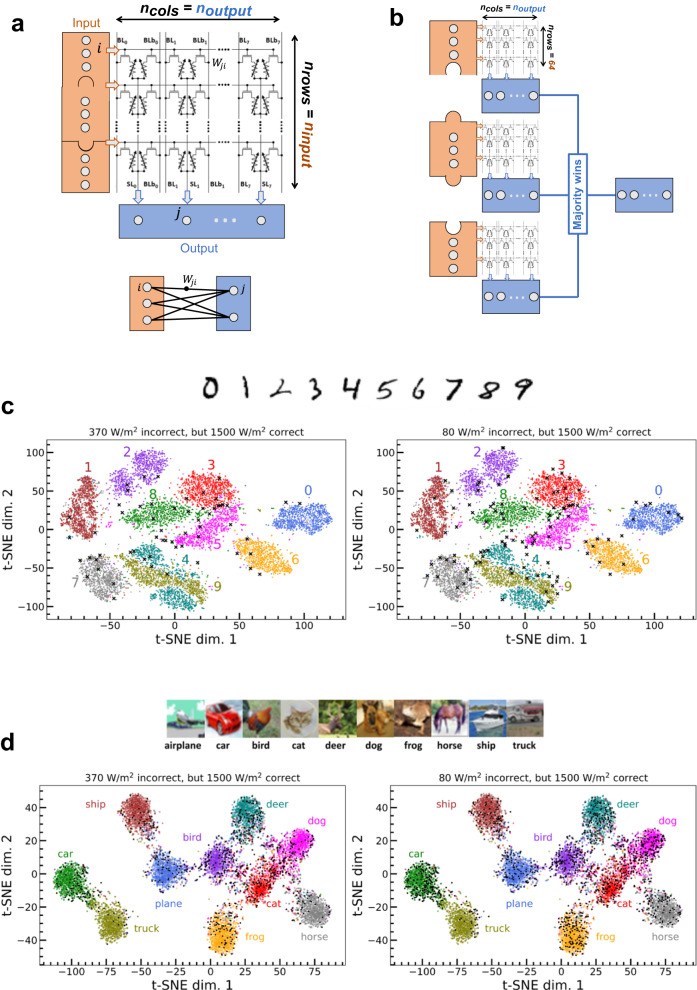
Memristor-based neural networks provide an exceptional energy-efficient platform for artificial intelligence (AI), presenting the possibility of self-powered operation when paired with energy harvesters. However, most memristor-based networks rely on analog in-memory computing, necessitating a stable and precise power supply, which is incompatible with the inherently unstable and unreliable energy harvesters. In this work, we fabricated a robust binarized neural network comprising 32,768 memristors, powered by a miniature wide-bandgap solar cell optimized for edge applications. Our circuit employs a resilient digital near-memory computing approach, featuring complementarily programmed memristors and logic-in-sense-amplifier. This design eliminates the need for compensation or calibration, operating effectively under diverse conditions. Under high illumination, the circuit achieves inference performance comparable to that of a lab bench power supply. In low illumination scenarios, it remains functional with slightly reduced accuracy, seamlessly transitioning to an approximate computing mode. Through image classification neural network simulations, we demonstrate that misclassified images under low illumination are primarily difficult-to-classify cases. Our approach lays the groundwork for self-powered AI and the creation of intelligent sensors for various applications in health, safety, and environment monitoring.
Overview
CoChat Summary
## TL;DR
The paper presents a hybrid CMOS/memristor binarized neural network that is designed to keep working under unstable, harvested power rather than requiring a tightly regulated supply. In experiments, it functioned down to 0.7 V and under illumination as low as 0.08 suns, with accuracy degrading gracefully rather than failing outright.
## Key findings
- The fabricated system integrates 32,768 memristors and operates as a robust binarized neural network using a differential, logic-in-sense-amplifier design that the authors say removes the need for compensation or calibration.
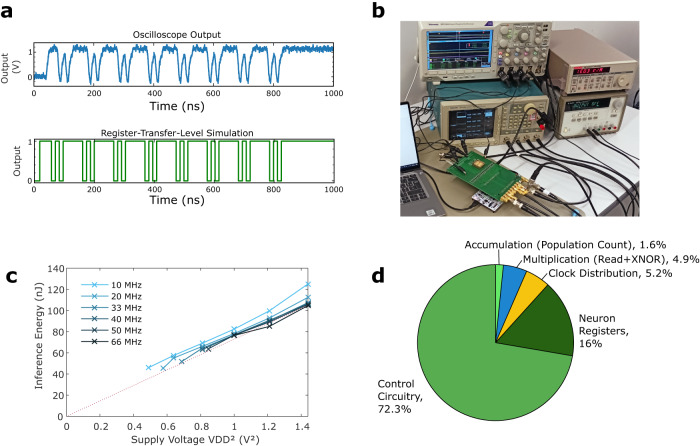
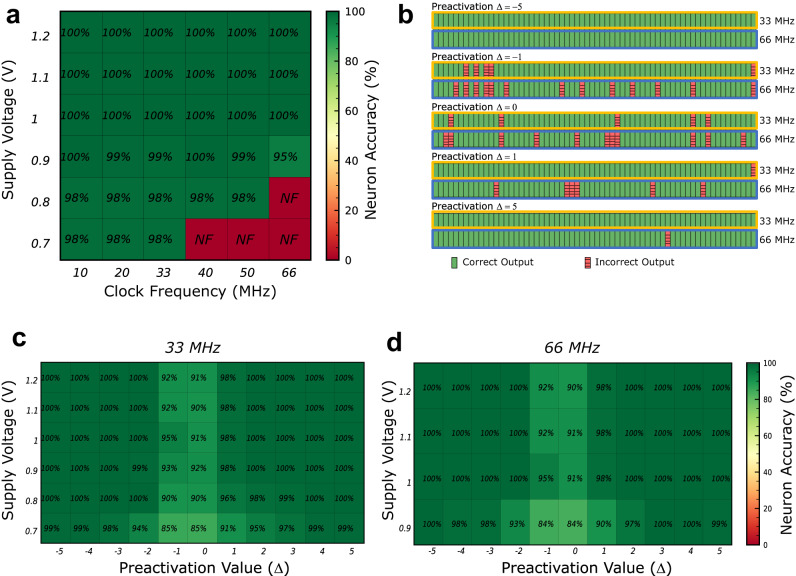
- With a lab-bench supply, the system had no errors at ≥1.0 V; at 0.9 V, occasional errors appeared at 66 MHz, and below that errors reached up to 2% at any frequency. The lowest measured energy consumption was 45 nJ at 0.7 V and 10 MHz.
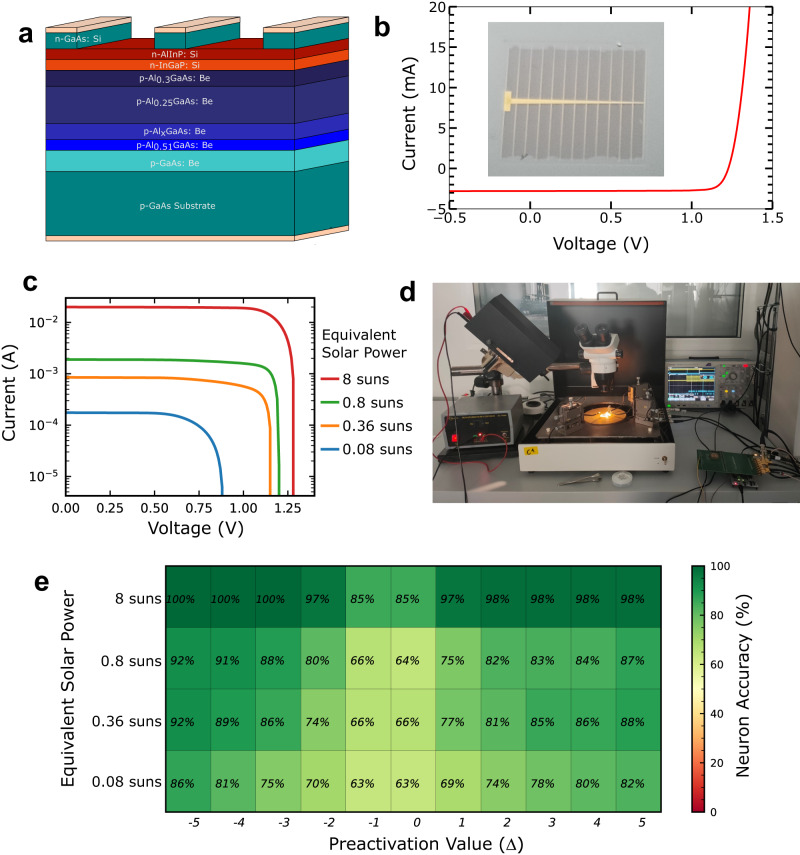
- Under harvested power, the circuit remained functional even at an equivalent solar power of 0.08 suns. For MNIST, accuracy dropped by only 0.7 percentage points at 0.08 suns, while for CIFAR-10 accuracy fell from 86.6% to 73.4%.
- The authors report an energy efficiency of 2.9 TOPS/W under optimal fabricated conditions after removing digital control energy; they estimate 22.5 TOPS/W after further optimizing away clock distribution and register energy, and project 397 TOPS/W for a scaled 28-nm design.
## Methods
- Design: A hybrid CMOS/nanotechnology binarized neural network with distributed memristor memory modules, complementary programming of two memristors per weight, and near-memory population-count accumulation.
- Data/sample: Hardware experiments used a fabricated demonstrator and a miniature AlGaAs/GaInP wide-bandgap solar cell; neural-network simulations were run for MNIST and CIFAR-10.
- Main analysis: Electrical characterization was done across supply voltages and frequencies with lab equipment; solar-powered inference was tested by directly connecting the chip to the solar cell; network accuracy under hardware errors was evaluated by injecting experimentally measured error rates into PyTorch simulations.
## Limitations
- The paper states that the current demonstrator handles single-layer computations in hardware; multilayer processing, input buffering, and convolution are not embedded on-chip and would be needed in a final commercial chip.
- The solar cell used had 8.7% efficiency under AM1.5G, and the authors explicitly note this was limited by an unoptimized process and no anti-reflection coating; they say similar stacks reached 18.7% with optimization.
- Evident from the text: the fabricated chip was measured on a packaged version with external lab equipment, so the system is not yet a fully integrated standalone self-powered device.
Model-written summary. Check it against the paper before relying on it.
Integrity signals
Registry
Cites
Statistics
Figures
Verification
Claims the paper makes
5 Valid · 1 Not valid · 12 Not checked · 90 Own results and interpretations
The cited sources support only part of this claim — read each source’s verdict below.
In the paper
“The most-energy efficient memristor-based AI circuits rely on analog-based in-memory computing: they exploit Ohm’s and Kirchhoff’s laws to perform the fundamental operation of neural networks, multiply-and-accumulate (MAC)7–9.”
§ Powering AI at the edge: A robust, memristor-based binarized neural network with near-memory computing and miniaturized solar cell > Introduction
What the sources say
- Not checked — no full text of the sourcecites [7] Ambrogio S Equivalent-accuracy accelerated neural-network training using analogue memory Nature 2018 558 60 10.1038/s41586-018-0180-5 29875487 source
- Partly supportedcites [8] Prezioso M Training and operation of an integrated neuromorphic network based on metal-oxide memristors Nature 2015 521 61 10.1038/nature14441 25951284 sourceExperimental — accuracy not yet measured
The Pattern Classification Experiment (p. 6) reports that the memristor crossbar performed analog vector-by-matrix multiplication using Ohm’s law. The introduction (p. 2) discusses estimated power efficiency, but the paper does not establish that the most energy-efficient memristor-based AI circuits rely on this approach. (LLM, conf=0.86)
- Not checked yetcites [9] Wang Z Fully memristive neural networks for pattern classification with unsupervised learning Nat. Electron. 2018 1 137 10.1038/s41928-018-0023-2 source
Checked before — its earlier verdict is held back until a new check runs.
plainstates a cause- Asserted: passes — The authors put it forward as true.
- Checkable: passes — It can be checked against evidence.
- Load-bearing: passes — The paper’s conclusions depend on it.
- Based: passes — The paper gives a reason why it holds.
The cited sources support only part of this claim — read each source’s verdict below.
In the paper
“In contrast, memristors exhibit near-immunity to read disturb effects, especially when read by precharge sense amplifiers20 (we observed no read disturb in our experiments)”
§ Powering AI at the edge: A robust, memristor-based binarized neural network with near-memory computing and miniaturized solar cell > Discussion
What the sources say
- Partly supportedcites [20] Harabi, K.-E. et al. A memristor-based Bayesian machine. Nat. Electron.6, 52–63 (2023). sourceExperimental — accuracy not yet measured
Our copy of Harabi et al. (2022) never uses the term 'read disturb' and makes no claim of near-immunity to it; searches for 'read disturb', 'disturb/endurance/retention' returned only programming, sensing-circuitry and error-resilience passages. The closest support is the 'Memristor-based stochastic Bayesian machine' section, which states that bits are programmed complementarily and 'read differentially by precharge sense amplifiers', a technique shown (crediting their ref. 44, Hirtzlin et al. 2020) to reduce errors as efficiently as SECDED codes — so the precharge-sense-amplifier part of the claim is grounded, but as generic error reduction, not read-disturb immunity. Indeed the same passage frames memristors as 'prone to errors', and the '(we observed no read disturb in our experiments)' element is the citing authors' own observation, not this paper's. (LLM, conf=0.65)
plain- Asserted: passes — The authors put it forward as true.
- Checkable: passes — It can be checked against evidence.
- Load-bearing: passes — The paper’s conclusions depend on it.
- Based: passes — The paper gives a reason why it holds.
- Partly supported
The cited sources support only part of this claim — read each source’s verdict below.
In the paper
“Nevertheless, binarized neural networks are highly robust to weight errors, which in many cases do not change neuron activation33,34.”
§ Powering AI at the edge: A robust, memristor-based binarized neural network with near-memory computing and miniaturized solar cell > Discussion
What the sources say
- Partly supportedcites [33] Hirtzlin, T. et al. Outstanding bit error tolerance of resistive ram-based binarized neural networks. In 2019 IEEE International Conference on Artificial Intelligence Circuits and Systems (AICAS) 288–292 (IEEE, 2019). sourceExperimental — accuracy not yet measured
The robustness half of the claim is squarely supported: the Abstract (p. 1) and Introduction (p. 1) state BNNs 'can exhibit outstanding error tolerance', Section III (pp. 2-3) shows MNIST accuracy unchanged up to 10^-3 weight bit errors (1.6%→1.8% at 10^-2) and CIFAR10 87.6%→87.4% at 10^-3, and the Conclusion (p. 4) reports tolerance up to 4×10^-2 with adapted training. However, our copy never makes the neuron-level sub-claim that weight errors 'in many cases do not change neuron activation': the only neuron-level mechanism it discusses (Section IV, p. 4) is that bit errors shift the mean of POPCOUNT_i(XNOR(W_i,X_i)) and can push a neuron permanently above or below threshold T so that 'the neuron always has the same value and is useless for classification' — i.e. errors are shown not to change network recognition performance, not that individual activations are preserved. Searched: neuron activation unchanged, sign flip, POPCOUNT shift, single bit error impact. (LLM, conf=0.70)
- Not checked — no full text of the sourcecites [34] Buschjäger, S. et al. Margin-maximization in binarized neural networks for optimizing bit error tolerance. In 2021 Design, Automation & Test in Europe Conference & Exhibition (DATE), 673–678 (IEEE, 2021). source
plainstates a cause- Asserted: passes — The authors put it forward as true.
- Checkable: passes — It can be checked against evidence.
- Load-bearing: passes — The paper’s conclusions depend on it.
- Based: passes — The paper gives a reason why it holds.
- Partly supported
A result the paper reports from its own data — it cites no other source for it, so there is none to check. The quote shows it is in the paper.
In the paper
“Through image classification neural network simulations, we demonstrate that misclassified images under low illumination are primarily difficult-to-classify cases.”
§ Powering AI at the edge: A robust, memristor-based binarized neural network with near-memory computing and miniaturized solar cell > Abstract
boostedstates an association- Asserted: passes — The authors put it forward as true.
- Checkable: passes — It can be checked against evidence.
- Load-bearing: unclear — It is unclear whether the paper’s conclusions depend on it.
- Based: passes — The paper gives a reason why it holds.
A result the paper reports from its own data — it cites no other source for it, so there is none to check. The quote shows it is in the paper.
In the paper
“However, its error rate increases, especially for low-magnitude preactivation values.”
§ Powering AI at the edge: A robust, memristor-based binarized neural network with near-memory computing and miniaturized solar cell > Results > Powering the system with harvested energy
plainstates a cause- Asserted: passes — The authors put it forward as true.
- Checkable: passes — It can be checked against evidence.
- Load-bearing: passes — The paper’s conclusions depend on it.
- Based: passes — The paper gives a reason why it holds.
- Rests on an assumption not shown here.
55 more claims
Create a free account to see all 108 claims and to verify the 8 references still open.
- It may state two separate claims as one. 37
- Probably not a substantial claim. 15
Citations
Cites
Gradient-based learning applied to document recognition
Lecun, Y., Bottou, L., Bengio, Y., & Haffner, P. (1998) · Proceedings of the IEEE · doi:10.1109/5.726791 · Cited by 58,805
Advances in neural information processing systems 7
Cios, K., & Shields, M. (1997) · Neurocomputing · doi:10.1016/s0925-2312(97)90018-7 · Cited by 22,059
SGDR: Stochastic Gradient Descent with Warm Restarts
Loshchilov, I., & Hutter, F. (2016) · arXiv · doi:10.48550/arxiv.1608.03983 · Cited by 5,309
XNOR-Net: ImageNet Classification Using Binary Convolutional Neural Networks
Rastegari, M., Ordonez, V., Redmon, J., & Farhadi, A. (2016) · Lecture Notes in Computer Science · doi:10.1007/978-3-319-46493-0_32 · Cited by 4,408
Efficient Processing of Deep Neural Networks: A Tutorial and Survey
Sze, V., Chen, Y.-H., Yang, T.-J., & Emer, J. S. (2017) · Proceedings of the IEEE · doi:10.1109/jproc.2017.2761740 · Cited by 4,215
Training and operation of an integrated neuromorphic network based on metal-oxide memristors
Prezioso, M., Merrikh-Bayat, F., Hoskins, B. D., Adam, G. C., Likharev, K. K., & Strukov, D. B. (2015) · Nature · doi:10.1038/nature14441 · Cited by 3,001 · cited 1×
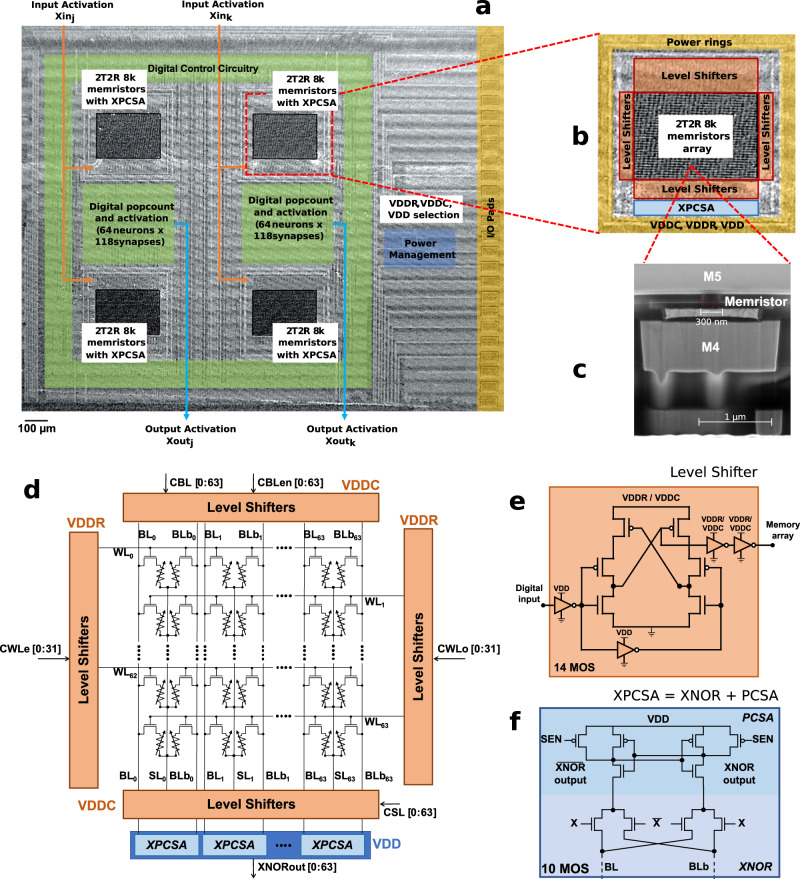
“Our fully digital circuit, devoid of the need for any analog-to-digital conversion, incorporates four arrays of 8,192 memristors each.”
In-memory computing with resistive switching devices
Ielmini, D., & Wong, H.-S. P. (2018) · Nature Electronics · doi:10.1038/s41928-018-0092-2 · Cited by 2,298
Fully hardware-implemented memristor convolutional neural network
Yao, P., Wu, H., Gao, B., Tang, J., Zhang, Q., Zhang, W., Yang, J. J., & Qian, H. (2020) · Nature · doi:10.1038/s41586-020-1942-4 · Cited by 2,179
Courbariaux, M., Hubara, I., Soudry, D., El-Yaniv, R., & Bengio, Y. (2016) · arXiv · doi:10.48550/arxiv.1602.02830 · Cited by 2,106
ISAAC: a convolutional neural network accelerator with in-situ analog arithmetic in crossbars
Shafiee, A., Nag, A., Muralimanohar, N., Balasubramonian, R., Strachan, J. P., Hu, M., Williams, R. S., & Srikumar, V. (2016) · ACM SIGARCH Computer Architecture News · doi:10.1145/3007787.3001139 · Cited by 1,536
Rahmani, A. M., Gia, T. N., Negash, B., Anzanpour, A., Azimi, I., Jiang, M., & Liljeberg, P. (2018) · Future Generation Computer Systems · doi:10.1016/j.future.2017.02.014 · Cited by 1,198
Neuro-Inspired Computing With Emerging Nonvolatile Memorys
Yu, S. (2018) · Proceedings of the IEEE · doi:10.1109/jproc.2018.2790840 · Cited by 1,170 · cited 1×
“A promising solution to this problem is the use of memristor-based systems, which can drastically reduce the energy consumption of AI 5,6 , making it even conceivable to create self-powered edge AI systems that do not require batteries and can instead harvest energy from the environment.”
Equivalent-accuracy accelerated neural-network training using analogue memory
Ambrogio, S., Narayanan, P., Tsai, H., Shelby, R. M., Boybat, I., di Nolfo, C., Sidler, S., Giordano, M., Bodini, M., Farinha, N. C. P., et al. (2018) · Nature · doi:10.1038/s41586-018-0180-5 · Cited by 1,151 · cited 12×
“The details of the memristor forming and programming operation are provided in Supplementary Note 2.”
InfluentialFully memristive neural networks for pattern classification with unsupervised learning
Wang, Z., Joshi, S., Savel’ev, S., Song, W., Midya, R., Li, Y., Rao, M., Yan, P., Asapu, S., Zhuo, Y., et al. (2018) · Nature Electronics · doi:10.1038/s41928-018-0023-2 · Cited by 1,106 · cited 1×
“The most-energy ef fi cient memristor-based AI circuits rely on analog-based in-memory computing: they exploit Ohm ’ s and Kirchh-off ’ s laws to perform the fundamental operation of neural networks, multiply-and-accumulate (MAC) 7 – 9 .”
A compute-in-memory chip based on resistive random-access memory
Wan, W., Kubendran, R., Schaefer, C., Eryilmaz, S. B., Zhang, W., Wu, D., Deiss, S., Raina, P., Qian, H., Gao, B., et al. (2022) · Nature · doi:10.1038/s41586-022-04992-8 · Cited by 943 · cited 1×
“To overcome these challenges, integrated memristor-based AI systems employ complex peripheral circuits, which are tuned for a particular supply voltage 10 – 16 .”
The Future of Healthcare Internet of Things: A Survey of Emerging Technologies
Qadri, Y. A., Nauman, A., Zikria, Y. B., Vasilakos, A. V., & Kim, S. W. (2020) · IEEE Communications Surveys & Tutorials · doi:10.1109/comst.2020.2973314 · Cited by 840
ISAAC: A Convolutional Neural Network Accelerator with In-Situ Analog Arithmetic in Crossbars
Shafiee, A., Nag, A., Muralimanohar, N., Balasubramonian, R., Strachan, J. P., Hu, M., Williams, R. S., & Srikumar, V. (2016) · 2016 ACM/IEEE 43rd Annual International Symposium on Computer Architecture (ISCA) · doi:10.1109/isca.2016.12 · Cited by 775
A crossbar array of magnetoresistive memory devices for in-memory computing
Jung, S., Lee, H., Myung, S., Kim, H., Yoon, S. K., Kwon, S.-W., Ju, Y., Kim, M., Yi, W., Han, S., et al. (2022) · Nature · doi:10.1038/s41586-021-04196-6 · Cited by 644
Advances in Energy Harvesting Communications: Past, Present, and Future Challenges
Ku, M.-L., Li, W., Chen, Y., & Ray Liu, K. J. (2016) · IEEE Communications Surveys & Tutorials · doi:10.1109/comst.2015.2497324 · Cited by 606
Binary Neural Networks: A Survey
Qin, H., Gong, R., Liu, X., Bai, X., Song, J., & Sebe, N. (2020) · Pattern Recognition · doi:10.1016/j.patcog.2020.107281 · Cited by 546 · cited 1×
“These net-worksareparticularly appropriatefortheextremeedge,asthey canbe trained for image and signalprocessingtaskswith high accuracy, while requiring less resources than conventional real-valued neural networks 24,25 .”
Progress and prospects for ultrathin solar cells
Massiot, I., Cattoni, A., & Collin, S. (2020) · Nature Energy · doi:10.1038/s41560-020-00714-4 · Cited by 322 · cited 1×
“Such lightweight, ultrathin solar cells can also be transferred into a fully-integrated, self-powered device 39,40 .”
Self-citationA survey on application of machine learning for Internet of Things
Cui, L., Yang, S., Chen, F., Ming, Z., Lu, N., & Qin, J. (2018) · International Journal of Machine Learning and Cybernetics · doi:10.1007/s13042-018-0834-5 · Cited by 293
Chen, H.-L., Cattoni, A., De Lépinau, R., Walker, A. W., Höhn, O., Lackner, D., Siefer, G., Faustini, M., Vandamme, N., Goffard, J., et al. (2019) · Nature Energy · doi:10.1038/s41560-019-0434-y · Cited by 200 · cited 1×
“Such lightweight, ultrathin solar cells can also be transferred into a fully-integrated, self-powered device 32,33 .”
BackgroundSelf-citationXue, C.-X., Chiu, Y.-C., Liu, T.-W., Huang, T.-Y., Liu, J.-S., Chang, T.-W., Kao, H.-Y., Wang, J.-H., Wei, S.-Y., Lee, C.-Y., et al. (2020) · Nature Electronics · doi:10.1038/s41928-020-00505-5 · Cited by 181 · cited 1×
“To overcome these challenges, integrated memristor-based AI systems employ complex peripheral circuits, which are tuned for a particular supply voltage 10 – 16 .”
Khaddam-Aljameh, R., Stanisavljevic, M., Fornt Mas, J., Karunaratne, G., Brändli, M., Liu, F., Singh, A., Müller, S. M., Egger, U., Petropoulos, A., et al. (2022) · IEEE Journal of Solid-State Circuits · doi:10.1109/jssc.2022.3140414 · Cited by 144
Wan, W., Kubendran, R., Eryilmaz, S. B., Zhang, W., Liao, Y., Wu, D., Deiss, S., Gao, B., Raina, P., Joshi, S., et al. (2020) · 2020 IEEE International Solid- State Circuits Conference - (ISSCC) · doi:10.1109/isscc19947.2020.9062979 · Cited by 143
Synchronous Non-Volatile Logic Gate Design Based on Resistive Switching Memories
Zhao, W., Moreau, M., Deng, E., Zhang, Y., Portal, J.-M., Klein, J.-O., Bocquet, M., Aziza, H., Deleruyelle, D., Muller, C., et al. (2014) · IEEE Transactions on Circuits and Systems I: Regular Papers · doi:10.1109/tcsi.2013.2278332 · Cited by 120 · cited 2×
“21 .”
MethodSelf-citationNeural inference at the frontier of energy, space, and time
Modha, D. S., Akopyan, F., Andreopoulos, A., Appuswamy, R., Arthur, J. V., Cassidy, A. S., Datta, P., DeBole, M. V., Esser, S. K., Otero, C. O., et al. (2023) · Science · doi:10.1126/science.adh1174 · Cited by 115
In-Memory and Error-Immune Differential RRAM Implementation of Binarized Deep Neural Networks
Bocquet, M., Hirztlin, T., Klein, J.-O., Nowak, E., Vianello, E., Portal, J.-M., & Querlioz, D. (2018) · 2018 IEEE International Electron Devices Meeting (IEDM) · doi:10.1109/iedm.2018.8614639 · Cited by 99 · cited 1×
“18,19.”
Self-citationHirtzlin, T., Bocquet, M., Penkovsky, B., Klein, J.-O., Nowak, E., Vianello, E., Portal, J.-M., & Querlioz, D. (2020) · Frontiers in Neuroscience · doi:10.3389/fnins.2019.01383 · Cited by 93
Self-citationNon-Volatile RRAM Embedded into 22FFL FinFET Technology
Golonzka, O., Arslan, U., Bai, P., Bohr, M., Baykan, O., Chang, Y., Chaudhari, A., Chen, A., Clarke, J., Connor, C., et al. (2019) · 2019 Symposium on VLSI Technology · doi:10.23919/vlsit.2019.8776570 · Cited by 79
Yoon, S., Carreon-Bautista, S., & Sanchez-Sinencio, E. (2018) · IEEE Transactions on Circuits and Systems II: Express Briefs · doi:10.1109/tcsii.2018.2794299 · Cited by 61
Photovoltaics for indoor applications: Progress, challenges and perspectives
Srivishnu, K. S., Rajesh, M. N., Prasanthkumar, S., & Giribabu, L. (2023) · Solar Energy · doi:10.1016/j.solener.2023.112057 · Cited by 60
A memristor-based Bayesian machine
Harabi, K.-E., Hirtzlin, T., Turck, C., Vianello, E., Laurent, R., Droulez, J., Bessière, P., Portal, J.-M., Bocquet, M., & Querlioz, D. (2022) · Nature Electronics · doi:10.1038/s41928-022-00886-9 · Cited by 58
Self-citationOutstanding Bit Error Tolerance of Resistive RAM-Based Binarized Neural Networks
Hirtzlin, T., Bocquet, M., Klein, J.-O., Nowak, E., Vianello, E., Portal, J.-M., & Querlioz, D. (2019) · 2019 IEEE International Conference on Artificial Intelligence Circuits and Systems (AICAS) · doi:10.1109/aicas.2019.8771544 · Cited by 51 · cited 1×
“Nevertheless, binarized neural networks are highly robust to weight errors, which in many cases do not change neuron activation 29,30 .”
BackgroundSelf-citationCMOS-integrated nanoscale memristive crossbars for CNN and optimization acceleration
Li, C., Ignowski, J., Sheng, X., Wessel, R., Jaffe, B., Ingemi, J., Graves, C., & Strachan, J. P. (2020) · 2020 IEEE International Memory Workshop (IMW) · doi:10.1109/imw48823.2020.9108112 · Cited by 37
Deaville, P., Zhang, B., Chen, L.-Y., & Verma, N. (2021) · ESSCIRC 2021 - IEEE 47th European Solid State Circuits Conference (ESSCIRC) · doi:10.1109/esscirc53450.2021.9567807 · Cited by 36
A Review of Recent Advances of Binary Neural Networks for Edge Computing
Zhao, W., Ma, T., Gong, X., Zhang, B., & Doermann, D. (2021) · IEEE Journal on Miniaturization for Air and Space Systems · doi:10.1109/jmass.2020.3034205 · Cited by 36
Margin-Maximization in Binarized Neural Networks for Optimizing Bit Error Tolerance
Buschjager, S., Chen, J.-J., Chen, K.-H., Gunzel, M., Hakert, C., Morik, K., Novkin, R., Pfahler, L., & Yayla, M. (2021) · 2021 Design, Automation & Test in Europe Conference & Exhibition (DATE) · doi:10.23919/date51398.2021.9473918 · Cited by 22 · cited 1×
“Nevertheless, binarized neural networks are highly robust to weight errors, which in many cases do not change neuron activation 33,34 .”
eNVM RRAM reliability performance and modeling in 22FFL FinFET technology
Chang, Y., O'Donnell, J. A., Acosta, T., Kotlyar, R., Chen, A., Quintero, P. A., Strutt, N., Golonzka, O., Connor, C., & Hicks, J. (2020) · IEEE International Reliability Physics Symposium proceedings · doi:10.1109/irps45951.2020.9128359 · Cited by 22
1.73 eV AlGaAs/InGaP heterojunction solar cell grown by MBE with 18.7% efficiency
Ben Slimane, A., Michaud, A., Mauguin, O., Lafosse, X., Bercegol, A., Lombez, L., Harmand, J., & Collin, S. (2020) · Progress in Photovoltaics: Research and Applications · doi:10.1002/pip.3249 · Cited by 13
Self-citationDeaville, P., Zhang, B., Chen, L.-Y., & Verma, N. (2021) · European Solid-State Device Research Conference · doi:10.1109/essderc53440.2021.9631798 · Cited by 8
Cited by
Hybrid chips to enable a sustainable internet of things technology: opportunities and challenges
Rogdakis, K., Psaltakis, G., Fagas, G., Quinn, A., Martins, R., & Kymakis, E. (2024) · Discover Materials · doi:10.1007/s43939-024-00074-w · Cited by 98
Pan, J., Kan, H., Liu, Z., Gao, S., Wu, E., Li, Y., & Zhang, C. (2024) · npj Flexible Electronics · doi:10.1038/s41528-024-00356-6 · Cited by 62
Neuromorphic overparameterisation and few-shot learning in multilayer physical neural networks
Stenning, K. D., Gartside, J. C., Manneschi, L., Cheung, C. T. S., Chen, T., Vanstone, A., Love, J., Holder, H. H., Caravelli, F., Kurebayashi, H., et al. (2024) · Nature Communications · doi:10.1038/s41467-024-50633-1 · Cited by 71
Kim, D., & Choi, J. (2025) · Toxicology · doi:10.1016/j.tox.2025.154230 · Cited by 47
A dual-domain compute-in-memory system for general neural network inference
Wang, Z., Yu, R., Jia, Z., He, Z., Yang, T., Gao, B., Li, Y., Hu, Z., Hao, Z., Liu, Y., et al. (2025) · Nature Electronics · doi:10.1038/s41928-024-01315-9 · Cited by 35
Metadata
- Authors
- Jebali, F., Majumdar, A., Turck, C., Harabi, K.-E., Faye, M.-C., Muhr, E., Walder, J.-P., Bilousov, O., Michaud, A., Vianello, E., Hirtzlin, T., Andrieu, F., Bocquet, M., Collin, S., Querlioz, D., & Portal, J.-M.
- Affiliations
- Centre National de la Recherche Scientifique (FR)
- Centre de Nanosciences et de Nanotechnologies (FR)
- Commissariat à l'Énergie Atomique et aux Énergies Alternatives (FR)
- Corresponding author
- Querlioz, Damien
- Portal, Jean-Michel
- ORCID
- Venue
- Nature Communications
- Published
- 2024-01-25
- Volume
- 15
- Issue
- 1
- Pages
- 741-741
- ISSN
- 2041-1723 (ISSN-L)
- PMC
- PMC10811339
- OpenAlex
- W4391222208
- Semantic Scholar
- 6e72467b2ee0c69cdd0e11d2b12e1845ab43eeb5
- Cited by
- 58
- References
- 45
- Citations by year
- 2026: 23 · 2025: 26 · 2024: 8
- FWCI
- 5.88
- Type
- journal article
- Language
- en
- Open access
- gold
- doi.org
- Licence
- cc-by
- creativecommons.org/licenses/by/4.0 (tdm)
- creativecommons.org/licenses/by/4.0 (vor)
- Locations
- Nature Communications (publishedVersion, cc-by)
- PubMed Central (publishedVersion, cc-by)
- PubMed (publishedVersion)
- arXiv (Cornell University) (submittedVersion)
- HAL AMU (submittedVersion, cc-by)
- HAL AMU (submittedVersion, other-oa)
- RePEc: Research Papers in Economics (submittedVersion)
- DOAJ (DOAJ: Directory of Open Access Journals) (submittedVersion, cc-by-sa)
- arXiv (Cornell University)
- Funders
- European Commission (H2020, 101007321)
- Agence Nationale de la Recherche (France2030, ANRIEED-002-01, ANR18, ANR-18-CE24-0009, ANR-22-PEEL-0010, IEED-002-01)
- Electronic Components and Systems for European Leadership (101007321)
- Horizon 2020 Framework Programme (101007321)
- H2020 European Research Council (715872)
- Topics
- Physical Sciences › Engineering › Electrical and Electronic Engineering › Advanced Memory and Neural Computing
- Physical Sciences › Engineering › Electrical and Electronic Engineering › Low-power high-performance VLSI design
- Physical Sciences › Computer Science › Artificial Intelligence › Neural Networks and Reservoir Computing
- Keywords
- memristor-based neural networks, binary neural networks, near-memory computing, energy harvesting, edge computing, approximate computing, image classification, smart sensors
About these checks
Registry, retraction, Cites and statistics results are computed, not judged, with one exception: a printed reference that no index lists is read once by a model before it counts as a citation error. Claims are extracted by a model and kept only when their quote appears verbatim in the text; each cited source is then checked, with a model’s help, for whether it says what the claim relies on. Those verdicts can be wrong — read the claim’s quote and the cited source before relying on one.
The claim verdicts this report counts are experimental: their accuracy is not yet measured.
A language model drew the claims from the paper on 2026-10-10, under version 3 of the claim definition (model deepseek-v4.1-flash, prompt extract-v3).
A second model labelled each claim on 2026-10-10 (model jev-1.13-20260917, definition revision gold-guideline-v0.2).
Cited sources are checked with a language model’s help (gpt-6-sol and qwen3.8-omni-flash).
Statistics and arithmetic are recomputed, not judged.
Confidence bands are shown only for fields calibrated on our annotated test set. None is calibrated yet, so no band is shown.
What counts as a claim ›How we measure confidence ›How we check this ›
Are you an author, or do you see a problem with this page? Request a review
Data sources
Bibliographic data: Semantic Scholar, OpenAlex, Crossref.
Contains information from the Semantic Scholar Academic Graph Datasets, made available under the ODC Attribution License (ODC-BY 1.0).
Semantic Scholar’s data is described in: Kinney, R., et al. (2023). The Semantic Scholar Open Data Platform. arXiv:2301.10140.
