

Genomic language model predicts protein co-regulation and function
Open accessPublished version of a preprint
The DOI matches its Crossref record; 76 of the 80 references it cites were found in a registry or an index.
Abstract
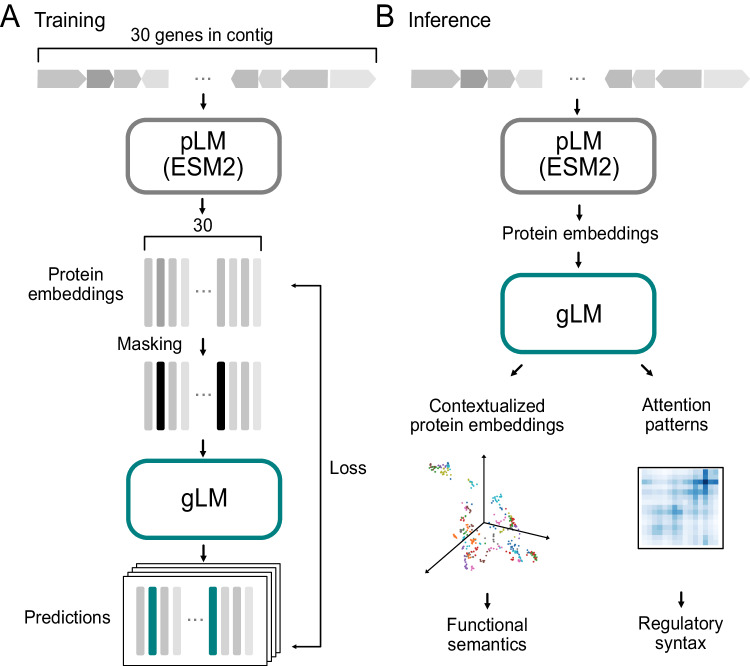
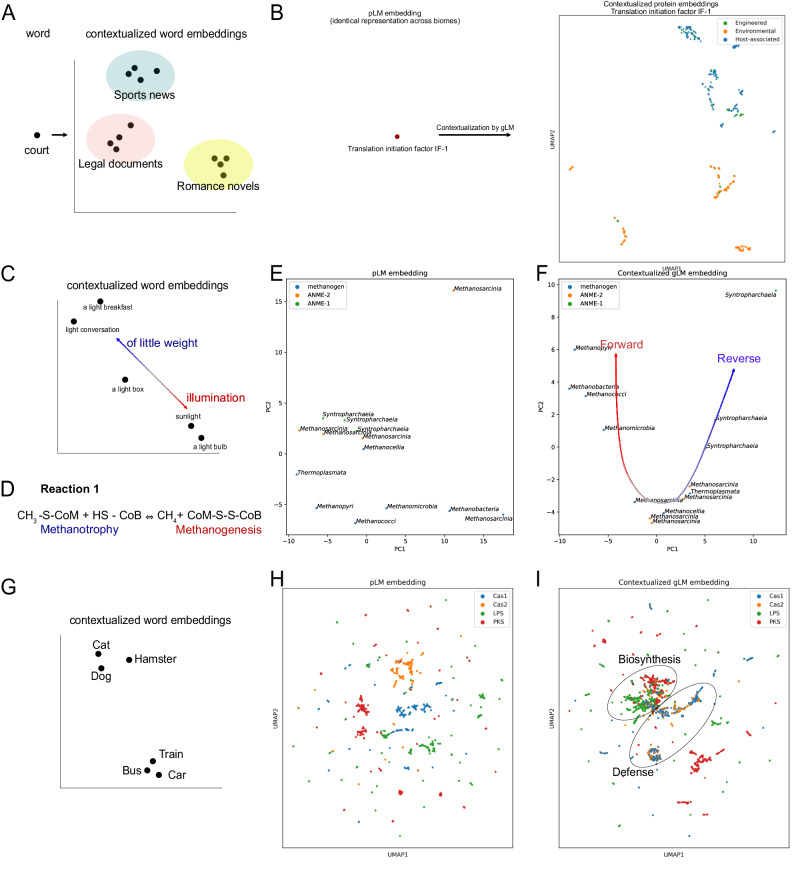
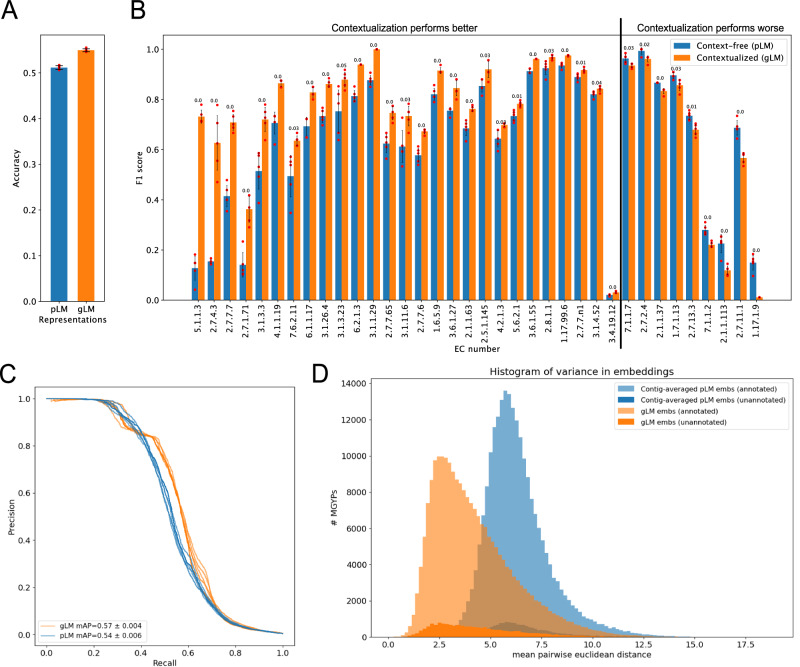
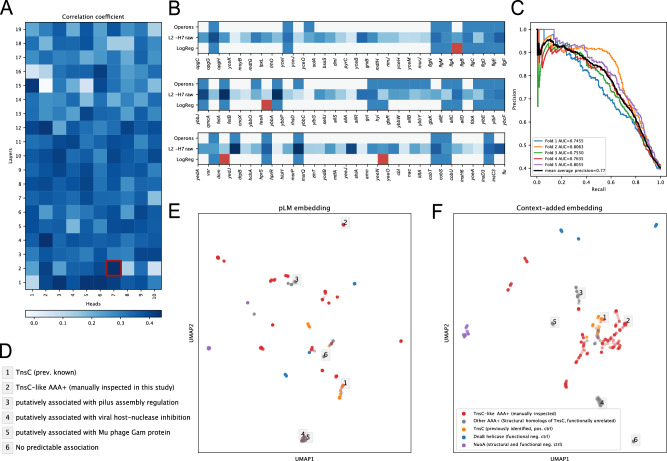
Deciphering the relationship between a gene and its genomic context is fundamental to understanding and engineering biological systems. Machine learning has shown promise in learning latent relationships underlying the sequence-structure-function paradigm from massive protein sequence datasets. However, to date, limited attempts have been made in extending this continuum to include higher order genomic context information. Evolutionary processes dictate the specificity of genomic contexts in which a gene is found across phylogenetic distances, and these emergent genomic patterns can be leveraged to uncover functional relationships between gene products. Here, we train a genomic language model (gLM) on millions of metagenomic scaffolds to learn the latent functional and regulatory relationships between genes. gLM learns contextualized protein embeddings that capture the genomic context as well as the protein sequence itself, and encode biologically meaningful and functionally relevant information (e.g. enzymatic function, taxonomy). Our analysis of the attention patterns demonstrates that gLM is learning co-regulated functional modules (i.e. operons). Our findings illustrate that gLM’s unsupervised deep learning of the metagenomic corpus is an effective and promising approach to encode functional semantics and regulatory syntax of genes in their genomic contexts and uncover complex relationships between genes in a genomic region.
Overview
The claims and statistics of this paper haven’t been checked yet.
Free: it reads the open-access text and checks the first 5 claims that cite a source we can check. Create a free account to check every claim.
Integrity signals
Registry
Cites
Statistics
Figures
Verification
Claims the paper makes
The claims and statistics of this paper haven’t been checked yet.
Free: it reads the open-access text and checks the first 5 claims that cite a source we can check. Create a free account to check every claim.
Claims other papers make about this one
Each is checked against this paper’s own text: does it say what the citing paper says it does?
The source backs part of the claim, not all of it — or backs it for a different population, condition or comparison.
In the citing paper
“As a result, Transformer-based DNA models are constrained to short context lengths and use schemes that aggregate nucleotides into the basic units of language models, called tokens, thereby sacrificing single-nucleotide resolution (15, 16, 21–23).”
From Sequence modeling and design from molecular to genome scale with Evo (2024) · cites this paper as [23]
Experimental — accuracy not yet measuredThe source backs part of the claim, not all of it — or backs it for a different population, condition or comparison.
In the citing paper
“This is a unique finding since literature broadly has reported common co-regulation of genes in protein complexes at both transcription and translational levels96–102.”
From EXOSC3 G191 Variants Trigger System-Wide Recalibration of RNA Processing Machinery (2026) · cites this paper as [96]
Experimental — accuracy not yet measured
Self-check
Percentages, sums and reported differences re-computed from the paper’s own numbers.
The self-check needs the paper’s full text.
Citations
Cites
Vaswani, A., Shazeer, N., Parmar, N., Uszkoreit, J., Jones, L., Gomez, A. N., Kaiser, L., & Polosukhin, I. (2017) · arXiv · doi:10.48550/arxiv.1706.03762 · Cited by 120,404 · cited 3×
“Our model is based on the transformer 24 architecture and is trained using millions of unla-belled metagenomic sequences via the masked language modeling 25 objective, with the hypothesis that its ability to attend to different parts of a multi-gene sequence will result in the learning of gene…”
InfluentialHochreiter, S., & Schmidhuber, J. (1997) · Neural Computation · doi:10.1162/neco.1997.9.8.1735 · Cited by 102,318 · cited 1×
“This is in contrast to Long-Short-Term-Memory networks (LSTMs) 26 that sequentially processes tokens.”
BERT: Pre-training of Deep Bidirectional Transformers for Language Understanding
Devlin, J., Chang, M.-W., Lee, K., & Toutanova, K. (2019) · Proceedings of the 2019 Conference of the North American Chapter of the Association for Computational Linguistics: Human Language Technologies, Volume 1 (Long and Short Papers) · doi:10.18653/v1/n19-1423 · Cited by 54,325
Highly accurate protein structure prediction with AlphaFold
Jumper, J., Evans, R., Pritzel, A., Green, T., Figurnov, M., Ronneberger, O., Tunyasuvunakool, K., Bates, R., Žídek, A., Potapenko, A., et al. (2021) · Nature · doi:10.1038/s41586-021-03819-2 · Cited by 43,764
RoBERTa: A Robustly Optimized BERT Pretraining Approach
Liu, Y., Ott, M., Goyal, N., Du, J., Joshi, M., Chen, D., Levy, O., Lewis, M., Zettlemoyer, L., & Stoyanov, V. (2019) · arXiv · doi:10.48550/arxiv.1907.11692 · Cited by 16,515
Fast and sensitive protein alignment using DIAMOND
Buchfink, B., Xie, C., & Huson, D. H. (2015) · Nature Methods · doi:10.1038/nmeth.3176 · Cited by 14,201 · cited 1×
“0.7.145 57 against the Uni-Ref90 database 58 with an e-value cut-off 1E-5.”
InfluentialScaling Laws for Neural Language Models
Kaplan, J., McCandlish, S., Henighan, T., Brown, T. B., Chess, B., Child, R., Gray, S., Radford, A., Wu, J., & Amodei, D. (2020) · arXiv · doi:10.48550/arxiv.2001.08361 · Cited by 9,550 · cited 1×
“…key areas for further development: First, the transformer architecture has shown to be successful in ef fi cient scaling; in both natural language 50 and protein language processing 23 , increasing the number of parameters in the model along with the training dataset size have been shown to lead…”
The Complete Genome Sequence of Escherichia coli K-12
Blattner, F. R., Plunkett, G., Bloch, C. A., Perna, N. T., Burland, V., Riley, M., Collado-Vides, J., Glasner, J. D., Rode, C. K., Mayhew, G. F., et al. (1997) · Science · doi:10.1126/science.277.5331.1453 · Cited by 7,452
Evolutionary-scale prediction of atomic level protein structure with a language model
Lin, Z., Akin, H., Rao, R., Hie, B., Zhu, Z., Lu, W., Smetanin, N., Verkuil, R., Kabeli, O., Shmueli, Y., et al. (2022) · doi:10.1101/2022.07.20.500902 · Cited by 5,990
Accurate prediction of protein structures and interactions using a 3-track network
Baek, M., DiMaio, F., Anishchenko, I., Dauparas, J., Ovchinnikov, S., Lee, G. R., Wang, J., Cong, Q., Kinch, L. N., Schaeffer, R. D., et al. (2021) · doi:10.1101/2021.06.14.448402 · Cited by 5,549
Self-citationMMseqs2 enables sensitive protein sequence searching for the analysis of massive data sets
Steinegger, M., & Söding, J. (2017) · Nature Biotechnology · doi:10.1038/nbt.3988 · Cited by 4,840
Rives, A., Meier, J., Sercu, T., Goyal, S., Lin, Z., Liu, J., Guo, D., Ott, M., Zitnick, C. L., Ma, J., et al. (2021) · Proceedings of the National Academy of Sciences · doi:10.1073/pnas.2016239118 · Cited by 3,286
Rives, A., Meier, J., Sercu, T., Goyal, S., Lin, Z., Liu, J., Guo, D., Ott, M., Zitnick, C. L., Ma, J., et al. (2019) · doi:10.1101/622803 · Cited by 3,280
Fast and accurate protein structure search with Foldseek
van Kempen, M., Kim, S. S., Tumescheit, C., Mirdita, M., Lee, J., Gilchrist, C. L. M., Söding, J., & Steinegger, M. (2022) · doi:10.1101/2022.02.07.479398 · Cited by 2,598
Fast and accurate protein structure search with Foldseek
van Kempen, M., Kim, S. S., Tumescheit, C., Mirdita, M., Lee, J., Gilchrist, C. L. M., Söding, J., & Steinegger, M. (2024) · Nature Biotechnology · doi:10.1038/s41587-023-01773-0 · Cited by 2,596
ProtTrans: Toward Understanding the Language of Life Through Self-Supervised Learning
Elnaggar, A., Heinzinger, M., Dallago, C., Rehawi, G., Wang, Y., Jones, L., Gibbs, T., Feher, T., Angerer, C., Steinegger, M., et al. (2022) · IEEE Transactions on Pattern Analysis and Machine Intelligence · doi:10.1109/tpami.2021.3095381 · Cited by 2,329
The origins of genome complexity
Lynch, M., & Conery, J. S. (2003) · Science · doi:10.1126/science.1089370 · Cited by 1,698
UniRef: comprehensive and non-redundant UniProt reference clusters
Suzek, B. E., Huang, H., McGarvey, P., Mazumder, R., & Wu, C. H. (2007) · Bioinformatics · doi:10.1093/bioinformatics/btm098 · Cited by 1,613
A primer in BERTology: What we know about how BERT works
Rogers, A., Kovaleva, O., & Rumshisky, A. (2020) · Transactions of the Association for Computational Linguistics · doi:10.1162/tacl_a_00349 · Cited by 1,552
Ji, Y.-R., Zhou, Z., Liu, H., & Davuluri, R. (2020) · bioRxiv · doi:10.1101/2020.09.17.301879 · Cited by 1,453 · cited 1×
“On the other end of the spectrum of representations, there have been efforts to use unsupervised learning on nucleotide sequences to predict gene expression level 18 and detect regulatory motifs 19 – 21 .”
Effective gene expression prediction from sequence by integrating long-range interactions
Avsec, Ž., Agarwal, V., Visentin, D., Ledsam, J. R., Grabska-Barwinska, A., Taylor, K. R., Assael, Y., Jumper, J., Kohli, P., & Kelley, D. R. (2021) · Nature Methods · doi:10.1038/s41592-021-01252-x · Cited by 1,326 · cited 1×
“On the other end of the spectrum of representations, there have been efforts to use unsupervised learning on nucleotide sequences to predict gene expression level 18 and detect regulatory motifs 19 – 21 .”
Ji, Y., Zhou, Z., Liu, H., & Davuluri, R. V. (2021) · Bioinformatics · doi:10.1093/bioinformatics/btab083 · Cited by 1,303
VirSorter2: a multi-classifier, expert-guided approach to detect diverse DNA and RNA viruses
Guo, J., Bolduc, B., Zayed, A. A., Varsani, A., Dominguez-Huerta, G., Delmont, T. O., Pratama, A. A., Gazitúa, M. C., Vik, D., Sullivan, M. B., et al. (2021) · Microbiome · doi:10.1186/s40168-020-00990-y · Cited by 1,279 · cited 1×
“In metagenomic datasets, the taxonomic identity of assembled sequences must be inferred post-hoc, therefore the iden-ti fi cation of viral sequences is conducted based on the presence of viralgenesandviralgenomicsignatures 49 .”
Large language models generate functional protein sequences across diverse families
Madani, A., Krause, B., Greene, E. R., Subramanian, S., Mohr, B. P., Holton, J. M., Olmos, J. L., Xiong, C., Sun, Z. Z., Socher, R., et al. (2023) · Nature Biotechnology · doi:10.1038/s41587-022-01618-2 · Cited by 1,078
Clustering of highly homologous sequences to reduce the size of large protein databases
Li, W., Jaroszewski, L., & Godzik, A. (2001) · Bioinformatics · doi:10.1093/bioinformatics/17.3.282 · Cited by 1,034 · cited 1×
“6 61 ).”
Nucleotide Transformer: building and evaluating robust foundation models for human genomics
Dalla-Torre, H., Gonzalez, L., Mendoza-Revilla, J., Lopez Carranza, N., Grzywaczewski, A. H., Oteri, F., Dallago, C., Trop, E., de Almeida, B. P., Sirelkhatim, H., et al. (2025) · Nature Methods · doi:10.1038/s41592-024-02523-z · Cited by 772
The Nucleotide Transformer: Building and Evaluating Robust Foundation Models for Human Genomics
Dalla-Torre, H., Gonzalez, L., Mendoza Revilla, J., Lopez Carranza, N., Henryk Grywaczewski, A., Oteri, F., Dallago, C., Trop, E., De Almeida, B. P., Sirelkhatim, H., et al. (2023) · doi:10.1101/2023.01.11.523679 · Cited by 680
Ovchinnikov, S., Kamisetty, H., & Baker, D. (2014) · eLife · doi:10.7554/elife.02030 · Cited by 629 · cited 3×
“Recent advances in protein-protein interaction (PPI) predictionand structuralcomplex researchhas largely been guided by identifying interologs (conserved PPI across organisms) and co-evolutionary signals between residues 47 .”
InfluentialSelf-citationTransposon-encoded CRISPR–Cas systems direct RNA-guided DNA integration
Klompe, S. E., Vo, P. L. H., Halpin-Healy, T. S., & Sternberg, S. H. (2019) · Nature · doi:10.1038/s41586-019-1323-z · Cited by 627
Population Genomics of Early Events in the Ecological Differentiation of Bacteria
Shapiro, B. J., Friedman, J., Cordero, O. X., Preheim, S. P., Timberlake, S. C., Szabó, G., Polz, M. F., & Alm, E. J. (2012) · Science · doi:10.1126/science.1218198 · Cited by 562
Horizontal Transfer, Not Duplication, Drives the Expansion of Protein Families in Prokaryotes
Treangen, T. J., & Rocha, E. P. C. (2011) · PLoS Genetics · doi:10.1371/journal.pgen.1001284 · Cited by 509
Enzyme function prediction using contrastive learning
Yu, T., Cui, H., Li, J. C., Luo, Y., Jiang, G., & Zhao, H. (2023) · Science · doi:10.1126/science.adf2465 · Cited by 440
MGnify: the microbiome sequence data analysis resource in 2023
Richardson, L., Allen, B., Baldi, G., Beracochea, M., Bileschi, M. L., Burdett, T., Burgin, J., Caballero-Pérez, J., Cochrane, G., Colwell, L. J., et al. (2023) · Nucleic Acids Research · doi:10.1093/nar/gkac1080 · Cited by 432 · cited 11×
“The genomic corpus was generated using the MGnify 27 dataset (released 2022-05-06 and downloaded 2022-06-07).”
InfluentialProtein moonlighting: what is it, and why is it important?
Jeffery, C. J. (2018) · Philosophical Transactions of the Royal Society B: Biological Sciences · doi:10.1098/rstb.2016.0523 · Cited by 361
ProtTrans: Towards Cracking the Language of Life’s Code Through Self-Supervised Learning
Elnaggar, A., Heinzinger, M., Dallago, C., Rehawi, G., Wang, Y., Jones, L., Gibbs, T., Feher, T., Angerer, C., Steinegger, M., et al. (2020) · bioRxiv (Cold Spring Harbor Laboratory) · doi:10.1101/2020.07.12.199554 · Cited by 354
Explaining microbial genomic diversity in light of evolutionary ecology
Cordero, O. X., & Polz, M. F. (2014) · Nature Reviews Microbiology · doi:10.1038/nrmicro3218 · Cited by 350
BERTology Meets Biology: Interpreting Attention in Protein Language Models
Vig, J., Madani, A., Varshney, L. R., Xiong, C., Socher, R., & Rajani, N. F. (2020) · doi:10.1101/2020.06.26.174417 · Cited by 338 · cited 1×
“Subsequently, different attention heads in pLMs 40 have been shown to correlate to speci fi c structural elements and functional sites in a protein.”
Using deep learning to annotate the protein universe
Bileschi, M. L., Belanger, D., Bryant, D. H., Sanderson, T., Carter, B., Sculley, D., Bateman, A., DePristo, M. A., & Colwell, L. J. (2022) · Nature Biotechnology · doi:10.1038/s41587-021-01179-w · Cited by 332
ON THE ROLES OF DIRECTED AND RANDOM CHANGES IN GENE FREQUENCY IN THE GENETICS OF POPULATIONS
Wright, S. (1948) · Evolution · doi:10.1111/j.1558-5646.1948.tb02746.x · Cited by 302
Deep learning enables high-quality and high-throughput prediction of enzyme commission numbers
Ryu, J. Y., Kim, H. U., & Lee, S. Y. (2019) · Proceedings of the National Academy of Sciences · doi:10.1073/pnas.1821905116 · Cited by 293
DEEPre: sequence-based enzyme EC number prediction by deep learning
Li, Y., Wang, S., Umarov, R., Xie, B., Fan, M., Li, L., & Gao, X. (2018) · Bioinformatics · doi:10.1093/bioinformatics/btx680 · Cited by 291
AAA+ ATPases: Achieving Diversity of Function with Conserved Machinery
White, S. R., & Lauring, B. (2007) · Traffic · doi:10.1111/j.1600-0854.2007.00642.x · Cited by 220
Remote homology detection: a motif based approach
Ben-Hur, A., & Brutlag, D. (2003) · Bioinformatics · doi:10.1093/bioinformatics/btg1002 · Cited by 193 · cited 1×
“Similar to words in natural language, a gene can confer different functions 29 depending on its context 30 , and many genes confer similar functions (i.e. convergent evolution 31 , remote homology 32 ).”
HyenaDNA: Long-Range Genomic Sequence Modeling at Single Nucleotide Resolution
Nguyen, E., Poli, M., Faizi, M., Thomas, A., Birch-Sykes, C., Wornow, M., Patel, A., Rabideau, C., Massaroli, S., Bengio, Y., et al. (2023) · arXiv · doi:10.48550/arxiv.2306.15794 · Cited by 168 · cited 1×
“On the other end of the spectrum of representations, there have been efforts to use unsupervised learning on nucleotide sequences to predict gene expression level 18 and detect regulatory motifs 19 – 21 .”
Just Say No to Single Embeddings: Why Your AI Needs Multiple Perspectives
Coenen, A., Reif, E., Yuan, A., Kim, B., Pearce, A., Viégas, F., & WATTENBERG, M. P. (2019) · arXiv (Cornell University) · doi:10.48550/arxiv.1906.02715 · Cited by 163 · cited 1×
“Contextualized protein embeddings are therefore able to capture relational properties akin to semantic information 36 , where genes encoding proteins that are more similar in their function are found in similar genomic contexts.”
Convergent Evolution of Enzyme Active Sites Is not a Rare Phenomenon
Gherardini, P. F., Wass, M. N., Helmer‐Citterich, M., & Sternberg, M. J. E. (2007) · Journal of Molecular Biology · doi:10.1016/j.jmb.2007.06.017 · Cited by 151
C-di-GMP Synthesis: Structural Aspects of Evolution, Catalysis and Regulation
Schirmer, T. (2016) · Journal of Molecular Biology · doi:10.1016/j.jmb.2016.07.023 · Cited by 146
Exploring the structure and function paradigm
Redfern, O., Dessailly, B. H., & Orengo, C. A. (2008) · Current Opinion in Structural Biology · doi:10.1016/j.sbi.2008.05.007 · Cited by 135
Unifying the known and unknown microbial coding sequence space
Vanni, C., Schechter, M. S., Acinas, S. G., Barberán, A., Buttigieg, P. L., Casamayor, E. O., Delmont, T. O., Duarte, C. M., Eren, A. M., Finn, R. D., et al. (2022) · eLife · doi:10.7554/elife.67667 · Cited by 134
GenSLMs: Genome-scale language models reveal SARS-CoV-2 evolutionary dynamics
Zvyagin, M., Brace, A., Hippe, K., Deng, Y., Zhang, B., Bohorquez, C. O., Clyde, A., Kale, B., Perez-Rivera, D., Ma, H., et al. (2023) · The International Journal of High Performance Computing Applications · doi:10.1177/10943420231201154 · Cited by 120
GenSLMs: Genome-scale language models reveal SARS-CoV-2 evolutionary dynamics
Zvyagin, M., Brace, A., Hippe, K., Deng, Y., Zhang, B., Bohorquez, C. O., Clyde, A., Kale, B., Perez-Rivera, D., Ma, H., et al. (2022) · doi:10.1101/2022.10.10.511571 · Cited by 120 · cited 1×
“Most recent efforts to leverage diverse microbial sequences to model genome-scale information include GenSLMs 22 , which is pretrained on codon-level representations of diverse bacterial and viral gene sequences and later fi ne-tuned on SARS-CoV-2 genomes.”
On the Roles of Directed and Random Changes in Gene Frequency in the Genetics of Populations
Wright, S. (1948) · Evolution · doi:10.2307/2405519 · Cited by 113
Piovesan, A., Caracausi, M., Antonaros, F., Pelleri, M. C., & Vitale, L. (2016) · Database · doi:10.1093/database/baw153 · Cited by 112
Tierrafría, V. H., Rioualen, C., Salgado, H., Lara, P., Gama-Castro, S., Lally, P., Gómez-Romero, L., Peña-Loredo, P., López-Almazo, A. G., Alarcón-Carranza, G., et al. (2022) · Microbial Genomics · doi:10.1099/mgen.0.000833 · Cited by 108 · cited 10×
“Instead, our goal was to remove as many E.coli K-12-like genomic contexts (subcontigs) from training, which is more appropriate for the training objective. gLM achieves 71.9% in validation pseudo-accuracy and 59.2% in vali-dationabsolute accuracy (SupplementaryFig.”
InfluentialImprove Transformer Models with Better Relative Position Embeddings
Huang, Z., Liang, D., Xu, P., & Xiang, B. (2020) · Findings of the Association for Computational Linguistics: EMNLP 2020 · doi:10.18653/v1/2020.findings-emnlp.298 · Cited by 106
Contrastive learning on protein embeddings enlightens midnight zone
(2022) · doi:10.1093/nargab/lqac043 · Cited by 105
Metagenomic discovery of CRISPR-associated transposons
Rybarski, J. R., Hu, K., Hill, A. M., Wilke, C. O., & Finkelstein, I. J. (2021) · Proceedings of the National Academy of Sciences · doi:10.1073/pnas.2112279118 · Cited by 83
Structures of the holo CRISPR RNA-guided transposon integration complex
Park, J.-U., Tsai, A. W.-L., Rizo, A. N., Truong, V. H., Wellner, T. X., Schargel, R. D., & Kellogg, E. H. (2023) · Nature · doi:10.1038/s41586-022-05573-5 · Cited by 80
Self-citationFuzziness enables context dependence of protein interactions
Miskei, M., Gregus, A., Sharma, R., Duro, N., Zsolyomi, F., & Fuxreiter, M. (2017) · FEBS Letters · doi:10.1002/1873-3468.12762 · Cited by 80 · cited 1×
“Similar to words in natural language, a gene can confer different functions 29 depending on its context 30 , and many genes confer similar functions (i.e. convergent evolution 31 , remote homology 32 ).”
Metagenomic discovery of CRISPR-associated transposons
Rybarski, J. R., Hu, K., Hill, A., Wilke, C., & Finkelstein, I. (2021) · Proceedings of the National Academy of Sciences of the United States of America · doi:10.1101/2021.08.16.456562 · Cited by 80
Codon language embeddings provide strong signals for use in protein engineering
Outeiral, C., & Deane, C. M. (2024) · Nature Machine Intelligence · doi:10.1038/s42256-024-00791-0 · Cited by 78
Methanogenic capabilities of ANME ‐archaea deduced from 13 C ‐labelling approaches
Bertram, S., Blumenberg, M., Michaelis, W., Siegert, M., Krüger, M., & Seifert, R. (2013) · Environmental Microbiology · doi:10.1111/1462-2920.12112 · Cited by 72 · cited 1×
“Previous reports demonstrate the capacities of ANME (ANME-2 in particular) carrying out methanogenesis 33 and methanogens conducting methane oxidation in speci fi c growth conditions 34 .”
Benler, S., Faure, G., Altae-Tran, H., Shmakov, S., Zhang, F., & Koonin, E. (2021) · mBio · doi:10.1128/mbio.02938-21 · Cited by 58 · cited 1×
“Multiple bioinformatic efforts focused on discovery of previously uncharacterized transposons through metagen-omesearch 44 andsequencesearches of assembledgenomes 45 aimed at identifying suitable homologs for genome-editing applications 46 .”
Products of trace methane oxidation during nonmethyltrophic growth by Methanosarcina
Moran, J., House, C. H., Thomas, B., & Freeman, K. H. (2007) · Journal of Geophysical Research Atmospheres · doi:10.1029/2006jg000268 · Cited by 56 · cited 1×
“Previous reports demonstrate the capacities of ANME (ANME-2 in particular) carrying out methanogenesis 33 and methanogens conducting methane oxidation in speci fi c growth conditions 34 .”
Deciphering microbial gene function using natural language processing
Miller, D., Stern, A., & Burstein, D. (2022) · Nature Communications · doi:10.1038/s41467-022-33397-4 · Cited by 55
Yelton, A. P., Thomas, B. C., Simmons, S. L., Wilmes, P., Zemla, A. T., Thelen, M. P., Justice, N. B., & Banfield, J. F. (2011) · PLoS Computational Biology · doi:10.1371/journal.pcbi.1002230 · Cited by 49
Machine learning enables prediction of metabolic system evolution in bacteria
Konno, N., & Iwasaki, W. (2023) · Science Advances · doi:10.1126/sciadv.adc9130 · Cited by 40
Walsh, D. A., Glass, D. B., & Mitchell, R. D. (1992) · Current Opinion in Cell Biology · doi:10.1016/0955-0674(92)90039-f · Cited by 39
Automatic Assignment of EC Numbers
Egelhofer, V., Schomburg, I., & Schomburg, D. (2010) · PLoS Computational Biology · doi:10.1371/journal.pcbi.1000661 · Cited by 33
Pairing interacting protein sequences using masked language modeling
Lupo, U., Sgarbossa, D., & Bitbol, A.-F. (2024) · Proceedings of the National Academy of Sciences · doi:10.1073/pnas.2311887121 · Cited by 31 · cited 1×
“In cases where multiple interacting pairs are found withinanorganism(e.g. histidinekinases(HK)andresponseregulators (RR)), prediction of interacting pairs is particularly dif fi cult 48 .”
Systematic prediction of functionally linked genes in bacterial and archaeal genomes
Shmakov, S., Faure, G., Makarova, K. S., Wolf, Y. I., Severinov, K., & Koonin, E. V. (2019) · Nature Protocols · doi:10.1038/s41596-019-0211-1 · Cited by 31
Expression of divergent methyl/alkyl coenzyme M reductases from uncultured archaea
Shao, N., Yu, F., Chou, C.-W., Yavari, S., Williams, R. V., Amster, I. J., Brown, S. M., Drake, I. J., Duin, E. C., Whitman, W. B., et al. (2022) · Communications Biology · doi:10.1038/s42003-022-04057-6 · Cited by 26
Unifying the known and unknown microbial coding sequence spacePreprint
Vanni, C., Schechter, M. S., Acinas, S. G., Barberán, A., Buttigieg, P. L., Casamayor, E. O., Delmont, T. O., Duarte, C. M., Eren, A. M., Finn, R. D., et al. (2020) · bioRxiv (Cold Spring Harbor Laboratory) · doi:10.1101/2020.06.30.180448 · Cited by 22 · cited 1×
“Metagenomic sequences featuremany genes with unknown or generic functions, and some are so divergent that they do not contain suf fi - cientsequencesimilarity totheannotatedfractionof thedatabase 37 .”
Leveraging Microbial Genomes and Genomic Context for Chemical Discovery
Kountz, D. J., & Balskus, E. P. (2021) · Accounts of Chemical Research · doi:10.1021/acs.accounts.1c00100 · Cited by 21
Codon language embeddings provide strong signals for protein engineeringPreprint
Outeiral, C., & Deane, C. M. (2022) · bioRxiv (Cold Spring Harbor Laboratory) · doi:10.1101/2022.12.15.519894 · Cited by 12
Using RegulonDB, the Escherichia coli K‐12 Gene Regulatory Transcriptional Network Database
Salgado, H., Martínez‐Flores, I., Bustamante, V. H., Alquicira‐Hernández, K., García-Sotelo, J. S., García, D., & Collado‐Vides, J. (2018) · Current Protocols in Bioinformatics · doi:10.1002/cpbi.43 · Cited by 11
Research works printed but not linked: 3
- Coenen, A. et al. Visualizing and Measuring the Geometry of BERT. In: Proceedings of the Neural Information Processing Systems, 2019.
- Kiros, R., Salakhutdinov, R. & Zemel, R. Multimodal Neural Language Models. In: Proceedings of the 31st International Conference on Machine Learning, Vol. 32, No. 2, pp. 595–603. PMLR, Beijing, China, 22–24 Jun 2014.
- Loshchilov, I. & Hutter, F. Decoupled Weight Decay Regularization. In: Proceedings of the International Conference on Learning Representations, 2019.
Cited by
Sequence modeling and design from molecular to genome scale with Evo
Nguyen, E., Poli, M., Durrant, M. G., Kang, B., Katrekar, D., Li, D. B., Bartie, L. J., Thomas, A. W., King, S. H., Brixi, G., et al. (2024) · Science · doi:10.1126/science.ado9336 · Cited by 580
“As a result, Transformer-based DNA models are constrained to short context lengths and use schemes that aggregate nucleotides into the basic units of language models, called tokens, thereby sacrificing single-nucleotide resolution ( 15 , 16 , 21 – 23 ).”
AI-Driven Antimicrobial Peptide Discovery: Mining and Generation
Szymczak, P., Zarzecki, W., Wang, J., Duan, Y., Wang, J., Coelho, L. P., de la Fuente‐Núñez, C., & Szczurek, E. (2025) · Accounts of Chemical Research · doi:10.1021/acs.accounts.0c00594 · Cited by 140
DeGroat, W., Abdelhalim, H., Peker, E., Sheth, N., Narayanan, R., Zeeshan, S., Liang, B. T., & Ahmed, Z. (2024) · Scientific Reports · doi:10.1038/s41598-024-78553-6 · Cited by 120
Large language models in biomedicine and healthcare
Zhou, J., Li, H., Chen, S., Chen, Z., Han, Z., & Gao, X. (2025) · Yearbook of pediatric endocrinology · doi:10.1038/s44387-025-00047-1 · Cited by 77
“For example, several LLMs related to genomics have been proposed, including Evo 32 , gLM 33 , and Caduceus 34 .”
Artificial intelligence for omics data analysis
Ahmed, Z., Wan, S., Zhang, F., & Zhong, W. (2024) · BMC Methods · doi:10.1186/s44330-024-00004-5 · Cited by 106
“…recent developed genomic language model (gLM), trained on millions of metagenomic scaffolds to learn the latent functional and regulatory relationships between genes, has proven to be a potent and promising method to close the gap between genomic-context and gene sequence-structure–function [6].”
Background
Metadata
- Authors
- Hwang, Y., Cornman, A. L., Kellogg, E. H., Ovchinnikov, S., & Girguis, P. R.
- Affiliations
- Harvard University (US)
- Tatta Bio (US)
- St. Jude Children's Research Hospital (US)
- Corresponding author
- Hwang, Yunha
- Ovchinnikov, Sergey
- Girguis, Peter R.
- Venue
- Nature Communications
- Published
- 2024-04-03
- Volume
- 15
- Issue
- 1
- Pages
- 2880-2880
- ISSN
- 2041-1723 (ISSN-L)
- PMC
- PMC10991518
- OpenAlex
- W4393870943
- Cited by
- 99
- References
- 80
- Citations by year
- 2026: 32 · 2025: 47 · 2024: 20
- FWCI
- 13.44
- Type
- journal article
- Language
- en
- Open access
- gold
- doi.org
- Licence
- cc-by
- creativecommons.org/licenses/by/4.0 (tdm)
- creativecommons.org/licenses/by/4.0 (vor)
- Locations
- Nature Communications (publishedVersion, cc-by)
- bioRxiv (Cold Spring Harbor Laboratory) (acceptedVersion)
- PubMed Central (publishedVersion, cc-by)
- PubMed (publishedVersion)
- RePEc: Research Papers in Economics (submittedVersion)
- DOAJ (DOAJ: Directory of Open Access Journals) (submittedVersion, cc-by-sa)
- Funders
- Gordon and Betty Moore Foundation (9208)
- National Science Foundation (OCE-1635365)
- National Aeronautics and Space Administration (80NSSC19K1427)
- Topics
- Life Sciences › Biochemistry, Genetics and Molecular Biology › Molecular Biology › Genomics and Phylogenetic Studies
- Life Sciences › Biochemistry, Genetics and Molecular Biology › Molecular Biology › Machine Learning in Bioinformatics
- Life Sciences › Biochemistry, Genetics and Molecular Biology › Molecular Biology › Bioinformatics and Genomic Networks
- Keywords
- genomic language models, operon, protein embeddings, gene function prediction, gene expression regulation, attention patterns, phylogenetic context, functional modules, enzyme function
- MeSH terms
- Machine Learning, Operon, Phylogeny, Proteins, Semantics, Metagenomics
About these checks
Registry, retraction, Cites and statistics results are computed, not judged, with one exception: a printed reference that no index lists is read once by a model before it counts as a citation error. Claims are extracted by a model and kept only when their quote appears verbatim in the text; each cited source is then checked, with a model’s help, for whether it says what the claim relies on. Those verdicts can be wrong — read the claim’s quote and the cited source before relying on one.
Statistics and arithmetic are recomputed, not judged.
Confidence bands are shown only for fields calibrated on our annotated test set. None is calibrated yet, so no band is shown.
What counts as a claim ›How we measure confidence ›How we check this ›
Are you an author, or do you see a problem with this page? Request a review
Data sources
Bibliographic data: Semantic Scholar, OpenAlex, Crossref.
Contains information from the Semantic Scholar Academic Graph Datasets, made available under the ODC Attribution License (ODC-BY 1.0).
Semantic Scholar’s data is described in: Kinney, R., et al. (2023). The Semantic Scholar Open Data Platform. arXiv:2301.10140.
