

Drivers and Impacts of the Record-Breaking 2023 Wildfire Season in Canada
Open accessThe DOI matches its Crossref record; 84 of the 84 references it cites were found in a registry or an index.
Abstract
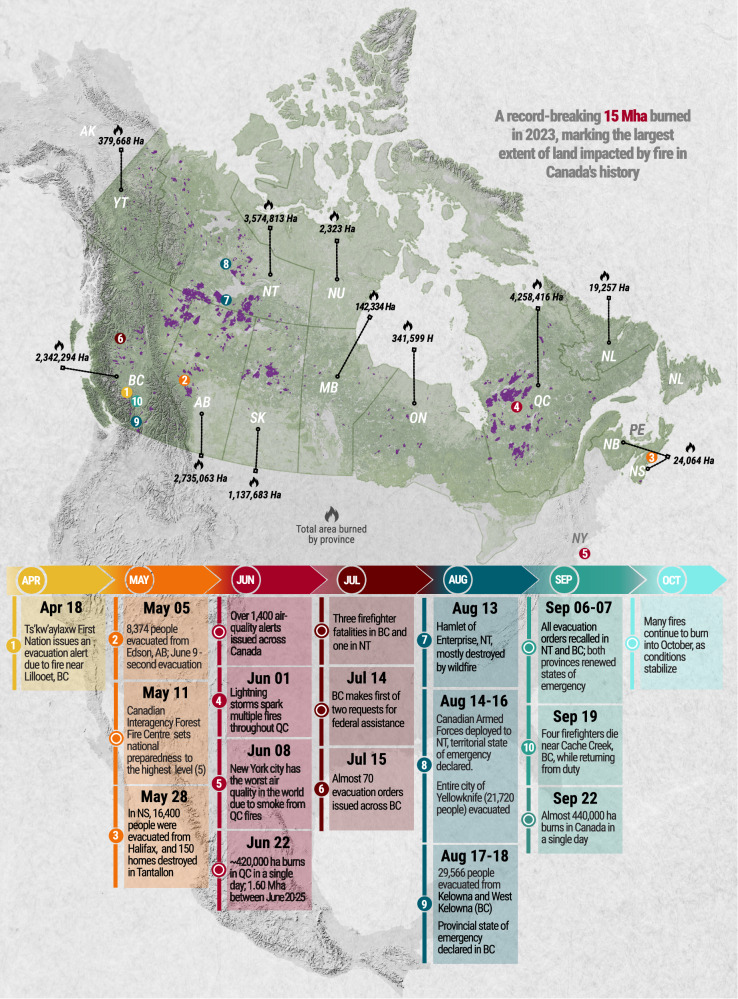
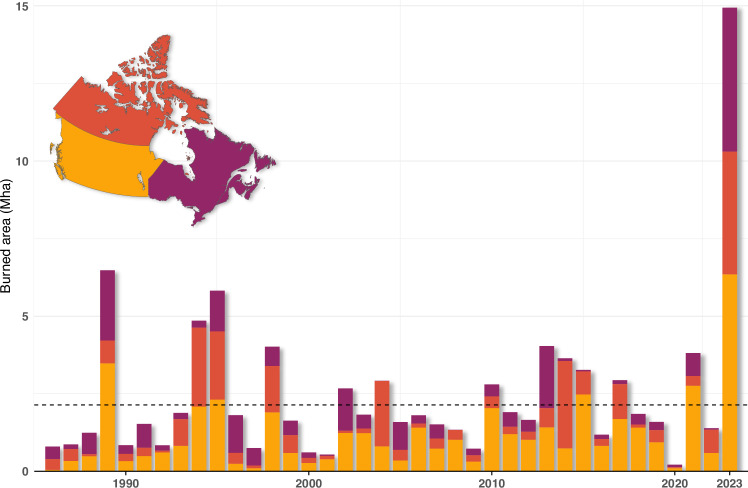
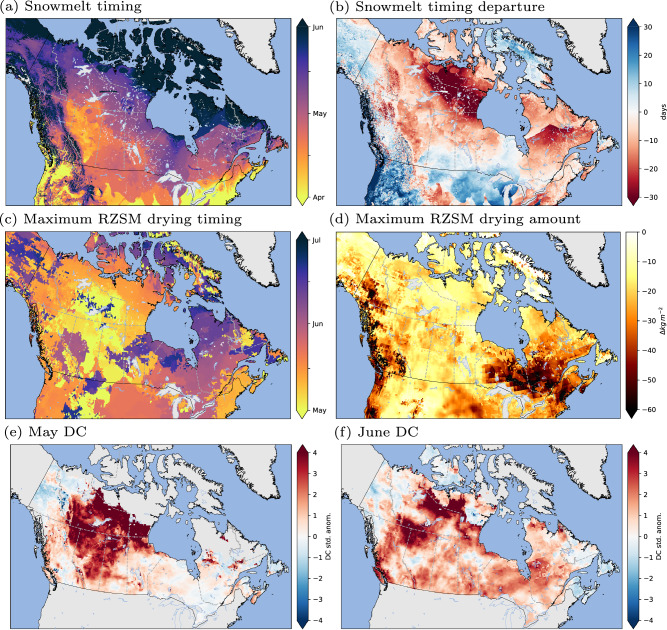
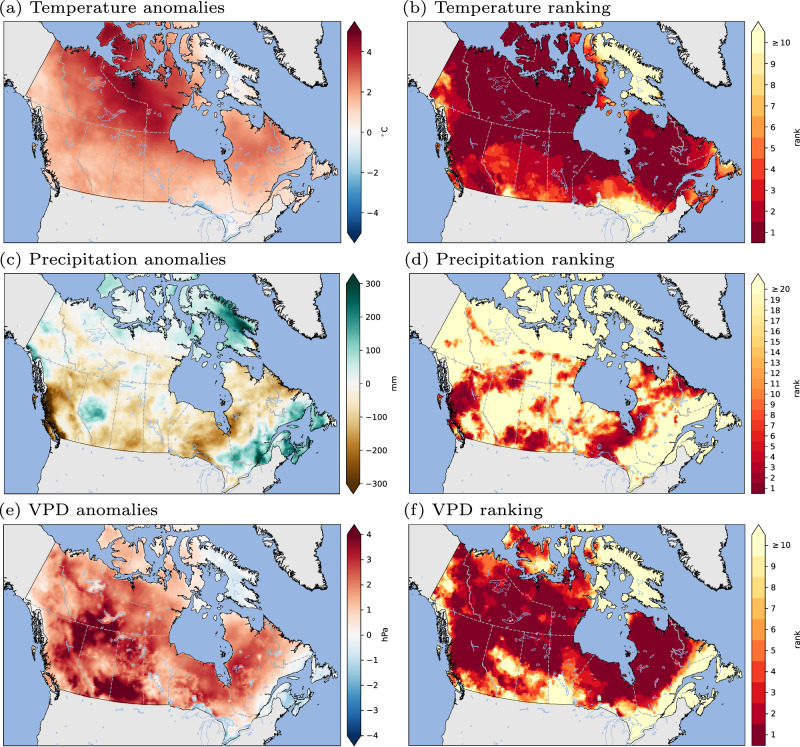
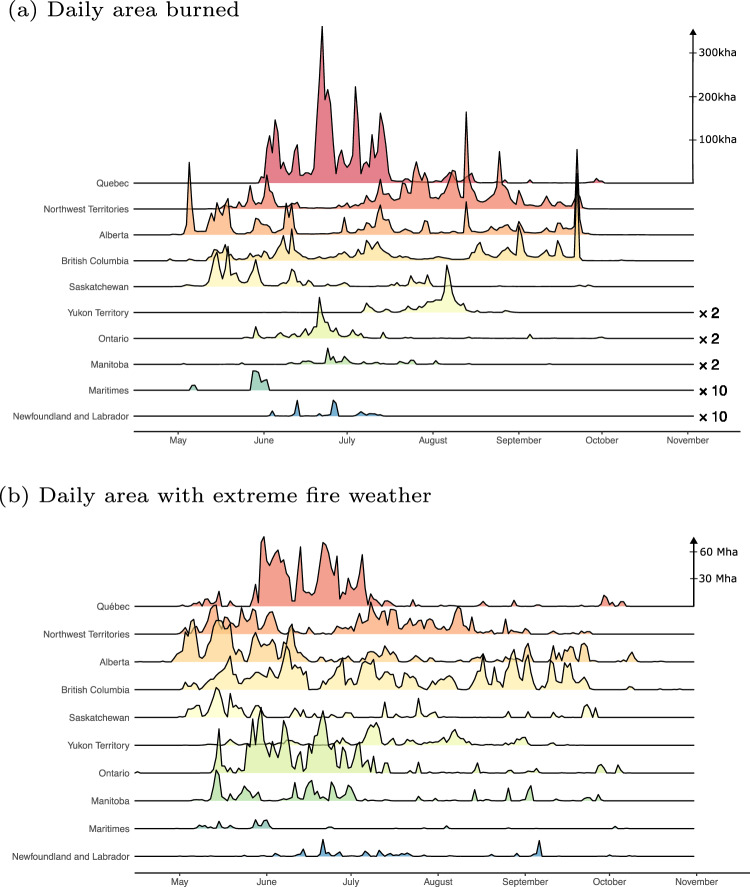
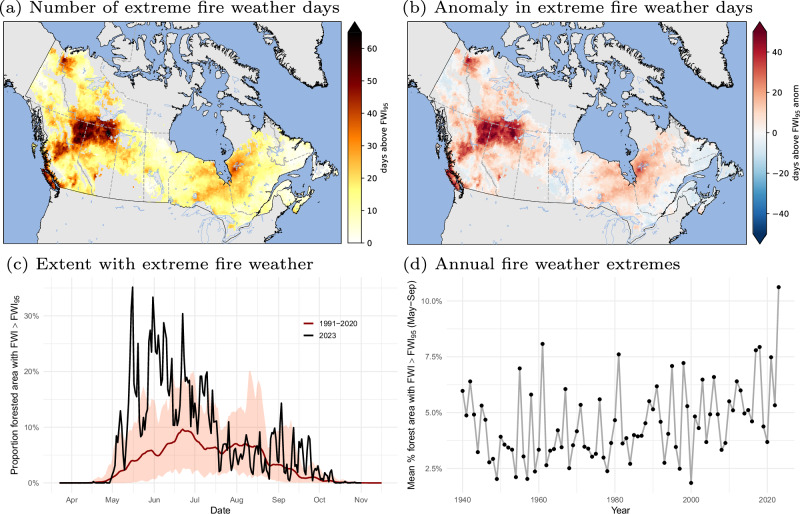
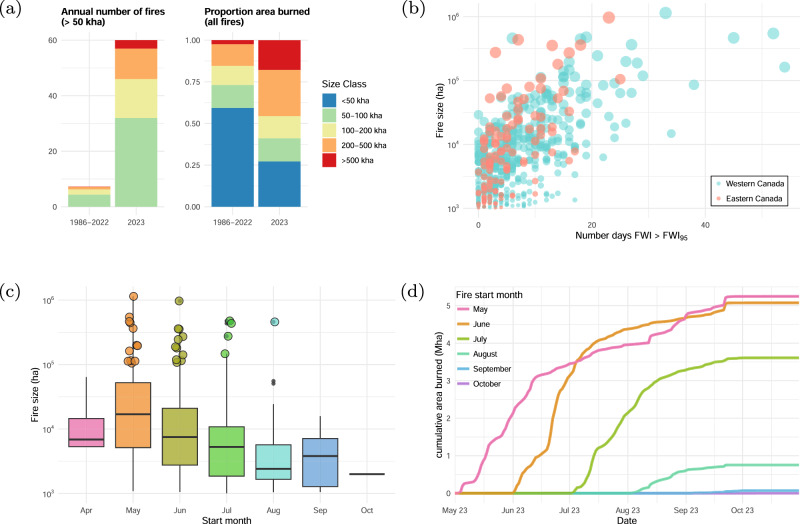
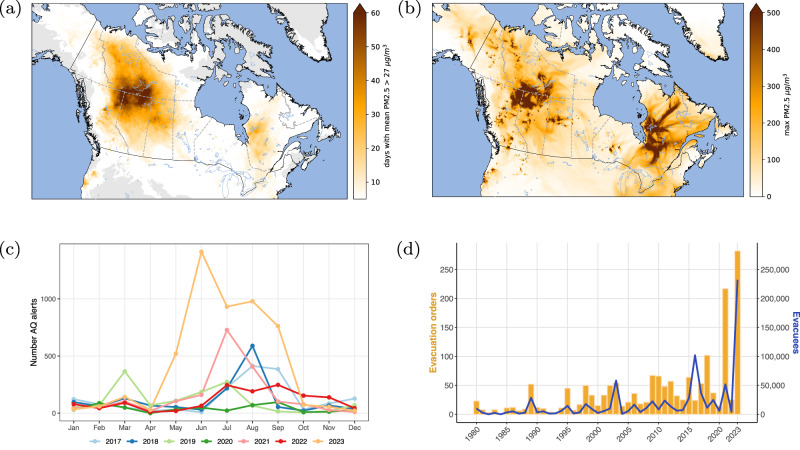
The 2023 wildfire season in Canada was unprecedented in its scale and intensity, spanning from mid-April to late October and across much of the forested regions of Canada. Here, we summarize the main causes and impacts of this exceptional season. The record-breaking total area burned (~15 Mha) can be attributed to several environmental factors that converged early in the season: early snowmelt, multiannual drought conditions in western Canada, and the rapid transition to drought in eastern Canada. Anthropogenic climate change enabled sustained extreme fire weather conditions, as the mean May–October temperature over Canada in 2023 was 2.2 °C warmer than the 1991–2020 average. The impacts were profound with more than 200 communities evacuated, millions exposed to hazardous air quality from smoke, and unmatched demands on fire-fighting resources. The 2023 wildfire season in Canada not only set new records, but highlights the increasing challenges posed by wildfires in Canada.
Overview
The claims and statistics of this paper haven’t been checked yet.
Free: it reads the open-access text and checks the first 5 claims that cite a source we can check. Create a free account to check every claim.
Integrity signals
Registry
Cites
Statistics
Figures
Verification
Claims the paper makes
The claims and statistics of this paper haven’t been checked yet.
Free: it reads the open-access text and checks the first 5 claims that cite a source we can check. Create a free account to check every claim.
Claims other papers make about this one
Each is checked against this paper’s own text: does it say what the citing paper says it does?
The source backs part of the claim, not all of it — or backs it for a different population, condition or comparison.
In the citing paper
“Changes in vegetation cover (i.e., deforestation and wildfires) can also shift the relative contribution of photodegradation by altering the amount of UV-radiation reaching plant litter [208–210].”
From Environmental consequences of interacting effects of changes in stratospheric ozone, ultraviolet radiation, and climate: UNEP Environmental Effects Assessment Panel, Update 2024 (2025) · cites this paper as [208]
Experimental — accuracy not yet measured
Self-check
Percentages, sums and reported differences re-computed from the paper’s own numbers.
The self-check needs the paper’s full text.
Citations
Cites
ERA5 hourly data on single levels from 1940 to present
C3S (2018) · European Centre for Medium-Range Weather Forecasts · doi:10.24381/cds.adbb2d47 · Cited by 2,550
Global and Regional Trends and Drivers of Fire Under Climate Change
Jones, M. W., Abatzoglou, J. T., Veraverbeke, S., Andela, N., Lasslop, G., Forkel, M., Smith, A. J. P., Burton, C., Betts, R. A., van der Werf, G. R., et al. (2022) · Reviews of Geophysics · doi:10.1029/2020rg000726 · Cited by 1,332
Boreal forest health and global change
Gauthier, S., Bernier, P., Kuuluvainen, T., Shvidenko, A. Z., & Schepaschenko, D. G. (2015) · Science · doi:10.1126/science.aaa9092 · Cited by 1,225 · cited 1×
“The cumulative impacts of the area burned in 2023 coupled with the extensive anthropogenic disturbance legacies on the landscape will challenge the resilience of forest eco-systems, especially if fi re activity continues to increase, as projected 65,66 .”
Improved Magnus Form Approximation of Saturation Vapor Pressure
Alduchov, O. A., & Eskridge, R. E. (1996) · Journal of Applied Meteorology · doi:10.1175/1520-0450(1996)035<0601:imfaos>2.0.co;2 · Cited by 979 · cited 5×
“We examined mean daily anomalies of temperature, precipitation and VPD averaged between May 1st and October 31st ( fi re season) of 2023 compared with the baseline period (1991 – 2020); we also plotted the rank of the fi re season mean of each variable for 2023 compared with the period 1940 – 2023.”
InfluentialOn the operational predictability of blocking
TIBALDI, S., & Molteni, F. (1990) · Tellus A Dynamic Meteorology and Oceanography · doi:10.1034/j.1600-0870.1990.t01-2-00003.x · Cited by 909 · cited 1×
“Blocking can be characterized by persistent positive anomalies in 500-hPa geopoten-tial heights 39 .”
Flannigan, M. D., Logan, K. A., Amiro, B. D., Skinner, W. R., & Stocks, B. J. (2005) · Climatic Change · doi:10.1007/s10584-005-5935-y · Cited by 874 · cited 2×
“Nationwide fi re activity, affecting nearly all forested areas in a single season as experienced in 2023 was not anticipated until later in the century based on climate change projections 5 .”
Self-citationCanada's changing climate report
Bush, E., & Lemmen, D. S. (2019) · doi:10.4095/314614 · Cited by 732
Global Emergence of Anthropogenic Climate Change in Fire Weather Indices
Abatzoglou, J. T., Williams, A. P., & Barbero, R. (2019) · Geophysical Research Letters · doi:10.1029/2018gl080959 · Cited by 680 · cited 4×
“Themodeldomain covers North America with a 10-km grid resolution.”
InfluentialWildfire-Driven Forest Conversion in Western North American Landscapes
Coop, J. D., Parks, S. A., Stevens-Rumann, C. S., Crausbay, S. D., Higuera, P. E., Hurteau, M. D., Tepley, A., Whitman, E., Assal, T., Collins, B. M., et al. (2020) · BioScience · doi:10.1093/biosci/biaa061 · Cited by 642
Self-citationParks, S. A., & Abatzoglou, J. T. (2020) · Geophysical Research Letters · doi:10.1029/2020gl089858 · Cited by 573 · cited 1×
“VPD is a good predictor of fuel moisture globally 30 and area burned regionally 31 .”
Research works printed but not linked: 2
- Jain, P. & Flannigan, M. The relationship between the polar jet stream and extreme wildfire events in North America. J. Clim. 34, 6247–6265 (2021).
- Stocks, B. J. et al. Large forest fires in Canada, 1959–1997. J. Geophys. Res.: Atmospheres 107, FFR–5 (2002).
Cited by
Items 301–400 of 464
Insights provided by a new searchable repository for post-fire hydrology studies and associated data
Boisramé, G. F. S., & Sueki, S. (2025) · Fire Ecology · doi:10.1186/s42408-025-00398-9
“1), Australia (Robinne et al. 2021), and Can - ada (Jain et al. 2024).”
Combining ALI space-based and MPL ground-based measurements for improved aerosol characterization
Tracey, E., Rieger, L., Bourassa, A., Degenstein, D. A., & Sica, R. J. (2026) · Journal of Quantitative Spectroscopy and Radiative Transfer · doi:10.1016/j.jqsrt.2026.109996
北美大陆野火产生的PM2.5远距离和近距离影响的大气环流条件
Luo, D. (2025) · SCIENTIA SINICA Terrae · doi:10.1360/sste-2025-0306
Luo, D. (2025) · Science China Earth Sciences · doi:10.1007/s11430-025-1751-0
Tran, B., Duran, E. J., Luu, M., Morgan, H., Maharjan, S., Li, W., & El-Askary, H. M. (2025) · IEEE International Geoscience and Remote Sensing Symposium (IGARSS) · doi:10.1109/igarss55030.2025.11243375
“The consequences were severe, forcing over 200 communities to evacuate and posing significant health risks to the population [2].”
Hu, J., Wang, X., Xie, Y., Yang, J., Ma, P., Liu, S., Dai, G., Zhu, X., Hou, X., Bu, L., et al. (2025) · Chinese Optics Letters · doi:10.3788/col202624.010101
Self-citationShrestha, R. R., & Cannon, A. J. (2026) · npj natural hazards. · doi:10.1038/s44304-026-00204-9 · Cited by 2
Bi, Z., Hu, J., Xie, Y., Bi, D., Zhu, X., Liu, J., & Chen, W. (2025) · Atmospheric measurement techniques · doi:10.5194/amt-18-7565-2025
“The wildfire produces substantial quantities of smoke, which can have a detrimental impact on coastal regions of the United States and Europe with the atmospheric circulation patterns (Jain et al., 2024).”
Vegetation health evaluation using cost-effective aerial reflectance measurements
Lucena, A., Rendeiro, R., & Marques, C. (2024) · Springer Link (Chiba Institute of Technology) · doi:10.1051/epjconf/202430500005/pdf
Study of the meteorological conditions during significant forest fire events in Portugal
Purificação, A. C. R. D. (2025) · Portuguese National Funding Agency for Science, Research and Technology (RCAAP Project by FCT)
Hardy, C. (2024) · Archipel (Université du Québec à Montréal)
Managing Fire Mosaics for Biodiversity
Bell, A. J. (2024) · HARVEST (University of Saskatchewan)
Pekelney, R. (2025) · cIRcle (University of British Columbia) · doi:10.14288/1.0450273
Patterns and drivers of post-fire tree regeneration of the Fraser Plateau, British Columbia
MacMillan, N. (2025) · cIRcle (University of British Columbia) · doi:10.14288/1.0450298
Yupanqui Concha, D. (2025) · HARVEST (University of Saskatchewan)
Apantaku, G. O. (2025) · cIRcle (University of British Columbia)
Snow Accumulation Increases With Forest Structural Diversity in Low‐Relief Catchments
Jones, M. W., Dymond, S. F., Sebestyen, S. D., & Feng, X. D. (2025) · Hydrological Processes · doi:10.1002/hyp.70352
Bae, J., Wang, S. S.-Y., Yoon, J., & Son, R. (2026) · SSRN Electronic Journal · doi:10.2139/ssrn.6052007
Global Atmospheric Release of Methoxyphenols From Wildfires
Shen, Y., Zheng, M., & Liu, G. (2026) · Journal of Geophysical Research Atmospheres · doi:10.1029/2025jd045402
Rating telecommunication towers by social importance and physical vulnerability to wildfirePreprint
Kuiper, C. S., & Beverly, J. (2026) · doi:10.5194/egusphere-2026-276
Chen, J., Makar, P. A., Gong, W., Anderson, K., Englefield, P., Cholette, M., & Milbrandt, J. A. (2026) · Springer proceedings in complexity · doi:10.1007/978-3-032-02971-3_54
Self-citationUltrahigh combustion temperatures in an extreme boreal wildfire recorded by graphite-bearing aerosol
Hornby, A., Zeltmann, S. E., Dayton, K., Colletta, M., Hess, P., Shi, Z., Mahowald, N. M., Muller, D. A., & Gazel, E. (2026) · Global and Planetary Change · doi:10.1016/j.gloplacha.2026.105355
Chen, Y., Yan, S., Hou, Y., Lin, Y., Liu, K., Cao, D., Xing, Y., Zhang, D., Pu, W., & Wang, X. (2026) · Environmental Science & Technology · doi:10.1021/acs.est.5c09936
Self-citationWildfire research and mental health: impacts, reflections, and a call to action
Dickson‐Hoyle, S., Santana, F. N., Szostak, C., & Oelke, N. D. (2026) · Fire Ecology · doi:10.1186/s42408-025-00434-8 · Cited by 1
“For example, the 2019/2020 Australian “Black Summer” bushfires and the 2023 Canadian wildfires catalyzed extensive research to understand the drivers and impacts of these megafires (Byrne et al. 2024; Daniels et al. 2025; Driscoll et al. 2024; Gorta et al. 2023; Jain et al. 2024).”
Drilling for disaster preparedness: Insights from a community wildfire evacuation exercise
Dugstad, A.-K., Bénichou, N., Berthiaume, M., Geoerg, P., Gwynne, S., Kimball, A., Kubose-Peutz, K., Xie, H., Ronchi, E., & Kinateder, M. T. (2026) · Transportation Research Part D Transport and Environment · doi:10.1016/j.trd.2026.105258 · Cited by 2
Wildfire smoke and the skin: Acute and chronic dermatologic effects
Udupa, M., Muha, J., Yu, X. X., Litvinov, I. V., Niebel, D., Parker, E. R., Hundal, S., & Netchiporouk, E. (2026) · JAAD reviews. · doi:10.1016/j.jdrv.2026.02.007
Climate-Driven Changes in Wildfire Hazard and Implications for Resilient Building Design
Lu, H., Gaur, A., Erni, S., Sandison, J., & Bénichou, N. (2026) · Fire · doi:10.3390/fire9030104
Fox‐Hughes, P., Yebra, M., Kumar, V., Narsey, S., Delage, F. P. D., Shokirov, S., Dowdy, A., Peace, M., Hope, P. K., & Zhang, H. (2026) · Agricultural and Forest Meteorology · doi:10.1016/j.agrformet.2026.111088
Mason, C. W., Bogetti, J. M., Vandermale, E. A., Yukon Environmental and Socio-economic Assessment Board, & Brouder, P. (2026) · The Journal of Arctic Tourism · doi:10.33112/arctour.4.2.5
SEGANTIN, L. D. S., & García, M. L. (2026) · Sustainable Water Resources Management · doi:10.1007/s40899-026-01331-x · Cited by 1
Seamless Global Mapping of HCHO from Chinese Satellite via Spectral Retrieval and Neural Operator
Xue, J., Hou, H., Hu, Q., Li, Q., Su, W., Lin, P., Zhang, Y. L., & Liu, C. (2026) · Journal of Remote Sensing · doi:10.34133/remotesensing.1043
Breathing in a changing climate: Compounding risks to respiratory health in Canada
Doiron, D., Brook, J. R., & Bourbeau, J. (2026) · Canadian Journal of Respiratory Critical Care and Sleep Medicine · doi:10.1080/24745332.2026.2622324
Smoke Signals: Understanding Temporal Dynamics of Wildfire Exposure on Health and Education
Arrizaga, R., Clarke, D., Cubillos, P. P., & Ruiz-Tagle, J. C. (2025) · Journal of Environmental Economics and Management · doi:10.1016/j.jeem.2026.103322 · Cited by 1
deCastro, M., Costoya, X., deCastro, N. G., & Gómez-Gesteira, M. (2026) · SSRN Electronic Journal · doi:10.2139/ssrn.6401047
Shorter Recovery Periods Between Smoke Waves: A Spatio‐Temporal Analysis in California (2006–2020)
Jones, C. G., Chen, C., Aguilera, R., Marlier, M. E., & Benmarhnia, T. (2026) · GeoHealth · doi:10.1029/2025gh001389 · Cited by 1
Liebzeit, E. C. (2025) · Mspace (University of Manitoba)
Gaston, M. V., Mitchell, G. W., Smith, P. A., Bennett, J., & Buxton, R. T. (2026) · Ornithological Applications · doi:10.1093/ornithapp/duag031
Dakua, N., & Marques, I. (2026) · International Conference on Emerging Trends and Innovations in ICT (ICEI) · doi:10.1109/icei65890.2026.11447598
“A multi-author analysis of the 2023 Canadian wildfire drivers and impacts [8] documents early snowmelt, accumulated drought, and heat anomalies as primary drivers.”
Linkage between the Tibetan Plateau and Global Extreme Heat in 2023
Sun, X., Su, Y., Yan, D., Xie, T., Sui, Y., Xu, J., Chen, S., Zhou, T., Chen, F., & Feng, M. (2026) · Atmospheric Research · doi:10.1016/j.atmosres.2026.108976
Long, T., Liu, Y., Pu, X., Li, Z., Li, S., Wang, Q., Han, L., Lu, N., Wang, L., & Xu, W. (2026) · Fire · doi:10.3390/fire9040155
Fire, bugs, and logging: what the public thinks about forest disturbance and management in Canada
Goodine, J. L., Lokuge, N., Sponarski, C. C., Andison, D., Nock, C. A., & Parkins, J. R. (2026) · Canadian Journal of Forest Research · doi:10.1139/cjfr-2025-0296
Crafts, G. (. (2026) · cIRcle (University of British Columbia) · doi:10.14288/1.0451973
Alonso, L., & Fernandes, P. M. (2026) · Frontiers in Forests and Global Change · doi:10.3389/ffgc.2026.1782881
Temperature extremes and drought risks
Sammonds, P. R., Guppy, L., & Sun, T. (2026) · Elsevier eBooks · doi:10.1016/b978-0-44-327368-1.00017-3
Hessilt, T. D., Veraverbeke, S., Mack, M. C., Olsen, R., Turetsky, M. R., Walker, X. J., & Baltzer, J. L. (2026) · International Journal of Wildland Fire · doi:10.1071/wf25286 · Cited by 1
Al-Jabiri, M. H., Chen, K., Olfert, J. S., Rivellini, L.-H., Schneider, S. R., Chan, T. W., Sharma, S., & Abbatt, J. P. D. (2026) · Journal of Geophysical Research Atmospheres · doi:10.1029/2025jd045566
Tetreault, I. (2026) · cIRcle (University of British Columbia)
Arctic condensed aromatic carbon budget reveals efficient fluvial transfer and shelf storagePreprint
Schwab, M., Coppola, A. I., van Gerrevink, M. J., Bertin, C., Haghipour, N., Galy, V., Hilton, R. G., Jones, M., Veraverbeke, S., & Eglinton, T. I. (2026) · Research Square · doi:10.21203/rs.3.rs-9476681/v1
Liang, W., van Lier, O. R., Friedl, M. A., Randerson, J. T., Rogers, B. M., Burrell, A. L., Hu, K., Tompalski, P., Macander, M. J., Yang, D., et al. (2026) · Remote Sensing of Environment · doi:10.1016/j.rse.2026.115446 · Cited by 1
Expériences vécues de privilèges sociaux dans le contexte des migrations climatiques internes
Lafond, V., Lord, M.-M., & Drolet, M.-J. (2026) · VertigO · doi:10.4000/1678i
Health and Regulatory Impacts of PM 2.5 From Wildland Fires for 2019–2024 in the US
Jaffe, D. A., Lee, H., Magzamen, S. L., Goldberg, D. L., & O’Dell, K. (2026) · GeoHealth · doi:10.1029/2025gh001576
“The year 2023 was exceptional for fires in Canada, with more than 15 million hectares burned (Jain et al., 2024; Kirchmeier‐Young et al., 2024; Kolden et al., 2024); these fires resulted in substantial air quality impacts in both Canada (Jain et al., 2024) and the US (Lee & Jaffe, 2024).”
Olonimoyo, E. A., Ahn, M. C., Rastogi, D., Jacoby, S., Duncan, C. M., & Asa-Awuku, A. (2026) · ACS ES&T Air · doi:10.1021/acsestair.5c00505
Risk-aware scheduling for post-wildfire salvage logging under inventory estimation uncertainty
Lorca, C., & Carrasco, R. A. (2026) · Computers & Industrial Engineering · doi:10.1016/j.cie.2026.112119
Touma, D., & Deser, C. (2026) · Journal of Climate · doi:10.1175/jcli-d-25-0077.1
Incorporating burn probability into spatial prioritization of woodland caribou habitat restoration
Maltman, J. C., Coops, N. C., Rickbeil, G. J. M., Mulverhill, C., Hermosilla, T., & Burton, A. C. (2026) · Restoration Ecology · doi:10.1111/rec.70455
“The 2023 wild fi re season in Canada burned 12.7 Mha, with fi res in BC burning 2.8 Mha, 10 times more than the 20-year average (Jain et al. 2024; Pelletier et al. 2024; Daniels et al. 2025).”
InfluentialLiang, Y., Tc, M., Liu, B., Liu, Z., He, H. S., Yang, J., Pan, Y., Yue, C., Wang, X., Wu, M., et al. (2026) · doi:10.5194/egusphere-2026-2906
Self-citationWildfire paradigms shape priorities and pathways for governance, management, and research in CanadaPreprint
Smith, C., Dickson‐Hoyle, S., & Kennedy, E. B. (2026) · SSRN Electronic Journal · doi:10.2139/ssrn.6890908
From megacities to wildfire smoke: observational constraints on atmospheric ammonia
Lill, E. R., Fischer, E. V., Pierce, J. R., Collett, J. L., & Jathar, S. H. (2026) · doi:10.25675/3.027277
Wildfire Smoke Alters Particle Size Distributions Indoors and Outdoors in an Urban Office Building
Wu, J., Qi, D., & Zhong, L. (2026) · E3S Web of Conferences · doi:10.1051/e3sconf/202671601006
Zhao, S., Whitman, E., Dawe, D. A., Coop, J. D., Parks, S. A., & Parisien, M. (2026) · Ecosphere · doi:10.1002/ecs2.70760
Self-citationSimulated Impacts of the 2023 Megadrought on Black Spruce Potential Productivity Across Canada
Soubeyrand, M., Girardin, M. P., & Boulanger, Y. (2026) · Journal of Geophysical Research Biogeosciences · doi:10.1029/2025jg009445
Self-citationInteractions among smoke, radiation, and meteorology in the Canadian wildfires
Zhang, M., Tu, Y., Wang, L., & Cao, Q. (2026) · Progress in Physical Geography Earth and Environment · doi:10.1177/03091333261461190
“Wildfires that were previously predicted to occur only later in the century erupted earlier in Canada (Flannigan et al., 2005), with a total burned area of 15 Mha and carbon emissions four times higher than Canada’s annual fossil fuel emissions (Byrne et al., 2024; Jain et al., 2024).”
Mak, S., Cantin, G., & Delahaye, B. (2026) · Discrete and Continuous Dynamical Systems - S · doi:10.3934/dcdss.2026167
段, 季., & 张, 东. (2026) · SCIENTIA SINICA Terrae · doi:10.1360/n072025-0424
The radiative effect and climate responses of present-day wildfire emissionsPreprint
Mourgela, R.-N., Roșu, I.-A., & Voulgarakis, A. (2026) · doi:10.5194/egusphere-2026-3239
A typology of wildfire governance configurations: relating outcomes and processes
Kirschner, J., Prat‐Guitart, N., Ballereau, D., Fontana, L. B., & Copes‐Gerbitz, K. (2026) · Journal of Pyrogeography · doi:10.1016/j.pyro.2026.100012
Applications for near-real-time detection of stand-replacing forest disturbances across Canada
Pelletier, F. (2026) · doi:10.82308/55943 · Cited by 1
Adaptive Task Allocation for in Forest Firefighting: A PPO-Based Hyper-Heuristic Approach
Yang, S., & Zhang, J. (2026) · Chinese Control and Decision Conference (CCDC) · doi:10.1109/ccdc69976.2026.11560756
Asadolah, S., & Jackson¹, P. L. (2026) · Research Square · doi:10.21203/rs.3.rs-9646546/v1
Mansuy, N., Madrali, S., & Julia, P. (2026) · Forests · doi:10.3390/f17070748
Anomalous Moisture Signal in Sentinel-2 Imagery Precedes Overwintering Wildfire
Barber, Q. E., Wilkinson, S. L., & Millard, K. (2026) · The international archives of the photogrammetry, remote sensing and spatial information sciences/International archives of the photogrammetry, remote sensing and spatial information sciences · doi:10.5194/isprs-archives-xlix-m-1-2026-11-2026
Self-citationWildfire smoke alters observations of 65% of breeding bird species in New York State
Adegbola, F. O., Evans, S. M., Sanderfoot, O. V., & Wilson, A. M. (2026) · Biodiversity and Conservation · doi:10.1007/s10531-026-03406-9
“For example, in June and July of 2023, smoke from boreal wildfires led to sustained periods of degraded air quality across the northeastern U.S., resulting in some of the worst air pollution ever recorded in New York State (Boulanger et al. 2024; Jain et al. 2024; Yu et al. 2024).”
Decadal variability modulates ENSO effects on wildfire weather in North America
Liang, Y., Yu, B., Jiang, Y., & Malinina, E. (2026) · Environmental Research Climate · doi:10.1088/2752-5295/ae861c
“Wildfires in North America are becoming increasingly frequent, widespread, and intense, with earlier onsets of the fire season (Abatzoglou et al 2019,Williams et al 2019, Goss et al 2020, Jain et al 2024, Madakumbura et al 2025).”
InfluentialAdachi, K., Bergner, N., Alden, J., Schmale, J., Ohata, S., & Tobo, Y. (2026) · doi:10.5194/egusphere-2026-3518
Das, R. C., Vernier, J., Pandit, A. K., Peterson, D. A., Fromm, M. D., Kablick, G. P., III, Dumelié, N., Joly, L., & Flaten, J. (2026) · doi:10.5194/egusphere-2026-3536
Advances in the interactions between atmospheric environment and terrestrial ecosystems
Zhou, X., Tian, C., Lu, X., Zhou, H., Wang, B., & Le, X. (2026) · Chinese Science Bulletin (Chinese Version) · doi:10.1360/csb-2026-0379
Chaieb, G., & Fraser, L. H. (2026) · Ecological Solutions and Evidence · doi:10.1002/2688-8319.70269
Agrawal, S. K., Welegedara, N., Steinwand, T., & Steinwand, T. (2026) · Remote Sensing · doi:10.3390/rs18132259
“In 2023, a record-breaking ~15 million hectares (ha) of land burned in a single season across Canada, an exceptional event that surpassed the previous record of ~7 million ha in 1989 [10,12].”
InfluentialMeng, Y., Lim, J. S., Chen, C., Rider, C. F., Ryu, M. H., & Carlsten, C. (2026) · European Respiratory Review · doi:10.1183/16000617.0326-2025
“A similar pattern was observed in Canada during the record-breaking wildfire season in 2023, with concentrations reaching a maximum of 251.1 μ g·m − 3 , and >60 days with daily mean PM 2.5 levels exceeding regulatory thresholds [7, 8].”
InfluentialClimate-pollution compound extremes drive PM2.5 beyond WHO air quality guidelines
Bento, V. A., Libonati, R., Wang, Q., Laura, W., Veraverbeke, S., Lima, D. C. A., Careto, J. A. M., Durão, R., Soares, P. M. M., Cardoso, R. M., et al. (2026) · Weather and Climate Extremes · doi:10.1016/j.wace.2026.100933
Razavi, H., Mozaffari, M. H., Bénichou, N., & Bonakdari, H. (2026) · Big Earth Data · doi:10.1080/20964471.2026.2686001
Stewart, T. S., D’Evelyn, S. M., Faiella, J., Sanchez, F., Mueller, K., Montrose, L. B., & Walker, E. S. (2026) · GeoHealth · doi:10.1029/2025gh001668
Wildfire smoke exposure impacts wing development of two pest outbreaking moths in boreal forests
Noor, S., Salazar, R. A. C., Girona, M. M., & Despland, E. (2026) · Environmental Science and Pollution Research · doi:10.1007/s11356-026-38023-0
“However, climate change is having persistent and escalating impacts in increasing frequency, extent, and severity of wildfires in Canada, with profound impacts on ecosystem processes and biodiversity (Boulanger et al. 2024; Jain et al. 2024).”
InfluentialSimple Spread Models for Understory Surface Fires
Perrakis, D. D. B., Hebda, N. J. R., & Taylor, S. W. (2026) · Fire · doi:10.3390/fire9070302 · Cited by 1
Self-citationMalarvizhi, A. S., Smith, K., Smith, S., Roberts, J. T., Chang, G., Pourhomayoun, M., & Yang, C. P. (2026) · Atmosphere · doi:10.3390/atmos17070692 · Cited by 1
“AirNow reaches a maximum of 150 µ g/m 3 , while Clarity reaches a maximum of 102 µ g/m 3 , with extreme observations corresponding to smoke transport from Canadian wildfires [59].”
Bae, J., Wang, S., Yoon, J., & Son, R. (2026) · Research Square · doi:10.21203/rs.3.rs-9948560/v1
Yang, C., Malarvizhi, A. S., Huang, Q., Yu, M., Chidananda, R., Pourhomayoun, M., Roberts, J., Chang, G. W., Hasheminassab, S., Llewellyn, G., et al. (2026) · International Journal of Digital Earth · doi:10.1080/17538947.2026.2738488
Fu, Y., Valeria, O., Bergeron, Y., & Liu, N. (2026) · Agricultural and Forest Meteorology · doi:10.1016/j.agrformet.2026.111372
Saira, T., Baghini, A. S., & Minet, L. (2026) · Atmospheric Pollution Research · doi:10.1016/j.apr.2026.103157
Nikkel, B. (2026) · Carleton University's Institutional Repository (MacOdrum Library, Carleton University) · doi:10.22215/etd/2026-17045
Azzarello, L. (2026) · York University Digital Library (York University)
Goldman, J. A., Fortin, M., & James, P. M. A. (2026) · Fire Ecology · doi:10.1186/s42408-026-00544-x
“Evidence of this trend is already apparent, as 2023 saw a record-breaking 15 Mha burned, surpassing the previous record of 7.6 Mha set in 1989 (Jain et al. 2024; Skakun et al. 2022).”
InfluentialBeyki, S. M., Pastor, E., Vacca, P., Patricio, A. S., Lopes, A. M. G., Santiago, A. M. C., & Laím, L. M. S. (2026) · SSRN Electronic Journal · doi:10.2139/ssrn.7396799
Huntley, D., Lakeland, B., Menounos, B., Geertsema, M., Hawkins, A., & Rotheram-Clarke, D. (2026) · Progress in landslide research and technology · doi:10.1007/978-3-032-18863-2_4
Categorizing weather patterns associated with lightning-caused ignition clusters in Canada
Ghali, R., Chavardès, R. D., Jain, P., Enri, S., Flannigan, M., Papavasileiou, G., Hanes, C. C., Carr, R., Giannaros, T. M., Anderson, J. L., et al. (2026) · International Journal of Wildland Fire · doi:10.1071/wf26023
Self-citationEnvironmental Health Team, Manore, A. J. W., Coonishish, J., Duguay, I., Fuller, C., & Ottereyes, J. (2026) · Canada Communicable Disease Report · doi:10.14745/ccdr.v52i78a08
“With a significant proportion of the population in Eeyou Istchee being particularly vulnerable to the health impacts of smoke, fire, and heat, monitoring with timely communication and coordination between adaptive response partners is crucial for managing a rapid response to the complex needs arising from these increa…”
InfluentialAdvancing Canadian wildfire technology through onboard processing and on the ground collaboration
Heydrich, T., Macdonald, A. J., Harrison, T., Bonham-Carter, B., Chavier, L., Pascual, A., Paul, S., Abdelrahman, S., Brass, S., Tymstra, C., et al. (2026) · The international archives of the photogrammetry, remote sensing and spatial information sciences/International archives of the photogrammetry, remote sensing and spatial information sciences · doi:10.5194/isprs-archives-xlix-b3-2026-1387-2026
“Their expertise guided the development of the concept of operations and provided expert input on data product structure that would add benefit to the current structure employed by the various wildfire agencies across Canada.”
Influential
Metadata
- Authors
- Jain, P., Barber, Q. E., Taylor, S. W., Whitman, E., Castellanos Acuna, D., Boulanger, Y., Chavardès, R. D., Chen, J., Englefield, P., Flannigan, M., Girardin, M. P., Hanes, C. C., Little, J., Morrison, K., Skakun, R. S., Thompson, D. K., Wang, X., & Parisien, M.-A.
- Affiliations
- Canadian Forest Service (CA)
- Environment and Climate Change Canada (CA)
- Thompson Rivers University (CA)
- Corresponding author
- Jain, Piyush
- ORCID
- Venue
- Nature Communications
- Published
- 2024-08-20
- Volume
- 15
- Issue
- 1
- Pages
- 6764-6764
- ISSN
- 2041-1723 (ISSN-L)
- PMC
- PMC11335882
- OpenAlex
- W4401728510
- Cited by
- 319
- References
- 83
- Citations by year
- 2026: 157 · 2025: 145 · 2024: 17
- FWCI
- 56.32
- Type
- journal article
- Language
- en
- Open access
- gold
- doi.org
- Licence
- cc-by
- creativecommons.org/licenses/by/4.0 (tdm)
- creativecommons.org/licenses/by/4.0 (vor)
- Locations
- Nature Communications (publishedVersion, cc-by)
- PubMed Central (publishedVersion, cc-by)
- PubMed (publishedVersion)
- RePEc: Research Papers in Economics (submittedVersion)
- DOAJ (DOAJ: Directory of Open Access Journals) (submittedVersion, cc-by-sa)
- Funders
- Environment and Climate Change Canada
- U.S. Forest Service
- Canadian Forest Service
- Topics
- Physical Sciences › Environmental Science › Global and Planetary Change › Fire effects on ecosystems
- Social Sciences › Sociology and Political Science › Disaster Management and Resilience
- Life Sciences › Agricultural and Biological Sciences › Forestry › Forest Management and Policy
- Keywords
- wildfire drivers, wildfire effects, climate change, drought, early snowmelt, extreme fire weather, smoke exposure, burned area, forest fires
About these checks
Registry, retraction, Cites and statistics results are computed, not judged, with one exception: a printed reference that no index lists is read once by a model before it counts as a citation error. Claims are extracted by a model and kept only when their quote appears verbatim in the text; each cited source is then checked, with a model’s help, for whether it says what the claim relies on. Those verdicts can be wrong — read the claim’s quote and the cited source before relying on one.
Statistics and arithmetic are recomputed, not judged.
Confidence bands are shown only for fields calibrated on our annotated test set. None is calibrated yet, so no band is shown.
What counts as a claim ›How we measure confidence ›How we check this ›
Are you an author, or do you see a problem with this page? Request a review
Data sources
Bibliographic data: Semantic Scholar, OpenAlex, Crossref.
Contains information from the Semantic Scholar Academic Graph Datasets, made available under the ODC Attribution License (ODC-BY 1.0).
Semantic Scholar’s data is described in: Kinney, R., et al. (2023). The Semantic Scholar Open Data Platform. arXiv:2301.10140.
