

Drivers and Impacts of the Record-Breaking 2023 Wildfire Season in Canada
Open accessThe DOI matches its Crossref record; 84 of the 84 references it cites were found in a registry or an index.
Abstract
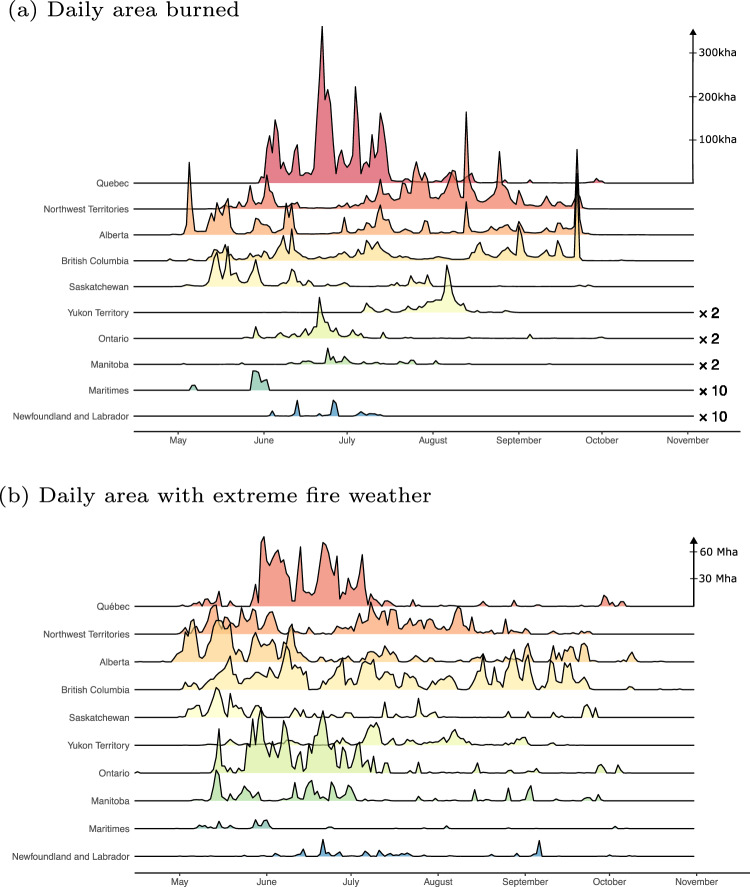
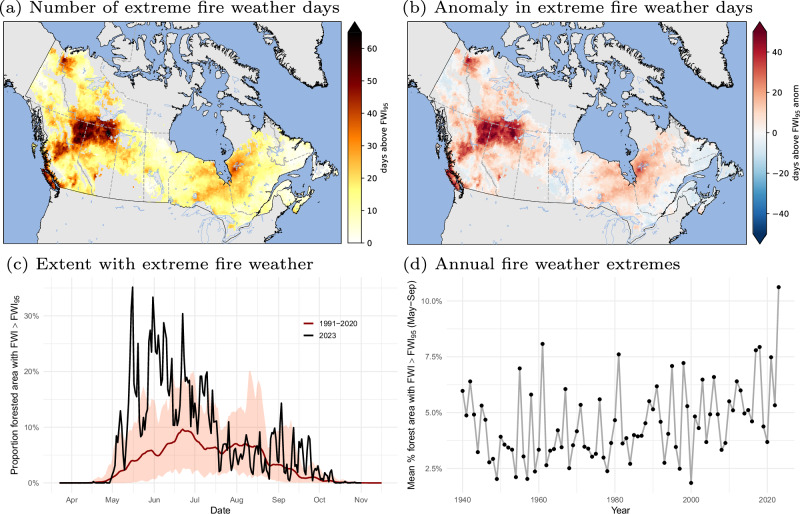
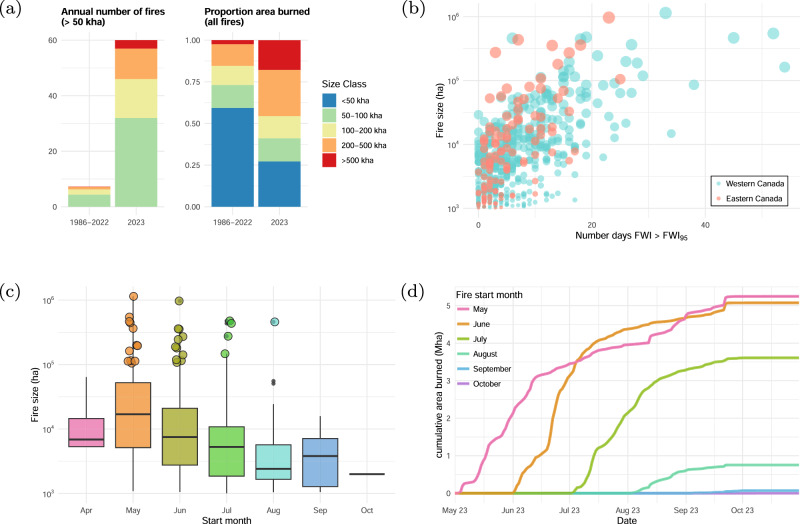
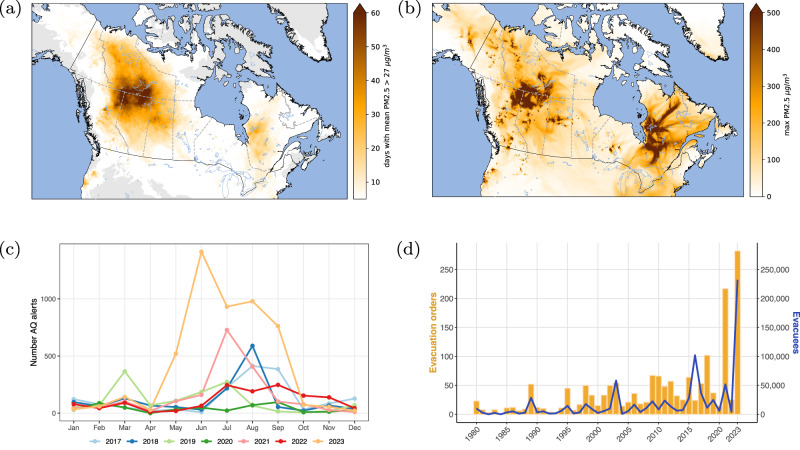
The 2023 wildfire season in Canada was unprecedented in its scale and intensity, spanning from mid-April to late October and across much of the forested regions of Canada. Here, we summarize the main causes and impacts of this exceptional season. The record-breaking total area burned (~15 Mha) can be attributed to several environmental factors that converged early in the season: early snowmelt, multiannual drought conditions in western Canada, and the rapid transition to drought in eastern Canada. Anthropogenic climate change enabled sustained extreme fire weather conditions, as the mean May–October temperature over Canada in 2023 was 2.2 °C warmer than the 1991–2020 average. The impacts were profound with more than 200 communities evacuated, millions exposed to hazardous air quality from smoke, and unmatched demands on fire-fighting resources. The 2023 wildfire season in Canada not only set new records, but highlights the increasing challenges posed by wildfires in Canada.
Overview
The claims and statistics of this paper haven’t been checked yet.
Free: it reads the open-access text and checks the first 5 claims that cite a source we can check. Create a free account to check every claim.
Integrity signals
Registry
Cites
Statistics
Figures
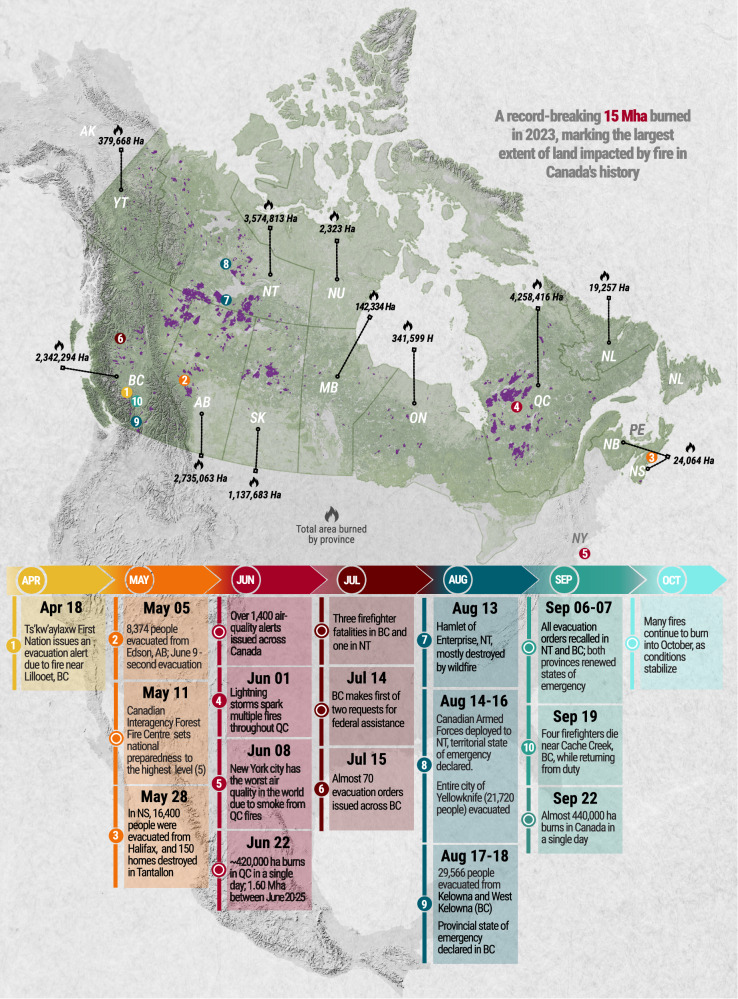
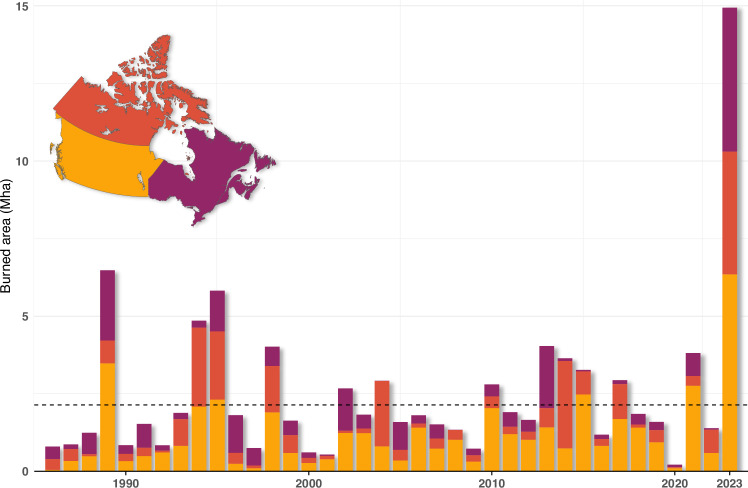
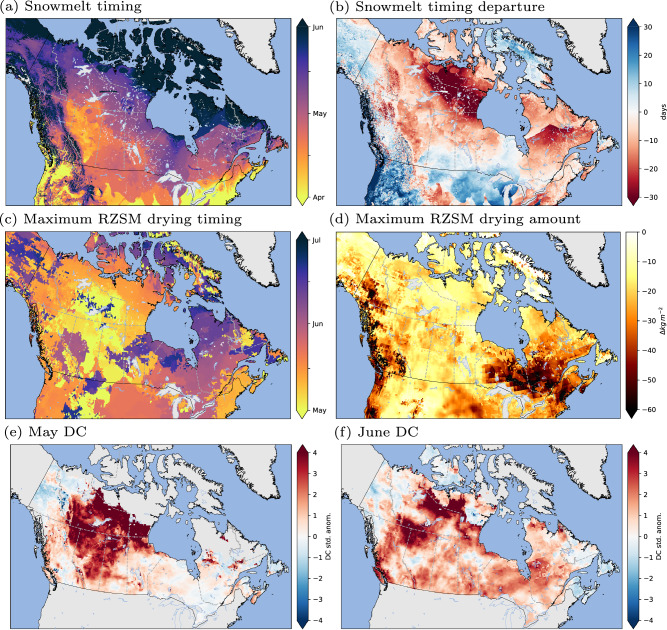
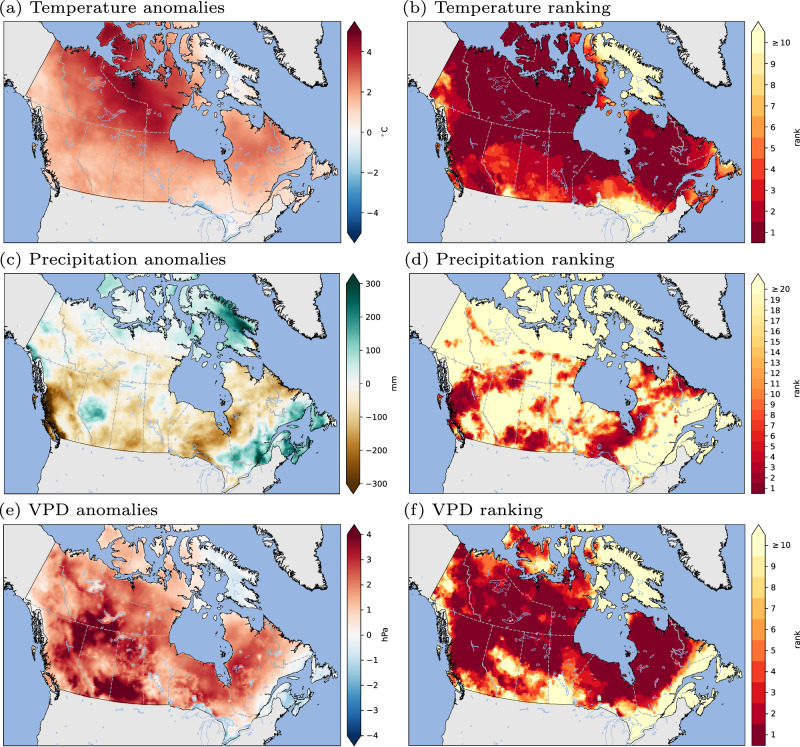
Verification
Claims the paper makes
The claims and statistics of this paper haven’t been checked yet.
Free: it reads the open-access text and checks the first 5 claims that cite a source we can check. Create a free account to check every claim.
Claims other papers make about this one
Each is checked against this paper’s own text: does it say what the citing paper says it does?
The source backs part of the claim, not all of it — or backs it for a different population, condition or comparison.
In the citing paper
“Changes in vegetation cover (i.e., deforestation and wildfires) can also shift the relative contribution of photodegradation by altering the amount of UV-radiation reaching plant litter [208–210].”
From Environmental consequences of interacting effects of changes in stratospheric ozone, ultraviolet radiation, and climate: UNEP Environmental Effects Assessment Panel, Update 2024 (2025) · cites this paper as [208]
Experimental — accuracy not yet measured
Self-check
Percentages, sums and reported differences re-computed from the paper’s own numbers.
The self-check needs the paper’s full text.
Citations
Cites
ERA5 hourly data on single levels from 1940 to present
C3S (2018) · European Centre for Medium-Range Weather Forecasts · doi:10.24381/cds.adbb2d47 · Cited by 2,550
Global and Regional Trends and Drivers of Fire Under Climate Change
Jones, M. W., Abatzoglou, J. T., Veraverbeke, S., Andela, N., Lasslop, G., Forkel, M., Smith, A. J. P., Burton, C., Betts, R. A., van der Werf, G. R., et al. (2022) · Reviews of Geophysics · doi:10.1029/2020rg000726 · Cited by 1,332
Boreal forest health and global change
Gauthier, S., Bernier, P., Kuuluvainen, T., Shvidenko, A. Z., & Schepaschenko, D. G. (2015) · Science · doi:10.1126/science.aaa9092 · Cited by 1,225 · cited 1×
“The cumulative impacts of the area burned in 2023 coupled with the extensive anthropogenic disturbance legacies on the landscape will challenge the resilience of forest eco-systems, especially if fi re activity continues to increase, as projected 65,66 .”
Improved Magnus Form Approximation of Saturation Vapor Pressure
Alduchov, O. A., & Eskridge, R. E. (1996) · Journal of Applied Meteorology · doi:10.1175/1520-0450(1996)035<0601:imfaos>2.0.co;2 · Cited by 979 · cited 5×
“We examined mean daily anomalies of temperature, precipitation and VPD averaged between May 1st and October 31st ( fi re season) of 2023 compared with the baseline period (1991 – 2020); we also plotted the rank of the fi re season mean of each variable for 2023 compared with the period 1940 – 2023.”
InfluentialOn the operational predictability of blocking
TIBALDI, S., & Molteni, F. (1990) · Tellus A Dynamic Meteorology and Oceanography · doi:10.1034/j.1600-0870.1990.t01-2-00003.x · Cited by 909 · cited 1×
“Blocking can be characterized by persistent positive anomalies in 500-hPa geopoten-tial heights 39 .”
Flannigan, M. D., Logan, K. A., Amiro, B. D., Skinner, W. R., & Stocks, B. J. (2005) · Climatic Change · doi:10.1007/s10584-005-5935-y · Cited by 874 · cited 2×
“Nationwide fi re activity, affecting nearly all forested areas in a single season as experienced in 2023 was not anticipated until later in the century based on climate change projections 5 .”
Self-citationCanada's changing climate report
Bush, E., & Lemmen, D. S. (2019) · doi:10.4095/314614 · Cited by 732
Global Emergence of Anthropogenic Climate Change in Fire Weather Indices
Abatzoglou, J. T., Williams, A. P., & Barbero, R. (2019) · Geophysical Research Letters · doi:10.1029/2018gl080959 · Cited by 680 · cited 4×
“Themodeldomain covers North America with a 10-km grid resolution.”
InfluentialWildfire-Driven Forest Conversion in Western North American Landscapes
Coop, J. D., Parks, S. A., Stevens-Rumann, C. S., Crausbay, S. D., Higuera, P. E., Hurteau, M. D., Tepley, A., Whitman, E., Assal, T., Collins, B. M., et al. (2020) · BioScience · doi:10.1093/biosci/biaa061 · Cited by 642
Self-citationParks, S. A., & Abatzoglou, J. T. (2020) · Geophysical Research Letters · doi:10.1029/2020gl089858 · Cited by 573 · cited 1×
“VPD is a good predictor of fuel moisture globally 30 and area burned regionally 31 .”
Research works printed but not linked: 2
- Jain, P. & Flannigan, M. The relationship between the polar jet stream and extreme wildfire events in North America. J. Clim. 34, 6247–6265 (2021).
- Stocks, B. J. et al. Large forest fires in Canada, 1959–1997. J. Geophys. Res.: Atmospheres 107, FFR–5 (2002).
Cited by
Items 401–464 of 464
Estimating the Impact of Wildfire Smoke on Distributed Solar PV PerformancePreprint
Farrokhabadi, M., & Sohail, I. (2026) · SSRN Electronic Journal · doi:10.2139/ssrn.7229985
Chace, W. S., Womack, C. C., Ahern, A. T., Ball, K., Bates, K. H., Bohn, B., Brock, C. A., Coggon, M. M., Crounse, J. D., Desai, N., et al. (2026) · Journal of Geophysical Research Atmospheres · doi:10.1029/2026jd047060
Self-citationBennett, L. L., Jain, P., Moore, B., & Boisvert, J. B. (2026) · International Journal of Wildland Fire · doi:10.1071/wf26072
Self-citationBeyki, S. M., Pastor, E., Vacca, P., Patricio, A. S., Lopes, A. M. G., Santiago, A. M. C., & Laím, L. M. S. (2026) · SSRN Electronic Journal · doi:10.2139/ssrn.7244752
Decadal doubling of Siberian methane emissions due to warming-induced fires and methanogenesis
Zhu, S., Liu, Y., Palmer, P. I., Feng, L., Yang, D., Chen, S., Sasakawa, M., Parker, R. J., Boesch, H., Cao, J., et al. (2026) · Science · doi:10.1126/science.aea5828 · Cited by 1
Post-wildfire wood moisture content in boreal tree species across a fire severity gradient
Boakye, E. A., Mvolo, C. S., Klutsch, J. G., & Koubaa, A. (2026) · Journal of Wood Science · doi:10.1186/s10086-026-02260-1
Methane Emissions From Wildfires: Trends and Anomalies
Zhu, A., Kondragunta, S., Csiszar, I. A., Zhang, X., Ye, Y., & Li, F. (2026) · Journal of Geophysical Research Atmospheres · doi:10.1029/2026jd046687
Arctic transport of North American and Canadian wildfire aerosols
McCerery, R., Namdeo, A. K., Malard, L. A., Woodward, J., & Pearce, D. A. (2026) · Atmospheric Environment · doi:10.1016/j.atmosenv.2026.122289
Challenges to Wildfire Preparedness in Ontario, Canada
Mohr, M., & Zettel, H. (2026) · Lund University Publications Student Papers (Lund University)
Chishtie, F., Ali, R. U., & Clague, J. J. (2026) · SSRN Electronic Journal · doi:10.2139/ssrn.7272442
Les feux de forêt comme source de particules fines PM2.5 : le cas du Québec
Arab, K. B. (2026) · Archipel (Université du Québec à Montréal)
Razavi, H., Hajiaghaei–Keshteli, M., Titidezh, O., Bonakdari, H., Mozaffari, M. H., & Smith, N. R. (2026) · Research Square · doi:10.21203/rs.3.rs-10528989/v1
Shahparvari, S., Mohammadi, M., & Tosarkani, B. M. (2026) · SSRN Electronic Journal · doi:10.2139/ssrn.7291579
Kumar, N., Bala, P. R., Behera, D., Anoop, A., & Sukumar, R. (2026) · Palaeogeography Palaeoclimatology Palaeoecology · doi:10.2139/ssrn.7303267
Profits Lost in the Haze: Evidence From Wildfire Smoke
Kong, J., Loch, H., & Shen, M. D. (2026) · Contemporary Accounting Research · doi:10.1111/1911-3846.70079 · Cited by 1
Yemshanov, D., Liu, N., Neilson, E. W., Thompson, D. K., Koch, F. H., & Gritter, K. (2026) · PLOS complex systems. · doi:10.1371/journal.pcsy.0000117
“Future damages from wildfires and associated mitigation costs are expected to increase due to climate change [5–8], as evidenced by the record-breaking 2023 fire season in Canada [9].”
Self-citationDifference in Resilience of White Pine and White Spruce to Environmental Stress
Biase, O. M. D. (2026) · TSpace (University of Toronto)
Goldman, J. A. (2026) · TSpace (University of Toronto)
Zhan, F., Adlard, B., Delic, A. O., Morris, A. D., Marteinson, S. C., & Khoury, C. (2026) · Journal of Hazardous Materials · doi:10.1016/j.jhazmat.2026.143386
Mburu, E., & Kiage, L. M. (2026) · Progress in Physical Geography Earth and Environment · doi:10.1177/03091333261480971
Increased Attribution of Climate Change in the Press Coverage of the 2023 Canadian Wildfires
Daoust-Boisvert, A., & Ross, B. L. (2026) · Journalism Practice · doi:10.1080/17512786.2026.2721573
Distinct seasonality and trends of natural and anthropogenic wildfires in boreal forests
Gao, C., Li, J., Fang, K., Zhang, X., Zhang, Q., & Shi, C. (2026) · Agricultural and Forest Meteorology · doi:10.1016/j.agrformet.2026.111436
Diao, J., Wei, X., & Ma, L. (2026) · Canadian Journal of Forest Research · doi:10.1139/cjfr-2026-0207
SELF-PERCEIVED WILDFIRE SMOKE EXPOSURE AND MENTAL HEALTH OUTCOMES AMONG CANADIAN ADOLESCENTS
Avenant, E. R. (2026) · AUSpace (Athabasca University)
Are high-income countries vulnerable to drought? A review
Engström, J., Ash, K. D., Mariotti, E., & Mao, L. (2026) · Environmental Research Letters · doi:10.1088/1748-9326/aea2ad
“At the end of 2023, 18.5 million hectares had burned, over 8 times the area burned in an average year (Jain et al 2024, Pelletier et al 2024).”
InfluentialImpact of Biomass Burning Inventories on Aerosol Number and Size in GEOS-Chem–TOMAS
Saleh, M. (2026) · DalSpace (Dalhousie University)
Olsen, S., Cunsolo, A., Lammiman, J., Clayton, S., & Harper, S. L. (2026) · Wellbeing Space and Society · doi:10.1016/j.wss.2026.100473
Kou‐Giesbrecht, S., Curasi, S. R., Hall, R., & Melton, J. R. (2026) · Environmental Research Climate · doi:10.1088/2752-5295/aea637
“While wildfire is a natural ecological process that plays a central role in the life cycle of forests, exacerbated wildfires driven by anthropogenic climate change lead to larger, rapidly spreading wildfires that are difficult to both prevent and suppress, often with catastrophic impacts [3, 14–18].”
Configuring tree planting and forest restoration for climate adaptation
Galán‐Acedo, C., Martin, A. E., Buxton, R. T., & Fahrig, L. (2026) · Trends in Ecology & Evolution · doi:10.1016/j.tree.2026.08.007
Blueboy, J., Murdoch, A., & Ibrahim, Z. (2026) · Tourism Cases · doi:10.1079/tourism.2026.0010
Long-Term Wildfire Exposure of North American Lakes: Watershed Burning and Smoke PlumesPreprint
Scordo, F., Seitz, C., Chuter-Davies, W., Or, D., & Chandra, S. (2026) · Research Square · doi:10.21203/rs.3.rs-10452785/v1
Mosallanejad, A., Shahvaran, A. R., Khosravi, K., Hatamiafkoueieh, J., & Bateni, S. M. (2026) · Expert Systems with Applications · doi:10.1016/j.eswa.2026.134428
Hu, K., Wang, J. A., Zhu, X., Liang, W., Morton, D. C., Kim, J., Randerson, J. T., & Friedl, M. A. (2026) · doi:10.5194/egusphere-2026-4090
Disturbances Increase Net Carbon Emissions in the Arctic-Boreal Zone - An Expert AssessmentPreprint
Rodenhizer, H., Treharne, R., Goeckede, M., Mauritz, M., Virkkala, A., Aalto, J., Althuizen, I., Bjerke, J. W., Bokhorst, S., Bryn, A., et al. (2026) · Research Square · doi:10.21203/rs.3.rs-11051608/v1
Self-citationÉvaluation de la prédisposition aux feux de forêt des communautés du Québec
Danneyrolles, V., Dorion, H., Bergeron, E., & Boucher, Y. (2026) · Constellation (Université du Québec à Chicoutimi)
Permafrost supports post-fire recovery of black spruce dominance in subarctic boreal forests
Lyons, C. L., Day, N. J., Johnstone, J. F., Mack, M. C., Turetsky, M. R., Walker, X. J., & Baltzer, J. L. (2026) · Environmental Research Ecology · doi:10.1088/2752-664x/aea99d
Broda, M. A., Zawadzka, O., Markowicz, K. M., & Xian, P. (2026) · Atmosphere · doi:10.3390/atmos17100913
Acton, K., & Wong, G. (2026) · Environmental Education Research · doi:10.1080/13504622.2026.2737178
Thiffault, N., Brant, A., & Snyder, S. (2026) · The Forestry Chronicle · doi:10.5558/tfc2026-037
Atténuation culturellement pertinente des risques liés aux feux de forêt en Eeyou Istchee
Proulx, G. (2026) · Depositum (Université du Québec en Abitibi-Témiscamingue)
Whaley, C. H., Digby, R. A. R., Arora, V. K., Akingunola, A., Anderson, K., Bergas‐Massó, E., Chan, E., Chen, J., Curasi, S. R., Griffin, D., et al. (2026) · doi:10.22541/essoar.15009630/v1
Self-citationKotzur, I., Boer, M., Benson, V., & Nolan, R. H. (2026) · doi:10.31223/x5dn6z
Hydrometeorological and hydrogeological trends and drought dynamics in a cold-humid, coastal region
Motamedi, A., LeRoux, N. K., Hill, A. M. R., Jamieson, R. C., Somers, L., & Kurylyk, B. L. (2026) · Journal of Hydrology · doi:10.1016/j.jhydrol.2026.136507
Temporal analysis of area and elevation changes in forest fires in İzmir Province (1995–2025)
Satar, N., OBAN, R. Ç., & Karadoǧan, S. (2026) · Turkish Journal of Remote Sensing · doi:10.51489/tuzal.2007777
Panes, B., Hamann, A., & Nock, C. A. (2026) · Forest Ecology and Management · doi:10.1016/j.foreco.2026.124301
Pouliot, E. (2026) · PolyPublie (École Polytechnique de Montréal)
Armaș, I., & Albulescu, A.-C. (2026) · Earth s Future · doi:10.1029/2026ef008718
Twenty core challenges to global wood security in the Anthropocene
Bousfield, C. G., Meeks, D., Cerullo, G. R., Betts, M. G., Miao, X., Adams, M. A., Pérez, G., Saiya, H. G., Bryant, R. G., Weiss, J., et al. (2026) · Trends Open · doi:10.1016/j.treopn.2026.08.021
Lecavalier, B., King, J., Alcock, H., Detto, M., Helbig, M., Gosselin, G. H., Marsh, P., Waddington, J. M., Yazbeck, T., & Sonnentag, O. (2026) · SSRN Electronic Journal · doi:10.2139/ssrn.7619684
Gu, Z., Qi, D., Fellouah, H., Taha, A., Geng, X., & Shu, C. (2026) · eSim: IBPSA-Canada Building Simulation Conference (eSim) · doi:10.26868/31114504.2026.148
Wattimena, E. M. C., Palembang, C. F., Pattiradjawane, V. E., Waas, D. V., & Saputri, S. D. (2026) · Jurnal Teknologi Terapan G-Tech · doi:10.70609/gtech.v10i4.11426
Ssozi, J. (2026) · Iowa Research Online (The University of Iowa) · doi:10.25820/etd.008671
Fire Regimes in North American Boreal Forests from 1980 to 2024
Portier, J., Danneyrolles, V., Chavardès, R. D., Erni, S., Gauthier, S., & Bergeron, Y. (2026) · Current Forestry Reports · doi:10.1007/s40725-026-00294-8
“…as burn rates are increasingly influenced by years marked by numerous large fires linked to extreme weather conditions [ 50], such as in 2023 [42], the bottom-up control of fuel continuity and accumulation may become even less important in a future characterised by more extreme fire-weather…”
Self-citationWilgenburg, S. L. V., Ball, J., Barker, N. K. S., Casey, B., Crosby, A., Cumming, S., Docherty, T., Drake, A., Fontaine, T., Haché, S., et al. (2026) · Avian Conservation and Ecology · doi:10.5751/ace-03106-210215
Liu, X., Yu, Z., Ban, Y., Bhattarai, H., Koenig, T. K., Huang, L., Zhang, E., Granier, C., Brasseur, G. P., Wang, Z., et al. (2026) · Geophysical Research Letters · doi:10.1029/2026gl124165
Frelich, L. E. (2026) · Elsevier eBooks · doi:10.1016/b978-0-443-41773-3.00097-4
Asif, B. S., & Fiorucci, P. (2026) · Journal of Environmental Management · doi:10.1016/j.jenvman.2026.131194
Pekelney, R. S., Eskelson, B. N. I., Daniels, L. D., & Rutherford, K. H. (2026) · Fire Ecology · doi:10.1186/s42408-026-00603-3
“The 2023 wildfire season, both in BC and across Canada, surpassed these previous record-breaking years, causing unprecedented ecological and human impacts (Daniels et al. 2025; Jain et al. 2024).”
Liu, J., Ren, R., Wang, S., Feng, J., He, E., Xue, W., Li, X., & Hu, J. (2026) · Frontiers in Forests and Global Change · doi:10.3389/ffgc.2026.1906504
Post‐Fire Surface Energy Partitioning and Thermal Responses in Arctic Boreal Forests and Tundra
Li, T., Ge, J., Zhang, H., Liu, Y., Xue, L., Zhu, A., Miao, X., Ding, K., Liu, Y., Xu, Y., et al. (2026) · Geophysical Research Letters · doi:10.1029/2026gl125479
Compounding Human and Bioclimatic Factors Driving the Global Fire Crisis
Nolan, R. H., Cawson, J. G., Collins, L., Hart, S. J., & Roos, C. I. (2026) · Global Change Biology · doi:10.1111/gcb.71189
Dong, F., Ford, J. D., & Sallu, S. M. (2026) · International Journal of Disaster Risk Reduction · doi:10.1016/j.ijdrr.2026.106562
Yuan, L., Liu, M., Gao, Y., Zheng, B., Dang, X., Song, Y., He, Y., Wu, H., Wang, L., & Du, M. (2026) · Atmospheric Environment · doi:10.1016/j.atmosenv.2026.122471
Liu, C., He, Y., Jia, Y., Hu, Q., Yin, Z., Yu, H., Mao, F., Zuo, L., Wu, Z., Jing, D., et al. (2026) · doi:10.5194/egusphere-2026-6287
Metadata
- Authors
- Jain, P., Barber, Q. E., Taylor, S. W., Whitman, E., Castellanos Acuna, D., Boulanger, Y., Chavardès, R. D., Chen, J., Englefield, P., Flannigan, M., Girardin, M. P., Hanes, C. C., Little, J., Morrison, K., Skakun, R. S., Thompson, D. K., Wang, X., & Parisien, M.-A.
- Affiliations
- Canadian Forest Service (CA)
- Environment and Climate Change Canada (CA)
- Thompson Rivers University (CA)
- Corresponding author
- Jain, Piyush
- ORCID
- Venue
- Nature Communications
- Published
- 2024-08-20
- Volume
- 15
- Issue
- 1
- Pages
- 6764-6764
- ISSN
- 2041-1723 (ISSN-L)
- PMC
- PMC11335882
- OpenAlex
- W4401728510
- Cited by
- 319
- References
- 83
- Citations by year
- 2026: 157 · 2025: 145 · 2024: 17
- FWCI
- 56.32
- Type
- journal article
- Language
- en
- Open access
- gold
- doi.org
- Licence
- cc-by
- creativecommons.org/licenses/by/4.0 (tdm)
- creativecommons.org/licenses/by/4.0 (vor)
- Locations
- Nature Communications (publishedVersion, cc-by)
- PubMed Central (publishedVersion, cc-by)
- PubMed (publishedVersion)
- RePEc: Research Papers in Economics (submittedVersion)
- DOAJ (DOAJ: Directory of Open Access Journals) (submittedVersion, cc-by-sa)
- Funders
- Environment and Climate Change Canada
- U.S. Forest Service
- Canadian Forest Service
- Topics
- Physical Sciences › Environmental Science › Global and Planetary Change › Fire effects on ecosystems
- Social Sciences › Sociology and Political Science › Disaster Management and Resilience
- Life Sciences › Agricultural and Biological Sciences › Forestry › Forest Management and Policy
- Keywords
- wildfire drivers, wildfire effects, climate change, drought, early snowmelt, extreme fire weather, smoke exposure, burned area, forest fires
About these checks
Registry, retraction, Cites and statistics results are computed, not judged, with one exception: a printed reference that no index lists is read once by a model before it counts as a citation error. Claims are extracted by a model and kept only when their quote appears verbatim in the text; each cited source is then checked, with a model’s help, for whether it says what the claim relies on. Those verdicts can be wrong — read the claim’s quote and the cited source before relying on one.
Statistics and arithmetic are recomputed, not judged.
Confidence bands are shown only for fields calibrated on our annotated test set. None is calibrated yet, so no band is shown.
What counts as a claim ›How we measure confidence ›How we check this ›
Are you an author, or do you see a problem with this page? Request a review
Data sources
Bibliographic data: Semantic Scholar, OpenAlex, Crossref.
Contains information from the Semantic Scholar Academic Graph Datasets, made available under the ODC Attribution License (ODC-BY 1.0).
Semantic Scholar’s data is described in: Kinney, R., et al. (2023). The Semantic Scholar Open Data Platform. arXiv:2301.10140.
