

Structural basis for the ligand-dependent activation of heterodimeric AHR-ARNT complex
Open accessThe DOI matches its Crossref record; 78 of the 80 references it cites were found in a registry or an index; 17 of the 22 sources its claims cite were checked for support.
Abstract
The aryl hydrocarbon receptor (AHR) possesses an extraordinary capacity to sense and respond to a wide range of small-molecule ligands, ranging from polycyclic aromatic hydrocarbons to endogenous compounds. Upon ligand binding, AHR translocates from the cytoplasm to nucleus, forming a transcriptionally active complex with aryl hydrocarbon receptor nuclear translocator (ARNT), for DNA binding and initiation of gene expression programs that include cellular detoxification pathways and immune responses. Here, we examine the molecular mechanisms governing AHR's high-affinity binding and activation by a diverse group of ligands. Crystal structures of the AHR-ARNT-DNA complexes, bound with each of six established AHR ligands, including Tapinarof, 6-formylindolo[3,2-b]carbazole (FICZ), benzo[a]pyrene (BaP), β-naphthoflavone (BNF), Indigo and Indirubin, reveal an unconventional mode of subunit assembly with intimate association between the PAS-B domains of AHR and ARNT. AHR's PAS-B domain utilizes eight conserved residues whose dynamic rearrangements account for the ability to bind to ligands through hydrophobic and π-π interactions. Our findings further reveal the structural underpinnings of a ligand-driven activation mechanism, whereby a segment of the AHR protein undergoes a structural transition from chaperone engagement to ARNT heterodimer stabilization, to generate the transcriptionally competent assembly. Our results provide key information for the future development of AHR-targeting drugs.
Overview
CoChat Summary
TL;DR
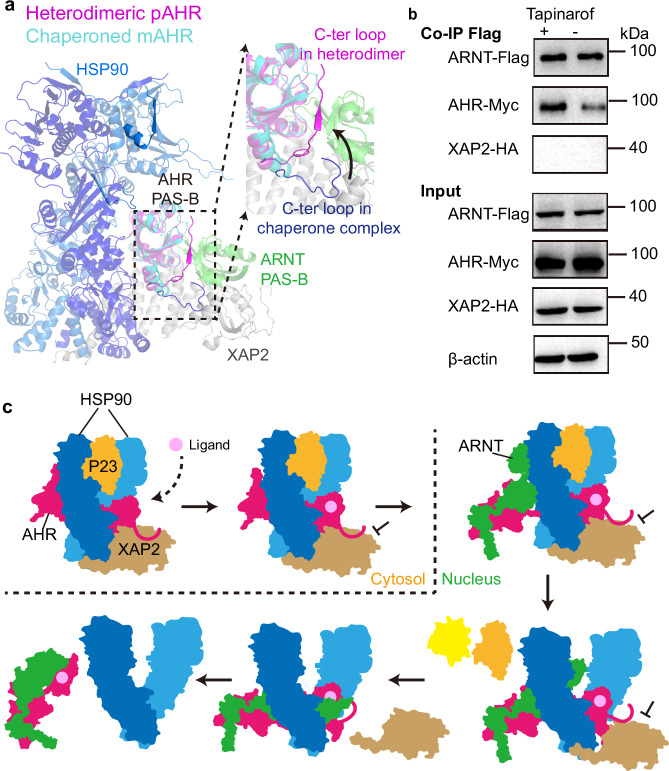
This paper reports crystal structures of AHR-ARNT-DNA complexes bound to six different AHR ligands and shows that AHR activation depends on a conserved PAS-B pocket and a conserved C-terminal loop that helps stabilize the AHR-ARNT heterodimer. The authors propose an allosteric activation mechanism in which ligand binding reorganizes AHR to promote ARNT binding, XAP2 displacement, and nuclear translocation.
Key findings
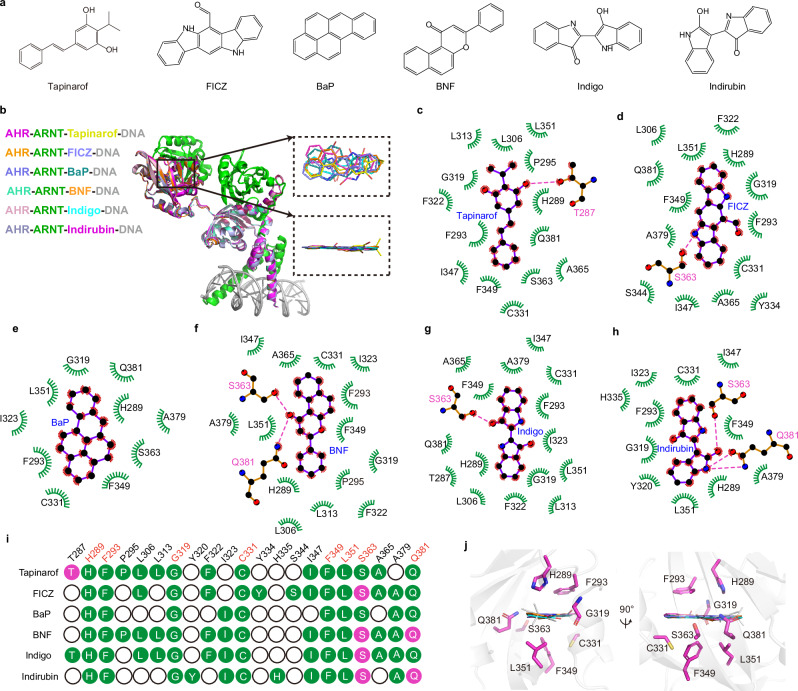
- The authors solved AHR-ARNT-DNA crystal structures with six ligands: Tapinarof, FICZ, BaP, BNF, Indigo, and Indirubin; the Tapinarof-bound structure was at 3.0 Å, and the other ligand-bound structures ranged from 2.6 Å to 3.1 Å.
- Across these six complexes, the overall structures were highly similar, with paired Cα RMSD values all < 0.7 Å.
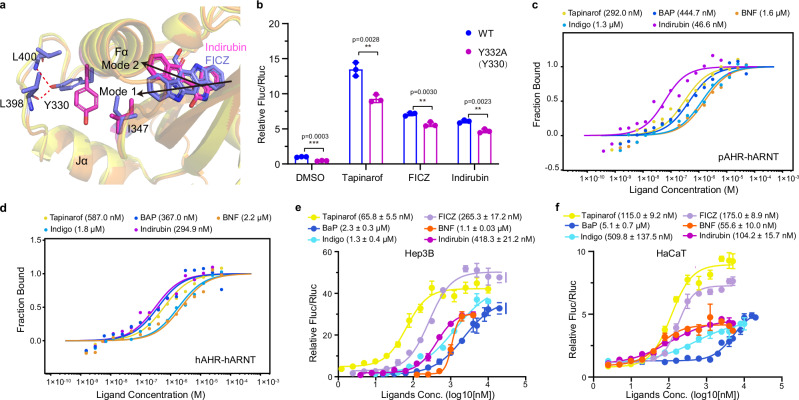
- Six ligands bind the same PAS-B pocket, but two binding modes were observed: Mode 1 for Tapinarof, FICZ, BaP, BNF, and Indigo, and Mode 2 for Indirubin.
- Quantitative binding values by MST were reported for pAHR as 292.0 nM (Tapinarof), 444.7 nM (BaP), 1.6 μM (BNF), 1.3 μM (Indigo), and 46.6 nM (Indirubin); for hAHR as 587.0 nM, 367.0 nM, 2.2 μM, 1.8 μM, and 294.9 nM, respectively. FICZ KD could not be measured because of intrinsic fluorescence.
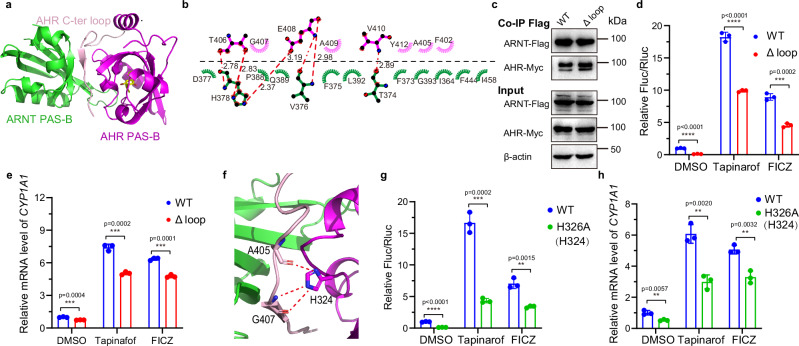
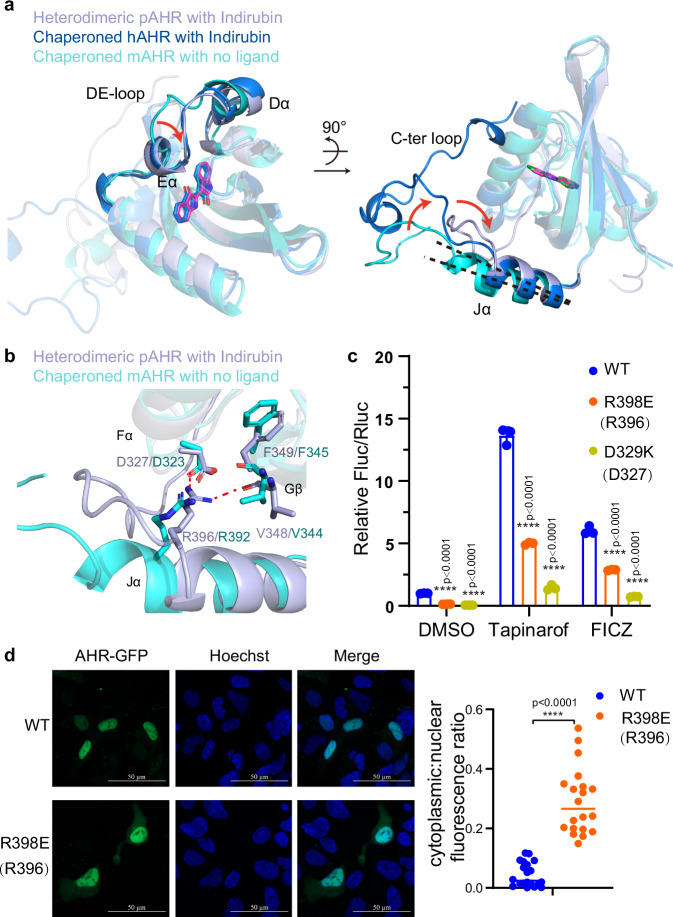
- Mutational tests showed that truncating the AHR C-terminal loop decreased AHR activity at baseline and with agonists, reduced CYP1A1 expression, and that mutations such as Y330A, D329K, R398E, and H326A reduced transcriptional activity; R398E also shifted AHR toward a more cytoplasmic localization under Tapinarof.
Methods
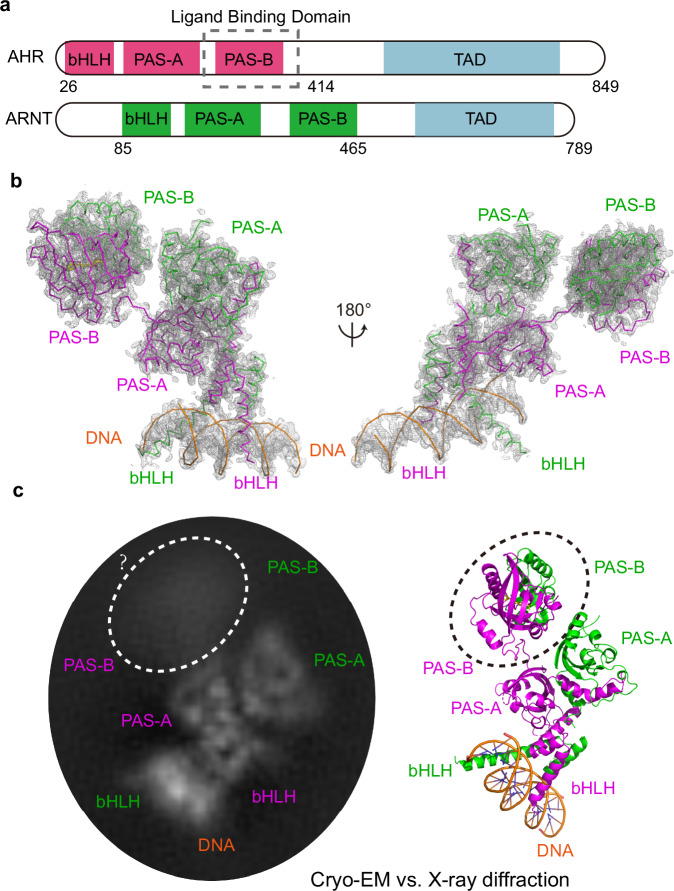
- Structural work combined X-ray crystallography of AHR-ARNT-DNA complexes with cryo-EM of an AHR-ARNT-DNA sample; the crystal structures used porcine AHR with human ARNT and a 21-mer dsDNA containing the 5’-TNGCGTG-3’ XRE sequence.
- Functional validation used dual-luciferase XRE reporter assays, qPCR for CYP1A1, co-immunoprecipitation, confocal microscopy, and microscale thermophoresis in HEK293, Hep3B, HaCaT, HT1080, and HT1080 AHR-KO cells.
- The main analyses were structural comparison, site-directed mutagenesis, RMSD comparisons, and MD/MM-GBSA-based residue contribution analysis for ligand binding.
Limitations
- The paper states that the reported KD values should be viewed as relative indications of affinity, because the authors could not rule out preoccupation of the AHR proteins by endogenous ligands from E. coli.
- FICZ KD could not be determined due to intrinsic fluorescence interfering with the MST signal.
- Evident from the text: the key crystallographic complex used porcine AHR and human ARNT, and several conclusions about human AHR are inferred from sequence conservation and targeted mutants rather than a single full human AHR structure.
Model-written summary. Check it against the paper before relying on it.
Integrity signals
Registry
Cites
Statistics
Figures
Verification
Claims the paper makes
13 Valid · 0 Not valid · 4 Not checked · 92 Own results and interpretations
The cited sources support only part of this claim — read each source’s verdict below.
In the paper
“Previous studies reported that the H320A mutation in mouse AHR (mAHR), located outside the PAS-B pocket (corresponding to H324A in porcine and H326A in human AHR), could reduce DNA-binding activity triggered by various agonists39.”
§ Structural basis for the ligand-dependent activation of heterodimeric AHR-ARNT complex > Results > The PAS-B unit relies on a conserved AHR segment
What the sources say
- Partly supportedcites [39] Soshilov, A. A. & Denison, M. S. Ligand promiscuity of aryl hydrocarbon receptor agonists and antagonists revealed by site-directed mutagenesis. Mol. Cell Biol. 34, 1707–1719 (2014). 24591650 PMC3993610 sourceExperimental — accuracy not yet measured
The Results (Fig. 2B–C; page unavailable) test mouse H320A for ligand-dependent DNA binding and report that it was activated by every compound in the panel except ANF. The cited paper does not give the claimed porcine H324A or human H326A correspondences, and the retrieved text does not establish that H320 lies outside the PAS-B pocket. (LLM, conf=0.78)
hedgedstates a cause- Asserted: passes — The authors put it forward as true.
- Checkable: passes — It can be checked against evidence.
- Load-bearing: passes — The paper’s conclusions depend on it.
- Based: passes — The paper gives a reason why it holds.
- Partly supported
Every source the paper cites for this claim was checked and supports it.
In the paper
“Notably, compared to two recently published structures of AHR cytosolic complexes bound to Indirubin and BaP29,40, these two ligands demonstrate similar binding patterns within the AHR-ARNT complexes (Supplementary Fig. 7g, h)”
§ Structural basis for the ligand-dependent activation of heterodimeric AHR-ARNT complex > Results > Promiscuous ligand binding mediated by conserved residues
What the sources say
- Supportedcites [29] Gruszczyk, J. et al. Cryo-EM structure of the agonist-bound Hsp90-XAP2-AHR cytosolic complex. Nat. Commun. 13, 7010 (2022). 36385050 PMC9668932 source
The Results section (“Exploring AHR ligand-binding mechanism”) identifies this paper as a structure of an indirubin-bound AHR cytosolic complex. The citation serves to identify a previously published structure used for comparison; the claim about similar binding patterns in AHR–ARNT complexes is the citing authors’ own comparison, not a finding attributed to this source. (LLM, conf=0.90)
- Supportedcites [40] Kwong, H. S. et al. Structural insights into the activation of human aryl hydrocarbon receptor by the environmental contaminant Benzo[a]pyrene and structurally related compounds. J. Mol. Biol. 436, 168411 (2023). 38135181 source
The Abstract (p. 1) identifies this paper as reporting a structure of the BaP-bound AHR cytosolic complex, and the structure-determination section (p. 3) compares it with the previously published indirubin-bound structure. The statement about binding within AHR–ARNT complexes is the citing authors’ own comparison, not a result attributed to this source. (LLM, conf=0.91)
boosted- Asserted: passes — The authors put it forward as true.
- Checkable: passes — It can be checked against evidence.
- Load-bearing: passes — The paper’s conclusions depend on it.
- Based: passes — The paper gives a reason why it holds.
- Supported
Every source the paper cites for this claim was checked and supports it.
In the paper
“They may rather function as “pro-ligands” through further conversion to “real” AHR ligands with much higher binding potencies, as exemplified by kynurenine and its trace derivatives52.”
§ Structural basis for the ligand-dependent activation of heterodimeric AHR-ARNT complex > Discussion
What the sources say
- Supportedcites [52] Seok, S. H. et al. Trace derivatives of kynurenine potently activate the aryl hydrocarbon receptor (AHR). J. Biol. Chem. 293, 1994–2005 (2018). 29279331 PMC5808761 source
The paper’s opening summary explicitly calls kynurenine an AHR pro-ligand that requires chemical conversion to act as a receptor agonist. It reports trace kynurenine derivatives active at low picomolar levels; the section on evidence for kynurenine as an AHR pro-ligand likewise describes conversion to potent ligands. The copy does not provide page numbers for these passages. (LLM, conf=0.94)
hedgedstates a possible cause- Asserted: passes — The authors put it forward as true.
- Checkable: passes — It can be checked against evidence.
- Load-bearing: unclear — It is unclear whether the paper’s conclusions depend on it.
- Based: passes — The paper gives a reason why it holds.
- Supported
Every source the paper cites for this claim was checked and supports it.
In the paper
“According to the ligand-bound complex structures and the sequence alignment of pAHR and hAHR (Fig. 3b and Supplementary Fig. 1b), pocket residues directly outlining the cavity (calculated by CASTp algorithm41) are highly conserved among these two species, with 24 out of 26 residues fully identical.”
§ Structural basis for the ligand-dependent activation of heterodimeric AHR-ARNT complex > Results > Promiscuous ligand binding mediated by conserved residues
What the sources say
- Supportedcites [41] Tian, W., Chen, C., Lei, X., Zhao, J. & Liang, J. CASTp 3.0: computed atlas of surface topography of proteins. Nucleic Acids Res. 46, W363–W367 (2018). 29860391 PMC6031066 source
The citation identifies the algorithm used to calculate the pocket residues, not the source of the pAHR–hAHR conservation result. The Output section says CASTp identifies protein cavities and delineates the atoms forming them; the Case study also shows how users can view pocket-forming residues. (LLM, conf=0.93)
plainstates an association- Asserted: passes — The authors put it forward as true.
- Checkable: passes — It can be checked against evidence.
- Load-bearing: passes — The paper’s conclusions depend on it.
- Based: passes — The paper gives a reason why it holds.
- Supported
The cited sources support only part of this claim — read each source’s verdict below.
In the paper
“suggesting the possible existence of a transitional state where ARNT can directly engage with AHR while it is still bound to HSP90 and XAP248.”
§ Structural basis for the ligand-dependent activation of heterodimeric AHR-ARNT complex > Results > Dynamic AHR conformational shifts: from cytosol to nucleus
What the sources say
- Partly supportedcites [48] Soshilov, A. A., Motta, S., Bonati, L. & Denison, M. S. Transitional states in ligand-dependent transformation of the aryl hydrocarbon receptor into its DNA-binding form. Int. J. Mol. Sci.21, 10.3390/ijms21072474 (2020). PMC7177239 32252465 sourceExperimental — accuracy not yet measured
The Discussion (page unavailable) proposes a transitional hsp90:AhR:ARNT complex in which ARNT binds AhR before hsp90 is fully released. It does not establish that XAP2 remains bound in that state, so the XAP2 portion of the claim is unsupported. (LLM, conf=0.87)
hedgedstates a possible cause- Asserted: passes — The authors put it forward as true.
- Checkable: passes — It can be checked against evidence.
- Load-bearing: passes — The paper’s conclusions depend on it.
- Based: passes — The paper gives a reason why it holds.
- Partly supported
72 more claims · 2 with their cited sources checked
Create a free account to see all 109 claims and every source verdict.
- Probably not a substantial claim. 9
- It may state two separate claims as one. 23
Citations
Cites
Comparison of simple potential functions for simulating liquid water
Jorgensen, W. L., Chandrasekhar, J., Madura, J. D., Impey, R. W., & Klein, M. L. (1983) · The Journal of Chemical Physics · doi:10.1063/1.445869 · Cited by 41,298 · cited 1×
“We used the amber-ff14SB force fi eld 66 for protein and the TIP3P model 67 for water molecules.”
Features and development of Coot
Emsley, P., Lohkamp, B., Scott, W. G., & Cowtan, K. (2010) · Acta Crystallographica Section D Biological Crystallography · doi:10.1107/s0907444910007493 · Cited by 29,915
Abraham, M. J., Murtola, T., Schulz, R., Páll, S., Smith, J. C., Hess, B., & Lindahl, E. (2015) · SoftwareX · doi:10.1016/j.softx.2015.06.001 · Cited by 27,190
PHENIX : a comprehensive Python-based system for macromolecular structure solution
Adams, P. D., Afonine, P. V., Bunkóczi, G., Chen, V. B., Davis, I. W., Echols, N., Headd, J. J., Hung, L.-W., Kapral, G. J., Grosse-Kunstleve, R. W., et al. (2010) · Acta Crystallographica Section D Biological Crystallography · doi:10.1107/s0907444909052925 · Cited by 23,716 · cited 1×
“Further manual model building and re fi nement were performed with Coot 62 and Phenix.re fi ne 63 .”
Phaser crystallographic software
McCoy, A. J., Grosse-Kunstleve, R. W., Adams, P. D., Winn, M. D., Storoni, L. C., & Read, R. J. (2007) · Journal of Applied Crystallography · doi:10.1107/s0021889807021206 · Cited by 20,612 · cited 1×
“The crystal structure of AHR-ARNT-DNA in complex with Tapinarof was determined by molecular replacement using Phaser 61 , employing the HIF-2 α -ARNT-DNA structure (PDB: 4ZPK) as the initial search model 31 .”
Development and testing of a general amber force field
Wang, J., Wolf, R. M., Caldwell, J. W., Kollman, P. A., & Case, D. A. (2004) · Journal of Computational Chemistry · doi:10.1002/jcc.20035 · Cited by 19,506
Kabsch, W. (2010) · Acta Crystallographica Section D Biological Crystallography · doi:10.1107/s0907444909047337 · Cited by 16,463
MolProbity : all-atom structure validation for macromolecular crystallography
Chen, V. B., Arendall, W. B., Headd, J. J., Keedy, D. A., Immormino, R. M., Kapral, G. J., Murray, L. W., Richardson, J. S., & Richardson, D. C. (2010) · Acta Crystallographica Section D Biological Crystallography · doi:10.1107/s0907444909042073 · Cited by 14,115 · cited 1×
“The Ramachandran statistics, calculated by Molprobity 64 , are 96.6%/0.17%, 97.6%/0.17%, 96.6%/ 0.17%, 96.8%/0.17%, 97.6%/0.17% and 97.5%/0.34% (favored/outliers) for the AHR-ARNT-DNA structures in complex with Tapinarof, BaP, FICZ, BNF, Indigo and Indirubin, respectively.”
InfluentialcryoSPARC: algorithms for rapid unsupervised cryo-EM structure determination
Punjani, A., Rubinstein, J. L., Fleet, D. J., & Brubaker, M. A. (2017) · Nature Methods · doi:10.1038/nmeth.4169 · Cited by 11,626
ff14SB: Improving the Accuracy of Protein Side Chain and Backbone Parameters from ff99SB
Maier, J. A., Martinez, C., Kasavajhala, K., Wickstrom, L., Hauser, K. E., & Simmerling, C. (2015) · Journal of Chemical Theory and Computation · doi:10.1021/acs.jctc.5b00255 · Cited by 10,830 · cited 1×
“We used the amber-ff14SB force fi eld 66 for protein and the TIP3P model 67 for water molecules.”
Cited by
The aryl hydrocarbon receptor: structure, signaling, physiology and pathology
Coumoul, X., Barouki, R., Esser, C., Haarmann‐Stemmann, T., Lawrence, B. P., Lehmann, J., Moura‐Alves, P., Murray, I. A., Opitz, C. A., Perdew, G. H., et al. (2026) · Signal Transduction and Targeted Therapy · doi:10.1038/s41392-025-02500-8 · Cited by 124
The AhR/IL-22 axis in chronic gut inflammation: unraveling mechanisms and therapeutic prospects
Kang, H., Chen, Z., Wang, B., & Chen, Z. (2025) · Frontiers in Immunology · doi:10.3389/fimmu.2025.1668173 · Cited by 68
“The classical AhR/IL-22 signaling pathway in the intestine mainly regulates the expression of target genes such as IL-22 by ligand activation of AhR, nuclear translocation, and heterodimerization with ARNT, thereby maintaining intestinal barrier function and immunization homeostasis (43, 44).”
Microbial metabolites and their influence on the tumor microenvironment
Duan, H., Xu, B., Luo, P., Chen, T., & Zou, J. (2025) · Frontiers in Immunology · doi:10.3389/fimmu.2025.1675677 · Cited by 35
“AhR is a ligand-activated transcription factor initially characterized as a receptor for environmental toxins that mediates dioxin toxicity (137).”
Emerging approaches for antagonizing the aryl hydrocarbon receptor
Dvořák, Z., Mani, S., & Vondráček, J. (2025) · Trends in Pharmacological Sciences · doi:10.1016/j.tips.2025.05.003 · Cited by 12
Ran, L., 李春润, Wang, P., Tang, J., Qu, Z., Hao, Y., & Zhang, Y. (2026) · Frontiers in Immunology · doi:10.3389/fimmu.2026.1720700 · Cited by 14
“Environmental pollutants with a high af fi nity for AHR, such as TCDD, exhibit resistance to degradation by CYP1 enzymes, resulting in sustained receptor activation that contributes to metabolic disorders, pro-in fl ammatory responses, and an increased carcinogenic risk (13, 18).”
HIF-1α and BMAL1 in bone regeneration: crosstalk between hypoxia response and circadian rhythm
Weng, Y., Xiong, J., Zhao, Q., & Tan, Z. (2026) · Bone Research · doi:10.1038/s41413-026-00506-8 · Cited by 16
A mechanism for ligand-dependent activation of AHR
Guesdon, A., & Bourguet, W. (2025) · Trends in Pharmacological Sciences · doi:10.1016/j.tips.2025.02.007 · Cited by 11
Rüegger, J., Gagestein, B., Janssen, A. P. A., Valeanu, A., Mori, A. L., van der Peet, M., Boutkan, M. S., Florea, B. I., Henneman, A. A., Hochstrasser, R., et al. (2025) · Molecular & Cellular Proteomics · doi:10.1016/j.mcpro.2025.100961 · Cited by 11
AhR in biological processes of adipocytes and lipid metabolism in obesity: Friend and foe
Li, X., Wang, S., Mao, X., Fang, M., Liu, X., Jiang, J., & Jin, W. L. (2025) · Life Sciences · doi:10.1016/j.lfs.2025.123996 · Cited by 9
Biotin deficiency bridges metabolic signaling to insecticide sequestration in Nilaparvata lugens
Deng, M., Xu, X., Yang, Z., & Lǚ, K. (2025) · Insect Biochemistry and Molecular Biology · doi:10.1016/j.ibmb.2025.104445 · Cited by 12
Tang, C., Zhang, Y., Zhang, F., Sun, Y., Zhu, Y. C., Xue, F., Wang, Z., Wu, Y., Ruan, J., Yue, Y., et al. (2025) · Environmental Health Perspectives · doi:10.1021/ehp.6c00111 · Cited by 6
Shang, Z.-Z., Ye, H.-Y., Li, Q.-M., Zha, X., & Luo, J. (2025) · Carbohydrate Polymers · doi:10.1016/j.carbpol.2025.124024 · Cited by 8
Jindra, M., & Noriega, F. G. (2025) · Elsevier eBooks · doi:10.1016/b978-0-323-95424-2.00036-4 · Cited by 11
Computational discovery of novel aryl hydrocarbon receptor modulators for psoriasis therapy
Santini, G., Bonati, L., & Motta, S. (2025) · Scientific Reports · doi:10.1038/s41598-025-03626-z · Cited by 8
Cell Signaling by Tryptophan Catabolism
Torrelli-Diljohn, A., Kulkarni, B., & Vitturi, D. A. (2026) · Biochemistry · doi:10.1021/acs.biochem.6c00179 · Cited by 7
Huang, Y., Zhang, J., Fu, S., Liu, Z., Zhong, H., Zhong, Q., Luo, Y.-D., Hu, Y., Zhu, H., Wen, B., et al. (2025) · Pharmaceutical Biology · doi:10.1080/13880209.2025.2568215 · Cited by 3
“As the dissociation constant (KD) of IDR binding to the human AhR-ARNT complex was 294.9 nM; and the EC50 values of IDR activating AhR were 104.2 and 418.3 nM in Hep3B and HaCaT cells (Diao et al. 2025), we selected 0.1–1.0 μM as the concentration range of IDR in our study.”
InfluentialSelf-citationYang, H., Zhang, K., Wang, Y., Liu, S., Guo, Y., Liu, W., Sun, J., Zhang, Z., Zhang, S., Li, S., et al. (2026) · Environmental Science and Ecotechnology · doi:10.1016/j.ese.2026.100663 · Cited by 4
“AhR is a cytosolic protein that translocates to the nucleus upon ligand binding, heterodimerizes with AhR nuclear translocator, and binds dioxin/xenobiotic response elements [33].”
Self-citationAdvances in understanding aryl hydrocarbon receptor structure, function, and modulation
Shang, Q., Khorasanizadeh, S., Diao, X., Rastinejad, F., & Wu, D. (2026) · Trends in Biochemical Sciences · doi:10.1016/j.tibs.2026.02.018 · Cited by 6
Self-citationDvořák, Z., & Přikryl, J. (2026) · Frontiers in Pharmacology · doi:10.3389/fphar.2026.1823615 · Cited by 3
“Binding of ARNT may ultimately displace XAP-2 from L-AhRNuc (Diao et al., 2025).”
InfluentialZhao, Y., Li, Y., Li, L., Wang, Y., Guo, Q., Yang, S., Xiong, C., Luo, F., Hu, Z., Sun, W., et al. (2025) · Journal of Medicinal Chemistry · doi:10.1021/acs.jmedchem.5c01060 · Cited by 3
Zhao, Y., Wei, Z., Feng, Y., Ma, L., Jiao, D., Cui, Y., Gu, J., Bian, K., Ci, C., Zhu, J., et al. (2025) · Chinese Medical Journal · doi:10.1097/cm9.0000000000003769 · Cited by 2
Microbiota-Derived Metabolites in the Epigenetic Regulation of Redox Homeostasis
Mester, P., Steinmann, S. M., Mehler, S., Müller, M., & Gülow, K. (2026) · Antioxidants · doi:10.3390/antiox15070897 · Cited by 6
“Recent structural studies have further improved the molecular understanding of ligand-dependent AhR activation and AHR–ARNT–DNA complex formation, providing a stronger framework for interpreting ligand-specific downstream transcriptional effects [105].”
Methylcarvones as immunomodulators through antagonism of aryl hydrocarbon receptor
Zůvalová, I., Grycová, A., Hrubý, J., Illéš, P., Soural, M., Kováč, O., Šebela, M., Bachleda, P., Kriegová, E., Trajerová, M., et al. (2025) · Bioorganic Chemistry · doi:10.1016/j.bioorg.2025.109256 · Cited by 1
AHR: The Overlooked Mediator in Skincare─Bridging Environmental Sensing and Skin Physiology
Hu, X., Zhu, R., Zhen, Y., Li, Q., Liu, Y., Xu, T., Yang, G., Chen, Y., Xie, H. Q., Xu, S. L., et al. (2026) · Environment & Health · doi:10.1021/envhealth.5c00424 · Cited by 1
Karabogdan, I., Yanqui-Rivera, F., Sayeeram, D., Sadik, A., Miller, A. K., Trump, S., Röhrig, U. F., & Opitz, C. A. (2026) · ACS Omega · doi:10.1021/acsomega.5c10598 · Cited by 1
Fang, D., Sheng, X., Li, X., Tan, B., Zhang, J., Ding, K., & An, K. (2026) · Phytomedicine · doi:10.1016/j.phymed.2026.158164 · Cited by 2
Koellisch, K., Blattner, C., Motta, S., Wesslowski, J., Rothley, M., Büchel, S., Sirounian, S., Segatto, I., Weber, H. T., Müller, J., et al. (2026) · iScience · doi:10.1016/j.isci.2026.115936 · Cited by 3
“31 The crystal structures of the AHR in complex with the aryl hydrocarbon receptor nuclear translocator (ARNT) bound to DNA and each of six classical AHR ligands have now been solved.”
Wang, H., Braun, G., Kamjunke, N., Krauss, M., Jiang, G., & Escher, B. I. (2026) · Environmental Science & Technology · doi:10.1021/acs.est.6c02059 · Cited by 1
Han, H., Dong, Q., Zhang, Z., Li, S., Zhang, H., Wang, X., Bai, J., Shi, L., Fu, X., Zheng, K., et al. (2026) · ImmunoTargets and Therapy · doi:10.2147/itt.s601152 · Cited by 1
Aryl hydrocarbon receptor pharmacology—mechanisms, ligands, and therapeutic potential
Bobrovs, R., Olafsen, N. E., Åhrling, S. S., & Matthews, J. B. (2026) · Pharmacological Reviews · doi:10.1016/j.pharmr.2026.100146 · Cited by 5
“67,68 AHR modulators come from both exogenous and endogenous sources.”
Koellisch, K., Blattner, C., Motta, S., Wesslowski, J., Rothley, M., Büchel, S., Sirounian, S., Müller, J., Grimaldi, M., Stober, J., et al. (2025) · bioRxiv (Cold Spring Harbor Laboratory) · doi:10.1101/2025.07.28.666967 · Cited by 1
Closson, J. D., Xu, X., Zhang, M., Tiyani, T. T., Marcelino, L. P., Isiorho, E. A., Nagati, J. S., Garcia, J. A., & Gardner, K. H. (2026) · Proceedings of the National Academy of Sciences · doi:10.1073/pnas.2514042123 · Cited by 2
Self-citationLiu, J., Fu, X., Huang, X., Wang, Y., Zhu, J., Wang, M., Lu, X., Luo, R., Yang, Y., & Zheng, W. (2025) · SSRN Electronic Journal · doi:10.2139/ssrn.5556934
Punia, R., & Goel, G. (2025) · Journal of Chemical Information and Modeling · doi:10.1021/acs.jcim.5c01556
Zhang, Y., Liu, F., Xu, C., Wang, L., Yang, Y., Xiong, M., Zhao, B., Min, Y. U., & Yang, H. (2026) · Inflammation Research · doi:10.1007/s00011-025-02182-6 · Cited by 1
“For example, endogenously produced metabolites, such as 6-formylindolo[3,2-b]carbazole (FICZ), indigo, indiru - bin, arachidonic acid metabolites, or metabolites from the kynurenine pathway, have been described as AhR ligands [19].”
Vuckovski, A., & Ackova, D. G. (2026) · Future Pharmacology · doi:10.3390/futurepharmacol6010015
Zhen, Y., Li, Q., Hu, X., Liu, X., Shao, Z., Xie, H. Q., Zhao, B., & Xu, S. L. (2026) · International Journal of Molecular Sciences · doi:10.3390/ijms27083530
“Furthermore, regarding AHR agonists, SHAP analysis revealed the critical role of nitrogen-containing functional groups in their structure: these groups form hydrogen bonds to establish specific binding with the receptor [35,36].”
Alaiya, A. A., Radwan, A. A., Shinwari, Z., Allam, R., Al-Mohanna, F., & Al‐Dhfyan, A. (2026) · Research Square · doi:10.21203/rs.3.rs-9103920/v1
Zhu, W., Chen, Y., Hong, X., Chen, Y., Chen, W., Ouyang, Z., Gui, S., & Fan, R. (2026) · Toxicology and Environmental Health Sciences · doi:10.1007/s13530-026-00309-8
“Notably, LMW PAHs, such as 1-ClNAP and 9-nitroANT, increased the flexibility of residues 12–25 and 33–42, while 1-BrNAP, 2-nitroFLA, and 2-nitroNAP affected the fluctuations in the regions near residues 29, 45, and 60.”
Wieland, V., Blum, T., Iriady, I., Reverte-Salisa, L., Pathirana, D., Foerster, I., Weighardt, H., & Hasenauer, J. (2026) · bioRxiv (Cold Spring Harbor Laboratory) · doi:10.64898/2026.05.05.722708
“…suggest that the tyrosine kinase c-Src dissociates from the AhR complex in the cytoplasm, while HSP90, p23, and AIP remain associated with AhR during nuclear import and are released in the nucleus upon, or during, the formation of a heterodimer with the AhR nuclear translocator (ARNT) [8, 9].”
Zhuang, M., Li, R. Q., Wang, Y., et al. (2026) · Burns · doi:10.1016/j.burns.2026.108056
The Molecular Makeup of Juvenile Hormone Receptor Signaling
Tumova, S., & Jindra, M. (2026) · Entomology monographs · doi:10.1007/978-981-95-8605-9_10 · Cited by 3
Zhao, H., Tan, J., Tang, T., & Dai, S. (2026) · TrAC Trends in Analytical Chemistry · doi:10.1016/j.trac.2026.118932
Fu, H., Luo, Y., Lv, X., Liu, J., Wang, L., Wei, X., & Jiang, D. (2026) · Canadian Journal of Chemistry · doi:10.1139/cjc-2025-0263
Person, R., Deval, G., Ferecatu, I., & Coumoul, X. (2026) · Environmental Research · doi:10.1016/j.envres.2026.124959
Xin, Y., Cen, Q., He, J., Lu, W., Yu, Y., Jing, F., Zhao, Y., Jin, J., Cui, Y., Feng, J., et al. (2026) · Pharmacological Research · doi:10.1016/j.phrs.2026.108303 · Cited by 1
Gao, Y., Duan, C., Zheng, X., & Qu, L. (2026) · NeuroToxicology · doi:10.1016/j.neuro.2026.103494
Kuhn, T., Tumova, S., Zacharewski, N., Averdung, P., Berdel, B., Kellner, K.-H., Pusch, S., Jindra, M., Opitz, C. A., & Prentzell, M. T. (2026) · bioRxiv (Cold Spring Harbor Laboratory) · doi:10.64898/2026.06.19.732932
Wang, W., Zhu, X., Geng, S., Wang, Y., Zhang, W., Zhang, W., Gao, X., Mo, Y., Zhang, Q., & Nie, J. (2026) · NeuroToxicology · doi:10.1016/j.neuro.2026.103532
Zhao, J., Ullah, F., Peng, H., et al. (2026) · Biotechnology Advances · doi:10.1016/j.biotechadv.2026.108990
Guo, X., 彭凡, Cai, Q., Lin, X., Yin, A., Xu, F., Zhao, J., He, S., Tian, C., & Ying, C. (2026) · Journal of Hazardous Materials · doi:10.1016/j.jhazmat.2026.143188
Juvenile hormone receptor relies on conserved domain interfaces for dimerization-dependent activity
Bittova, L., Tumova, S., Yatsenko, M., Mokhamatam, R. B., Tůma, R., & Jindra, M. (2026) · Proceedings of the National Academy of Sciences · doi:10.1073/pnas.2605755123
“The mammalian AHR and insect JHR additionally depend on binding of small - molecular agonists which trigger a sequence of events transforming either receptor from a cytoplasmic, chaperone associated monomer to the DNA binding dimer with the cognate bHLH - PAS partner (6, 13, 14).”
InfluentialGreen, S. E., Casola, A., & de Mello, A. H. (2026) · Frontiers in Microbiology · doi:10.3389/fmicb.2026.1887894
Li, X., Wu, H., Yang, Y., Tan, B., Zhang, J., Ma, J., Zhang, J., An, K., & Ge, F. (2026) · European Journal of Pharmacology · doi:10.1016/j.ejphar.2026.179219 · Cited by 1
Buján, S., Miret, N. V., Torres, D., Pontillo, C. A., Chiappini, F., Candia, A. J. N., Agustina, L., Sofia, M. M., Bressan, M., Scicolone, G., et al. (2026) · Environmental Research · doi:10.1016/j.envres.2026.125482
Omidi, M., Shadboorestan, A., & Mohammadi‐Bardbori, A. (2026) · Drug Discovery Today · doi:10.1016/j.drudis.2026.104779
Selective AhR modulation by tapinarof reprograms microglial inflammation through the AhR–Nrf2 Axis
Elbaz, R. M., Waheed, N., & Abdelnaser, A. (2026) · Toxicology Letters · doi:10.1016/j.toxlet.2026.113184
Li, M., Zhang, Y., Zhu, L., Zhang, R., Zhang, Q., Wang, W., & Wang, Q. (2026) · Environmental Pollution · doi:10.1016/j.envpol.2026.129016
Hu, H., Guo, W., Li, X., Li, Z., Chen, Y., Wang, Y., Hu, K., Chen, Z., Jiang, H., & Wang, S. (2026) · Pharmacological Research · doi:10.1016/j.phrs.2026.108429
Alqahtani, M. A. (2026) · Pharmaceuticals · doi:10.3390/ph19091416
Miller, D. H., Lachapelle, A., Satbhai, K. M., Chien, P., Borys, K. M., & Timme‐Laragy, A. R. (2026) · Environmental Pollution · doi:10.1016/j.envpol.2026.129135
Compensatory pathways in tryptophan metabolism and immune regulation following IDO inhibition
da Costa, I. M. G., Camurça, M., & Kfoury, J. R. (2026) · Molecular Biology Reports · doi:10.1007/s11033-026-12707-9
“…tumor necrosis factor; TNFR, tumor necrosis factor receptor; Trp, tryptophan AHR nuclear translocator (ARNT), forming a transcriptionally active complex that binds xenobiotic response elements (XREs), also known as dioxin response elements (DREs), within regulatory regions of target genes [28].”
The AHR–TFAP2A axis regulates melanosome transport by directly targeting myosin Va and Mlph
Sung, H.-Y., Jo, C. S., Hairu, Z., Baek, G. C., You, C. M., & Hwang, J. S. (2026) · Journal of Investigative Dermatology · doi:10.1016/j.jid.2026.08.019
Pandey, S., & Cox, B. C. (2026) · Frontiers in Molecular Neuroscience · doi:10.3389/fnmol.2026.1943479
Mechanism of BaP- regulated hepatic lipid metabolism via AhR activation and AR modulation
Wang, H., Zhang, M., Wang, X., Su, M., Fan, L., Du, Y., Hu, Y., Lv, X., Li, J., Zhou, S., et al. (2026) · Frontiers in Pharmacology · doi:10.3389/fphar.2026.1880959
Self-citation
Metadata
- Authors
- Diao, X., Shang, Q., Guo, M., Huang, Y., Zhang, M., Chen, X., Liang, Y., Sun, X., Zhou, F., Zhuang, J., Liu, S.-J., Vogel, C. F. A., Rastinejad, F., & Wu, D.
- Affiliations
- Shandong University (CN)
- University of California, Davis (US)
- University of Oxford (GB)
- Corresponding author
- Wu, Dalei
- ORCID
- Venue
- Nature communications
- Published
- 2025-02-03
- Volume
- 16
- Issue
- 1
- Pages
- 1282-1282
- ISSN
- 2041-1723 (ISSN-L)
- PMC
- PMC11791172
- OpenAlex
- W4407083612
- Cited by
- 72
- References
- 80
- Citations by year
- 2026: 54 · 2025: 18
- FWCI
- 30.35
- Type
- journal article
- Language
- en
- Open access
- gold
- doi.org
- Licence
- cc-by-nc-nd
- creativecommons.org/licenses/by-nc-nd/4.0 (tdm)
- creativecommons.org/licenses/by-nc-nd/4.0 (vor)
- Locations
- Nature Communications (publishedVersion, cc-by-nc-nd)
- PubMed Central (publishedVersion, cc-by-nc-nd)
- PubMed (publishedVersion)
- eScholarship (California Digital Library) (submittedVersion, cc-by-nc-nd)
- RePEc: Research Papers in Economics (submittedVersion)
- DOAJ (DOAJ: Directory of Open Access Journals) (submittedVersion)
- Funders
- National Natural Science Foundation of China (82373876, 22177063)
- National Key R&D Program of China
- Topics
- Physical Sciences › Environmental Science › Health, Toxicology and Mutagenesis › Toxic Organic Pollutants Impact
- Life Sciences › Biochemistry, Genetics and Molecular Biology › Molecular Biology › Protein Structure and Dynamics
- Life Sciences › Pharmacology, Toxicology and Pharmaceutics › Pharmacology › Pharmacogenetics and Drug Metabolism
- Keywords
- aryl hydrocarbon receptor, ARNT, ligand-dependent activation, PAS-B domain, protein-DNA complex crystal structure, tapinarof, FICZ, benzo[a]pyrene, beta-naphthoflavone, indigo, indirubin, π-π stacking, hydrophobic interactions, transcriptional activation
- MeSH terms
- Benzo(a)pyrene, Carbazoles, DNA, Humans, Indoles, Ligands, Models, Molecular, Protein Binding, Receptors, Aryl Hydrocarbon, Crystallography, X-Ray, beta-Naphthoflavone, Aryl Hydrocarbon Receptor Nuclear Translocator, Basic Helix-Loop-Helix Proteins, Protein Multimerization
About these checks
Registry, retraction, Cites and statistics results are computed, not judged, with one exception: a printed reference that no index lists is read once by a model before it counts as a citation error. Claims are extracted by a model and kept only when their quote appears verbatim in the text; each cited source is then checked, with a model’s help, for whether it says what the claim relies on. Those verdicts can be wrong — read the claim’s quote and the cited source before relying on one.
The claim verdicts this report counts are experimental: their accuracy is not yet measured.
A language model drew the claims from the paper on 2026-10-11, under version 3 of the claim definition (model deepseek-v4.1-flash, prompt extract-v3).
A second model labelled each claim on 2026-10-11 (model jev-1.13-20260917, definition revision gold-guideline-v0.2).
Cited sources are checked with a language model’s help (gpt-6-sol).
Statistics and arithmetic are recomputed, not judged.
Confidence bands are shown only for fields calibrated on our annotated test set. None is calibrated yet, so no band is shown.
What counts as a claim ›How we measure confidence ›How we check this ›
Are you an author, or do you see a problem with this page? Request a review
Data sources
Bibliographic data: Semantic Scholar, OpenAlex, Crossref.
Contains information from the Semantic Scholar Academic Graph Datasets, made available under the ODC Attribution License (ODC-BY 1.0).
Semantic Scholar’s data is described in: Kinney, R., et al. (2023). The Semantic Scholar Open Data Platform. arXiv:2301.10140.
