

Yoked surface codes
Open accessThe DOI matches its Crossref record; 43 of the 44 references it cites were found in a registry or an index; 12 of the 17 sources its claims cite were checked for support.
Abstract
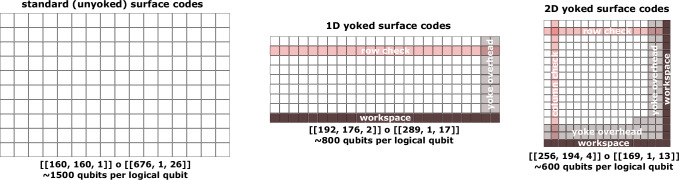
Abstract One of the biggest obstacles to building a large scale quantum computer is the high qubit cost of protecting quantum information. For two-dimensional architectures, the surface code has long been the leading candidate quantum memory, but can require upwards of a thousand physical qubits per logical qubit to reach algorithmically-relevant logical error rates. In this work, we introduce a hierarchical memory formed from surface codes concatenated into high-density parity check codes. These yoked surface codes are arrayed in a rectangular grid, with parity checks (yokes) measured along each row, and optionally along each column, using lattice surgery. Our construction assumes no additional connectivity beyond a nearest-neighbor square qubit grid operating at a physical error rate of 10 −3 . At algorithmically-relevant logical error rates, yoked surface codes use as few as one-third the number of physical qubits per logical qubit as standard surface codes, enabling moderate-overhead fault-tolerant quantum memories in two dimensions.
Overview
CoChat Summary
## TL;DR
The paper introduces yoked surface codes, a hierarchical memory that concatenates surface codes with simple parity-check outer codes arranged on a grid. At a physical error rate of \(10^{-3}\), the authors estimate these codes can cut qubit overhead to as little as one-third of standard surface codes at algorithmically relevant logical error rates.
## Key findings
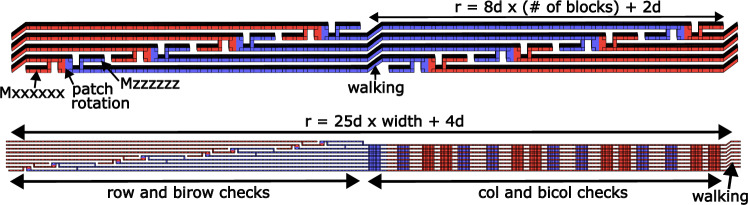
- Yoked surface codes use row parity checks in 1D and row-plus-column parity checks in 2D, with no connectivity beyond a nearest-neighbor square qubit grid.
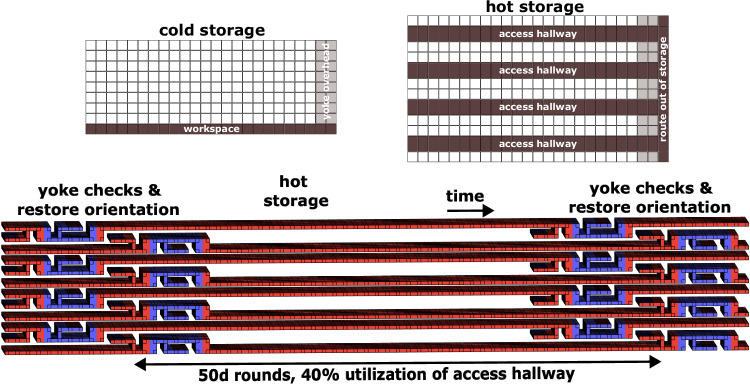
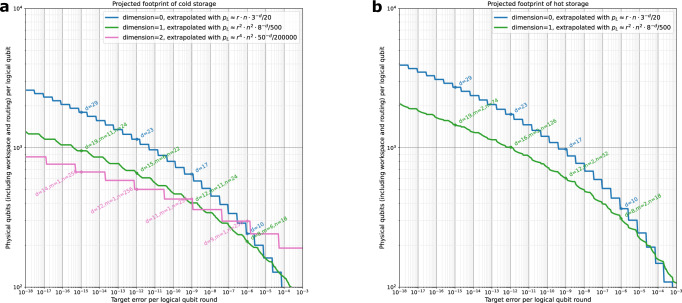
- The paper estimates that, in the teraquop regime at physical error rate \(10^{-3}\), yoked surface codes achieve nearly 3× as many logical qubits per physical qubit as standard surface codes for cold storage (2D), and nearly 2× as many for hot storage (1D).
- The abstract states these codes can use as few as one-third the number of physical qubits per logical qubit as standard surface codes at algorithmically relevant logical error rates.
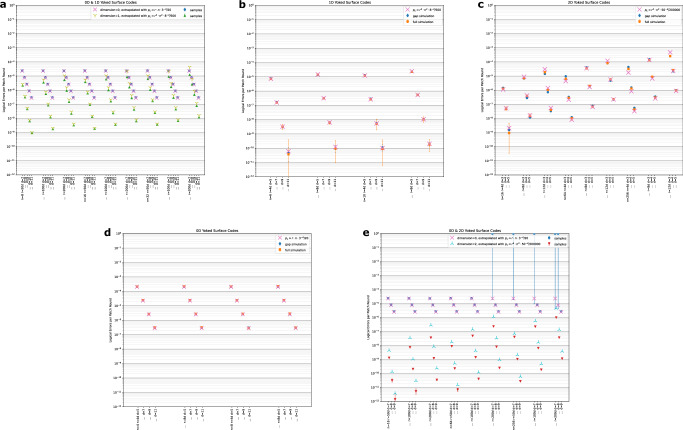
- The authors report that their simulations at \(10^{-3}\) show good agreement for 0D and 1D and fairly good agreement in 2D, while noting that in one benchmark a standard uniform depolarizing model suggests approximately 350 physical qubits per logical qubit versus 500 under their SI1000 model.
## Methods
- Design: a hierarchical memory made by concatenating surface codes into outer quantum parity-check codes (“yokes”) measured using lattice surgery.
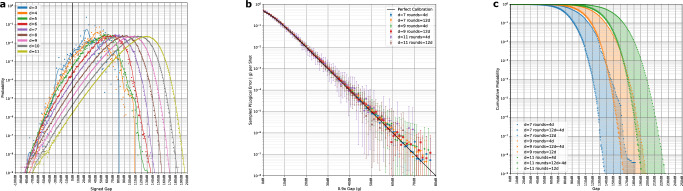
- Data/sample: simulations of inner surface-code experiments and outer-code decoding, including gap distributions from \(10^9\) shots, inner rounds up to \(10d\) for calibration, and phenomenological simulations up to 200d rounds between checks and 256 surface code patches.
- Main analysis: they use correlated minimum-weight perfect matching, complementary gaps as decoder edge weights, and heuristic/path-counting scaling laws validated against circuit-level and phenomenological simulations.
## Limitations
- The paper explicitly says the savings are shown through extrapolations and that full-scale simulations are needed to verify the precise overhead saved.
- It states that the estimates are conservative because of hook-error suppression and scaling approximations, so the reported overheads may be improvable.
- Evident from the text: the main benchmarks are based on a specific noise model (SI1000 at \(10^{-3}\)) and the authors acknowledge limited noise-strength diversity, so generality beyond these settings is not directly established.
Model-written summary. Check it against the paper before relying on it.
Integrity signals
Registry
Cites
Statistics
Figures
Verification
Claims the paper makes
7 Valid · 2 Not valid · 3 Not checked · 44 Own results and interpretations
Every source the paper cites for this claim was checked and supports it.
In the paper
“Second, their locality limits the damage caused by correlated errors, sometimes for free28.”
§ Yoked surface codes > Introduction
What the sources say
- Supportedcites [28] Manes, A. G. & Claes, J. Distance-preserving stabilizer measurements in hypergraph product codes. Quantum 9, 1618 (2025). source
Section 1 (Introduction) and Section 4 (Effective Code Distance) state that a single ancilla fault in a weight-ω check propagates to at most ⌊ω/2⌋ data qubits, so the size (and hence damage) of the resulting correlated multi-qubit error is bounded by the small support of the parity check. Section 4 then shows that, because each HGP stabilizer acts only on a single row/column of qubits, such a propagated error 'can only reduce the weight of the logical by 1', giving Theorem 2: the effective distance stays d for any measurement circuit — i.e. the damage limitation comes 'for free'. The only wording difference is that our copy speaks of fault propagation/hook errors rather than 'correlated errors' as a noise model, which is the same content. (LLM, conf=0.82)
hedgedstates a cause- Asserted: passes — The authors put it forward as true.
- Checkable: passes — It can be checked against evidence.
- Load-bearing: unclear — It is unclear whether the paper’s conclusions depend on it.
- Based: passes — The paper gives a reason why it holds.
- Supported
The cited sources that could be checked couldn’t confirm or dispute this claim.
In the paper
“When 4∣n, this can be fixed by permuting the qubits for different Pauli type row and column checks.”
§ Yoked surface codes > Results > Quantum parity check codes
What the sources say
- Could not verifycites [12] Li, M. & Yoder, T. J. A numerical study of bravyi-bacon-shor and subsystem hypergraph product codes. In: 2020 IEEE international conference on quantum computing and engineering (QCE), 109–119 (IEEE, 2020). sourceExperimental — accuracy not yet measured
Our copy of the Li-Muyuan-Yoder (2020) paper nowhere states a divisibility-by-4 condition or a qubit-permutation fix for anticommuting row/column operators. The closest material is the BBS review (Sec. II) and 'Decoding the BBS codes' (Eqs. 60-61), which give the X-type stabilizers as X(diag(r)A) and Z-type as Z(Adiag(c)) for a symmetric A = G^T Q G, and the only anticommutation remark in the paper (Sec. III.B, on FIG. 1) concerns qubit 4's high-weight logical operators having 'more chance of anticommuting with dressed logical operators' — a simulation-performance point, not a construction fix. Searches for 'permuting qubits when 4 divides n', 'anticommuting row and column logical operators', 'relabel/reorder qubits so X and Z checks commute', and 'doubly-even/self-orthogonal, weight divisible by four' returned no passage addressing the claim, so the attributed point cannot be checked against this source. (LLM, conf=0.70)
plainstates a cause- Asserted: passes — The authors put it forward as true.
- Checkable: passes — It can be checked against evidence.
- Load-bearing: passes — The paper’s conclusions depend on it.
- Based: passes — The paper gives a reason why it holds.
- Could not verify
The cited sources that could be checked couldn’t confirm or dispute this claim.
In the paper
“In 1D, these consist of parity checks along each row of an array of surface codes29.”
§ Yoked surface codes > Introduction
What the sources say
- Could not verifycites [29] Steane, A. M. Simple quantum error-correcting codes. Phys. Rev. A 54, 4741–4751 (1996). 9914038 sourceExperimental — accuracy not yet measured
Our copy of Steane (1996) is entirely about quantum codes built from pairs of classical linear codes (the {n,K,d}+ notation, weakly self-dual codes, displacement matrices D, and Hadamard/sign-allocation searches in section 3); it never mentions surface codes, arrays or lattices of qubits laid out geometrically, or parity checks taken along rows of such an array. I searched for 'surface code / array of codes / parity checks along rows' and 'two dimensional lattice / topological / toric code' — the closest hits are the generic use of rows of check and generator matrices (pp. 6, 8, 9) and the metaphorical 'lattice of points in Hamming space' (p. 14), none of which describe surface codes. The paper therefore neither supports nor contradicts the attributed statement about 1D yoked surface codes. (LLM, conf=0.70)
plain- Asserted: passes — The authors put it forward as true.
- Checkable: passes — It can be checked against evidence.
- Load-bearing: passes — The paper’s conclusions depend on it.
- Based: passes — The paper gives a reason why it holds.
- Could not verify
The cited sources support only part of this claim — read each source’s verdict below.
In the paper
“At an error rate of 10−3, it can take 1000–2000 physical qubits per logical qubit for the surface code to reach error rates low enough to run classically intractable algorithms1–5.”
§ Yoked surface codes > Introduction
What the sources say
- Partly supportedcites [1] Fowler, A. G., Mariantoni, M., Martinis, J. M. & Cleland, A. N. Surface codes: Towards practical large-scale quantum computation. Phys. Rev. A 86, 032324 (2012). sourceExperimental — accuracy not yet measured
The statistical-model section (p. 12) says that at a physical error rate around 10^-3, a logical qubit needs 10^3–10^4 physical qubits to reach error rates sufficient for Shor’s algorithm. That supports the claim’s general point, but not its narrower 1,000–2,000-qubit estimate; the paper’s factoring example uses about 14,500 physical qubits per computational logical qubit (Background, p. 2). (LLM, conf=0.87)
- Not checked — no full text of the sourcecites [2] Shor, P. W. Algorithms for quantum computation: Discrete logarithms and factoring. In: Foundations of Computer Science, 1994 Proceedings, 35th Annual Symposium on, 124–134 (IEEE, 1994). source
- Supportedcites [3] Gidney, C. & Ekerå, M. How to factor 2048 bit rsa integers in 8 hours using 20 million noisy qubits. Quantum 5, 433 (2021). source
Section 2.14 (Physical qubit count) states that, at code distance 27 for factoring a 2048-bit RSA integer, each logical qubit covers 1,568 physical qubits. Sections 2.13 and 2.16 connect that code distance and surface-code error correction to the assumed physical gate error rate of 10^-3. This supports the claim as an example of what such a computation can require. (LLM, conf=0.92)
- Partly supportedcites [4] Häner, T., Jaques, S., Naehrig, M., Roetteler, M. & Soeken, M. Improved quantum circuits for elliptic curve discrete logarithms. In: Post-Quantum Cryptography: 11th International Conference, PQCrypto 2020, vol. 12100, 425 (Springer Nature, 2020). sourceExperimental — accuracy not yet measured
The Introduction (p. 1) reports that 2,330 logical qubits could translate into 6.77 × 10^7 physical qubits under plausible assumptions about physical error rates. The Preliminaries (p. 2) also describe surface-code overhead. Neither passage supports the specified 10^-3 physical error rate or the estimate of 1,000–2,000 physical qubits per logical qubit. (LLM, conf=0.76)
- Partly supportedcites [5] Litinski, D. How to compute a 256-bit elliptic curve private key with only 50 million toffoli gates. Preprint at https://arxiv.org/abs/2306.08585 (2023). sourceExperimental — accuracy not yet measured
Sections 2.1 and 2.2 use code distances of 28 and 24 for the paper’s key-breaking computation; section 2.1 says a circuit-based logical qubit uses 2d² physical qubits, yielding 1,568 and 1,152 qubits respectively. The Overview of results specifies a physical error rate of 10% of the surface-code threshold, but our copy does not equate that assumption with 10^-3. Thus the qubit range is supported, while the claimed physical error rate is not established by this source. (LLM, conf=0.84)
plainstates a cause- Asserted: passes — The authors put it forward as true.
- Checkable: passes — It can be checked against evidence.
- Load-bearing: passes — The paper’s conclusions depend on it.
- Based: passes — The paper gives a reason why it holds.
- Partly supported
Every source the paper cites for this claim was checked and supports it.
In the paper
“Passing this information to the outer code helps it to identify likely culprit errors30.”
§ Yoked surface codes > Results > Complementary gaps
What the sources say
- Supportedcites [30] Poulin, D. Optimal and efficient decoding of concatenated quantum block codes. Phys. Rev. A 74, 052333 (2006). source
Section III.A (Optimal decoding, p. 4) states that the message passing algorithm's advantage comes from not throwing away useful information: instead of a hard decision, 'the entire list of probability of possible recoveries, conditioned on the observed syndrome, is passed on' to the next level of coding, yielding a conditionally renormalized channel. Section IV (p. 4) likewise says 'information about the syndromes is propagated from one layer of concatenation to the next,' which is what lets the outer layer carry out the maximum-likelihood identification of the logical error L (Section III.A, p. 3). The citing sentence's 'complementary gap information' is its own framing; the attributed content — that passing this soft information upward helps the outer code pinpoint the likely error — is what our copy states. (LLM, conf=0.85)
plainstates a cause- Asserted: passes — The authors put it forward as true.
- Checkable: passes — It can be checked against evidence.
- Load-bearing: passes — The paper’s conclusions depend on it.
- Based: passes — The paper gives a reason why it holds.
- Supported
27 more claims
Create a free account to see all 56 claims and to verify the 4 references still open.
- Probably not a substantial claim. 6
- It may state two separate claims as one. 18
- The quote only partly states this claim. 1
Citations
Cites
Algorithms for quantum computation: discrete logarithms and factoring
Shor, P. W. (2002) · Proceedings 35th Annual Symposium on Foundations of Computer Science · doi:10.1109/sfcs.1994.365700 · Cited by 8,713
Surface codes: Towards practical large-scale quantum computation
Fowler, A. G., Mariantoni, M., Martinis, J. M., & Cleland, A. N. (2012) · Physical Review A · doi:10.1103/physreva.86.032324 · Cited by 3,059 · cited 2×
“At an error rate of 10 − 3 , it can take 1000 – 2000 physical qubits per logical qubit for the surface code to reach error rates low enough to run classically intractable algorithms 1 – 5 .”
How to factor 2048 bit RSA integers in 8 hours using 20 million noisy qubits
Gidney, C., & Ekerå, M. (2021) · Quantum · doi:10.22331/q-2021-04-15-433 · Cited by 830
Self-citationSurface code quantum computing by lattice surgery
Horsman, D., Fowler, A. G., Devitt, S., & Meter, R. V. (2012) · New Journal of Physics · doi:10.1088/1367-2630/14/12/123011 · Cited by 598 · cited 1×
“Originally, lattice surgery was thought of as being built out of parity measurements 26,31 , but another useful perspective is to view lattice surgery as an instantiation of the ZX calculus 32 .”
Simple quantum error-correcting codes
Steane, A. M. (1996) · Physical Review A · doi:10.1103/physreva.54.4741 · Cited by 522 · cited 2×
“In particular, for 1D and square 2D codes, we obtain families of [[ n , n − 2, 2]] 29 and [[ n 2 , n 2 − 4 n + 2, 4]] codes, respectively.”
High-threshold and low-overhead fault-tolerant quantum memory
Bravyi, S., Cross, A. W., Gambetta, J. M., Maslov, D., Rall, P., & Yoder, T. J. (2024) · Nature · doi:10.1038/s41586-024-07107-7 · Cited by 456
Stim: a fast stabilizer circuit simulator
Gidney, C. (2021) · Quantum · doi:10.22331/q-2021-07-06-497 · Cited by 415 · cited 1×
“The full simulations were performed by generating stim circuits 36 to describe the experiments, with yoke detectors added to the boundaries to preserve matchability.”
Self-citationA Game of Surface Codes: Large-Scale Quantum Computing with Lattice Surgery
Litinski, D. (2019) · Quantum · doi:10.22331/q-2019-03-05-128 · Cited by 408
Tillich, J.-P., & Zemor, G. (2014) · IEEE Transactions on Information Theory · doi:10.1109/tit.2013.2292061 · Cited by 288
Degenerate Quantum LDPC Codes With Good Finite Length Performance
Panteleev, P., & Kalachev, G. (2021) · Quantum · doi:10.22331/q-2021-11-22-585 · Cited by 257
A no-go theorem for a two-dimensional self-correcting quantum memory based on stabilizer codes
Bravyi, S., & Terhal, B. (2009) · New Journal of Physics · doi:10.1088/1367-2630/11/4/043029 · Cited by 255
A game of surface codes: Large-scale quantum computing with lattice surgery
Litinski, D. (2019) · Refubium (Universitätsbibliothek der Freien Universität Berlin) · doi:10.17169/refubium-4067 · Cited by 252
Asymptotically good Quantum and locally testable classical LDPC codes
Panteleev, P., & Kalachev, G. (2022) · Proceedings of the 54th Annual ACM SIGACT Symposium on Theory of Computing · doi:10.1145/3519935.3520017 · Cited by 222
Tradeoffs for Reliable Quantum Information Storage in 2D Systems
Bravyi, S., Poulin, D., & Terhal, B. (2010) · Physical Review Letters · doi:10.1103/physrevlett.104.050503 · Cited by 191
Fault-Tolerant quantum computation with constant overhead
Gottesman, D. (2014) · Quantum Information and Computation · doi:10.26421/qic14.15-16-5 · Cited by 172
Constant-overhead fault-tolerant quantum computation with reconfigurable atom arrays
Xu, Q., Bonilla Ataides, J. P., Pattison, C. A., Raveendran, N., Bluvstein, D., Wurtz, J., Vasić, B., Lukin, M. D., Jiang, L., & Zhou, H. (2024) · Nature Physics · doi:10.1038/s41567-024-02479-z · Cited by 157
Constant overhead quantum fault tolerance with quantum expander codes
Fawzi, O., Grospellier, A., & Leverrier, A. (2021) · Communications of the ACM · doi:10.1145/3434163 · Cited by 111
Fault tolerance of quantum low-density parity check codes with sublinear distance scaling
Kovalev, A. A., & Pryadko, L. P. (2013) · Physical Review A · doi:10.1103/physreva.87.020304 · Cited by 107
Optimal and efficient decoding of concatenated quantum block codes
Poulin, D. (2006) · Physical Review A · doi:10.1103/physreva.74.052333 · Cited by 105 · cited 2×
“These outer codes have distances two and four respectively which, by utilizing the soft information provided by the inner surface codes 30 , double and quadruple the inner code distance.”
Hyperbolic and semi-hyperbolic surface codes for quantum storage
Breuckmann, N. P., Vuillot, C., Campbell, E., Krishna, A., & Terhal, B. M. (2017) · Quantum Science and Technology · doi:10.1088/2058-9565/aa7d3b · Cited by 87
The ZX calculus is a language for surface code lattice surgery
de Beaudrap, N., & Horsman, D. (2020) · Quantum · doi:10.22331/q-2020-01-09-218 · Cited by 83
A Fault-Tolerant Honeycomb Memory
Gidney, C., Newman, M., Fowler, A., & Broughton, M. (2021) · Quantum · doi:10.22331/q-2021-12-20-605 · Cited by 83 · cited 1×
“See also Supplementary Note 1 for overhead estimates using a standard uniform depolarizing error model, which is typically less noisy than SI1000 at the same parameterized noise rate 37 .”
Self-citationConstant-Overhead Quantum Error Correction with Thin Planar Connectivity
Tremblay, M. A., Delfosse, N., & Beverland, M. E. (2022) · Physical Review Letters · doi:10.1103/physrevlett.129.050504 · Cited by 83 · cited 2×
“First, their syndrome extraction circuits are small and highly parallelizable 6 , so the noise injected into the system while measuring checks is low.”
Relaxing Hardware Requirements for Surface Code Circuits using Time-dynamics
McEwen, M., Bacon, D., & Gidney, C. (2023) · Quantum · doi:10.22331/q-2023-11-07-1172 · Cited by 78
Self-citationEfficient Markov chain Monte Carlo algorithm for the surface code
Hutter, A., Wootton, J. R., & Loss, D. (2014) · Physical Review A · doi:10.1103/physreva.89.022326 · Cited by 77
Improved Quantum Circuits for Elliptic Curve Discrete Logarithms
Häner, T., Jaques, S., Naehrig, M., Roetteler, M., & Soeken, M. (2020) · Lecture Notes in Computer Science · doi:10.1007/978-3-030-44223-1_23 · Cited by 76
Connectivity constrains quantum codes
Baspin, N., & Krishna, A. (2022) · Quantum · doi:10.22331/q-2022-05-13-711 · Cited by 75
Hierarchical memories: Simulating quantum LDPC codes with local gates
Pattison, C. A., Krishna, A., & Preskill, J. P. (2025) · Quantum · doi:10.22331/q-2025-05-05-1728 · Cited by 74
Fault-Tolerant Postselection for Low-Overhead Magic State Preparation
Bombín, H., Pant, M., Roberts, S., & Seetharam, K. (2024) · PRX Quantum · doi:10.1103/prxquantum.5.010302 · Cited by 70
Low overhead quantum computation using lattice surgery
Fowler, A. G., & Gidney, C. (2018) · arXiv · doi:10.48550/arxiv.1808.06709 · Cited by 69
Self-citationLogical Blocks for Fault-Tolerant Topological Quantum Computation
Bombín, H., Dawson, C., Mishmash, R. V., Nickerson, N., Pastawski, F., & Roberts, S. (2023) · PRX Quantum · doi:10.1103/prxquantum.4.020303 · Cited by 59
Subsystem codes with spatially local generators
Bravyi, S. (2011) · Physical Review A · doi:10.1103/physreva.83.012320 · Cited by 53
Subsystem codes with high thresholds by gauge fixing and reduced qubit overhead
Higgott, O., & Breuckmann, N. P. (2021) · Physical Review X · doi:10.1103/physrevx.11.031039 · Cited by 48
Quantifying Nonlocality: How Outperforming Local Quantum Codes Is Expensive
Baspin, N., & Krishna, A. (2022) · Physical Review Letters · doi:10.1103/physrevlett.129.050505 · Cited by 37
Optimal complexity correction of correlated errors in the surface code
Fowler, A. G. (2013) · arXiv · doi:10.48550/arxiv.1310.0863 · Cited by 36
Fault-Tolerant Quantum Computation with Constant OverheadPreprint
Gottesman, D. (2013) · arXiv (Cornell University) · doi:10.48550/arxiv.1310.2984 · Cited by 35
Improved rate-distance trade-offs for quantum codes with restricted connectivity
Baspin, N., Guruswami, V., Krishna, A., & Li, R. (2024) · Quantum Science and Technology · doi:10.1088/2058-9565/ad8370 · Cited by 25
Partial Syndrome Measurement for Hypergraph Product Codes
Berthusen, N., & Gottesman, D. (2024) · Quantum · doi:10.22331/q-2024-05-14-1345 · Cited by 24
Hierarchical memories: Simulating quantum LDPC codes with local gates
Pattison, C. A., Krishna, A., & Preskill, J. (2023) · arXiv · doi:10.48550/arxiv.2303.04798 · Cited by 20
Distance-preserving stabilizer measurements in hypergraph product codes
Manes, A. G., & Claes, J. (2025) · Quantum · doi:10.22331/q-2025-01-30-1618 · Cited by 17 · cited 1×
“Second, their locality limits the damage caused by correlated errors, sometimes for free 28 .”
A Numerical Study of Bravyi-Bacon-Shor and Subsystem Hypergraph Product Codes
Li, M., & Yoder, T. J. (2020) · 2020 IEEE International Conference on Quantum Computing and Engineering (QCE) · doi:10.1109/qce49297.2020.00024 · Cited by 12
Asymptotically Good Quantum and Locally Testable Classical LDPC Codes
Panteleev, P., & Kalachev, G. (2021) · arXiv · doi:10.48550/arxiv.2111.03654 · Cited by 9
How to compute a 256-bit elliptic curve private key with only 50 million Toffoli gates
Litinski, D. (2023) · arXiv · doi:10.48550/arxiv.2306.08585 · Cited by 5
Research works printed but not linked: 1
- Gidney, C., Newman, M., Brooks, P. & Jones, C. Data for “yoked surface codes” https://zenodo.org/record/10277397 (2025). PMC12078507 40368911
Cited by
Quantum error correction below the surface code threshold
Collaborators, G. Q. A. A., Acharya, R., Abanin, D. A., Aghababaie-Beni, L., Aleiner, I., Andersen, T. I., Ansmann, M., Arute, F., Arya, K., Asfaw, A., et al. (2025) · Nature · doi:10.1038/s41586-024-08449-y · Cited by 778
Self-citationLearning high-accuracy error decoding for quantum processors
Bausch, J., Senior, A. W., Heras, F. J. H., Edlich, T., Davies, A., Newman, M., Jones, C., Satzinger, K., Niu, M. Y., Blackwell, S., et al. (2024) · Nature · doi:10.1038/s41586-024-08148-8 · Cited by 106
“The probabilistic output can be used as soft information in hierarchical decoding schemes 50,51 , or as a confidence measure to discard the least confident samples (Fig.”
Self-citationAkahoshi, Y., Toshio, R., Fujisaki, J., Oshima, H., Sato, S., & Fujii, K. (2025) · PRX Quantum · doi:10.1103/93zr-1ykb · Cited by 49
Grand Challenge of Quantum Applications
Babbush, R., King, R., Boixo, S., Huggins, W. J., Khattar, T., Low, G. H., McClean, J. R., O’Brien, T. E., & Rubin, N. C. (2026) · PRX Quantum · doi:10.1103/6r9l-lynr · Cited by 73
Low-Overhead Magic State Distillation with Color Codes
Lee, S.-H., Thomsen, F., Fazio, N., Brown, B. J., & Bartlett, S. D. (2025) · PRX Quantum · doi:10.1103/ch5r-cnfq · Cited by 49
Metadata
- Authors
- Gidney, C., Newman, M., Brooks, P., & Jones, C.
- Affiliations
- Google (United States) (US)
- Corresponding author
- Newman, Michael
- ORCID
- Newman, Michael
- Venue
- Nature Communications
- Published
- 2025-05-14
- Volume
- 16
- Issue
- 1
- Pages
- 4498-4498
- ISSN
- 2041-1723 (ISSN-L)
- PMC
- PMC12078507
- OpenAlex
- W4410357503
- Cited by
- 85
- References
- 44
- Citations by year
- 2026: 56 · 2025: 21
- FWCI
- 19.80
- Type
- journal article
- Language
- en
- Open access
- gold
- doi.org
- Licence
- cc-by
- creativecommons.org/licenses/by/4.0 (tdm)
- creativecommons.org/licenses/by/4.0 (vor)
- Locations
- Nature Communications (publishedVersion, cc-by)
- PubMed Central (publishedVersion, cc-by)
- PubMed (publishedVersion)
- arXiv (Cornell University) (submittedVersion)
- RePEc: Research Papers in Economics (submittedVersion)
- DOAJ (DOAJ: Directory of Open Access Journals) (submittedVersion, cc-by-sa)
- arXiv (Cornell University)
- Topics
- Physical Sciences › Computer Science › Artificial Intelligence › Quantum Computing Algorithms and Architecture
- Physical Sciences › Physics and Astronomy › Atomic and Molecular Physics, and Optics › Quantum Information and Cryptography
- Physical Sciences › Physics and Astronomy › Atomic and Molecular Physics, and Optics › Quantum many-body systems
- Keywords
- surface code, fault-tolerant quantum memory, lattice surgery, logical error rate, concatenated codes, quantum error correction
About these checks
Registry, retraction, Cites and statistics results are computed, not judged, with one exception: a printed reference that no index lists is read once by a model before it counts as a citation error. Claims are extracted by a model and kept only when their quote appears verbatim in the text; each cited source is then checked, with a model’s help, for whether it says what the claim relies on. Those verdicts can be wrong — read the claim’s quote and the cited source before relying on one.
The claim verdicts this report counts are experimental: their accuracy is not yet measured.
A language model drew the claims from the paper on 2026-10-10, under version 3 of the claim definition (model deepseek-v4.1-flash, prompt extract-v3).
A second model labelled each claim on 2026-10-10 (model jev-1.13-20260917, definition revision gold-guideline-v0.2).
Cited sources are checked with a language model’s help (qwen3.8-omni-flash and gpt-6-sol).
Statistics and arithmetic are recomputed, not judged.
Confidence bands are shown only for fields calibrated on our annotated test set. None is calibrated yet, so no band is shown.
What counts as a claim ›How we measure confidence ›How we check this ›
Are you an author, or do you see a problem with this page? Request a review
Data sources
Bibliographic data: Semantic Scholar, OpenAlex, Crossref.
Contains information from the Semantic Scholar Academic Graph Datasets, made available under the ODC Attribution License (ODC-BY 1.0).
Semantic Scholar’s data is described in: Kinney, R., et al. (2023). The Semantic Scholar Open Data Platform. arXiv:2301.10140.
