

Spatially resolved nanostructural analysis of disordered phases in carbonated alkali-activated slag
Open accessThe DOI matches its Crossref record; 76 of the 76 references it cites were found in a registry or an index; 1 of the 52 sources its claims cite were checked for support.
Abstract
Alkali-activated slag (AAS) is a promising low-CO2 alternative cement consisting of several disordered phases of similar composition. Although their local atomic arrangements are known to influence macroscopic behavior, determination of structural changes in response to external stimuli remains a challenge. Here, X-ray diffraction-computed tomography (XRD-CT), pair distribution function-CT (PDF-CT), and nanoprobe X-ray fluorescence (nano-XRF) have been used to uncover how an increase of magnesium in AAS affects the atomic structure and spatial arrangement of phases after aggressive carbonation (100% dry CO2), conditions experienced in applications such as oil and gas wells and geological storage of CO2. From PDF-CT it is found that a higher magnesium content decreases the average nanoscale crystallite size of disordered calcium carbonate. At the same time, higher magnesium content is correlated with a less decalcified C-(N)-A-S-H gel, as determined via analysis of Ca-Si atom-atom correlations from PDF-CT and Ca/Si ratios from nano-XRF. Finally, nano-XRF reveals that the disordered (i.e., amorphous) calcium carbonate is stabilized by the presence of silicates. Amorphous phases in alkali-activated slag cement are explored using spatially resolved synchrotron X-ray techniques. Local atomic structures of individual phases show the impact of magnesium content on resistance to CO2-induced degradation.
Overview
CoChat Summary
## TL;DR
The paper uses XRD-CT, PDF-CT, and nano-XRF to map how magnesium changes the carbonation response of early-age alkali-activated slag under 100% dry CO2. Higher Mg content is linked to less decalcified C-(N)-A-S-H gel, smaller/less crystalline calcium carbonate domains, and silicate-stabilized amorphous calcium carbonate.
## Key findings
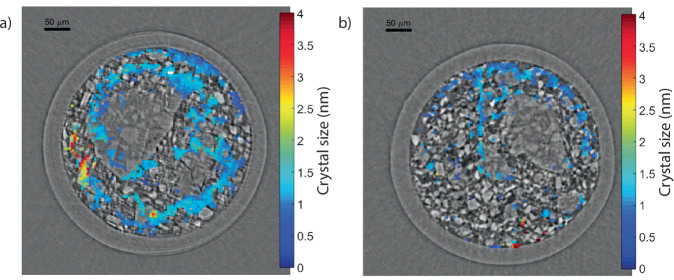
- After carbonation in 100% dry CO2, the low-Mg sample showed more carbonation than the high-Mg sample: more voxels contained CaCO3, and the carbonation front was about 10 to 40 μm wide, though this may be overestimated because of the 10 μm beam dimension.
- PDF-CT nanocrystallite-size fits gave average calcium carbonate domain sizes of 1.2 nm for low-Mg AAS and 1.1 nm for high-Mg AAS; the low-Mg sample also had nanocrystals up to 3.5–4 nm.
- The C–Si-related PDF peak at 3.65 Å was diminished by carbonation, and it was more diminished in the low-Mg sample, indicating greater decalcification of C-(N)-A-S-H gel.
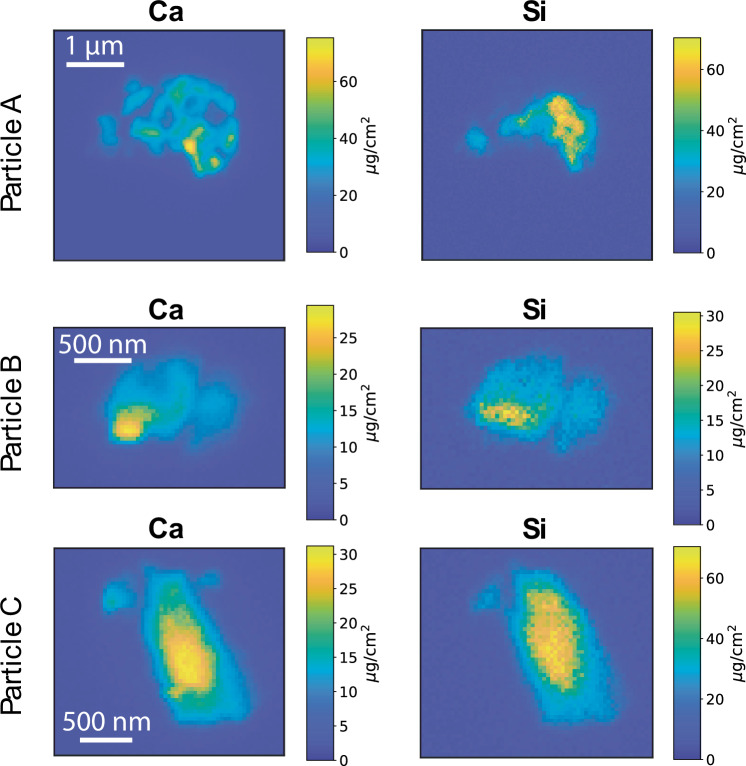
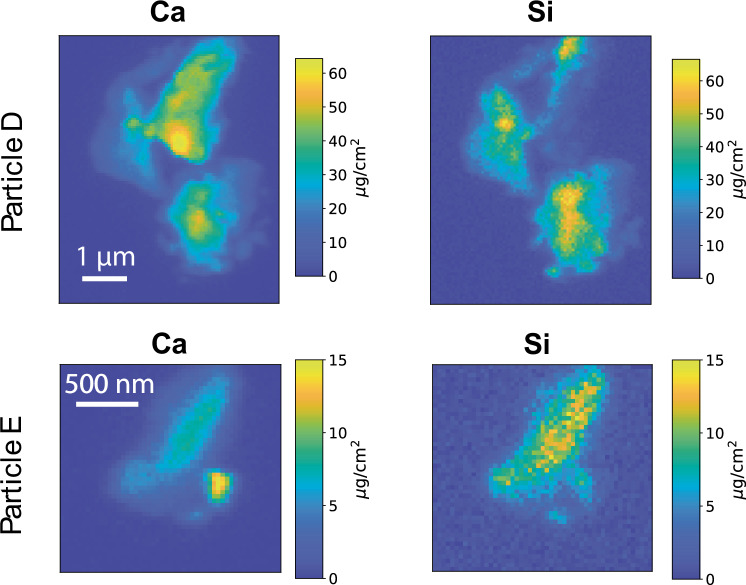
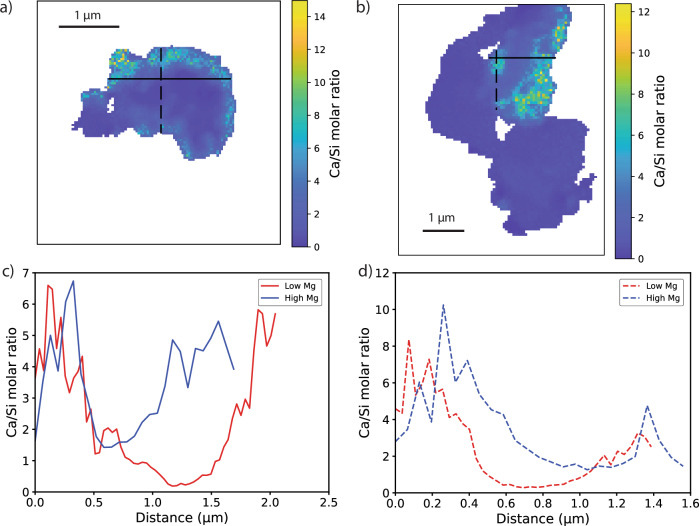
- Nano-XRF showed that Ca-rich outer regions contained Si, supporting the conclusion that silicates stabilize amorphous calcium carbonate (ACC); the low-Mg sample had a lower minimum Ca/Si ratio, consistent with greater calcium migration/decalcification.
## Methods
- Two sodium silicate-activated slag pastes were prepared: one from slag with 12.7% MgO and one with 7.3% MgO; pastes were cured 24 h before analysis or carbonation.
- Carbonated samples were exposed to 100% dry industrial-grade CO2 for 24 h at room temperature; the high-Mg paste was also measured before carbonation.
- Phase/structure mapping used XRD-CT and PDF-CT at APS 1-ID with voxel sizes of 2 × 2 × 10 μm3 for the non-carbonated sample and 4 × 4 × 10 μm3 for the carbonated samples; chemical mapping used nano-XRF at APS 26-ID-B with ~40 nm resolution.
## Limitations
- The paper states that phase intermixing occurred below the 10 μm length scale, so the local atomic structure of C-(N)-A-S-H gel in carbonated samples could not be determined in some regions, and slag vs gel remained hard to distinguish at 4 × 4 × 10 μm3 resolution.
- The authors note that the 10 μm beam dimension may overestimate the carbonation front width.
- The paper explicitly notes that humidity was not actively controlled during carbonation, and says the implications should be reassessed across different humidity levels; this limits how directly the findings generalize to other carbonation environments.
Model-written summary. Check it against the paper before relying on it.
Integrity signals
Registry
Cites
Statistics
Figures
Verification
Claims the paper makes
1 Valid · 0 Not valid · 28 Not checked · 73 Own results and interpretations
Every source the paper cites for this claim was checked and supports it.
In the paper
“It has also been shown that the Mg content of ACC affects solubility, where a higher extent of Mg incorporation leads to a more soluble phase74.”
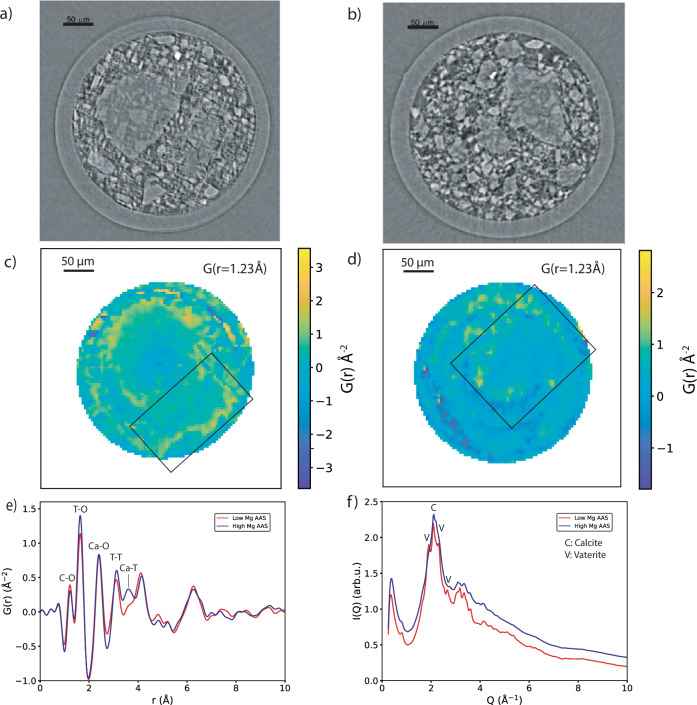
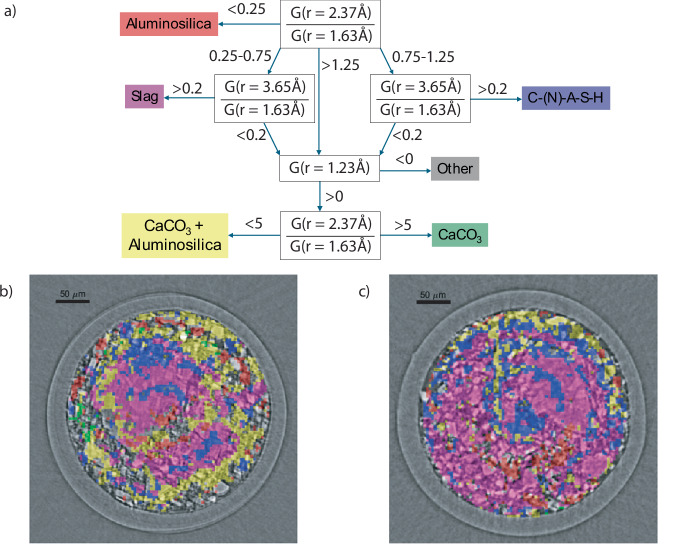
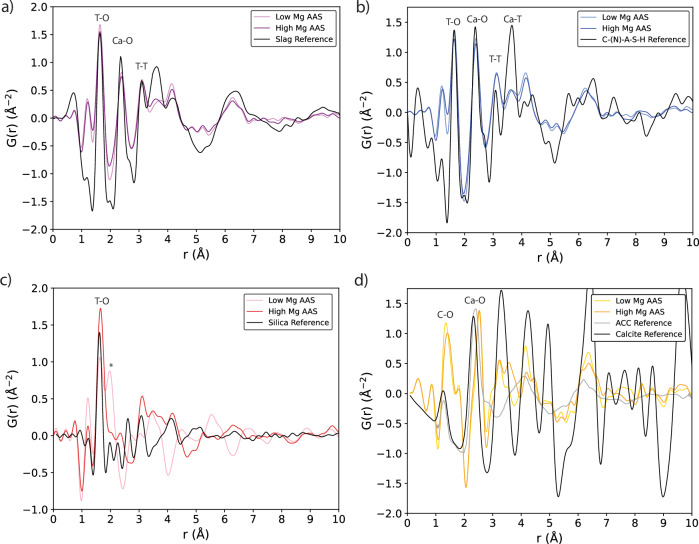
§ Spatially resolved nanostructural analysis of disordered phases in carbonated alkali-activated slag > Discussion This study used X-ray diffraction-computed tomography (XRD-CT), pair distribution function-computed tomography (PDF-CT), and nanoprobe X-ray fluorescence (nano-XRF) to elucidate the roles of magnesium and silicates in mitigating CO2-induced degradation of sustainable alkali-activated blast furnace slag (AAS) cement under accelerated 100% carbonation conditions. PDF-CT analysis of a young AAS paste (after 24 h of curing) was capable of identifying voxels (2 × 2 × 10 μm3 voxel size) whose PDFs were consistent with unreacted slag or pure C-(N)-A-S-H gel, although the majority of voxels were found to contain both phases, showing intermixing within 10 μm. After exposure of young AAS pastes synthesized with high and low Mg slag to 100% dry CO2, the PDF-CT data contained amorphous calcium carbonate (ACC) regions intermixed with decalcified gel (i.e., aluminosilica gel) (see yellow regions in Fig. 4b, c and corresponding colored regions in Fig. 6 for enhanced clarity). These regions were found to encase carbonate-deficient cores consisting of slightly decalcified partially-reacted slag (blue and magenta, particularly evident in the lower half of Fig. 4b). Regions identified as C-(N)-A-S-H gel in the carbonate-deficient cores were found to strongly mimic slag (at 4 × 4 × 10 μm3 voxel size), so the local atomic structure of C-(N)-A-S-H gel in the carbonated samples could not be determined. Unexpectedly, the calcium carbonate phase was found to be mostly amorphous for both carbonated samples, and a higher magnesium content slag correlated with greater amorphicity, with 1.2 nm nanocrystallite size for the low Mg carbonated AAS sample and 1.1 nm for the high Mg sample. The distinct presence of Ca–Si atom-atom correlations in the ACC PDF data was attributed to the inclusion of silicates in this phase, as independently verified using nano-XRF. This quantification of nanocrystalline size supports the hypothesis that carbonation resistance in AAS is linked with the formation of a more disordered (i.e., amorphous) calcium carbonate39. Since ACC is metastable but less thermodynamically favorable than crystalline calcium carbonate48, the equilibrium of dissolution favors a higher concentration of Ca2+ in solution where ACC is present, which reduces the driving force for decalcification of the C-(N)-A-S-H gel. It has also been shown that the Mg content of ACC affects solubility, where a higher extent of Mg incorporation leads to a more soluble phase74. PDF-CT data showed that both magnesium and silicates are linked with the formation of ACC, although no direct evidence of magnesium incorporation was found in the PDF data due to resolution limitations. Nano-XRF provided additional evidence of this carbonation resistance mechanism. Elemental maps of the two carbonated samples showed spatial variance in the Ca/Si ratio of carbonated gel particles, with high Ca/Si areas on the exterior attributed to calcium carbonate, and low Ca/Si on the interior attributed to decalcified C-(N)-A-S-H gel. This spatial variance is due to the outward migration of calcium. The low Mg carbonated AAS sample had a significantly lower minimum Ca/Si ratio, indicating greater decalcification (i.e., calcium migration), while the presence of Si within the Ca-rich regions is in agreement with PDF-CT data showing that ACC formation is stabilized by silicates. Nano-XRF Ca/Si ratio maps showed that slag particles remain largely unaffected by exposure to 100% dry CO2. These findings demonstrate that the combination of spatially resolved PDF analysis with nano-XRF is particularly powerful at uncovering the local atomic structures of different disordered phases of similar chemical compositions in heterogeneous microstructures. Recent increases in synchrotron brilliance and implementation of primary beam X-ray focusing optics will be especially useful for achieving finer PDF-CT resolution compared to this investigation, where significant intermixing of phases occurred at a length scale of 10 μm. Moreover, not only are the findings of this investigation relevant for increasing the resistance of cements such as AAS to CO2-induced degradation caused by aggressive conditions (i.e., 100% CO2), they provide clues as to which chemistries are best avoided if the aim is to maximize CO2 uptake when using 100% dry CO2. For calcium-based cements where the formation of calcite is desired (e.g., carbonate cements) or CO2 uptake is beneficial (e.g., carbonation of waste cement), magnesium (in a reactive form) should be avoided since it would likely lead to the formation of less stable and therefore undesirable calcium carbonate phases that inhibit further uptake of CO2. In addition, the presence of silicates in the aqueous phase may suppress CO2 uptake, which would be prevalent under highly alkaline and highly acidic conditions, so careful control of pH may be helpful. However, it is important to note that humidity is known to play a critical role in the carbonation of cement-based materials75,76, and as such, these implications should be reassessed across a range of humidity levels to determine their relevance.
What the sources say
- Supportedcites [74] Purgstaller, B., Goetschl, K. E., Mavromatis, V. & Dietzel, M. Solubility investigations in the amorphous calcium magnesium carbonate system. CrystEngComm 21, 155–164 (2019). 30760969 PMC6336086 source
The Results and discussion section (Solubility approach, Fig. 5 discussion) explicitly states that ACMC solubility increases with Mg content. This directly supports the claim that greater Mg incorporation yields a more soluble amorphous carbonate phase. (LLM, conf=0.94)
plainstates a cause- Asserted: passes — The authors put it forward as true.
- Checkable: passes — It can be checked against evidence.
- Load-bearing: unclear — It is unclear whether the paper’s conclusions depend on it.
- Based: passes — The paper gives a reason why it holds.
- Supported
A result the paper reports from its own data — it cites no other source for it, so there is none to check. The quote shows it is in the paper.
In the paper
“Isothermal conduction calorimetry (ICC) data given in Supplementary Fig. 1 show similar cumulative heat after 24 h of curing, indicating a similar extent of reaction (i.e., extent of slag dissolution and amount of C-(N)-A-S-H gel precipitation).”
§ Spatially resolved nanostructural analysis of disordered phases in carbonated alkali-activated slag > Results
hedged- Asserted: passes — The authors put it forward as true.
- Checkable: passes — It can be checked against evidence.
- Load-bearing: unclear — It is unclear whether the paper’s conclusions depend on it.
- Based: passes — The paper gives a reason why it holds.
In the paper
“A small peak is observable at Q = 0.8 Å−1 from the individual voxels, which is attributed to an LDH secondary phase15.”
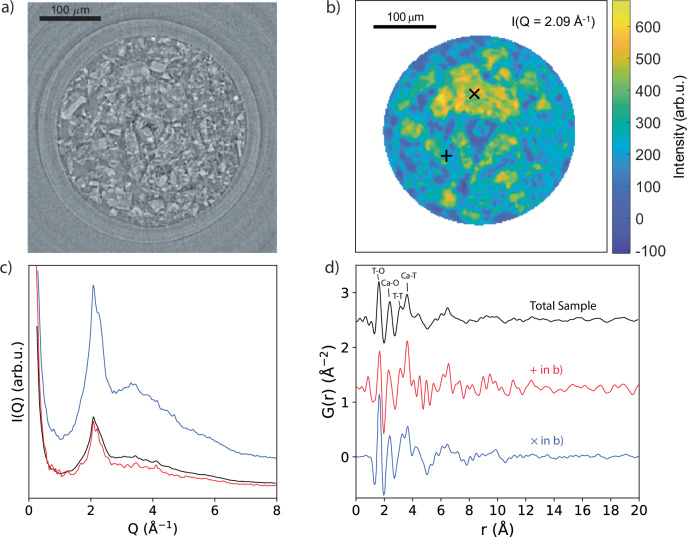
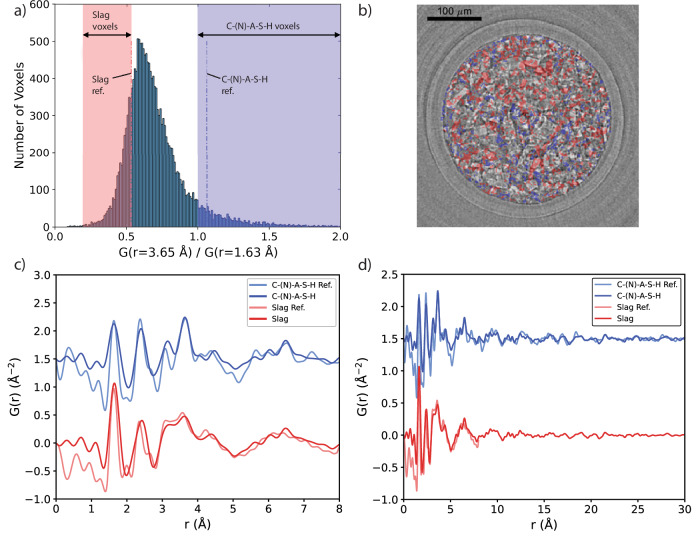
§ Spatially resolved nanostructural analysis of disordered phases in carbonated alkali-activated slag > Results > Alkali activated slag A tomographic slice of high Mg AAS paste is displayed in Fig. 1a, which shows the cross-section region subsequently chosen for XRD-CT and PDF-CT analysis. This region contains mostly large solid regions of AAS rather than loose powder particles, and is seen to consist of angular, partially-reacted slag particles surrounded by the gel matrix. Such solid regions are particularly evident in Fig. 1b (XRD-CT and PDF-CT have voxel dimensions of 2 × 2 × 10 µm3, with 10 µm aligned along the length of the capillary), where the diffraction intensity at Q = 2.09 Å−1 is mapped, which corresponds to the main peak observed for C-(N)-A-S-H gel33. Since the intensity of this peak varies across the cross-section, the average X-ray scattering pattern has been computed and is shown in Fig. 1c, along with diffraction patterns for two individual voxels of different peak intensities from Fig. 1b. In each case, the diffraction pattern shows diffuse scattering with amorphous C-(N)-A-S-H gel as the primary component. A small peak is observable at Q = 0.8 Å−1 from the individual voxels, which is attributed to an LDH secondary phase15. Due to the amorphous nature of the slag and C-(N)-A-S-H gel, phase identification has been conducted in real space. Figure 1d shows the average PDF across the whole sample in addition to PDFs from the two individual voxels noted previously. The individual voxels show similar peak positions and intensities to the average, although the ‘+’ voxel appears to have some longer-range order. The average scan corresponds well with the local structure of AAS of the same age and composition determined from bulk PDF measurement39. The peaks at 1.63 Å and 2.37 Å correspond to tetrahedrally bonded Si and AlIV atoms (labeled T) with oxygen, and Ca–O bonds, respectively62. The peak at 3.15 Å represents the correlation (i.e., distance) between two T atoms (T–T correlation) in addition to a correlation between calcium and tetrahedral atoms (Ca–T), while the peak at 3.65 Å predominantly contains contributions from a Ca atom and a tetrahedrally bonded atom (Ca–T) along with those from two calcium atoms (Ca–Ca)63,64. Small contributions to AAS PDFs that are typically observed in the literature, for example, a small peak at 2.0 Å from Mg–O bonds and a shoulder or peak at 2.6 Å from O–O interactions are absent here14,39. This is attributed to the relatively low Qmax value used for the Fourier transformation (data were collected to 20 Å−1 but processed to 16 Å−1) that was necessary to obtain sufficient quality real space data. For the two individual voxels, clear differences are observed in their PDFs, in particular the relative intensities of peaks at close range (r = 1–4 Å) as well as peak positions and intensities for longer range correlations, demonstrating spatial variance in atomic structure not observable with XRD-CT. In order to identify the phase distribution of slag and C-(N)-A-S-H gel, it is useful to consider the relative PDF peak intensity at r = 3.65 Å for each voxel, since this is known to noticeably increase as C-(N)-A-S-H gel forms64,65. This relative peak intensity can be approximated by the G(r = 3.65 Å)/G(r = 1.63 Å) ratio from PDF, i.e., the intensity at r = 3.65 Å divided by the intensity at r = 1.63 Å. Figure 2a shows the histogram of values for this ratio, along with a reference value of 0.53 obtained for the same slag14 and a reference value of 1.1 for C-(N)-A-S-H gel, obtained by subtraction of slag contribution to PDF in an AAS sample63. As the majority of voxels fall within these two limits, this indicates that many voxels contain a mixture of phases. Clearly, within the resolution of the voxel, there is heterogeneity of AAS, with slag and C-(N)-A-S-H gel intermixed. This is consistent with electron microscopy studies of AAS, where slag and C-(N)-A-S-H gel are also observed to intermix within 10 μm17,18,66. To determine the spatial distribution of slag- and gel-rich regions within the AAS microstructure, the voxels that have a ratio between 0.2–0.55 and a ratio between 1–2 (shaded red and blue in Fig. 2a, respectively) were assigned as voxels containing predominantly slag and C-(N)-A-S-H gel, respectively. A minimum cutoff of 0.2 for slag and a maximum cutoff of 2 for C-(N)-A-S-H gel were used to keep ratios to realistic values. The PDF of a voxel with a ratio <0.2 is provided in Supplementary Fig. 3a, where the local atomic structure is observed to be distinctly different from that of slag. By contrast, Supplementary Fig. 3b, c confirms that an individual voxel assigned as slag or C-(N)-A-S-H gel shows similar local atomic structure to the average of the respective phase. Individual voxels appear to have greater long-range order, which is attributed to regions of (nano)crystallinity. The higher degree of long-range ordering in C-(N)-A-S-H gel compared to slag indicates the C-(N)-A-S-H gel has a greater degree of nanocrystallinity, with ordering up to 30 Å observed, in agreement with a previous study using bulk PDF characterization63. Figure 2b shows the distribution of slag and C-(N)-A-S-H gel voxels overlaid on the 2D cross-section of the tomogram. These voxels align well with the light slag and dark gel matrix regions of the tomogram cross-section, and account for 21.0% and 7.4% of all voxels, respectively. The low extent of reaction after 24 h of curing is in agreement with observations from isothermal calorimetry18,65. Figure 2c, d shows the average PDF of these voxels compared with the reference PDFs14,63 out to 8 and 30 Å, respectively. For both phases, the local atomic structure, Ca/Si ratios (from G(r = 2.37 Å)/G(r = 1.63 Å) ratio), and structure at distances up to 30 Å all show excellent agreement with the reference values, demonstrating the validity of using PDF-CT to identify separate phases within a heterogeneous mixture and extract quantitative information on the structure of each phase.
What the sources say
- Not checked — no full text of the sourcecites [15] Ben Haha, M., Lothenbach, B., Le Saout, G. & Winnefeld, F. Influence of slag chemistry on the hydration of alkali-activated blast-furnace slag - Part II: effect of Al 2 O 3. Cem. Concr. Res. 42, 74–83 (2012). source
plainstates an associationn = 2- Asserted: passes — The authors put it forward as true.
- Checkable: passes — It can be checked against evidence.
- Load-bearing: unclear — It is unclear whether the paper’s conclusions depend on it.
- Based: passes — The paper gives a reason why it holds.
A result the paper reports from its own data — it cites no other source for it, so there is none to check. The quote shows it is in the paper.
In the paper
“Finally, nano-XRF reveals that the disordered (i.e., amorphous) calcium carbonate is stabilized by the presence of silicates.”
§ Spatially resolved nanostructural analysis of disordered phases in carbonated alkali-activated slag > Abstract
plainstates a cause- Asserted: passes — The authors put it forward as true.
- Checkable: passes — It can be checked against evidence.
- Load-bearing: passes — The paper’s conclusions depend on it.
- Based: passes — The paper gives a reason why it holds.
A result the paper reports from its own data — it cites no other source for it, so there is none to check. The quote shows it is in the paper.
In the paper
“In each case, the diffraction pattern shows diffuse scattering with amorphous C-(N)-A-S-H gel as the primary component.”
§ Spatially resolved nanostructural analysis of disordered phases in carbonated alkali-activated slag > Results > Alkali activated slag A tomographic slice of high Mg AAS paste is displayed in Fig. 1a, which shows the cross-section region subsequently chosen for XRD-CT and PDF-CT analysis. This region contains mostly large solid regions of AAS rather than loose powder particles, and is seen to consist of angular, partially-reacted slag particles surrounded by the gel matrix. Such solid regions are particularly evident in Fig. 1b (XRD-CT and PDF-CT have voxel dimensions of 2 × 2 × 10 µm3, with 10 µm aligned along the length of the capillary), where the diffraction intensity at Q = 2.09 Å−1 is mapped, which corresponds to the main peak observed for C-(N)-A-S-H gel33. Since the intensity of this peak varies across the cross-section, the average X-ray scattering pattern has been computed and is shown in Fig. 1c, along with diffraction patterns for two individual voxels of different peak intensities from Fig. 1b. In each case, the diffraction pattern shows diffuse scattering with amorphous C-(N)-A-S-H gel as the primary component. A small peak is observable at Q = 0.8 Å−1 from the individual voxels, which is attributed to an LDH secondary phase15. Due to the amorphous nature of the slag and C-(N)-A-S-H gel, phase identification has been conducted in real space. Figure 1d shows the average PDF across the whole sample in addition to PDFs from the two individual voxels noted previously. The individual voxels show similar peak positions and intensities to the average, although the ‘+’ voxel appears to have some longer-range order. The average scan corresponds well with the local structure of AAS of the same age and composition determined from bulk PDF measurement39. The peaks at 1.63 Å and 2.37 Å correspond to tetrahedrally bonded Si and AlIV atoms (labeled T) with oxygen, and Ca–O bonds, respectively62. The peak at 3.15 Å represents the correlation (i.e., distance) between two T atoms (T–T correlation) in addition to a correlation between calcium and tetrahedral atoms (Ca–T), while the peak at 3.65 Å predominantly contains contributions from a Ca atom and a tetrahedrally bonded atom (Ca–T) along with those from two calcium atoms (Ca–Ca)63,64. Small contributions to AAS PDFs that are typically observed in the literature, for example, a small peak at 2.0 Å from Mg–O bonds and a shoulder or peak at 2.6 Å from O–O interactions are absent here14,39. This is attributed to the relatively low Qmax value used for the Fourier transformation (data were collected to 20 Å−1 but processed to 16 Å−1) that was necessary to obtain sufficient quality real space data. For the two individual voxels, clear differences are observed in their PDFs, in particular the relative intensities of peaks at close range (r = 1–4 Å) as well as peak positions and intensities for longer range correlations, demonstrating spatial variance in atomic structure not observable with XRD-CT. In order to identify the phase distribution of slag and C-(N)-A-S-H gel, it is useful to consider the relative PDF peak intensity at r = 3.65 Å for each voxel, since this is known to noticeably increase as C-(N)-A-S-H gel forms64,65. This relative peak intensity can be approximated by the G(r = 3.65 Å)/G(r = 1.63 Å) ratio from PDF, i.e., the intensity at r = 3.65 Å divided by the intensity at r = 1.63 Å. Figure 2a shows the histogram of values for this ratio, along with a reference value of 0.53 obtained for the same slag14 and a reference value of 1.1 for C-(N)-A-S-H gel, obtained by subtraction of slag contribution to PDF in an AAS sample63. As the majority of voxels fall within these two limits, this indicates that many voxels contain a mixture of phases. Clearly, within the resolution of the voxel, there is heterogeneity of AAS, with slag and C-(N)-A-S-H gel intermixed. This is consistent with electron microscopy studies of AAS, where slag and C-(N)-A-S-H gel are also observed to intermix within 10 μm17,18,66. To determine the spatial distribution of slag- and gel-rich regions within the AAS microstructure, the voxels that have a ratio between 0.2–0.55 and a ratio between 1–2 (shaded red and blue in Fig. 2a, respectively) were assigned as voxels containing predominantly slag and C-(N)-A-S-H gel, respectively. A minimum cutoff of 0.2 for slag and a maximum cutoff of 2 for C-(N)-A-S-H gel were used to keep ratios to realistic values. The PDF of a voxel with a ratio <0.2 is provided in Supplementary Fig. 3a, where the local atomic structure is observed to be distinctly different from that of slag. By contrast, Supplementary Fig. 3b, c confirms that an individual voxel assigned as slag or C-(N)-A-S-H gel shows similar local atomic structure to the average of the respective phase. Individual voxels appear to have greater long-range order, which is attributed to regions of (nano)crystallinity. The higher degree of long-range ordering in C-(N)-A-S-H gel compared to slag indicates the C-(N)-A-S-H gel has a greater degree of nanocrystallinity, with ordering up to 30 Å observed, in agreement with a previous study using bulk PDF characterization63. Figure 2b shows the distribution of slag and C-(N)-A-S-H gel voxels overlaid on the 2D cross-section of the tomogram. These voxels align well with the light slag and dark gel matrix regions of the tomogram cross-section, and account for 21.0% and 7.4% of all voxels, respectively. The low extent of reaction after 24 h of curing is in agreement with observations from isothermal calorimetry18,65. Figure 2c, d shows the average PDF of these voxels compared with the reference PDFs14,63 out to 8 and 30 Å, respectively. For both phases, the local atomic structure, Ca/Si ratios (from G(r = 2.37 Å)/G(r = 1.63 Å) ratio), and structure at distances up to 30 Å all show excellent agreement with the reference values, demonstrating the validity of using PDF-CT to identify separate phases within a heterogeneous mixture and extract quantitative information on the structure of each phase.
plainn = 2- Asserted: passes — The authors put it forward as true.
- Checkable: passes — It can be checked against evidence.
- Load-bearing: passes — The paper’s conclusions depend on it.
- Based: passes — The paper gives a reason why it holds.
52 more claims
Create a free account to see all 102 claims and to verify the 9 references still open.
- It may state two separate claims as one. 36
- Probably not a substantial claim. 10
Citations
Cites
Costs and carbon emissions for geopolymer pastes in comparison to ordinary portland cement
McLellan, B. C., Williams, R. P., Lay, J., van Riessen, A., & Corder, G. D. (2011) · Journal of Cleaner Production · doi:10.1016/j.jclepro.2011.02.010 · Cited by 1,949 · cited 1×
“AAMs can exhibit comparable mechanical properties to OPC 9 and have seen real-world deployment 10 , whilst reducing CO 2 emissions by as much as 70% or more 11 – 13 .”
Le Quéré, C., Andrew, R. M., Canadell, J. G., Sitch, S., Korsbakken, J. I., Peters, G. P., Manning, A. C., Boden, T. A., Tans, P. P., Houghton, R. A., et al. (2016) · Earth System Science Data · doi:10.5194/essd-8-605-2016 · Cited by 1,094 · cited 1×
“Cement production accounts for 5 – 8% of global anthropogenic CO 2 emissions 1,2 .”
Ben Haha, M., Le Saout, G., Winnefeld, F., & Lothenbach, B. (2011) · Cement and Concrete Research · doi:10.1016/j.cemconres.2010.11.016 · Cited by 1,059
Alkali-activated fly ash/slag cements
Puertas, F., Martı́nez-Ramı́rez, S., Alonso, S., & Vázquez, T. (2000) · Cement and Concrete Research · doi:10.1016/s0008-8846(00)00298-2 · Cited by 921 · cited 1×
“7, 8).”
Innovation in use and research on cementitious material
Scrivener, K. L., & Kirkpatrick, R. J. (2008) · Cement and Concrete Research · doi:10.1016/j.cemconres.2007.09.025 · Cited by 828 · cited 1×
“Cement production accounts for 5 – 8% of global anthropogenic CO 2 emissions 1,2 .”
Technical and commercial progress in the adoption of geopolymer cement
Van Deventer, J. S. J., Provis, J. L., & Duxson, P. (2012) · Minerals Engineering · doi:10.1016/j.mineng.2011.09.009 · Cited by 820 · cited 1×
“AAMs can exhibit comparable mechanical properties to OPC 9 and have seen real-world deployment 10 , whilst reducing CO 2 emissions by as much as 70% or more 11 – 13 .”
Durability of concrete — Degradation phenomena involving detrimental chemical reactions
Glasser, F. P., Marchand, J., & Samson, E. (2008) · Cement and Concrete Research · doi:10.1016/j.cemconres.2007.09.015 · Cited by 704 · cited 1×
“However, after portlandite is consumed, additional CO 2 causes a reduction in pore solution pH, which may instigate steel corrosion for reinforced concrete, leading to a loss of tensile strength and formation of expansive ironoxidephases 24,25 .”
Loste, E., Wilson, R. M., Seshadri, R., & Meldrum, F. C. (2003) · Journal of Crystal Growth · doi:10.1016/s0022-0248(03)01153-9 · Cited by 618 · cited 2×
“It has been shown that Mg stabilization of ACC is due to the higher solvation energy of Mg 2+ compared with Ca 2+47 , making it harder for dehydration to occur for transformation into anhydrous crystalline CaCO 3 45 .”
Haha, M. B., Lothenbach, B., Le Saout, G., & Winnefeld, F. (2012) · Cement and Concrete Research · doi:10.1016/j.cemconres.2011.08.005 · Cited by 580
The pore solution of blended cements: a review
Vollpracht, A., Lothenbach, B., Snellings, R., & Haufe, J. (2016) · Materials and Structures · doi:10.1617/s11527-015-0724-1 · Cited by 568 · cited 1×
“In OPC concrete, the presence of portlandite (Ca(OH) 2 ) buffers the pore solution at >12.5, which initially prevents depassivation and corrosion of reinforcing steel, if present 21 .”
InfluentialCarbonation of C–S–H and C–A–S–H samples studied by 13C, 27Al and 29Si MAS NMR spectroscopy
Sevelsted, T. F., & Skibsted, J. (2015) · Cement and Concrete Research · doi:10.1016/j.cemconres.2015.01.019 · Cited by 558
Carbonation of CH and C–S–H in composite cement pastes containing high amounts of BFS
Borges, P. H. R., Costa, J. O., Milestone, N. B., Lynsdale, C. J., & Streatfield, R. E. (2010) · Cement and Concrete Research · doi:10.1016/j.cemconres.2009.10.020 · Cited by 555
Transformation and crystallization energetics of synthetic and biogenic amorphous calcium carbonate
Radha, A. V., Forbes, T. Z., Killian, C. E., Gilbert, P. U. P. A., & Navrotsky, A. (2010) · Proceedings of the National Academy of Sciences · doi:10.1073/pnas.1009959107 · Cited by 509 · cited 2×
“With respect to AAS, since ACC is less thermodynamically stable than crystalline CaCO 3 48 , the higher solubility product of ACC increases Ca 2+ concentration in the pore solution, which lowers the driving force for C-(N)-A-S-H gel decomposition 39 .”
Carey, J. W., Wigand, M., Chipera, S. J., WoldeGabriel, G., Pawar, R., Lichtner, P. C., Wehner, S. C., Raines, M. A., & Guthrie, G. D. (2007) · International Journal of Greenhouse Gas Control · doi:10.1016/s1750-5836(06)00004-1 · Cited by 503
Bernal, S. A., San Nicolas, R., Myers, R. J., Mejía de Gutiérrez, R., Puertas, F., van Deventer, J. S. J., & Provis, J. L. (2014) · Cement and Concrete Research · doi:10.1016/j.cemconres.2013.12.003 · Cited by 493
Microstructural changes in alkali-activated slag mortars induced by accelerated carbonation
Li, N., Farzadnia, N., & Shi, C. (2017) · Cement and Concrete Research · doi:10.1016/j.cemconres.2017.07.008 · Cited by 488 · cited 3×
“Similarly, for AAS, it is known that permeability and gel composition affect carbonation behavior, where C-(N)-A-S-H gel with a high Ca/Si ratio has been linked with a lower extent of CO 2 -induced gel decalci fi cation 33,34 .”
InfluentialChemical changes and phase analysis of OPC pastes carbonated at different CO2 concentrations
Castellote, M., Fernandez, L., Andrade, C., & Alonso, C. (2009) · Materials and Structures · doi:10.1617/s11527-008-9399-1 · Cited by 470
Ions in Solution and their Solvation
Marcus, Y. (2015) · doi:10.1002/9781118892336 · Cited by 420 · cited 1×
“It has been shown that Mg stabilization of ACC is due to the higher solvation energy of Mg 2+ compared with Ca 2+47 , making it harder for dehydration to occur for transformation into anhydrous crystalline CaCO 3 45 .”
Puertas, F., Fernández-Jiménez, A., & Blanco-Varela, M. T. (2004) · Cement and Concrete Research · doi:10.1016/s0008-8846(03)00254-0 · Cited by 409 · cited 1×
“The composition of the gel, secondary phases, and pore solution in AAS are affected by both initial slag composition 14 – 16 and choice of alkaline activator 17 – 19 .”
A reaction engineering approach to the problem of concrete carbonation
Papadakis, V. G., Vayenas, C. G., & Fardis, M. N. (1989) · AIChE Journal · doi:10.1002/aic.690351008 · Cited by 404 · cited 2×
“However, after portlandite is consumed, additional CO 2 causes a reduction in pore solution pH, which may instigate steel corrosion for reinforced concrete, leading to a loss of tensile strength and formation of expansive ironoxidephases 24,25 .”
Very early-age reaction kinetics and microstructural development in alkali-activated slag
Gebregziabiher, B. S., Thomas, R., & Peethamparan, S. (2015) · Cement and Concrete Composites · doi:10.1016/j.cemconcomp.2014.09.001 · Cited by 393 · cited 2×
“The low extent of reaction after 24 h of curing is in agreement with observations from isothermal calorimetry 18,65 .”
Ke, X., Bernal, S. A., & Provis, J. L. (2017) · Cement and Concrete Research · doi:10.1016/j.cemconres.2017.05.015 · Cited by 375 · cited 1×
“…et al. linked improved carbonation resistance to the presence of a hydrotalcite-like layered double hydroxide (LDH) phase (with composition Mg 1-x Al x (OH) 2 A n-x/ n ·mH 2 O, where x = 0.17 – 0.33 and A n − is an anion 42 ) which sequesters carbonate anions within its layered structure 37,38,43 .”
InfluentialBlack, L., Breen, C., Yarwood, J., Garbev, K., Stemmermann, P., & Gasharova, B. (2007) · Journal of the American Ceramic Society · doi:10.1111/j.1551-2916.2006.01429.x · Cited by 350
Recent update on the environmental impact of geopolymers
Habert, G., & Ouellet-Plamondon, C. (2016) · RILEM Technical Letters · doi:10.21809/rilemtechlett.2016.6 · Cited by 330 · cited 1×
“AAMs can exhibit comparable mechanical properties to OPC 9 and have seen real-world deployment 10 , whilst reducing CO 2 emissions by as much as 70% or more 11 – 13 .”
Adsorption of Carbon Dioxide onto Hydrotalcite-like Compounds (HTlcs) at High Temperatures
Yong, Z., Mata, & Rodrigues, A. E. (2001) · Industrial & Engineering Chemistry Research · doi:10.1021/ie000238w · Cited by 297 · cited 1×
“…et al. linked improved carbonation resistance to the presence of a hydrotalcite-like layered double hydroxide (LDH) phase (with composition Mg 1-x Al x (OH) 2 A n-x/ n ·mH 2 O, where x = 0.17 – 0.33 and A n − is an anion 42 ) which sequesters carbonate anions within its layered structure 37,38,43 .”
InfluentialMagnesium and calcium silicate hydrates
Lothenbach, B., Nied, D., L'Hôpital, E., Achiedo, G., & Dauzères, A. (2015) · Cement and Concrete Research · doi:10.1016/j.cemconres.2015.06.007 · Cited by 296 · cited 1×
“…possesses a slightly higher amount of surface and weakly bound water visible via moreweightlossbetweenambienttemperatureand105°C. Additional insightsonAASpastepropertiespriortoCO 2 exposurearegiveninthe Supplementary Information, based on existing literature 58 – 61 and our recent work 39 – 41 .”
Effect of alkali dosage and silicate modulus on carbonation of alkali-activated slag mortars
Shi, Z., Shi, C., Wan, S., Li, N., & Zhang, Z. (2018) · Cement and Concrete Research · doi:10.1016/j.cemconres.2018.07.005 · Cited by 291 · cited 1×
“Moreover, high alkali dosage and increased silicate modulus of AAS have been observed to improve carbonation resistance, where a high alkali dosage leads to faster gel formation and increases pore solution alkalinity 35,36 .”
Properties of Metakaolin blended cements
Ambroise, J., Maximilien, S., & Pera, J. (1994) · Advanced Cement Based Materials · doi:10.1016/1065-7355(94)90007-8 · Cited by 275
Phase diagrams for alkali-activated slag binders
Myers, R. J., Bernal, S. A., & Provis, J. L. (2017) · Cement and Concrete Research · doi:10.1016/j.cemconres.2017.02.006 · Cited by 241
Thermodynamic modelling of alkali-activated slag cements
Myers, R. J., Lothenbach, B., Bernal, S. A., & Provis, J. L. (2015) · Applied Geochemistry · doi:10.1016/j.apgeochem.2015.06.006 · Cited by 240
X-ray diffraction computed tomography
Harding, G., Kosanetzky, J., & Neitzel, U. (1987) · Medical Physics · doi:10.1118/1.596063 · Cited by 212 · cited 1×
“When carried out using a small beam size at a synchrotron source ( 10× 10 μ m 2 ), the technique can be combined with computed tomography 50 , similar to the more established X-ray diffraction computed tomography (XRD-CT) technique 51 – 53 .”
Activation of blended cements containing fly ash
Qian, J., Shi, C., & Wang, Z. (2001) · Cement and Concrete Research · doi:10.1016/s0008-8846(01)00526-9 · Cited by 177
Natural carbonation of aged alkali-activated slag concretes
Bernal, S. A., San Nicolas, R., Provis, J. L., Mejía de Gutiérrez, R., & van Deventer, J. S. J. (2014) · Materials and Structures · doi:10.1617/s11527-013-0089-2 · Cited by 168 · cited 1×
“Similarly, for AAS, it is known that permeability and gel composition affect carbonation behavior, where C-(N)-A-S-H gel with a high Ca/Si ratio has been linked with a lower extent of CO 2 -induced gel decalci fi cation 33,34 .”
Stabilization of amorphous calcium carbonate in inorganic silica-rich environments
Kellermeier, M., Melero-García, E., Glaab, F., Klein, R., Drechsler, M., Rachel, R., García-Ruiz, J. M., & Kunz, W. (2010) · Journal of the American Chemical Society · doi:10.1021/ja106959p · Cited by 158 · cited 2×
“Discrepancies between the samples and references between 3 – 4Å are attributed to Ca – Si correlations, which arise from silicates stabilizing ACC 69 .”
Characterization of Aged Slag Concretes
(2008) · ACI Materials Journal · doi:10.14359/19753 · Cited by 157
Hydration Degree of Alkali‐Activated Slags: A 29 Si NMR Study
Le Saoût, G., Ben Haha, M., Winnefeld, F., & Lothenbach, B. (2011) · Journal of the American Ceramic Society · doi:10.1111/j.1551-2916.2011.04828.x · Cited by 154
Energetic and structural studies of amorphous Ca1−Mg CO3·nH2O (0 ⩽x⩽ 1)
Radha, A. V., Fernandez-Martinez, A., Hu, Y., Jun, Y.-S., Waychunas, G. A., & Navrotsky, A. (2012) · Geochimica et Cosmochimica Acta · doi:10.1016/j.gca.2012.04.056 · Cited by 151
Bernal, S. A. (2015) · Construction and Building Materials · doi:10.1016/j.conbuildmat.2015.08.013 · Cited by 142
Colloidal Stabilization of Calcium Carbonate Prenucleation Clusters with Silica
Kellermeier, M., Gebauer, D., Melero‐García, E., Drechsler, M., Talmon, Y., Kienle, L., Cölfen, H., García‐Ruiz, J. M., & Kunz, W. (2012) · Advanced Functional Materials · doi:10.1002/adfm.201200953 · Cited by 140 · cited 1×
“The presence of silicates within the calcium car-bonateregionssupportspreviousstudiesbyKellermeieretal.that fi nd silicates stabilize ACC 69,71,72 , and our previous study that hypothesizes both Mg and silicates contribute to the formation of ACC (as opposed to crystalline calcium carbonate phases)…”
Structure, Mechanisms of Reaction, and Strength of an Alkali‐Activated Blast‐Furnace Slag
Burciaga‐Díaz, O., & Escalante‐García, J. I. (2013) · Journal of the American Ceramic Society · doi:10.1111/jace.12620 · Cited by 137 · cited 1×
“The composition of the gel, secondary phases, and pore solution in AAS are affected by both initial slag composition 14 – 16 and choice of alkaline activator 17 – 19 .”
Zhang, Q., Feng, P., Shen, X., Lu, J., Ye, S., Wang, H., Ling, T., & Ran, Q. (2023) · Journal of CO2 Utilization · doi:10.1016/j.jcou.2023.102502 · Cited by 137 · cited 1×
“…are certain applications where extensive carbonation is bene fi cial for a cement-based material, such as carbonate cement (i.e., carbonation of pseudo-wollastonite and rankinite) 30 and carbonation of waste cement as a means of reducing CO 2 emissions across the life cycle of OPC concrete 31 .”
Garg, N., & White, C. E. (2017) · Journal of Materials Chemistry A · doi:10.1039/c7ta00412e · Cited by 128
Self-citationGong, K., & White, C. E. (2016) · Cement and Concrete Research · doi:10.1016/j.cemconres.2016.09.003 · Cited by 125 · cited 7×
“ThereferenceforslagisfromGong and White 14 , for C-(N)-A-S-H gel from Garg and White 63 , for aluminosilica (reference is fumed silica) from Alventosa and White 67 , for calcite, the reference was simulated (crystal structure ICSD-52151), while the reference for ACC is from Radha et al. 46 .…”
InfluentialSelf-citationPair distribution function computed tomography
Jacques, S. D. M., Michiel, M. D., Kimber, S. A. J., Yang, X., Cernik, R. J., Beale, A. M., & Billinge, S. J. L. (2013) · Nature Communications · doi:10.1038/ncomms3536 · Cited by 125 · cited 1×
“When carried out using a small beam size at a synchrotron source ( 10× 10 μ m 2 ), the technique can be combined with computed tomography 50 , similar to the more established X-ray diffraction computed tomography (XRD-CT) technique 51 – 53 .”
Jacques, S. D. M., Michiel, M. D., Beale, A. M., Sochi, T., O’Brien, M. G., Espinosa‐Alonso, L., Weckhuysen, B. M., & Barnes, P. W. (2011) · Angewandte Chemie International Edition · doi:10.1002/anie.201104604 · Cited by 112
Morandeau, A. E., & White, C. E. (2015) · Journal of Materials Chemistry A · doi:10.1039/c5ta00348b · Cited by 107 · cited 1×
“T and Ca – Ca peak position at 3.65Å is present, and some calcium carbonate phases possess Ca – Ca contributions in this region 68 .”
Self-citationCalcite, vaterite and aragonite forming on cement hydration from liquid and gaseous phase
Stepkowska, E. T., Pérez-Rodríguez, J. L., Sayagués, M. J., & Martínez-Blanes, J. M. (2003) · Journal of Thermal Analysis and Calorimetry · doi:10.1023/a:1025158213560 · Cited by 95 · cited 1×
“Concurrent with the lossofportlandite, the strength-giving calcium-silicate-hydrate (C-S-H) gel decalci fi es and CaCO 3 phases (such as calcite, vaterite, and aragonite) precipitate 22,23 .”
Solubility investigations in the amorphous calcium magnesium carbonate system
Purgstaller, B., Goetschl, K. E., Mavromatis, V., & Dietzel, M. (2019) · CrystEngComm · doi:10.1039/c8ce01596a · Cited by 88 · cited 1×
“It has also been shown that the Mg content of ACC affects solubility, where a higher extent of Mg incorporation leads to a more soluble phase 74 .”
Provis, J. L., Arbi, K., Bernal, S. A., Bondar, D., Buchwald, A., Castel, A., Chithiraputhiran, S., Cyr, M., Dehghan, A., Dombrowski-Daube, K., et al. (2019) · Materials and Structures · doi:10.1617/s11527-019-1396-z · Cited by 85
Morandeau, A. E., & White, C. E. (2015) · Chemistry of Materials · doi:10.1021/acs.chemmater.5b02382 · Cited by 84 · cited 9×
“39 .”
InfluentialSelf-citationRecent developments in X-ray diffraction/scattering computed tomography for materials science
Omori, N. E., Bobitan, A. D., Vamvakeros, A., Beale, A. M., & Jacques, S. D. M. (2023) · Philosophical Transactions of the Royal Society A Mathematical Physical and Engineering Sciences · doi:10.1098/rsta.2022.0350 · Cited by 79 · cited 1×
“This approach, known as PDF-CT, can spatially resolve the local atomic structures contained within heterogeneous multiphase materials and has recently been used to study catalyst and battery materials 54 – 57 .”
Sénécal, P., Jacques, S. D. M., Michiel, M. D., Kimber, S. A. J., Vamvakeros, A., Odarchenko, Y. I., Lezcano‐González, I., Paterson, J., Ferguson, E., & Beale, A. M. (2017) · ACS Catalysis · doi:10.1021/acscatal.6b03145 · Cited by 75 · cited 1×
“This approach, known as PDF-CT, can spatially resolve the local atomic structures contained within heterogeneous multiphase materials and has recently been used to study catalyst and battery materials 54 – 57 .”
Richardson, I. G., & Li, S. (2018) · Construction and Building Materials · doi:10.1016/j.conbuildmat.2018.02.034 · Cited by 70
Pair distribution function and structure factor of spherical particles
Howell, R. C., Proffen, T. E., & Conradson, S. D. (2006) · Physical Review B · doi:10.1103/physrevb.73.094107 · Cited by 68
In situ X-ray pair distribution function analysis of geopolymer gel nanostructure formation kinetics
White, C. E., Provis, J. L., Bloomer, B., Henson, N. J., & Page, K. (2013) · Physical Chemistry Chemical Physics · doi:10.1039/c3cp44342f · Cited by 67
Self-citationNatural carbonation process in cement paste particles in different relative humidities
Saeki, N., Cheng, L., Kurihara, R., Ohkubo, T., Teramoto, A., Suda, Y., Kitagaki, R., & Maruyama, I. (2024) · Cement and Concrete Composites · doi:10.1016/j.cemconcomp.2023.105400 · Cited by 67
Nanoscale Ordering and Depolymerization of Calcium Silicate Hydrates in the Presence of Alkalis
Garg, N., Özçelik, V. O., Skibsted, J., & White, C. E. (2019) · The Journal of Physical Chemistry C · doi:10.1021/acs.jpcc.9b06412 · Cited by 65 · cited 7×
“The higher degree of long-range ordering in C-(N)-A-S-H gel compared to slag indicates the C-(N)-A-S-H gel has a greater degree of nanocrystallinity, with ordering up to 30Å observed, in agreement with a previous study using bulk PDF characterization 63 .”
InfluentialSelf-citationA parametric study of accelerated carbonation in alkali-activated slag
McCaslin, E. R., & White, C. E. (2021) · Cement and Concrete Research · doi:10.1016/j.cemconres.2021.106454 · Cited by 65 · cited 1×
“…within the calcium car-bonateregionssupportspreviousstudiesbyKellermeieretal.that fi nd silicates stabilize ACC 69,71,72 , and our previous study that hypothesizes both Mg and silicates contribute to the formation of ACC (as opposed to crystalline calcium carbonate phases) in carbonated AAS 40 .”
Self-citationKellermeier, M., Glaab, F., Klein, R., Melero-García, E., Kunz, W., & García-Ruiz, J. M. (2013) · Nanoscale · doi:10.1039/c3nr00301a · Cited by 59 · cited 1×
“The presence of silicates within the calcium car-bonateregionssupportspreviousstudiesbyKellermeieretal.that fi nd silicates stabilize ACC 69,71,72 , and our previous study that hypothesizes both Mg and silicates contribute to the formation of ACC (as opposed to crystalline calcium carbonate phases)…”
Zhang, Y., & Çopuroğlu, O. (2022) · Cement and Concrete Composites · doi:10.1016/j.cemconcomp.2022.104642 · Cited by 59 · cited 1×
“Similar behavior in OPC-slag blended systems has been reported, where the hydrotalcite-like LDH phase acts as a sorbent for carbonate anions 44 .”
Shen, J., Dangla, P., & Thiery, M. (2013) · International Journal of Greenhouse Gas Control · doi:10.1016/j.ijggc.2013.07.003 · Cited by 55
ADVANCED CEMENTS FOR GEOTHERMAL WELLS
Sugama, T., & Doe - Office Of Science (2007) · doi:10.2172/909955 · Cited by 50
Saeki, N., Kurihara, R., Ohkubo, T., Teramoto, A., Suda, Y., Kitagaki, R., & Maruyama, I. (2025) · Cement and Concrete Research · doi:10.1016/j.cemconres.2024.107777 · Cited by 48 · cited 2×
“Calciummigrationisthought to beenhanced in wet conditions (i.e., saturated pores) and atambient CO 2 levels, where CO 2 diffusion through the pores is relatively slow compared with the rate of outward migration of calcium 73 .”
Wang, S. Y., McCaslin, E., & White, C. E. (2020) · Cement and Concrete Research · doi:10.1016/j.cemconres.2020.105979 · Cited by 46 · cited 4×
“Because of this difference in ACC stability according to the availability of Mg, we have observed that high Mg AAS undergoes less pore structural change upon accelerated carbonation 41 .”
InfluentialSelf-citationLeemreize, H., Almer, J., Stock, S. R., & Birkedal, H. (2013) · Journal of The Royal Society Interface · doi:10.1098/rsif.2013.0319 · Cited by 38
Self-citationCheng, L., Kurihara, R., Ohkubo, T., Kitagaki, R., Teramoto, A., Suda, Y., & Maruyama, I. (2025) · Cement and Concrete Research · doi:10.1016/j.cemconres.2025.107898 · Cited by 36 · cited 1×
“However, it is important to note that humidity is knownto play a critical role in the carbonation of cement-based materials 75,76 , and as such, these implications should be reassessed across a range of humidity levels to determine their relevance.”
Effect of MgO and Na 2 SiO 3 on the carbonation resistance of alkali activated slag concrete
Khan, M. S. H., & Castel, A. (2018) · Magazine of Concrete Research · doi:10.1680/jmacr.17.00062 · Cited by 29
Claret, F., Grangeon, S., Loschetter, A., Tournassat, C., Nolf, W. D., Harker, N., Boulahya, F., Gaboreau, S., Linard, Y., Bourbon, X., et al. (2018) · IUCrJ · doi:10.1107/s205225251701836x · Cited by 23 · cited 1×
“When carried out using a small beam size at a synchrotron source ( 10× 10 μ m 2 ), the technique can be combined with computed tomography 50 , similar to the more established X-ray diffraction computed tomography (XRD-CT) technique 51 – 53 .”
Pozzolanic Reaction of Carbonated Wollastonite Clinker
Winnefeld, F., Läng, F., & Leemann, A. (2023) · Journal of Advanced Concrete Technology · doi:10.3151/jact.21.631 · Cited by 23
Gong, K., & White, C. E. (2022) · Cement and Concrete Research · doi:10.1016/j.cemconres.2021.106642 · Cited by 21
Self-citationSottmann, J., Ruud, A., Fjellvåg, Ø. S., Vaughan, G., Michel, M. D., Fjellvåg, H., Lebedev, O. I., Vajeeston, P., & Wragg, D. S. (2022) · Physical Chemistry Chemical Physics · doi:10.1039/d2cp03892g · Cited by 17
Mitigation of errors in pair distribution function analysis of nanoparticles
Mullen, K. M., & Levin, I. (2011) · Journal of Applied Crystallography · doi:10.1107/s0021889811014749 · Cited by 13
Lolli, F., & Kurtis, K. E. (2021) · RILEM Technical Letters · doi:10.21809/rilemtechlett.2021.120 · Cited by 11
Sottmann, J., Michiel, M. D., Fjellvåg, H., Malavasi, L., Margadonna, S., Vajeeston, P., Vaughan, G., & Wragg, D. S. (2017) · Angewandte Chemie · doi:10.1002/ange.201704271 · Cited by 10
Alventosa, K. M. L., & White, C. E. (2024) · The Journal of Physical Chemistry C · doi:10.1021/acs.jpcc.3c06653 · Cited by 6 · cited 4×
“ThereferenceforslagisfromGong and White 14 , for C-(N)-A-S-H gel from Garg and White 63 , for aluminosilica (reference is fumed silica) from Alventosa and White 67 , for calcite, the reference was simulated (crystal structure ICSD-52151), while the reference for ACC is from Radha et al. 46 . https://doi.org/10.1038/s4…”
InfluentialSelf-citationA Technology Roadmap for Advanced Geothermal Well Construction
Price, C., Renewable Power Office. Geothermal Technologies Office USDOE Office of Energy Efficiency and Renewable Energy (EERE), Polsky, Y., et al. (2023) · doi:10.2172/2000376 · Cited by 5
Research works printed but not linked: 2
- Palomo, A. & Glasser, F. P. Chemically-bonded cementitious materials based on metakaolin. Br. Ceram. Trans. J. 4, 107–112 (1992).
- Neville, A. M. Properties of Concrete. (Pearson, Harlow, 2011).
Cited by
Zhang, J., & Wu, M. (2026) · Proceedings of the Institution of Mechanical Engineers Part L Journal of Materials Design and Applications · doi:10.1177/14644207261459583
Jee, H., & Garg, N. (2026) · Journal of Synchrotron Radiation · doi:10.1107/s1600577526006776 · Cited by 1
Chen, Y., Huang, J., & Yu, Q. (2026) · Journal of Sustainable Cement-Based Materials · doi:10.1080/21650373.2026.2735350
Xingcai, H. E., Pantongsuk, T., Chen, W., Deng, R., Yu, T., & Zhang, B. (2026) · Journal of Materials Science · doi:10.1007/s10853-026-13826-1
Integrated BSEM-Raman reveals the spatial heterogeneity of mineralogical phases in KOH-GGBS pastes
Yue, Z., Li, X., Zhang, Z., Lyu, Z., Lu, S., Wang, S., & Zhu, X. (2026) · Cement and Concrete Research · doi:10.1016/j.cemconres.2026.108421
Metadata
- Authors
- McCaslin, E. R., James, M. C., Almer, J., Cai, Z., Kenesei, P., Park, J.-S., & White, C. E.
- Affiliations
- Princeton University (US)
- Argonne National Laboratory (US)
- Corresponding author
- White, Claire E.
- ORCID
- Venue
- Nature Communications
- Published
- 2025-12-11
- Volume
- 17
- Issue
- 1
- Pages
- 491-491
- ISSN
- 2041-1723 (ISSN-L)
- PMC
- PMC12804976
- OpenAlex
- W4417227360
- Semantic Scholar
- 8ae11e8b17434618d28cf70343b29e301d4cb351
- Cited by
- 6
- References
- 75
- Citations by year
- 2026: 6
- FWCI
- 2.18
- Type
- journal article
- Language
- en
- Open access
- gold
- doi.org
- Licence
- cc-by-nc-nd
- creativecommons.org/licenses/by-nc-nd/4.0 (tdm)
- creativecommons.org/licenses/by-nc-nd/4.0 (vor, 34 d)
- Locations
- Nature Communications (publishedVersion, cc-by-nc-nd)
- PubMed (publishedVersion)
- PubMed Central (publishedVersion, cc-by-nc-nd)
- DOAJ (DOAJ: Directory of Open Access Journals) (submittedVersion, cc-by-sa)
- Funders
- NSF | Directorate for Mathematical & Physical Sciences | Division of Materials Research (1553607)
- DOE | SC | Basic Energy Sciences (DE-SC0023441, DE-AC02-06CH11357)
- Topics
- Physical Sciences › Engineering › Civil and Structural Engineering › Concrete and Cement Materials Research
- Physical Sciences › Environmental Science › Environmental Engineering › CO2 Sequestration and Geologic Interactions
- Physical Sciences › Materials Science › Biomaterials › Calcium Carbonate Crystallization and Inhibition
- Keywords
- alkali-activated slag, carbonation, disordered phase, amorphous calcium carbonate, C-(N)-A-S-H gel, magnesium content, CO2 geological storage, low-carbon cement, local atomic structure
About these checks
Registry, retraction, Cites and statistics results are computed, not judged, with one exception: a printed reference that no index lists is read once by a model before it counts as a citation error. Claims are extracted by a model and kept only when their quote appears verbatim in the text; each cited source is then checked, with a model’s help, for whether it says what the claim relies on. Those verdicts can be wrong — read the claim’s quote and the cited source before relying on one.
A language model drew the claims from the paper on 2026-10-10, under version 3 of the claim definition (model deepseek-v4.1-flash, prompt extract-v3).
A second model labelled each claim on 2026-10-10 (model jev-1.13-20260917, definition revision gold-guideline-v0.2).
Cited sources are checked with a language model’s help (gpt-6-sol).
Statistics and arithmetic are recomputed, not judged.
Confidence bands are shown only for fields calibrated on our annotated test set. None is calibrated yet, so no band is shown.
What counts as a claim ›How we measure confidence ›How we check this ›
Are you an author, or do you see a problem with this page? Request a review
Data sources
Bibliographic data: Semantic Scholar, OpenAlex, Crossref.
Contains information from the Semantic Scholar Academic Graph Datasets, made available under the ODC Attribution License (ODC-BY 1.0).
Semantic Scholar’s data is described in: Kinney, R., et al. (2023). The Semantic Scholar Open Data Platform. arXiv:2301.10140.
