

Efficient and noise resilient measurements for quantum chemistry on near-term quantum computers
Open accessThe DOI matches its Crossref record; 59 of the 59 references it cites were found in a registry or an index.
Abstract
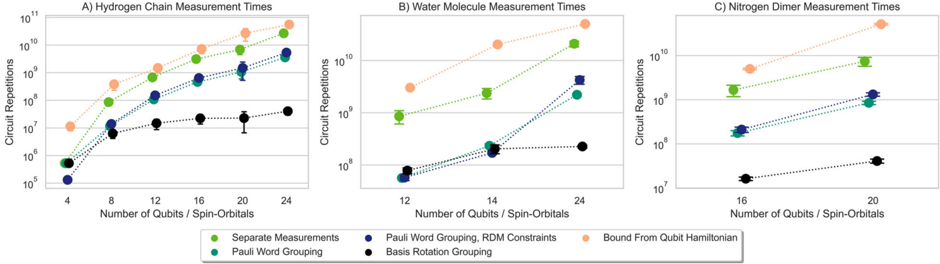
Variational algorithms are a promising paradigm for utilizing near-term quantum devices for modeling electronic states of molecular systems. However, previous bounds on the measurement time required have suggested that the application of these techniques to larger molecules might be infeasible. We present a measurement strategy based on a low-rank factorization of the two-electron integral tensor. Our approach provides a cubic reduction in term groupings over prior state-of-the-art and enables measurement times three orders of magnitude smaller than those suggested by commonly referenced bounds for the largest systems we consider. Although our technique requires execution of a linear-depth circuit prior to measurement, this is compensated for by eliminating challenges associated with sampling nonlocal Jordan–Wigner transformed operators in the presence of measurement error, while enabling a powerful form of error mitigation based on efficient postselection. We numerically characterize these benefits with noisy quantum circuit simulations for ground-state energies of strongly correlated electronic systems.
Overview
The claims and statistics of this paper haven’t been checked yet.
Free: it reads the open-access text and checks the first 5 claims that cite a source we can check. Create a free account to check every claim.
Integrity signals
Registry
Cites
Statistics
Figures

Verification
Claims the paper makes
The claims and statistics of this paper haven’t been checked yet.
Free: it reads the open-access text and checks the first 5 claims that cite a source we can check. Create a free account to check every claim.
Claims other papers make about this one
Each is checked against this paper’s own text: does it say what the citing paper says it does?
The source backs part of the claim, not all of it — or backs it for a different population, condition or comparison.
In the citing paper
“To this end, it has been shown that by considering general commutations (and increasing the number of gates of the circuit quadratically with n ) the scaling of the number of measurements can be reduced to n 3 [213, 214, 216-219].”
From Variational quantum algorithms (2021) · cites this paper as [219]
Experimental — accuracy not yet measured
Self-check
Percentages, sums and reported differences re-computed from the paper’s own numbers.
The self-check needs the paper’s full text.
Citations
Cites
Quantum Computing in the NISQ era and beyond
Preskill, J. (2018) · Quantum · doi:10.22331/q-2018-08-06-79 · Cited by 8,830
Density matrix formulation for quantum renormalization groups
White, S. R. (1992) · Physical Review Letters · doi:10.1103/physrevlett.69.2863 · Cited by 7,702
A variational eigenvalue solver on a photonic quantum processor
Peruzzo, A., McClean, J., Shadbolt, P., Yung, M.-H., Zhou, X.-Q., Love, P. J., Aspuru-Guzik, A., & O’Brien, J. L. (2014) · Nature Communications · doi:10.1038/ncomms5213 · Cited by 4,552
Self-citationHardware-efficient variational quantum eigensolver for small molecules and quantum magnets
Kandala, A., Mezzacapo, A., Temme, K., Takita, M., Brink, M., Chow, J. M., & Gambetta, J. M. (2017) · Nature · doi:10.1038/nature23879 · Cited by 2,982
The theory of variational hybrid quantum-classical algorithms
McClean, J. R., Romero, J., Babbush, R., & Aspuru-Guzik, A. (2016) · New Journal of Physics · doi:10.1088/1367-2630/18/2/023023 · Cited by 2,227
Self-citationAquilante, F., De Vico, L., Ferré, N., Ghigo, G., Malmqvist, P., Neogrády, P., Pedersen, T. B., Pitoňák, M., Reiher, M., Roos, B. O., et al. (2010) · Journal of Computational Chemistry · doi:10.1002/jcc.21318 · Cited by 1,554
Superconducting Qubits: Current State of Play
Kjaergaard, M., Schwartz, M. E., Braumüller, J., Krantz, P., Wang, J. I.-J., Gustavsson, S., & Oliver, W. D. (2020) · Annual Review of Condensed Matter Physics · doi:10.1146/annurev-conmatphys-031119-050605 · Cited by 1,544
Trapped-ion quantum computing: Progress and challenges
Bruzewicz, C. D., Chiaverini, J., McConnell, R., & Sage, J. M. (2019) · Applied Physics Reviews · doi:10.1063/1.5088164 · Cited by 1,483
Error Mitigation for Short-Depth Quantum Circuits
Temme, K., Bravyi, S., & Gambetta, J. M. (2017) · Physical Review Letters · doi:10.1103/physrevlett.119.180509 · Cited by 1,379
Parrish, R. M., Burns, L. A., Smith, D. G. A., Simmonett, A. C., DePrince, A. E., Hohenstein, E. G., Bozkaya, U., Sokolov, A. Y., Di Remigio, R., Richard, R. M., et al. (2017) · Journal of Chemical Theory and Computation · doi:10.1021/acs.jctc.7b00174 · Cited by 1,249
Cited by
Variational quantum algorithms
Cerezo, M., Arrasmith, A., Babbush, R., Benjamin, S. C., Endo, S., Fujii, K., McClean, J. R., Mitarai, K., Yuan, X., Cincio, L., et al. (2021) · Nature Reviews Physics · doi:10.1038/s42254-021-00348-9 · Cited by 3,385
“For using VQE on fermionic systems, this scaling can actually be brought down to either quadratic or, for simpler cases even linear in n [193].”
MethodSelf-citationNoisy intermediate-scale quantum algorithms
Bharti, K., Cervera-Lierta, A., Kyaw, T. H., Haug, T., Alperin-Lea, S., Anand, A., Degroote, M., Heimonen, H., Kottmann, J. S., Menke, T., et al. (2022) · Reviews of Modern Physics · doi:10.1103/revmodphys.94.015004 · Cited by 2,231
The Variational Quantum Eigensolver: A review of methods and best practices
Tilly, J., Chen, H., Cao, S., Picozzi, D., Setia, K., Li, Y., Grant, E., Wossnig, L., Rungger, I., Booth, G. H., et al. (2022) · Physics Reports · doi:10.1016/j.physrep.2022.08.003 · Cited by 1,031
Cai, Z., Babbush, R., Benjamin, S. C., Endo, S., Huggins, W. J., Li, Y., McClean, J. R., & O’Brien, T. E. (2023) · Reviews of Modern Physics · doi:10.1103/revmodphys.95.045005 · Cited by 591
“As discussed above, we can greatly simplify the measurement circuit through post-processing, but this will come at a higher sampling overhead, which scales as Cai, 2021c; Huggins et al. , 2021b).”
BackgroundMethodInfluentialSelf-citationEven More Efficient Quantum Computations of Chemistry Through Tensor Hypercontraction
Lee, J., Berry, D. W., Gidney, C., Huggins, W. J., McClean, J. R., Wiebe, N., & Babbush, R. (2021) · PRX Quantum · doi:10.1103/prxquantum.2.030305 · Cited by 304
Self-citationInformation-Theoretic Bounds on Quantum Advantage in Machine Learning
Huang, H.-Y., Kueng, R., & Preskill, J. (2021) · Physical Review Letters · doi:10.1103/physrevlett.126.190505 · Cited by 250
“muting observables [30,31]; See the Supplemental Material, App.”
BackgroundZhu, L., Tang, H. L., Barron, G. S., Calderon-Vargas, F. A., Mayhall, N. J., Barnes, E., & Economou, S. E. (2022) · Physical Review Research · doi:10.1103/physrevresearch.4.033029 · Cited by 209
Virtual Distillation for Quantum Error Mitigation
Huggins, W. J., McArdle, S., O’Brien, T. E., Lee, J., Rubin, N. C., Boixo, S., Whaley, K. B., Babbush, R., & McClean, J. R. (2021) · Physical Review X · doi:10.1103/physrevx.11.041036 · Cited by 205
“[17] William J Huggins, Jarrod McClean, Nicholas Rubin, Zhang Jiang, Nathan Wiebe, K Birgitta Whaley, and Ryan Babbush, “Efficient and noise resilient measurements for quantum chemistry on Near-Term quantum computers,” arXiv:1907.”
BackgroundResultSelf-citationPerspective on the Current State-of-the-Art of Quantum Computing for Drug Discovery Applications
Blunt, N. S., Camps, J., Crawford, O., Izsák, R., Leontica, S., Mirani, A., Moylett, A. E., Scivier, S. A., Sünderhauf, C., Schopf, P., et al. (2022) · Journal of Chemical Theory and Computation · doi:10.1021/acs.jctc.2c00574 · Cited by 192
Efficient quantum measurement of Pauli operators in the presence of finite sampling error
Crawford, O., Straaten, B. V., Wang, D., Parks, T., Campbell, E., & Brierley, S. (2021) · Quantum · doi:10.22331/q-2021-01-20-385 · Cited by 188
Solving nonlinear differential equations with differentiable quantum circuits
Kyriienko, O., Paine, A. E., & Elfving, V. E. (2021) · Physical Review A · doi:10.1103/physreva.103.052416 · Cited by 185
Solving nonlinear differential equations with differentiable quantum circuits
Kyriienko, O., Paine, A. E., & Elfving, V. E. (2020) · arXiv · doi:10.48550/arxiv.2011.10395 · Cited by 185
Strategies for solving the Fermi-Hubbard model on near-term quantum computers
Cade, C., Mineh, L., Montanaro, A., & Stanisic, S. (2020) · Physical Review B · doi:10.1103/physrevb.102.235122 · Cited by 178
Efficient Estimation of Pauli Observables by Derandomization
Huang, H.-Y., Kueng, R., & Preskill, J. (2021) · Physical Review Letters · doi:10.1103/physrevlett.127.030503 · Cited by 175
Low rank representations for quantum simulation of electronic structure
Motta, M., Ye, E., McClean, J. R., Li, Z., Minnich, A. J., Babbush, R., & Chan, G. K.-L. (2021) · npj Quantum Information · doi:10.1038/s41534-021-00416-z · Cited by 171
Self-citationEmerging quantum computing algorithms for quantum chemistry
Motta, M., & Rice, J. E. (2022) · WIREs Computational Molecular Science · doi:10.1002/wcms.1580 · Cited by 173
“When the JW representation is used in conjunction with low-rank decompositions of the Hamiltonian [201, 392], several such constants of motion quantities can be efficiently measured simultaneously with the one-and two-body contributions to the Hamiltonian, thereby projecting the electronic…”
MethodLow rank representations for quantum simulation of electronic structure
Motta, M., Ye, E., McClean, J. R., Li, Z., Minnich, A. J., Babbush, R., & Chan, G. K.-L. (2018) · arXiv · doi:10.48550/arxiv.1808.02625 · Cited by 173
Self-citationNoisy intermediate-scale quantum (NISQ) algorithms
Bharti, K., Cervera-Lierta, A., Kyaw, T. H., Haug, T., Alperin-Lea, S., Anand, A., Degroote, M., Heimonen, H., Kottmann, J. S., Menke, T., et al. (2021) · arXiv · doi:10.48550/arxiv.2101.08448 · Cited by 166
Standard model physics and the digital quantum revolution: thoughts about the interface
Klco, N., Roggero, A., & Savage, M. J. (2022) · Reports on Progress in Physics · doi:10.1088/1361-6633/ac58a4 · Cited by 166
Fermionic Partial Tomography via Classical Shadows
Zhao, A., Rubin, N. C., & Miyake, A. (2021) · Physical Review Letters · doi:10.1103/physrevlett.127.110504 · Cited by 144
Self-citationDigital Quantum Simulation of the Schwinger Model and Symmetry Protection with Trapped Ions
Nguyen, N. H., Tran, M. C., Zhu, Y., Green, A., Alderete, C. H., Davoudi, Z., & Linke, N. M. (2022) · PRX Quantum · doi:10.1103/prxquantum.3.020324 · Cited by 191
Measurements of Quantum Hamiltonians with Locally-Biased Classical Shadows
Hadfield, C., Bravyi, S., Raymond, R., & Mezzacapo, A. (2022) · Communications in Mathematical Physics · doi:10.1007/s00220-022-04343-8 · Cited by 117
“A series of recent efforts [5, 6, 7, 8, 9, 10, 11, 12] has shown that savings in the number of measurements can be obtained for the estimation of complex observables, at the expense of increasing circuit depths.”
BackgroundA non-orthogonal variational quantum eigensolver
Huggins, W., Lee, J., Baek, U., O'Gorman, B., & Whaley, K. (2020) · eScholarship (California Digital Library) · Cited by 128
Self-citationMeasurements of Quantum Hamiltonians with Locally-Biased Classical Shadows
Hadfield, C., Bravyi, S., Raymond, R., & Mezzacapo, A. (2020) · arXiv · doi:10.48550/arxiv.2006.15788 · Cited by 129
“A series of recent efforts [5, 6, 7, 8, 9, 10, 11, 12] has shown that savings in the number of measurements can be obtained for the estimation of complex observables, at the expense of increasing circuit depths.”
BackgroundChemistry beyond the scale of exact diagonalization on a quantum-centric supercomputer
Moreno, J. R., Motta, M., Haas, H., Javadi-Abhari, A., Jurcevic, P., Kirby, W., Martiel, S., Sharma, K., Sharma, S., Shirakawa, T., et al. (2025) · Science Advances · doi:10.1126/sciadv.adu9991 · Cited by 442
Measurements as a roadblock to near-term practical quantum advantage in chemistry: resource analysis
Gonthier, J. F., Radin, M. D., Buda, C., Doskocil, E. J., Abuan, C. M., & Romero, J. (2022) · Physical Review Research · doi:10.1103/physrevresearch.4.033154 · Cited by 120
“We also consider the basis rotation approach to Hamiltonian decomposition [28, 42, 73].”
BackgroundMethodInfluentialPerformance comparison of optimization methods on variational quantum algorithms
Bonet-Monroig, X., Wang, H., Vermetten, D., Senjean, B., Moussa, C., Bäck, T., Dunjko, V., & O'Brien, T. E. (2023) · Physical Review A · doi:10.1103/physreva.107.032407 · Cited by 107
$O(N^3)$ Measurement Cost for Variational Quantum Eigensolver on Molecular Hamiltonians
Gokhale, P., Angiuli, O., Ding, Y., Gui, K., Tomesh, T., Suchara, M., Martonosi, M., & Chong, F. T. (2020) · IEEE Transactions on Quantum Engineering · doi:10.1109/tqe.2020.3035814 · Cited by 104
“Recent work [9] has gone deeper in this direction, by factoring molecular Hamiltonians into a form that empirically seems to have O(N) partitions.”
BackgroundMethod$O(N^3)$ Measurement Cost for Variational Quantum Eigensolver on Molecular Hamiltonians
Gokhale, P., & Chong, F. T. (2019) · arXiv · doi:10.48550/arxiv.1908.11857 · Cited by 104
“Recent work [9] has gone deeper in this direction, by factoring molecular Hamiltonians into a form that empirically seems to have O(N) partitions.”
BackgroundMethodKoh, D. E., & Grewal, S. (2022) · Quantum · doi:10.22331/q-2022-08-16-776 · Cited by 97
“However, estimation is often the major bottleneck in many of these applications, where the number of measurements required is often too large for the algorithms to achieve the desired accuracy on useful instances using nearterm quantum hardware [9, 10].”
BackgroundHuang, H.-L., Xu, X., Guo, C., Tian, G., Wei, S.-J., Sun, X., Bao, W., & Long, G. (2023) · Science China Physics Mechanics and Astronomy · doi:10.1007/s11433-022-2057-y · Cited by 145
Jastrow-type Decomposition in Quantum Chemistry for Low-Depth Quantum Circuits
Matsuzawa, Y., & Kurashige, Y. (2020) · Journal of Chemical Theory and Computation · doi:10.1021/acs.jctc.9b00963 · Cited by 97
Simple mitigation of global depolarizing errors in quantum simulations
Vovrosh, J., Khosla, K. E., Greenaway, S., Self, C., Kim, M. S., & Knolle, J. (2021) · Physical Review E · doi:10.1103/physreve.104.035309 · Cited by 94
Simple Mitigation of Global Depolarizing Errors in Quantum Simulations
Vovrosh, J., Khosla, K. E., Greenaway, S., Self, C., Kim, M., & Knolle, J. (2021) · arXiv · doi:10.48550/arxiv.2101.01690 · Cited by 96
Nearly Optimal Measurement Scheduling for Partial Tomography of Quantum States
Bonet-Monroig, X., Babbush, R., & O’Brien, T. E. (2020) · Physical Review X · doi:10.1103/physrevx.10.031064 · Cited by 96
Self-citationAlexeev, Y., Amsler, M., Barroca, M. A., Bassini, S., Battelle, T., Camps, D., Casanova, D., Choi, Y. J., Chong, F. T., Chung, C., et al. (2024) · Future Generation Computer Systems · doi:10.1016/j.future.2024.04.060 · Cited by 192
Biology and medicine in the landscape of quantum advantages
Cordier, B. A., Sawaya, N. P. D., Guerreschi, G. G., & McWeeney, S. K. (2022) · Journal of The Royal Society Interface · doi:10.1098/rsif.2022.0541 · Cited by 87
“Fortunately, substantial recent work suggests that this measurement problem may not be insurmountable [184, 185, 186, 187].”
BackgroundExponential Separations Between Learning With and Without Quantum Memory
Chen, S., Cotler, J. S., Huang, H.-Y., & Li, J. Z. (2022) · Annual Symposium on Foundations of Computer Science · doi:10.1109/focs52979.2021.00063 · Cited by 238
Gate-free state preparation for fast variational quantum eigensolver simulations
Meitei, O. R., Gard, B. T., Barron, G. S., Pappas, D. P., Economou, S. E., Barnes, E., & Mayhall, N. J. (2021) · npj Quantum Information · doi:10.1038/s41534-021-00493-0 · Cited by 78
Using models to improve optimizers for variational quantum algorithms
Sung, K. J., Yao, J., Harrigan, M. P., Rubin, N. C., Jiang, Z., Lin, L., Babbush, R., & McClean, J. R. (2020) · Quantum Science and Technology · doi:10.1088/2058-9565/abb6d9 · Cited by 66
Self-citationMinimizing Estimation Runtime on Noisy Quantum Computers
Wang, G., Koh, D. E., Johnson, P. D., & Cao, Y. (2021) · PRX Quantum · doi:10.1103/prxquantum.2.010346 · Cited by 77
“In spite of such algorithmic innovations, many of these approaches have appeared to be impractical for commercially-relevant problems owing to their high cost in terms of number of measurements [2, 14] and hence runtime, of the expectation value estimation subroutine.”
BackgroundCai, Z. (2021) · npj Quantum Information · doi:10.1038/s41534-021-00404-3 · Cited by 76
Efficient evaluation of quantum observables using entangled measurements
Hamamura, I., & Imamichi, T. (2020) · npj Quantum Information · doi:10.1038/s41534-020-0284-2 · Cited by 69
Nearly Optimal Measurement Scheduling for Partial Tomography of Quantum States
Bonet-Monroig, X., Babbush, R., & O’Brien, T. E. (2020) · Leiden Repository (Leiden University) · Cited by 74
Self-citationVariational quantum eigensolver with reduced circuit complexity
Zhang, Y., Cincio, Ł., Negre, C. F. A., Czarnik, P., Coles, P. J., Anisimov, P. M., Mniszewski, S. M., Tretiak, S., & Dub, P. A. (2022) · npj Quantum Information · doi:10.1038/s41534-022-00599-z · Cited by 112
Purification-based quantum error mitigation of pair-correlated electron simulations
O’Brien, T. E., Anselmetti, G.-L., Gkritsis, F., Elfving, V. E., Polla, S., Huggins, W. J., Oumarou, O., Kechedzhi, K., Abanin, D. A., Acharya, R., et al. (2023) · Nature Physics · doi:10.1038/s41567-023-02240-y · Cited by 129
“Theoretical developments in ansatz design 8–13 and measurement optimization 14–18 have enabled small to midscale VQE experiments 11,19–26 .”
BackgroundSelf-citationQuantum Filter Diagonalization with Compressed Double-Factorized Hamiltonians
Cohn, J., Motta, M., & Parrish, R. M. (2021) · PRX Quantum · doi:10.1103/prxquantum.2.040352 · Cited by 72
Quantum computing of the Li6 nucleus via ordered unitary coupled clusters
Kiss, O., Grossi, M., Lougovski, P., Sánchez, F. A., Vallecorsa, S., & Papenbrock, T. (2022) · Physical Review C · doi:10.1103/physrevc.106.034325 · Cited by 84
Can Error Mitigation Improve Trainability of Noisy Variational Quantum Algorithms?
Wang, S., Czarnik, P., Arrasmith, A., Cerezo, M., Cincio, Ł., & Coles, P. J. (2024) · Quantum · doi:10.22331/q-2024-03-14-1287 · Cited by 133
“Indeed, EM methods like Zero-Noise Extrapolation [10, 42–44], Clifford Data Regression [45], Virtual Distillation [46, 47], Probabilistic Error Cancellation [42, 43] and others [48–52] have been demonstrated to reduce errors of observable expectation values, sometimes by orders of magnitude.”
MethodA hybrid quantum computing pipeline for real world drug discovery
Li, W., Yin, Z., Li, X., Ma, D., Yi, S., Zhang, Z., Zou, C., Bu, K., Dai, M., Yue, J., et al. (2024) · Scientific Reports · doi:10.1038/s41598-024-67897-8 · Cited by 67
“As a result, measurement grouping methods developed for energy measurement can be employed directly to reduce the measurement cost 75 .”
MethodExperimental Quantum State Measurement with Classical Shadows
Zhang, T., Sun, J., Fang, X.-X., Zhang, X.-M., Yuan, X., & Lu, H. (2021) · Physical Review Letters · doi:10.1103/physrevlett.127.200501 · Cited by 106
Yen, T.-C., Ganeshram, A., & Izmaylov, A. F. (2023) · npj Quantum Information · doi:10.1038/s41534-023-00683-y · Cited by 118
“(14), takes advantage of this opportunity by splitting coefficients of Pauli products that are compatible with multiple fragments Âα 1⁄4 P k cðαÞ k P̂k ; P̂k 2 Pα (12)”
Li, W., Huang, Z., Cao, C., Huang, Y., Shuai, Z., Sun, X., Sun, J., Yuan, X., & Lv, D. (2022) · Chemical Science · doi:10.1039/d2sc01492k · Cited by 60
Quantum Error Mitigation using Symmetry Expansion
Cai, Z. (2021) · Quantum · doi:10.22331/q-2021-09-21-548 · Cited by 57
Simulating Many-Body Systems with a Projective Quantum Eigensolver
Stair, N. H., & Evangelista, F. A. (2021) · PRX Quantum · doi:10.1103/prxquantum.2.030301 · Cited by 60
“For example, grouping commuting Pauli operators [3, 35, 58–60], utilizing integral factorization strategies [61], and employing alternative bases [29, 62] have been shown to reduce the number of measurements needed for operator averaging.”
Asthana, A., Kumar, A., Abraham, V., Grimsley, H. R., Zhang, Y., Cincio, Ł., Tretiak, S., Dub, P. A., Economou, S. E., Barnes, E., et al. (2023) · Chemical Science · doi:10.1039/d2sc05371c · Cited by 89
Overlapped grouping measurement: A unified framework for measuring quantum states
Wu, B., Sun, J., Huang, Q. J., & Yuan, X. (2023) · Quantum · doi:10.22331/q-2023-01-13-896 · Cited by 106
“[73] William J Huggins, Jarrod R McClean, Nicholas C Rubin, Zhang Jiang, Nathan Wiebe, K Birgitta Whaley, and Ryan Babbush.”
BackgroundEfficient quantum computation of molecular forces and other energy gradients
O'Brien, T. E., Streif, M., Rubin, N. C., Santagati, R., Su, Y., Huggins, W. J., Goings, J. J., Moll, N., Kyoseva, E., Degroote, M., et al. (2022) · Physical Review Research · doi:10.1103/physrevresearch.4.043210 · Cited by 50
Self-citationOperator Sampling for Shot-frugal Optimization in Variational Algorithms
Arrasmith, A., Cincio, L., Somma, R. D., & Coles, P. J. (2020) · arXiv · doi:10.48550/arxiv.2004.06252 · Cited by 53
Nearly Optimal Quantum Algorithm for Estimating Multiple Expectation Values
Huggins, W. J., Wan, K., McClean, J. R., O’Brien, T. E., Wiebe, N., & Babbush, R. (2022) · Physical Review Letters · doi:10.1103/physrevlett.129.240501 · Cited by 101
Self-citationQuantum computing with and for many-body physics
Ayral, T., Besserve, P., Lacroix, D., & Guzman, E. A. R. (2023) · The European Physical Journal A · doi:10.1140/epja/s10050-023-01141-1 · Cited by 84
Simulating quantum chemistry in the seniority-zero space on qubit-based quantum computers
Elfving, V. E., Millaruelo, M., Gámez, J. A., & Gogolin, C. (2021) · Physical Review A · doi:10.1103/physreva.103.032605 · Cited by 65
Quantum computing algorithms: getting closer to critical problems in computational biology
Marchetti, L., Nifosì, R., Martelli, P. L., Da Pozzo, E., Cappello, V., Banterle, F., Trincavelli, M. L., Martini, C., & D’Elia, M. (2022) · Briefings in Bioinformatics · doi:10.1093/bib/bbac437 · Cited by 47
Liu, J., Li, Z., & Yang, J. (2021) · The Journal of Chemical Physics · doi:10.1063/5.0054822 · Cited by 60
Subspace methods for electronic structure simulations on quantum computers
Motta, M., Kirby, W., Liepuoniute, I., Sung, K. J., Cohn, J. F., Mezzacapo, A., Klymko, K., Nguyen, N., Yoshioka, N., & Rice, J. E. (2024) · Electronic Structure · doi:10.1088/2516-1075/ad3592 · Cited by 107
Near- and long-term quantum algorithmic approaches for vibrational spectroscopy
Sawaya, N. P. D., Paesani, F., & Tabor, D. P. (2021) · Physical Review A · doi:10.1103/physreva.104.062419 · Cited by 47
Dynamical mean field theory algorithm and experiment on quantum computers
Rungger, I., Fitzpatrick, N., Chen, H., Alderete, C. H., Apel, H., Cowtan, A., Patterson, A., Ramo, D. M., Zhu, Y., Nguyen, N. H., et al. (2019) · arXiv (Cornell University) · doi:10.48550/arxiv.1910.04735 · Cited by 45
Low depth mechanisms for quantum optimization
McClean, J. R., Harrigan, M. P., Mohseni, M., Rubin, N. C., Jiang, Z., Boixo, S., Smelyanskiy, V. N., Babbush, R., & Neven, H. (2020) · arXiv · doi:10.48550/arxiv.2008.08615 · Cited by 45
Self-citationLow-Depth Mechanisms for Quantum Optimization
McClean, J. R., Harrigan, M. P., Mohseni, M., Rubin, N. C., Jiang, Z., Boixo, S., Smelyanskiy, V. N., Babbush, R., & Neven, H. (2021) · PRX Quantum · doi:10.1103/prxquantum.2.030312 · Cited by 43
Self-citationMaciejewski, F. B., Baccari, F., Zimborás, Z., & Oszmaniec, M. (2021) · Quantum · doi:10.22331/q-2021-06-01-464 · Cited by 66
“Similarly, testing noise mitigation in more general, Variational Quantum Eigensolver (VQE) scenarios is of great interest [62, 63].”
BackgroundMotta, M., Jones, G. O., Rice, J. E., Gujarati, T. P., Sakuma, R., Liepuoniute, I., García, J. M., & Ohnishi, Y. (2023) · Chemical Science · doi:10.1039/d2sc06019a · Cited by 66
Quantum computing and chemistry
Weidman, J. D., Sajjan, M., Mikolas, C. A., Stewart, Z. J., Pollanen, J., Kais, S., & Wilson, A. K. (2024) · Cell Reports Physical Science · doi:10.1016/j.xcrp.2024.102105 · Cited by 71
Variational quantum eigensolvers by variance minimization
Zhang, D.-B., Chen, B.-L., Yuan, Z.-H., & Yin, T. (2022) · Chinese Physics B · doi:10.1088/1674-1056/ac8a8d · Cited by 81
“Besides, one may reduce the overload of evaluating the energy variance using some smarter strategies that can simultaneously access a set of quantum covariance matrix elements [45, 46].”
MethodGutzwiller hybrid quantum-classical computing approach for correlated materials
Yao, Y., Zhang, F., Wang, C.-Z., Ho, K.-M., & Orth, P. P. (2021) · Physical Review Research · doi:10.1103/physrevresearch.3.013184 · Cited by 56
“Importantly, only one-qubit Z and two-qubit ZZ operators need to be measured as a result of tensorfactorization, hence the exponential growth of measurement error with respect to the Pauli operator length is reduced to minimum [74].”
BackgroundCompilation by stochastic Hamiltonian sparsification
Ouyang, Y., White, D. R., & Campbell, E. T. (2020) · White Rose Research Online (University of Leeds, The University of Sheffield, University of York) · Cited by 41
Quantum computing for chemistry and physics applications from a Monte Carlo perspective
Mazzola, G. (2024) · The Journal of Chemical Physics · doi:10.1063/5.0173591 · Cited by 64
“54 Other methods aim to find better grouping schemes, introducing general commutativity rules at the expense of longer measurement circuits 49,60–63 .”
BackgroundMethodA Review of Optical Neural Networks
Zhang, D., & Tan, Z. (2022) · Applied Sciences · doi:10.3390/app12115338 · Cited by 53
Quantum utility – definition and assessment of a practical quantum advantage
Herrmann, N., Arya, D., Doherty, M. W., Mingare, A., Pillay, J. C., Preis, F., & Prestel, S. (2023) · IEEE International Conference on Quantum Software (QSW) · doi:10.1109/qsw59989.2023.00028 · Cited by 71
“In terms of the VQE, sophisticated term grouping techniques such as explicit double factorization[79] or full rank optimization[75] are claimed to reach reasonable energies for a linear scaling number of measurement circuits, O(N), w.”
BackgroundKoridon, E., Yalouz, S., Senjean, B., Buda, F., O’Brien, T. E., & Visscher, L. (2021) · Physical Review Research · doi:10.1103/physrevresearch.3.033127 · Cited by 51
Ryabinkin, I. G., Izmaylov, A. F., & Genin, S. N. (2021) · Quantum Science and Technology · doi:10.1088/2058-9565/abda8e · Cited by 47
Learning efficient decoders for quasichaotic quantum scramblers
Leone, L., Oliviero, S. F. E., Lloyd, S., & Hamma, A. (2024) · Physical Review A · doi:10.1103/physreva.109.022429 · Cited by 66
Gutzwiller hybrid quantum-classical computing approach for correlated materials
Yao, Y., Zhang, F., Wang, C., Ho, K., & Orth, P. P. (2021) · Iowa State University Digital Repository (Iowa State University) · Cited by 35
Hamiltonian operator approximation for energy measurement and ground state preparation
(21925472), T. B., & Kyriienko, O. (2025) · Figshare · Cited by 39
Choi, S., Loaiza, I., & Izmaylov, A. F. (2023) · Quantum · doi:10.22331/q-2023-01-03-889 · Cited by 51
Decision Diagrams for Quantum Measurements with Shallow Circuits
Hillmich, S., Hadfield, C. F., Raymond, R., Mezzacapo, A., & Wille, R. (2021) · IEEE International Conference on Quantum Computing and Engineering (QCE) · doi:10.1109/qce52317.2021.00018 · Cited by 54
Maciejewski, F. B., Baccari, F., Zimborás, Z., & Oszmaniec, M. (2021) · Repository of the Academy's Library (Library of the Hungarian Academy of Sciences) · Cited by 33
Quantum expectation-value estimation by computational basis sampling
Kohda, M., Imai, R., Kanno, K., Mitarai, K., Mizukami, W., & Nakagawa, Y. O. (2022) · Physical Review Research · doi:10.1103/physrevresearch.4.033173 · Cited by 52
“Since our method picks up dominant computational basis states in the first step of the algorithm, it is easy to mitigate errors of quantum devices that change a symmetry of the computational basis states, by the method called symmetry verification [21, 43, 44].”
MethodImproving Quantum Measurements by Introducing “Ghost” Pauli Products
Choi, S., Yen, T.-C., & Izmaylov, A. F. (2022) · Journal of Chemical Theory and Computation · doi:10.1021/acs.jctc.2c00837 · Cited by 47
Folded Spectrum VQE: A Quantum Computing Method for the Calculation of Molecular Excited States
Tazi, L. C., & Thom, A. J. W. (2024) · Journal of Chemical Theory and Computation · doi:10.1021/acs.jctc.3c01378 · Cited by 57
Tamiya, S., & Yamasaki, H. (2022) · npj Quantum Information · doi:10.1038/s41534-022-00592-6 · Cited by 57
“, LðtÞ :1⁄4 fθ̂ ηðtÞĝðtÞjηðtÞ 2 1⁄2 ηmax; ηmax g; (19)”
BackgroundInfluentialSchleich, P., Kottmann, J. S., & Aspuru‐Guzik, A. (2022) · Physical Chemistry Chemical Physics · doi:10.1039/d2cp00247g · Cited by 35
Lie-algebraic classical simulations for quantum computing
Goh, M. L., Larocca, M., Cincio, Ł., Cerezo, M., & Sauvage, F. (2025) · Physical Review Research · doi:10.1103/3y65-f5w6 · Cited by 147
State preparation and evolution in quantum computing: A perspective from Hamiltonian moments
Aulicino, J. C., Keen, T., & Peng, B. (2021) · International Journal of Quantum Chemistry · doi:10.1002/qua.26853 · Cited by 32
A brief introduction to quantum algorithms
Zhang, S., & Li, L. (2022) · CCF Transactions on High Performance Computing · doi:10.1007/s42514-022-00090-3 · Cited by 35
“…et al. 2019; Jones et al. 2019; Shao 2019; Liang et al. 2020; Schuld et al. 2021; Wang et al. 2021; Xu et al. 2021), promoting quantum error mitigation methods (Li and Benjamin 2017; McArdle et al. 2019; Otten and Gray 2019; Huggins et al. 2021) and quantum materials science (Bauer et al. 2020).”
BackgroundHamLib: A library of Hamiltonians for benchmarking quantum algorithms and hardware
Sawaya, N. P. D., Marti-Dafcik, D., Ho, Y., Tabor, D. P., Bernal, D. E., Magann, A. B., Premaratne, S., Dubey, P. K., Matsuura, A. Y., Bishop, N. C., et al. (2024) · Quantum · doi:10.22331/q-2024-12-11-1559 · Cited by 58
“Third, one may compare methods for calculating expectation values ⟨ ψ | H | ψ ⟩ , which is often a very time-consuming subroutine [VYI20, GAD + 20, CvSW + 21, HKP20, KMZC + 22, HMR + 21].”
Optimization of Simultaneous Measurement for Variational Quantum Eigensolver Applications
Gokhale, P., Angiuli, O., Ding, Y., Gui, K., Tomesh, T., Suchara, M., Martonosi, M., & Chong, F. T. (2020) · IEEE International Conference on Quantum Computing and Engineering (QCE) · doi:10.1109/qce49297.2020.00054 · Cited by 42
“We focus on JordanWigner [23], which is the most popular encoding [19], though our results also apply to the Parity encoding [47].”
MethodNeural-network-encoded variational quantum algorithms
Miao, J., Hsieh, C., & Zhang, S. (2024) · Physical Review Applied · doi:10.1103/physrevapplied.21.014053 · Cited by 34
Unitary block optimization for variational quantum algorithms
Slattery, L., Villalonga, B., & Clark, B. K. (2022) · Physical Review Research · doi:10.1103/physrevresearch.4.023072 · Cited by 34
Loaiza, I., & Izmaylov, A. F. (2023) · Journal of Chemical Theory and Computation · doi:10.1021/acs.jctc.3c00912 · Cited by 57
Rocca, D., Cortes, C. L., Gonthier, J. F., Ollitrault, P. J., Parrish, R. M., Anselmetti, G.-L., Degroote, M., Moll, N., Santagati, R., & Streif, M. (2024) · Journal of Chemical Theory and Computation · doi:10.1021/acs.jctc.4c00352 · Cited by 55
“According to 19 the V t tensor has rank 1 and, as already mentioned in the previous section, this is an important feature to implement efficiently the double-factorized Hamiltonian using the approach of von Burg et al. 24 This XDF procedure is, in principle, exact if no truncation is applied,…”
BackgroundMethod
Metadata
- Authors
- Huggins, W. J., McClean, J. R., Rubin, N. C., Jiang, Z., Wiebe, N., Whaley, K. B., & Babbush, R.
- Affiliations
- Google (United States) (US)
- University of California, Berkeley (US)
- Corresponding author
- Huggins, William J.
- Babbush, Ryan
- ORCID
- Venue
- npj Quantum Information
- Published
- 2021-02-05
- Volume
- 7
- Issue
- 1
- ISSN
- 2056-6387 (ISSN-L)
- OpenAlex
- W2964421692
- Cited by
- 256
- References
- 58
- Citations by year
- 2026: 17 · 2025: 45 · 2024: 44 · 2023: 44 · 2022: 44 · 2021: 49
- FWCI
- 15.93
- Type
- journal article
- Language
- en
- Open access
- gold
- doi.org
- Licence
- cc-by
- creativecommons.org/licenses/by/4.0 (tdm)
- creativecommons.org/licenses/by/4.0 (vor)
- Locations
- npj Quantum Information (publishedVersion, cc-by)
- arXiv (Cornell University) (submittedVersion)
- DOAJ (DOAJ: Directory of Open Access Journals) (submittedVersion, cc-by-sa)
- arXiv (Cornell University)
- Funders
- U.S. Department of Energy
- Office of Science
- Topics
- Physical Sciences › Computer Science › Artificial Intelligence › Quantum Computing Algorithms and Architecture
- Physical Sciences › Physics and Astronomy › Atomic and Molecular Physics, and Optics › Quantum many-body systems
- Physical Sciences › Physics and Astronomy › Atomic and Molecular Physics, and Optics › Advanced Chemical Physics Studies
- Keywords
- variational quantum algorithms, measurement time reduction, low-rank factorization, Jordan-Wigner transformation, measurement error, post-selection, error mitigation, ground state energy, strongly correlated electrons, molecular electronic structure
About these checks
Registry, retraction, Cites and statistics results are computed, not judged, with one exception: a printed reference that no index lists is read once by a model before it counts as a citation error. Claims are extracted by a model and kept only when their quote appears verbatim in the text; each cited source is then checked, with a model’s help, for whether it says what the claim relies on. Those verdicts can be wrong — read the claim’s quote and the cited source before relying on one.
Statistics and arithmetic are recomputed, not judged.
Confidence bands are shown only for fields calibrated on our annotated test set. None is calibrated yet, so no band is shown.
What counts as a claim ›How we measure confidence ›How we check this ›
Are you an author, or do you see a problem with this page? Request a review
Data sources
Bibliographic data: Semantic Scholar, OpenAlex, Crossref.
Contains information from the Semantic Scholar Academic Graph Datasets, made available under the ODC Attribution License (ODC-BY 1.0).
Semantic Scholar’s data is described in: Kinney, R., et al. (2023). The Semantic Scholar Open Data Platform. arXiv:2301.10140.
