

Multi-exponential error extrapolation and combining error mitigation techniques for NISQ applications
Open accessThe DOI matches its Crossref record; 22 of the 24 references it cites were found in a registry or an index.
Abstract
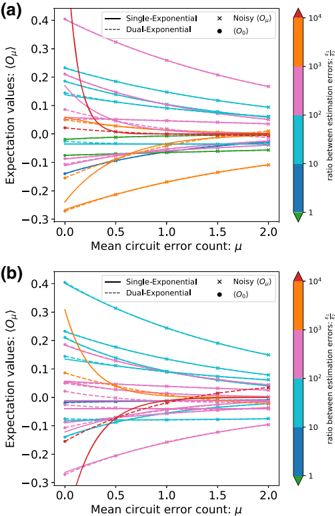
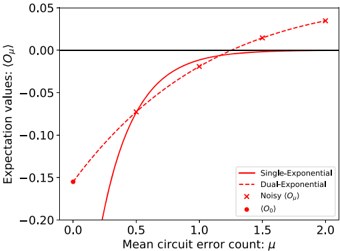
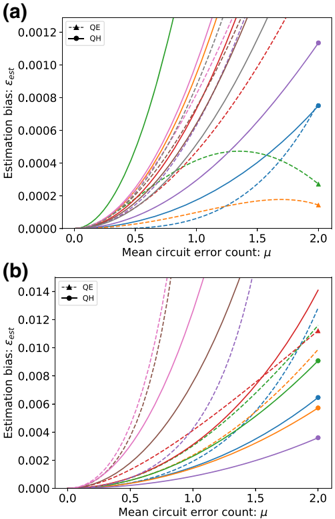
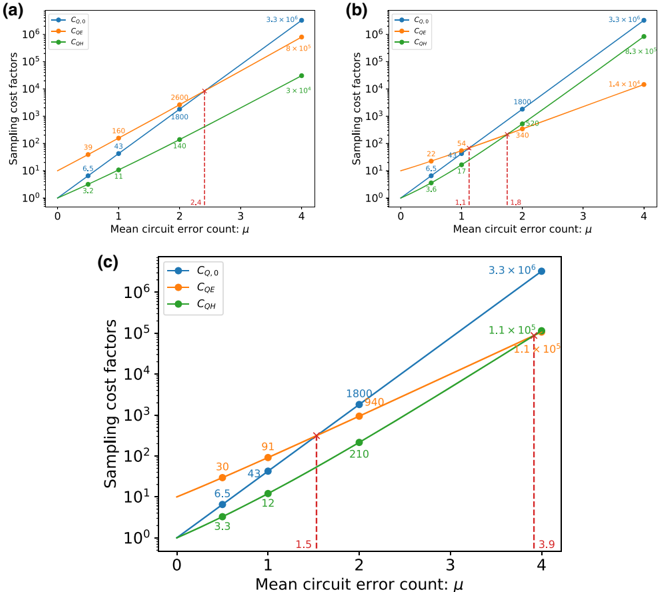
Noise in quantum hardware remains the biggest roadblock for the implementation of quantum computers. To fight the noise in the practical application of near-term quantum computers, instead of relying on quantum error correction which requires large qubit overhead, we turn to quantum error mitigation, in which we make use of extra measurements. Error extrapolation is an error mitigation technique that has been successfully implemented experimentally. Numerical simulation and heuristic arguments have indicated that exponential curves are effective for extrapolation in the large circuit limit with an expected circuit error count around unity. In this Article, we extend this to multi-exponential error extrapolation and provide more rigorous proof for its effectiveness under Pauli noise. This is further validated via our numerical simulations, showing orders of magnitude improvements in the estimation accuracy over single-exponential extrapolation. Moreover, we develop methods to combine error extrapolation with two other error mitigation techniques: quasi-probability and symmetry verification, through exploiting features of these individual techniques. As shown in our simulation, our combined method can achieve low estimation bias with a sampling cost multiple times smaller than quasi-probability while without needing to be able to adjust the hardware error rate as required in canonical error extrapolation.
Overview
The claims and statistics of this paper haven’t been checked yet.
Free: it reads the open-access text and checks the first 5 claims that cite a source we can check. Create a free account to check every claim.
Integrity signals
Registry
Cites
Statistics
Figures
Verification
Claims the paper makes
The claims and statistics of this paper haven’t been checked yet.
Free: it reads the open-access text and checks the first 5 claims that cite a source we can check. Create a free account to check every claim.
Claims other papers make about this one
Each is checked against this paper’s own text: does it say what the citing paper says it does?
The check wasn’t confident either way, so it gives no verdict — never disputed.
In the citing paper
“As discussed in the section on BPs, the intuition behind this slowing down is that the cost landscape is flattened, and hence gradient magnitudes are reduced, by the presence of incoherent noise [202, 230, 231].”
From Variational quantum algorithms (2021) · cites this paper as [230]
Experimental — accuracy not yet measuredIn the citing paper
“One can combine the ZNE, quasi-probability, and stabiliser-based approaches together for further improvements (Cai, 2021a).”
From Noisy intermediate-scale quantum algorithms (2022) · cites this paper as Cai, 2021a
Self-check
Percentages, sums and reported differences re-computed from the paper’s own numbers.
The self-check needs the paper’s full text.
Citations
Cites
Quantum Computing in the NISQ era and beyond
Preskill, J. (2018) · Quantum · doi:10.22331/q-2018-08-06-79 · Cited by 8,830 · cited 2×
“[2] John Preskill, “Quantum Computing in the NISQ era and beyond,” Quantum 2, 79 (2018).”
BackgroundMethodSantos, A. G., da Rocha, G. O., & de Andrade, J. B. (2019) · Scientific Reports · doi:10.1038/s41598-018-37186-2 · Cited by 8,495
Quantum supremacy using a programmable superconducting processor
Arute, F., Arya, K., Babbush, R., Bacon, D., Bardin, J. C., Barends, R., Biswas, R., Boixo, S., Brandao, F. G. S. L., Buell, D. A., et al. (2019) · Nature · doi:10.1038/s41586-019-1666-5 · Cited by 7,720
Error Mitigation for Short-Depth Quantum Circuits
Temme, K., Bravyi, S., & Gambetta, J. M. (2017) · Physical Review Letters · doi:10.1103/physrevlett.119.180509 · Cited by 1,379
Error mitigation extends the computational reach of a noisy quantum processor
Kandala, A., Temme, K., Córcoles, A. D., Mezzacapo, A., Chow, J. M., & Gambetta, J. M. (2019) · Nature · doi:10.1038/s41586-019-1040-7 · Cited by 871
Noise tailoring for scalable quantum computation via randomized compiling
Wallman, J. J., & Emerson, J. (2016) · Physical Review A · doi:10.1103/physreva.94.052325 · Cited by 535
Dynamic flood modeling essential to assess the coastal impacts of climate change
Barnard, P. L., Erikson, L. H., Foxgrover, A. C., Hart, J. A. F., Limber, P., O’Neill, A. C., van Ormondt, M., Vitousek, S., Wood, N., Hayden, M. K., et al. (2019) · Scientific Reports · doi:10.1038/s41598-019-40742-z · Cited by 375
Soundness and completeness of quantum root-mean-square errors
Ozawa, M. (2019) · npj Quantum Information · doi:10.1038/s41534-018-0113-z · Cited by 265
Efficient and noise resilient measurements for quantum chemistry on near-term quantum computers
Huggins, W. J., McClean, J. R., Rubin, N. C., Jiang, Z., Wiebe, N., Whaley, K. B., & Babbush, R. (2021) · npj Quantum Information · doi:10.1038/s41534-020-00341-7 · Cited by 256
Low-cost error mitigation by symmetry verification
Bonet-Monroig, X., Sagastizabal, R., Singh, M., & O'Brien, T. E. (2018) · Physical Review A · doi:10.1103/physreva.98.062339 · Cited by 250 · cited 4×
“[6].”
BackgroundMethodInfluentialError-Mitigated Digital Quantum Simulation
McArdle, S., Yuan, X., & Benjamin, S. (2019) · Physical Review Letters · doi:10.1103/physrevlett.122.180501 · Cited by 245 · cited 2×
“Three of the most well-studied error mitigation techniques are symmetry verification [5, 6], quasi-probability and error extrapolation [7–9].”
BackgroundDigital zero noise extrapolation for quantum error mitigation
Giurgica-Tiron, T., Hindy, Y., LaRose, R., Mari, A., & Zeng, W. J. (2020) · 2020 IEEE International Conference on Quantum Computing and Engineering (QCE) · doi:10.1109/qce49297.2020.00045 · Cited by 241 · cited 1×
“[9, 12].”
Digital zero noise extrapolation for quantum error mitigation
Giurgica-Tiron, T., Hindy, Y., LaRose, R., Mari, A., & Zeng, W. J. (2020) · arXiv · doi:10.48550/arxiv.2005.10921 · Cited by 241 · cited 1×
“[9, 12].”
Strategies for solving the Fermi-Hubbard model on near-term quantum computers
Cade, C., Mineh, L., Montanaro, A., & Stanisic, S. (2020) · Physical Review B · doi:10.1103/physrevb.102.235122 · Cited by 178 · cited 2×
“Resource estimation has been performed for one of the most promising applications on NISQ hardware: the Fermi-Hubbard model simulation [3, 4], realising that even with an optimistic local gate error rate of 10−4, the large number of gates needed for a classically intractable calculation will lead to an expected circui…”
BackgroundMethodEfficient Estimation of Pauli Channels
Flammia, S. T., & Wallman, J. J. (2020) · ACM Transactions on Quantum Computing · doi:10.1145/3408039 · Cited by 122 · cited 2×
“[17] Steven T.”
BackgroundExtending the computational reach of a noisy superconducting quantum processorPreprint
Kandala, A., Temme, K., Corcoles, A. D., et al. (2018) · arXiv (Cornell University) · doi:10.48550/arxiv.1805.04492 · Cited by 119
A new class of efficient randomized benchmarking protocols
Helsen, J., Xue, X., Vandersypen, L. M. K., & Wehner, S. (2019) · npj Quantum Information · doi:10.1038/s41534-019-0182-7 · Cited by 89
Scalable randomised benchmarking of non-Clifford gates
Cross, A. W., Magesan, E., Bishop, L. S., Smolin, J. A., & Gambetta, J. M. (2016) · npj Quantum Information · doi:10.1038/npjqi.2016.12 · Cited by 84
Resource Estimation for Quantum Variational Simulations of the Hubbard Model
Cai, Z. (2020) · Physical Review Applied · doi:10.1103/physrevapplied.14.014059 · Cited by 78 · cited 3×
“Therefore in practice, QH could be the preferred method over pure quasi-probability as it is challenging to sample more than N∗ for each observable within reasonable runtime constraints [3].”
BackgroundMethodSelf-citationIntroduction to Quantum Gate Set Tomography
Greenbaum, D. (2015) · arXiv (Cornell University) · doi:10.48550/arxiv.1509.02921 · Cited by 77 · cited 2×
“[10] Daniel Greenbaum, “Introduction to Quantum Gate Set Tomography,” arXiv:1509.”
BackgroundMethodQInfer: Statistical inference software for quantum applications
Granade, C., Ferrie, C., Hincks, I., Casagrande, S., Alexander, T., Gross, J. A., Kononenko, M., & Sanders, Y. R. (2017) · Quantum · doi:10.22331/q-2017-04-25-5 · Cited by 56 · cited 2×
“[18] Christopher Granade, Christopher Ferrie, Ian Hincks, Steven Casagrande, Thomas Alexander, Jonathan Gross, Michal Kononenko, and Yuval Sanders, “QInfer: Statistical inference software for quantum applications,” Quantum 1, 5 (2017).”
BackgroundQuESTlink—Mathematica embiggened by a hardware-optimised quantum emulator*
Jones, T., & Benjamin, S. (2020) · Quantum Science and Technology · doi:10.1088/2058-9565/ab8506 · Cited by 42
Research works printed but not linked: 3
- Li, Y. & Benjamin, S. C. Efficient variational quantum simulator incorporating active error minimization. Phys. Rev. X7, 021050 (2017).
- Endo, S., Benjamin, S. C. & Li, Y. Practical quantum error mitigation for near-future applications. Phys. Rev. X 8, 031027 (2018).
- Cai, Z. & Benjamin, S. C. Constructing smaller Pauli twirling sets for arbitrary error channels. Sci. Rep. 9, 1-11 (2019). · DOI · Paper page
Cited by
Variational quantum algorithms
Cerezo, M., Arrasmith, A., Babbush, R., Benjamin, S. C., Endo, S., Fujii, K., McClean, J. R., Mitarai, K., Yuan, X., Cincio, L., et al. (2021) · Nature Reviews Physics · doi:10.1038/s42254-021-00348-9 · Cited by 3,385
“First, Richardson extrapolation was proposed [74, 89, 205], and it was shown that single- and multi-exponential extrapolation work well for Markovian gate errors, with the latter subsequently shown to have very broad efficacy [206, 207].”
BackgroundMethodNoisy intermediate-scale quantum algorithms
Bharti, K., Cervera-Lierta, A., Kyaw, T. H., Haug, T., Alperin-Lea, S., Anand, A., Degroote, M., Heimonen, H., Kottmann, J. S., Menke, T., et al. (2022) · Reviews of Modern Physics · doi:10.1103/revmodphys.94.015004 · Cited by 2,231
Evidence for the utility of quantum computing before fault tolerance
Kim, Y., Eddins, A., Anand, S., Wei, K. X., van den Berg, E., Rosenblatt, S., Nayfeh, H., Wu, Y., Zaletel, M., Temme, K., et al. (2023) · Nature · doi:10.1038/s41586-023-06096-3 · Cited by 1,050
“31).”
The Variational Quantum Eigensolver: A review of methods and best practices
Tilly, J., Chen, H., Cao, S., Picozzi, D., Setia, K., Li, Y., Grant, E., Wossnig, L., Rungger, I., Booth, G. H., et al. (2022) · Physics Reports · doi:10.1016/j.physrep.2022.08.003 · Cited by 1,031
Cai, Z., Babbush, R., Benjamin, S. C., Endo, S., Huggins, W. J., Li, Y., McClean, J. R., & O’Brien, T. E. (2023) · Reviews of Modern Physics · doi:10.1103/revmodphys.95.045005 · Cited by 591
“There are also suggestions that it can be applied to symmetry-based methods (Cai, 2021c).”
BackgroundMethodResultInfluentialSelf-citation
Metadata
- Authors
- Cai, Z.
- Affiliations
- University of Oxford (GB)
- Corresponding author
- Cai, Zhenyu
- ORCID
- Cai, Zhenyu
- Venue
- npj Quantum Information
- Published
- 2021-05-25
- Volume
- 7
- Issue
- 1
- ISSN
- 2056-6387 (ISSN-L)
- OpenAlex
- W3040276504
- Cited by
- 76
- References
- 24
- Citations by year
- 2026: 7 · 2025: 8 · 2024: 13 · 2023: 14 · 2022: 19 · 2021: 13
- FWCI
- 5.21
- Type
- journal article
- Language
- en
- Open access
- gold
- doi.org
- Licence
- cc-by
- creativecommons.org/licenses/by/4.0 (tdm)
- creativecommons.org/licenses/by/4.0 (vor)
- Locations
- npj Quantum Information (publishedVersion, cc-by)
- arXiv (Cornell University) (submittedVersion)
- DOAJ (DOAJ: Directory of Open Access Journals) (submittedVersion, cc-by-sa)
- arXiv (Cornell University)
- Funders
- Engineering and Physical Sciences Research Council (EP/T001062/1)
- Topics
- Physical Sciences › Computer Science › Artificial Intelligence › Quantum Computing Algorithms and Architecture
- Physical Sciences › Physics and Astronomy › Atomic and Molecular Physics, and Optics › Quantum Information and Cryptography
- Physical Sciences › Physics and Astronomy › Atomic and Molecular Physics, and Optics › Quantum many-body systems
- Keywords
- quantum error mitigation, NISQ devices, Pauli noise, noise estimation, quantum hardware noise
About these checks
Registry, retraction, Cites and statistics results are computed, not judged, with one exception: a printed reference that no index lists is read once by a model before it counts as a citation error. Claims are extracted by a model and kept only when their quote appears verbatim in the text; each cited source is then checked, with a model’s help, for whether it says what the claim relies on. Those verdicts can be wrong — read the claim’s quote and the cited source before relying on one.
Statistics and arithmetic are recomputed, not judged.
Confidence bands are shown only for fields calibrated on our annotated test set. None is calibrated yet, so no band is shown.
What counts as a claim ›How we measure confidence ›How we check this ›
Are you an author, or do you see a problem with this page? Request a review
Data sources
Bibliographic data: Semantic Scholar, OpenAlex, Crossref.
Contains information from the Semantic Scholar Academic Graph Datasets, made available under the ODC Attribution License (ODC-BY 1.0).
Semantic Scholar’s data is described in: Kinney, R., et al. (2023). The Semantic Scholar Open Data Platform. arXiv:2301.10140.
