

Classical variational simulation of the Quantum Approximate Optimization Algorithm
Open accessThe DOI matches its Crossref record; 55 of the 56 references it cites were found in a registry or an index.
Abstract
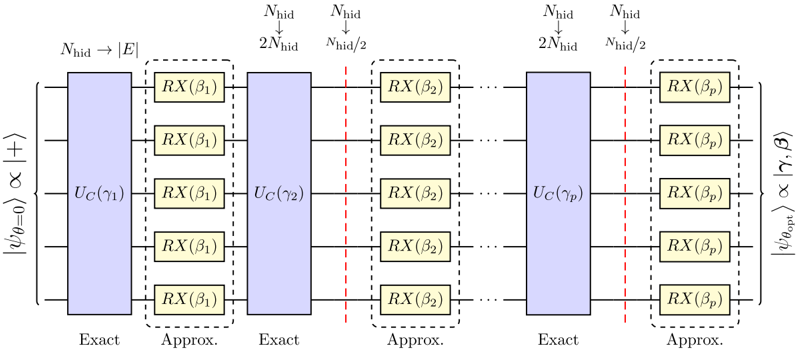
A key open question in quantum computing is whether quantum algorithms can potentially offer a significant advantage over classical algorithms for tasks of practical interest. Understanding the limits of classical computing in simulating quantum systems is an important component of addressing this question. We introduce a method to simulate layered quantum circuits consisting of parametrized gates, an architecture behind many variational quantum algorithms suitable for near-term quantum computers. A neural-network parametrization of the many-qubit wavefunction is used, focusing on states relevant for the Quantum Approximate Optimization Algorithm (QAOA). For the largest circuits simulated, we reach 54 qubits at 4 QAOA layers, approximately implementing 324 RZZ gates and 216 RX gates without requiring large-scale computational resources. For larger systems, our approach can be used to provide accurate QAOA simulations at previously unexplored parameter values and to benchmark the next generation of experiments in the Noisy Intermediate-Scale Quantum (NISQ) era.
Overview
The claims and statistics of this paper haven’t been checked yet.
Free: it reads the open-access text and checks the first 5 claims that cite a source we can check. Create a free account to check every claim.
Integrity signals
Registry
Cites
Statistics
Figures

Verification
Claims the paper makes
The claims and statistics of this paper haven’t been checked yet.
Free: it reads the open-access text and checks the first 5 claims that cite a source we can check. Create a free account to check every claim.
Claims other papers make about this one
Each is checked against this paper’s own text: does it say what the citing paper says it does?
The source backs part of the claim, not all of it — or backs it for a different population, condition or comparison.
In the citing paper
“In practice, the matrix S is typically ill-conditioned and needs to be regularized, for which there exist several approaches 47,56,121 .”
From Beyond-classical computation in quantum simulation (2025) · cites this paper as [56]
Experimental — accuracy not yet measured
Self-check
Percentages, sums and reported differences re-computed from the paper’s own numbers.
The self-check needs the paper’s full text.
Citations
Cites
LeCun, Y., Bengio, Y., & Hinton, G. (2015) · Nature · doi:10.1038/nature14539 · Cited by 84,126
Matplotlib: a 2D graphics environment
Hunter, J. D. (2007) · Computing in Science & Engineering · doi:10.1109/mcse.2007.55 · Cited by 39,249
SciPy 1.0: fundamental algorithms for scientific computing in Python
Virtanen, P., Gommers, R., Oliphant, T. E., Haberland, M., Reddy, T., Cournapeau, D., Burovski, E., Peterson, P., Weckesser, W., Bright, J., et al. (2020) · Nature Methods · doi:10.1038/s41592-019-0686-2 · Cited by 38,430
Equation of State Calculations by Fast Computing Machines
Metropolis, N., Rosenbluth, A. W., Rosenbluth, M. N., Teller, A. H., & Teller, E. (1953) · The Journal of Chemical Physics · doi:10.1063/1.1699114 · Cited by 37,192
Harris, C. R., Millman, K. J., van der Walt, S. J., Gommers, R., Virtanen, P., Cournapeau, D., Wieser, E., Taylor, J., Berg, S., Smith, N. J., et al. (2020) · Nature · doi:10.1038/s41586-020-2649-2 · Cited by 23,826
Reducing the dimensionality of data with neural networks
Hinton, G. E., & Salakhutdinov, R. R. (2006) · Science · doi:10.1126/science.1127647 · Cited by 20,928
Monte Carlo sampling methods using Markov chains and their applications.
Hastings, W. K. (1970) · Biometrika · doi:10.1093/biomet/57.1.97 · Cited by 15,195
Quantum Computing in the NISQ era and beyond
Preskill, J. (2018) · Quantum · doi:10.22331/q-2018-08-06-79 · Cited by 8,830
Quantum supremacy using a programmable superconducting processor
Arute, F., Arya, K., Babbush, R., Bacon, D., Bardin, J. C., Barends, R., Biswas, R., Boixo, S., Brandao, F. G. S. L., Buell, D. A., et al. (2019) · Nature · doi:10.1038/s41586-019-1666-5 · Cited by 7,720
Density matrix formulation for quantum renormalization groups
White, S. R. (1992) · Physical Review Letters · doi:10.1103/physrevlett.69.2863 · Cited by 7,702
Research works printed but not linked: 2
- 43. Kingma, D. P. & Ba, J. L. Adam: a method for stochastic optimization. in 3rd Int. Conf. Learn. Represent. ICLR 2015 -Conf. Track Proc. (San Diego, CA, USA, 2015) https://dblp.org/db/conf/iclr/iclr2015.html.
- 49. Zhao, T., Carleo, G., Stokes, J. & Veerapaneni, S. Natural evolution strategies and variational Monte Carlo. Mach. Learn. Sci. Technol. 2, 2-3 (2020).
Cited by
Quantum annealing initialization of the quantum approximate optimization algorithm
Sack, S. H., & Serbyn, M. (2021) · Quantum · doi:10.22331/q-2021-07-01-491 · Cited by 146
“Furthermore, it will be interesting to study the finite size scaling for problem sizes N > 12 considered here using Matrix Product States (MPS) [35] or neural-network quantum states [36, 37].”
MethodBeyond-classical computation in quantum simulation
King, A. D., Nocera, A., Rams, M. M., Dziarmaga, J., Wiersema, R., Bernoudy, W., Raymond, J., Kaushal, N., Heinsdorf, N., Harris, R., et al. (2025) · Science · doi:10.1126/science.ado6285 · Cited by 138
Does provable absence of barren plateaus imply classical simulability?
Cerezo, M., Larocca, M., García-Martín, D., Diaz, N. L., Braccia, P., Fontana, E., Rudolph, M. S., Bermejo, P., Ijaz, A., Thanasilp, S., et al. (2025) · Nature Communications · doi:10.1038/s41467-025-63099-6 · Cited by 110
“In this manner, our conclusions push against current practice in the community and the net result is that variational quantum algorithms need a rethink.”
Parameter Transfer for Quantum Approximate Optimization of Weighted MaxCut
Shaydulin, R., Lotshaw, P. C., Larson, J., Ostrowski, J., & Humble, T. S. (2023) · ACM Transactions on Quantum Computing · doi:10.1145/3584706 · Cited by 97
RETRACTED ARTICLE: A review on quantum computing and deep learning algorithms and their applications
Valdez, F., & Melín, P. (2022) · Soft Computing · doi:10.1007/s00500-022-07037-4 · Cited by 92
“On the other hand, a classical simulation of the Quantum Approximate Optimization Algorithm was presented, in this work Medvidovic´ and Carleo (2021), was developed A neural-network of the many qubit wave function, focusing on states relevant for the Quantum Approximate Optimization Algorithm.”
MethodRetractedFast quantum circuit cutting with randomized measurements
Lowe, A., Medvidović, M., Hayes, A., Riordan, L. J. O. A., Bromley, T. R., Arrazola, J. M., & Killoran, N. (2023) · Quantum · doi:10.22331/q-2023-03-02-934 · Cited by 141
“In the case of p = 1 , an exact expression for the QAOA cost is available [57, 41], from which we are able to obtain the analytic optimal value to use as a baseline comparison.”
MethodSelf-citationAyral, T., Louvet, T., Zhou, Y., Lambert, C., Stoudenmire, E. M., & Waintal, X. (2023) · PRX Quantum · doi:10.1103/prxquantum.4.020304 · Cited by 66
“This indicates that in order to beat compression algorithms, quantum hardware must improve in fidelity and/or connectivity : a mere increase in the number of qubit is not sufficient.”
Empirical performance bounds for quantum approximate optimization
Lotshaw, P. C., Humble, T. S., Herrman, R., Ostrowski, J., & Siopsis, G. (2021) · Quantum Information Processing · doi:10.1007/s11128-021-03342-3 · Cited by 59
“[8] Matija Medvidović and Giuseppe Carleo.”
Unbiasing time-dependent Variational Monte Carlo by projected quantum evolution
Sinibaldi, A., Giuliani, C., Carleo, G., & Vicentini, F. (2023) · Quantum · doi:10.22331/q-2023-10-10-1131 · Cited by 51
“These latter equations can be integrated with an explicit scheme, the time-dependent Variational Monte Carlo or tVMC [30, 31], or with an implicit method by solving an optimization problem at every time-step [32, 33, 34, 35, 36].”
BackgroundSelf-citationNeural-network quantum states for many-body physics
Medvidović, M., & Moreno, J. R. (2024) · The European Physical Journal Plus · doi:10.1140/epjp/s13360-024-05311-y · Cited by 103
Self-citationSolving correlation clustering with QAOA and a Rydberg qudit system: a full-stack approach
Weggemans, J. R., Urech, A., Rausch, A., Spreeuw, R. J. C., Boucherie, R. J., Schreck, F., Schoutens, K., Minář, J., & Speelman, F. (2022) · Quantum · doi:10.22331/q-2022-04-13-687 · Cited by 59
“Modifying and adopting recently developed classical simulation methods [91] might allow us to study larger graph instances, which we leave to future work.”
Parameter Setting in Quantum Approximate Optimization of Weighted Problems
Sureshbabu, S. H., Herman, D., Shaydulin, R., Basso, J., Chakrabarti, S., Sun, Y., & Pistoia, M. (2024) · Quantum · doi:10.22331/q-2024-01-18-1231 · Cited by 41
“The cost of finding parameters can be significantly reduced by leveraging the apparent problem-instance independence of the optimal QAOA parameters [26, 27].”
BackgroundQuantum machine-learning phase prediction of high-entropy alloys
Brown, P., & Zhuang, H. L. (2023) · Materials Today · doi:10.1016/j.mattod.2023.02.014 · Cited by 44
An efficient quantum proactive incremental learning algorithm
Li, L., Li, J., Song, Y., Qin, S., Wen, Q., & Gao, F. (2024) · Science China Physics Mechanics and Astronomy · doi:10.1007/s11433-024-2501-4 · Cited by 55
Entanglement perspective on the quantum approximate optimization algorithm
Dupont, M., Didier, N., Hodson, M. J., Moore, J. E., & Reagor, M. J. (2022) · Physical Review A · doi:10.1103/physreva.106.022423 · Cited by 57
Impact of graph structures for QAOA on MaxCut
Herrman, R., Treffert, L., Ostrowski, J., Lotshaw, P. C., Humble, T. S., & Siopsis, G. (2021) · Quantum Information Processing · doi:10.1007/s11128-021-03232-8 · Cited by 44
“[8] Matija Medvidović and Giuseppe Carleo.”
Supporting data for "Multipartite entangled states in dipolar quantum simulators"
Comparin, T., Mezzacapo, F., & Roscilde, T. (2022) · Zenodo (CERN European Organization for Nuclear Research) · doi:10.5281/zenodo.6534223 · Cited by 41
Dynamics with autoregressive neural quantum states: Application to critical quench dynamics
Donatella, K., Denis, Z., Le Boité, A., & Ciuti, C. (2023) · Physical Review A · doi:10.1103/physreva.108.022210 · Cited by 36
“These Neural Quantum States (NQS) have found many important applications, including finding the ground state [2, 3], investigating the dynamics of strongly correlated systems [4, 5], quantum tomography [6], open quantum systems [7–11] and the classical simulation of quantum circuits [12, 13].”
BackgroundGPU-accelerated simulations of quantum annealing and the quantum approximate optimization algorithm
Willsch, D., Willsch, M., Jin, F., Michielsen, K., & De Raedt, H. (2022) · Computer Physics Communications · doi:10.1016/j.cpc.2022.108411 · Cited by 36
Investigating topological order using recurrent neural networks
Hibat-Allah, M., Melko, R. G., & Carrasquilla, J. (2023) · Physical Review B · doi:10.1103/physrevb.108.075152 · Cited by 27
“[36] Matija Medvidović and Giuseppe Carleo, “Classical variational simulation of the quantum approximate optimization algorithm,” npj Quantum Information 7, 101 (2021).”
BackgroundQuantum dropout: On and over the hardness of quantum approximate optimization algorithm
Wang, Z., Zheng, P.-L., Wu, B., & Zhang, Y. (2023) · Physical Review Research · doi:10.1103/physrevresearch.5.023171 · Cited by 26
Quantum Metrology Assisted by Machine Learning
Huang, J., Zhuang, M., Zhou, J., Shen, Y., & Lee, C. (2024) · Advanced Quantum Technologies · doi:10.1002/qute.202300329 · Cited by 24
A Herculean task: classical simulation of quantum computers
Xu, X., Benjamin, S. C., Chen, J., Sun, J., Yuan, X., & Zhang, P. (2025) · Science Bulletin · doi:10.1016/j.scib.2025.10.016 · Cited by 79
“(cid:105) [41, 42], specific neural networks, restricted Boltzmann machines (RBM) [43, 44] have been employed to approximately represent and evolve the quantum state.”
Augmenting QAOA Ansatz with Multiparameter Problem-Independent Layer
Chalupnik, M., Melo, H., Alexeev, Y., & Galda, A. (2022) · IEEE International Conference on Quantum Computing and Engineering (QCE) · doi:10.1109/qce53715.2022.00028 · Cited by 41
Variational Quantum Dynamics of Two-Dimensional Rotor Models
Medvidović, M., & Sels, D. (2023) · PRX Quantum · doi:10.1103/prxquantum.4.040302 · Cited by 39
“[47, 48].”
Self-citationSpin-symmetry-enforced solution of the many-body Schrödinger equation with a deep neural network
Li, Z., Lu, Z., Li, R., Wen, X., Li, X., Wang, L., Chen, J., & Ren, W. (2024) · Nature Computational Science · doi:10.1038/s43588-024-00730-4 · Cited by 32
“The square of overlap ∣ S ij ∣ 2 can be estimated through Monte Carlo method using the following effective estimator 21,66,67 : Article https://doi.org/10.1038/s43588-024-00730-4 ].”
InfluentialSolution of SAT problems with the adaptive-bias quantum approximate optimization algorithm
Yu, Y., Cao, C., Wang, X., Shannon, N., & Joynt, R. (2023) · Physical Review Research · doi:10.1103/physrevresearch.5.023147 · Cited by 27
“Simulations of the QAOA give solutions for MaxCut problems on sizes up to 20 vertices [10] with the standard method and up to 54 qubits with a neural network based method [25].”
MethodYu, G., Wu, C., Liu, Y., Du, Z., Zhao, N., Jiao, Y., Xu, Z., & Shi, W. (2023) · Science China Earth Sciences · doi:10.1007/s11430-022-1144-7 · Cited by 20
Bayesian Optimization for QAOA
Tibaldi, S., Vodola, D., Tignone, E., & Ercolessi, E. (2023) · IEEE Transactions on Quantum Engineering · doi:10.1109/tqe.2023.3325167 · Cited by 39
“Among the hybrid variational algorithms, the Quantum Approximate Optimization Algorithm (QAOA) [7] is extensively studied [8] as a promising algorithm to investigate quantum speedups on NISQ devices and has been implemented on several experimental platforms, such as Rydberg atom arrays [9], superconducting processors…”
MethodQuantum approximate optimization algorithm: a review study and problems
Abualigah, L., AlNajdawi, S., Ikotun, A. M., Forestiero, A., Gul, F., Ezugwu, A. E.-S., Jia, H., Zare, M., Mahajan, S., & Alshinwan, M. (2024) · Elsevier eBooks · doi:10.1016/b978-0-443-13925-3.00007-8 · Cited by 21
Markov chain Monte Carlo enhanced variational quantum algorithms
Patti, T. L., Shehab, O., Najafi, K., & Yelin, S. F. (2022) · Quantum Science and Technology · doi:10.1088/2058-9565/aca821 · Cited by 24
“Likewise, while classical MCMC methods have been used to simulate quantum computing routines [40, 41], our work uses classical MCMC to enhance quantum algorithms on quantum hardware.”
MethodNeural Projected Quantum Dynamics: a systematic study
Gravina, L., Savona, V., & Vicentini, F. (2025) · Quantum · doi:10.22331/q-2025-07-22-1803 · Cited by 45
“Identifying an optimal value for λ is nontrivial, and it is rare for a single value of λ to be suitable across all optimization iterations.”
Neural-shadow quantum state tomography
Wei, V., Coish, W. A., Ronagh, P., & Muschik, C. A. (2024) · Physical Review Research · doi:10.1103/physrevresearch.6.023250 · Cited by 25
“In particular, NSQST can be used to construct a “digital twin” [65] of the prepared target state, where a neural network quantum state can be used for experimentally-relevant simulation [66, 67], cross-platform verification [68], error mitigation [18] and other uses.”
MethodSolving MaxCut with quantum imaginary time evolution
Alam, R., Siopsis, G., Herrman, R., Ostrowski, J., Lotshaw, P. C., & Humble, T. S. (2023) · Quantum Information Processing · doi:10.1007/s11128-023-04045-7 · Cited by 17
Federated quantum machine learning for drug discovery and healthcare
Saggi, M. K., Bhatia, A. S., & Kais, S. (2024) · Annual reports in computational chemistry · doi:10.1016/bs.arcc.2024.10.007 · Cited by 16
Deep recurrent networks predicting the gap evolution in adiabatic quantum computing
Mohseni, N., Navarrete–Benlloch, C., Byrnes, T., & Marquardt, F. (2023) · Quantum · doi:10.22331/q-2023-06-12-1039 · Cited by 16
“[14] Matija Medvidović and Giuseppe Carleo, “Classical variational simulation of the quantum approximate optimization algorithm,” npj Quantum Information 7, 1–7 (2021).”
BackgroundCalibrating the Classical Hardness of the Quantum Approximate Optimization Algorithm
Dupont, M., Didier, N., Hodson, M. J., Moore, J. E., & Reagor, M. J. (2022) · PRX Quantum · doi:10.1103/prxquantum.3.040339 · Cited by 26
“Recently, shallow neural networks based on restricted Boltzmann machines [90–92] have been used to simulate QAOA circuits [55], with promising results.”
MethodImpact of conditional modelling for a universal autoregressive quantum state
Bortone, M., Rath, Y., & Booth, G. H. (2024) · Quantum · doi:10.22331/q-2024-02-08-1245 · Cited by 12
Scalable imaginary time evolution with neural network quantum states
Ledinauskas, E., & Anisimovas, E. (2023) · SciPost Physics · doi:10.21468/scipostphys.15.6.229 · Cited by 17
Mahmoudi, Y., Zioui, N., Belbachir, H., Tadjine, M., & Rezgui, A. (2022) · Emerging Science Journal · doi:10.28991/esj-2023-07-01-020 · Cited by 10
“In Medvidović & Carleo [137], a method has been described for simulating layered quantum circuits made of parameterized gates, a key architecture for many variational quantum algorithms suitable for short-range quantum computers.”
MethodChallenges for Quantum Software Engineering: An Industrial Application Scenario Perspective
Carbonelli, C., Felderer, M., Jung, M., Lobe, E., Lochau, M., Luber, S. M., Mauerer, W., Ramler, R., Schaefer, I., & Schroth, C. (2024) · Springer eBooks · doi:10.1007/978-3-031-64136-7_12 · Cited by 19
Nuclear Responses with Neural-Network Quantum States
Parnes, E., Barnea, N., Carleo, G., Lovato, A., Rocco, N., & Zhang, X. (2026) · Physical Review Letters · doi:10.1103/tlqz-nw28 · Cited by 25
Self-citationInfinite neural network quantum states: entanglement and training dynamics
Luo, D., & Halverson, J. (2023) · Machine Learning Science and Technology · doi:10.1088/2632-2153/ace02f · Cited by 18
Time-Dependent Neural Galerkin Method for Quantum Dynamics
Sinibaldi, A., Hendry, D., Vicentini, F., & Carleo, G. (2026) · Physical Review Letters · doi:10.1103/kqvx-dl54 · Cited by 46
Self-citationMimicking quantum correlation of a long-range Hamiltonian by finite-range interactions
Lakkaraju, L. G. C., Ghosh, S., Sadhukhan, D., & Sen, A. (2022) · Physical Review A · doi:10.1103/physreva.106.052425 · Cited by 8
Amplitude Ratios and Neural Network Quantum States
Havlíček, V. (2023) · Quantum · doi:10.22331/q-2023-03-02-938 · Cited by 12
Quantum-Inspired Clustering for Hazardous Asteroid Prediction in Quantum Machine LearningPreprint
Bhagwakar, P. P., Thaker, C. S., & Joshiara, H. A. (2024) · Research Square · doi:10.21203/rs.3.rs-4496890/v1 · Cited by 7
Quantum resources of quantum and classical variational methods
Spriggs, T., Ahmadi, A., Chen, B., & Greplová, E. (2025) · Machine Learning Science and Technology · doi:10.1088/2632-2153/adaca2 · Cited by 9
“NQS have shown to be useful in a variety of problems, such as finding the ground state in different quantum systems [13, 28, 29], evolving quantum states through time [8, 30], and simulating quantum circuits [31].”
Supervised training of neural-network quantum states for the next-nearest neighbor Ising model
Wu, Z., Zen, R. A. M., Casagrande, H. P., Poletti, D., & Bressan, S. (2024) · Computer Physics Communications · doi:10.1016/j.cpc.2024.109169 · Cited by 6
Warm-start adaptive-bias quantum approximate optimization algorithm
Yu, Y., Wang, X., Shannon, N., & Joynt, R. (2025) · Physical Review A · doi:10.1103/nt3w-j4mj · Cited by 12
Krüger, T., & Mauerer, W. (2025) · Quantum · doi:10.22331/q-2025-11-06-1903 · Cited by 8
“qaoa and variants of the algorithm have been subject of intensive research [5, 6, 13, 15, 21, 22, 25, 28, 32– 34, 37, 39, 41–43, 45, 49, 54–56, 59, 60, 64–67, 69, 73, 74, 76, 79–81, 85–87, 89–91, 93, 95, 96], as recently reviewed by Blekos et al. [19] or Zhou et al. [98].”
岳, 天., 吴, 晨., 刘, 熠., 杜, 正., 赵, 娜., 焦, 毅., 徐, 喆., & 史, 文. (2023) · SCIENTIA SINICA Terrae · doi:10.1360/sste-2022-0319 · Cited by 3
Tabu-Driven Quantum Neighborhood Samplers
Moussa, C., Wang, H., Calandra, H., Bäck, T., & Dunjko, V. (2021) · Lecture notes in computer science · doi:10.1007/978-3-030-72904-2_7 · Cited by 6
“imulated) noise. One reason of why so many uncertainties remain is that classical simulation is computationally very expensive, and quantum devices are still scarce to prevent large real world tests. [30,3]. In contrast to optimization problems, quantum advantage has been demonstrated in sampling [2]. Indeed, theoreti…”
BackgroundFundamental Physics and Computation: The Computer-Theoretic Framework
Miguel-Tomé, S., Lázaro, Á. L. S., & Alonso-Romero, L. (2022) · Universe · doi:10.3390/universe8010040 · Cited by 3
de Lima, E. F., Fernandes, M. E. F., & Castelano, L. K. (2022) · Physical Review A · doi:10.1103/physreva.105.032454 · Cited by 4
Tabu-driven Quantum Neighborhood SamplersPreprint
Moussa, C., Wang, H., Calandra, H., Bäck, T. H. W., & Dunjko, V. (2020) · Leiden Repository (Leiden University) · Cited by 3
Grassmann variational Monte Carlo with neural wave functions
Hendry, D., Sinibaldi, A., & Carleo, G. (2026) · Physical review. B./Physical review. B · doi:10.1103/l8mr-567g · Cited by 12
Self-citationAn Exact and Practical Classical Strategy for 2D Graph State Sampling
Zhang, S., Bao, J., Sun, Y., Li, L., Sun, H., & Zhang, X. (2023) · Annalen der Physik · doi:10.1002/andp.202200531 · Cited by 2
Quantum harmonic oscillator model for simulation of intercity population mobility
Hu, X. L., Qian, L., Niu, X., Gao, M. X., Luo, W., Yuan, L., & Yu, Z. (2024) · Journal of Geographical Sciences · doi:10.1007/s11442-024-2213-3 · Cited by 2
“…al ., 2009), big data least squares fitting algorithm (Wiebe et al ., 2012), support vector machine quantum algorithm (Rebentrost et al ., 2014), variational quantum eigenvalue solving algorithm (Peruzzo et al ., 2014), and quantum approximation optimization algorithm (Medvidović and Carleo, 2021).”
CUAOA: A Novel CUDA-Accelerated Simulation Framework for the QAOA
Stein, J., Blenninger, J., Bucher, D., Eder, P. J., Çetiner, E., Zorn, M., & Linnhoff–Popien, C. (2024) · IEEE International Conference on Quantum Computing and Engineering (QCE) · doi:10.1109/qce60285.2024.10292 · Cited by 11
Heuristic Time Complexity of NISQ Shortest-Vector-Problem Solvers
Prokop, M., & Wallden, P. (2025) · IEEE Transactions on Quantum Engineering · doi:10.1109/tqe.2025.3620104 · Cited by 7
“Because the optimization subroutine that finds the optimal parameters of QAOA can be computationally expensive [28], [34], [35], methods to leverage the QAOA parameter search are being investigated.”
Finding the Dynamics of an Integrable Quantum Many‐Body System via Machine Learning
Wei, V., Orfi, A., Fehse, F., & Coish, W. A. (2023) · Advanced Physics Research · doi:10.1002/apxr.202300078 · Cited by 1
Entangling Intelligence: AI-Quantum Crossovers and Perspectives
Chen, Z., & Luo, D. (2024) · IEEE International Conference on Trust, Privacy and Security in Intelligent Systems and Applications (TPS-ISA) · doi:10.1109/tps-isa62245.2024.00069 · Cited by 6
The convergence of quantum computing and machine learning
Khou, T., & Stuetzle, C. S. (2026) · Elsevier eBooks · doi:10.1016/b978-0-443-34193-9.00012-0 · Cited by 1
Turab, A., Latif, J., Zaidi, S. A., & Hussain, A. (2026) · Journal of Computational and Applied Mathematics · doi:10.1016/j.cam.2026.117857 · Cited by 1
Complexity phase transitions in instantaneous quantum polynomial-time circuits
Park, C.-Y., & Kastoryano, M. J. (2025) · Physical Review Research · doi:10.1103/physrevresearch.7.013001 · Cited by 6
A Technical Note for a Shor’s Algorithm by Phase Estimation
Fleury, G., & Lacomme, P. (2022) · Journal of quantum computing · doi:10.32604/jqc.2022.032973 · Cited by 2
Multipartite Entangled States in Dipolar Quantum Simulators
Comparin, T., Mezzacapo, F., & Roscilde, T. (2022) · Physical Review Letters · doi:10.1103/physrevlett.129.150503 · Cited by 26
The Restricted Boltzmann Machine Ansatz through Adiabiatic Routes
Korutcheva, E., Korutchev, K., Santalla, S. N., Rodríguez-Laguna, J., & Chamati, H. (2023) · Journal of Physics Conference Series · doi:10.1088/1742-6596/2436/1/012001
Ledinauskas, E., & Anisimovas, E. (2023) · SciPost Physics · doi:10.21468/scipost.report.8117
Ledinauskas, E., & Anisimovas, E. (2023) · SciPost Physics · doi:10.21468/scipost.report.7880
A machine learning ride in the physics theme park: from quantum to biophysics
Requena, B. (2024) · UPCommons institutional repository (Universitat Politècnica de Catalunya) · doi:10.5821/dissertation-2117-409132
Research on Key Technologies for Analyzing Quantum Computing with Deep Learning
Chen, K., Shi, L., He, C., Yu, Y., & Deng, K. (2025) · SPIN · doi:10.1142/s2010324724400083
Quantum Computing in Drug Discovery: A Review of Foundations and Emerging Applications
Kulkarni, S., Patil, D. P. S., & Patil, R. D. (2025) · International Journal of Advanced Pharmaceutical Sciences and Research · doi:10.54105/ijapsr.e4078.05040625 · Cited by 1
The Fundamental Theorem for Eco-Environmental Surface Modelling
Yu, G., Zhao, N., Shi, W., & Fan, Z. (2025) · Springer eBooks · doi:10.1007/978-981-96-1977-1_2
Afzal, A., Rana, M. E., Hameed, V. A., & Safavi, S. (2025) · International Conference on Advancements in Smart, Secure and Intelligent Computing (ASSIC) · doi:10.1109/assic64892.2025.11158364
Zhong, H., & Zhang, Q. (2025) · Theoretical Computer Science · doi:10.1016/j.tcs.2025.115649 · Cited by 1
Hybrid Quantum-Classical Optimization Method for Avionics Architecture in Space Launcher
Isidory, E., & Annighöfer, B. (2025) · IEEE/AIAA Digital Avionics Systems Conference (DASC) · doi:10.1109/dasc66011.2025.11257356
Revolutionizing drug design: the convergence of AI and quantum computing - A systematic review
Khan, N. A., Akhtar, M. M., Zamani, A. S., Siddiqi, A. M. U., Khan, A. R., & Rajeyyagari, S. (2026) · Elsevier eBooks · doi:10.1016/b978-0-443-44430-2.00008-6 · Cited by 1
Removing Nodal and Support-Mismatch Pathologies in Variational Monte Carlo via Blurred Sampling
Wan, Z., Wiersema, R., & Zhang, S. (2026) · Physical Review X · doi:10.1103/jrn5-gv19 · Cited by 12
“Strong localization of the wavefunction also appears in neural quantum state simulations of quantum circuits, where one typically evolves a single computational basis state [48].”
Metadata
- Authors
- Medvidović, M., & Carleo, G.
- Affiliations
- Flatiron Institute (US)
- École Polytechnique Fédérale de Lausanne (CH)
- Corresponding author
- Carleo, Giuseppe
- Venue
- npj Quantum Information
- Published
- 2021-06-18
- Volume
- 7
- Issue
- 1
- ISSN
- 2056-6387 (ISSN-L)
- OpenAlex
- W3082481571
- Semantic Scholar
- 589fd76505aeff4f64326a6f552e6daeb0fdf156
- Cited by
- 79
- References
- 47
- Citations by year
- 2026: 7 · 2025: 14 · 2024: 17 · 2023: 23 · 2022: 13 · 2021: 4
- FWCI
- 5.13
- Type
- journal article
- Language
- en
- Open access
- gold
- doi.org
- Licence
- cc-by
- creativecommons.org/licenses/by/4.0 (tdm)
- creativecommons.org/licenses/by/4.0 (vor)
- Locations
- npj Quantum Information (publishedVersion, cc-by)
- arXiv (Cornell University) (submittedVersion)
- Infoscience (Ecole Polytechnique Fédérale de Lausanne) (submittedVersion, cc-by-nc-nd)
- DOAJ (DOAJ: Directory of Open Access Journals) (submittedVersion, cc-by-sa)
- Funders
- Simons Foundation
- Flatiron Health
- Topics
- Physical Sciences › Computer Science › Artificial Intelligence › Quantum Computing Algorithms and Architecture
- Physical Sciences › Physics and Astronomy › Atomic and Molecular Physics, and Optics › Quantum many-body systems
- Physical Sciences › Physics and Astronomy › Atomic and Molecular Physics, and Optics › Quantum Mechanics and Applications
- Keywords
- quantum approximate optimization algorithm, classical simulation of quantum circuits, variational quantum algorithms, variational quantum eigensolver, NISQ devices, variational quantum circuits
About these checks
Registry, retraction, Cites and statistics results are computed, not judged, with one exception: a printed reference that no index lists is read once by a model before it counts as a citation error. Claims are extracted by a model and kept only when their quote appears verbatim in the text; each cited source is then checked, with a model’s help, for whether it says what the claim relies on. Those verdicts can be wrong — read the claim’s quote and the cited source before relying on one.
Statistics and arithmetic are recomputed, not judged.
Confidence bands are shown only for fields calibrated on our annotated test set. None is calibrated yet, so no band is shown.
What counts as a claim ›How we measure confidence ›How we check this ›
Are you an author, or do you see a problem with this page? Request a review
Data sources
Bibliographic data: Semantic Scholar, OpenAlex, Crossref.
Contains information from the Semantic Scholar Academic Graph Datasets, made available under the ODC Attribution License (ODC-BY 1.0).
Semantic Scholar’s data is described in: Kinney, R., et al. (2023). The Semantic Scholar Open Data Platform. arXiv:2301.10140.
