

Classical variational simulation of the Quantum Approximate Optimization Algorithm
Open accessThe DOI matches its Crossref record; 55 of the 56 references it cites were found in a registry or an index.
Abstract
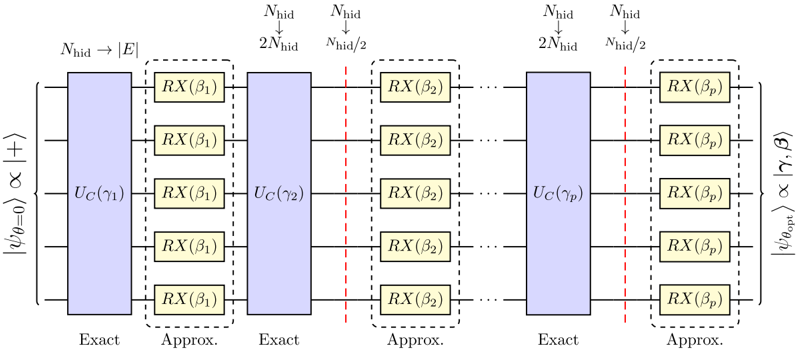
A key open question in quantum computing is whether quantum algorithms can potentially offer a significant advantage over classical algorithms for tasks of practical interest. Understanding the limits of classical computing in simulating quantum systems is an important component of addressing this question. We introduce a method to simulate layered quantum circuits consisting of parametrized gates, an architecture behind many variational quantum algorithms suitable for near-term quantum computers. A neural-network parametrization of the many-qubit wavefunction is used, focusing on states relevant for the Quantum Approximate Optimization Algorithm (QAOA). For the largest circuits simulated, we reach 54 qubits at 4 QAOA layers, approximately implementing 324 RZZ gates and 216 RX gates without requiring large-scale computational resources. For larger systems, our approach can be used to provide accurate QAOA simulations at previously unexplored parameter values and to benchmark the next generation of experiments in the Noisy Intermediate-Scale Quantum (NISQ) era.
Overview
The claims and statistics of this paper haven’t been checked yet.
Free: it reads the open-access text and checks the first 5 claims that cite a source we can check. Create a free account to check every claim.
Integrity signals
Registry
Cites
Statistics
Figures

Verification
Claims the paper makes
The claims and statistics of this paper haven’t been checked yet.
Free: it reads the open-access text and checks the first 5 claims that cite a source we can check. Create a free account to check every claim.
Claims other papers make about this one
Each is checked against this paper’s own text: does it say what the citing paper says it does?
The source backs part of the claim, not all of it — or backs it for a different population, condition or comparison.
In the citing paper
“In practice, the matrix S is typically ill-conditioned and needs to be regularized, for which there exist several approaches 47,56,121 .”
From Beyond-classical computation in quantum simulation (2025) · cites this paper as [56]
Experimental — accuracy not yet measured
Self-check
Percentages, sums and reported differences re-computed from the paper’s own numbers.
The self-check needs the paper’s full text.
Citations
Cites
LeCun, Y., Bengio, Y., & Hinton, G. (2015) · Nature · doi:10.1038/nature14539 · Cited by 84,126
Matplotlib: a 2D graphics environment
Hunter, J. D. (2007) · Computing in Science & Engineering · doi:10.1109/mcse.2007.55 · Cited by 39,249
SciPy 1.0: fundamental algorithms for scientific computing in Python
Virtanen, P., Gommers, R., Oliphant, T. E., Haberland, M., Reddy, T., Cournapeau, D., Burovski, E., Peterson, P., Weckesser, W., Bright, J., et al. (2020) · Nature Methods · doi:10.1038/s41592-019-0686-2 · Cited by 38,430
Equation of State Calculations by Fast Computing Machines
Metropolis, N., Rosenbluth, A. W., Rosenbluth, M. N., Teller, A. H., & Teller, E. (1953) · The Journal of Chemical Physics · doi:10.1063/1.1699114 · Cited by 37,192
Harris, C. R., Millman, K. J., van der Walt, S. J., Gommers, R., Virtanen, P., Cournapeau, D., Wieser, E., Taylor, J., Berg, S., Smith, N. J., et al. (2020) · Nature · doi:10.1038/s41586-020-2649-2 · Cited by 23,826
Reducing the dimensionality of data with neural networks
Hinton, G. E., & Salakhutdinov, R. R. (2006) · Science · doi:10.1126/science.1127647 · Cited by 20,928
Monte Carlo sampling methods using Markov chains and their applications.
Hastings, W. K. (1970) · Biometrika · doi:10.1093/biomet/57.1.97 · Cited by 15,195
Quantum Computing in the NISQ era and beyond
Preskill, J. (2018) · Quantum · doi:10.22331/q-2018-08-06-79 · Cited by 8,830
Quantum supremacy using a programmable superconducting processor
Arute, F., Arya, K., Babbush, R., Bacon, D., Bardin, J. C., Barends, R., Biswas, R., Boixo, S., Brandao, F. G. S. L., Buell, D. A., et al. (2019) · Nature · doi:10.1038/s41586-019-1666-5 · Cited by 7,720
Density matrix formulation for quantum renormalization groups
White, S. R. (1992) · Physical Review Letters · doi:10.1103/physrevlett.69.2863 · Cited by 7,702
Research works printed but not linked: 2
- 43. Kingma, D. P. & Ba, J. L. Adam: a method for stochastic optimization. in 3rd Int. Conf. Learn. Represent. ICLR 2015 -Conf. Track Proc. (San Diego, CA, USA, 2015) https://dblp.org/db/conf/iclr/iclr2015.html.
- 49. Zhao, T., Carleo, G., Stokes, J. & Veerapaneni, S. Natural evolution strategies and variational Monte Carlo. Mach. Learn. Sci. Technol. 2, 2-3 (2020).
Cited by
Quantum annealing initialization of the quantum approximate optimization algorithm
Sack, S. H., & Serbyn, M. (2021) · Quantum · doi:10.22331/q-2021-07-01-491 · Cited by 146
“Furthermore, it will be interesting to study the finite size scaling for problem sizes N > 12 considered here using Matrix Product States (MPS) [35] or neural-network quantum states [36, 37].”
MethodBeyond-classical computation in quantum simulation
King, A. D., Nocera, A., Rams, M. M., Dziarmaga, J., Wiersema, R., Bernoudy, W., Raymond, J., Kaushal, N., Heinsdorf, N., Harris, R., et al. (2025) · Science · doi:10.1126/science.ado6285 · Cited by 138
Does provable absence of barren plateaus imply classical simulability?
Cerezo, M., Larocca, M., García-Martín, D., Diaz, N. L., Braccia, P., Fontana, E., Rudolph, M. S., Bermejo, P., Ijaz, A., Thanasilp, S., et al. (2025) · Nature Communications · doi:10.1038/s41467-025-63099-6 · Cited by 110
“In this manner, our conclusions push against current practice in the community and the net result is that variational quantum algorithms need a rethink.”
Parameter Transfer for Quantum Approximate Optimization of Weighted MaxCut
Shaydulin, R., Lotshaw, P. C., Larson, J., Ostrowski, J., & Humble, T. S. (2023) · ACM Transactions on Quantum Computing · doi:10.1145/3584706 · Cited by 97
RETRACTED ARTICLE: A review on quantum computing and deep learning algorithms and their applications
Valdez, F., & Melín, P. (2022) · Soft Computing · doi:10.1007/s00500-022-07037-4 · Cited by 92
“On the other hand, a classical simulation of the Quantum Approximate Optimization Algorithm was presented, in this work Medvidovic´ and Carleo (2021), was developed A neural-network of the many qubit wave function, focusing on states relevant for the Quantum Approximate Optimization Algorithm.”
MethodRetracted
Metadata
- Authors
- Medvidović, M., & Carleo, G.
- Affiliations
- Flatiron Institute (US)
- École Polytechnique Fédérale de Lausanne (CH)
- Corresponding author
- Carleo, Giuseppe
- Venue
- npj Quantum Information
- Published
- 2021-06-18
- Volume
- 7
- Issue
- 1
- ISSN
- 2056-6387 (ISSN-L)
- OpenAlex
- W3082481571
- Semantic Scholar
- 589fd76505aeff4f64326a6f552e6daeb0fdf156
- Cited by
- 79
- References
- 47
- Citations by year
- 2026: 7 · 2025: 14 · 2024: 17 · 2023: 23 · 2022: 13 · 2021: 4
- FWCI
- 5.13
- Type
- journal article
- Language
- en
- Open access
- gold
- doi.org
- Licence
- cc-by
- creativecommons.org/licenses/by/4.0 (tdm)
- creativecommons.org/licenses/by/4.0 (vor)
- Locations
- npj Quantum Information (publishedVersion, cc-by)
- arXiv (Cornell University) (submittedVersion)
- Infoscience (Ecole Polytechnique Fédérale de Lausanne) (submittedVersion, cc-by-nc-nd)
- DOAJ (DOAJ: Directory of Open Access Journals) (submittedVersion, cc-by-sa)
- Funders
- Simons Foundation
- Flatiron Health
- Topics
- Physical Sciences › Computer Science › Artificial Intelligence › Quantum Computing Algorithms and Architecture
- Physical Sciences › Physics and Astronomy › Atomic and Molecular Physics, and Optics › Quantum many-body systems
- Physical Sciences › Physics and Astronomy › Atomic and Molecular Physics, and Optics › Quantum Mechanics and Applications
- Keywords
- quantum approximate optimization algorithm, classical simulation of quantum circuits, variational quantum algorithms, variational quantum eigensolver, NISQ devices, variational quantum circuits
About these checks
Registry, retraction, Cites and statistics results are computed, not judged, with one exception: a printed reference that no index lists is read once by a model before it counts as a citation error. Claims are extracted by a model and kept only when their quote appears verbatim in the text; each cited source is then checked, with a model’s help, for whether it says what the claim relies on. Those verdicts can be wrong — read the claim’s quote and the cited source before relying on one.
Statistics and arithmetic are recomputed, not judged.
Confidence bands are shown only for fields calibrated on our annotated test set. None is calibrated yet, so no band is shown.
What counts as a claim ›How we measure confidence ›How we check this ›
Are you an author, or do you see a problem with this page? Request a review
Data sources
Bibliographic data: Semantic Scholar, OpenAlex, Crossref.
Contains information from the Semantic Scholar Academic Graph Datasets, made available under the ODC Attribution License (ODC-BY 1.0).
Semantic Scholar’s data is described in: Kinney, R., et al. (2023). The Semantic Scholar Open Data Platform. arXiv:2301.10140.
