

Classical variational simulation of the Quantum Approximate Optimization Algorithm
Open accessThe DOI matches its Crossref record; 55 of the 56 references it cites were found in a registry or an index.
Abstract
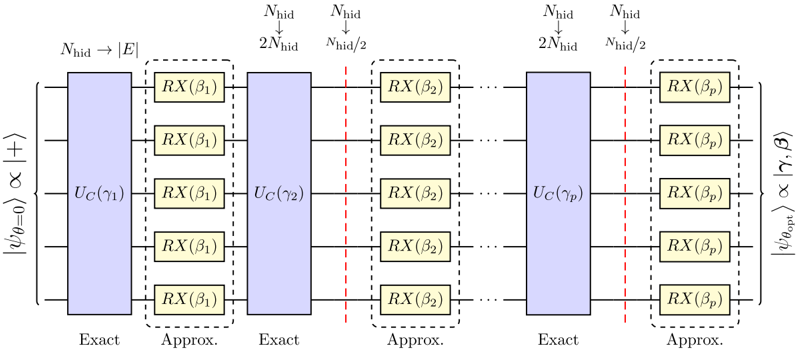
A key open question in quantum computing is whether quantum algorithms can potentially offer a significant advantage over classical algorithms for tasks of practical interest. Understanding the limits of classical computing in simulating quantum systems is an important component of addressing this question. We introduce a method to simulate layered quantum circuits consisting of parametrized gates, an architecture behind many variational quantum algorithms suitable for near-term quantum computers. A neural-network parametrization of the many-qubit wavefunction is used, focusing on states relevant for the Quantum Approximate Optimization Algorithm (QAOA). For the largest circuits simulated, we reach 54 qubits at 4 QAOA layers, approximately implementing 324 RZZ gates and 216 RX gates without requiring large-scale computational resources. For larger systems, our approach can be used to provide accurate QAOA simulations at previously unexplored parameter values and to benchmark the next generation of experiments in the Noisy Intermediate-Scale Quantum (NISQ) era.
Overview
The claims and statistics of this paper haven’t been checked yet.
Free: it reads the open-access text and checks the first 5 claims that cite a source we can check. Create a free account to check every claim.
Integrity signals
Registry
Cites
Statistics
Figures

Verification
Claims the paper makes
The claims and statistics of this paper haven’t been checked yet.
Free: it reads the open-access text and checks the first 5 claims that cite a source we can check. Create a free account to check every claim.
Claims other papers make about this one
Each is checked against this paper’s own text: does it say what the citing paper says it does?
The source backs part of the claim, not all of it — or backs it for a different population, condition or comparison.
In the citing paper
“In practice, the matrix S is typically ill-conditioned and needs to be regularized, for which there exist several approaches 47,56,121 .”
From Beyond-classical computation in quantum simulation (2025) · cites this paper as [56]
Experimental — accuracy not yet measured
Self-check
Percentages, sums and reported differences re-computed from the paper’s own numbers.
The self-check needs the paper’s full text.
Citations
Cites
LeCun, Y., Bengio, Y., & Hinton, G. (2015) · Nature · doi:10.1038/nature14539 · Cited by 84,126
Matplotlib: a 2D graphics environment
Hunter, J. D. (2007) · Computing in Science & Engineering · doi:10.1109/mcse.2007.55 · Cited by 39,249
SciPy 1.0: fundamental algorithms for scientific computing in Python
Virtanen, P., Gommers, R., Oliphant, T. E., Haberland, M., Reddy, T., Cournapeau, D., Burovski, E., Peterson, P., Weckesser, W., Bright, J., et al. (2020) · Nature Methods · doi:10.1038/s41592-019-0686-2 · Cited by 38,430
Equation of State Calculations by Fast Computing Machines
Metropolis, N., Rosenbluth, A. W., Rosenbluth, M. N., Teller, A. H., & Teller, E. (1953) · The Journal of Chemical Physics · doi:10.1063/1.1699114 · Cited by 37,192
Harris, C. R., Millman, K. J., van der Walt, S. J., Gommers, R., Virtanen, P., Cournapeau, D., Wieser, E., Taylor, J., Berg, S., Smith, N. J., et al. (2020) · Nature · doi:10.1038/s41586-020-2649-2 · Cited by 23,826
Reducing the dimensionality of data with neural networks
Hinton, G. E., & Salakhutdinov, R. R. (2006) · Science · doi:10.1126/science.1127647 · Cited by 20,928
Monte Carlo sampling methods using Markov chains and their applications.
Hastings, W. K. (1970) · Biometrika · doi:10.1093/biomet/57.1.97 · Cited by 15,195
Quantum Computing in the NISQ era and beyond
Preskill, J. (2018) · Quantum · doi:10.22331/q-2018-08-06-79 · Cited by 8,830
Quantum supremacy using a programmable superconducting processor
Arute, F., Arya, K., Babbush, R., Bacon, D., Bardin, J. C., Barends, R., Biswas, R., Boixo, S., Brandao, F. G. S. L., Buell, D. A., et al. (2019) · Nature · doi:10.1038/s41586-019-1666-5 · Cited by 7,720
Density matrix formulation for quantum renormalization groups
White, S. R. (1992) · Physical Review Letters · doi:10.1103/physrevlett.69.2863 · Cited by 7,702
Exploring Network Structure, Dynamics, and Function Using NetworkX
Hagberg, A. A., Schult, D. A., & Swart, P. J. (2008) · Proceedings of the Python in Science Conference · doi:10.25080/tcwv9851 · Cited by 7,477 · cited 1×
“Random graph generation was done with NetworkX [41, 42] (BSD 3).”
MethodTraining Products of Experts by Minimizing Contrastive Divergence
Hinton, G. E. (2002) · Neural Computation · doi:10.1162/089976602760128018 · Cited by 4,879
Biamonte, J., Wittek, P., Pancotti, N., Rebentrost, P., Wiebe, N., & Lloyd, S. (2017) · Nature · doi:10.1038/nature23474 · Cited by 4,779
A variational eigenvalue solver on a photonic quantum processor
Peruzzo, A., McClean, J., Shadbolt, P., Yung, M.-H., Zhou, X.-Q., Love, P. J., Aspuru-Guzik, A., & O’Brien, J. L. (2014) · Nature Communications · doi:10.1038/ncomms5213 · Cited by 4,552
Goemans, M. X., & Williamson, D. P. (1995) · Journal of the ACM · doi:10.1145/227683.227684 · Cited by 3,587
Monte Carlo Methods in Statistical Physics
Newman, M. E. J., & Barkema, G. T. (1999) · doi:10.1093/oso/9780198517962.001.0001 · Cited by 3,165
Lloyd, S. (1996) · Science · doi:10.1126/science.273.5278.1073 · Cited by 3,088
Natural Gradient Works Efficiently in Learning
Amari, S.-I. (1998) · Neural Computation · doi:10.1162/089976698300017746 · Cited by 2,681
Ising formulations of many NP problems
Lucas, A. (2014) · Frontiers in Physics · doi:10.3389/fphy.2014.00005 · Cited by 2,512
Efficient Classical Simulation of Slightly Entangled Quantum Computations
Vidal, G. (2003) · Physical Review Letters · doi:10.1103/physrevlett.91.147902 · Cited by 2,368
Solving the quantum many-body problem with artificial neural networks
Carleo, G., & Troyer, M. (2017) · Science · doi:10.1126/science.aag2302 · Cited by 2,215
Self-citationA Quantum Approximate Optimization Algorithm
Farhi, E., Goldstone, J., & Gutmann, S. (2014) · arXiv · doi:10.48550/arxiv.1411.4028 · Cited by 1,789 · cited 3×
“The Quantum Approximate Optimization Algorithm (QAOA) [5] is a notable example of variational quantum algorithm with prospects of quantum speedup on near-term devices.”
BackgroundMethodEfficient Simulation of One-Dimensional Quantum Many-Body Systems
Vidal, G. (2004) · Physical Review Letters · doi:10.1103/physrevlett.93.040502 · Cited by 1,779
Simulated Quantum Computation of Molecular Energies
Aspuru-Guzik, A., Dutoi, A. D., Love, P. J., & Head-Gordon, M. (2005) · Science · doi:10.1126/science.1113479 · Cited by 1,418
On the computational complexity of Ising spin glass models
Barahona, F. (1982) · Journal of Physics A: Mathematical and General · doi:10.1088/0305-4470/15/10/028 · Cited by 1,306
Scalable Quantum Simulation of Molecular Energies
O’Malley, P. J. J., Babbush, R., Kivlichan, I. D., Romero, J., McClean, J. R., Barends, R., Kelly, J., Roushan, P., Tranter, A., Ding, N., et al. (2016) · Physical Review X · doi:10.1103/physrevx.6.031007 · Cited by 1,059 · cited 1×
“(8)) found when approximating the action of RX gates with the RBM wavefunction.”
BackgroundZhou, L., Wang, S.-T., Choi, S., Pichler, H., & Lukin, M. D. (2020) · Physical Review X · doi:10.1103/physrevx.10.021067 · Cited by 913 · cited 2×
“Devised to take advantage of quantum effects to solve combinatorial optimization problems, it has been extensively theoretically characterized [7–12], and also experimentally realized on state-of-the-art NISQ hardware [13].”
BackgroundFrom the Quantum Approximate Optimization Algorithm to a Quantum Alternating Operator Ansatz
Hadfield, S., Wang, Z., O’Gorman, B., Rieffel, E. G., Venturelli, D., & Biswas, R. (2019) · Algorithms · doi:10.3390/a12020034 · Cited by 772
Theory of Quantum Annealing of an Ising Spin Glass
Santoro, G. E., Martoňák, R., Tosatti, E., & Car, R. (2002) · Science · doi:10.1126/science.1068774 · Cited by 734
Defining and detecting quantum speedup
Rønnow, T. F., Wang, Z., Job, J., Boixo, S., Isakov, S. V., Wecker, D., Martinis, J. M., Lidar, D. A., & Troyer, M. (2014) · Science · doi:10.1126/science.1252319 · Cited by 601
Classification with Quantum Neural Networks on Near Term Processors
Farhi, E., & Neven, H. (2018) · arXiv · doi:10.48550/arxiv.1802.06002 · Cited by 598
Quantum approximate optimization of non-planar graph problems on a planar superconducting processor
Harrigan, M. P., Sung, K. J., Neeley, M., Satzinger, K. J., Arute, F., Arya, K., Atalaya, J., Bardin, J. C., Barends, R., Boixo, S., et al. (2021) · Nature Physics · doi:10.1038/s41567-020-01105-y · Cited by 564
Stokes, J., Izaac, J., Killoran, N., & Carleo, G. (2020) · Quantum · doi:10.22331/q-2020-05-25-269 · Cited by 473
Self-citationQuantum approximate optimization algorithm for MaxCut: A fermionic view
Wang, Z., Hadfield, S., Jiang, Z., & Rieffel, E. G. (2018) · Physical Review A · doi:10.1103/physreva.97.022304 · Cited by 353
QAOA for Max-Cut requires hundreds of qubits for quantum speed-up
Guerreschi, G. G., & Matsuura, A. Y. (2019) · Scientific Reports · doi:10.1038/s41598-019-43176-9 · Cited by 337
Hierarchical quantum classifiers
Grant, E., Benedetti, M., Cao, S., Hallam, A., Lockhart, J., Stojevic, V., Green, A. G., & Severini, S. (2018) · npj Quantum Information · doi:10.1038/s41534-018-0116-9 · Cited by 318
Simulation of quantum circuits by low-rank stabilizer decompositions
Bravyi, S., Browne, D., Calpin, P., Campbell, E., Gosset, D., & Howard, M. (2019) · Quantum · doi:10.22331/q-2019-09-02-181 · Cited by 302
Obstacles to State Preparation and Variational Optimization from Symmetry Protection
Bravyi, S., Kliesch, A., Koenig, R., & Tang, E. (2019) · arXiv · doi:10.48550/arxiv.1910.08980 · Cited by 279
Obstacles to Variational Quantum Optimization from Symmetry Protection
Bravyi, S., Kliesch, A., Koenig, R., & Tang, E. (2020) · Physical Review Letters · doi:10.1103/physrevlett.125.260505 · Cited by 278
Green Function Monte Carlo with Stochastic Reconfiguration
Sorella, S. (1998) · Physical Review Letters · doi:10.1103/physrevlett.80.4558 · Cited by 269
Unsupervised Machine Learning on a Hybrid Quantum Computer
Otterbach, J. S., Manenti, R., Alidoust, N., Bestwick, A., Block, M., Bloom, B., Caldwell, S., Didier, N., Fried, E. S., Hong, S., et al. (2017) · arXiv · doi:10.48550/arxiv.1712.05771 · Cited by 263 · cited 1×
“While the general presence of quantum advantage in quantum optimization algorithms remains an open question [18–21], QAOA has gained popularity as a quantum hardware benchmark [22–25].”
BackgroundQuantum approximate optimization of the long-range Ising model with a trapped-ion quantum simulator
Pagano, G., Bapat, A., Becker, P., Collins, K. S., De, A., Hess, P. W., Kaplan, H. B., Kyprianidis, A., Tan, W. L., Baldwin, C., et al. (2020) · Proceedings of the National Academy of Sciences · doi:10.1073/pnas.2006373117 · Cited by 262
What Limits the Simulation of Quantum Computers?
Zhou, Y., Stoudenmire, E. M., & Waintal, X. (2020) · Physical Review X · doi:10.1103/physrevx.10.041038 · Cited by 254 · cited 1×
“Routinely adopted to simulate ground states of one-dimensional systems with high accuracy [43–45], extensions of this approach to simulate challenging circuits have also been recently put forward [46].”
BackgroundGenerating Random Regular Graphs Quickly
STEGER, A., & WORMALD, N. C. (1999) · Combinatorics, Probability and Computing · doi:10.1017/s0963548399003867 · Cited by 234
Restricted Boltzmann machines in quantum physics
Melko, R. G., Carleo, G., Carrasquilla, J., & Cirac, J. I. (2019) · Nature Physics · doi:10.1038/s41567-019-0545-1 · Cited by 200
Self-citationNear-optimal quantum circuit for Grover's unstructured search using a transverse field
Jiang, Z., Rieffel, E. G., & Wang, Z. (2017) · Physical Review A · doi:10.1103/physreva.95.062317 · Cited by 142
A Quantum Approximate Optimization Algorithm Applied to a Bounded Occurrence Constraint Problem
Farhi, E., Goldstone, J., & Gutmann, S. (2014) · arXiv · doi:10.48550/arxiv.1412.6062 · Cited by 131 · cited 1×
“Since its inception in the seminal work of Farhi, Goldstone and Gutmann [5, 12], QAOA has been applied to Maximum Cut (Max-Cut) problems.”
MethodThe ITensor Software Library for Tensor Network CalculationsPreprint
Fishman, M., White, S. R., & Stoudenmire, E. M. (2020) · arXiv (Cornell University) · doi:10.48550/arxiv.2007.14822 · Cited by 129 · cited 3×
“Numerical simulations were performed using NumPy [53], SciPy [54], Google Cirq [55] and PastaQ [56, 57] for MPS simulations.”
MethodBenchmarking the quantum approximate optimization algorithm
Willsch, M., Willsch, D., Jin, F., De Raedt, H., & Michielsen, K. (2020) · Quantum Information Processing · doi:10.1007/s11128-020-02692-8 · Cited by 128
Establishing the quantum supremacy frontier with a 281 Pflop/s simulation
Villalonga, B., Lyakh, D., Boixo, S., Neven, H., Humble, T. S., Biswas, R., Rieffel, E. G., Ho, A., & Mandrà, S. (2020) · Quantum Science and Technology · doi:10.1088/2058-9565/ab7eeb · Cited by 124 · cited 2×
“The method is contrasted with state-of-the-art classical simulations based on low-rank Clifford group decompositions [26], whose complexity is exponential in the number of non-Clifford gates as well as tensor-based approaches [29].”
BackgroundMethodGenerating random regular graphs
Kim, J. H., & Vu, V. H. (2003) · ACM Symposium on Theory of Computing (STOC) · doi:10.1145/780542.780576 · Cited by 98
Neural-network states for the classical simulation of quantum computingPreprint
Jónsson, B., Bauer, B., & Carleo, G. (2018) · arXiv (Cornell University) · doi:10.48550/arxiv.1808.05232 · Cited by 94 · cited 1×
“[28] to simulate QAOA.”
Self-citationBengtsson, A., Vikstål, P., Warren, C., Svensson, M., Gu, X., Kockum, A. F., Krantz, P., Križan, C., Shiri, D., Svensson, I.-M., et al. (2020) · Physical Review Applied · doi:10.1103/physrevapplied.14.034010 · Cited by 79 · cited 2×
“(23) is manifestly invariant to rescaling of ψθ and φ, removing the need to ever compute normalization constants.”
BackgroundHibat-Allah, M., Inack, E. M., Wiersema, R., Melko, R. G., & Carrasquilla, J. (2021) · Nature Machine Intelligence · doi:10.1038/s42256-021-00401-3 · Cited by 78
Quantum approximate optimization is computationally universal
Lloyd, S. (2018) · arXiv (Cornell University) · doi:10.48550/arxiv.1812.11075 · Cited by 64
Classical Quantum Optimization with Neural Network Quantum StatesPreprint
Gomes, J., McKiernan, K. A., Eastman, P. K., & Pande, V. S. (2019) · arXiv (Cornell University) · doi:10.48550/arxiv.1910.10675 · Cited by 17
Research works printed but not linked: 2
- 43. Kingma, D. P. & Ba, J. L. Adam: a method for stochastic optimization. in 3rd Int. Conf. Learn. Represent. ICLR 2015 -Conf. Track Proc. (San Diego, CA, USA, 2015) https://dblp.org/db/conf/iclr/iclr2015.html.
- 49. Zhao, T., Carleo, G., Stokes, J. & Veerapaneni, S. Natural evolution strategies and variational Monte Carlo. Mach. Learn. Sci. Technol. 2, 2-3 (2020).
Cited by
Quantum annealing initialization of the quantum approximate optimization algorithm
Sack, S. H., & Serbyn, M. (2021) · Quantum · doi:10.22331/q-2021-07-01-491 · Cited by 146
“Furthermore, it will be interesting to study the finite size scaling for problem sizes N > 12 considered here using Matrix Product States (MPS) [35] or neural-network quantum states [36, 37].”
MethodBeyond-classical computation in quantum simulation
King, A. D., Nocera, A., Rams, M. M., Dziarmaga, J., Wiersema, R., Bernoudy, W., Raymond, J., Kaushal, N., Heinsdorf, N., Harris, R., et al. (2025) · Science · doi:10.1126/science.ado6285 · Cited by 138
Does provable absence of barren plateaus imply classical simulability?
Cerezo, M., Larocca, M., García-Martín, D., Diaz, N. L., Braccia, P., Fontana, E., Rudolph, M. S., Bermejo, P., Ijaz, A., Thanasilp, S., et al. (2025) · Nature Communications · doi:10.1038/s41467-025-63099-6 · Cited by 110
“In this manner, our conclusions push against current practice in the community and the net result is that variational quantum algorithms need a rethink.”
Parameter Transfer for Quantum Approximate Optimization of Weighted MaxCut
Shaydulin, R., Lotshaw, P. C., Larson, J., Ostrowski, J., & Humble, T. S. (2023) · ACM Transactions on Quantum Computing · doi:10.1145/3584706 · Cited by 97
RETRACTED ARTICLE: A review on quantum computing and deep learning algorithms and their applications
Valdez, F., & Melín, P. (2022) · Soft Computing · doi:10.1007/s00500-022-07037-4 · Cited by 92
“On the other hand, a classical simulation of the Quantum Approximate Optimization Algorithm was presented, in this work Medvidovic´ and Carleo (2021), was developed A neural-network of the many qubit wave function, focusing on states relevant for the Quantum Approximate Optimization Algorithm.”
MethodRetracted
Metadata
- Authors
- Medvidović, M., & Carleo, G.
- Affiliations
- Flatiron Institute (US)
- École Polytechnique Fédérale de Lausanne (CH)
- Corresponding author
- Carleo, Giuseppe
- Venue
- npj Quantum Information
- Published
- 2021-06-18
- Volume
- 7
- Issue
- 1
- ISSN
- 2056-6387 (ISSN-L)
- OpenAlex
- W3082481571
- Semantic Scholar
- 589fd76505aeff4f64326a6f552e6daeb0fdf156
- Cited by
- 79
- References
- 47
- Citations by year
- 2026: 7 · 2025: 14 · 2024: 17 · 2023: 23 · 2022: 13 · 2021: 4
- FWCI
- 5.13
- Type
- journal article
- Language
- en
- Open access
- gold
- doi.org
- Licence
- cc-by
- creativecommons.org/licenses/by/4.0 (tdm)
- creativecommons.org/licenses/by/4.0 (vor)
- Locations
- npj Quantum Information (publishedVersion, cc-by)
- arXiv (Cornell University) (submittedVersion)
- Infoscience (Ecole Polytechnique Fédérale de Lausanne) (submittedVersion, cc-by-nc-nd)
- DOAJ (DOAJ: Directory of Open Access Journals) (submittedVersion, cc-by-sa)
- Funders
- Simons Foundation
- Flatiron Health
- Topics
- Physical Sciences › Computer Science › Artificial Intelligence › Quantum Computing Algorithms and Architecture
- Physical Sciences › Physics and Astronomy › Atomic and Molecular Physics, and Optics › Quantum many-body systems
- Physical Sciences › Physics and Astronomy › Atomic and Molecular Physics, and Optics › Quantum Mechanics and Applications
- Keywords
- quantum approximate optimization algorithm, classical simulation of quantum circuits, variational quantum algorithms, variational quantum eigensolver, NISQ devices, variational quantum circuits
About these checks
Registry, retraction, Cites and statistics results are computed, not judged, with one exception: a printed reference that no index lists is read once by a model before it counts as a citation error. Claims are extracted by a model and kept only when their quote appears verbatim in the text; each cited source is then checked, with a model’s help, for whether it says what the claim relies on. Those verdicts can be wrong — read the claim’s quote and the cited source before relying on one.
Statistics and arithmetic are recomputed, not judged.
Confidence bands are shown only for fields calibrated on our annotated test set. None is calibrated yet, so no band is shown.
What counts as a claim ›How we measure confidence ›How we check this ›
Are you an author, or do you see a problem with this page? Request a review
Data sources
Bibliographic data: Semantic Scholar, OpenAlex, Crossref.
Contains information from the Semantic Scholar Academic Graph Datasets, made available under the ODC Attribution License (ODC-BY 1.0).
Semantic Scholar’s data is described in: Kinney, R., et al. (2023). The Semantic Scholar Open Data Platform. arXiv:2301.10140.
