

The DOI matches its Crossref record; 69 of the 69 references it cites were found in a registry or an index.
Deeply conserved synteny resolves early events in vertebrate evolution
Open accessAbstract
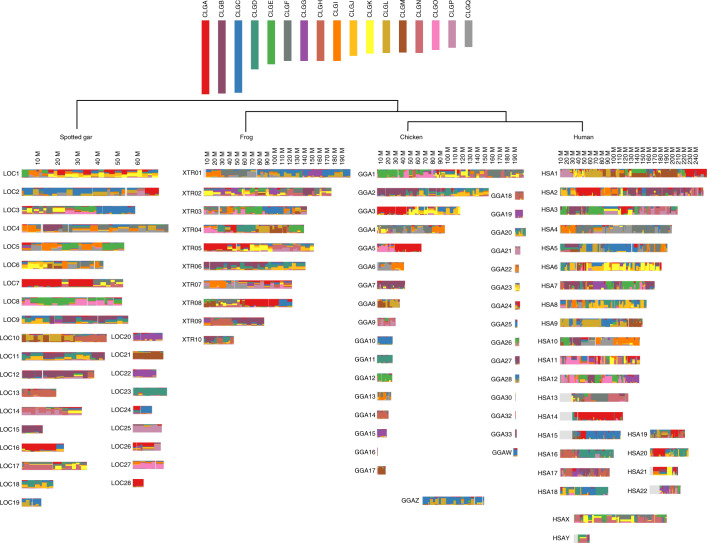
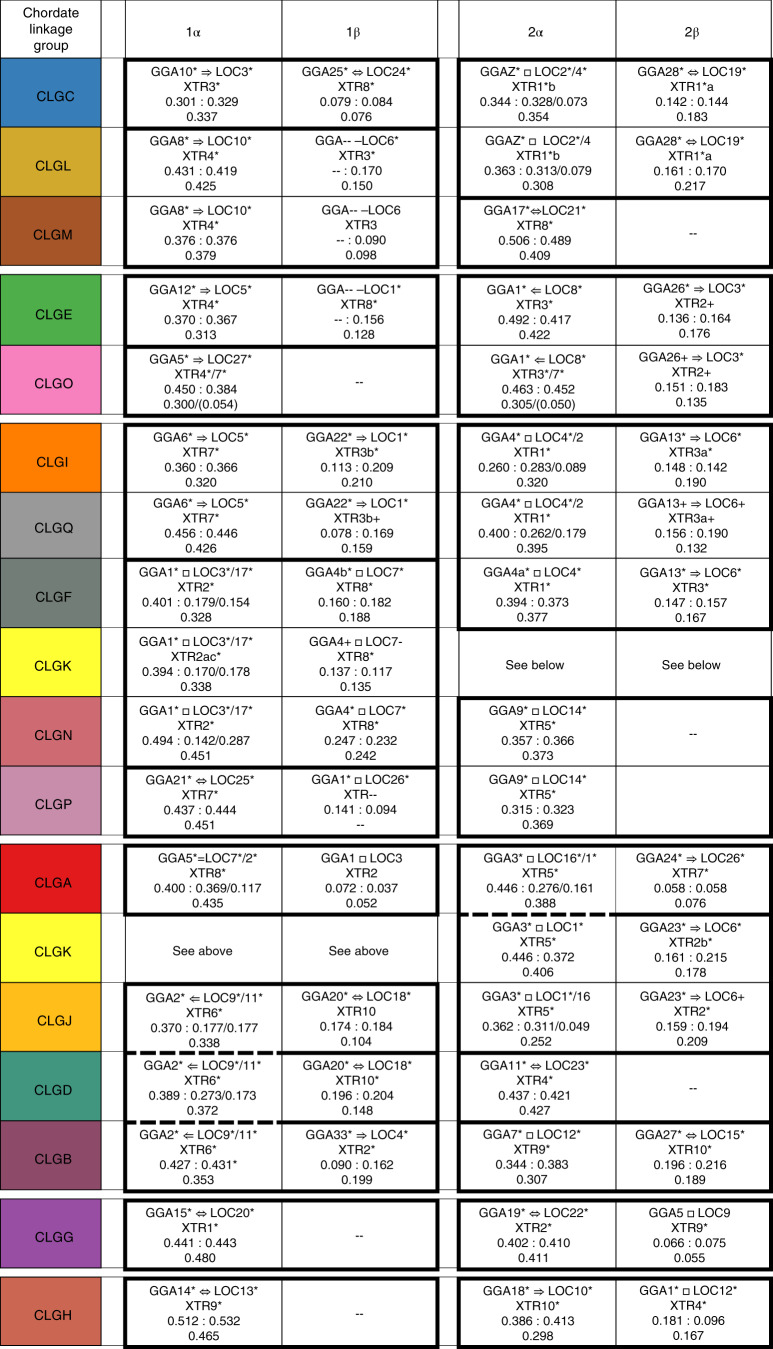
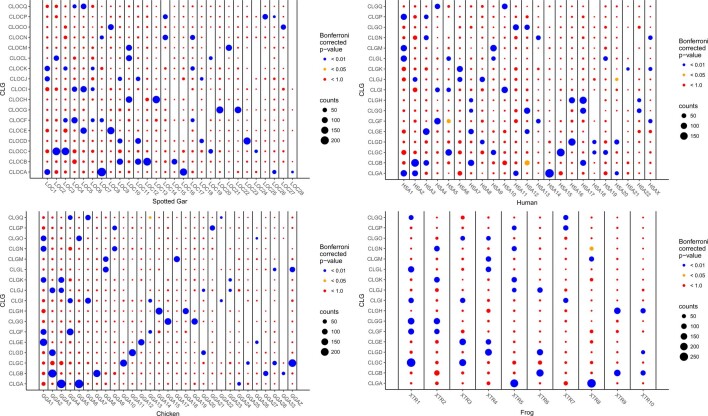
Although it is widely believed that early vertebrate evolution was shaped by ancient whole-genome duplications, the number, timing and mechanism of these events remain elusive. Here, we infer the history of vertebrates through genomic comparisons with a new chromosome-scale sequence of the invertebrate chordate amphioxus. We show how the karyotypes of amphioxus and diverse vertebrates are derived from 17 ancestral chordate linkage groups (and 19 ancestral bilaterian groups) by fusion, rearrangement and duplication. We resolve two distinct ancient duplications based on patterns of chromosomal conserved synteny. All extant vertebrates share the first duplication, which occurred in the mid/late Cambrian by autotetraploidization (that is, direct genome doubling). In contrast, the second duplication is found only in jawed vertebrates and occurred in the mid–late Ordovician by allotetraploidization (that is, genome duplication following interspecific hybridization) from two now-extinct progenitors. This complex genomic history parallels the diversification of vertebrate lineages in the fossil record.
Overview
The claims and statistics of this paper haven’t been checked yet.
Run the check — free, no account needed. It reads the open-access text and checks the sources it cites.
Integrity signals
Registry
Cites
Statistics
Figures





Verification
Claims the paper makes
The claims and statistics of this paper haven’t been checked yet.
Run the check — free, no account needed. It reads the open-access text and checks the sources it cites.
Claims other papers make about this one
Each is checked against this paper’s own text: does it say what the citing paper says it does?
The source backs part of the claim, not all of it — or backs it for a different population, condition or comparison.
In the citing paper
“The multistep dynamic of FWM helps explain the mosaic origins of extant chromosomes and can be thought of as contributing to diversification through population-level, speciation, and macroevolutionary processes (67, 69).”
From Topological Approaches in Animal Comparative Genomics (2026) · cites this paper as [67]
Experimental — accuracy not yet measuredThe source backs part of the claim, not all of it — or backs it for a different population, condition or comparison.
In the citing paper
“This particular chromosome ALG G has survived even with rare translocations in several vertebrate lineages after the two rounds of vertebrate WGD in the lineages leading to jawed vertebrates (Gnathostoma).”
From Topological Approaches in Animal Comparative Genomics (2026) · cites this paper as [67]
Experimental — accuracy not yet measuredThe source backs part of the claim, not all of it — or backs it for a different population, condition or comparison.
In the citing paper
“The most highly conserved of the three ALG G ohnologs among diverse vertebrates are microchromosomes 15 and 19 in chicken (Gallus gallus), the two small chromosomes 20 and 22 in the spotted gar (Lepisosteus oculatus), and independently integrated into larger chromosomes in frog (Xenopus tropicalis) and human (Homo sapiens) (67).”
From Topological Approaches in Animal Comparative Genomics (2026) · cites this paper as [67]
Experimental — accuracy not yet measuredThe source backs part of the claim, not all of it — or backs it for a different population, condition or comparison.
In the citing paper
“These patterns of conservation hold largely for smaller chromosomes across vertebrates, including mammals (65, 67, 100)”
From Topological Approaches in Animal Comparative Genomics (2026) · cites this paper as [67]
Experimental — accuracy not yet measuredThe cited source says what the claim attributes to it.
In the citing paper
“In several jawed vertebrate lineages, three of the four ALG G homeologous chromosomes derived from two rounds of WGD remain largely intact and lack major translocations or fusions with other chromosomes (67).”
From Topological Approaches in Animal Comparative Genomics (2026) · cites this paper as [67]
3 more claims about this paper
Create a free account to see every claim other papers make about this one.
Self-check
Percentages, sums and reported differences re-computed from the paper’s own numbers.
The self-check needs the paper’s full text.
Citations
Cites
Ohno, S. (1970) · doi:10.1007/978-3-642-86659-3 · Cited by 7,833
Haas, B. J., Salzberg, S. L., Zhu, W., Pertea, M., Allen, J. E., Orvis, J., White, O., Buell, C. R., & Wortman, J. R. (2008) · Genome Biology · doi:10.1186/gb-2008-9-1-r7 · Cited by 4,079
DNA methylation and epigenetic inheritance
Holliday, R. (1990) · Philosophical Transactions of the Royal Society of London. B, Biological Sciences · doi:10.1098/rstb.1990.0015 · Cited by 2,279
Molecular evidence for an ancient duplication of the entire yeast genome
Wolfe, K. H., & Shields, D. C. (1997) · Nature · doi:10.1038/42711 · Cited by 1,785
The amphioxus genome and the evolution of the chordate karyotype
Putnam, N. H., Butts, T., Ferrier, D. E. K., Furlong, R. F., Hellsten, U., Kawashima, T., Robinson-Rechavi, M., Shoguchi, E., Terry, A., Yu, J.-K., et al. (2008) · Nature · doi:10.1038/nature06967 · Cited by 1,580
Self-citationSea Anemone Genome Reveals Ancestral Eumetazoan Gene Repertoire and Genomic Organization
Putnam, N. H., Srivastava, M., Hellsten, U., Dirks, B., Chapman, J., Salamov, A., Terry, A., Shapiro, H., Lindquist, E., Kapitonov, V. V., et al. (2007) · Science · doi:10.1126/science.1139158 · Cited by 1,555
Self-citationTwo Rounds of Whole Genome Duplication in the Ancestral Vertebrate
Dehal, P., & Boore, J. L. (2005) · PLoS Biology · doi:10.1371/journal.pbio.0030314 · Cited by 1,526
Proof and evolutionary analysis of ancient genome duplication in the yeast Saccharomyces cerevisiae
Kellis, M., Birren, B. W., & Lander, E. S. (2004) · Nature · doi:10.1038/nature02424 · Cited by 1,522
Chromosome-scale scaffolding of de novo genome assemblies based on chromatin interactions
Burton, J. N., Adey, A., Patwardhan, R. P., Qiu, R., Kitzman, J. O., & Shendure, J. (2013) · Nature Biotechnology · doi:10.1038/nbt.2727 · Cited by 1,470
The Atlantic salmon genome provides insights into rediploidization
Lien, S., Koop, B. F., Sandve, S. R., Miller, J. R., Kent, M. P., Nome, T., Hvidsten, T. R., Leong, J. S., Minkley, D. R., Zimin, A., et al. (2016) · Nature · doi:10.1038/nature17164 · Cited by 1,047
Cited by
Ancient gene linkages support ctenophores as sister to other animals
Schultz, D. T., Haddock, S. H. D., Bredeson, J. V., Green, R. E., Simakov, O., & Rokhsar, D. S. (2023) · Nature · doi:10.1038/s41586-023-05936-6 · Cited by 362
Self-citationGENESPACE tracks regions of interest and gene copy number variation across multiple genomes
Lovell, J. T., Sreedasyam, A., Schranz, M. E., Wilson, M., Carlson, J. W., Harkess, A., Emms, D., Goodstein, D. M., & Schmutz, J. (2022) · eLife · doi:10.7554/elife.78526 · Cited by 391
Self-citationComparative genomics reveals the dynamics of chromosome evolution in Lepidoptera
Wright, C. J., Stevens, L., Mackintosh, A., Lawniczak, M., & Blaxter, M. (2024) · Nature Ecology & Evolution · doi:10.1038/s41559-024-02329-4 · Cited by 318
Deeply conserved synteny and the evolution of metazoan chromosomes
Simakov, O., Bredeson, J., Berkoff, K., Marletaz, F., Mitros, T., Schultz, D. T., O’Connell, B. L., Dear, P., Martinez, D. E., Steele, R. E., et al. (2022) · Science Advances · doi:10.1126/sciadv.abi5884 · Cited by 197
Self-citationGiant lungfish genome elucidates the conquest of land by vertebrates
Meyer, A., Schloissnig, S., Franchini, P., Du, K., Woltering, J. M., Irisarri, I., Wong, W. Y., Nowoshilow, S., Kneitz, S., Kawaguchi, A., et al. (2021) · Nature · doi:10.1038/s41586-021-03198-8 · Cited by 211
Self-citation
Metadata
- Authors
- Simakov, O., Marlétaz, F., Yue, J.-X., O’Connell, B., Jenkins, J., Brandt, A., Calef, R., Tung, C.-H., Huang, T.-K., Schmutz, J., Satoh, N., Yu, J.-K., Putnam, N. H., Green, R. E., & Rokhsar, D. S.
- Affiliations
- University of Vienna (AT)
- Okinawa Institute of Science and Technology Graduate University (JP)
- Centre National de la Recherche Scientifique (FR)
- University of California, Santa Cruz (US)
- HudsonAlpha Institute for Biotechnology (US)
- University of California, Berkeley (US)
- Dovetail Genomics (United States) (US)
- Institute of Cellular and Organismic Biology, Academia Sinica (TW)
- Corresponding author
- Simakov, Oleg
- Rokhsar, Daniel S.
- ORCID
- Venue
- Nature Ecology & Evolution
- Published
- 2020-04-20
- Volume
- 4
- Issue
- 6
- Pages
- 820-830
- ISSN
- 2397-334X (ISSN-L)
- PMC
- PMC7269912
- OpenAlex
- W3016709954
- Cited by
- 363
- References
- 69
- Citations by year
- 2026: 39 · 2025: 57 · 2024: 66 · 2023: 62 · 2022: 61 · 2021: 55 · 2020: 23
- FWCI
- 32.61
- Type
- journal article
- Language
- en
- Open access
- hybrid
- doi.org
- Licence
- cc-by
- creativecommons.org/licenses/by/4.0 (tdm)
- creativecommons.org/licenses/by/4.0 (vor)
- Locations
- Nature Ecology & Evolution (publishedVersion, cc-by)
- PubMed Central (publishedVersion, cc-by)
- PubMed (publishedVersion)
- Institutional Repositories DataBase (IRDB) (submittedVersion, cc-by-nc-nd)
- OSTI OAI (U.S. Department of Energy Office of Scientific and Technical Information) (submittedVersion)
- UCL Discovery (University College London) (submittedVersion)
- Okinawa Institute of Science and Technology Graduate University (Okinawa Institute of Science and Technology Graduate University) (submittedVersion, cc-by-nc-nd)
- Funders
- U.S. Department of Energy (-AC02-05CH11231, 05CH11231, DE AC02 05CH11231, DE-AC02-)
- Gordon and Betty Moore Foundation (GBMF3804)
- Joint Genome Institute (AC02-05CH11231, DE–AC02–05CH11231)
- Academia Sinica (AS-98-CDA-L06)
- Austrian Science Fund (P32190, P30686‐B29), P30686, DE‐AC02‐05CH11231)
- Universität Wien
- Fondation ARC pour la Recherche sur le Cancer (PDF20150602803)
- Okinawa Institute of Science and Technology Graduate University
- Ministry of Science and Technology, Taiwan (MOST105-2628-B001-003-MY3, MOST104-2923-B001-002-MY3, 003-MY3, DE-AC02-05CH11231)
- Directorate for Biological Sciences
- Office of Science (DEAC02–05CH11231, AC02-05CH11231, DE-AC02, 05CH11231)
- Japan Society for the Promotion of Science (19K06620)
- National Human Genome Research Institute (T32HG000047)
- Topics
- Life Sciences › Biochemistry, Genetics and Molecular Biology › Genetics › Chromosomal and Genetic Variations
- Life Sciences › Biochemistry, Genetics and Molecular Biology › Genetics › Genome Rearrangement Algorithms
- Life Sciences › Biochemistry, Genetics and Molecular Biology › Molecular Biology › Genomics and Phylogenetic Studies
- Keywords
- vertebrate evolution, whole-genome duplication, conserved synteny, amphioxus, karyotype evolution, chromosome-level genome assembly, allotetraploidization, interspecific hybridization, Cambrian, Ordovician, jawed vertebrates, genome rearrangement
- MeSH terms
- Animals, Vertebrates, Genome, Evolution, Molecular, Gene Duplication, Synteny
About these checks
Registry, retraction, Cites and statistics results are computed, not judged, with one exception: a printed reference that no index lists is read once by a model before it counts as a citation error. Claims are extracted by a model and kept only when their quote appears verbatim in the text; each cited source is then checked, with a model’s help, for whether it says what the claim relies on. Those verdicts can be wrong — read the claim’s quote and the cited source before relying on one.
Statistics and arithmetic are recomputed, not judged.
Confidence bands are shown only for fields calibrated on our annotated test set. None is calibrated yet, so no band is shown.
What counts as a claim ›How we measure confidence ›How we check this ›
Are you an author, or do you see a problem with this page? Request a review
How to cite
Cite CoChat for the checks on this page, and the paper for its own findings.
- This page
- CoChat. (2026). Citation check: Deeply conserved synteny resolves early events in vertebrate evolution. https://app.cochat.ai/papers/10.1038/s41559-020-1156-z
- The paper
- Simakov, O., Marlétaz, F., Yue, J.-X., O’Connell, B., Jenkins, J., Brandt, A., Calef, R., Tung, C.-H., Huang, T.-K., Schmutz, J., Satoh, N., Yu, J.-K., Putnam, N. H., Green, R. E., & Rokhsar, D. S. (2020). Deeply conserved synteny resolves early events in vertebrate evolution. Nature Ecology & Evolution. https://doi.org/10.1038/s41559-020-1156-z
Data sources
Bibliographic data: Semantic Scholar, OpenAlex, Crossref.
Contains information from the Semantic Scholar Academic Graph Datasets, made available under the ODC Attribution License (ODC-BY 1.0).
Semantic Scholar’s data is described in: Kinney, R., et al. (2023). The Semantic Scholar Open Data Platform. arXiv:2301.10140.
