

Measuring the impact of COVID-19 vaccine misinformation on vaccination intent in the UK and USA
Open accessPublished version of a preprint
The DOI matches its Crossref record; 56 of the 59 references it cites were found in a registry or an index; 25 of the 36 sources its claims cite were checked for support.
Abstract
Widespread acceptance of a vaccine for severe acute respiratory syndrome coronavirus 2 (SARS-CoV-2) will be the next major step in fighting the coronavirus disease 2019 (COVID-19) pandemic, but achieving high uptake will be a challenge and may be impeded by online misinformation. To inform successful vaccination campaigns, we conducted a randomized controlled trial in the UK and the USA to quantify how exposure to online misinformation around COVID-19 vaccines affects intent to vaccinate to protect oneself or others. Here we show that in both countries-as of September 2020-fewer people would 'definitely' take a vaccine than is likely required for herd immunity, and that, relative to factual information, recent misinformation induced a decline in intent of 6.2 percentage points (95th percentile interval 3.9 to 8.5) in the UK and 6.4 percentage points (95th percentile interval 4.0 to 8.8) in the USA among those who stated that they would definitely accept a vaccine. We also find that some sociodemographic groups are differentially impacted by exposure to misinformation. Finally, we show that scientific-sounding misinformation is more strongly associated with declines in vaccination intent.
Overview
CoChat Summary
## TL;DR
In a randomized controlled survey experiment of 8,001 adults in the UK and USA, exposure to COVID-19 vaccine misinformation reduced stated willingness to vaccinate compared with factual information. The effect was about 6 percentage points among those who initially said they would “definitely” accept a vaccine, and some sociodemographic groups were differentially affected.
## Key findings
- Before exposure, only 54.1% of respondents in the UK and 42.5% in the USA said they would “definitely” accept a COVID-19 vaccine for themselves; for protecting others, the figures were 63.7% in the UK and 53.3% in the USA.
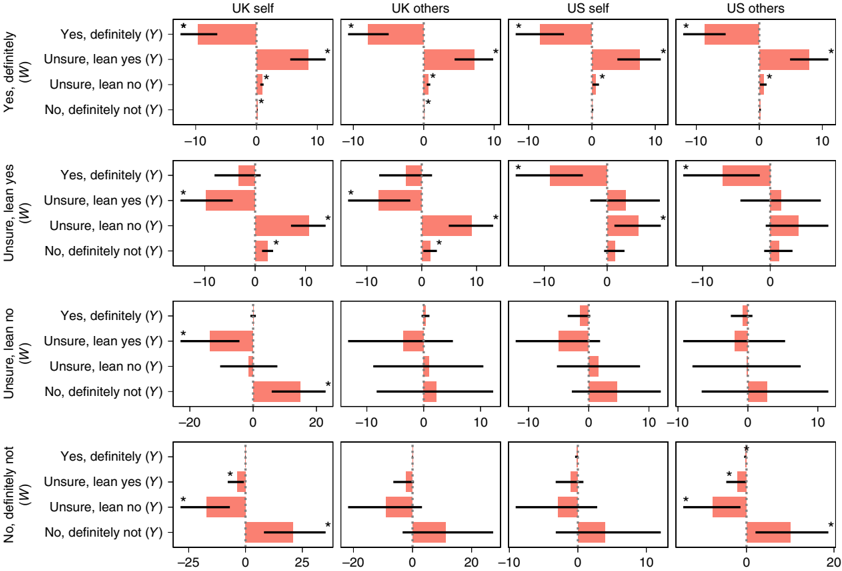
- Exposure to misinformation reduced the share answering “yes, definitely” by 6.2 percentage points in the UK (95% PI 3.9 to 8.5) and 6.4 percentage points in the USA (95% PI 4.0 to 8.8) for self-protection; for protecting others the decreases were 5.7 points in the UK (95% PI 3.5 to 7.9) and 6.5 points in the USA (95% PI 4.1 to 8.8).
- Misinformation also shifted respondents toward lower-intent categories: in the UK, for self-protection there was an increase of 2.7 points in “unsure, but leaning towards no” and 3.3 points in “no, definitely not”; in the USA, there was a 2.3-point rise in “unsure, but leaning towards no.”
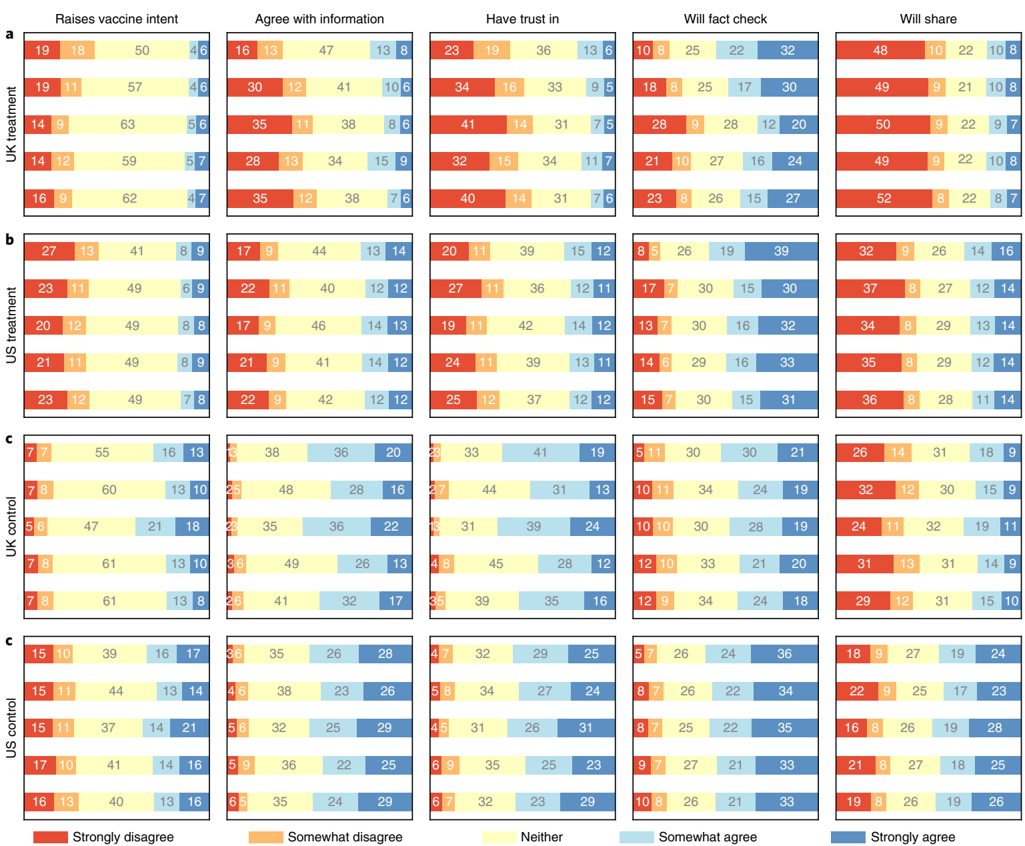
- Scientific-sounding misinformation was more damaging: the paper reports that the misinformation image with the strongest association with reduced intent had weight 0.42 in the UK (95% PI 0.28 to 0.56) and 0.41 in the USA (95% PI 0.25 to 0.58), and that around a quarter of respondents found some misinformation agreeable or trustworthy.
## Methods
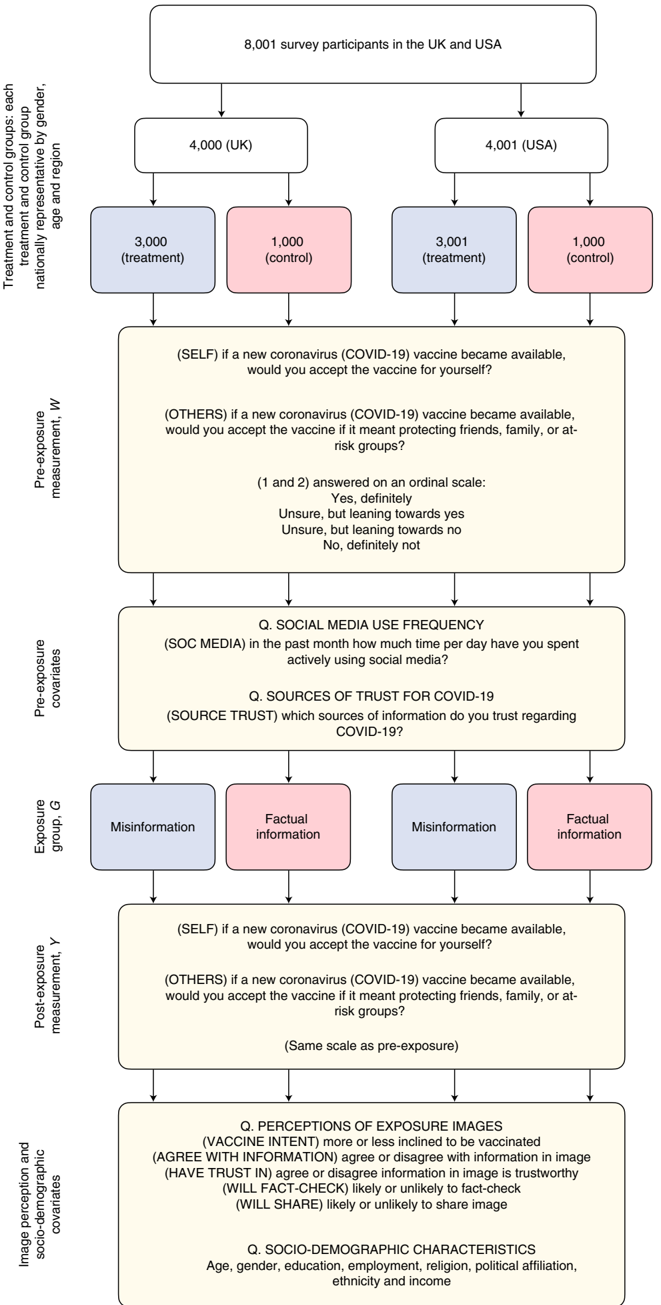
- Quantitative cross-sectional pre-post randomized controlled survey experiment in the UK and USA, fielded 7–14 September 2020.
- 8,001 respondents recruited via an online panel: 4,000 in the UK and 4,001 in the USA; within each country, 75% were assigned to misinformation and 25% to factual-information control.
- Respondents reported vaccination intent on a four-point ordered scale before and after exposure, for both self-protection and protecting others; analysis used hierarchical Bayesian ordered logistic regression with treatment effects, heterogeneous treatment effects, and image-impact models estimated via Hamiltonian Monte Carlo / NUTS in PyStan.
## Limitations
- The paper states that the design does not replicate a real-world social media platform environment, and that results are unlikely to be representative of real-world uptake rates.
- The authors state that the study does not allow causal inferences about different kinds of vaccine messaging from the post-exposure perception measures, and that they were limited in the type and volume of misinformation presented.
- Evident from the text: the sample was an online panel and respondents who did not participate simply did not complete the survey; the authors also note possible technological-literacy biases in this sampling mode.
Model-written summary. Check it against the paper before relying on it.
Integrity signals
Registry
Cites
Statistics
Figures


Verification
Claims the paper makes
14 Valid · 1 Not valid · 5 Not checked · 82 Own results and interpretations
The cited sources support only part of this claim — read each source’s verdict below.
In the paper
“Here we show that in both countries-as of September 2020-fewer people would 'definitely' take a vaccine than is likely required for herd immunity”
What the sources say
- Partly supportedcites [15] Kwok, K. O., Lai, F., Wei, W. I., Wong, S. Y. S. & Tang, J. W. T. Herd immunity—estimating the level required to halt the COVID-19 epidemics in affected countries. J. Infect. 80, e32–e33 (2020). sourceExperimental — accuracy not yet measured
The paper’s main text gives a formula for the minimum population immunity needed to halt spread, and Table 1 estimates thresholds for countries using data as of 13 March 2020. It does not report September 2020 vaccine willingness, whether people would ‘definitely’ take a vaccine, or a comparison between willingness and those thresholds in the two countries. (LLM, conf=0.88)
- Supportedcites [16] Sanche, S. et al. High contagiousness and rapid spread of severe acute respiratory syndrome coronavirus 2. Emerg. Infect. Dis. 26, 1470–1477 (2020). source
The Results section (‘Implications for Intervention Strategies’; page unavailable) estimates that more than 82% of the population would need immunity to stop transmission at R0 = 5.7. That supports the herd-immunity benchmark attributed to this source. The two-country September 2020 vaccine-willingness comparison is introduced as the citing authors’ own finding (‘Here we show’), not as a finding of this paper. (LLM, conf=0.87)
plain- Asserted: passes — The authors put it forward as true.
- Checkable: passes — It can be checked against evidence.
- Load-bearing: passes — The paper’s conclusions depend on it.
- Based: passes — The paper gives a reason why it holds.
- Partly supported
The cited sources support only part of this claim — read each source’s verdict below.
In the paper
“Under these current plausible COVID-19 vaccine acceptance rates, possible levels of existing protective immunity-though it is unclear whether post-infection immunity confers long-term immunity 29 and the rapidly evolving nature of misinformation surrounding the pandemic 23,30 , it is unclear whether vaccination will reach the levels required for herd immunity.”
What the sources say
- Supportedcites [29] Altmann, D. M., Douek, D. C. & Boyton, R. J. What policy makers need to know about COVID-19 protective immunity. Lancet 395, 1527–1529 (2020). source
The paper’s discussion of how long COVID-19 immunity might last says immunity could wane and that evidence extending only a little beyond one year offers little reassurance about longer-term protection. In the citing sentence, this source is attached to the uncertainty about long-term post-infection immunity, not to vaccine acceptance or misinformation. (LLM, conf=0.91)
- Partly supportedcites [23] Pennycook, G., McPhetres, J., Zhang, Y., Lu, J. G. & Rand, D. G. Fighting COVID-19 misinformation on social media: experimental evidence for a scalable accuracy-nudge intervention. Psychol. Sci. 31, 770–780 (2020). sourceExperimental — accuracy not yet measured
The citation is attached to the statement about pandemic misinformation, not the citing authors’ conclusion about herd immunity. The paper’s Abstract says COVID-19 misinformation has proliferated and takes many forms, but it does not establish that the misinformation is rapidly evolving. (LLM, conf=0.78)
- Supportedcites [30] Zarocostas, J. How to fight an infodemic. Lancet 395, 676 (2020). source
The citation is attached to the rapidly changing misinformation surrounding COVID-19, not to the citing authors’ conclusion about vaccination and herd immunity. In “How to fight an infodemic,” the paper describes misinformation spreading rapidly through social media and says its amplification makes timely responses a challenge. (LLM, conf=0.90)
hedged- Asserted: passes — The authors put it forward as true.
- Checkable: passes — It can be checked against evidence.
- Load-bearing: passes — The paper’s conclusions depend on it.
- Based: passes — The paper gives a reason why it holds.
- Supported
The cited sources support only part of this claim — read each source’s verdict below.
In the paper
“While large-scale vaccine rejection threatens herd immunity goals, large-scale acceptance with local vaccine rejection can also have negative consequences for community (herd) immunity, as clustering of non-vaccinators can disproportionately increase the needed percentage of vaccination coverage to achieve herd immunity in adjacent geographical regions and encourage epidemic spread 24 .”
What the sources say
- Partly supportedcites [24] Salathé, M. & Bonhoeffer, S. The effect of opinion clustering on disease outbreaks. J. R. Soc. Interface 5, 1505–1508 (2008). sourceExperimental — accuracy not yet measured
The Results and Discussion (pp. not specified) report that clusters of unvaccinated people can undermine herd immunity, increase outbreak probability, and mean that vaccination-coverage estimates needed to avoid outbreaks are too low. The Discussion also says infection can spread from one susceptible cluster to another. The paper does not specifically find that clustering raises the coverage percentage needed in adjacent geographical regions. (LLM, conf=0.86)
plainstates a cause- Asserted: passes — The authors put it forward as true.
- Checkable: passes — It can be checked against evidence.
- Load-bearing: unclear — It is unclear whether the paper’s conclusions depend on it.
- Based: passes — The paper gives a reason why it holds.
- Partly supported
The cited sources that could be checked couldn’t confirm or dispute this claim.
In the paper
“In the UK, this contrasted with more memetic imaging (for example, 'striking images with text superimposed on top' 42 ) which showed far weaker associations (images 3 and 4 in Supplementary Table 1).”
What the sources say
- Could not verifycites [42] Lazer, D. M. J. et al. The science of fake news. Science 359, 1094–1096 (2018). sourceExperimental — accuracy not yet measured
Citation 42 is attached to the description of memetic images, not to the UK association results, which the citing sentence attributes to its own Supplementary Table 1. Our copy discusses fake-news exposure and impact (Prevalence and Impact, p. 3), but searches for the quoted phrase and for memetic images or text-overlaid images found no passage defining them that way. (LLM, conf=0.77)
plainstates an association- Asserted: passes — The authors put it forward as true.
- Checkable: passes — It can be checked against evidence.
- Load-bearing: unclear — It is unclear whether the paper’s conclusions depend on it.
- Based: passes — The paper gives a reason why it holds.
- Could not verify
A result the paper reports from its own data — it cites no other source for it, so there is none to check. The quote shows it is in the paper.
In the paper
“while in the USA it was image 1 (Supplementary Table 1), with weight 0.41 (95% PI 0.25 to 0.58).”
plainstates an association- Asserted: passes — The authors put it forward as true.
- Checkable: passes — It can be checked against evidence.
- Load-bearing: passes — The paper’s conclusions depend on it.
- Based: passes — The paper gives a reason why it holds.
- Rests on an assumption not shown here.
52 more claims
Create a free account to see all 102 claims and to verify the 3 references still open.
- It may state two separate claims as one. 23
- Probably not a substantial claim. 32
- The quote only partly states this claim. 1
Claims other papers make about this one
Each is checked against this paper’s own text: does it say what the citing paper says it does?
The cited source says what the claim attributes to it.
In the citing paper
“Other research has found a causal link between exposure to vaccine misinformation and reduced intentions to get vaccinated (Loomba et al. 2021).”
From Social Media and Morality. (2024) · cites this paper as Loomba et al. 2021
In the citing paper
“belief in misinformation about coronavirus disease 2019 (COVID-19) has been linked to reduced willingness to get vaccinated against the disease and lower intentions to comply with public health measures (2, 3).”
From Psychological inoculation improves resilience against misinformation on social media (2022) · cites this paper as [3]
In the citing paper
“At the same time, misinformation about both technologies is already circulating among the public that can and should be targeted in a debunking intervention (e.g., Loomba et al., 2021;Wang & Song, 2020).”
From How to debunk misinformation? An experimental online study investigating text structures and headline formats (2023) · cites this paper as Loomba et al., 2021
Self-check
Percentages, sums and reported differences re-computed from the paper’s own numbers.
Each contradiction between two passages listed here was confirmed by an independent check.
Rated minor: it would not touch a result — a value no result rests on, a p-value that stays on the same side of the significance level, or a conflict that is clerical, resolved elsewhere in the paper, or outside its own findings.
In the paper
§ Methods
“Ethical approval for this study was obtained by the London School of Hygiene and Tropical Medicine ethics committee on 15 June 2020 with reference 22647.”
§ Human research participants
“Approval for this study was obtained by the LSHTM ethics committee on 15 June 2020 with reference 22130.”
Citations
Cites
A pneumonia outbreak associated with a new coronavirus of probable bat origin
Zhou, P., Yang, X.-L., Wang, X.-G., Hu, B., Zhang, L., Zhang, W., Si, H.-R., Zhu, Y., Li, B., Huang, C.-L., et al. (2020) · Nature · doi:10.1038/s41586-020-2012-7 · Cited by 21,969
Inference from iterative simulation using multiple sequences
Gelman, A., & Rubin, D. B. (1992) · Statistical Science · doi:10.1214/ss/1177011136 · Cited by 16,627
Estimating causal effects of treatments in randomized and nonrandomized studies
Rubin, D. B. (1974) · Journal of Educational Psychology · doi:10.1037/h0037350 · Cited by 9,436
The spread of true and false news online
Vosoughi, S., Roy, D., & Aral, S. (2018) · Science · doi:10.1126/science.aap9559 · Cited by 8,847
Statistics and Causal Inference
Holland, P. W. (1986) · Journal of the American Statistical Association · doi:10.1080/01621459.1986.10478354 · Cited by 5,293
The proximal origin of SARS-CoV-2
Andersen, K. G., Rambaut, A., Lipkin, W. I., Holmes, E. C., & Garry, R. F. (2020) · Nature Medicine · doi:10.1038/s41591-020-0820-9 · Cited by 5,081
Voysey, M., Clemens, S. A. C., Madhi, S. A., Weckx, L. Y., Folegatti, P. M., Aley, P. K., Angus, B., Baillie, V. L., Barnabas, S. L., Bhorat, Q. E., et al. (2021) · The Lancet · doi:10.1016/s0140-6736(20)32661-1 · Cited by 4,616
Regression Models for Ordinal Data
McCullagh, P. (1980) · Journal of the Royal Statistical Society Series B: Statistical Methodology · doi:10.1111/j.2517-6161.1980.tb01109.x · Cited by 4,453
Lazer, D. M. J., Baum, M. A., Benkler, Y., Berinsky, A. J., Greenhill, K. M., Menczer, F., Metzger, M. J., Nyhan, B., Pennycook, G., Rothschild, D., et al. (2018) · Science · doi:10.1126/science.aao2998 · Cited by 4,160
An mRNA Vaccine against SARS-CoV-2 — Preliminary Report
Jackson, L. A., Anderson, E. J., Rouphael, N. G., Roberts, P. C., Makhene, M., Coler, R. N., McCullough, M. P., Chappell, J. D., Denison, M. R., Stevens, L. J., et al. (2020) · New England Journal of Medicine · doi:10.1056/nejmoa2022483 · Cited by 3,406
Research works printed but not linked: 2
- Pfizer. Pfizer and BioNTech conclude phase 3 study of COVID-19 vaccine candidate, meeting all primary efficacy endpoints https://www.pfizer.com/news/press-release/press-release-detail/pfizer-and-biontech-conclude-phase-3-study-covid-19-vaccine (2020).
- Graham, M. & Coppock, A. Asking about attitude change. Public Opinion Quarterly (in the press).
Cited by
Items 201–300 of 1,802
Luk, T. T., Lui, J. H. T., & Wang, M. P. (2022) · Journal of Medical Internet Research · doi:10.2196/39063 · Cited by 43
Ethical Issues in AI-Enabled Disease Surveillance: Perspectives from Global Health
Borda, A., Molnar, A., Neesham, C., & Kostkova, P. (2022) · Applied Sciences · doi:10.3390/app12083890 · Cited by 58
Lim, H. M., Dunn, A. G., Lim, J. R., Abdullah, A. B., & Ng, C. J. (2022) · Digital Health · doi:10.1177/20552076221097784 · Cited by 51
“For medications of this type, patients may be more susceptible to misinformation.(70,71) This might create medication distrust and hesitancy even among patients who are indicated for such medication.”
BackgroundArgote, P., Barham, E., Daly, S. Z., Gerez, J. E., Marshall, J., & Pocasangre, O. (2021) · PLoS ONE · doi:10.1371/journal.pone.0259059 · Cited by 51
“These questions may be especially significant in the Global South, where more limited distribution channels than in the Global North may increase the costs of accessing vaccines, but encouraging vaccination is no less important for both mitigating human suffering and restricting the emergence and spread of new variant…”
BackgroundInfluentialStrategic COVID-19 vaccine distribution can simultaneously elevate social utility and equity
Chen, L., Xu, F., Han, Z., Tang, K., Hui, P., Evans, J. A., & Li, Y. (2022) · Nature Human Behaviour · doi:10.1038/s41562-022-01429-0 · Cited by 61
Vardavas, C. I., Nikitara, K., Aslanoglou, K., Lagou, I., Marou, V., Phalkey, R. K., Leonardi‐Bee, J., Fernández, E., Vivilaki, V. G., Kamekis, A., et al. (2023) · Preventive Medicine Reports · doi:10.1016/j.pmedr.2023.102319 · Cited by 58
Analysis of Public Sentiment on COVID-19 Vaccination Using Twitter
Jayasurya, G. G., Kumar, S., Singh, B. K., & Kumar, V. (2021) · IEEE Transactions on Computational Social Systems · doi:10.1109/tcss.2021.3122439 · Cited by 45
Perlis, R. H., Ognyanova, K., Santillana, M., Lin, J. A.-J., Druckman, J. N., Lazer, D. M. J., Green, J., Simonson, M. D., Baum, M., & Volpe, J. D. (2022) · JAMA Network Open · doi:10.1001/jamanetworkopen.2021.45697 · Cited by 50
Othman, S. S., Alsuwaidi, A., Aseel, R., Alotaibi, R., Bablgoom, R., Alsulami, G., Alharbi, R. S., & Ghamri, R. A. (2022) · BMC Public Health · doi:10.1186/s12889-022-12757-1 · Cited by 43
Willingness to Get the COVID-19 Vaccine among Residents of Slum Settlements
Ticona, J. P. A., Nery, N., Victoriano, R., Fofana, M. O., Ribeiro, G. S., Giorgi, E., dos Reis, M. G., Ko, A. I., & Costa, F. (2021) · Vaccines · doi:10.3390/vaccines9090951 · Cited by 43
“On the other hand, exposure to misinformation may seriously hamper vaccination efforts [20].”
BackgroundFerwana, I., & Varshney, L. R. (2021) · PLoS ONE · doi:10.1371/journal.pone.0260818 · Cited by 45
Xiao, X. (2022) · Telematics and Informatics · doi:10.1016/j.tele.2022.101890 · Cited by 49
Purnat, T. D., Nguyen, T., & Briand, S. C. (2023) · Springer eBooks · doi:10.1007/978-3-031-27789-4 · Cited by 70
Psychological profiles of anti-vaccination argument endorsement
Holford, D. L., Fasce, A., Costello, T. H., & Lewandowsky, S. (2023) · Scientific Reports · doi:10.1038/s41598-023-30883-7 · Cited by 45
Countering misinformation through psychological inoculation
van der Linden, S. (2023) · Advances in experimental social psychology · doi:10.1016/bs.aesp.2023.11.001 · Cited by 70
Shah, S. B., Thapa, S., Acharya, A., Rauniyar, K., Poudel, S., Jain, S., Masood, A., & Naseem, U. (2025) · IEEE Access · doi:10.1109/access.2024.3406644 · Cited by 39
“For example, the spread of misinformation about COVID-19 vaccines contributed to lower vaccination rates even in educated countries [124].”
Alobaidi, S. A. (2021) · Journal of Multidisciplinary Healthcare · doi:10.2147/jmdh.s306654 · Cited by 39
“News reports of the vaccine-related adverse effects and media debates about the efficacy and safety of the vaccine can also potentially influence the acceptance of the vaccine.(20) The health belief model (HBM) is a commonly used model to study vaccination beliefs and vaccination intention.”
BackgroundButuroiu, R., Udrea, G., Oprea, D.-A., & Corbu, N. (2021) · Societies · doi:10.3390/soc11040138 · Cited by 60
“As previously shown, in previous studies, the latter have been linked directly to the undermining of public health efforts [1], and, more specifically, to people’s reluctance in adopting rules that could successfully contribute to herd immunity [11,12].”
ResultLewandowsky, S., Armaos, K., Bruns, H., Schmid, P., Holford, D. L., Hahn, U., Al‐Rawi, A., Sah, S., & Cook, J. (2022) · The Annals of the American Academy of Political and Social Science · doi:10.1177/00027162221084663 · Cited by 55
“Research has also shown that exposure to misinformation can reduce people’s intention to get vaccinated (Loomba et al. 2021).”
BackgroundLin, F., Chen, X., & Cheng, E. W. (2022) · Information Processing & Management · doi:10.1016/j.ipm.2022.103013 · Cited by 49
The (Mis)Information Game: A social media simulator
Butler, L. H., Lamont, P. X., Wan, D. L. Y., Prike, T., Nasim, M., Walker, B., Fay, N., & Ecker, U. K. H. (2023) · Behavior Research Methods · doi:10.3758/s13428-023-02153-x · Cited by 57
“…and societal implications belief in misinformation can have (e.g., exacerbating vaccine refusal and climate-change denial; Donzelli et al., 2018; Loomba et al., 2021; Simonov et al., 2022; van der Linden, 2015), substantial research has gone into understanding the conditions under which people…”
BackgroundOleksy, T., Wnuk, A., Gambin, M., Łyś, A. E., Bargiel-Matusiewicz, K. M., & Pisula, E. (2022) · Personality and Individual Differences · doi:10.1016/j.paid.2022.111524 · Cited by 61
Fighting the infodemic: the 4 i Framework for Advancing Communication and Trust
Sundelson, A. E., Jamison, A., Huhn, N., Pasquino, S.-L., & Sell, T. K. (2023) · BMC Public Health · doi:10.1186/s12889-023-16612-9 · Cited by 51
Psychological booster shots targeting memory increase long-term resistance against misinformation
Maertens, R., Roozenbeek, J., Simons, J. S., Lewandowsky, S., Maturo, V., Goldberg, B., Xu, R., & van der Linden, S. (2025) · Nature Communications · doi:10.1038/s41467-025-57205-x · Cited by 92
“9, we implemented a SEM model similar to Studies 1 and 2, to test whether the effects of the intervention on the outcome variable are mediated by motivation and memory.”
InfluentialYang, A., Shin, J., Zhou, A. Y., Huang-Isherwood, K. M., Lee, E., Dong, C., Kim, H. M., Zhang, Y., Sun, J., Li, Y., et al. (2021) · Harvard Kennedy School Misinformation Review · doi:10.37016/mr-2020-78 · Cited by 51
“The spread of misinformation on social media has been identified as a major threat to public health, particularly in the uptake of COVID-19 vaccines (Burki, 2020; Loomba et al., 2021).”
BackgroundKhankeh, H. R., Farrokhi, M., Khanjani, M. S., Momtaz, Y. A., Forouzan, A. S., Norouzi, M., Ahmadi, S., Harouni, G. G., Roudini, J., Ghanaatpisheh, E., et al. (2021) · Vaccines · doi:10.3390/vaccines9111248 · Cited by 43
“After performing the intervention and the exposure of individuals with misinformation in both countries, a decrease of more than 6% was observed in the vaccine acceptance [36].”
MethodChen, Y.-P., Chen, Y., Yang, K.-C., Lai, F., Huang, C., Chen, Y.-N., & Tu, Y.-C. (2022) · Journal of Medical Internet Research · doi:10.2196/36830 · Cited by 49
“Loomba et al [22] designed a prospective study to examine vaccine intent before and after exposure to misinformation and confirmed that misinformation has adverse effects on vaccination rates.”
Digital Technology, Politics, and Policy-Making
Gilardi, F. (2022) · Cambridge University Press eBooks · doi:10.1017/9781108887304 · Cited by 57
Bitar, A. N., Zawiah, M., Al-Ashwal, F. Y., Kubas, M. A., Saeed, R. M., Abduljabbar, R., Jaber, A. A. S., Sulaiman, S. A. S., & Khan, A. H. (2021) · PLoS ONE · doi:10.1371/journal.pone.0248325 · Cited by 48
“This suggests that altruistic messaging to protect their families, friends, country might be a useful strategy among the Yemenis to increase their acceptance rate for the COVID-19 vaccine [33].”
BackgroundDigital inequality in disconnection practices: voluntary nonuse during COVID-19
Nguyen, M. H., & Hargittai, E. (2023) · Journal of Communication · doi:10.1093/joc/jqad021 · Cited by 53
Public agreement with misinformation about wind farms
Winter, K., Hornsey, M. J., Pummerer, L., & Sassenberg, K. (2024) · Nature Communications · doi:10.1038/s41467-024-53278-2 · Cited by 53
“…relatively positive, but events during the COVID-19 pandemic highlighted how quickly this can change in the face of misinformation campaigns 21 , how dramatically misinformation can cause social schism 22 , and how easy it is for the scienti fi c community to be left unprepared in the face…”
Real-World Acceptance of COVID-19 Vaccines among Healthcare Workers in Perinatal Medicine in China
Xu, B., Gao, X., Zhang, X., Hu, Y., Yang, H., & Zhou, Y. (2021) · Vaccines · doi:10.3390/vaccines9070704 · Cited by 44
“This finding is in agreement with the observation that the scientific-sounding misinformation appears to be associated with the decline of the COVID-19 vaccine [44].”
ResultHigher COVID-19 Vaccination Rates Are Associated with Lower COVID-19 Mortality: A Global Analysis
Hoxha, I. S., Agahi, R., Bimbashi, A., Aliu, M., Raka, L., Bajraktari, I., Beqiri, P., & Adams, L. V. (2022) · Vaccines · doi:10.3390/vaccines11010074 · Cited by 42
Misinformation in the media: global coverage of GMOs 2019-2021
Lynas, M., Adams, J., & Conrow, J. (2022) · GM crops & food · doi:10.1080/21645698.2022.2140568 · Cited by 56
Towards Reliable Misinformation Mitigation: Generalization, Uncertainty, and GPT-4
Pelrine, K., Imouza, A., Thibault, C., Reksoprodjo, M., Gupta, C., Christoph, J. N., Godbout, J., & Rabbany, R. (2023) · Conference on Empirical Methods in Natural Language Processing (EMNLP) · doi:10.18653/v1/2023.emnlp-main.395 · Cited by 134
Escaping the neutralization effect of modality features fusion in multimodal Fake News Detection
Wang, B., Li, X., Li, C., Wang, S., & Gao, W. (2024) · Information Fusion · doi:10.1016/j.inffus.2024.102500 · Cited by 47
Seboka, B. T., Yehualashet, D. E., Mareg, M., Kabthymer, R. H., Ewune, H. A., Hailegebreal, S., Demeke, A. D., Amede, E. S., & Tesfa, G. A. (2021) · Risk Management and Healthcare Policy · doi:10.2147/rmhp.s315043 · Cited by 37
Jiang, P., Klemeš, J. J., Fan, Y. V., Fu, X., Tan, R. R., You, S., & Foley, A. M. (2021) · Energy · doi:10.1016/j.energy.2021.121315 · Cited by 36
“55%e85% of the world's population [11].”
Albi, G., Bertaglia, G., Boscheri, W., Dimarco, G., Pareschi, L., Toscani, G., & Zanella, M. (2022) · Modeling and simulation in science, engineering & technology · doi:10.1007/978-3-030-96562-4_3 · Cited by 45
“The former in particular plays a decisive role in analyzing the influence of the so-called super-spreaders [79,92], while the latter we have seen play a key role regarding the vaccination campaign [85, 102].”
BackgroundLin, T.-H., Chang, M.-C., Chang, C.-C., & Chou, Y.-H. (2022) · Social Science & Medicine · doi:10.1016/j.socscimed.2022.114744 · Cited by 43
Lohiniva, A., Nurzhynska, A., Hudi, A.-H., Anim, B., & Aboagye, D. C. (2022) · JMIR Infodemiology · doi:10.2196/37134 · Cited by 43
Meghana, G. V. R., & Chavali, D. P. (2023) · Cureus · doi:10.7759/cureus.48239 · Cited by 43
Palmer, A., & Gorman, S. E. (2025) · Social Science & Medicine · doi:10.1016/j.socscimed.2025.118272 · Cited by 47
COVID-19 Vaccine Hesitancy Among Adolescent and Young Adult Cancer Survivors
Waters, A. R., Kepka, D., Ramsay, J. M., Mann, K., Lopez, P. L. V., Anderson, J. S., Ou, J. Y., Kaddas, H. K., Palmer, A., Ray, N., et al. (2021) · JNCI Cancer Spectrum · doi:10.1093/jncics/pkab049 · Cited by 36
“may be driven by COVID-19 vaccine misinformation asserting that the vaccine causes infertility (12,13).”
BackgroundJamieson, K. H., Romer, D., Jamieson, P. E., Winneg, K. M., & Pasek, J. (2021) · Proceedings of the National Academy of Sciences · doi:10.1073/pnas.2112266118 · Cited by 39
“[The widespread dissemination of health misinformation on the platforms has been flagged by scholars (45, 54) and by a report by the US Surgeon General as a cause for concern (55).”
BackgroundJang, H., Rempel, E., Roe, I., Adu, P., Carenini, G., & Janjua, N. Z. (2022) · Journal of Medical Internet Research · doi:10.2196/35016 · Cited by 35
The risk of miscarriage following COVID-19 vaccination: a systematic review and meta-analysis
Rimmer, M. P., Teh, J. J., Mackenzie, S. C., & Wattar, B. H. A. (2023) · Human Reproduction · doi:10.1093/humrep/dead036 · Cited by 38
Thaker, J. J., & Ganchoudhuri, S. (2021) · Vaccines · doi:10.3390/vaccines9101132 · Cited by 41
“The primary outcome measure was COVID-19 vaccination intention, adopted from previous studies [35].”
MethodHealth misinformation: what it is, why people believe it, how to counter it
Nan, X., Thier, K., & Wang, Y. (2023) · Annals of the International Communication Association · doi:10.1080/23808985.2023.2225489 · Cited by 48
“Experimental research shows that exposure to misinformation indeed can have detrimental e ff ects on more consequential outcomes such as attitudes (Featherstone & Zhang, 2020) and intentions to uptake a health behavior (Jolley & Douglas, 2014; Loomba et al., 2021).”
BackgroundDo Conspiracy Theories Shape or Rationalize Vaccination Hesitancy Over Time?
van Prooijen, J., & Böhm, N. (2023) · Social Psychological and Personality Science · doi:10.1177/19485506231181659 · Cited by 38
“Indeed, intervention cam-paigns to increase public health often focus on reducing conspiracy beliefs (Loomba et al., 2021).”
BackgroundResultChow, E. P. F., Samra, R. S., Bradshaw, C. S., Chen, M. Y., Williamson, D. A., Towns, J. M., Maddaford, K., Mercury, F., & Fairley, C. K. (2023) · Sexual Health · doi:10.1071/sh23075 · Cited by 39
Sulaiman, S. K., Musa, M. S., Tsiga-Ahmed, F. I., Sulaiman, A. K., & Bako, A. T. (2023) · Nature Human Behaviour · doi:10.1038/s41562-023-01733-3 · Cited by 35
Predictors of COVID-19 vaccine uptake: an online three-wave survey study of US adults
Thorpe, A., Fagerlin, A., Drews, F. A., Shoemaker, H. E., Brecha, F. S., & Scherer, L. D. (2024) · BMC Infectious Diseases · doi:10.1186/s12879-024-09148-9 · Cited by 41
“…factors (e.g., COVID-19 risk perceptions [3–6], belief in conspiracy theories [7], political affiliation [3, 5, 6, 8], exposure to misinformation [9], and trust in scientists [5, 10], and the government [10, 11]) associated with public attitudes and intentions towards COVID-19 vaccines has…”
BackgroundEvaluating COVID-19 vaccine hesitancy: A qualitative study from Vietnam
Duong, M. C., Nguyen, H. T., & Duong, M. H. (2021) · Diabetes & Metabolic Syndrome Clinical Research & Reviews · doi:10.1016/j.dsx.2021.102363 · Cited by 37
“Indeed, people’ willingness to accept a vaccine is not static, relying on the epidemic phase and perceived risk of acquiring infection [44].”
Kumar, N., Corpus, I., Hans, M., Harle, N., Yang, N., McDonald, C., Sakai, S. N., Janmohamed, K., Chen, K., Altice, F. L., et al. (2022) · BMC Public Health · doi:10.1186/s12889-022-12824-7 · Cited by 50
“Several studies have detailed the relationship between exposure to COVID-19 misinformation and vaccine acceptance [21], as well as COVID-19 vaccine perceptions assessed via Twitter [22, 23] and online surveys [24, 25].”
BackgroundGreene, C. M., de Saint Laurent, C., Murphy, G., Prike, T., Hegarty, K., & Ecker, U. K. H. (2023) · European Psychologist · doi:10.1027/1016-9040/a000491 · Cited by 33
Ecker, U. K. H., Sharkey, C. X. M., & Swire‐Thompson, B. (2023) · PLoS ONE · doi:10.1371/journal.pone.0281140 · Cited by 49
“Vaccine misinformation is a prime example of this, as illustrated by the negative effect of false information about the mumps-measles-rubella (MMR) vaccine, or more recently the COVID-19 vaccines, on uptake rates [4, 5].”
BackgroundLuo, H., Qu, H., Basu, R., Rafferty, A. P., Patil, S. P., & Cummings, D. M. (2021) · Journal of Public Health Management and Practice · doi:10.1097/phh.0000000000001394 · Cited by 33
“Anti-vaccine messages, conspiracy theories, and political rhetoric about vaccine safety have proliferated in the social media during this time period, which may have contributed to vaccine hesitancy.(22,23) Innovative strategies are needed to consistently communicate the potential benefits of vaccination to improve ac…”
BackgroundBates, B. R., Botero, A. V., Costales, J. A., Moncayo, A. L., Tami, A., Carvajal, A., & Grijalva, M. J. (2022) · Health Communication · doi:10.1080/10410236.2022.2035943 · Cited by 38
“Although there is a desire to promote correct information, mis- and disinformation about COVID-19 vaccines is prevalent in both traditional and social media (Loomba et al., 2021; Piltch-Loeb et al., 2021; Scales et al., 2021).”
BackgroundSu, Y., Borah, P., & Xiao, X. (2022) · Online Information Review · doi:10.1108/oir-06-2021-0305 · Cited by 38
The vaccine hesitancy continuum among hesitant adopters of the COVID‐19 vaccine
Moore, R. A., Purvis, R. S., Willis, D. E., Worley, K. C., Hervey, D., Reece, S., Yeates, A., & McElfish, P. A. (2022) · Clinical and Translational Science · doi:10.1111/cts.13385 · Cited by 36
COVID-19 Vaccination Willingness and Reasons for Vaccine Refusal
Lun, P., Ning, K., Wang, Y., Ma, T. S. W., Flores, F. P., Xiao, X., Subramaniam, M., Abdin, E., Tian, L., Tsang, T. K., et al. (2023) · JAMA Network Open · doi:10.1001/jamanetworkopen.2023.37909 · Cited by 42
Pennycook, G., & Rand, D. G. (2021) · doi:10.31234/osf.io/v8ruj · Cited by 33
Political dimensions of misinformation, trust, and vaccine confidence in a digital age
Enria, L., Dwyer, H., Marchant, M., Beckmann, N., Schmidt-Sane, M. M., Conteh, A., Mansaray, A., & N′jai, A. U. (2024) · BMJ · doi:10.1136/bmj-2024-079940 · Cited by 43
Bruns, H., Dessart, F. J., Krawczyk, M. W., Lewandowsky, S., Pantazi, M., Pennycook, G., Schmid, P., & Smillie, L. (2024) · Scientific Reports · doi:10.1038/s41598-024-71599-6 · Cited by 53
Health conspiracy theories: a scoping review of drivers, impacts, and countermeasures
Kısa, A., & Kısa, S. (2025) · International Journal for Equity in Health · doi:10.1186/s12939-025-02451-0 · Cited by 44
“Exposure to online misinfor-mation reduced vaccination intent by over 6% in the UK and the USA [4].”
InfluentialAutomatic detection of COVID-19 vaccine misinformation with graph link prediction
Weinzierl, M., & Harabagiu, S. M. (2021) · Journal of Biomedical Informatics · doi:10.1016/j.jbi.2021.103955 · Cited by 48
“In fact, recent research by [1] “ There is no vaccine for Covid viruses.”
Piltch-Loeb, R. N., Harriman, N. W., Healey, J., Bonetti, M., Toffolutti, V., Testa, M. A., Su, M., & Savoia, E. (2021) · Vaccines · doi:10.3390/vaccines9101138 · Cited by 32
“In multiple countries, higher rates of vaccine hesitancy have been tied to exposure to vaccine misinformation [9].”
BackgroundSocial Media Use and Misinformation Among Asian Americans During COVID-19
Chong, S. K., Ali, S. H., Ðoàn, L. N., Yi, S. S., Trinh‐Shevrin, C., & Kwon, S. C. (2022) · Frontiers in Public Health · doi:10.3389/fpubh.2021.764681 · Cited by 37
Lessard, D., Ortiz-Paredes, D., Park, H., Varsaneux, O., Worthington, J. R., Basta, N. E., MacDonald, S. E., Lebouché, B., Cox, J., Ismail, S. J., et al. (2022) · Vaccine X · doi:10.1016/j.jvacx.2022.100150 · Cited by 32
“While providing adapted information will be key, addressing misinformation such as conspiracies to harm will be equally important as misinformation has been shown to be associated with reduced vaccination intent [41].”
BackgroundSavoia, E., Harriman, N. W., Piltch-Loeb, R. N., Bonetti, M., Toffolutti, V., & Testa, M. A. (2022) · Vaccines · doi:10.3390/vaccines10050671 · Cited by 48
“A study conducted in the United Kingdom and the United States quantified the impact of misinformation on vaccination intent and found that, in an experimental setting, exposure to misinformation decreased study participants’ self-reported intent to get the COVID-19 vaccine [3].”
BackgroundFactors Influencing the Acceptance of COVID-19 Vaccines in a Country with a High Vaccination Rate
Toro‐Ascuy, D., Cifuentes-Muñoz, N., Andrea Avaria, S., Pereira-Montecinos, C., Cruzat, G., Peralta-Arancibia, K., Zorondo‐Rodríguez, F., & Fuenzalida, L. (2022) · Vaccines · doi:10.3390/vaccines10050681 · Cited by 34
Who Doesn't Want to Be Vaccinated? Determinants of Vaccine Hesitancy During COVID-19
Dabla‐Norris, E., Khan, H., Lima, F., & Sollaci, A. B. (2021) · IMF Working Paper · doi:10.2139/ssrn.4026306 · Cited by 48
Bruno, F., Laganà, V., Pistininzi, R., Tarantino, F., Martin, L. R., & Servidio, R. C. (2022) · Current Psychology · doi:10.1007/s12144-022-03209-5 · Cited by 37
“Consistent with a previous work, our results showed that those with lower trust in health authorities are more concerned about vaccine safety, suggesting that transparent communication about vaccines is urgent (Loomba et al., 2021).”
Trusting COVID-19 vaccines as individual and social goal
Falcone, R., Ansani, A., Colí, E., Marini, M., Sapienza, A., Castelfranchi, C., & Paglieri, F. (2022) · Scientific Reports · doi:10.1038/s41598-022-13675-3 · Cited by 37
Determinants of university students’ COVID-19 vaccination intentions and behavior
Schäfer, M., Stark, B., Werner, A. M., Mülder, L. M., Heller, S., Reichel, J. L., Schwab, L., Rigotti, T., Beutel, M. E., Simon, P. D., et al. (2022) · Scientific Reports · doi:10.1038/s41598-022-23044-9 · Cited by 34
OBGYNs of TikTok and the role of misinformation in diffractive knowledge production
Southerton, C., & Clark, M. (2022) · Journal of Sociology · doi:10.1177/14407833221135209 · Cited by 49
“While scholars have examined the harms of misinformation (Crocco et al., 2002; Loomba et al., 2021), there have been few nuanced explorations of misinformation and how people might engage with it beyond identifying its potential harms.”
BackgroundProviding normative information increases intentions to accept a COVID-19 vaccinePreprint
Moehring, A., Collis, A., Garimella, K. V., et al. (2021) · doi:10.31234/osf.io/srv6t · Cited by 32
Maertens, R., Götz, F. M., Golino, H., Roozenbeek, J., Schneider, C. R., Kyrychenko, Y., Kerr, J. R., Stieger, S., McClanahan, W. P., Drabot, K., et al. (2021) · doi:10.31234/osf.io/gk68h · Cited by 31
Barrall, A. L., Hoff, N. A., Nkamba, D. M., Musene, K., Ida, N., Bratcher, A. M., Dzogang, C., Tangney, S., Beia, M., Nzaji, M. K., et al. (2022) · Vaccine · doi:10.1016/j.vaccine.2022.06.077 · Cited by 32
“Research findings that predominant narratives in the media and perceived social norms are also highly influential on vaccination uptake [3,8,23–26] support the hypothesis that COVID-19 vaccine hesitancy has not been static among HCWs, particularly in the DRC, during the pandemic.”
Exploring the patient perspective in pulmonary hypertension
Ford, H. J., Brunetti, C., Ferrari, P., Mészáros, G., Moles, V., Skaara, H., Torbicki, A., & Gibbs, J. S. R. (2024) · European Respiratory Journal · doi:10.1183/13993003.01129-2024 · Cited by 45
“False information about healthcare on social networks has been shown to influence patients ’ healthcare choices [24].”
Al-Hasan, A., Khuntia, J., & Yim, D. (2021) · Frontiers in Public Health · doi:10.3389/fpubh.2021.715931 · Cited by 36
Manganello, J. A., Chiang, S. C., Cowlin, H., Kearney, M. D., & Massey, P. M. (2022) · Journal of Behavioral Medicine · doi:10.1007/s10865-022-00316-3 · Cited by 37
“Increasing vaccine hesitancy may be partially attributable to highly prevalent and viral social media misinformation about vaccine inefficacy or conspiracy theories (Loomba et al., 2021; Massey et al., 2020; Suk et al., 2019).”
BackgroundPilditch, T. D., Roozenbeek, J., Madsen, J. K., & van der Linden, S. (2022) · Royal Society Open Science · doi:10.1098/rsos.211953 · Cited by 54
“For example, misinformation about climate change undermines people’s confidence in the scientific consensus [2,3], disinformation spread on WhatsApp has led to mob lynchings [4], 5G conspiracy theories have motivated people to set phone masts ablaze [5], and susceptibility to misinformation has been linked to reduced…”
BackgroundPublic perception of COVID-19 vaccines through analysis of Twitter content and users
Saleh, S. N., McDonald, S., Basit, M. A., Kumar, S., Arasaratnam, R. J., Perl, T. M., Lehmann, C. U., & Medford, R. J. (2023) · Vaccine · doi:10.1016/j.vaccine.2023.06.058 · Cited by 34
Disentangling untruths online: Creators, spreaders and how to stop them
Lesher, M., Pawelec, H., & Desai, A. (2022) · OECD going digital toolkit notes · doi:10.1787/84b62df1-en · Cited by 59
Kotz, J., Giese, H., & König, L. M. (2023) · British Journal of Health Psychology · doi:10.1111/bjhp.12670 · Cited by 31
Last-mile delivery increases vaccine uptake in Sierra Leone
Meriggi, N. F., Voors, M., Levine, M., Ramakrishna, V., Kangbai, D. M., Rozelle, M., Tyler, E., Kallon, S., Nabieu, J., Cundy, S., et al. (2024) · Nature · doi:10.1038/s41586-024-07158-w · Cited by 36
Humprecht, E. (2023) · Digital Journalism · doi:10.1080/21670811.2023.2200196 · Cited by 54
“Research has claimed that exposure to this false information can impact attitudes and behaviors (Hameleers, van der Meer, and Brosius 2020; loomba et al. 2021).”
Chandrasekaran, R., Muhammed Sadiq, T., & Moustakas, E. (2024) · Journal of Medical Internet Research · doi:10.2196/55086 · Cited by 45
Zamir, M. T., Ullah, F., Tariq, R., Bangyal, W. H., Arif, M., & Gelbukh, A. F. (2024) · PLoS ONE · doi:10.1371/journal.pone.0315407 · Cited by 45
Hou, Z., Wu, Z., Qu, Z., Gong, L., Peng, H., Jit, M., Larson, H. J., Wu, J. T. K., & Lin, L. K. (2025) · Nature Medicine · doi:10.1038/s41591-025-03618-6 · Cited by 52
Self-citationGuljaš, S., Bosnić, Z., Salha, T., Berecki, M., Dupan, Z. K., Rudan, S., & Majnarić, L. T. (2021) · International Journal of Environmental Research and Public Health · doi:10.3390/ijerph18116141 · Cited by 37
Phillips, T., Zhang, Y., & Petherick, A. (2021) · Interface Focus · doi:10.1098/rsfs.2021.0041 · Cited by 35
“Even in some countries with relatively good vaccine supply, misinformation and low levels of vaccine acceptance may make it difficult to achieve herd immunity [18].”
BackgroundWinters, M., Oppenheim, B., Sengeh, P., Jalloh, M. B., Webber, N., Pratt, S., Leigh, B., Mölsted-Alvesson, H., Zeebari, Z., Sundberg, C. J., et al. (2021) · BMJ Global Health · doi:10.1136/bmjgh-2021-006954 · Cited by 39
Caiazzo, V., & Stimpfel, A. W. (2022) · Public Health · doi:10.1016/j.puhe.2022.03.017 · Cited by 32
Communications to Promote Interest and Confidence in COVID-19 Vaccines
Thorpe, A., Fagerlin, A., Drews, F. A., Butler, J. M., Stevens, V. W., Riddoch, M. S., & Scherer, L. D. (2022) · American Journal of Health Promotion · doi:10.1177/08901171221082904 · Cited by 32
Abdullah, M., Ahmad, T., Kazmi, T., Sultan, F., Afzal, S., Safdar, R. M., & Khan, A. A. (2022) · PLoS ONE · doi:10.1371/journal.pone.0274718 · Cited by 37
“In addition, information and communication about COVID-19 vaccination act as signals to influence individual behavior [26, 27].”
BackgroundFactors Influencing Monkeypox Vaccination: A Cue to Policy Implementation
Rajkhowa, P., Dsouza, V. S., Kharel, R., Cauvery, K., Mallya, B. R., Raksha, D. S., Mrinalini, V., Sharma, P., Pattanshetty, S. M., Narayanan, P., et al. (2023) · Journal of Epidemiology and Global Health · doi:10.1007/s44197-023-00100-9 · Cited by 37
“Even the Coronavirus Disease 2019 (COVID-19) vaccination rate dropped as a result of the negative effect of misinformation on vaccination [28].”
BackgroundMisinformation Adoption or Rejection in the Era of COVID-19
Weinzierl, M., Hopfer, S., & Harabagiu, S. (2021) · International Conference on Web and Social Media · doi:10.1609/icwsm.v15i1.18103 · Cited by 29
“Moreover, recent research (Loomba et al. 2021) has shown that exposure to online misinformation around COVID-19 vaccines affects intent to vaccinate in order to protect one-self or others.”
Background
Metadata
- Authors
- Loomba, S., de Figueiredo, A., Piatek, S. J., de Graaf, K., & Larson, H. J.
- Affiliations
- Imperial College London (GB)
- London School of Hygiene & Tropical Medicine (GB)
- University of Antwerp (BE)
- Corresponding author
- Larson, Heidi J.
- Venue
- Nature Human Behaviour
- Published
- 2021-02-05
- Volume
- 5
- Issue
- 3
- Pages
- 337-348
- ISSN
- 2397-3374 (ISSN-L)
- OpenAlex
- W3128392043
- Semantic Scholar
- fad25c63595eefecba05d0b6a34163f54deb9a62
- Cited by
- 1,800
- References
- 59
- Citations by year
- 2026: 175 · 2025: 206 · 2024: 277 · 2023: 379 · 2022: 500 · 2021: 256
- FWCI
- 489.51
- Type
- journal article
- Language
- en
- Update notices
- Open access
- bronze
- doi.org
- Licence
- www.springernature.com/gp/researchers/text-and-data-mining (tdm)
- www.springernature.com/gp/researchers/text-and-data-mining (vor)
- Locations
- Nature Human Behaviour (publishedVersion)
- PubMed (publishedVersion)
- LSHTM Research Online (London School of Hygiene and Tropical Medicine) (acceptedVersion)
- RePEc: Research Papers in Economics (submittedVersion)
- Topics
- Social Sciences › Sociology and Political Science › Misinformation and Its Impacts
- Social Sciences › Health › Vaccine Coverage and Hesitancy
- Social Sciences › Communication › Communication and COVID-19 Impact
- Keywords
- COVID-19 vaccines, vaccine misinformation, vaccination intention, vaccine hesitancy, online misinformation, herd immunity, sociodemographic differences, vaccine acceptance
- MeSH terms
- COVID-19, SARS-CoV-2, COVID-19 Vaccines, Adolescent, Adult, Aged, Communication, Female, United Kingdom, Humans, Health Knowledge, Attitudes, Practice, Male, Middle Aged, United States, Health Behavior, Internet, Immunity, Herd, Intention, Young Adult
About these checks
Registry, retraction, Cites and statistics results are computed, not judged, with one exception: a printed reference that no index lists is read once by a model before it counts as a citation error. Claims are extracted by a model and kept only when their quote appears verbatim in the text; each cited source is then checked, with a model’s help, for whether it says what the claim relies on. Those verdicts can be wrong — read the claim’s quote and the cited source before relying on one.
The claim verdicts this report counts are experimental: their accuracy is not yet measured.
A language model drew the claims from the paper on 2026-10-10, under version 3 of the claim definition (model deepseek-v4.1-flash, prompt extract-v3).
A second model labelled each claim on 2026-10-10 (model jev-1.13-20260917, definition revision gold-guideline-v0.2).
Cited sources are checked with a language model’s help (gpt-6-sol).
Statistics and arithmetic are recomputed, not judged.
Confidence bands are shown only for fields calibrated on our annotated test set. None is calibrated yet, so no band is shown.
What counts as a claim ›How we measure confidence ›How we check this ›
Are you an author, or do you see a problem with this page? Request a review
Data sources
Bibliographic data: Semantic Scholar, OpenAlex, Crossref.
Contains information from the Semantic Scholar Academic Graph Datasets, made available under the ODC Attribution License (ODC-BY 1.0).
Semantic Scholar’s data is described in: Kinney, R., et al. (2023). The Semantic Scholar Open Data Platform. arXiv:2301.10140.
