

Measuring the impact of COVID-19 vaccine misinformation on vaccination intent in the UK and USA
Open accessPublished version of a preprint
The DOI matches its Crossref record; 56 of the 59 references it cites were found in a registry or an index; 25 of the 36 sources its claims cite were checked for support.
Abstract
Widespread acceptance of a vaccine for severe acute respiratory syndrome coronavirus 2 (SARS-CoV-2) will be the next major step in fighting the coronavirus disease 2019 (COVID-19) pandemic, but achieving high uptake will be a challenge and may be impeded by online misinformation. To inform successful vaccination campaigns, we conducted a randomized controlled trial in the UK and the USA to quantify how exposure to online misinformation around COVID-19 vaccines affects intent to vaccinate to protect oneself or others. Here we show that in both countries-as of September 2020-fewer people would 'definitely' take a vaccine than is likely required for herd immunity, and that, relative to factual information, recent misinformation induced a decline in intent of 6.2 percentage points (95th percentile interval 3.9 to 8.5) in the UK and 6.4 percentage points (95th percentile interval 4.0 to 8.8) in the USA among those who stated that they would definitely accept a vaccine. We also find that some sociodemographic groups are differentially impacted by exposure to misinformation. Finally, we show that scientific-sounding misinformation is more strongly associated with declines in vaccination intent.
Overview
CoChat Summary
## TL;DR
In a randomized controlled survey experiment of 8,001 adults in the UK and USA, exposure to COVID-19 vaccine misinformation reduced stated willingness to vaccinate compared with factual information. The effect was about 6 percentage points among those who initially said they would “definitely” accept a vaccine, and some sociodemographic groups were differentially affected.
## Key findings
- Before exposure, only 54.1% of respondents in the UK and 42.5% in the USA said they would “definitely” accept a COVID-19 vaccine for themselves; for protecting others, the figures were 63.7% in the UK and 53.3% in the USA.
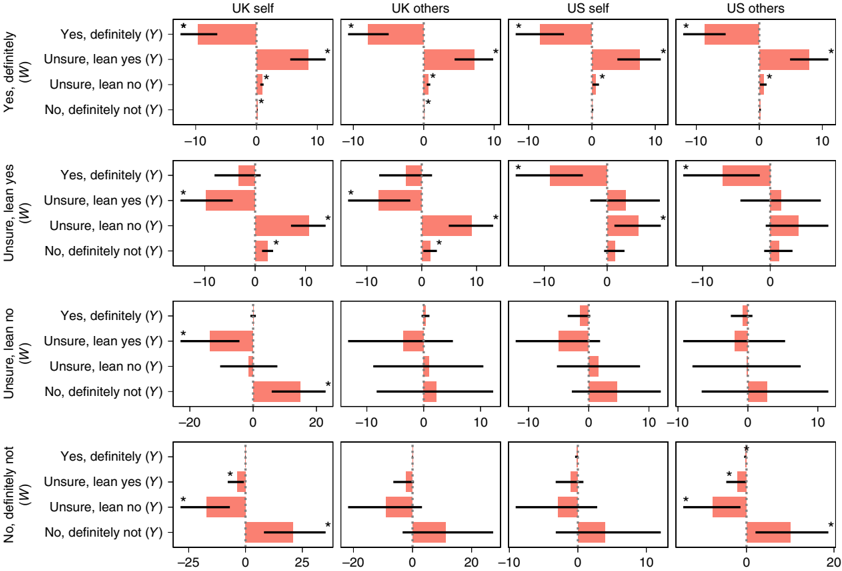
- Exposure to misinformation reduced the share answering “yes, definitely” by 6.2 percentage points in the UK (95% PI 3.9 to 8.5) and 6.4 percentage points in the USA (95% PI 4.0 to 8.8) for self-protection; for protecting others the decreases were 5.7 points in the UK (95% PI 3.5 to 7.9) and 6.5 points in the USA (95% PI 4.1 to 8.8).
- Misinformation also shifted respondents toward lower-intent categories: in the UK, for self-protection there was an increase of 2.7 points in “unsure, but leaning towards no” and 3.3 points in “no, definitely not”; in the USA, there was a 2.3-point rise in “unsure, but leaning towards no.”
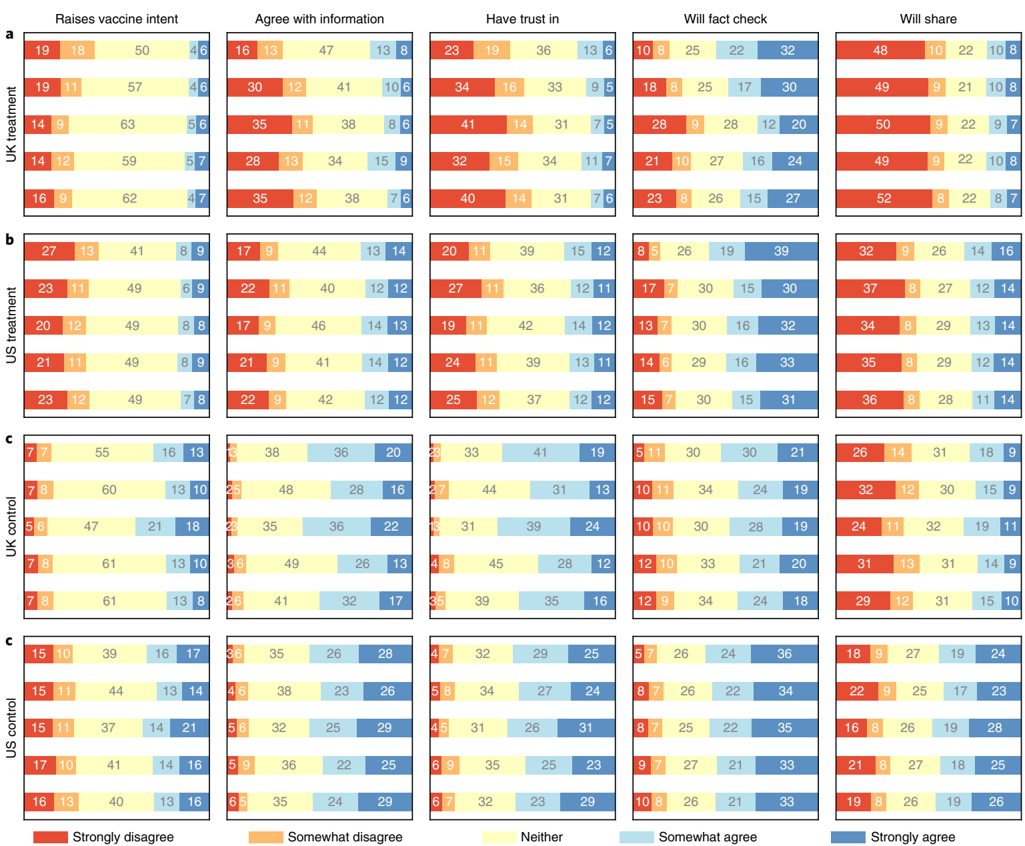
- Scientific-sounding misinformation was more damaging: the paper reports that the misinformation image with the strongest association with reduced intent had weight 0.42 in the UK (95% PI 0.28 to 0.56) and 0.41 in the USA (95% PI 0.25 to 0.58), and that around a quarter of respondents found some misinformation agreeable or trustworthy.
## Methods
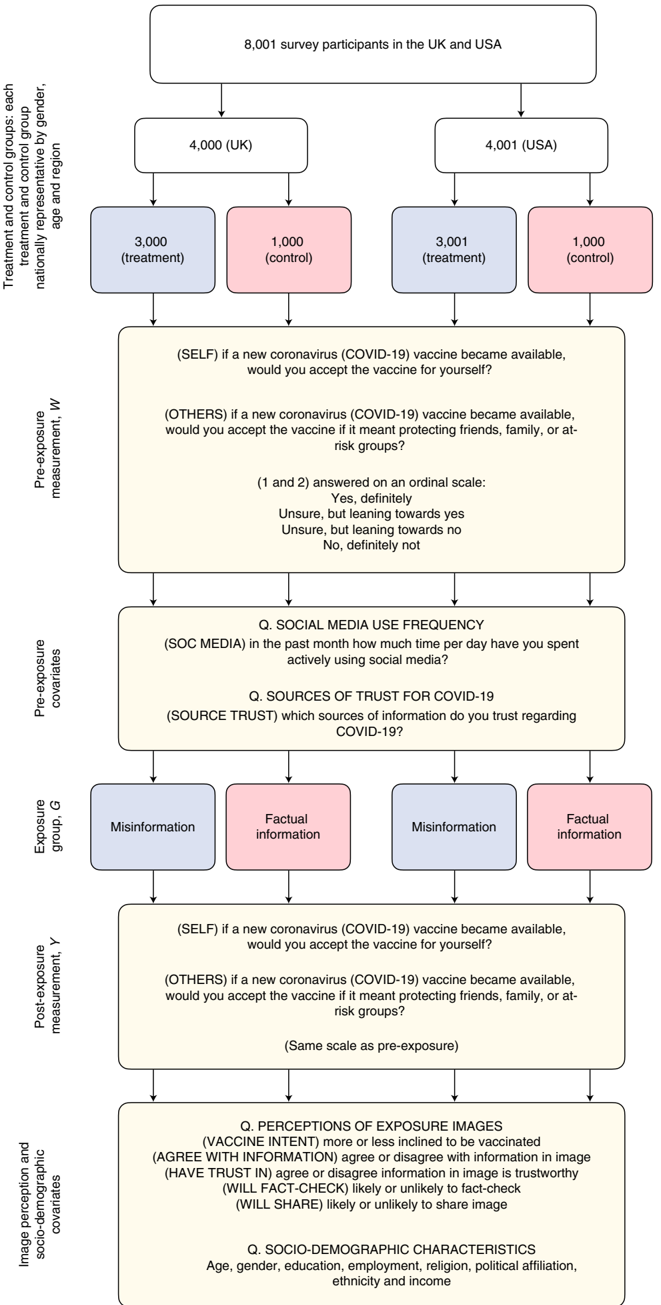
- Quantitative cross-sectional pre-post randomized controlled survey experiment in the UK and USA, fielded 7–14 September 2020.
- 8,001 respondents recruited via an online panel: 4,000 in the UK and 4,001 in the USA; within each country, 75% were assigned to misinformation and 25% to factual-information control.
- Respondents reported vaccination intent on a four-point ordered scale before and after exposure, for both self-protection and protecting others; analysis used hierarchical Bayesian ordered logistic regression with treatment effects, heterogeneous treatment effects, and image-impact models estimated via Hamiltonian Monte Carlo / NUTS in PyStan.
## Limitations
- The paper states that the design does not replicate a real-world social media platform environment, and that results are unlikely to be representative of real-world uptake rates.
- The authors state that the study does not allow causal inferences about different kinds of vaccine messaging from the post-exposure perception measures, and that they were limited in the type and volume of misinformation presented.
- Evident from the text: the sample was an online panel and respondents who did not participate simply did not complete the survey; the authors also note possible technological-literacy biases in this sampling mode.
Model-written summary. Check it against the paper before relying on it.
Integrity signals
Registry
Cites
Statistics
Figures


Verification
Claims the paper makes
14 Valid · 1 Not valid · 5 Not checked · 82 Own results and interpretations
The cited sources support only part of this claim — read each source’s verdict below.
In the paper
“Here we show that in both countries-as of September 2020-fewer people would 'definitely' take a vaccine than is likely required for herd immunity”
What the sources say
- Partly supportedcites [15] Kwok, K. O., Lai, F., Wei, W. I., Wong, S. Y. S. & Tang, J. W. T. Herd immunity—estimating the level required to halt the COVID-19 epidemics in affected countries. J. Infect. 80, e32–e33 (2020). sourceExperimental — accuracy not yet measured
The paper’s main text gives a formula for the minimum population immunity needed to halt spread, and Table 1 estimates thresholds for countries using data as of 13 March 2020. It does not report September 2020 vaccine willingness, whether people would ‘definitely’ take a vaccine, or a comparison between willingness and those thresholds in the two countries. (LLM, conf=0.88)
- Supportedcites [16] Sanche, S. et al. High contagiousness and rapid spread of severe acute respiratory syndrome coronavirus 2. Emerg. Infect. Dis. 26, 1470–1477 (2020). source
The Results section (‘Implications for Intervention Strategies’; page unavailable) estimates that more than 82% of the population would need immunity to stop transmission at R0 = 5.7. That supports the herd-immunity benchmark attributed to this source. The two-country September 2020 vaccine-willingness comparison is introduced as the citing authors’ own finding (‘Here we show’), not as a finding of this paper. (LLM, conf=0.87)
plain- Asserted: passes — The authors put it forward as true.
- Checkable: passes — It can be checked against evidence.
- Load-bearing: passes — The paper’s conclusions depend on it.
- Based: passes — The paper gives a reason why it holds.
- Partly supported
The cited sources support only part of this claim — read each source’s verdict below.
In the paper
“Under these current plausible COVID-19 vaccine acceptance rates, possible levels of existing protective immunity-though it is unclear whether post-infection immunity confers long-term immunity 29 and the rapidly evolving nature of misinformation surrounding the pandemic 23,30 , it is unclear whether vaccination will reach the levels required for herd immunity.”
What the sources say
- Supportedcites [29] Altmann, D. M., Douek, D. C. & Boyton, R. J. What policy makers need to know about COVID-19 protective immunity. Lancet 395, 1527–1529 (2020). source
The paper’s discussion of how long COVID-19 immunity might last says immunity could wane and that evidence extending only a little beyond one year offers little reassurance about longer-term protection. In the citing sentence, this source is attached to the uncertainty about long-term post-infection immunity, not to vaccine acceptance or misinformation. (LLM, conf=0.91)
- Partly supportedcites [23] Pennycook, G., McPhetres, J., Zhang, Y., Lu, J. G. & Rand, D. G. Fighting COVID-19 misinformation on social media: experimental evidence for a scalable accuracy-nudge intervention. Psychol. Sci. 31, 770–780 (2020). sourceExperimental — accuracy not yet measured
The citation is attached to the statement about pandemic misinformation, not the citing authors’ conclusion about herd immunity. The paper’s Abstract says COVID-19 misinformation has proliferated and takes many forms, but it does not establish that the misinformation is rapidly evolving. (LLM, conf=0.78)
- Supportedcites [30] Zarocostas, J. How to fight an infodemic. Lancet 395, 676 (2020). source
The citation is attached to the rapidly changing misinformation surrounding COVID-19, not to the citing authors’ conclusion about vaccination and herd immunity. In “How to fight an infodemic,” the paper describes misinformation spreading rapidly through social media and says its amplification makes timely responses a challenge. (LLM, conf=0.90)
hedged- Asserted: passes — The authors put it forward as true.
- Checkable: passes — It can be checked against evidence.
- Load-bearing: passes — The paper’s conclusions depend on it.
- Based: passes — The paper gives a reason why it holds.
- Supported
The cited sources support only part of this claim — read each source’s verdict below.
In the paper
“While large-scale vaccine rejection threatens herd immunity goals, large-scale acceptance with local vaccine rejection can also have negative consequences for community (herd) immunity, as clustering of non-vaccinators can disproportionately increase the needed percentage of vaccination coverage to achieve herd immunity in adjacent geographical regions and encourage epidemic spread 24 .”
What the sources say
- Partly supportedcites [24] Salathé, M. & Bonhoeffer, S. The effect of opinion clustering on disease outbreaks. J. R. Soc. Interface 5, 1505–1508 (2008). sourceExperimental — accuracy not yet measured
The Results and Discussion (pp. not specified) report that clusters of unvaccinated people can undermine herd immunity, increase outbreak probability, and mean that vaccination-coverage estimates needed to avoid outbreaks are too low. The Discussion also says infection can spread from one susceptible cluster to another. The paper does not specifically find that clustering raises the coverage percentage needed in adjacent geographical regions. (LLM, conf=0.86)
plainstates a cause- Asserted: passes — The authors put it forward as true.
- Checkable: passes — It can be checked against evidence.
- Load-bearing: unclear — It is unclear whether the paper’s conclusions depend on it.
- Based: passes — The paper gives a reason why it holds.
- Partly supported
The cited sources that could be checked couldn’t confirm or dispute this claim.
In the paper
“In the UK, this contrasted with more memetic imaging (for example, 'striking images with text superimposed on top' 42 ) which showed far weaker associations (images 3 and 4 in Supplementary Table 1).”
What the sources say
- Could not verifycites [42] Lazer, D. M. J. et al. The science of fake news. Science 359, 1094–1096 (2018). sourceExperimental — accuracy not yet measured
Citation 42 is attached to the description of memetic images, not to the UK association results, which the citing sentence attributes to its own Supplementary Table 1. Our copy discusses fake-news exposure and impact (Prevalence and Impact, p. 3), but searches for the quoted phrase and for memetic images or text-overlaid images found no passage defining them that way. (LLM, conf=0.77)
plainstates an association- Asserted: passes — The authors put it forward as true.
- Checkable: passes — It can be checked against evidence.
- Load-bearing: unclear — It is unclear whether the paper’s conclusions depend on it.
- Based: passes — The paper gives a reason why it holds.
- Could not verify
A result the paper reports from its own data — it cites no other source for it, so there is none to check. The quote shows it is in the paper.
In the paper
“while in the USA it was image 1 (Supplementary Table 1), with weight 0.41 (95% PI 0.25 to 0.58).”
plainstates an association- Asserted: passes — The authors put it forward as true.
- Checkable: passes — It can be checked against evidence.
- Load-bearing: passes — The paper’s conclusions depend on it.
- Based: passes — The paper gives a reason why it holds.
- Rests on an assumption not shown here.
52 more claims
Create a free account to see all 102 claims and to verify the 3 references still open.
- It may state two separate claims as one. 23
- Probably not a substantial claim. 32
- The quote only partly states this claim. 1
Claims other papers make about this one
Each is checked against this paper’s own text: does it say what the citing paper says it does?
The cited source says what the claim attributes to it.
In the citing paper
“Other research has found a causal link between exposure to vaccine misinformation and reduced intentions to get vaccinated (Loomba et al. 2021).”
From Social Media and Morality. (2024) · cites this paper as Loomba et al. 2021
In the citing paper
“belief in misinformation about coronavirus disease 2019 (COVID-19) has been linked to reduced willingness to get vaccinated against the disease and lower intentions to comply with public health measures (2, 3).”
From Psychological inoculation improves resilience against misinformation on social media (2022) · cites this paper as [3]
In the citing paper
“At the same time, misinformation about both technologies is already circulating among the public that can and should be targeted in a debunking intervention (e.g., Loomba et al., 2021;Wang & Song, 2020).”
From How to debunk misinformation? An experimental online study investigating text structures and headline formats (2023) · cites this paper as Loomba et al., 2021
Self-check
Percentages, sums and reported differences re-computed from the paper’s own numbers.
Each contradiction between two passages listed here was confirmed by an independent check.
Rated minor: it would not touch a result — a value no result rests on, a p-value that stays on the same side of the significance level, or a conflict that is clerical, resolved elsewhere in the paper, or outside its own findings.
In the paper
§ Methods
“Ethical approval for this study was obtained by the London School of Hygiene and Tropical Medicine ethics committee on 15 June 2020 with reference 22647.”
§ Human research participants
“Approval for this study was obtained by the LSHTM ethics committee on 15 June 2020 with reference 22130.”
Citations
Cites
A pneumonia outbreak associated with a new coronavirus of probable bat origin
Zhou, P., Yang, X.-L., Wang, X.-G., Hu, B., Zhang, L., Zhang, W., Si, H.-R., Zhu, Y., Li, B., Huang, C.-L., et al. (2020) · Nature · doi:10.1038/s41586-020-2012-7 · Cited by 21,969
Inference from iterative simulation using multiple sequences
Gelman, A., & Rubin, D. B. (1992) · Statistical Science · doi:10.1214/ss/1177011136 · Cited by 16,627
Estimating causal effects of treatments in randomized and nonrandomized studies
Rubin, D. B. (1974) · Journal of Educational Psychology · doi:10.1037/h0037350 · Cited by 9,436
The spread of true and false news online
Vosoughi, S., Roy, D., & Aral, S. (2018) · Science · doi:10.1126/science.aap9559 · Cited by 8,847
Statistics and Causal Inference
Holland, P. W. (1986) · Journal of the American Statistical Association · doi:10.1080/01621459.1986.10478354 · Cited by 5,293
The proximal origin of SARS-CoV-2
Andersen, K. G., Rambaut, A., Lipkin, W. I., Holmes, E. C., & Garry, R. F. (2020) · Nature Medicine · doi:10.1038/s41591-020-0820-9 · Cited by 5,081
Voysey, M., Clemens, S. A. C., Madhi, S. A., Weckx, L. Y., Folegatti, P. M., Aley, P. K., Angus, B., Baillie, V. L., Barnabas, S. L., Bhorat, Q. E., et al. (2021) · The Lancet · doi:10.1016/s0140-6736(20)32661-1 · Cited by 4,616
Regression Models for Ordinal Data
McCullagh, P. (1980) · Journal of the Royal Statistical Society Series B: Statistical Methodology · doi:10.1111/j.2517-6161.1980.tb01109.x · Cited by 4,453
Lazer, D. M. J., Baum, M. A., Benkler, Y., Berinsky, A. J., Greenhill, K. M., Menczer, F., Metzger, M. J., Nyhan, B., Pennycook, G., Rothschild, D., et al. (2018) · Science · doi:10.1126/science.aao2998 · Cited by 4,160
An mRNA Vaccine against SARS-CoV-2 — Preliminary Report
Jackson, L. A., Anderson, E. J., Rouphael, N. G., Roberts, P. C., Makhene, M., Coler, R. N., McCullough, M. P., Chappell, J. D., Denison, M. R., Stevens, L. J., et al. (2020) · New England Journal of Medicine · doi:10.1056/nejmoa2022483 · Cited by 3,406
Research works printed but not linked: 2
- Pfizer. Pfizer and BioNTech conclude phase 3 study of COVID-19 vaccine candidate, meeting all primary efficacy endpoints https://www.pfizer.com/news/press-release/press-release-detail/pfizer-and-biontech-conclude-phase-3-study-covid-19-vaccine (2020).
- Graham, M. & Coppock, A. Asking about attitude change. Public Opinion Quarterly (in the press).
Cited by
Items 301–400 of 1,802
Thaker, J. J., & Subramanian, A. (2021) · Frontiers in Communication · doi:10.3389/fcomm.2021.721982 · Cited by 31
“In contrast, a few studies examine how real-world vaccine information exposure affects vaccination intentions (Loomba et al., 2021).”
BackgroundCOVID-19 Vaccine Fact-Checking Posts on Facebook: Observational Study
Xue, H., Gong, X., & Stevens, H. (2022) · Journal of Medical Internet Research · doi:10.2196/38423 · Cited by 35
“Indeed, Loomba et al found that exposure to COVID-19 vaccine misinformation significantly decreases the intention to receive the COVID-19 vaccine [13].”
Confirmation bias and vaccine-related beliefs in the time of COVID-19
Malthouse, E. (2022) · Journal of Public Health · doi:10.1093/pubmed/fdac128 · Cited by 43
Disinformation: A Bibliometric Review
Wang, S., Su, F., Ye, L., & Jing, Y. (2022) · International Journal of Environmental Research and Public Health · doi:10.3390/ijerph192416849 · Cited by 54
From Facebook to YouTube: The Potential Exposure to COVID-19 Anti-Vaccine Videos on Social Media
Gruzd, A. A., Abul‐Fottouh, D., Song, M. Y., & Saiphoo, A. (2023) · Social Media + Society · doi:10.1177/20563051221150403 · Cited by 43
“…exposed to information about the risk of communicable diseases (Thaker & Subramanian, 2021); on the other hand, some studies show that people who were pro-vaccine would reduce their intention to get vaccinated after being exposed to COVID-19 vaccine–related misinformation (Loomba et al., 2021).”
BackgroundInfluentialThe Costs of Polarizing a Pandemic: Antecedents, Consequences, and Lessons
Van Bavel, J. J., Pretus, C., Rathje, S., Pärnamets, P., Vlasceanu, M., & Knowles, E. D. (2024) · Perspectives on Psychological Science · doi:10.1177/17456916231190395 · Cited by 29
“For instance, COVID-19 misinformation has a causal effect on vaccination intentions (Loomba et al., 2021).”
Keisari, S., Palgi, Y., Ring, L., Folkman, A., & Ben‐David, B. M. (2022) · Frontiers in Psychiatry · doi:10.3389/fpsyt.2022.838903 · Cited by 34
“I would rather gradually return to routine;” (4) “.”
BackgroundCan News Literacy Help Reduce Belief in COVID Misinformation?
Ashley, S., Craft, S., Maksl, A., Tully, M., & Vraga, E. K. (2022) · Mass Communication & Society · doi:10.1080/15205436.2022.2137040 · Cited by 57
“…throughout the pandemic as a primary obstacle to controlling the spread of the virus because of the ways misinformation has affected beliefs and behaviors related to vaccination, mask-wearing, distancing, and other health measures (Hameleers et al., 2020; Harmon, 2021; Loomba et al., 2021).”
BackgroundRaza, S. H., Yousaf, M. T., Zaman, U., Khan, S. W., Core, R. S., & Malik, A. N. (2023) · Vaccine · doi:10.1016/j.vaccine.2023.01.047 · Cited by 36
“These conspiracy theories revolve around vaccine side effects and population control vis-à-vis the COVID-19 vaccination[22,23].”
A framework for understanding reasoning errors: From fake news to climate change and beyondPreprint
Pennycook, G. (2022) · doi:10.31234/osf.io/j3w7d · Cited by 27
van der Linden, S., Albarracín, D., Fazio, L. K., Freelon, D., Roozenbeek, J., Swire‐Thompson, B., & Bavel, J. J. V. (2023) · PsycEXTRA Dataset · doi:10.1037/e506432023-001 · Cited by 34
Bleakley, A., Hennessy, M. H., Maloney, E. K., Young, D. G., Crowley, J. P., Silk, K. J., & Langbaum, J. B. S. (2021) · Annals of Behavioral Medicine · doi:10.1093/abm/kaab091 · Cited by 28
“Thus, vaccination intention is lower among those exposed to misinformation and older adults are particularly susceptible to believing misinformation [26, 27].”
BackgroundPredictors of COVID-19 Vaccine Confidence: Findings from Slums of Four Major Metro Cities of India
Tamysetty, S., Babu, G. R., Sahu, B., et al. (2021) · Vaccines · doi:10.3390/vaccines10010060 · Cited by 27
“In order to dispel the misinformation that leads to decline in vaccination intent [32], there is need for the development of an effective communication strategy to create trust in the communities, raise awareness, and reveal myths regarding safety and efficacy of vaccines through consistent and evidence-based messages…”
BackgroundPriming with social benefit information of vaccination to increase acceptance of COVID-19 vaccines
Liao, Q., Cowling, B. J., Xiao, J., Yuan, J., Dong, M., Ni, M. Y., Fielding, R., & Lam, W. (2022) · Vaccine · doi:10.1016/j.vaccine.2022.01.031 · Cited by 29
“Negative information about vaccines from news media can be quickly spread through social media which further amplifies its impact on vaccine confidence [31,36].”
Mudenda, S., Hikaambo, C. N., Daka, V., Chileshe, M., Mfune, R. L., Kampamba, M., Kasanga, M., Phiri, M. L., Mufwambi, W., Banda, M., et al. (2022) · Pan African Medical Journal · doi:10.11604/pamj.2022.41.112.31219 · Cited by 32
Coulaud, P.-J., Ablona, A., Bolduc, N., Fast, D., Bertrand, K., Ward, J. K., Greyson, D. L., Jauffret‐Roustide, M., & Knight, R. (2022) · Vaccine · doi:10.1016/j.vaccine.2022.02.085 · Cited by 29
Misinformation can prevent the suppression of epidemics
Sontag, A., Rogers, T., & Yates, C. A. (2022) · Journal of The Royal Society Interface · doi:10.1098/rsif.2021.0668 · Cited by 36
Hesitancy towards COVID-19 vaccines on social media in Canada
Rotolo, B., Dubé, È., Vivion, M., MacDonald, S. E., & Meyer, S. B. (2022) · Vaccine · doi:10.1016/j.vaccine.2022.03.024 · Cited by 32
“Indeed data has shown that exposure to disinformation can have a detrimental impact on vaccine acceptance [18] and social media provides a platform for information dissemination.”
Baghdadi, J. D., Coffey, K., Belcher, R., Frisbie, J., Hassan, N., Sim, D., & Malik, R. D. (2023) · JAMIA Open · doi:10.1093/jamiaopen/ooad013 · Cited by 44
“Third, we did not examine the characteristics of users posting comments, which are known to influence susceptibility to health-related misinformation.(12) Thus, we were unable to understand how viewer characteristics might interact with video characteristics to affect engagement.”
BackgroundSaltor, J., Barberia, I., & Rodríguez‐Ferreiro, J. (2022) · Applied Cognitive Psychology · doi:10.1002/acp.4008 · Cited by 37
Public health education post-COVID-19: a proposal for critical revisions
Ghaffar, A., Rashid, S. F., Wanyenze, R. K., et al. (2021) · BMJ Global Health · doi:10.1136/bmjgh-2021-005669 · Cited by 26
Challenges of evaluating and modelling vaccination in emerging infectious diseases
Madewell, Z. J., Dean, N. E., Berlin, J. A., COPLAN, P. M., Davis, K. J., Struchiner, C. J., & Halloran, M. E. (2021) · Epidemics · doi:10.1016/j.epidem.2021.100506 · Cited by 31
Role of Blockchain Technology in Combating COVID-19 Crisis
Alsaed, Z., Khweiled, R., Hamad, M., Daraghmi, E. Y., Cheikhrouhou, O., Alhakami, W., & Hamam, H. (2021) · Applied Sciences · doi:10.3390/app112412063 · Cited by 31
“As known as a blockchain, it gives secure issuance and sharing of verifiable educational credentials where one of the issuing authorities of an institute uploads a credential to a blockchain‐based system [4].”
BackgroundGeniole, S. N., Bird, B. M., Witzel, A., McEvoy, J. T., & Proietti, V. M. (2022) · Computers in Human Behavior · doi:10.1016/j.chb.2022.107218 · Cited by 34
Bari, A., Heymann, M., Cohen, R. J., Zhao, R., Szabo, L., Vasandani, S. A., Khubchandani, A., DiLorenzo, M. A., & Coffee, M. P. (2022) · Clinical Infectious Diseases · doi:10.1093/cid/ciac141 · Cited by 31
Zhang, R., Shan, Q., McKeever, B. W., Olatosi, B., & Li, X. (2022) · Vaccines · doi:10.3390/vaccines10071046 · Cited by 26
“Research suggests that the spread of misinformation about the COVID-19 vaccine may be an important driver of vaccine hesitancy, whereas conversely, exposure to reliable medical information may increase vaccine acceptance [10,12,13].”
BackgroundGoulding, M., Ryan, G. W., Minkah, P. A., Borg, A., Gonzalez, M., Medina, N., Suprenant, P., Rosal, M. C., & Lemon, S. C. (2022) · Human Vaccines & Immunotherapeutics · doi:10.1080/21645515.2022.2120721 · Cited by 31
“through proactive and continued communication, so parents are not left vulnerable to misinformation which can further drive vaccine hesitancy.(39)”
BackgroundPerrone, C., Fiabane, E., Maffoni, M., Pierobon, A., Setti, I., Sommovigo, V., & Gabanelli, P. (2022) · Public Health Nursing · doi:10.1111/phn.13134 · Cited by 32
“…literature on COVID-19 vaccine hesitancy has identified concerns about the rapid pace of vaccine development (Freeman et al., 2020), aversion to side effects (Luyten et al., 2019), and the spread of misinformation about the outbreak (Loomba et al., 2021) as key drivers of vaccine refusal and delay.”
BackgroundBetsch, C., Schmid, P., Verger, P., Lewandowsky, S., Soveri, A., Hertwig, R., Fasce, A., Holford, D. L., Raeve, P. D., Gagneur, A., et al. (2022) · Nature Communications · doi:10.1038/s41467-022-34995-y · Cited by 27
Understanding and Combating Misinformation Across 16 Countries on Six Continents
Arechar, A. A., Allen, J. N. L., Berinsky, A. J., Cole, R., Epstein, Z., Garimella, K., Gully, A., Lu, J. G., Ross, R. M., Stagnaro, M., et al. (2022) · doi:10.31234/osf.io/a9frz · Cited by 25
Accuracy and Social Motivations Shape Judgements of (Mis)InformationPreprint
Rathje, S., Roozenbeek, J., Bavel, J. J. V., & van der Linden, S. (2022) · doi:10.31234/osf.io/hkqyv · Cited by 26
Attitudes of the US general public towards MonkeypoxPreprint
Malik, A. A., Winters, M., & Omer, S. B. (2022) · medRxiv · doi:10.1101/2022.06.20.22276527 · Cited by 26
Analysis of Fluoride-Free Content on Twitter: Topic Modeling Study
Lotto, M., Hussain, I. Z., Kaur, J., Butt, Z. A., Cruvinel, T., & Morita, P. P. (2023) · Journal of Medical Internet Research · doi:10.2196/44586 · Cited by 30
“For example, screening COVID-19 vaccine misinformation on Twitter helped to identify the health beliefs associated with the antivaccination movement, which contributed to a better understanding of the factors relating to the prevalence and severity of cases in different countries [15].”
Implications of COVID-19 Vaccine Hesitancy: Results of Online Bulletin Board Interviews
Gorman, J. M., Gorman, S. E., Sandy, W., Gregorian, N., & Scales, D. A. (2022) · Frontiers in Public Health · doi:10.3389/fpubh.2021.757283 · Cited by 27
“Vaccine hesitancy and refusal threaten the ability to establish community (also called “herd”) immunity and therefore pose a significant risk to the public’s health (2).”
BackgroundWong, C. L., Leung, A. W. Y., Chung, O. M. H., & Chien, W. T. (2022) · BMJ Open · doi:10.1136/bmjopen-2021-058416 · Cited by 30
Does Hospitalization Change the Perception of COVID-19 Vaccines among Unvaccinated Patients?
Zarębska‐Michaluk, D., Rzymski, P., Moniuszko-Malinowska, A. M., Brzdęk, M., Martonik, D., Rorat, M., Wielgat, J., Kłos, K., Musierowicz, W., Wasilewski, P., et al. (2022) · Vaccines · doi:10.3390/vaccines10030476 · Cited by 24
“Some cross-sectional analyses documented that mainstream media (TV, newspapers) and social media may negatively affect a subject’s vaccine intent due to the spread of false information [31,32].”
BackgroundUsing big data to understand the online ecology of COVID-19 vaccination hesitancy
Teng, S., Jiang, N., & Khong, K. W. (2022) · Humanities and Social Sciences Communications · doi:10.1057/s41599-022-01185-6 · Cited by 31
“For instance, mis-information induced the decline in vaccine uptake (Loomba et al., 2021), inaccurate and negative social media data potentially in fl uenced population-wide vaccine uptake (Basch et al., 2021a), belief in COVID-related conspiracy theories predicted resistance to preventive health…”
BackgroundResultInfluentialDerdemezis, C. S., Markozannes, G., Rontogianni, M. O., Trigki, M., Kanellopoulou, A., Papamichail, D., Aretouli, E., Ntzani, E., & Tsilidis, K. K. (2022) · Vaccines · doi:10.3390/vaccines10050814 · Cited by 32
COVID-19 Vaccine Misperceptions in a Community Sample of Adults Aged 18–49 Years in Australia
Pickles, K. M., Copp, T., Meyerowitz‐Katz, G., Dodd, R. H., Bonner, C., Nickel, B., Steffens, M., Seale, H., Cvejic, E., Taba, M., et al. (2022) · International Journal of Environmental Research and Public Health · doi:10.3390/ijerph19116883 · Cited by 27
“While around 20% of our sample on average agreed or strongly agreed with misbelief items, this is of concern, given that increased susceptibility to misbeliefs has been found to reduce self-reported compliance with COVID prevention measures including intention to get vaccinated, likelihood of recommending COVID-19 vac…”
BackgroundInfluentialCOVID-19 vaccination uptake in 441 socially and ethnically diverse pregnant women
Husain, F., Powys, V. R., White, E., Jones, R., Goldsmith, L. P., Heath, P. T., Oakeshott, P., & Razai, M. S. (2022) · PLoS ONE · doi:10.1371/journal.pone.0271834 · Cited by 27
Coevolving spreading dynamics of negative information and epidemic on multiplex networks
Chen, J., Liu, Y., Yue, J., Duan, X., & Tang, M. (2022) · Nonlinear Dynamics · doi:10.1007/s11071-022-07776-x · Cited by 27
Institutional Perspectives on Digital Transformation
Gegenhuber, T. K., Logue, D. M., Hinings, C. R., & Barrett, M. I. (2022) · Research in the sociology of organizations · doi:10.1108/s0733-558x20220000083001 · Cited by 46
Kirubarajan, A., Lynch, M., Nasreen, S., Gebretekle, G. B., Fadel, S. A., Crowcroft, N. S., & Allin, S. M. (2023) · BMC Geriatrics · doi:10.1186/s12877-022-03653-9 · Cited by 29
Mousoulidou, M., Christodoulou, A., Siakalli, M., & Argyrides, M. (2023) · International Journal of Environmental Research and Public Health · doi:10.3390/ijerph20042898 · Cited by 27
Maranto, M., Gullo, G., Bruno, A., Minutolo, G., Cucinella, G., Maiorana, A., Casuccio, A., & Restivo, V. (2023) · Vaccines · doi:10.3390/vaccines11020454 · Cited by 27
“The finding that a high perception of barriers is negatively associated with a willingness to vaccinate is consistent with the results of other studies regarding vaccine-preventable diseases [36,37].”
ResultHajissa, K., Hammed-Akanmu, M., Kaabi, N. A., Alissa, M., Garout, M. A., Alenezy, A. A., Almaghrabi, R. H. D., AlRasheed, H. A., Al‐Subaie, M. F., Alhani, H. M., et al. (2023) · Vaccines · doi:10.3390/vaccines11061070 · Cited by 31
Liu, J., Kassas, B., Lai, J., Kropp, J. D., & Gao, Z. (2024) · Scientific Reports · doi:10.1038/s41598-024-52408-6 · Cited by 37
Axelsson, A., Nygren, T., Roozenbeek, J., & van der Linden, S. (2024) · Journal of Research on Technology in Education · doi:10.1080/15391523.2024.2338451 · Cited by 56
“For teenagers, misinformation may lead to disengagement from politics (Gunther et al., 2019), foster vaccine hesitancy (Loomba et al., 2021), or potentially increase engagement in violent behavior (Jolley & Douglas, 2014a, 2014b; Jolley & Paterson, 2020).”
Refusing blood transfusions from COVID‐19‐vaccinated donors: are we repeating history?
Jacobs, J. W., Bibb, L. A., Savani, B. N., & Booth, G. S. (2021) · British Journal of Haematology · doi:10.1111/bjh.17842 · Cited by 27
Spreading of fake news, competence and learning: kinetic modelling and numerical approximation
Franceschi, J., & Pareschi, L. (2022) · Philosophical Transactions of the Royal Society A Mathematical Physical and Engineering Sciences · doi:10.1098/rsta.2021.0159 · Cited by 33
“Governments in many countries have found themselves in enormous difficulty because of the slowdown in vaccination campaigns due to the spread of false information and the inability of individuals to discern the authenticity of such information [2,3].”
BackgroundHwang, Y., So, J., & Jeong, S. (2022) · Health Communication · doi:10.1080/10410236.2022.2111636 · Cited by 32
Exploring the determinants of global vaccination campaigns to combat COVID-19
Yin, F., Ji, M., Yang, Z., Wu, Z., Xia, X., Xing, T., She, Y., & Zhi, H. (2022) · Humanities and Social Sciences Communications · doi:10.1057/s41599-022-01106-7 · Cited by 27
“For instance, the National Foundation for Infectious Diseases in the USA convened a multidisciplinary expert roundtable and developed a new report, COVID-19 Communications: Promoting Prevention Measures and Vaccine Confidence, to help leaders across sectors and in the government communicate effectively and encourage t…”
BackgroundResultInfluentialKim, S., Capasso, A., Ali, S. H., Headley, T., DiClemente, R. J., & Tozan, Y. (2022) · BMC Public Health · doi:10.1186/s12889-022-14431-y · Cited by 24
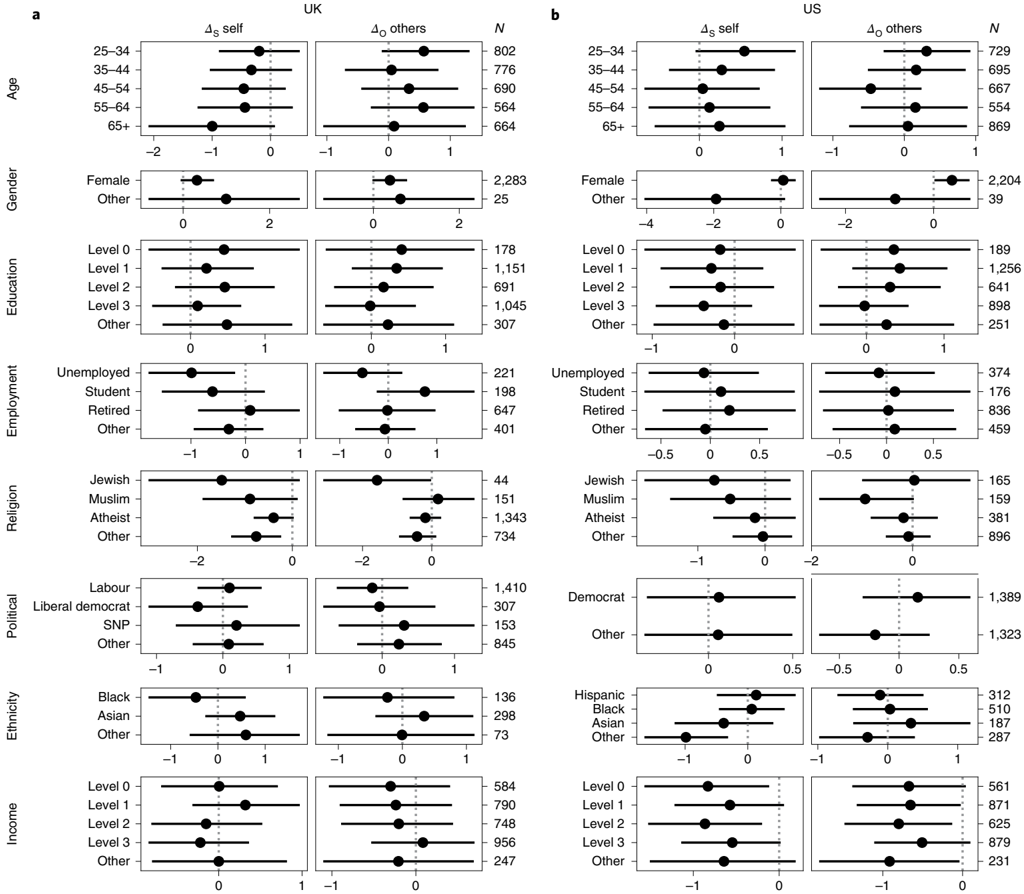
“Moreover, misinformation impacted sociodemographic groups differently [5].”
BackgroundSpirituality is associated with Covid-19 vaccination scepticism
Zarzeczna, N., Bertlich, T., Većkalov, B., & Rutjens, B. T. (2022) · Vaccine · doi:10.1016/j.vaccine.2022.11.050 · Cited by 34
Lee, E. W. J., Bao, H., Wang, Y., & Lim, Y. T. (2023) · Social Science & Medicine · doi:10.1016/j.socscimed.2023.115979 · Cited by 31
“During the COVID-19 pandemic, misinformation with a scientific veneer has been more strongly associated with a decline in vaccination intentions (Loomba et al., 2021).”
ERIUE: Evidential reasoning-based influential users evaluation in social networks
Wen, T., Chen, Y., Syed, T. A., & Wu, T. (2023) · Omega · doi:10.1016/j.omega.2023.102945 · Cited by 32
Under threat: the International AIDS Society–Lancet Commission on Health and Human Rights
Beyrer, C., Kamarulzaman, A., Isbell, M. T., Amon, J. J., Baral, S., Bassett, M. T., Cepeda, J., Deacon, H. J., Dean, L. T., Fan, L., et al. (2024) · The Lancet · doi:10.1016/s0140-6736(24)00302-7 · Cited by 31
On the disposition to think analytically: Four distinct intuitive-analytic thinking stylesPreprint
Newton, C., Feeney, J. R., & Pennycook, G. (2021) · doi:10.31234/osf.io/r5wez · Cited by 24
Nan, X., Wang, Y., & Thier, K. (2022) · doi:10.31234/osf.io/x48qs · Cited by 24
Butler, L. H., Prike, T., & Ecker, U. K. H. (2024) · Scientific Reports · doi:10.1038/s41598-024-62286-7 · Cited by 38
Yan, Y., Yu, S., Yu, Z., et al. (2024) · Nonlinear Dynamics · doi:10.1007/s11071-024-09894-0 · Cited by 23
Profiling misinformation susceptibility
Kyrychenko, Y., Koo, H. J., Maertens, R., Roozenbeek, J., van der Linden, S., & Götz, F. M. (2025) · Personality and Individual Differences · doi:10.1016/j.paid.2025.113177 · Cited by 63
Alzahrani, S. H., Baig, M., Al-Rabia, M. W., Algethami, M. R., Alhamdan, M. M., Alhakamy, N. A., Asfour, H. Z., & Ahmad, T. (2021) · Vaccines · doi:10.3390/vaccines9070798 · Cited by 29
Xu, S., Coman, I. A., Yamamoto, M., & Najera, C. J. (2022) · Health Communication · doi:10.1080/10410236.2022.2059802 · Cited by 30
“However, the proliferation of misinformation about COVID-19 vaccines, such as COVID19 vaccines changing people’s DNA or having microchips, has caused confusion, and led people to decline vaccines (Loomba et al., 2021).”
BackgroundVerrall, N. (2022) · Advanced sciences and technologies for security applications · doi:10.1007/978-3-030-94825-2_4 · Cited by 26
Zenone, M. A., & Caulfield, T. (2022) · JAMA Network Open · doi:10.1001/jamanetworkopen.2022.36993 · Cited by 23
Jiang, L. C., Sun, M., Chu, T. H., & Chia, S. C. (2022) · Frontiers in Psychology · doi:10.3389/fpsyg.2022.976091 · Cited by 27
“These false claims could hinder the fight against the pandemic, as it has been found that exposure to COVID-19 vaccine misinformation reduces the intention to get vaccinated (Loomba et al., 2021).”
BackgroundChen, Y.-T. (2022) · Health Policy and Technology · doi:10.1016/j.hlpt.2022.100699 · Cited by 28
“[44] examined the impact of misinformation about COVID-19 vaccines on vaccination acceptance and found that scientific-sounding misinformation was closely related to a decline in vaccination intention.”
BackgroundLalot, F., Abrams, D., Heering, M. S., Babaian, J., Özkeçeci, H., Peitz, L., Hayon, K. D., & Broadwood, J. (2022) · Political Psychology · doi:10.1111/pops.12871 · Cited by 33
“Respondents with both low trust and low concern were 10% more vaccine hesitant than respondents with high concern, 19% more hesitant than respondents with high trust, and 26% more hesitant than respondents with both high trust and high concern.”
InfluentialDebriefing works: Successful retraction of misinformation following a fake news study
Greene, C. M., & Murphy, G. (2023) · PLoS ONE · doi:10.1371/journal.pone.0280295 · Cited by 25
“Some research has suggested that anti-vaccination misinformation leads to vaccine hesitancy and reduced vaccination intentions [20, 21].”
BackgroundWood, R. M., Juanchich, M., Ramirez, M. D., & Zhang, S. (2023) · Social Science & Medicine · doi:10.1016/j.socscimed.2023.115863 · Cited by 26
“The volume of misinformation surrounding COVID-19 vaccines—as well as the politicization of attitudes about COVID-19 more generally—threatened to undermine vaccination campaigns in many countries by creating public skepticism and uncertainty (Loomba et al., 2021; Neely et al., 2022).”
BackgroundLotto, M., Hanjahanja-Phiri, T., Padalko, H., Oetomo, A., Butt, Z. A., Boger, J. N., Millar, J., Cruvinel, T., & Morita, P. P. (2023) · Frontiers in Public Health · doi:10.3389/fpubh.2023.1130079 · Cited by 28
“Then, misinformation negatively impacted the acceptability of the various COVID-19 vaccines in different countries, contributing to an increased prevalence and severity of cases in some countries (22).”
BackgroundAdiyoso, W., Wilopo, W., Mondry, M., Nurbaiti, B., & Suprapto, F. A. (2023) · Vaccine X · doi:10.1016/j.jvacx.2023.100297 · Cited by 42
Hopkins, K. L., Lepage, C., Cook, W., Thomson, A., Abeyesekera, S., Knobler, S., Boehman, N., Thompson, B., Waiswa, P., Ssanyu, J. N., et al. (2023) · Journal of Health Communication · doi:10.1080/10810730.2023.2231377 · Cited by 34
“Vaccine misinformation can have a serious negative impact on vaccination uptake (Loomba, de Figueiredo, Piatek, de Graaf, & Larson, 2021).”
BackgroundInformation is a determinant of health
Graham, G. N., Goren, N., Sounderajah, V., & DeSalvo, K. B. (2024) · Nature Medicine · doi:10.1038/s41591-023-02792-9 · Cited by 28
Online information disorder: fake news, bots and trolls
Giachanou, A., Zhang, X., Barrón‐Cedeño, A., Koltsova, O. Y., & Rosso, P. (2022) · International Journal of Data Science and Analytics · doi:10.1007/s41060-022-00325-0 · Cited by 30
Personalized Interventions for Online Moderation
Cresci, S., Trujillo, A., & Fagni, T. (2022) · ACM Conference on Hypertext and Social Media (HT) · doi:10.1145/3511095.3536369 · Cited by 41
“The consequences of such harms are not limited to online platforms, but also affect the offline world, as demonstrated by recent political riots [20] and by the decreased confidence in vaccines [17].”
BackgroundPerceived experts are prevalent and influential within an antivaccine community on Twitter
Harris, M., Murtfeldt, R., Wang, S., Mordecai, E. A., & West, J. D. (2024) · PNAS Nexus · doi:10.1093/pnasnexus/pgae007 · Cited by 42
“Misinformation claims containing arguments that appear scientific may be particularly effective at reducing vaccine intent (6), suggesting that perceived experts may be responsible for some of the most compelling antivaccine claims.”
Mapping global public perspectives on mRNA vaccines and therapeutics
Xu, J., Wu, Z., Wass, L. M., Larson, H. J., & Lin, L. K. (2024) · npj Vaccines · doi:10.1038/s41541-024-01019-3 · Cited by 39
“On the other hand, platforms like Twitter, with over 300 million active accounts and 500 million tweets posted daily, have ampli fi ed COVID-19 vaccine misinformation 13 , resulting in real-world behavioral consequences like the rejection of vaccines 14,15 .”
Self-citationGlobal socioeconomic inequalities in vaccination coverage, supply, and confidence
Wang, Q., Leung, K. S. M., Jit, M., Wu, T.-S. J., & Lin, L. K. (2025) · npj Vaccines · doi:10.1038/s41541-025-01143-8 · Cited by 38
“Base map data from Natural Earth (public domain), rendered using R packages rnaturalearth, rnaturalearthdata, and sf. among individuals with different socio-demographic characteristics 22 .”
Vaccine Hesitancy Against SARS-CoV-2 in Health Personnel of Northeastern Mexico and Its Determinants
Castañeda-Vásquez, D. E., Ruíz-Padilla, J. P., & Botello-Hernández, E. (2021) · Journal of Occupational and Environmental Medicine · doi:10.1097/jom.0000000000002205 · Cited by 25
“The attitude of health personnel influences the patient decision to accept immunization, so ensuring that all health care professionals know immunization practices is an effective strategy to address vaccine hesitancy.(25) To February 2021, Mexico’s regulatory body ‘‘COFEPRIS’’ has approved three COVID-19 vaccines: Pf…”
BackgroundInfluentialFilipinos’ health information‐seeking behaviors and their implications for COVID‐19 vaccination
Berdida, D. J. E., Grande, R. A. N., & López, V. (2021) · Public Health Nursing · doi:10.1111/phn.13034 · Cited by 27
Yoneoka, D., Eguchi, A., Nomura, S., Kawashima, T., Tanoue, Y., Murakami, M., Sakamoto, H., Maruyama‐Sakurai, K., Gilmour, S., Shi, S., et al. (2021) · The Lancet Regional Health - Western Pacific · doi:10.1016/j.lanwpc.2021.100330 · Cited by 25
Calac, A. J., Haupt, M. R., Li, Z., & Mackey, T. K. (2022) · JMIR Infodemiology · doi:10.2196/33587 · Cited by 27
Effects of Health Literacy in the Fight Against the COVID-19 Infodemic: The Case of Japan
Cheng, J. W., & Nishikawa, M. (2022) · Health Communication · doi:10.1080/10410236.2022.2065745 · Cited by 33
“Moreover, Loomba et al. (2021) found that COVID-19 vaccine misinformation reduced people’s vaccination intent in the UK and the US.”
BackgroundAddressing COVID-19 vaccine hesitancy
Kassianos, G. C., Puig‐Barberà, J., Dinse, H., Teufel, M., Türeci, Ö., & Pather, S. (2022) · Drugs in Context · doi:10.7573/dic.2021-12-3 · Cited by 24
Opposing Role of Trust as a Modifier of COVID-19 Vaccine Uptake in an Indigenous Population
Juárez, R., Phankitnirundorn, K., Okihiro, M. M., & Maunakea, A. K. (2022) · Vaccines · doi:10.3390/vaccines10060968 · Cited by 27
“Although prior studies of other populations demonstrated that vaccine hesitancy is associated with distrust and misinformation [10,11], none have yet reported whether these factors account for the low vaccination rates in indigenous populations, including NHPIs.”
BackgroundUnderstanding COVID-19 Vaccine Hesitancy in Ethnic Minorities Groups in the UK
Naqvi, M., Li, L., Woodrow, M., Yadav, P. K., & Kostkova, P. (2022) · Frontiers in Public Health · doi:10.3389/fpubh.2022.917242 · Cited by 25
“Examples of misinformation on social media includes links between the 5G mobile network and COVID-19, and the theory that the pandemic is a bioweapon or conspiracy (8).”
BackgroundShahzalal, M., & Adnan, H. M. (2022) · Sustainability · doi:10.3390/su14169822 · Cited by 41
Impact of media coverage on side effect reports from the COVID-19 vaccine
MacKrill, K. (2022) · Journal of Psychosomatic Research · doi:10.1016/j.jpsychores.2022.111093 · Cited by 24
Scales, D. A., Gorman, J. M., DiCaprio, P., Hurth, L., Radhakrishnan, M., Windham, S., Akunne, A., Florman, J., Leininger, L. J., & Starks, T. J. (2022) · Computers in Human Behavior · doi:10.1016/j.chb.2022.107609 · Cited by 29
Lenti, J., Mejova, Y., Kalimeri, K., Panisson, A., Paolotti, D., Tizzani, M., & Starnini, M. (2023) · JMIR Infodemiology · doi:10.2196/44714 · Cited by 26
Motta, M., Motta, G., & Stecula, D. A. (2023) · Vaccine · doi:10.1016/j.vaccine.2023.08.059 · Cited by 38
Battling the coronavirus ‘infodemic’ among social media users in Kenya and Nigeria
Offer‐Westort, M., Rosenzweig, L. R., & Athey, S. C. (2024) · Nature Human Behaviour · doi:10.1038/s41562-023-01810-7 · Cited by 40
“Recent evidence suggests that fact checks can improve discernment (belief) among samples from Africa, Latin America and the United Kingdom 20 .”
Kerr, J. R., Freeman, A. L. J., Marteau, T. M., et al. (2021) · medRxiv · doi:10.1101/2021.03.19.21253963 · Cited by 22
Herman, B. C., Poor, S., Clough, M. P., Rao, A., Kidd, A., De Jesús, D., & Varghese, D. (2024) · Journal of Research in Science Teaching · doi:10.1002/tea.21934 · Cited by 22
Prominent misinformation interventions reduce misperceptions but increase skepticism
Hoes, E., Aitken, B., Zhang, J., Gackowski, T., & Wojcieszak, M. (2023) · doi:10.31234/osf.io/zmpdu · Cited by 21
Samanta, S., Banerjee, J., Kar, S. S., Ali, K. M., Giri, B., Pal, A., & Dash, S. K. (2022) · Vacunas (English Edition) · doi:10.1016/j.vacun.2022.01.002 · Cited by 26
Wang, C., de Jong, E. P., Faure, J. A., Ellington, J. L., Chen, C.-H. S., & Chan, C. (2022) · Human Vaccines & Immunotherapeutics · doi:10.1080/21645515.2022.2050121 · Cited by 28
Factors Influencing Willingness to Be Vaccinated against COVID-19 in Nigeria
Oyekale, A. S. (2022) · International Journal of Environmental Research and Public Health · doi:10.3390/ijerph19116816 · Cited by 24
“[59] reported that willingness to be vaccinated against COVID-19 cannot be taken as a static phenomenon.”
Background
Metadata
- Authors
- Loomba, S., de Figueiredo, A., Piatek, S. J., de Graaf, K., & Larson, H. J.
- Affiliations
- Imperial College London (GB)
- London School of Hygiene & Tropical Medicine (GB)
- University of Antwerp (BE)
- Corresponding author
- Larson, Heidi J.
- Venue
- Nature Human Behaviour
- Published
- 2021-02-05
- Volume
- 5
- Issue
- 3
- Pages
- 337-348
- ISSN
- 2397-3374 (ISSN-L)
- OpenAlex
- W3128392043
- Semantic Scholar
- fad25c63595eefecba05d0b6a34163f54deb9a62
- Cited by
- 1,800
- References
- 59
- Citations by year
- 2026: 175 · 2025: 206 · 2024: 277 · 2023: 379 · 2022: 500 · 2021: 256
- FWCI
- 489.51
- Type
- journal article
- Language
- en
- Update notices
- Open access
- bronze
- doi.org
- Licence
- www.springernature.com/gp/researchers/text-and-data-mining (tdm)
- www.springernature.com/gp/researchers/text-and-data-mining (vor)
- Locations
- Nature Human Behaviour (publishedVersion)
- PubMed (publishedVersion)
- LSHTM Research Online (London School of Hygiene and Tropical Medicine) (acceptedVersion)
- RePEc: Research Papers in Economics (submittedVersion)
- Topics
- Social Sciences › Sociology and Political Science › Misinformation and Its Impacts
- Social Sciences › Health › Vaccine Coverage and Hesitancy
- Social Sciences › Communication › Communication and COVID-19 Impact
- Keywords
- COVID-19 vaccines, vaccine misinformation, vaccination intention, vaccine hesitancy, online misinformation, herd immunity, sociodemographic differences, vaccine acceptance
- MeSH terms
- COVID-19, SARS-CoV-2, COVID-19 Vaccines, Adolescent, Adult, Aged, Communication, Female, United Kingdom, Humans, Health Knowledge, Attitudes, Practice, Male, Middle Aged, United States, Health Behavior, Internet, Immunity, Herd, Intention, Young Adult
About these checks
Registry, retraction, Cites and statistics results are computed, not judged, with one exception: a printed reference that no index lists is read once by a model before it counts as a citation error. Claims are extracted by a model and kept only when their quote appears verbatim in the text; each cited source is then checked, with a model’s help, for whether it says what the claim relies on. Those verdicts can be wrong — read the claim’s quote and the cited source before relying on one.
The claim verdicts this report counts are experimental: their accuracy is not yet measured.
A language model drew the claims from the paper on 2026-10-10, under version 3 of the claim definition (model deepseek-v4.1-flash, prompt extract-v3).
A second model labelled each claim on 2026-10-10 (model jev-1.13-20260917, definition revision gold-guideline-v0.2).
Cited sources are checked with a language model’s help (gpt-6-sol).
Statistics and arithmetic are recomputed, not judged.
Confidence bands are shown only for fields calibrated on our annotated test set. None is calibrated yet, so no band is shown.
What counts as a claim ›How we measure confidence ›How we check this ›
Are you an author, or do you see a problem with this page? Request a review
Data sources
Bibliographic data: Semantic Scholar, OpenAlex, Crossref.
Contains information from the Semantic Scholar Academic Graph Datasets, made available under the ODC Attribution License (ODC-BY 1.0).
Semantic Scholar’s data is described in: Kinney, R., et al. (2023). The Semantic Scholar Open Data Platform. arXiv:2301.10140.
