

Measuring the impact of COVID-19 vaccine misinformation on vaccination intent in the UK and USA
Open accessPublished version of a preprint
The DOI matches its Crossref record; 56 of the 59 references it cites were found in a registry or an index; 25 of the 36 sources its claims cite were checked for support.
Abstract
Widespread acceptance of a vaccine for severe acute respiratory syndrome coronavirus 2 (SARS-CoV-2) will be the next major step in fighting the coronavirus disease 2019 (COVID-19) pandemic, but achieving high uptake will be a challenge and may be impeded by online misinformation. To inform successful vaccination campaigns, we conducted a randomized controlled trial in the UK and the USA to quantify how exposure to online misinformation around COVID-19 vaccines affects intent to vaccinate to protect oneself or others. Here we show that in both countries-as of September 2020-fewer people would 'definitely' take a vaccine than is likely required for herd immunity, and that, relative to factual information, recent misinformation induced a decline in intent of 6.2 percentage points (95th percentile interval 3.9 to 8.5) in the UK and 6.4 percentage points (95th percentile interval 4.0 to 8.8) in the USA among those who stated that they would definitely accept a vaccine. We also find that some sociodemographic groups are differentially impacted by exposure to misinformation. Finally, we show that scientific-sounding misinformation is more strongly associated with declines in vaccination intent.
Overview
CoChat Summary
## TL;DR
In a randomized controlled survey experiment of 8,001 adults in the UK and USA, exposure to COVID-19 vaccine misinformation reduced stated willingness to vaccinate compared with factual information. The effect was about 6 percentage points among those who initially said they would “definitely” accept a vaccine, and some sociodemographic groups were differentially affected.
## Key findings
- Before exposure, only 54.1% of respondents in the UK and 42.5% in the USA said they would “definitely” accept a COVID-19 vaccine for themselves; for protecting others, the figures were 63.7% in the UK and 53.3% in the USA.
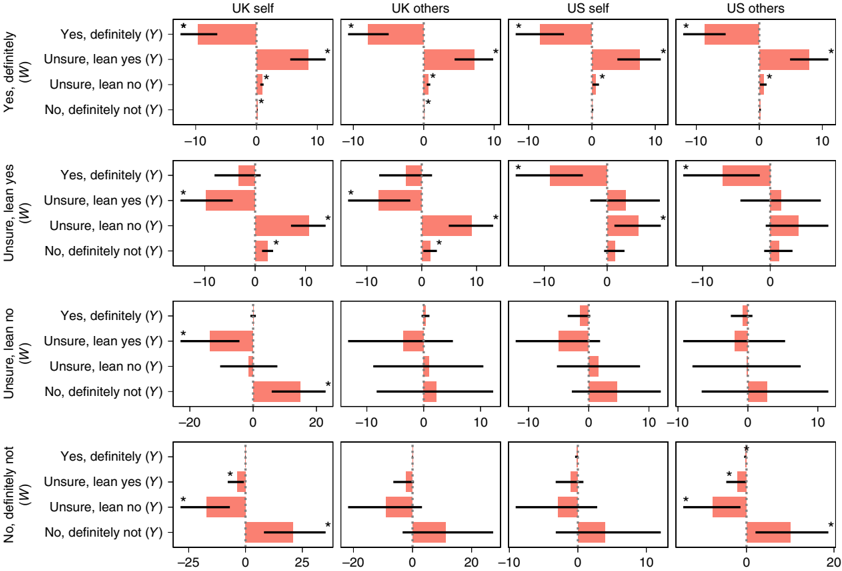
- Exposure to misinformation reduced the share answering “yes, definitely” by 6.2 percentage points in the UK (95% PI 3.9 to 8.5) and 6.4 percentage points in the USA (95% PI 4.0 to 8.8) for self-protection; for protecting others the decreases were 5.7 points in the UK (95% PI 3.5 to 7.9) and 6.5 points in the USA (95% PI 4.1 to 8.8).
- Misinformation also shifted respondents toward lower-intent categories: in the UK, for self-protection there was an increase of 2.7 points in “unsure, but leaning towards no” and 3.3 points in “no, definitely not”; in the USA, there was a 2.3-point rise in “unsure, but leaning towards no.”
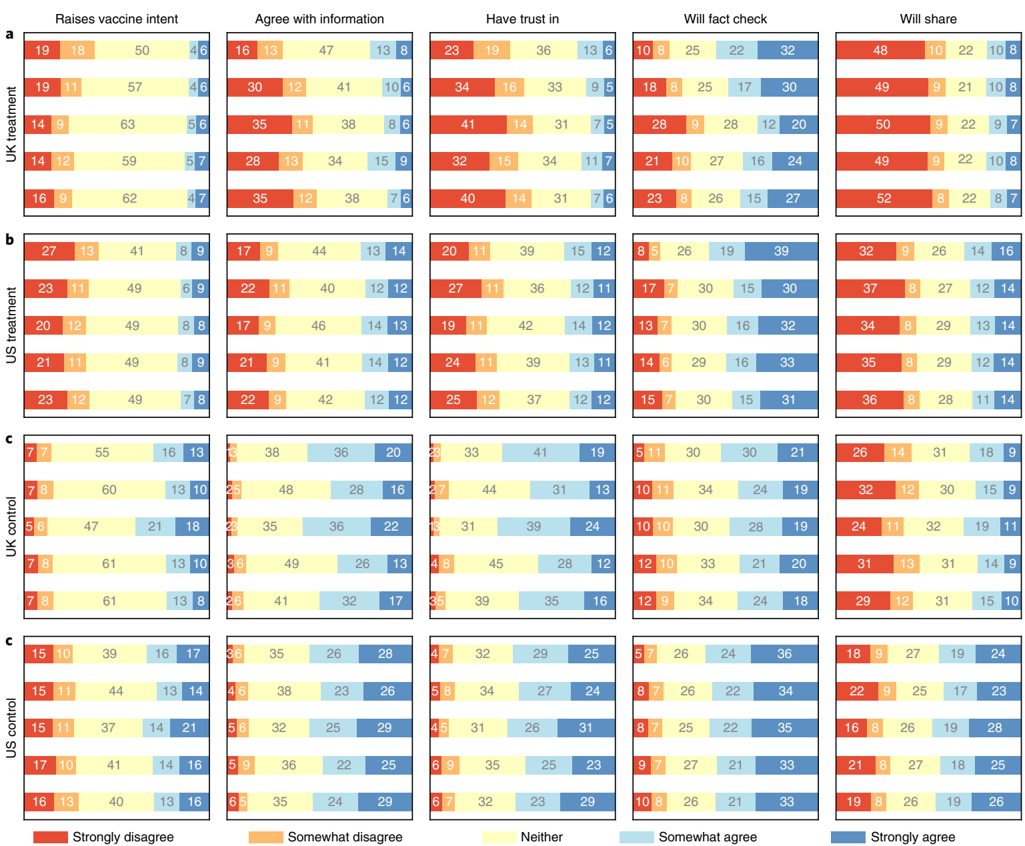
- Scientific-sounding misinformation was more damaging: the paper reports that the misinformation image with the strongest association with reduced intent had weight 0.42 in the UK (95% PI 0.28 to 0.56) and 0.41 in the USA (95% PI 0.25 to 0.58), and that around a quarter of respondents found some misinformation agreeable or trustworthy.
## Methods
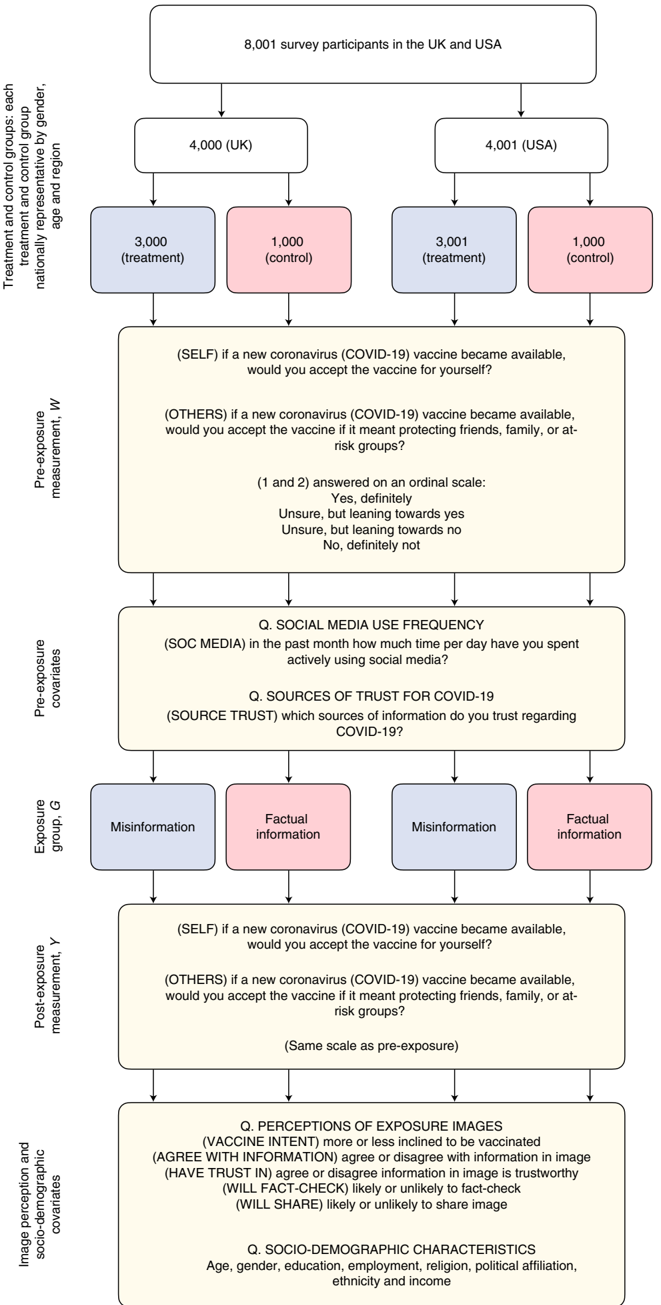
- Quantitative cross-sectional pre-post randomized controlled survey experiment in the UK and USA, fielded 7–14 September 2020.
- 8,001 respondents recruited via an online panel: 4,000 in the UK and 4,001 in the USA; within each country, 75% were assigned to misinformation and 25% to factual-information control.
- Respondents reported vaccination intent on a four-point ordered scale before and after exposure, for both self-protection and protecting others; analysis used hierarchical Bayesian ordered logistic regression with treatment effects, heterogeneous treatment effects, and image-impact models estimated via Hamiltonian Monte Carlo / NUTS in PyStan.
## Limitations
- The paper states that the design does not replicate a real-world social media platform environment, and that results are unlikely to be representative of real-world uptake rates.
- The authors state that the study does not allow causal inferences about different kinds of vaccine messaging from the post-exposure perception measures, and that they were limited in the type and volume of misinformation presented.
- Evident from the text: the sample was an online panel and respondents who did not participate simply did not complete the survey; the authors also note possible technological-literacy biases in this sampling mode.
Model-written summary. Check it against the paper before relying on it.
Integrity signals
Registry
Cites
Statistics
Figures


Verification
Claims the paper makes
14 Valid · 1 Not valid · 5 Not checked · 82 Own results and interpretations
The cited sources support only part of this claim — read each source’s verdict below.
In the paper
“Here we show that in both countries-as of September 2020-fewer people would 'definitely' take a vaccine than is likely required for herd immunity”
What the sources say
- Partly supportedcites [15] Kwok, K. O., Lai, F., Wei, W. I., Wong, S. Y. S. & Tang, J. W. T. Herd immunity—estimating the level required to halt the COVID-19 epidemics in affected countries. J. Infect. 80, e32–e33 (2020). sourceExperimental — accuracy not yet measured
The paper’s main text gives a formula for the minimum population immunity needed to halt spread, and Table 1 estimates thresholds for countries using data as of 13 March 2020. It does not report September 2020 vaccine willingness, whether people would ‘definitely’ take a vaccine, or a comparison between willingness and those thresholds in the two countries. (LLM, conf=0.88)
- Supportedcites [16] Sanche, S. et al. High contagiousness and rapid spread of severe acute respiratory syndrome coronavirus 2. Emerg. Infect. Dis. 26, 1470–1477 (2020). source
The Results section (‘Implications for Intervention Strategies’; page unavailable) estimates that more than 82% of the population would need immunity to stop transmission at R0 = 5.7. That supports the herd-immunity benchmark attributed to this source. The two-country September 2020 vaccine-willingness comparison is introduced as the citing authors’ own finding (‘Here we show’), not as a finding of this paper. (LLM, conf=0.87)
plain- Asserted: passes — The authors put it forward as true.
- Checkable: passes — It can be checked against evidence.
- Load-bearing: passes — The paper’s conclusions depend on it.
- Based: passes — The paper gives a reason why it holds.
- Partly supported
The cited sources support only part of this claim — read each source’s verdict below.
In the paper
“Under these current plausible COVID-19 vaccine acceptance rates, possible levels of existing protective immunity-though it is unclear whether post-infection immunity confers long-term immunity 29 and the rapidly evolving nature of misinformation surrounding the pandemic 23,30 , it is unclear whether vaccination will reach the levels required for herd immunity.”
What the sources say
- Supportedcites [29] Altmann, D. M., Douek, D. C. & Boyton, R. J. What policy makers need to know about COVID-19 protective immunity. Lancet 395, 1527–1529 (2020). source
The paper’s discussion of how long COVID-19 immunity might last says immunity could wane and that evidence extending only a little beyond one year offers little reassurance about longer-term protection. In the citing sentence, this source is attached to the uncertainty about long-term post-infection immunity, not to vaccine acceptance or misinformation. (LLM, conf=0.91)
- Partly supportedcites [23] Pennycook, G., McPhetres, J., Zhang, Y., Lu, J. G. & Rand, D. G. Fighting COVID-19 misinformation on social media: experimental evidence for a scalable accuracy-nudge intervention. Psychol. Sci. 31, 770–780 (2020). sourceExperimental — accuracy not yet measured
The citation is attached to the statement about pandemic misinformation, not the citing authors’ conclusion about herd immunity. The paper’s Abstract says COVID-19 misinformation has proliferated and takes many forms, but it does not establish that the misinformation is rapidly evolving. (LLM, conf=0.78)
- Supportedcites [30] Zarocostas, J. How to fight an infodemic. Lancet 395, 676 (2020). source
The citation is attached to the rapidly changing misinformation surrounding COVID-19, not to the citing authors’ conclusion about vaccination and herd immunity. In “How to fight an infodemic,” the paper describes misinformation spreading rapidly through social media and says its amplification makes timely responses a challenge. (LLM, conf=0.90)
hedged- Asserted: passes — The authors put it forward as true.
- Checkable: passes — It can be checked against evidence.
- Load-bearing: passes — The paper’s conclusions depend on it.
- Based: passes — The paper gives a reason why it holds.
- Supported
The cited sources support only part of this claim — read each source’s verdict below.
In the paper
“While large-scale vaccine rejection threatens herd immunity goals, large-scale acceptance with local vaccine rejection can also have negative consequences for community (herd) immunity, as clustering of non-vaccinators can disproportionately increase the needed percentage of vaccination coverage to achieve herd immunity in adjacent geographical regions and encourage epidemic spread 24 .”
What the sources say
- Partly supportedcites [24] Salathé, M. & Bonhoeffer, S. The effect of opinion clustering on disease outbreaks. J. R. Soc. Interface 5, 1505–1508 (2008). sourceExperimental — accuracy not yet measured
The Results and Discussion (pp. not specified) report that clusters of unvaccinated people can undermine herd immunity, increase outbreak probability, and mean that vaccination-coverage estimates needed to avoid outbreaks are too low. The Discussion also says infection can spread from one susceptible cluster to another. The paper does not specifically find that clustering raises the coverage percentage needed in adjacent geographical regions. (LLM, conf=0.86)
plainstates a cause- Asserted: passes — The authors put it forward as true.
- Checkable: passes — It can be checked against evidence.
- Load-bearing: unclear — It is unclear whether the paper’s conclusions depend on it.
- Based: passes — The paper gives a reason why it holds.
- Partly supported
The cited sources that could be checked couldn’t confirm or dispute this claim.
In the paper
“In the UK, this contrasted with more memetic imaging (for example, 'striking images with text superimposed on top' 42 ) which showed far weaker associations (images 3 and 4 in Supplementary Table 1).”
What the sources say
- Could not verifycites [42] Lazer, D. M. J. et al. The science of fake news. Science 359, 1094–1096 (2018). sourceExperimental — accuracy not yet measured
Citation 42 is attached to the description of memetic images, not to the UK association results, which the citing sentence attributes to its own Supplementary Table 1. Our copy discusses fake-news exposure and impact (Prevalence and Impact, p. 3), but searches for the quoted phrase and for memetic images or text-overlaid images found no passage defining them that way. (LLM, conf=0.77)
plainstates an association- Asserted: passes — The authors put it forward as true.
- Checkable: passes — It can be checked against evidence.
- Load-bearing: unclear — It is unclear whether the paper’s conclusions depend on it.
- Based: passes — The paper gives a reason why it holds.
- Could not verify
A result the paper reports from its own data — it cites no other source for it, so there is none to check. The quote shows it is in the paper.
In the paper
“while in the USA it was image 1 (Supplementary Table 1), with weight 0.41 (95% PI 0.25 to 0.58).”
plainstates an association- Asserted: passes — The authors put it forward as true.
- Checkable: passes — It can be checked against evidence.
- Load-bearing: passes — The paper’s conclusions depend on it.
- Based: passes — The paper gives a reason why it holds.
- Rests on an assumption not shown here.
52 more claims
Create a free account to see all 102 claims and to verify the 3 references still open.
- It may state two separate claims as one. 23
- Probably not a substantial claim. 32
- The quote only partly states this claim. 1
Claims other papers make about this one
Each is checked against this paper’s own text: does it say what the citing paper says it does?
The cited source says what the claim attributes to it.
In the citing paper
“Other research has found a causal link between exposure to vaccine misinformation and reduced intentions to get vaccinated (Loomba et al. 2021).”
From Social Media and Morality. (2024) · cites this paper as Loomba et al. 2021
In the citing paper
“belief in misinformation about coronavirus disease 2019 (COVID-19) has been linked to reduced willingness to get vaccinated against the disease and lower intentions to comply with public health measures (2, 3).”
From Psychological inoculation improves resilience against misinformation on social media (2022) · cites this paper as [3]
In the citing paper
“At the same time, misinformation about both technologies is already circulating among the public that can and should be targeted in a debunking intervention (e.g., Loomba et al., 2021;Wang & Song, 2020).”
From How to debunk misinformation? An experimental online study investigating text structures and headline formats (2023) · cites this paper as Loomba et al., 2021
Self-check
Percentages, sums and reported differences re-computed from the paper’s own numbers.
Each contradiction between two passages listed here was confirmed by an independent check.
Rated minor: it would not touch a result — a value no result rests on, a p-value that stays on the same side of the significance level, or a conflict that is clerical, resolved elsewhere in the paper, or outside its own findings.
In the paper
§ Methods
“Ethical approval for this study was obtained by the London School of Hygiene and Tropical Medicine ethics committee on 15 June 2020 with reference 22647.”
§ Human research participants
“Approval for this study was obtained by the LSHTM ethics committee on 15 June 2020 with reference 22130.”
Citations
Cites
A pneumonia outbreak associated with a new coronavirus of probable bat origin
Zhou, P., Yang, X.-L., Wang, X.-G., Hu, B., Zhang, L., Zhang, W., Si, H.-R., Zhu, Y., Li, B., Huang, C.-L., et al. (2020) · Nature · doi:10.1038/s41586-020-2012-7 · Cited by 21,969
Inference from iterative simulation using multiple sequences
Gelman, A., & Rubin, D. B. (1992) · Statistical Science · doi:10.1214/ss/1177011136 · Cited by 16,627
Estimating causal effects of treatments in randomized and nonrandomized studies
Rubin, D. B. (1974) · Journal of Educational Psychology · doi:10.1037/h0037350 · Cited by 9,436
The spread of true and false news online
Vosoughi, S., Roy, D., & Aral, S. (2018) · Science · doi:10.1126/science.aap9559 · Cited by 8,847
Statistics and Causal Inference
Holland, P. W. (1986) · Journal of the American Statistical Association · doi:10.1080/01621459.1986.10478354 · Cited by 5,293
The proximal origin of SARS-CoV-2
Andersen, K. G., Rambaut, A., Lipkin, W. I., Holmes, E. C., & Garry, R. F. (2020) · Nature Medicine · doi:10.1038/s41591-020-0820-9 · Cited by 5,081
Voysey, M., Clemens, S. A. C., Madhi, S. A., Weckx, L. Y., Folegatti, P. M., Aley, P. K., Angus, B., Baillie, V. L., Barnabas, S. L., Bhorat, Q. E., et al. (2021) · The Lancet · doi:10.1016/s0140-6736(20)32661-1 · Cited by 4,616
Regression Models for Ordinal Data
McCullagh, P. (1980) · Journal of the Royal Statistical Society Series B: Statistical Methodology · doi:10.1111/j.2517-6161.1980.tb01109.x · Cited by 4,453
Lazer, D. M. J., Baum, M. A., Benkler, Y., Berinsky, A. J., Greenhill, K. M., Menczer, F., Metzger, M. J., Nyhan, B., Pennycook, G., Rothschild, D., et al. (2018) · Science · doi:10.1126/science.aao2998 · Cited by 4,160
An mRNA Vaccine against SARS-CoV-2 — Preliminary Report
Jackson, L. A., Anderson, E. J., Rouphael, N. G., Roberts, P. C., Makhene, M., Coler, R. N., McCullough, M. P., Chappell, J. D., Denison, M. R., Stevens, L. J., et al. (2020) · New England Journal of Medicine · doi:10.1056/nejmoa2022483 · Cited by 3,406
Research works printed but not linked: 2
- Pfizer. Pfizer and BioNTech conclude phase 3 study of COVID-19 vaccine candidate, meeting all primary efficacy endpoints https://www.pfizer.com/news/press-release/press-release-detail/pfizer-and-biontech-conclude-phase-3-study-covid-19-vaccine (2020).
- Graham, M. & Coppock, A. Asking about attitude change. Public Opinion Quarterly (in the press).
Cited by
Items 401–500 of 1,802
Applications of machine learning for COVID-19 misinformation: a systematic review
Sanaullah, A. R., Das, A., Das, A., Kabir, M. A., & Shu, K. (2022) · Social Network Analysis and Mining · doi:10.1007/s13278-022-00921-9 · Cited by 33
Zhou, X., Wang, S., Zhang, K., Chen, S., Chan, P. S.-F., Fang, Y., Cao, H., Chen, H., Hu, T., Chen, Y., et al. (2022) · Vaccines · doi:10.3390/vaccines10091478 · Cited by 21
Vaccine hesitancy prospectively predicts nocebo side-effects following COVID-19 vaccination
Hoffman, Y. S. G., Levin, Y., Palgi, Y., Goodwin, R. B., Ben‐Ezra, M., & Greenblatt‐Kimron, L. (2022) · Scientific Reports · doi:10.1038/s41598-022-21434-7 · Cited by 26
“Side effects included (1) Swollen arm/pain injection site, (2) Fever, (3) Chills, (4) Headaches, (5) Joint pains, (6) Nausea, (7) Feeling tired/fatigue, (8) Facial paralysis, (9) Vomiting, (10) Allergic reactions, (11) Swollen lymph nodes, (12) Rash, (13) Swollen eyes, (14) Sore throat, (15) Coughing, (16) Stomach pai…”
Audience segmentation analysis of public intentions to get a COVID-19 vaccine in Australia
Thaker, J. J., Richardson, L., & Holmes, D. (2022) · Public Understanding of Science · doi:10.1177/09636625221138494 · Cited by 27
“Four measures of intentions were collected from respondents following previous surveys (Lin et al., 2020; Loomba et al., 2021) that have been also used subsequently in other studies (Zheng et al., 2022).”
ResultPublic Health Needs the Public Trust: A Pandemic Retrospective
Halma, M. T. J., & Guetzkow, J. (2023) · BioMed · doi:10.3390/biomed3020023 · Cited by 26
“It has been found that people exposed to non-mainstream sources of information on COVID vaccines were less likely to get vaccinated [73].”
BackgroundThinking clearly about misinformation
Tay, L. Q., Lewandowsky, S., Hurlstone, M. J., Kurz, T., & Ecker, U. K. H. (2024) · Communications Psychology · doi:10.1038/s44271-023-00054-5 · Cited by 21
“Some studies will fi nd misinformation has minimal effects, others may suggest the opposite 9 — as a generalization, both characterizations will be inaccurate unless quali fi ed with explicit recognition of heterogeneity.”
BackgroundLi, Y., Li, M., Rice, M., Su, Y., & Yang, C. P. (2021) · International Journal of Environmental Research and Public Health · doi:10.3390/ijerph18147665 · Cited by 25
“A similar mistrust of vaccination can be found in countries beyond the US, such as in the UK [34].”
BackgroundThe effects of misinformation on COVID-19 vaccine hesitancy in Bangladesh
Mahmud, M. R., Reza, R. B., & Ahmed, S. M. Z. (2021) · Global Knowledge, Memory and Communication · doi:10.1108/gkmc-05-2021-0080 · Cited by 21
Increasing COVID-19 vaccination intentions: a field experiment on psychological ownership
Keppeler, F., Sievert, M., & Jilke, S. (2022) · Behavioural Public Policy · doi:10.1017/bpp.2022.16 · Cited by 28
“They aim to convince members of the public that vaccinations are both saving individual lives and contributing to herd immunity (Lunn et al ., 2020; Loomba et al ., 2021; Patel, 2021).”
Zhang, W., Wang, R., & Liu, H. (2022) · Computers in Human Behavior · doi:10.1016/j.chb.2022.107479 · Cited by 28
Uchibori, M., Ghaznavi, C., Murakami, M., Eguchi, A., Kunishima, H., Kaneko, S., Maruyama‐Sakurai, K., Miyata, H., & Nomura, S. (2022) · International Journal of Environmental Research and Public Health · doi:10.3390/ijerph192114511 · Cited by 22
Polo, A. J., Solano-Martinez, J., Saldana, L., Ramos, A. D., Herrera, M., Ullrich, T., & DeMario, M. (2023) · Journal of Clinical Child & Adolescent Psychology · doi:10.1080/15374416.2023.2169925 · Cited by 23
“Uncertainty and widespread misinformation have existed regarding the nature, course, and lethality of the COVID-19 illness, as well as about the best approaches to protect individuals (Loomba et al., 2021).”
Determinants of COVID-19 vaccine readiness and hesitancy among adults in sub-Saharan Africa
Abubakari, S. W., Workneh, F., Asante, K. P., Hemler, E. C., Madzorera, I., Wang, D., Ismail, A., Assefa, N., Azemraw, T., Lankoandé, B., et al. (2023) · PLOS Global Public Health · doi:10.1371/journal.pgph.0000713 · Cited by 26
“Surveys in the US and UK found that people in older age groups, with lower educational attainment, and those who are unemployed are more likely to believe in COVID-19 vaccine-related misinformation [33].”
BackgroundYuan, J., Xu, Y., Wong, I. O. L., Lam, W., Ni, M. Y., Cowling, B. J., & Liao, Q. (2024) · Nature Communications · doi:10.1038/s41467-023-44650-9 · Cited by 28
“Concernsaboutvaccinesafetyweremainlydrivenbythenoveltyofthe vaccine technology and its rapid development 49 , and further intensi-fi ed by the negative news regarding COVID-19 vaccines and people ’ s conspiracy beliefs 28,50 .”
BackgroundMisinformation interventions decay rapidly without an immediate posttest
Capewell, G., Maertens, R., Remshard, M., van der Linden, S., Compton, J., Lewandowsky, S., & Roozenbeek, J. (2024) · Journal of Applied Social Psychology · doi:10.1111/jasp.13049 · Cited by 38
“The spread of and belief in misinformation is a substantial societal problem (Lewandowsky et al., 2017; Roozenbeek & van der Linden, 2024), having been linked to a range of negative public health outcomes (Schmid et al., 2023), including reduced vaccine uptake (Loomba et al., 2021, 2024).”
BackgroundApplications of AI and IoT in COVID-19 Vaccine and Its Impact on Social Life
Almars, A. M., Gad, I., & Atlam, E.-S. (2021) · Studies in computational intelligence · doi:10.1007/978-3-030-91103-4_7 · Cited by 27
Dutta, B., Peng, M.-H., Chen, C.-C., & Sun, S.-L. (2022) · International Journal of Environmental Research and Public Health · doi:10.3390/ijerph19031347 · Cited by 22
“The relationship between TRSM and citizens’ readiness toward COVID-19 preventive measures is positive and significant, in line with previous studies [42,67]; thus, H2 is supported.”
ResultRuggeri, K., Stock, F., Haslam, S. A., Capraro, V., Boggio, P., Ellemers, N., Cichocka, A., Douglas, K., Rand, D. G., Cikara, M., et al. (2022) · doi:10.31234/osf.io/58udn · Cited by 19
Health Information Sourcing and Health Knowledge Quality: Repeated Cross-sectional Survey
Korshakova, E., Marsh, J. K., & Kleinberg, S. (2022) · JMIR Formative Research · doi:10.2196/39274 · Cited by 32
Metacognition, public health compliance, and vaccination willingness
Fischer, H., Huff, M., Anders, G., & Said, N. (2023) · Proceedings of the National Academy of Sciences · doi:10.1073/pnas.2105425120 · Cited by 26
“In line with prior research demonstrating the impact of COVID - 19 - related misin-formation on vaccination willingness (28), we found that citizens with more accurate COVID - 19 beliefs were more likely to comply with public health measures, and showed higher vaccination willingness.”
BackgroundResultInfluentialLearning in a Post-Truth World
Mostagir, M., & Siderius, J. (2022) · Management Science · doi:10.1287/mnsc.2022.4340 · Cited by 32
Understanding Factors to COVID-19 Vaccine Adoption in Gujarat, India
Tolia, V., Singh, R. R., Deshpande, S., Dave, A. C., & Rathod, R. (2022) · International Journal of Environmental Research and Public Health · doi:10.3390/ijerph19052707 · Cited by 23
Evaluative mindsets can protect against the influence of false information
Salovich, N. A., Kirsch, A. M., & Rapp, D. N. (2022) · Cognition · doi:10.1016/j.cognition.2022.105121 · Cited by 25
A Holistic Framework for Analyzing the COVID-19 Vaccine Debate
Pacheco, M. L., Islam, T., Mahajan, M., Shor, A., Yin, M., Ungar, L., & Goldwasser, D. (2022) · Conference of the North American Chapter of the Association for Computational Linguistics: Human Language Technologies (NAACL-HLT) · doi:10.18653/v1/2022.naacl-main.427 · Cited by 23
“Recent studies have noted the prevalence of rumors and misinformation in the context of the Covid19 pandemic (Loomba et al., 2021; Shahi et al., 2021; Lazarus et al., 2021; Ahmed et al., 2020).”
BackgroundCOVID-19 vaccine misinformation in English-language news media: retrospective cohort study
Lurie, P. G., Adams, J., Lynas, M., Stockert, K., Carlyle, R. C., Pisani, A., & Evanega, S. D. (2022) · BMJ Open · doi:10.1136/bmjopen-2021-058956 · Cited by 24
Führer, A., Pacolli, L., Yılmaz-Aslan, Y., et al. (2022) · Vaccines · doi:10.3390/vaccines10081350 · Cited by 19
“As illustrated in previous research, hesitation to take up vaccination can also be attributed to fears that arise from incorrect or limited information [30,31].”
BackgroundRömer, D., & Jamieson, K. H. (2022) · Scientific Reports · doi:10.1038/s41598-022-22014-5 · Cited by 22
Health Misinformation on Social Media and its Impact on COVID-19 Vaccine Inoculation in Jordan
Aljalabneh, A. A. (2023) · Communication & Society · doi:10.15581/003.36.1.185-200 · Cited by 21
Stefanizzi, P., Provenzano, S., Santangelo, O. E., Dallagiacoma, G., & Gianfredi, V. (2023) · Vaccines · doi:10.3390/vaccines11040717 · Cited by 19
“On the other hand, the pandemic-related misinformation deluge aggravated antivaccination movements and reduced trust in vaccination in general [50,51].”
BackgroundThe Psychology of COVID-19 Booster Hesitancy, Acceptance and Resistance in Australia
Kleitman, S., Fullerton, D. J., Law, M. K. H., Blanchard, M. D., Campbell, R., Tait, M.-A., Schulz, J. S., Lee, J., Stankov, L., & King, M. T. (2023) · Vaccines · doi:10.3390/vaccines11050907 · Cited by 25
“Misinformation can be a major hurdle for prompt COVID-19 vaccination; an experiment that exposed groups to either factual information or misinformation about both COVID-19 and vaccines found that misinformation lowered intentions to get a COVID-19 vaccine [36].”
BackgroundIncorporating Psychological Science Into Policy Making: The Case of Misinformation
Kozyreva, A., Smillie, L., & Lewandowsky, S. (2023) · European Psychologist · doi:10.1027/1016-9040/a000493 · Cited by 20
“Misinformation is a global problem in need of urgent solutions, primarily because it can encourage people to adopt false beliefs and take ill-informed action – for instance, in matters of public health (e.g., Loomba et al., 2021 ; Schmid et al., 2023 ; Tran et al., 2020 ).”
BackgroundFocusing on Relevant Responses for Multi-Modal Rumor Detection
Li, J., Bin, Y., Peng, L., Yang, Y., Li, Y., Jin, H., & Huang, Z. H. (2024) · IEEE Transactions on Knowledge and Data Engineering · doi:10.1109/tkde.2024.3389694 · Cited by 28
“For instance, rumors would mislead the voters during the 2016 U.S. election [2] and affect the willingness of the public to receive the COVID-19 vaccine [3].”
BackgroundEffective Communication at Different Phases of COVID-19 Prevention: Roles, Enablers and Barriers
Hanafiah, K. M., Ng, C., & Wan, A. M. (2021) · Viruses · doi:10.3390/v13061058 · Cited by 31
“These claims further exacerbated hesitance, even among undecided people [100], premised on the value judgment between facing the continued but unpredictable risk of becoming infected and falling ill with COVID-19 or being vaccinated with a vaccine that is perceived as “not 100% safe.”
BackgroundUndergraduate nursing students’ COVID-19 vaccine intentions: A national survey
Fontenot, H. B., Mattheus, D. B., Lim, E., Michel, A. D., Ryan, N., Knopf, A., Abuelezam, N. N., Stamp, K. D., Hekel, B. E., Branson, S., et al. (2021) · PLoS ONE · doi:10.1371/journal.pone.0261669 · Cited by 21
Santirocchi, A., Spataro, P., Costanzi, M., Doricchi, F., Rossi‐Arnaud, C., & Cestari, V. (2022) · Journal of Personalized Medicine · doi:10.3390/jpm12010111 · Cited by 25
“[13], who found that recent exposure to misinformation induced a decline in vaccination intent of 6.”
BackgroundResultNakhostin-Ansari, A., Zimet, G. D., Khonji, M. S., Aghajani, F., Teymourzadeh, A., Kazerooni, A. R., Pirayandeh, P., Aghajani, R., Safari, S., Khalaj, K., et al. (2022) · Vaccines · doi:10.3390/vaccines10050670 · Cited by 24
“This pattern can be exacerbated by a lack of knowledge and misinformation [44].”
BackgroundCable News and COVID-19 Vaccine CompliancePreprint
Pinna, M., Picard, L., & Goessmann, C. (2021) · SSRN Electronic Journal · doi:10.2139/ssrn.3890340 · Cited by 19
“Exposure to online misinformation is associated with a decline in the willingness to take a COVID-19 vaccine (Loomba et al., 2021; Roozenbeek et al., 2020).”
The role of political devotion in sharing partisan misinformation and resistance to fact-checkingPreprint
Pretus, C., Servin, C., Harris, E., et al. (2021) · doi:10.31234/osf.io/7k9gx · Cited by 19
Countering AI-generated misinformation with pre-emptive source discreditation and debunking
Spearing, E. R., Gile, C. I., Fogwill, A. L., Prike, T., Swire‐Thompson, B., Lewandowsky, S., & Ecker, U. K. H. (2025) · Royal Society Open Science · doi:10.1098/rsos.242148 · Cited by 42
Guardrails for Human-AI Ecologies: Norm-Based Coordination and Design for Predictability
Grisold, T., Berente, N., & Seidel, S. (2025) · MIS Quarterly · doi:10.25300/misq/2025/18058 · Cited by 24
Perceptions towards COVID-19 Vaccines and Willingness to Vaccinate in Nepal
Subedi, D., Pantha, S., Subedi, S., Gautam, A., Gaire, A., Sapkota, D., Sapkota, S., Kandel, M., Parajuli, A., Ghimire, H. C., et al. (2021) · Vaccines · doi:10.3390/vaccines9121448 · Cited by 23
Early Impact of SARS-CoV-2 Pandemic on Immunization Services in Nigeria
Essoh, T.-A., Adeyanju, G. C., Adamu, A. A., Ahawo, A. K., Desquith, A. A., Tall, H., Aplogan, A., & Wiysonge, C. S. (2022) · Vaccines · doi:10.3390/vaccines10071107 · Cited by 19
Koné, A., Horter, L., Rose, C. E., Rao, C. Y., Orquiola, D., Thomas, I. M., Byrkit, R., Bryant-Genevier, J., & Lopes-Cardozo, B. (2022) · Annals of Epidemiology · doi:10.1016/j.annepidem.2022.07.001 · Cited by 20
“[6] Loomba S, de Figueiredo A, Piatek SJ, de Graaf K, Larson HJ.”
Xin, M., Luo, S., Wang, S., Zhao, J., Zhang, G., Li, L., Li, L., & Lau, J. T. F. (2022) · American Journal of Health Promotion · doi:10.1177/08901171221121292 · Cited by 20
“Another experimental study found that scientific-sounding negative information that questioned the effectiveness and safety of COVID-19 vaccines showed the strongest negative impact on vaccination intention among negative information of varying quality levels.(6) It is thus hypothesized that high perceived information…”
BackgroundSides, E., Jones, L. F., Kamal, A., Thomas, A., Syeda, R. B., Kaissi, A., Lecky, D. M., Patel, M., Nellums, L. B., Greenway, J., et al. (2022) · BMJ Open · doi:10.1136/bmjopen-2022-060992 · Cited by 20
Rasul, M. E., & Ahmed, S. (2023) · Vaccines · doi:10.3390/vaccines11030586 · Cited by 26
“On the other hand, exposure to reliable information has been shown to increase the acceptance of vaccines [9].”
BackgroundQorib, M., Oladunni, T., Denis, M. F., Ososanya, E., & Cotae, P. (2023) · International Journal of Environmental Research and Public Health · doi:10.3390/ijerph20105803 · Cited by 23
“Consequently, many researchers and public health experts have been continuously gathering dataset to have a better understanding on vaccine hesitancy [26].”
BackgroundXiao, X., Borah, P., Lee, D. K. L., Su, Y., & Kim, S. C. (2023) · American Journal of Health Promotion · doi:10.1177/08901171231184075 · Cited by 20
Kemp, P. L., Goldman, A., & Wahlheim, C. N. (2023) · Current Opinion in Psychology · doi:10.1016/j.copsyc.2023.101783 · Cited by 28
“For example, COVID-19 misinformation beliefs and sharing were associated with less hand washing and social distancing [4] and lower intentions to vaccinate [5].”
BackgroundAtuheirwe, M., Richard, O., Male, K. J., Ahimbisibwe, S., Sackey, J. D., & Sande, O. J. (2024) · BMC Public Health · doi:10.1186/s12889-024-17678-9 · Cited by 21
“These results significantly align with results from a study done previously among populations from the UK and the US where intent to vaccinate decreased by 6.4% and 2.4%, respectively [27].”
ResultInfluentialWhat is the impact of artificial intelligence-based chatbots on infodemic management?
Morita, P. P., Lotto, M., Kaur, J., Chumachenko, D., Oetomo, A., Espiritu, K. D., & Hussain, I. Z. (2024) · Frontiers in Public Health · doi:10.3389/fpubh.2024.1310437 · Cited by 22
“For instance, COVID-19-related misinformation delayed vaccination rates among American and British individuals (12).”
BackgroundPredicting COVID-19 vaccine uptake: Comparing the health belief model and theory of planned behavior
Alshagrawi, S. S. (2024) · Human Vaccines & Immunotherapeutics · doi:10.1080/21645515.2024.2361503 · Cited by 18
“8 In a scoping review of factors associated with the desire to use COVID-19 vaccinations, age, gender, education level, race/ethnicity, vaccine safety and efficacy, influenza vaccination history, and personal protection from COVID-19 were the most significant.”
BackgroundGarcía, Y. E., Mery, G., Vásquez, P., Calvo, J. G., Barboza, L. A., Rivas, T., & Sánchez, F. (2022) · Scientific Reports · doi:10.1038/s41598-022-06236-1 · Cited by 20
“Something similar is expected in countries where, despite having enough vaccines, large pockets of the population remain unvaccinated due in part to misinformation and ineffective health promotion and communication strategies [29, 48].”
BackgroundOkuno, H., Arai, S., Suzuki, M., & Kikkawa, T. (2022) · Frontiers in Public Health · doi:10.3389/fpubh.2022.775486 · Cited by 18
“Additionally, the environment cannot be cleared of negative information regarding the vaccine (correct or incorrect) (7), and vaccines do have some risks for certain populations; people should have the right to decide whether they want to be vaccinated.”
BackgroundLyu, H., Zheng, Z., & Luo, J. (2022) · Health Data Science · doi:10.34133/2022/9858292 · Cited by 30
“[4], where they conducted a questionnaire-based randomized controlled trial to quantify the effects of exposure to online misinformation around COVID-19 vaccines over vaccination intent.”
BackgroundResultInfluentialA Unified Framework for Understanding and Intervening on False News SharingPreprint
Gollwitzer, A., Tump, A. N., Martel, C., Deffner, D., Sultan, M., Kurvers, R. H. J. M., & Hertwig, R. (2024) · PsyArXiv (OSF Preprints) · doi:10.31234/osf.io/pxn29 · Cited by 19
The Missing Link Between User Engagement and Misinformation’s Impact on Online Behavior
Bellutta, D., Uyheng, J., & Carley, K. M. (2022) · Lecture notes in computer science · doi:10.1007/978-3-031-17114-7_8 · Cited by 17
DeVerna, M., Pierri, F., Ahn, Y., Fortunato, S., Flammini, A., & Menczer, F. (2025) · npj Complexity · doi:10.1038/s44260-025-00038-y · Cited by 32
“Even without active sharing, exposure to misinformation or misleading content can still influence individual behavior 35,1 .”
Arsenault, C., Ravishankar, S., Lewis, T., Armeni, P., Croke, K. G., Doubova, S. V., McKee, M., Tarricone, R., & Kruk, M. E. (2025) · Vaccine · doi:10.1016/j.vaccine.2025.127134 · Cited by 24
Yang, L., Ji, L., Wang, Q., Xu, Y. J., Yang, G., Cui, T., Shi, N., Zhu, L., Xiu, S., Jin, H., et al. (2022) · JMIR Public Health and Surveillance · doi:10.2196/34666 · Cited by 23
“Research on vaccine acceptance suggests that individual decisions about vaccination behavior are much more complex and may involve emotional, cultural, social, spiritual, or political factors, as well as cognitive factors [2,3].”
BackgroundThe state of human rights in a (post) COVID-19 world
Chiozza, G., & King, J. (2022) · Journal of Human Rights · doi:10.1080/14754835.2022.2051450 · Cited by 19
“Such refusals may be spurred by genuine anxiety, a sense of uncertainty, and a person’s level of trust of authority and medical expertise, but they may also be fostered by the poison of conspiracy theories and fake news (Kerr et al., 2021; Loomba et al., 2021).”
BackgroundKyei‐Arthur, F., Kyei‐Gyamfi, S., Agyekum, M. W., Afrifa-Anane, G. F., & Amoh, B. A. (2022) · PLoS ONE · doi:10.1371/journal.pone.0272801 · Cited by 21
Juárez, R., Kang, Z., Okihiro, M. M., Garcia, B. K., Phankitnirundorn, K., & Maunakea, A. K. (2022) · Vaccines · doi:10.3390/vaccines10091435 · Cited by 17
“The negative relationship between trust in unofficial sources and vaccine uptake might indicate that such sources actively discourage vaccination and potentially include factors such as the spread of misinformation (previously implicated in contributing to reduced vaccine uptake) [10,15,25].”
BackgroundKim, K., Lee, C., Ihm, J., & Kim, Y. (2022) · Journal of Health Communication · doi:10.1080/10810730.2022.2130479 · Cited by 19
Xiang, H., Zhou, J., & Wang, Z. (2023) · International Journal of Human-Computer Interaction · doi:10.1080/10447318.2022.2158263 · Cited by 24
“What ’ s worse, Loomba et al. (2021) found that exposure to COVID-19 misinformation resulted in a decrease in willingness definitely to get vaccinated by (cid:1) 6%.”
BackgroundIvanov, A., Tacheva, Z., Alzaidan, A., Souyris, S., & England, A. C. (2023) · Production and Operations Management · doi:10.1111/poms.13982 · Cited by 18
“…of nudges, and specifically the effect of prior nudges on future behavior, which goes beyond the limited framework of short-term decisions to capture long-term conditioning, has been studied in the realm of economic theory and altruistic behavior in the context of charity (Loomba et al., 2021).”
BackgroundInfluentialRozenblum, Y., Dalyot, K., & Baram‐Tsabari, A. (2024) · Journal of Research in Science Teaching · doi:10.1002/tea.21975 · Cited by 22
Donkor, F. K., Mitoulis, S.-A., Argyroudis, S. A., Aboelkhair, H., Ballesteros‐Cánovas, J. A., Bashir, A., Cuaton, G. P., Diatta, S., Habibi, M., Hölbling, D. D., et al. (2022) · Sustainability · doi:10.3390/su142215401 · Cited by 22
Psychological Booster Shots Targeting Memory Increase Long-Term Resistance Against MisinformationPreprint
Maertens, R., Roozenbeek, J., Simons, J. S., Lewandowsky, S., Maturo, V., Goldberg, B., Xu, R., & van der Linden, S. (2023) · doi:10.31234/osf.io/6r9as · Cited by 16
Kuru, O. (2024) · Journal of Communication · doi:10.1093/joc/jqae032 · Cited by 29
Rathje, S., & Bavel, J. J. V. (2025) · Trends in Cognitive Sciences · doi:10.1016/j.tics.2025.06.014 · Cited by 36
Identifying Strategies to Boost COVID-19 Vaccine Acceptance in the United States
Schmitzberger, F., Scott, K. W., Nham, W., Mathews, K. S., Schulson, L., Fouché, S., Berri, N., Shehab, A. Y., Gupta, A. B., Salhi, R. A., et al. (2021) · Rand health quarterly · doi:10.7249/rhq-09-03-12 · Cited by 19
Wagner, E. F., Langwerden, R. J., Morris, S. L., Ward‐Peterson, M., Trepka, M. J., Campa, A. L., Howard, M. M., Charles, S. C., & Garba, N. A. (2021) · Journal of the American Pharmacists Association · doi:10.1016/j.japh.2021.11.005 · Cited by 19
Mekonnen, C. K., Demissie, N. G., Beko, Z. W., Ferede, Y. M., & Abate, H. K. (2022) · International Journal of Africa Nursing Sciences · doi:10.1016/j.ijans.2022.100401 · Cited by 17
Solidarity, Afro-communitarianism, and COVID-19 vaccination
Ewuoso, C., Obengo, T., & Atuire, C. (2022) · Journal of Global Health · doi:10.7189/jogh.12.03046 · Cited by 17
Addressing vaccine hesitancy in developing countries: Survey and experimental evidence
Hoy, C., Wood, T., & Moscoe, E. (2022) · PLoS ONE · doi:10.1371/journal.pone.0277493 · Cited by 20
Obeidat, R., Gharaibeh, M., Abdullah, M., & Alharahsheh, Y. (2022) · PeerJ Computer Science · doi:10.7717/peerj-cs.1151 · Cited by 20
“It is estimated that COVID-19 vaccines must be accepted by at least 55% of the population to obtain herd immunity (Loomba et al., 2021).”
BackgroundMisinformation and the sins of memory: False-belief formation and limits on belief revision.
Newman, E. J., Swire‐Thompson, B., & Ecker, U. K. H. (2022) · Journal of Applied Research in Memory and Cognition · doi:10.1037/mac0000090 · Cited by 26
Trust in scientists on COVID-19 vaccine hesitancy and vaccine intention in China and the US
Yuan, S., Rui, J. R., & Xu, P. (2023) · International Journal of Disaster Risk Reduction · doi:10.1016/j.ijdrr.2023.103539 · Cited by 17
Ahmed, W., Das, R., Vidal‐Alaball, J., Hardey, M., & Fuster‐Casanovas, A. (2023) · Journal of Medical Internet Research · doi:10.2196/43497 · Cited by 23
Sobierajski, T., Małecka, I., & Augustynowicz, E. (2023) · Human Vaccines & Immunotherapeutics · doi:10.1080/21645515.2023.2186105 · Cited by 23
“A study of a representative population of Americans found that lesseducated parents showed less confidence in vaccinations in general and in doctors’ recommendations for their child’s vaccinations than parents with higher education.(22,23,30,31) Researchers analyzing hesitation toward vaccination among mothers in Alba…”
Lee, J., Kim, Y., & Zhu, X. (2023) · Behaviour and Information Technology · doi:10.1080/0144929x.2023.2222192 · Cited by 16
“With COVID-19 vaccinations, social media posts against COVID-19 vaccines have reduced vaccine adoption (Loomba et al. 2021).”
BackgroundPrebunking Against Misinformation in the Modern Digital Age
Traberg, C. S., Harjani, T., Basol, M., Biddlestone, M., Maertens, R., Roozenbeek, J., & van der Linden, S. (2023) · Springer eBooks · doi:10.1007/978-3-031-27789-4_8 · Cited by 33
Impact of misinformation in the evolution of collective cooperation on networks
Meng, Y., Broom, M., & Li, A. (2023) · Journal of The Royal Society Interface · doi:10.1098/rsif.2023.0295 · Cited by 25
“For instance, a randomized controlled trial shows that mis-information around COVID-19 vaccines induced a decline in the intent of 6.2 percentage points in the UK and 6.4 percentage points in the USA among those who stated that they would definitely accept a vaccine [4].”
InfluentialRecio-Román, A., Recio-Menéndez, M., & Román-González, M. V. (2023) · Computation · doi:10.3390/computation11100208 · Cited by 29
Lessons from COVID-19 for behavioural and communication interventions to enhance vaccine uptake
Lewandowsky, S., Schmid, P., Habersaat, K. B., Nielsen, S. M., Seale, H., Betsch, C., BOHM, R. M., Geiger, M., Craig, B. J., Sunstein, C. R., et al. (2023) · Communications Psychology · doi:10.1038/s44271-023-00036-7 · Cited by 19
“In addition, randomized controlled trials reveal that exposure to COVID-19 vaccination misinformation can increase the belief in false statements (e.g., vaccination causes cancer) and decrease the intention to get vaccinated 11 .”
BackgroundSelf-citationWang, Y. (2023) · Atlantic Journal of Communication · doi:10.1080/15456870.2023.2291200 · Cited by 21
“…of studies suggests that exposure to health misinformation leads to greater misperceptions (e.g., Wang, 2021), lower intentions to engage in healthy behaviors (e.g., Loomba, de Figueiredo, Piatek, de Graaf, & Larson, 2021), and more negative psychological states (e.g., Featherstone & Zhang, 2020).”
Cato, S., Iida, T., Ishida, K., Ito, A., Katsumata, H., McElwain, K. M., & Shoji, M. (2021) · Global Health Action · doi:10.1080/16549716.2021.1995958 · Cited by 20
Tourkmani, A. M., Rsheed, A. M. B., AlEissa, M., Alqahtani, S., Alotaibi, A., AlMujil, M., AlKhshan, I., ALNassar, T., ALOtaibi, M., & Alrasheedy, A. A. (2022) · Vaccines · doi:10.3390/vaccines10020310 · Cited by 18
“Therefore, it is important for governments to work on educating the population against these conspiracy theories, as such theories could jeopardize the strategies to mitigate the spread of COVID-19 and prevent timely and wide vaccination coverage of the populations [64,68,69].”
BackgroundLeuker, C., Eggeling, L. M., Fleischhut, N., Gubernath, J., Gumenik, K., Hechtlinger, S., Kozyreva, A., Samaan, L., & Hertwig, R. (2022) · European Journal of Health Communication · doi:10.47368/ejhc.2022.202 · Cited by 20
Bernados, S. J., & Ocampo, L. A. (2022) · Social Sciences · doi:10.3390/socsci11040145 · Cited by 17
“Misinformation and conspiracy theories, particularly when presented in pseudoscientific language, social media, and the skeptic attitude in traditional and authoritative journalism, have added to the public’s skepticism toward vaccines (Loomba et al. 2021; Murphy et al. 2021; Paul et al. 2021).”
BackgroundMisconceptions Related to COVID 19 Vaccines Among the Jordanian Population: Myth and Public Health
Hammad, A. M., Al-Qerem, W. A., Zaid, A. A., Khdair, S. I., & Hall, F. S. (2022) · Disaster Medicine and Public Health Preparedness · doi:10.1017/dmp.2022.143 · Cited by 17
Yong, S. J., Halim, A., Halim, M., Mutair, A. S. A., Alhumaid, S., AlSihati, J., Albayat, H., Alsaeed, M., Garout, M. A., Azmi, R. A., et al. (2022) · Vaccines · doi:10.3390/vaccines10071067 · Cited by 16
Restore politics in societal debates on new genomic techniques
Poort, L. M., Swart, J. A. A., Mampuys, R., et al. (2022) · Agriculture and Human Values · doi:10.1007/s10460-022-10328-z · Cited by 15
“Lack of public trust in science and emerging technology, sometimes even the denial of scientific insights, is raging in recent years through societies as other controversies illustrate, like the recent COVID-19 vaccine debate (Loomba et al. 2021).”
Parthasarathi, A., Puvvada, R. K., Shankar, M., Siddaiah, J. B., Ganguly, K., Upadhyay, S., & Mahesh, P. A. (2022) · Vaccines · doi:10.3390/vaccines10071095 · Cited by 17
“Thus, it is crucial to reach out to locally trusted sources and have them seek to establish a transparent and trusted line of communication with high-risk groups, as such sources are more effective in dealing with community-specific concerns and misconceptions [35].”
BackgroundOsaghae, I., Chido‐Amajuoyi, O. G., & Shete, S. S. (2022) · Vaccines · doi:10.3390/vaccines10091515 · Cited by 18
The influence of anxiety and fear of COVID-19 on vaccination hesitancy among postsecondary students
Šorgo, A., Crnkovič, N., Cesar, K., Selak, Š., Vrdelja, M., & Gabrovec, B. (2022) · Scientific Reports · doi:10.1038/s41598-022-25221-2 · Cited by 20
Siani, A., & Green, I. (2023) · Vaccines · doi:10.3390/vaccines11020301 · Cited by 19
“Similarly, a randomised controlled trial involving 8001 participants revealed that exposure to online scientific misinformation is strongly associated with a decline in vaccination intent [9].”
BackgroundBeyond Belief: On Disinformation and Manipulation
Harris, K. R. (2023) · Erkenntnis · doi:10.1007/s10670-023-00710-6 · Cited by 30
“…Brexit vote (Chivvis, 2016: 5; Cooper, 2021), the 2016 election of Donald Trump to US president (Benkler et al., 2018; Mueller, 2019), resistance to various public health measures in the face of the COVID-19 pandemic (Loomba et al., 2021; Pereira et al. 2020; Tagliabue et al., 2020), and so on.”
Alizadeh, M., Hoes, E., & Gilardi, F. (2023) · Scientific Reports · doi:10.1038/s41598-023-40716-2 · Cited by 25
Metadata
- Authors
- Loomba, S., de Figueiredo, A., Piatek, S. J., de Graaf, K., & Larson, H. J.
- Affiliations
- Imperial College London (GB)
- London School of Hygiene & Tropical Medicine (GB)
- University of Antwerp (BE)
- Corresponding author
- Larson, Heidi J.
- Venue
- Nature Human Behaviour
- Published
- 2021-02-05
- Volume
- 5
- Issue
- 3
- Pages
- 337-348
- ISSN
- 2397-3374 (ISSN-L)
- OpenAlex
- W3128392043
- Semantic Scholar
- fad25c63595eefecba05d0b6a34163f54deb9a62
- Cited by
- 1,800
- References
- 59
- Citations by year
- 2026: 175 · 2025: 206 · 2024: 277 · 2023: 379 · 2022: 500 · 2021: 256
- FWCI
- 489.51
- Type
- journal article
- Language
- en
- Update notices
- Open access
- bronze
- doi.org
- Licence
- www.springernature.com/gp/researchers/text-and-data-mining (tdm)
- www.springernature.com/gp/researchers/text-and-data-mining (vor)
- Locations
- Nature Human Behaviour (publishedVersion)
- PubMed (publishedVersion)
- LSHTM Research Online (London School of Hygiene and Tropical Medicine) (acceptedVersion)
- RePEc: Research Papers in Economics (submittedVersion)
- Topics
- Social Sciences › Sociology and Political Science › Misinformation and Its Impacts
- Social Sciences › Health › Vaccine Coverage and Hesitancy
- Social Sciences › Communication › Communication and COVID-19 Impact
- Keywords
- COVID-19 vaccines, vaccine misinformation, vaccination intention, vaccine hesitancy, online misinformation, herd immunity, sociodemographic differences, vaccine acceptance
- MeSH terms
- COVID-19, SARS-CoV-2, COVID-19 Vaccines, Adolescent, Adult, Aged, Communication, Female, United Kingdom, Humans, Health Knowledge, Attitudes, Practice, Male, Middle Aged, United States, Health Behavior, Internet, Immunity, Herd, Intention, Young Adult
About these checks
Registry, retraction, Cites and statistics results are computed, not judged, with one exception: a printed reference that no index lists is read once by a model before it counts as a citation error. Claims are extracted by a model and kept only when their quote appears verbatim in the text; each cited source is then checked, with a model’s help, for whether it says what the claim relies on. Those verdicts can be wrong — read the claim’s quote and the cited source before relying on one.
The claim verdicts this report counts are experimental: their accuracy is not yet measured.
A language model drew the claims from the paper on 2026-10-10, under version 3 of the claim definition (model deepseek-v4.1-flash, prompt extract-v3).
A second model labelled each claim on 2026-10-10 (model jev-1.13-20260917, definition revision gold-guideline-v0.2).
Cited sources are checked with a language model’s help (gpt-6-sol).
Statistics and arithmetic are recomputed, not judged.
Confidence bands are shown only for fields calibrated on our annotated test set. None is calibrated yet, so no band is shown.
What counts as a claim ›How we measure confidence ›How we check this ›
Are you an author, or do you see a problem with this page? Request a review
Data sources
Bibliographic data: Semantic Scholar, OpenAlex, Crossref.
Contains information from the Semantic Scholar Academic Graph Datasets, made available under the ODC Attribution License (ODC-BY 1.0).
Semantic Scholar’s data is described in: Kinney, R., et al. (2023). The Semantic Scholar Open Data Platform. arXiv:2301.10140.
