

Metagenomic compendium of 189,680 DNA viruses from the human gut microbiome
Open accessThe DOI matches its Crossref record; 96 of the 96 references it cites were found in a registry or an index.
Abstract
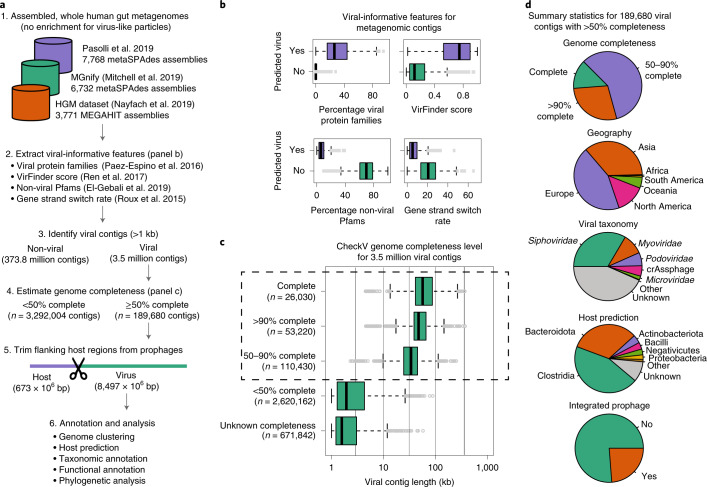
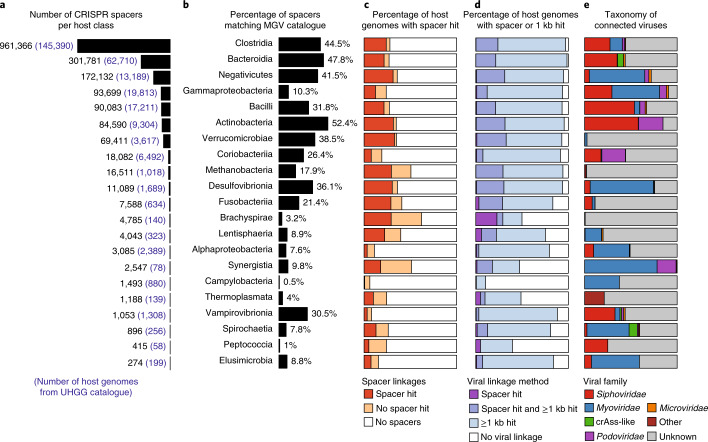
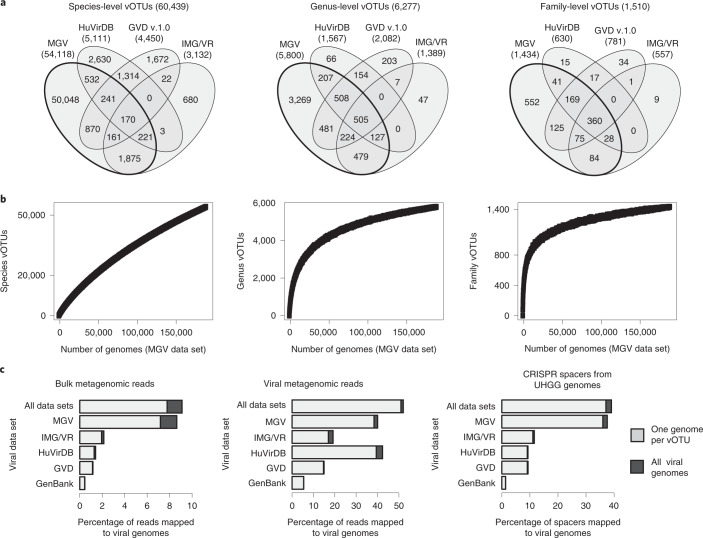
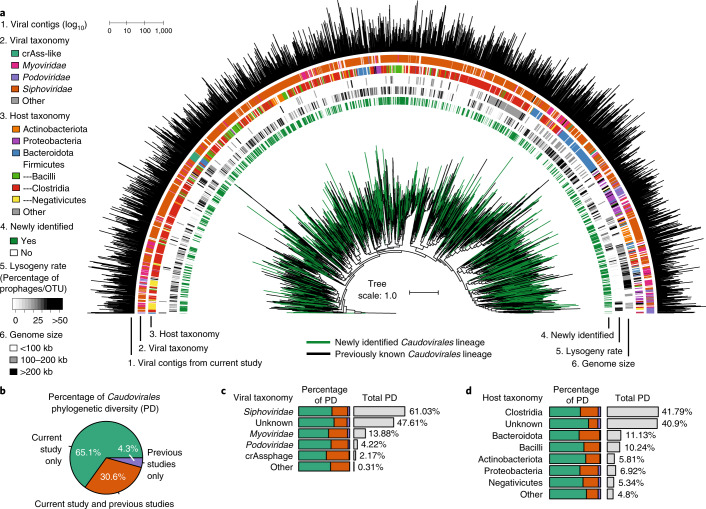
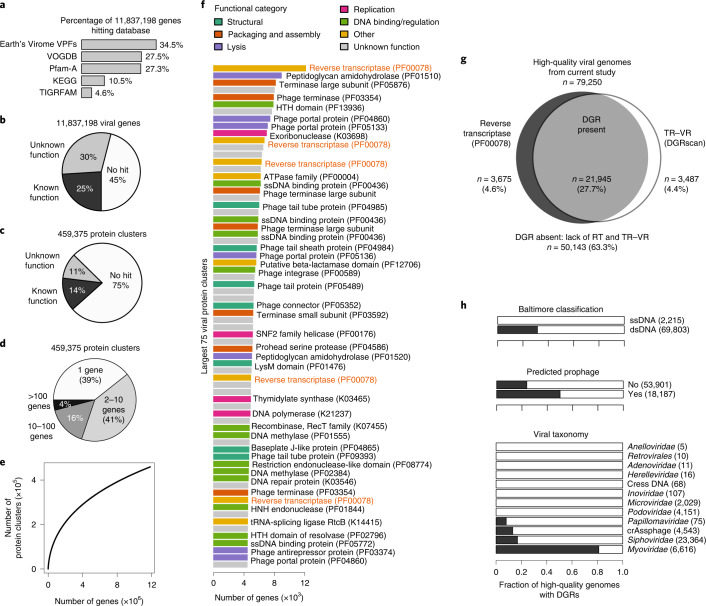
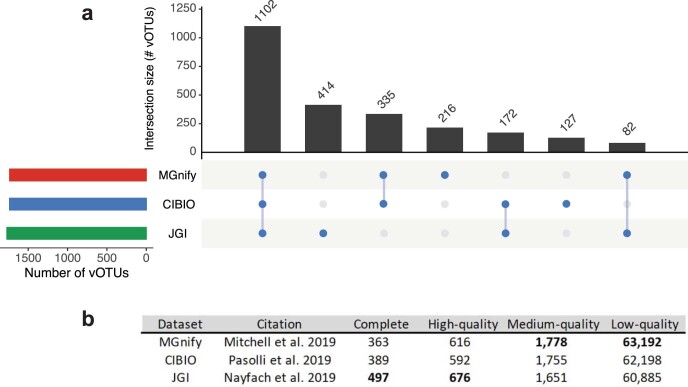
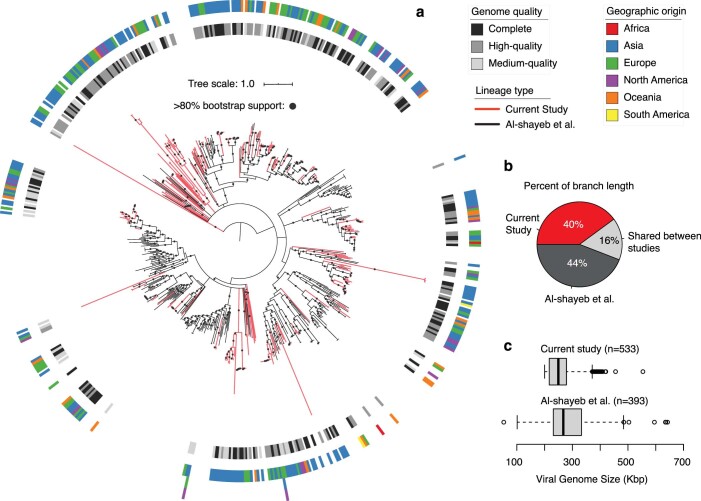
Bacteriophages have important roles in the ecology of the human gut microbiome but are under-represented in reference databases. To address this problem, we assembled the Metagenomic Gut Virus catalogue that comprises 189,680 viral genomes from 11,810 publicly available human stool metagenomes. Over 75% of genomes represent double-stranded DNA phages that infect members of the Bacteroidia and Clostridia classes. Based on sequence clustering we identified 54,118 candidate viral species, 92% of which were not found in existing databases. The Metagenomic Gut Virus catalogue improves detection of viruses in stool metagenomes and accounts for nearly 40% of CRISPR spacers found in human gut Bacteria and Archaea. We also produced a catalogue of 459,375 viral protein clusters to explore the functional potential of the gut virome. This revealed tens of thousands of diversity-generating retroelements, which use error-prone reverse transcription to mutate target genes and may be involved in the molecular arms race between phages and their bacterial hosts.
Overview
The claims and statistics of this paper haven’t been checked yet.
Free: it reads the open-access text and checks the first 5 claims that cite a source we can check. Create a free account to check every claim.
Integrity signals
Registry
Cites
Statistics
Figures
Verification
Claims the paper makes
The claims and statistics of this paper haven’t been checked yet.
Free: it reads the open-access text and checks the first 5 claims that cite a source we can check. Create a free account to check every claim.
Self-check
Percentages, sums and reported differences re-computed from the paper’s own numbers.
The self-check needs the paper’s full text.
Citations
Cites
KEGG: Kyoto Encyclopedia of Genes and Genomes
Kanehisa, M. (2000) · Nucleic Acids Research · doi:10.1093/nar/28.1.27 · Cited by 37,077
KEGG: Kyoto Encyclopedia of Genes and Genomes
Ogata, H., Goto, S., Sato, K., Fujibuchi, W., Bono, H., & Kanehisa, M. (1999) · Nucleic Acids Research · doi:10.1093/nar/27.1.29 · Cited by 31,232
BLAST+: architecture and applications
Camacho, C., Coulouris, G., Avagyan, V., Ma, N., Papadopoulos, J., Bealer, K., & Madden, T. L. (2009) · BMC Bioinformatics · doi:10.1186/1471-2105-10-421 · Cited by 22,074
FastTree 2 – Approximately Maximum-Likelihood Trees for Large Alignments
Price, M. N., Dehal, P. S., & Arkin, A. P. (2010) · PLoS ONE · doi:10.1371/journal.pone.0009490 · Cited by 14,894
Fast and sensitive protein alignment using DIAMOND
Buchfink, B., Xie, C., & Huson, D. H. (2015) · Nature Methods · doi:10.1038/nmeth.3176 · Cited by 14,201
trimAl: a tool for automated alignment trimming in large-scale phylogenetic analyses
Capella-Gutiérrez, S., Silla-Martínez, J. M., & Gabaldón, T. (2009) · Bioinformatics · doi:10.1093/bioinformatics/btp348 · Cited by 12,751
A human gut microbial gene catalogue established by metagenomic sequencing
MetaHIT Consortium, Qin, J., Li, R., Raes, J., Arumugam, M., Burgdorf, K. S., Manichanh, C., Nielsen, T., Pons, N., Levenez, F., et al. (2010) · Nature · doi:10.1038/nature08821 · Cited by 11,624
Enterotypes of the human gut microbiome
MetaHIT Consortium (additional members), Arumugam, M., Raes, J., Pelletier, E., Le Paslier, D., Yamada, T., Mende, D. R., Fernandes, G. R., Tap, J., Bruls, T., et al. (2011) · Nature · doi:10.1038/nature09944 · Cited by 7,548
Accelerated Profile HMM Searches
Eddy, S. R. (2011) · PLoS Computational Biology · doi:10.1371/journal.pcbi.1002195 · Cited by 6,975
Interactive Tree Of Life (iTOL) v4: recent updates and new developments
Letunic, I., & Bork, P. (2019) · Nucleic Acids Research · doi:10.1093/nar/gkz239 · Cited by 5,925
Research works printed but not linked: 1
- Telesnitsky, A. & Goff, G. P. in Retroviruses (eds Coffin, J. M. et al.) 121–160 (Cold Spring Harbor Laboratory Press, 1997). 21433342
Cited by
Items 101–200 of 616
From hype to hope: Considerations in conducting robust microbiome science
McGuinness, A. J., Stinson, L. F., Snelson, M., Loughman, A., Stringer, A. M., Hannan, A. J., Cowan, C. S. M., Jama, H. A., Caparros-Martin, J. A., West, M. L., et al. (2023) · Brain Behavior and Immunity · doi:10.1016/j.bbi.2023.09.022 · Cited by 47
“In the microbiome field, machine-learning algorithms have been used in different facets, including microbial systematics (Parks et al., 2018; Rinke et al., 2021), antimicrobial peptide prediction (Ma et al., 2022), and viral discovery (Nayfach et al., 2021; Neri et al., 2022).”
Machine learning enables scalable and systematic hierarchical virus taxonomy
Bolduc, B., Zablocki, O., Turner, D., Jang, H. B., Guo, J., Adriaenssens, E. M., Dutilh, B. E., & Sullivan, M. B. (2025) · Nature Biotechnology · doi:10.1038/s41587-025-02946-9 · Cited by 50
Organizing the Global Diversity of Microviruses
Kirchberger, P. C., Martinez, Z. A., & Ochman, H. (2022) · mBio · doi:10.1128/mbio.00588-22 · Cited by 47
“Using the final set of HMMs from our curated database, searches for microviruses were conducted on the wastewater data set of Kirstahler et al. (27), the Cenote Human Virome Database (3), the Metagenomic Gut Virus Database (28), a global ocean virome data set of Gregory et al. (29), and three additional data sets from…”
BackgroundWang, G., Li, S., Yan, Q., Guo, R., Zhang, Y., Chen, F., Tian, X., Lv, Q., Jin, H., Ma, X., et al. (2022) · Journal of Advanced Research · doi:10.1016/j.jare.2022.08.011 · Cited by 43
“Currently, there are two main approaches for sequencing viruses from fecal samples: directly whole-metagenome sequencing (referred to as bulk metagenomic sequencing) and virus-like particle (VLP) enrichment and subsequently metagenomic sequencing (referred to as viral metagenomic sequencing)[9].”
BackgroundInfluentialUpdated Virophage Taxonomy and Distinction from Polinton-like Viruses
Roux, S., Fischer, M., Hackl, T., Katz, L. A., Schulz, F., & Yutin, N. (2023) · Biomolecules · doi:10.3390/biom13020204 · Cited by 44
“Genome-wide amino acid identity (AAI) clustering was performed as in [57].”
MethodInduction mechanisms and strategies underlying interprophage competition during polylysogeny
Silpe, J. E., Duddy, O. P., & Bassler, B. L. (2023) · PLoS Pathogens · doi:10.1371/journal.ppat.1011363 · Cited by 45
The prototypic crAssphage is a linear phage-plasmid
Schmidtke, D. T., Hickey, A. S.-M., Wirbel, J., Lin, J. D., Liachko, I., Sherlock, G., & Bhatt, A. S. (2025) · Cell Host & Microbe · doi:10.1016/j.chom.2025.07.004 · Cited by 43
Self-citationWu, Y., Gao, N., Sun, C., Feng, T., Liu, Q., & Chen, W. (2024) · Microbiome · doi:10.1186/s40168-024-01784-2 · Cited by 42
“Despite tremendous success in identifying viruses from various environmental sources such as the ruminants rumen [25–31], human gut [21, 32–38], aquatic, terrestrial, plants, as well as other mammals (i.e., IMG/VR v3 [39]), the virome structure remains the “dark matter” in different ruminant GIT…”
BackgroundResultInfluentialThe Chinese gut virus catalogue reveals gut virome diversity and disease-related viral signatures
Yan, Q., Huang, L., Li, S., Zhang, Y., Guo, R., Zhang, P., Lei, Z., Lv, Q., Chen, F., Li, Z., et al. (2025) · Genome Medicine · doi:10.1186/s13073-025-01460-6 · Cited by 43
“Consistent with the previous studies [23, 40], virus-specific genes were predominantly involved in replication and repair, transcription, prokaryotic defense system, and the metabolism of amino acids and nucleotides.”
InfluentialPhage diversity in cell-free DNA identifies bacterial pathogens in human sepsis cases
Haddock, N. L., Barkal, L. J., Ram-Mohan, N., Kaber, G., Chiu, C. Y., Bhatt, A. S., Yang, S. S., & Bollyky, P. L. (2023) · Nature Microbiology · doi:10.1038/s41564-023-01406-x · Cited by 43
Self-citationStructure-guided discovery of viral proteins that inhibit host immunity
Yirmiya, E., Hobbs, S. J., Leavitt, A., Osterman, I. А., Avraham, C., Hochhauser, D., Madhala, B., Skovorodka, M., Tan, J. M. J., Toyoda, H. C., et al. (2025) · Cell · doi:10.1016/j.cell.2024.12.035 · Cited by 42
Mood Disorders: The Gut Bacteriome and Beyond
McGuinness, A. J., Loughman, A., Foster, J. A., & Jacka, F. N. (2023) · Biological Psychiatry · doi:10.1016/j.biopsych.2023.08.020 · Cited by 41
“…databases for these other microorganisms are less developed than for the gut bacteriome, groups are developing and curating databases speci fi cally focusing on human gut viruses (16,58,59), fungi (30), and archaea (45); however, such initiatives for the gut parasitome are still required (60).”
BackgroundAdministration of 25,000 IU vitamin A doses at routine immunisation in young infants.
Rahman, M. M., Mahalanabis, D., Wahed, M. A., Islam, M. A., & Habte, D. (1995) · PubMed · Cited by 42
Interpersonal variability of the human gut virome confounds disease signal detection in IBD
Stockdale, S. R., Shkoporov, A. N., Khokhlova, E. V., Daly, K. M., McDonnell, S. A., Regan, O. O., Nolan, J. A., Sutton, T., Clooney, A. G., Ryan, F. J., et al. (2023) · Communications Biology · doi:10.1038/s42003-023-04592-w · Cited by 39
Connecting the Human Microbiome and Pancreatic Cancer
Sexton, R. E., Uddin, M. H., Bannoura, S. F., Khan, H. Y., Mzannar, Y., Li, Y., Aboukameel, A., Al-Hallak, M. N., Al-Share, B. A., Mohamed, A., et al. (2022) · Cancer and Metastasis Reviews · doi:10.1007/s10555-022-10022-w · Cited by 38
“The microbiome of the oral cavity consists of over 700 bacterial species along with fungi, viruses and protozoa with only around 60% of bacterial species having been categorized [8, 9].”
BackgroundThe multi-kingdom microbiome catalog of the chicken gastrointestinal tract
Wang, Y., Qu, M., Bi, Y., Liu, W. J., Ma, S., Wan, B., Hu, Y., Zhu, B., Zhang, G., & Gao, G. F. (2024) · Biosafety and Health · doi:10.1016/j.bsheal.2024.02.006 · Cited by 41
Chen, X., Yin, X., Xu, X., & Zhang, T. (2025) · Nature Communications · doi:10.1038/s41467-025-57088-y · Cited by 40
“We omit ARGs carried by phages since phage-associated ARGs are highly rare, and even if detected with permissive thresholds, these genes are unlikely to be bona fi de ARGs that confer antibiotic resistance 30,31 .”
Viromics approaches for the study of viral diversity and ecology in microbiomes
Roux, S., & Coclet, C. (2025) · Nature Reviews Genetics · doi:10.1038/s41576-025-00871-w · Cited by 47
“In human gut microbiomes, several studies identified near-identical viral genomes across multiple continents and highlighted human lifestyle (for example, urban versus rural) as a strong driver of human gut viral diversity rather than geographic distribution 19,105 .”
Clustering the protein universe of life using DIAMOND DeepClust
Buchfink, B., Barbe, E., Ashkenazy, H., Reuter, K., Kennedy, J. A., & Drost, H. (2026) · Nature Methods · doi:10.1038/s41592-026-03030-z · Cited by 40
Presence and role of viruses in anaerobic digestion of food waste under environmental variability
Fan, L., Peng, W., Duan, H., Lü, F., Zhang, H., & He, P. (2023) · Microbiome · doi:10.1186/s40168-023-01585-z · Cited by 38
“In addition, previous studies on viruses focused more on natural ecosystems [5, 7, 58] and human health [59], resulting in a certain bias in the reference database.”
BackgroundProbiotics alleviate constipation and inflammation in late gestating and lactating sows
Ma, T., Huang, W., Li, Y., Jin, H., Kwok, L. Y., Sun, Z., & Zhang, H. (2023) · npj Biofilms and Microbiomes · doi:10.1038/s41522-023-00434-z · Cited by 38
“To evaluate the novelty of vOTUs in the current dataset, 145,589 vOTUs were cross-compared with the Metage-nomic Gut Virus catalog (comprised of 189,680 viral genomes from 11,810 publicly available human stool metagenomes) 93 .”
Evaluation of computational phage detection tools for metagenomic datasets
Schackart, K., Graham, J. B., Ponsero, A. J., & Hurwitz, B. L. (2023) · Frontiers in Microbiology · doi:10.3389/fmicb.2023.1078760 · Cited by 41
“This type of hybrid pipeline has been in previously used by several large-scale viral discovery studies for human-associated metagenomes (Gregory et al., 2020; Camarillo-Guerrero et al., 2021; Nayfach et al., 2021b) and environmental metagenomes (Jian et al., 2021; Hegarty et al., 2022).”
MethodTomofuji, Y., Kishikawa, T., Maeda, Y., Ogawa, K., Otake-Kasamoto, Y., Kawabata, S., Nii, T., Okuno, T., Oguro-Igashira, E., Kinoshita, M., et al. (2022) · Cell Genomics · doi:10.1016/j.xgen.2022.100219 · Cited by 35
“Recently, a few studies recovered viral genomes from large-scale MSS data.(19,20) However, the diversity of the gut viral genomes is still not saturated and the current populational diversity of the viral genomes remains limited, as is the case of the prokaryotes.”
BackgroundResultInfluentialMa, T., Li, Y., Yang, N., Wang, H., Shi, X., Liu, Y., Jin, H., Kwok, L. Y., Sun, Z., & Zhang, H. (2025) · Cell Reports Medicine · doi:10.1016/j.xcrm.2025.102093 · Cited by 42
Factors Affecting Variation of the Human Gut Phageome
Tobin, C. A., Hill, C., & Shkoporov, A. N. (2023) · Annual Review of Microbiology · doi:10.1146/annurev-micro-032421-105754 · Cited by 36
Unveiling the unknown viral world in groundwater
Wu, Z., Liu, T., Chen, Q., Chen, T., Hu, J., Sun, L., Wang, B., Li, W., & Ni, J. (2024) · Nature Communications · doi:10.1038/s41467-024-51230-y · Cited by 38
Towards geospatially-resolved public-health surveillance via wastewater sequencing
Tierney, B. T., Foox, J., Ryon, K. A., Butler, D., Damle, N., Young, B. G., Mozsary, C., Babler, K. M., Yin, X., Carattini, Y., et al. (2024) · Nature Communications · doi:10.1038/s41467-024-52427-x · Cited by 35
“4, we addi-tionallyimplementedaBLAST 80 approachforspecies-levelannotation, modeled directly on published methods 51 , with code available at https://github.com/snayfach/MGV/blob/master/ani_cluster/README. md. Brie fl y, we BLASTed putative viral contigs against the RefSeq database at the 90%…”
InfluentialAbundance measurements reveal the balance between lysis and lysogeny in the human gut microbiome
Lopez, J. A., McKeithen-Mead, S. A., Shi, H., Nguyen, T. H., Huang, K. C., & Good, B. H. (2024) · Current Biology · doi:10.1016/j.cub.2025.03.073 · Cited by 37
A remarkably diverse and well-organized virus community in a filter-feeding oyster
Jiang, J., Fang, Y.-F., Wei, H., Zhu, P., Liu, M., Yuan, W.-G., Yang, L., Guo, Y.-X., Jin, T., Shī, M., et al. (2023) · Microbiome · doi:10.1186/s40168-022-01431-8 · Cited by 35
“Culture-independent next-generation sequencing technologies have recently been used to explore the tremendous diversity of the virosphere from multiple samples [13, 59, 60, 66, 84, 85].”
MethodHecatomb: an integrated software platform for viral metagenomics
Roach, M. J., Beecroft, S. J., Mihindukulasuriya, K. A., Wang, L., Paredes, A. M., Cárdenas, L. A. C., Henry-Cocks, K., Lima, L. F. O., Dinsdale, E. A., Edwards, R. A., et al. (2024) · GigaScience · doi:10.1093/gigascience/giae020 · Cited by 34
Yang, N., Ma, T., Xie, Y., Li, Q., Li, Y., Zheng, L., Li, Y., Xiao, Q., Sun, Z., Zuo, K., et al. (2024) · Nature Communications · doi:10.1038/s41467-024-51094-2 · Cited by 34
“The resulting 145,589 vOTUs were compared againsta curated set of 189,680 viral genomes from the Metagenomic Gut Virus catalog (accessed inJuly 2021) to assess the novelty of vOTUs in this dataset 104 .”
Experimental validation that human microbiome phages use alternative genetic coding
Peters, S. L., Borges, A. L., Giannone, R. J., Morowitz, M. J., Banfield, J. F., & Hettich, R. L. (2022) · Nature Communications · doi:10.1038/s41467-022-32979-6 · Cited by 33
Coclet, C., Camargo, A. P., & Roux, S. (2024) · mSystems · doi:10.1128/msystems.00888-24 · Cited by 34
“Similarly, multiple studies, for example, Tara Oceans (3–5), and the human gut microbiomes (6–8), have performed metagenomics across ecosystems, collectively leading to the detailed characterization of the global diversity of DNA viruses and their abundance patterns on local and global scales (9,…”
Song, X., Wang, Y., Wang, Y., Zhao, K., Tong, D., Gao, R., Lv, X., Kong, D., Ruan, Y., Wang, M., et al. (2025) · Nature Communications · doi:10.1038/s41467-025-58695-5 · Cited by 36
“As alignment fraction (AF) has been increasingly recognized for improving the robustness and reliability of species delineation 74 – 76 , AF was estimated using a pipeline 77 , and only contigs meeting the AF threshold were retained.”
InfluentialGut virome dynamics: from commensal to critical player in health and disease
Cárdenas, L. A. C., Leonard, M. M., Baldridge, M. T., & Handley, S. A. (2025) · Nature Reviews Gastroenterology & Hepatology · doi:10.1038/s41575-025-01134-z · Cited by 34
“Conversely, bulk metagenomics preferentially detects integrated prophages and captures both extracellular and intracellular viruses, revealing viral–host mutualism and lysogenic conversion as mechanisms of bacterial adaptation 56 .”
Luo, S., Ru, J., Mirzaei, M. K., Xue, J., Peng, X., Ralser, A., Mejías‐Luque, R., Gerhard, M., & Deng, L. (2023) · Gut Microbes · doi:10.1080/19490976.2023.2257291 · Cited by 33
Systematic and scalable genome-wide essentiality mapping to identify nonessential genes in phages
Piya, D., Nolan, N., Moore, M. L., Ramirez Hernandez, L. A., Cress, B. F., Young, R., Arkin, A. P., & Mutalik, V. K. (2023) · PLOS Biology · doi:10.1371/journal.pbio.3002416 · Cited by 31
“Phages represent one of the largest pools of genetic diversity with unexplored functional information [6–9].”
BackgroundThe role of the early-life gut microbiome in childhood asthma
Boulund, U., Thorsen, J., Trivedi, U., Tranæs, K., Jiang, J., Shah, S. A., & Stokholm, J. (2025) · Gut Microbes · doi:10.1080/19490976.2025.2457489 · Cited by 31
Viral Dark Matter: Illuminating Protein Function, Ecology, and Biotechnological Promises
Kosmopoulos, J. C., & Anantharaman, K. (2025) · Biochemistry · doi:10.1021/acs.biochem.5c00349 · Cited by 32
Taxonomy-aware, sequence similarity ranking reliably predicts phage–host relationships
Zieleziński, A., Barylski, J., & Karlowski, W. M. (2021) · BMC Biology · doi:10.1186/s12915-021-01146-6 · Cited by 33
“The identification of similar sequence regions between host and phage genomes using BLAST has been a base-line for the identification of putative virus – host connections in numerous metagenomic projects [13, 32 – 34].”
BackgroundThe pediatric virome in health and disease
Liang, G., Gao, H., & Bushman, F. D. (2022) · Cell Host & Microbe · doi:10.1016/j.chom.2022.04.006 · Cited by 32
A genomic atlas of the human gut virome elucidates genetic factors shaping host interactionsPreprint
Camargo, A. P., Baltoumas, F. A., Ndela, É. O., Fiamenghi, M. B., Merrill, B. D., Carter, M. M., Pinto, Y., Chakraborty, M., Andreeva, A. E., Ghiotto, G., et al. (2025) · bioRxiv (Cold Spring Harbor Laboratory) · doi:10.1101/2025.11.01.686033 · Cited by 34
Self-citationGulyaeva, A. A., Garmaeva, S., Kurilshikov, A., Vila, A. V., Riksen, N. P., Netea, M. G., Weersma, R. K., Fu, J., & Zhernakova, A. (2022) · Viruses · doi:10.3390/v14102305 · Cited by 32
“If the sum of the ORF coding potential scores was higher under an alternative genetic code and exceeded the sum under the standard genetic code by 10%, the alternative genetic code was assigned to the viral genome sequence [3,32].”
BackgroundMethodMassive expansion of the pig gut virome based on global metagenomic mining
Mi, J., Jing, X., Ma, C., Yang, Y., Li, Y., Zhang, Y., Long, R., & Zheng, H. (2024) · npj Biofilms and Microbiomes · doi:10.1038/s41522-024-00554-0 · Cited by 31
Large-scale analysis of bacterial genomes reveals thousands of lytic phages
Perfilyev, A., Gæde, A., Hooton, S., Zahran, S. A., Kalatzis, P. G., Winther-Have, C. S., Ibarra‐Chávez, R., Wilkinson, R. C., Thanki, A. M., Liu, Z., et al. (2025) · Nature Microbiology · doi:10.1038/s41564-025-02203-4 · Cited by 32
“The MGV catalogue consists of 189,680 viral genomes derived from 11,810 stool metagenomes 32 .”
Terabase-Scale Coassembly of a Tropical Soil Microbiome
Riley, R. W., Bowers, R. M., Camargo, A. P., Campbell, A., Egan, R. S., Eloe‐Fadrosh, E. A., Foster, B., Hofmeyr, S. A., Huntemann, M., Kellom, M., et al. (2023) · Microbiology Spectrum · doi:10.1128/spectrum.00200-23 · Cited by 32
“153) search, as described previously (77).”
Stable coexistence between an archaeal virus and the dominant methanogen of the human gut
Baquero, D. P., Medvedeva, S., Martin‐Gallausiaux, C., Pende, N., Sartori-Rupp, A., Tachon, S., Pédron, T., Debarbieux, L., Borrel, G., Gribaldo, S., et al. (2024) · Nature Communications · doi:10.1038/s41467-024-51946-x · Cited by 30
“limited understanding of the viral component within the human GIT microbiome 7,16 – 18 .”
Accelerated Evolution by Diversity-Generating Retroelements
Macadangdang, B. R., Makanani, S. K., & Miller, J. F. (2022) · Annual Review of Microbiology · doi:10.1146/annurev-micro-030322-040423 · Cited by 30
Multiomic spatial analysis reveals a distinct mucosa-associated virome
Yan, A., Butcher, J., Schramm, L., Mack, D. R., & Stintzi, A. (2023) · Gut Microbes · doi:10.1080/19490976.2023.2177488 · Cited by 30
Yan, X., Xin, Y., Zhu, L., Tang, Q., Chen, M., Wei, Y., Zhang, J., & Richnow, H. H. (2025) · Water Research · doi:10.1016/j.watres.2025.123627 · Cited by 28
Advanced Strategies in Phage Research: Innovations, Applications, and Challenges
Wu, P., Li, W., Zhang, W., Li, S., Deng, B., Xu, S., & Li, Z. (2025) · Microorganisms · doi:10.3390/microorganisms13081960 · Cited by 31
“Metagenomic surveys have further expanded the known phage repertoire in under-studied biomes such as marine ecosystems and the human gut [28–30].”
viralFlye: assembling viruses and identifying their hosts from long-read metagenomics data
Antipov, D., Rayko, M., Kolmogorov, M., & Pevzner, P. A. (2022) · Genome biology · doi:10.1186/s13059-021-02566-x · Cited by 28
Training Compute-Optimal Protein Language ModelsPreprint
Cheng, X., Chen, B., Li, P., Gong, J., Tang, J., & Song, L. (2024) · bioRxiv (Cold Spring Harbor Laboratory) · doi:10.1101/2024.06.06.597716 · Cited by 32
“To tackle the challenge of data scarcity, we leveraged the Colab-FoldDB database [56], which focuses on metagenomic data sources such as BFD [1], MGnify [57], and specific eukaryotic and viral datasets including SMAG [22], MetaEuk [44], TOPAZ [3], MGV [59], and GPD [13].”
Mixture of Experts Enable Efficient and Effective Protein Understanding and DesignPreprint
Sun, N., Zou, S., Tao, T., Mahbub, S., Li, D., Zhuang, Y., Wang, H., Cheng, X., Song, L., & Xing, E. P. (2024) · bioRxiv (Cold Spring Harbor Laboratory) · doi:10.1101/2024.11.29.625425 · Cited by 30
“The ColabfoldDB emphasizes metagenomic data sources such as BFD [30], MGnify [31], and various eukaryotic and viral datasets, including SMAG [32], MetaEuk [33], TOPAZ [34], MGV [35], and GPD [36].”
Interplay of Microbiome, Oxidative Stress and Inflammation in Health and Disease
Herrera‐Quintana, L., Iturbe-Sanz, P., Arancibia, J. E. O., Vázquez‐Lorente, H., & Plaza-Diaz, J. (2026) · Antioxidants · doi:10.3390/antiox15020222 · Cited by 27
Human land use impacts viral diversity and abundance in a New Zealand river
French, R. K., Charon, J., Lay, C. L., Muller, C. G., & Holmes, E. C. (2022) · Virus Evolution · doi:10.1093/ve/veac032 · Cited by 30
Kaushal, A., & Noor, R. (2022) · Current Microbiology · doi:10.1007/s00284-022-02877-7 · Cited by 29
Harnessing stepping-stone hosts to engineer, select, and reboot synthetic bacteriophages in one pot
Li, C., Deng, Z., Tao, H., Song, W., Xing, B., Liu, W., Kong, L., Yuan, S., Ma, Y., Wu, Y., et al. (2022) · Cell Reports Methods · doi:10.1016/j.crmeth.2022.100217 · Cited by 27
Sato, Y., Takebe, H., Tominaga, K., Yasuda, J., Kumagai, H., Hirooka, H., & Yoshida, T. (2023) · Applied and Environmental Microbiology · doi:10.1128/aem.01581-23 · Cited by 26
“To date, many metagenomic sequencing studies have been conducted to construct viral genomes in various environments (11–13).”
BackgroundVIRE: a metagenome-derived, planetary-scale virome resource with environmental context
Nishijima, S., Fullam, A., Schmidt, T., Kuhn, M., & Bork, P. (2025) · Nucleic Acids Research · doi:10.1093/nar/gkaf1225 · Cited by 29
“However, most existing resources are environment-specific (e.g. human gut [ 13 –15 , 34 ], marine [ 21 , 23 , 35 ], or soil [ 25 , 26 , 36 ]) with only a few exceptions [ 37 , 38 ].”
Rodríguez‐Frias, F., Quer, J., Tabernero, D., Cortese, M. F., García-García, S., Rando‐Segura, A., & Pumarola, T. (2021) · Microorganisms · doi:10.3390/microorganisms9122518 · Cited by 31
Li, Y., Cao, L., Ye, M., Xu, R., Chen, X., Ma, Y., Tian, R., Liu, F., Zhang, P., Kuang, Y., et al. (2022) · Microbiology Spectrum · doi:10.1128/spectrum.01447-22 · Cited by 26
Automated identification of sequence-tailored Cas9 proteins using massive metagenomic data
Ciciani, M., Demozzi, M., Pedrazzoli, E., Visentin, E., Pezzè, L., Signorini, L. F., Blanco‐Míguez, A., Zolfo, M., Asnicar, F., Casini, A., et al. (2022) · Nature Communications · doi:10.1038/s41467-022-34213-9 · Cited by 26
“…to phage genomes of the human microbiome: 142,809 viral genomes from the Gut Phage Database 11 , 189,680 from the Metage-nomic Gut Viral catalog 12 and 45,872 from de-novo assembled gut phages from highly enriched viromes as pro fi led via ViromeQC 13 (see Methods section: Viral genomes…”
BackgroundCharacterizing the gut phageome and phage-borne antimicrobial resistance genes in pigs
Hu, J., Chen, J., Nie, Y., Zhou, C., Hou, Q., & Yan, X. (2024) · Microbiome · doi:10.1186/s40168-024-01818-9 · Cited by 26
“Compared to the viral metagenomes, whole microbial communities (bulk) metagenomes have several advantages, including capturing the sequences of both extracellular and intracellular viruses, and not being influenced by the biases induced by whole-genome amplification [33].”
BackgroundPita, S., Myers, P. N., Johansen, J., Russel, J., Nielsen, M. C., Eklund, A. C., & Nielsen, H. B. (2024) · Frontiers in Microbiology · doi:10.3389/fmicb.2024.1425489 · Cited by 28
Phage Diversity in the Human Gut Microbiome: a Taxonomist’s Perspective
Adriaenssens, E. M. (2021) · mSystems · doi:10.1128/msystems.00799-21 · Cited by 26
“containing 189,680 (partial) genomes grouped into 54,118 species-level vOTUs (22).”
BackgroundLossless indexing with counting de Bruijn graphs
Karasikov, M., Mustafa, H., Rätsch, G., & Kahles, A. (2022) · Genome Research · doi:10.1101/gr.276607.122 · Cited by 24
The human phageome: niche-specific distribution of bacteriophages and their clinical implications
Rybicka, I., & Kaźmierczak, Z. (2025) · Applied and Environmental Microbiology · doi:10.1128/aem.01788-24 · Cited by 25
Fiamenghi, M. B., Camargo, A. P., Chasapi, I. N., Baltoumas, F. A., Roux, S., Egorov, A. A., Aplakidou, E., Ndela, É. O., Vasquez, Y. M., Chen, I.-M. A., et al. (2025) · Nucleic Acids Research · doi:10.1093/nar/gkaf1283 · Cited by 29
“The cultivation-independent nature of metagenomics streamlines the discovery process and allows for the analysis of far more viral groups than would be possible through cultivation-based approaches alone [ 6 , 7 , 9 , 15 ].”
Self-citationDikareva, E., Matharu, D., Lahtinen, E., Kolho, K., de Vos, W. M., Salonen, A., & Ponsero, A. J. (2023) · Frontiers in Microbiology · doi:10.3389/fmicb.2023.1254535 · Cited by 24
Vakirlis, N., & Kupczok, A. (2024) · Genome Research · doi:10.1101/gr.278977.124 · Cited by 24
Peng, Y., Zhu, J., Wang, S., Liu, Y., Liu, X., DeLeon, O., Zhu, W., Xu, Z., Zhang, X., Zhao, S., et al. (2024) · Cell Host & Microbe · doi:10.1016/j.chom.2024.10.017 · Cited by 23
Liu, Z., Huang, Y., Zhang, T., Meng, D., Jiang, Z., Yang, Z., Yang, Z., Li, L., Gu, Y., Wang, J., et al. (2023) · Applied and Environmental Microbiology · doi:10.1128/aem.01973-22 · Cited by 25
“Viral sequences were clustered into species levels of viral operational taxonomic units (vOTUs) with 95% average nucleotide identity (ANI) and 85% alignment fraction of the shorter one, as described by a previous study (53).”
MethodChoice of Ultrafilter Affects Recovery Rate of Bacteriophages
Larsen, F., Offersen, S. M., Li, V. R., Deng, L., Nielsen, D. S., & Rasmussen, T. S. (2023) · Viruses · doi:10.3390/v15102051 · Cited by 23
Gut phages and their interactions with bacterial and mammalian hosts
Godsil, M., Ritz, N. L., Venkatesh, S., & Meeske, A. J. (2025) · Journal of Bacteriology · doi:10.1128/jb.00428-24 · Cited by 24
“In a metagenomic analysis of almost 200,000 intestinal phages, DGR-associated reverse transcriptases were the third-most abundant functionally annotated protein, supplanted only by phage integrases and the helix-turn-helix DNA-binding domain (88).”
Oral virome metagenomic catalog links Porphyromonas gingivalis phages to obesity and type 2 diabetes
Xu, T., Jiao, X., Liu, G. E., Chen, X., Luo, Q., Zhang, G., Li, B., Zhang, Y., Li, X., Cheung, Y., et al. (2025) · Cell Reports Medicine · doi:10.1016/j.xcrm.2025.102325 · Cited by 23
Synthetic Biology of Plants and Microbes for Agriculture, Environment, and Future Applications
Clauer, P. R., Nou, A., Toth, T., Yu, Q., Chemla, Y., Boo, A., Yoon, K. S., & Voigt, C. A. (2026) · Chemical Reviews · doi:10.1021/acs.chemrev.4c00687 · Cited by 24
Adriaenssens, E. M., Roux, S., Brister, J. R., Karsch‐Mizrachi, I., Kuhn, J. H., Varsani, A., Tong, Y., Reyes, A., Lood, C., Lefkowitz, E. J., et al. (2023) · Nature Biotechnology · doi:10.1038/s41587-023-01844-2 · Cited by 23
Efficient Recovery of Complete Gut Viral Genomes by Combined Short‐ and Long‐Read Sequencing
Chen, J., Sun, C., Dong, Y., Jin, M., Lai, S., Jia, L., Zhao, X., Wang, H., Gao, N., Bork, P., et al. (2024) · Advanced Science · doi:10.1002/advs.202305818 · Cited by 24
Discovering CRISPR-Cas system with self-processing pre-crRNA capability by foundation models
Li, W., Jiang, X., Wang, W., Hou, L., Cai, R., Li, Y., Gu, Q., Chen, Q., Ma, P., Tang, J., et al. (2024) · Nature Communications · doi:10.1038/s41467-024-54365-0 · Cited by 21
Landscapes of Enteric Virome Signatures in Early-Weaned Piglets
Tao, S., Zou, H., Li, J., & Hong Kui, W. E. I. (2022) · Microbiology Spectrum · doi:10.1128/spectrum.01698-22 · Cited by 21
“to construct a reference database of DNA viruses from human intestinal microbiomes (23).”
BackgroundHedžet, S., Rupnik, M., & Accetto, T. (2022) · Scientific Reports · doi:10.1038/s41598-022-25636-x · Cited by 21
A tale of caution: How endogenous viral elements affect virus discovery in transcriptomic data
Brait, N., Hackl, T., Morel, C., Exbrayat, A., Gutiérrez, S., & Lequime, S. (2023) · Virus Evolution · doi:10.1093/ve/vead088 · Cited by 21
“Computational aids like CheckV (Nayfach et al. 2021) can partially filter EVE sequences by discerning host gene contamination within virus-like sequences (Mifsud et al. 2022; Costa et al. 2023); however, applications are constrained by stringent sequence quality prerequisites.”
BackgroundMicrobiomeStatPlots: Microbiome statistics plotting gallery for meta‐omics and bioinformatics
Bai, D., Ma, C., Xun, J., Luo, H., Yang, H., Lyu, H., Zhu, Z., Gai, A., Yousuf, S., Peng, K., et al. (2025) · iMeta · doi:10.1002/imt2.70002 · Cited by 23
“Micro-biomeAnalyst [8, 18] supports the analysis of amplicons, metagenomics, and metabolomics data, while viromics workflows such as MGV (metagenomic gut virus) [29], ViWrap [30], and Hecatomb [31] are dedicated to virome data analysis.”
Discovering CRISPR-Cas system with self-processing pre-crRNA capability by foundation models
(2024) · doi:10.1101/2024.03.11.583506 · Cited by 21
Pye, H. V., Krishnamurthi, R., Cook, R., & Adriaenssens, E. M. (2024) · Essays in Biochemistry · doi:10.1042/ebc20240012 · Cited by 20
“…available from the Unified Human Gut Virus Catalog (comprising 12 high-throughput studies of the human gut such as the Gut Phage Database, the Metagenomic Gut Virus Compendium, the Human Virome database and the Atlas of Infant Gut DNA Virus Diversity) (https://github.com/snayfach/UHGV) [5,10–20].”
Computational function prediction of bacteria and phage proteins
Grigson, S. R., Bouras, G. S., Dutilh, B. E., Olson, R., & Edwards, R. A. (2025) · Microbiology and Molecular Biology Reviews · doi:10.1128/mmbr.00022-25 · Cited by 27
“Compared with eukaryotic systems, homology-based sequence annotation is less effective for prokary otic sequences, with 30% of bacterial (12) and 60%–80% of phage proteins (13–16) remaining functionally unknown, compared with approximately 20% in eukaryotic genomes (17).”
Metagenomic analysis of wastewater phageome from a University Hospital in Turkey
Salih, H., Karaynir, A., Yalçın, M., Oryaşın, E., Holyavkin, C., Başbülbül, G., & Bozdoğan, B. (2022) · Archives of Microbiology · doi:10.1007/s00203-022-02962-2 · Cited by 21
“The rate of phages infecting Proteobacteria was ~ 7% (Nayfach et al. 2021).”
BackgroundGao, S., Fei, H., Li, Q., Lan, L., Huang, L., & Fan, P. (2024) · Nature Communications · doi:10.1038/s41467-024-45663-8 · Cited by 20
“%) were compared using BLASTn with a criteria of E-value ≤ 10 − 3 , bit score ≥ 50, alignment length ≥ 1 kb and identity ≥ 96% 74 .”
RNA control of reverse transcription in a diversity-generating retroelement
Handa, S., Biswas, T., Chakraborty, J., Ghosh, G., Paul, B. G., & Ghosh, P. (2025) · Nature · doi:10.1038/s41586-024-08405-w · Cited by 20
Fernández-Pato, A., Sinha, T., Garmaeva, S., Gulyaeva, A. A., Kuzub, N., Roux, S., Fu, J., Kurilshikov, A., & Zhernakova, A. (2025) · Cell Reports · doi:10.1016/j.celrep.2025.115731 · Cited by 19
Daily Reports on Phage-Host Interactions
Albrycht, K., Rynkiewicz, A. A., Harasymczuk, M., Barylski, J., & Zieleziński, A. (2022) · Frontiers in Microbiology · doi:10.3389/fmicb.2022.946070 · Cited by 21
“This has provided a unique opportunity to study the natural viral diversity and complex dynamics of phage-host interactions (Paez-Espino et al., 2016; Nayfach et al., 2021).”
BackgroundMetagenomic-based characterization of the gut virome in patients with polycystic ovary syndrome
Huang, L., Wu, X., Guo, S., Lv, Y., Zhou, P., Huang, G., Duan, Z., & Sun, W. C. (2022) · Frontiers in Microbiology · doi:10.3389/fmicb.2022.951782 · Cited by 20
Fucarino, A., Burgio, S., Paladino, L., Bavisotto, C. C., Pitruzzella, A., Bucchieri, F., & Cappello, F. (2022) · Anatomia · doi:10.3390/anatomia1020019 · Cited by 23
Sun, C., Chen, J., Jin, M., Zhao, X., Li, Y., Dong, Y., Gao, N., Liu, Z., Bork, P., Zhao, X., et al. (2023) · Advanced Science · doi:10.1002/advs.202302159 · Cited by 20
Wu, J., Qing, H., Ouyang, J., Zhou, J., Gao, Z., Mason, C. E., Liu, Z., & Shi, T. (2023) · Briefings in Bioinformatics · doi:10.1093/bib/bbad311 · Cited by 19
“With the extensive application of metagenomic sequencing technology in the human gut studies [42–45], large amounts of unknown species and proteins have been uncovered, which also spur the annotation of novel species and proteins.”
Gastrointestinal jumbo phages possess independent synthesis and utilization systems of NAD+
Li, C., Liu, K., Gu, C., Li, M., Zhou, P., Chen, L., Sun, S., Li, X., Wang, L., Ni, W., et al. (2024) · Microbiome · doi:10.1186/s40168-024-01984-w · Cited by 18
“We obtained human-associated jumbo phage genomes and metadata from the Metagenomic Gut Virus (MGV) Catalogue [46], Gut Phage Database [16], and an unknown phage genome set in the human gut reported by Benler et al. [47].”
Shang, J., Peng, C., Guan, J., Cai, D., Wang, D., & Sun, Y. (2025) · Briefings in Bioinformatics · doi:10.1093/bib/bbaf626 · Cited by 18
Using metagenomic data to boost protein structure prediction and discovery
Hou, Q., Pucci, F., Pan, F., Xue, F., Rooman, M. J., & Feng, Q. (2022) · Computational and Structural Biotechnology Journal · doi:10.1016/j.csbj.2021.12.030 · Cited by 20
“Other resources are mainly databases that collect eukaryotic metagenomic data such as TOPAZ [50], SMAGs [51] and MetaEuk [52] or viral metagenomes such as MetaVir [53], VIROME [54], Metagenomic Gut Virus (MGV) [55] and Gut Phage Database (GPD) [56].”
BackgroundGenome engineering of the human gut microbiome
Zheng, L., Shen, J., Chen, R., Hu, Y., Zhao, W., Leung, E. L., & Dai, L. (2024) · Journal of genetics and genomics/Journal of Genetics and Genomics · doi:10.1016/j.jgg.2024.01.002 · Cited by 20
Metadata
- Authors
- Nayfach, S., Páez-Espino, D., Call, L., Low, S. J., Sberro, H., Ivanova, N. N., Proal, A. D., Fischbach, M. A., Bhatt, A. S., Hugenholtz, P., & Kyrpides, N. C.
- Affiliations
- Lawrence Berkeley National Laboratory (US)
- The University of Queensland (AU)
- Stanford Medicine (US)
- Curvenote Inc. (Canada) (CA)
- Chan Zuckerberg Biohub San Francisco (US)
- Corresponding author
- Nayfach, Stephen
- Kyrpides, Nikos C.
- ORCID
- Venue
- Nature Microbiology
- Published
- 2021-06-24
- Volume
- 6
- Issue
- 7
- Pages
- 960-970
- ISSN
- 2058-5276 (ISSN-L)
- PMC
- PMC8241571
- OpenAlex
- W3176037658
- Cited by
- 580
- References
- 94
- Citations by year
- 2026: 96 · 2025: 141 · 2024: 134 · 2023: 98 · 2022: 91 · 2021: 19
- FWCI
- 49.04
- Type
- journal article
- Language
- en
- Open access
- hybrid
- doi.org
- Licence
- cc-by
- creativecommons.org/licenses/by/4.0 (tdm)
- creativecommons.org/licenses/by/4.0 (vor)
- Locations
- Nature Microbiology (publishedVersion, cc-by)
- PubMed Central (publishedVersion, cc-by)
- PubMed (publishedVersion)
- eScholarship (California Digital Library) (submittedVersion, cc-by)
- OSTI OAI (U.S. Department of Energy Office of Scientific and Technical Information) (submittedVersion)
- eScholarship (California Digital Library) (submittedVersion)
- Minerva Access (University of Melbourne) (submittedVersion, cc-by)
- Funders
- Australian Research Council (FL150100038)
- National Cancer Institute (P30CA124435)
- National Institute of Allergy and Infectious Diseases (R01AI148623)
- Lawrence Berkeley National Laboratory
- Topics
- Life Sciences › Immunology and Microbiology › Virology › Bacteriophages and microbial interactions
- Life Sciences › Biochemistry, Genetics and Molecular Biology › Molecular Biology › Genomics and Phylogenetic Studies
- Life Sciences › Immunology and Microbiology › Virology › Plant and Fungal Interactions Research
- Keywords
- human gut microbiome, bacteriophages, DNA viruses, virome, viral genome assembly, Bacteroidia, Clostridia, CRISPR spacers, diversity-generating retroelements, phage-bacteria arms race
- MeSH terms
- Gastrointestinal Microbiome, Archaea, Bacteria, Bacteriophages, Catalogs as Topic, DNA Viruses, DNA, Viral, Feces, Humans, Phylogeny, Genetic Variation, Viral Proteins, Genome, Viral, Metagenomics
About these checks
Registry, retraction, Cites and statistics results are computed, not judged, with one exception: a printed reference that no index lists is read once by a model before it counts as a citation error. Claims are extracted by a model and kept only when their quote appears verbatim in the text; each cited source is then checked, with a model’s help, for whether it says what the claim relies on. Those verdicts can be wrong — read the claim’s quote and the cited source before relying on one.
Statistics and arithmetic are recomputed, not judged.
Confidence bands are shown only for fields calibrated on our annotated test set. None is calibrated yet, so no band is shown.
What counts as a claim ›How we measure confidence ›How we check this ›
Are you an author, or do you see a problem with this page? Request a review
Data sources
Bibliographic data: Semantic Scholar, OpenAlex, Crossref.
Contains information from the Semantic Scholar Academic Graph Datasets, made available under the ODC Attribution License (ODC-BY 1.0).
Semantic Scholar’s data is described in: Kinney, R., et al. (2023). The Semantic Scholar Open Data Platform. arXiv:2301.10140.
