

Metagenomic compendium of 189,680 DNA viruses from the human gut microbiome
Open accessThe DOI matches its Crossref record; 96 of the 96 references it cites were found in a registry or an index.
Abstract
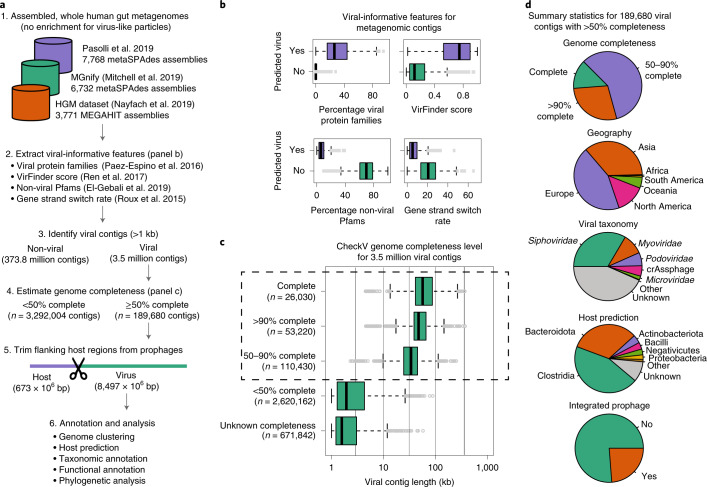
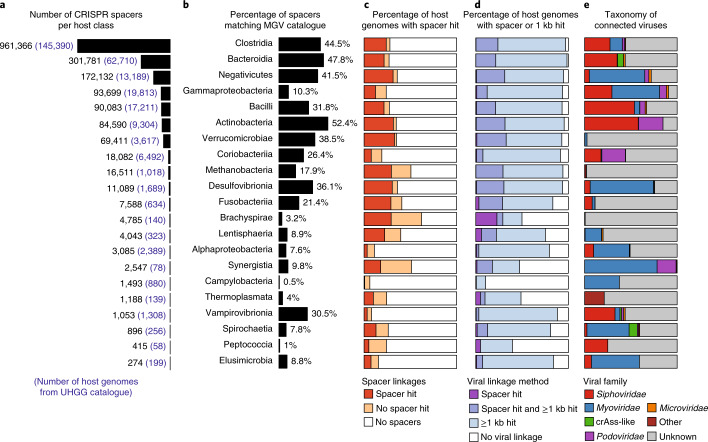
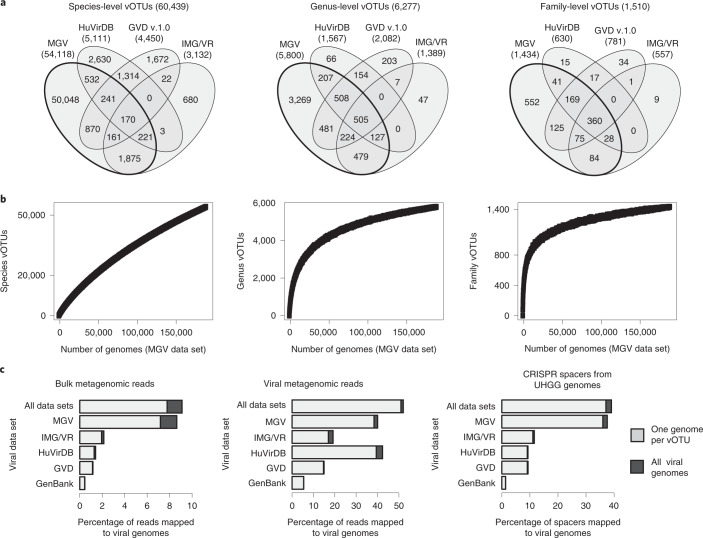
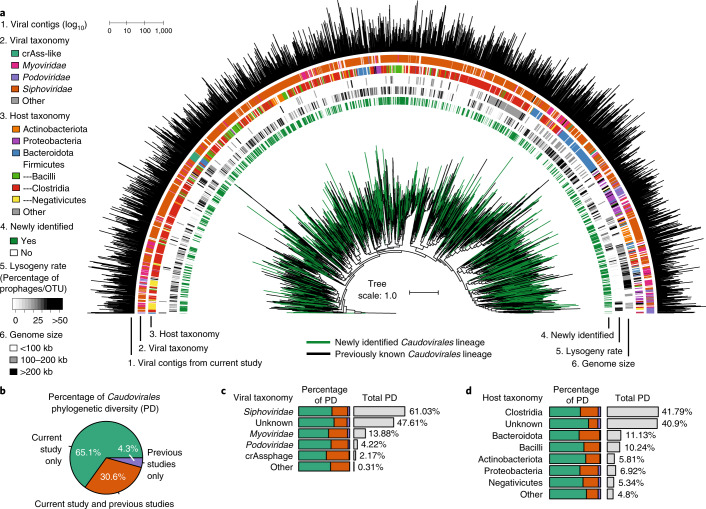
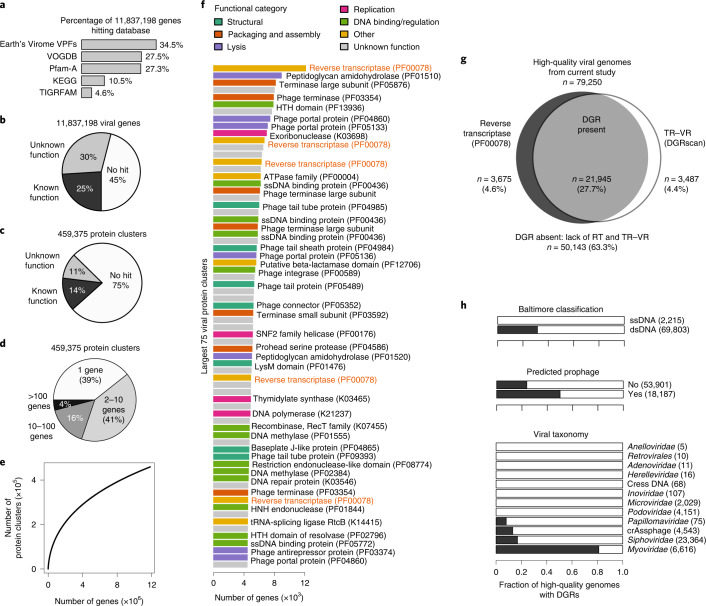
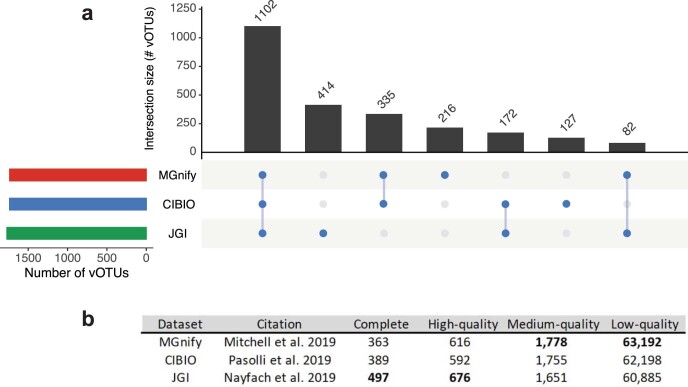
Bacteriophages have important roles in the ecology of the human gut microbiome but are under-represented in reference databases. To address this problem, we assembled the Metagenomic Gut Virus catalogue that comprises 189,680 viral genomes from 11,810 publicly available human stool metagenomes. Over 75% of genomes represent double-stranded DNA phages that infect members of the Bacteroidia and Clostridia classes. Based on sequence clustering we identified 54,118 candidate viral species, 92% of which were not found in existing databases. The Metagenomic Gut Virus catalogue improves detection of viruses in stool metagenomes and accounts for nearly 40% of CRISPR spacers found in human gut Bacteria and Archaea. We also produced a catalogue of 459,375 viral protein clusters to explore the functional potential of the gut virome. This revealed tens of thousands of diversity-generating retroelements, which use error-prone reverse transcription to mutate target genes and may be involved in the molecular arms race between phages and their bacterial hosts.
Overview
The claims and statistics of this paper haven’t been checked yet.
Free: it reads the open-access text and checks the first 5 claims that cite a source we can check. Create a free account to check every claim.
Integrity signals
Registry
Cites
Statistics
Figures
Verification
Claims the paper makes
The claims and statistics of this paper haven’t been checked yet.
Free: it reads the open-access text and checks the first 5 claims that cite a source we can check. Create a free account to check every claim.
Self-check
Percentages, sums and reported differences re-computed from the paper’s own numbers.
The self-check needs the paper’s full text.
Citations
Cites
KEGG: Kyoto Encyclopedia of Genes and Genomes
Kanehisa, M. (2000) · Nucleic Acids Research · doi:10.1093/nar/28.1.27 · Cited by 37,077
KEGG: Kyoto Encyclopedia of Genes and Genomes
Ogata, H., Goto, S., Sato, K., Fujibuchi, W., Bono, H., & Kanehisa, M. (1999) · Nucleic Acids Research · doi:10.1093/nar/27.1.29 · Cited by 31,232
BLAST+: architecture and applications
Camacho, C., Coulouris, G., Avagyan, V., Ma, N., Papadopoulos, J., Bealer, K., & Madden, T. L. (2009) · BMC Bioinformatics · doi:10.1186/1471-2105-10-421 · Cited by 22,074
FastTree 2 – Approximately Maximum-Likelihood Trees for Large Alignments
Price, M. N., Dehal, P. S., & Arkin, A. P. (2010) · PLoS ONE · doi:10.1371/journal.pone.0009490 · Cited by 14,894
Fast and sensitive protein alignment using DIAMOND
Buchfink, B., Xie, C., & Huson, D. H. (2015) · Nature Methods · doi:10.1038/nmeth.3176 · Cited by 14,201
trimAl: a tool for automated alignment trimming in large-scale phylogenetic analyses
Capella-Gutiérrez, S., Silla-Martínez, J. M., & Gabaldón, T. (2009) · Bioinformatics · doi:10.1093/bioinformatics/btp348 · Cited by 12,751
A human gut microbial gene catalogue established by metagenomic sequencing
MetaHIT Consortium, Qin, J., Li, R., Raes, J., Arumugam, M., Burgdorf, K. S., Manichanh, C., Nielsen, T., Pons, N., Levenez, F., et al. (2010) · Nature · doi:10.1038/nature08821 · Cited by 11,624
Enterotypes of the human gut microbiome
MetaHIT Consortium (additional members), Arumugam, M., Raes, J., Pelletier, E., Le Paslier, D., Yamada, T., Mende, D. R., Fernandes, G. R., Tap, J., Bruls, T., et al. (2011) · Nature · doi:10.1038/nature09944 · Cited by 7,548
Accelerated Profile HMM Searches
Eddy, S. R. (2011) · PLoS Computational Biology · doi:10.1371/journal.pcbi.1002195 · Cited by 6,975
Interactive Tree Of Life (iTOL) v4: recent updates and new developments
Letunic, I., & Bork, P. (2019) · Nucleic Acids Research · doi:10.1093/nar/gkz239 · Cited by 5,925
Research works printed but not linked: 1
- Telesnitsky, A. & Goff, G. P. in Retroviruses (eds Coffin, J. M. et al.) 121–160 (Cold Spring Harbor Laboratory Press, 1997). 21433342
Cited by
ColabFold - Making protein folding accessible to all
Mirdita, M., Schütze, K., Moriwaki, Y., Heo, L., Ovchinnikov, S., & Steinegger, M. (2021) · doi:10.1101/2021.08.15.456425 · Cited by 9,391
“To update the database we searched the proteins from the SMAG (eukaryotes) 14 , MetaEuk (eukaryotes) 13 , TOPAZ (eukaryotes) 15 , MGV (DNA viruses) 16 , GPD (bacteriophages) 17 and an updated version of MetaClust 18 against the BFD/MGnify centroids using MMseqs2 and assigned each sequence to the…”
MethodPhage therapy: From biological mechanisms to future directions
Strathdee, S. A., Hatfull, G. F., Mutalik, V. K., & Schooley, R. T. (2023) · Cell · doi:10.1016/j.cell.2022.11.017 · Cited by 817
Roux, S., Camargo, A. P., Coutinho, F. H., Dabdoub, S. M., Dutilh, B. E., Nayfach, S., & Tritt, A. (2023) · PLOS Biology · doi:10.1371/journal.pbio.3002083 · Cited by 466
“6.3 (option “-p meta”; [54]), and the AAI estimation script provided with the Metagenomic Gut Virus catalogue (https://github.com/snayfach/MGV/blob/master/aai_cluster; [33]).”
InfluentialSelf-citationCamargo, A. P., Nayfach, S., Chen, I.-M. A., Palaniappan, K., Ratner, A., Chu, K., Ritter, S. J., Reddy, T. B. K., Mukherjee, S., Schulz, F., et al. (2023) · Nucleic Acids Research · doi:10.1093/nar/gkac1037 · Cited by 446
Self-citationMou, Y., Du, Y., Zhou, L., Yue, J., Hu, X., Liu, Y., Chen, S., Lin, X., Zhang, G., Xiao, H., et al. (2022) · Frontiers in Immunology · doi:10.3389/fimmu.2022.796288 · Cited by 432
ColabFold - Making protein folding accessible to all
Ovchinnikov, S., Steinegger, M., Mirdita, M., konsti, Moriwaki, Y., Kim, R. S., Wang, P., Kosinski, J., Tadej Satler, P., Cha, S., et al. (2021) · bioRxiv (Cold Spring Harbor Laboratory) · doi:10.5281/zenodo.5123296 · Cited by 425
The gut virome: A new microbiome component in health and disease
Cao, Z., Sugimura, N., Burgermeister, E., Ebert, M. P., Zuo, T., & Lan, P. (2022) · eBioMedicine · doi:10.1016/j.ebiom.2022.104113 · Cited by 291
Ma, Z., Zuo, T., Frey, N., & Rangrez, A. Y. (2024) · Signal Transduction and Targeted Therapy · doi:10.1038/s41392-024-01946-6 · Cited by 259
Microbiome-based interventions to modulate gut ecology and the immune system
Hitch, T. C. A., Hall, L. J., Walsh, S. K., Leventhal, G. E., Slack, E., de Wouters, T., Walter, J., & Clavel, T. (2022) · Mucosal Immunology · doi:10.1038/s41385-022-00564-1 · Cited by 243
Chen, B., Cheng, X., Li, P., Geng, Y., Gong, J., Li, S., Bei, Z., Tan, X., Wang, B., Zeng, X., et al. (2025) · Nature Methods · doi:10.1038/s41592-025-02636-z · Cited by 240
Ultra-deep sequencing of Hadza hunter-gatherers recovers vanishing gut microbes
Carter, M. M., Olm, M. R., Merrill, B. D., Dahan, D., Tripathi, S., Spencer, S. P., Yu, F. B., Jain, S., Neff, N., Jha, A. R., et al. (2023) · Cell · doi:10.1016/j.cell.2023.05.046 · Cited by 216
The Mechanism of Bacterial Resistance and Potential Bacteriostatic Strategies
Zhang, F., & Cheng, W. (2022) · Antibiotics · doi:10.3390/antibiotics11091215 · Cited by 213
PhageScope: a well-annotated bacteriophage database with automatic analyses and visualizations
Wang, R. H., Yang, S., Liu, Z., Zhang, Y., Wang, X., Xu, Z., Wang, J., & Li, S. C. (2024) · Nucleic Acids Research · doi:10.1093/nar/gkad979 · Cited by 209
Mutualistic interplay between bacteriophages and bacteria in the human gut
Shkoporov, A. N., Turkington, C. J., & Hill, C. (2022) · Nature Reviews Microbiology · doi:10.1038/s41579-022-00755-4 · Cited by 185
Metagenomics: An Effective Approach for Exploring Microbial Diversity and Functions
Nam, N., Do, H., Loan Trinh, K., & Lee, N. (2023) · Foods · doi:10.3390/foods12112140 · Cited by 181
Viruses inhibit TIR gcADPR signalling to overcome bacterial defence
Leavitt, A., Yirmiya, E., Amitai, G., Lu, A., Garb, J., Herbst, E., Morehouse, B. R., Hobbs, S. J., Antine, S. P., Sun, Z.-Y. J., et al. (2022) · Nature · doi:10.1038/s41586-022-05375-9 · Cited by 165
Expanding known viral diversity in the healthy infant gut
Shah, S. A., Deng, L., Thorsen, J., Pedersen, A. G., Dion, M. B., Castro-Mejía, J. L., Silins, R., Romme, F. O., Sausset, R., Jessen, L. E., et al. (2023) · Nature Microbiology · doi:10.1038/s41564-023-01345-7 · Cited by 160
“However, progress has been made in recent years 24–26 , leading to several human gut virus databases 27–29 , although these are still developing and currently lack viral taxonomies for all the novel viruses they contain.”
BackgroundA global atlas of soil viruses reveals unexplored biodiversity and potential biogeochemical impacts
Graham, E. B., Camargo, A. P., Wu, R., NECHES, R. Y., Nolan, M., Páez-Espino, D., Kyrpides, N. C., Jansson, J. K., McDermott, J., Hofmockel, K., et al. (2024) · Nature Microbiology · doi:10.1038/s41564-024-01686-x · Cited by 157
“78) 35,36 .”
Self-citationVirus classification for viral genomic fragments using PhaGCN2
Jiang, J., Yuan, W.-G., Shang, J., Shi, Y.-H., Yang, L., Liu, M., Zhu, P., Jin, T., Sun, Y., & Yuan, L. (2022) · Briefings in Bioinformatics · doi:10.1093/bib/bbac505 · Cited by 148
Phages overcome bacterial immunity via diverse anti-defence proteins
(2023) · doi:10.1038/s41586-023-06869-w · Cited by 138
Biogeographic patterns and drivers of soil viromes
Ma, B., Wang, Y., Zhao, K., Stirling, E., Lv, X., Yu, Y., Hu, L., Tang, C., Wu, C., Dong, B., et al. (2024) · Nature Ecology & Evolution · doi:10.1038/s41559-024-02347-2 · Cited by 141
“Gene sharing and amino acid identity were used to cluster viral genomes into genus-level and family-level vOTUs 44 .”
Rapid species-level metagenome profiling and containment estimation with sylph
Shaw, J., & Yu, Y. W. (2024) · Nature Biotechnology · doi:10.1038/s41587-024-02412-y · Cited by 148
“To generate synthetic viral metagenomes for profiling, we down-loaded all viral genomes from RefSeq and the MGV database 53 and computed ANI from all RefSeq viruses to MGV using skani and the ‘-slow’ setting.”
Nishijima, S., Nagata, N., Kiguchi, Y., Kojima, Y., Miyoshi‐Akiyama, T., Kimura, M., Ohsugi, M., Ueki, K., Oka, S., Mizokami, M., et al. (2022) · Nature Communications · doi:10.1038/s41467-022-32832-w · Cited by 137
Zuppi, M., Hendrickson, H. L., O'Sullivan, J. M., & Vatanen, T. (2022) · Frontiers in Cellular and Infection Microbiology · doi:10.3389/fcimb.2021.822562 · Cited by 139
Brown, T. L., Charity, O. J., & Adriaenssens, E. M. (2022) · Current Opinion in Microbiology · doi:10.1016/j.mib.2022.102229 · Cited by 121
Genome binning of viral entities from bulk metagenomics data
Johansen, J., Plichta, D. R., Nissen, J. N., Jespersen, M. L., Shah, S. A., Deng, L., Stokholm, J., Bisgaard, H. F., Nielsen, D. S., Sørensen, S. J., et al. (2022) · Nature Communications · doi:10.1038/s41467-022-28581-5 · Cited by 121
“Finally, Reverse Transcriptase (RT, PF00078) proteins were also highly detected, in agreement with recent results 20 and shared by all viral populations irrespective of the predicted host (Supplementary Fig.”
MethodResultInfluentialInterrogating the viral dark matter of the rumen ecosystem with a global virome database
Yan, M., Pratama, A. A., Somasundaram, S., Li, Z., Jiang, Y., Sullivan, M. B., & Yu, Z. (2023) · Nature Communications · doi:10.1038/s41467-023-41075-2 · Cited by 125
“%) to existing families (Supplementary Data 2).”
InfluentialJohansen, J., Atarashi, K., Arai, Y., Hirose, N., Sørensen, S. J., Vatanen, T., Knip, M., Honda, K., Xavier, R. J., Rasmussen, S., et al. (2023) · Nature Microbiology · doi:10.1038/s41564-023-01370-6 · Cited by 107
Diversity in the soil virosphere: to infinity and beyond?
Roux, S., & Emerson, J. (2022) · Trends in Microbiology · doi:10.1016/j.tim.2022.05.003 · Cited by 106
Gut virome in inflammatory bowel disease and beyond
Tun, H. M., Peng, Y., Massimino, L., Sin, Z. Y., Parigi, T. L., Facoetti, A., Rahman, S., Danese, S., & Ungaro, F. (2023) · Gut · doi:10.1136/gutjnl-2023-330001 · Cited by 108
“54 In the largest study to date, Camarillo-Guerrero et al analysed over 28 000 bulk gut metagenomes and 2898 gut bacterial reference genomes to form the Gut Phage Database, consisting of 142 809 non-redundant phage genomes (95% ANI and 75% AF).”
BackgroundXu, Q., Zhang, H., Vandenkoornhuyse, P., Guo, S., Kuzyakov, Y. V., Shen, Q., & Ling, N. (2024) · Proceedings of the National Academy of Sciences · doi:10.1073/pnas.2318160121 · Cited by 98
“The transfer of DNA is greatly facilitated by viruses (14), which rely on the presence of corresponding hosts for persistence and prop agation.”
BackgroundSignals triggering prophage induction in the gut microbiota
Henrot, C., & Petit, M. (2022) · Molecular Microbiology · doi:10.1111/mmi.14983 · Cited by 95
Albright, M., Gallegos‐Graves, L. V., Feeser, K. L., Montoya, K. N., Emerson, J., Shakya, M., & Dunbar, J. (2022) · ISME Communications · doi:10.1038/s43705-022-00109-4 · Cited by 95
“1 [44] and then clustered into vOTUs using scripts described previously in [45].”
MethodTierney, B. T., Kim, J., Overbey, E. G., Ryon, K. A., Foox, J., Sierra, M. A., Bhattacharya, C., Damle, N., Najjar, D., Park, J., et al. (2024) · Nature Microbiology · doi:10.1038/s41564-024-01635-8 · Cited by 99
“We first dereplicated these sequences with BLAST 99% identity threshold via published approaches (https://github.com/snayfach/MGV/tree/ master/ani_cluster) 46,59 .”
MethodExpanding the human gut microbiome atlas of Africa
Maghini, D. G., Oduaran, O. H., Ingasia, L. A. O., Cook, J. A., Smyth, N., Mathema, T., Belger, C. W., Agongo, G., Boua, P. R., Choma, S., et al. (2025) · Nature · doi:10.1038/s41586-024-08485-8 · Cited by 96
“114) vOTU representative phage genomes using the same BLAST clustering approach and parameters.”
Self-citationLarge language models improve annotation of prokaryotic viral proteins
Flamholz, Z. N., Biller, S. J., & Kelly, L. (2024) · Nature Microbiology · doi:10.1038/s41564-023-01584-8 · Cited by 92
“In recent years, next-generation sequencing and increasing computational resources have been applied to catalogue the world’s virome 1–7 .”
InfluentialThe human gut virome: composition, colonization, interactions, and impacts on human health
Pargin, E., Roach, M. J., Skye, A., Papudeshi, B. N., Inglis, L. K., Mallawaarachchi, V., Grigson, S. R., Harker, C. M., Edwards, R. A., & Giles, S. K. (2023) · Frontiers in Microbiology · doi:10.3389/fmicb.2023.963173 · Cited by 92
Hi-C metagenome sequencing reveals soil phage–host interactions
Wu, R., Davison, M. R., Nelson, W. C., Smith, M. L., Lipton, M. S. W., Jansson, J. K., McClure, R., McDermott, J., & Hofmockel, K. (2023) · Nature Communications · doi:10.1038/s41467-023-42967-z · Cited by 91
“A greedy centroid algorithm was applied in clustering as described in the published work fl ow (https://github. com/snayfach/MGV/blob/master/ani_cluster/README.md) 64 .”
A long-context language model for deciphering and generating bacteriophage genomes
Shao, B., & Yan, J. (2024) · Nature Communications · doi:10.1038/s41467-024-53759-4 · Cited by 95
The multi-kingdom microbiome of the goat gastrointestinal tract
Cao, Y., Feng, T., Wu, Y., Xu, Y., Du, L., Wang, T., Luo, Y., Wang, Y., Li, Z., Xuan, Z., et al. (2023) · Microbiome · doi:10.1186/s40168-023-01651-6 · Cited by 83
“…tool (v 1.1) [61] was also used to calculate the ANI between the GMMC viral genomes and the sequences in several public viral databases including the Gut Virome Database (GVD) [62], Metagenomic Gut Virus (MGV) [54], Gut Phage Database (GPD) [51], and NCBI viral Reference genomes, Release 201 (Fig.”
BackgroundMethodInfluentialZhang, J., Lu, T., Song, Y., da Rocha, U. N., Liu, J., Nikolausz, M., Wei, Y., & Richnow, H. H. (2024) · Environmental Science & Technology · doi:10.1021/acs.est.3c07664 · Cited by 80
The Genomic Landscape of Reference Genomes of Cultivated Human Gut Bacteria
Lin, X., Hu, T., Chen, J., Liang, H., Zhou, J., Wu, Z., Ye, C., Jin, X., Xu, X., Zhang, W., et al. (2021) · Nature Communications · doi:10.1038/s41467-023-37396-x · Cited by 82
Li, S., Guo, R., Zhang, Y., Li, P., Chen, F., Wang, X., Li, J., Jie, Z., Lv, Q., Jin, H., et al. (2021) · iScience · doi:10.1016/j.isci.2022.104418 · Cited by 79
“We clustered the vOTUs into 3,572 approximately genus-level groups and 529 approximately family-level groups based on their protein similarity and gene sharing proportion following a previously reported method (Nayfach et al., 2021).”
BackgroundMethodA high-quality genome compendium of the human gut microbiome of Inner Mongolians
Jin, H., Quan, K., He, Q., Kwok, L. Y., Ma, T., Li, Y., Zhao, F., You, L., Zhang, H., & Sun, Z. (2023) · Nature Microbiology · doi:10.1038/s41564-022-01270-1 · Cited by 78
Deng, F., Lin, Z., Sun, Q., Min, Y., Zhang, Y., Chen, Y., Chen, W., Hu, J., & Liu, K. (2022) · International Journal of Biological Sciences · doi:10.7150/ijbs.71491 · Cited by 76
Liu, X., Liu, Y., Liu, J., Zhang, H., Shan, C., Guo, Y., Gong, X., Cui, M., Li, X., & Tang, M. (2023) · Neural Regeneration Research · doi:10.4103/1673-5374.382223 · Cited by 83
“It has helped to clarify microbial community structure, species composition, phylogeny, gene function, and metabolic networks in clinical samples (Hertel et al., 2019; Nayfach et al., 2021).”
BackgroundCuration of the AMRFinderPlus databases: applications, functionality and impact
Feldgarden, M., Brover, V. V., Fedorov, B., Haft, D. H., Prasad, A. B., & Klimke, W. A. (2022) · Microbial Genomics · doi:10.1099/mgen.0.000832 · Cited by 85
“Users might use a curated database as the backbone for their own specialized analyses, such as using existing databases for large- scale metagenomic analyses [7].”
Viral biogeography of the mammalian gut and parenchymal organs
Shkoporov, A. N., Stockdale, S. R., Lavelle, A., Kondova, I. I., Hueston, C. M., Upadrasta, A., Khokhlova, E. V., van der Kamp, I., Ouwerling, B., Draper, L. A., et al. (2022) · Nature Microbiology · doi:10.1038/s41564-022-01178-w · Cited by 71
“Approximately half (58,573) of the contigs were broadly similar (≥50% sequence identity over 85% of contig length) to previously reported genomes of either cultured or uncultured viruses 50–55 , but the remaining half were only identifiable as viral using a de novo multi-classifier approach 56 .”
Huang, Y., Lu, W., Zeng, M., Hu, X., Su, Z., Liu, Y., Liu, Z., Yuan, J., Li, L., Zhang, X., et al. (2022) · Microbiome · doi:10.1186/s40168-022-01437-2 · Cited by 72
Medvedeva, S., Borrel, G., Krupovìč, M., & Gribaldo, S. (2023) · Nature Microbiology · doi:10.1038/s41564-023-01485-w · Cited by 71
Role of bacteriophages in shaping gut microbial community
Mahmud, M. R., Tamanna, S. K., Akter, S., Mazumder, L., Akter, S., Hasan, M. R., Acharjee, M., Esti, I. Z., Islam, M. S., Shihab, M., et al. (2024) · Gut Microbes · doi:10.1080/19490976.2024.2390720 · Cited by 74
“51 Several challenges impede progress in this field.”
BackgroundJankowski, P., Gan, J., Le, T., McKennitt, M., Garcia, A., Yanaç, K., Yuan, Q., & Uyaguari, M. (2022) · Environmental Microbiome · doi:10.1186/s40793-022-00398-1 · Cited by 72
Metagenomic analysis reveals unexplored diversity of archaeal virome in the human gut
Li, R., Wang, Y., Hu, H., Tan, Y. Q., & Ma, Y. (2022) · Nature Communications · doi:10.1038/s41467-022-35735-y · Cited by 68
“Moreover, in agreement with the previous gut virome studies 20,25 , the majority (68.4”
BackgroundMethodResultInfluentialMa, T., Yang, N., Xie, Y., Li, Y., Xiao, Q., Li, Q., Jin, H., Zheng, L., Sun, Z., Zuo, K., et al. (2023) · Pharmacological Research · doi:10.1016/j.phrs.2023.106755 · Cited by 67
A metagenomic catalog of the early-life human gut virome
Zeng, S., Almeida, A., Li, S., Ying, J., Wang, H., Qu, Y., Ross, R. P., Stanton, C., Zhou, Z., Niu, X., et al. (2024) · Nature Communications · doi:10.1038/s41467-024-45793-z · Cited by 69
“On the other hand, the use of bulk metagenomes may miss low-abundance viruses, especially if samples are not sequenced at suf fi - cientdepth 18,56 .”
A multi-kingdom collection of 33,804 reference genomes for the human vaginal microbiome
Huang, L., Guo, R., Li, S., Wu, X., Zhang, Y., Guo, S., Lv, Y., Xiao, Z., Kang, J., Meng, J., et al. (2024) · Nature Microbiology · doi:10.1038/s41564-024-01751-5 · Cited by 68
“This clustering approach was also applied to evaluate the overlap of viral sequences among different virome databases (VMGC viruses, Oral Virus Database 43 , Gut Virome Database 40 , Gut Phage Database 41 , Metagenomic Gut Virus catalogue 42 , NCBI RefSeq-viruses).”
Perspective on taxonomic classification of uncultivated viruses
Dutilh, B. E., Varsani, A., Tong, Y., Simmonds, P., Sabanadzovic, S., Rubino, L., Roux, S., Reyes, A., Lood, C., Lefkowitz, E. J., et al. (2021) · Current Opinion in Virology · doi:10.1016/j.coviro.2021.10.011 · Cited by 67
Large-scale phage cultivation for commensal human gut bacteria
Shen, J., Zhang, J., Mo, L., Li, Y., Li, Y., Li, C., Kuang, X., Tao, Z., Qu, Z., Wu, L. H., et al. (2023) · Cell Host & Microbe · doi:10.1016/j.chom.2023.03.013 · Cited by 65
The role of virome in the gastrointestinal tract and beyond
Tiamani, K., Luo, S., Schulz, S., Xue, J., Costa, R., Mirzaei, M. K., & Deng, L. (2022) · FEMS Microbiology Reviews · doi:10.1093/femsre/fuac027 · Cited by 70
“However, AMGs are found to be prevalent in the genomes of many gut phages identified by metagenomic analyses (Mathieu et al. 2020, de Jonge et al. 2021, Ma et al. 2021, Nayfach et al. 2021, Pratama et al. 2021).”
BackgroundCrop root bacterial and viral genomes reveal unexplored species and microbiome patterns
Dai, R., Zhang, J., Liu, F., Xu, H., Qian, J.-M., Cheskis, S., Liu, W., Wang, B., Zhu, H., Pronk, L. J. U., et al. (2025) · Cell · doi:10.1016/j.cell.2025.02.013 · Cited by 66
PHIST: fast and accurate prediction of prokaryotic hosts from metagenomic viral sequences
Zieleziński, A., Deorowicz, S., & Gudyś, A. (2021) · Bioinformatics · doi:10.1093/bioinformatics/btab837 · Cited by 61
Widespread stop-codon recoding in bacteriophages may regulate translation of lytic genes
Borges, A. L., Lou, Y. C., Sachdeva, R., Al-Shayeb, B., Penev, P. I., Jaffe, A. L., Lei, S., Santini, J. M., & Banfield, J. F. (2022) · Nature Microbiology · doi:10.1038/s41564-022-01128-6 · Cited by 58
Phage-inclusive profiling of human gut microbiomes with Phanta
Pinto, Y., Chakraborty, M., Jain, N., & Bhatt, A. S. (2023) · Nature Biotechnology · doi:10.1038/s41587-023-01799-4 · Cited by 64
“These assembly-based approaches overcome the fundamental limitation that, until recently, a majority of phages had no reference genome 33 .”
InfluentialSelf-citationKMCP: accurate metagenomic profiling of both prokaryotic and viral populations by pseudo-mapping
Shen, W., Xiang, H., Huang, T., Tang, H. D., Peng, M., Cai, D., Hu, P., & Ren, H. G. (2022) · Bioinformatics · doi:10.1093/bioinformatics/btac845 · Cited by 60
“With the establishment of the increasing number of human gut prokaryotic [22-24] and virus/phage [25-27] catalogs, it is possible for reference-based taxonomic profiling tools to investigate archaea, bacteria, and viruses simultaneously.”
BackgroundIsolation, engineering and ecology of temperate phages from the human gut
Dahlman, S., Avellaneda-Franco, L., Rutten, E. L., Gulliver, E. L., Solari, S. M., Chonwerawong, M., Kett, C., Subedi, D., Young, R. B., Campbell, N., et al. (2025) · Nature · doi:10.1038/s41586-025-09614-7 · Cited by 64
Three families of Asgard archaeal viruses identified in metagenome-assembled genomes
Medvedeva, S., Sun, J., Yutin, N., Koonin, E. V., Nunoura, T., Rinke, C., & Krupovìč, M. (2022) · Nature Microbiology · doi:10.1038/s41564-022-01144-6 · Cited by 60
Tundra Soil Viruses Mediate Responses of Microbial Communities to Climate Warming
Ji, M., Fan, X., Cornell, C. R., Zhang, Y., Yuan, M., Tian, Z., Sun, K., Gao, R., Liu, Y., & Zhou, J. Z. (2023) · mBio · doi:10.1128/mbio.03009-22 · Cited by 59
“3 was used to screen the reads mapped to viral contigs with the following parameters: identity $ 95% and coverage $ 90% (18, 96).”
MethodThousands of small, novel genes predicted in global phage genomes
Fremin, B. J., Bhatt, A. S., Kyrpides, N. C., Sengupta, A., Sczyrba, A., da Silva, A. M., Buchan, A., Gaudin, A. C. M., Brune, A., Hirsch, A. M., et al. (2022) · Cell Reports · doi:10.1016/j.celrep.2022.110984 · Cited by 61
“To test this hypothesis, we predicted small genes by using MetaProdigal within the GEM (Genomes from Earth’s Micro-biomes) dataset (Nayfach et al., 2021b), containing 52,515 meta-genome assembled genomes (MAGs).”
Self-citationChen, F., Li, S., Guo, R., Song, F., Zhang, Y., Wang, X., Huo, X., Lv, Q., Ullah, H., Wang, G., et al. (2022) · Journal of Advanced Research · doi:10.1016/j.jare.2022.09.012 · Cited by 59
“72 % vOTUs in this study), and Metagenomic Gut Virus catalog [43] (covering 25.”
BackgroundLiao, H., Li, H., Duan, C.-S., Zhou, X., An, X., Zhu, Y., & Su, J. (2022) · Environment International · doi:10.1016/j.envint.2022.107595 · Cited by 57
Characterizations of the Gut Bacteriome, Mycobiome, and Virome in Patients with Osteoarthritis
Chen, C., Zhang, Y., Yao, X., Li, S., Wang, G., Huang, Y., Yang, Y., Zhang, A., Liu, C., Zhu, D., et al. (2022) · Microbiology Spectrum · doi:10.1128/spectrum.01711-22 · Cited by 56
“Phage Database (24), and Metagenomic Gut Virus catalogue (25) (Fig.”
BackgroundSeelbinder, B., Lohinai, Z., Vazquez-Uribe, R., Brunke, S., Chen, X., Mirhakkak, M. H., Lopez-Escalera, S., Döme, B., Megyesfalvi, Z., Berta, J., et al. (2023) · Nature Communications · doi:10.1038/s41467-023-38058-8 · Cited by 55
“To complement our study on the ecological context associated with Candida species expansion in the humangut, wealso quanti fi ed phage abundance using the recent release of the Metagenomic Gut Virus (MGV) catalogue 43 .”
Phables: from fragmented assemblies to high-quality bacteriophage genomes
Mallawaarachchi, V., Roach, M. J., Decewicz, P., Papudeshi, B. N., Giles, S. K., Grigson, S. R., Bouras, G. S., Hesse, R. D., Inglis, L. K., Hutton, A. L. K., et al. (2023) · Bioinformatics · doi:10.1093/bioinformatics/btad586 · Cited by 55
“Computational tools have enabled large-scale studies to recover novel phages entirely from metagenomic sequencing data (Simmonds et al. 2017) and gain insights into interactions with their hosts (Nayfach et al. 2021b, Roach et al. 2022b, Hesse et al. 2022).”
InfluentialA systematic analysis of marine lysogens and proviruses
Yi, Y., Liu, S., Hao, Y., Sun, Q., Lei, X., Wang, Y., Wang, J., Zhang, M., Tang, S., Tang, Q., et al. (2023) · Nature Communications · doi:10.1038/s41467-023-41699-4 · Cited by 53
“The CRISPR spacers were aligned against the viral contigs using BLASTn and matches with 100% coverage and 2 mismatches were retained 95 .”
Guo, S., Ma, T., Kwok, L. Y., Quan, K., Li, B., Wang, H., Zhang, H., Menghe, B., & Chen, Y. (2024) · Gut Microbes · doi:10.1080/19490976.2024.2395092 · Cited by 59
Small protein modules dictate prophage fates during polylysogeny
Silpe, J. E., Duddy, O. P., Johnson, G. E., Beggs, G. A., Hussain, F. A., Forsberg, K. J., & Bassler, B. L. (2023) · Nature · doi:10.1038/s41586-023-06376-y · Cited by 52
Using AnnoTree to Get More Assignments, Faster, in DIAMOND+MEGAN Microbiome Analysis
Gautam, A., Felderhoff, H., Bağcı, C., & Huson, D. H. (2022) · mSystems · doi:10.1128/msystems.01408-21 · Cited by 53
“subdivision of NCBI-nr or another dedicated resource (34, 35).”
BackgroundGlobal diversity and biogeography of DNA viral communities in activated sludge systems
Fan, X., Ji, M., Mu, D., Zeng, X., Tian, Z., Sun, K., Gao, R., Liu, Y., He, X., Wu, L., et al. (2023) · Microbiome · doi:10.1186/s40168-023-01672-1 · Cited by 53
“A phylogenetic analysis of vOTUs classified as the order Caudovirales was performed based on marker genes (be prevalent in more than 10% of the viral genomes and gene copy number less than 1.1) as previously proposed [28, 72].”
BackgroundMethodInfluentialA unified compendium of prokaryotic and viral genomes from over 300 anaerobic digestion microbiomes
Centurion, V. B., Rossi, A., Orellana, E., Ghiotto, G., Kakuk, B., Morlino, M. S., Basile, A., Zampieri, G., Treu, L., & Campanaro, S. (2024) · Environmental Microbiome · doi:10.1186/s40793-023-00545-2 · Cited by 53
“The rise of metagenomics in the last two decades has revealed the important role viruses play in shaping microbial communities [11].”
BackgroundVITAP: a high precision tool for DNA and RNA viral classification based on meta-omic data
Zheng, K., Sun, J., Liang, Y., Kong, L., Páez-Espino, D., McMinn, A., & Wang, M. (2025) · Nature Communications · doi:10.1038/s41467-025-57500-7 · Cited by 55
“In-depth sequencing of the gut viral metagenomes has led to the construction of a human intestinal DNA virome database 20 – 22 , which has revealed the dominant viral lineages in the human gut 23,24 .”
Self-citationPhages with a broad host range are common across ecosystems
Bignaud, A., Conti, D. E., Thierry, A., Serizay, J., Labadie, K., Poulain, J., Chény, O., Colón‐González, M., Debarbieux, L., Guerrero‐Osornio, M. G., et al. (2025) · Nature Microbiology · doi:10.1038/s41564-025-02108-2 · Cited by 56
“Viruses, the most abundant genomic entities across all habitats and a large reservoir of genetic diversity 1–3 , are important drivers of bacterial community evolution both as predators and as agents of horizontal gene transfer 4,5 .”
Advances and challenges in cataloging the human gut virome
Li, J., Yang, F., Xiao, M., & Li, A. (2022) · Cell Host & Microbe · doi:10.1016/j.chom.2022.06.003 · Cited by 53
Long-read metagenomics reveals phage dynamics in the human gut microbiome
Wirbel, J., Hickey, A. S.-M., Chang, D., Enright, N. J., Dvorak, M., Chanin, R. B., Schmidtke, D. T., & Bhatt, A. S. (2025) · Nature · doi:10.1038/s41586-025-09786-2 · Cited by 56
“Because we observed only a small number of IScream phages in our data, we screened the Metagenomic Gut Virus (MGV) catalogue 8 and found 1,780 potential IS30-bound phages, revealing that these phages are abundant and prevalent gut residents (Extended Data Fig.”
Self-citationdbAPIS: a database of anti-prokaryotic immune system genes
Yan, Y., Zheng, J., Zhang, X., & Yin, Y. (2023) · Nucleic Acids Research · doi:10.1093/nar/gkad932 · Cited by 51
“These databases include the INfrastruc-ture for a PHAge REference Database (INPHARED) ( 34 ) with all GenBank phage isolate genomes, and three large databases of metagenome assembled (pro)phage genomes: Metagenomic Gut Virus (MGV) ( 35 ), IMG / VR ( 36 ) and Gut Phage Database (GPD) ( 37 ).”
MethodTian, X., Li, S., Wang, C., Zhang, Y., Feng, X., Yan, Q., Guo, R., Wu, F., Wu, C., Wang, Y., et al. (2024) · Microbiome · doi:10.1186/s40168-024-01832-x · Cited by 50
“%) of vOTUs in this study were not present in existing gut virus catalogs (i.e., the Gut Virome Database (GVD) [30], Gut Phage Database (GPD) [39], or Metagenomic Gut Virus (MGV) [40]) (Supplementary Fig.”
BackgroundPei, Z., Liu, Y., Chen, Y., Pan, T., Sun, X., Wang, H., Ross, R. P., Lu, W., & Chen, W. (2024) · Gut Microbes · doi:10.1080/19490976.2024.2309684 · Cited by 48
Peng, Y., Lu, Z., Pan, D., Shi, L.-D., Zhao, Z., Liu, Q., Zhang, C., Jia, K., Li, J., Hubert, C. R. J., et al. (2023) · The ISME Journal · doi:10.1038/s41396-023-01491-0 · Cited by 48
Structural atlas of a human gut crassvirus
Bayfield, O. W., Shkoporov, A. N., Yutin, N., Khokhlova, E. V., Smith, J. L. R., Hawkins, D. E. D. P., Koonin, E. V., Hill, C., & Antson, A. A. (2023) · Nature · doi:10.1038/s41586-023-06019-2 · Cited by 48
Gut Virome: Role and Distribution in Health and Gastrointestinal Diseases
Spencer, L. A., Olawuni, B., & Singh, P. (2022) · Frontiers in Cellular and Infection Microbiology · doi:10.3389/fcimb.2022.836706 · Cited by 51
Zhang, J., Tang, A., Jin, T., Sun, D., Guo, F., Lei, H., Lin, L., Shu, W., Yu, P., Li, X., et al. (2024) · iMeta · doi:10.1002/imt2.188 · Cited by 49
“Due to its operational simplicity and ability to provide a holistic view of microbial communities, NC metagenomics has been extensively used in various studies for environmental viromes [15, 16].”
BackgroundJansen, D., & Matthijnssens, J. (2023) · Viruses · doi:10.3390/v15010173 · Cited by 50
Unravelling viral ecology and evolution over 20 years in a freshwater lake
Zhou, Z., Tran, P. Q., Martin, C., Rohwer, R. R., Baker, B. J., McMahon, K. D., & Anantharaman, K. (2025) · Nature Microbiology · doi:10.1038/s41564-024-01876-7 · Cited by 51
“We first clustered all viral genomes into families and genera using the gene sharing and amino acid identity (AAI) method 76 .”
Rossi, A., Morlino, M. S., Gaspari, M., Basile, A., Kougias, P., Treu, L., & Campanaro, S. (2022) · Microbiome · doi:10.1186/s40168-022-01316-w · Cited by 46
“Other metaviromic studies report similar numbers of high quality viral genomes per dataset [9, 21, 69].”
BackgroundResultLongitudinal phage–bacteria dynamics in the early life gut microbiome
Tisza, M. J., Lloyd, R. E., Hoffman, K. L., Smith, D. P., Rewers, M., Cregeen, S. J., & Petrosino, J. F. (2025) · Nature Microbiology · doi:10.1038/s41564-024-01906-4 · Cited by 48
Infant gut DNA bacteriophage strain persistence during the first 3 years of life
Lou, Y. C., Chen, L., Borges, A. L., West-Roberts, J. A., Firek, B., Morowitz, M. J., & Banfield, J. F. (2023) · Cell Host & Microbe · doi:10.1016/j.chom.2023.11.015 · Cited by 48
Barcenilla, C., Cobo-Díaz, J. F., Filippis, F. D., Valentino, V., Cabrera‐Rubio, R., O’Neil, D., de Sanchez, L. M., Armanini, F., Carlino, N., Blanco‐Míguez, A., et al. (2024) · Nature Protocols · doi:10.1038/s41596-023-00949-x · Cited by 47
“…of information, including the taxonomic composition (even at the species and strain level) of prokaryotic 9,10 , eukaryotic 11,12 and viral 13,14 communities; the functional potential of the global, or a specific, community 15 ; the occurrence and composition of virulence genes,…”
Computational Tools for the Analysis of Uncultivated Phage Genomes
Andrade-Martínez, J. S., Valera, L. C. C., Cárdenas, L. A. C., Junco, L. M. F., López-Leal, G., Moreno-Gallego, J. L., Piñeros, G. A. R., & Reyes, A. (2022) · Microbiology and Molecular Biology Reviews · doi:10.1128/mmbr.00004-21 · Cited by 48
“Furthermore, analyses of both human gut and environmental phage genomes indicate that around 75% of the sequences encoded by the phage genomes cannot be assigned to any biological function, suggesting that the functional novelty of phage sequences is even higher (7, 55).”
BackgroundDu, S., Tong, X., Lai, A. C. K., Chan, C. K., Mason, C. E., & Lee, P. K. H. (2023) · Nature Communications · doi:10.1038/s41467-023-38400-0 · Cited by 44
“3f), and most of the ARGs were retrieved from viruses inhabiting human skin.”
InfluentialFrom hype to hope: Considerations in conducting robust microbiome science
McGuinness, A. J., Stinson, L. F., Snelson, M., Loughman, A., Stringer, A. M., Hannan, A. J., Cowan, C. S. M., Jama, H. A., Caparros-Martin, J. A., West, M. L., et al. (2023) · Brain Behavior and Immunity · doi:10.1016/j.bbi.2023.09.022 · Cited by 46
“In the microbiome field, machine-learning algorithms have been used in different facets, including microbial systematics (Parks et al., 2018; Rinke et al., 2021), antimicrobial peptide prediction (Ma et al., 2022), and viral discovery (Nayfach et al., 2021; Neri et al., 2022).”
Machine learning enables scalable and systematic hierarchical virus taxonomy
Bolduc, B., Zablocki, O., Turner, D., Jang, H. B., Guo, J., Adriaenssens, E. M., Dutilh, B. E., & Sullivan, M. B. (2025) · Nature Biotechnology · doi:10.1038/s41587-025-02946-9 · Cited by 50
Metadata
- Authors
- Nayfach, S., Páez-Espino, D., Call, L., Low, S. J., Sberro, H., Ivanova, N. N., Proal, A. D., Fischbach, M. A., Bhatt, A. S., Hugenholtz, P., & Kyrpides, N. C.
- Affiliations
- Lawrence Berkeley National Laboratory (US)
- The University of Queensland (AU)
- Stanford Medicine (US)
- Curvenote Inc. (Canada) (CA)
- Chan Zuckerberg Biohub San Francisco (US)
- Corresponding author
- Nayfach, Stephen
- Kyrpides, Nikos C.
- ORCID
- Venue
- Nature Microbiology
- Published
- 2021-06-24
- Volume
- 6
- Issue
- 7
- Pages
- 960-970
- ISSN
- 2058-5276 (ISSN-L)
- PMC
- PMC8241571
- OpenAlex
- W3176037658
- Cited by
- 580
- References
- 94
- Citations by year
- 2026: 96 · 2025: 141 · 2024: 134 · 2023: 98 · 2022: 91 · 2021: 19
- FWCI
- 49.04
- Type
- journal article
- Language
- en
- Open access
- hybrid
- doi.org
- Licence
- cc-by
- creativecommons.org/licenses/by/4.0 (tdm)
- creativecommons.org/licenses/by/4.0 (vor)
- Locations
- Nature Microbiology (publishedVersion, cc-by)
- PubMed Central (publishedVersion, cc-by)
- PubMed (publishedVersion)
- eScholarship (California Digital Library) (submittedVersion, cc-by)
- OSTI OAI (U.S. Department of Energy Office of Scientific and Technical Information) (submittedVersion)
- eScholarship (California Digital Library) (submittedVersion)
- Minerva Access (University of Melbourne) (submittedVersion, cc-by)
- Funders
- Australian Research Council (FL150100038)
- National Cancer Institute (P30CA124435)
- National Institute of Allergy and Infectious Diseases (R01AI148623)
- Lawrence Berkeley National Laboratory
- Topics
- Life Sciences › Immunology and Microbiology › Virology › Bacteriophages and microbial interactions
- Life Sciences › Biochemistry, Genetics and Molecular Biology › Molecular Biology › Genomics and Phylogenetic Studies
- Life Sciences › Immunology and Microbiology › Virology › Plant and Fungal Interactions Research
- Keywords
- human gut microbiome, bacteriophages, DNA viruses, virome, viral genome assembly, Bacteroidia, Clostridia, CRISPR spacers, diversity-generating retroelements, phage-bacteria arms race
- MeSH terms
- Gastrointestinal Microbiome, Archaea, Bacteria, Bacteriophages, Catalogs as Topic, DNA Viruses, DNA, Viral, Feces, Humans, Phylogeny, Genetic Variation, Viral Proteins, Genome, Viral, Metagenomics
About these checks
Registry, retraction, Cites and statistics results are computed, not judged, with one exception: a printed reference that no index lists is read once by a model before it counts as a citation error. Claims are extracted by a model and kept only when their quote appears verbatim in the text; each cited source is then checked, with a model’s help, for whether it says what the claim relies on. Those verdicts can be wrong — read the claim’s quote and the cited source before relying on one.
Statistics and arithmetic are recomputed, not judged.
Confidence bands are shown only for fields calibrated on our annotated test set. None is calibrated yet, so no band is shown.
What counts as a claim ›How we measure confidence ›How we check this ›
Are you an author, or do you see a problem with this page? Request a review
Data sources
Bibliographic data: Semantic Scholar, OpenAlex, Crossref.
Contains information from the Semantic Scholar Academic Graph Datasets, made available under the ODC Attribution License (ODC-BY 1.0).
Semantic Scholar’s data is described in: Kinney, R., et al. (2023). The Semantic Scholar Open Data Platform. arXiv:2301.10140.
