

Metagenomic compendium of 189,680 DNA viruses from the human gut microbiome
Open accessThe DOI matches its Crossref record; 96 of the 96 references it cites were found in a registry or an index.
Abstract
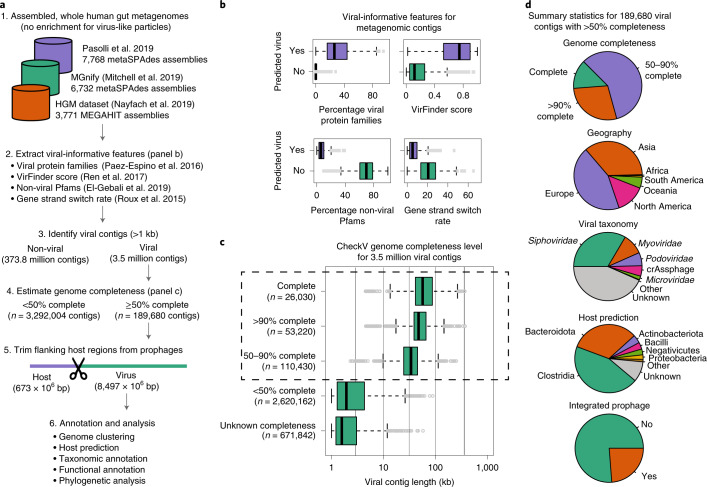
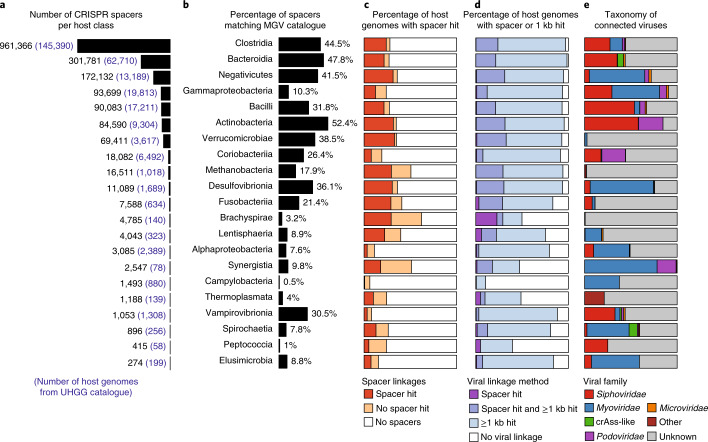
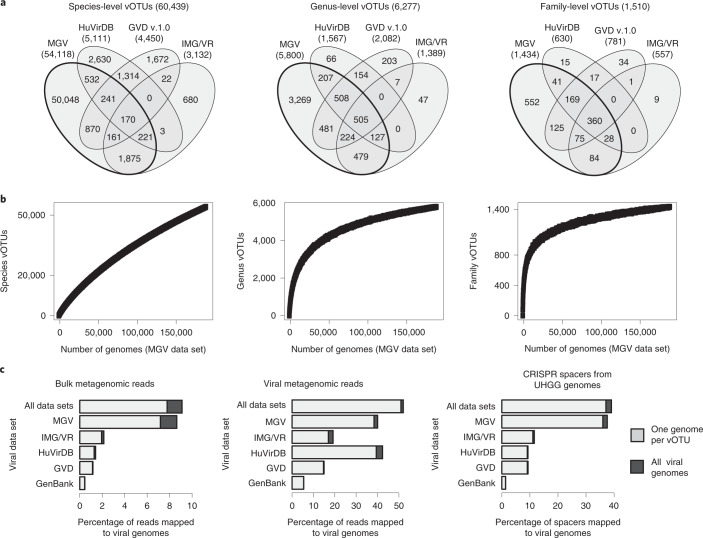
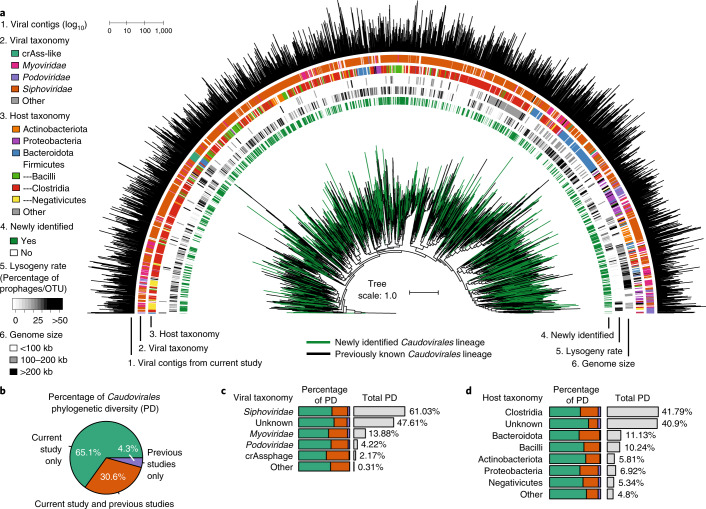
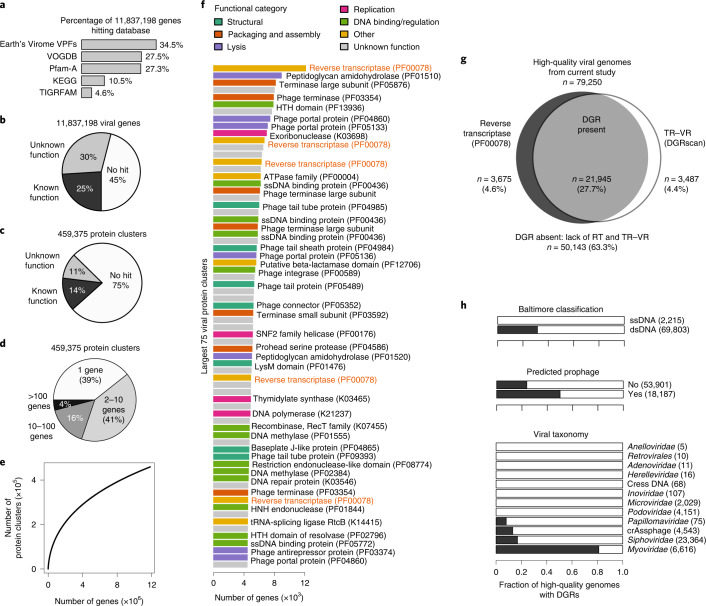
Bacteriophages have important roles in the ecology of the human gut microbiome but are under-represented in reference databases. To address this problem, we assembled the Metagenomic Gut Virus catalogue that comprises 189,680 viral genomes from 11,810 publicly available human stool metagenomes. Over 75% of genomes represent double-stranded DNA phages that infect members of the Bacteroidia and Clostridia classes. Based on sequence clustering we identified 54,118 candidate viral species, 92% of which were not found in existing databases. The Metagenomic Gut Virus catalogue improves detection of viruses in stool metagenomes and accounts for nearly 40% of CRISPR spacers found in human gut Bacteria and Archaea. We also produced a catalogue of 459,375 viral protein clusters to explore the functional potential of the gut virome. This revealed tens of thousands of diversity-generating retroelements, which use error-prone reverse transcription to mutate target genes and may be involved in the molecular arms race between phages and their bacterial hosts.
Overview
The claims and statistics of this paper haven’t been checked yet.
Free: it reads the open-access text and checks the first 5 claims that cite a source we can check. Create a free account to check every claim.
Integrity signals
Registry
Cites
Statistics
Figures
Verification
Claims the paper makes
The claims and statistics of this paper haven’t been checked yet.
Free: it reads the open-access text and checks the first 5 claims that cite a source we can check. Create a free account to check every claim.
Self-check
Percentages, sums and reported differences re-computed from the paper’s own numbers.
The self-check needs the paper’s full text.
Citations
Cites
KEGG: Kyoto Encyclopedia of Genes and Genomes
Kanehisa, M. (2000) · Nucleic Acids Research · doi:10.1093/nar/28.1.27 · Cited by 37,077
KEGG: Kyoto Encyclopedia of Genes and Genomes
Ogata, H., Goto, S., Sato, K., Fujibuchi, W., Bono, H., & Kanehisa, M. (1999) · Nucleic Acids Research · doi:10.1093/nar/27.1.29 · Cited by 31,232
BLAST+: architecture and applications
Camacho, C., Coulouris, G., Avagyan, V., Ma, N., Papadopoulos, J., Bealer, K., & Madden, T. L. (2009) · BMC Bioinformatics · doi:10.1186/1471-2105-10-421 · Cited by 22,074
FastTree 2 – Approximately Maximum-Likelihood Trees for Large Alignments
Price, M. N., Dehal, P. S., & Arkin, A. P. (2010) · PLoS ONE · doi:10.1371/journal.pone.0009490 · Cited by 14,894
Fast and sensitive protein alignment using DIAMOND
Buchfink, B., Xie, C., & Huson, D. H. (2015) · Nature Methods · doi:10.1038/nmeth.3176 · Cited by 14,201
trimAl: a tool for automated alignment trimming in large-scale phylogenetic analyses
Capella-Gutiérrez, S., Silla-Martínez, J. M., & Gabaldón, T. (2009) · Bioinformatics · doi:10.1093/bioinformatics/btp348 · Cited by 12,751
A human gut microbial gene catalogue established by metagenomic sequencing
MetaHIT Consortium, Qin, J., Li, R., Raes, J., Arumugam, M., Burgdorf, K. S., Manichanh, C., Nielsen, T., Pons, N., Levenez, F., et al. (2010) · Nature · doi:10.1038/nature08821 · Cited by 11,624
Enterotypes of the human gut microbiome
MetaHIT Consortium (additional members), Arumugam, M., Raes, J., Pelletier, E., Le Paslier, D., Yamada, T., Mende, D. R., Fernandes, G. R., Tap, J., Bruls, T., et al. (2011) · Nature · doi:10.1038/nature09944 · Cited by 7,548
Accelerated Profile HMM Searches
Eddy, S. R. (2011) · PLoS Computational Biology · doi:10.1371/journal.pcbi.1002195 · Cited by 6,975
Interactive Tree Of Life (iTOL) v4: recent updates and new developments
Letunic, I., & Bork, P. (2019) · Nucleic Acids Research · doi:10.1093/nar/gkz239 · Cited by 5,925
Research works printed but not linked: 1
- Telesnitsky, A. & Goff, G. P. in Retroviruses (eds Coffin, J. M. et al.) 121–160 (Cold Spring Harbor Laboratory Press, 1997). 21433342
Cited by
Items 201–300 of 616
Dietary Effects on the Gut Phageome
Howard, A., Carroll‐Portillo, A., Alcock, J., & Lin, H. C. (2024) · International Journal of Molecular Sciences · doi:10.3390/ijms25168690 · Cited by 19
In-depth analysis of 17,115 rice transcriptomes reveals extensive viral diversity in rice plants
Zhu, Y., Raza, A., Bai, Q., Zou, C., Niu, J., Guo, Z., & Wu, Q. (2025) · Nature Communications · doi:10.1038/s41467-025-56769-y · Cited by 18
“Therefore, viral metagenomic approaches were also applied to these data resource for the mining of related viruses and other pathogens 21,22 .”
de Ora, L. O., Wiles, E. T., Zünd, M., Bañuelos, M. S., Haro-Ramirez, N., Suder, D. S., Ujagar, N. S., Angulo, J. A. A., Trinh, C., Knitter, C., et al. (2025) · Nature Microbiology · doi:10.1038/s41564-025-01981-1 · Cited by 20
“70.”
Che, Y., Han, J., Harkins, C. P., Hou, P., Conlan, S., Deming, C., Amirkhani, A., Bingham, M. A., Holmes, C. J., Englander, H. E., et al. (2025) · Cell Host & Microbe · doi:10.1016/j.chom.2025.07.002 · Cited by 19
Transformer Models, Graph Networks, and Generative AI in Gut Microbiome Research: A Narrative Review
Zhu, Y., Tang, Y., Qi, X., & Zhu, X. (2026) · Bioengineering · doi:10.3390/bioengineering13020144 · Cited by 18
“The Gut Virus Catalog includes 189,680 viral genomes derived from over 11,000 stool metagenomes and captures hundreds of thousands of viral proteins, offering valuable insight into the virome—a less-explored component of gut ecology [83].”
iVirus 2.0: Cyberinfrastructure-supported tools and data to power DNA virus ecology
Bolduc, B., Zablocki, O., Guo, J., Zayed, A. A., Vik, D., Dehal, P., Wood-Charlson, E. M., Arkin, A. P., Merchant, N., Pett-Ridge, J., et al. (2021) · ISME Communications · doi:10.1038/s43705-021-00083-3 · Cited by 17
VirusPredictor: XGBoost-based software to predict virus-related sequences in human data
Liu, G., Chen, X., Luan, Y., & Li, D. (2024) · Bioinformatics · doi:10.1093/bioinformatics/btae192 · Cited by 17
“A study (Nayfach et al. 2021) released the genome sequences of 189 680 under-represented DNA viruses (98% were dsDNA viruses) from the human gut microbiome.”
MethodCui, S., Guo, R., Chen, C., Zhang, Y., Meng, J., Liu, L., Li, Y., Kang, Z., Li, S., Yan, Q., et al. (2024) · Influenza and Other Respiratory Viruses · doi:10.1111/irv.13362 · Cited by 17
Strain-resolved de-novo metagenomic assembly of viral genomes and microbial 16S rRNAs
Jochheim, A., Jochheim, F. A., Kolodyazhnaya, A., Morice, É., Steinegger, M., & Söding, J. (2024) · Microbiome · doi:10.1186/s40168-024-01904-y · Cited by 17
“Virus genomes can be retrieved from datasets enriched for virus particles (viral metagenomes) or from bulk metagenomes, including both virus particles and microbial cells [5, 22].”
BackgroundThe Dayhoff Atlas: scaling sequence diversity for improved protein generationPreprint
Yang, K., Alamdari, S., Lee, A. J., Kaymak-Loveless, K., Char, S., Brixi, G., Domingo-Enrich, C., Wang, C., Lyu, S., Fusi, N., et al. (2025) · bioRxiv (Cold Spring Harbor Laboratory) · doi:10.1101/2025.07.21.665991 · Cited by 18
Du, S., Lin, H., Luo, Q., Man, C. L., Lai, S. H., Ho, K., Leung, K., & Lee, P. K. H. (2025) · Microbiome · doi:10.1186/s40168-025-02081-2 · Cited by 16
“Genus-and family-level vOTUs were generated using a combination of shared genes and amino acid identity (AAI) based on Markov clustering as described previously [95].”
Gao, H., Wang, Y., Zhao, Y., Jiao, X., Guo, Z., Zheng, L., Li, Y., Su, Y., Wang, Z., Bai, J., et al. (2025) · Nature Communications · doi:10.1038/s41467-025-66733-5 · Cited by 16
Gao, Y., Zhong, Z., Zhang, D., Zhang, J., & Li, Y. (2024) · Microbiome · doi:10.1186/s40168-024-01807-y · Cited by 17
“6.3, -p meta) was run using the standard code (11), opal code (25), amber code (15), and ochre code (90) [116, 117].”
MethodInfluentialYu, Z., Somasundaram, S., & Yan, M. (2025) · Journal of Dairy Science · doi:10.3168/jds.2024-25780 · Cited by 16
Inflammation, microbiota, and pancreatic cancer
Chen, X., Sun, F., Wang, X., Feng, X., Aref, A. R., Tian, Y., Ashrafizadeh, M., & Wu, D. (2025) · Cancer Cell International · doi:10.1186/s12935-025-03673-6 · Cited by 16
“In addition to bacteria, viruses can also be present in the gut microbiota and an experiment has recognized up to 100,000 viruses [199].”
Longitudinal Investigation of Enteric Virome Signatures from Parental-Generation to Offspring Pigs
Chen, Q., Zhang, X., Shi, W., Du, X., Ma, L., Wang, W., Tao, S., & Xiao, Y. (2023) · Microbiology Spectrum · doi:10.1128/spectrum.00023-23 · Cited by 16
“A recent study on the human gut microbiome constructed reference databases of DNA viruses by using an assembly metagenomic approach, and more than 75% of the genomes represented double-stranded DNA phages that infect members of the classes Bacteroidia and Clostridia (25).”
BackgroundLeleiwi, I., Rodríguez-Ramos, J. A., Shaffer, M., Sabag-Daigle, A., Kokkinias, K., Flynn, R. M., Daly, R. A., Kop, L. F. M., Solden, L., Ahmer, B. M. M., et al. (2023) · Microbiome · doi:10.1186/s40168-023-01529-7 · Cited by 19
Synteny-aware functional annotation of bacteriophage genomes with PhyntenyPreprint
Grigson, S. R., Bouras, G. S., Papudeshi, B. N., Mallawaarachchi, V., Roach, M. J., Decewicz, P., & Edwards, R. A. (2025) · bioRxiv (Cold Spring Harbor Laboratory) · doi:10.1101/2025.07.28.667340 · Cited by 18
“As a result, 60–80% of phage genes lack any functional annotation 16–18 .”
Gut Phage Biobank: a collection of bacteriophages targeting human commensal bacteria
Xing, B., Liu, C., Chen, W., Li, Z., Jing, X., Wu, C., Liu, R., Zhang, X., Xu, X., Li, J., et al. (2025) · Nature Communications · doi:10.1038/s41467-025-61946-0 · Cited by 17
Mukherjee, A., D’Ugo, E., Giuseppetti, R., Magurano, F., & Cotter, P. D. (2022) · Elsevier eBooks · doi:10.1016/b978-0-323-96113-4.00003-2 · Cited by 22
Istvan, P., Birkeland, E. E., Avershina, E., Kværner, A. S., Bemanian, V., Pardini, B., Tarallo, S., de Vos, W. M., Rognes, T., Berstad, P. M., et al. (2024) · Nature Communications · doi:10.1038/s41467-024-46033-0 · Cited by 17
Integrating functional metagenomics to decipher microbiome–immune interactions
Sardar, P., Almeida, A., & Pedicord, V. A. (2024) · Immunology and Cell Biology · doi:10.1111/imcb.12798 · Cited by 16
Protein Set Transformer: a protein-based genome language model to power high-diversity viromics
Martin, C., Gitter, A., & Anantharaman, K. (2025) · Nature Communications · doi:10.1038/s41467-025-66049-4 · Cited by 17
Alignment-based Protein Mutational Landscape Prediction: Doing More with Less
Abakarova, M., Marquet, C., Rera, M., Rost, B., & Laine, E. (2023) · Genome Biology and Evolution · doi:10.1093/gbe/evad201 · Cited by 14
Planetary-scale metagenomic analysis reveals CRISPR targeting dynamics across ecosystems
Roux, S., Neri, U., Bushnell, B., Fremin, B. J., George, N. A., Gophna, U., Hug, L. A., Camargo, A. P., Wu, D., Ivanova, N., et al. (2026) · Nature Microbiology · doi:10.1101/2025.06.12.659409 · Cited by 15
“Previous smaller scale studies already highlighted that DGR-encoding viruses are targeted by a broader diversity of CRISPR systems than non-DGR-encoding viruses 49 , and the large spacer database collected here further suggests that some of these may originate from non-host microbes.”
Self-citationUltraconserved bacteriophage genome sequence identified in 1300-year-old human palaeofaeces
Rozwalak, P., Barylski, J., Wijesekara, Y., Dutilh, B. E., & Zieleziński, A. (2024) · Nature Communications · doi:10.1038/s41467-023-44370-0 · Cited by 17
Virus ecology and 7‐year temporal dynamics across a permafrost thaw gradient
Sun, C. L., Pratama, A. A., Gazitúa, M. C., Cronin, D. R., McGivern, B. B., Wainaina, J. M., Vik, D. R., Zayed, A. A., Bolduc, B., IsoGenie Project Field Teams 2010‐2017, T. I. A. E. P. C., et al. (2024) · Environmental Microbiology · doi:10.1111/1462-2920.16665 · Cited by 15
Towards a unifying phylogenomic framework for tailed phages
Weinheimer, A., Ha, A. D., & Aylward, F. O. (2025) · PLoS Genetics · doi:10.1371/journal.pgen.1011595 · Cited by 15
Characterizations of the multi-kingdom gut microbiota in Chinese patients with gouty arthritis
Chen, C., Zhang, Y., Yao, X., Yan, Q., Li, S., Zhong, Q., Liu, Z., Tang, F., Liu, C., Li, H., et al. (2023) · BMC Microbiology · doi:10.1186/s12866-023-03097-0 · Cited by 15
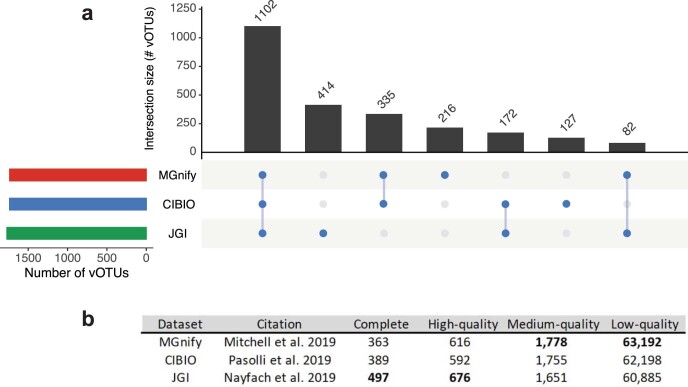
“Of note, only 28.2 % ( n = 3,272) of 11,596 vOTUs were shared with the currently available collections of the human gut virome including the Gut Virome Database [36], Gut Phage Database [37], and Metagenomic Gut Virus catalog [38] (Fig.”
BackgroundInfluentialDiverse Single-Stranded DNA Viruses Identified in Chicken Buccal Swabs
Chrząstek, K., Kraberger, S. J., Schmidlin, K., Fontenele, R. S., Kulkarni, A., Chappell, L., Dufour-Zavala, L., Kapczynski, D. R., & Varsani, A. (2021) · Microorganisms · doi:10.3390/microorganisms9122602 · Cited by 14
Petascale Homology Search for Structure Prediction
Lee, S., Kim, G., Karin, E. L., Mirdita, M., Park, S., Chikhi, R., Babaian, A., Kryshtafovych, A., & Steinegger, M. (2023) · bioRxiv (Cold Spring Harbor Laboratory) · doi:10.1101/2023.07.10.548308 · Cited by 15
Diversity and potential function of pig gut DNA viruses
Qin, J., Ji, B., Ma, Y.-J., Liu, X., Wang, T., Liu, G., Li, B., Wang, G., & Gao, P. (2023) · Heliyon · doi:10.1016/j.heliyon.2023.e14020 · Cited by 13
Assessing phage-host population dynamics by reintroducing virulent viruses to synthetic microbiomes
Wilde, J., Boyes, R., Robinson, A. V., Daisley, B. A., Botschner, A. J., Brettingham, D. J. L., Macpherson, C. V., Mallory, E., & Allen‐Vercoe, E. (2024) · Cell Host & Microbe · doi:10.1016/j.chom.2024.04.001 · Cited by 13
Ten computational challenges in human virome studies
Wu, Y., & Peng, Y. (2024) · Virologica Sinica · doi:10.1016/j.virs.2024.04.008 · Cited by 14
Another piece of puzzle for the human microbiome: the gut virome under dietary modulation
Zhao, F., & Wang, J. (2024) · Journal of genetics and genomics/Journal of Genetics and Genomics · doi:10.1016/j.jgg.2024.04.013 · Cited by 13
Gao, S., Wang, P., Li, Q., Shu, W.-S., Tang, L.-Y., Lin, Z.-L., Li, J., & Huang, L. (2024) · Journal of Hazardous Materials · doi:10.1016/j.jhazmat.2024.135478 · Cited by 13
Lucía-Sanz, A., Peng, S., Leung, C. Y., Gupta, A., Meyer, J. R., & Weitz, J. S. (2024) · Virus Evolution · doi:10.1093/ve/veae104 · Cited by 13
“Next-generation sequencing technology has revealed widespread diversity in microbial and viral communities [ (Aylward FO, 2017), (Munson-McGee JH, 2018), (Breitbart, 2018), (Guillermo Dominguez-Huerta, 2022), (Sunagawa S., 2015) , (Nayfach, 2021), (Sunagawa, 2020)].”
BackgroundA metagenome-wide study of the gut virome in chronic kidney disease
Zhang, P., Guo, R., Ma, S., Jiang, H., Yan, Q., Li, S., Wang, K., Deng, J., Zhang, Y., Zhang, Y., et al. (2024) · Theranostics · doi:10.7150/thno.101601 · Cited by 13
Metagenomic analysis reveals gut phage diversity across three mammalian models
Yu, M., Chu, Y., Wang, Y., Mo, L., Tan, X., Guo, S., Yuan, S., & Ma, Y. (2025) · Microbiome · doi:10.1186/s40168-025-02144-4 · Cited by 13
“The hcMGV, hcPGV, and hcCMGV representatives were compared against the Metagenomic Gut Virus (MGV) catalogue ( n = 189,680) from the human gut microbiome [8] using blastn, with > = 50% coverage.”
InfluentialIntegrating metagenomics and cultivation unveils oral phage diversity and potential impact on hosts
Jie, Z., Liang, H., Meng, Y., Zhang, J., Zhang, T., Li, W., Lin, X., Hu, T., Han, M., Liang, W., et al. (2025) · npj Biofilms and Microbiomes · doi:10.1038/s41522-025-00773-z · Cited by 15
Li, J., Qu, W., Hu, C., Liu, Z., & Yan, H. (2023) · Frontiers in Microbiology · doi:10.3389/fmicb.2023.1132403 · Cited by 14
“We then estimated the quality and length of each viral genome with CheckV (Nayfach et al., 2021).”
MethodInfluentialMaheshwari, K., Musyuni, P., Moulick, A., Mishra, H., Ekielski, A., Mishra, P. K., & Aggarwal, G. (2024) · Health Sciences Review · doi:10.1016/j.hsr.2024.100173 · Cited by 20
Cortés‐Martín, A., Denise, R., Guerin, E., Stockdale, S. R., Draper, L. A., Ross, R. P., Shkoporov, A. N., & Hill, C. (2024) · Gut Microbes · doi:10.1080/19490976.2023.2298254 · Cited by 12
Dong, Y., Chen, W.-H., & Zhao, X. (2024) · Genome biology · doi:10.1186/s13059-024-03320-9 · Cited by 12
“These datasets include (1) a left-out test set from the union of GVD [21], GPD [22], CHVD [23], and MGV [24] collection (denoted as GGCM-test); (2) a subset of the virus genome marked as human intestinal origin in the IMG/VR database v3 (IMG/VR-gut) [26]; (3) the Danish Enteric Virome Catalog…”
BackgroundMethodPhylogeny and disease associations of a widespread and ancient intestinal bacteriophage lineage
de Jonge, P. A., van den Born, B. H., Zwinderman, A. H., Nieuwdorp, M., Dutilh, B. E., & Herrema, H. (2024) · Nature Communications · doi:10.1038/s41467-024-50777-0 · Cited by 15
“…consisted of four recently constructed databases of gut bacteriophages: the gut phage database (GPD, 142,809 genomes) 17 , cenote-taker 2 human virome database (CHVD, 93,860 genomes) 19 , gut virome database (GVD, 33,242 genomes) 18 , and metagenomic gut virus catalog (MGV, 189,680 genomes) 63 .”
Improving viral annotation with artificial intelligence
Flamholz, Z., Li, C., & Kelly, L. (2024) · mBio · doi:10.1128/mbio.03206-23 · Cited by 12
“Viral profiling studies, which have been performed from terrestrial (5) to aquatic (6) to host-associated microbiomes (7–9), constitute the foundation for environmen tal virology by answering questions of “who” on the way to answering questions of “how,” “where,” and “when.”
BackgroundEvolutionary diversification and succession of soil huge phages in glacier foreland
Liao, H., Li, J., Wang, Y., Li, H., An, X., Wang, T., Chang, R., Zhu, Y., & Su, J. (2025) · Microbiome · doi:10.1186/s40168-024-02017-2 · Cited by 14
“Most of metagenome-assembled huge phages were found in aquatic ecosystems and human-associated settings [2, 9–11], and barely genomes were recovered from soil metagenomes [1].”
InfluentialLi, Y., Sun, C., Zhu, J., Geng, M., Li, M., Zhao, X., & Chen, W. (2025) · Microbiology Spectrum · doi:10.1128/spectrum.00013-25 · Cited by 14
Líndez, P. P., Danielsen, L. S., Kovačić, I., Avelli, M. P., Nesme, J., Jensen, L. J., Andersen, J. N., Sørensen, S. J., & Rasmussen, S. (2026) · Nature Biotechnology · doi:10.1038/s41587-026-03005-7 · Cited by 12
De novo discovery of conserved gene clusters in microbial genomes with Spacedust
Zhang, R., Mirdita, M., & Söding, J. (2025) · Nature Methods · doi:10.1038/s41592-025-02816-x · Cited by 13
Cappello, F., Saguto, D., Burgio, S., Paladino, L., & Bucchieri, F. (2022) · Applied Biosciences · doi:10.3390/applbiosci1010006 · Cited by 11
Land use patterns change N and P cycling bacterial diversity in an acidic karst soil
Li, Z., Qin, W., You, Y., Chen, J., Zhao, X., Dong, R., Gu, X., Cui, S., Chen, C., Stirling, E., et al. (2024) · Agriculture Ecosystems & Environment · doi:10.1016/j.agee.2024.109389 · Cited by 11
Zhang, Z., Zhu, T., Li, Y., Yu, B., Tao, H., Zhao, H., & Cui, B. (2025) · Journal of Agricultural and Food Chemistry · doi:10.1021/acs.jafc.4c07966 · Cited by 11
Park, J.-W., Yun, Y.-E., Cho, J. A., Yoon, S.-I., In, S.-A., Park, E., & Kim, M. (2025) · Nature Communications · doi:10.1038/s41467-025-58856-6 · Cited by 13
Molecular Mechanisms of the Microbiota–Gut–Brain Axis in the Onset and Progression of Stroke
Caballero‐Villarraso, J., Pons-Villarta, S., Cruces-Párraga, J., Navarrete-Pérez, A., Camargo, A., Moreno, J. A., Túnez, I., & Agüera, E. (2025) · International Journal of Molecular Sciences · doi:10.3390/ijms262010071 · Cited by 11
Douadi, C., Lamy-Besnier, Q., Theodorou, I., Schiettekatte, O., Sbardella, Y., Brot, L., Costantini, P. E., Saporetti, R., Danielli, A., Calvaresi, M., et al. (2025) · Cell Reports · doi:10.1016/j.celrep.2025.116726 · Cited by 11
Chisompola, D., Luwaya, E. L., Nzobokela, J., Mwansa, P., & Chakulya, M. (2026) · Frontiers in Microbiology · doi:10.3389/fmicb.2025.1717859 · Cited by 16
“In viral metagenomics, LSTMs are particularly effective in modeling genome-wide signals such as codon usage bias, oligonucleotide frequencies, and co-evolutionary patterns between viruses and hosts (Nayfach et al., 2021).”
Su, J.-W., Elsheikha, H. M., Guo, L., Liu, R., Shang, K.-M., Yu, H.-L., Ma, H., Ni, H.-B., Chen, B.-N., Zhang, X.-X., et al. (2026) · Communications Biology · doi:10.1038/s42003-026-09726-4 · Cited by 11
“2.9) 40 with theparameter “ --k-list 21,41,61,81,101,121,141 ” while all other settings were kept at their defaults.”
InfluentialAltamirano, F. L. G., Subedi, D., Beiers, M., Bucher, M. J., Dahlman, S., Patel, D. M., Parker, M., Korneev, D., Robinson, M. J., Pragastis, K., et al. (2026) · Nature Medicine · doi:10.1038/s41591-026-04301-0 · Cited by 11
“70) and the gene voting approach 71 , both using the Inphared database (v.1Dec2021) 72 .”
Co-transfer of functionally interdependent genes contributes to genome mosaicism in lambdoid phages
Kupczok, A., Bailey, Z. M., Refardt, D., & Wendling, C. C. (2022) · Microbial Genomics · doi:10.1099/mgen.0.000915 · Cited by 12
Spohr, P., Scharf, S. A., Rommerskirchen, A., Henrich, B., Jäger, P. S., Klau, G. W., Haas, R. R., Dilthey, A., & Pfeffer, K. (2024) · Scientific Reports · doi:10.1038/s41598-024-53506-1 · Cited by 12
“Interrogation of non-bacterial domains of microbial life from shotgun metagenomics is challenging 36–38 ; reasons for this include contamination 39,40 and coverage gaps in the relevant reference databases, likely remaining despite significant recent expansion efforts 41,42 .”
Phage–bacterial contig association prediction with a convolutional neural network
Tang, T., Hou, S., Fuhrman, J. A., & Sun, F. (2022) · Bioinformatics · doi:10.1093/bioinformatics/btac239 · Cited by 11
Cheng, Z., Li, X., Palomo, A., Yang, Q. Y., Han, L., Wu, Z., Li, Z., Zhang, M., Chen, L., Zhao, B., et al. (2023) · Journal of Hazardous Materials · doi:10.1016/j.jhazmat.2023.131944 · Cited by 12
Deciphering the Microbiome: Integrating Theory, New Technologies, and Inclusive Science
Milligan‐McClellan, K., Dundore-Arias, J. P., Klassen, J. L., Shade, A. L., Kinkel, L. L., & Wolfe, B. E. (2022) · mSystems · doi:10.1128/msystems.00583-22 · Cited by 12
“Viruses are also increasingly recognized as diverse and functionally significant players in most microbiome systems but are rarely characterized in the same studies as prokaryotic and eukaryotic microbes (43).”
BackgroundPetabase-Scale Homology Search for Structure Prediction
Lee, S., Kim, G., Karin, E. L., Mirdita, M., Park, S., Chikhi, R., Babaian, A., Kryshtafovych, A., & Steinegger, M. (2024) · Cold Spring Harbor Perspectives in Biology · doi:10.1101/cshperspect.a041465 · Cited by 13
Systematic annotation of hyper-variability hotspots in phage genomes and plasmidsPreprint
Egorov, A. A., Hauryliuk, V., & Atkinson, G. C. (2024) · bioRxiv (Cold Spring Harbor Laboratory) · doi:10.1101/2024.10.15.618418 · Cited by 11
A single-stranded based library preparation method for virome characterization
Zhai, X., Gobbi, A., Kot, W., Krych, Ł., Nielsen, D. S., & Deng, L. (2024) · Microbiome · doi:10.1186/s40168-024-01935-5 · Cited by 10
Du, S., Tong, X., Leung, M. H. Y., Betts, R. J., Woo, A. C., Bastien, P., Misra, N., Aguilar, L., Clavaud, C., & Lee, P. K. H. (2024) · The ISME Journal · doi:10.1093/ismejo/wrae218 · Cited by 12
Liu, Z., Jiang, C., Yin, Z., Ibrahim, I. A., Zhang, T., Wen, J., Zhou, L., Jiang, G., Li, L., Yang, Z., et al. (2024) · Applied and Environmental Microbiology · doi:10.1128/aem.01028-24 · Cited by 10
“All putative viral contigs were clustered into species-level vOTU at 95% ANI and 85% alignment fraction of the shorter sequence by using “aniclust.py” script from the CheckV repository (57, 58).”
Wei, C., Wang, Y., & Chen, Z. (2025) · Frontiers in Microbiology · doi:10.3389/fmicb.2025.1662087 · Cited by 10
Jumbo phage–mediated transduction of genomic islands
Zhao, Y., Ma, Y., Vasileiou, C., Farr, A. D., Rogers, D. W., & Rainey, P. B. (2025) · Proceedings of the National Academy of Sciences · doi:10.1073/pnas.2512465122 · Cited by 10
“2 B depicts the relationship among the elements, constructed based on previously established methods (53, 54).”
Bioinformatics Tools and Approaches for Virus Discovery in Genomic Data: A Systematic Review
Galeeva, J. S., Kuzmichenko, P., Manolov, A. I., Lukashev, A. N., & Ilina, E. N. (2025) · Viruses · doi:10.3390/v17121538 · Cited by 11
Optimized Metavirome Analysis of Marine DNA Virus Communities for Taxonomic Profiling
Kim, K. E., Jung, S. W., Park, J. Y., Kim, H., Lee, C., Ha, S., & Lee, T. (2022) · Ocean Science Journal · doi:10.1007/s12601-022-00064-0 · Cited by 10
“01 and cut-off of 90% for classifying viral contigs (Nayfach et al. 2021).”
BackgroundInto the Dark: Exploring the Deep Ocean with Single-Virus Genomics
Martinez‐Hernández, F., Fornas, Ò., & Martínez‐García, M. (2022) · Viruses · doi:10.3390/v14071589 · Cited by 10
“, viral metagenomics) has been the most commonly employed method to unveil the deep-ocean virosphere, increasing our current knowledge on the global viral diversity [6,11,17], abundance [18], and virus–host interaction [19,20].”
MethodSun, Y., Zhang, R., Wang, H., Sun, Z., Yi, L., Tu, C., Yang, Y., & He, B. (2024) · BMC Veterinary Research · doi:10.1186/s12917-024-04400-5 · Cited by 10
“Most viromic analyses were based on the contig level, with its length limited to longer than 1 kb, 1.5 kb, or 3 kb [16].”
InfluentialSugimoto, R., Nishimura, L., Phuong, N. T., Ito, J., Parrish, N. F., Mori, H., Kurokawa, K., Nakaoka, H., & Inoue, I. (2021) · PLoS Computational Biology · doi:10.1371/journal.pcbi.1009428 · Cited by 10
“During the review of this manuscript, a study of an enormous gut virome was published [37].”
BackgroundComparative Metagenomic Analysis of Bacteriophages and Prophages in Gnotobiotic Mouse Models
Ishola, O. A., Kublik, S., Raj, A. C. D., Ohnmacht, C., Schulz, S., Foesel, B. U., & Schloter, M. (2024) · Microorganisms · doi:10.3390/microorganisms12020255 · Cited by 9
“This is in agreement with other studies from murine and human guts, as well as other ecosystems. dsDNA Caudoviricetes are ubiquitous and have a wide range of bacterial hosts [45,47–50].”
ResultVirus detection by short read high throughput sequencing in a high virus low cellular background
Chin, P.-J., Lambert, C., Beurdelay, P., Charlebois, R. L., Colinet, A.-S., Éloit, M., Gilchrist, S., Gilleece, M., Hess, M. C., Leimbach, A., et al. (2025) · npj Vaccines · doi:10.1038/s41541-025-01104-1 · Cited by 9
Xin, Y., Zhang, J., Tang, Q., Wei, M., Zhu, L., Zhao, Y., Cui, Y., Sun, T., Wei, Y., & Richnow, H. H. (2025) · Journal of Hazardous Materials · doi:10.1016/j.jhazmat.2025.138605 · Cited by 9
Crosstalk between three CRISPR-Cas types enables primed type VI-A adaptation in Listeria seeligeri
Margolis, S. R., & Meeske, A. J. (2024) · Cell Host & Microbe · doi:10.1016/j.chom.2025.05.020 · Cited by 9
Bryson, S., Sisson, Z., Nelson, B., Grove, J., Reister, E., Liachko, I., Auch, B., Graiziger, C. T., & Khoruts, A. (2025) · Gut Microbes · doi:10.1080/19490976.2025.2559019 · Cited by 9
“Phage genomes were clustered following previously described methods for the MGV 75 and IMGVR 76 databases.”
What Lies Beneath? Taking the Plunge into the Murky Waters of Phage Biology
Zünd, M., Dunham, S. J. B., Rothman, J. A., & Whiteson, K. (2023) · mSystems · doi:10.1128/msystems.00807-22 · Cited by 10
“fication of phage-host pairs in large metagenomic data sets (42, 60).”
BackgroundPhageTailFinder: A tool for phage tail module detection and annotation
Zhou, F., Yang, H. M., Si, Y., Gan, R., Yu, L., Chen, C., Ren, C., Wu, J., & Zhang, F. (2023) · Frontiers in Genetics · doi:10.3389/fgene.2023.947466 · Cited by 9
“performed large-scale viral genome characterization of bulk metagenomic data of human stool samples based on 61 previously published studies (Nayfach et al., 2021).”
Colorectal cancer and gut viruses: a visualized analysis based on CiteSpace knowledge graph
Chu, J., Jing, Z., Wu, Y., Jinlong, D., Pan, Y., Quan, Q., & Han, S. (2023) · Frontiers in Microbiology · doi:10.3389/fmicb.2023.1239818 · Cited by 9
“These genomes greatly expand the known diversity of DNA viruses in the gut microbiome and improve the understanding of host-virus associations (Nayfach et al., 2021).”
BackgroundTheabrownin, gut microbiota, and obesity: Effects and mechanisms
Hu, J., Li, Y., & Zhang, T. (2024) · Food Bioscience · doi:10.1016/j.fbio.2024.105381 · Cited by 9
Zhou, Z., Liu, S., Saleem, M., Liu, F., Hu, R., Su, H., Dong, D., Luo, Z., Wu, Y., Zhang, Y., et al. (2025) · Bioresource Technology · doi:10.1016/j.biortech.2025.132081 · Cited by 9
Maast: genotyping thousands of microbial strains efficiently
Shi, Z. J., Nayfach, S., & Pollard, K. S. (2023) · Genome biology · doi:10.1186/s13059-023-03030-8 · Cited by 9
“This is a common scenario for uncultured prokaryotic species plus many eukaryotes and viruses beyond the best-studied pathogens, although metagenome-assembled genomes and single-cell sequencing methods are closing this gap [20–22].”
BackgroundSelf-citationPalomo, A., Dechesne, A., Smets, B. F., & Zheng, Y. (2023) · Water Research · doi:10.1016/j.watres.2023.120655 · Cited by 9
Li, S., Song, X., Song, Y., Wu, Y., Yuan, J., Yang, X., Lü, Z., Xu, J. M., Ma, B., & He, Y. (2024) · Soil Biology and Biochemistry · doi:10.1016/j.soilbio.2024.109553 · Cited by 8
Galperina, A., Lugli, G. A., Milani, C., de Vos, W. M., Ventura, M., Salonen, A., Hurwitz, B. L., & Ponsero, A. J. (2025) · PLoS Computational Biology · doi:10.1371/journal.pcbi.1012268 · Cited by 9
“Nayfach et al. constructed the metagenomic gut virus (MGV) catalogue from 11,810 human gut metagenomes and retrieved 54,118 species-like vOTUs [16].”
Wang, X., Dong, Q., Huang, P., Yang, S., Gao, M., Zhang, C., Zhang, C., Deng, Y., Huang, Z., Ma, B., et al. (2025) · Microbiome · doi:10.1186/s40168-025-02185-9 · Cited by 9
“The Unified Human Gut Virome Catalog (UHGV) recently integrated 12 existing virome catalogs [6, 9–19], establishing itself as the most extensive viral resource to date.”
InfluentialGut Virome and Aging: Phage-Driven Microbial Stability and Immune Modulation
Ullah, K., Kanwar, R., Ali, S., Uddin, S., Izza, I., Ahmad, I., Alzahrani, K. J., Qadeer, A., Chu, C., & Chen, C. (2025) · Aging and Disease · doi:10.14336/ad.2025.0854 · Cited by 10
“The dominant taxa in the gut virome are Caudovirales (dsDNA viruses) at the order level and Microviridae (ssDNA viruses) at the family level [35]. crAssphage is a common phage family known as Intestiviridae within the (newly established crAssvirales order by ICTV in 2021).”
Phage-Microbiota Interactions in the Gut: Implications for Health and Therapeutic Strategies
Naderian, R., Alibabaei, F., Paraandavaji, E., Dehghan, P., & Eslami, M. (2025) · Probiotics and Antimicrobial Proteins · doi:10.1007/s12602-025-10784-z · Cited by 10
“Notably, the prevalence of certain phages, like crAssphage, within the gut virome underscores their potential significance in gut microbial dynamics [48].”
Exploring diversity and distribution patterns of chicken gut bacteriophage community
Chen, W., Zhang, Y., Gong, H., Cao, Z., Yang, K., & Mi, J. (2025) · Animal Microbiome · doi:10.1186/s42523-025-00484-y · Cited by 8
“Members of Caudoviricetes are ubiquitous across diverse environments, including soil [71], water [72, 73], and within the gut microbiomes of animals [74] and humans [47, 75].”
InfluentialWei, C., & Chen, Z. (2025) · Frontiers in Microbiology · doi:10.3389/fmicb.2025.1686402 · Cited by 8
“For phylogenetic tree construction, gene markers in retained genomes were identified via HMMER searches ( E -value ≤ 1 × 10 − 3 ) against the core HMM profiles (Nayfach et al., 2021b).”
InfluentialValadez‐Cano, C., Reyes‐Prieto, A., & Lawrence, J. E. (2023) · Environmental Microbiology · doi:10.1111/1462-2920.16527 · Cited by 8
Flores, V. S., Amgarten, D., Iha, B. K. V., Ryon, K. A., Danko, D., Tierney, B. T., Mason, C. E., da Silva, A. M., & Setúbal, J. C. (2024) · Scientific Reports · doi:10.1038/s41598-024-58226-0 · Cited by 10
“This result contrasts with what has been reported in some recent studies where only a small fraction of recovered phage genomes has a substantial degree of completeness [less than 30% in 32 ; less than 8% in 33 ].”
BackgroundResultXiao, Z., Zhang, Y., Zhang, W., Zhang, A., Wang, G., Chen, C., Ullah, H., Taj, A., Li, S., Zhaxi, D., et al. (2024) · International Microbiology · doi:10.1007/s10123-024-00531-9 · Cited by 8
“The viral sequences within the metagenomic assembled contigs were identified using the methods developed in recent studies (Camarillo-Guerrero et al. 2021; Gregory et al. 2020; Nayfach et al. 2021).”
Chen, W., Liang, F., Zhang, Y., Zhang, Y., Lv, J., Jin, X., Ran, Y., Li, S., & Sun, W. C. (2024) · Frontiers in Microbiology · doi:10.3389/fmicb.2024.1449090 · Cited by 9
Insights into diversity, host-range, and temporal stability of Bacteroides and Phocaeicola prophages
Stopnišek, N., Hedžet, S., Accetto, T., & Rupnik, M. (2025) · BMC Microbiology · doi:10.1186/s12866-025-03827-6 · Cited by 8
“The three viral databases we used were the Metagenomic Gut Virus (MGV) catalogue with 189,680 viral genomes [34], Gut Virome Database (GVD) with 33,242 unique viral populations [35], and the Gut Phage Database (GPD) with 142,809 non-redundant gut phage genomes [36].”
Metadata
- Authors
- Nayfach, S., Páez-Espino, D., Call, L., Low, S. J., Sberro, H., Ivanova, N. N., Proal, A. D., Fischbach, M. A., Bhatt, A. S., Hugenholtz, P., & Kyrpides, N. C.
- Affiliations
- Lawrence Berkeley National Laboratory (US)
- The University of Queensland (AU)
- Stanford Medicine (US)
- Curvenote Inc. (Canada) (CA)
- Chan Zuckerberg Biohub San Francisco (US)
- Corresponding author
- Nayfach, Stephen
- Kyrpides, Nikos C.
- ORCID
- Venue
- Nature Microbiology
- Published
- 2021-06-24
- Volume
- 6
- Issue
- 7
- Pages
- 960-970
- ISSN
- 2058-5276 (ISSN-L)
- PMC
- PMC8241571
- OpenAlex
- W3176037658
- Cited by
- 580
- References
- 94
- Citations by year
- 2026: 96 · 2025: 141 · 2024: 134 · 2023: 98 · 2022: 91 · 2021: 19
- FWCI
- 49.04
- Type
- journal article
- Language
- en
- Open access
- hybrid
- doi.org
- Licence
- cc-by
- creativecommons.org/licenses/by/4.0 (tdm)
- creativecommons.org/licenses/by/4.0 (vor)
- Locations
- Nature Microbiology (publishedVersion, cc-by)
- PubMed Central (publishedVersion, cc-by)
- PubMed (publishedVersion)
- eScholarship (California Digital Library) (submittedVersion, cc-by)
- OSTI OAI (U.S. Department of Energy Office of Scientific and Technical Information) (submittedVersion)
- eScholarship (California Digital Library) (submittedVersion)
- Minerva Access (University of Melbourne) (submittedVersion, cc-by)
- Funders
- Australian Research Council (FL150100038)
- National Cancer Institute (P30CA124435)
- National Institute of Allergy and Infectious Diseases (R01AI148623)
- Lawrence Berkeley National Laboratory
- Topics
- Life Sciences › Immunology and Microbiology › Virology › Bacteriophages and microbial interactions
- Life Sciences › Biochemistry, Genetics and Molecular Biology › Molecular Biology › Genomics and Phylogenetic Studies
- Life Sciences › Immunology and Microbiology › Virology › Plant and Fungal Interactions Research
- Keywords
- human gut microbiome, bacteriophages, DNA viruses, virome, viral genome assembly, Bacteroidia, Clostridia, CRISPR spacers, diversity-generating retroelements, phage-bacteria arms race
- MeSH terms
- Gastrointestinal Microbiome, Archaea, Bacteria, Bacteriophages, Catalogs as Topic, DNA Viruses, DNA, Viral, Feces, Humans, Phylogeny, Genetic Variation, Viral Proteins, Genome, Viral, Metagenomics
About these checks
Registry, retraction, Cites and statistics results are computed, not judged, with one exception: a printed reference that no index lists is read once by a model before it counts as a citation error. Claims are extracted by a model and kept only when their quote appears verbatim in the text; each cited source is then checked, with a model’s help, for whether it says what the claim relies on. Those verdicts can be wrong — read the claim’s quote and the cited source before relying on one.
Statistics and arithmetic are recomputed, not judged.
Confidence bands are shown only for fields calibrated on our annotated test set. None is calibrated yet, so no band is shown.
What counts as a claim ›How we measure confidence ›How we check this ›
Are you an author, or do you see a problem with this page? Request a review
Data sources
Bibliographic data: Semantic Scholar, OpenAlex, Crossref.
Contains information from the Semantic Scholar Academic Graph Datasets, made available under the ODC Attribution License (ODC-BY 1.0).
Semantic Scholar’s data is described in: Kinney, R., et al. (2023). The Semantic Scholar Open Data Platform. arXiv:2301.10140.
