

Integrated photonic quantum technologies
Open accessThe DOI matches its Crossref record; 156 of the 158 references it cites were found in a registry or an index, and 2 are not checked yet; 103 of the 132 sources its claims cite were checked for support.
Abstract
Quantum technologies comprise an emerging class of devices capable of controlling superposition and entanglement of quantum states of light or matter, to realize fundamental performance advantages over ordinary classical machines. The technology of integrated quantum photonics has enabled the generation, processing and detection of quantum states of light at a steadily increasing scale and level of complexity, progressing from few-component circuitry occupying centimetre-scale footprints and operating on two photons, to programmable devices approaching 1,000 components occupying millimetre-scale footprints with integrated generation of multiphoton states. This Review summarizes the advances in integrated photonic quantum technologies and its demonstrated applications, including quantum communications, simulations of quantum chemical and physical systems, sampling algorithms, and linear-optic quantum information processing. This Review covers recent progress in integrated quantum photonics (IQP) technologies and their applications. The challenges and opportunities of realizing large-scale, monolithic IQP circuits for future quantum applications are discussed.
Verified 2026-11-22 · 2 references not checked yet
Overview
CoChat Summary
TL;DR
This review summarizes a decade of integrated quantum photonics (IQP), covering platforms, single-photon sources/detectors, circuits, and applications in quantum communications, information processing, Boson sampling, and simulation. It argues that IQP has scaled from few-component two-photon circuits to programmable silicon chips with hundreds of components, while identifying full integration and photon-number scaling as key challenges.
Key findings
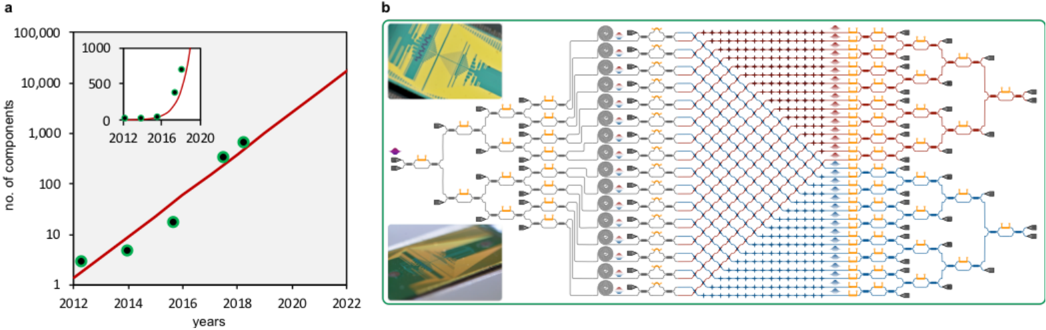
- IQP advanced from fixed circuits with few components operating on two photons to programmable circuitry approaching 1000 components with integrated multi-photon generation; a state-of-the-art Si device monolithically integrated 671 components (16 SFWM-SPSs, 93 TOPSs, 122 MMIs, 376 waveguide-crossers, 64 grating couplers) and verified up to 15×15 dimensional two-photon entangled states.
- Integrated QKD demonstrations include a chip-to-chip InP transmitter/SiOxNy receiver programmable for BB84 at 560 MHz, coherent-one-way at 860 MHz, and differential-phase-shift at 1.76 GHz; WDM-QKD doubled key rates to 1.11 Mbit/s over 20 km emulated fiber; Si-based transmitters achieved kbps–Mbps secret key rates and 1.0%–5.4% QBER.
- Key device benchmarks: Si-waveguide SNSPDs reached 91% detection efficiency, 18 ps jitter, and 50 Hz dark count; QD-SPSs produced 99.1% single-photon purity, 66% extraction efficiency, and 98.5% indistinguishability; two-photon interference visibilities were 100.1±0.4% in SiO2 and 100.0±0.4% in Si.
- Boson sampling was first demonstrated with n=3 photons, mainly in integrated photonics; the highest photon numbers used demultiplexed single QD-SPS photons, and the review states >20 photons are needed to challenge conventional computers and >50 to surpass supercomputers.
Methods
- Design: narrative review of integrated photonic quantum technologies, summarizing advances in materials, devices, functionality, and on-chip applications.
- Data/sample: published literature and milestone demonstrations from 2008 onward, including platforms (silica, Si, Si3N4, LN, GaAs, InP), sources, detectors, QKD, QIP, Boson sampling, and quantum simulation.
- Analysis: qualitative synthesis of experimental results and stated benchmarks; no primary experimental data or formal systematic-review methodology are reported.
Limitations
- Stated: a fully integrated quantum chip having sources, circuits, and detectors is yet to be realised; cryogenic operation for detectors and manipulation of photons at cryogenic temperature remain technical challenges.
- Stated: creating multiple identical QD-SPSs is difficult due to sample reproducibility; parametric SPSs produce photons nondeterministically with 5%–10% probability; full certification of Boson sampling is believed not possible.
- Evident from the text: as a review, it synthesizes prior work rather than presenting new experiments, and its performance numbers are drawn from cited demonstrations rather than a systematic meta-analysis.
Model-written summary. Check it against the paper before relying on it.
Integrity signals
Registry
Cites
Statistics
Figures

Verification
Claims the paper makes
28 Valid · 48 Not valid · 25 Not checked · 34 Own results and interpretations
Some cited sources support this claim and some don’t — read each source’s verdict below.
In the paper
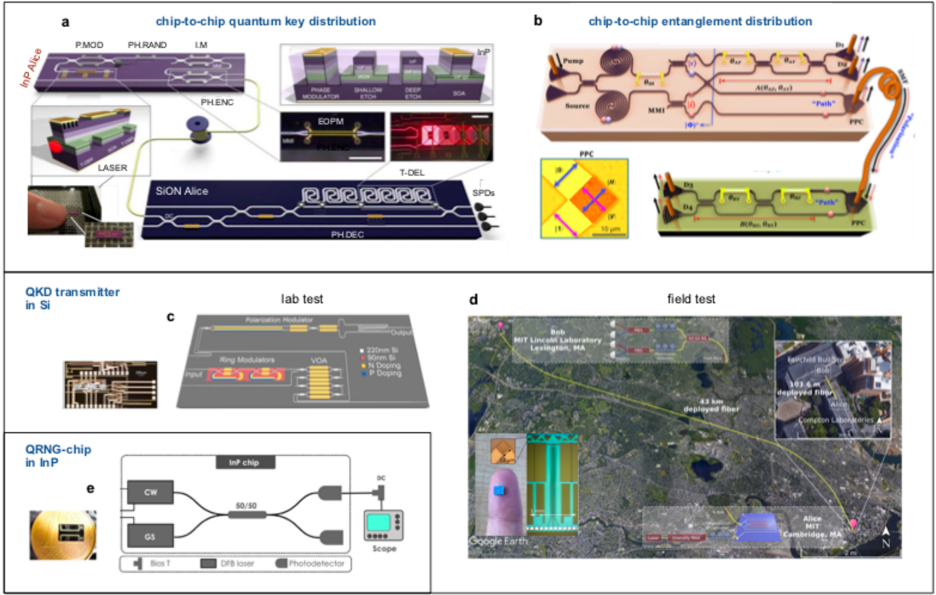
“For example, fully integrated QRNGs have been demonstrated in InP-chips ( Fig.3e ) [38, 74], in which random numbers were generated from the random phases of two-laser interference.”
What the sources say
- Partly supportedcites [38] 37. P. Sibson et al. Chip-based quantum key distribution. Nat. Commun. 8, 13984 (2017). sourceExperimental — accuracy not yet measured
The Results (Integrated photonic devices and Transmitter; page unavailable) describe a monolithically integrated InP chip with an on-chip laser, but it is a QKD transmitter, not a demonstrated QRNG. The Discussion says the receiver's passive basis choice removes the requirement for a QRNG; no passage describes generating random numbers from the phases of two interfering lasers. (LLM, conf=0.85)
- Disputedcites [74] 69. Y. Ding et al. High-dimensional quantum key distribution based on multicore fiber using silicon photonic integrated circuits. npj Quantum Information 3, 25 (2017). sourceExperimental — accuracy not yet measured
The Introduction describes a high-dimensional QKD demonstration using silicon photonic integrated circuits, not an InP-chip QRNG. The Experimental results say the experiment used FPGA-generated pseudorandom sequences for state and basis choices, rather than random phases from two-laser interference. Page numbers are unavailable in our copy. (LLM, conf=0.87)
Checked by a reasoning model — may be wrong.
boostedstates a cause- Asserted: passes — The authors put it forward as true.
- Checkable: passes — It can be checked against evidence.
- Load-bearing: unclear — It is unclear whether the paper’s conclusions depend on it.
- Based: passes — The paper gives a reason why it holds.
- Partly supported
At least one cited source doesn’t support this claim or points to a different paper, and none confirmed it — see the verdicts below.
In the paper
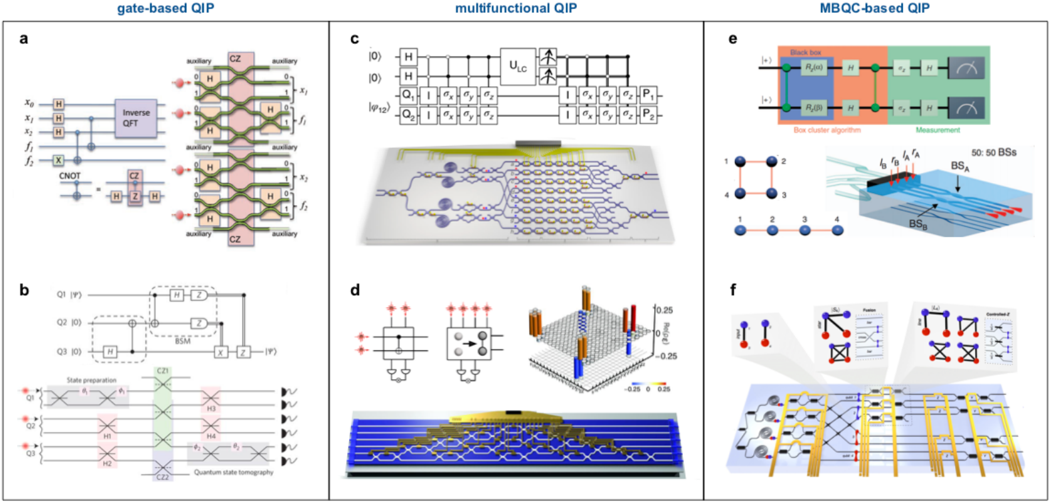
“The on-chip GMM of four-photon four-qubit graph states was demonstrated in a Si-chip ( Fig. 4f ) [87].”
What the sources say
- Disputedcites [87] 81. X. Qiang et al. Large-scale silicon quantum photonics implementing arbitrary two-qubit processing. Nat. Photon. 12, 534-539 (2018). sourceExperimental — accuracy not yet measured
The paper’s Abstract describes a silicon chip that generates two photonic qubits and performs two-qubit processing using only two photons. It does not report generating, manipulating and measuring four-photon four-qubit graph states; its stated demonstration uses a different number of photons and qubits. (LLM, conf=0.90)
Checked by a reasoning model — may be wrong.
boosted- Asserted: passes — The authors put it forward as true.
- Checkable: passes — It can be checked against evidence.
- Load-bearing: unclear — It is unclear whether the paper’s conclusions depend on it.
- Based: passes — The paper gives a reason why it holds.
- Disputed
At least one cited source doesn’t support this claim or points to a different paper, and none confirmed it — see the verdicts below.
In the paper
“The first on-chip GMM of four-qubit cluster state was realised in a laser-writing chip ( Fig.4e ), by manipulating both the polarisation and path DoFs of two photons [85].”
What the sources say
- Disputedcites [85] 79. A. Peruzzo et al. A variational eigenvalue solver on a photonic quantum processor. Nat. Commun. 5, 4213 (2013). sourceExperimental — accuracy not yet measured
The Results section (“Prototype demonstration”; page unavailable) describes a chip that prepares and measures two-qubit states encoded in photon paths, not a four-qubit cluster state encoded in both polarisation and path. Our copy does not establish the claimed first demonstration or laser-writing fabrication. (LLM, conf=0.88)
Checked by a reasoning model — may be wrong.
plainstates a cause- Asserted: passes — The authors put it forward as true.
- Checkable: passes — It can be checked against evidence.
- Load-bearing: unclear — It is unclear whether the paper’s conclusions depend on it.
- Based: passes — The paper gives a reason why it holds.
- Disputed
At least one cited source doesn’t support this claim or points to a different paper, and none confirmed it — see the verdicts below.
In the paper
“For example, the first GMM of entangled two-qubit states encoded in dual-paths were demonstrated in a Si-chip, with the inclusion of ring-resonator-based SFWM photon sources and circuits [84].”
What the sources say
- Disputedcites [84] 78. B. J. Metcalf et al. Quantum teleportation on a photonic chip. Nat. Photon. 8, 770-774 (2014). sourceExperimental — accuracy not yet measured
The main-experiment passage describes three photons from two parametric down-conversion sources coupled into a UV-written silica-on-silicon chip, not ring-resonator SFWM sources integrated on a silicon chip. Figure 1(c) does support dual-rail encoding and on-chip state preparation and tomography, but the claimed chip and photon-source technology contradict the paper’s description. (LLM, conf=0.88)
Checked by a reasoning model — may be wrong.
boosted- Asserted: passes — The authors put it forward as true.
- Checkable: passes — It can be checked against evidence.
- Load-bearing: unclear — It is unclear whether the paper’s conclusions depend on it.
- Based: passes — The paper gives a reason why it holds.
- Disputed
Some cited sources support this claim and some don’t — read each source’s verdict below.
In the paper
“In Fig.6 , we summarise the scaling of integrated quantum photonic circuits in silicon: from a single MZI adopted for the on-chip HOM-interference experiment in 2012 [24], to a state-of-the-art large-scale quantum photonic device having 671 components that was used for the GMM of multi-dimensional entanglement [44].”
What the sources say
- Disputedcites [24] 24. D. Bonneau et al. Quantum interference and manipulation of entanglement in silicon wire waveguide quantum circuits. New J. Phys. 14, 045003 (2012). sourceExperimental — accuracy not yet measured
Split into 2 atoms — 0 confirmed, 1 partially supported, 1 disputed, 0 misattributed, 0 unverifiable. Expand the claim to see per-atom verdicts.
Checked by a reasoning model — may be wrong.
- Partly supportedcites [44] 44. J. Wang et al. Multidimensional quantum entanglement with large-scale integrated optics. Science 360, 285-291 (2018). sourceExperimental — accuracy not yet measured
The opening summary (p. 1) says the silicon-photonics device generated, manipulated and measured multidimensional entanglement. It reports more than 550 components, however, and the components listed in Fig. 1 (p. 2) total 551; our copy does not support the attributed figure of 671. The 2012 single-MZI experiment is attached to a different citation in the citing sentence. (LLM, conf=0.88)
plainstates an association- Asserted: passes — The authors put it forward as true.
- Checkable: passes — It can be checked against evidence.
- Load-bearing: unclear — It is unclear whether the paper’s conclusions depend on it.
- Based: passes — The paper gives a reason why it holds.
- Disputed
67 more claims · 35 with their cited sources checked
Create a free account to see all 135 claims and to verify the 22 references still open.
- It may state two separate claims as one. 38
- Probably not a substantial claim. 34
Claims other papers make about this one
Each is checked against this paper’s own text: does it say what the citing paper says it does?
The source backs part of the claim, not all of it — or backs it for a different population, condition or comparison.
In the citing paper
“As an example, the timeline in figure 1 illustrates this rapid progression from few-component circuits enabling two-photon quantum interference in 2008 [5] to a decade later with devices combining more than 650 components capable of arbitrary and programmable two-qubit operations [6], enabling advances in foundational quantum mechanics, computing, communications, and metrology [7].”
From 2022 Roadmap on integrated quantum photonics (2022) · cites this paper as [7]
Experimental — accuracy not yet measuredThe source backs part of the claim, not all of it — or backs it for a different population, condition or comparison.
In the citing paper
“Thermo-optic tuning can be used as a drift-free method of bias control [16,468], but this requires tradeoffs in power dissipation and tuning bandwidth.”
From Integrated photonics on thin-film lithium niobate (2021) · cites this paper as [468]
Experimental — accuracy not yet measuredThe source backs part of the claim, not all of it — or backs it for a different population, condition or comparison.
In the citing paper
“Recent advances in the fabrication of quantum photonic integrated circuits (QPICs) have enabled the functionality of bench-top nonlinear sources to be scaled down to a single chip, with a dramatic improvement in the efficiency and stability [12][13][14][15].”
From Ultrabright Entangled-Photon-Pair Generation from anAlGaAs-On-Insulator Microring Resonator (2021) · cites this paper as [14]
Experimental — accuracy not yet measuredThe cited source says what the claim attributes to it.
In the citing paper
“As a result, it has been the material of choice for many early demonstrations of building blocks for photonic quantum computing and has seen rapid growth in the number of generated photons and integrated components over the last 10 years [7,24,25].”
From 2022 Roadmap on integrated quantum photonics (2022) · cites this paper as [7]
The cited source says what the claim attributes to it.
In the citing paper
“Silicon photonics has been pivotal for increasing the complexity and component-number of on-chip quantum circuitry and revealing the disruptive potential an engineered integrated approach can take for a quantum technology [7].”
From 2022 Roadmap on integrated quantum photonics (2022) · cites this paper as [7]
1 more claim about this paper
Create a free account to see every claim other papers make about this one.
Self-check
Percentages, sums and reported differences re-computed from the paper’s own numbers.
Each contradiction between two passages listed here was confirmed by an independent check.
Rated minor: it would not touch a result — a value no result rests on, a p-value that stays on the same side of the significance level, or a conflict that is clerical, resolved elsewhere in the paper, or outside its own findings.
In the paper
§ Box 2: integrated building blocks for operating photonic states · p. 9
“large-scale quantum circuits in Si with 670 components [44]”
§ Box 2: integrated building blocks for operating photonic states · p. 13
“This large-scale device monolithically integrates 16 SFMW-SPSs, 93 reconfigurable TOPSs, 122 MMIs, 376 waveguide-crossers and 64 grating couplers, in total 671 photonic components.”
Rated minor: it would not touch a result — a value no result rests on, a p-value that stays on the same side of the significance level, or a conflict that is clerical, resolved elsewhere in the paper, or outside its own findings.
In the paper
§ Introduction · p. 1
“In 2001, a theoretical breakthrough presented a scheme for universal quantum computation using photons in linear optics, in which photons interact non-deterministically via quantum interference and measurement-induced nonlinearities [9, 10]”
§ References · p. 14
“9. E. Knill, R. Laflamme & G. J. Milburn. A scheme for efficient quantum computation with linear optics. Nature 409, 46-52 (2000).”
Citations
Cites
Gisin, N., Ribordy, G., Tittel, W., & Zbinden, H. (2002) · Reviews of Modern Physics · doi:10.1103/revmodphys.74.145 · Cited by 8,515 · cited 4×
“do not require operation at mK temperatures or in high vacuum. The translation of quantum information science to real world technologies promises extreme advantages for certain tasks in communication [5], computation [6], and simulation [7]. However, implementing large instances of quantum algorithms or the deployment…”
InfluentialA scheme for efficient quantum computation with linear optics
Knill, E., Laflamme, R., & Milburn, G. J. (2001) · Nature · doi:10.1038/35051009 · Cited by 5,880
Experimental quantum teleportation
Bouwmeester, D., Pan, J.-W., Mattle, K., Eibl, M., Weinfurter, H., & Zeilinger, A. (1997) · Nature · doi:10.1038/37539 · Cited by 5,545 · cited 1×
“antum information processing. Introduction Pioneering investigations of quantum science, including tests of entanglement [1], generation of squeezed light [2], demonstrations of quantum teleportation [3], and loophole-free tests of Bell nonlocality [4], were possible because photons are excellent, low-noise carriers o…”
BackgroundBiamonte, J., Wittek, P., Pancotti, N., Rebentrost, P., Wiebe, N., & Lloyd, S. (2017) · Nature · doi:10.1038/nature23474 · Cited by 4,779
A variational eigenvalue solver on a photonic quantum processor
Peruzzo, A., McClean, J., Shadbolt, P., Yung, M.-H., Zhou, X.-Q., Love, P. J., Aspuru-Guzik, A., & O’Brien, J. L. (2014) · Nature Communications · doi:10.1038/ncomms5213 · Cited by 4,552 · cited 4×
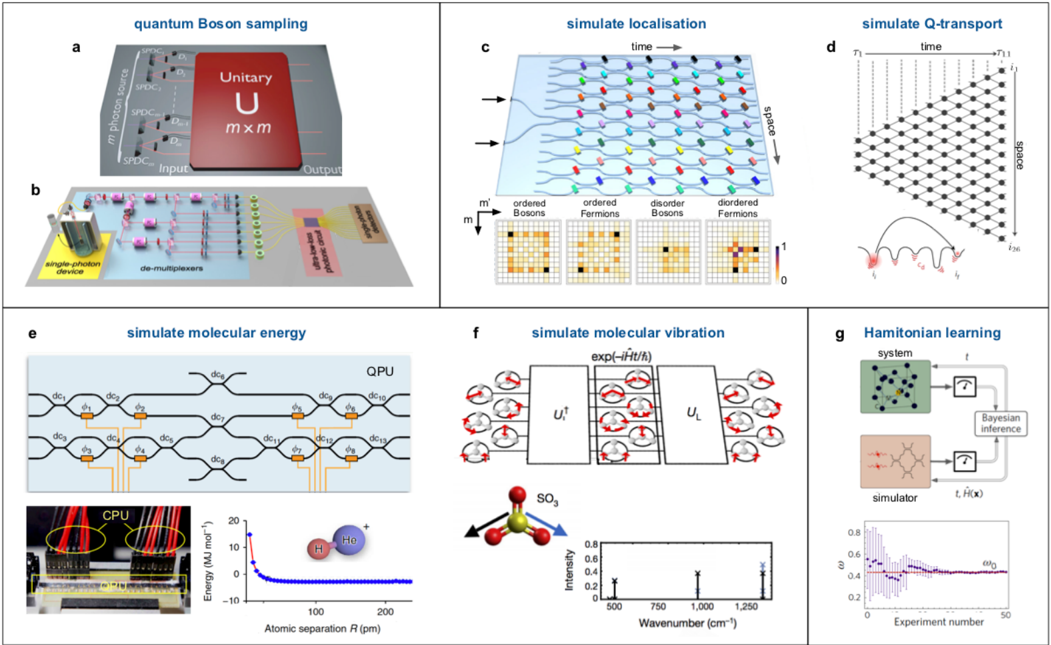
“hysical process [40, 111]. Molecular simulation. Efficient simulation of molecular properties is fundamentally interesting in chemistry [7]. Quantum phase estimation [112] and variational eigensolver [79] were implemented in IQP chips to compute the ground-state energy of molecules (Fig.5e). An algorithm combining the…”
BackgroundMethodInfluentialRaussendorf, R., & Briegel, H. J. (2001) · Physical Review Letters · doi:10.1103/physrevlett.86.5188 · Cited by 4,477
Ladd, T. D., Jelezko, F., Laflamme, R., Nakamura, Y., Monroe, C., & O’Brien, J. L. (2010) · Nature · doi:10.1038/nature08812 · Cited by 3,592
Integrated lithium niobate electro-optic modulators operating at CMOS-compatible voltages
Wang, C., Zhang, M., Chen, X., Bertrand, M., Shams-Ansari, A., Chandrasekhar, S., Winzer, P., & Lončar, M. (2018) · Nature · doi:10.1038/s41586-018-0551-y · Cited by 2,593 · cited 2×
“elopment of multiplexed parametric SPSs [49, 50] and de-multiplexed QD-SPSs [56, 57]. They both require a network of fast and low-loss optical switches. Recent progress in thin-film LN-based switches [118] has shown a great promise for the multiplexed and de-multiplexed many-photon generation. These advanced systems a…”
BackgroundExperimental Test of Local Hidden-Variable Theories
Freedman, S. J., & Clauser, J. F. (1972) · Physical Review Letters · doi:10.1103/physrevlett.28.938 · Cited by 1,999 · cited 1×
“s of quantum physical and chemical systems, Boson sampling, and linear-optic quantum information processing. Introduction Pioneering investigations of quantum science, including tests of entanglement [1], generation of squeezed light [2], demonstrations of quantum teleportation [3], and loophole-free tests of Bell non…”
BackgroundGottesman, D., & Chuang, I. L. (1999) · Nature · doi:10.1038/46503 · Cited by 1,860
Research works printed but not linked: 1
- 99. S. Aaronson & A. Arkhipov. Boson sampling is far from uniform. Quantum Inf. Comput. 14, 1383-423 (2014).
Cited by
Items 301–400 of 1,640
Holewa, P., Kadkhodazadeh, S., Gawełczyk, M., Baluta, P., Musiał, A., Dubrovskii, V. G., Syperek, M., & Semenova, E. S. (2022) · Nanophotonics · doi:10.1515/nanoph-2021-0482 · Cited by 34
Lomonte, E., Stappers, M., Krämer, L., Pernice, W. H. P., & Lenzini, F. (2024) · Scientific Reports · doi:10.1038/s41598-024-53975-4 · Cited by 39
A 3D Polymeric Platform for Photonic Quantum Technologies
Colautti, M., Lombardi, P., Trapuzzano, M., Piccioli, F. S., Pazzagli, S., Tiribilli, B., Nocentini, S., Cataliotti, F. S., Wiersma, D. S., & Toninelli, C. (2020) · Advanced Quantum Technologies · doi:10.1002/qute.202000004 · Cited by 36
Universal visible emitters in nanoscale integrated photonics
Spektor, G., Carlson, D. R., Newman, Z. L., Skarda, J., Sapra, N. V., Su, L., Jammi, S., Ferdinand, A. R., Agrawal, A. K., Vučković, J., et al. (2023) · Optica · doi:10.1364/optica.486747 · Cited by 37
Demonstration of hypergraph-state quantum information processing
Huang, J., Li, X., Chen, X., Zhai, C., Zheng, Y., Chi, Y., Li, Y., He, Q., Gong, Q., & Wang, J. (2024) · Nature Communications · doi:10.1038/s41467-024-46830-7 · Cited by 54
Self-citationÇoban, A., Dzsotjan, D., Küchemann, S., Durst, J., Kühn, J., & Hoyer, C. (2025) · EPJ Quantum Technology · doi:10.1140/epjqt/s40507-025-00310-z · Cited by 43
Reconfigurable metasurface-based 1 × 2 waveguide switch
Alquliah, A., ElKabbash, M., Cheng, J., Verma, G., Saraj, C. S., Li, W., & Guo, C. (2021) · Photonics Research · doi:10.1364/prj.428577 · Cited by 35
On-chip microdisk laser on Yb3+-doped thin-film lithium niobate
Zhou, Y., Wang, Z., Fang, Z., Liu, Z., Zhang, H., Yin, D., Liang, Y., Zhang, Z., Liu, J., Huang, T. C., et al. (2021) · Optics Letters · doi:10.1364/ol.440379 · Cited by 35
Topologically protecting squeezed light on a photonic chip
Ren, R.-J., Lu, Y., Jiang, Z.-K., Gao, J., Zhou, W., Wang, Y., Jiao, Z., Wang, X., Solntsev, A. S., & Jin, X. (2022) · Photonics Research · doi:10.1364/prj.445728 · Cited by 35
Tailoring polarization in WSe2 quantum emitters through deterministic strain engineering
Paralikis, A., Piccinini, C., Madigawa, A. A., Metuh, P., Vannucci, L., Gregersen, N., & Munkhbat, B. (2024) · npj 2D Materials and Applications · doi:10.1038/s41699-024-00497-2 · Cited by 32
3D Integrated Laser Attach Technology on a 300-mm Monolithic CMOS Silicon Photonics Platform
Bian, Y., Ramachandran, K., Wu, Z.-J., Hedrick, B., Dezfulian, K. K., Houghton, T., Nummy, K., Fisher, D., Hirokawa, T., Donegan, K. P., et al. (2023) · IEEE Journal of Selected Topics in Quantum Electronics · doi:10.1109/jstqe.2023.3238290 · Cited by 35
Krisnanda, T., Ghosh, S., Paterek, T., & Liew, T. C. H. (2021) · Neural Networks · doi:10.1016/j.neunet.2021.01.003 · Cited by 37
On-chip quantum interference between the origins of a multi-photon state
Feng, L., Zhang, M., Liu, D., Cheng, Y., Guo, G., Daoxin Dai, A., Guo, G., Krenn, M., & Ren, X. (2022) · Optica · doi:10.1364/optica.474750 · Cited by 40
Enhanced Detection Rate and High Photon-Number Efficiencies with a Scalable Parallel SNSPD
Stasi, L., Taher, T., Resta, G. V., Zbinden, H., Thew, R., & Bussières, F. (2024) · ACS Photonics · doi:10.1021/acsphotonics.4c01680 · Cited by 43
Gradient-Descent Quantum Process Tomography by Learning Kraus Operators
Ahmed, S., Quijandría, F., & Kockum, A. F. (2023) · Physical Review Letters · doi:10.1103/physrevlett.130.150402 · Cited by 54
Fyrillas, A., Faure, O., Maring, N., Sénellart, J., & Belabas, N. (2024) · Optica · doi:10.1364/optica.512148 · Cited by 49
Towards large‐scale programmable silicon photonic chip for signal processing
Xie, Y., Wu, J., Hong, S., Wang, C., Liu, S., Li, H., Ju, X., Ke, X., Liu, D., & Dai, D. (2024) · Nanophotonics · doi:10.1515/nanoph-2023-0836 · Cited by 40
Room temperature polariton spin switches based on Van der Waals superlattices
Zhao, J., Fieramosca, A., Bao, R., Dini, K., Su, R., Sanvitto, D., Xiong, Q., & Liew, T. C. H. (2024) · Nature Communications · doi:10.1038/s41467-024-51612-2 · Cited by 36
Ferroelectric domain architecture and poling of BaTiO3 on Si
Nordlander, J., Eltes, F., Reynaud, M., Nürnberg, J., Luca, G. D., Caimi, D., Demkov, A. A., Abel, S., Fiebig, M., Fompeyrine, J., et al. (2020) · Physical Review Materials · doi:10.1103/physrevmaterials.4.034406 · Cited by 33
Spatially Shaping Waves to Penetrate Deep inside a Forbidden Gap
Uppu, R., Adhikary, M., Harteveld, C. A. M., & Vos, W. L. (2021) · Physical Review Letters · doi:10.1103/physrevlett.126.177402 · Cited by 31
Selectively steering photon spin angular momentum via electron-induced optical spin Hall effect
Chi, C., Jiang, Q., Liu, Z., Zheng, L., Jiang, M., Zhang, H., Lin, F., Shen, B., & Fang, Z. (2021) · Science Advances · doi:10.1126/sciadv.abf8011 · Cited by 33
A generalized multipath delayed-choice experiment on a large-scale quantum nanophotonic chip
Chen, X., Deng, Y., Liu, S., Pramanik, T., Mao, J., Bao, J., Zhai, C., Dai, T., Yuan, H., Guo, J., et al. (2021) · Nature Communications · doi:10.1038/s41467-021-22887-6 · Cited by 35
Self-citationThermal Behaviors and Optical Parametric Oscillation in 4H‐Silicon Carbide Integrated Platforms
Shi, X., Fan, W., Hansen, A. K., Chi, M., Yi, A., Ou, X., Rottwitt, K. K., & Ou, H. (2021) · Advanced Photonics Research · doi:10.1002/adpr.202100068 · Cited by 32
Topologically Protected Quantum Logic Gates with Valley‐Hall Photonic Crystals
He, L., Liu, D., Zhang, H., Zhang, F., Zhang, W., Feng, X., Huang, Y., Cui, K., Liu, F., Zhang, W., et al. (2024) · Advanced Materials · doi:10.1002/adma.202311611 · Cited by 37
Lee, J. ‐., Jeong, M., Jang, J., Kim, J., Mun, J., Gong, X., Fang, R., Yang, Y., Chae, S. H., Kim, S., et al. (2025) · Nano Letters · doi:10.1021/acs.nanolett.4c05544 · Cited by 31
Enhanced on-chip phase measurement by inverse weak value amplification
Song, M., Steinmetz, J., Zhang, Y., Nauriyal, J., Lyons, K., Jordan, A. N., & Cárdenas, J. (2021) · Nature Communications · doi:10.1038/s41467-021-26522-2 · Cited by 34
Ashby, J., Thiel, V., Allgaier, M., d’Ornellas, P., Davis, A. O. C., & Smith, B. J. (2020) · Optics Express · doi:10.1364/oe.410371 · Cited by 38
High-rate 16-node quantum access network based on a passive optical network
Pan, Y., Bian, Y., Li, Y., Xu, X., Ma, L., Wang, H., Luo, Y., Ye, T., Pi, Y., Yang, J., et al. (2025) · Optica · doi:10.1364/optica.553783 · Cited by 46
Low-threshold power and tunable integrated optical limiter based on an ultracompact VO2/Si waveguide
Parra, J., Navarro‐Arenas, J., Menghini, M. A., Recaman-Payo, M., Locquet, J., & Sanchis, P. (2021) · APL Photonics · doi:10.1063/5.0071395 · Cited by 34
High-dimensional quantum information processing on programmable integrated photonic chips
Chi, Y., Yu, Y., Gong, Q., & Wang, J. (2023) · Science China Information Sciences · doi:10.1007/s11432-022-3602-0 · Cited by 34
Self-citationQuantum state processing through controllable synthetic temporal photonic lattices
Monika, M., Nosrati, F., George, A., Sciara, S., Fazili, R., Muniz, A. L. M., Bisianov, A., Franco, R. L., Munro, W. J., Chemnitz, M., et al. (2024) · Nature Photonics · doi:10.1038/s41566-024-01546-4 · Cited by 47
Multimode-enabled silicon photonic delay lines: break the delay-density limit
Hong, S., Zhang, L., Wu, J., Peng, Y., Lyu, L., Hu, Y., Xie, Y., & Dai, D. (2025) · Light Science & Applications · doi:10.1038/s41377-025-01820-2 · Cited by 37
Experimental multiparameter quantum metrology in adaptive regime
Valeri, M., Cimini, V., Piacentini, S., Ceccarelli, F., Polino, E., Hoch, F., Bizzarri, G., Corrielli, G., Spagnolo, N., Osellame, R., et al. (2023) · Physical Review Research · doi:10.1103/physrevresearch.5.013138 · Cited by 38
Self-citationEnergy-time and time-bin entanglement: past, present and future
XAVIER, G. B., Larsson, J.-Å., Villoresi, P., Vallone, G., & Cabello, A. (2025) · npj Quantum Information · doi:10.1038/s41534-025-01072-3 · Cited by 53
Unitarity Estimation for Quantum Channels
Chen, K., Wang, Q., Long, P., & Ying, M. (2023) · IEEE Transactions on Information Theory · doi:10.1109/tit.2023.3263645 · Cited by 46
A generalized multipath delayed-choice experiment on a large-scale quantum nanophotonic chip
Chen, X., Deng, Y., Liu, S., Pramanik, T., Mao, J., Bao, J., Zhai, C., Dai, T., Yuan, H., Guo, J., et al. (2021) · RePEc: Research Papers in Economics · Cited by 30
Self-citationPhotonic-chip-based dense entanglement distribution
Ren, S., Wang, W.-Q., Cheng, Y., Huang, L., Du, B., Zhao, W., Guo, G., Feng, L., Zhang, W., & Ren, X. (2023) · PhotoniX · doi:10.1186/s43074-023-00089-1 · Cited by 35
Liu, S., Li, X., Liu, H., Qiu, G., Ma, J., Nie, L., Meng, Y., Hu, X., Ni, H., Niu, Z., et al. (2024) · Nature Photonics · doi:10.1038/s41566-024-01449-4 · Cited by 41
Burridge, B. M., Faruque, I. I., Rarity, J. G., & Barreto, J. (2020) · Optics Letters · doi:10.1364/ol.393077 · Cited by 40
Zhu, Y., Wei, W., Yi, A., Jin, T., Shen, C., Wang, X., Zhou, L., Wang, C., Ou, W., Song, S., et al. (2022) · Laser & Photonics Review · doi:10.1002/lpor.202200172 · Cited by 31
Photonic topological insulators in femtosecond laser direct-written waveguides
Yan, W., Zhang, B., & Chen, F. (2024) · npj Nanophotonics · doi:10.1038/s44310-024-00040-7 · Cited by 37
Two strategies for modeling nonlinear optics in lossy integrated photonic structures
Banić, M., Zatti, L., Liscidini, M., & Sipe, J. E. (2022) · Physical Review A · doi:10.1103/physreva.106.043707 · Cited by 35
Vandekerckhove, T., Vanackere, T., Witte, J. D., Cuyvers, S., Reis, L., Billet, M., Roelkens, G., Clemmen, S., & Kuyken, B. (2023) · Optical Materials Express · doi:10.1364/ome.494038 · Cited by 34
Deterministic Quantum Light Arrays from Giant Silica-Shelled Quantum Dots
Nguyen, H., Sharp, D., Fröch, J. E., Cai, Y., Wu, S., Monahan, M., Munley, C., Manna, A., Majumdar, A., Kagan, C. R., et al. (2022) · ACS Applied Materials & Interfaces · doi:10.1021/acsami.2c18475 · Cited by 32
Information processing at the speed of light
AbuGhanem, M. (2024) · Frontiers of Optoelectronics · doi:10.1007/s12200-024-00133-3 · Cited by 35
A Bi-CMOS electronic photonic integrated circuit quantum light detector
Tasker, J. F., Frazer, J., Ferranti, G., & Matthews, J. C. F. (2024) · Science Advances · doi:10.1126/sciadv.adk6890 · Cited by 39
Heisenberg-limited Hamiltonian learning for interacting bosons
Li, H., Tong, Y., Gefen, T., Ni, H., & Ying, L. (2024) · npj Quantum Information · doi:10.1038/s41534-024-00881-2 · Cited by 57
Kumar, S., Wu, C., Komisar, D., Kan, Y., Kulikova, L. F., Давыдов, В. А., Agafonov, V., & Bozhevolnyi, S. I. (2021) · The Journal of Chemical Physics · doi:10.1063/5.0033507 · Cited by 30
Compact high-extinction tunable CROW filters for integrated quantum photonic circuits
Kumar, R. R., Wu, X., & Tsang, H. K. (2020) · Optics Letters · doi:10.1364/ol.384187 · Cited by 29
Polarization-Based Quantum Key Distribution Encoder and Decoder on Silicon Photonics
Zhang, G., Zhao, Z., Dai, J., Yang, S., Fu, X., & Yang, L. (2021) · Journal of Lightwave Technology · doi:10.1109/jlt.2021.3131193 · Cited by 33
Solid-State Color Centers for Single-Photon Generation
Andrini, G., Amanti, F., Armani, F., Bellani, V., Bonaiuto, V., Cammarata, S., Campostrini, M., Dao, T. H., Matteis, F. D., Demontis, V., et al. (2024) · Photonics · doi:10.3390/photonics11020188 · Cited by 33
Femtosecond laser-induced optical waveguides in crystalline garnets: Fabrication and application
Shen, Y., Jia, Y., & Chen, F. (2023) · Optics & Laser Technology · doi:10.1016/j.optlastec.2023.109528 · Cited by 30
Deterministic Fabrication of a Coupled Cavity–Emitter System in Hexagonal Boron Nitride
Nonahal, M., Horder, J., Gale, A., Ding, L., Li, C., Hennessey, M., Ha, S. T., Toth, M., & Aharonovich, I. (2023) · Nano Letters · doi:10.1021/acs.nanolett.3c01836 · Cited by 31
Ma, Y., Liu, W., Liu, X., Wang, N., & Zhang, H. (2024) · International Journal of Optomechatronics · doi:10.1080/15599612.2024.2342279 · Cited by 32
On-Chip Hong–Ou–Mandel Interference from Separate Quantum Dot Emitters in an Integrated Circuit
Dusanowski, Ł., Köck, D., Schneider, C., & Höfling, S. (2023) · ACS Photonics · doi:10.1021/acsphotonics.3c00679 · Cited by 34
Hashemi, A., Zakeri, M. J., Jung, P. S., & Blanco‐Redondo, A. (2025) · APL Photonics · doi:10.1063/5.0239265 · Cited by 33
Coherent perfect absorption of quantum light
Vetlugin, A. N. (2021) · Physical Review A · doi:10.1103/physreva.104.013716 · Cited by 33
A conformal mapping approach to broadband nonlinear optics on chip
Huang, C., Luo, Y., Zhao, Y., Ma, X., Yan, Z. B., Liu, Z., Sheng, C., Zhu, S. N., & Liu, H. (2024) · Nature Photonics · doi:10.1038/s41566-024-01386-2 · Cited by 33
Сукачев, Д. Д. (2020) · Physics-Uspekhi · doi:10.3367/ufne.2020.11.038888 · Cited by 28
Marangon, D. G., Smith, P. R., Walk, N., Paraïso, T. K., Dynes, J. F., Lovic, V., Sanzaro, M., Roger, T., Marco, I. D., Lucamarini, M., et al. (2024) · Nature Electronics · doi:10.1038/s41928-024-01140-0 · Cited by 40
Sun, A., Deng, X., Xing, S., Li, Z., Jia, J., Li, G., Yan, A., Luo, P., Li, Y., Luo, Z., et al. (2023) · Optics Express · doi:10.1364/oe.493866 · Cited by 31
High-dimensional time-frequency entanglement in a singly-filtered biphoton frequency comb
Cheng, X., Chang, K.-C., Sarihan, M. C., Mueller, A., Spiropulu, M., Shaw, M. D., Korzh, B. A., Faraon, A., Wong, F. N. C., Shapiro, J. H., et al. (2023) · Communications Physics · doi:10.1038/s42005-023-01370-2 · Cited by 35
Field-programmable photonic nonlinearity
Wu, T., Li, Y., Ge, L., & Feng, L. (2025) · Nature Photonics · doi:10.1038/s41566-025-01660-x · Cited by 47
All-photonic one-way quantum repeaters with measurement-based error correction
Niu, D., Zhang, Y., Shabani, A., & Shapourian, H. (2023) · npj Quantum Information · doi:10.1038/s41534-023-00775-9 · Cited by 38
Symmetric quantum states: a review of recent progress
Marconi, C., Müller-Rigat, G., Romero-Pallejà, J., Tura, J., & Sanpera, A. (2026) · Reports on Progress in Physics · doi:10.1088/1361-6633/ae440a · Cited by 38
Lu, C., Li, H., Qiu, J., Zhang, Y., Liu, S., Zheng, Y., & Chen, X. (2022) · Optics Express · doi:10.1364/oe.447958 · Cited by 27
Miller, F., Chen, R., Fröch, J. E., Fang, Z., Tara, V., Geiger, S., & Majumdar, A. (2024) · Nano Letters · doi:10.1021/acs.nanolett.4c00070 · Cited by 27
Programmable Bloch polaritons in graphene
Xiong, L., Li, Y., Jung, M., Forsythe, C., Zhang, S., McLeod, A. S., Dong, Y., Liu, S., Ruta, F., Li, C., et al. (2021) · Science Advances · doi:10.1126/sciadv.abe8087 · Cited by 29
Chip-Based Quantum Key Distribution against Trojan-Horse Attack
Tan, H., Li, W., Zhang, L., Wei, K., & Xu, F. (2021) · Physical Review Applied · doi:10.1103/physrevapplied.15.064038 · Cited by 29
Accelerated variational algorithms for digital quantum simulation of many-body ground states
Lyu, C., Montenegro, V., & Bayat, A. (2020) · Quantum · doi:10.22331/q-2020-09-16-324 · Cited by 37
Lauro, L. D., Sciara, S., Fischer, B., Dong, J., Alamgir, I., Wetzel, B., Genty, G., Nichols, M., Eshaghi, A., Moss, D., et al. (2025) · Advances in Optics and Photonics · doi:10.1364/aop.533504 · Cited by 59
Hepp, S., Hornung, F., Bauer, S., Hesselmeier, E., Yuan, X., Jetter, M., Portalupi, S. L., Rastelli, A., & Michler, P. (2020) · Applied Physics Letters · doi:10.1063/5.0033213 · Cited by 26
Logical rotation of non-separable states via uniformly self-assembled chiral superstructures
Zhang, Y., Liu, S., Chen, P., Zhu, D. B., Chen, W., Ge, S., Wang, Y., Zhang, Z., & Lu, Y. (2024) · Nature Communications · doi:10.1038/s41467-024-45299-8 · Cited by 30
Pockels effect in low-temperature rhombohedral BaTiO3
Paoletta, T., & Demkov, A. A. (2021) · Physical review. B./Physical review. B · doi:10.1103/physrevb.103.014303 · Cited by 26
Proposal of Low-Loss Non-Volatile Mid-Infrared Optical Phase Shifter Based on Ge2Sb2Te3S2
Miyatake, Y., Makino, K., Tominaga, J., Miyata, N., Nakano, T., Okano, M., Toprasertpong, K., Takagi, S., & Takenaka, M. (2023) · IEEE Transactions on Electron Devices · doi:10.1109/ted.2023.3235865 · Cited by 26
Molding Photon Emission with Hybrid Plasmon‐Emitter Coupled Metasurfaces
Kan, Y., & Bozhevolnyi, S. I. (2022) · Advanced Optical Materials · doi:10.1002/adom.202102697 · Cited by 28
Quantum computer-aided design of quantum optics hardware
Kottmann, J. S., Krenn, M., Kyaw, T. H., Alperin-Lea, S., & Aspuru‐Guzik, A. (2021) · Quantum Science and Technology · doi:10.1088/2058-9565/abfc94 · Cited by 29
Quantum state engineering in arrays of nonlinear waveguides
Barral, D., Walschaers, M., Bencheikh, K., Parigi, V., Levenson, J. A., Treps, N., & Belabas, N. (2020) · Physical Review A · doi:10.1103/physreva.102.043706 · Cited by 28
Quantum random number generation based on a perovskite light emitting diode
Argillander, J., Alarcón, A., Bao, C., Kuang, C., Lima, G., Gao, F., & XAVIER, G. B. (2023) · Communications Physics · doi:10.1038/s42005-023-01280-3 · Cited by 26
Unified laser stabilization and isolation on a silicon chip
White, A. D., Ahn, G. H., Luhtaru, R., Guo, J., Morin, T. J., Saxena, A., Chang, L., Majumdar, A., Gasse, K. V., Bowers, J. E., et al. (2024) · Nature Photonics · doi:10.1038/s41566-024-01539-3 · Cited by 38
Boson bunching is not maximized by indistinguishable particles
Seron, B., Novo, L., & Cerf, N. J. (2023) · Nature Photonics · doi:10.1038/s41566-023-01213-0 · Cited by 48
Efficient linear optical generation of a multipartite W state via a quantum eraser
Kim, Y., Cho, Y., Lim, H., & Han, S.-W. (2020) · Physical Review A · doi:10.1103/physreva.101.022337 · Cited by 28
Hybrid material integration for active photonic applications
Chen, C., Chen, Y., Fang, Z., Ge, R., Wu, J., & Chen, X. (2024) · APL Photonics · doi:10.1063/5.0187924 · Cited by 28
Bias-free source-independent quantum random number generator
Zheng, Z., Zhang, Y., Huang, M., Chen, Z., Yu, S., & Guo, H. (2020) · Optics Express · doi:10.1364/oe.396461 · Cited by 26
Meta-grating outcouplers for optimized beam shaping in the visible
Ropp, C., Yulaev, A., Westly, D., Simelgor, G., & Aksyuk, V. (2021) · Optics Express · doi:10.1364/oe.424644 · Cited by 30
Top-down integration of an hBN quantum emitter in a monolithic photonic waveguide
Gérard, D., Rosticher, M., Watanabe, K., Taniguchi, T., Barjon, J., Buil, S., Hermier, J., & Delteil, A. (2023) · Applied Physics Letters · doi:10.1063/5.0152721 · Cited by 25
Scalable feedback stabilization of quantum light sources on a CMOS chip
Kramnik, D., Wang, I., Ramesh, A., Cabanillas, J. M. F., Gluhović, Ð., Buchbinder, S., Zarkos, P. G., Adamopoulos, C. G., Kumar, P., Stojanovic, V. M., et al. (2025) · Nature Electronics · doi:10.1038/s41928-025-01410-5 · Cited by 29
Large-scale quantum communication networks with integrated photonics
Zheng, Y., Wang, H., Jia, X., Huang, J., Yuan, H., Zhai, C., Dai, J., Shi, J., Zhang, L., Zhang, X., et al. (2026) · Nature · doi:10.1038/s41586-026-10152-z · Cited by 53
Self-citationEngineering Quantum Nanophotonic Components from Hexagonal Boron Nitride
Nonahal, M., Li, C., Ren, H., Spencer, L., Kianinia, M., Toth, M., & Aharonovich, I. (2023) · Laser & Photonics Review · doi:10.1002/lpor.202300019 · Cited by 29
On-Chip Quantum Interference between Independent Lithium Niobate-on-Insulator Photon-Pair Sources
Chapman, R. J., Kuttner, T., Kellner, J., Sabatti, A., Maeder, A., Finco, G., Kaufmann, F., & Grange, R. (2025) · Physical Review Letters · doi:10.1103/n2y3-2bmz · Cited by 36
Electrons herald non-classical light
Arend, G., Huang, G., Feist, A., Yang, Y., Henke, J.-W., Qiu, Z., Jeng, H., Raja, A. S., Haindl, R., Wang, R. N., et al. (2025) · Nature Physics · doi:10.1038/s41567-025-03033-1 · Cited by 43
Demonstration of universal time-reversal for qubit processes
Schiansky, P., Strömberg, T., Trillo, D., Saggio, V., Dive, B., Navascués, M., & Walther, P. J. (2022) · Optica · doi:10.1364/optica.469109 · Cited by 25
Yu, X., Wu, X., Chen, K., Wang, J., & Liu, L. (2022) · Optical Materials Express · doi:10.1364/ome.477278 · Cited by 26
Self-citationAmorphous superconducting nanowire single-photon detectors integrated with nanophotonic waveguides
Häußler, M., Mikhaĭlov, M. Y., Wolff, M. A., & Schuck, C. (2020) · APL Photonics · doi:10.1063/5.0004677 · Cited by 25
Transparent glass-ceramic waveguides made by femtosecond laser writing
Ferreira, P. H. D., Fabris, D. C. N., Villas-Bôas, M. D. O. C., Bezerra, I. G., Mendonça, C. R., & Zanotto, E. D. (2020) · Optics & Laser Technology · doi:10.1016/j.optlastec.2020.106742 · Cited by 24
Position-dependent chiral coupling between single quantum dots and cross waveguides
Xiao, S., Wu, S., Xie, X., Yang, J., Wei, W., Shi, S., Song, F., Sun, S., Dang, J., Yang, L., et al. (2021) · Applied Physics Letters · doi:10.1063/5.0042480 · Cited by 25
Fedyanin, D. Y. (2021) · Advanced Quantum Technologies · doi:10.1002/qute.202100048 · Cited by 28
Experimental Parity-Time Symmetric Quantum Walks for Centrality Ranking on Directed Graphs
Wu, T., Izaac, J., Li, Z., Wang, K., Chen, Z., Zhu, S. N., Wang, J. B., & Ma, X. (2020) · Physical Review Letters · doi:10.1103/physrevlett.125.240501 · Cited by 25
Self-citationHäußler, M., Terhaar, R., Wolff, M. A., Gehring, H., Beutel, F., Hartmann, W., Walter, N., Tillmann, M., Ahangarianabhari, M., Wahl, M., et al. (2023) · Review of Scientific Instruments · doi:10.1063/5.0114903 · Cited by 26
Nanoscopic Charge Fluctuations in a Gallium Phosphide Waveguide Measured by Single Molecules
Shkarin, A., Rattenbacher, D., Renger, J., Hönl, S., Utikal, T., Seidler, P. F., Götzinger, S., & Sandoghdar, V. (2021) · Physical Review Letters · doi:10.1103/physrevlett.126.133602 · Cited by 25
Metadata
- Authors
- Wang, J., Sciarrino, F., Laing, A., & Thompson, M. G.
- Affiliations
- Peking University (CN)
- Sapienza University of Rome (IT)
- University of Bristol (GB)
- Corresponding author
- Thompson, Mark G.
- Venue
- Nature Photonics
- Published
- 2019-10-21
- Volume
- 14
- Issue
- 5
- Pages
- 273-284
- ISSN
- 1749-4885 (ISSN-L)
- 1749-4893
- OpenAlex
- W2980980200
- Cited by
- 1,576
- References
- 139
- Citations by year
- 2026: 195 · 2025: 342 · 2024: 290 · 2023: 259 · 2022: 189 · 2021: 203 · 2020: 89 · 2019: 6
- FWCI
- 55.54
- Type
- journal article
- Language
- en
- Open access
- green
- arxiv.org
- Licence
- www.springer.com/tdm (tdm)
- www.springer.com/tdm (vor)
- Locations
- Nature Photonics (publishedVersion)
- arXiv (Cornell University) (submittedVersion)
- arXiv (Cornell University)
- Funders
- Engineering and Physical Sciences Research Council (EP/L024020/1, EP/N003470/1, EP/K033085/1)
- Topics
- Physical Sciences › Physics and Astronomy › Atomic and Molecular Physics, and Optics › Quantum Information and Cryptography
- Physical Sciences › Engineering › Electrical and Electronic Engineering › Photonic and Optical Devices
- Physical Sciences › Computer Science › Artificial Intelligence › Quantum Computing Algorithms and Architecture
- Keywords
- integrated quantum photonics, quantum technologies, quantum entanglement, multi-photon states, quantum communication, quantum simulation, sampling algorithms
About these checks
Registry, retraction, Cites and statistics results are computed, not judged, with one exception: a printed reference that no index lists is read once by a model before it counts as a citation error. Claims are extracted by a model and kept only when their quote appears verbatim in the text; each cited source is then checked, with a model’s help, for whether it says what the claim relies on. Those verdicts can be wrong — read the claim’s quote and the cited source before relying on one.
The claim verdicts this report counts are experimental: their accuracy is not yet measured.
A language model drew the claims from the paper on 2026-11-10, under version 3 of the claim definition (model deepseek-v4.1-flash, prompt extract-v3).
A second model labelled each claim on 2026-11-10 (model jev-1.13-20260917, definition revision gold-guideline-v0.2).
Cited sources are checked with a language model’s help (gpt-6-sol).
Statistics and arithmetic are recomputed, not judged.
Confidence bands are shown only for fields calibrated on our annotated test set. None is calibrated yet, so no band is shown.
What counts as a claim ›How we measure confidence ›How we check this ›
Are you an author, or do you see a problem with this page? Request a review
Data sources
Bibliographic data: Semantic Scholar, OpenAlex, Crossref.
Contains information from the Semantic Scholar Academic Graph Datasets, made available under the ODC Attribution License (ODC-BY 1.0).
Semantic Scholar’s data is described in: Kinney, R., et al. (2023). The Semantic Scholar Open Data Platform. arXiv:2301.10140.
