

Integrated photonic quantum technologies
Open accessThe DOI matches its Crossref record; 156 of the 158 references it cites were found in a registry or an index, and 2 are not checked yet; 103 of the 132 sources its claims cite were checked for support.
Abstract
Quantum technologies comprise an emerging class of devices capable of controlling superposition and entanglement of quantum states of light or matter, to realize fundamental performance advantages over ordinary classical machines. The technology of integrated quantum photonics has enabled the generation, processing and detection of quantum states of light at a steadily increasing scale and level of complexity, progressing from few-component circuitry occupying centimetre-scale footprints and operating on two photons, to programmable devices approaching 1,000 components occupying millimetre-scale footprints with integrated generation of multiphoton states. This Review summarizes the advances in integrated photonic quantum technologies and its demonstrated applications, including quantum communications, simulations of quantum chemical and physical systems, sampling algorithms, and linear-optic quantum information processing. This Review covers recent progress in integrated quantum photonics (IQP) technologies and their applications. The challenges and opportunities of realizing large-scale, monolithic IQP circuits for future quantum applications are discussed.
Verified 2026-11-22 · 2 references not checked yet
Overview
CoChat Summary
TL;DR
This review summarizes a decade of integrated quantum photonics (IQP), covering platforms, single-photon sources/detectors, circuits, and applications in quantum communications, information processing, Boson sampling, and simulation. It argues that IQP has scaled from few-component two-photon circuits to programmable silicon chips with hundreds of components, while identifying full integration and photon-number scaling as key challenges.
Key findings
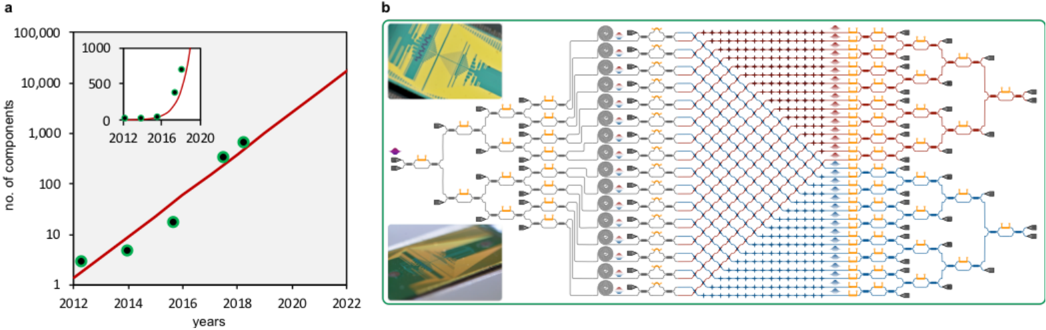
- IQP advanced from fixed circuits with few components operating on two photons to programmable circuitry approaching 1000 components with integrated multi-photon generation; a state-of-the-art Si device monolithically integrated 671 components (16 SFWM-SPSs, 93 TOPSs, 122 MMIs, 376 waveguide-crossers, 64 grating couplers) and verified up to 15×15 dimensional two-photon entangled states.
- Integrated QKD demonstrations include a chip-to-chip InP transmitter/SiOxNy receiver programmable for BB84 at 560 MHz, coherent-one-way at 860 MHz, and differential-phase-shift at 1.76 GHz; WDM-QKD doubled key rates to 1.11 Mbit/s over 20 km emulated fiber; Si-based transmitters achieved kbps–Mbps secret key rates and 1.0%–5.4% QBER.
- Key device benchmarks: Si-waveguide SNSPDs reached 91% detection efficiency, 18 ps jitter, and 50 Hz dark count; QD-SPSs produced 99.1% single-photon purity, 66% extraction efficiency, and 98.5% indistinguishability; two-photon interference visibilities were 100.1±0.4% in SiO2 and 100.0±0.4% in Si.
- Boson sampling was first demonstrated with n=3 photons, mainly in integrated photonics; the highest photon numbers used demultiplexed single QD-SPS photons, and the review states >20 photons are needed to challenge conventional computers and >50 to surpass supercomputers.
Methods
- Design: narrative review of integrated photonic quantum technologies, summarizing advances in materials, devices, functionality, and on-chip applications.
- Data/sample: published literature and milestone demonstrations from 2008 onward, including platforms (silica, Si, Si3N4, LN, GaAs, InP), sources, detectors, QKD, QIP, Boson sampling, and quantum simulation.
- Analysis: qualitative synthesis of experimental results and stated benchmarks; no primary experimental data or formal systematic-review methodology are reported.
Limitations
- Stated: a fully integrated quantum chip having sources, circuits, and detectors is yet to be realised; cryogenic operation for detectors and manipulation of photons at cryogenic temperature remain technical challenges.
- Stated: creating multiple identical QD-SPSs is difficult due to sample reproducibility; parametric SPSs produce photons nondeterministically with 5%–10% probability; full certification of Boson sampling is believed not possible.
- Evident from the text: as a review, it synthesizes prior work rather than presenting new experiments, and its performance numbers are drawn from cited demonstrations rather than a systematic meta-analysis.
Model-written summary. Check it against the paper before relying on it.
Integrity signals
Registry
Cites
Statistics
Figures

Verification
Claims the paper makes
28 Valid · 48 Not valid · 25 Not checked · 34 Own results and interpretations
Some cited sources support this claim and some don’t — read each source’s verdict below.
In the paper
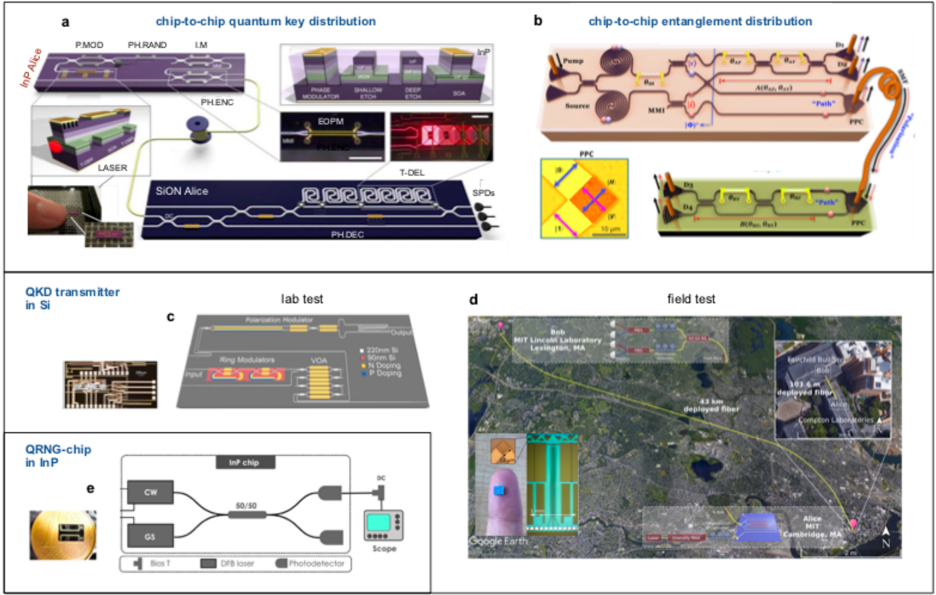
“For example, fully integrated QRNGs have been demonstrated in InP-chips ( Fig.3e ) [38, 74], in which random numbers were generated from the random phases of two-laser interference.”
What the sources say
- Partly supportedcites [38] 37. P. Sibson et al. Chip-based quantum key distribution. Nat. Commun. 8, 13984 (2017). sourceExperimental — accuracy not yet measured
The Results (Integrated photonic devices and Transmitter; page unavailable) describe a monolithically integrated InP chip with an on-chip laser, but it is a QKD transmitter, not a demonstrated QRNG. The Discussion says the receiver's passive basis choice removes the requirement for a QRNG; no passage describes generating random numbers from the phases of two interfering lasers. (LLM, conf=0.85)
- Disputedcites [74] 69. Y. Ding et al. High-dimensional quantum key distribution based on multicore fiber using silicon photonic integrated circuits. npj Quantum Information 3, 25 (2017). sourceExperimental — accuracy not yet measured
The Introduction describes a high-dimensional QKD demonstration using silicon photonic integrated circuits, not an InP-chip QRNG. The Experimental results say the experiment used FPGA-generated pseudorandom sequences for state and basis choices, rather than random phases from two-laser interference. Page numbers are unavailable in our copy. (LLM, conf=0.87)
Checked by a reasoning model — may be wrong.
boostedstates a cause- Asserted: passes — The authors put it forward as true.
- Checkable: passes — It can be checked against evidence.
- Load-bearing: unclear — It is unclear whether the paper’s conclusions depend on it.
- Based: passes — The paper gives a reason why it holds.
- Partly supported
At least one cited source doesn’t support this claim or points to a different paper, and none confirmed it — see the verdicts below.
In the paper
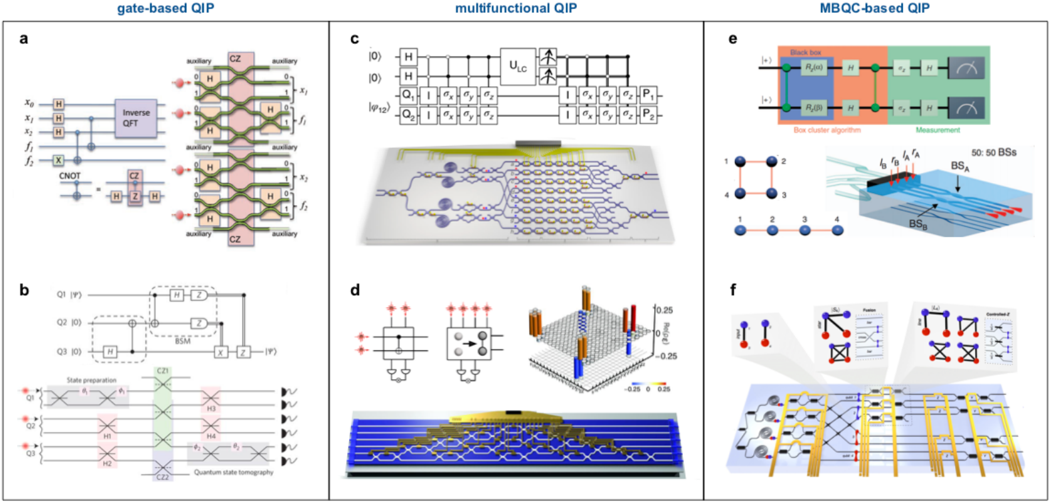
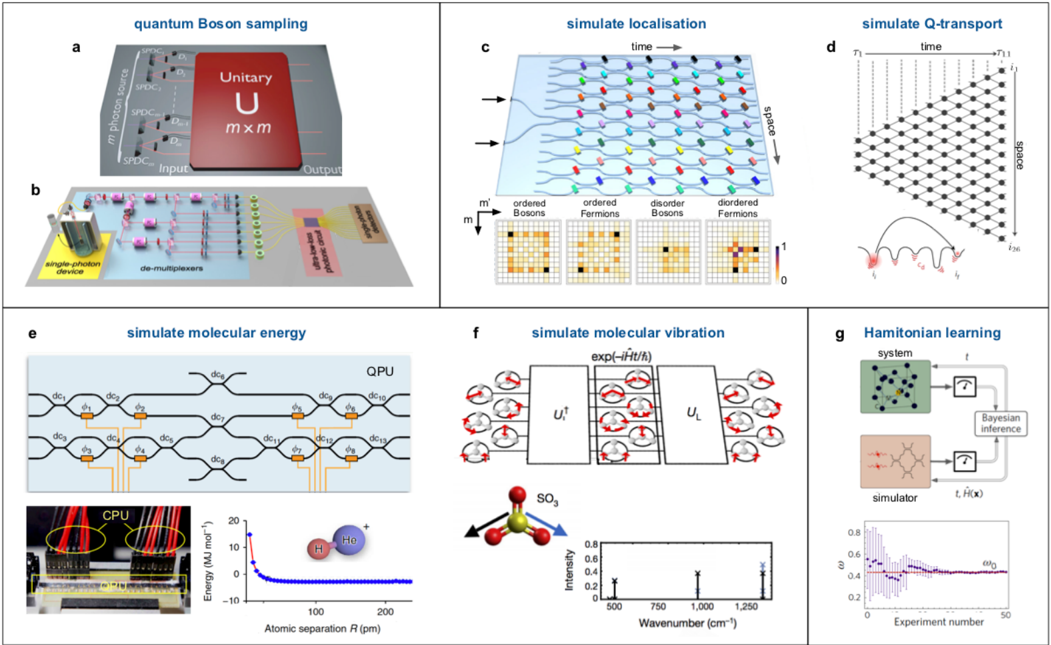
“The on-chip GMM of four-photon four-qubit graph states was demonstrated in a Si-chip ( Fig. 4f ) [87].”
What the sources say
- Disputedcites [87] 81. X. Qiang et al. Large-scale silicon quantum photonics implementing arbitrary two-qubit processing. Nat. Photon. 12, 534-539 (2018). sourceExperimental — accuracy not yet measured
The paper’s Abstract describes a silicon chip that generates two photonic qubits and performs two-qubit processing using only two photons. It does not report generating, manipulating and measuring four-photon four-qubit graph states; its stated demonstration uses a different number of photons and qubits. (LLM, conf=0.90)
Checked by a reasoning model — may be wrong.
boosted- Asserted: passes — The authors put it forward as true.
- Checkable: passes — It can be checked against evidence.
- Load-bearing: unclear — It is unclear whether the paper’s conclusions depend on it.
- Based: passes — The paper gives a reason why it holds.
- Disputed
At least one cited source doesn’t support this claim or points to a different paper, and none confirmed it — see the verdicts below.
In the paper
“The first on-chip GMM of four-qubit cluster state was realised in a laser-writing chip ( Fig.4e ), by manipulating both the polarisation and path DoFs of two photons [85].”
What the sources say
- Disputedcites [85] 79. A. Peruzzo et al. A variational eigenvalue solver on a photonic quantum processor. Nat. Commun. 5, 4213 (2013). sourceExperimental — accuracy not yet measured
The Results section (“Prototype demonstration”; page unavailable) describes a chip that prepares and measures two-qubit states encoded in photon paths, not a four-qubit cluster state encoded in both polarisation and path. Our copy does not establish the claimed first demonstration or laser-writing fabrication. (LLM, conf=0.88)
Checked by a reasoning model — may be wrong.
plainstates a cause- Asserted: passes — The authors put it forward as true.
- Checkable: passes — It can be checked against evidence.
- Load-bearing: unclear — It is unclear whether the paper’s conclusions depend on it.
- Based: passes — The paper gives a reason why it holds.
- Disputed
At least one cited source doesn’t support this claim or points to a different paper, and none confirmed it — see the verdicts below.
In the paper
“For example, the first GMM of entangled two-qubit states encoded in dual-paths were demonstrated in a Si-chip, with the inclusion of ring-resonator-based SFWM photon sources and circuits [84].”
What the sources say
- Disputedcites [84] 78. B. J. Metcalf et al. Quantum teleportation on a photonic chip. Nat. Photon. 8, 770-774 (2014). sourceExperimental — accuracy not yet measured
The main-experiment passage describes three photons from two parametric down-conversion sources coupled into a UV-written silica-on-silicon chip, not ring-resonator SFWM sources integrated on a silicon chip. Figure 1(c) does support dual-rail encoding and on-chip state preparation and tomography, but the claimed chip and photon-source technology contradict the paper’s description. (LLM, conf=0.88)
Checked by a reasoning model — may be wrong.
boosted- Asserted: passes — The authors put it forward as true.
- Checkable: passes — It can be checked against evidence.
- Load-bearing: unclear — It is unclear whether the paper’s conclusions depend on it.
- Based: passes — The paper gives a reason why it holds.
- Disputed
Some cited sources support this claim and some don’t — read each source’s verdict below.
In the paper
“In Fig.6 , we summarise the scaling of integrated quantum photonic circuits in silicon: from a single MZI adopted for the on-chip HOM-interference experiment in 2012 [24], to a state-of-the-art large-scale quantum photonic device having 671 components that was used for the GMM of multi-dimensional entanglement [44].”
What the sources say
- Disputedcites [24] 24. D. Bonneau et al. Quantum interference and manipulation of entanglement in silicon wire waveguide quantum circuits. New J. Phys. 14, 045003 (2012). sourceExperimental — accuracy not yet measured
Split into 2 atoms — 0 confirmed, 1 partially supported, 1 disputed, 0 misattributed, 0 unverifiable. Expand the claim to see per-atom verdicts.
Checked by a reasoning model — may be wrong.
- Partly supportedcites [44] 44. J. Wang et al. Multidimensional quantum entanglement with large-scale integrated optics. Science 360, 285-291 (2018). sourceExperimental — accuracy not yet measured
The opening summary (p. 1) says the silicon-photonics device generated, manipulated and measured multidimensional entanglement. It reports more than 550 components, however, and the components listed in Fig. 1 (p. 2) total 551; our copy does not support the attributed figure of 671. The 2012 single-MZI experiment is attached to a different citation in the citing sentence. (LLM, conf=0.88)
plainstates an association- Asserted: passes — The authors put it forward as true.
- Checkable: passes — It can be checked against evidence.
- Load-bearing: unclear — It is unclear whether the paper’s conclusions depend on it.
- Based: passes — The paper gives a reason why it holds.
- Disputed
67 more claims · 35 with their cited sources checked
Create a free account to see all 135 claims and to verify the 22 references still open.
- It may state two separate claims as one. 38
- Probably not a substantial claim. 34
Claims other papers make about this one
Each is checked against this paper’s own text: does it say what the citing paper says it does?
The source backs part of the claim, not all of it — or backs it for a different population, condition or comparison.
In the citing paper
“As an example, the timeline in figure 1 illustrates this rapid progression from few-component circuits enabling two-photon quantum interference in 2008 [5] to a decade later with devices combining more than 650 components capable of arbitrary and programmable two-qubit operations [6], enabling advances in foundational quantum mechanics, computing, communications, and metrology [7].”
From 2022 Roadmap on integrated quantum photonics (2022) · cites this paper as [7]
Experimental — accuracy not yet measuredThe source backs part of the claim, not all of it — or backs it for a different population, condition or comparison.
In the citing paper
“Thermo-optic tuning can be used as a drift-free method of bias control [16,468], but this requires tradeoffs in power dissipation and tuning bandwidth.”
From Integrated photonics on thin-film lithium niobate (2021) · cites this paper as [468]
Experimental — accuracy not yet measuredThe source backs part of the claim, not all of it — or backs it for a different population, condition or comparison.
In the citing paper
“Recent advances in the fabrication of quantum photonic integrated circuits (QPICs) have enabled the functionality of bench-top nonlinear sources to be scaled down to a single chip, with a dramatic improvement in the efficiency and stability [12][13][14][15].”
From Ultrabright Entangled-Photon-Pair Generation from anAlGaAs-On-Insulator Microring Resonator (2021) · cites this paper as [14]
Experimental — accuracy not yet measuredThe cited source says what the claim attributes to it.
In the citing paper
“As a result, it has been the material of choice for many early demonstrations of building blocks for photonic quantum computing and has seen rapid growth in the number of generated photons and integrated components over the last 10 years [7,24,25].”
From 2022 Roadmap on integrated quantum photonics (2022) · cites this paper as [7]
The cited source says what the claim attributes to it.
In the citing paper
“Silicon photonics has been pivotal for increasing the complexity and component-number of on-chip quantum circuitry and revealing the disruptive potential an engineered integrated approach can take for a quantum technology [7].”
From 2022 Roadmap on integrated quantum photonics (2022) · cites this paper as [7]
1 more claim about this paper
Create a free account to see every claim other papers make about this one.
Self-check
Percentages, sums and reported differences re-computed from the paper’s own numbers.
Each contradiction between two passages listed here was confirmed by an independent check.
Rated minor: it would not touch a result — a value no result rests on, a p-value that stays on the same side of the significance level, or a conflict that is clerical, resolved elsewhere in the paper, or outside its own findings.
In the paper
§ Box 2: integrated building blocks for operating photonic states · p. 9
“large-scale quantum circuits in Si with 670 components [44]”
§ Box 2: integrated building blocks for operating photonic states · p. 13
“This large-scale device monolithically integrates 16 SFMW-SPSs, 93 reconfigurable TOPSs, 122 MMIs, 376 waveguide-crossers and 64 grating couplers, in total 671 photonic components.”
Rated minor: it would not touch a result — a value no result rests on, a p-value that stays on the same side of the significance level, or a conflict that is clerical, resolved elsewhere in the paper, or outside its own findings.
In the paper
§ Introduction · p. 1
“In 2001, a theoretical breakthrough presented a scheme for universal quantum computation using photons in linear optics, in which photons interact non-deterministically via quantum interference and measurement-induced nonlinearities [9, 10]”
§ References · p. 14
“9. E. Knill, R. Laflamme & G. J. Milburn. A scheme for efficient quantum computation with linear optics. Nature 409, 46-52 (2000).”
Citations
Cites
Gisin, N., Ribordy, G., Tittel, W., & Zbinden, H. (2002) · Reviews of Modern Physics · doi:10.1103/revmodphys.74.145 · Cited by 8,515 · cited 4×
“do not require operation at mK temperatures or in high vacuum. The translation of quantum information science to real world technologies promises extreme advantages for certain tasks in communication [5], computation [6], and simulation [7]. However, implementing large instances of quantum algorithms or the deployment…”
InfluentialA scheme for efficient quantum computation with linear optics
Knill, E., Laflamme, R., & Milburn, G. J. (2001) · Nature · doi:10.1038/35051009 · Cited by 5,880
Experimental quantum teleportation
Bouwmeester, D., Pan, J.-W., Mattle, K., Eibl, M., Weinfurter, H., & Zeilinger, A. (1997) · Nature · doi:10.1038/37539 · Cited by 5,545 · cited 1×
“antum information processing. Introduction Pioneering investigations of quantum science, including tests of entanglement [1], generation of squeezed light [2], demonstrations of quantum teleportation [3], and loophole-free tests of Bell nonlocality [4], were possible because photons are excellent, low-noise carriers o…”
BackgroundBiamonte, J., Wittek, P., Pancotti, N., Rebentrost, P., Wiebe, N., & Lloyd, S. (2017) · Nature · doi:10.1038/nature23474 · Cited by 4,779
A variational eigenvalue solver on a photonic quantum processor
Peruzzo, A., McClean, J., Shadbolt, P., Yung, M.-H., Zhou, X.-Q., Love, P. J., Aspuru-Guzik, A., & O’Brien, J. L. (2014) · Nature Communications · doi:10.1038/ncomms5213 · Cited by 4,552 · cited 4×
“hysical process [40, 111]. Molecular simulation. Efficient simulation of molecular properties is fundamentally interesting in chemistry [7]. Quantum phase estimation [112] and variational eigensolver [79] were implemented in IQP chips to compute the ground-state energy of molecules (Fig.5e). An algorithm combining the…”
BackgroundMethodInfluentialRaussendorf, R., & Briegel, H. J. (2001) · Physical Review Letters · doi:10.1103/physrevlett.86.5188 · Cited by 4,477
Ladd, T. D., Jelezko, F., Laflamme, R., Nakamura, Y., Monroe, C., & O’Brien, J. L. (2010) · Nature · doi:10.1038/nature08812 · Cited by 3,592
Integrated lithium niobate electro-optic modulators operating at CMOS-compatible voltages
Wang, C., Zhang, M., Chen, X., Bertrand, M., Shams-Ansari, A., Chandrasekhar, S., Winzer, P., & Lončar, M. (2018) · Nature · doi:10.1038/s41586-018-0551-y · Cited by 2,593 · cited 2×
“elopment of multiplexed parametric SPSs [49, 50] and de-multiplexed QD-SPSs [56, 57]. They both require a network of fast and low-loss optical switches. Recent progress in thin-film LN-based switches [118] has shown a great promise for the multiplexed and de-multiplexed many-photon generation. These advanced systems a…”
BackgroundExperimental Test of Local Hidden-Variable Theories
Freedman, S. J., & Clauser, J. F. (1972) · Physical Review Letters · doi:10.1103/physrevlett.28.938 · Cited by 1,999 · cited 1×
“s of quantum physical and chemical systems, Boson sampling, and linear-optic quantum information processing. Introduction Pioneering investigations of quantum science, including tests of entanglement [1], generation of squeezed light [2], demonstrations of quantum teleportation [3], and loophole-free tests of Bell non…”
BackgroundGottesman, D., & Chuang, I. L. (1999) · Nature · doi:10.1038/46503 · Cited by 1,860
Research works printed but not linked: 1
- 99. S. Aaronson & A. Arkhipov. Boson sampling is far from uniform. Quantum Inf. Comput. 14, 1383-423 (2014).
Cited by
Items 701–800 of 1,640
Anisotropic Van Der Waals 2D GeAs Integrated on Silicon Four-Waveguide Crossing
Dushaq, G. H., Villegas, J. E., Paredes, B., Tamalampudi, S. R., & Rasras, M. (2022) · Journal of Lightwave Technology · doi:10.1109/jlt.2022.3229069 · Cited by 9
Pérez‐Armenta, C., Ortega‐Moñux, A., Luque‐González, J. M., Halir, R., Schmid, J. H., Cheben, P., Molina‐Fernández, Í., & Wangüemert-Pérez, J. G. (2023) · Optics & Laser Technology · doi:10.1016/j.optlastec.2023.109493 · Cited by 9
Emission of an atom inside a one-dimensional atomic cavity
Zhou, C., Maleki, Y., Liao, Z., & Zubairy, M. S. (2023) · Physical Review A · doi:10.1103/physreva.108.013708 · Cited by 9
Electrically Controlled Photonic Circuits of Field-Induced Dipolaritons with Huge Nonlinearities
Liran, D., Rapaport, R., Hu, J., Lydick, N., Deng, H., & Pfeiffer, L. N. (2024) · Physical Review X · doi:10.1103/physrevx.14.031022 · Cited by 15
Xue, G.-T., Tian, X.-H., Zhang, C., Xie, Z., Xu, P., Gong, Y.-X., & Zhu, S. N. (2021) · Chinese Physics B · doi:10.1088/1674-1056/ac22a1 · Cited by 9
Ding, S., Dong, B., Huang, H., Bowers, J. E., & Grillot, F. (2022) · Applied Physics Letters · doi:10.1063/5.0077221 · Cited by 9
Rai, A., & Rai, A. (2022) · Journal of Optics · doi:10.1088/2040-8986/ac9915 · Cited by 11
Nonlinear flip-flop quantum walks through potential barriers
Passos, F. S., & Buarque, A. R. C. (2022) · Physical Review A · doi:10.1103/physreva.106.062407 · Cited by 9
Krstić, A., Setzpfandt, F., & Saravi, S. (2023) · Physical Review Research · doi:10.1103/physrevresearch.5.043228 · Cited by 11
Programmable photonic unitary circuits for light computing
Kim, K., Park, K., Park, H., Yu, S., Park, N., & Piao, X. (2025) · Nanophotonics · doi:10.1515/nanoph-2024-0602 · Cited by 14
Integrated dispersion compensator based on cascaded silicon micro-ring resonators
Hui, Z., Xian, B., Han, D., Li, T., & Soliman, A. (2025) · Optics Express · doi:10.1364/oe.554967 · Cited by 9
Tunable Topological Directional Supercoupler and Applications in THz On‐Chip Communication
Jia, R., Wang, W., Tan, Y. J., Tan, T. C., Gupta, M. K., Gu, Z., Pitchappa, P., Szriftgiser, P., Ducournau, G., & Singh, R. (2025) · Laser & Photonics Review · doi:10.1002/lpor.202501209 · Cited by 10
Embedded growth of visible InP quantum dot lasers in silicon nitride photonic integrated circuits
Wang, Y., Heidelberger, C., Plant, J. J., Kharas, D., Dhingra, P., Kaufman, R. B., Fang, X., Li, B., Hool, R. D., Dallesasse, J. M., et al. (2025) · Optica · doi:10.1364/optica.569454 · Cited by 9
Degenerate photons from a cryogenic spontaneous parametric down-conversion source
Lange, N. A., Schapeler, T., Höpker, J. P., Protte, M., & Bartley, T. J. (2023) · Physical Review A · doi:10.1103/physreva.108.023701 · Cited by 11
Guymon, G. G., Sharp, D., Cohen, T. A., Gibbs, S. L., Manna, A., Tzanetopoulos, E., Gamelin, D. R., Majumdar, A., & MacKenzie, J. D. (2024) · Advanced Materials Technologies · doi:10.1002/admt.202301921 · Cited by 9
Double Etch Method for the Fabrication of Nanophotonic Devices from van der Waals Materials
Schaeper, O. C., Spencer, L., Scognamiglio, D., El-Sayed, W., Whitefield, B., Horder, J., Coste, N., Barclay, P. E., Toth, M., Zalogina, A., et al. (2024) · ACS Photonics · doi:10.1021/acsphotonics.4c02115 · Cited by 9
la Torre-Robles, D. D., Domínguez-Serna, F. A., Osorio, G. L., U’Ren, A. B., Bermúdez, D., & Garay-Palmett, K. (2021) · Scientific Reports · doi:10.1038/s41598-021-97563-2 · Cited by 9
Humbert, M., Wiecha, P. R., Francs, G. C. D., Yu, X., Mallet, N., Lecestre, A., Larrieu, G., Larrey, V., Fournel, F., Ressier, L., et al. (2022) · Physical Review Applied · doi:10.1103/physrevapplied.17.014008 · Cited by 9
Tunable photo-induced second-harmonic generation in a mode-engineered silicon nitride microresonator
Nitišs, E., Zabelich, B., Hu, J., Stroganov, A., & Brès, C. (2023) · Optics Express · doi:10.1364/oe.487525 · Cited by 11
Universal Multiport Interferometers for Post‐Selected Multi‐Photon Gates
Baldazzi, A., & Pavesi, L. (2024) · Advanced Quantum Technologies · doi:10.1002/qute.202400418 · Cited by 11
A van der Waals Moiré Bilayer Photonic Crystal Cavity
Spencer, L., Coste, N., Ni, X., Park, S.-M., Schaeper, O. C., Kim, Y. D., Taniguchi, T., Watanabe, K., Toth, M., Zalogina, A., et al. (2025) · Nano Letters · doi:10.1021/acs.nanolett.5c03959 · Cited by 9
Jiang, Z.-H., Chen, Y., Yan, W., Lu, C., Wen, W., An, Y.-Y., Chen, L., Liu, Y., Liu, H.-Y., Xie, Z., et al. (2025) · Physical Review Applied · doi:10.1103/5c5v-cw8c · Cited by 14
High-speed non-volatile barium titanate field-programmable photonic gate array
Catalá-Lahoz, C., Rausell‐Campo, J. R., Pérez, D., Güniat, L., Convertino, C., Eltes, F., Fompeyrine, J., Mesaritakis, C., Bogris, A., Wilmart, Q., et al. (2026) · Nature Photonics · doi:10.1038/s41566-026-01934-y · Cited by 14
High-dimensional two-photon quantum controlled phase-flip gate
Chen, M., Tang, J.-S., Cai, M., Lu, Y., Nori, F., & Xia, K. (2024) · Physical Review Research · doi:10.1103/physrevresearch.6.033004 · Cited by 9
Large-scale free-space photonic circuits in two dimensions
Ammendola, M. G., Colandrea, F. D., Marrucci, L., & Cardano, F. (2025) · Advanced Photonics · doi:10.1117/1.ap.7.1.016006 · Cited by 13
Calculating the Green’s function of two-site fermionic Hubbard model in a photonic system
Zhu, J., Nakagawa, Y. O., Zhang, Y.-S., Li, C., & Guo, G. (2022) · New Journal of Physics · doi:10.1088/1367-2630/ac61d1 · Cited by 10
Yamashita, D., Yumoto, M., Narazaki, A., & Okano, M. (2025) · Advanced Optical Materials · doi:10.1002/adom.202501231 · Cited by 12
Tunable and Low-Noise WSe 2 Quantum Emitters for Quantum Photonics
Paralikis, A., Wyborski, P., Metuh, P., Gregersen, N., & Munkhbat, B. (2025) · PRX Quantum · doi:10.1103/cynh-ql3j · Cited by 9
Near-optimal decomposition of unitary matrices using phase masks and the discrete Fourier transform
Girouard, V., & Quesada, N. (2025) · Journal of the Optical Society of America B · doi:10.1364/josab.577579 · Cited by 13
Zhu, Y., Liu, Y., Yang, X., Liu, K., Hua, X., Luo, M., Liu, J., Chang, S., Yan, J., Zhang, S., et al. (2026) · Light Science & Applications · doi:10.1038/s41377-026-02209-5 · Cited by 10
Superconducting Quantum Simulation for Many-Body Physics beyond Equilibrium
Yao, Y., & Xiang, L. (2024) · Entropy · doi:10.3390/e26070592 · Cited by 9
Pereira, L., Rojas, A., Lima, G., Delgado, A., Cañas, G., & Cabello, A. (2025) · Physical Review A · doi:10.1103/physreva.111.062603 · Cited by 16
Quantum computing using photons
Couteau, C. (2025) · The European Physical Journal A · doi:10.1140/epja/s10050-025-01517-5 · Cited by 10
Magnon and photon blockade in a hybrid antiferromagnet-cavity quantum system
Falch, V., Brataas, A., & Qaiumzadeh, A. (2025) · Physical review. B./Physical review. B · doi:10.1103/m2rq-l6fl · Cited by 9
Multifunctional Colloidal Quantum Dots-Based Light-Emitting Devices for On-Chip Integration
Li, R., Zhao, J., Qiao, Y., Liu, X., & Mei, S. (2025) · Nanomaterials · doi:10.3390/nano15181422 · Cited by 10
Direct measurement of topological invariants in photonic superlattices
Xu, Z.-S., Gao, J., Krishna, G., Steinhauer, S., Zwiller, V., & Elshaari, A. W. (2022) · Photonics Research · doi:10.1364/prj.474165 · Cited by 10
A spin-mechanical quantum chip for exploring exotic interactions
Wu, L., Lin, S., Kong, X., Wang, M., Zhou, J., Duan, C., Huang, P., Zhang, L., & Du, J. (2023) · Proceedings of the National Academy of Sciences · doi:10.1073/pnas.2302145120 · Cited by 10
Implementation of all-optical single qubit gates using Si3N4 based micro ring resonator
Choure, K. K., Saharia, A., Mudgal, N., Pandey, R., Prajapat, M., Maddila, R. K., Tiwari, M., & Singh, G. K. (2023) · Optics & Laser Technology · doi:10.1016/j.optlastec.2023.110263 · Cited by 8
Emerging Trends, Applications, and Fabrication Techniques in Photonic Crystal Technology
Firouzjaei, A. S., Afghahi, S. S. S., & Valmoozi, A. A. E. (2024) · IntechOpen eBooks · doi:10.5772/intechopen.1002455 · Cited by 8
Integrated photon pair source based on a silicon nitride micro-ring resonator for quantum memories
Gómez, J. S. S. D., Ramírez-Alarcón, R., Gómez-Robles, M., Ramírez, P. M. C. T., Becerra, G. J. R., Ortiz-Ricardo, E., & Salas‐Montiel, R. (2024) · Optics Letters · doi:10.1364/ol.519784 · Cited by 11
Mie metasurfaces for enhancing photon outcoupling from single embedded quantum emitters
Prescott, S., Iyer, P. P., Addamane, S., Jung, H., Luk, T. S., Brener, I., & Mitrofanov, O. (2024) · Nanophotonics · doi:10.1515/nanoph-2024-0300 · Cited by 9
On-chip differential mode group delay manipulation based on 3D waveguides
Liu, X., Huang, Q., Ran, J., Zhang, J., Xu, O., Peng, D., & Qin, Y. (2025) · Chip · doi:10.1016/j.chip.2025.100137 · Cited by 8
Dispersion engineering of W2 steeple-house-defect waveguide photonic crystal
Elshahat, S., Abood, I., Liang, Z., Pei, J., & Ouyang, Z. (2020) · Results in Physics · doi:10.1016/j.rinp.2020.103547 · Cited by 8
Efficient Integration of Single-Photon Emitters in Thin InSe Films into Resonance Silicon Waveguides
Gartman, A. D., Kroychuk, M. K., Shorokhov, A. S., & Fedyanin, A. A. (2020) · Journal of Experimental and Theoretical Physics Letters · doi:10.1134/s002136402023006x · Cited by 8
Integrable high-efficiency generation of three-photon entangled states by a single incident photon
Lu, Y., Liao, Z., Li, F., & Wang, X. (2021) · Photonics Research · doi:10.1364/prj.443245 · Cited by 8
Quantum Hybrid Plasmonic Nanocircuits for Versatile Polarized Photon Generation
Wu, C., Kumar, S., Komisar, D., Meng, C., Deng, Y., Wang, Z., Bozhevolnyi, S. I., & Ding, F. (2022) · Advanced Optical Materials · doi:10.1002/adom.202101596 · Cited by 8
Security of Optical Beam Splitter in Quantum Key Distribution
Li, D., Tang, Y.-L., Zhao, Y.-K., Zhou, L., Zhao, Y., & Tang, S.-B. (2022) · Photonics · doi:10.3390/photonics9080527 · Cited by 10
Pushing photon-pair generation rate in microresonators by Q factor manipulation
Chen, N., Wang, Z., Wu, J., Li, H., He, S., Fan, Z., Fan, Y., Zhang, X., Zhou, Q., & Xu, J. M. (2023) · Optics Letters · doi:10.1364/ol.498828 · Cited by 8
Delaney, M., Zeimpekis, I., Du, H., Yan, X., Banakar, M., Thomson, D. J., Hewak, D. W., & Muskens, O. L. (2021) · PubMed Central · doi:10.48550/arxiv.2101.03623 · Cited by 8
Quantum transport in non-Markovian dynamically disordered photonic lattices
Román-Ancheyta, R., Çakmak, B., León‐Montiel, R. D. J., & Pérez-Leija, A. (2021) · Physical Review A · doi:10.1103/physreva.103.033520 · Cited by 9
Vivas-Viaña, A., Martín-Cano, D., & Muñoz, C. S. (2024) · Physical Review Research · doi:10.1103/physrevresearch.6.043051 · Cited by 12
Phase transitions and virtual exceptional points in quantum emitters coupled to dissipative baths
Longhi, S. (2025) · Journal of Applied Physics · doi:10.1063/5.0299681 · Cited by 8
Optimizing the growth conditions of Al mirrors for superconducting nanowire single-photon detectors
Flaschmann, R., Schmid, C., Zugliani, L., Strohauer, S., Wietschorke, F., Grotowski, S., Jonas, B., Müller, M., Althammer, M., Groß, R., et al. (2023) · Materials for Quantum Technology · doi:10.1088/2633-4356/ace490 · Cited by 9
Fourier Quantum Process Tomography
Colandrea, F. D., Dehghan, N., D’Errico, A., & Karimi, E. (2024) · npj Quantum Information · doi:10.1038/s41534-024-00844-7 · Cited by 13
From polarization multipoles to higher-order coherences
Goldberg, A. Z., Klimov, A. B., de Guise, H., Leuchs, G., Agarwal, G. S., & Sánchez-Soto, L. L. (2021) · Optics Letters · doi:10.1364/ol.443053 · Cited by 8
Tokman, M. D., Wang, Y., Chen, Q., Shterengas, L., & Belyanin, A. A. (2022) · Physical Review A · doi:10.1103/physreva.105.033707 · Cited by 8
Zhang, W., Xu, G., You, L., Zhang, C., Huang, H., Ou, X., Sun, X.-Q., Xiong, J.-M., Li, H., Wang, Z., et al. (2021) · Optics Letters · doi:10.1364/ol.418219 · Cited by 8
A systemic model for lossy mode resonances (LMRs)
Imas, J. J., Villar, I. D., Halir, R., Wangüemert-Pérez, J. G., Ortega‐Moñux, A., Matias, I. R., & Molina‐Fernández, Í. (2024) · Optics & Laser Technology · doi:10.1016/j.optlastec.2024.112070 · Cited by 9
Artificial intelligence with metasurfaces: from intelligent design to intelligent computing
Ma, Q., Feng, Z. R., Hou, J., Liu, C., Ning, Y. M., Li, R. S., Wu, Q. W., Huang, Y. S., Zhang, Y., Gu, Z., et al. (2026) · PhotoniX · doi:10.1186/s43074-026-00239-1 · Cited by 11
Near-Coherent Quantum Emitters in Hexagonal Boron Nitride with Discrete Polarization Axes
Horder, J., Scognamiglio, D., Ganyecz, Á., Ivády, V., Coste, N., Kianinia, M., Toth, M., & Aharonovich, I. (2024) · ACS Photonics · doi:10.1021/acsphotonics.4c01297 · Cited by 11
Exact Quantum Electrodynamics of Radiative Photonic Environments
Yuen, B., & Demetriadou, A. (2024) · Physical Review Letters · doi:10.1103/physrevlett.133.203604 · Cited by 8
Programming universal unitary transformations on a general-purpose silicon photonic platform
Rausell‐Campo, J. R., Pérez, D., & Capmany, J. (2025) · APL Photonics · doi:10.1063/5.0235712 · Cited by 9
Quantum computation of phase transition in interacting scalar quantum field theory
Thompson, S., & Siopsis, G. (2023) · Quantum Information Processing · doi:10.1007/s11128-023-04149-0 · Cited by 8
Optimal Switching Networks for Paired-Egress Bell State Analyzer Pools
Koyama, M., Yun, C., Taherkhani, A., Benchasattabuse, N., Sane, B. O., Hajdušek, M., Nagayama, S., & Meter, R. V. (2024) · IEEE International Conference on Quantum Computing and Engineering (QCE) · doi:10.1109/qce60285.2024.00219 · Cited by 11
Can thermal emission from time-varying media be described semiclassically? [Invited]
Liberal, I., Vázquez‐Lozano, J. E., & Ganfornina-Andrades, A. (2025) · Optical Materials Express · doi:10.1364/ome.561748 · Cited by 10
SUPER and femtosecond spin-conserving coherent excitation of a tin-vacancy color center in diamond
Torun, C. G., Gökçe, M., Bracht, T. K., Isaza-Monsalve, M., Benbouabdellah, S., Nacitarhan, Ö. O., Stucki, M. E., Alvaro, D. B., Markham, M., Pregnolato, T., et al. (2026) · Nature Communications · doi:10.1038/s41467-026-69911-1 · Cited by 12
Programmable on-chip synthesis and reconstruction of partially coherent two-mode optical fields
Hashemi, A., Shiri, A., Saleh, B. E. A., Blanco‐Redondo, A., & Abouraddy, A. F. (2026) · APL Photonics · doi:10.1063/5.0334629 · Cited by 8
Humbert, M., Hernandez, R., Mallet, N., Larrieu, G., Larrey, V., Fournel, F., Guérin, F., Palleau, É., Paillard, V., Cuche, A., et al. (2022) · Nanoscale · doi:10.1039/d2nr05526k · Cited by 8
Realization of photon correlations beyond the linear optics limit
Park, G., Matsumoto, I., Kiyohara, T., Hofmann, H. F., Okamoto, R., & Takeuchi, S. (2023) · Science Advances · doi:10.1126/sciadv.adj8146 · Cited by 9
Das, G. M., Saha, S., & Vadivel, G. (2023) · ACS Applied Optical Materials · doi:10.1021/acsaom.3c00266 · Cited by 7
Efficient single-photon directional transfer between waveguides via two giant atoms
Bao, D., & Lin, Z. (2024) · Optics Express · doi:10.1364/oe.528096 · Cited by 7
Optimized higher-order photon state classification by machine learning
Xu, G., Carvalho, J., Wijesundara, C., & Thomay, T. O. (2024) · APL Quantum · doi:10.1063/5.0215915 · Cited by 13
Collective quantum dynamics with distant quantum emitters in slow-wave nanoplasmonic waveguides
Jalali-Mola, Z., Asgarnezhad-Zorgabad, S., & Hess, O. G. (2024) · APL Quantum · doi:10.1063/5.0217702 · Cited by 7
Nisi, K., Thomas, J. C., Levashov, S., Mitterreiter, E., Taniguchi, T., Watanabe, K., Aloni, S., Kuykendall, T., Eichhorn, J., Holleitner, A. W., et al. (2024) · 2D Materials · doi:10.1088/2053-1583/ada046 · Cited by 7
Compact and low-loss on-chip silicon crossing based on subwavelength grating slot waveguides
Zhu, J., Yu, Q., Jin, Y., Huang, C., Guo, Z., Hao, P., Xiao, J., & Wu, S. (2025) · Optics Express · doi:10.1364/oe.551964 · Cited by 8
Entanglement dynamics in a three-atom multi-photon nonlinear JCM with f-deformed Kerr nonlinearity
Langarizadeh, F., Faghihi, M. J., & Baghshahi, H. R. (2025) · Scientific Reports · doi:10.1038/s41598-025-00700-4 · Cited by 8
Kim, Y., & Kuljanishvili, I. (2025) · Nano Express · doi:10.1088/2632-959x/ae11c9 · Cited by 9
Seniority-zero wavefunction parameterizations
Calero-Osorio, D. F., & Ayers, P. W. (2025) · Theoretical Chemistry Accounts · doi:10.1007/s00214-025-03245-x · Cited by 8
Yu, H., Xia, S., Leykam, D., & Chen, Z. (2024) · Optics Express · doi:10.1364/oe.533728 · Cited by 7
Silicon-on-insulator slot waveguide design for C band optical amplification confinement
Li, R., Zhao, Y., Li, R., Ge, Y., & Xu, Z. (2021) · Optical Materials Express · doi:10.1364/ome.427415 · Cited by 7
Vašinka, D., Bielak, M., Neset, M., & Ježek, M. (2022) · Physical Review Applied · doi:10.1103/physrevapplied.17.054042 · Cited by 9
Quantum Interference in Wilkinson Power Dividers
Hernández, O., Ortega‐Gomez, A., Bravo, M., & Liberal, I. (2022) · Laser & Photonics Review · doi:10.1002/lpor.202200095 · Cited by 7
Tempering Multichannel Photon Emission from Emitter-Coupled Holographic Metasurfaces
Kan, Y., Liu, X., Kumar, S., & Bozhevolnyi, S. I. (2024) · ACS Photonics · doi:10.1021/acsphotonics.3c01745 · Cited by 8
Iyer, P. P., Prescott, S., Addamane, S., Jung, H., Renteria, E. J., Henshaw, J., Mounce, A. M., Luk, T. S., Mitrofanov, O., & Brener, I. (2024) · Nano Letters · doi:10.1021/acs.nanolett.3c04846 · Cited by 11
Quantum integrated photonic circuits
Bounouar, S., Davanço, M., & Reitzenstein, S. (2020) · Semiconductors and semimetals · doi:10.1016/bs.semsem.2020.09.003 · Cited by 7
Templated dewetting for self-assembled ultra-low-loss chalcogenide integrated photonics
Jean, P., Douaud, A., LaRochelle, S., Messaddeq, Y., & Shi, W. (2021) · Optical Materials Express · doi:10.1364/ome.443648 · Cited by 9
Heralded generation of programmable two-qubit entangled states on a linear-optical platform
Skryabin, N. N., Biriukov, Y., Dryazgov, M., Fldzhyan, S. A., Zhuravitskii, S. A., Argenchiev, A. S., Kondratyev, I. V., Tsoma, L. A., Okhlopkov, K. I., Gruzinov, I. M., et al. (2025) · Optica Quantum · doi:10.1364/opticaq.546244 · Cited by 9
Gualandi, G., Atzeni, S., Gardina, M., Caime, A., Corrielli, G., Labanca, I. G., Gulinatti, A., Rech, I., Osellame, R., Acconcia, G., et al. (2025) · Light Science & Applications · doi:10.1038/s41377-025-01854-6 · Cited by 7
Generalized Indefinite Causal Orders in an Integrated Quantum Switch
Deng, Y., Liu, S., Chen, X., Fu, Z., Bao, J., Zheng, Y., Gong, Q., He, Q., & Wang, J. (2025) · Physical Review Letters · doi:10.1103/39vh-84n1 · Cited by 11
Self-citationWhat are the key degrees of freedom for the next generation of quantum functional materials?
Zhang, D., Shi, G. Q., Chen, K., Peng, C., Zhi, C., & Xue, D. (2023) · Next Materials · doi:10.1016/j.nxmate.2023.100018 · Cited by 8
Thiele, F., Hummel, T. R., Lange, N. A., Dreher, F., Protte, M., Bruch, F. V., Lengeling, S., Herrmann, H., Eigner, C., Silberhorn, C., et al. (2024) · Materials for Quantum Technology · doi:10.1088/2633-4356/ad207d · Cited by 10
Programmable silicon-photonic quantum simulator based on a linear combination of unitaries
Yu, Y., Chi, Y., Zhai, C., Huang, J., Gong, Q., & Wang, J. (2024) · Photonics Research · doi:10.1364/prj.517294 · Cited by 8
Self-citationSubwavelength and broadband on-chip mode splitting with shifted junctions
Haines, J., Naik, P. U., Ji, K., Vitali, V., Franz, Y., Petropoulos, P., & Guasoni, M. (2024) · Optics Express · doi:10.1364/oe.525394 · Cited by 7
Lombardi, P., Georgieva, H., Hirt, F., Mony, J., Duquennoy, R., Emadi, R., Aparicio, M. G., Colautti, M., López, M., Kück, S., et al. (2024) · Advanced Quantum Technologies · doi:10.1002/qute.202400107 · Cited by 7
Noise-Aware Variational Eigensolvers: A Dissipative Route for Lattice Gauge Theories
Cobos, J., Locher, D. F., Bermúdez, A., Müller, M., & Rico, E. (2024) · PRX Quantum · doi:10.1103/prxquantum.5.030340 · Cited by 7
Automatic Test Pattern Generation for Robust Quantum Circuit Testing
Chen, K., & Ying, M. (2024) · ACM Transactions on Design Automation of Electronic Systems · doi:10.1145/3689333 · Cited by 8
2D Semiconductors as On-Chip Light Sources for Integrated Nanophotonics
Frydendahl, C., Yezekyan, T. S., Zenin, V. A., & Bozhevolnyi, S. I. (2025) · Nano Letters · doi:10.1021/acs.nanolett.4c06398 · Cited by 9
Efficient training of unitary optical neural networks
Lu, K., & Guo, X. (2023) · Optics Express · doi:10.1364/oe.500544 · Cited by 9
An ultra-fast quantum random number generation scheme based on laser phase noise
Yang, J., Wu, M., Zhang, Y., Li, Y., Huang, W., Wang, H., Pan, Y., Su, Q., Bian, Y., Jiang, H., et al. (2025) · Communications Physics · doi:10.1038/s42005-025-02436-z · Cited by 11
On-chip multiphoton Greenberger—Horne—Zeilinger state based on integrated frequency combs
Zhu, P., Zheng, Q., Xue, S., Wu, C., Yu, X., Wang, Y., Liu, Y., Qiang, X., Wu, J., & Xu, P. (2020) · Frontiers of Physics · doi:10.1007/s11467-020-1010-4 · Cited by 7
Metadata
- Authors
- Wang, J., Sciarrino, F., Laing, A., & Thompson, M. G.
- Affiliations
- Peking University (CN)
- Sapienza University of Rome (IT)
- University of Bristol (GB)
- Corresponding author
- Thompson, Mark G.
- Venue
- Nature Photonics
- Published
- 2019-10-21
- Volume
- 14
- Issue
- 5
- Pages
- 273-284
- ISSN
- 1749-4885 (ISSN-L)
- 1749-4893
- OpenAlex
- W2980980200
- Cited by
- 1,576
- References
- 139
- Citations by year
- 2026: 195 · 2025: 342 · 2024: 290 · 2023: 259 · 2022: 189 · 2021: 203 · 2020: 89 · 2019: 6
- FWCI
- 55.54
- Type
- journal article
- Language
- en
- Open access
- green
- arxiv.org
- Licence
- www.springer.com/tdm (tdm)
- www.springer.com/tdm (vor)
- Locations
- Nature Photonics (publishedVersion)
- arXiv (Cornell University) (submittedVersion)
- arXiv (Cornell University)
- Funders
- Engineering and Physical Sciences Research Council (EP/L024020/1, EP/N003470/1, EP/K033085/1)
- Topics
- Physical Sciences › Physics and Astronomy › Atomic and Molecular Physics, and Optics › Quantum Information and Cryptography
- Physical Sciences › Engineering › Electrical and Electronic Engineering › Photonic and Optical Devices
- Physical Sciences › Computer Science › Artificial Intelligence › Quantum Computing Algorithms and Architecture
- Keywords
- integrated quantum photonics, quantum technologies, quantum entanglement, multi-photon states, quantum communication, quantum simulation, sampling algorithms
About these checks
Registry, retraction, Cites and statistics results are computed, not judged, with one exception: a printed reference that no index lists is read once by a model before it counts as a citation error. Claims are extracted by a model and kept only when their quote appears verbatim in the text; each cited source is then checked, with a model’s help, for whether it says what the claim relies on. Those verdicts can be wrong — read the claim’s quote and the cited source before relying on one.
The claim verdicts this report counts are experimental: their accuracy is not yet measured.
A language model drew the claims from the paper on 2026-11-10, under version 3 of the claim definition (model deepseek-v4.1-flash, prompt extract-v3).
A second model labelled each claim on 2026-11-10 (model jev-1.13-20260917, definition revision gold-guideline-v0.2).
Cited sources are checked with a language model’s help (gpt-6-sol).
Statistics and arithmetic are recomputed, not judged.
Confidence bands are shown only for fields calibrated on our annotated test set. None is calibrated yet, so no band is shown.
What counts as a claim ›How we measure confidence ›How we check this ›
Are you an author, or do you see a problem with this page? Request a review
Data sources
Bibliographic data: Semantic Scholar, OpenAlex, Crossref.
Contains information from the Semantic Scholar Academic Graph Datasets, made available under the ODC Attribution License (ODC-BY 1.0).
Semantic Scholar’s data is described in: Kinney, R., et al. (2023). The Semantic Scholar Open Data Platform. arXiv:2301.10140.
