

The DOI matches its Crossref record; 88 of the 89 references it cites were found in a registry or an index; none of the 44 sources its claims cite is checked for support yet.
The Integrative Human Microbiome Project
Open accessAbstract
The NIH Human Microbiome Project (HMP) has been carried out over ten years and two phases to provide resources, methods, and discoveries that link interactions between humans and their microbiomes to health-related outcomes. The recently completed second phase, the Integrative Human Microbiome Project, comprised studies of dynamic changes in the microbiome and host under three conditions: pregnancy and preterm birth; inflammatory bowel diseases; and stressors that affect individuals with prediabetes. The associated research begins to elucidate mechanisms of host–microbiome interactions under these conditions, provides unique data resources (at the HMP Data Coordination Center), and represents a paradigm for future multi-omic studies of the human microbiome.
Overview
AI snapshot
Written from the paper’s full text.
TL;DR
The Integrative Human Microbiome Project (iHMP/HMP2) reports three longitudinal multi-omic cohort studies linking host and microbial dynamics to pregnancy/preterm birth, inflammatory bowel disease, and prediabetes. It also describes the resulting data resources and argues that longitudinal, multi-omic profiling is needed to capture personalized host–microbiome interactions.
Key findings
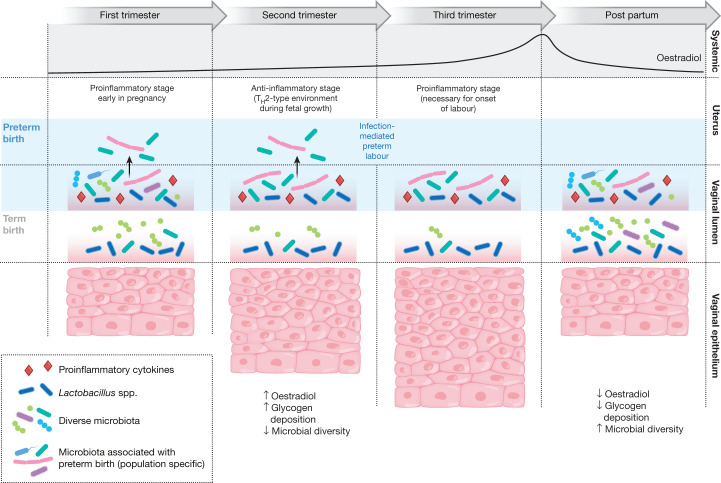
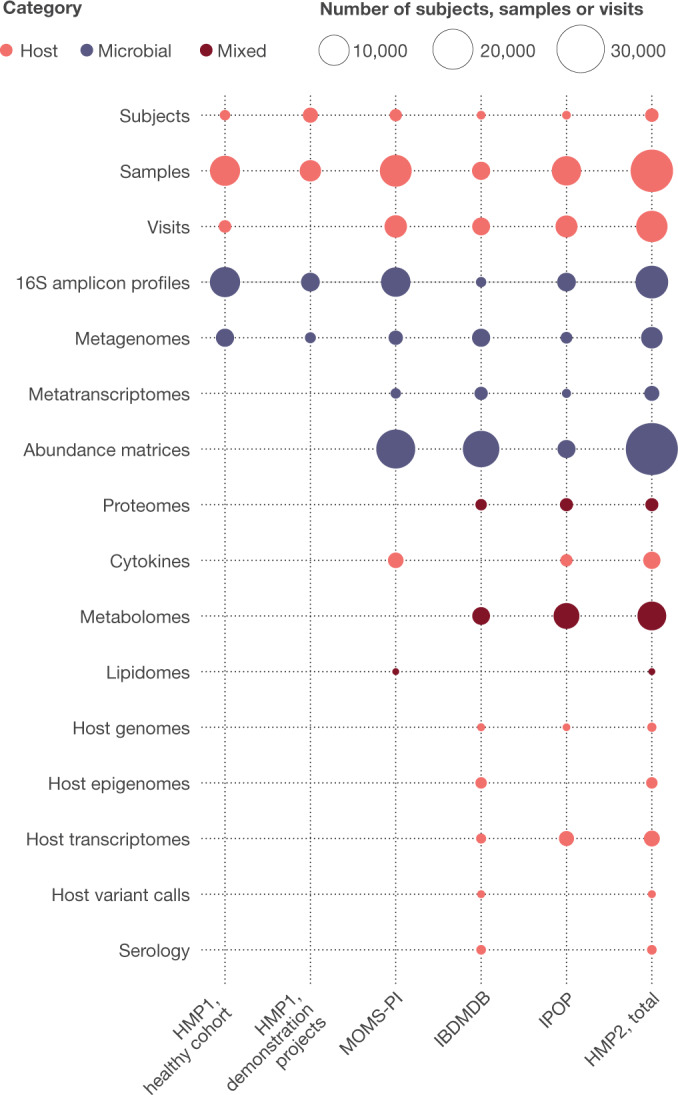
- In pregnancy/preterm birth (MOMS-PI), 1,527 women were followed and 206,437 specimens collected; analysis of 12,039 samples from 597 pregnancies found that women who had spontaneous preterm birth were less likely to have *Lactobacillus crispatus*-dominated vaginal microbiota and more likely to have increased *Sneathia amnii*, *Prevotella*-related clades, BVAB1, and TM7-H1, with prediction most sensitive/specific using samples before 24 weeks.
- In IBD (IBDMDB), 132 individuals from five clinical centres were followed for one year each, with 1,785 stool samples, 651 intestinal biopsies, and 529 quarterly blood samples; longitudinal changes were larger than cross-sectional differences among clinical phenotypes, and a network of more than 2,900 significant host and microbial interactors was constructed.
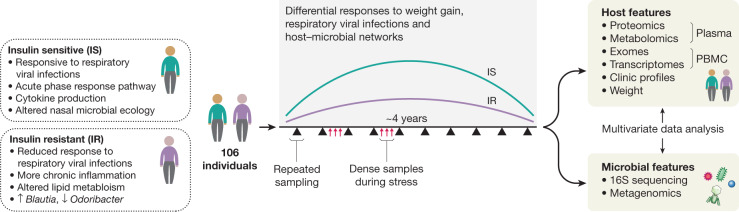
- In prediabetes (IPOP), 106 healthy/prediabetic individuals were followed over about four years across 1,092 collections; insulin-resistant and insulin-sensitive participants differed at baseline and in response to respiratory viral infection or weight change, with insulin-resistant participants showing decreased/delayed inflammatory responses and altered gut microbial changes.
- Across HMP1 and HMP2, 42 terabytes of multi-omic data were produced and archived at the HMP Data Coordination Center, which receives 9,000–12,000 user sessions each month; shotgun metagenomics, untargeted metabolomics, and immunoprofiling were particularly effective, whereas genetic variants were generally difficult to link to the microbiome in these small deeply profiled populations.
Methods
- HMP2 comprised three longitudinal, multi-omic cohort studies: MOMS-PI for pregnancy and preterm birth, IBDMDB for inflammatory bowel diseases, and IPOP for prediabetes.
- MOMS-PI followed 1,527 pregnancies and collected 206,437 specimens, with subsets analyzed by 16S rRNA gene sequencing, metagenomics, metatranscriptomics, cytokine profiling, lipidomics, and bacterial genome analysis; 12,039 samples from 597 pregnancies were analyzed in depth.
- IBDMDB followed 132 individuals for one year each with stool, biopsy, and blood multi-omics; IPOP followed 106 individuals quarterly over about four years, profiling host exomes, transcriptomes, metabolomes, proteomes, cytokines, clinical labs, and microbial 16S profiles, including a 23-person weight gain/loss subset.
Limitations
- Stated: the HMP2 raised more questions than it answered; the aetiologies of baseline inter-individual microbiome differences and dynamic changes were not apparent, it remains unclear whether specific strains are sufficient or necessary for disease phenotypes, and the small molecules or immune cell subsets transmitting gut signals to systemic conditions were not identified.
- Stated: each HMP2 study was carried out within a geographically and genetically constrained population, and global differences in early life events, infectious disease exposure, or diet may change how microbiome dynamics contribute to disease.
- Evident: the three studies are separate condition-specific cohorts rather than one unified population, and the findings are largely longitudinal associations rather than direct causal demonstrations.
Model-written summary. Check it against the paper before relying on it.
Integrity signals
Registry
Cites
Statistics
Figures
Verification
Claims the paper makes
21 Not checked yet · 21 No basis given · 18 Own result · 10 Own interpretation · 1 Own method
The paper states this without a source or data behind it here, so there is nothing to check it against. The quote shows it is in the paper.
In the paper
“Although the overall MOMS-PI cohort was demographically diverse, most women who experienced spontaneous PTB at less than 37 weeks of gestation were of African ancestry.”
§ The Integrative Human Microbiome Project > The vaginal microbiome, pregnancy and preterm birth
plaincorrelational- Asserted: passes — The authors put it forward as true.
- Checkable: passes — It can be checked against evidence.
- Load-bearing: unclear — It is unclear whether the paper’s conclusions depend on it.
- Based: passes — The paper gives a reason why it holds.
A result the paper reports from its own data — it cites no other source for it, so there is none to check. The quote shows it is in the paper.
In the paper
“and a preliminary model to predict risk of PTB was most sensitive and specific using vaginal microbiome profiles from samples collected before 24 weeks of gestation.”
§ The Integrative Human Microbiome Project > The vaginal microbiome, pregnancy and preterm birth
plaincorrelational- Asserted: passes — The authors put it forward as true.
- Checkable: passes — It can be checked against evidence.
- Load-bearing: passes — The paper’s conclusions depend on it.
- Based: passes — The paper gives a reason why it holds.
A result the paper reports from its own data — it cites no other source for it, so there is none to check. The quote shows it is in the paper.
In the paper
“and were more likely to exhibit an increased proportional abundance of several taxa including Sneathia amnii, Prevotella-related clades, a Lachnospiraceae taxon known as BVAB1, and a Saccharibacteria bacterium known as TM7-H1.”
§ The Integrative Human Microbiome Project > The vaginal microbiome, pregnancy and preterm birth
plaincorrelational- Asserted: passes — The authors put it forward as true.
- Checkable: passes — It can be checked against evidence.
- Load-bearing: passes — The paper’s conclusions depend on it.
- Based: passes — The paper gives a reason why it holds.
The paper states this without a source or data behind it here, so there is nothing to check it against. The quote shows it is in the paper.
In the paper
“The signatures of PTB were also reflected in metagenomic and metatranscriptomic measurements”
§ The Integrative Human Microbiome Project > The vaginal microbiome, pregnancy and preterm birth
plaincorrelational- Asserted: passes — The authors put it forward as true.
- Checkable: passes — It can be checked against evidence.
- Load-bearing: passes — The paper’s conclusions depend on it.
- Based: passes — The paper gives a reason why it holds.
A result the paper reports from its own data — it cites no other source for it, so there is none to check. The quote shows it is in the paper.
In the paper
“and vaginal pro-inflammatory cytokines (including IL-1β, IL-6, MIP-1β and eotaxin-1) were positively correlated with PTB-associated taxa.”
§ The Integrative Human Microbiome Project > The vaginal microbiome, pregnancy and preterm birth
plaincorrelational- Asserted: passes — The authors put it forward as true.
- Checkable: passes — It can be checked against evidence.
- Load-bearing: passes — The paper’s conclusions depend on it.
- Based: passes — The paper gives a reason why it holds.
In the paper
“Notably, these taxa were also associated with low levels of vitamin D63”
§ The Integrative Human Microbiome Project > The vaginal microbiome, pregnancy and preterm birth
What the sources say
- Not checked yetcites [63] Jefferson, K. K. et al. Relationship between vitamin D status and the vaginal microbiome during pregnancy. J. Perinatol. https://doi.org/10.1038/s41372-019-0343-8 (2019). source
plaincorrelational- Asserted: passes — The authors put it forward as true.
- Checkable: passes — It can be checked against evidence.
- Load-bearing: passes — The paper’s conclusions depend on it.
- Based: passes — The paper gives a reason why it holds.
The paper states this without a source or data behind it here, so there is nothing to check it against. The quote shows it is in the paper.
In the paper
“Interestingly, this trend was most pronounced in women of African ancestry with lower socioeconomic profiles.”
§ The Integrative Human Microbiome Project > The vaginal microbiome, pregnancy and preterm birth
plaincorrelational- Asserted: passes — The authors put it forward as true.
- Checkable: passes — It can be checked against evidence.
- Load-bearing: unclear — It is unclear whether the paper’s conclusions depend on it.
- Based: passes — The paper gives a reason why it holds.
In the paper
“Women who often began pregnancy with a vaginal microbiome of greater ecological complexity generally converged towards a more homogeneous Lactobacillus-dominated microbiome by the second trimester58.”
§ The Integrative Human Microbiome Project > The vaginal microbiome, pregnancy and preterm birth
What the sources say
- Not checked yetcites [58] Serrano, M. G. et al. Racioethnic diversity in the dynamics of the vaginal microbiome during pregnancy. Nat. Med. https://doi.org/10.1038/s41591-019-0465-8 (2019). HMP2 term birth study of 613 pregnant women, 1,969 non-pregnant women, and an additional 90 pregnant women followed longitudinally profiling vaginal, buccal, blood, urine, and rectal samples; shifts toward Lactobacillus -dominated communities tended to occur early during pregnancy, particularly in women of African or Hispanic descent. source
plaincorrelational- Asserted: passes — The authors put it forward as true.
- Checkable: passes — It can be checked against evidence.
- Load-bearing: passes — The paper’s conclusions depend on it.
- Based: passes — The paper gives a reason why it holds.
None of the sources cited for this claim have been checked yet.
In the paper
“Women who went on to experience spontaneous PTB were less likely to exhibit a vaginal microbiota dominated by Lactobacillus crispatus, as previously reported in other populations59–62”
§ The Integrative Human Microbiome Project > The vaginal microbiome, pregnancy and preterm birth
What the sources say
- Not checked yetcites [59] DiGiulio, D. B. et al. Temporal and spatial variation of the human microbiota during pregnancy. Proc. Natl Acad. Sci. USA 112, 11060–11065 (2015). source
- Not checked yetcites [60] Callahan, B. J. et al. Replication and refinement of a vaginal microbial signature of preterm birth in two racially distinct cohorts of US women. Proc. Natl Acad. Sci. USA 114, 9966–9971 (2017). source
- Not checked yetcites [61] Kindinger, L. M. et al. The interaction between vaginal microbiota, cervical length, and vaginal progesterone treatment for preterm birth risk. Microbiome 5, 6 (2017). source
- Not checked yetcites [62] Brown, R. G. et al. Vaginal dysbiosis increases risk of preterm fetal membrane rupture, neonatal sepsis and is exacerbated by erythromycin. BMC Med. 16, 9 (2018). source
plaincorrelational- Asserted: passes — The authors put it forward as true.
- Checkable: passes — It can be checked against evidence.
- Load-bearing: passes — The paper’s conclusions depend on it.
- Based: passes — The paper gives a reason why it holds.
A result the paper reports from its own data — it cites no other source for it, so there is none to check. The quote shows it is in the paper.
In the paper
“the vaginal microbiomes of mothers who experienced PTB were most distinct from those of control mothers early in pregnancy”
§ The Integrative Human Microbiome Project > The vaginal microbiome, pregnancy and preterm birth
plaincorrelational- Asserted: passes — The authors put it forward as true.
- Checkable: passes — It can be checked against evidence.
- Load-bearing: passes — The paper’s conclusions depend on it.
- Based: passes — The paper gives a reason why it holds.
- It may state two separate claims as one. 15
- Probably not a substantial claim. 10
In the paper
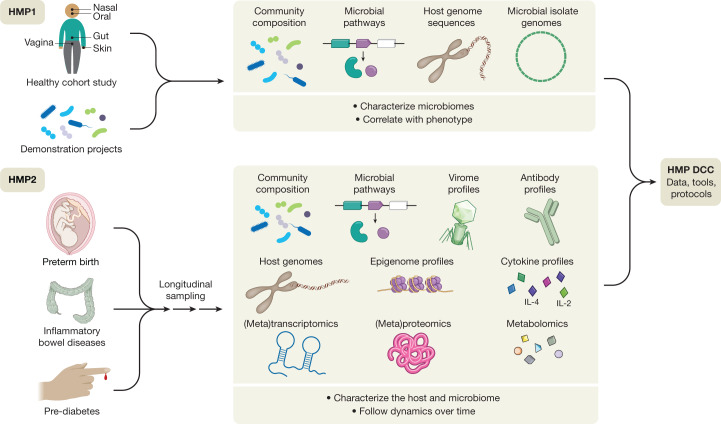
“One of the main findings of the HMP1 was that the taxonomic composition of the microbiome alone was often not a good correlate with host phenotype—this tended to be better predicted by prevalent microbial molecular function or personalized strain-specific makeup21.”
§ The Integrative Human Microbiome Project > Main
What the sources say
- Not checked yetcites [21] Human Microbiome Project Consortium. Structure, function and diversity of the healthy human microbiome. Nature 486, 207–214 (2012). HMP1 study analysing 5,177 16S rRNA gene sequencng profiles and 681 shotgun metagenomes spanning up to 18 body sites and three time points each from 242 healthy adults; established baseline ranges of taxonomic diversity within and between body sites, as well as strain personalization and functional commonalities. source
plaincorrelational- Asserted: passes — The authors put it forward as true.
- Checkable: passes — It can be checked against evidence.
- Load-bearing: passes — The paper’s conclusions depend on it.
- Based: passes — The paper gives a reason why it holds.
It may state two separate claims as one.
The paper states this without a source or data behind it here, so there is nothing to check it against. The quote shows it is in the paper.
In the paper
“Together, the HMP1 and HMP2 phases have produced a total of 42 terabytes of multi-omic data”
§ The Integrative Human Microbiome Project > Resources from the HMP2
plain- Asserted: passes — The authors put it forward as true.
- Checkable: passes — It can be checked against evidence.
- Load-bearing: fails — The paper’s conclusions may not depend on it.
- Based: passes — The paper gives a reason why it holds.
Probably not a substantial claim. The paper’s conclusions may not depend on it.
A result the paper reports from its own data — it cites no other source for it, so there is none to check. The quote shows it is in the paper.
In the paper
“For example, during RVI, insulin-resistant participants showed substantially decreased and delayed inflammatory responses (for example, the acute phase response and IL-1 signalling) and altered gut microbial changes when compared with insulin-sensitive participants (for example, in Lachnospiraceae and Rikenellaceae but not bacilli).”
§ The Integrative Human Microbiome Project > Multi-omics profiling in prediabetes
plaincorrelational- Asserted: passes — The authors put it forward as true.
- Checkable: passes — It can be checked against evidence.
- Load-bearing: passes — The paper’s conclusions depend on it.
- Based: passes — The paper gives a reason why it holds.
It may state two separate claims as one.
The paper states this without a source or data behind it here, so there is nothing to check it against. The quote shows it is in the paper.
In the paper
“The DCC website allows users to find, query, search, visualize, and download data from thousands of samples with associated metadata.”
§ The Integrative Human Microbiome Project > Resources from the HMP2
plain- Asserted: passes — The authors put it forward as true.
- Checkable: passes — It can be checked against evidence.
- Load-bearing: fails — The paper’s conclusions may not depend on it.
- Based: passes — The paper gives a reason why it holds.
Probably not a substantial claim. The paper’s conclusions may not depend on it.
None of the sources cited for this claim have been checked yet.
In the paper
“Studies of both a baseline adult population21–23 and ‘demonstration’ populations with specific disease states established typical ranges (for some populations) of microbial membership and enzymatic repertoires across the body, combinations of metabolic functions that were either prevalent or strain-specific, and some of the host factors (such as race or ethnicity) that determine this variation.”
§ The Integrative Human Microbiome Project > Main
What the sources say
- Not checked yetcites [21] Human Microbiome Project Consortium. Structure, function and diversity of the healthy human microbiome. Nature 486, 207–214 (2012). HMP1 study analysing 5,177 16S rRNA gene sequencng profiles and 681 shotgun metagenomes spanning up to 18 body sites and three time points each from 242 healthy adults; established baseline ranges of taxonomic diversity within and between body sites, as well as strain personalization and functional commonalities. source
- Not checked yetcites [22] Human Microbiome Project Consortium. A framework for human microbiome research. Nature 486, 215–221 (2012). source
- Not checked yetcites [23] Lloyd-Price, J. et al. Strains, functions and dynamics in the expanded Human Microbiome Project. Nature 550, 61–66 (2017). Second wave of HMP1 data (HMP1-II) extending the analysis and data resource to 2,355 total shotgun metagenomes from 265 healthy adults; quantified strain personalization and retention dynamics over time, as well as identifying niche-specific and host-associated microbial community functions. source
plaincorrelational- Asserted: passes — The authors put it forward as true.
- Checkable: passes — It can be checked against evidence.
- Load-bearing: passes — The paper’s conclusions depend on it.
- Based: passes — The paper gives a reason why it holds.
It may state two separate claims as one.
A result the paper reports from its own data — it cites no other source for it, so there is none to check. The quote shows it is in the paper.
In the paper
“Overall, the data led to microbially linked, clinically actionable health discoveries in a number of diseases in addition to T2D, including metabolic disease, cardiovascular disease, haematological or oncological conditions, and other areas; these signs were often present before symptom onset”
§ The Integrative Human Microbiome Project > Multi-omics profiling in prediabetes
boosteddirect- Asserted: passes — The authors put it forward as true.
- Checkable: passes — It can be checked against evidence.
- Load-bearing: passes — The paper’s conclusions depend on it.
- Based: passes — The paper gives a reason why it holds.
It may state two separate claims as one.
A result the paper reports from its own data — it cites no other source for it, so there is none to check. The quote shows it is in the paper.
In the paper
“These included early detection of T2D, which developed differently among participants and was better detectable with varied assays; for example, some individuals first exhibited measurements in the diabetic range on tests of fasting glucose, whereas others did so on tests of haemoglobin A1c, oral glucose tolerance tests, or even continuous glucose monitoring.”
§ The Integrative Human Microbiome Project > Multi-omics profiling in prediabetes
plaincorrelational- Asserted: passes — The authors put it forward as true.
- Checkable: passes — It can be checked against evidence.
- Load-bearing: passes — The paper’s conclusions depend on it.
- Based: passes — The paper gives a reason why it holds.
It may state two separate claims as one.
A result the paper reports from its own data — it cites no other source for it, so there is none to check. The quote shows it is in the paper.
In the paper
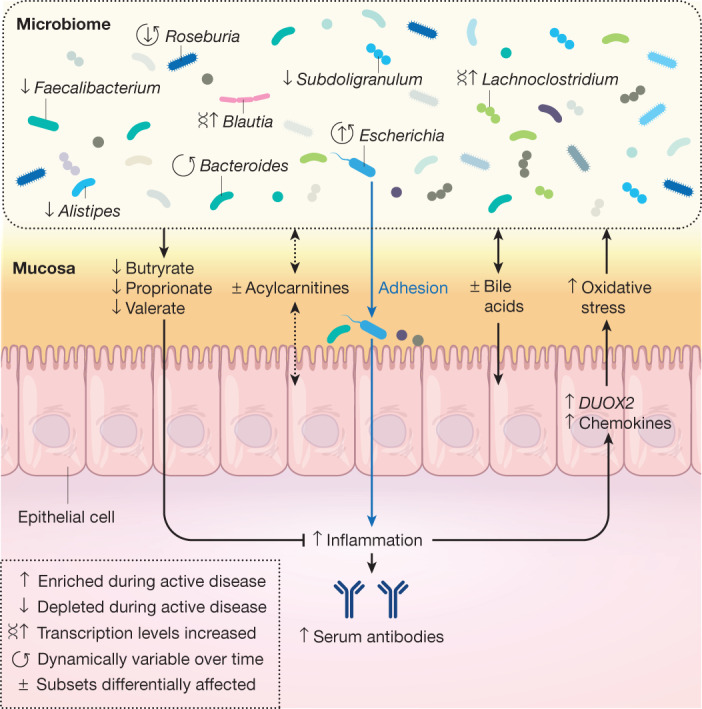
“This dysbiosis was not unique to the microbial response to inflammation, however, and was associated with other host and biochemical alterations”
§ The Integrative Human Microbiome Project > The gut microbiome and inflammatory bowel disease
plaincorrelational- Asserted: passes — The authors put it forward as true.
- Checkable: passes — It can be checked against evidence.
- Load-bearing: passes — The paper’s conclusions depend on it.
- Based: passes — The paper gives a reason why it holds.
It may state two separate claims as one.
A result the paper reports from its own data — it cites no other source for it, so there is none to check. The quote shows it is in the paper.
In the paper
“The main microbial contributors to these large-scale shifts from one time point to the next largely mirrored the differences observed in dysbiosis, and the shifts frequently marked the entrance into or exit from periods of dysbiosis.”
§ The Integrative Human Microbiome Project > The gut microbiome and inflammatory bowel disease
plaincorrelational- Asserted: passes — The authors put it forward as true.
- Checkable: passes — It can be checked against evidence.
- Load-bearing: passes — The paper’s conclusions depend on it.
- Based: passes — The paper gives a reason why it holds.
It may state two separate claims as one.
The paper states this without a source or data behind it here, so there is nothing to check it against. The quote shows it is in the paper.
In the paper
“Accordingly, there were fewer changes in nasal microbiota in insulin-resistant participants, and both the richness and the diversity of nasal microorganisms decreased during RVI in insulin-sensitive but not insulin-resistant participants.”
§ The Integrative Human Microbiome Project > Multi-omics profiling in prediabetes
plain- Asserted: passes — The authors put it forward as true.
- Checkable: passes — It can be checked against evidence.
- Load-bearing: passes — The paper’s conclusions depend on it.
- Based: passes — The paper gives a reason why it holds.
It may state two separate claims as one.
None of the sources cited for this claim have been checked yet.
In the paper
“This first phase of the HMP (HMP1) thus yielded a wealth of community resources: nucleotide sequences of microorganisms and communities from a large number of isolates, individuals, and populations (http://hmpdacc.org)34–37; protocols to support reproducible body-wide microbiome sampling and data generation38–40; and computational methods for microbiome analysis and epidemiology41–47.”
§ The Integrative Human Microbiome Project > Main
What the sources say
- Not checked yetcites [34] Fodor, A. A. et al. The “most wanted” taxa from the human microbiome for whole genome sequencing. PLoS One 7, e41294 (2012).
- Not checked yetcites [35] Nelson, K. E. et al. A catalog of reference genomes from the human microbiome. Science 328, 994–999 (2010). source
- Not checked yetcites [36] Wylie, K. M. et al. Novel bacterial taxa in the human microbiome. PLoS One 7, e35294 (2012).
- Not checked yetcites [37] Li, K., Bihan, M., Yooseph, S. & Methé, B. A. Analyses of the microbial diversity across the human microbiome. PLoS One 7, e32118 (2012).
- Not checked yetcites [38] Aagaard, K. et al. The Human Microbiome Project strategy for comprehensive sampling of the human microbiome and why it matters. FASEB J. 27, 1012–1022 (2013). source
- Not checked yetcites [39] Schloss, P. D., Gevers, D. & Westcott, S. L. Reducing the effects of PCR amplification and sequencing artifacts on 16S rRNA-based studies. PLoS One 6, e27310 (2011).
- Not checked yetcites [40] Jumpstart Consortium Human Microbiome Project Data Generation Working Group. Evaluation of 16S rDNA-based community profiling for human microbiome research. PLoS One 7, e39315 (2012).
- Not checked yetcites [41] Gevers, D., Pop, M., Schloss, P. D. & Huttenhower, C. Bioinformatics for the Human Microbiome Project. PLoS Comput. Biol. 8, e1002779 (2012). source
- Not checked yetcites [42] Huse, S. M., Ye, Y., Zhou, Y. & Fodor, A. A. A core human microbiome as viewed through 16S rRNA sequence clusters. PLoS One 7, e34242 (2012).
- Not checked yetcites [43] Markowitz, V. M. et al. IMG/M-HMP: a metagenome comparative analysis system for the Human Microbiome Project. PLoS One 7, e40151 (2012).
plain- Asserted: passes — The authors put it forward as true.
- Checkable: passes — It can be checked against evidence.
- Load-bearing: unclear — It is unclear whether the paper’s conclusions depend on it.
- Based: passes — The paper gives a reason why it holds.
It may state two separate claims as one.
A result the paper reports from its own data — it cites no other source for it, so there is none to check. The quote shows it is in the paper.
In the paper
“In numerous cases, the microbiome of a participant with IBD changed completely over the course of only weeks (measured as maximal Bray–Curtis dissimilarity to earlier samples from the same subject), whereas such shifts were rare in individuals without IBD.”
§ The Integrative Human Microbiome Project > The gut microbiome and inflammatory bowel disease
plaincorrelational- Asserted: passes — The authors put it forward as true.
- Checkable: passes — It can be checked against evidence.
- Load-bearing: passes — The paper’s conclusions depend on it.
- Based: passes — The paper gives a reason why it holds.
It may state two separate claims as one.
The paper states this without a source or data behind it here, so there is nothing to check it against. The quote shows it is in the paper.
In the paper
“All data on the DCC is available for unrestricted use, with a subset of project metadata also being shared when permitted by institutional review boards (IRBs), and other restricted data (for example, human genome sequences and protected metadata) available through controlled access at dbGaP”
§ The Integrative Human Microbiome Project > Resources from the HMP2
plain- Asserted: passes — The authors put it forward as true.
- Checkable: passes — It can be checked against evidence.
- Load-bearing: fails — The paper’s conclusions may not depend on it.
- Based: passes — The paper gives a reason why it holds.
Probably not a substantial claim. The paper’s conclusions may not depend on it. It may state two separate claims as one.
The paper states this without a source or data behind it here, so there is nothing to check it against. The quote shows it is in the paper.
In the paper
“These included large shifts in acylcarnitine pools and bile acids, increased serum antibody levels, and alterations in transcription for several microbial species.”
§ The Integrative Human Microbiome Project > The gut microbiome and inflammatory bowel disease
plaincorrelational- Asserted: passes — The authors put it forward as true.
- Checkable: passes — It can be checked against evidence.
- Load-bearing: passes — The paper’s conclusions depend on it.
- Based: passes — The paper gives a reason why it holds.
It may state two separate claims as one.
The paper states this without a source or data behind it here, so there is nothing to check it against. The quote shows it is in the paper.
In the paper
“and together they provide a rich multi-omic data resource to be mined by future work (http://www.ihmpdcc.org).”
§ The Integrative Human Microbiome Project > Main
plain- Asserted: passes — The authors put it forward as true.
- Checkable: passes — It can be checked against evidence.
- Load-bearing: passes — The paper’s conclusions depend on it.
- Based: passes — The paper gives a reason why it holds.
Probably not a substantial claim.
The paper states this without a source or data behind it here, so there is nothing to check it against. The quote shows it is in the paper.
In the paper
“A few mechanisms were identified by which signals in the gut can be transmitted to systemic conditions such as diabetes, but not the specific small molecules or immune cell subsets by which they are likely to be transmitted”
§ The Integrative Human Microbiome Project > Next steps in microbiome multi-omics
hedgeddirect- Asserted: passes — The authors put it forward as true.
- Checkable: passes — It can be checked against evidence.
- Load-bearing: passes — The paper’s conclusions depend on it.
- Based: passes — The paper gives a reason why it holds.
It may state two separate claims as one.
The paper states this without a source or data behind it here, so there is nothing to check it against. The quote shows it is in the paper.
In the paper
“The formal data models and associated entity relationship schemas produced by all phases of the HMP are freely available at https://github.com/ihmpdcc/osdf-schemas.”
§ The Integrative Human Microbiome Project > Resources from the HMP2
plain- Asserted: passes — The authors put it forward as true.
- Checkable: passes — It can be checked against evidence.
- Load-bearing: fails — The paper’s conclusions may not depend on it.
- Based: passes — The paper gives a reason why it holds.
Probably not a substantial claim. The paper’s conclusions may not depend on it.
None of the sources cited for this claim have been checked yet.
In the paper
“The microbiome has long been implicated in IBD, potentially as a causative or risk factor66,67”
§ The Integrative Human Microbiome Project > The gut microbiome and inflammatory bowel disease
What the sources say
- Not checked yetcites [66] Manichanh, C. et al. Reduced diversity of faecal microbiota in Crohn's disease revealed by a metagenomic approach. Gut 55, 205–211 (2005). source
- Not checked yetcites [67] Frank, D. N. et al. Molecular-phylogenetic characterization of microbial community imbalances in human inflammatory bowel diseases. Proc. Natl Acad. Sci. USA 104, 13780–13785 (2007). source
hedgedconditional- Asserted: passes — The authors put it forward as true.
- Checkable: passes — It can be checked against evidence.
- Load-bearing: fails — The paper’s conclusions may not depend on it.
- Based: passes — The paper gives a reason why it holds.
Probably not a substantial claim. The paper’s conclusions may not depend on it.
In the paper
“It is clear that PTB has a complex aetiology56.”
§ The Integrative Human Microbiome Project > The vaginal microbiome, pregnancy and preterm birth
What the sources say
- Not checked yetcites [56] Romero, R., Dey, S. K. & Fisher, S. J. Preterm labor: one syndrome, many causes. Science 345, 760–765 (2014). source
boosted- Asserted: passes — The authors put it forward as true.
- Checkable: fails — It may be too vague to check against evidence.
- Load-bearing: passes — The paper’s conclusions depend on it.
- Based: passes — The paper gives a reason why it holds.
Probably not a substantial claim. It may be too vague to check against evidence.
A conclusion the paper draws from its own results — it cites no other source for it, so there is none to check. The quote shows it is in the paper.
In the paper
“The combination of shotgun metagenomics, untargeted metabolomics, and immunoprofiling was particularly effective, as in all projects this subset of molecular measurements tended to efficiently capture interpretable host and microbial properties that are linked to disease.”
§ The Integrative Human Microbiome Project > Complementary host–microbiome interactions
plaincorrelational- Asserted: passes — The authors put it forward as true.
- Checkable: passes — It can be checked against evidence.
- Load-bearing: passes — The paper’s conclusions depend on it.
- Based: passes — The paper gives a reason why it holds.
It may state two separate claims as one.
A conclusion the paper draws from its own results — it cites no other source for it, so there is none to check. The quote shows it is in the paper.
In the paper
“The collective results of the NIH HMP projects, alongside many other studies, show that the microbiome is an integral component of human biology, with a major role in health and well-being.”
§ The Integrative Human Microbiome Project > Next steps in microbiome multi-omics
boostedcorrelational- Asserted: passes — The authors put it forward as true.
- Checkable: passes — It can be checked against evidence.
- Load-bearing: unclear — It is unclear whether the paper’s conclusions depend on it.
- Based: passes — The paper gives a reason why it holds.
It may state two separate claims as one.
A conclusion the paper draws from its own results — it cites no other source for it, so there is none to check. The quote shows it is in the paper.
In the paper
“Human-associated microbiology now clearly extends beyond infectious and gastrointestinal diseases to areas barely imaginable a few decades ago, including metabolism, neoplasia, maternal and child health, and central nervous system function.”
§ The Integrative Human Microbiome Project > Next steps in microbiome multi-omics
boosted- Asserted: passes — The authors put it forward as true.
- Checkable: passes — It can be checked against evidence.
- Load-bearing: fails — The paper’s conclusions may not depend on it.
- Based: fails — The paper may give no reason why it holds.
Probably not a substantial claim. The paper’s conclusions may not depend on it. The paper may give no reason why it holds.
In the paper
“The HMP DCC efforts are thus by design consistent with the NIH’s stated goals to make all data generated from NIH funding findable, accessible, interoperable, and reusable88.”
§ The Integrative Human Microbiome Project > Resources from the HMP2
What the sources say
- Not checked yetcites [88] Wilkinson, M. D. et al. The FAIR Guiding Principles for scientific data management and stewardship. Sci. Data 3, 160018 (2016). source
plain- Asserted: passes — The authors put it forward as true.
- Checkable: passes — It can be checked against evidence.
- Load-bearing: fails — The paper’s conclusions may not depend on it.
- Based: passes — The paper gives a reason why it holds.
Probably not a substantial claim. The paper’s conclusions may not depend on it.
What the paper did — it cites no source for this, so there is none to check. The quote shows it is in the paper.
In the paper
“each HMP2 study was necessarily carried out within a geographically and genetically constrained population”
§ The Integrative Human Microbiome Project > Next steps in microbiome multi-omics
plain- Asserted: passes — The authors put it forward as true.
- Checkable: passes — It can be checked against evidence.
- Load-bearing: passes — The paper’s conclusions depend on it.
- Based: fails — The paper may give no reason why it holds.
Probably not a substantial claim. The paper may give no reason why it holds.
The paper relies on this without support.
Little is known about systemic alterations during prediabetes, their effects on biological processes, or the critical transition to full-blown T2D.
“but little is known about systemic alterations during prediabetes, their effects on biological processes, or the critical transition to full-blown T2D.”
The paper relies on this without support.
Prediabetes and T2D are often associated with insulin resistance.
“Prediabetes and T2D are often associated with insulin resistance”
The paper relies on this without support.
Environmental factors, including the microbiome of the female reproductive tract, are important contributors to prematurity.
“Environmental factors, including the microbiome of the female reproductive tract, are important contributors to prematurity.”
The paper relies on this without support.
The three HMP2 studies' multi-omic measurements and populations are sufficiently comparable to allow identification of common host–microbiome features across them.
“a surprising range of host–microbiome immune and ecological features were common among them”
The paper relies on this without support.
A consistently high rate of user access to the DCC web resources is a valid indicator of the success of the HMP DCC data-sharing efforts.
“The success of these efforts is evidenced by a consistently high rate of user access to the web resources, with 9,000–12,000 user sessions each month”
Claims other papers make about this one
Each is checked against this paper’s own text: does it say what the citing paper says it does?
The check wasn’t confident either way, so it gives no verdict — never disputed.
In the citing paper
“Vaginal probiotics, administered either topically or orally, are currently promising to restore the balance in the vaginal microbial community and preventing recurrent infections by inhibiting pathogen growth [12].”
From Women's health is a team effort: probiogenomics supports the development of a multi-species vaginal probiotic (2026) · cites this paper as [12]
Experimental — accuracy not yet measured
Citations
Cites
The FAIR Guiding Principles for scientific data management and stewardship
Wilkinson, M. D., Dumontier, M., Aalbersberg, I. J., Appleton, G., Axton, M., Baak, A., Blomberg, N., Boiten, J.-W., da Silva Santos, L. B., Bourne, P. E., et al. (2016) · Scientific Data · doi:10.1038/sdata.2016.18 · Cited by 18,423
Structure, function and diversity of the healthy human microbiome
The Human Microbiome Project Consortium (2012) · Nature · doi:10.1038/nature11234 · Cited by 11,726
Diversity of the Human Intestinal Microbial Flora
Eckburg, P. B., Bik, E. M., Bernstein, C. N., Purdom, E., Dethlefsen, L., Sargent, M., Gill, S. R., Nelson, K. E., & Relman, D. A. (2005) · Science · doi:10.1126/science.1110591 · Cited by 7,913
Human gut microbiome viewed across age and geography
Yatsunenko, T., Rey, F. E., Manary, M. J., Trehan, I., Dominguez-Bello, M. G., Contreras, M., Magris, M., Hidalgo, G., Baldassano, R. N., Anokhin, A. P., et al. (2012) · Nature · doi:10.1038/nature11053 · Cited by 7,815
A metagenome-wide association study of gut microbiota in type 2 diabetes
Qin, J., Li, Y., Cai, Z., Li, S., Zhu, J., Zhang, F., Liang, S., Zhang, W., Guan, Y., Shen, D., et al. (2012) · Nature · doi:10.1038/nature11450 · Cited by 6,762
Turnbaugh, P. J., Ley, R. E., Hamady, M., Fraser-Liggett, C. M., Knight, R., & Gordon, J. I. (2007) · Nature · doi:10.1038/nature06244 · Cited by 6,091
Gut microbiome influences efficacy of PD-1-based immunotherapy against epithelial tumors
Routy, B., Le Chatelier, E., Derosa, L., Duong, C. P. M., Alou, M. T., Daillère, R., Fluckiger, A., Messaoudene, M., Rauber, C., Roberti, M. P., et al. (2018) · Science · doi:10.1126/science.aan3706 · Cited by 5,671
Gut microbiome modulates response to anti-PD-1 immunotherapy in melanoma patients
Gopalakrishnan, V., Spencer, C. N., Nezi, L., Reuben, A., Andrews, M. C., Karpinets, T. V., Prieto, P. A., Vicente, D., Hoffman, K., Wei, S. C., et al. (2018) · Science · doi:10.1126/science.aan4236 · Cited by 4,812
Dominguez-Bello, M. G., Costello, E. K., Contreras, M., Magris, M., Hidalgo, G., Fierer, N., & Knight, R. (2010) · Proceedings of the National Academy of Sciences · doi:10.1073/pnas.1002601107 · Cited by 4,774
Metagenomic Analysis of the Human Distal Gut Microbiome
Gill, S. R., Pop, M., DeBoy, R. T., Eckburg, P. B., Turnbaugh, P. J., Samuel, B. S., Gordon, J. I., Relman, D. A., Fraser-Liggett, C. M., & Nelson, K. E. (2006) · Science · doi:10.1126/science.1124234 · Cited by 4,699
Research works printed but not linked: 1
- Behrman, R. E. & Butler A. S. (eds.) Preterm Birth: Causes, Consequences, and Prevention (National Academies Press, 2007).
Cited by
Sorted by citations
Items 901–1,000 of 1,001
Bacterial Diversity, Introduction to
Ogunseitan, O. A. (2024) · Elsevier eBooks · doi:10.1016/b978-0-443-15750-9.00073-2 · Cited by 2
Skoulakis, A., Skoufos, G., Ovsepian, A., & Hatzigeorgiou, A. G. (2025) · Frontiers in Microbiology · doi:10.3389/fmicb.2024.1512304 · Cited by 2
Microbiome and In Vitro Gut Models
Hushpulian, D. M., Nikulin, S. V., Zakhariants, A. A., Сергеевич, С. С., & Tishkov, V. I. (2024) · Applied Biochemistry and Microbiology · doi:10.1134/s0003683824700261 · Cited by 2
Huang, X., Liu, Y., Feng, J., Xin, L., Wang, Z., Hua, Z., Wang, C., Zhang, L., & Yu, J. (2025) · Frontiers in Microbiology · doi:10.3389/fmicb.2025.1530857 · Cited by 2
Oral microbiota in allergic diseases, and sublingual allergen immunotherapy
Gazi, U., & Bahçeciler, N. N. (2025) · Clinical Immunology · doi:10.1016/j.clim.2025.110538 · Cited by 2
The anti-hyperuricemia effects of polysaccharide from Saccharina japonica through gut-kidney axis
Yu, H., Dong, K., Fu, M., Wang, H., Wang, J., Zhang, Q., Yue, Y., Geng, L., & Wu, N. (2025) · International Journal of Biological Macromolecules · doi:10.1016/j.ijbiomac.2025.145336 · Cited by 2
Unveiling the Gut Microbiome’s Role in Obesity and Insulin Resistance
Kumar, R., Shukla, S. K., Gupta, A., & Vibhuti, A. (2025) · Springer eBooks · doi:10.1007/978-981-96-6246-3_8 · Cited by 2
mbSparse: an autoencoder-based imputation method to address sparsity in microbiome data
Qi, C., Cai, Y., He, G., Qian, K., Guo, M., & Cheng, L. (2025) · Gut Microbes · doi:10.1080/19490976.2025.2552347 · Cited by 2
KADAIF: an anomaly detection method for complex microbiome data
Peleg, O., Raytan, M., & Borenstein, E. (2025) · Bioinformatics · doi:10.1093/bioinformatics/btaf520 · Cited by 2
The gut microbiota of Labrador retriever puppies: a longitudinal cohort study
Woolley, C. S. C., Muwonge, A., Bronsvoort, M., Schoenebeck, J. J., Handel, I. G., Chamberlain, K., Rose, E., & Clements, D. N. (2025) · Animal Microbiome · doi:10.1186/s42523-025-00464-2 · Cited by 2
Song, S., Iino, K., Nakamura, M., Sato, M., Oishi, M., Ito, A., & Yokoyama, Y. (2025) · Microorganisms · doi:10.3390/microorganisms13122671 · Cited by 2
Kurban, G., Chen, X., Jin, X., Xia, H., Wang, S., & Sun, G. (2025) · Frontiers in Nutrition · doi:10.3389/fnut.2025.1686937 · Cited by 2
Genomic GC bias correction improves species abundance estimation from metagenomic data
Holcik, L., von Haeseler, A., & Pflug, F. (2025) · Nature Communications · doi:10.1038/s41467-025-65530-4 · Cited by 2
Cho, J. M., Park, S.-K., Babu, A. K. S., Mookherjee, S., Hansen, M., Petersen, C., Zhong, Y., Jalili, T., Robeson, M. S., Wankhade, U. D., et al. (2026) · American Journal of Physiology-Gastrointestinal and Liver Physiology · doi:10.1152/ajpgi.00354.2025 · Cited by 2
An integrative neurogenomics workflow for precision medicine in neurodegenerative disorders
Perezcano, C., & Pérez-Coria, M. (2026) · Frontiers in Dementia · doi:10.3389/frdem.2026.1745504 · Cited by 2
Chen, H.-Y., Sun, X., Huang, H., Huang, W.-Q., Liu, C., & Liu, S. (2026) · Systematic and Applied Microbiology · doi:10.1016/j.syapm.2026.126696 · Cited by 2
The bidirectional interface between oral drug and the gut microbiome: Implications for drug delivery
Zai, K. (2026) · Pharmaceutical Science Advances · doi:10.1016/j.pscia.2026.100112 · Cited by 2
Multifaceted human gut microbiome data associated with health and nutrition
Maisto, L., Telegrafo, C., Rubino, F., Santamaría, M., Τράκα, Μ., Tullo, A., Bouwman, J., Sbisà, E., & Balech, B. (2026) · Frontiers in Microbiology · doi:10.3389/fmicb.2026.1722500 · Cited by 2
Ayalew, M., Hoffman, A. M., Fuller, K. S., Kerr, J., Lee, A., Lee, J. S., Martinez, E. S., Ulbricht, K., & Xie, X. (2026) · Journal of Microbiology and Biology Education · doi:10.1128/jmbe.00288-25 · Cited by 2
Alawad, D. M., Fertel, M., & Hicks, C. (2026) · Cancers · doi:10.3390/cancers18101503 · Cited by 2
Tan, M.-S., Clister, D., Chandra, Q. M., Wangsa, C. E., Simone, C. N., Umaya, C., Choi, J., Park, S., Rani, A., Akter, S., et al. (2026) · Clinica Chimica Acta · doi:10.1016/j.cca.2026.121086 · Cited by 2
Synbiotics as a Microbiome-Based Strategy in Colorectal Cancer
Procopciuc, L. M., Hangan, A. C., & Lucaciu, R. L. (2026) · Nutrients · doi:10.3390/nu18101591 · Cited by 2
Rao, X., Zou, L., Cai, X., Yao, Y., & Zhong, L. (2026) · Frontiers in Immunology · doi:10.3389/fimmu.2026.1761834 · Cited by 2
Zielińska, K., Pantiukh, K., Org, E., Łabaj, P. P., & Kościółek, T. (2026) · mSystems · doi:10.1128/msystems.00144-26 · Cited by 2
Jonouchi, D., Shenoy, S. G., Saintlouis, R., Singh, A., Kashyap, D., Bhargavi, C., Mansoor, R., Mansoor, E., & Honnavar, P. (2026) · Infection and Immunity · doi:10.1128/iai.00542-25 · Cited by 2
The Gut Microbiome in Heart Failure: Pathways to Inflammation and Therapeutic Targets
Vankayala, U. S. A., Sohail, A., George, B., Singh, M., Omar, K., Kreidieh, M., Hasham, A., & Quiel, L. (2026) · Metabolites · doi:10.3390/metabo16060431 · Cited by 3
Bautista, J., & López-Cortés, A. (2026) · Frontiers in Immunology · doi:10.3389/fimmu.2026.1887873 · Cited by 2
sedeek, M., Ayoub, A., Hany, E., Bahaa, A., Bahr, A., Saher, O., & Ahmed, S. (2026) · Frontiers in Pharmacology · doi:10.3389/fphar.2026.1942291 · Cited by 2
Pierre, J. F., & Leone, V. (2020) · Elsevier eBooks · doi:10.1016/b978-0-323-66162-1.00037-8 · Cited by 3
Gut Microbiome and Nonalcoholic Fatty Liver Disease (NAFLD)
Liang, Y., Zhou, S., Chen, X., Yu, L., Zhang, D., & Lin, C. (2021) · Gastroenterology Nursing · doi:10.1097/sga.0000000000000545 · Cited by 2
Zhao, J., Ma, Y., & Liu, L. (2021) · Frontiers in Molecular Biosciences · doi:10.3389/fmolb.2021.643014 · Cited by 2
Yang, Z. J., & Kulik, H. J. (2021) · The Journal of Physical Chemistry B · doi:10.1021/acs.jpcb.1c05320 · Cited by 2
More Than Our Enemy: Making Space for the Microbiome in Pharmacy Education
Collier, S. P., Weldon, A. J., & Johnson, J. L. (2022) · INNOVATIONS in pharmacy · doi:10.24926/iip.v13i1.4553 · Cited by 2
Targeting the Gut Microbiome in Cirrhosis
Krag, A. A., & Bajaj, J. S. (2022) · Springer eBooks · doi:10.1007/978-3-031-08552-9_26 · Cited by 2
Desîlets, A., & Elkrief, A. (2023) · Current Opinion in Oncology · doi:10.1097/cco.0000000000000957 · Cited by 2
The Challenges of Conducting Research in Rural Populations: A Feasibility Study
Hepburn, K. E., Cordts, K. M. P., Dinkel, D. M., Hanish, A., Pendyala, G., & Moore, T. A. (2023) · Online Journal of Rural Nursing and Health Care · doi:10.14574/ojrnhc.v23i2.740 · Cited by 2
Duong, V., Enkhbayar, A., Bhasin, N., Senavirathna, L. K., Preisner, E. C., Hoffman, K. L., Shukla, R., Jenq, R. R., Cheng, K., Bronner, M. P., et al. (2024) · PROTEOMICS · doi:10.1002/pmic.202400078 · Cited by 2
Kizilbash, S. J., Connolly, H., Bartosh, S. M., Zahr, R. S., Al-Akash, S. I., Chishti, A. S., Mansuri, A., Tawadrous, H. K., & Jain, N. G. (2024) · Pediatric Transplantation · doi:10.1111/petr.14790 · Cited by 2
Alford, B. A., Bekele, D., Yimer, M. T., Fayyaz, A., Carrasquilla‐Garcia, N., Chang, P. L., Badger, C., Surendrarao, A., von Wettberg, E., Munis, M. F. H., et al. (2024) · Phytobiomes Journal · doi:10.1094/pbiomes-02-24-0023-r · Cited by 2
Hernández, M. M., & Jiménez‐Rodríguez, D. (2024) · Healthcare · doi:10.3390/healthcare12141441 · Cited by 2
Identifications of the potential in-silico biomarkers in lung cancer tissue microbiomes
Ma, Z. S., & Li, L. (2024) · Computers in Biology and Medicine · doi:10.1016/j.compbiomed.2024.109231 · Cited by 2
Han, X., Ma, P., Liu, C., Yao, C., Yi, Y., Du, Z., Liu, P., Zhang, M., Xu, J., Meng, X., et al. (2025) · Advanced Biotechnology · doi:10.1007/s44307-025-00064-w · Cited by 2
Das Mikrobiom bei Erkrankungen der Nase und der Nasennebenhöhlen
Bartosik, T. J. (2025) · HNO · doi:10.1007/s00106-025-01661-w · Cited by 2
Position statement of the Microbiota International Clinical Society
Palazzi, C. M., Ciampaglia, G., Binato, B., Ragazzini, M., Bertuccioli, A., Cavecchia, I., Matera, M., Cazzaniga, M., Zonzini, G. B., Zerbinati, N., et al. (2025) · Frontiers in Microbiomes · doi:10.3389/frmbi.2025.1657750 · Cited by 2
Tamock: simulation of habitat-specific benchmark data in metagenomics
Gerner, S. M., Graf, A. B., & Rattei, T. (2021) · BMC Bioinformatics · doi:10.1186/s12859-021-04154-z · Cited by 2
Александровна, О. А., Mezhevitinova, E. A., Prilepskaya, V. N., Донников, А. Е., Тимуровна, У. А., Abakarova, P. R., Мирзоевна, Н. Н., Dovletkhanova, E. R., Gusakov, K. I., & Kepsha, M. A. (2022) · Meditsinskiy sovet = Medical Council · doi:10.21518/2079-701x-2022-16-14-178-184 · Cited by 2
Sequencing our way to more accurate community abundance
Brennan, G. L. (2022) · Molecular Ecology Resources · doi:10.1111/1755-0998.13717 · Cited by 2
Current Progress of Bioinformatics for Human Health
Zhao, J., Zhang, S., Wu, S., Zhang, W., & Su, X. (2023) · Translational bioinformatics · doi:10.1007/978-981-19-8210-1_8 · Cited by 2
Shi, K., Li, L., Yu, J., Zhang, Y., & Xie, X. (2022) · International Conference on Bioinformatics and Biomedical Science (ICBBS) · doi:10.1145/3571532.3571540 · Cited by 2
The East Asian gut microbiome and its role in oncology: a narrative review
Wong, E. Y. T., Lee, J. J., Lim, J. Y., & Toh, H. C. (2023) · Singapore Medical Journal · doi:10.4103/singaporemedj.smj-2022-042 · Cited by 2
Hempel, C. A., Carson, S. E. E., Elliott, T. A., Adamowicz, S. J., & Steinke, D. (2023) · Methods in Ecology and Evolution · doi:10.1111/2041-210x.14149 · Cited by 5
Wavelet-Based Microbiome Correlations of Host Traits
Shankar, A., Chang, S., Zhao, Y., Wang, X., & Liu, T. (2022) · International Conference on Computational Biology and Bioinformatics (ICCBB) · doi:10.1145/3589437.3589440 · Cited by 2
Yang, P., Yang, J., Long, H., Huang, K., Ji, L., Lin, H., Jiang, X., Wang, A. K., Tian, G., & Ning, K. (2023) · iMeta · doi:10.1002/imt2.131 · Cited by 2
SMS: A Novel Approach for Bacterial Strain Analysis in Multiple Samples
Wang, S., Ventolero, M. F. H., Hu, H., & Li, X. (2023) · Journal of Bioinformatics and Systems Biology · doi:10.26502/jbsb.5107065 · Cited by 2
EL PROBLEMA DE LA ÉTICA: EL CONVIVIO. Ética e Inteligencia Artificial
Maldonado, C. E. (2024) · Revista Iberoamericana de Complejidad y Ciencias Económicas · doi:10.48168/ricce.v2n2p31 · Cited by 2
Epigenetic Modulations by Microbiome in Breast Cancer
Zhao, Y., & Bhatnagar, S. (2024) · Advances in experimental medicine and biology · doi:10.1007/978-3-031-66686-5_4 · Cited by 2
Gut Microbiota: Role in Health and Diseases
Bhardwaj, K., Das, B., Zuo, T., & Vrati, S. (2025) · IntechOpen eBooks · doi:10.5772/intechopen.1007004 · Cited by 2
Li, X., Wu, Y., Chen, S., Deng, C., Cheng, S., Yan, Z., & Qiu, G. (2025) · Archives of Dermatological Research · doi:10.1007/s00403-025-03857-0 · Cited by 2
Gut Microbiota in Drug Metabolism: A New Frontier in Precision Medicine
Kaur, H. (2025) · INTERANTIONAL JOURNAL OF SCIENTIFIC RESEARCH IN ENGINEERING AND MANAGEMENT · doi:10.55041/ijsrem47264 · Cited by 2
Metabolomics Approaches for Microbiome Analysis
Roy, S. S., & Singh, S. (2025) · Springer eBooks · doi:10.1007/978-981-96-7067-3_9 · Cited by 2
Recent developments and future perspectives in statistical mechanics of ecological systems
Azaele, S., Maritan, A., & Suweis, S. S. (2025) · Europhysics Letters (EPL) · doi:10.1209/0295-5075/ade9ec · Cited by 2
Lara, R. A. N., Beltran, J. A., Brizuela, C. A., & del Rio, G. (2020) · Pharmaceuticals · doi:10.3390/ph13090204 · Cited by 2
BEYAZ PEYNİR MİKROBİYOTASINDA KÜLTÜROMİK VE SHOTGUN METAGENOMİK TEKNOLOJİLERİN DEĞERLENDİRİLMESİ
Cerit, Z. G., Baloğlu, M. C., & Yılmaz, R. (2021) · GIDA / THE JOURNAL OF FOOD · doi:10.15237/gida.gd20136 · Cited by 2
Dunnack, H., Judge, M. P., Cong, X. S., Salner, A., Duffy, V. B., & Xu, W. (2021) · Oncology nursing forum · doi:10.1188/21.onf.317-331 · Cited by 2
Statistical Methods for Analyzing Tree-Structured Microbiome Data
Wang, T., & Zhao, H. (2021) · Frontiers in probability and the statistical sciences · doi:10.1007/978-3-030-73351-3_8 · Cited by 2
NAMData: A Web-application for the Network Analysis of Microbiome Data
Aguinaldo, R. D., Solano, G. A., Pontiveros, M. J., & Balolong, M. P. (2021) · IEEE Region 10 Conference (TENCON) · doi:10.1109/tencon54134.2021.9707181 · Cited by 2
Introduction and Background to Microbiome Research
Pierre, J. F. (2022) · Royal Society of Chemistry eBooks · doi:10.1039/9781839160950-00001 · Cited by 2
Bioinformatic Analysis to Investigate Metaproteome Composition Using Trans‐Proteomic Pipeline
He, S., & Ranganathan, S. (2022) · Current Protocols · doi:10.1002/cpz1.506 · Cited by 2
Bacterial Microbiota of Asthmatic Children and Preschool Wheezers’ Airways—What Do We Know?
Bar, K., Litera-Bar, M., & Sozańska, B. (2023) · Microorganisms · doi:10.3390/microorganisms11051154 · Cited by 2
Mapping the Chinese microbiome: it’s time for a united effort
Zheng, J. (2023) · Nature · doi:10.1038/d41586-023-01843-y · Cited by 2
Krupa-Kotara, K. H., Grajek, M. K., Grot, M., Czarnota, M., Wypych-Ślusarska, A., Oleksiuk, K., Głogowska‐Ligus, J., & Slowinski, J. L. (2023) · Life · doi:10.3390/life13061383 · Cited by 2
Konyshko, N. A., & Konyshko, G. S. (2023) · Modern Rheumatology Journal · doi:10.14412/1996-7012-2023-5-118-122 · Cited by 2
Microorganisms and Breast Cancer: An In-Depth Analysis of Clinical Studies
Naderi, N., Mosahebi, A., & Williams, N. R. (2023) · Pathogens · doi:10.3390/pathogens13010006 · Cited by 2
The Importance of the Microbiome in the Gut
Morrison, M., Murtaza, N., & Talley, N. J. (2023) · Springer eBooks · doi:10.1007/978-3-031-46712-7_1 · Cited by 2
Chávez-Elizalde, B. P., Barrera-Vázquez, O. S., & Carrillo-Vega, M. F. (2020) · Springer eBooks · doi:10.1007/978-3-030-40955-5_9 · Cited by 2
Eukaryome: Emerging Field with Profound Translational Potential
Guillén, N. (2020) · Springer eBooks · doi:10.1007/978-3-030-44826-4_1 · Cited by 2
Fulci, V., Carissimi, C., & Laudadio, I. (2021) · OMICS A Journal of Integrative Biology · doi:10.1089/omi.2021.0058 · Cited by 3
Management of Next-Generation Sequencing in Precision Medicine
Tan, S. C., Neoh, H., Ang, M. Y., Sharzehan, M. A. K., Omar, N., & Low, T. Y. (2022) · Translational bioinformatics · doi:10.1007/978-981-16-7893-6_11 · Cited by 2
Editorial: Statistical and Computational Methods for Microbiome Multi-Omics Data
Mallick, H., Bucci, V., & An, L. (2020) · Frontiers in Genetics · doi:10.3389/fgene.2020.00927 · Cited by 2
Growth inhibition of Akkermansia muciniphila by a secreted pathobiont sialidasePreprint
van Muijlwijk, G. H., Bröring, E., van Mierlo, G., Jansen, P. W. T. C., Vermeulen, M., Aerts, P. C., van Putten, J. P. M., Palm, N. W., & de Zoete, M. R. (2022) · bioRxiv (Cold Spring Harbor Laboratory) · doi:10.1101/2022.03.15.484512 · Cited by 2
García, G., Soto, J., Rodríguez, L., Nuez, M., Pacheco, N. D., Faxas, E. B., Martínez, D., Gómez, R. J., Ávila, Y., Carlin, M. R., et al. (2022) · medRxiv · doi:10.1101/2022.12.06.22283186 · Cited by 2
Kaye, A. G., Rusling, M., & Yuan, L. (2023) · Journal of Neurotrauma · doi:10.1089/neu.2023.0278 · Cited by 2
Where bacteria and eukaryotes meet
Chai, L., Shank, E. A., & Zaburdaev, V. (2024) · Journal of Bacteriology · doi:10.1128/jb.00049-23 · Cited by 2
Correlation measures in metagenomic data: the blessing of dimensionalityPreprint
Fuschi, A., Merlotti, A., Tran, T. D. B., Nguyen, H. T., Weinstock, G. M., & Remondini, D. (2024) · bioRxiv (Cold Spring Harbor Laboratory) · doi:10.1101/2024.02.29.582875 · Cited by 2
Self-citationMa, Z. S., Li, L., & Mei, J. (2024) · medRxiv · doi:10.1101/2024.03.23.24304768 · Cited by 2
MOSAIC: A Pipeline for MicrobiOme Studies Analytical Integration and CorrectionPreprint
Fu, C., Lu, J., Zhao, N., & Ling, W. (2024) · bioRxiv (Cold Spring Harbor Laboratory) · doi:10.1101/2024.11.07.622561 · Cited by 2
Enhanced multi-omic viral profiling from microbial community sequencing with BAQLaVaPreprint
Jensen, J. H., Maharjan, S., Münch, P. C., Shen, J., Bowcutt, B., Sumner, J. T., Morgan, X. C., Thompson, K. N., Nguyen, L. H., Franzosa, E. A., et al. (2026) · bioRxiv (Cold Spring Harbor Laboratory) · doi:10.64898/2026.02.11.705346 · Cited by 2
Self-citationPenile skin microbiota / microbiome in healthy men and some diseases
Набока, Ю. Л., Котиева, Е. М., Котиева, В. М., & Коган, М. И. (2023) · Urology Herald · doi:10.21886/2308-6424-2023-11-3-118-130 · Cited by 1
Palmer, D. H., Henze, L., Escobar, H. M., Walter, U., Kowald, A., & Fuellen, G. (2024) · BMJ Open · doi:10.1136/bmjopen-2024-088181 · Cited by 1
Age-related features of the gut microbiota composition of Rhesus monkeys kept in captivity
Polyakova, V. I., Krivonos, D. V., Klimina, K. M., Veselovsky, V. A., Orlov, A. V., Fedorov, D. E., Korneenko, E. V., Penkin, L. N., Pavlenko, A. V., Ilina, E. N., et al. (2024) · Molecular Genetics Microbiology and Virology (Russian) · doi:10.17116/molgen20244203122 · Cited by 1
Hou, Y.-Y., Jiao, Y.-H., Zhang, X., & Fang, C. (2025) · Food Bioscience · doi:10.1016/j.fbio.2025.105861 · Cited by 1
Metabolic crosstalk: Exploring the dynamic interactions between gut microbiota and metabolism
Akash, M. S. H., & Rehman, K. (2025) · Elsevier eBooks · doi:10.1016/b978-0-443-36312-2.00017-6 · Cited by 1
Sun, Y. C., Guo, K., Tang, J., Zhao, J., Zhang, X., Yan, Y., Yuan, L., Zhang, Y., Qiu, C., Luo, J. F., et al. (2025) · Annals of Medicine · doi:10.1080/07853890.2025.2514093 · Cited by 1
González-Vigil, V. (2025) · The microbiomes of humans, animals, plants, and the environment · doi:10.1007/978-3-031-93902-0_7 · Cited by 1
The event of multiomics in metagenomics
Mallick, H., Bardhan, M., Dagli, C. S., Liu, Z., & Gao, J. (2025) · Elsevier eBooks · doi:10.1016/b978-0-443-22376-1.00010-6 · Cited by 2
Correlation Measures in Metagenomic Data: The Blessing of Dimensionality
Fuschi, A., Merlotti, A., Tran, T. D. B., Nguyen, H. T., Weinstock, G. M., & Remondini, D. (2025) · Applied Sciences · doi:10.3390/app15158602 · Cited by 1
Self-citationWang, C., Zheng, F., Fu, X., Xie, Q., Zha, L., Cai, J., Yan, J., & Li, J. (2025) · Forensic Science International · doi:10.1016/j.forsciint.2025.112663 · Cited by 1
Ray, M., Ashwini, M., Bhargava, N., & Mondal, K. C. (2025) · Springer eBooks · doi:10.1007/978-3-031-94472-7_14 · Cited by 1
Szabó, P. J., Sági, V., Kassai, L. K., Kiss-Miki, R., Makra, N., Szabó, D., & Garami, M. (2025) · Cancers · doi:10.3390/cancers17213426 · Cited by 1
Feng, S., Wang, J., Si, X., Lu, S., Lu, C., Gao, Z., Yang, J., Wu, J., He, X., & Wu, L. (2025) · Frontiers in Microbiology · doi:10.3389/fmicb.2025.1688325 · Cited by 1
Metadata
- Authors
- The Integrative HMP (iHMP) Research Network Consortium, Proctor, L. M., Creasy, H. H., Fettweis, J. M., Lloyd-Price, J., Mahurkar, A., Zhou, W., Buck, G. A., Snyder, M. P., Strauss, J. F., Weinstock, G. M., White, O., & Huttenhower, C.
- Affiliations
- National Institutes of Health (US)
- University of Maryland, Baltimore (US)
- Virginia Commonwealth University (US)
- Stanford Medicine (US)
- The Jackson Laboratory for Genomic Medicine (US)
- Broad Institute (US)
- Corresponding author
- Buck, Gregory A.
- Snyder, Michael P.
- Strauss, Jerome F.
- Weinstock, George M.
- White, Owen
- Huttenhower, Curtis
- ORCID
- Venue
- Nature
- Published
- 2019-05-29
- Volume
- 569
- Issue
- 7758
- Pages
- 641-648
- ISSN
- 0028-0836 (ISSN-L)
- 1476-4687
- PMC
- PMC6784865
- OpenAlex
- W2990249310
- Semantic Scholar
- 67e3a32761e08ffca7868bca6d1388e6a297ce43
- Cited by
- 1,381
- References
- 89
- Citations by year
- 2026: 193 · 2025: 184 · 2024: 196 · 2023: 198 · 2022: 203 · 2021: 195 · 2020: 166 · 2019: 44
- FWCI
- 50.48
- Type
- journal article
- Language
- en
- Open access
- hybrid
- doi.org
- Locations
- Nature (publishedVersion, cc-by)
- PubMed Central (publishedVersion, cc-by)
- PubMed (publishedVersion)
- Funders
- Office of Dietary Supplements
- National Institutes of Health
- National Institute of Allergy and Infectious Diseases (UH3AI083263)
- National Institute of Diabetes and Digestive and Kidney Diseases (U54DK102556, U54DK102557)
- National Institute of Dental and Craniofacial Research (U54DE023786)
- Office of Research on Women's Health
- National Center for Complementary and Integrative Health
- Eunice Kennedy Shriver National Institute of Child Health and Human Development (U54HD080784, R01HD092415)
- Common Fund
- Topics
- Life Sciences › Biochemistry, Genetics and Molecular Biology › Molecular Biology › Gut microbiota and health
- Health Sciences › Dentistry › Periodontics › Oral microbiology and periodontitis research
- Physical Sciences › Environmental Science › Ecology › Microbial Community Ecology and Physiology
- Keywords
- human microbiome, host-microbiome interactions, pregnancy, preterm birth, inflammatory bowel disease, prediabetes, stress, microbiome dynamics, multi-omics
- MeSH terms
- Gastrointestinal Microbiome, Host Microbial Interactions, Diet, Female, Humans, Infant, Newborn, Infant, Premature, Infections, National Institutes of Health (U.S.), Prediabetic State, Pregnancy, Research, Time Factors, United States, Vagina, Inflammatory Bowel Diseases, Microbiota
About these checks
Registry, retraction, Cites and statistics results are computed, not judged, with one exception: a printed reference that no index lists is read once by a model before it counts as a citation error. Claims are extracted by a model and kept only when their quote appears verbatim in the text; each cited source is then checked, with a model’s help, for whether it says what the claim relies on. Those verdicts can be wrong — read the claim’s quote and the cited source before relying on one.
A language model drew the claims from the paper on 2026-10-09, under version 3 of the claim definition (model deepseek-v4.1-flash, prompt extract-v3).
A second model labelled each claim on 2026-10-09 (model jev-1.13-20260917, definition revision gold-guideline-v0.2).
Statistics and arithmetic are recomputed, not judged.
Confidence bands are shown only for fields calibrated on our annotated test set. None is calibrated yet, so no band is shown.
What counts as a claim ›How we measure confidence ›How we check this ›
Are you an author, or do you see a problem with this page? Request a review
