

Array programming with NumPy
Open accessThe DOI matches its Crossref record; 43 of the 43 references it cites were found in a registry or an index.
Abstract
Abstract Array programming provides a powerful, compact and expressive syntax for accessing, manipulating and operating on data in vectors, matrices and higher-dimensional arrays. NumPy is the primary array programming library for the Python language. It has an essential role in research analysis pipelines in fields as diverse as physics, chemistry, astronomy, geoscience, biology, psychology, materials science, engineering, finance and economics. For example, in astronomy, NumPy was an important part of the software stack used in the discovery of gravitational waves 1 and in the first imaging of a black hole 2 . Here we review how a few fundamental array concepts lead to a simple and powerful programming paradigm for organizing, exploring and analysing scientific data. NumPy is the foundation upon which the scientific Python ecosystem is constructed. It is so pervasive that several projects, targeting audiences with specialized needs, have developed their own NumPy-like interfaces and array objects. Owing to its central position in the ecosystem, NumPy increasingly acts as an interoperability layer between such array computation libraries and, together with its application programming interface (API), provides a flexible framework to support the next decade of scientific and industrial analysis.
Overview
The claims and statistics of this paper haven’t been checked yet.
Free: it reads the open-access text and checks the first 5 claims that cite a source we can check. Create a free account to check every claim.
Integrity signals
Registry
Cites
Statistics
Figures
Verification
Claims the paper makes
The claims and statistics of this paper haven’t been checked yet.
Free: it reads the open-access text and checks the first 5 claims that cite a source we can check. Create a free account to check every claim.
Claims other papers make about this one
Each is checked against this paper’s own text: does it say what the citing paper says it does?
The cited source says what the claim attributes to it.
In the citing paper
“Each subset is saved in NumPy39 npz format, named as <data> mnist.npz for MedMNIST2D and <data> mnist3d.npz for MedMNIST3D, and is comprised of 6 keys (“train_images”, “train_labels”, “val_images”, “val_labels”, “test_images”, “test_labels”).”
From MedMNIST v2 - A large-scale lightweight benchmark for 2D and 3D biomedical image classification (2023) · cites this paper as [39]
The check wasn’t confident either way, so it gives no verdict — never disputed.
In the citing paper
“But there is no reason to suppose that the same system, absent human-generated inputs, would spontaneously develop a disposition to think analogically, as apparently happened at some point in human evolution.”
From Emergent analogical reasoning in large language models (2023) · cites this paper as [62]
Experimental — accuracy not yet measuredIn the citing paper
“RivGraph relies on functionality from the following Python packages: GDAL (GDAL/OGR contributors, 2020), NumPy (Harris et al., 2020), Matplotlib (Hunter, 2007), GeoPandas (Jordahl et al., 2020), Shapely (Gillies & others, 2007), Fiona (Gillies & others, 2011), pyproj (Snow et al., 2020), scikit-image (van der Walt et al., 2014), OpenCV (Bradski, 2000), networkx (Hagberg et al., 2008), and fastdtw”
From RivGraph: Automatic extraction and analysis of river and delta channel network topology (2021) · cites this paper as Harris et al., 2020
Self-check
Percentages, sums and reported differences re-computed from the paper’s own numbers.
The self-check needs the paper’s full text.
Citations
Cites
Scikit-learn: Machine Learning in Python
Pedregosa, F., Varoquaux, G., Gramfort, A., Michel, V., Thirion, B., Grisel, O., Blondel, M., Müller, A., Nothman, J., Louppe, G., et al. (2012) · arXiv · doi:10.48550/arxiv.1201.0490 · Cited by 71,016 · cited 3×
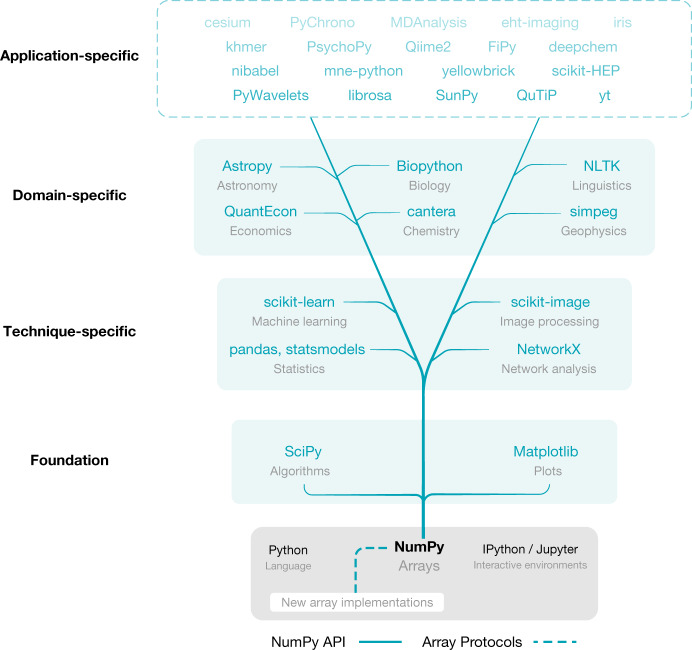
“2) builds on top of this foundation to provide several, widely used technique specific libraries [16, 17, 23], that in turn underlay numerous domain specific projects [24, 25, 26, 27, 28, 29].”
BackgroundSelf-citationMatplotlib: a 2D graphics environment
Hunter, J. D. (2007) · Computing in Science & Engineering · doi:10.1109/mcse.2007.55 · Cited by 39,249 · cited 2×
“[14] J.”
BackgroundSciPy 1.0: fundamental algorithms for scientific computing in Python
Virtanen, P., Gommers, R., Oliphant, T. E., Haberland, M., Reddy, T., Cournapeau, D., Burovski, E., Peterson, P., Weckesser, W., Bright, J., et al. (2020) · Nature Methods · doi:10.1038/s41592-019-0686-2 · Cited by 38,430 · cited 2×
“Now, fifteen years later, NumPy underpins almost every Python library that does scientific or numerical computation including SciPy [13], Matplotlib [14], pandas [15], scikit-learn [16], and scikit-image [17].”
BackgroundSelf-citationPyTorch: An Imperative Style, High-Performance Deep Learning Library
Paszke, A., Gross, S., Massa, F., Lerer, A., Bradbury, J., Chanan, G., Killeen, T., Lin, Z., Gimelshein, N., Antiga, L., et al. (2019) · arXiv · doi:10.48550/arxiv.1912.01703 · Cited by 31,473 · cited 2×
“For example, each deep learning framework created its own arrays; PyTorch [38], Tensorflow [39], Apache MXNet [40], and JAX arrays all have the capability to run on CPUs and GPUs, in a distributed fashion, utilizing lazy evaluation to allow for additional performance optimizations.”
MethodAstropy: A community Python package for astronomy
The Astropy Collaboration, Robitaille, T. P., Tollerud, E. J., Greenfield, P., Droettboom, M., Bray, E., Aldcroft, T., Davis, M., Ginsburg, A., Price-Whelan, A. M., et al. (2013) · Astronomy & Astrophysics · doi:10.1051/0004-6361/201322068 · Cited by 14,620 · cited 3×
“Astropy [24, 25] handles standard astronomical file formats and computes time/coordinate transformations.”
BackgroundObservation of Gravitational Waves from a Binary Black Hole Merger
Abbott, B. P., Abbott, R., Abbott, T. D., Abernathy, M. R., Acernese, F., Ackley, K., Adams, C., Adams, T., Addesso, P., Adhikari, R. X., et al. (2016) · Physical Review Letters · doi:10.1103/physrevlett.116.061102 · Cited by 14,151
TensorFlow: A system for large-scale machine learning
Abadi, M., Barham, P., Chen, J., Chen, Z., Davis, A., Dean, J., Devin, M., Ghemawat, S., Irving, G., Isard, M., et al. (2016) · arXiv (Cornell University) · doi:10.48550/arxiv.1605.08695 · Cited by 11,822
R: A Language for Data Analysis and Graphics
Ihaka, R., & Gentleman, R. (1996) · Journal of Computational and Graphical Statistics · doi:10.1080/10618600.1996.10474713 · Cited by 11,220 · cited 2×
“The design of this new tool was informed by other powerful interactive programming languages for scientific computing such as Basis [47], Yorick [48], R [49], and APL [50], as well as commercial languages and environments like IDL and MATLAB.”
MethodData Structures for Statistical Computing in Python
McKinney, W. (2010) · Proceedings of the Python in Science Conference · doi:10.25080/majora-92bf1922-00a · Cited by 11,032 · cited 2×
“Now, fifteen years later, NumPy underpins almost every Python library that does scientific or numerical computation including SciPy [13], Matplotlib [14], pandas [15], scikit-learn [16], and scikit-image [17].”
BackgroundSciPy 1.0: fundamental algorithms for scientific computing in Python
Virtanen, P., Gommers, R., Oliphant, T. E., Haberland, M., Reddy, T., Cournapeau, D., Burovski, E., Peterson, P., Weckesser, W., Bright, J., et al. (2019) · Apollo - University of Cambridge Repository · doi:10.17863/cam.64134 · Cited by 10,460
Self-citation
Research works printed but not linked: 11
- Yang, T.-Y., Furnish, G. & Dubois, P. F. Steering object-oriented scientific computations. In Proc. TOOLS USA 97. Intl Conf. Technology of Object Oriented Systems and Languages (eds Ege, R., Singh, M. & Meyer, B.) 112–119 (IEEE, 1997).
- Hamman, J., Rocklin, M. & Abernathy, R. Pangeo: a big-data ecosystem for scalable Earth system science. In EGU General Assembly Conf. Abstracts 12146 (2018).
- van der Walt, S. The SciPy Documentation Project (technical overview). In Proc. 7th Python in Science Conf. (SciPy 2008) (eds Varoquaux, G., Vaught, T. & Millman, K. J.) 27–28 (2008).
- Harrington, J. The SciPy Documentation Project. In Proc. 7th Python in Science Conference (SciPy 2008) (eds Varoquaux, G., Vaught, T. & Millman, K. J.) 33–35 (2008).
- Harrington, J. & Goldsmith, D. Progress report: NumPy and SciPy documentation in 2009. In Proc. 8th Python in Science Conf. (SciPy 2009) (eds Varoquaux, G., van der Walt, S. & Millman, K. J.) 84–87 (2009).
- Entschev, P. Distributed multi-GPU computing with Dask, CuPy and RAPIDS. In EuroPython 2019 https://ep2019.europython.eu/media/conference/slides/fX8dJsD-distributed-multi-gpu-computing-with-dask-cupy-and-rapids.pdf (2019).
- Barrett, K. A., Chiu, Y. H., Painter, J. F., Motteler, Z. C. & Dubois, P. F. Basis System, Part I: Running a Basis Program—A Tutorial for Beginners UCRL-MA-118543, Vol. 1 (Lawrence Livermore National Laboratory 1995).
- Dubois, P. F. & Motteler, Z. Basis System, Part II: Basis Language Reference Manual UCRL-MA-118543, Vol. 2 (Lawrence Livermore National Laboratory, 1995).
- Chiu, Y. H. & Dubois, P. F. Basis System, Part III: EZN User Manual UCRL-MA-118543, Vol. 3 (Lawrence Livermore National Laboratory, 1995).
- Chiu, Y. H. & Dubois, P. F. Basis System, Part IV: EZD User Manual UCRL-MA-118543, Vol. 4 (Lawrence Livermore National Laboratory, 1995).
- Lattner, C. & Adve, V. LLVM: a compilation framework for lifelong program analysis and transformation. In Proc. 2004 Intl Symp. Code Generation and Optimization (CGO’04) 75–88 (IEEE, 2004).
Cited by
Items 101–200 of 1,215
Thermal emission from the Earth-sized exoplanet TRAPPIST-1 b using JWST
Greene, T. P., Bell, T. J., Ducrot, E., Dyrek, A., Lagage, P.-O., & Fortney, J. J. (2023) · Nature · doi:10.1038/s41586-023-05951-7 · Cited by 242
Fast Radio Burst Morphology in the First CHIME/FRB Catalog
Pleunis, Z., Good, D. C., Kaspi, V. M., Mckinven, R., Ransom, S. M., Scholz, P., Bandura, K., Bhardwaj, M., Boyle, P. J., Brar, C., et al. (2021) · The Astrophysical Journal · doi:10.3847/1538-4357/ac33ac · Cited by 237
“Facility: CHIME/FRB. Software: Matplotlib (Hunter 2007), NumPy (Harris et al. 2020), rpy2 (https://rpy2.github.io/), SciPy (Virtanen et al. 2020), scikit-learn (Pedregosa et al. 2011).”
The Atacama Cosmology Telescope: DR6 power spectra, likelihoods and ΛCDM parameters
Louis, T., La Posta, A., Atkins, Z., Jense, H. T., Abril-Cabezas, I., Addison, G. E., Ade, P. A. R., Aiola, S., Alford, T., Alonso, D., et al. (2025) · Journal of Cosmology and Astroparticle Physics · doi:10.1088/1475-7516/2025/11/062 · Cited by 232
New improved Brazilian daily weather gridded data (1961–2020)
Xavier, A. C., Scanlon, B. R., King, C. W., & Alves, A. I. (2022) · International Journal of Climatology · doi:10.1002/joc.7731 · Cited by 226
Tufail, S., Riggs, H., Tariq, M., & Sarwat, A. I. (2023) · Electronics · doi:10.3390/electronics12081789 · Cited by 231
“Besides powerful ML model development tools, Python also has libraries that are helpful to the ML as auxiliary tools, such as an extensive number library, a plotting library, and a data manipulation library (numpy, matplotlib, and pandas, respectively) [78–80].”
Gaia Data Release 3: Processing and validation of BP/RP low-resolution spectral data
De Angeli, F., Weiler, M., Montegriffo, P., Evans, D. W., Riello, M., Andrae, R., Carrasco, J. M., Busso, G., Burgess, P. W., Cacciari, C., et al. (2023) · Astronomy & Astrophysics · doi:10.1051/0004-6361/202243680 · Cited by 227
The JWST FRESCO survey: legacy NIRCam/grism spectroscopy and imaging in the two GOODS fields
Oesch, P. A., Brammer, G., Naidu, R. P., Bouwens, R. J., Chisholm, J., Illingworth, G. D., Matthee, J., Nelson, E., Qin, Y., Reddy, N., et al. (2023) · Monthly Notices of the Royal Astronomical Society · doi:10.1093/mnras/stad2411 · Cited by 224
CMB power spectra and cosmological parameters from Planck PR4 with CamSpec
Rosenberg, E., Gratton, S., & Efstathiou, G. (2022) · Monthly Notices of the Royal Astronomical Society · doi:10.1093/mnras/stac2744 · Cited by 225
Monacelli, L., Bianco, R., Cherubini, M., Calandra, M., Errea, I., & Mauri, F. (2021) · Journal of Physics: Condensed Matter · doi:10.1088/1361-648x/ac066b · Cited by 224
“Most of the code is written in Python, however, the heaviest CPU-intensive calculation is written in Fortran and interfaced with python through the f2py utility provided by numpy[56].”
Methodexoplanet: Gradient-based probabilistic inference for exoplanet data other astronomical time series
Foreman-Mackey, D., Luger, R., Agol, E., Barclay, T., Bouma, L., Brandt, T., Czekala, I., David, T., Dong, J., Gilbert, E., et al. (2021) · Journal of Open Source Software · doi:10.21105/joss.03285 · Cited by 219
“Besides the implementation for PyMC3, exoplanet-core includes implementations in numpy (Harris et al., 2020) and jax (Bradbury et al., 2018).”
MethodProDy 2.0: increased scale and scope after 10 years of protein dynamics modelling with Python
Zhang, S., Krieger, J. M., Zhang, Y., Kaya, C., Kaynak, B., Mikulska-Ruminska, K., Doruker, P., Li, H., & Bahar, I. (2021) · Bioinformatics · doi:10.1093/bioinformatics/btab187 · Cited by 219
“S1), as well as various plots facilitated by integration with numeric and scientific Python libraries, NumPy (Harris et al., 2020) and SciPy (Virtanen et al., 2020), and plotting library Matplotlib (Hunter, 2007), and the visualization tool NMWiz as a VMD plug-in (Bakan et al., 2014).”
MethodNo thick carbon dioxide atmosphere on the rocky exoplanet TRAPPIST-1 c
Zieba, S., Kreidberg, L., Ducrot, E., Gillon, M., Morley, C., Schaefer, L., Tamburo, P., Koll, D. D. B., Lyu, X., Acuña, L., et al. (2023) · Nature · doi:10.1038/s41586-023-06232-z · Cited by 218
“We used the following codes, resources, and python packages to reduce, analyze and interpret our JWST observations of TRAPPIST-1 c: numpy[81], matplotlib[82], astropy[83], batman[36], Eureka![9], jwst[32], emcee[35], trafit [41–43], dynesty[84, 85], SMART[60], VPL Climate[3, 58, 59], DISORT [56, 57], IRAF/DAOPHOT [33].”
MethodMUON: multimodal omics analysis framework
Bredikhin, D., Kats, I., & Stegle, O. (2022) · Genome Biology · doi:10.1186/s13059-021-02577-8 · Cited by 216
“…in the Python programming language and builds on a number of existing numerical and scientific open-source libraries, in particular, NumPy [53], Scipy [54], Sklearn [55], Pandas [56], h5py [57], AnnData [17], and Scanpy [9] for omics data handling, MOFA+ [30] for multimodal data…”
BackgroundBlomberg, O. S., Spagnuolo, L., Garner, H., Voorwerk, L., Isaeva, O. I., van Dyk, E., Bakker, N., Chalabi, M., Klaver, C., Duijst, M., et al. (2023) · Cancer Cell · doi:10.1016/j.ccell.2022.11.014 · Cited by 212
Kuett, L., Catena, R., Özcan, A., Plüss, A., Cancer Grand Challenges IMAXT Consortium, Ali, H. R., Sa’d, M. A., Alon, S., Aparicio, S., Battistoni, G., et al. (2021) · Nature Cancer · doi:10.1038/s43018-021-00301-w · Cited by 215
Volk, A. A., Epps, R. W., Yonemoto, D. T., Masters, B. S., Castellano, F. N., Reyes, K. G., & Abolhasani, M. (2023) · Nature Communications · doi:10.1038/s41467-023-37139-y · Cited by 215
Towards the biogeography of prokaryotic genes
Coelho, L. P., Alves, R., del Río, Á. R., Myers, P. N., Cantalapiedra, C. P., Giner-Lamia, J., Schmidt, T. S., Mende, D. R., Orakov, A., Letunic, I., et al. (2022) · Nature · doi:10.1038/s41586-021-04233-4 · Cited by 215
Health Care Students’ Perspectives on Artificial Intelligence: Countrywide Survey in Canada
Teng, M., Singla, R., Yau, O., Lamoureux, D., Gupta, A., Hu, Z., Hu, R., Aissiou, A., Eaton, S., Hamm, C., et al. (2022) · JMIR Medical Education · doi:10.2196/33390 · Cited by 214
“Data management and statistical testing were conducted using the following packages: tableone [25], scikit-learn [26], numpy [27], pandas [28], matplotlib [29], scipy [30].”
MethodBifurcation of planetary building blocks during Solar System formation
Lichtenberg, T., Dra̧żkowska, J., Schönbächler, M., Golabek, G. J., & Hands, T. O. (2021) · Science · doi:10.1126/science.abb3091 · Cited by 212
Spontaneous behaviour is structured by reinforcement without explicit reward
Markowitz, J. E., Gillis, W. F., Jay, M., Wood, J., Harris, R. W., Cieszkowski, R., Scott, R., Brann, D., Koveal, D., Kula, T., et al. (2023) · Nature · doi:10.1038/s41586-022-05611-2 · Cited by 209
Data leakage inflates prediction performance in connectome-based machine learning models
Rosenblatt, M., Tejavibulya, L., Jiang, R., Noble, S., & Scheinost, D. (2024) · Nature Communications · doi:10.1038/s41467-024-46150-w · Cited by 236
ixpeobssim: A simulation and analysis framework for the imaging X-ray polarimetry explorer
Baldini, L., Bucciantini, N., Lalla, N. D., Ehlert, S., Manfreda, A., Negro, M., Omodei, N., Pesce-Rollins, M., Sgrò, C., & Silvestri, S. (2022) · SoftwareX · doi:10.1016/j.softx.2022.101194 · Cited by 210
Technical Note: SpekPy v2.0—a software toolkit for modeling x‐ray tube spectra
Poludniowski, G., Omar, A., Bujila, R., & Andreo, P. (2021) · Medical Physics · doi:10.1002/mp.14945 · Cited by 203
Hunt, E. L., & Reffert, S. (2024) · Astronomy & Astrophysics · doi:10.1051/0004-6361/202348662 · Cited by 207
Abac, A. G., Abbott, R., Abouelfettouh, I., Acernese, F., Ackley, K., Adhicary, S., Adhikari, N., Adhikari, R. X., Adkins, V. K., Agarwal, D., et al. (2024) · The Astrophysical Journal Letters · doi:10.3847/2041-8213/ad5beb · Cited by 206
Montero, D., Aybar, C., Mahecha, M. D., Martinuzzi, F., Söchting, M., & Wieneke, S. (2023) · Scientific Data · doi:10.1038/s41597-023-02096-0 · Cited by 206
Prša, A., Kochoska, A., Conroy, K. E., Eisner, N., Hey, D. R., IJspeert, L., Kruse, E., Fleming, S. W., Johnston, C., Kristiansen, M. H., et al. (2022) · The Astrophysical Journal Supplement Series · doi:10.3847/1538-4365/ac324a · Cited by 206
“Available at www.python.org) and the Python packages Django (Django Software Foundation 2020), Numpy (Harris et al. 2020), Numba (Lam et al. 2015), Scipy (Virtanen et al. 2020), and Matplotlib (Hunter 2007).”
MethodToward a Better Understanding of Cosmic Chronometers: A New Measurement of H(z) at z ∼ 0.7
Borghi, N., Moresco, M., & Cimatti, A. (2022) · The Astrophysical Journal Letters · doi:10.3847/2041-8213/ac3fb2 · Cited by 205
“Software: Astropy (Astropy Collaboration et al. 2018), ChainConsumer (Hinton 2016), CosmoBolognaLib (Marulli et al. 2016), emcee (ForemanMackey et al. 2019), Matplotlib (Hunter 2007), Numpy (Harris et al. 2020), PyLick (Borghi et al. 2022).”
MethodEndsley, R., Stark, D. P., Whitler, L., Topping, M. W., Chen, Z., Plat, A., Chisholm, J., & Charlot, S. (2023) · Monthly Notices of the Royal Astronomical Society · doi:10.1093/mnras/stad1919 · Cited by 203
Katz, M. L., Chua, A. J. K., Speri, L., Warburton, N., & Hughes, S. A. (2021) · Physical Review D · doi:10.1103/physrevd.104.064047 · Cited by 204
The Atacama Cosmology Telescope: DR6 constraints on extended cosmological models
Calabrese, E., Hill, J. C., Jense, H. T., La Posta, A., Abril-Cabezas, I., Addison, G. E., Ade, P. A. R., Aiola, S., Alford, T., Alonso, D., et al. (2025) · Journal of Cosmology and Astroparticle Physics · doi:10.1088/1475-7516/2025/11/063 · Cited by 201
Solving the spike sorting problem with Kilosort
Pachitariu, M., Sridhar, S., & Stringer, C. (2023) · bioRxiv (Cold Spring Harbor Laboratory) · doi:10.1101/2023.01.07.523036 · Cited by 200
Advanced Monte Carlo simulations of emission tomography imaging systems with GATE
Sarrut, D., Bała, M., Bardiès, M., Bert, J., Chauvin, M., Chatzipapas, K., Dupont, M., Etxebeste, A., M Fanchon, L., Jan, S., et al. (2021) · Physics in Medicine & Biology · doi:10.1088/1361-6560/abf276 · Cited by 204
“Since version 9.0, GATEnow includes additional options to read/write data inNPYfile format (Harris et al 2020) that can be processedwith Python.”
MethodInfluentialA city of cities: Measuring how 15-minutes urban accessibility shapes human mobility in Barcelona
Graells-Garrido, E., Serra-Burriel, F., Rowe, F., Cucchietti, F. M., & Reyes, P. (2021) · PLOS ONE · doi:10.1371/journal.pone.0250080 · Cited by 201
“We acknowledge the following software libraries used in the analysis: numpy [68], scipy [69], matplotlib [70], seaborn, PySAL [71], mgwr [64], pandas [72], and geopandas.”
MethodSpatiotemporal dissection of the cell cycle with single-cell proteogenomics
Mahdessian, D., Cesnik, A. J., Gnann, C., Danielsson, F., Stenström, L., Arif, M., Zhang, C., Le, T., Johansson, F., Schutten, R., et al. (2021) · Nature · doi:10.1038/s41586-021-03232-9 · Cited by 198
Bias free multiobjective active learning for materials design and discovery
Jablonka, K. M., Jothiappan, G. M., Wang, S., Smit, B., & Yoo, B. (2021) · Nature Communications · doi:10.1038/s41467-021-22437-0 · Cited by 198
Identification of carbon dioxide in an exoplanet atmosphere
JWST Transiting Exoplanet Community Early Release Science Team, Ahrer, E.-M., Alderson, L., Batalha, N. M., Batalha, N. E., Bean, J. L., Beatty, T. G., Bell, T. J., Benneke, B., Berta-Thompson, Z. K., et al. (2023) · Nature · doi:10.1038/s41586-022-05269-w · Cited by 196
Self-citationFirst Results from HERA Phase I: Upper Limits on the Epoch of Reionization 21 cm Power Spectrum
Abdurashidova, Z., Aguirre, J. E., Alexander, P., Ali, Z. S., Balfour, Y., Beardsley, A. P., Bernardi, G., Billings, T. S., Bowman, J. D., Bradley, R. F., et al. (2022) · The Astrophysical Journal · doi:10.3847/1538-4357/ac1c78 · Cited by 196
“This analysis also relied on publicly accessible and open-source software, including numpy (Harris et al. 2020), scipy (Virtanen et al. 2020), and astropy (Astropy Collaboration et al. 2018).”
MethodBenchmarking spatial clustering methods with spatially resolved transcriptomics data
Yuan, Z., Zhao, F., Lin, S., Zhao, Y., Yao, J., Cui, Y., Zhang, X.-Y., & Zhao, Y. (2024) · Nature Methods · doi:10.1038/s41592-024-02215-8 · Cited by 194
Coarse graining molecular dynamics with graph neural networks
Husic, B. E., Charron, N. E., Lemm, D., Wang, J., Pérez, A., Majewski, M., Krämer, A., Chen, Y., Olsson, S., de Fabritiis, G., et al. (2020) · The Journal of Chemical Physics · doi:10.1063/5.0026133 · Cited by 195
Protein structure generation via folding diffusion
Wu, K. E., Yang, K. K., Berg, R. V. D., Zou, J. Y., Lu, A. X., & Amini, A. P. (2022) · arXiv · doi:10.48550/arxiv.2209.15611 · Cited by 193
Mao, Y.-Y., Geha, M., Wechsler, R. H., Weiner, B., Tollerud, E. J., Nadler, E. O., & Kallivayalil, N. (2021) · The Astrophysical Journal · doi:10.3847/1538-4357/abce58 · Cited by 192
PyCO2SYS v1.8: marine carbonate system calculations in Python
Humphreys, M. P., Lewis, E. R., Sharp, J. D., & Pierrot, D. (2022) · Geoscientific Model Development · doi:10.5194/gmd-15-15-2022 · Cited by 192
“A combination of scalar and multidimensional arguments can be provided, with the latter formatted as NumPy ndarrays (Harris et al., 2020).”
BackgroundStandardized and reproducible measurement of decision-making in mice
Laboratory, T. I. B., Aguillon-Rodriguez, V., Angelaki, D., Bayer, H., Bonacchi, N., Carandini, M., Cazettes, F., Chapuis, G., Churchland, A. K., Dan, Y., et al. (2021) · eLife · doi:10.7554/elife.63711 · Cited by 189
Functional connectomics spanning multiple areas of mouse visual cortex
The MICrONS Consortium, Bae, J. A., Baptiste, M., Baptiste, M. R., Bishop, C. A., Bodor, A. L., Brittain, D., Brooks, V., Buchanan, J., Bumbarger, D. J., et al. (2025) · Nature · doi:10.1038/s41586-025-08790-w · Cited by 190
Rosen, A. S., Fung, V., Huck, P., O’Donnell, C. T., Horton, M. K., Truhlar, D. G., Persson, K. A., Notestein, J. M., & Snurr, R. Q. (2022) · npj Computational Materials · doi:10.1038/s41524-022-00796-6 · Cited by 190
“…calculations), 62 ASE v. 3.20.0b1 (orchestrate the VASP calculations), 44 Pymatgen v. 2020.12.3 (electronic structure analysis), 63 Bader v. 1.04 (Bader analysis), 64 NumPy/Pandas/SciPy/matplotlib/seaborn (data analysis and visualization), 65 – 69 and PtitPrince v.0.2.5 (for raincloud plots 70 ).”
InfluentialVolk, J. M., Huntington, J. L., Melton, F. S., Allen, R., Anderson, M., Fisher, J. B., Kilic, A., Ruhoff, A., Senay, G. B., Minor, B., et al. (2024) · Nature Water · doi:10.1038/s44221-023-00181-7 · Cited by 189
Delocalized photonic deep learning on the internet’s edge
Sludds, A., Bandyopadhyay, S., Chen, Z., Zhong, Z., Cochrane, J., Bernstein, L., Bunandar, D., Dixon, P. B., Hamilton, S. A., Streshinsky, M., et al. (2022) · Science · doi:10.1126/science.abq8271 · Cited by 189
Gaia Data Release 3: External calibration of BP/RP low-resolution spectroscopic data
Montegriffo, P., De Angeli, F., Andrae, R., Riello, M., Pancino, E., Sanna, N., Bellazzini, M., Evans, D. W., Carrasco, J. M., Sordo, R., et al. (2023) · Astronomy & Astrophysics · doi:10.1051/0004-6361/202243880 · Cited by 185
FISH-quant v2: a scalable and modular tool for smFISH image analysis
Imbert, A., Ouyang, W., Safieddine, A., Coleno, E., Zimmer, C., Bertrand, E., Walter, T., & Mueller, F. (2022) · RNA · doi:10.1261/rna.079073.121 · Cited by 186
Tang, M., Stark, D. P., Chen, Z., Mason, C., Topping, M., Endsley, R., Senchyna, P., Plat, A., Lu, T.-Y., Whitler, L., et al. (2023) · Monthly Notices of the Royal Astronomical Society · doi:10.1093/mnras/stad2763 · Cited by 186
Atomic-scale evidence of chemical short-range order in CrCoNi medium-entropy alloy
Zhou, L., Wang, Q., Wang, J., Chen, X., Jiang, P., Zhou, H., Yuan, F., Wu, X., Cheng, Z., & Ma, E. (2022) · Acta Materialia · doi:10.1016/j.actamat.2021.117490 · Cited by 179
Predicting the mutational drivers of future SARS-CoV-2 variants of concern
Maher, M. C., Bartha, I., Weaver, S., di Iulio, J., Ferri, E., Soriaga, L., Lempp, F. A., Hie, B. L., Bryson, B., Berger, B., et al. (2022) · Science Translational Medicine · doi:10.1126/scitranslmed.abk3445 · Cited by 184
Moran, S. E., Stevenson, K. B., Sing, D. K., MacDonald, R. J., Kirk, J., Lustig-Yaeger, J., Peacock, S., Mayorga, L. C., Bennett, K. A., López-Morales, M., et al. (2023) · The Astrophysical Journal Letters · doi:10.3847/2041-8213/accb9c · Cited by 182
Mechanistic Origin of Superionic Lithium Diffusion in Anion-Disordered Li 6 PS 5 X Argyrodites
Morgan, B. J. (2021) · Chemistry of Materials · doi:10.1021/acs.chemmater.0c03738 · Cited by 182
LOFAR Detection of 110–188 MHz Emission and Frequency-dependent Activity from FRB 20180916B
Pleunis, Z., Michilli, D., Bassa, C. G., Hessels, J. W. T., Naidu, A., Andersen, B. C., Chawla, P., Fonseca, E., Gopinath, A., Kaspi, V. M., et al. (2021) · The Astrophysical Journal Letters · doi:10.3847/2041-8213/abec72 · Cited by 181
Abdurashidova, T. H. C. Z., Adams, T., Aguirre, J. E., Alexander, P., Ali, Z. S., Baartman, R., Balfour, Y., Barkana, R., Beardsley, A. P., Bernardi, G., et al. (2023) · The Astrophysical Journal · doi:10.3847/1538-4357/acaf50 · Cited by 179
A unified genealogy of modern and ancient genomes
Wohns, A. W., Wong, Y., Jeffery, B., Akbari, A., Mallick, S., Pinhasi, R., Patterson, N., Reich, D., Kelleher, J., & McVean, G. (2022) · Science · doi:10.1126/science.abi8264 · Cited by 179
PINT: A Modern Software Package for Pulsar Timing
Luo, J., Ransom, S., Demorest, P., Ray, P. S., Archibald, A., Kerr, M., Jennings, R. J., Bachetti, M., van Haasteren, R., Champagne, C. A., et al. (2021) · The Astrophysical Journal · doi:10.3847/1538-4357/abe62f · Cited by 177
Protein structure generation via folding diffusion
Wu, K. E., Yang, K. K., van den Berg, R., Alamdari, S., Zou, J. Y., Lu, A. X., & Amini, A. P. (2024) · Nature Communications · doi:10.1038/s41467-024-45051-2 · Cited by 178
Py-Feat: Python Facial Expression Analysis Toolbox
Cheong, J. H., Jolly, E., Xie, T., Byrne, S., Kenney, M., & Chang, L. J. (2023) · Affective Science · doi:10.1007/s42761-023-00191-4 · Cited by 178
“…that has already created a rich library of tightly integrated high-quality scientific computing packages for working with arrays such as numpy (Harris et al., 2020) and pandas (McKinney, 2011); scientific numerical routines with scipy (Jones et al., 2001), machine learning algorithms with…”
Optimizing the Cell Painting assay for image-based profiling
Cimini, B. A., Chandrasekaran, S. N., Kost-Alimova, M., Miller, L., Goodale, A., Fritchman, B., Byrne, P., Garg, S., Jamali, N., Logan, D. J., et al. (2023) · Nature Protocols · doi:10.1038/s41596-023-00840-9 · Cited by 177
Cheng, J., Yan, J., Liu, Y., Shi, J., Wang, H., Zhou, H., Zhou, Y., Zhang, T., Zhao, L., Meng, X., et al. (2023) · Cell Metabolism · doi:10.1016/j.cmet.2023.04.017 · Cited by 177
Automated design of synthetic microbial communities
Karkaria, B. D., Fedorec, A. J. H., & Barnes, C. P. (2021) · Nature Communications · doi:10.1038/s41467-020-20756-2 · Cited by 175
Position Information in Transformers: An Overview
Dufter, P., Schmitt, M., & Schütze, H. (2022) · Computational Linguistics · doi:10.1162/coli_a_00445 · Cited by 175
Pacifici, C., Iyer, K. G., Mobasher, B., da Cunha, E., Acquaviva, V., Burgarella, D., Calistro Rivera, G., Carnall, A. C., Chang, Y.-Y., Chartab, N., et al. (2023) · The Astrophysical Journal · doi:10.3847/1538-4357/acacff · Cited by 175
Lim, O., Benneke, B., Doyon, R., MacDonald, R. J., Piaulet, C., Artigau, É., Coulombe, L.-P., Radica, M., L’Heureux, A., Albert, L., et al. (2023) · The Astrophysical Journal Letters · doi:10.3847/2041-8213/acf7c4 · Cited by 175
Self-citationCell-type-directed design of synthetic enhancers
Taskiran, I. I., Spanier, K. I., Dickmänken, H., Kempynck, N., Pančíková, A., Ekşi, E. C., Hulselmans, G., Ismail, J. N., Theunis, K., Vandepoel, R., et al. (2024) · Nature · doi:10.1038/s41586-023-06936-2 · Cited by 175
The Third Fermi Large Area Telescope Catalog of Gamma-Ray Pulsars
Smith, D. A., Abdollahi, S., Ajello, M., Bailes, M., Baldini, L., Ballet, J., Baring, M. G., Bassa, C., Gonzalez, J. B., Bellazzini, R., et al. (2023) · The Astrophysical Journal · doi:10.3847/1538-4357/acee67 · Cited by 171
Key features and guidelines for the application of microbial alpha diversity metrics
Cassol, I., Ibañez, M., & Bustamante, J. P. (2025) · Scientific Reports · doi:10.1038/s41598-024-77864-y · Cited by 167
Practical autoencoder based anomaly detection by using vector reconstruction error
Torabi, H., Mirtaheri, S. L., & Greco, S. (2023) · Cybersecurity · doi:10.1186/s42400-022-00134-9 · Cited by 168
A parsec-scale Galactic 3D dust map out to 1.25 kpc from the Sun
Edenhofer, G., Zucker, C., Frank, P., Saydjari, A. K., Speagle, J. S., Finkbeiner, D., & Enßlin, T. A. (2024) · Astronomy & Astrophysics · doi:10.1051/0004-6361/202347628 · Cited by 172
Hardware error correction for programmable photonics
Bandyopadhyay, S., Hamerly, R., & Englund, D. (2021) · Optica · doi:10.1364/optica.424052 · Cited by 170
Comparing machine learning algorithms for predicting ICU admission and mortality in COVID-19
Subudhi, S., Verma, A., Patel, A. B., Hardin, C. C., Khandekar, M. J., Lee, H., McEvoy, D., Stylianopoulos, T., Munn, L. L., Dutta, S., et al. (2021) · npj Digital Medicine · doi:10.1038/s41746-021-00456-x · Cited by 170
Decoding gene regulation in the fly brain
Janssens, J., Aibar, S., Taskiran, I. I., Ismail, J. N., Gomez, A. E., Aughey, G., Spanier, K. I., De Rop, F. V., González-Blas, C. B., Dionne, M., et al. (2022) · Nature · doi:10.1038/s41586-021-04262-z · Cited by 170
Decoding gene regulation in the fly brain
Janssens, J., Aibar, S., Taskiran, I. I., Ismail, J. N., Spanier, K. I., Bravo González-Blas, C., Quan, X. J., Papasokrati, D., Hulselmans, G., Makhzami, S., et al. (2021) · doi:10.1101/2021.08.11.454937 · Cited by 170
Symbolic Discovery of Optimization Algorithms
Chen, X., Liang, C., Huang, D., Real, E., Wang, K., Liu, Y., Pham, H., Dong, X., Luong, T., Hsieh, C.-J., et al. (2023) · arXiv · doi:10.48550/arxiv.2302.06675 · Cited by 303
“They are similar to Python code using NumPy / JAX [10, 36] as well as pseudo code of optimization algorithms.”
MethodNonlinear Effects in Black Hole Ringdown
Cheung, M. H.-Y., Baibhav, V., Berti, E., Cardoso, V., Carullo, G., Cotesta, R., Del Pozzo, W., Duque, F., Helfer, T., Shukla, E., et al. (2023) · Physical Review Letters · doi:10.1103/physrevlett.130.081401 · Cited by 166
A gut microbial signature for combination immune checkpoint blockade across cancer types
Gunjur, A., Shao, Y., Rozday, T., Klein, O., Mu, A., Haak, B. W., Markman, B., Kee, D., Carlino, M. S., Underhill, C., et al. (2024) · Nature Medicine · doi:10.1038/s41591-024-02823-z · Cited by 165
Energy Forecasting: A Comprehensive Review of Techniques and Technologies
Mystakidis, A., Koukaras, P., Tsalikidis, N., Ioannidis, D., & Tjortjis, C. (2024) · Energies · doi:10.3390/en17071662 · Cited by 165
Gaia Data Release 3: Apsis. II. Stellar parameters
Fouesneau, M., Frémat, Y., Andrae, R., Korn, A. J., Soubiran, C., Kordopatis, G., Vallenari, A., Heiter, U., Creevey, O. L., Sarro, L. M., et al. (2023) · Astronomy & Astrophysics · doi:10.1051/0004-6361/202243919 · Cited by 165
A versatile and customizable low-cost 3D-printed open standard for microscopic imaging
Diederich, B., Lachmann, R., Carlstedt, S., Marsikova, B., Wang, H., Uwurukundo, X., Mosig, A. S., & Heintzmann, R. (2020) · Nature Communications · doi:10.1038/s41467-020-19447-9 · Cited by 164
Madagascar’s extraordinary biodiversity: Threats and opportunities
Ralimanana, H., Perrigo, A. L., Smith, R. J., Borrell, J. S., Faurby, S., Rajaonah, M. T., Randriamboavonjy, T., Vorontsova, M. S., Cooke, R. S. C., Phelps, L. N., et al. (2022) · Science · doi:10.1126/science.adf1466 · Cited by 164
Freedman, W. L., Madore, B. F., Hoyt, T. J., Jang, I. S., Lee, A. J., & Owens, K. A. (2025) · The Astrophysical Journal · doi:10.3847/1538-4357/adce78 · Cited by 164
Hopkins, J. B. (2024) · Journal of Applied Crystallography · doi:10.1107/s1600576723011019 · Cited by 160
Mouse spontaneous behavior reflects individual variation rather than estrous state
Levy, D. R., Hunter, N., Lin, S., Robinson, E. M., Gillis, W., Conlin, E. B., Anyoha, R., Shansky, R. M., & Datta, S. R. (2023) · Current Biology · doi:10.1016/j.cub.2023.02.035 · Cited by 162
Most of the photons that reionized the Universe came from dwarf galaxies
Atek, H., Labbé, I., Furtak, L. J., Chemerynska, I., Fujimoto, S., Setton, D. J., Miller, T. B., Oesch, P., Bezanson, R., Price, S. H., et al. (2024) · Nature · doi:10.1038/s41586-024-07043-6 · Cited by 161
Singh, S., Lang, L., Dovale-Farelo, V., Herath, U., Tavadze, P., Coudert, F.-X., & Romero, A. H. (2021) · Computer Physics Communications · doi:10.1016/j.cpc.2021.108068 · Cited by 161
A concerted neuron–astrocyte program declines in ageing and schizophrenia
Ling, E., Nemesh, J. C., Goldman, M., Kamitaki, N., Reed, N. M., Handsaker, R. E., Genovese, G., Vogelgsang, J. S., Gerges, S., Kashin, S., et al. (2024) · Nature · doi:10.1038/s41586-024-07109-5 · Cited by 205
Thresholds for Particle Clumping by the Streaming Instability
Li 李, R. 日., & Youdin, A. N. (2021) · The Astrophysical Journal · doi:10.3847/1538-4357/ac0e9f · Cited by 159
Explainable machine learning model for liquefaction potential assessment of soils using XGBoost-SHAP
Jas, K., & Dodagoudar, G. R. (2022) · Soil Dynamics and Earthquake Engineering · doi:10.1016/j.soildyn.2022.107662 · Cited by 177
DESI 2024: reconstructing dark energy using crossing statistics with DESI DR1 BAO data
Calderon, R., Lodha, K., Shafieloo, A., Linder, E., Sohn, W., de Mattia, A., Cervantes-Cota, J. L., Crittenden, R., Davis, T. M., Ishak, M., et al. (2024) · Journal of Cosmology and Astroparticle Physics · doi:10.1088/1475-7516/2024/10/048 · Cited by 159
Rapid Stellar and Binary Population Synthesis with COMPAS
Team COMPAS, Riley, J. A., Agrawal, P., Barrett, J. W., Boyett, K., Broekgaarden, F. S., Chattopadhyay, D., Gaebel, S. M., Gittins, F., Hirai, R., et al. (2022) · The Astrophysical Journal Supplement Series · doi:10.3847/1538-4365/ac416c · Cited by 225
Chandrasekaran, S. N., Cimini, B. A., Goodale, A., Miller, L., Kost-Alimova, M., Jamali, N., Doench, J. G., Fritchman, B., Skepner, A., Melanson, M., et al. (2024) · Nature Methods · doi:10.1038/s41592-024-02241-6 · Cited by 154
Self-citationThe Target-selection Pipeline for the Dark Energy Spectroscopic Instrument
Myers, A. D., Moustakas, J., Bailey, S., Weaver, B. A., Cooper, A. P., Forero-Romero, J. E., Abolfathi, B., Alexander, D. M., Brooks, D., Chaussidon, E., et al. (2023) · The Astronomical Journal · doi:10.3847/1538-3881/aca5f9 · Cited by 158
“…WISE Software: astropy (Astropy Collaboration et al. 2013, 2018), fitsio (https://github.com/esheldon/fitsio), healpy (Zonca et al. 2019), matplotlib (Caswell et al. 2021), numpy (Harris et al. 2020), photutils (Bradley et al. 2019), pyyaml (https://pyyaml.org/), scipy (Gommers et al. 2021).”
Antigen Dominance Hierarchies Shape TCF1+ Progenitor CD8 T Cell Phenotypes in Tumors
Burger, M. L., Cruz, A. M., Crossland, G. E., Gaglia, G., Ritch, C. C., Blatt, S. E., Bhutkar, A. J., Canner, D. A., Kienka, T., Tavana, S. Z., et al. (2021) · Cell · doi:10.1016/j.cell.2021.08.020 · Cited by 169
Compatibility rules of human enhancer and promoter sequences
Bergman, D. T., Jones, T. R., Liu, V., Ray, J., Jagoda, E., Siraj, L., Kang, H. Y., Nasser, J., Kane, M., Rios, A., et al. (2022) · Nature · doi:10.1038/s41586-022-04877-w · Cited by 151
POSYDON: A General-purpose Population Synthesis Code with Detailed Binary-evolution Simulations
Fragos, T., Andrews, J. J., Bavera, S. S., Berry, C. P. L., Coughlin, S., Dotter, A., Giri, P., Kalogera, V., Katsaggelos, A. K., Kovlakas, K., et al. (2023) · The Astrophysical Journal Supplement Series · doi:10.3847/1538-4365/ac90c1 · Cited by 246
Pompili, L., Buonanno, A., Estellés, H., Khalil, M., van de Meent, M., Mihaylov, D. P., Ossokine, S., Pürrer, M., Ramos-Buades, A., Mehta, A. K., et al. (2023) · Physical review. D/Physical review. D. · doi:10.1103/physrevd.108.124035 · Cited by 249
CHIME/FRB Discovery of 25 Repeating Fast Radio Burst Sources
Andersen, B. C., Bandura, K., Bhardwaj, M., Boyle, P. J., Brar, C., Cassanelli, T., Chatterjee, S., Chawla, P., Cook, A. M., Curtin, A. P., et al. (2023) · The Astrophysical Journal · doi:10.3847/1538-4357/acc6c1 · Cited by 228
Metadata
- Authors
- Harris, C. R., Millman, K. J., van der Walt, S. J., Gommers, R., Virtanen, P., Cournapeau, D., Wieser, E., Taylor, J., Berg, S., Smith, N. J., Kern, R., Picus, M., Hoyer, S., van Kerkwijk, M. H., Brett, M., Haldane, A., del Río, J. F., Wiebe, M., Peterson, P., Gérard-Marchant, P., Sheppard, K., Reddy, T., Weckesser, W., Abbasi, H., Gohlke, C., & Oliphant, T. E.
- Affiliations
- University of California, Berkeley (US)
- Quansight (United States) (US)
- University of Jyväskylä (FI)
- University of Cambridge (GB)
- Enthought (United States) (US)
- Google (United States) (US)
- University of Birmingham (GB)
- Temple University (US)
- Amazon (United States) (US)
- Tallinn University of Technology (EE)
- University of Georgia (US)
- University of Oxford (GB)
- Los Alamos National Laboratory (US)
- University of California, Irvine (US)
- Corresponding author
- Millman, K. Jarrod
- Gommers, Ralf
- ORCID
- Venue
- Nature
- Published
- 2020-09-16
- Volume
- 585
- Issue
- 7825
- Pages
- 357-362
- ISSN
- 0028-0836 (ISSN-L)
- 1476-4687
- PMC
- PMC7759461
- OpenAlex
- W3035965352
- Semantic Scholar
- 024a2c03be8e468e7c4fdf9bda36cdc0eaae85fb
- Cited by
- 23,826
- References
- 40
- Citations by year
- 2026: 4948 · 2025: 5392 · 2024: 4557 · 2023: 3671 · 2022: 3110 · 2021: 1994 · 2020: 142
- FWCI
- 77.10
- Type
- journal article
- Language
- en
- Open access
- hybrid
- doi.org
- Licence
- cc-by
- creativecommons.org/licenses/by/4.0 (tdm)
- creativecommons.org/licenses/by/4.0 (vor)
- Locations
- Nature (publishedVersion, cc-by)
- Europe PMC (PubMed Central) (publishedVersion, other-oa)
- PubMed Central (publishedVersion, cc-by)
- PubMed (publishedVersion)
- arXiv (Cornell University) (submittedVersion)
- Jyväskylä University Digital Archive (University of Jyväskylä) (submittedVersion, cc-by)
- eScholarship (California Digital Library) (submittedVersion, cc-by)
- arXiv (Cornell University) (cc-by)
- Funders
- Alfred P. Sloan Foundation (g-2017-9960, 2013-10-27)
- Gordon and Betty Moore Foundation (GBMF5447, GBMF3834)
- Topics
- Physical Sciences › Computer Science › Software › Computational Physics and Python Applications
- Social Sciences › Decision Sciences › Information Systems and Management › Scientific Computing and Data Management
- Physical Sciences › Computer Science › Hardware and Architecture › Parallel Computing and Optimization Techniques
- Keywords
- array programming, NumPy, Python, scientific computing, multidimensional arrays, matrix-vector operations, scientific data analysis, scientific Python ecosystem, gravitational waves, black hole imaging
- MeSH terms
- Mathematics, Programming Languages, Software Design, Computational Biology
About these checks
Registry, retraction, Cites and statistics results are computed, not judged, with one exception: a printed reference that no index lists is read once by a model before it counts as a citation error. Claims are extracted by a model and kept only when their quote appears verbatim in the text; each cited source is then checked, with a model’s help, for whether it says what the claim relies on. Those verdicts can be wrong — read the claim’s quote and the cited source before relying on one.
Statistics and arithmetic are recomputed, not judged.
Confidence bands are shown only for fields calibrated on our annotated test set. None is calibrated yet, so no band is shown.
What counts as a claim ›How we measure confidence ›How we check this ›
Are you an author, or do you see a problem with this page? Request a review
Data sources
Bibliographic data: Semantic Scholar, OpenAlex, Crossref.
Contains information from the Semantic Scholar Academic Graph Datasets, made available under the ODC Attribution License (ODC-BY 1.0).
Semantic Scholar’s data is described in: Kinney, R., et al. (2023). The Semantic Scholar Open Data Platform. arXiv:2301.10140.
