

Measuring human capital using global learning data
Open accessThe DOI matches its Crossref record; 37 of the 38 references it cites were found in a registry or an index.
Abstract
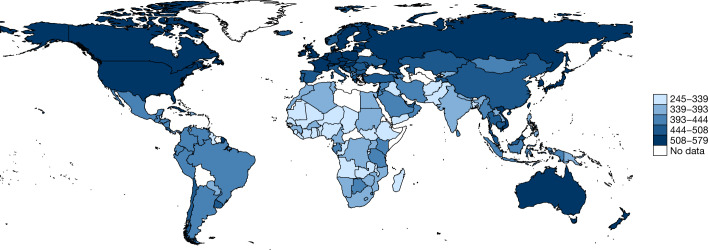
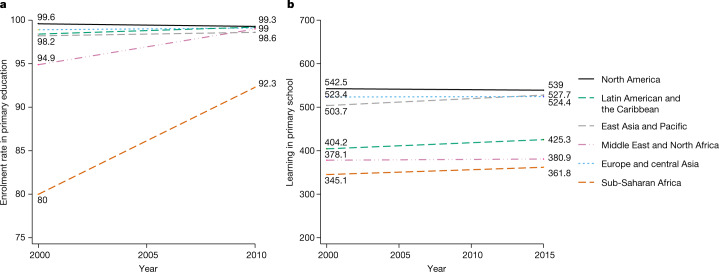
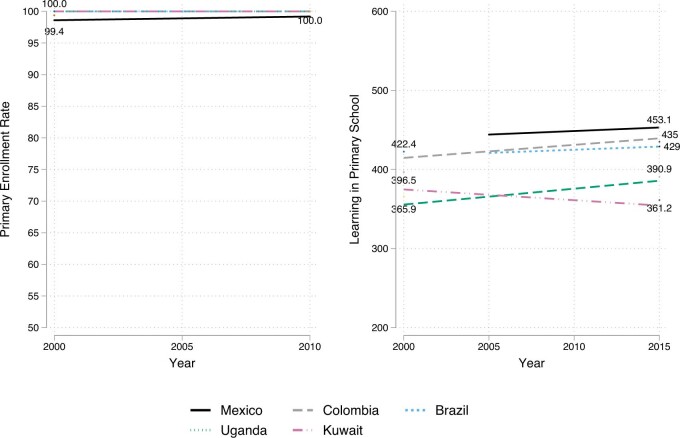
Human capital—that is, resources associated with the knowledge and skills of individuals—is a critical component of economic development 1,2 . Learning metrics that are comparable for countries globally are necessary to understand and track the formation of human capital. The increasing use of international achievement tests is an important step in this direction 3 . However, such tests are administered primarily in developed countries 4 , limiting our ability to analyse learning patterns in developing countries that may have the most to gain from the formation of human capital. Here we bridge this gap by constructing a globally comparable database of 164 countries from 2000 to 2017. The data represent 98% of the global population and developing economies comprise two-thirds of the included countries. Using this dataset, we show that global progress in learning—a priority Sustainable Development Goal—has been limited, despite increasing enrolment in primary and secondary education. Using an accounting exercise that includes a direct measure of schooling quality, we estimate that the role of human capital in explaining income differences across countries ranges from a fifth to half; this result has an intermediate position in the wide range of estimates provided in earlier papers in the literature 5–13 . Moreover, we show that average estimates mask considerable heterogeneity associated with income grouping across countries and regions. This heterogeneity highlights the importance of including countries at various stages of economic development when analysing the role of human capital in economic development. Finally, we show that our database provides a measure of human capital that is more closely associated with economic growth than current measures that are included in the Penn world tables version 9.0 14 and the human development index of the United Nations 15 .
Overview
The claims and statistics of this paper haven’t been checked yet.
Free: it reads the open-access text and checks the first 5 claims that cite a source we can check. Create a free account to check every claim.
Integrity signals
Registry
Cites
Statistics
Figures

Verification
Claims the paper makes
The claims and statistics of this paper haven’t been checked yet.
Free: it reads the open-access text and checks the first 5 claims that cite a source we can check. Create a free account to check every claim.
Claims other papers make about this one
Each is checked against this paper’s own text: does it say what the citing paper says it does?
The cited source says what the claim attributes to it.
In the citing paper
“Low-and middle-income countries were already struggling with a learning crisis before the pandemic.”
From A systematic review and meta-analysis of the evidence on learning during the COVID-19 pandemic (2023) · cites this paper as [30]
Self-check
Percentages, sums and reported differences re-computed from the paper’s own numbers.
The self-check needs the paper’s full text.
Citations
Cites
A Contribution to the Empirics of Economic Growth
Mankiw, N. G., Romer, D., & Weil, D. N. (1992) · The Quarterly Journal of Economics · doi:10.2307/2118477 · Cited by 15,119
An Inquiry into the Nature and Causes of the Wealth of Nations
Smith, A. (1776) · The Glasgow Edition of the Works and Correspondence of Adam Smith, Vol. 2: An Inquiry into the Nature and Causes of the Wealth of Nations, Vol. 1 · doi:10.1093/oseo/instance.00043218 · Cited by 11,757
Investment in Human Capital: A Theoretical Analysis
Becker, G. S. (1962) · Journal of Political Economy · doi:10.1086/258724 · Cited by 8,063
Why do Some Countries Produce So Much More Output Per Worker than Others?
Hall, R. E., & Jones, C. I. (1999) · The Quarterly Journal of Economics · doi:10.1162/003355399555954 · Cited by 7,879
The United Nations Development Programme
Oestreich, J. E. (2017) · Development and Human Rights · doi:10.1093/acprof:oso/9780190637347.003.0003 · Cited by 4,894
The Next Generation of the Penn World Table
Feenstra, R. C., Inklaar, R., & Timmer, M. P. (2015) · American Economic Review · doi:10.1257/aer.20130954 · Cited by 4,799
A new data set of educational attainment in the world, 1950–2010
Barro, R. J., & Lee, J. W. (2013) · Journal of Development Economics · doi:10.1016/j.jdeveco.2012.10.001 · Cited by 4,333
International data on educational attainment: updates and implications
Barro, R. J. (2001) · Oxford Economic Papers · doi:10.1093/oep/53.3.541 · Cited by 2,569
Schooling, Labor-Force Quality, and the Growth of Nations
Hanushek, E. A., & Kimko, D. D. (2000) · American Economic Review · doi:10.1257/aer.90.5.1184 · Cited by 2,164
Education for Growth: Why and for Whom?
Krueger, A. B., & Lindahl, M. (2001) · Journal of Economic Literature · doi:10.1257/jel.39.4.1101 · Cited by 2,060
The Neoclassical Revival in Growth Economics: Has It Gone Too Far?
Klenow, P. J., & Rodríguez-Clare, A. (1997) · NBER Macroeconomics Annual · doi:10.1086/654324 · Cited by 1,302
Do better schools lead to more growth? Cognitive skills, economic outcomes, and causation
Hanushek, E. A., & Woessmann, L. (2012) · Journal of Economic Growth · doi:10.1007/s10887-012-9081-x · Cited by 1,264
Human Capital and Regional Development *
Gennaioli, N., La Porta, R., Lopez-de-Silanes, F., & Shleifer, A. (2013) · The Quarterly Journal of Economics · doi:10.1093/qje/qjs050 · Cited by 1,082
Returns to investment in education: a decennial review of the global literature
Psacharopoulos, G., & Patrinos, H. A. (2018) · Education Economics · doi:10.1080/09645292.2018.1484426 · Cited by 869
Self-citationChapter 9 Accounting for Cross-Country Income Differences
Caselli, F. (2005) · Handbook of Economic Growth · doi:10.1016/s1574-0684(05)01009-9 · Cited by 784
Caselli, F., & Coleman, W. J. (2006) · American Economic Review · doi:10.1257/aer.96.3.499 · Cited by 676
Estimating Population Characteristics From Sparse Matrix Samples of Item Responses
Mislevy, R. J., Beaton, A. E., Kaplan, B., & Sheehan, K. M. (1992) · Journal of Educational Measurement · doi:10.1111/j.1745-3984.1992.tb00371.x · Cited by 447
Human capital and economic growth
Mincer, J. (1984) · Economics of Education Review · doi:10.1016/0272-7757(84)90032-3 · Cited by 411
Returns to investment in education
Psacharopoulos, G., & Patrinos, H. A. (1993) · Cited by 352
Self-citationGlobal Human Capital: Integrating Education and Population
Lutz, W., & KC, S. (2011) · Science · doi:10.1126/science.1206964 · Cited by 342
Schooling, educational achievement, and the Latin American growth puzzle
Hanushek, E. A., & Woessmann, L. (2012) · Journal of Development Economics · doi:10.1016/j.jdeveco.2012.06.004 · Cited by 324
Lee, J.-W., & Lee, H. (2016) · Journal of Development Economics · doi:10.1016/j.jdeveco.2016.05.006 · Cited by 301
How Important Is Human Capital for Development? Evidence from Immigrant Earnings
Hendricks, L. (2002) · American Economic Review · doi:10.1257/000282802760015676 · Cited by 214
Chapter 11 Does Learning to Add up Add up? The Returns to Schooling in Aggregate Data
Pritchett, L. H. (2006) · Handbook of the economics of education · doi:10.1016/s1574-0692(06)01011-7 · Cited by 212
Education Quality and Development Accounting
Schoellman, T. (2012) · The Review of Economic Studies · doi:10.1093/restud/rdr025 · Cited by 206
Global Data Set on Education Quality (1965–2015)
Altinok, N., Angrist, N., & Patrinos, H. A. (2018) · World Bank, Washington, DC eBooks · doi:10.1596/1813-9450-8314 · Cited by 197
Self-citationDas, J., & Zajonc, T. (2009) · Journal of Development Economics · doi:10.1016/j.jdeveco.2009.03.004 · Cited by 174
Human Capital and Development Accounting: New Evidence from Wage Gains at Migration
Hendricks, L., & Schoellman, T. (2016) · The Quarterly Journal of Economics · doi:10.1093/qje/qjx047 · Cited by 171
The Human Capital Stock: A Generalized Approach
Jones, B. F. (2014) · American Economic Review · doi:10.1257/aer.104.11.3752 · Cited by 163
Measuring and forecasting progress towards the education-related SDG targets
Friedman, J., York, H., Graetz, N., Woyczynski, L., Whisnant, J., Hay, S. I., & Gakidou, E. (2020) · Nature · doi:10.1038/s41586-020-2198-8 · Cited by 138
Quality‐Consistent Estimates of International Schooling and Skill Gradients
Hanushek, E. A., & Zhang, L. (2009) · Journal of Human Capital · doi:10.1086/644780 · Cited by 132
The World Bank Human Capital Index: A Guide
Kraay, A. (2019) · The World Bank Research Observer · doi:10.1093/wbro/lkz001 · Cited by 126
Reardon, S. F., Kalogrides, D., & Ho, A. D. (2019) · Journal of Educational and Behavioral Statistics · doi:10.3102/1076998619874089 · Cited by 49
Revisiting human capital and aggregate income differences
Campbell, S. G., & Üngör, M. (2020) · Economic Modelling · doi:10.1016/j.econmod.2020.05.016 · Cited by 42
The Human Capital Stock: A Generalized Approach: Comment
Caselli, F., & Ciccone, A. (2019) · American Economic Review · doi:10.1257/aer.20171787 · Cited by 36
The Human Capital Stock: A Generalized Approach: Reply
Jones, B. F. (2019) · American Economic Review · doi:10.1257/aer.20181678 · Cited by 33
Nonequivalent Groups: Linear Methods
Kolen, M. J., & Brennan, R. L. (2014) · Springer eBooks · doi:10.1007/978-1-4939-0317-7_4 · Cited by 8
Cited by
A systematic review and meta-analysis of the evidence on learning during the COVID-19 pandemic
Betthäuser, B. A., Bach-Mortensen, A. M., & Engzell, P. (2023) · Nature Human Behaviour · doi:10.1038/s41562-022-01506-4 · Cited by 568
Public Procurement in Law and Practice
Bosio, E., Djankov, S., Glaeser, E., & Shleifer, A. (2022) · American Economic Review · doi:10.1257/aer.20200738 · Cited by 237
Self-citationGlobal universal basic skills: Current deficits and implications for world development
Gust, S., Hanushek, E. A., & Woessmann, L. (2023) · Journal of Development Economics · doi:10.1016/j.jdeveco.2023.103205 · Cited by 171
Improving Learning in Low- and Lower-Middle-Income Countries
Angrist, N., Aurino, E., Patrinos, H. A., Psacharopoulos, G., Vegas, E., Nordjo, R. E., & Wong, B. A. (2023) · Journal of Benefit-Cost Analysis · doi:10.1017/bca.2023.26 · Cited by 138
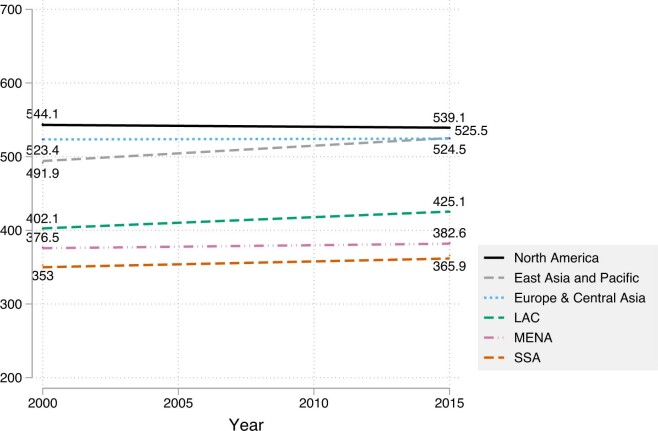
“…of learning, the Harmonized Learning Outcomes (HLO), shows a slow improvement in primary school learning from 2000 to 2015 for most developing regions of the world, but the improvement is vastly insufficient to reach high-performing education systems by 2030 or even 2050 (Angrist et al. , 2020).”
BackgroundMethodInfluentialSelf-citationSecondary School Fee Abolition in Sub-Saharan Africa: Taking Stock of the Evidence
Gruijters, R. J., Abango, M. A., & Casely-Hayford, L. (2024) · Comparative Education Review · doi:10.1086/731496 · Cited by 119
Metadata
- Authors
- Angrist, N., Djankov, S., Goldberg, P. K., & Patrinos, H. A.
- Affiliations
- World Bank (US)
- Peterson Institute for International Economics (US)
- National Bureau of Economic Research (US)
- Corresponding author
- Angrist, Noam
- Venue
- Nature
- Published
- 2021-03-10
- Volume
- 592
- Issue
- 7854
- Pages
- 403-408
- ISSN
- 0028-0836 (ISSN-L)
- 1476-4687
- PMC
- PMC8046667
- OpenAlex
- W3135040737
- Semantic Scholar
- 75fae8a9912fe4a8a084321eec4f489258a1aaa3
- Cited by
- 328
- References
- 38
- Citations by year
- 2026: 47 · 2025: 49 · 2024: 80 · 2023: 69 · 2022: 65 · 2021: 14
- FWCI
- 43.52
- Type
- journal article
- Language
- en
- Open access
- hybrid
- doi.org
- Licence
- cc-by
- creativecommons.org/licenses/by/4.0 (tdm)
- creativecommons.org/licenses/by/4.0 (vor)
- Locations
- Nature (publishedVersion, cc-by)
- PubMed Central (publishedVersion, cc-by)
- PubMed (publishedVersion)
- London School of Economics and Political Science Research Online (London School of Economics and Political Science) (acceptedVersion)
- London School of Economics and Political Science Theses Online (London School of Economics and Political Science) (acceptedVersion)
- LSE Research Online Documents on Economics (submittedVersion)
- RePEc: Research Papers in Economics (submittedVersion)
- Funders
- United States Agency for International Development (FHI360)
- World Bank Group
- Topics
- Social Sciences › Economics, Econometrics and Finance › Economics and Econometrics › Economic Growth and Productivity
- Social Sciences › Economics, Econometrics and Finance › Economics and Econometrics › Economic Growth and Development
- Social Sciences › Development › Culture, Economy, and Development Studies
- Keywords
- human capital, learning metrics, developing countries, economic growth, educational quality, Sustainable Development Goal 4, human capital accounting, Human Development Index, Penn World Table
About these checks
Registry, retraction, Cites and statistics results are computed, not judged, with one exception: a printed reference that no index lists is read once by a model before it counts as a citation error. Claims are extracted by a model and kept only when their quote appears verbatim in the text; each cited source is then checked, with a model’s help, for whether it says what the claim relies on. Those verdicts can be wrong — read the claim’s quote and the cited source before relying on one.
Statistics and arithmetic are recomputed, not judged.
Confidence bands are shown only for fields calibrated on our annotated test set. None is calibrated yet, so no band is shown.
What counts as a claim ›How we measure confidence ›How we check this ›
Are you an author, or do you see a problem with this page? Request a review
Data sources
Bibliographic data: Semantic Scholar, OpenAlex, Crossref.
Contains information from the Semantic Scholar Academic Graph Datasets, made available under the ODC Attribution License (ODC-BY 1.0).
Semantic Scholar’s data is described in: Kinney, R., et al. (2023). The Semantic Scholar Open Data Platform. arXiv:2301.10140.
