

A weakly structured stem for human origins in Africa
Open accessPublished version of a preprint
The DOI matches its Crossref record; 59 of the 59 references it cites were found in a registry or an index.
Abstract
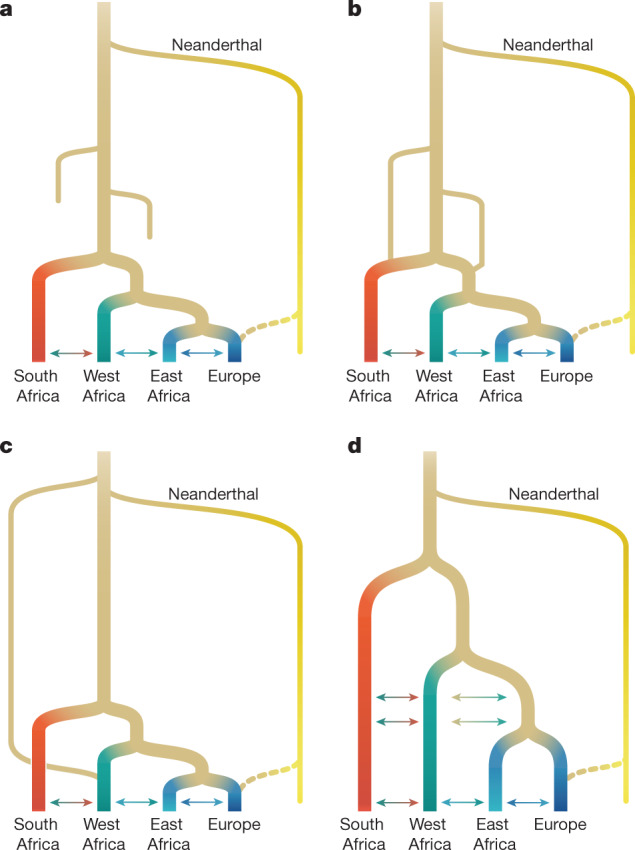
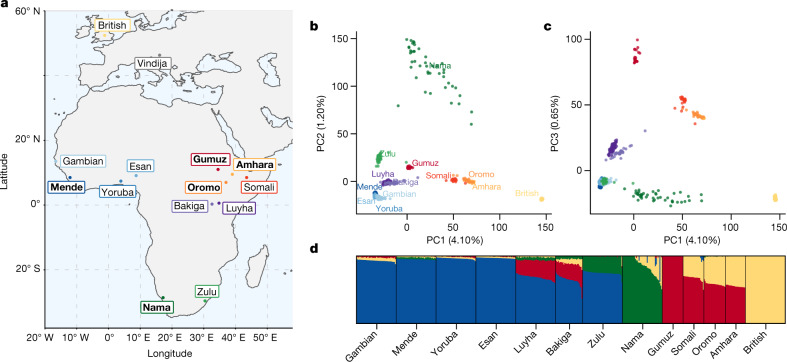
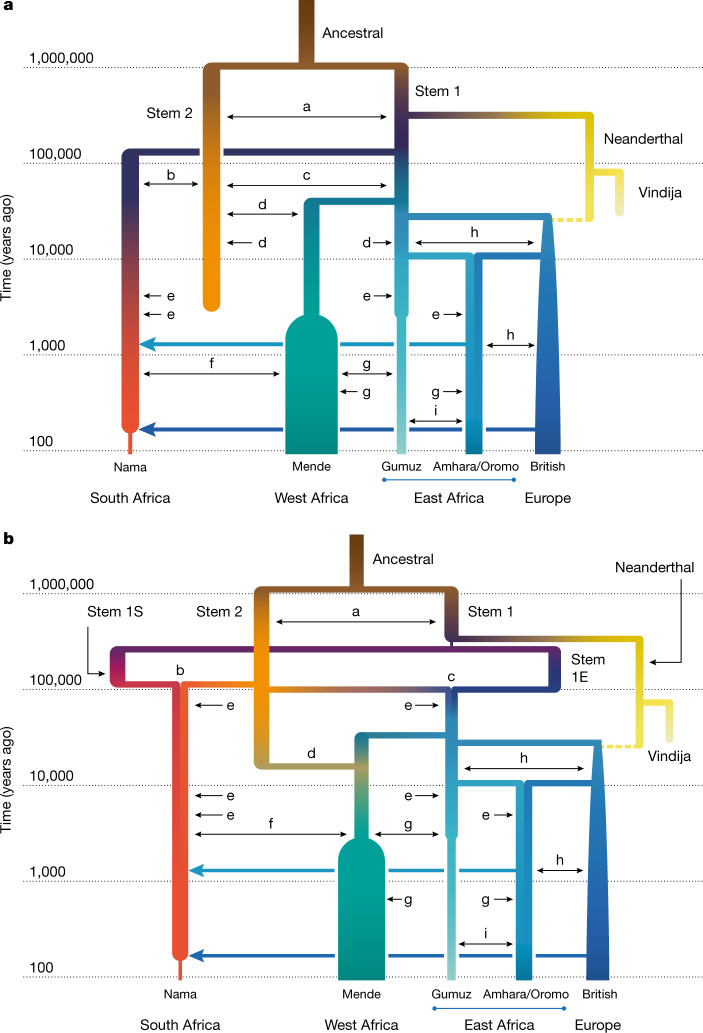
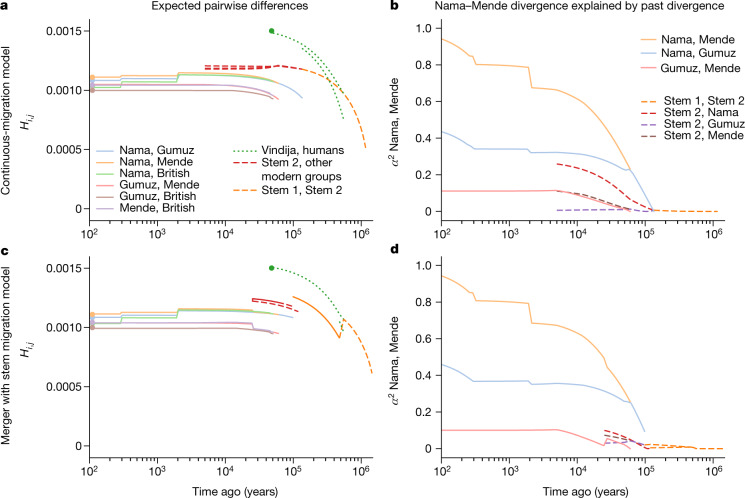
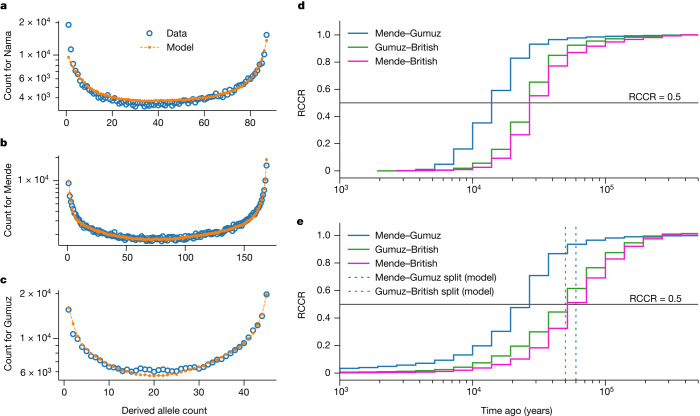
Despite broad agreement that Homo sapiens originated in Africa, considerable uncertainty surrounds specific models of divergence and migration across the continent1. Progress is hampered by a shortage of fossil and genomic data, as well as variability in previous estimates of divergence times1. Here we seek to discriminate among such models by considering linkage disequilibrium and diversity-based statistics, optimized for rapid, complex demographic inference2. We infer detailed demographic models for populations across Africa, including eastern and western representatives, and newly sequenced whole genomes from 44 Nama (Khoe-San) individuals from southern Africa. We infer a reticulated African population history in which present-day population structure dates back to Marine Isotope Stage 5. The earliest population divergence among contemporary populations occurred 120,000 to 135,000 years ago and was preceded by links between two or more weakly differentiated ancestral Homo populations connected by gene flow over hundreds of thousands of years. Such weakly structured stem models explain patterns of polymorphism that had previously been attributed to contributions from archaic hominins in Africa2–7. In contrast to models with archaic introgression, we predict that fossil remains from coexisting ancestral populations should be genetically and morphologically similar, and that only an inferred 1–4% of genetic differentiation among contemporary human populations can be attributed to genetic drift between stem populations. We show that model misspecification explains the variation in previous estimates of divergence times, and argue that studying a range of models is key to making robust inferences about deep history. An analysis of models of human populations in Africa, using some newly sequenced genomes, finds that human origins in the continent can best be described by a weakly structured stem model.
Overview
The claims and statistics of this paper haven’t been checked yet.
Free: it reads the open-access text and checks the first 5 claims that cite a source we can check. Create a free account to check every claim.
Integrity signals
Registry
Cites
Statistics
Figures
Verification
Claims the paper makes
The claims and statistics of this paper haven’t been checked yet.
Free: it reads the open-access text and checks the first 5 claims that cite a source we can check. Create a free account to check every claim.
Self-check
Percentages, sums and reported differences re-computed from the paper’s own numbers.
The self-check needs the paper’s full text.
Citations
Cites
A global reference for human genetic variation
The 1000 Genomes Project Consortium, authors, C., Auton, A., Abecasis, G. R., Steering committee, Altshuler, D. M., Durbin, R. M., Abecasis, G. R., Bentley, D. R., Chakravarti, A., et al. (2015) · Nature · doi:10.1038/nature15393 · Cited by 18,247
Inference of human population history from individual whole-genome sequences
Li, H., & Durbin, R. (2011) · Nature · doi:10.1038/nature10231 · Cited by 2,590
New fossils from Jebel Irhoud, Morocco and the pan-African origin of Homo sapiens.
Hublin, J.-J., Ben-Ncer, A., Bailey, S. E., Freidline, S. E., Neubauer, S., Skinner, M. M., Bergmann, I., Le Cabec, A., Benazzi, S., Harvati, K., et al. (2017) · Nature · doi:10.1038/nature22336 · Cited by 1,347
Pleistocene Homo sapiens from Middle Awash, Ethiopia
White, T. D., Asfaw, B., DeGusta, D., Gilbert, H., Richards, G. D., Suwa, G., & Clark Howell, F. (2003) · Nature · doi:10.1038/nature01669 · Cited by 1,032
Genome sequence of a 45,000-year-old modern human from western Siberia
Fu, Q., Li, H., Moorjani, P., Jay, F., Slepchenko, S. M., Bondarev, A. A., Johnson, P. L. F., Aximu-Petri, A., Prüfer, K., de Filippo, C., et al. (2014) · Nature · doi:10.1038/nature13810 · Cited by 1,023 · cited 1×
“By 403 45ka, there is additionally an unequivocal Homo sapiens femur from southern Siberia which contains derived 404 alleles shared with later Eurasian populations (Fu et al., 2014).”
BackgroundA high-coverage Neandertal genome from Vindija Cave in Croatia
Prüfer, K., de Filippo, C., Grote, S., Mafessoni, F., Korlević, P., Hajdinjak, M., Vernot, B., Skov, L., Hsieh, P., Peyrégne, S., et al. (2017) · Science · doi:10.1126/science.aao1887 · Cited by 719
Homo naledi, a new species of the genus Homo from the Dinaledi chamber. South Africa.
Berger, L. R., Hawks, J., de Ruiter, D. J., Churchill, S. E., Schmid, P., Delezene, L. K., Kivell, T. L., Garvin, H. M., Williams, S. A., DeSilva, J. M., et al. (2015) · eLife · doi:10.7554/elife.09560 · Cited by 703
Efficient Coalescent Simulation and Genealogical Analysis for Large Sample Sizes
Kelleher, J., Etheridge, A. M., & McVean, G. (2016) · PLOS Computational Biology · doi:10.1371/journal.pcbi.1004842 · Cited by 654
The African Genome Variation Project shapes medical genetics in Africa
Gurdasani, D., Carstensen, T., Tekola-Ayele, F., Pagani, L., Tachmazidou, I., Hatzikotoulas, K., Karthikeyan, S., Iles, L., Pollard, M. O., Choudhury, A., et al. (2015) · Nature · doi:10.1038/nature13997 · Cited by 636
The age of the hominin fossils from Jebel Irhoud, Morocco, and the origins of the Middle Stone Age
Richter, D., Grün, R., Joannes-Boyau, R., Steele, T. E., Amani, F., Rué, M., Fernandes, P., Raynal, J.-P., Geraads, D., Ben-Ncer, A., et al. (2017) · Nature · doi:10.1038/nature22335 · Cited by 576
Research works printed but not linked: 1
- Marean, C. W. et al. in Fynbos (ed. Allsopp, N.) Ch. 8 (Oxford Univ. Press, 2014).
Cited by
Spatiotemporal omics for biology and medicine
Liu, L., Chen, A., Li, Y., Mulder, J., Heyn, H., & Xu, X. (2024) · Cell · doi:10.1016/j.cell.2024.07.040 · Cited by 230
Genetic and molecular architecture of complex traits
Lappalainen, T., Li, Y. I., Ramachandran, S., & Gusev, A. (2024) · Cell · doi:10.1016/j.cell.2024.01.023 · Cited by 134
Merge and the Strong Minimalist Thesis
Chomsky, N., Seely, T. D., Berwick, R. C., Fong, S., Huybregts, M. A. C., Kitahara, H., McInnerney, A., & Sugimoto, Y. (2023) · Cambridge University Press eBooks · doi:10.1017/9781009343244 · Cited by 155
Robust and accurate Bayesian inference of genome-wide genealogies for hundreds of genomes
Deng, Y. K., Nielsen, R., & Song, Y. S. (2025) · Nature Genetics · doi:10.1038/s41588-025-02317-9 · Cited by 79
“However, there is ongoing debate regarding the timing, strength and even the existence of certain archaic introgression 81 .”
Evolutionary Genetics and Admixture in African Populations
Pfennig, A., Petersen, L. N., Kachambwa, P., & Lachance, J. (2023) · Genome Biology and Evolution · doi:10.1093/gbe/evad054 · Cited by 69
Direct dating of human fossils and the ever-changing story of human evolution
Grün, R., & Stringer, C. B. (2023) · Quaternary Science Reviews · doi:10.1016/j.quascirev.2023.108379 · Cited by 60
The promise and pitfalls of synteny in phylogenomics
Steenwyk, J. L., & King, N. (2024) · PLoS Biology · doi:10.1371/journal.pbio.3002632 · Cited by 59
On the genes, genealogies, and geographies of Quebec
Anderson-Trocmé, L., Nelson, D., Zabad, S., Diaz-Papkovich, A., Kryukov, I. L., Baya, N. A., Touvier, M., Jeffery, B., Dina, C., Vézina, H., et al. (2023) · Science · doi:10.1126/science.add5300 · Cited by 53
Self-citationDeep history of cultural and linguistic evolution among Central African hunter-gatherers
Padilla‐Iglesias, C., Blanco-Portillo, J., Pricop, B., Ioannidis, A. G., Bickel, B., Manica, A., Vinicius, L., & Migliano, A. B. (2024) · Nature Human Behaviour · doi:10.1038/s41562-024-01891-y · Cited by 50
“Such groups include Khoisan-speaking hunter-gatherer groups in southern and eastern Africa 6–8 .”
Tournebize, R., & Chikhi, L. (2024) · Nature Ecology & Evolution · doi:10.1038/s41559-024-02591-6 · Cited by 45
“We interpret this surprising result as a hint that ancient population structure should be explicitly integrated in future models of hominin evolution, as also suggested in a recent demogenetic study 8 .”
InfluentialMeneganzin, A., Pievani, T., & Manzi, G. (2022) · Evolutionary Anthropology Issues News and Reviews · doi:10.1002/evan.21955 · Cited by 47
Wang, Z., Liu, K., Yuan, H., Duan, S., Liu, Y., Luo, L., Jiang, X., Chen, S., Wei, L., Tang, R., et al. (2025) · Genomics Proteomics & Bioinformatics · doi:10.1093/gpbjnl/qzaf049 · Cited by 37
The MUC19 gene: An evolutionary history of recurrent introgression and natural selection
Villanea, F. A., Peede, D., Kaufman, E. J., Añorve-Garibay, V., Chevy, E. T., Villa-Islas, V., Witt, K. E., Zeloni, R., Marnetto, D., Moorjani, P., et al. (2025) · Science · doi:10.1126/science.adl0882 · Cited by 37
The importance of gene flow in human evolution
Templeton, A. R. (2023) · Human Population Genetics and Genomics · doi:10.47248/hpgg2303030005 · Cited by 32
Evolutionary immuno-genetics of endoplasmic reticulum aminopeptidase II (ERAP2)
Raja, A., & Kuiper, J. J. W. (2023) · Genes and Immunity · doi:10.1038/s41435-023-00225-8 · Cited by 30
“…African populations considered devoid of archaic introgression, which indicates that rs2248374 probably arose in an early hominid ancestor and its allelic diversity in modern humans populations is perhaps result of continuous or recurrent contact between multiple very early African lineages [30].”
BackgroundA structured coalescent model reveals deep ancestral structure shared by all modern humans
Cousins, T., Scally, A., & Durbin, R. (2025) · Nature Genetics · doi:10.1038/s41588-025-02117-1 · Cited by 27
“Numerous authors have reported evidence for there being more recent contributions of unknown archaic ancestry to modern humans, especially in West Africans 9–16, 53, 54 .”
Humans in Africa’s wet tropical forests 150 thousand years ago
Arous, E. B., Blinkhorn, J., Elliott, S., Kiahtipes, C. A., N’zi, C. D., Bateman, M. D., Duval, M., Roberts, P., Patalano, R., Blackwood, A. F., et al. (2025) · Nature · doi:10.1038/s41586-025-08613-y · Cited by 28
Envisioning a new era: Complete genetic information from routine, telomere-to-telomere genomes
Miga, K. H., & Eichler, E. E. (2023) · The American Journal of Human Genetics · doi:10.1016/j.ajhg.2023.09.011 · Cited by 26
Language follows a distinct mode of extra-genomic evolution
Bickel, B., Giraud, A., Zuberbühler, K., & van Schaik, C. P. (2024) · Physics of Life Reviews · doi:10.1016/j.plrev.2024.08.003 · Cited by 27
Population Pharmacogenomics for Health Equity
Jordan, I. K., Sharma, S., & Mariño‐Ramírez, L. (2023) · Genes · doi:10.3390/genes14101840 · Cited by 28
A high-coverage genome from a 200,000-year-old DenisovanPreprint
Peyrégne, S., Massilani, D., Swiel, Y., Boyle, M. J., Iasi, L. N. M., Sümer, A. P., Mesa, A. B., de Filippo, C., Viola, B., Essel, E., et al. (2025) · bioRxiv (Cold Spring Harbor Laboratory) · doi:10.1101/2025.10.20.683404 · Cited by 37
Past materials, past minds: The philosophy of cognitive paleoanthropology
Currie, A., Killin, A., Lequin, M., Meneganzin, A., & Pain, R. (2024) · Philosophy Compass · doi:10.1111/phc3.13001 · Cited by 17
Homo sapiens, Neanderthals and speciation complexity in palaeoanthropology
Meneganzin, A., & Stringer, C. B. (2024) · Evolutionary Journal of the Linnean Society · doi:10.1093/evolinnean/kzae033 · Cited by 17
Archaic hominin admixture and its consequences for modern humans
Tagore, D., & Akey, J. M. (2024) · Current Opinion in Genetics & Development · doi:10.1016/j.gde.2024.102280 · Cited by 17
Evolutionary implications of a deep‐time perspective on insect pollination
Peris, D., Ollerton, J., Sauquet, H., Hidalgo, O., Peñalver, E., Magrach, A., Álvarez‐Parra, S., Peña‐Kairath, C., Condamine, F. L., Delclòs, X., et al. (2025) · Biological reviews/Biological reviews of the Cambridge Philosophical Society · doi:10.1111/brv.70008 · Cited by 22
“…of Precambrian faunas (Anderson et al ., 2023), the origin of modern birds from non-avian dinosaurs (Chiappe, 2009), the key link connecting early seed plants to angiosperms ( fl owering plants) (Shi et al ., 2021), and the constant revisions of human origins (Ragsdale et al ., 2023).”
Common DNA sequence variation influences epigenetic aging in African populations
Meeks, G. L., Scelza, B. A., Asnake, H. M., Prall, S. P., Patin, É., Froment, A., Fagny, M., Quintana‐Murci, L., Henn, B. M., & Gopalan, S. (2025) · Communications Biology · doi:10.1038/s42003-025-08893-0 · Cited by 16
“Populations that experienced the out-of-Africa migration bottleneck carry only a subset of the genetic variation that exists in African populations 92 ; therefore, we expect that our analyses capture a majority of the meQTL variation that exists in the European, Hispanic/Latino, and Japanese…”
Self-citationFerrari, T., Feng, S., Zhang, X., & Mooney, J. A. (2025) · Genome Biology and Evolution · doi:10.1093/gbe/evaf097 · Cited by 15
Decoding genomic landscapes of introgression
Huang, X., Hackl, J., & Kuhlwilm, M. (2025) · Trends in Genetics · doi:10.1016/j.tig.2025.07.001 · Cited by 15
Flegontov, P., Işıldak, U., Maier, R., Yüncü, E., Changmai, P., & Reich, D. (2023) · PLoS Genetics · doi:10.1371/journal.pgen.1010931 · Cited by 17
Soni, V., Versoza, C. J., Vallender, E. J., Jensen, J. D., & Pfeifer, S. P. (2025) · Molecular Biology and Evolution · doi:10.1093/molbev/msaf119 · Cited by 13
Homo sapiens-specific evolution unveiled by ancient southern African genomes
Jakobsson, M., Bernhardsson, C., McKenna, J., Hollfelder, N., Vicente, M., Edlund, H., Coutinho, A., Sjödin, P., Brink, J. S., Zipfel, B., et al. (2025) · Nature · doi:10.1038/s41586-025-09811-4 · Cited by 15
“This approximately 300 ka population-divergence-time estimate is not caused by a deeper partial archaic admixture event per se, but it does not negate such an event either 6,29 (Supplementary Information 3.11 and Supplementary Figs.”
InfluentialThe Meanings and Dividends of Man the Hunter
Venkataraman, V. V., Hagen, E. H., Stibbard-Hawkes, D., Hames, R., Lew‐Levy, S., Jang, H., Glowacki, L., Hoffman, J., Kramer, K., Davis, H. E., et al. (2026) · Evolution and Human Behavior · doi:10.1016/j.evolhumbehav.2026.106840 · Cited by 12
Multiple Sources of Uncertainty Confound Inference of Historical Human Generation Times
Ragsdale, A. P., & Thornton, K. (2023) · Molecular Biology and Evolution · doi:10.1093/molbev/msad160 · Cited by 13
Self-citationCousins, T., & Durvasula, A. (2025) · Molecular Biology and Evolution · doi:10.1093/molbev/msaf041 · Cited by 13
Did our ancestors nearly die out?
Ashton, N. M., & Stringer, C. B. (2023) · Science · doi:10.1126/science.adj9484 · Cited by 12
Biogeographic Perspectives on Human Genetic Diversification
Hünemeier, T. (2024) · Molecular Biology and Evolution · doi:10.1093/molbev/msae029 · Cited by 11
Recovering signatures of archaic hominin introgression using ancestral recombination graphs
Zhang, Y., Biddanda, A., Johnson, S., O’Dushlaine, C., & Moorjani, P. (2026) · Science · doi:10.1126/science.aef8874 · Cited by 15
Interbreeding between Neanderthals and modern humans was strongly sex biased
Platt, A., Harris, D., & Tishkoff, S. A. (2026) · Science · doi:10.1126/science.aea6774 · Cited by 11
Biases in ARG-Based Inference of Historical Population Size in Populations Experiencing Selection
Marsh, J. I., & Johri, P. (2024) · Molecular Biology and Evolution · doi:10.1093/molbev/msae118 · Cited by 11
Clark, J., & Matás, G. J. L. (2024) · Quaternary Science Advances · doi:10.1016/j.qsa.2024.100218 · Cited by 11
Serradell, J. M., Lorenzo-Salazar, J. M., Flores, C., Lao, Ó., & Comas, D. (2024) · Genome biology · doi:10.1186/s13059-024-03341-4 · Cited by 11
“However, basic assumptions about the demographic events, and particularly population substructure, can significantly bias the model ascertainment [31].”
BackgroundResultInfluentialGWAS in the southern African context
Swart, Y., van Eeden, G., Uren, C., van der Spuy, G. D., Tromp, G., & Möller, M. (2022) · PLoS ONE · doi:10.1371/journal.pone.0264657 · Cited by 10
“The demographic model for the Nama (Fig 1) was based on the above mentioned events and a conference poster by Ragsdale et al. (21) where they inferred detailed parameterized demographic models for five present day populations (GBR, Gumuz, LWK, MSL and Nama) using joint allele frequency and LD…”
MethodSelf-citationvan Eeden, G., Uren, C., Pless, E., Mastoras, M., van der Spuy, G. D., Tromp, G., Henn, B. M., & Möller, M. (2022) · Genome biology · doi:10.1186/s13059-022-02744-5 · Cited by 9
“We used whole genome sequencing (WGS) data of 54 unrelated Nama individuals [27] to infer a LD-based recombination map that is adjusted according to past changes in N e .”
MethodSelf-citationSantos, F. D., O’Riordan, T., de Sousa, M. R., & Pedersen, J. S. T. (2023) · Sustainability · doi:10.3390/su16010331 · Cited by 12
Sommer, M. (2024) · Open Book Publishers · doi:10.11647/obp.0396 · Cited by 11
A model for background selection in nonequilibrium populations
Barroso, G. V., & Ragsdale, A. P. (2026) · Genetics · doi:10.1093/genetics/iyag081 · Cited by 8
“Interpretability can be gained by working out these effects directly on expected changes in two-locus haplotype frequencies, which aids modeling other processes such as migration and admixture (Ragsdale and Gravel, 2019; Ragsdale et al., 2023).”
Self-citationBlood symbolism at the root of symbolic culture? African hunter-gatherer perspectives
Watts, I. (2024) · Journal of Anthropological Archaeology · doi:10.1016/j.jaa.2024.101627 · Cited by 13
Cultural Evolution of Central African hunter-gatherers reflects a deep history of interconnectivityPreprint
Padilla‐Iglesias, C., Blanco-Portillo, J., Ioannidis, A. G., Manica, A., Vinicius, L., & Migliano, A. B. (2022) · Research Square · doi:10.21203/rs.3.rs-2205369/v1 · Cited by 8
Scerri, E. M. L. (2023) · Nature Ecology & Evolution · doi:10.1038/s41559-023-02080-2 · Cited by 9
Freidline, S. E., Gunz, P., Alichane, H., Oujaa, A., Ben-Ncer, A., Hajraoui, M. A. E., & Hublin, J. (2024) · Journal of Paleolithic Archaeology · doi:10.1007/s41982-024-00181-3 · Cited by 7
“Rigorous and Systematic Qualitative Data Analysis in Biological Anthropology”
Wutich, A., Nelson, R. G., DuBois, L. Z., Astorino, C. M., Knudson, K. J., Reynolds, A. W., Riley, E. P., Smith, R. W. A., VanSickle, C., Carroll, S. R., et al. (2024) · American Journal of Biological Anthropology · doi:10.1002/ajpa.70008 · Cited by 6
Ancient tree-topologies and gene-flow processes among human lineages in AfricaPreprint
Breton, G., Sjödin, P., Zervakis, P., Laurent, R., Froment, A., Sjöstrand, A. E., Hewlett, B. S., Barreiro, L. B., Perry, G. H., Soodyall, H., et al. (2024) · bioRxiv (Cold Spring Harbor Laboratory) · doi:10.1101/2024.07.15.603519 · Cited by 8
Pan-African model explains Homo sapiens genetic and morphological evolutionPreprint
Padilla‐Iglesias, C., Xue, Z., Leonardi, M., Perez, M. F., Paijmans, J. L. A., Colucci, M., Hovhannisyan, A., Delser, P. M., Blanco-Portillo, J., Ioannidis, A. G., et al. (2025) · bioRxiv (Cold Spring Harbor Laboratory) · doi:10.1101/2025.05.22.655514 · Cited by 6
Power and Limitations of Inferring Genetic Ancestry
Bird, N., King, T., & Hellenthal, G. (2025) · Annals of Human Genetics · doi:10.1111/ahg.70007 · Cited by 5
SimHumanity: Using SLiM 5.0 to run whole-genome simulations of human evolution
Haller, B. C., Nelson, C. W., Rodrigues, M. F., & Messer, P. W. (2025) · Human Population Genetics and Genomics · doi:10.47248/hpgg2505040006 · Cited by 6
Low accuracy of complex admixture graph inference from f -statistics
Frankel, L., & Ané, C. (2025) · Genetics · doi:10.1093/genetics/iyaf259 · Cited by 5
Prehistoric global migration of vanishing gut microbes with humans
Carter, M. M., Liu, Z., Olm, M. R., Martin, M., Sprockett, D. D., Ghadermazi, P., Trumble, B. C., Kaplan, H. S., Stieglitz, J., Rodríguez, D. E., et al. (2026) · Nature · doi:10.1038/s41586-026-11106-1 · Cited by 6
“Although these are contemporary populations, the genetic relationships between their gut bacteria can shed light on their past evolutionary history, similar to the benefits of including diverse populations in human genome studies 46 .”
Rappaport, M. B., & Corbally, C. J. (2023) · NeuroSci · doi:10.3390/neurosci4040021 · Cited by 5
“Extrapolating to Homo sapiens from rodents in spaceflight, we understand that the human species evolved in many different environments all over the African continent, over a lengthy span of time, emerging almost 400,000 years ago [23].”
BackgroundTile by tile: capturing the evolutionary mosaic of human conditions
Caporale, N., Leonardi, O., Villa, C. E., Vitriolo, A., Boeckx, C. A., & Testa, G. (2024) · Current Opinion in Genetics & Development · doi:10.1016/j.gde.2024.102297 · Cited by 6
Resolving out of Africa event for Papua New Guinean population using neural network
Mondal, M., André, M., Pathak, A. K., Brucato, N., Ricaut, F., Metspalu, M., & Eriksson, A. (2025) · Nature Communications · doi:10.1038/s41467-025-61661-w · Cited by 7
“Thus, using RCCR analysis to rebuild the tree ofdivergencemight need to be revised 39,40 .”
Linkage equilibrium between rare mutations
Lyulina, A. S., Liu, Z., & Good, B. H. (2024) · Genetics · doi:10.1093/genetics/iyae145 · Cited by 5
Higashino, A., Nakamura, K., & Osada, N. (2025) · Genome Biology and Evolution · doi:10.1093/gbe/evaf001 · Cited by 4
Hunter–gatherer genetics research: Importance and avenues
Padilla‐Iglesias, C., & Derkx, I. (2024) · Evolutionary Human Sciences · doi:10.1017/ehs.2024.7 · Cited by 8
“Despite these inferred deep divergences, studies have also consistently found evidence for intermittent episodes of gene-flow between all hunter – gatherer lineages (Bergström et al., 2021; Ragsdale et al., 2023).”
BackgroundGalor, O., Klemp, M., & Wainstock, D. C. (2023) · National Bureau of Economic Research · doi:10.3386/w31580 · Cited by 9
Recent advances in methods to characterize archaic introgression in modern humans
Peede, D., Bañuelos, M. M., Tretmanis, J. M., Miyagi, M., & Huerta‐Sánchez, E. (2026) · Genome Research · doi:10.1101/gr.278993.124 · Cited by 5
Genome-wide genealogies reveal deep admixtures forming modern humansPreprint
Loya, H., Hinch, A. G., Palamara, P. F., Speidel, L., & Myers, S. (2026) · bioRxiv (Cold Spring Harbor Laboratory) · doi:10.64898/2026.04.17.719197 · Cited by 7
Computational Genomics and Its Applications to Anthropological Questions
Witt, K. E., & Villanea, F. A. (2024) · American Journal of Biological Anthropology · doi:10.1002/ajpa.70010 · Cited by 3
“…as human populations whose ancestors may have overlapped in time and space with other fossil hominins have not yet shown evidence for super-archaic introgression (Teixeira et al. 2021), and the patterns in African populations may also be explained by deep structure in Africa (Ragsdale et al. 2023).”
InfluentialGlobal impact of micronutrients in modern human evolution
Rees, J., Castellano, S., & Andrés, A. M. (2025) · The American Journal of Human Genetics · doi:10.1016/j.ajhg.2025.08.005 · Cited by 3
“…across entire gene sets: while genetic drift in populations with extreme demographic histories (e.g., recent bottle-necks or ancient structure 47,49,65,69,73 ) may drive strong allele-frequency change in individual SNPs, such processes are unlikely to result in signatures at the oligo-genic…”
Reynolds, A. W., Schurz, H., Meeks, G. L., Gravel, S., Myrick, J. W., Edington, S., Mendez, F. L., Werely, C. J., van Helden, P. D., Hoal, E. G., et al. (2025) · The American Journal of Human Genetics · doi:10.1016/j.ajhg.2025.08.012 · Cited by 3
“38 The diverse range of groups include both hunter-gatherers (San) and cattle/goat/sheep pastoralists (Khoekhoe) who share a common genetic ancestry.”
Self-citationHuman-evolution story rewritten by fresh data and more computing power
Coleman, J. (2023) · Nature · doi:10.1038/d41586-023-01664-z · Cited by 3
Reich, D. (2026) · bioRxiv (Cold Spring Harbor Laboratory) · doi:10.64898/2026.03.11.711219 · Cited by 3
“…, although a caveat is that the inference is not stable across populations plausibly reflecting multiple layers of mixture in Africa 11,36 , and some studies have preferred models of persistent substructure 37 consistent with a view of human ancestors as a deeply structured metapopulation 38 .”
Frontal sinus size in South African Later Stone Age Holocene Khoe‐San
Grine, F. E., Post, N. W., Greening, V. A., Crèvecoeur, I., Billings, B. K., Meyer, A., Holt, S., Black, W., Morris, A. G., Veeramah, K. R., et al. (2024) · The Anatomical Record · doi:10.1002/ar.25556 · Cited by 3
“The Khoe-San would seem to be especially relevant to exploring the deep genetic diversity of the continent and of H . sapiens itself (Henn et al., 2018; Ragsdale et al., 2023; Schlebusch et al., 2017; Veeramah & Hammer, 2014).”
Monogenism Revisited: New Perspectives on a Classical Controversy
Grygiel, W. P., & Lizak, O. (2025) · Religions · doi:10.3390/rel16060694 · Cited by 2
Li, R., Taliun, S. A. G., Liao, K., Flickinger, M., Sobell, J. L., Genovese, G., Locke, A. E., Chiu, R. R., LeFaive, J., Wang, J., et al. (2025) · Human Genetics and Genomics Advances · doi:10.1016/j.xhgg.2025.100499 · Cited by 4
The Fate of Behavioral Modernity
Meneganzin, A. (2025) · Biological Theory · doi:10.1007/s13752-025-00519-2 · Cited by 3
Chikhi, L., Racine, J., Tournebize, R., & Pocheville, A. (2026) · Evolutionary Biology/Evolutionary biology · doi:10.1007/978-3-032-13925-2_10 · Cited by 4
Jaratlerdsiri, W., Soh, P. X. Y., Gong, T., Jiang, J., Simayi, Z., Petersen, D. C., Holland, E., Chan, E. K. F., Theron, K. E., Haacke, W., et al. (2026) · Nature Communications · doi:10.1038/s41467-026-69269-4 · Cited by 2
“Xoon) and Namibia (5 Nama and 9 Ju| ’ hoan) 1,10,22,23 .”
Troubling Populations: Where Races Go, Populations Must Follow
Roseman, C. C., & Winther, R. G. (2026) · Current Anthropology · doi:10.1086/741015 · Cited by 2
Hybridization in Animal Evolution
Hunnicutt, K. E., & Schumer, M. E. (2026) · Annual Review of Ecology Evolution and Systematics · doi:10.1146/annurev-ecolsys-102924-052935 · Cited by 2
Circadian rhythm and host genetics
Odriozola, A., González, A., Álvarez‐Herms, J., & Corbi, F. (2024) · Advances in genetics · doi:10.1016/bs.adgen.2024.02.001 · Cited by 2
Beyin, A. (2024) · Quaternary Science Advances · doi:10.1016/j.qsa.2024.100247 · Cited by 2
GHIST 2024: The First Genomic History Inference Strategies Tournament
Struck, T. J., Vaughn, A. H., Daigle, A., Ray, D. D., Noskova, E., Sequeira, J. J., Antonets, S., Alekseevskaya, E., Grigoreva, E., Raines, E., et al. (2025) · Molecular Biology and Evolution · doi:10.1093/molbev/msaf257 · Cited by 2
Self-citationDeep coalescent history of the hominin lineage
Cousins, T., Durbin, R. M., & Schweiger, R. (2026) · Genetics · doi:10.1093/genetics/iyag271 · Cited by 2
The power of contemporary African DNA: Exploring models of human evolution and health in Africa
Möller, M., Hoal, E. G., & Henn, B. M. (2024) · South African Journal of Science · doi:10.17159/sajs.2024/17145 · Cited by 2
“However, these studies contrasted only a single-origin model with an archaic hominin admixture model, leaving out other plausible models 1 .”
InfluentialSelf-citationThe Puzzle of the Origin of Human Persons
Driessen, A. (2023) · Scientia et Fides · doi:10.12775/setf.2023.016 · Cited by 1
“About 70 thousand years later, geology changed, and corridors appeared that allowed the spreading of the Homo sapiens persons to southern parts of Africa and north of Africa to Eurasia.”
BackgroundInfluentialHunting and Gathering Homo Sapiens
Olsson, O. (2024) · Springer eBooks · doi:10.1007/978-3-031-52784-5_4 · Cited by 1
Why focus on population genomics in developing countries?
Siwada, A., & Möller, M. (2024) · Elsevier eBooks · doi:10.1016/b978-0-443-18546-5.00002-4 · Cited by 1
Self-citationThe legacy of Luca Cavalli-Sforza on human evolution
Colucci, M., Leonardi, M., Hodgson, J. A., Stringer, C. B., & Scerri, E. M. L. (2025) · Human Population Genetics and Genomics · doi:10.47248/hpgg2505010001 · Cited by 2
Ancestral origin of amyotrophic lateral sclerosis pathogenic variants in South Africa
Kinghorn, E., Heckmann, J. M., Uren, C., Möller, M., Swart, Y., & Nel, M. (2025) · Wellcome Open Research · doi:10.12688/wellcomeopenres.24788.1 · Cited by 1
Self-citationAshton, N. M., & Davis, R. (2025) · Journal of the Royal Anthropological Institute · doi:10.1111/1467-9655.70027 · Cited by 3
Regional variability in the Acheulian to Middle Stone Age transition in southern Africa
Blackwood, A. F., Wilkins, J., Arnold, L. J., Demuro, M., Boschian, G., Caruana, M. V., Lalunio, E. F., Spate, M., Hatton, A., Muir, R. A., et al. (2026) · Scientific Reports · doi:10.1038/s41598-026-40075-8 · Cited by 1
“…evolutionary history for H. sapiens involving interactions between structured populations across the whole African continent, with deep ancestral structure shared by all modern humans prior to 1 Ma followed by the divergence of populations that coalesced again sometime after 300 ka 1, 3, 109–114 .”
Revolution, modernity, and the dispersal of Homo sapiens beyond Africa
Groucutt, H. S. (2026) · Quaternary Science Reviews · doi:10.1016/j.quascirev.2026.109981 · Cited by 1
Malaria shaped human spatial organization for the past 74 thousand years
Colucci, M., Leonardi, M., Blinkhorn, J., Irish, S. R., Padilla‐Iglesias, C., Kaboth‐Bahr, S., Gosling, W. D., Snow, R. W., Manica, A., & Scerri, E. M. L. (2026) · Science Advances · doi:10.1126/sciadv.aea2316 · Cited by 1
Dental morphology and ancient human dispersals within and out of Africa
Irish, J. D., Morez, A., Lea, J. M., Flink, L. G., & Scott, G. R. (2026) · Journal of Human Evolution · doi:10.1016/j.jhevol.2026.103855 · Cited by 1
Pazan, K., Carr, A. S., Cimmerer, K., Patalano, R., Matela, M., Leanya, L., Theofanopoulos, S., Ralimpe, J., & Stewart, B. A. (2026) · Archaeological and Anthropological Sciences · doi:10.1007/s12520-026-02459-9 · Cited by 2
“Genetic evidence implicates the period of 250 − 100 ka as transformative, painting the image of a patchwork genetic landscape that merged and morphed into something resembling modern population structure as late as MIS 5 (Bergström et al. 2021; Ragsdale et al. 2023).”
Upper Pleistocene population dynamics (Neandertals, Denisovans, Homo sapiens)
Crèvecoeur, I. (2024) · Elsevier eBooks · doi:10.1016/b978-0-323-99931-1.00257-9 · Cited by 1
Accurate and flexible estimation of effective population size historyPreprint
Huang, Z., Chan, Y.-B., & Balding, D. J. (2024) · bioRxiv (Cold Spring Harbor Laboratory) · doi:10.1101/2024.10.16.618650 · Cited by 1
“More precise estimates of N ( g ) can benefit inference for other evolutionary parameters, such as species divergence times.”
Roots of Cultural DiversityPreprint
Galor, O., Klemp, M., & Wainstock, D. C. (2024) · SSRN Electronic Journal · doi:10.2139/ssrn.5038223 · Cited by 4
Partitioning the genomic journey to becoming Homo sapiensPreprint
Pagani, L., Bertazzon, R., Pankratov, V., Vallini, L., Marnetto, D., Morez, A., Delbrassine, H., Carollo, F., D’Esposito, M., Granata, I., et al. (2024) · bioRxiv (Cold Spring Harbor Laboratory) · doi:10.1101/2024.12.09.627480 · Cited by 2
LD Matrix Approximations for Scalable Analysis of High-dimensional Genetic DataPreprint
Bercovich, U., Zabad, S., & Gravel, S. (2025) · bioRxiv (Cold Spring Harbor Laboratory) · doi:10.1101/2025.09.16.676478 · Cited by 1
Self-citation
Metadata
- Authors
- Ragsdale, A. P., Weaver, T. D., Atkinson, E. G., Hoal, E. G., Möller, M., Henn, B. M., & Gravel, S.
- Affiliations
- University of Wisconsin–Madison (US)
- University of California, Davis (US)
- Baylor College of Medicine (US)
- South African Medical Research Council (ZA)
- McGill University (CA)
- Corresponding author
- Henn, Brenna M.
- Gravel, Simon
- ORCID
- Venue
- Nature
- Published
- 2023-05-17
- Volume
- 617
- Issue
- 7962
- Pages
- 755-763
- ISSN
- 0028-0836 (ISSN-L)
- 1476-4687
- PMC
- PMC10208968
- OpenAlex
- W4377012029
- Semantic Scholar
- b7446b95948f6cca2a711a1b8bc0853e92f66d2d
- Cited by
- 159
- References
- 56
- Citations by year
- 2026: 24 · 2025: 36 · 2024: 67 · 2023: 28
- FWCI
- 26.73
- Type
- journal article
- Language
- en
- Update notices
- correction (2023-07-17)
- Open access
- hybrid
- doi.org
- Licence
- cc-by
- www.springernature.com/gp/researchers/text-and-data-mining (tdm)
- www.springernature.com/gp/researchers/text-and-data-mining (vor)
- Locations
- Nature (publishedVersion, cc-by)
- bioRxiv (Cold Spring Harbor Laboratory) (acceptedVersion, cc-by-nc)
- PubMed Central (publishedVersion, cc-by)
- PubMed (publishedVersion)
- eScholarship (California Digital Library) (submittedVersion, cc-by)
- Digital Commons-TMC (Texas Medical Center) (submittedVersion)
- RePEc: Research Papers in Economics (submittedVersion)
- Funders
- South African Medical Research Council
- Universiteit Stellenbosch
- National Institutes of Health (NIH K01)
- Canadian Institutes of Health Research (437576, RGPIN-2017-04816)
- Natural Sciences and Engineering Research Council of Canada (RGPIN 2017 ?, rgpin-2017-04816)
- Medical Research Council
- National Institute of Mental Health (K01MH121659)
- National Institute of General Medical Sciences (R35GM133531, K12GM102778)
- Topics
- Life Sciences › Biochemistry, Genetics and Molecular Biology › Genetics › Forensic and Genetic Research
- Social Sciences › Anthropology › Pleistocene-Era Hominins and Archaeology
- Life Sciences › Biochemistry, Genetics and Molecular Biology › Genetics › Genetic diversity and population structure
- Keywords
- human origins, human, population divergence, gene flow, linkage disequilibrium, genetic diversity, Marine Isotope Stage 5, divergence time estimation, model misspecification, genetic drift
- MeSH terms
- Genetic Introgression, Africa, Fossils, Genetics, Population, Humans, Phylogeny, Polymorphism, Genetic, Time Factors, Linkage Disequilibrium, Genome, Human, Genetic Drift, History, Ancient, Gene Flow, Human Migration
About these checks
Registry, retraction, Cites and statistics results are computed, not judged, with one exception: a printed reference that no index lists is read once by a model before it counts as a citation error. Claims are extracted by a model and kept only when their quote appears verbatim in the text; each cited source is then checked, with a model’s help, for whether it says what the claim relies on. Those verdicts can be wrong — read the claim’s quote and the cited source before relying on one.
Statistics and arithmetic are recomputed, not judged.
Confidence bands are shown only for fields calibrated on our annotated test set. None is calibrated yet, so no band is shown.
What counts as a claim ›How we measure confidence ›How we check this ›
Are you an author, or do you see a problem with this page? Request a review
Data sources
Bibliographic data: Semantic Scholar, OpenAlex, Crossref.
Contains information from the Semantic Scholar Academic Graph Datasets, made available under the ODC Attribution License (ODC-BY 1.0).
Semantic Scholar’s data is described in: Kinney, R., et al. (2023). The Semantic Scholar Open Data Platform. arXiv:2301.10140.
