

A weakly structured stem for human origins in Africa
Open accessPublished version of a preprint
The DOI matches its Crossref record; 59 of the 59 references it cites were found in a registry or an index.
Abstract
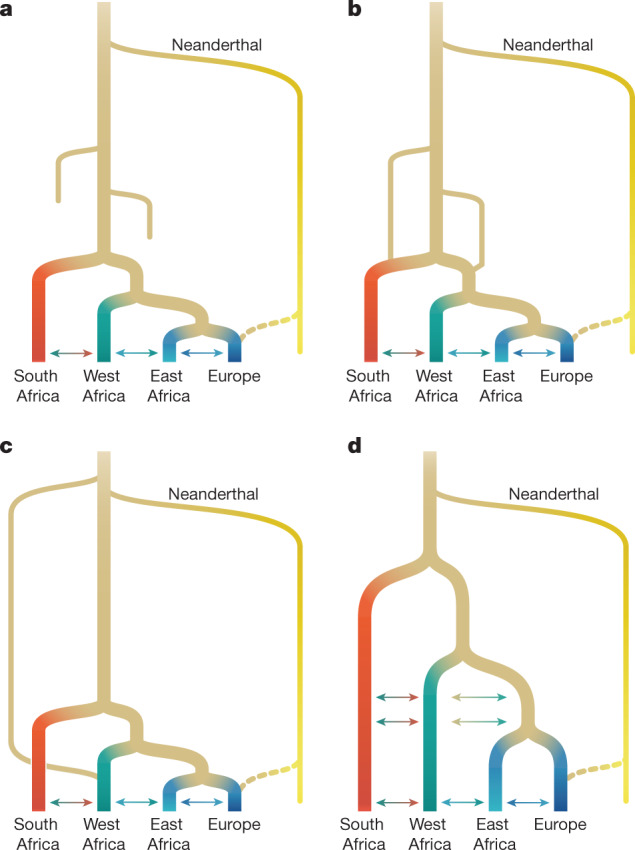
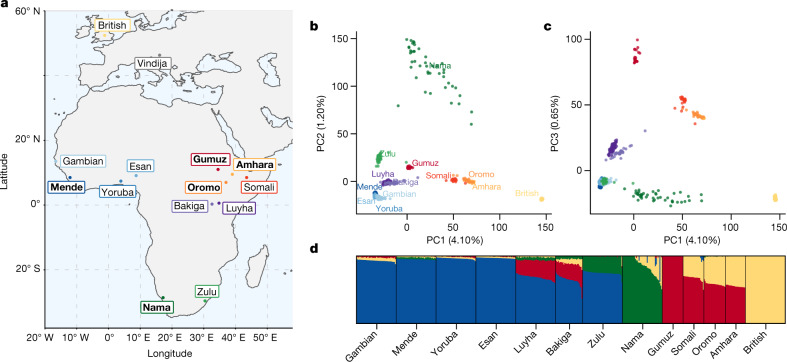
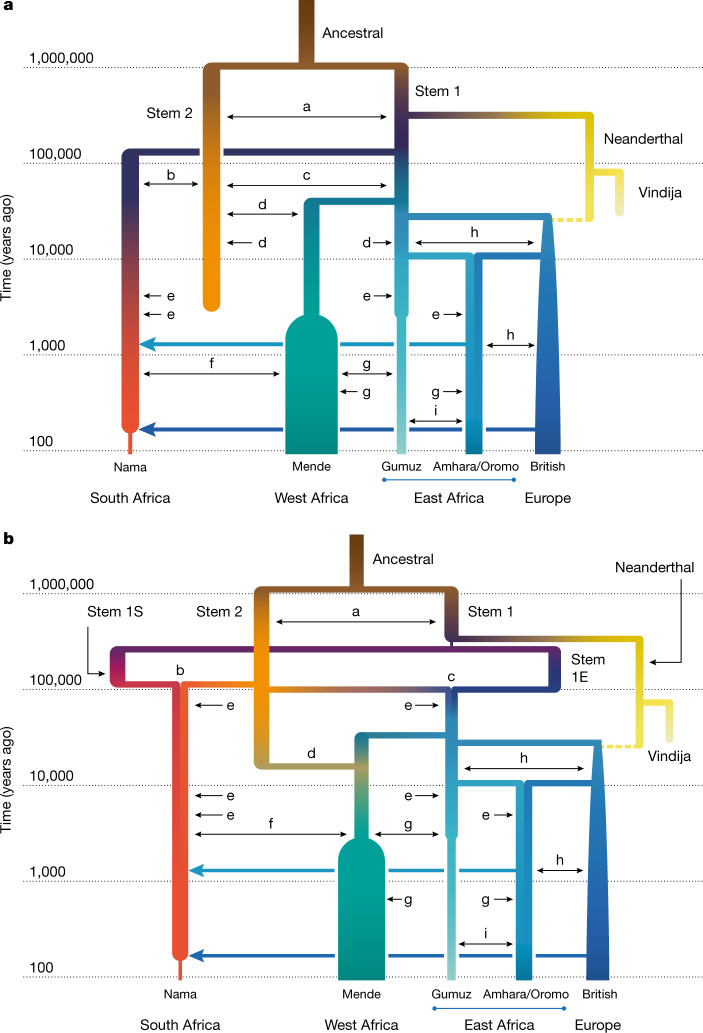
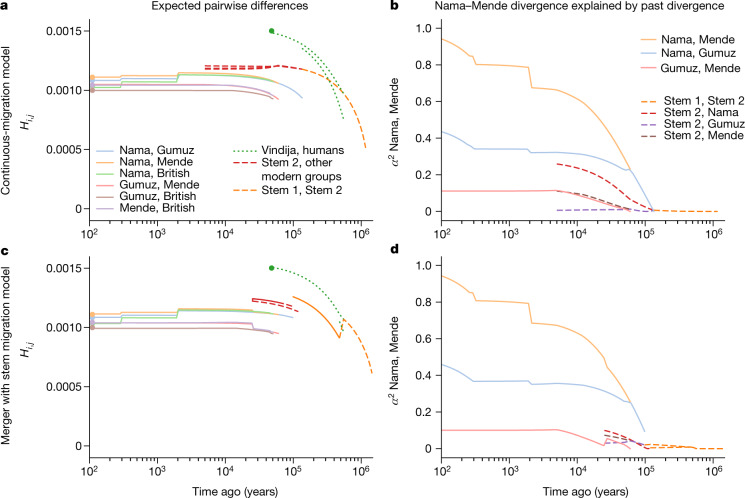
Despite broad agreement that Homo sapiens originated in Africa, considerable uncertainty surrounds specific models of divergence and migration across the continent1. Progress is hampered by a shortage of fossil and genomic data, as well as variability in previous estimates of divergence times1. Here we seek to discriminate among such models by considering linkage disequilibrium and diversity-based statistics, optimized for rapid, complex demographic inference2. We infer detailed demographic models for populations across Africa, including eastern and western representatives, and newly sequenced whole genomes from 44 Nama (Khoe-San) individuals from southern Africa. We infer a reticulated African population history in which present-day population structure dates back to Marine Isotope Stage 5. The earliest population divergence among contemporary populations occurred 120,000 to 135,000 years ago and was preceded by links between two or more weakly differentiated ancestral Homo populations connected by gene flow over hundreds of thousands of years. Such weakly structured stem models explain patterns of polymorphism that had previously been attributed to contributions from archaic hominins in Africa2–7. In contrast to models with archaic introgression, we predict that fossil remains from coexisting ancestral populations should be genetically and morphologically similar, and that only an inferred 1–4% of genetic differentiation among contemporary human populations can be attributed to genetic drift between stem populations. We show that model misspecification explains the variation in previous estimates of divergence times, and argue that studying a range of models is key to making robust inferences about deep history. An analysis of models of human populations in Africa, using some newly sequenced genomes, finds that human origins in the continent can best be described by a weakly structured stem model.
Overview
The claims and statistics of this paper haven’t been checked yet.
Free: it reads the open-access text and checks the first 5 claims that cite a source we can check. Create a free account to check every claim.
Integrity signals
Registry
Cites
Statistics
Figures
Verification
Claims the paper makes
The claims and statistics of this paper haven’t been checked yet.
Free: it reads the open-access text and checks the first 5 claims that cite a source we can check. Create a free account to check every claim.
Self-check
Percentages, sums and reported differences re-computed from the paper’s own numbers.
The self-check needs the paper’s full text.
Citations
Cites
A global reference for human genetic variation
The 1000 Genomes Project Consortium, authors, C., Auton, A., Abecasis, G. R., Steering committee, Altshuler, D. M., Durbin, R. M., Abecasis, G. R., Bentley, D. R., Chakravarti, A., et al. (2015) · Nature · doi:10.1038/nature15393 · Cited by 18,247
Inference of human population history from individual whole-genome sequences
Li, H., & Durbin, R. (2011) · Nature · doi:10.1038/nature10231 · Cited by 2,590
New fossils from Jebel Irhoud, Morocco and the pan-African origin of Homo sapiens.
Hublin, J.-J., Ben-Ncer, A., Bailey, S. E., Freidline, S. E., Neubauer, S., Skinner, M. M., Bergmann, I., Le Cabec, A., Benazzi, S., Harvati, K., et al. (2017) · Nature · doi:10.1038/nature22336 · Cited by 1,347
Pleistocene Homo sapiens from Middle Awash, Ethiopia
White, T. D., Asfaw, B., DeGusta, D., Gilbert, H., Richards, G. D., Suwa, G., & Clark Howell, F. (2003) · Nature · doi:10.1038/nature01669 · Cited by 1,032
Genome sequence of a 45,000-year-old modern human from western Siberia
Fu, Q., Li, H., Moorjani, P., Jay, F., Slepchenko, S. M., Bondarev, A. A., Johnson, P. L. F., Aximu-Petri, A., Prüfer, K., de Filippo, C., et al. (2014) · Nature · doi:10.1038/nature13810 · Cited by 1,023 · cited 1×
“By 403 45ka, there is additionally an unequivocal Homo sapiens femur from southern Siberia which contains derived 404 alleles shared with later Eurasian populations (Fu et al., 2014).”
BackgroundA high-coverage Neandertal genome from Vindija Cave in Croatia
Prüfer, K., de Filippo, C., Grote, S., Mafessoni, F., Korlević, P., Hajdinjak, M., Vernot, B., Skov, L., Hsieh, P., Peyrégne, S., et al. (2017) · Science · doi:10.1126/science.aao1887 · Cited by 719
Homo naledi, a new species of the genus Homo from the Dinaledi chamber. South Africa.
Berger, L. R., Hawks, J., de Ruiter, D. J., Churchill, S. E., Schmid, P., Delezene, L. K., Kivell, T. L., Garvin, H. M., Williams, S. A., DeSilva, J. M., et al. (2015) · eLife · doi:10.7554/elife.09560 · Cited by 703
Efficient Coalescent Simulation and Genealogical Analysis for Large Sample Sizes
Kelleher, J., Etheridge, A. M., & McVean, G. (2016) · PLOS Computational Biology · doi:10.1371/journal.pcbi.1004842 · Cited by 654
The African Genome Variation Project shapes medical genetics in Africa
Gurdasani, D., Carstensen, T., Tekola-Ayele, F., Pagani, L., Tachmazidou, I., Hatzikotoulas, K., Karthikeyan, S., Iles, L., Pollard, M. O., Choudhury, A., et al. (2015) · Nature · doi:10.1038/nature13997 · Cited by 636
The age of the hominin fossils from Jebel Irhoud, Morocco, and the origins of the Middle Stone Age
Richter, D., Grün, R., Joannes-Boyau, R., Steele, T. E., Amani, F., Rué, M., Fernandes, P., Raynal, J.-P., Geraads, D., Ben-Ncer, A., et al. (2017) · Nature · doi:10.1038/nature22335 · Cited by 576
Did Our Species Evolve in Subdivided Populations across Africa, and Why Does It Matter?
Scerri, E. M. L., Thomas, M. G., Manica, A., Gunz, P., Stock, J. T., Stringer, C., Grove, M., Groucutt, H. S., Timmermann, A., Rightmire, G. P., et al. (2018) · Trends in Ecology & Evolution · doi:10.1016/j.tree.2018.05.005 · Cited by 497
Self-citationA method for genome-wide genealogy estimation for thousands of samples
Speidel, L., Forest, M., Shi, S., & Myers, S. R. (2019) · Nature Genetics · doi:10.1038/s41588-019-0484-x · Cited by 480 · cited 4×
“We used Relate (Speidel et al., 2019) to reconstruct gene genealogies from the simulations under our four 795 inferred demographic models.”
MethodInfluentialEfficient ancestry and mutation simulation with msprime 1.0
Baumdicker, F., Bisschop, G., Goldstein, D., Gower, G., Ragsdale, A. P., Tsambos, G., Zhu, S., Eldon, B., Ellerman, E. C., Galloway, J. G., et al. (2022) · Genetics · doi:10.1093/genetics/iyab229 · Cited by 442
Self-citationCraniometric variation among modern human populations
Relethford, J. H. (1994) · American Journal of Physical Anthropology · doi:10.1002/ajpa.1330950105 · Cited by 418
Origins of modern human ancestry
Bergström, A., Stringer, C., Hajdinjak, M., Scerri, E. M. L., & Skoglund, P. (2021) · Nature · doi:10.1038/s41586-021-03244-5 · Cited by 415
The origin and evolution of Homo sapiens
Stringer, C. (2016) · Philosophical Transactions of the Royal Society B: Biological Sciences · doi:10.1098/rstb.2015.0237 · Cited by 395
Mazet, O., Rodríguez, W., Grusea, S., Boitard, S., & Chikhi, L. (2016) · Heredity · doi:10.1038/hdy.2015.104 · Cited by 324
Rethinking the dispersal of Homo sapiens out of Africa
Groucutt, H. S., Petraglia, M. D., Bailey, G., Scerri, E. M. L., Parton, A., Clark‐Balzan, L., Jennings, R. P., Lewis, L., Blinkhorn, J., Drake, N. A., et al. (2015) · Evolutionary Anthropology: Issues, News, and Reviews · doi:10.1002/evan.21455 · Cited by 317
The age of Homo naledi and associated sediments in the Rising Star Cave, South Africa
Dirks, P. H., Roberts, E. M., Hilbert-Wolf, H., Kramers, J. D., Hawks, J., Dosseto, A., Duval, M., Elliott, M., Evans, M., Grün, R., et al. (2017) · eLife · doi:10.7554/elife.24231 · Cited by 317
Blome, M. W., Cohen, A. S., Tryon, C. A., Brooks, A. S., & Russell, J. (2012) · Journal of Human Evolution · doi:10.1016/j.jhevol.2012.01.011 · Cited by 311
Genetic evidence for archaic admixture in Africa
Hammer, M. F., Woerner, A. E., Mendez, F. L., Watkins, J. C., & Wall, J. D. (2011) · Proceedings of the National Academy of Sciences · doi:10.1073/pnas.1109300108 · Cited by 310
Possible Ancestral Structure in Human Populations
Plagnol, V., & Wall, J. D. (2006) · PLoS Genetics · doi:10.1371/journal.pgen.0020105 · Cited by 275 · cited 1×
“212 σDz has been shown to be sensitive to deep population structure and archaic hominin admixture (Rags213 dale and Gravel, 2019), and this statistic is closely related to S∗ statistics used to scan for introgressed 214 haplotypes (Plagnol and Wall, 2006).”
ResultTwo Late Pleistocene-Holocene Archaeological Depositories from the Southern Cape, South Africa
Deacon, H. J. (1995) · The South African Archaeological Bulletin · doi:10.2307/3889061 · Cited by 258
Pagani, L., Schiffels, S., Gurdasani, D., Danecek, P., Scally, A., Chen, Y., Xue, Y., Haber, M., Ekong, R., Oljira, T., et al. (2015) · The American Journal of Human Genetics · doi:10.1016/j.ajhg.2015.04.019 · Cited by 216
Limits of long-term selection against Neandertal introgression
Petr, M., Pääbo, S., Kelso, J., & Vernot, B. (2019) · Proceedings of the National Academy of Sciences · doi:10.1073/pnas.1814338116 · Cited by 211
Y-chromosomal evidence of a pastoralist migration through Tanzania to southern Africa
Henn, B. M., Gignoux, C., Lin, A. A., Oefner, P. J., Shen, P., Scozzari, R., Cruciani, F., Tishkoff, S. A., Mountain, J. L., & Underhill, P. A. (2008) · Proceedings of the National Academy of Sciences · doi:10.1073/pnas.0801184105 · Cited by 201
Self-citationThe Later Stone Age Calvaria from Iwo Eleru, Nigeria: Morphology and Chronology
Harvati, K., Stringer, C., Grün, R., Aubert, M., Allsworth-Jones, P., & Folorunso, C. A. (2011) · PLoS ONE · doi:10.1371/journal.pone.0024024 · Cited by 180
Soft Sweeps Are the Dominant Mode of Adaptation in the Human Genome
Schrider, D. R., & Kern, A. D. (2017) · Molecular Biology and Evolution · doi:10.1093/molbev/msx154 · Cited by 176
Age of the oldest known Homo sapiens from eastern Africa
Vidal, C. M., Lane, C. S., Asrat, A., Barfod, D. N., Mark, D. F., Tomlinson, E. L., Tadesse, A. Z., Yirgu, G., Deino, A. L., Hutchison, W. R., et al. (2022) · Nature · doi:10.1038/s41586-021-04275-8 · Cited by 176
von Cramon‐Taubadel, N. (2009) · American Journal of Physical Anthropology · doi:10.1002/ajpa.21041 · Cited by 175
Breton, G., Schlebusch, C. M., Lombard, M., Sjödin, P., Soodyall, H., & Jakobsson, M. (2014) · Current Biology · doi:10.1016/j.cub.2014.02.041 · Cited by 164
Efficiently Inferring the Demographic History of Many Populations With Allele Count Data
Kamm, J., Terhorst, J., Durbin, R., & Song, Y. S. (2020) · Journal of the American Statistical Association · doi:10.1080/01621459.2019.1635482 · Cited by 164
Recovering signals of ghost archaic introgression in African populations
Durvasula, A., & Sankararaman, S. (2020) · Science Advances · doi:10.1126/sciadv.aax5097 · Cited by 164 · cited 2×
“By contrast, a U-shaped distribution has been taken as evidence for introgression 271 from an archaic hominin population that split from humans at least as far back in time as the human272 Neanderthal split (Yang et al., 2012; Durvasula and Sankararaman, 2020).”
BackgroundMethodStone Age people in a changing South African Greater Cape Floristic Region
Marean, C. W., Cawthra, H. C., Cowling, R. M., Esler, K. J., Fisher, E. C., Milewski, A. V., Potts, A., Singels, E., & Vynck, J. C. D. (2014) · Oxford University Press eBooks · doi:10.1093/acprof:oso/9780199679584.003.0008 · Cited by 158
Ancient DNA and deep population structure in sub-Saharan African foragers
Lipson, M., Sawchuk, E. A., Thompson, J. C., Oppenheimer, J., Tryon, C. A., Ranhorn, K. L., de Luna, K. M., Sirak, K. A., Olalde, I., Ambrose, S. H., et al. (2022) · Nature · doi:10.1038/s41586-022-04430-9 · Cited by 156
Phylogeny Estimation by Integration over Isolation with Migration Models
Hey, J., Chung, Y., Sethuraman, A., Lachance, J., Tishkoff, S., Sousa, V. C., & Wang, Y. (2018) · Molecular Biology and Evolution · doi:10.1093/molbev/msy162 · Cited by 140
Day, M. H. (1969) · Nature · doi:10.1038/2221135a0 · Cited by 130
Beyond multiregional and simple out-of-Africa models of human evolution
Scerri, E. M. L., Chikhi, L., & Thomas, M. (2019) · Nature Ecology & Evolution · doi:10.1038/s41559-019-0992-1 · Cited by 128
A genome sequence from a modern human skull over 45,000 years old from Zlatý kůň in Czechia
Prüfer, K., Posth, C., Yu, H., Stoessel, A., Spyrou, M. A., Deviese, T., Mattonai, M., Ribechini, E., Higham, T., Velemínský, P., et al. (2021) · Nature Ecology & Evolution · doi:10.1038/s41559-021-01443-x · Cited by 126
Dating the skull from Broken Hill, Zambia, and its position in human evolution
Grün, R., Pike, A. W. G., McDermott, F. P., Eggins, S. M., Mortimer, G. E., Aubert, M., Kinsley, L., Joannes‐Boyau, R., Rumsey, M. S., Denys, C., et al. (2020) · Nature · doi:10.1038/s41586-020-2165-4 · Cited by 115
Climatic windows for human migration out of Africa in the past 300,000 years
Beyer, R. M., Krapp, M., Eriksson, A., & Manica, A. (2021) · Nature Communications · doi:10.1038/s41467-021-24779-1 · Cited by 115
Hsieh, P., Woerner, A. E., Wall, J. D., Lachance, J., Tishkoff, S. A., Gutenkunst, R. N., & Hammer, M. F. (2016) · Genome Research · doi:10.1101/gr.196634.115 · Cited by 105
The history and evolution of the Denisovan- EPAS1 haplotype in Tibetans
Zhang, X., Witt, K. E., Bañuelos, M. M., Ko, A., Yuan, K., Xu, S., Nielsen, R., & Huerta-Sanchez, E. (2021) · Proceedings of the National Academy of Sciences · doi:10.1073/pnas.2020803118 · Cited by 105
Models of archaic admixture and recent history from two-locus statistics
Ragsdale, A. P., & Gravel, S. (2019) · PLOS Genetics · doi:10.1371/journal.pgen.1008204 · Cited by 99
Self-citationWeaver, T. D., Roseman, C. C., & Stringer, C. B. (2008) · Proceedings of the National Academy of Sciences · doi:10.1073/pnas.0709079105 · Cited by 95
Self-citationClarifying distinct models of modern human origins in Africa
Henn, B. M., Steele, T. E., & Weaver, T. D. (2018) · Current Opinion in Genetics & Development · doi:10.1016/j.gde.2018.10.003 · Cited by 79
Self-citationBiases in demographic modelling affect our understanding of recent divergence
Momigliano, P., Florin, A.-B., & Merilä, J. (2021) · Molecular Biology and Evolution · doi:10.1093/molbev/msab047 · Cited by 79
Lorente-Galdos, B., Lao, O., Serra-Vidal, G., Santpere, G., Kuderna, L. F. K., Arauna, L. R., Fadhlaoui-Zid, K., Pimenoff, V. N., Soodyall, H., Zalloua, P., et al. (2019) · Genome Biology · doi:10.1186/s13059-019-1684-5 · Cited by 77
Gopalan, S., Berl, R. E. W., Myrick, J. W., Garfield, Z. H., Reynolds, A. W., Bafens, B. K., Belbin, G. M., Mastoras, M., Williams, C., Daya, M., et al. (2022) · Current Biology · doi:10.1016/j.cub.2022.02.050 · Cited by 76
Self-citationCrevecoeur, I., Brooks, A. S., Ribot, I., Cornelissen, E., & Semal, P. (2016) · Journal of Human Evolution · doi:10.1016/j.jhevol.2016.04.003 · Cited by 75
Inferring number of populations and changes in connectivity under the n-island model
Arredondo, A., Mourato, B. V., Nguyen, K. N. D., Boitard, S., Rodríguez, W., Mazet, O., & Chikhi, L. (2021) · Heredity · doi:10.1038/s41437-021-00426-9 · Cited by 38
Unbiased estimation of linkage disequilibrium from unphased data
Ragsdale, A. P., & Gravel, S. (2020) · Molecular Biology and Evolution · doi:10.1093/molbev/msz265 · Cited by 36
Self-citationEfficient ancestry and mutation simulation with msprime 1.0Preprint
Baumdicker, F., Bisschop, G., Goldstein, D., et al. (2021) · bioRxiv (Cold Spring Harbor Laboratory) · doi:10.1101/2021.08.31.457499 · Cited by 31
The history and evolution of the Denisovan-EPAS1 haplotype in Tibetans
Zhang, X., Witt, K. E., Bañuelos, M. M., Ko, A. Y. M. A., Yuan, K., Xu, S., Nielsen, R., & Huerta‐Sánchez, E. (2020) · eScholarship (California Digital Library) · Cited by 31
The Upper Paleolithic Human Remains of Nazlet Khater 2 (Egypt) and Past Modern Human Diversity
Crevecoeur, I. (2012) · Vertebrate paleobiology and paleoanthroplogy series/Vertebrate paleobiology and paleoanthropology series · doi:10.1007/978-94-007-2929-2_14 · Cited by 28
Identification of African-Specific Admixture between Modern and Archaic Humans
Wall, J. D., Ratan, A., Stawiski, E., Wall, J. D., Stawiski, E., Ratan, A., Kim, H. L., Kim, C., Gupta, R. K., Suryamohan, K., et al. (2019) · The American Journal of Human Genetics · doi:10.1016/j.ajhg.2019.11.005 · Cited by 20
West Asian sources of the Eurasian component in Ethiopians: a reassessment
Molinaro, L., Montinaro, F., Yelmen, B., Marnetto, D., Behar, D. M., Kivisild, T., & Pagani, L. (2019) · Scientific Reports · doi:10.1038/s41598-019-55344-y · Cited by 17
Estimating population split times and migration rates from historical effective population sizesPreprint
Shchur, V., Brandt, D. Y. C., Il'ina, A. V., & Nielsen, R. (2022) · bioRxiv (Cold Spring Harbor Laboratory) · doi:10.1101/2022.06.17.496540 · Cited by 17
West Asian sources of the Eurasian component in Ethiopians: a reassessmentPreprint
Molinaro, L., Montinaro, F., Kivisild, T., et al. (2019) · bioRxiv (Cold Spring Harbor Laboratory) · doi:10.1101/694299 · Cited by 2
Research works printed but not linked: 1
- Marean, C. W. et al. in Fynbos (ed. Allsopp, N.) Ch. 8 (Oxford Univ. Press, 2014).
Cited by
Spatiotemporal omics for biology and medicine
Liu, L., Chen, A., Li, Y., Mulder, J., Heyn, H., & Xu, X. (2024) · Cell · doi:10.1016/j.cell.2024.07.040 · Cited by 230
Genetic and molecular architecture of complex traits
Lappalainen, T., Li, Y., Ramachandran, S., & Gusev, A. (2024) · Cell · doi:10.1016/j.cell.2024.01.023 · Cited by 138
Merge and the Strong Minimalist Thesis
Chomsky, N., Seely, T. D., Berwick, R. C., Fong, S., Huybregts, M. A. C., Kitahara, H., McInnerney, A., & Sugimoto, Y. (2023) · Cambridge University Press eBooks · doi:10.1017/9781009343244 · Cited by 155
Robust and accurate Bayesian inference of genome-wide genealogies for hundreds of genomes
Deng, Y. K., Nielsen, R., & Song, Y. S. (2025) · Nature Genetics · doi:10.1038/s41588-025-02317-9 · Cited by 79
“However, there is ongoing debate regarding the timing, strength and even the existence of certain archaic introgression 81 .”
Evolutionary Genetics and Admixture in African Populations
Pfennig, A., Petersen, L. N., Kachambwa, P., & Lachance, J. (2023) · Genome Biology and Evolution · doi:10.1093/gbe/evad054 · Cited by 69
Metadata
- Authors
- Ragsdale, A. P., Weaver, T. D., Atkinson, E. G., Hoal, E. G., Möller, M., Henn, B. M., & Gravel, S.
- Affiliations
- University of Wisconsin–Madison (US)
- University of California, Davis (US)
- Baylor College of Medicine (US)
- South African Medical Research Council (ZA)
- McGill University (CA)
- Corresponding author
- Henn, Brenna M.
- Gravel, Simon
- ORCID
- Venue
- Nature
- Published
- 2023-05-17
- Volume
- 617
- Issue
- 7962
- Pages
- 755-763
- ISSN
- 0028-0836 (ISSN-L)
- 1476-4687
- PMC
- PMC10208968
- OpenAlex
- W4377012029
- Semantic Scholar
- b7446b95948f6cca2a711a1b8bc0853e92f66d2d
- Cited by
- 159
- References
- 56
- Citations by year
- 2026: 24 · 2025: 36 · 2024: 67 · 2023: 28
- FWCI
- 26.73
- Type
- journal article
- Language
- en
- Update notices
- correction (2023-07-17)
- Open access
- hybrid
- doi.org
- Licence
- cc-by
- www.springernature.com/gp/researchers/text-and-data-mining (tdm)
- www.springernature.com/gp/researchers/text-and-data-mining (vor)
- Locations
- Nature (publishedVersion, cc-by)
- bioRxiv (Cold Spring Harbor Laboratory) (acceptedVersion, cc-by-nc)
- PubMed Central (publishedVersion, cc-by)
- PubMed (publishedVersion)
- eScholarship (California Digital Library) (submittedVersion, cc-by)
- Digital Commons-TMC (Texas Medical Center) (submittedVersion)
- RePEc: Research Papers in Economics (submittedVersion)
- Funders
- South African Medical Research Council
- Universiteit Stellenbosch
- National Institutes of Health (NIH K01)
- Canadian Institutes of Health Research (437576, RGPIN-2017-04816)
- Natural Sciences and Engineering Research Council of Canada (RGPIN 2017 ?, rgpin-2017-04816)
- Medical Research Council
- National Institute of Mental Health (K01MH121659)
- National Institute of General Medical Sciences (R35GM133531, K12GM102778)
- Topics
- Life Sciences › Biochemistry, Genetics and Molecular Biology › Genetics › Forensic and Genetic Research
- Social Sciences › Anthropology › Pleistocene-Era Hominins and Archaeology
- Life Sciences › Biochemistry, Genetics and Molecular Biology › Genetics › Genetic diversity and population structure
- Keywords
- human origins, human, population divergence, gene flow, linkage disequilibrium, genetic diversity, Marine Isotope Stage 5, divergence time estimation, model misspecification, genetic drift
- MeSH terms
- Genetic Introgression, Africa, Fossils, Genetics, Population, Humans, Phylogeny, Polymorphism, Genetic, Time Factors, Linkage Disequilibrium, Genome, Human, Genetic Drift, History, Ancient, Gene Flow, Human Migration
About these checks
Registry, retraction, Cites and statistics results are computed, not judged, with one exception: a printed reference that no index lists is read once by a model before it counts as a citation error. Claims are extracted by a model and kept only when their quote appears verbatim in the text; each cited source is then checked, with a model’s help, for whether it says what the claim relies on. Those verdicts can be wrong — read the claim’s quote and the cited source before relying on one.
Statistics and arithmetic are recomputed, not judged.
Confidence bands are shown only for fields calibrated on our annotated test set. None is calibrated yet, so no band is shown.
What counts as a claim ›How we measure confidence ›How we check this ›
Are you an author, or do you see a problem with this page? Request a review
Data sources
Bibliographic data: Semantic Scholar, OpenAlex, Crossref.
Contains information from the Semantic Scholar Academic Graph Datasets, made available under the ODC Attribution License (ODC-BY 1.0).
Semantic Scholar’s data is described in: Kinney, R., et al. (2023). The Semantic Scholar Open Data Platform. arXiv:2301.10140.
