

A weakly structured stem for human origins in Africa
Open accessPublished version of a preprint
The DOI matches its Crossref record; 59 of the 59 references it cites were found in a registry or an index.
Abstract
Despite broad agreement that Homo sapiens originated in Africa, considerable uncertainty surrounds specific models of divergence and migration across the continent1. Progress is hampered by a shortage of fossil and genomic data, as well as variability in previous estimates of divergence times1. Here we seek to discriminate among such models by considering linkage disequilibrium and diversity-based statistics, optimized for rapid, complex demographic inference2. We infer detailed demographic models for populations across Africa, including eastern and western representatives, and newly sequenced whole genomes from 44 Nama (Khoe-San) individuals from southern Africa. We infer a reticulated African population history in which present-day population structure dates back to Marine Isotope Stage 5. The earliest population divergence among contemporary populations occurred 120,000 to 135,000 years ago and was preceded by links between two or more weakly differentiated ancestral Homo populations connected by gene flow over hundreds of thousands of years. Such weakly structured stem models explain patterns of polymorphism that had previously been attributed to contributions from archaic hominins in Africa2–7. In contrast to models with archaic introgression, we predict that fossil remains from coexisting ancestral populations should be genetically and morphologically similar, and that only an inferred 1–4% of genetic differentiation among contemporary human populations can be attributed to genetic drift between stem populations. We show that model misspecification explains the variation in previous estimates of divergence times, and argue that studying a range of models is key to making robust inferences about deep history. An analysis of models of human populations in Africa, using some newly sequenced genomes, finds that human origins in the continent can best be described by a weakly structured stem model.
Overview
The claims and statistics of this paper haven’t been checked yet.
Free: it reads the open-access text and checks the first 5 claims that cite a source we can check. Create a free account to check every claim.
Integrity signals
Registry
Cites
Statistics
Figures
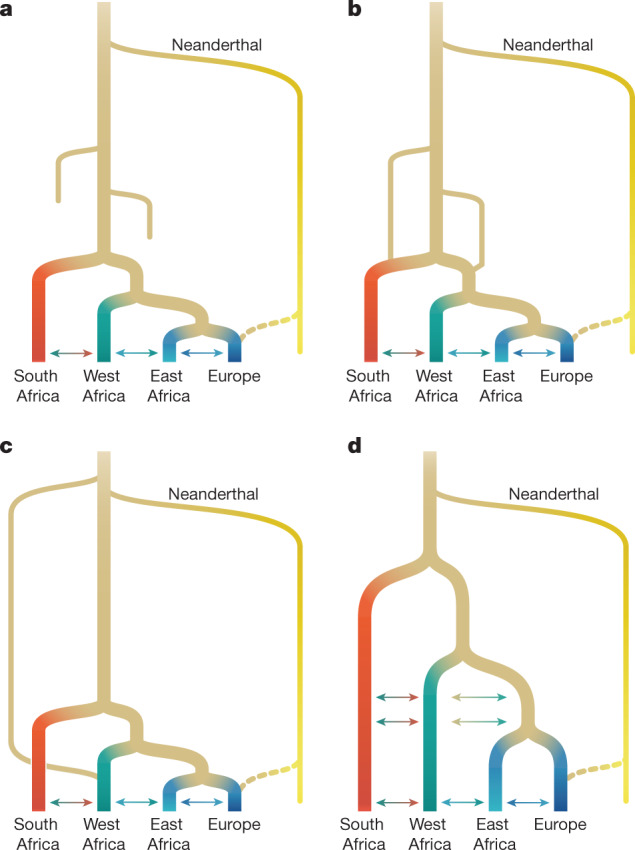
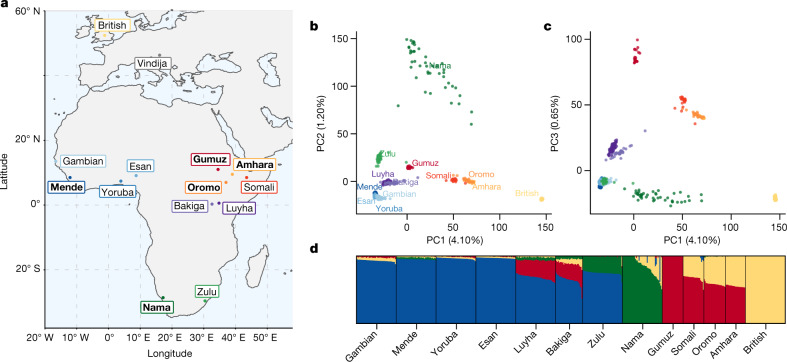
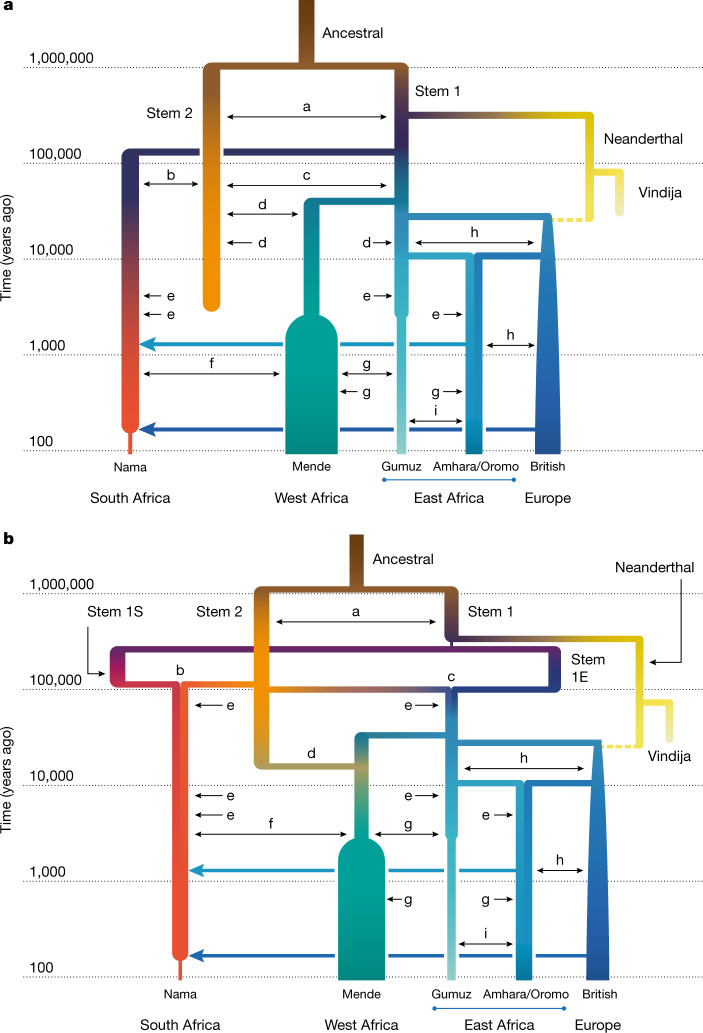
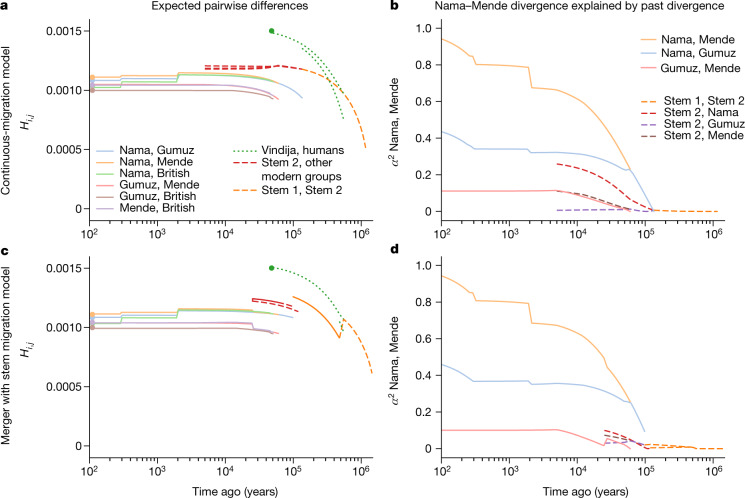
Verification
Claims the paper makes
The claims and statistics of this paper haven’t been checked yet.
Free: it reads the open-access text and checks the first 5 claims that cite a source we can check. Create a free account to check every claim.
Self-check
Percentages, sums and reported differences re-computed from the paper’s own numbers.
The self-check needs the paper’s full text.
Citations
Cites
A global reference for human genetic variation
The 1000 Genomes Project Consortium, authors, C., Auton, A., Abecasis, G. R., Steering committee, Altshuler, D. M., Durbin, R. M., Abecasis, G. R., Bentley, D. R., Chakravarti, A., et al. (2015) · Nature · doi:10.1038/nature15393 · Cited by 18,247
Inference of human population history from individual whole-genome sequences
Li, H., & Durbin, R. (2011) · Nature · doi:10.1038/nature10231 · Cited by 2,590
New fossils from Jebel Irhoud, Morocco and the pan-African origin of Homo sapiens.
Hublin, J.-J., Ben-Ncer, A., Bailey, S. E., Freidline, S. E., Neubauer, S., Skinner, M. M., Bergmann, I., Le Cabec, A., Benazzi, S., Harvati, K., et al. (2017) · Nature · doi:10.1038/nature22336 · Cited by 1,347
Pleistocene Homo sapiens from Middle Awash, Ethiopia
White, T. D., Asfaw, B., DeGusta, D., Gilbert, H., Richards, G. D., Suwa, G., & Clark Howell, F. (2003) · Nature · doi:10.1038/nature01669 · Cited by 1,032
Genome sequence of a 45,000-year-old modern human from western Siberia
Fu, Q., Li, H., Moorjani, P., Jay, F., Slepchenko, S. M., Bondarev, A. A., Johnson, P. L. F., Aximu-Petri, A., Prüfer, K., de Filippo, C., et al. (2014) · Nature · doi:10.1038/nature13810 · Cited by 1,023 · cited 1×
“By 403 45ka, there is additionally an unequivocal Homo sapiens femur from southern Siberia which contains derived 404 alleles shared with later Eurasian populations (Fu et al., 2014).”
BackgroundA high-coverage Neandertal genome from Vindija Cave in Croatia
Prüfer, K., de Filippo, C., Grote, S., Mafessoni, F., Korlević, P., Hajdinjak, M., Vernot, B., Skov, L., Hsieh, P., Peyrégne, S., et al. (2017) · Science · doi:10.1126/science.aao1887 · Cited by 719
Homo naledi, a new species of the genus Homo from the Dinaledi chamber. South Africa.
Berger, L. R., Hawks, J., de Ruiter, D. J., Churchill, S. E., Schmid, P., Delezene, L. K., Kivell, T. L., Garvin, H. M., Williams, S. A., DeSilva, J. M., et al. (2015) · eLife · doi:10.7554/elife.09560 · Cited by 703
Efficient Coalescent Simulation and Genealogical Analysis for Large Sample Sizes
Kelleher, J., Etheridge, A. M., & McVean, G. (2016) · PLOS Computational Biology · doi:10.1371/journal.pcbi.1004842 · Cited by 654
The African Genome Variation Project shapes medical genetics in Africa
Gurdasani, D., Carstensen, T., Tekola-Ayele, F., Pagani, L., Tachmazidou, I., Hatzikotoulas, K., Karthikeyan, S., Iles, L., Pollard, M. O., Choudhury, A., et al. (2015) · Nature · doi:10.1038/nature13997 · Cited by 636
The age of the hominin fossils from Jebel Irhoud, Morocco, and the origins of the Middle Stone Age
Richter, D., Grün, R., Joannes-Boyau, R., Steele, T. E., Amani, F., Rué, M., Fernandes, P., Raynal, J.-P., Geraads, D., Ben-Ncer, A., et al. (2017) · Nature · doi:10.1038/nature22335 · Cited by 576
Research works printed but not linked: 1
- Marean, C. W. et al. in Fynbos (ed. Allsopp, N.) Ch. 8 (Oxford Univ. Press, 2014).
Cited by
Items 101–180 of 180
Collier, N. W., Gravel, S., & Ragsdale, A. P. (2026) · bioRxiv (Cold Spring Harbor Laboratory) · doi:10.64898/2026.04.11.717825 · Cited by 2
“…inferred models of ancestral structure marked by introgression from an isolated deme (Durvasula and Sankararaman, 2020; Fan et al., 2023; Cousins et al., 2025) or persistent contact among differentiated demes (Ragsdale et al., 2023) 2B) with an equal ICR profile (Figure 2D) (Mazet et al., 2016).”
Self-citationThe Genetic Legacy of Introgression from Two Deeply Divergent Lineages in the Genus Homo
Rogers, A. R., Islam, M. T., Brand, C. M., & Webster, T. H. (2026) · bioRxiv · doi:10.64898/2026.03.22.713509
“The results of Ragsdale et al. [26] (see above) suggest that these populations may not have been isolated after all—perhaps there was a continuous trickle of gene flow between them.”
Homo sapiens' birth and ProgRetrogProg evolution by DNA's extreme climate-induced rearrangementPreprint
ÇAKIR, Ş. (2023) · OSF Preprints (OSF Preprints) · doi:10.31219/osf.io/ph247
Roots of InequalityPreprint
Galor, O., Klemp, M., & Wainstock, D. C. (2023) · SSRN Electronic Journal · doi:10.2139/ssrn.4477984 · Cited by 2
Robust inference of historical human generation timesPreprint
Wang, R. J., Rogers, J., & Hahn, M. W. (2023) · bioRxiv (Cold Spring Harbor Laboratory) · doi:10.1101/2023.07.20.549788
“…several of these groups do currently live in West Africa, these samples reflect much more of the diversity of Africa, a continent on which recent work has inferred the existence of deep population structure more than 250,000 year ago (Fan et al. 2023; Pfennig et al. 2023; Ragsdale et al. 2023).”
BackgroundLes racines multiples de notre espèce
Savatier, F. (2023) · Pour la Science · doi:10.3917/pls.550.0008
Reflections on the Dynamics of Savanna Landscapes
Young, K. R. (2023) · Land · doi:10.3390/land12101857 · Cited by 1
Thanks Mom! The Evolution-Health Disparities Link Through Mitochondrial Genetic Disease
Jackson, F. L. C., Mingo, E., Caldwell, J., Batson, N., Mohammed, M., & Keaton, K. (2023) · Advances In Clinical And Medical Research · doi:10.52793/acmr.2023.4(4)-66
Human evolution: Neanderthal footprints in African genomes
Ragsdale, A. P. (2023) · Current Biology · doi:10.1016/j.cub.2023.10.005
Self-citationOrigin of Neanderthals. Neanderthals of the Altai: Myth or Reality?
Derevianko, A. P. (2024) · Archaeology Ethnology and Anthropology of Eurasia · doi:10.17746/1563-0110.2024.52.1.003-034
Part I. Building a Diagrammatics of ‘Race’ in the Emerging Field of Anthropology
Sommer, M. (2024) · Open Book Publishers · doi:10.11647/obp.0396.01
11. Denying Even the Tree-Structured Human Kinship
Sommer, M. (2024) · Open Book Publishers · doi:10.11647/obp.0396.14
7. Map, Scale, and Tree in Natural History
Sommer, M. (2024) · Open Book Publishers · doi:10.11647/obp.0396.09
4. Prichard's Third Edition of Researches (1846-47) and Nott's and Gliddon's Types of Mankind (1854)
Sommer, M. (2024) · Open Book Publishers · doi:10.11647/obp.0396.05
2. Samuel George Morton and His (Paper) Skulls
Sommer, M. (2024) · Open Book Publishers · doi:10.11647/obp.0396.03
5. Codifying a Diagrammatics of 'Race'
Sommer, M. (2024) · Open Book Publishers · doi:10.11647/obp.0396.06
Sommer, M. (2024) · Open Book Publishers · doi:10.11647/obp.0396.12
8. Map, Scale, and Tree in Darwin, Haeckel and Co. The Genealogy of the Human Species
Sommer, M. (2024) · Open Book Publishers · doi:10.11647/obp.0396.10
Part IV. The Tree, the Map, the Mosaic, and the Network in Genetic Anthropology
Sommer, M. (2024) · Open Book Publishers · doi:10.11647/obp.0396.19
12. Meandering Rivers and Synthetic Networks against Polygenism
Sommer, M. (2024) · Open Book Publishers · doi:10.11647/obp.0396.15
13. The Reaffirmation of the Polygenist ‘Tree’
Sommer, M. (2024) · Open Book Publishers · doi:10.11647/obp.0396.16
19. The (Diagrammatic) Narratives of Genetic Revolutions
Sommer, M. (2024) · Open Book Publishers · doi:10.11647/obp.0396.23
3. Kinship Denied and Acknowledged
Sommer, M. (2024) · Open Book Publishers · doi:10.11647/obp.0396.04
Part III. Radicalizing versus Deconstructing the Family Tree of the Human ‘Races’
Sommer, M. (2024) · Open Book Publishers · doi:10.11647/obp.0396.13
9. Map, Scale, and Tree in Darwin, Haeckel and Co. The Genealogy of the Human ‘Races’
Sommer, M. (2024) · Open Book Publishers · doi:10.11647/obp.0396.11
1. Esthetics, Diagrammatics, and Metrics: The Beginnings of Physical Anthropology
Sommer, M. (2024) · Open Book Publishers · doi:10.11647/obp.0396.02
18. Gene Flow and Ancient DNA: Trees with Connecting Branches
Sommer, M. (2024) · Open Book Publishers · doi:10.11647/obp.0396.22
Sommer, M. (2024) · Open Book Publishers · doi:10.11647/obp.0396.00
15. Missing Links to the Eugenic Pedigrees
Sommer, M. (2024) · Open Book Publishers · doi:10.11647/obp.0396.18
20. Deconstructing the Tree Diagram to a Mess – or at least a Net
Sommer, M. (2024) · Open Book Publishers · doi:10.11647/obp.0396.24
16. The History, Geography, and Politics of Human Genes
Sommer, M. (2024) · Open Book Publishers · doi:10.11647/obp.0396.20
17. Genetic Trees, Admixture, and Mosaics
Sommer, M. (2024) · Open Book Publishers · doi:10.11647/obp.0396.21
Sommer, M. (2024) · Open Book Publishers · doi:10.11647/obp.0396.17
Part II. Maps, Scales, and Trees as (Intertwined) Diagrams of Human Genealogy and Evolution
Sommer, M. (2024) · Open Book Publishers · doi:10.11647/obp.0396.07
Sommer, M. (2024) · Open Book Publishers · doi:10.11647/obp.0396.25
6. The First Tree of the Human ‘Races’: Mappa Mundi, Chain of Being, and Tree of Life
Sommer, M. (2024) · Open Book Publishers · doi:10.11647/obp.0396.08
Insights into Human Evolution through Paleogenomics
Ranganath, H. A. (2024) · Resonance · doi:10.1007/s12045-024-0617-0
Campbell, B. (2024) · Springer eBooks · doi:10.1007/978-3-031-38971-9_1987-1
Implementing genomics research in developing countries: Common challenges, and emerging solutions
Reynolds, A. W., Lea, A. J., & Nieves-Colón, M. A. (2024) · Elsevier eBooks · doi:10.1016/b978-0-443-18546-5.00004-8
Premo, L. S., & Režek, Ž. (2024) · Journal of Archaeological Method and Theory · doi:10.1007/s10816-024-09682-5
“…., Bailey et al. , 2020; Gunz et al. , 2009; Harvati et al. , 2011) and genetic variation ( e.g ., Bergstrom et al. , 2021; Lipson et al. , 2022; Ragsdale et al. , 2023; Skoglund et al. , 2017) point generally to the structured character of the Pleistocene hominin population in Africa (see also…”
Roots of Cultural DiversityPreprint
Galor, O., Klemp, M., & Wainstock, D. C. (2024) · SSRN Electronic Journal · doi:10.2139/ssrn.5054239 · Cited by 1
Sommer, M. (2024) · Open Book Publishers · doi:10.11647/obp.0396.26
Mapping a complex evolutionary history
Gravel, S. (2025) · Science · doi:10.1126/science.adw5484
Self-citationMalaria shaped human spatial organisation for the last 74 thousand yearsPreprint
Colucci, M., Leonardi, M., Blinkhorn, J., Irish, S. R., Padilla‐Iglesias, C., Kaboth‐Bahr, S., Gosling, W. D., Snow, R. W., Manica, A., & Scerri, E. M. L. (2025) · bioRxiv (Cold Spring Harbor Laboratory) · doi:10.1101/2025.06.04.657870
Azulay, R. S. D. S., Ferreira, L. L., Gonçalves, A. B. R., Barbosa, I. J., Rodrigues, V. P., Facundo, A. N., Lago, D. C. F., Nascimento, G. C., Magalhães, M., Faria, M. D. S., et al. (2025) · Scientific Reports · doi:10.1038/s41598-025-05990-2
“Africa is widely recognized as the cradle of humanity, with its population possessing the oldest genetic lineages, contributing to the high genetic diversity observed 57 .”
WITHDRAWN: Modern humans dispersed from southern Africa?Preprint
Cenac, Z. (2025) · bioRxiv (Cold Spring Harbor Laboratory) · doi:10.1101/2025.07.15.664985
Leaping between branches: Hybridisation and the tangled evolutionary history of true lemurs
Mercuri, G., Merici, G., Farh, K. K., Kuderna, L. F. K., Rogers, J., Marquès‐Bonet, T., Donati, G., Percudani, R., & Capelli, C. (2025) · Molecular Phylogenetics and Evolution · doi:10.1016/j.ympev.2025.108503
Serradell, J. M., Lorenzo-Salazar, J. M., Flores, C., Lao, Ó., & Comas, D. (2024) · DIGITAL.CSIC (Spanish National Research Council (CSIC)) · doi:10.6084/m9.figshare.26756104
Serradell, J. M., Lorenzo-Salazar, J. M., Flores, C., Lao, Ó., & Comas, D. (2024) · DIGITAL.CSIC (Spanish National Research Council (CSIC)) · doi:10.6084/m9.figshare.26410044
Serradell, J. M., Lorenzo-Salazar, J. M., Flores, C., Lao, Ó., & Comas, D. (2024) · DIGITAL.CSIC (Spanish National Research Council (CSIC)) · doi:10.6084/m9.figshare.26756101
Serradell, J. M., Lorenzo-Salazar, J. M., Flores, C., Lao, Ó., & Comas, D. (2024) · DIGITAL.CSIC (Spanish National Research Council (CSIC)) · doi:10.6084/m9.figshare.26756107
Serradell, J. M., Lorenzo-Salazar, J. M., Flores, C., Lao, Ó., & Comas, D. (2024) · DIGITAL.CSIC (Spanish National Research Council (CSIC)) · doi:10.6084/m9.figshare.26756110
Serradell, J. M., Lorenzo-Salazar, J. M., Flores, C., Lao, Ó., & Comas, D. (2024) · DIGITAL.CSIC (Spanish National Research Council (CSIC)) · doi:10.6084/m9.figshare.26409853
Johnson, C. L. (2024) · eScholarship (California Digital Library)
Laval, G., Decugis, A., Parasayan, O., Patin, É., Quintana‐Murci, L., & Chiaroni, J. (2025) · bioRxiv (Cold Spring Harbor Laboratory) · doi:10.64898/2025.12.25.695976
“…studies (Figure 1, Table S2): split times between Bantu speakers and rainforest hunter gatherers were drawn from (Lopez et al. 2018), migration rates and split times between Southern hunter gatherers, Western and Eastern Africans and Eurasians populations were drawn from (Ragsdale et al. 2023).”
InfluentialGeneral moment closure for the neutral two-locus wright-fisher dynamicsPreprint
Kundagrami, R., Yetter, S., & Steinrücken, M. (2026) · bioRxiv (Cold Spring Harbor Laboratory) · doi:10.64898/2026.01.16.700021
“…a closed system of moments in terms of powers of LD and functions of the marginal allele frequencies, and use moments up to order 4 within and between sub-populations to derive a powerful method to infer complex demographic histories from contemporary genomic data (see also Ragsdale et al., 2023).”
The humanity of a new DenisovanPreprint
Hawks, J. D. (2025) · doi:10.32388/substack.c306dh
Dissecting human population variation in single-cell responses to SARS-CoV-2
Aquino, Y. (2023) · theses.fr (ABES) · doi:10.70675/061da45czf5e5z482dzb71dz92b95c997a05
Attentive-SPIDNA: Attention-based neural networks for population geneticsPreprint
Sanchez, T., Jobic, P., Regan, C., Verdu, P., Charpiat, G., & Jay, F. (2026) · bioRxiv (Cold Spring Harbor Laboratory) · doi:10.64898/2026.04.15.718687
“…on sets of population genetics’ classical summary-statistics com-270 puted on a variety of genome-wide data in similar or analogous population sample sets (Mallick et al, 2016; Bergstr¨om et al, 2020; Lorente-Galdos et al, 2019; Ragsdale et al, 2023; Lorente-Galdos et al, 2019; Fan et al, 2023).”
The morphological affinities of the fossil cranium from Kabua, Kenya
Bosman, A. M., Buck, L. T., Reyes‐Centeno, H., Lahr, M. M., Stringer, C. B., Grün, R., Shao, Q., & Harvati, K. (2026) · Journal of the Royal Anthropological Institute · doi:10.1111/1467-9655.70137
Roseman, C. C., & Weaver, T. D. (2026) · Cambridge University Press eBooks · doi:10.1017/9781316756492.021
Self-citationCowgill, L. W., & Maddux, S. D. (2026) · Cambridge University Press eBooks · doi:10.1017/9781316756492.017
Educação Ambiental e Paleontologia: caminhos para descolonizar as relações humano-natureza
Sepulvreda, B. A., da Costa, S. A. R. F., & Peres, A. D. C. (2026) · Terrae Didatica · doi:10.20396/td.v22i00.8682314
Recent progress in studies of the last million years of human physical and behavioural evolution
Cole, J., Scerri, E. M. L., Hajdinjak, M., & Stringer, C. B. (2026) · Journal of the Royal Anthropological Institute · doi:10.1111/1467-9655.70141
Retaining Models of Human Evolution After Repeated Falsifications—Why?
Templeton, A. R. (2026) · Natural Sciences · doi:10.1002/ntls.70072
McAllister, N. P., Zöllner, S., & Zhang, X. (2026) · bioRxiv (Cold Spring Harbor Laboratory) · doi:10.64898/2026.06.25.734355 · Cited by 1
“For example, Ragsdale et al. showed that a weakly structured stem model can explain some apparent ghost signature in Africa [33], and Loya et al. found only limited support for superarchaic introgression using ARG-based analyses [36].”
Mackintosh, A. (2026) · bioRxiv (Cold Spring Harbor Laboratory) · doi:10.64898/2026.07.14.738421 · Cited by 1
Reconceiving of the Doctrine of Original Sin
Nieuwenhove, R. V. (2026) · Cambridge University Press eBooks · doi:10.1017/9781009873093.004
A Curated Pharmacogenomic Allele Catalog for Sub-Saharan African PopulationsPreprint
Sulaiman, M. A., & Oyeyemi, B. F. (2026) · medRxiv · doi:10.64898/2026.08.25.26361354
Milanković cycles and Cultural Evolution as important Catalysts for Hominin Genetic DiversificationPreprint
Fang, S., Raia, P., Aneesh, S., Barbieri, C., Ruan, J., Vahdati, A. R., Zeller, E., Zollikofer, C. P., & Timmermann, A. (2026) · bioRxiv (Cold Spring Harbor Laboratory) · doi:10.64898/2026.09.03.749301
Absolon, N. (2026) · Zenodo (CERN European Organization for Nuclear Research) · doi:10.5281/zenodo.22712961
¿EXISTIÓ EL PRIMER SER HUMANO? EL PROBLEMA DE BUSCAR UN «ADÁN BIOLÓGICO»
Sepúlveda, H. A. Á. (2026) · Editora Artemis eBooks · doi:10.37572/edart_28092633811
Garcia-Calleja, J., Fortes‐Lima, C., Macià, M. C., Lao, Ó., & Bosch, E. (2026) · bioRxiv (Cold Spring Harbor Laboratory) · doi:10.64898/2026.09.23.753770
Nature in Flux: Flow, Thresholds, and Invisible Ecological TransformationPreprint
Boko, I. (2026) · SSRN Electronic Journal · doi:10.2139/ssrn.7536342
Gene flux shapes diversity and evolution of the ancient 17q21.31 inversion polymorphismPreprint
Harringmeyer, O. S., Biddanda, A., McCoy, R. C., & Akey, J. M. (2026) · bioRxiv (Cold Spring Harbor Laboratory) · doi:10.64898/2026.09.28.755014
HACIA UNA DESMITIFICACIÓN DEL MESTIZAJE
Pérez, B. E. (2026) · Editora Científica Digital eBooks · doi:10.37885/260221239
Amazônia Contemporânea: Educação, Saúde, Políticas Públicas e Ambiente - Vol. 2
Santos, D. M. A., & Viana, W. C. (2026) · Editora Científica Digital eBooks · doi:10.37885/978-65-6155-309-4
Bellmann, O. T., Witt, M., & Hoeschele, M. (2026) · Frontiers in Psychology · doi:10.3389/fpsyg.2026.1992265
What shapes shape? Extinctions as a key driver of Acheulean cultural variation
Clark, J. (2026) · Cambridge Prisms Extinction · doi:10.1017/ext.2026.10029
Metadata
- Authors
- Ragsdale, A. P., Weaver, T. D., Atkinson, E. G., Hoal, E. G., Möller, M., Henn, B. M., & Gravel, S.
- Affiliations
- University of Wisconsin–Madison (US)
- University of California, Davis (US)
- Baylor College of Medicine (US)
- South African Medical Research Council (ZA)
- McGill University (CA)
- Corresponding author
- Henn, Brenna M.
- Gravel, Simon
- ORCID
- Venue
- Nature
- Published
- 2023-05-17
- Volume
- 617
- Issue
- 7962
- Pages
- 755-763
- ISSN
- 0028-0836 (ISSN-L)
- 1476-4687
- PMC
- PMC10208968
- OpenAlex
- W4377012029
- Semantic Scholar
- b7446b95948f6cca2a711a1b8bc0853e92f66d2d
- Cited by
- 159
- References
- 56
- Citations by year
- 2026: 24 · 2025: 36 · 2024: 67 · 2023: 28
- FWCI
- 26.73
- Type
- journal article
- Language
- en
- Update notices
- correction (2023-07-17)
- Open access
- hybrid
- doi.org
- Licence
- cc-by
- www.springernature.com/gp/researchers/text-and-data-mining (tdm)
- www.springernature.com/gp/researchers/text-and-data-mining (vor)
- Locations
- Nature (publishedVersion, cc-by)
- bioRxiv (Cold Spring Harbor Laboratory) (acceptedVersion, cc-by-nc)
- PubMed Central (publishedVersion, cc-by)
- PubMed (publishedVersion)
- eScholarship (California Digital Library) (submittedVersion, cc-by)
- Digital Commons-TMC (Texas Medical Center) (submittedVersion)
- RePEc: Research Papers in Economics (submittedVersion)
- Funders
- South African Medical Research Council
- Universiteit Stellenbosch
- National Institutes of Health (NIH K01)
- Canadian Institutes of Health Research (437576, RGPIN-2017-04816)
- Natural Sciences and Engineering Research Council of Canada (RGPIN 2017 ?, rgpin-2017-04816)
- Medical Research Council
- National Institute of Mental Health (K01MH121659)
- National Institute of General Medical Sciences (R35GM133531, K12GM102778)
- Topics
- Life Sciences › Biochemistry, Genetics and Molecular Biology › Genetics › Forensic and Genetic Research
- Social Sciences › Anthropology › Pleistocene-Era Hominins and Archaeology
- Life Sciences › Biochemistry, Genetics and Molecular Biology › Genetics › Genetic diversity and population structure
- Keywords
- human origins, human, population divergence, gene flow, linkage disequilibrium, genetic diversity, Marine Isotope Stage 5, divergence time estimation, model misspecification, genetic drift
- MeSH terms
- Genetic Introgression, Africa, Fossils, Genetics, Population, Humans, Phylogeny, Polymorphism, Genetic, Time Factors, Linkage Disequilibrium, Genome, Human, Genetic Drift, History, Ancient, Gene Flow, Human Migration
About these checks
Registry, retraction, Cites and statistics results are computed, not judged, with one exception: a printed reference that no index lists is read once by a model before it counts as a citation error. Claims are extracted by a model and kept only when their quote appears verbatim in the text; each cited source is then checked, with a model’s help, for whether it says what the claim relies on. Those verdicts can be wrong — read the claim’s quote and the cited source before relying on one.
Statistics and arithmetic are recomputed, not judged.
Confidence bands are shown only for fields calibrated on our annotated test set. None is calibrated yet, so no band is shown.
What counts as a claim ›How we measure confidence ›How we check this ›
Are you an author, or do you see a problem with this page? Request a review
Data sources
Bibliographic data: Semantic Scholar, OpenAlex, Crossref.
Contains information from the Semantic Scholar Academic Graph Datasets, made available under the ODC Attribution License (ODC-BY 1.0).
Semantic Scholar’s data is described in: Kinney, R., et al. (2023). The Semantic Scholar Open Data Platform. arXiv:2301.10140.
