

Safe and just Earth system boundaries
Open accessThe DOI matches its Crossref record; 119 of the 120 references it cites were found in a registry or an index.
Abstract
The stability and resilience of the Earth system and human well-being are inseparably linked 1–3 , yet their interdependencies are generally under-recognized; consequently, they are often treated independently 4,5 . Here, we use modelling and literature assessment to quantify safe and just Earth system boundaries (ESBs) for climate, the biosphere, water and nutrient cycles, and aerosols at global and subglobal scales. We propose ESBs for maintaining the resilience and stability of the Earth system (safe ESBs) and minimizing exposure to significant harm to humans from Earth system change (a necessary but not sufficient condition for justice) 4 . The stricter of the safe or just boundaries sets the integrated safe and just ESB. Our findings show that justice considerations constrain the integrated ESBs more than safety considerations for climate and atmospheric aerosol loading. Seven of eight globally quantified safe and just ESBs and at least two regional safe and just ESBs in over half of global land area are already exceeded. We propose that our assessment provides a quantitative foundation for safeguarding the global commons for all people now and into the future.
Overview
The claims and statistics of this paper haven’t been checked yet.
Free: it reads the open-access text and checks the first 5 claims that cite a source we can check. Create a free account to check every claim.
Integrity signals
Registry
Cites
Statistics
Figures
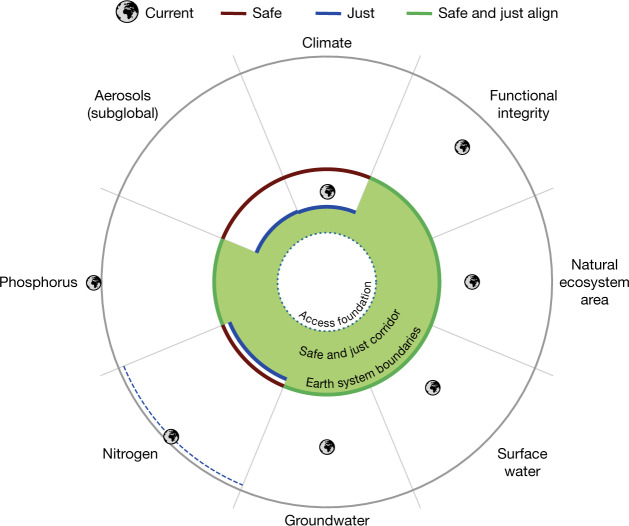
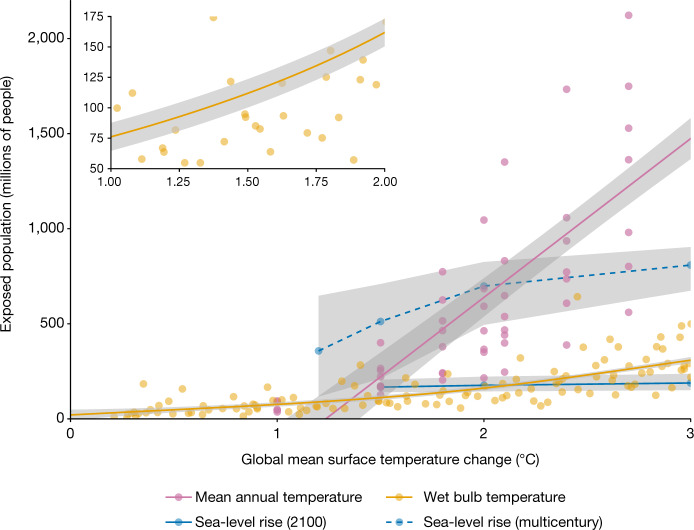
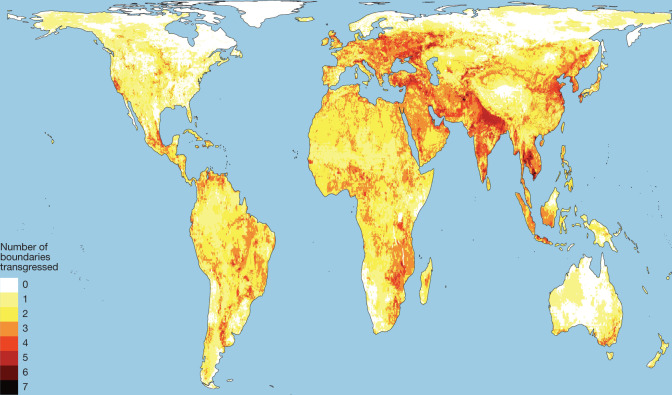
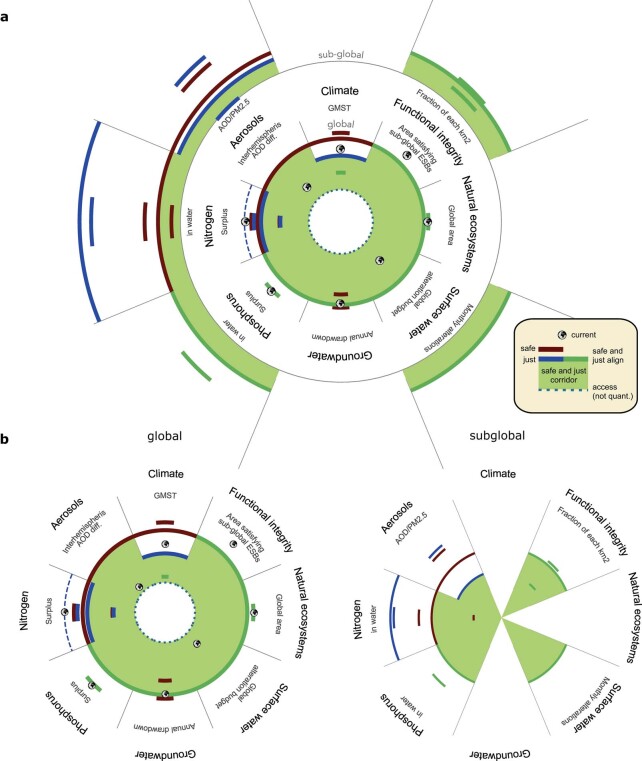
Verification
Claims the paper makes
The claims and statistics of this paper haven’t been checked yet.
Free: it reads the open-access text and checks the first 5 claims that cite a source we can check. Create a free account to check every claim.
Claims other papers make about this one
Each is checked against this paper’s own text: does it say what the citing paper says it does?
In the citing paper
“The accelerating socioeconomic trends of the past century [232] have put us on a path toward exceeding seven of eight globally defined safe and just Earth system boundaries that would provide safe living conditions for all humanity within the boundaries of the living systems on Earth [219].”
From Sustainability in computing education: A systematic literature review (2024) · cites this paper as [219]
Self-check
Percentages, sums and reported differences re-computed from the paper’s own numbers.
The self-check needs the paper’s full text.
Citations
Cites
A safe operating space for humanity
Rockström, J., Steffen, W., Noone, K., Persson, Å., Chapin, F. S., Lambin, E. F., Lenton, T. M., Scheffer, M., Folke, C., Schellnhuber, H. J., et al. (2009) · Nature · doi:10.1038/461472a · Cited by 13,333
Self-citationPlanetary boundaries: Guiding human development on a changing planet
Steffen, W., Richardson, K., Rockström, J., Cornell, S. E., Fetzer, I., Bennett, E. M., Biggs, R., Carpenter, S. R., de Vries, W., de Wit, C. A., et al. (2015) · Science · doi:10.1126/science.1259855 · Cited by 12,527 · cited 6×
“We note that the area of largely natural ecosystems replaces the “land boundary” in the planetary boundaries concept, which implied “largely intact lands” or areas of high biodiversity intactness (Steffen et al. 2015).”
InfluentialSelf-citationCohen, A. J., Brauer, M., Burnett, R., Anderson, H. R., Frostad, J., Estep, K., Balakrishnan, K., Brunekreef, B., Dandona, L., Dandona, R., et al. (2017) · The Lancet · doi:10.1016/s0140-6736(17)30505-6 · Cited by 6,583
Poff, N. L., Allan, J. D., Bain, M. B., Karr, J. R., Prestegaard, K. L., Richter, B. D., Sparks, R. E., & Stromberg, J. C. (1997) · BioScience · doi:10.2307/1313099 · Cited by 6,500
Four billion people facing severe water scarcity
Mekonnen, M. M., & Hoekstra, A. Y. (2016) · Science Advances · doi:10.1126/sciadv.1500323 · Cited by 5,531
Tipping elements in the Earth’s climate system
Lenton, T. M., Held, H., Kriegler, E., Hall, J. W., Lucht, W., Rahmstorf, S., & Schellnhuber, H. J. (2008) · Proceedings of the National Academy of Sciences · doi:10.1073/pnas.0705414105 · Cited by 3,982 · cited 1×
“Tipping elements: Those components or processes that regulate the functioning and state of the planet and that show evidence of having thresholds at which small additional perturbations can trigger selfreinforcing changes that undermine Earth system resilience (Lenton et al. 2008; Armstrong McKay et al. 2022).”
Self-citationEmerging threats and persistent conservation challenges for freshwater biodiversity
Reid, A. J., Carlson, A. K., Creed, I. F., Eliason, E. J., Gell, P. A., Johnson, P. T. J., Kidd, K. A., MacCormack, T. J., Olden, J. D., Ormerod, S. J., et al. (2019) · Biological Reviews · doi:10.1111/brv.12480 · Cited by 3,645
Options for keeping the food system within environmental limits
Springmann, M., Clark, M., Mason-D’Croz, D., Wiebe, K., Bodirsky, B. L., Lassaletta, L., de Vries, W., Vermeulen, S. J., Herrero, M., Carlson, K. M., et al. (2018) · Nature · doi:10.1038/s41586-018-0594-0 · Cited by 3,380
Self-citationBasic Principles and Ecological Consequences of Altered Flow Regimes for Aquatic Biodiversity
BUNN, S. E., & ARTHINGTON, A. H. (2002) · Environmental Management · doi:10.1007/s00267-002-2737-0 · Cited by 3,379
Self-citationIPBES (2019) · Socio-Environmental Systems Modeling · doi:10.5281/zenodo.3831673 · Cited by 3,354
Research works printed but not linked: 15
- IPCC Climate Change 2022: Impacts, Adaptation, and Vulnerability (eds Pörtner, H.-O. et al.) (Cambridge Univ. Press, 2022).
- IPCC Climate Change 2021: The Physical Science Basis (eds Masson-Delmotte, V. et al.) (Cambridge Univ. Press, 2021).
- O’Neill, B. et al. in Climate Change 2022: Impacts, Adaptation, and Vulnerability (eds Pörtner, H.-O. et al.) 2411–2538 (Cambridge Univ. Press, 2022).
- Parmesan, C. et al. in Climate Change 2022: Impacts, Adaptation, and Vulnerability (eds Pörtner, H.-O. et al.) 197–377 (Cambridge Univ. Press, 2022).
- WHO Guidelines for Drinking-water Quality 4th edn (World Health Organization, 2022); https://www.who.int/publications/i/item/9789240045064. 35417116
- Tirado, R. & Allsopp, M. Phosphorus in Agriculture: Problems and Solutions. Technical report (review) (Greenpeace, 2012); https://www.greenpeace.to/greenpeace/wp-content/uploads/2012/06/tirado-and-allsopp-2012-phosphorus-in-agriculture-technical-report-02-2012.pdf.
- Douville, H. et al. in Climate Change 2021: The Physical Science Basis (eds Masson-Delmotte, V. et al.) 1055–1210 (Cambridge Univ. Press, 2021).
- WHO Global Air Quality Guidelines: Particulate Matter (PM2.5and PM10), Ozone, Nitrogen Dioxide, Sulfur Dioxide and Carbon Monoxide (WHO, 2021); https://apps.who.int/iris/handle/10665/345329. 34662007
- EPA. Review of the national ambient air quality standards for particulate matter. Environmental Protection Agency. 40 CFR Part 50. Fed. Regis. Rules Regul. 85, 82684–82748 (2020).
- Biggs, R. et al. in Encyclopedia of Theoretical Ecology (eds Hastings, A. & Gross, L.) 609–617 (Univ. of California Press, 2012).
- Owusu, K. A., Kulesz, M. M. & Merico, A. Extraction behaviour and income inequalities resulting from a common pool resource exploitation. Sustain. Sci. Pract. Policy 11, 536 (2019).
- IPCC Climate Change 2022: Impacts, Adaptation, and Vulnerability (eds Pörtner, H.-O. et al.) (Cambridge Univ. Press, 2022).
- Fox-Kemper, B. et al. in Climate Change 2021: The Physical Science Basis (eds Masson-Delmotte, V. et al.) 1211–1362 (Cambridge Univ. Press, 2021).
- Shaw, R. et al. in Climate Change 2022: Impacts, Adaptation, and Vulnerability (eds Pörtner, H.-O. et al.) 1457–1579 (Cambridge Univ. Press, 2022).
- Klein Goldewijk, K., Beusen, A., Doelman, J. & Stehfest, E. Anthropogenic land use estimates for the Holocene–HYDE 3.2. Earth Syst. Monit. 9, 927–953 (2017).
Cited by
Items 501–600 of 1,001
Reorienting water and sanitation narratives towards sustainability transformations
Carrard, N. (2024) · Nature Water · doi:10.1038/s44221-023-00187-1 · Cited by 7
Wei, X. L., Gao, D., Wang, Y., Li, B., Zhang, Z., Zuliani, P., Yao, H., & Curtis, T. P. (2024) · The Science of The Total Environment · doi:10.1016/j.scitotenv.2024.171091 · Cited by 8
The Anthropocene and Its Contenders: Cross‐Disciplinary Tools for a Nationally Divided Humanity
Conversi, D. (2025) · Earth s Future · doi:10.1029/2024ef004918 · Cited by 8
“One of the most treacherous obstacles in the fight against climate change and correlated planetary crises (Rockström et al., 2023) is to be found in the disciplinary closures that have too often impeded mutual collaboration between scientists, including natural and social scientists.”
Cisneros, M., Pozo, J. X. O., Boqué-Ciurana, A., Cimolai, C., Dermit, D., Arnal, A., Masip, M., Sigró, J., & Aguilar, E. (2025) · Environmental Research Communications · doi:10.1088/2515-7620/adf37a · Cited by 7
Ness, D. A. (2024) · Agathón · doi:10.19229/2464-9309/1562024 · Cited by 7
How to define unjust planetary change
Humphreys, S. J. (2023) · Nature · doi:10.1038/d41586-023-01743-1 · Cited by 7
Alternate Stable States Theory: Critical Evaluation and Relevance to Marine Conservation
Guarini, J., & Coston‐Guarini, J. (2024) · Journal of Marine Science and Engineering · doi:10.3390/jmse12020261 · Cited by 9
Goudsblom, M., & Clarke, A. C. (2025) · Climate · doi:10.3390/cli13110228 · Cited by 6
“The impact of climate change is predominantly driven by human consumerism and social and economic systems that run on unsustainable practices [6].”
Ascaso, J., Mendoza-Salido, D., Pedrero-Méndez, A., Monte, E., Quijada, N. M., & Hermosa, R. (2025) · Frontiers in Plant Science · doi:10.3389/fpls.2025.1716657 · Cited by 6
“Current agriculture faces the need to ensure food for the global growing population, which is expected to reach 9 billion by 2050 (FAO, 2024), in a scenario where heating and drought are increasing with global warming (Rockström et al., 2023).”
Artificial General Intelligence and Planetary Justice: A Framework for Safe and Just Transitions
Stiefenhofer, P., & Deniz, C. (2025) · Challenges · doi:10.3390/challe16040059 · Cited by 6
“Earth-system science reinforces it through the concept of safe-and-just boundaries, where biophysical limits intersect with distributive thresholds to protect vulnerable populations [65,66].”
InfluentialKeiner, D., Pourjamal, Y., Khalili, S., & Breyer, C. (2025) · Gondwana Research · doi:10.1016/j.gr.2025.11.016 · Cited by 6
Leng, X., Feng, X., Qiu, J., Wang, J., Zhang, X., Feng, Y., & Fu, B. (2025) · Environmental Impact Assessment Review · doi:10.1016/j.eiar.2025.108228 · Cited by 7
Self-citationReview of weighting methods for life cycle impact assessment under GLAM
Askham, C., Arendt, R., Bachmann, T. M., Dias, L. C., Amadei, A., Scherer, L., Qian, H., Rupcic, L., Steen, B., Santos, J. L., et al. (2025) · The International Journal of Life Cycle Assessment · doi:10.1007/s11367-025-02564-2 · Cited by 7
“The remaining methods provide trade-off rates; all of the eight monetary methods assessed (budget constraint, Rockström et al. ( 2023 ) and Richardson et al. ( 2023 ) contain the latest planetary boundaries (PB) estimates.”
Green promises, gray realities: nationalism between climate action and obstruction
Conversi, D., Posocco, L., Arantes, V., Navarrete, R. M., & Enguer, J. (2025) · Oxford Open Climate Change · doi:10.1093/oxfclm/kgaf031 · Cited by 6
Ensuring consistency between biogeochemical planetary boundaries
Wolfram, P., Niazi, H., Kyle, P., & McJeon, H. (2026) · Nature Sustainability · doi:10.1038/s41893-026-01770-6 · Cited by 7
Ecological Feedbacks in the Earth System
Murphy, E. J., Williams, J. J., Myers‐Smith, I. H., Groner, V. P., Jacoby, D. M. P., Kwiatkowski, L., Melbourne-Thomas, J., Ransome, E. J., Banks-Leite, C., Bopp, L., et al. (2026) · Earth s Future · doi:10.1029/2025ef006478 · Cited by 7
Call for the mainstreaming of eutrophication in global water assessments and policies
Varis, O., & Zhao, D. (2026) · npj Clean Water · doi:10.1038/s41545-026-00562-x · Cited by 6
Dentoni, D., Roglić, M., Williams, A. N., & Bansal, P. (2026) · Journal of Management · doi:10.1177/01492063261417581 · Cited by 7
“In 2009, the Stockholm Resilience Centre proposed the planetary boundaries framework, which identified non-linear thresholds of nine scientifically quantified Earth system processes that define the safe operating space for humanity (Rockström et al., 2023).”
Materials come around and go around: Adapting to nature’s circularity
Schüpfer, D., Wagner-Wenz, R., Hendrich, K., & Weidenkaff, A. (2023) · MRS Bulletin · doi:10.1557/s43577-023-00603-7 · Cited by 6
Electricity mix from renewable energies can avoid further fragmentation of African rivers
Peters, R., Berlekamp, J., Tockner, K., & Zarfl, C. (2024) · Sustainable Energy Research · doi:10.1186/s40807-024-00110-6 · Cited by 6
“At the same time, irreversible damage caused by unregulated renewable infrastructure expansion needs to be avoided in order to ensure sustainable systems in the future that provide important ecosystem services for human well-being (Rockström et al., 2023).”
BackgroundReduction potential of German environmental food impacts due to a planetary health diet
Eberle, U., & Mumm, N. (2024) · The International Journal of Life Cycle Assessment · doi:10.1007/s11367-024-02352-4 · Cited by 6
“A transformation of food systems is therefore essential (Rockström et al. 2009, 2023).”
Sandhu, R., Rougeot, A., Josephy, P. D., Dolan, D. G., Emenike, C. U., Takaro, T. K., León, L. F., & Fraser, G. S. (2024) · Evidence-Based Toxicology · doi:10.1080/2833373x.2024.2399944 · Cited by 8
Esquius, J. R., González-Ingelmo, M., García, M. L., Laruelo, A. V., Santamaría, R., Blanco, C., & Rocha, V. G. (2024) · International Journal of Hydrogen Energy · doi:10.1016/j.ijhydene.2024.10.160 · Cited by 7
Cabrerizo, M. J., Happe, A., Ahme, A., John, U., Olsson, M., & Striebel, M. (2024) · Limnology and Oceanography · doi:10.1002/lno.12718 · Cited by 6
“Temperature is a major driver governing all biochemical reactions on Earth (Gillooly et al. 2001), and one of the most pervasive changes that the biosphere is facing (Rockström et al. 2023).”
How economic instruments address sustainable nutrient use: the example of phosphorus governance
Garske, B., Heyl, K., & Ekardt, F. (2025) · Environmental Sciences Europe · doi:10.1186/s12302-024-01045-x · Cited by 7
Caldera, U., Mühlbauer, A., ElSayed, M., Aghahosseini, A., & Breyer, C. (2025) · Smart Energy · doi:10.1016/j.segy.2025.100174 · Cited by 7
Bansal, P., Lee, J. Y., Barbosa, A. M., Rüegger, S., & Miller, E. M. (2025) · Journal of Business Research · doi:10.1016/j.jbusres.2025.115232 · Cited by 9
Human Behavioural Traits and the Polycrisis: A Systematic Review
King, N., & Jones, A. W. (2025) · Sustainability · doi:10.3390/su17041495 · Cited by 6
Prioritising the purpose: a Water System Justice framework for water utilities
Schwartz, K., Gupta, J., Mazzucato, M., Bosch, H., & van Vliet, L. (2025) · Water Policy · doi:10.2166/wp.2025.284 · Cited by 6
Self-citationAher, G., Sandberg, M., Boudjadar, J., & Ramanujan, D. (2025) · Smart and Sustainable Manufacturing Systems · doi:10.1520/ssms20240018 · Cited by 6
Planetary Boundaries: designing (fair?) limits to assess performance at the country level
Dao, H., & Friot, D. (2025) · Frontiers in Sustainable Resource Management · doi:10.3389/fsrma.2025.1537031 · Cited by 6
“…development indicators with science-based frameworks such as the PBs, or the “safe and just Earth system boundaries” (Rammelt et al., 2023; Rockström et al., 2023), which proposes setting more stringent PB values based on 31 justice criteria that “minimize human exposure to significant…”
Earth system functioning as a separate area of protection for life cycle impact assessment
Matuštík, J., & Paulu, A. (2025) · Journal of Industrial Ecology · doi:10.1111/jiec.70012 · Cited by 8
Bridging local and global vulnerabilities for an integrated assessment of nature-based solutions
Camacho-Caballero, D., Langemeyer, J., Segura, R., Vervoort, G., Barton, D. N., & Villalba, G. (2025) · Sustainable Cities and Society · doi:10.1016/j.scs.2025.106508 · Cited by 6
A software package for assessing terrestrial planetary boundaries
Gerten, D., Braun, J., Breier, J., Lucht, W., Tobian, A., & Stenzel, F. (2025) · One Earth · doi:10.1016/j.oneear.2025.101341 · Cited by 7
From science to policy: evolving marine biodiversity targets
Dajka, J., Eilrich, A. K., Franke, A., Halpern, B. S., Snow, B., Lombard, A. T., Jacob, U., Laakmann, S., Luhede, A., & Hillebrand, H. (2025) · Frontiers in Ecology and the Environment · doi:10.1002/fee.70000 · Cited by 6
Li, J., Li, Z., Wang, Q., Chen, Y., Zhang, X., Kahil, T., & Fridman, D. (2025) · Ecological Indicators · doi:10.1016/j.ecolind.2025.114066 · Cited by 6
Self-citationLi, J., Huang, L., Zhai, J., & Wang, S. (2025) · Environmental Impact Assessment Review · doi:10.1016/j.eiar.2025.108247 · Cited by 6
Self-citationFaith-Based Ecological Counselling: Integrating Spirituality and Sustainability for Muslim Students
Hidayat, H., Pendi, H. Z., & Warlizasusi, J. (2025) · Studia Ecologiae et Bioethicae · doi:10.21697/seb.5873 · Cited by 9
How can Health in All Policies approaches support the transition to the well‐being economy?
Valentine, N., Williams, C., Vega, J., Solar, O., & Told, M. (2023) · Health Promotion Journal of Australia · doi:10.1002/hpja.766 · Cited by 6
Ocean Governance in the Anthropocene: A New Approach in the Era of Climate Emergency
Barros-Platiau, A. F., da Cunha, G. L., Tomé, C. H., de Queiroz, F. A., Câmara, P. E. A. S., de Oliveira, C. C., & Barros, F. H. G. E. (2023) · Environment & policy · doi:10.1007/978-3-031-48098-0_4 · Cited by 6
Santos, F. D., O’Riordan, T., de Sousa, M. R., & Pedersen, J. S. T. (2024) · Sustainability Science · doi:10.1007/s11625-024-01462-0 · Cited by 6
Nitrogen and me — How little did we, and do we know about “stikstof – azote – nitrogen”?
Verstraete, W. (2024) · Water Research · doi:10.1016/j.watres.2024.121687 · Cited by 6
On the importance of diversity in ecological research
Brunn, M., Billings, S., Birke, J., Brockmüller, S., Nielsen, M. W., Salas, S. K., & Oelmann, Y. (2024) · Plants People Planet · doi:10.1002/ppp3.10553 · Cited by 6
Hu, Y., Wang, X., Liang, Q., Wei, M., & Zhang, W. (2024) · Journal of Cleaner Production · doi:10.1016/j.jclepro.2024.143703 · Cited by 6
Lago, S. P., Varela-Losada, M., & Rial, M. A. L. (2024) · European Public & Social Innovation Review · doi:10.31637/epsir-2024-936 · Cited by 6
Hybrid deep learning for climate prediction with temporal, spatial, and environmental data
Munandar, T. A., & Surbakti, H. (2025) · International Journal of Information Technology · doi:10.1007/s41870-025-02509-w · Cited by 7
Political science and the Earth system: Adapting governance to planetary realities
Milkoreit, M. (2025) · The British Journal of Politics and International Relations · doi:10.1177/13691481251326418 · Cited by 7
Bohn, F. J., Bastos, A., Martin, R., Rammig, A., Koh, N. S., Sioen, G. B., Büscher, B., Carver, L., DeClerck, F., Drupp, M. A., et al. (2025) · Biogeosciences · doi:10.5194/bg-22-2425-2025 · Cited by 9
Self-citationExploring Social Value for Sustainability: A Revelatory Case Study
Hueske, A., & Dijkstra-Silva, S. (2025) · Corporate Social Responsibility and Environmental Management · doi:10.1002/csr.70002 · Cited by 8
Reuse of plastic waste in eco-efficient concrete: an introductory guide
Pacheco-Torgal, F. (2024) · Elsevier eBooks · doi:10.1016/b978-0-443-13798-3.00010-3 · Cited by 6
Phase synchronization between culture and climate forcing
Timmermann, A., Wasay, A., & Raia, P. (2024) · Proceedings of the Royal Society B Biological Sciences · doi:10.1098/rspb.2024.0320 · Cited by 6
Etiology of the ecological crisis
Peppoloni, S., & Capua, G. D. (2024) · Elsevier eBooks · doi:10.1016/b978-0-443-15654-0.00009-8 · Cited by 6
Review: The Energy Implications of Averting Climate Change Catastrophe
Moriarty, P., & Honnery, D. (2023) · Energies · doi:10.3390/en16176178 · Cited by 7
“As already discussed, Gupta et al. [68] and Rockström et al. [90] argued on equity grounds that no further temperature increase should be allowed—even a 1.5 ◦ C rise is too high.”
InfluentialJørgensen, A. C. S., Pienkowski, T., Clark, M., Dunn, M., Jagadish, A., Bellot, Á. R., Mangubhai, S., Tawake, A., Vakalalabure, M. T., Waqa, E., et al. (2024) · bioRxiv (Cold Spring Harbor Laboratory) · doi:10.1101/2024.06.16.599026 · Cited by 6
From organic to climate solidarity: challenges for climate change mitigation
Bazzani, G. (2024) · Globalizations · doi:10.1080/14747731.2024.2386138 · Cited by 9
“Indeed, the e ff ects of climate change vary temporally and geographically (Rockström et al., 2023), with future generations set to su ff er far more greatly and some areas experiencing more severe consequences than others.”
ARL – Academy for Territorial Development in the Leibniz Association (2024) · RePEc: Research Papers in Economics · doi:10.60683/66zc-c156 · Cited by 6
Crafting Attributes of a Geological Now
Böhle, M. (2023) · Earth Science Systems and Society · doi:10.3389/esss.2023.10089 · Cited by 5
“Such arguments are essential because geological concepts might differ in the potential for societal action, such as empowering citizens to ensure that human operations stay within planetary boundaries (Steffen et al., 2015b; Lade et al., 2020; Rockström et al., 2023).”
BackgroundReflexiones y disyuntivas sobre la cuestión socioambiental en tiempos fragmentados
Agoglia, O., Gelman, M., & Maure, G. (2024) · Prometeica - Revista de Filosofía y Ciencias · doi:10.34024/prometeica.2024.29.15499 · Cited by 5
Opportunities for Blue food in a turbulent future - what’s ahead for a growing aquaculture industry?
Troell, M. F. (2024) · Bulletin of the European Association of Fish Pathologists · doi:10.48045/001c.122387 · Cited by 5
He, X., Zhao, Z., Zhang, Y., Cai, Z., & Wang, Y. (2024) · International Journal of Sediment Research · doi:10.1016/j.ijsrc.2024.12.004 · Cited by 5
León, M. F. G., Bankert, A., Becerra, D. T., & Abson, D. J. (2025) · Sustainable Production and Consumption · doi:10.1016/j.spc.2025.04.015 · Cited by 6
Du, S., Gao, M., Li, Q., & Guo, A. (2025) · Computers and Electronics in Agriculture · doi:10.1016/j.compag.2025.110455 · Cited by 5
Assessment of land surface vulnerability using time-series geospatial datasets
Yuan, B., Guo, S., Mu, H., Pan, X., Li, C., Xia, Z., Zhang, X., & Du, P. (2025) · Ecological Informatics · doi:10.1016/j.ecoinf.2025.103178 · Cited by 7
Self-citationToward energy systems within the planetary boundaries
Meramo, S., Mesa, J. A., Cano, N., Pupo-Roncallo, O., & González‐Quiroga, A. (2025) · AMBIO · doi:10.1007/s13280-025-02197-7 · Cited by 5
“Lately, Safe and Just Earth System Boundaries (Rockstro¨m et al. 2023) have been proposed, showing the interconnection between Earth-system stability, resilience, and the limits of human activities that could affect such stability.”
Soil moisture in the Anthropocene: a tipping component in planetary boundary transgressions
Tefera, G. W., Ray, R. L., Kumar, N., Gashaw, T., & Sarkar, R. (2025) · Environmental Research Letters · doi:10.1088/1748-9326/adfcea · Cited by 5
“The framework originally focused on blue water (surface and groundwater used for irrigation, industry, and consumption), setting a global withdrawal limit of approximately 4000 km 3 (Rockström et al 2023).”
Yao, Y., Jia, C., Xue, Y., Su, P., & Song, Y. (2025) · Journal of Environmental Management · doi:10.1016/j.jenvman.2025.127031 · Cited by 5
Jacquet, C., & Siqueira, T. T. D. S. (2025) · Environmental Innovation and Societal Transitions · doi:10.1016/j.eist.2025.101038 · Cited by 5
Kou‐Giesbrecht, S. (2025) · Journal of Geophysical Research Biogeosciences · doi:10.1029/2025jg009209 · Cited by 5
“…nitrogen inputs are approximately 119 Tg N yr 1 , grossly exceeding the boundary which is set at 57 Tg N yr 1 and thus far beyond the safe limit for maintaining the stability and resilience of the Earth system (Richardson et al., 2023; Rockström et al., 2023; Schulte‐Uebbing et al., 2022).”
Villalba‐Eguiluz, U., & Barona, C. C. (2025) · Current Research in Environmental Sustainability · doi:10.1016/j.crsust.2025.100308 · Cited by 5
García, P. A. S., Schröter, B., Krause, T., Boonstra, W. J., Nielsen, J. Ø., & Loft, L. (2025) · Sustainability Science · doi:10.1007/s11625-025-01749-w · Cited by 5
“Climate change threatens the planetary life support systems and humanity’s well-being (Rockström et al. 2023; Steffen et al. 2015), and there is a growing urge to transition to more sustainable pathways (IPCC 2023; United Nations Framework Convention on Climate Change 2015).”
Vegetation change in the Manas River Basin: dominance of groundwater-agricultural land synergy
Mu, X., Yin, F., Zhang, J., Zhang, J., Li, W., Liang, H., Pei, D., & Wang, Z. (2025) · Ecological Indicators · doi:10.1016/j.ecolind.2025.114297 · Cited by 5
Pei, W., Wan, S., Clift, P. D., Zhang, J., Liu, P., Han, Y., Zhao, D., Luan, Z., Yu, Z., Song, Z., et al. (2025) · Global and Planetary Change · doi:10.1016/j.gloplacha.2025.105143 · Cited by 5
Ye, C., Wang, S., Li, C., Stringer, L. C., Wu, X., Wu, S., & Wang, Y. (2025) · Communications Earth & Environment · doi:10.1038/s43247-025-02864-3 · Cited by 5
“These pressures represent multiple biogeochemical and biogeophysical processesandcomponentsoflife-supportsystems 21 .”
Yang, X., Li, D., Cai, R., Wang, X., Mun, T., Guo, X., Zhu, X., Zhu, T., & Wang, H. (2025) · Biomass and Bioenergy · doi:10.1016/j.biombioe.2025.108855 · Cited by 5
Lopez-De-Alba, P. L., Rodríguez-Carvajal, R., Isiordia-Lachica, P. C., Segoviano, F. J. V., Hidalgo, J. A. R., & Puente, O. T. (2026) · Journal of Open Innovation Technology Market and Complexity · doi:10.1016/j.joitmc.2026.100738 · Cited by 5
Roy, S., Ali, A.-R., Harvey, J.-P., Herrmann, C. A., & Fradette, L. (2026) · npj Sustainable Mobility and Transport · doi:10.1038/s44333-026-00089-1 · Cited by 6
“Aggregating this condition at the global level yielded a maximal altered fl ow of 7600 km 3 /yr, muchhigherthantheinitialboundaryof4000 km 3 /yr,duetotherevisionof world annual runoff considering newly accessible water from the Amazon, theCongoandthehigharcticregionswithawarmingclimate 64 .”
InfluentialHertel, C. J., Vedula, S., Bacq, S. C., & Rocchino, R. (2026) · Academy of Management Annals · doi:10.5465/annals.2024.0282 · Cited by 6
Outcomes from the First European Planetary Health Congress at ARTIS in Amsterdam
Kort, R., Arts, K., Antó, J. M., Berg, M. P., Cepella, G., Cole, J., Doorn, A. V., van Gorp, T., Grootjen, M., Gupta, J., et al. (2023) · Challenges · doi:10.3390/challe14040049 · Cited by 5
Self-citationZhao, Y., Wang, R., Qiu, H., Zheng, J., Zhu, K., Zheng, W., Yang, X., & Zhang, E. (2024) · Palaeogeography Palaeoclimatology Palaeoecology · doi:10.1016/j.palaeo.2024.112238 · Cited by 5
La economía circular y las economías transformadoras. Alcances y tensiones en el País Vasco
Villalba‐Eguiluz, U. (2024) · CIRIEC-España revista de economía pública social y cooperativa · doi:10.7203/ciriec-e.112.28299 · Cited by 5
Accounting for Social and Environmental Sustainability: A Multi-Capital Approach
Gibassier, D. (2025) · Routledge eBooks · doi:10.4324/9781003537533 · Cited by 6
The recipe for success in working across boundaries
O’Brien, K. R., Nastase, E. A., & Dennison, W. C. (2025) · Cell Reports Sustainability · doi:10.1016/j.crsus.2024.100284 · Cited by 5
Smith, E. K., Wiedermann, M., Donges, J. F., Heitzig, J., & Winkelmann, R. (2025) · Earth System Dynamics · doi:10.5194/esd-16-545-2025 · Cited by 5
Self-citationDantzer, L. B., Dybdahl, R. B., & Bjørna, A. (2025) · Sustainable Production and Consumption · doi:10.1016/j.spc.2025.05.014 · Cited by 6
Chevrollier, N., Levelt, L., Argyrou, A., & Meijer, F. (2025) · Journal of Business Models · doi:10.54337/jobm.v13i2.8375 · Cited by 5
Li, K., Guo, L., Wang, G., Gao, J., Sun, X., Huang, P., Li, J., Ma, J., & Zhang, X. (2026) · Hydrology and earth system sciences · doi:10.5194/hess-30-205-2026 · Cited by 6
Self-citationBozeman, J. F. (2024) · Frontiers of Environmental Science & Engineering · doi:10.1007/s11783-024-1825-2 · Cited by 5
Jovet, Y., LEFEVRE, F., Laurent, A., & Clausse, M. (2024) · Energies · doi:10.3390/en17112602 · Cited by 5
“However, there is a limit to the method based solely on EVA, as this value is currently based on an unsustainable economy that exceeds a large number of planetary limits [20,48].”
MethodJenner, L., Metzger, M. J., Moseley, D., Peskett, L. M., & Forrest, E. (2024) · Environmental Science & Policy · doi:10.1016/j.envsci.2024.103889 · Cited by 5
Grand (meta) challenges in planetary health: environmental, social, and cognitive
Butler, C. D. (2024) · Frontiers in Public Health · doi:10.3389/fpubh.2024.1373787 · Cited by 5
Waste Heat and Habitability: Constraints from Technological Energy Consumption
Balbi, A., & Lingam, M. (2025) · Astrobiology · doi:10.1089/ast.2024.0082 · Cited by 5
“…et al., 2009, Barnosky et al., 2012, Steffen et al., 2015, Raworth, 2017, O ’ Neill et al., 2018, Ritchie et al., 2021, Persson et al., 2022, Richardson et al., 2023, Rockström et al., 2023, Wunderling et al., 2024), as well as cognate paradigms, but are not equivalent to them. al., 2022).”
A Strategy for Resisting the Vested Interests Driving the Collapse of the Biosphere and Civilisation
Diesendorf, M. O. (2025) · Ecological civilization · doi:10.70322/ecolciviliz.2025.10005 · Cited by 9
Economic Analysis of Global and Local Policies for Respecting Planetary Boundaries
Hertel, T. W. (2025) · Agricultural Economics · doi:10.1111/agec.70008 · Cited by 7
Happersberger, S., & Bertram, C. (2025) · Geopolitics · doi:10.1080/14650045.2025.2468767 · Cited by 8
“In environmental cosmopolitan-ism, scholars refer to ‘planetary boundaries’ (Rockström et al. 2023) or ‘Earth-system boundaries’ (Biermann 2007), while commercial cosmopo-litanism speaks of a ‘world market’ (Nida-Ruemlin 2006).”
Climate Injustices Have Multiplied over Time: The Need for Climate System Justice
Gupta, J., Chen, Y., McDonnell, C., Heras, A., Herzog-Hawelka, J., de Morrée, F., & Asencio, O. M. (2025) · Progress in Development Studies · doi:10.1177/14649934251360854 · Cited by 6
Self-citationEnvisaged methodologies for sustainable food labelling policies might worsen water scarcity
Vanham, D. (2023) · The Science of The Total Environment · doi:10.1016/j.scitotenv.2023.167021 · Cited by 5
Enabling a political tipping point for rapid decarbonisation in the United KingdomPreprint
Smith, S. R. (2023) · doi:10.5194/egusphere-2023-1674 · Cited by 5
Climate crisis paralysis: Accelerating global action for health resilience in a changing world
Orasche, J., Nadeau, K. C., Schuster, A., Rockström, J., Akdiş, C. A., & Traidl‐Hoffmann, C. (2024) · Allergy · doi:10.1111/all.16096 · Cited by 6
Self-citationFood systems governance and the public sector: an overview
Trevenen-Jones, A., Nel, R., Sutarjadi, E., & Hafsari, R. P. (2025) · doi:10.36072/wp.47 · Cited by 5
Villalba‐Eguiluz, U., & Alonso, A. A. (2025) · Revista iberoamericana de estudios de desarrollo = Iberoamerican journal of development studies · doi:10.26754/ojs_ried/ijds.11588 · Cited by 7
Metadata
- Authors
- Rockström, J., Gupta, J., Qin, D., Lade, S. J., Abrams, J. F., Andersen, L. S., Armstrong McKay, D. I., Bai, X., Bala, G., Bunn, S. E., Ciobanu, D., DeClerck, F., Ebi, K., Gifford, L., Gordon, C., Hasan, S., Kanie, N., Lenton, T. M., Loriani, S., Liverman, D. M., Mohamed, A., Nakicenovic, N., Obura, D., Ospina, D., Prodani, K., Rammelt, C., Sakschewski, B., Scholtens, J., Stewart-Koster, B., Tharammal, T., van Vuuren, D., Verburg, P. H., Winkelmann, R., Zimm, C., Bennett, E. M., Bringezu, S., Broadgate, W., Green, P. A., Huang, L., Jacobson, L., Ndehedehe, C., Pedde, S., Rocha, J., Scheffer, M., Schulte-Uebbing, L., de Vries, W., Xiao, C., Xu, C., Xu, X., Zafra-Calvo, N., & Zhang, X.
- Affiliations
- Stockholm Resilience Centre (SE)
- IHE Delft Institute for Water Education (NL)
- China Meteorological Administration (CN)
- Australian National University (AU)
- University of Exeter (GB)
- Leibniz Association (DE)
- Indian Institute of Science Bangalore (IN)
- Griffith University (AU)
- CGIAR (FR)
- University of Washington (US)
- University of Arizona (US)
- University of Ghana (GH)
- Keio University (JP)
- Universität Hamburg (DE)
- Coastal Oceans Research and Development in the Indian Ocean (KE)
- Future Earth (SE)
- University of Amsterdam (NL)
- Netherlands Environmental Assessment Agency (NL)
- Swiss Federal Institute for Forest, Snow and Landscape Research (CH)
- University of Potsdam (DE)
- International Institute for Applied Systems Analysis (AT)
- McGill University (CA)
- University of Kassel (DE)
- The Graduate Center, CUNY (US)
- Wageningen University & Research (NL)
- Chinese Academy of Sciences (CN)
- Nanjing University (CN)
- University of Maryland Center for Environmental Science (US)
- Corresponding author
- Rockström, Johan
- Lade, Steven J.
- ORCID
- Rockström, Johan
- Gupta, Joyeeta
- Lade, Steven J.
- Abrams, Jesse F.
- Andersen, Lauren S.
- Armstrong McKay, David I.
- Bai, Xuemei
- Bala, Govindasamy
- Bunn, Stuart E.
- Ciobanu, Daniel
- DeClerck, Fabrice
- Ebi, Kristie
- Gifford, Lauren
- Gordon, Christopher
- Hasan, Syezlin
- Kanie, Norichika
- Lenton, Timothy M.
- Loriani, Sina
- Liverman, Diana M.
- Mohamed, Awaz
- Obura, David
- Ospina, Daniel
- Prodani, Klaudia
- Rammelt, Crelis
- Sakschewski, Boris
- Scholtens, Joeri
- Stewart-Koster, Ben
- Tharammal, Thejna
- van Vuuren, Detlef
- Verburg, Peter H.
- Winkelmann, Ricarda
- Zimm, Caroline
- Bennett, Elena M.
- Bringezu, Stefan
- Broadgate, Wendy
- Green, Pamela A.
- Jacobson, Lisa
- Ndehedehe, Christopher
- Pedde, Simona
- Rocha, Juan
- Scheffer, Marten
- Schulte-Uebbing, Lena
- de Vries, Wim
- Xiao, Cunde
- Xu, Chi
- Zafra-Calvo, Noelia
- Zhang, Xin
- Venue
- Nature
- Published
- 2023-05-31
- Volume
- 619
- Issue
- 7968
- Pages
- 102-111
- ISSN
- 0028-0836 (ISSN-L)
- 1476-4687
- PMC
- PMC10322705
- OpenAlex
- W4378905467
- Semantic Scholar
- a8edd13b5e3c32453654f8d778fde8192c874d3e
- Cited by
- 1,400
- References
- 106
- Citations by year
- 2026: 364 · 2025: 452 · 2024: 438 · 2023: 145
- FWCI
- 157.19
- Type
- journal article
- Language
- en
- Open access
- hybrid
- doi.org
- Licence
- cc-by
- creativecommons.org/licenses/by/4.0 (tdm)
- creativecommons.org/licenses/by/4.0 (vor)
- Locations
- Nature (publishedVersion, cc-by)
- PubMed Central (publishedVersion, cc-by)
- PubMed (publishedVersion)
- VU Research Portal (publishedVersion, other-oa)
- ANU Open Research (Australian National University) (submittedVersion, cc-by)
- UA Campus Repository (The University of Arizona) (submittedVersion, cc-by)
- Communities in ADDI (University of the Basque Country) (submittedVersion, cc-by-nc-sa)
- CGSPace A Repository of Agricultural Research Outputs (Consultative Group for International Agricultural Research) (submittedVersion, cc-by)
- DORA WSL (Swiss Federal Institute for Forest, Snow and Landscape Research) (submittedVersion, cc-by)
- Socio-Environmental Systems Modeling (submittedVersion, cc-by)
- Open Research Exeter (University of Exeter) (submittedVersion, cc-by)
- Publication Database PIK (Potsdam Institute for Climate Impact Research (PIK)) (submittedVersion, cc-by)
- IIASA PURE (International Institute of Applied Systems Analysis) (submittedVersion, other-oa)
- Griffith Research Online (submittedVersion, cc-by)
- RePEc: Research Papers in Economics (submittedVersion)
- UvA-DARE (University of Amsterdam) (submittedVersion, cc-by)
- Utrecht University Repository (Utrecht University) (submittedVersion, other-oa)
- Figshare (submittedVersion, cc-by)
- Hispana (submittedVersion, cc-by-nc-sa)
- Greater South Information System
- Funders
- Open Society Foundations
- Gordon and Betty Moore Foundation
- Oak Foundation
- Global Environment Facility
- Australian Government (FT200100381)
- Porticus Foundation
- Svenska Forskningsrådet Formas (2020-00371)
- Vetenskapsrådet (ERC-2016-ADG 743080)
- Stockholms Universitet
- Tiina ja Antti Herlinin säätiö
- Australian Research Council (DE230101327)
- Japan Society for the Promotion of Science (18H03428)
- H2020 European Research Council (101020082)
- Topics
- Physical Sciences › Environmental Science › Global and Planetary Change › Sustainability and Climate Change Governance
- Physical Sciences › Environmental Science › Global and Planetary Change › Earth Systems and Cosmic Evolution
- Physical Sciences › Environmental Science › Global and Planetary Change › Land Use and Ecosystem Services
- Keywords
- planetary boundaries, planetary resilience, justice, climate change, biosphere, water cycle, nutrient cycling, atmospheric aerosols, global commons
- MeSH terms
- Nutrients, Environmental Justice, Aerosols, Climate, Humans, Safety, Water, Earth, Planet, Internationality, Climate Change
About these checks
Registry, retraction, Cites and statistics results are computed, not judged, with one exception: a printed reference that no index lists is read once by a model before it counts as a citation error. Claims are extracted by a model and kept only when their quote appears verbatim in the text; each cited source is then checked, with a model’s help, for whether it says what the claim relies on. Those verdicts can be wrong — read the claim’s quote and the cited source before relying on one.
Statistics and arithmetic are recomputed, not judged.
Confidence bands are shown only for fields calibrated on our annotated test set. None is calibrated yet, so no band is shown.
What counts as a claim ›How we measure confidence ›How we check this ›
Are you an author, or do you see a problem with this page? Request a review
Data sources
Bibliographic data: Semantic Scholar, OpenAlex, Crossref.
Contains information from the Semantic Scholar Academic Graph Datasets, made available under the ODC Attribution License (ODC-BY 1.0).
Semantic Scholar’s data is described in: Kinney, R., et al. (2023). The Semantic Scholar Open Data Platform. arXiv:2301.10140.
