

Safe and just Earth system boundaries
Open accessThe DOI matches its Crossref record; 119 of the 120 references it cites were found in a registry or an index.
Abstract
The stability and resilience of the Earth system and human well-being are inseparably linked 1–3 , yet their interdependencies are generally under-recognized; consequently, they are often treated independently 4,5 . Here, we use modelling and literature assessment to quantify safe and just Earth system boundaries (ESBs) for climate, the biosphere, water and nutrient cycles, and aerosols at global and subglobal scales. We propose ESBs for maintaining the resilience and stability of the Earth system (safe ESBs) and minimizing exposure to significant harm to humans from Earth system change (a necessary but not sufficient condition for justice) 4 . The stricter of the safe or just boundaries sets the integrated safe and just ESB. Our findings show that justice considerations constrain the integrated ESBs more than safety considerations for climate and atmospheric aerosol loading. Seven of eight globally quantified safe and just ESBs and at least two regional safe and just ESBs in over half of global land area are already exceeded. We propose that our assessment provides a quantitative foundation for safeguarding the global commons for all people now and into the future.
Overview
The claims and statistics of this paper haven’t been checked yet.
Free: it reads the open-access text and checks the first 5 claims that cite a source we can check. Create a free account to check every claim.
Integrity signals
Registry
Cites
Statistics
Figures
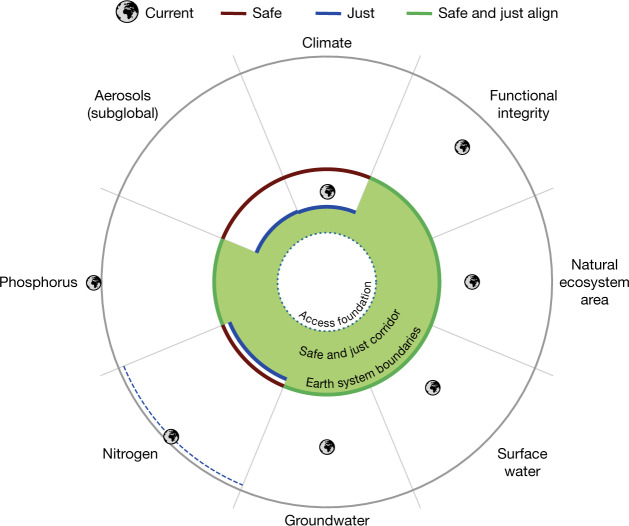
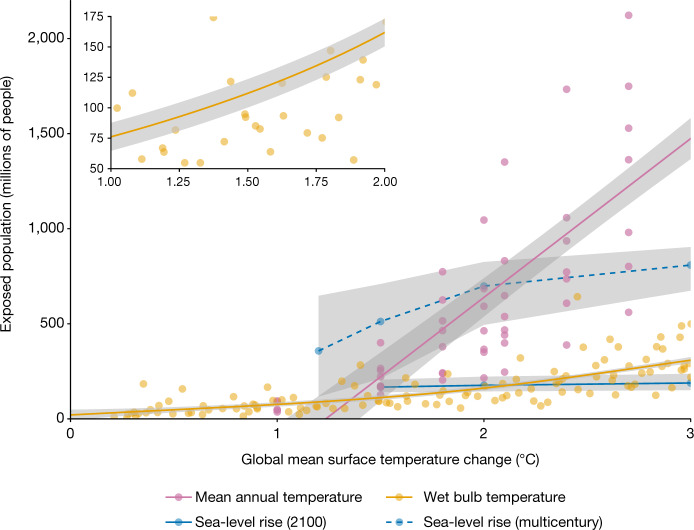
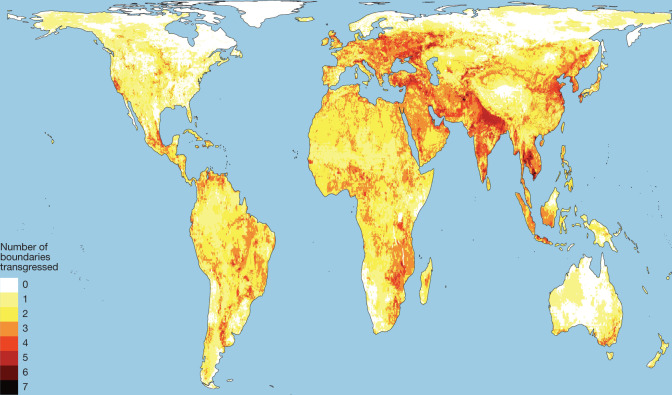
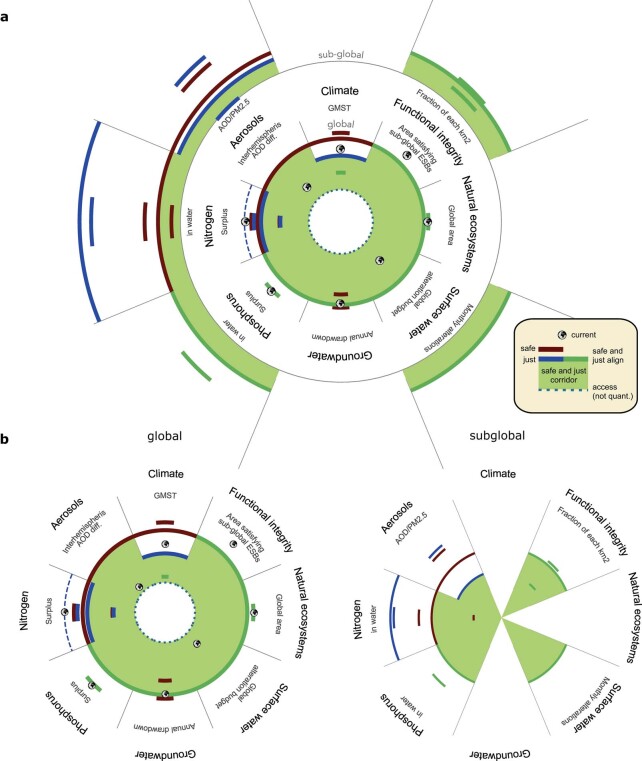
Verification
Claims the paper makes
The claims and statistics of this paper haven’t been checked yet.
Free: it reads the open-access text and checks the first 5 claims that cite a source we can check. Create a free account to check every claim.
Claims other papers make about this one
Each is checked against this paper’s own text: does it say what the citing paper says it does?
In the citing paper
“The accelerating socioeconomic trends of the past century [232] have put us on a path toward exceeding seven of eight globally defined safe and just Earth system boundaries that would provide safe living conditions for all humanity within the boundaries of the living systems on Earth [219].”
From Sustainability in computing education: A systematic literature review (2024) · cites this paper as [219]
Self-check
Percentages, sums and reported differences re-computed from the paper’s own numbers.
The self-check needs the paper’s full text.
Citations
Cites
A safe operating space for humanity
Rockström, J., Steffen, W., Noone, K., Persson, Å., Chapin, F. S., Lambin, E. F., Lenton, T. M., Scheffer, M., Folke, C., Schellnhuber, H. J., et al. (2009) · Nature · doi:10.1038/461472a · Cited by 13,333
Self-citationPlanetary boundaries: Guiding human development on a changing planet
Steffen, W., Richardson, K., Rockström, J., Cornell, S. E., Fetzer, I., Bennett, E. M., Biggs, R., Carpenter, S. R., de Vries, W., de Wit, C. A., et al. (2015) · Science · doi:10.1126/science.1259855 · Cited by 12,527 · cited 6×
“We note that the area of largely natural ecosystems replaces the “land boundary” in the planetary boundaries concept, which implied “largely intact lands” or areas of high biodiversity intactness (Steffen et al. 2015).”
InfluentialSelf-citationCohen, A. J., Brauer, M., Burnett, R., Anderson, H. R., Frostad, J., Estep, K., Balakrishnan, K., Brunekreef, B., Dandona, L., Dandona, R., et al. (2017) · The Lancet · doi:10.1016/s0140-6736(17)30505-6 · Cited by 6,583
Poff, N. L., Allan, J. D., Bain, M. B., Karr, J. R., Prestegaard, K. L., Richter, B. D., Sparks, R. E., & Stromberg, J. C. (1997) · BioScience · doi:10.2307/1313099 · Cited by 6,500
Four billion people facing severe water scarcity
Mekonnen, M. M., & Hoekstra, A. Y. (2016) · Science Advances · doi:10.1126/sciadv.1500323 · Cited by 5,531
Tipping elements in the Earth’s climate system
Lenton, T. M., Held, H., Kriegler, E., Hall, J. W., Lucht, W., Rahmstorf, S., & Schellnhuber, H. J. (2008) · Proceedings of the National Academy of Sciences · doi:10.1073/pnas.0705414105 · Cited by 3,982 · cited 1×
“Tipping elements: Those components or processes that regulate the functioning and state of the planet and that show evidence of having thresholds at which small additional perturbations can trigger selfreinforcing changes that undermine Earth system resilience (Lenton et al. 2008; Armstrong McKay et al. 2022).”
Self-citationEmerging threats and persistent conservation challenges for freshwater biodiversity
Reid, A. J., Carlson, A. K., Creed, I. F., Eliason, E. J., Gell, P. A., Johnson, P. T. J., Kidd, K. A., MacCormack, T. J., Olden, J. D., Ormerod, S. J., et al. (2019) · Biological Reviews · doi:10.1111/brv.12480 · Cited by 3,645
Options for keeping the food system within environmental limits
Springmann, M., Clark, M., Mason-D’Croz, D., Wiebe, K., Bodirsky, B. L., Lassaletta, L., de Vries, W., Vermeulen, S. J., Herrero, M., Carlson, K. M., et al. (2018) · Nature · doi:10.1038/s41586-018-0594-0 · Cited by 3,380
Self-citationBasic Principles and Ecological Consequences of Altered Flow Regimes for Aquatic Biodiversity
BUNN, S. E., & ARTHINGTON, A. H. (2002) · Environmental Management · doi:10.1007/s00267-002-2737-0 · Cited by 3,379
Self-citationIPBES (2019) · Socio-Environmental Systems Modeling · doi:10.5281/zenodo.3831673 · Cited by 3,354
Research works printed but not linked: 15
- IPCC Climate Change 2022: Impacts, Adaptation, and Vulnerability (eds Pörtner, H.-O. et al.) (Cambridge Univ. Press, 2022).
- IPCC Climate Change 2021: The Physical Science Basis (eds Masson-Delmotte, V. et al.) (Cambridge Univ. Press, 2021).
- O’Neill, B. et al. in Climate Change 2022: Impacts, Adaptation, and Vulnerability (eds Pörtner, H.-O. et al.) 2411–2538 (Cambridge Univ. Press, 2022).
- Parmesan, C. et al. in Climate Change 2022: Impacts, Adaptation, and Vulnerability (eds Pörtner, H.-O. et al.) 197–377 (Cambridge Univ. Press, 2022).
- WHO Guidelines for Drinking-water Quality 4th edn (World Health Organization, 2022); https://www.who.int/publications/i/item/9789240045064. 35417116
- Tirado, R. & Allsopp, M. Phosphorus in Agriculture: Problems and Solutions. Technical report (review) (Greenpeace, 2012); https://www.greenpeace.to/greenpeace/wp-content/uploads/2012/06/tirado-and-allsopp-2012-phosphorus-in-agriculture-technical-report-02-2012.pdf.
- Douville, H. et al. in Climate Change 2021: The Physical Science Basis (eds Masson-Delmotte, V. et al.) 1055–1210 (Cambridge Univ. Press, 2021).
- WHO Global Air Quality Guidelines: Particulate Matter (PM2.5and PM10), Ozone, Nitrogen Dioxide, Sulfur Dioxide and Carbon Monoxide (WHO, 2021); https://apps.who.int/iris/handle/10665/345329. 34662007
- EPA. Review of the national ambient air quality standards for particulate matter. Environmental Protection Agency. 40 CFR Part 50. Fed. Regis. Rules Regul. 85, 82684–82748 (2020).
- Biggs, R. et al. in Encyclopedia of Theoretical Ecology (eds Hastings, A. & Gross, L.) 609–617 (Univ. of California Press, 2012).
- Owusu, K. A., Kulesz, M. M. & Merico, A. Extraction behaviour and income inequalities resulting from a common pool resource exploitation. Sustain. Sci. Pract. Policy 11, 536 (2019).
- IPCC Climate Change 2022: Impacts, Adaptation, and Vulnerability (eds Pörtner, H.-O. et al.) (Cambridge Univ. Press, 2022).
- Fox-Kemper, B. et al. in Climate Change 2021: The Physical Science Basis (eds Masson-Delmotte, V. et al.) 1211–1362 (Cambridge Univ. Press, 2021).
- Shaw, R. et al. in Climate Change 2022: Impacts, Adaptation, and Vulnerability (eds Pörtner, H.-O. et al.) 1457–1579 (Cambridge Univ. Press, 2022).
- Klein Goldewijk, K., Beusen, A., Doelman, J. & Stehfest, E. Anthropogenic land use estimates for the Holocene–HYDE 3.2. Earth Syst. Monit. 9, 927–953 (2017).
Cited by
Items 701–800 of 1,001
Challenges and Initiatives to Operationalize the Planetary Boundaries for Novel Entities
Smit, M., Jeddi, M. Z., Tolls, J., Terry, C., & Fantke, P. (2026) · Environmental Science & Technology · doi:10.1021/acs.est.5c14324 · Cited by 3
Chung, H., & Muntaner, C. (2026) · Health Politics · doi:10.66534/hp.2026.0002 · Cited by 3
Agroforestry and Its Role in Soil Conservation
Bhattacharjee, S., Mandal, I., Jha, P., Mondal, B., & Poddar, A. (2026) · Springer eBooks · doi:10.1007/978-3-032-17991-3_12 · Cited by 3
Gomm, S., Blumer, Y., Czellar, S., Haasova, S., Kühne, S. J., Schubert, R., & Bernauer, T. (2026) · Sustainable Production and Consumption · doi:10.1016/j.spc.2026.04.008 · Cited by 5
Boxall, A. B. A., Amerasinghe, P. A. P., Beckenham, S., Bertram, M. G., Gaw, S., Gray, A., Kidd, K. A., Langan, L. M., Leung, K., Manera, J. L., et al. (2026) · Environmental Science & Technology · doi:10.1021/acs.est.5c13062 · Cited by 3
Forecast on Africa’s power production up to 2030 with related water use and CO2 emissions
Vaca, S., Gerbens-Leenes, P. W., Holmatov, B., Vanham, R., & Vanham, D. (2026) · Nature Communications · doi:10.1038/s41467-026-72692-2 · Cited by 3
“The methodology by Richter is widely used in water management studies 23, 30, 69 – 72 .”
ElSayed, M., Aghahosseini, A., Galimova, T., Khalili, S., Satymov, R., Honkapuro, S., & Breyer, C. (2026) · Cities · doi:10.1016/j.cities.2026.107201 · Cited by 3
da Silva, F. I., Júnior, F. A. B., Fernandes, L. F. S., & Pacheco, F. A. L. (2026) · Water Security · doi:10.1016/j.wasec.2026.100213 · Cited by 3
Rethinking Evaluation Competencies for the Transformational Imperative
Chaplowe, S. G., Morkel, C., de la Garza, T., Buckton, S. J., Ferretti, S., Nandi, R., & Zaveri, S. (2026) · Journal of MultiDisciplinary Evaluation · doi:10.56645/jmde.v22i53.1309 · Cited by 6
Revue historique de la gouvernance mondiale de l'environnement (1945–2022)
Beaudoin, S. (2023) · Canadian Journal of Political Science · doi:10.1017/s0008423923000483 · Cited by 7
“Toutefois, les enjeux environnementaux prennent actuellement des proportions qui pourraient atteindre des points de non-retour (Rockström et al., 2023).”
BackgroundWieck, C., Mensah, K., & Heß, S. (2024) · Wirtschaftsdienst · doi:10.2478/wd-2024-0049 · Cited by 3
Partnerships for the Sustainable Development Goals: a call for more science
Berry, E. M., Burlingame, B., & le Coutre, J. (2024) · Frontiers in Nutrition · doi:10.3389/fnut.2024.1347593 · Cited by 3
Sustainable Frontrunners and Pathfinders—What Can Be Learnt from Their Practices?
Oxenswärdh, A. (2024) · Journal of Sustainability Research · doi:10.20900/jsr20240024 · Cited by 3
La insoportable levedad de la justicia climática en el AR6 del IPCC
Clercq, J. A. L. (2024) · Foro Internacional · doi:10.24201/fi.v64i3.3072 · Cited by 4
(A)mending Architecture Education in the Climate Emergency: a focus on values and cultures
Nisonen, E., Pelsmakers, S., & Kallio, K. P. (2024) · Architectural Research in Finland · doi:10.37457/arf.146880 · Cited by 5
Sue‐Chue‐Lam, C., Yanikomeroglu, S., Hamad, D. M., Wong, B. M., & Born, K. B. (2024) · PLoS ONE · doi:10.1371/journal.pone.0309417 · Cited by 3
Assessment of regenerative hospitality
Kreb, J., & Zwaal, W. (2024) · Research in Hospitality Management · doi:10.1080/22243534.2024.2411978 · Cited by 3
“…in natural settings and a shift in mindset toward eco-consciousness contribute to overall well-being, aligning with the primary goal of a tourism experience as well-being rather than a mere activity or destination (Pollock, 2019; Lindell et al., 2021; Zaman et al., 2022; Rockström et al., 2023).”
Phillips, J. (2024) · Journal of Environmental Management · doi:10.1016/j.jenvman.2024.123520 · Cited by 3
Vea, E. B., Richardson, K., Bjørn, A., & Hauschild, M. Z. (2025) · Environmental Research Letters · doi:10.1088/1748-9326/adaa8e · Cited by 3
“In agricultural areas with environmental boundaries allowing much higher nitrogen inputs than what is sensible from an agronomic perspective, Rockström et al (2023) adjusted SOS to avoid unrealistically high values.”
InfluentialAsakereh, H., & Jahedi, A. (2025) · Acta Geophysica · doi:10.1007/s11600-024-01525-x · Cited by 4
“6 and 7, respectively) resembled the variability of teleconnection patterns studied by Loubere (2012) and Gan et al. (2023), which have been attributed to the influence of human activities by Zalasiewicz et al. (2017) and Rockström et al. (2023).”
Gleason, T. (2025) · Ecological Economics · doi:10.1016/j.ecolecon.2025.108566 · Cited by 4
Nordrum, O. L., Mobacke, I., Männistö, T. I., Schønemann‐Lund, M., Björnsson, H. M., & Sviland, L. (2025) · Scandinavian Journal of Public Health · doi:10.1177/14034948241302923 · Cited by 3
“We have already exceeded many safe Earth system boundaries [2]—our life-support systems.”
Agroforestry and net-zero in the European agriculture, forestry and land use sector
LAWSON, G., Bertomeu, M., den Herder, M., Kay, S., Deranja, D., Boeck, A. D., & Burgess, P. J. (2025) · Elsevier eBooks · doi:10.1016/b978-0-443-13985-7.00011-7 · Cited by 3
Boons, F., Doménech, T., & Mahanty, S. (2025) · Sustainable Production and Consumption · doi:10.1016/j.spc.2025.04.004 · Cited by 3
A Needs-Based Design Method for Product–Service Systems to Enhance Social Sustainability
Murata, H., & Kobayashi, H. (2025) · Sustainability · doi:10.3390/su17083619 · Cited by 4
Climate emergency declarations by local governments– what comes next?
Bush, J., & Doyon, A. (2025) · npj Climate Action · doi:10.1038/s44168-025-00253-2 · Cited by 3
“A focus on ‘ climate justice ’ and ‘ just transitions 28,45 requires consideration of integrating climate mitigation and adaptation measures that provide wider sustainable development bene fi ts 28 .”
Six footprints to monitor the bioeconomy into a safe and just future
Helander, H., O’Brien, M., Lutz, C., Schaldach, R., Schomberg, A. C., Többen, J., & Bringezu, S. (2025) · Frontiers in Environmental Science · doi:10.3389/fenvs.2025.1563666 · Cited by 3
Self-citationLiu, Y., Zhuo, L., Ji, X., Tian, P., Gao, R., & Wu, P. (2025) · Water Resources Research · doi:10.1029/2024wr037184 · Cited by 3
“It is essential for the terrestrial biosphere and human activities, including food production, livestock breeding, and landscape maintenance (Falkenmark & Rockström, 2004; Rockström et al., 2023; Vanham et al., 2022; Wang‐Erlandsson et al., 2022).”
Qu, S., Gao, J., Wang, L., Zhang, Y., & Huang, F. (2025) · Transactions in Earth Environment and Sustainability · doi:10.1177/2754124x251349303 · Cited by 3
“Thresholds are inherent to the social-ecology system and are typically determined by various key elements located at a safe distance from the planetary boundary (Rockstroem et al., 2023).”
Navarro‐Gambín, P., Bonetti, M., Villa, M., Brunori, G., & Vergamini, D. (2025) · International Journal of the Commons · doi:10.5334/ijc.1458 · Cited by 5
Garnier, J. A., & Billen, G. (2025) · Environmental Research Letters · doi:10.1088/1748-9326/adf97e · Cited by 4
“Today, six of the nine planetary boundaries have been crossed, including biogeochemical flows of phosphorus (P) and nitrogen (N) (Rockström et al 2023).”
Sun, C., Chen, L., Liu, Y., Zheng, W., Hua, Y., & Zhang, Q. (2025) · Plant Stress · doi:10.1016/j.stress.2025.101008 · Cited by 3
de Medeiros, J. M., Dicezare, A. C. W., Bertassini, A. C., Carpinetti, L. C. R., & Zanon, L. G. (2025) · Standards · doi:10.3390/standards5030022 · Cited by 3
Circular bioeconomy: policy and regulatory impacts on livestock production systems
Arsic, M., Gonzalez, E. U., Mendez, J., Rowland, D., & Becquet, P. (2025) · Animal Frontiers · doi:10.1093/af/vfaf025 · Cited by 4
“The planetary boundaries framework is a science-based analysis of the risk that human perturbations will destabilize eco-systems at the planetary scale (Steffen et al., 2015; Rockström et al., 2023).”
Garau, E., de Abreu, G., Pérez‐Ramírez, I., Schütze, N., Farhat, Y. A., Loureiro, J., Moussaoui, H. E., Mahjoub, O., Amami, H. E., Sandri, S., et al. (2025) · Sustainability Science · doi:10.1007/s11625-025-01757-w · Cited by 6
AI-generated contradictions for environmental democracy
Sťahel, R. (2025) · AI & Society · doi:10.1007/s00146-025-02704-0 · Cited by 5
Weiser, A., Wanner, M., Stelzer, F., Lang, D. J., Berger, H., Förster, A., Liedtke, C., Micklitz, H., Niewöhner, J., Parodi, O., et al. (2023) · GAIA - Ecological Perspectives for Science and Society · doi:10.14512/gaia.32.3.13 · Cited by 3
Černík, M., Černý, M., Gažo, P., & Fraňková, E. (2023) · Journal für Entwicklungspolitik · doi:10.20446/jep-2414-3197-39-3-83 · Cited by 3
Managing a low urban emissions world
Lichtman, R. (2024) · npj Climate Action · doi:10.1038/s44168-024-00117-1 · Cited by 4
Cha, S.-K. (2024) · Journal of Daesoon Thought and the Religions of East Asia · doi:10.25050/jdtrea.2024.3.2.13 · Cited by 3
Invertebrate Life in the Anthropocene
Durrant, R. (2024) · Palgrave studies in green criminology. · doi:10.1007/978-3-031-64443-6_3 · Cited by 3
Acevedo, L. I., Pigosso, D. C. A., & McAloone, T. C. (2024) · Circular Economy and Sustainability · doi:10.1007/s43615-024-00399-x · Cited by 6
“These are necessary to maintain the resilience and stability of the Earth system [59, 60].”
Agroecology for the City—Spatialising ES-Based Design in Peri-Urban Contexts
Morris, R., Davis, S. G., Grelet, G., & Gregorini, P. (2024) · Land · doi:10.3390/land13101589 · Cited by 4
Charting the course for the next decade of sustainability research and innovation
Sioen, G. B., McGreevy, S. R., Ungvari‐Martin, J., Attig-Bahar, F., & Juhola, S. K. (2024) · Global Sustainability · doi:10.1017/sus.2024.41 · Cited by 3
“The age of the Anthropocene had led us to surpass planetary and social boundaries and place societies in a position where urgent changes are required (Rockström et al., 2023).”
The human right to a safe climate
Villasante, S., Shannon, L. J., Waddock, S. A., Garibaldi, L. A., Bennett, N. J., Gupta, J., Obura, D. O., Norström, A. V., O’Brien, K. L., Pascual, U., et al. (2025) · Nature Sustainability · doi:10.1038/s41893-025-01700-y · Cited by 3
Self-citationCollaborative energy districts – Urban workshops for proximity energy
Crippa, D., Prete, B. D., Fagnoni, R., & Leonardi, C. (2024) · Agathón · doi:10.19229/2464-9309/15242024 · Cited by 3
Global environmental footprint of food
Weinzettel, J., & Wood, R. A. (2023) · Nature Food · doi:10.1038/s43016-023-00801-1 · Cited by 3
Russia’s withdrawal from the Ukraine grain deal is weaponising hunger
Lang, T., & McKee, M. (2023) · BMJ · doi:10.1136/bmj.p1815 · Cited by 3
Applying E/hf systems thinking to complex global problems
Thatcher, A., Yeow, P. H. P., Sigahi, T. F. A. C., & Salmon, P. M. (2024) · Ergonomics · doi:10.1080/00140139.2024.2336366 · Cited by 3
“…these macro-systems perspectives. this is especially concerning given that the last two decades have seen a significant deterioration in the health and wellbeing of global systems and emerging evidence that several planetary boundaries may already have been breached (rockström et al. 2023).”
BackgroundEntry points for accelerating transitions towards a more sustainable futurePreprint
Moallemi, E. A., Miller, M., Szetey, K., Chakori, S., Palmer, J., Battaglia, M., Bryan, B. A., Gao, L., Hall, A., Leith, P., et al. (2024) · EarthArXiv (California Digital Library) · doi:10.31223/x5c68x · Cited by 3
Safe and Just Earth System Boundaries for Novel Entities
Diamond, M. L., & Wang, Z. (2024) · Environmental Science & Technology Letters · doi:10.1021/acs.estlett.4c00517 · Cited by 3
Giannetti, B. F., Lombardi, G. V., de Koch, I., Colivicchi, I., Agostinho, F., & Almeida, C. M. V. B. (2024) · Journal of Cleaner Production · doi:10.1016/j.jclepro.2024.144535 · Cited by 3
Naydani, C. J., Jessiman, L. J., & Jarvis, S. (2025) · doi:10.1079/cabionehealth.2025.0011 · Cited by 4
Leveraging positive tipping points in the race to net zero
OECD (2025) · OECD Net Zero+ Policy Papers · doi:10.1787/50b737f8-en · Cited by 6
Eco-Anxiety and Ecological Citizenship
Bourban, M. (2026) · doi:10.1007/978-3-032-03219-5 · Cited by 2
It Is Not What We Eat, It's How We Produce It
Martínez‐Valderrama, J. (2024) · Agricultural & Rural Studies · doi:10.59978/ar02010006 · Cited by 2
de Paz, J. M., Ramos, C. A., & Visconti, F. (2024) · Journal of Environmental Management · doi:10.1016/j.jenvman.2024.121746 · Cited by 3
Zou, T., Davidson, E. A., Sabo, R. D., MacDonald, G. K., & Zhang, X. (2024) · Environmental Research Letters · doi:10.1088/1748-9326/ad786c · Cited by 2
Self-citationHilf, J. (2025) · Springer eBooks · doi:10.1007/978-3-031-25960-9_113-1 · Cited by 2
Flaherty, D., Hoefnagel, I., Hogervorst, P. A. M., & Klaassen, P. (2025) · Sustainability & Circularity NOW · doi:10.1055/a-2540-9377 · Cited by 2
“…when designing technologies for CE or formulating criteria to evaluate the circularity of technology, it is important to simultaneously consider the values of safety (for human health and the environment), and greater environmental and planetary sustainability , as Rockström et al. describe [35].”
Prevention Through Design Approach For Geotechnical Design Hazard Risk Reduction
Ismail, H. B., Sarbini, N. N., Yunus, N. Z. M., Kidam, K., Ariffin, H. L. T., & Mohd, N. I. (2025) · Civil And Environmental Engineering Reports · doi:10.59440/ceer/202705 · Cited by 2
Naudé, W. A. (2025) · Springer eBooks · doi:10.1007/978-3-031-82299-5_2 · Cited by 2
Groundwater urgencies: what can geography offer?
Frick-Trzebitzky, F., Luetkemeier, R., Dountcheva, I., Sanz, D., Hodžić, D., Kuhn, D., Srivastwa, A. K., Walter, C., Söller, L., & Kramer, J. (2025) · Geographica Helvetica · doi:10.5194/gh-80-135-2025 · Cited by 2
“…boundaries in human–water relations extend beyond aquifers (York et al., 2019; Luetkemeier et al., 2021), and the notion of planetary boundaries (Rockström et al., 2023) adds urgency to managing groundwater for (global) water security and resilience in human–groundwater relations…”
Small habitats as sources of food for pollinators and frugivores in fragmented landscapes
Lindgren, J., Kimberley, A., Eriksson, O., & Cousins, S. A. O. (2025) · Landscape Ecology · doi:10.1007/s10980-025-02119-8 · Cited by 2
Castro, I. B., Ferreira-Sousa, L., de Mello, T. D. R. B., Martins, A., & Bustamante, M. (2025) · Oecologia · doi:10.1007/s00442-025-05747-8 · Cited by 2
“Those shifts are said to be beyond the “safe operating space” of planetary boundaries (Richardson et al. 2023; Rockström et al. 2023), and affect native plant communities in different vegetation types.”
Miswar, S. H. (2025) · Khwopa Journal · doi:10.3126/kjour.v7i1.80151 · Cited by 2
A critical approach to social media, food and well-being
Fernandes, A. (2025) · International Journal of Spa and Wellness · doi:10.1080/24721735.2025.2527531 · Cited by 3
“Regarding contextual conditions, given that food production and human well-being depend on a sustainable environment, ecological factors are essential for the well-being of both humans and animals (Echeverria et al., 2022; Jahanger et al., 2022; Rockstroem et al., 2023).”
Moore, E. R. H., Burke, M., Biehl, E., & Neff, R. (2025) · Frontiers in Sustainable Food Systems · doi:10.3389/fsufs.2025.1563045 · Cited by 2
Li, K., & Goslee, S. (2025) · Landscape Ecology · doi:10.1007/s10980-025-02185-y · Cited by 3
“…within an ecologically sustainable and socially just operating space in global biophysical systems is a critical goal for humanity (Raworth 2017; Rockström et al. 2023), as many ecosystem services are declining globally due to losses in biodiversity and thus ecosystem functioning (Brauman et…”
A putative research model for sustainable fisheries driven by noninvasive diagnostic imaging
Miyamoto, H., Ito, S., Suzuki, K., Tamachi, S., Yamada, S., Nagatsuka, T., Satoh, T., Udagawa, M., Miyamoto, H., Ohno, H., et al. (2025) · The Innovation Life · doi:10.59717/j.xinn-life.2025.100155 · Cited by 3
Life cycle assessment of organic chocolate production in Peru
Vázquez‐Rowe, I., Mogrovejo, P., Muñoz-Sovero, E., Socorro, P. G., Murga, J., Madhanaroopan, S., Fotovat, S., Stanley, T., Bartl, K., & Quispe, I. (2025) · Cleaner Environmental Systems · doi:10.1016/j.cesys.2025.100322 · Cited by 2
Biodiversity under pressure: In search of sustainable planning strategies
Groven, K., Auestad, I., Moberg, K. R., & Hamre, L. N. (2025) · People and Nature · doi:10.1002/pan3.70132 · Cited by 2
Do Peri-Urban Areas Act as Refuges for the European Rabbit (Oryctolagus cuniculus L.)?
Cabrera, A., Mata, C., & Malo, J. E. (2025) · Animals · doi:10.3390/ani15182719 · Cited by 2
Cuadra, C. B., Tsunoda, E. K., Björneland, C., Dabaieh, M., Persson, S., Berseus, J., & Nordqvist, J. (2025) · Sustainability Science Practice and Policy · doi:10.1080/15487733.2025.2548659 · Cited by 2
“Nevertheless, cities, as local authorities, have a central role as agents in climate transition (Acuto 2010; Rockström et al. 2023), due to their regulatory and democratic functions, which are linked to the legitimacy of formal decisions and their implementation (Kronsell and Mukhtar-Landgren 2018).”
Xie, Y., Sun, Y., Chen, Y., Sun, S., Qian, X., & Dong, L. (2025) · Land Use Policy · doi:10.1016/j.landusepol.2025.107772 · Cited by 2
Man-made Cellulosic Textile Fibres: Circular Bioeconomy To Reduce Impacts or Increase Supply?
Durán-Rubí, E., & Deza, X. V. (2025) · Circular Economy and Sustainability · doi:10.1007/s43615-025-00695-0 · Cited by 2
Is There Commonality in Global Sustainability From Different Environment‐Human Perspectives?
Phillips, J. (2025) · Sustainable Development · doi:10.1002/sd.70357 · Cited by 2
Jordá-Faus, P., Vidal‐Iglesias, F. J., Feliu, J. M., Herrero, E., & Arán‐Ais, R. M. (2025) · Electrochimica Acta · doi:10.1016/j.electacta.2025.147701 · Cited by 2
Carlile, R., Darmon, I., & Blair, K. (2025) · Review of Agricultural Food and Environmental Studies · doi:10.1007/s41130-025-00246-z · Cited by 2
Yong, X., Wang, C., Zheng, Y. H., Ding, X., Yan, S., Zhang, X., Huang, X., & Zhou, J. (2025) · Journal of environmental chemical engineering · doi:10.1016/j.jece.2025.120572 · Cited by 2
Self-citationOperational definitions of justice produce different outcomes in urban heat resilience projects
Pakizeh, A. H., Naderpajouh, N., & Johnson, D. R. (2025) · Cities · doi:10.1016/j.cities.2025.106715 · Cited by 3
Beyond Abiotic Decay: Fiddler Crabs Accelerate Plastic Fragmentation in Pollution Hotspots
Riascos, J. M., Díaz, D., Restrepo, L., & Galloway, T. S. (2025) · Global Change Biology · doi:10.1111/gcb.70651 · Cited by 2
“The human-mediated production, accumulation, and transformation of “novel entities”—new substances or forms of existing substances, and modified life forms (Rockström et al. 2023)—is one of these planetary boundaries.”
Zhang, X., Zhang, Y., Lv, J., & Zhipeng, S. (2025) · Environmental Technology & Innovation · doi:10.1016/j.eti.2025.104512 · Cited by 2
Self-citationTorres, C., Valero, A., Valero, A., & Naredo, J. M. (2025) · Ecological Economics · doi:10.1016/j.ecolecon.2025.108817 · Cited by 2
Dealing with Peace in Times of Planetary Emergencies
Krohn, J. (2025) · Unipub UB Graz (Universität Graz) · doi:10.25364/17.8:2025.2.7 · Cited by 2
Wet-Bulb Temperature from Pressure, Relative Humidity, and Air Temperature
Romps, D. M. (2025) · Journal of Applied Meteorology and Climatology · doi:10.1175/jamc-d-25-0130.1 · Cited by 2
Breeze, D., Scarselli, N., Hampson, G. J., & Chiarella, D. (2025) · Journal of the Geological Society · doi:10.1144/jgs2025-099 · Cited by 2
Improving the assessment of eco-oriented development management of agricultural enterprises
Palenychak, O. (2025) · Balanced nature using · doi:10.33730/2310-4678.4.2025.346180 · Cited by 2
Ecosystem Services of Mediterranean Lakes: Management Implications
Kagalou, I., & Latinopoulos, D. (2025) · Springer eBooks · doi:10.1007/978-3-032-02168-7_9 · Cited by 2
Sagvosdkin, V., Bäuerle, L., Semb, J., & Praetorius, B. (2026) · Energy Research & Social Science · doi:10.1016/j.erss.2025.104527 · Cited by 2
Water justice: evolving perspectives and dilemmas
Bosch, H., Gupta, J., van Vliet, L., & Müller, A. B. (2026) · International Journal of Water Resources Development · doi:10.1080/07900627.2025.2597823 · Cited by 4
“…for freshwater (i.e., monthly surface water fluctuation should not exceed 20%; groundwater extraction should be less than the recharge rate) have already been crossed in many parts of the world (Rockström et al., 2023), affecting water flows, downstream regions and the nature that depends on it.”
Self-citationSustainability and Other Global Existential Risks
Bellos, E. (2026) · Springer eBooks · doi:10.1007/978-3-032-11244-6_4 · Cited by 2
Serra, J., Marinheiro, J., Marques-dos-Santos, C. S. C., Graversgaard, M., Quemada, M., Lassaletta, L., Ros, G. H., Kurina, F. G., VRIES, W. D., Aguilera, E., et al. (2026) · Environmental Science & Policy · doi:10.1016/j.envsci.2026.104312 · Cited by 2
Ruddat, M., Sonnberger, M., & Kropp, C. (2026) · Nature-Based Solutions · doi:10.1016/j.nbsj.2026.100303 · Cited by 2
Friedrich, A., & Ekardt, F. (2026) · Environmental Sciences Europe · doi:10.1186/s12302-025-01315-2 · Cited by 2
Estoque, R. C., Wu, J., & Verburg, P. H. (2026) · Geography and sustainability · doi:10.1016/j.geosus.2026.100415 · Cited by 5
Self-citationBasu, S., Banerjee, A., Chakraborty, S. L., Chanda, A., & Islam, K. H. (2026) · Wetlands Ecology and Management · doi:10.1007/s11273-026-10112-4 · Cited by 2
“Based on and built upon the PB framework, ESB includes justice considerations (both intergenerational and intragenerational), primarily to emphasise safe and just boundaries rather than just biophysical limits (Gupta et al. 2023).”
Han, Z., Jiao, R., Zhang, Y., & Feng, Y. (2026) · Land · doi:10.3390/land15020318 · Cited by 2
Asymmetry of safeguarding regional air and water nitrogen boundaries in China
Zou, Y., Zhang, X., Xu, X., Wu, J., Cheng, L., Xu, X., Deng, O., Chen, Y., Wang, C., He, P., et al. (2026) · National Science Review · doi:10.1093/nsr/nwag113 · Cited by 3
“Taken together, these co-benefits demonstrate that the CSM plays an essential role in maintaining the resilience and stability of the Earth system while safeguarding multiple planetary boundaries [13 ,38 ].”
InfluentialSelf-citationPolicy Coherence in Process and Outcome : Solving Sustainability Goal Conflicts?
Gottenhuber, S. (2026) · Linköping studies in arts and science · doi:10.3384/9789181184907 · Cited by 3
Metadata
- Authors
- Rockström, J., Gupta, J., Qin, D., Lade, S. J., Abrams, J. F., Andersen, L. S., Armstrong McKay, D. I., Bai, X., Bala, G., Bunn, S. E., Ciobanu, D., DeClerck, F., Ebi, K., Gifford, L., Gordon, C., Hasan, S., Kanie, N., Lenton, T. M., Loriani, S., Liverman, D. M., Mohamed, A., Nakicenovic, N., Obura, D., Ospina, D., Prodani, K., Rammelt, C., Sakschewski, B., Scholtens, J., Stewart-Koster, B., Tharammal, T., van Vuuren, D., Verburg, P. H., Winkelmann, R., Zimm, C., Bennett, E. M., Bringezu, S., Broadgate, W., Green, P. A., Huang, L., Jacobson, L., Ndehedehe, C., Pedde, S., Rocha, J., Scheffer, M., Schulte-Uebbing, L., de Vries, W., Xiao, C., Xu, C., Xu, X., Zafra-Calvo, N., & Zhang, X.
- Affiliations
- Stockholm Resilience Centre (SE)
- IHE Delft Institute for Water Education (NL)
- China Meteorological Administration (CN)
- Australian National University (AU)
- University of Exeter (GB)
- Leibniz Association (DE)
- Indian Institute of Science Bangalore (IN)
- Griffith University (AU)
- CGIAR (FR)
- University of Washington (US)
- University of Arizona (US)
- University of Ghana (GH)
- Keio University (JP)
- Universität Hamburg (DE)
- Coastal Oceans Research and Development in the Indian Ocean (KE)
- Future Earth (SE)
- University of Amsterdam (NL)
- Netherlands Environmental Assessment Agency (NL)
- Swiss Federal Institute for Forest, Snow and Landscape Research (CH)
- University of Potsdam (DE)
- International Institute for Applied Systems Analysis (AT)
- McGill University (CA)
- University of Kassel (DE)
- The Graduate Center, CUNY (US)
- Wageningen University & Research (NL)
- Chinese Academy of Sciences (CN)
- Nanjing University (CN)
- University of Maryland Center for Environmental Science (US)
- Corresponding author
- Rockström, Johan
- Lade, Steven J.
- ORCID
- Rockström, Johan
- Gupta, Joyeeta
- Lade, Steven J.
- Abrams, Jesse F.
- Andersen, Lauren S.
- Armstrong McKay, David I.
- Bai, Xuemei
- Bala, Govindasamy
- Bunn, Stuart E.
- Ciobanu, Daniel
- DeClerck, Fabrice
- Ebi, Kristie
- Gifford, Lauren
- Gordon, Christopher
- Hasan, Syezlin
- Kanie, Norichika
- Lenton, Timothy M.
- Loriani, Sina
- Liverman, Diana M.
- Mohamed, Awaz
- Obura, David
- Ospina, Daniel
- Prodani, Klaudia
- Rammelt, Crelis
- Sakschewski, Boris
- Scholtens, Joeri
- Stewart-Koster, Ben
- Tharammal, Thejna
- van Vuuren, Detlef
- Verburg, Peter H.
- Winkelmann, Ricarda
- Zimm, Caroline
- Bennett, Elena M.
- Bringezu, Stefan
- Broadgate, Wendy
- Green, Pamela A.
- Jacobson, Lisa
- Ndehedehe, Christopher
- Pedde, Simona
- Rocha, Juan
- Scheffer, Marten
- Schulte-Uebbing, Lena
- de Vries, Wim
- Xiao, Cunde
- Xu, Chi
- Zafra-Calvo, Noelia
- Zhang, Xin
- Venue
- Nature
- Published
- 2023-05-31
- Volume
- 619
- Issue
- 7968
- Pages
- 102-111
- ISSN
- 0028-0836 (ISSN-L)
- 1476-4687
- PMC
- PMC10322705
- OpenAlex
- W4378905467
- Semantic Scholar
- a8edd13b5e3c32453654f8d778fde8192c874d3e
- Cited by
- 1,400
- References
- 106
- Citations by year
- 2026: 364 · 2025: 452 · 2024: 438 · 2023: 145
- FWCI
- 157.19
- Type
- journal article
- Language
- en
- Open access
- hybrid
- doi.org
- Licence
- cc-by
- creativecommons.org/licenses/by/4.0 (tdm)
- creativecommons.org/licenses/by/4.0 (vor)
- Locations
- Nature (publishedVersion, cc-by)
- PubMed Central (publishedVersion, cc-by)
- PubMed (publishedVersion)
- VU Research Portal (publishedVersion, other-oa)
- ANU Open Research (Australian National University) (submittedVersion, cc-by)
- UA Campus Repository (The University of Arizona) (submittedVersion, cc-by)
- Communities in ADDI (University of the Basque Country) (submittedVersion, cc-by-nc-sa)
- CGSPace A Repository of Agricultural Research Outputs (Consultative Group for International Agricultural Research) (submittedVersion, cc-by)
- DORA WSL (Swiss Federal Institute for Forest, Snow and Landscape Research) (submittedVersion, cc-by)
- Socio-Environmental Systems Modeling (submittedVersion, cc-by)
- Open Research Exeter (University of Exeter) (submittedVersion, cc-by)
- Publication Database PIK (Potsdam Institute for Climate Impact Research (PIK)) (submittedVersion, cc-by)
- IIASA PURE (International Institute of Applied Systems Analysis) (submittedVersion, other-oa)
- Griffith Research Online (submittedVersion, cc-by)
- RePEc: Research Papers in Economics (submittedVersion)
- UvA-DARE (University of Amsterdam) (submittedVersion, cc-by)
- Utrecht University Repository (Utrecht University) (submittedVersion, other-oa)
- Figshare (submittedVersion, cc-by)
- Hispana (submittedVersion, cc-by-nc-sa)
- Greater South Information System
- Funders
- Open Society Foundations
- Gordon and Betty Moore Foundation
- Oak Foundation
- Global Environment Facility
- Australian Government (FT200100381)
- Porticus Foundation
- Svenska Forskningsrådet Formas (2020-00371)
- Vetenskapsrådet (ERC-2016-ADG 743080)
- Stockholms Universitet
- Tiina ja Antti Herlinin säätiö
- Australian Research Council (DE230101327)
- Japan Society for the Promotion of Science (18H03428)
- H2020 European Research Council (101020082)
- Topics
- Physical Sciences › Environmental Science › Global and Planetary Change › Sustainability and Climate Change Governance
- Physical Sciences › Environmental Science › Global and Planetary Change › Earth Systems and Cosmic Evolution
- Physical Sciences › Environmental Science › Global and Planetary Change › Land Use and Ecosystem Services
- Keywords
- planetary boundaries, planetary resilience, justice, climate change, biosphere, water cycle, nutrient cycling, atmospheric aerosols, global commons
- MeSH terms
- Nutrients, Environmental Justice, Aerosols, Climate, Humans, Safety, Water, Earth, Planet, Internationality, Climate Change
About these checks
Registry, retraction, Cites and statistics results are computed, not judged, with one exception: a printed reference that no index lists is read once by a model before it counts as a citation error. Claims are extracted by a model and kept only when their quote appears verbatim in the text; each cited source is then checked, with a model’s help, for whether it says what the claim relies on. Those verdicts can be wrong — read the claim’s quote and the cited source before relying on one.
Statistics and arithmetic are recomputed, not judged.
Confidence bands are shown only for fields calibrated on our annotated test set. None is calibrated yet, so no band is shown.
What counts as a claim ›How we measure confidence ›How we check this ›
Are you an author, or do you see a problem with this page? Request a review
Data sources
Bibliographic data: Semantic Scholar, OpenAlex, Crossref.
Contains information from the Semantic Scholar Academic Graph Datasets, made available under the ODC Attribution License (ODC-BY 1.0).
Semantic Scholar’s data is described in: Kinney, R., et al. (2023). The Semantic Scholar Open Data Platform. arXiv:2301.10140.
