

Algorithm for optimized mRNA design improves stability and immunogenicity
Open accessThe DOI matches its Crossref record; 63 of the 63 references it cites were found in a registry or an index; 45 of the 63 sources its claims cite were checked for support.
Abstract
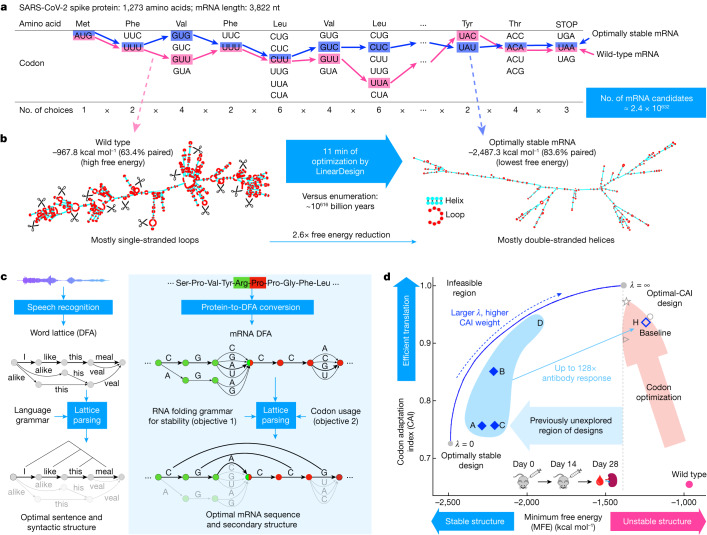
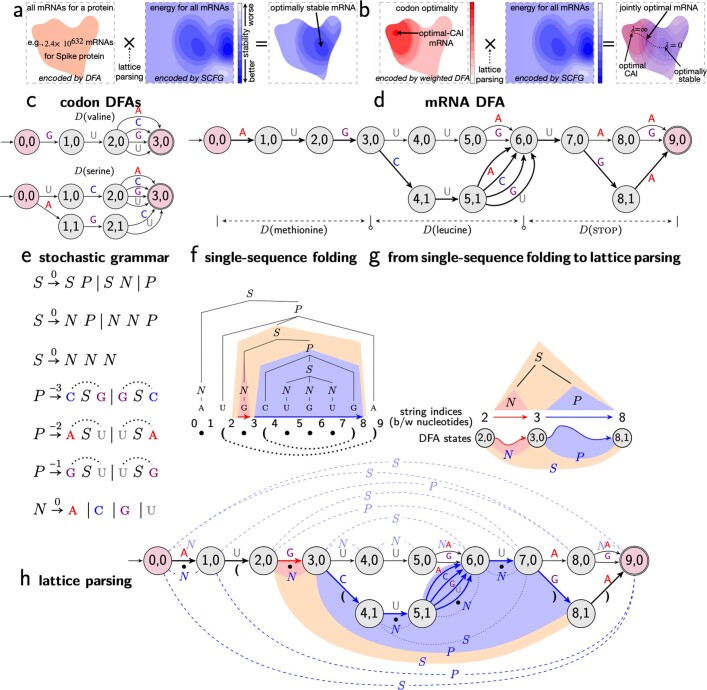
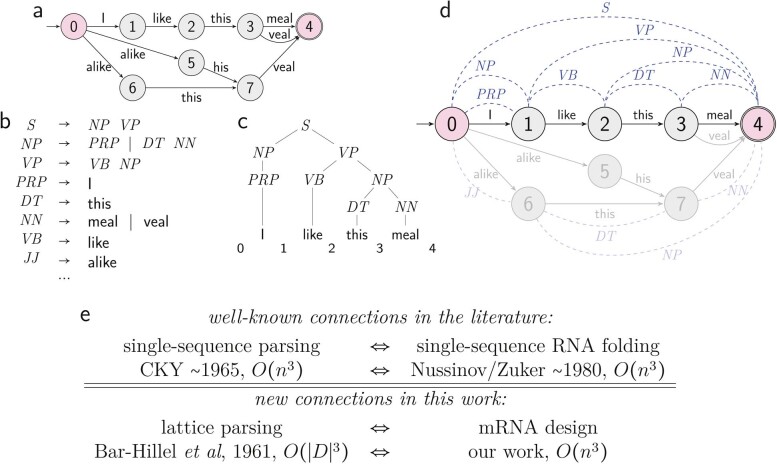
Abstract Messenger RNA (mRNA) vaccines are being used to combat the spread of COVID-19 (refs. 1–3 ), but they still exhibit critical limitations caused by mRNA instability and degradation, which are major obstacles for the storage, distribution and efficacy of the vaccine products 4 . Increasing secondary structure lengthens mRNA half-life, which, together with optimal codons, improves protein expression 5 . Therefore, a principled mRNA design algorithm must optimize both structural stability and codon usage. However, owing to synonymous codons, the mRNA design space is prohibitively large—for example, there are around 2.4 × 10 632 candidate mRNA sequences for the SARS-CoV-2 spike protein. This poses insurmountable computational challenges. Here we provide a simple and unexpected solution using the classical concept of lattice parsing in computational linguistics, where finding the optimal mRNA sequence is analogous to identifying the most likely sentence among similar-sounding alternatives 6 . Our algorithm LinearDesign finds an optimal mRNA design for the spike protein in just 11 minutes, and can concurrently optimize stability and codon usage. LinearDesign substantially improves mRNA half-life and protein expression, and profoundly increases antibody titre by up to 128 times in mice compared to the codon-optimization benchmark on mRNA vaccines for COVID-19 and varicella-zoster virus. This result reveals the great potential of principled mRNA design and enables the exploration of previously unreachable but highly stable and efficient designs. Our work is a timely tool for vaccines and other mRNA-based medicines encoding therapeutic proteins such as monoclonal antibodies and anti-cancer drugs 7,8 .
Overview
CoChat Summary
TL;DR
LinearDesign is a lattice-parsing-based algorithm for mRNA design that jointly optimizes folding stability and codon usage. In experiments on SARS-CoV-2 spike and VZV gE mRNAs, LinearDesign improved in vitro stability, protein expression, and in vivo immunogenicity versus codon-optimization benchmarks, with up to 128× higher antibody responses in mice.
Key findings
- The paper states that the SARS-CoV-2 spike protein has about 2.4 × 10^632 possible mRNA sequences, making brute-force enumeration infeasible; LinearDesign found an optimal spike mRNA in 11 min.
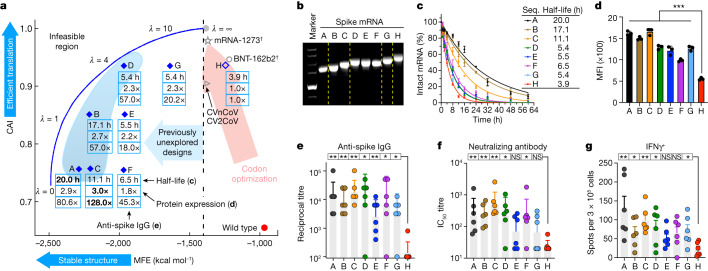
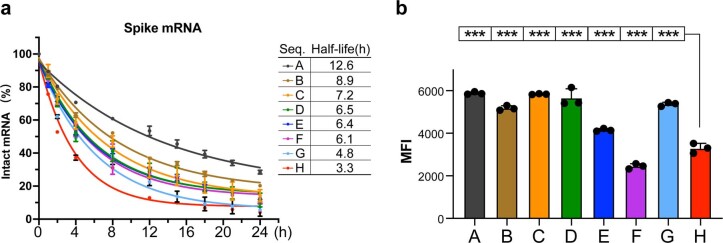
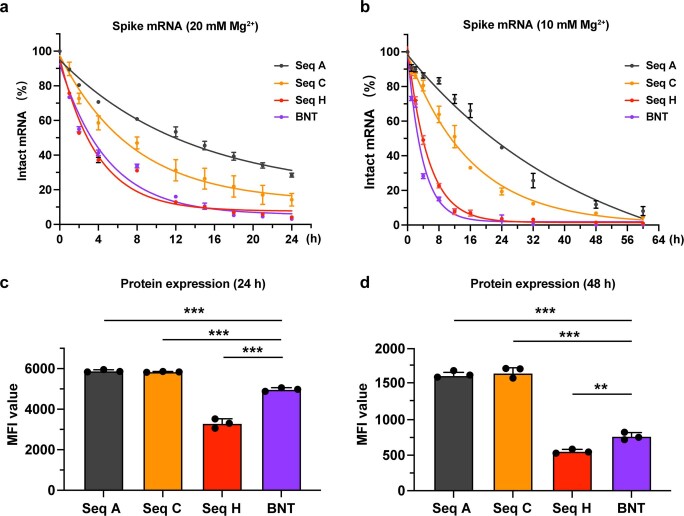
- On SARS-CoV-2 spike mRNAs, the best LinearDesign sequences showed substantially better stability than the benchmark: sequence A had a T1/2 of 20.0 h in 10 mM Mg2+ and 12.6 h in 20 mM Mg2+, versus sequence H at 3.9 h and 3.3 h.
- In HEK293 cells, all seven LinearDesign spike mRNAs (A–G) produced higher spike protein levels than benchmark H; sequence D and G were 2.3-fold higher than H, and sequence A was 2.9-fold higher.
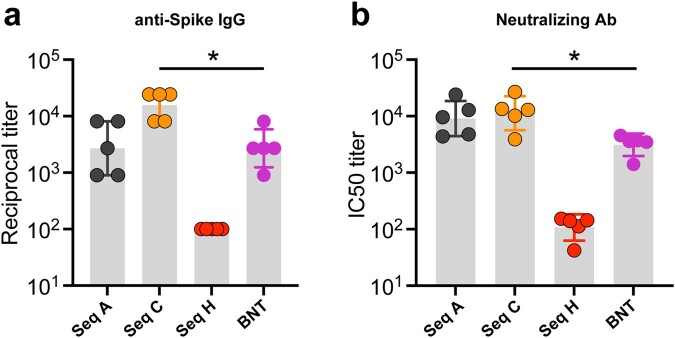
- In mice, LinearDesign spike mRNAs elicited much stronger immune responses: sequences A–D gave a 57 to 128× increase in anti-spike IgG titres and a 9 to 20× increase in neutralizing antibody titres over H.
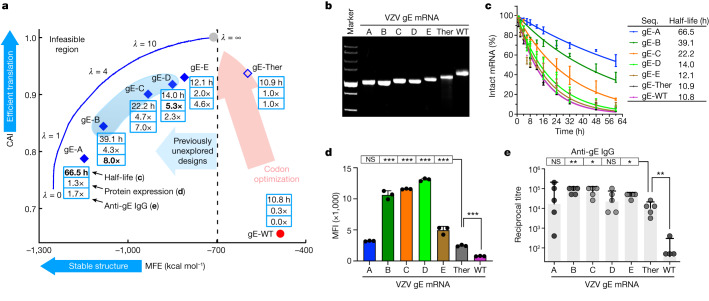
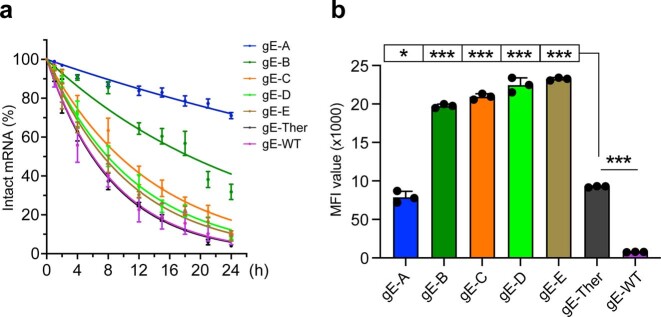
- For VZV gE, LinearDesign mRNAs also improved stability and expression; for example, gE-A had T1/2 = 66.5 h in 10 mM Mg2+ and 50.7 h in 20 mM Mg2+, compared with gE-Ther at 10.9 h and 5.9 h.
Methods
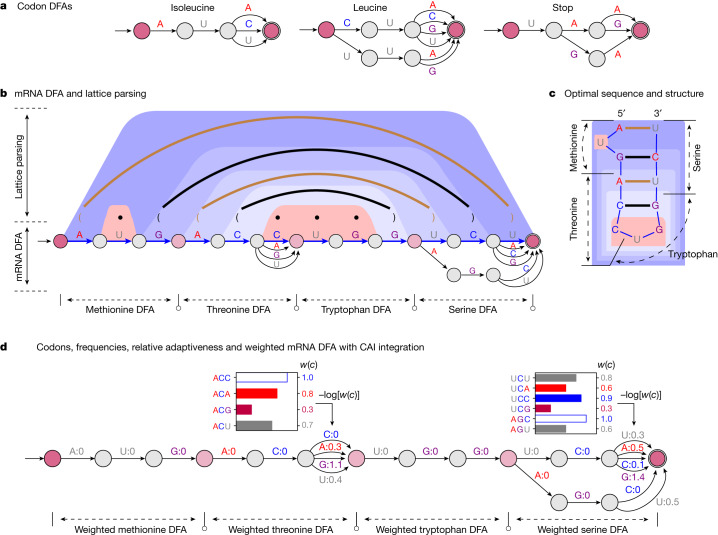
- The authors formulated mRNA design as a joint optimization problem over folding stability (MFE) and codon adaptation index (CAI), then solved it using deterministic finite automata (DFA) plus lattice parsing / weighted intersection with a stochastic context-free grammar.
- They benchmarked runtime on 114 human protein sequences from UniProt, with lengths from 78 to 3,333 amino acids, and also evaluated SARS-CoV-2 spike and VZV gE design cases.
- Experimental validation used in vitro mRNA stability assays, HEK293 protein expression assays, and in vivo immunogenicity studies in C57BL/6 mice given two intramuscular doses of 10 µg LPP-formulated mRNA at a 2-week interval.
Limitations
- The paper states that the work considered only the coding region; UTR optimization was not addressed directly.
- It also states that chemical modification was not used in the designed mRNAs, even though this is widely used in mRNA vaccines.
- Evident from the text: the in vivo experiments were not randomized, the investigators were not blinded, and the animal experiments were completed once, which limits robustness of the experimental evidence.
Model-written summary. Check it against the paper before relying on it.
Integrity signals
Registry
Cites
Statistics
Figures
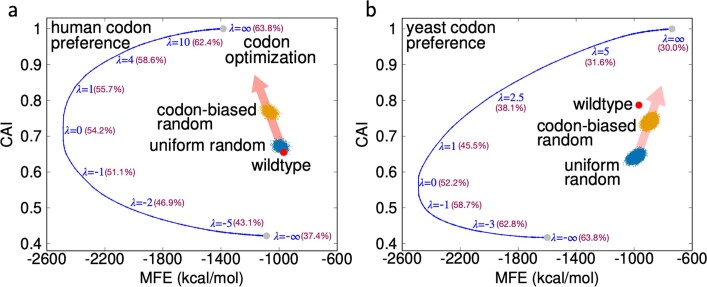
![Fig. 3 Computational characteristics of the LinearDesign algorithm. a, Runtime analysis of mRNA design for proteins in UniProt (Supplementary Table 1). Overall, our exact search scales quadratically with sequence length (Supplementary Figs. 7 and 8), and our MFE + CAI mode (with λ = 4) is about 15% slower than the MFE-only version. Moreover, beam search (b = 500) significantly speeds up the design of long sequences, with minor search errors (Supplementary Fig. 9). b,c, Two-dimensional (MFE–CAI) visualizations of designs for the SARS-CoV-2 spike (b) and VZV gE (c) proteins, respectively (both using human codon preference). The blue curves form the feasibility limit (optimal boundary), by varying λ from 0 to ∞ (see Extended Data Fig. 4 for λ of (–∞, 0]). The GC percentage is shown in parentheses. The human genome favours GC-rich codons; therefore, codon optimization (pink arrows) also improves stability, but only marginally, as the two optimization directions (codon versus stability) are largely orthogonal. By contrast, with an AU-rich codon preference (such as in yeast), codon optimization decreases stability (Extended Data Fig. 4b). d, Secondary structures of the mRNA designs for SARS-CoV-2 spike and VZV gE protein. The optimal-CAI designs (top, λ = ∞) are largely single-stranded (around 60% base-paired), whereas the optimally stable designs (bottom, λ = 0) are mostly double-stranded (around 80% base-paired). We also show intermediate designs (centre, λ = 4) with a balance of stability and CAI.](https://figures.cochat.ai/paper-figures/7f3b742293c6471081bcef7e5469da5b/algorithm-for-optimized-mrna-design-improves-stability-and-immunogenicity-figure-3.jpg)
Verification
Claims the paper makes
35 Valid · 2 Not valid · 9 Not checked · 111 Own results and interpretations
The cited sources support only part of this claim — read each source’s verdict below.
In the paper
“Messenger RNA (mRNA) vaccines are being used to combat the spread of COVID-19 (refs. 1–3), but they still exhibit critical limitations caused by mRNA instability and degradation”
§ Algorithm for optimized mRNA design improves stability and immunogenicity > Abstract
What the sources say
- Not matchedcites refs. 1–3
This doesn’t read as a citation we can look up.
- Supportedcites [4] Crommelin DJ Anchordoquy TJ Volkin DB Jiskoot W Mastrobattista E Addressing the cold reality of mRNA vaccine stability J. Pharm. Sci. 2021 110 997 1001 10.1016/j.xphs.2020.12.006 33321139 PMC7834447 source
The Historical Perspective section says that even minor mRNA degradation can severely impair translation and antigen expression. The Stability Data section describes storage stability as a critical limitation on large-scale mRNA vaccine deployment. No page numbers were supplied for these passages. (LLM, conf=0.93)
plainstates a cause- Asserted: passes — The authors put it forward as true.
- Checkable: passes — It can be checked against evidence.
- Load-bearing: passes — The paper’s conclusions depend on it.
- Based: passes — The paper gives a reason why it holds.
- Not matched
Every source the paper cites for this claim was checked and supports it.
In the paper
“which are major obstacles for the storage, distribution and efficacy of the vaccine products4”
§ Algorithm for optimized mRNA design improves stability and immunogenicity > Abstract
What the sources say
- Supportedcites [4] Crommelin DJ Anchordoquy TJ Volkin DB Jiskoot W Mastrobattista E Addressing the cold reality of mRNA vaccine stability J. Pharm. Sci. 2021 110 997 1001 10.1016/j.xphs.2020.12.006 33321139 PMC7834447 source
The Historical Perspective section says that even minor mRNA degradation can impair translation and antigen expression, affecting vaccine potency. The Abstract and Concluding Considerations identify formulation stability as a challenge for storage, transport and worldwide distribution. (LLM, conf=0.92)
plainstates a cause- Asserted: passes — The authors put it forward as true.
- Checkable: passes — It can be checked against evidence.
- Load-bearing: passes — The paper’s conclusions depend on it.
- Based: passes — The paper gives a reason why it holds.
- Supported
The cited sources support only part of this claim — read each source’s verdict below.
In the paper
“Increasing secondary structure lengthens mRNA half-life, which, together with optimal codons, improves protein expression5.”
§ Algorithm for optimized mRNA design improves stability and immunogenicity > Abstract
What the sources say
- Partly supportedcites [5] Mauger DM mRNA structure regulates protein expression through changes in functional half-life Proc. Natl Acad. Sci. USA 2019 116 24075 24083 10.1073/pnas.1908052116 31712433 PMC6883848 sourceExperimental — accuracy not yet measured
The Results section reports that highly structured mRNAs had more than twice the *functional* half-life of mRNAs with middling structure, independent of codon optimality, and the Abstract reports that codon optimality and greater CDS structure synergize to increase it. The Results also distinguish functional half-life—the time an mRNA productively generates protein—from physical half-life ending in degradation. The claim omits that distinction and the finding's position-dependent qualification: reduced structure in the 5′ leader correlated with higher expression. (LLM, conf=0.85)
plainstates a cause- Asserted: passes — The authors put it forward as true.
- Checkable: passes — It can be checked against evidence.
- Load-bearing: passes — The paper’s conclusions depend on it.
- Based: passes — The paper gives a reason why it holds.
- Partly supported
Every source the paper cites for this claim was checked and supports it.
In the paper
“Improving this structural stability, combined with optimal codon usage, leads to increased protein expression5.”
§ Algorithm for optimized mRNA design improves stability and immunogenicity > Main
What the sources say
- Supportedcites [5] Mauger DM mRNA structure regulates protein expression through changes in functional half-life Proc. Natl Acad. Sci. USA 2019 116 24075 24083 10.1073/pnas.1908052116 31712433 PMC6883848 source
The Results section, “Codon Usage and mRNA Structure Synergize to Determine Ribosome Loading and mRNA Half-Life,” reports that increasing either codon optimality or secondary structure increased median protein expression when the other was held constant. The paper specifies that greater structure is beneficial in the coding region beyond the 5′ leader; the highest-codon-optimality, most-structured group showed no further increase over the improved groups. (LLM, conf=0.90)
plainstates a cause- Asserted: passes — The authors put it forward as true.
- Checkable: passes — It can be checked against evidence.
- Load-bearing: passes — The paper’s conclusions depend on it.
- Based: passes — The paper gives a reason why it holds.
- Supported
The cited sources support only part of this claim — read each source’s verdict below.
In the paper
“However, mRNA molecules are chemically unstable and prone to degrade, which leads to insufficient protein expression5”
§ Algorithm for optimized mRNA design improves stability and immunogenicity > Main
What the sources say
- Partly supportedcites [5] Mauger DM mRNA structure regulates protein expression through changes in functional half-life Proc. Natl Acad. Sci. USA 2019 116 24075 24083 10.1073/pnas.1908052116 31712433 PMC6883848 sourceExperimental — accuracy not yet measured
The Results section (page unavailable) reports that protein output correlated strongly with mRNA functional half-life, supporting a link between shorter productive life and lower expression. But it explicitly says functional half-life is not necessarily physical degradation; the paper does not establish that chemical instability and degradation caused the lower expression. (LLM, conf=0.88)
plainstates a cause- Asserted: passes — The authors put it forward as true.
- Checkable: passes — It can be checked against evidence.
- Load-bearing: passes — The paper’s conclusions depend on it.
- Based: passes — The paper gives a reason why it holds.
- Partly supported
87 more claims · 9 with their cited sources checked
Create a free account to see all 157 claims and to verify the 1 reference still open.
- Probably not a substantial claim. 25
- It may state two separate claims as one. 45
Citations
Cites
Safety and Efficacy of the BNT162b2 mRNA Covid-19 Vaccine
Polack, F. P., Thomas, S. J., Kitchin, N., Absalon, J., Gurtman, A., Lockhart, S., Perez, J. L., Pérez Marc, G., Moreira, E. D., Zerbini, C., et al. (2020) · New England Journal of Medicine · doi:10.1056/nejmoa2034577 · Cited by 14,592
Efficacy and Safety of the mRNA-1273 SARS-CoV-2 Vaccine
Baden, L. R., El Sahly, H. M., Essink, B., Kotloff, K., Frey, S., Novak, R., Diemert, D., Spector, S. A., Rouphael, N., Creech, C. B., et al. (2021) · New England Journal of Medicine · doi:10.1056/nejmoa2035389 · Cited by 10,119
Cryo-EM structure of the 2019-nCoV spike in the prefusion conformation
Wrapp, D., Wang, N., Corbett, K. S., Goldsmith, J. A., Hsieh, C.-L., Abiona, O., Graham, B. S., & McLellan, J. S. (2020) · Science · doi:10.1126/science.abb2507 · Cited by 8,897
UniProt: a hub for protein information
The UniProt Consortium (2015) · Nucleic Acids Research · doi:10.1093/nar/gku989 · Cited by 5,106
Lorenz, R., Bernhart, S. H., Höner zu Siederdissen, C., Tafer, H., Flamm, C., Stadler, P. F., & Hofacker, I. L. (2011) · Algorithms for Molecular Biology · doi:10.1186/1748-7188-6-26 · Cited by 5,098
mRNA vaccines — a new era in vaccinology
Pardi, N., Hogan, M. J., Porter, F. W., & Weissman, D. (2018) · Nature Reviews Drug Discovery · doi:10.1038/nrd.2017.243 · Cited by 4,667
Direct Gene Transfer into Mouse Muscle in Vivo
Wolff, J. A., Malone, R. W., Williams, P., Chong, W., Acsadi, G., Jani, A., & Felgner, P. L. (1990) · Science · doi:10.1126/science.1690918 · Cited by 4,173
Sharp, P. M., & Li, W.-H. (1987) · Nucleic Acids Research · doi:10.1093/nar/15.3.1281 · Cited by 3,992
Mathews, D. H., Sabina, J., Zuker, M., & Turner, D. H. (1999) · Journal of Molecular Biology · doi:10.1006/jmbi.1999.2700 · Cited by 3,795
Self-citationBiological sequence analysis probabilistic models of proteins and nucleic acids
Durbin, R. M., Eddy, S. R., Krogh, A., & Mitchison, G. (1998) · Cited by 3,565
Research works printed but not linked: 4
- Hall, K. B. Best-First Word-Lattice Parsing: Techniques for Integrated Syntactic Language Modeling. PhD thesis, Brown Univ. (2005).
- Nederhof, M. J. & Satta, G. Probabilistic parsing as intersection. In Proc. 8th International Conference on Parsing Technologies 137–148 (2003).
- Huang, L. & Sagae, K. Dynamic programming for linear-time incremental parsing. In Proc. 48th Annual Meeting of the Association for Computational Linguistics 1077–1086 (Association for Computational Linguistics, 2010).
- Huang, L., Fayong, S. & Guo, Y. Structured perceptron with inexact search. In Proc. 2012 Conference of the North American Chapter of the Association for Computational Linguistics: Human Language Technologies 142–151 (Association for Computational Linguistics, 2012).
Cited by
Items 301–400 of 484
mRNA Fragmentation Pattern Detected by SHAPE
Feng, S., Chen, T., Zhang, Y., & Lu, C. (2024) · Current Issues in Molecular Biology · doi:10.3390/cimb46090610 · Cited by 2
“If enough mRNA MPRT-seq data are accumulated, AI-guided optimizations can also be integrated alongside mRNA optimization algorithms [22,25,39–41] to provide a more robust mRNA design protocol.”
BackgroundMethodSelf-citationMachine learning-assisted investigations toward polymer synthesis
Zhang, Z., Cai, Z., Zhang, W., lu, H., & Chen, M. (2024) · Chinese Science Bulletin (Chinese Version) · doi:10.1360/tb-2024-0800 · Cited by 5
AntigenBoost: enhanced mRNA-based antigen expression through rational amino acid substitution
Gao, Y., Zhu, S., Li, H., Hao, X., Chen, W., Pan, D., & Qian, Z. (2024) · Briefings in Bioinformatics · doi:10.1093/bib/bbae468 · Cited by 2
“Advanced bioinformatics tools, such as LinearDesign [10], mRNAid [11], and Codon Box [12], have been developed to mainly focus on optimizing the codon adaptation index (CAI) and the minimum free energy (MFE) of the mRNA structure [10, 13].”
MethodSelf-citationBanico, E. C., Sira, E. M. J. S., Fajardo, L. E., & Orosco, F. L. (2024) · International Journal of One Health · doi:10.14202/ijoh.2024.216-229 · Cited by 2
Paradis, N. J., & Wu, C. F. (2024) · Virus Evolution · doi:10.1093/ve/veae089 · Cited by 4
Rethinking Optimal Immunogens to Face SARS‐CoV‐2 Evolution Through Vaccination
Blanco, J., Trinité, B., & Puig‐Barberà, J. (2025) · Influenza and Other Respiratory Viruses · doi:10.1111/irv.70076 · Cited by 4
“AI tools will help design mRNA vaccines that are more potent and stable [88] .”
Boon, W. X., Sia, B. Z., & Ng, C. H. (2024) · F1000Research · doi:10.12688/f1000research.72896.4 · Cited by 3
ppLM-CO:Pre-trained Protein Language Model for Codon OptimizationPreprint
Pathak, S., & Lin, G. (2024) · bioRxiv (Cold Spring Harbor Laboratory) · doi:10.1101/2024.12.12.628267 · Cited by 4
“As summarized in table 2, ppLM-CO achieved superior CAI across both antigens—0.99 for the SARS-CoV-2 spike and 0.99 for VZV gE—surpassing CodonBERT [16], LinearDesign [21], and even the optimized commercial vaccine CDSs from Pfizer (0.94) and Moderna (0.97).”
InfluentialAkiyama, M., Tashiro, M., Huang, Y., Uehara, M., Kanzaki, T., Itaya, M., Kataoka, M., Miyamoto, K., & Sakakibara, Y. (2025) · bioRxiv (Cold Spring Harbor Laboratory) · doi:10.1101/2025.05.08.652991 · Cited by 2
“…that co‑optimising multiple constraints can greatly enhance mRNA performance: one algorithm that jointly tunes folding energy and codon usage raised vaccine antibody titres 128‑fold 33 , and another design strategy used measured half‑life data to increase both expression and decay resistance 34 .”
A Unified Framework for Model-Informed and Agentic RNA DesignPreprint
Riley, A. T., Vlasity, M., Becicka, W. M., Huang, J., Pang, S., Wong, W. W., Grinstaff, M. W., & Green, A. A. (2025) · bioRxiv (Cold Spring Harbor Laboratory) · doi:10.1101/2025.06.17.659751 · Cited by 4
“We carried the probabilistic reconstructions of the CIRBP binding motif forward for DIGs-based design while additionally incorporating novel miRNA-122 binding sites, a miRNA that is highly expressed within liver tissue 30 .”
InfluentialGrAdaBeam: Combining model gradients with evolutionary search for generalizable nucleic acid designPreprint
Shor, J., Strand, E., & McLean, C. Y. (2025) · Research Square · doi:10.1101/2025.06.20.660785 · Cited by 8
“…RNAs with minimal off-target effects for gene editing therapies [6], creating mRNA vaccines with optimized stability and translational efficiency [7], designing antisense oligonucleotides that maximize target binding while minimizing immunogenicity [3, 8], and developing aptamers with enhanced…”
Razzak, A., Saha, O., Sultana, K. F., Amin, M. R., bin Zahid, A., Sultana, A., Bristi, U. P., Rajia, S., Sarker, N., Rahaman, M. M., et al. (2025) · Bioinformatics and Biology Insights · doi:10.1177/11779322251328302 · Cited by 2
“97 Overall, the results of this work highlight the promise of reverse vaccinology for developing mRNA Shigella vaccines based on epitopes.”
He, Y., Huang, C., Ma, R., Xu, Y., Zheng, Y., Yang, X., Zhang, Y., Chen, J., Yan, P., Ma, Y., et al. (2025) · Materials & Design · doi:10.1016/j.matdes.2025.114456 · Cited by 1
Self-citationJu, Y.-R., Cho, L.-S., & Lu, C. L. (2025) · IEEE Transactions on Computational Biology and Bioinformatics · doi:10.1109/tcbbio.2025.3596771 · Cited by 4
Yang, L., Gao, Y. Q., Huang, Y., & Yang, J. (2025) · Scientia Sinica Chimica · doi:10.1360/ssc-2025-0169 · Cited by 2
Li, Y., Kang, X., Yu-na, S., Akter, L., VanLuinen, E., Nakkala, J. R., & Chen, X. (2025) · Scientific Reports · doi:10.1038/s41598-025-21238-5 · Cited by 4
Kumano, S., Tanaka, K., Kawakami, S., Yamamoto, M., Akahori, R., & Nojima, A. (2025) · Analytical Chemistry · doi:10.1021/acs.analchem.5c02991 · Cited by 2
Yoon, S., Cho, H.-G., Lee, J., Ha, S., Lee, S., Lee, Y., Cho, Y., Ha, D., Oh, A., Lee, S., et al. (2026) · Molecular Therapy · doi:10.1016/j.ymthe.2025.12.060 · Cited by 6
“52 Supported by our additional experiments in mouse Nor10 and Hepa1-6 cells, this cell model-dependent variation emphasizes the need to test beyond HEK293T cells 7,22 multiple cell models for 5 ′ UTR optimization and mRNA engineering.”
Zhang, M., Pan, X., Li, J., & Wang, H. (2026) · Chinese Chemical Letters · doi:10.1016/j.cclet.2026.112358 · Cited by 3
Breaking barriers in prostate cancer: the mRNA vaccine breakthrough and what comes next
Rajabi, R., Vafaei, S., Afrashteh, F., Ghods, R., & Madjd, Z. (2026) · npj Vaccines · doi:10.1038/s41541-025-01358-9 · Cited by 3
“This computational approach not only streamlines the vaccine designprocess but also substantially enhances the precision and therapeutic ef fi cacy of the resulting vaccine constructs 189,190 .”
Baddam, S., Emam, O., Elfikky, A., Cavarretta, F., Luka, G., Farag, I., & Sanad, Y. M. (2026) · Bioengineering · doi:10.3390/bioengineering13010114 · Cited by 1
“This metric impacts ribosome binding and translation initiation efficiency, where lower values correspond to enhanced overall translational efficiency [37].”
Bo, Y., Liu, B., Huang, S., Liu, Y., Deng, L., Zhang, D., & Zhang, J. (2026) · Briefings in Bioinformatics · doi:10.1093/bib/bbag047 · Cited by 1
“Recent algorithms like LinearDesign [11] partially address this via coordinated optimization.”
Self-citationFairlamb, M. S., Kumru, O. S., Hickey, J. M., Elbaz, N. M., Bevernaegie, R., Straeten, A. V., Vandekerckhove, K., Ingham, D. J., Neuenswander, S. A., Douglas, J. T., et al. (2026) · Journal of Pharmaceutical Sciences · doi:10.1016/j.xphs.2026.104199 · Cited by 1
Bridging technical innovation and computational advances in studies of RNA–protein assemblies
Ducoli, L., Srinivasan, S., Amjadi, E., & Khavari, P. A. (2026) · Nature Reviews Genetics · doi:10.1038/s41576-026-00931-9 · Cited by 7
Synthesizing proteins on the graphics card: protein folding and the limits of critical AI studies
Offert, F., Kim, P. T., & Cai, Q. (2026) · AI & Society · doi:10.1007/s00146-026-02917-x · Cited by 3
“Today, this disciplinary entanglement is mirrored, for instance, in the cross-disciplinary interests of natural language researchers, who seem to easily move between language processing and challenges like mRNA sequence design optimization for vaccine research (Zhang et al. 2023).”
Sun, S., Deng, Y., Ren, J., Xiaotian, H., Bing, J., Wang, T., Hao, Z., Tian, H., Zhang, L., & Tan, W. (2026) · Molecular Biomedicine · doi:10.1186/s43556-026-00412-9 · Cited by 1
“E7E6 was optimised for structural stability and codon optimality [11, 14].”
InfluentialSelf-citationChen, X., Deng, Y. C., Yang, X., Zhang, Y., Huang, Y., Li, S., Yang, H., Shi, Q., Wu, S., Chen, S., et al. (2026) · Nature Machine Intelligence · doi:10.1038/s42256-026-01192-1 · Cited by 3
Self-citationStrategies to Improve the Stability and Translation of Therapeutic mRNAs
Gao, B., He, S., & Sun, Q. (2026) · Annual Review of Chemical and Biomolecular Engineering · doi:10.1146/annurev-chembioeng-100724-084241 · Cited by 5
Kim, S., Jo, M. J., Jeong, M. S., Ha, M., Ham, Y., Hong, J., Kim, D., Yum, K., Yeon, J., Han, S., et al. (2026) · Gene Therapy · doi:10.1038/s41434-026-00606-4 · Cited by 1
Controlling In Vitro mRNA Polyadenylation by Monitoring Poly(A) Polymerase Consumption of ATP
Skok, J., Tiwari, P. M., Seravalli, T. V., Lebar, S., Budihna, A. F., Celjar, A. M., Megušar, P., Povh, M., Mencin, N., Bawage, S. S., et al. (2026) · International Journal of Molecular Sciences · doi:10.3390/ijms27072928 · Cited by 1
Qiao, N., Chen, J., Liu, Y., Chen, Z. J., & Chen, S. J. (2026) · MedScience · doi:10.1007/s11684-026-1210-6 · Cited by 5
VaxLab: integrated platform for rapid multistrategy mRNA vaccine design
Kim, J., Han, Y., Kwon, C. Y., & Chang, H. (2026) · Experimental & Molecular Medicine · doi:10.1038/s12276-026-01637-y · Cited by 2
“For instance, LinearDesign ’ s computational and memory complexity increases quadratically with sequence length 15 .”
InfluentialZhang, Q., Niu, D., Jia, Y., Lu, L., Qu, C., Qu, C., Sun, Z., Li, S., Liu, Z., Lv, J., et al. (2026) · PLoS Pathogens · doi:10.1371/journal.ppat.1013741 · Cited by 1
“The LinearDesign algorithm [35] was employed to optimize the VB16T13 sequence, enhancing translational efficiency and stability by balancing minimal free energy (MFE), codon adapt index (CAI), and GC content (S2A-B Fig).”
Self-citationZhang, Y., Zhang, J.-P., & Zhang, X.-B. (2026) · Frontiers in Bioengineering and Biotechnology · doi:10.3389/fbioe.2026.1838589 · Cited by 7
Self-citationZhang, Z. F., Zhou, X., Wei, T., Meng, L., & Long, K. (2026) · Frontiers in Bioengineering and Biotechnology · doi:10.3389/fbioe.2026.1824349 · Cited by 1
Kim, J., Kim, J., Lee, J., Qi, Q., Danehy, C., Kang, H. Y., Cheng, Y., & Song, G. (2026) · Molecular Therapy — Nucleic Acids · doi:10.1016/j.omtn.2026.102991 · Cited by 5
“10 Because codon modification acts downstream of transcription, it can augment protein expression without altering promoter architecture or enhancer elements.”
RNA design: update on computational frameworks and programs for inverse RNA folding
Mukherjee, S., Zakh, R., Churkin, A., & Barash, D. (2026) · Briefings in Bioinformatics · doi:10.1093/bib/bbag327 · Cited by 1
“Finally, the problem of mRNA design is emerging, with mRNA folding recently reviewed in [ 89] and a breakthrough achieved in [ 90] using LinearDesign.”
Hwang, S., Lee, M. J., Gong, J., Park, I. G., Kim, M., Cho, J., Kang, J., Kim, U., Lee, Y., Park, S., et al. (2026) · Journal of Chemical Information and Modeling · doi:10.1021/acs.jcim.6c01314 · Cited by 2
Recent progress in the rational design of mRNA vaccines
Guo, Z., Fu, J., Ran, L., Bao, N., Wang, Y., Dong, H., Yang, X., & Jin, Y. (2026) · Molecular Therapy · doi:10.1016/j.ymthe.2026.07.020 · Cited by 2
Industry News update, May 2023
Foster, T., Mooranian, A., & Al‐Salami, H. (2023) · Therapeutic Delivery · doi:10.4155/tde-2023-0043 · Cited by 1
mRNA vaccines against arthropod-borne orthofaviviruses
Wang, Z., Chi, H., Deng, Y., & Han, X. (2024) · Chinese Science Bulletin (Chinese Version) · doi:10.1360/tb-2024-0261 · Cited by 1
RNAs in the diagnosis and treatment of major diseases
Huang, D., Zhang, T., Jiang, X., Li, J., Yan, Z., Sun, R., Su, S., & Hong, W. (2024) · Chinese Science Bulletin (Chinese Version) · doi:10.1360/tb-2024-0523 · Cited by 1
Hillery, A. M. (2024) · Elsevier eBooks · doi:10.1016/b978-0-443-28934-7.00003-0 · Cited by 1
The Potential of mRNA Vaccines to Fight Against Viruses
Wang, X. (2024) · Viral Immunology · doi:10.1089/vim.2024.0047 · Cited by 2
“Compared to traditional vaccine technologies, mRNA vaccines are characterized with signi fi cant advantages such as rapid development speed, high adjustability, relatively low production costs, and rapid response to new variant strains (Duan et al., 2022; Yu et al., 2023; Zhang et al., 2023).”
Codon Optimality Modulates Cellular Stress and Innate Immune Responses Triggered by Exogenous RNAs
Seephetdee, C., Bejar, N., Castillo, K., Chau, E. P., Nguyen, T. Y., Godin, B., & Kiss, D. (2026) · Journal of Molecular Biology · doi:10.1016/j.jmb.2026.169995 · Cited by 1
Investigating the Immunogenic Properties of a Mutagenized NS3/4A-Based HCV Genotype 3a DNA Vaccine
Chutoam, P., Srisucharitpanit, K., & Intamaso, U. (2025) · Viral Immunology · doi:10.1089/vim.2024.0063 · Cited by 3
“However, our results, along with previous observations (Zhang et al., 2023), demonstrate that the ideal MFE of an RNA sequence may not always align with its CAI.”
Interrogating nucleotide sequences with AI to understand codon usage patterns
Elazar, A., Mathew, S., & Babu, M. M. (2025) · Proceedings of the National Academy of Sciences · doi:10.1073/pnas.2426326122 · Cited by 1
“Its applications range from the precise modulation of native and heterologous protein expression to the rational design of mRNA - based therapeutics, e.g., COVID - 19 vaccines ( 1 , 8 ).”
Zou, Y., Shi, Q., Khandia, R., Kumar, U., Al‐Hussain, S. A., Gurjar, P., & Zaki, M. E. A. (2025) · International Journal of Biological Macromolecules · doi:10.1016/j.ijbiomac.2025.142182 · Cited by 1
Less is more: slow-codon windows enhance eGFP mRNA resilience against RNA interference
Müller, J., Schwake, G., Reiser, A., Woschée, D., Alirezaeizanjani, Z., Rädler, J. O., & Rudorf, S. (2025) · Journal of The Royal Society Interface · doi:10.1098/rsif.2024.0582
Deciphering the Code of Viral-Host Adaptation Through Maximum-Entropy Nucleotide Bias Models
Gioacchino, A. D., Lecce, I., Greenbaum, B. D., Monasson, R., & Cocco, S. (2025) · Molecular Biology and Evolution · doi:10.1093/molbev/msaf127 · Cited by 4
RNA viruses: from RNA processing and interaction mechanisms to new prevention and control strategies
ZHANG, F., Tang, Y., Yu, J. I. A., & Zhou, Y. (2025) · Scientia Sinica Vitae · doi:10.1360/ssv-2024-0100 · Cited by 1
Wang, H., Chen, K., Wei, Z. C., Song, B., Zhu, M., Su, J., Nguyen, A., Meng, J., & Wang, Y. (2025) · Computational and Structural Biotechnology Journal · doi:10.1016/j.csbj.2025.08.030 · Cited by 1
“The lack of comprehensive datasets characterizing antibody efficiency exacerbates this challenge [65].”
Editorial: Delivering nucleic acids to immune and non-immune cells
Afonin, K. A., Re, F., & Boraschi, D. (2023) · Frontiers in Immunology · doi:10.3389/fimmu.2023.1237506 · Cited by 1
Evolutionary principles underpinning codon usage bias: patterns, functions, and mechanismsPreprint
Cope, A., Shah, P., Shah, P., & Wallace, E. W. J. (2024) · EcoEvoRxiv · doi:10.32942/x2802v · Cited by 1
Ascanelli, C., Lawrence, E., Batho, C. A. P., & Wilson, C. H. (2024) · bioRxiv (Cold Spring Harbor Laboratory) · doi:10.1101/2024.06.27.600987 · Cited by 1
Gradient Oriented Active Learning for Candidate Drug DesignPreprint
Medabalimi, V. (2024) · bioRxiv (Cold Spring Harbor Laboratory) · doi:10.1101/2024.07.11.603160 · Cited by 1
“…that this might be attributable to the nature of inductive bias that Residual-ConvNets bring in. Wayment-Steele et al. [2021] observe that the sequences arrived at using their RiboTree algorithm and LinearDesign from Zhang et al. [2023] also don’t have long stretches of double stranded RNA helices.”
MethodZhang, J., Li, C., Liu, Y., Liao, R., He, D., Xu, L., Chen, T., Xiao, Q., Luo, M., Chen, Y., et al. (2024) · bioRxiv (Cold Spring Harbor Laboratory) · doi:10.1101/2024.09.22.614306 · Cited by 1
Integration of protein and coding sequences enables mutual augmentation of the language modelPreprint
Zhao, H.-R., Cheng, M., Jinhua, Z., Wang, H., Yang, X.-R., Wang, B., Sun, Y., Fang, M.-H., Chen, E., Li, H., et al. (2024) · bioRxiv (Cold Spring Harbor Laboratory) · doi:10.1101/2024.10.24.620004 · Cited by 1
“In fact, our model essentially serves as a function indicator for artificial fitting, thus we also compared our model with the traditional strategies for protein expression optimization, including codon adaptation index (CAI) 32 , minimum free energy (MFE) 2,33 and MFECAI 34 .”
MethodInfluentialSelf-citationArtificial Intelligence, Domain AI Readiness, and Firm ProductivityPreprint
Zeng, S., Wang, X., & Sun, T. (2025) · SSRN Electronic Journal · doi:10.2139/ssrn.5390109 · Cited by 4
Bian, B., Zhang, Y., Li, H., Zhong, J., & Saito, Y. (2025) · bioRxiv (Cold Spring Harbor Laboratory) · doi:10.64898/2025.12.22.695962 · Cited by 2
Self-citationWard, M., Richardson, M. O. G., Lin, H., Stamm, M., Wright, K., Kim, A., Bicknell, A. A., Ahmed, N., Jones, A. K., Davis, J. W., et al. (2026) · bioRxiv (Cold Spring Harbor Laboratory) · doi:10.64898/2026.01.23.701221 · Cited by 1
“For the second run, we targeted low structure only in the upstream 5’UTR region only by setting R = [1 , 45] ( encourage_unpaired 0,45 ).”
InfluentialMachine Learning Method for Optimizing Coding Sequences in Mammalian CellsPreprint
Theodorou, E., Stadler, M. P., Gustafsson, C., et al. (2026) · bioRxiv (Cold Spring Harbor Laboratory) · doi:10.64898/2026.01.26.701778 · Cited by 1
“Other codon optimization algorithms are based on a small number of extreme structure predictions vs a non-structured parental sequence (Zhang et al ., 2023).”
Du, S., Kaynar, G., Li, J., You, Z., Tang, S., & Kingsford, C. (2026) · bioRxiv (Cold Spring Harbor Laboratory) · doi:10.64898/2026.02.12.705465 · Cited by 4
“…wild-type coding sequences; (3) CAI-maximization , a greedy algorithm that selects the highest-frequency codon at each position; (4) LinearDesign [Zhang et al., 2023] with λ = 0 (pure MFE optimization) and λ = 4 (balanced MFE-CAI trade-off); (5) GEMORNA [Zhang et al., 2025], a recent deep…”
InfluentialA Long-Context Generative Foundation Model Deciphers RNA Design PrinciplesPreprint
Huang, Y., Lv, G., Cheng, A., Xie, W., Chen, M., Ma, X., Huang, Y., Tang, Y., Shi, Q., Wang, J., et al. (2026) · bioRxiv (Cold Spring Harbor Laboratory) · doi:10.64898/2026.03.17.712398 · Cited by 3
“The standard pipeline for mRNA codon optimization jointly optimizes minimum free energy (MFE) for RNA folding stability and the Codon Adaptation Index (CAI) for host codon usage compatibility 29 .”
Self-citationTranscriptome-wide meta-analysis of codon usage in Escherichia coliPreprint
Sutradhar, A., Pointon, J., Lennon, C., & Stracquadanio, G. (2023) · bioRxiv (Cold Spring Harbor Laboratory) · doi:10.1101/2023.08.31.555696 · Cited by 1
“The accurate quantification of codon usage benefits a wide range of applications, from fine-tuning gene expression for mRNA vaccine design [15], to understanding its relationship with protein folding and structure [16].”
BackgroundDeciphering the code of viral-host adaptation through maximum entropy modelsPreprint
Gioacchino, A. D., Greenbaum, B. D., Monasson, R., & Cocco, S. (2023) · bioRxiv (Cold Spring Harbor Laboratory) · doi:10.1101/2023.10.28.564530
[Research Progress of Lung Cancer Vaccines].
Fan, H., Ge, X., Zhou, X., Li, Y., Wang, A., & Hu, Y. (2023) · PubMed Central · doi:10.3779/j.issn.1009-3419.2023.106.19
AI and the future of vaccine development
Koff, W. C., Anandkumar, A., & Poland, G. A. (2024) · Vaccine · doi:10.1016/j.vaccine.2024.01.059
Mucosal mRNA Vaccines. Merits and PerspectivesPreprint
Toniolo, A., Maccari, G., & Camussi, G. (2024) · Preprints.org · doi:10.20944/preprints202402.0614.v1 · Cited by 1
Prediction of the effects of the top 10 synonymous mutations from 26645 SARS-CoV-2 genomes
Boon, W. X., Sia, B. Z., & Ng, C. H. (2024) · F1000Research · doi:10.12688/f1000research.72896.3
Role of synthetic biology to build a sustainable vaccine industry
Gottumukkala, S. B., Malakar, P., & Palanisamy, A. (2024) · Elsevier eBooks · doi:10.1016/b978-0-443-15378-5.00020-6 · Cited by 2
Unveiling Fundamentals and Research Opportunities of mRNA Technology
Kumar, D., Singh, A., Kaviraj, S., & Singh, S. (2024) · Springer eBooks · doi:10.1007/978-981-97-0896-3_5
Advancing mRNA technology for high-quality development of biopharmaceutical industry
Qin, C., Wang, Q., & Gao, F. (2024) · Chinese Science Bulletin (Chinese Version) · doi:10.1360/tb-2024-0906
Old Dog, New Tricks: Exact Seeding Strategy Improves RNA Design Performances
Boury, T., Sidl, L., Hofacker, I. L., Ponty, Y., & Yao, H.-T. (2025) · Lecture notes in computer science · doi:10.1007/978-3-031-90252-9_9 · Cited by 3
Circular RNA Therapeutics and Vaccines
Liu, X., & Zhu, G. (2024) · Wiley eBooks · doi:10.1002/9783527838394.ch5
Wang, T., Han, R., Hao, Z., Cheng, X., Li, J., Zhai, C., Wang, D., Deng, Y. L., Zhang, L., & Tan, W. (2025) · SSRN Electronic Journal · doi:10.2139/ssrn.5083848
Self-citationThermal cycling transcription boosts RNA productionPreprint
Liu, Y., Shi, L., Brosius, J., & Mo, D. (2025) · bioRxiv (Cold Spring Harbor Laboratory) · doi:10.1101/2025.01.18.633700
Development and application of fluorescence RNA imaging tools
Yin, P., Wang, J., Huang, C., KUANG, S., & Nie, Z. (2025) · Scientia Sinica Vitae · doi:10.1360/ssv-2024-0300
Alignment-driven Cross-Graph Modeling for 3D RNA Inverse FoldingPreprint
Wang, S., Shen, H., & Pan, X. (2025) · bioRxiv (Cold Spring Harbor Laboratory) · doi:10.1101/2025.05.23.655885 · Cited by 1
Self-citationXu, M., Chong, P., Yu, H., Zhang, Z., Zhou, H., Wang, J., Qian, A., & Zhang, W. (2025) · Elsevier eBooks · doi:10.1016/b978-0-443-36338-2.00011-0
Multiepitope mRNA Vaccine mRNA-mEp21-FL-IDT Provides Efficient Protection against M. tuberculosis
Kazakova, A. A., Сергеевна, Ш. Г., Kukushkin, I. S., Yeremeev, V., Ivanov, R. A., & Reshetnikov, V. V. (2025) · Biochemistry (Moscow) · doi:10.1134/s0006297925600073 · Cited by 4
Iterative delivery of mRNA by MEFIPreprint
Gao, Y., Li, H., Xun, Y., Liu, Y., Zhang, Y., Liu, S., Fang, X., Shan, X., Liu, J., Zhu, Q., et al. (2025) · bioRxiv (Cold Spring Harbor Laboratory) · doi:10.1101/2025.07.31.667827
Self-citationA Sparse Dynamic Programming Algorithm for Solving the Coding Sequence Design Problem
Cho, L.-S., Chang, K.-W., & Lu, C. L. (2025) · Theoretical Computer Science · doi:10.1007/978-981-95-0218-9_24 · Cited by 1
ARCADE: Controllable Codon Design from Foundation Models via Activation EngineeringPreprint
Li, J., Lai, H.-S., Liang, L., Du, S., Tang, S., & Kingsford, C. (2025) · bioRxiv (Cold Spring Harbor Laboratory) · doi:10.1101/2025.08.19.668819 · Cited by 2
“LinearDesign [6] uses lattice parsing to navigate the massive search space for possible codon sequences and jointly optimizes the codon adaptation index (CAI) and minimum free energy (MFE), but its decoding complexity scales quadratically with input length, making it computationally expensive to…”
RNAJog: Fast Multi-objective RNA Optimization with Autoregressive Reinforcement LearningPreprint
Huang, J., Feng, N., Bai, H., Fang, Y. Q., Liu, X., Wang, S., Yan, J., Shen, H.-B., Qiu, Z., Yuan, Y., et al. (2025) · bioRxiv (Cold Spring Harbor Laboratory) · doi:10.1101/2025.08.26.672486
“RNAJog generates RNAs with similar CAIs and a slightly higher MFE than that of LinearDesign[6], and we can see that RNAJog generates more sequences with high CAIs than that of LinearDesign.”
InfluentialSelf-citationThe strategies and advances of mRNA translation booster
Shi, Y., Sun, K., Hu, Y., Lou, Z., Wang, Y., & You, J. (2025) · Asian Journal of Pharmaceutical Sciences · doi:10.1016/j.ajps.2025.101090 · Cited by 4
“…at the mRNA level, such as structural and sequence optimizations (cap modifications, poly(A) tails, noncoding regions, and codon replacements) [ 124– 127 ], and the incorporation of modified nucleotides [ 128–132 ] (such as pseudouridine [ (cid:5) ], 1-methylpseudouridine [m1 (cid:5) ],…”
Wang, J., Jiang, Z., Jin, Z., Cao, Z., & Deng, P. (2025) · Journal of Chromatography A · doi:10.1016/j.chroma.2025.466362 · Cited by 1
Fairlamb, M. S., Kumru, O. S., Hickey, J. M., et al. (2025) · doi:10.12688/verixiv.1767.1
Enhancement of mRNA translation efficiency through 5’-UTR engineering
Broset, E., Blasco-Machín, I., Lampaya, V., Matute, C., Toro-Córdova, A., & Martínez-Oliván, J. (2025) · doi:10.1101/2025.09.30.679448
“Multiple strategies are being employed to enhance the potency of mRNA therapeutics, including improving delivery and cell transduction (4), increasing mRNA stability (5), optimizing regulatory sequences to boost translation efficiency.”
RNA secondary structure prediction: a practical guide
Mao, L., & Mathews, D. H. (2025) · Elsevier eBooks · doi:10.1016/b978-0-323-99507-8.00005-6
Self-citationAI-driven innovations in vaccine development for human metapneumovirus
Charles, D. A., Kumar, G., Nisar, N. T., Velu, S., & Prince, S. E. (2025) · Future Virology · doi:10.1080/17460794.2025.2580198
Marconcini, S., Russo, A., & Giammarinaro, E. (2025) · International Journal of Dental Research and Allied Sciences · doi:10.51847/ajgf3zdkqz
Hydroxychloroquine decouples reactogenicity from efficacy in mRNA and viral-vector gene deliveryPreprint
Lainšček, D., Malenšek, Š., Golob-Urbanc, A., Orehek, S., Bohinc, J., Keber, M. M., Sotošek, T., Esih, H., Forstnerič, V., Pečan, P., et al. (2025) · bioRxiv (Cold Spring Harbor Laboratory) · doi:10.1101/2025.11.10.687670
Engineering bone tissue with mRNA: from molecular design and delivery to clinical applications
Runzer, C. D. T., van Griensven, M., & Balmayor, E. R. (2025) · Materials Today · doi:10.1016/j.mattod.2025.11.002 · Cited by 1
Co-Optimization of Codon Usage and mRNA Secondary Structure Using Quantum Computing
Alevras, D., Metkar, M., Friedhoff, T., Park, J.-E., LaDue, M., Kumar, V., Davis, W., & Galda, A. (2025) · IEEE International Conference on Quantum Computing and Engineering (QCE) · doi:10.1109/qce65121.2025.00255 · Cited by 1
A method for estimating energy parameters of RNAs by differentiating base-pairing probabilities
Yamamura, K., Terai, G., & Asai, K. (2025) · NAR Genomics and Bioinformatics · doi:10.1093/nargab/lqaf171
“While many deep learning-based methods have been proposed for this design task, highly performing approaches that depend on energy parameters are still being actively developed [ 25–27 ].”
Wang, G., Guo, Y., Guo, K., Zhang, C., Zhou, Y., Xia, J., Liu, J., Ren, J., Mohamed, A. O., Tang, K., et al. (2025) · bioRxiv (Cold Spring Harbor Laboratory) · doi:10.64898/2025.12.13.694161
Self-citationmRNA-based vaccines: Rational antigen design, delivery optimization, and immune modulation
Liu, S., Shi, H., Dai, D., Tian, T., Duan, X., Sun, J., Xu, W., Yin, X., Xie, Y., & Song, X. (2025) · Chinese Chemical Letters · doi:10.1016/j.cclet.2025.112312
Recent Trends and Success Stories of Computational Techniques in Drug Discovery
Yang, S., & Kar, S. (2025) · Springer handbooks · doi:10.1007/978-3-031-81728-1_4
Yeo, J., Yun, M.-R., Kim, S.-Y., Seok, J.-H., Jeon, J. H., Lee, T., Kim, J., Kim, K., Park, M., Kim, D., et al. (2026) · Frontiers in Immunology · doi:10.3389/fimmu.2025.1718740
Metadata
- Authors
- Zhang, H., Zhang, L., Lin, A., Xu, C., Li, Z., Liu, K., Liu, B., Ma, X., Zhao, F., Jiang, H., Chen, C., Shen, H., Li, H., Mathews, D. H., Zhang, Y., & Huang, L.
- Affiliations
- Oregon State University (US)
- China Pharmaceutical University (CN)
- Baidu (China) (CN)
- National University of Singapore (SG)
- University of Rochester Medicine (US)
- Corresponding author
- Zhang, Liang
- Li, Hangwen
- Mathews, David H.
- Zhang, Yujian
- Huang, Liang
- ORCID
- Venue
- Nature
- Published
- 2023-05-02
- Volume
- 621
- Issue
- 7978
- Pages
- 396-403
- ISSN
- 0028-0836 (ISSN-L)
- 1476-4687
- PMC
- PMC10499610
- OpenAlex
- W4367681391
- Semantic Scholar
- 0ce2602824c861bd268acb6a61c6681b85e32df7
- Cited by
- 531
- References
- 61
- Citations by year
- 2026: 193 · 2025: 182 · 2024: 119 · 2023: 32
- FWCI
- 40.70
- Type
- journal article
- Language
- en
- Open access
- hybrid
- doi.org
- Licence
- cc-by
- creativecommons.org/licenses/by/4.0 (tdm)
- creativecommons.org/licenses/by/4.0 (vor)
- Locations
- Nature (publishedVersion, cc-by)
- PubMed Central (publishedVersion, cc-by)
- PubMed (publishedVersion)
- arXiv (Cornell University) (submittedVersion)
- RePEc: Research Papers in Economics (submittedVersion)
- arXiv (Cornell University)
- Funders
- Pfizer
- Sanofi
- Baidu
- National Institutes of Health
- University of California, Davis
- National Institute of General Medical Sciences (R35GM145283)
- Topics
- Life Sciences › Biochemistry, Genetics and Molecular Biology › Molecular Biology › RNA and protein synthesis mechanisms
- Health Sciences › Medicine › Infectious Diseases › SARS-CoV-2 and COVID-19 Research
- Life Sciences › Biochemistry, Genetics and Molecular Biology › Molecular Biology › RNA Interference and Gene Delivery
- Keywords
- mRNA vaccine design, mRNA stability, codon optimization, SARS-CoV-2 spike protein, mRNA secondary structure, immunogenicity, antibody titers, mRNA half-life, varicella-zoster vaccine, mRNA therapeutics
- MeSH terms
- COVID-19, SARS-CoV-2, COVID-19 Vaccines, mRNA Vaccines, Algorithms, Animals, Codon, Half-Life, Humans, RNA, Messenger, Herpesvirus 3, Human, RNA Stability, Mice, Spike Glycoprotein, Coronavirus
About these checks
Registry, retraction, Cites and statistics results are computed, not judged, with one exception: a printed reference that no index lists is read once by a model before it counts as a citation error. Claims are extracted by a model and kept only when their quote appears verbatim in the text; each cited source is then checked, with a model’s help, for whether it says what the claim relies on. Those verdicts can be wrong — read the claim’s quote and the cited source before relying on one.
The claim verdicts this report counts are experimental: their accuracy is not yet measured.
A language model drew the claims from the paper on 2026-10-09, under version 3 of the claim definition (model deepseek-v4.1-flash, prompt extract-v3).
A second model labelled each claim on 2026-10-09 (model jev-1.13-20260917, definition revision gold-guideline-v0.2).
Cited sources are checked with a language model’s help (gpt-6-sol).
Statistics and arithmetic are recomputed, not judged.
Confidence bands are shown only for fields calibrated on our annotated test set. None is calibrated yet, so no band is shown.
What counts as a claim ›How we measure confidence ›How we check this ›
Are you an author, or do you see a problem with this page? Request a review
Data sources
Bibliographic data: Semantic Scholar, OpenAlex, Crossref.
Contains information from the Semantic Scholar Academic Graph Datasets, made available under the ODC Attribution License (ODC-BY 1.0).
Semantic Scholar’s data is described in: Kinney, R., et al. (2023). The Semantic Scholar Open Data Platform. arXiv:2301.10140.
