

Algorithm for optimized mRNA design improves stability and immunogenicity
Open accessThe DOI matches its Crossref record; 63 of the 63 references it cites were found in a registry or an index; 45 of the 63 sources its claims cite were checked for support.
Abstract
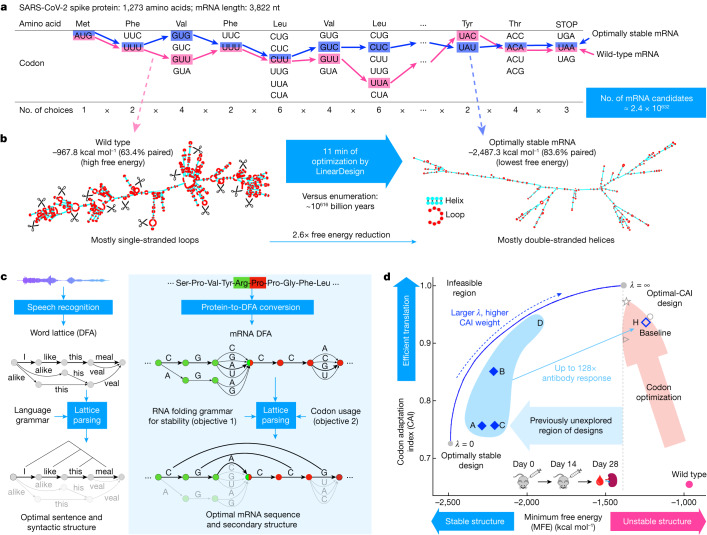
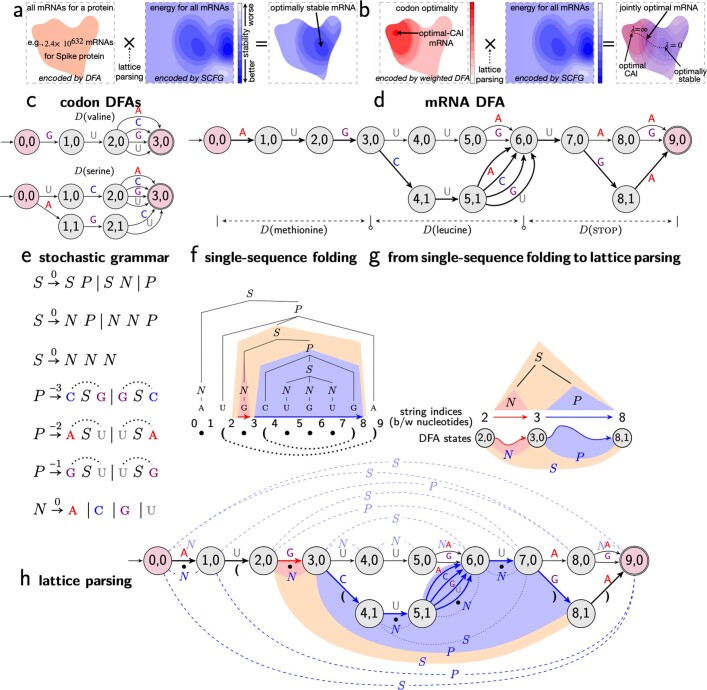
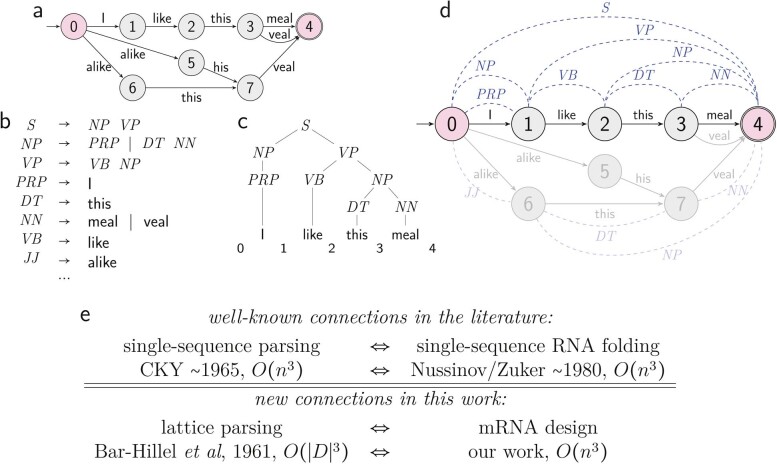
Abstract Messenger RNA (mRNA) vaccines are being used to combat the spread of COVID-19 (refs. 1–3 ), but they still exhibit critical limitations caused by mRNA instability and degradation, which are major obstacles for the storage, distribution and efficacy of the vaccine products 4 . Increasing secondary structure lengthens mRNA half-life, which, together with optimal codons, improves protein expression 5 . Therefore, a principled mRNA design algorithm must optimize both structural stability and codon usage. However, owing to synonymous codons, the mRNA design space is prohibitively large—for example, there are around 2.4 × 10 632 candidate mRNA sequences for the SARS-CoV-2 spike protein. This poses insurmountable computational challenges. Here we provide a simple and unexpected solution using the classical concept of lattice parsing in computational linguistics, where finding the optimal mRNA sequence is analogous to identifying the most likely sentence among similar-sounding alternatives 6 . Our algorithm LinearDesign finds an optimal mRNA design for the spike protein in just 11 minutes, and can concurrently optimize stability and codon usage. LinearDesign substantially improves mRNA half-life and protein expression, and profoundly increases antibody titre by up to 128 times in mice compared to the codon-optimization benchmark on mRNA vaccines for COVID-19 and varicella-zoster virus. This result reveals the great potential of principled mRNA design and enables the exploration of previously unreachable but highly stable and efficient designs. Our work is a timely tool for vaccines and other mRNA-based medicines encoding therapeutic proteins such as monoclonal antibodies and anti-cancer drugs 7,8 .
Overview
CoChat Summary
TL;DR
LinearDesign is a lattice-parsing-based algorithm for mRNA design that jointly optimizes folding stability and codon usage. In experiments on SARS-CoV-2 spike and VZV gE mRNAs, LinearDesign improved in vitro stability, protein expression, and in vivo immunogenicity versus codon-optimization benchmarks, with up to 128× higher antibody responses in mice.
Key findings
- The paper states that the SARS-CoV-2 spike protein has about 2.4 × 10^632 possible mRNA sequences, making brute-force enumeration infeasible; LinearDesign found an optimal spike mRNA in 11 min.
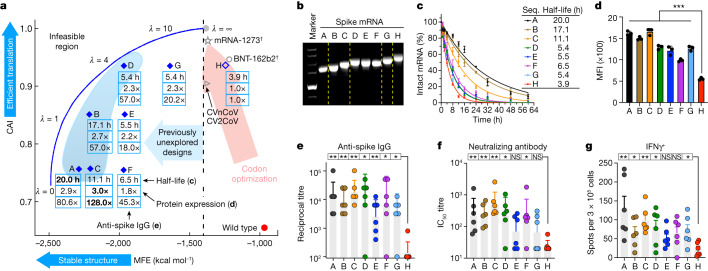
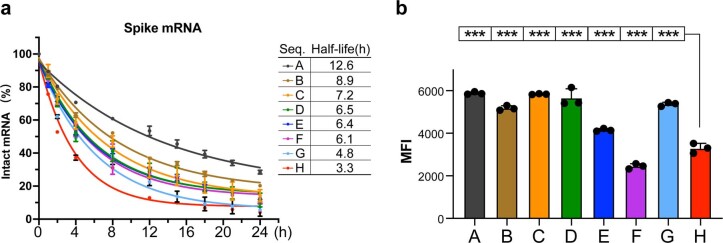
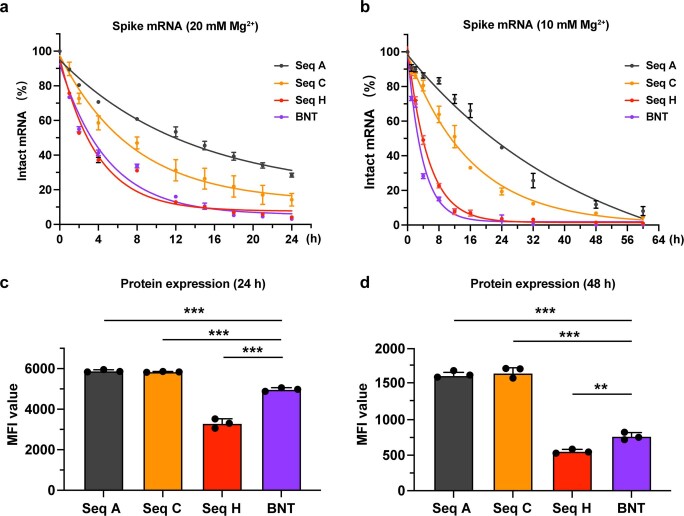
- On SARS-CoV-2 spike mRNAs, the best LinearDesign sequences showed substantially better stability than the benchmark: sequence A had a T1/2 of 20.0 h in 10 mM Mg2+ and 12.6 h in 20 mM Mg2+, versus sequence H at 3.9 h and 3.3 h.
- In HEK293 cells, all seven LinearDesign spike mRNAs (A–G) produced higher spike protein levels than benchmark H; sequence D and G were 2.3-fold higher than H, and sequence A was 2.9-fold higher.
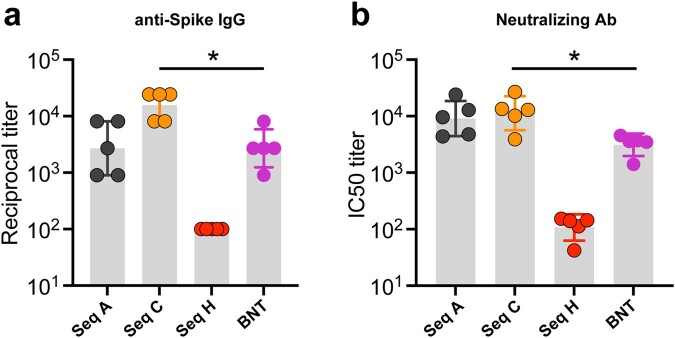
- In mice, LinearDesign spike mRNAs elicited much stronger immune responses: sequences A–D gave a 57 to 128× increase in anti-spike IgG titres and a 9 to 20× increase in neutralizing antibody titres over H.
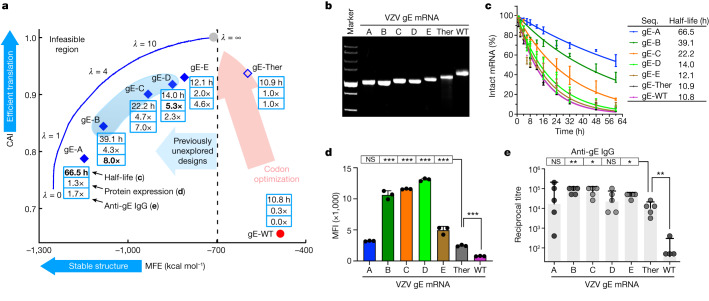
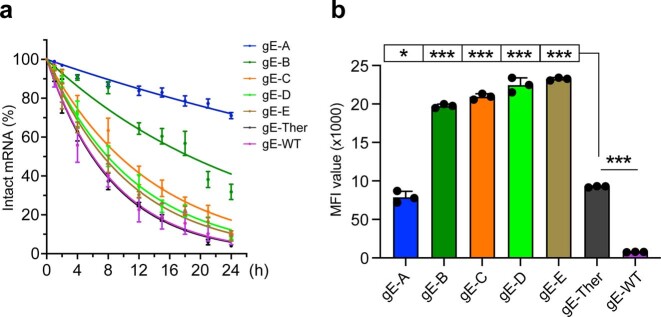
- For VZV gE, LinearDesign mRNAs also improved stability and expression; for example, gE-A had T1/2 = 66.5 h in 10 mM Mg2+ and 50.7 h in 20 mM Mg2+, compared with gE-Ther at 10.9 h and 5.9 h.
Methods
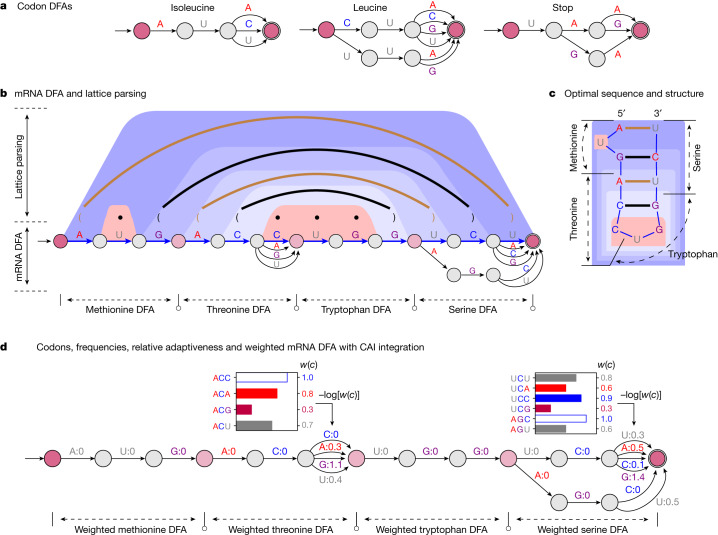
- The authors formulated mRNA design as a joint optimization problem over folding stability (MFE) and codon adaptation index (CAI), then solved it using deterministic finite automata (DFA) plus lattice parsing / weighted intersection with a stochastic context-free grammar.
- They benchmarked runtime on 114 human protein sequences from UniProt, with lengths from 78 to 3,333 amino acids, and also evaluated SARS-CoV-2 spike and VZV gE design cases.
- Experimental validation used in vitro mRNA stability assays, HEK293 protein expression assays, and in vivo immunogenicity studies in C57BL/6 mice given two intramuscular doses of 10 µg LPP-formulated mRNA at a 2-week interval.
Limitations
- The paper states that the work considered only the coding region; UTR optimization was not addressed directly.
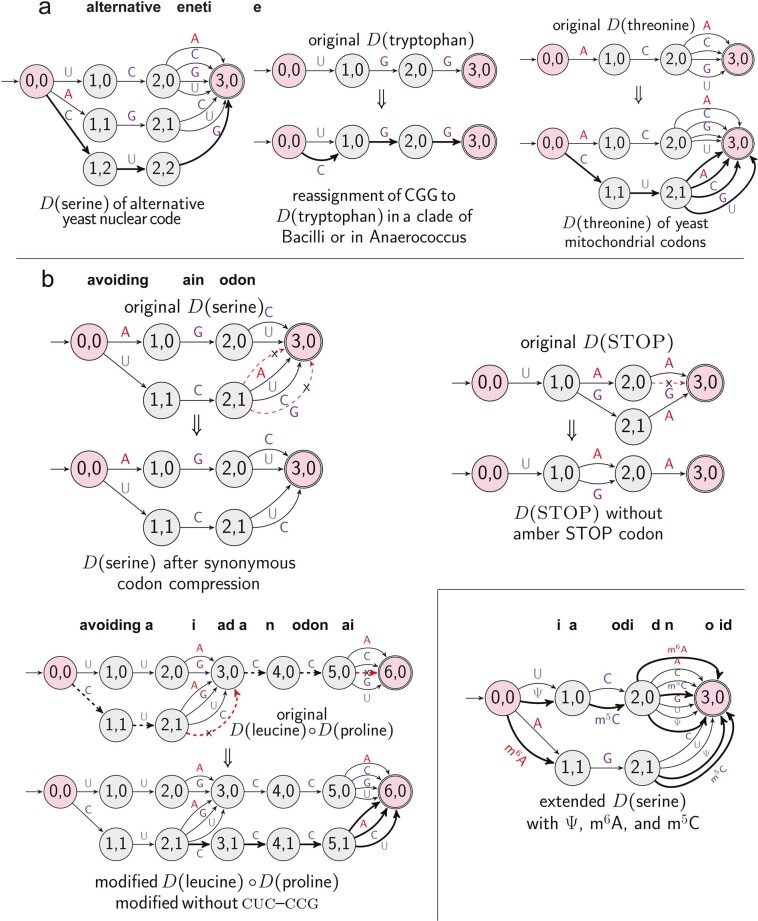
- It also states that chemical modification was not used in the designed mRNAs, even though this is widely used in mRNA vaccines.
- Evident from the text: the in vivo experiments were not randomized, the investigators were not blinded, and the animal experiments were completed once, which limits robustness of the experimental evidence.
Model-written summary. Check it against the paper before relying on it.
Integrity signals
Registry
Cites
Statistics
Figures
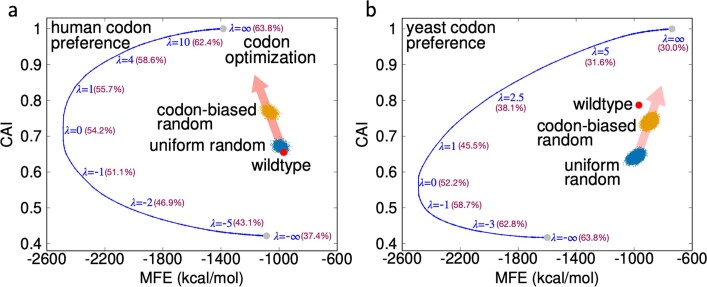
![Fig. 3 Computational characteristics of the LinearDesign algorithm. a, Runtime analysis of mRNA design for proteins in UniProt (Supplementary Table 1). Overall, our exact search scales quadratically with sequence length (Supplementary Figs. 7 and 8), and our MFE + CAI mode (with λ = 4) is about 15% slower than the MFE-only version. Moreover, beam search (b = 500) significantly speeds up the design of long sequences, with minor search errors (Supplementary Fig. 9). b,c, Two-dimensional (MFE–CAI) visualizations of designs for the SARS-CoV-2 spike (b) and VZV gE (c) proteins, respectively (both using human codon preference). The blue curves form the feasibility limit (optimal boundary), by varying λ from 0 to ∞ (see Extended Data Fig. 4 for λ of (–∞, 0]). The GC percentage is shown in parentheses. The human genome favours GC-rich codons; therefore, codon optimization (pink arrows) also improves stability, but only marginally, as the two optimization directions (codon versus stability) are largely orthogonal. By contrast, with an AU-rich codon preference (such as in yeast), codon optimization decreases stability (Extended Data Fig. 4b). d, Secondary structures of the mRNA designs for SARS-CoV-2 spike and VZV gE protein. The optimal-CAI designs (top, λ = ∞) are largely single-stranded (around 60% base-paired), whereas the optimally stable designs (bottom, λ = 0) are mostly double-stranded (around 80% base-paired). We also show intermediate designs (centre, λ = 4) with a balance of stability and CAI.](https://figures.cochat.ai/paper-figures/7f3b742293c6471081bcef7e5469da5b/algorithm-for-optimized-mrna-design-improves-stability-and-immunogenicity-figure-3.jpg)
Verification
Claims the paper makes
35 Valid · 2 Not valid · 9 Not checked · 111 Own results and interpretations
The cited sources support only part of this claim — read each source’s verdict below.
In the paper
“Messenger RNA (mRNA) vaccines are being used to combat the spread of COVID-19 (refs. 1–3), but they still exhibit critical limitations caused by mRNA instability and degradation”
§ Algorithm for optimized mRNA design improves stability and immunogenicity > Abstract
What the sources say
- Not matchedcites refs. 1–3
This doesn’t read as a citation we can look up.
- Supportedcites [4] Crommelin DJ Anchordoquy TJ Volkin DB Jiskoot W Mastrobattista E Addressing the cold reality of mRNA vaccine stability J. Pharm. Sci. 2021 110 997 1001 10.1016/j.xphs.2020.12.006 33321139 PMC7834447 source
The Historical Perspective section says that even minor mRNA degradation can severely impair translation and antigen expression. The Stability Data section describes storage stability as a critical limitation on large-scale mRNA vaccine deployment. No page numbers were supplied for these passages. (LLM, conf=0.93)
plainstates a cause- Asserted: passes — The authors put it forward as true.
- Checkable: passes — It can be checked against evidence.
- Load-bearing: passes — The paper’s conclusions depend on it.
- Based: passes — The paper gives a reason why it holds.
- Not matched
Every source the paper cites for this claim was checked and supports it.
In the paper
“which are major obstacles for the storage, distribution and efficacy of the vaccine products4”
§ Algorithm for optimized mRNA design improves stability and immunogenicity > Abstract
What the sources say
- Supportedcites [4] Crommelin DJ Anchordoquy TJ Volkin DB Jiskoot W Mastrobattista E Addressing the cold reality of mRNA vaccine stability J. Pharm. Sci. 2021 110 997 1001 10.1016/j.xphs.2020.12.006 33321139 PMC7834447 source
The Historical Perspective section says that even minor mRNA degradation can impair translation and antigen expression, affecting vaccine potency. The Abstract and Concluding Considerations identify formulation stability as a challenge for storage, transport and worldwide distribution. (LLM, conf=0.92)
plainstates a cause- Asserted: passes — The authors put it forward as true.
- Checkable: passes — It can be checked against evidence.
- Load-bearing: passes — The paper’s conclusions depend on it.
- Based: passes — The paper gives a reason why it holds.
- Supported
The cited sources support only part of this claim — read each source’s verdict below.
In the paper
“Increasing secondary structure lengthens mRNA half-life, which, together with optimal codons, improves protein expression5.”
§ Algorithm for optimized mRNA design improves stability and immunogenicity > Abstract
What the sources say
- Partly supportedcites [5] Mauger DM mRNA structure regulates protein expression through changes in functional half-life Proc. Natl Acad. Sci. USA 2019 116 24075 24083 10.1073/pnas.1908052116 31712433 PMC6883848 sourceExperimental — accuracy not yet measured
The Results section reports that highly structured mRNAs had more than twice the *functional* half-life of mRNAs with middling structure, independent of codon optimality, and the Abstract reports that codon optimality and greater CDS structure synergize to increase it. The Results also distinguish functional half-life—the time an mRNA productively generates protein—from physical half-life ending in degradation. The claim omits that distinction and the finding's position-dependent qualification: reduced structure in the 5′ leader correlated with higher expression. (LLM, conf=0.85)
plainstates a cause- Asserted: passes — The authors put it forward as true.
- Checkable: passes — It can be checked against evidence.
- Load-bearing: passes — The paper’s conclusions depend on it.
- Based: passes — The paper gives a reason why it holds.
- Partly supported
Every source the paper cites for this claim was checked and supports it.
In the paper
“Improving this structural stability, combined with optimal codon usage, leads to increased protein expression5.”
§ Algorithm for optimized mRNA design improves stability and immunogenicity > Main
What the sources say
- Supportedcites [5] Mauger DM mRNA structure regulates protein expression through changes in functional half-life Proc. Natl Acad. Sci. USA 2019 116 24075 24083 10.1073/pnas.1908052116 31712433 PMC6883848 source
The Results section, “Codon Usage and mRNA Structure Synergize to Determine Ribosome Loading and mRNA Half-Life,” reports that increasing either codon optimality or secondary structure increased median protein expression when the other was held constant. The paper specifies that greater structure is beneficial in the coding region beyond the 5′ leader; the highest-codon-optimality, most-structured group showed no further increase over the improved groups. (LLM, conf=0.90)
plainstates a cause- Asserted: passes — The authors put it forward as true.
- Checkable: passes — It can be checked against evidence.
- Load-bearing: passes — The paper’s conclusions depend on it.
- Based: passes — The paper gives a reason why it holds.
- Supported
The cited sources support only part of this claim — read each source’s verdict below.
In the paper
“However, mRNA molecules are chemically unstable and prone to degrade, which leads to insufficient protein expression5”
§ Algorithm for optimized mRNA design improves stability and immunogenicity > Main
What the sources say
- Partly supportedcites [5] Mauger DM mRNA structure regulates protein expression through changes in functional half-life Proc. Natl Acad. Sci. USA 2019 116 24075 24083 10.1073/pnas.1908052116 31712433 PMC6883848 sourceExperimental — accuracy not yet measured
The Results section (page unavailable) reports that protein output correlated strongly with mRNA functional half-life, supporting a link between shorter productive life and lower expression. But it explicitly says functional half-life is not necessarily physical degradation; the paper does not establish that chemical instability and degradation caused the lower expression. (LLM, conf=0.88)
plainstates a cause- Asserted: passes — The authors put it forward as true.
- Checkable: passes — It can be checked against evidence.
- Load-bearing: passes — The paper’s conclusions depend on it.
- Based: passes — The paper gives a reason why it holds.
- Partly supported
87 more claims · 9 with their cited sources checked
Create a free account to see all 157 claims and to verify the 1 reference still open.
- Probably not a substantial claim. 25
- It may state two separate claims as one. 45
Citations
Cites
Safety and Efficacy of the BNT162b2 mRNA Covid-19 Vaccine
Polack, F. P., Thomas, S. J., Kitchin, N., Absalon, J., Gurtman, A., Lockhart, S., Perez, J. L., Pérez Marc, G., Moreira, E. D., Zerbini, C., et al. (2020) · New England Journal of Medicine · doi:10.1056/nejmoa2034577 · Cited by 14,592
Efficacy and Safety of the mRNA-1273 SARS-CoV-2 Vaccine
Baden, L. R., El Sahly, H. M., Essink, B., Kotloff, K., Frey, S., Novak, R., Diemert, D., Spector, S. A., Rouphael, N., Creech, C. B., et al. (2021) · New England Journal of Medicine · doi:10.1056/nejmoa2035389 · Cited by 10,119
Cryo-EM structure of the 2019-nCoV spike in the prefusion conformation
Wrapp, D., Wang, N., Corbett, K. S., Goldsmith, J. A., Hsieh, C.-L., Abiona, O., Graham, B. S., & McLellan, J. S. (2020) · Science · doi:10.1126/science.abb2507 · Cited by 8,897
UniProt: a hub for protein information
The UniProt Consortium (2015) · Nucleic Acids Research · doi:10.1093/nar/gku989 · Cited by 5,106
Lorenz, R., Bernhart, S. H., Höner zu Siederdissen, C., Tafer, H., Flamm, C., Stadler, P. F., & Hofacker, I. L. (2011) · Algorithms for Molecular Biology · doi:10.1186/1748-7188-6-26 · Cited by 5,098
mRNA vaccines — a new era in vaccinology
Pardi, N., Hogan, M. J., Porter, F. W., & Weissman, D. (2018) · Nature Reviews Drug Discovery · doi:10.1038/nrd.2017.243 · Cited by 4,667
Direct Gene Transfer into Mouse Muscle in Vivo
Wolff, J. A., Malone, R. W., Williams, P., Chong, W., Acsadi, G., Jani, A., & Felgner, P. L. (1990) · Science · doi:10.1126/science.1690918 · Cited by 4,173
Sharp, P. M., & Li, W.-H. (1987) · Nucleic Acids Research · doi:10.1093/nar/15.3.1281 · Cited by 3,992
Mathews, D. H., Sabina, J., Zuker, M., & Turner, D. H. (1999) · Journal of Molecular Biology · doi:10.1006/jmbi.1999.2700 · Cited by 3,795
Self-citationBiological sequence analysis probabilistic models of proteins and nucleic acids
Durbin, R. M., Eddy, S. R., Krogh, A., & Mitchison, G. (1998) · Cited by 3,565
Research works printed but not linked: 4
- Hall, K. B. Best-First Word-Lattice Parsing: Techniques for Integrated Syntactic Language Modeling. PhD thesis, Brown Univ. (2005).
- Nederhof, M. J. & Satta, G. Probabilistic parsing as intersection. In Proc. 8th International Conference on Parsing Technologies 137–148 (2003).
- Huang, L. & Sagae, K. Dynamic programming for linear-time incremental parsing. In Proc. 48th Annual Meeting of the Association for Computational Linguistics 1077–1086 (Association for Computational Linguistics, 2010).
- Huang, L., Fayong, S. & Guo, Y. Structured perceptron with inexact search. In Proc. 2012 Conference of the North American Chapter of the Association for Computational Linguistics: Human Language Technologies 142–151 (Association for Computational Linguistics, 2012).
Cited by
Therapeutic cancer vaccines: Advancements, challenges, and prospects
Fan, T., Zhang, M., Yang, J., Zhu, Z., Cao, W., & Dong, C. (2023) · Signal Transduction and Targeted Therapy · doi:10.1038/s41392-023-01674-3 · Cited by 597
mRNA vaccines for infectious diseases — advances, challenges and opportunities
Pardi, N., & Krammer, F. (2024) · Nature Reviews Drug Discovery · doi:10.1038/s41573-024-01042-y · Cited by 229
Designing nanotheranostics with machine learning
Rao, L., Yuan, Y., Shen, X., Yu, G., & Chen, X. (2024) · Nature Nanotechnology · doi:10.1038/s41565-024-01753-8 · Cited by 207
“More importantly, polymer surface activity was found 94,97 • Nanoplasmonic detection and nanopore sequencing 30,111 • mRNA vaccine and nanodrug development 39,133 Unsupervised learning”
InfluentialChemically Modified Platforms for Better RNA Therapeutics
Shi, Y., Zhen, X., Zhang, Y., Li, Y., Koo, S., Saiding, Q., Kong, N., Liu, G., Chen, W., & Tao, W. (2024) · Chemical Reviews · doi:10.1021/acs.chemrev.3c00611 · Cited by 172
Self-citationStrategies for non-viral vectors targeting organs beyond the liver
Kim, J., Eygeris, Y., Ryals, R. C., Jozić, A., & Sahay, G. (2023) · Nature Nanotechnology · doi:10.1038/s41565-023-01563-4 · Cited by 175
“Zhang et al. recently reported a novel algorithm called LinearDesign, which has the ability to optimize both codon usage and mRNA stability concurrently 209 .”
Exosome for mRNA delivery: Strategies and therapeutic applications
Iqbal, Z., Rehman, K., Mahmood, A., Shabbir, M., Liang, Y., Duan, L., & Zeng, H. (2024) · Journal of Nanobiotechnology · doi:10.1186/s12951-024-02634-x · Cited by 144
“The analysis of a patient’s genetic and molecular data plays a crucial role in identifying specific targets and optimizing the codon usage in mRNA sequences to specifically address the underlying disease mechanisms [27].”
BackgroundTailor made: the art of therapeutic mRNA design
Metkar, M., Pepin, C. S., & Moore, M. J. (2023) · Nature Reviews Drug Discovery · doi:10.1038/s41573-023-00827-x · Cited by 180
“None of these models, however, explains the observed positive relationship between CDS structure and mRNA half-life 25,26,28 .”
InfluentialZhang, H., Vandesompele, J., Braeckmans, K., Smedt, S. C. D., & Remaut, K. (2024) · Chemical Society Reviews · doi:10.1039/d3cs00194f · Cited by 159
Self-citationFrom structural design to delivery: mRNA therapeutics for cancer immunotherapy
Zhou, F., Huang, L., Li, S., Yang, W., Chen, F., Cai, Z., Liu, X., Xu, W., Lehto, V., Lächelt, U., et al. (2023) · Exploration · doi:10.1002/exp.20210146 · Cited by 127
Self-citationRecent advances in nanoparticulate RNA delivery systems
Witten, J. J., Hu, Y., Langer, R., & Anderson, D. G. (2024) · Proceedings of the National Academy of Sciences · doi:10.1073/pnas.2307798120 · Cited by 122
“Additionally, both screening - based and com - putational approaches to codon and UTR optimizations have shown success in improving mRNA expression (12, 13).”
Advancements of in vitro transcribed mRNA (IVT mRNA) to enable translation into the clinics
Kang, D. D., Li, H., & Dong, Y. (2023) · Advanced Drug Delivery Reviews · doi:10.1016/j.addr.2023.114961 · Cited by 100
Self-citationSato, K., & Hamada, M. (2023) · Briefings in Bioinformatics · doi:10.1093/bib/bbad186 · Cited by 95
“[117] proposed an efficient method, named LinearDesign, for mRNA design by reducing it to a problem in computational linguistics.”
MethodChemical Modifications of mRNA Ends for Therapeutic Applications
Warminski, M., Mamot, A., Depaix, A., Kowalska, J., & Jemielity, J. (2023) · Accounts of Chemical Research · doi:10.1021/acs.accounts.3c00442 · Cited by 91
Soroudi, S., Jaafari, M. R., & Arabi, L. (2024) · Journal of Controlled Release · doi:10.1016/j.jconrel.2024.06.023 · Cited by 102
Recent progress in mRNA cancer vaccines
Yao, R., Xie, C., & Xia, X. (2024) · Human Vaccines & Immunotherapeutics · doi:10.1080/21645515.2024.2307187 · Cited by 104
“47,48 We have listed a few here with noted features and advantages/disadvantages (Table 3).”
BackgroundRNA chemistry and therapeutics
Wang, S., Weissman, D., & Dong, Y. (2025) · Nature Reviews Drug Discovery · doi:10.1038/s41573-025-01237-x · Cited by 119
“Deep-learning techniques and AI are essential tools to optimize the sequences of translatable RNAs 228,229 .”
Advanced technologies for the development of infectious disease vaccines
Gupta, A., Rudra, A., Reed, K., Langer, R., & Anderson, D. G. (2024) · Nature Reviews Drug Discovery · doi:10.1038/s41573-024-01041-z · Cited by 100
“Moreover, this algorithm could be used to improve the chemical stability of the mRNA 121 .”
Deep generative models generate mRNA sequences with enhanced translation capacity and stability
Zhang, H., Liu, H., Xu, Y., Liu, Y., Wang, J., Qin, Y., Wang, H., Ma, L., Xun, Z., Lu, T. K., et al. (2024) · doi:10.1101/2024.06.20.599727 · Cited by 79
Self-citationEliciting antitumor immunity via therapeutic cancer vaccines
Peng, K., Zhao, X., Fu, Y., & Liang, Y. (2025) · Cellular and Molecular Immunology · doi:10.1038/s41423-025-01316-4 · Cited by 114
“Key strategies include nucleotide modi fi cation, machine learning-guided mRNA design, and the exploration of noncanonical structures, such as circular and self-amplifying mRNAs [49, 217, 227].”
Viroid-like colonists of human microbiomes
Zheludev, I. N., Edgar, R. C., Lopez-Galiano, M. J., de la Peña, M., Babaian, A., Bhatt, A. S., & Fire, A. Z. (2024) · Cell · doi:10.1016/j.cell.2024.09.033 · Cited by 73
mRNA vaccine sequence and structure design and optimization: Advances and challenges
Jin, L., Zhou, Y., Zhang, S., & Chen, S. (2024) · Journal of Biological Chemistry · doi:10.1016/j.jbc.2024.108015 · Cited by 111
Computational biology and artificial intelligence in mRNA vaccine design for cancer immunotherapy
İmani, S., Li, X., Chen, K., Maghsoudloo, M., Kaboli, P. J., Hashemi, M., Khoushab, S., & Li, X. (2025) · Frontiers in Cellular and Infection Microbiology · doi:10.3389/fcimb.2024.1501010 · Cited by 112
Deep generative models design mRNA sequences with enhanced translational capacity and stability
Zhang, H., Liu, H., Xu, Y., Huang, H., Liu, Y., Wang, J., Qin, Y., Wang, H., Ma, L., Xun, Z., et al. (2025) · Science · doi:10.1126/science.adr8470 · Cited by 119
Self-citationViroid-like colonists of human microbiomes
Zheludev, I. N., Edgar, R. C., Lopez-Galiano, M. J., de la Peña, M., Babaian, A., Bhatt, A. S., & Fire, A. Z. (2024) · doi:10.1101/2024.01.20.576352 · Cited by 73
“At 1164 nt in length, the rod-like secondary structure was striking because typical mRNA sequences are not predicted to readily fold in this manner (as evidenced by the efforts required to maximise the degree of “rod-ness” in mRNA vaccines 22 ).”
Bicknell, A. A., Reid, D. W., Licata, M. C., Jones, A. K., Cheng, Y. M., Li, M., Hsiao, C. J., Pepin, C. S., Metkar, M., Levdansky, Y., et al. (2024) · Cell Reports · doi:10.1016/j.celrep.2024.114098 · Cited by 68
Codon-optimization in gene therapy: promises, prospects and challenges
Paremskaia, A. I., Kogan, A. A., Murashkina, A., Naumova, D. A., Satish, A., Abramov, I. S., Feoktistova, S. G., Mityaeva, O. N., Deviatkin, A. A., & Volchkov, P. (2024) · Frontiers in Bioengineering and Biotechnology · doi:10.3389/fbioe.2024.1371596 · Cited by 79
CodonBERT large language model for mRNA vaccines
Li, S., Moayedpour, S., Li, R., Bailey, M., Riahi, S., Kogler-Anele, L., Miladi, M., Miner, J., Pertuy, F., Zheng, D., et al. (2024) · Genome Research · doi:10.1101/gr.278870.123 · Cited by 60
Advances and prospects of RNA delivery nanoplatforms for cancer therapy
Attia, M. S., Kijanka, G. S., Nguyen, N., Zhang, J., & An, H. (2024) · Acta Pharmaceutica Sinica B · doi:10.1016/j.apsb.2024.09.009 · Cited by 67
“Further approaches that hinge on modifying nucleosides or optimizing the sequence are often adopted to increase the inherent stability of RNA molecules 402 .”
Fan, T., Xu, C., Wu, J., Cai, Y., Cao, W., Shen, H., Zhang, M., Zhu, H., Yang, J., Zhu, Z., et al. (2024) · Science Advances · doi:10.1126/sciadv.adn9961 · Cited by 70
“In addition, we have recently reported an algorithm, termed LinearDesign, for mRNA de-sign to improve the stability of mRNA for enhanced protein expression ( 24 ).”
Self-citationRNA vaccines for cancer: Principles to practice
Guasp, P., Reiche, C., Sethna, Z. M., & Balachandran, V. P. (2024) · Cancer Cell · doi:10.1016/j.ccell.2024.05.005 · Cited by 69
A Review on the Stability Challenges of Advanced Biologic Therapeutics
Sarvepalli, S., Pasika, S. R., Verma, V., Thumma, A., Bolla, S., Nukala, P. K., Butreddy, A., & Bolla, P. K. (2025) · Pharmaceutics · doi:10.3390/pharmaceutics17050550 · Cited by 71
“In this process of modification, the selection of synonymous codons is optimized for the host organism, thereby improving the effectiveness of mRNA-based therapies [149].”
mRNA vaccines contribute to innate and adaptive immunity to enhance immune response in vivo
Cao, Q., Fang, H., & Tian, H. (2024) · Biomaterials · doi:10.1016/j.biomaterials.2024.122628 · Cited by 68
Optimized circular RNA vaccines for superior cancer immunotherapy
Yu, H., Wen, Y., Yu, W., Lu, L., Yu, Y., Liu, C., Hu, Z., Fang, Z., & Huang, S. (2024) · Theranostics · doi:10.7150/thno.104698 · Cited by 57
“Additional strategies to enhance linear mRNA include refining purification protocols to minimize double-stranded RNA (dsRNA) contamination [11,12], optimizing the secondary structure of the coding sequence [13,14], and incorporating branched polyA tails [15].”
Li, X., Li, J., Wei, J., Du, W., Su, C., Shen, X., Zhao, A., & Xu, M. (2025) · MedComm · doi:10.1002/mco2.70414 · Cited by 72
“Codon optimization and RNA folding algorithms (e.g., LinearDesign and mRNAid) have been utilized to reduce secondary structure formation, resulting in improved encapsulation [155].”
Extracellular vesicles as carriers of mRNA: Opportunities and challenges in diagnosis and treatment
Kirian, R. D., Steinman, D., Jewell, C. M., & Zierden, H. C. (2024) · Theranostics · doi:10.7150/thno.93115 · Cited by 50
“Authors achieved 128x the antibody response than conventional codon-optimized benchmark, demonstrating the usefulness in tuning mRNA design to enhance therapeutic efficacy [150].”
BackgroundPredicting RNA structures and functions by artificial intelligence.
Zhang, J., Lang, M., Zhou, Y., & Zhang, Y. (2024) · Trends in Genetics · doi:10.1016/j.tig.2023.10.001 · Cited by 48
Self-citationAdvances in the design and delivery of RNA vaccines for infectious diseases
Lokras, A. G., Bobak, T. R., Baghel, S. S., Sebastiani, F., & Foged, C. (2024) · Advanced Drug Delivery Reviews · doi:10.1016/j.addr.2024.115419 · Cited by 56
Computational design of mRNA vaccines
Kim, Y.-A., Mousavi, K., Yazdi, A. K., Zwierzyna, M., Cardinali, M., Fox, D. M., Peel, T., Coller, J., Aggarwal, K., & Maruggi, G. (2023) · Vaccine · doi:10.1016/j.vaccine.2023.07.024 · Cited by 51
Cellular control of protein levels: A systems biology perspective
Munro, V., Kelly, V. C., Messner, C. B., & Kustatscher, G. (2023) · PROTEOMICS · doi:10.1002/pmic.202200220 · Cited by 54
“Understanding RNA stability is important for RNA vaccine design [29], while protein stability is a factor in the development of PROTACs, an emerging class of drugs inducing protein degradation [30].”
BackgroundTherapeutic synthetic and natural materials for immunoengineering
Slezak, A., Chang, K., Hossainy, S., Mansurov, A., Rowan, S. J., Hubbell, J. A., & Guler, M. O. (2024) · Chemical Society Reviews · doi:10.1039/d3cs00805c · Cited by 46
Recombinant therapeutic proteins degradation and overcoming strategies in CHO cells
Geng, S., Zhao, X., Zhang, X., Zhang, J., Mi, C., & Wang, T. (2024) · Applied Microbiology and Biotechnology · doi:10.1007/s00253-024-13008-6 · Cited by 51
“Another way to control protease activity in cell culture is to add inhibitors or alternative substrates (Table 4), such as plant peptone or albumin to the medium (Li et al. 2021; Schauer et al. 2018; Zhang et al. 2023b).”
Pyroptosis: Induction and inhibition strategies for immunotherapy of diseases
Wu, J., Wang, H., Gao, P., & Ouyang, S. (2024) · Acta Pharmaceutica Sinica B · doi:10.1016/j.apsb.2024.06.026 · Cited by 45
“The development of RNA structures 124 and delivery carrier designs 125,126 have greatly improved resistance to RNase.”
BackgroundEndo/Lysosomal-Escapable Lipid Nanoparticle Platforms for Enhancing mRNA Delivery in Cancer Therapy
Wang, J., Chen, R., Xie, Y., Qin, X., Zhou, Y., & Xu, C. (2025) · Pharmaceutics · doi:10.3390/pharmaceutics17070803 · Cited by 56
“Sequence optimization through enriching the GC content, optimizing codon usage to match the host cell’s preferences, and modifying the 5 ′ and 3 ′ untranslated regions (UTRs) to incorporate regulatory elements can also enhance mRNA stability and translation [20].”
Self-citationSarantopoulos, A., Mastori Kourmpani, C., Yokarasa, A. L., Makamanzi, C., Antoniou, P., Spernovasilis, N., & Tsioutis, C. (2024) · Tropical Medicine and Infectious Disease · doi:10.3390/tropicalmed9100228 · Cited by 40
“Specifically, AI can be used to maximize stability, ensure a prolonged half-life of mRNA vaccines, reduce reliance on expensive cold-chain technology currently required for storage, and significantly reduce the production time of vaccines [40].”
BackgroundEngineered mRNA Delivery Systems for Biomedical Applications
Wang, J., Zhu, H., Gan, J., Liang, G., Li, L., & Zhao, Y. (2024) · Advanced Materials · doi:10.1002/adma.202308029 · Cited by 50
Zhao, H., Shao, X., Yu, Y., Huang, L., Amor, N. P., Guo, K., Weng, C., Zhao, W., Yang, A., Hu, J., et al. (2024) · npj Vaccines · doi:10.1038/s41541-024-00813-3 · Cited by 44
“Recently, we reported a proprietary arti fi cial intelligence-based algorithm that designs mRNA with optimal folding stability and codon usage that together contribute to a high translation ef fi ciency 12 .”
BackgroundSelf-citationIntelligent Photonics: A Disruptive Technology to Shape the Present and Redefine the Future
Xu, D., Ma, Y., Jin, G., & Cao, L. (2024) · Engineering · doi:10.1016/j.eng.2024.08.016 · Cited by 57
Lipid nanoparticle (LNP) mediated mRNA delivery in neurodegenerative diseases
Moosavi, S. G., Rahiman, N., Jaafari, M. R., & Arabi, L. (2025) · Journal of Controlled Release · doi:10.1016/j.jconrel.2025.113641 · Cited by 61
Development of Thermally Stable mRNA-LNP Delivery Systems: Current Progress and Future Prospects
Kafle, U., Truong, H. Q., Cao, T. G. N., & Meng, F. (2024) · Molecular Pharmaceutics · doi:10.1021/acs.molpharmaceut.4c00826 · Cited by 52
Xie, Z., Li, Y., Wang, F., Yang, J., Han, Z., Chen, L., Jiang, W., Zhou, H., Li, T., Tang, Z., et al. (2024) · doi:10.21203/rs.3.rs-5040961/v1 · Cited by 39
Li, Y., Wang, F., Yang, J., Han, Z., Chen, L., Jiang, W., Zhou, H., Li, T., Tang, Z., Deng, J., et al. (2025) · Nature Communications · doi:10.1038/s41467-025-64894-x · Cited by 37
“LinearDesign uses a linear programming approach to explore a wider space of sequence variants compared to previous methods and showed superior performance over the previous codon optimization methods.”
InfluentialHuang, L., Zhao, T., Zhao, W., Shao, A., Zhao, H., Ma, W., Gong, Y., Zeng, X., Weng, C., Bu, L., et al. (2024) · Emerging Microbes & Infections · doi:10.1080/22221751.2024.2309985 · Cited by 39
“Recently, we reported a proprietary artificial intelligence (AI)-based algorithm (LinearDesign) that can design mRNA sequence to achieve optimal folding stability and codon usage that together contribute to high translation efficiency and high vaccine immunogenicity [24].”
BackgroundMethodSelf-citationRamadan, E., Ismeal, A. A. A., & Naguib, Y. W. (2024) · Journal of Personalized Medicine · doi:10.3390/jpm14111092 · Cited by 50
Demissie, E. A., Park, S., Moon, J. H., & Lee, D. (2025) · Journal of Microbiology and Biotechnology · doi:10.4014/jmb.2411.11066 · Cited by 52
Synthetic circRNA therapeutics: innovations, strategies, and future horizons
Cai, J., Qiu, Z., Cho, W. C. S., Liu, Z., Chen, S., Li, H., Chen, K., Li, Y., Zuo, C., & Qiu, M. (2024) · MedComm · doi:10.1002/mco2.720 · Cited by 45
Self-citationGenerative and predictive neural networks for the design of functional RNA molecules
Riley, A. T., Robson, J. M., Ulanova, A., & Green, A. A. (2025) · Nature Communications · doi:10.1038/s41467-025-59389-8 · Cited by 51
Zhao, Y., & Wang, H. (2025) · Briefings in Bioinformatics · doi:10.1093/bib/bbaf263 · Cited by 41
“In the design of circRNA sequences, optimizing mRNA vaccine secondary structure and codon usage strategies significantly enhances mRNA stability against endonuclease degradation and chemical instability while improving translation efficiency and antibody response levels [78, 79].”
Ren, Z., Jiang, L., Di, Y., Zhang, D., Gong, J., Gong, J., Jiang, Q., Fu, Z., Sun, P., Zhou, B., et al. (2024) · Bioinformatics · doi:10.1093/bioinformatics/btae330 · Cited by 41
“Zhang et al. (2023) proposed LinearDesign, which integrates stability and expression optimization using lattice parsing, a classic natural language processing technology.”
BackgroundVaccine development using artificial intelligence and machine learning: A review
Asediya, V., Anjaria, P. A., Mathakiya, R. A., KORINGA, P. G., Nayak, J. B., Bisht, D., Fulmali, D., Patel, V. A., & Desai, D. N. (2024) · International Journal of Biological Macromolecules · doi:10.1016/j.ijbiomac.2024.136643 · Cited by 41
Ma, X., Liu, S., Fan, B., Jin, D., Miao, L., Liu, L., Du, S., & Lin, J. (2025) · Molecular Therapy — Nucleic Acids · doi:10.1016/j.omtn.2025.102485 · Cited by 39
Self-citationMo, O., Zhang, Z., Cheng, X., Zhu, L., Zhang, K., Zhang, N., Li, J., Li, H., Fan, S., Li, X., et al. (2025) · Nucleic Acids Research · doi:10.1093/nar/gkaf410 · Cited by 41
“More recent integrative approaches such as LinearDesign [ 12 ] have combined codon optimization with structural considerations, balancing codon adaptation index (CAI) and free energy minimization to achieve higher protein expression levels.”
Self-citationEmerging advances in delivery systems for mRNA cancer vaccines
Jiang, Z., Xu, Y., Du, G., & Sun, X. (2024) · Journal of Controlled Release · doi:10.1016/j.jconrel.2024.04.039 · Cited by 35
mRNA vaccines in tumor targeted therapy: mechanism, clinical application, and development trends
Gao, Y., Yang, L., Li, Z., Peng, X., & Li, H. (2024) · Biomarker Research · doi:10.1186/s40364-024-00644-3 · Cited by 43
Self-citationHarnessing artificial intelligence to advance CRISPR-based genome editing technologies
Thomson, T., Li, G. L., Strilchuk, A. W., Cui, H., Wang, B., & Li, B. (2025) · Nature Reviews Genetics · doi:10.1038/s41576-025-00907-1 · Cited by 45
“In parallel, AI-assisted mRNA optimization 158–161 is a rapidly growing field that remains under-used in genome editing.”
Engineering brain-derived neurotrophic factor mRNA delivery for the treatment of Alzheimer’s disease
Li, H., Cao, Y., Ye, J., Yang, Z., Chen, Q., Liu, X., Zhang, B., Qiao, J., Tang, Q., Yang, H., et al. (2023) · Chemical Engineering Journal · doi:10.1016/j.cej.2023.143152 · Cited by 32
“Another AI algorithms, Linear Design, for mRNA secondary structure can achieve similar results with more stable mRNA and higher protein expression[25].”
Self-citationCodonBERT: Large Language Models for mRNA design and optimizationPreprint
Li, S., Moayedpour, S., Li, R., Bailey, M., Riahi, S., Kogler-Anele, L., Miladi, M., Miner, J. C., Zheng, D., Wang, J., et al. (2023) · bioRxiv (Cold Spring Harbor Laboratory) · doi:10.1101/2023.09.09.556981 · Cited by 65
“While mRNA sequence heavily influences cellular RNA stability [21, 22], secondary structure can also impact mRNA stability in solution and modulate protein expression [13, 23, 24, 25].”
BackgroundRNA language models predict mutations that improve RNA function
Shulgina, Y., Trinidad, M. I., Langeberg, C. J., Nisonoff, H., Chithrananda, S., Skopintsev, P., Nissley, A. J., Patel, J., Boger, R. S., Shi, H., et al. (2024) · Nature Communications · doi:10.1038/s41467-024-54812-y · Cited by 32
RNA language models predict mutations that improve RNA function
(2024) · doi:10.1101/2024.04.05.588317 · Cited by 32
Current Non-Viral-Based Strategies to Manufacture CAR-T Cells
Gehrke, L., Gonçalves, V. D. R., Andrae, D., Raskó, T., Ho, P., Einsele, H., Hudecek, M., & Friedel, S. R. (2024) · International Journal of Molecular Sciences · doi:10.3390/ijms252413685 · Cited by 36
“…(b) increased translatability by the incorporation of synthetic caps [134–136], poly A tail length [137–139], as well as codon and secondary structure optimization [130,140,141], and (c) decreased immunogenicity by the incorporation of alternative nucleotides like pseudouridine [142,143].”
Engineering Lipid Nanoparticles for mRNA Immunotherapy
Zwolsman, R. C., Darwish, Y. B., Kluza, E., & van der Meel, R. (2025) · Wiley Interdisciplinary Reviews Nanomedicine and Nanobiotechnology · doi:10.1002/wnan.70007 · Cited by 43
Targeting and tracking mRNA lipid nanoparticles at the particle, transcript and protein level
Kang, D. D., Marks, A. R., Morlà‐Folch, J., Dong, Y., Brown, B. D., & Teunissen, A. J. P. (2025) · Nature Biomedical Engineering · doi:10.1038/s41551-025-01511-8 · Cited by 53
“Artificial intelligence could also greatly accelerate mRNA development by optimizing its structural stability and codon usage 226 .”
Accelerating drug discovery, development, and clinical trials by artificial intelligence
Zhang, Y., Mastouri, M., & Zhang, Y. (2024) · Med · doi:10.1016/j.medj.2024.07.026 · Cited by 39
Self-citationVlasova, K. Y., Kerr, A., Pennock, N. D., Jozić, A., Sahel, D. K., Gautam, M., Murthy, N. T. V., Roberts, A., Ali, M. W., MacDonald, K. D., et al. (2025) · Nature Communications · doi:10.1038/s41467-025-59136-z · Cited by 41
“However, for further improvement of therapeutic effect, the CFTR mRNA sequence should also be further optimized 100 .”
Cheng, X., Liu, S., Sun, J., Liu, L., Ma, X., Li, J., Fan, B., Chen, Y., Zhao, Y., Liu, S., et al. (2023) · Advanced Materials · doi:10.1002/adma.202310886 · Cited by 32
Self-citationVaccine design and development: Exploring the interface with computational biology and AI
Ananya, A., Panchariya, D. C., Karthic, A., Singh, S. P., Mani, A., Chawade, A., & Kushwaha, S. K. (2024) · International Reviews of Immunology · doi:10.1080/08830185.2024.2374546 · Cited by 31
“This algorithm allows codon optimisation and structural stability for optimal protein expression of mRNA vaccines and also improves its distribution [170].”
Leveraging mRNA technology for antigen based immuno-oncology therapies
Floudas, C. S., Sarkizova, S., Ceccarelli, M., & Zheng, W. (2025) · Journal for ImmunoTherapy of Cancer · doi:10.1136/jitc-2024-010569 · Cited by 35
“160 While protein and mRNA sequence design share biological information content and involve constrained combinatorial optimization, combining training objectives at both protein and mRNA codon levels is an attractive research direction in mRNA sequence engineering.”
Advances of computational methods enhance the development of multi-epitope vaccines
Wei, Y., Qiu, T., Ai, Y., Zhang, Y., Xie, J., Zhang, D., Luo, X., Sun, X., Wang, X., & Qiu, J. (2024) · Briefings in Bioinformatics · doi:10.1093/bib/bbaf055 · Cited by 40
Self-citationmRNAid, an open-source platform for therapeutic mRNA design and optimization strategies
Vostrosablin, N., Lim, S., Gopal, P., Brazdilova, K., Parajuli, S., Wei, X., Gromek, A., Příhoda, D., Spale, M., Muždalo, A., et al. (2024) · NAR Genomics and Bioinformatics · doi:10.1093/nargab/lqae028 · Cited by 33
Recent Advancements in mRNA Vaccines: From Target Selection to Delivery Systems
Wu, Z., Sun, W., & Qi, H. (2024) · Vaccines · doi:10.3390/vaccines12080873 · Cited by 35
“Notably, the Linear Design Algorithm, introduced by Zhang et al., innovatively integrates the Codon Adaptation Index (CAI) and Minimum Free Energy (MFE) considerations to engineer more stable mRNA sequences, augmenting intracellular protein synthesis [65].”
MethodOptimization of the 5ʹ untranslated region of mRNA vaccines
Ma, Q., Zhang, X., Yang, J., Li, H., Hao, Y., & Feng, X. (2024) · Scientific Reports · doi:10.1038/s41598-024-70792-x · Cited by 39
Self-citationA Spleen‐Targeted Tolerogenic mRNA‐LNPs Vaccine for the Treatment of Experimental Asthma
Wang, F., Lou, J., Lou, X., Wu, F., Gao, X., Yao, X., Wan, J., Duan, X., Deng, W., Ma, L., et al. (2025) · Advanced Science · doi:10.1002/advs.202412543 · Cited by 33
Self-citationConsiderations for mRNA Product Development, Regulation and Deployment Across the Lifecycle
Skerritt, J. H. (2025) · Vaccines · doi:10.3390/vaccines13050473 · Cited by 35
“A “LinearDesign AI tool” that increased mRNA sequence stability through the creation of folded structures [19] resulted in significantly higher antibody responses in mice with candidate COVID-19 and varicella-zoster vaccines.”
InfluentialEngineering challenges and translational opportunities in emerging gene delivery platforms
Ma, Y., Dong, S., Wu, A., Jeong, S. D., Lee, A. S., Jiang, W., & Kim, B. Y. S. (2026) · Nature Biomedical Engineering · doi:10.1038/s41551-026-01643-5 · Cited by 49
“Computational algorithms further assist in matching novel lipids with mRNA payloads to enhance delivery efficacy and translation 107,154,155 .”
RNA stability enhancers for durable base-modified mRNA therapeutics
Jung, S.-J., Seo, J. J., Lee, S., Hyun, S.-I., Lee, J.-E., Lee, S., Lee, Y., Chang, H., Lee, H., Kim, J.-H., et al. (2025) · Nature Biotechnology · doi:10.1038/s41587-025-02891-7 · Cited by 26
Ige, M. A., Ren, X., Yang, Y., Zhang, H., Shen, C., Jiang, Y., Li, J., & Wan, X. (2025) · Molecular Therapy — Nucleic Acids · doi:10.1016/j.omtn.2025.102721 · Cited by 37
“96,97 Nevertheless, DP-based methods remain inherently limited by their inability to capture higher-order epistatic interactions among synonymous sites.”
Self-citationArtificial intelligence-guided design of lipid nanoparticles for mRNA delivery
Su, K., Qiu, J., Xu, T., & Liu, S. (2025) · Acta Pharmaceutica Sinica B · doi:10.1016/j.apsb.2025.11.029 · Cited by 50
“2) 4,88,89 .”
Castellanos, M. M., Gressard, H., Li, X., Magagnoli, C., Moriconi, A., Stranges, D., Strodiot, L., Soto, M., Zwierzyna, M., & Campa, C. (2023) · Vaccines · doi:10.3390/vaccines11071153 · Cited by 32
“For instance, there are more than 10632 possible mRNA sequences that produce the spike protein of coronavirus, the target antigen of the COVID-19 vaccines—a much larger number than the estimated number of atoms in the visible universe [53].”
BackgroundVaccine Strategies Against RNA Viruses: Current Advances and Future Directions
Hsiung, K. C., Chiang, H.-J., Reinig, S., & Shih, S. (2024) · Vaccines · doi:10.3390/vaccines12121345 · Cited by 26
“…of mRNA vaccines during the COVID-19 pandemic have opened a window for further applications of this technology, in which it is predicted that AI will play a key role in optimizing and accelerating vaccine development, with the promise of a new era in vaccinology and personalized medicine [162].”
Developing mRNA Nanomedicines with Advanced Targeting Functions
Wang, J., Cai, L., Li, N., Luo, Z., Ren, H., Zhang, B., & Zhao, Y. (2025) · Nano-Micro Letters · doi:10.1007/s40820-025-01665-9 · Cited by 46
Lu, Y., Qian, C., Huang, Y., Ren, T., Xie, W., Xia, N., & Li, S. (2025) · International Journal of Biological Macromolecules · doi:10.1016/j.ijbiomac.2025.145501 · Cited by 31
Prospects and Challenges in Developing mRNA Vaccines for Infectious Diseases and Oncogenic Viruses
Kutikuppala, L. V. S., Kourampi, I., Kanagala, R. S. D., Bhattacharjee, P., & Boppana, S. H. (2024) · Medical Sciences · doi:10.3390/medsci12020028 · Cited by 38
“The humoral and cellular approach responses have have played their instability According to the variations in For the proposed. nanoparticles (LNPs) delivery techniques [26–28].”
BackgroundThe design, manufacture and LNP formulation of mRNA for research use
Leighton, L. J., Chaudhary, N., Tompkins, H. E., Kulkarni, A., Carrodus, N. L., Budzinska, M. A., Das, S. L., Cheetham, S. W., & Mercer, T. R. (2025) · Nature Protocols · doi:10.1038/s41596-025-01174-4 · Cited by 34
“27.”
Advancing Cancer Immunotherapy: The Potential of mRNA Vaccines As a Promising Therapeutic Approach
Goyal, F., Chattopadhyay, A., Navik, U., Jain, A., Reddy, P. H., Bhatti, G. K., & Bhatti, J. S. (2023) · Advanced Therapeutics · doi:10.1002/adtp.202300255 · Cited by 29
Huang, L., Zhao, F., He, M., Fang, Y., Ma, X., Lu, S., Li, E., Xiao, H. Q., Zhu, H., Wang, X., et al. (2024) · Journal of Controlled Release · doi:10.1016/j.jconrel.2024.01.002 · Cited by 24
Self-citationAdvances in targeted delivery of mRNA into immune cells for enhanced cancer therapy
Huang, L., Huang, Z., Zhang, Y., Lin, C., Zhao, Z., Li, R., Saw, P. E., & Xu, X. (2024) · Theranostics · doi:10.7150/thno.93745 · Cited by 27
“A variety of chemical modifications can be performed on the mRNA skeleton structure to improve the stability of mRNA, such as modifying the 5’ cap structure, optimizing the 5’ UTR sequence and adding an appropriate length of poly (A) tail [34, 35]. mRNA Immunogenicity.”
BackgroundSelf-citationThe mRNA vaccine, a swift warhead against a moving infectious disease target
Mir, S., & Mir, M. A. (2024) · Expert Review of Vaccines · doi:10.1080/14760584.2024.2320327 · Cited by 32
“Recently researchers have developed algorithms for optimized mRNA design while increasing stability and immunogenicity [40].”
mRNA Technology and Mucosal Immunization
Toniolo, A., Maccari, G., & Camussi, G. (2024) · Vaccines · doi:10.3390/vaccines12060670 · Cited by 24
“…parameters: (a) the levels of secretory IgA (S-IgA) in relevant mucosae, (b) the levels of IgG, IgA, and IgM in serum, (c) and—as a proxy for mucosal immunity—the numbers of innate cells, helper/cytotoxic T cells, as well as B cells in peripheral blood using cytofluorimetry or ELISPOT [18].”
BackgroundLiu, X., Wang, S., Sun, Y., Liao, Y., Jiang, G., Sun, B., Yu, J., & Zhao, D. (2025) · EBioMedicine · doi:10.1016/j.ebiom.2025.105638 · Cited by 27
Advancing mRNA vaccines for infectious diseases: key components, innovations, and clinical progress
Li, S., Zheng, L., Zhong, J., & Gao, X. (2025) · Essays in Biochemistry · doi:10.1042/ebc20253009 · Cited by 24
Engineering exosomes for mRNA delivery: a review
Yao, T. S., Dong, X., Wang, X., Liu, X., Fu, L., & Li, L. (2025) · International Journal of Biological Macromolecules · doi:10.1016/j.ijbiomac.2025.144662 · Cited by 28
Metadata
- Authors
- Zhang, H., Zhang, L., Lin, A., Xu, C., Li, Z., Liu, K., Liu, B., Ma, X., Zhao, F., Jiang, H., Chen, C., Shen, H., Li, H., Mathews, D. H., Zhang, Y., & Huang, L.
- Affiliations
- Oregon State University (US)
- China Pharmaceutical University (CN)
- Baidu (China) (CN)
- National University of Singapore (SG)
- University of Rochester Medicine (US)
- Corresponding author
- Zhang, Liang
- Li, Hangwen
- Mathews, David H.
- Zhang, Yujian
- Huang, Liang
- ORCID
- Venue
- Nature
- Published
- 2023-05-02
- Volume
- 621
- Issue
- 7978
- Pages
- 396-403
- ISSN
- 0028-0836 (ISSN-L)
- 1476-4687
- PMC
- PMC10499610
- OpenAlex
- W4367681391
- Semantic Scholar
- 0ce2602824c861bd268acb6a61c6681b85e32df7
- Cited by
- 531
- References
- 61
- Citations by year
- 2026: 193 · 2025: 182 · 2024: 119 · 2023: 32
- FWCI
- 40.70
- Type
- journal article
- Language
- en
- Open access
- hybrid
- doi.org
- Licence
- cc-by
- creativecommons.org/licenses/by/4.0 (tdm)
- creativecommons.org/licenses/by/4.0 (vor)
- Locations
- Nature (publishedVersion, cc-by)
- PubMed Central (publishedVersion, cc-by)
- PubMed (publishedVersion)
- arXiv (Cornell University) (submittedVersion)
- RePEc: Research Papers in Economics (submittedVersion)
- arXiv (Cornell University)
- Funders
- Pfizer
- Sanofi
- Baidu
- National Institutes of Health
- University of California, Davis
- National Institute of General Medical Sciences (R35GM145283)
- Topics
- Life Sciences › Biochemistry, Genetics and Molecular Biology › Molecular Biology › RNA and protein synthesis mechanisms
- Health Sciences › Medicine › Infectious Diseases › SARS-CoV-2 and COVID-19 Research
- Life Sciences › Biochemistry, Genetics and Molecular Biology › Molecular Biology › RNA Interference and Gene Delivery
- Keywords
- mRNA vaccine design, mRNA stability, codon optimization, SARS-CoV-2 spike protein, mRNA secondary structure, immunogenicity, antibody titers, mRNA half-life, varicella-zoster vaccine, mRNA therapeutics
- MeSH terms
- COVID-19, SARS-CoV-2, COVID-19 Vaccines, mRNA Vaccines, Algorithms, Animals, Codon, Half-Life, Humans, RNA, Messenger, Herpesvirus 3, Human, RNA Stability, Mice, Spike Glycoprotein, Coronavirus
About these checks
Registry, retraction, Cites and statistics results are computed, not judged, with one exception: a printed reference that no index lists is read once by a model before it counts as a citation error. Claims are extracted by a model and kept only when their quote appears verbatim in the text; each cited source is then checked, with a model’s help, for whether it says what the claim relies on. Those verdicts can be wrong — read the claim’s quote and the cited source before relying on one.
The claim verdicts this report counts are experimental: their accuracy is not yet measured.
A language model drew the claims from the paper on 2026-10-09, under version 3 of the claim definition (model deepseek-v4.1-flash, prompt extract-v3).
A second model labelled each claim on 2026-10-09 (model jev-1.13-20260917, definition revision gold-guideline-v0.2).
Cited sources are checked with a language model’s help (gpt-6-sol).
Statistics and arithmetic are recomputed, not judged.
Confidence bands are shown only for fields calibrated on our annotated test set. None is calibrated yet, so no band is shown.
What counts as a claim ›How we measure confidence ›How we check this ›
Are you an author, or do you see a problem with this page? Request a review
Data sources
Bibliographic data: Semantic Scholar, OpenAlex, Crossref.
Contains information from the Semantic Scholar Academic Graph Datasets, made available under the ODC Attribution License (ODC-BY 1.0).
Semantic Scholar’s data is described in: Kinney, R., et al. (2023). The Semantic Scholar Open Data Platform. arXiv:2301.10140.
