

Algorithm for optimized mRNA design improves stability and immunogenicity
Open accessThe DOI matches its Crossref record; 63 of the 63 references it cites were found in a registry or an index; 45 of the 63 sources its claims cite were checked for support.
Abstract
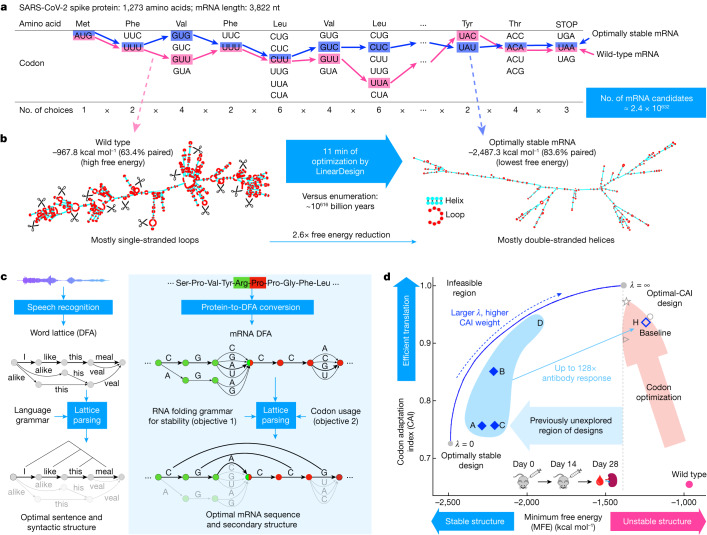
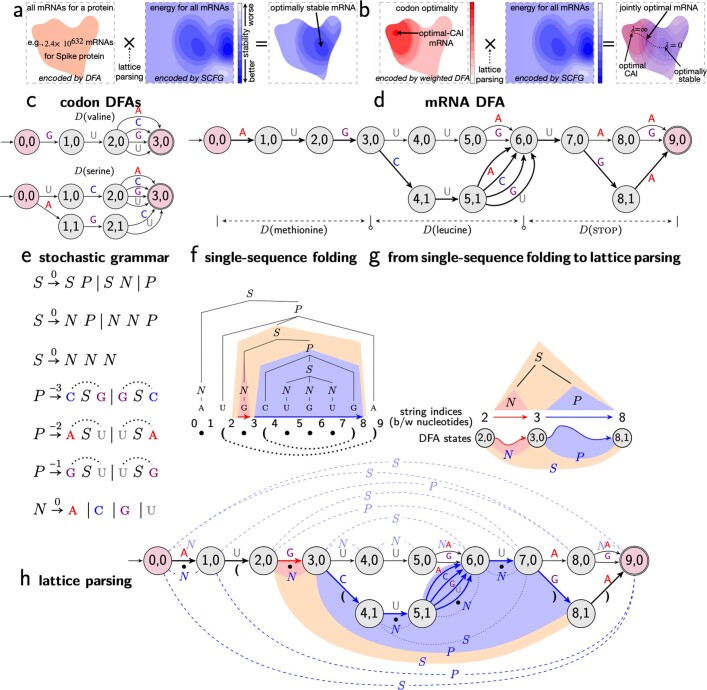
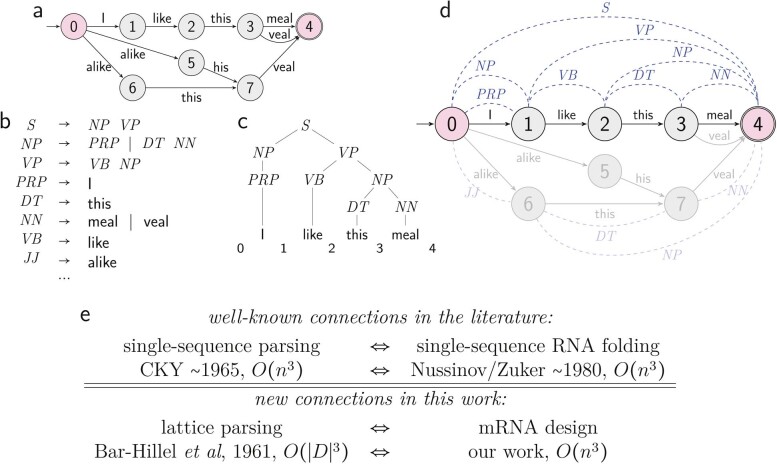
Abstract Messenger RNA (mRNA) vaccines are being used to combat the spread of COVID-19 (refs. 1–3 ), but they still exhibit critical limitations caused by mRNA instability and degradation, which are major obstacles for the storage, distribution and efficacy of the vaccine products 4 . Increasing secondary structure lengthens mRNA half-life, which, together with optimal codons, improves protein expression 5 . Therefore, a principled mRNA design algorithm must optimize both structural stability and codon usage. However, owing to synonymous codons, the mRNA design space is prohibitively large—for example, there are around 2.4 × 10 632 candidate mRNA sequences for the SARS-CoV-2 spike protein. This poses insurmountable computational challenges. Here we provide a simple and unexpected solution using the classical concept of lattice parsing in computational linguistics, where finding the optimal mRNA sequence is analogous to identifying the most likely sentence among similar-sounding alternatives 6 . Our algorithm LinearDesign finds an optimal mRNA design for the spike protein in just 11 minutes, and can concurrently optimize stability and codon usage. LinearDesign substantially improves mRNA half-life and protein expression, and profoundly increases antibody titre by up to 128 times in mice compared to the codon-optimization benchmark on mRNA vaccines for COVID-19 and varicella-zoster virus. This result reveals the great potential of principled mRNA design and enables the exploration of previously unreachable but highly stable and efficient designs. Our work is a timely tool for vaccines and other mRNA-based medicines encoding therapeutic proteins such as monoclonal antibodies and anti-cancer drugs 7,8 .
Overview
CoChat Summary
TL;DR
LinearDesign is a lattice-parsing-based algorithm for mRNA design that jointly optimizes folding stability and codon usage. In experiments on SARS-CoV-2 spike and VZV gE mRNAs, LinearDesign improved in vitro stability, protein expression, and in vivo immunogenicity versus codon-optimization benchmarks, with up to 128× higher antibody responses in mice.
Key findings
- The paper states that the SARS-CoV-2 spike protein has about 2.4 × 10^632 possible mRNA sequences, making brute-force enumeration infeasible; LinearDesign found an optimal spike mRNA in 11 min.
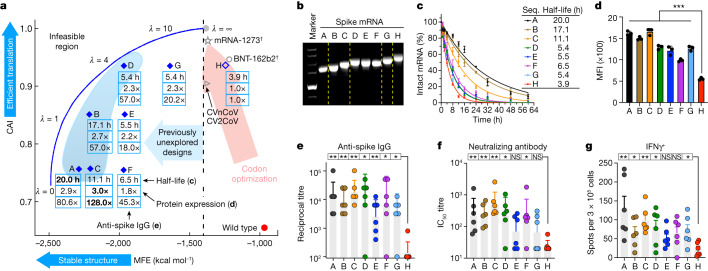
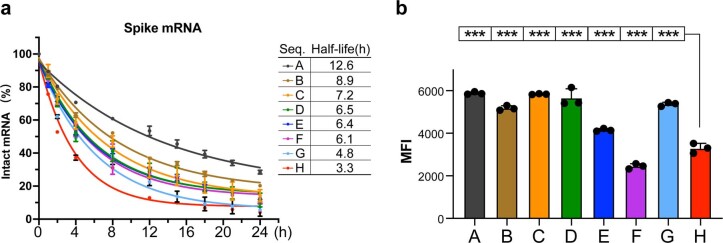
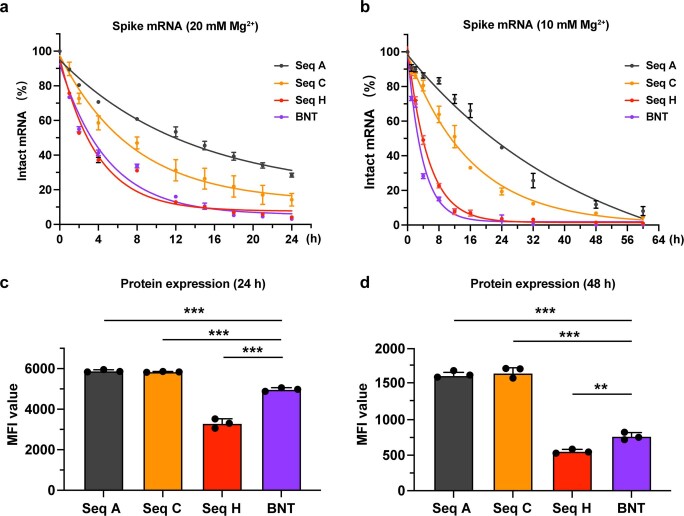
- On SARS-CoV-2 spike mRNAs, the best LinearDesign sequences showed substantially better stability than the benchmark: sequence A had a T1/2 of 20.0 h in 10 mM Mg2+ and 12.6 h in 20 mM Mg2+, versus sequence H at 3.9 h and 3.3 h.
- In HEK293 cells, all seven LinearDesign spike mRNAs (A–G) produced higher spike protein levels than benchmark H; sequence D and G were 2.3-fold higher than H, and sequence A was 2.9-fold higher.
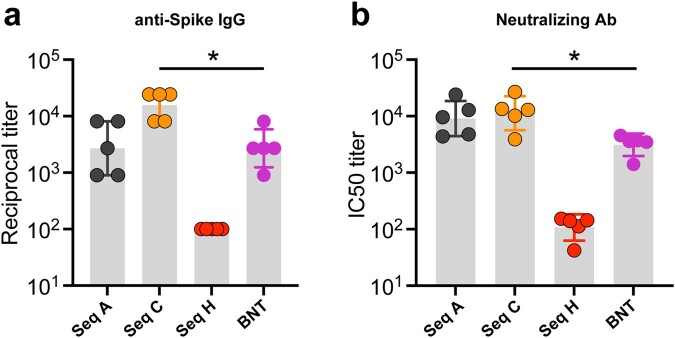
- In mice, LinearDesign spike mRNAs elicited much stronger immune responses: sequences A–D gave a 57 to 128× increase in anti-spike IgG titres and a 9 to 20× increase in neutralizing antibody titres over H.
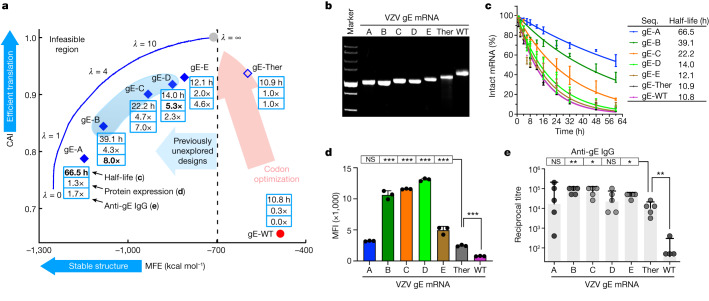
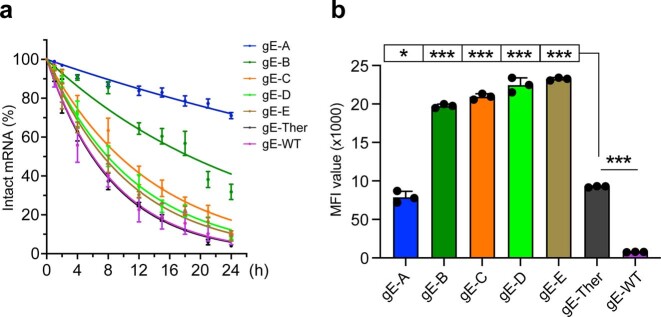
- For VZV gE, LinearDesign mRNAs also improved stability and expression; for example, gE-A had T1/2 = 66.5 h in 10 mM Mg2+ and 50.7 h in 20 mM Mg2+, compared with gE-Ther at 10.9 h and 5.9 h.
Methods
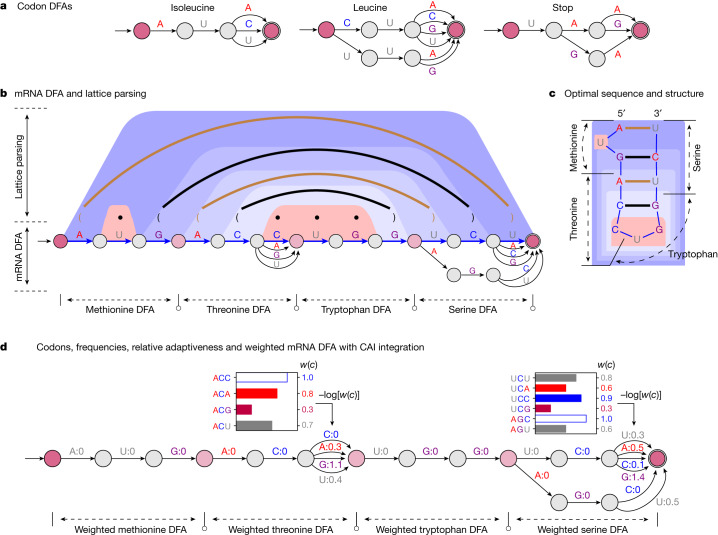
- The authors formulated mRNA design as a joint optimization problem over folding stability (MFE) and codon adaptation index (CAI), then solved it using deterministic finite automata (DFA) plus lattice parsing / weighted intersection with a stochastic context-free grammar.
- They benchmarked runtime on 114 human protein sequences from UniProt, with lengths from 78 to 3,333 amino acids, and also evaluated SARS-CoV-2 spike and VZV gE design cases.
- Experimental validation used in vitro mRNA stability assays, HEK293 protein expression assays, and in vivo immunogenicity studies in C57BL/6 mice given two intramuscular doses of 10 µg LPP-formulated mRNA at a 2-week interval.
Limitations
- The paper states that the work considered only the coding region; UTR optimization was not addressed directly.
- It also states that chemical modification was not used in the designed mRNAs, even though this is widely used in mRNA vaccines.
- Evident from the text: the in vivo experiments were not randomized, the investigators were not blinded, and the animal experiments were completed once, which limits robustness of the experimental evidence.
Model-written summary. Check it against the paper before relying on it.
Integrity signals
Registry
Cites
Statistics
Figures
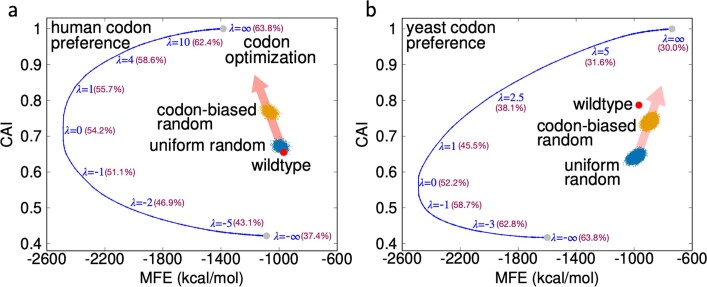
![Fig. 3 Computational characteristics of the LinearDesign algorithm. a, Runtime analysis of mRNA design for proteins in UniProt (Supplementary Table 1). Overall, our exact search scales quadratically with sequence length (Supplementary Figs. 7 and 8), and our MFE + CAI mode (with λ = 4) is about 15% slower than the MFE-only version. Moreover, beam search (b = 500) significantly speeds up the design of long sequences, with minor search errors (Supplementary Fig. 9). b,c, Two-dimensional (MFE–CAI) visualizations of designs for the SARS-CoV-2 spike (b) and VZV gE (c) proteins, respectively (both using human codon preference). The blue curves form the feasibility limit (optimal boundary), by varying λ from 0 to ∞ (see Extended Data Fig. 4 for λ of (–∞, 0]). The GC percentage is shown in parentheses. The human genome favours GC-rich codons; therefore, codon optimization (pink arrows) also improves stability, but only marginally, as the two optimization directions (codon versus stability) are largely orthogonal. By contrast, with an AU-rich codon preference (such as in yeast), codon optimization decreases stability (Extended Data Fig. 4b). d, Secondary structures of the mRNA designs for SARS-CoV-2 spike and VZV gE protein. The optimal-CAI designs (top, λ = ∞) are largely single-stranded (around 60% base-paired), whereas the optimally stable designs (bottom, λ = 0) are mostly double-stranded (around 80% base-paired). We also show intermediate designs (centre, λ = 4) with a balance of stability and CAI.](https://figures.cochat.ai/paper-figures/7f3b742293c6471081bcef7e5469da5b/algorithm-for-optimized-mrna-design-improves-stability-and-immunogenicity-figure-3.jpg)
Verification
Claims the paper makes
35 Valid · 2 Not valid · 9 Not checked · 111 Own results and interpretations
The cited sources support only part of this claim — read each source’s verdict below.
In the paper
“Messenger RNA (mRNA) vaccines are being used to combat the spread of COVID-19 (refs. 1–3), but they still exhibit critical limitations caused by mRNA instability and degradation”
§ Algorithm for optimized mRNA design improves stability and immunogenicity > Abstract
What the sources say
- Not matchedcites refs. 1–3
This doesn’t read as a citation we can look up.
- Supportedcites [4] Crommelin DJ Anchordoquy TJ Volkin DB Jiskoot W Mastrobattista E Addressing the cold reality of mRNA vaccine stability J. Pharm. Sci. 2021 110 997 1001 10.1016/j.xphs.2020.12.006 33321139 PMC7834447 source
The Historical Perspective section says that even minor mRNA degradation can severely impair translation and antigen expression. The Stability Data section describes storage stability as a critical limitation on large-scale mRNA vaccine deployment. No page numbers were supplied for these passages. (LLM, conf=0.93)
plainstates a cause- Asserted: passes — The authors put it forward as true.
- Checkable: passes — It can be checked against evidence.
- Load-bearing: passes — The paper’s conclusions depend on it.
- Based: passes — The paper gives a reason why it holds.
- Not matched
Every source the paper cites for this claim was checked and supports it.
In the paper
“which are major obstacles for the storage, distribution and efficacy of the vaccine products4”
§ Algorithm for optimized mRNA design improves stability and immunogenicity > Abstract
What the sources say
- Supportedcites [4] Crommelin DJ Anchordoquy TJ Volkin DB Jiskoot W Mastrobattista E Addressing the cold reality of mRNA vaccine stability J. Pharm. Sci. 2021 110 997 1001 10.1016/j.xphs.2020.12.006 33321139 PMC7834447 source
The Historical Perspective section says that even minor mRNA degradation can impair translation and antigen expression, affecting vaccine potency. The Abstract and Concluding Considerations identify formulation stability as a challenge for storage, transport and worldwide distribution. (LLM, conf=0.92)
plainstates a cause- Asserted: passes — The authors put it forward as true.
- Checkable: passes — It can be checked against evidence.
- Load-bearing: passes — The paper’s conclusions depend on it.
- Based: passes — The paper gives a reason why it holds.
- Supported
The cited sources support only part of this claim — read each source’s verdict below.
In the paper
“Increasing secondary structure lengthens mRNA half-life, which, together with optimal codons, improves protein expression5.”
§ Algorithm for optimized mRNA design improves stability and immunogenicity > Abstract
What the sources say
- Partly supportedcites [5] Mauger DM mRNA structure regulates protein expression through changes in functional half-life Proc. Natl Acad. Sci. USA 2019 116 24075 24083 10.1073/pnas.1908052116 31712433 PMC6883848 sourceExperimental — accuracy not yet measured
The Results section reports that highly structured mRNAs had more than twice the *functional* half-life of mRNAs with middling structure, independent of codon optimality, and the Abstract reports that codon optimality and greater CDS structure synergize to increase it. The Results also distinguish functional half-life—the time an mRNA productively generates protein—from physical half-life ending in degradation. The claim omits that distinction and the finding's position-dependent qualification: reduced structure in the 5′ leader correlated with higher expression. (LLM, conf=0.85)
plainstates a cause- Asserted: passes — The authors put it forward as true.
- Checkable: passes — It can be checked against evidence.
- Load-bearing: passes — The paper’s conclusions depend on it.
- Based: passes — The paper gives a reason why it holds.
- Partly supported
Every source the paper cites for this claim was checked and supports it.
In the paper
“Improving this structural stability, combined with optimal codon usage, leads to increased protein expression5.”
§ Algorithm for optimized mRNA design improves stability and immunogenicity > Main
What the sources say
- Supportedcites [5] Mauger DM mRNA structure regulates protein expression through changes in functional half-life Proc. Natl Acad. Sci. USA 2019 116 24075 24083 10.1073/pnas.1908052116 31712433 PMC6883848 source
The Results section, “Codon Usage and mRNA Structure Synergize to Determine Ribosome Loading and mRNA Half-Life,” reports that increasing either codon optimality or secondary structure increased median protein expression when the other was held constant. The paper specifies that greater structure is beneficial in the coding region beyond the 5′ leader; the highest-codon-optimality, most-structured group showed no further increase over the improved groups. (LLM, conf=0.90)
plainstates a cause- Asserted: passes — The authors put it forward as true.
- Checkable: passes — It can be checked against evidence.
- Load-bearing: passes — The paper’s conclusions depend on it.
- Based: passes — The paper gives a reason why it holds.
- Supported
The cited sources support only part of this claim — read each source’s verdict below.
In the paper
“However, mRNA molecules are chemically unstable and prone to degrade, which leads to insufficient protein expression5”
§ Algorithm for optimized mRNA design improves stability and immunogenicity > Main
What the sources say
- Partly supportedcites [5] Mauger DM mRNA structure regulates protein expression through changes in functional half-life Proc. Natl Acad. Sci. USA 2019 116 24075 24083 10.1073/pnas.1908052116 31712433 PMC6883848 sourceExperimental — accuracy not yet measured
The Results section (page unavailable) reports that protein output correlated strongly with mRNA functional half-life, supporting a link between shorter productive life and lower expression. But it explicitly says functional half-life is not necessarily physical degradation; the paper does not establish that chemical instability and degradation caused the lower expression. (LLM, conf=0.88)
plainstates a cause- Asserted: passes — The authors put it forward as true.
- Checkable: passes — It can be checked against evidence.
- Load-bearing: passes — The paper’s conclusions depend on it.
- Based: passes — The paper gives a reason why it holds.
- Partly supported
87 more claims · 9 with their cited sources checked
Create a free account to see all 157 claims and to verify the 1 reference still open.
- Probably not a substantial claim. 25
- It may state two separate claims as one. 45
Citations
Cites
Safety and Efficacy of the BNT162b2 mRNA Covid-19 Vaccine
Polack, F. P., Thomas, S. J., Kitchin, N., Absalon, J., Gurtman, A., Lockhart, S., Perez, J. L., Pérez Marc, G., Moreira, E. D., Zerbini, C., et al. (2020) · New England Journal of Medicine · doi:10.1056/nejmoa2034577 · Cited by 14,592
Efficacy and Safety of the mRNA-1273 SARS-CoV-2 Vaccine
Baden, L. R., El Sahly, H. M., Essink, B., Kotloff, K., Frey, S., Novak, R., Diemert, D., Spector, S. A., Rouphael, N., Creech, C. B., et al. (2021) · New England Journal of Medicine · doi:10.1056/nejmoa2035389 · Cited by 10,119
Cryo-EM structure of the 2019-nCoV spike in the prefusion conformation
Wrapp, D., Wang, N., Corbett, K. S., Goldsmith, J. A., Hsieh, C.-L., Abiona, O., Graham, B. S., & McLellan, J. S. (2020) · Science · doi:10.1126/science.abb2507 · Cited by 8,897
UniProt: a hub for protein information
The UniProt Consortium (2015) · Nucleic Acids Research · doi:10.1093/nar/gku989 · Cited by 5,106
Lorenz, R., Bernhart, S. H., Höner zu Siederdissen, C., Tafer, H., Flamm, C., Stadler, P. F., & Hofacker, I. L. (2011) · Algorithms for Molecular Biology · doi:10.1186/1748-7188-6-26 · Cited by 5,098
mRNA vaccines — a new era in vaccinology
Pardi, N., Hogan, M. J., Porter, F. W., & Weissman, D. (2018) · Nature Reviews Drug Discovery · doi:10.1038/nrd.2017.243 · Cited by 4,667
Direct Gene Transfer into Mouse Muscle in Vivo
Wolff, J. A., Malone, R. W., Williams, P., Chong, W., Acsadi, G., Jani, A., & Felgner, P. L. (1990) · Science · doi:10.1126/science.1690918 · Cited by 4,173
Sharp, P. M., & Li, W.-H. (1987) · Nucleic Acids Research · doi:10.1093/nar/15.3.1281 · Cited by 3,992
Mathews, D. H., Sabina, J., Zuker, M., & Turner, D. H. (1999) · Journal of Molecular Biology · doi:10.1006/jmbi.1999.2700 · Cited by 3,795
Self-citationBiological sequence analysis probabilistic models of proteins and nucleic acids
Durbin, R. M., Eddy, S. R., Krogh, A., & Mitchison, G. (1998) · Cited by 3,565
Research works printed but not linked: 4
- Hall, K. B. Best-First Word-Lattice Parsing: Techniques for Integrated Syntactic Language Modeling. PhD thesis, Brown Univ. (2005).
- Nederhof, M. J. & Satta, G. Probabilistic parsing as intersection. In Proc. 8th International Conference on Parsing Technologies 137–148 (2003).
- Huang, L. & Sagae, K. Dynamic programming for linear-time incremental parsing. In Proc. 48th Annual Meeting of the Association for Computational Linguistics 1077–1086 (Association for Computational Linguistics, 2010).
- Huang, L., Fayong, S. & Guo, Y. Structured perceptron with inexact search. In Proc. 2012 Conference of the North American Chapter of the Association for Computational Linguistics: Human Language Technologies 142–151 (Association for Computational Linguistics, 2012).
Cited by
Items 101–200 of 484
Using RNA therapeutics to promote healthy aging
Chen, S., Chen, Q., You, X., Zhou, Z., Kong, N., Ambrosio, F., Cao, Y., Abdi, R., & Tao, W. (2025) · Nature Aging · doi:10.1038/s43587-025-00895-1 · Cited by 25
“Further optimization strategies are being explored, including codon optimization to reduce the free energy of mRNA structure (as seen with the LinearDesign algorithm) 128 .”
Next-Generation mRNA Vaccines in Melanoma: Advances in Delivery and Combination Strategies
Zoroddu, S., & Bagella, L. (2025) · Cells · doi:10.3390/cells14181476 · Cited by 30
“Beyond codon frequency, recent computational frameworks, such as LinearDesign, integrate codon selection with RNA secondary structure optimization, producing constructs with markedly improved half-life and antigen expression compared with conventional synonymous optimization strategies [36].”
InfluentialmRNA medicine: Recent progresses in chemical modification, design, and engineering
Hou, X., Shi, J., & Xiao, Y. (2024) · Nano Research · doi:10.1007/s12274-024-6978-6 · Cited by 28
Vosoughi, P., Naghib, S. M., Kangarshahi, B. M., & Mozafari, M. R. (2025) · International Journal of Biological Macromolecules · doi:10.1016/j.ijbiomac.2025.139532 · Cited by 24
Qi, H., Sun, Z., Gao, T., Yao, Y., Yu, W., Li, W., Wang, X., Wang, X., Liu, D., & Jiang, J. (2024) · Molecular Cancer · doi:10.1186/s12943-024-01958-4 · Cited by 22
“Improvement of immunogenicity can be achieved by nucleotide sequence optimization to increase mRNA stability and the expression of antigens [3].”
Decoding Codon Bias: The Role of tRNA Modifications in Tissue-Specific Translation
Ando, D., Rashad, S., Begley, T. J., Endo, H., Aoki, M., Dedon, P. C., & Niizuma, K. (2025) · International Journal of Molecular Sciences · doi:10.3390/ijms26020706 · Cited by 26
Enhancing clinical trial outcome prediction with artificial intelligence: a systematic review
Qian, L., Lu, X., Haris, P. I., Zhu, J., Li, S., & Yang, Y. (2025) · Drug Discovery Today · doi:10.1016/j.drudis.2025.104332 · Cited by 29
Advancements in RNA-based therapies from bench to bedside
Singh, A., Tekade, M., Nagaraja, S., Bharti, A., & Tekade, R. K. (2026) · npj Drug Discovery. · doi:10.1038/s44386-025-00037-y · Cited by 33
“Similarly, optimizing RNA secondary structure and codon usage using computational tools such as LinearDesign has proven effective in prolonging mRNA half-life and increasing protein expression without introducing new immunogenic motifs 108 .”
Immunogenicity and Efficacy of Vaccination in People Living with Human Immunodeficiency Virus
Tortellini, E., Ngangue, Y. C. F., Dominelli, F., Guardiani, M., Falvino, C., Mengoni, F., Carraro, A., Marocco, R., Pasculli, P., Mastroianni, C. M., et al. (2023) · Viruses · doi:10.3390/v15091844 · Cited by 32
Mahony, T. J., Briody, T. E., & Ommeh, S. C. (2024) · Vaccines · doi:10.3390/vaccines12020152 · Cited by 24
“To address this issue, Zhang et al. [81] developed an artificial intelligence-based algorithm to reconfigure the tertiary structure of mRNA transcripts.”
BackgroundInfluentialRecent Findings on Therapeutic Cancer Vaccines: An Updated Review
Sheikhlary, S., Lopez, D. H., Moghimi, S., & Sun, B. (2024) · Biomolecules · doi:10.3390/biom14040503 · Cited by 26
“Furthermore optimized DNA vaccines have been efficient in preclinical studies [299–302].”
MethodNonviral targeted mRNA delivery: principles, progresses, and challenges
He, X., Li, G., Huang, L., Shi, H., Zhong, S., Zhao, S., Jiao, X., Xin, J., Yin, X., Liu, S., et al. (2025) · MedComm · doi:10.1002/mco2.70035 · Cited by 28
Self-citationExploring the immuno-nano nexus: A paradigm shift in tumor vaccines
Li, Y., Xu, Y., Su, W., Xu, J., Ye, Z., Wang, Z., Liu, Q., & Chen, F. (2025) · Biomedicine & Pharmacotherapy · doi:10.1016/j.biopha.2025.117897 · Cited by 20
Non-Viral RNA Therapies for Non-Small Cell Lung Cancer and Their Corresponding Clinical Trials
Tiwade, P. B., Fung, V., VanKeulen‐Miller, R., Narasipura, E. A., Ma, Y., & Fenton, O. S. (2025) · Molecular Pharmaceutics · doi:10.1021/acs.molpharmaceut.4c00871 · Cited by 21
Rapid folding of nascent RNA regulates eukaryotic RNA biogenesis
Schärfen, L., Vock, I. W., Simon, M. D., & Neugebauer, K. M. (2024) · Molecular Cell · doi:10.1016/j.molcel.2025.02.025 · Cited by 19
mRNABERT: advancing mRNA sequence design with a universal language model and comprehensive dataset
Xiong, Y., Wang, A., Kang, Y., Shen, C., Hsieh, C., & Hou, T. (2025) · Nature Communications · doi:10.1038/s41467-025-65340-8 · Cited by 32
“Although mRNA components exhibit high design fl exibility, designing effective mRNA therapeutics remains complex 22 – 24 .”
Not so cold! Improving the thermostability of mRNA vaccines
Haensler, J., Even, L., Wils, P., Bensaid, F., Dias, A., Deng, H., Karve, S., & DeRosa, F. (2025) · Expert Review of Vaccines · doi:10.1080/14760584.2025.2596674 · Cited by 21
“Some of these optimizations were also found to enhance the chemical stability of mRNA in solution [53,55].”
mRNA extraction from lipid nanoparticles
Malburet, C., Carboni, A., Guinamand, S., Naik, H., & Fertier-Prizzon, S. (2023) · Journal of Chromatography A · doi:10.1016/j.chroma.2023.464545 · Cited by 20
Artificial Intelligence and Breast Cancer Management: From Data to the Clinic
Feng, K., Yi, Z., & Xu, B. (2025) · Cancer Innovation · doi:10.1002/cai2.159 · Cited by 22
mRNA-LM: full-length integrated SLM for mRNA analysis
Li, S., Noroozizadeh, S., Moayedpour, S., Kogler-Anele, L., Xue, Z., Zheng, D., Montoya, F. U., Agarwal, V., Bar‐Joseph, Z., & Jäger, S. (2025) · Nucleic Acids Research · doi:10.1093/nar/gkaf044 · Cited by 27
“Given the interest in using mRNA for vaccines, we tested mRNA-LM using two mRNA vaccine datasets [ 49 , 50 ].”
Biomimetic nanovaccines in cancer therapy: mechanisms, efficacy, and clinical translation
Wusiman, D., Wang, Y., Wang, M., Wang, J., Wu, R., Tuo, Z., Wang, Z., Yu, Q., An, Z., Cho, W. C. S., et al. (2025) · Materials Today Bio · doi:10.1016/j.mtbio.2025.102116 · Cited by 29
“The breakthrough LinearDesign AI tool, published in Nature in 2023 and refined through 2024 – 2025, represents a paradigm shift in mRNA vaccine optimization [145].”
Periodicity-aware deep learning for polymers
Wu, Y., Wang, C., Shen, X., Zhang, T., Zhang, P., & Ji, J. (2025) · Nature Computational Science · doi:10.1038/s43588-025-00903-9 · Cited by 29
“Major breakthroughs have been recently achieved in biochemistry 1–3 , organic chemistry 4 and inorganic chemistry 5 .”
Li, X., Kaboli, P. J., Roozitalab, G., Salahi, S., Qian, H., Zhang, X., Chen, K., & İmani, S. (2026) · Cellular Oncology · doi:10.1007/s13402-026-01199-1 · Cited by 25
mRNA therapeutics for disease therapy: principles, delivery, and clinical translation
Zhou, D., Wang, K., Zhang, Y., Ma, K., Yang, X., Li, Z.-Y., Yu, S., Chen, K., & Qiao, S. (2023) · Journal of Materials Chemistry B · doi:10.1039/d2tb02782h · Cited by 19
Self-citationEmerging mRNA Technology for Liver Disease Therapy
Wang, J., Fang, Y., Luo, Z., Wang, J., & Zhao, Y. (2024) · ACS Nano · doi:10.1021/acsnano.4c02987 · Cited by 23
Defining ortholog-specific UHRF1 inhibition by STELLA for cancer therapy
Bai, W., Xu, J., Gu, W., Wang, D., Cui, Y., Rong, W., Du, X., Li, M., Xia, C., Gan, Q., et al. (2025) · Nature Communications · doi:10.1038/s41467-024-55481-7 · Cited by 23
“…in 5 ’ or/and 3 ’ end) and coding regions of mSTELLA mRNA may further improve the nanoparticle delivery expression ef fi ciency and therapeutic windows, while also circumventing the immunogenicity arising from the exogenous mRNA sequenceperseoritstranslatedproteinfromotherspecies 99,100,109,110 .”
Wang, Z., Tian, C., Zhu, J., Wang, S., Ao, X., He, Y., Chen, H., Liao, X., Kong, D., Zhou, Y.-F., et al. (2025) · Journal of Nanobiotechnology · doi:10.1186/s12951-025-03156-w · Cited by 21
“Recent studies have demonstrated that modifying the secondary structure of mRNA can significantly extend its half-life and improves the immunization effect of mRNA vaccines [65, 66].”
Tkaczyk, C., Newton, M. R., Patnaik, M. M., Thom, G., Strain, M., Gamson, A., Daramola, O., Murthy, A., Douthwaite, J. A., Stepanov, O., et al. (2024) · Molecular Therapy · doi:10.1016/j.ymthe.2024.05.036 · Cited by 19
mRNA vaccines as cancer therapies
Huang, S., Que, H., Wang, M., & Wei, X. (2024) · Chinese Medical Journal · doi:10.1097/cm9.0000000000003455 · Cited by 19
“[110] In addition, the TME also poses a significant barrier to the efficacy of mRNA-based cancer vaccines.”
Wang, S., Zheng, J., Zhou, J., Jiang, W., Chen, Z., Wu, X., Guo, B., Wu, Y., & Yang, F. H. (2025) · Materials Today Bio · doi:10.1016/j.mtbio.2025.102107 · Cited by 37
Mixtures Recomposition by Neural Nets: A Multidisciplinary Overview
Nicolle, A., Deng, S., Ihme, M., Kuzhagaliyeva, N., Ibrahim, E. A., & Farooq, A. (2024) · Journal of Chemical Information and Modeling · doi:10.1021/acs.jcim.3c01633 · Cited by 16
mRNA biotherapeutics landscape for rare genetic disorders
Iyer, V. R., Praveen Reddy., P., Kaduskar, B., Moharir, S. C., & Mishra, R. K. (2024) · Journal of Biosciences · doi:10.1007/s12038-023-00415-6 · Cited by 19
“Recently, a research team reported an algorithm called ‘LinearDesign’ to computationally arrive at stable as well as immunogenic mRNA designs for mRNA vaccine technology (Zhang et al .”
Transformer-based settlement prediction model of pile composite foundation under embankment loading
Gao, S., Chen, C., Jiang, X., Zhu, S., Cai, H., & Li, W. (2024) · Computers and Geotechnics · doi:10.1016/j.compgeo.2024.106783 · Cited by 20
Self-citationNon-viral vectors for chimeric antigen receptor immunotherapy
Tretbar, S., Rurik, J. G., Rustad, E. H., Sürün, D., Koehl, U., Olweus, J., Buchholz, F., Ivics, Z., Fricke, S., & Blache, U. (2024) · Nature Reviews Methods Primers · doi:10.1038/s43586-024-00348-w · Cited by 16
Preclinical evaluation of AGT mRNA replacement therapy for primary hyperoxaluria type I disease
Yang, T., Ge, J., Huang, L., Zhu, X., Zhang, D., Tang, S., Zhao, J., Ma, Y., Long, M., Bo, X., et al. (2025) · Science Advances · doi:10.1126/sciadv.adt9694 · Cited by 18
“We used an optimized linear design algorithm to enhance mRNA stability and translational efficacy ( 28 ).”
Self-citationML-driven design of 3’ UTRs for mRNA stabilityPreprint
Morrow, A., Thornal, A., Flynn, E. D., Hoelzli, E., Shan, M., Garipler, G., Kirchner, R., Reddy, A. J., Tabchouri, S., Gupta, A., et al. (2024) · bioRxiv (Cold Spring Harbor Laboratory) · doi:10.1101/2024.10.07.616676 · Cited by 26
“While codon usage and 5’ UTRs are routinely optimized to maximize protein production, including with ML-based methods [3, 4, 5, 6, 7, 8, 9, 10, 11, 12], attempts to use ML to design 3’ UTRs for enhanced stability or translation efficiency are in their infancy, even considering successful predictive…”
Amplifying mRNA vaccines: potential versatile magicians for oncotherapy
Hu, C., Liu, J., Cheng, F., Bai, Y., Mao, Q., Xu, M., & Liang, Z. (2023) · Frontiers in Immunology · doi:10.3389/fimmu.2023.1261243 · Cited by 17
“In recent years, arti fi cial intelligence (AI) tools have been employed for the optimization of mRNA vaccine sequences, leading to signi fi cant increases in mRNA half-life, protein expression levels, and thermal stability of mRNAs (59).”
MethodDERNA Enables Pareto Optimal RNA Design
Gu, X., Qi, Y., & El-Kebir, M. (2024) · Journal of Computational Biology · doi:10.1089/cmb.2023.0283 · Cited by 17
“Motivated by Mauger et al. (2019), showing the importance of sampling a wide range of solutions that achieve different trade-offs between CAI and MFE, we introduce the Pareto Optimal RNA Design (PORD) problem.”
InfluentialLi, D., Bian, L., Cui, L., Zhou, J., Li, G., Zhao, X., Xing, L., Cui, J., Sun, B., Jiang, C., et al. (2024) · International Journal of Nanomedicine · doi:10.2147/ijn.s464720 · Cited by 15
Self-citationUsing the RNAstructure Software Package to Predict Conserved RNA Structures
Mittal, A., Ali, S. E., & Mathews, D. H. (2024) · Current Protocols · doi:10.1002/cpz1.70054 · Cited by 15
“Structure prediction is also the basis of methods that are used to de-sign mRNA open reading frames that contain maximal structure because this makes the mRNA resistant to degradation (Mauger et al., 2019; Zhang et al., 2023).”
Self-citationHarnessing AI for advancing pathogenic microbiology: a bibliometric and topic modeling approach
Tian, T., Zhang, X., Zhang, F., Huang, X. C., Li, M., Quan, Z.-W., Wang, W., Lei, J., Wang, Y., Liu, Y., et al. (2024) · Frontiers in Microbiology · doi:10.3389/fmicb.2024.1510139 · Cited by 20
mRNA-based technology for engineered regenerative medicine
Zhen, X., Chen, W., & Tao, W. (2025) · Cell Biomaterials · doi:10.1016/j.celbio.2025.100185 · Cited by 19
A Quantitative Clinical Pharmacology-Based Framework For Model-Informed Vaccine Development
Desikan, R., Germani, M., van der Graaf, P. H., & Magee, M. H. (2023) · Journal of Pharmaceutical Sciences · doi:10.1016/j.xphs.2023.10.043 · Cited by 14
Messenger RNA Therapy for Female Reproductive Health
VanKeulen‐Miller, R., & Fenton, O. S. (2024) · Molecular Pharmaceutics · doi:10.1021/acs.molpharmaceut.3c00803 · Cited by 14
JAX-RNAfold: scalable differentiable folding
Krueger, R., & Ward, M. (2025) · Bioinformatics · doi:10.1093/bioinformatics/btaf203 · Cited by 17
“Optimized performance of five benchmark mRNA sequences via our method and LinearDesign (Zhang et al. 2023).”
InfluentialcircDesign Algorithm for Designing Synthetic Circular RNAPreprint
Xu, C., Pu, C., Chen, R., Wang, W., Jiang, F., Deng, C., Zhai, D., Chen, Y., Hu, W., Zhang, Y., et al. (2023) · bioRxiv (Cold Spring Harbor Laboratory) · doi:10.1101/2023.07.09.548293 · Cited by 18
“MFE value dictates the compactness of circRNA structure and CAI of CDS refers to the codon optimality as previously reported 15 .”
Self-citationThinking on the Use of Artificial Intelligence in Drug Discovery
Wang, Y., Hu, Z., Chang, J., & Yu, B. (2025) · Journal of Medicinal Chemistry · doi:10.1021/acs.jmedchem.5c00373 · Cited by 15
Chen, L., Song, L., Yang, J., Li, T., Ju, R., Sun, C., & Xie, Z. (2025) · Molecular Therapy — Nucleic Acids · doi:10.1016/j.omtn.2025.102587 · Cited by 14
Harnessing the Loop: The Perspective of Circular RNA in Modern Therapeutics
Zhao, Y.-Y., Zhu, F.-M., Zhang, Y.-J., & Wei, H. Y. (2025) · Vaccines · doi:10.3390/vaccines13080821 · Cited by 20
“To address this, the LinearDesign algorithm jointly optimizes mRNA sequences for stability and codon usage, yielding enhanced vaccine efficacy [81].”
Self-citationTherapeutic applications of cell engineering using mRNA technology
He, Y., Johnston, A. P. R., & Pouton, C. W. (2024) · Trends in biotechnology · doi:10.1016/j.tibtech.2024.07.012 · Cited by 14
Wei, Z., Zhang, S., Wang, X., Xue, Y., Dang, S., & Zhai, J. (2025) · Frontiers in Immunology · doi:10.3389/fimmu.2025.1524317 · Cited by 25
Circular RNAs modulate cancer drug resistance: advances and challenges
Hua, J., Wang, Z., Cheng, X., Dai, J., & Zhao, P. (2025) · Cancer Drug Resistance · doi:10.20517/cdr.2024.195 · Cited by 21
Khalaf, W. S., Morgan, R. N., & Elkhatib, W. F. (2025) · Journal of Microbiological Methods · doi:10.1016/j.mimet.2025.107125 · Cited by 22
Meade, E., Rowan, N. J., & Garvey, M. (2023) · Vaccines · doi:10.3390/vaccines11050992 · Cited by 13
“mRNA vaccines are also relatively unstable and require cold storage, which is a major limitation impacting storage, distribution and the efficacy of these vaccine types [77].”
BackgroundAdvances and Strategies in Enhancing mRNA Cancer Vaccines
Zhang, M., Chen, S., Hu, H.-J., Ong, Y., & Ni, Q. (2025) · Advanced Materials · doi:10.1002/adma.202509880 · Cited by 23
Oh, A., Lee, S., Park, H.-J., Yoon, S., Ha, D., Lee, J., Lee, S., Roh, G., Cho, Y., Lee, S., et al. (2025) · npj Vaccines · doi:10.1038/s41541-025-01287-7 · Cited by 13
“Previousreports haverevealedseveralkeystrategiestoenhancemRNAexpression,suchas optimizingthe5 ’ or 3 ’ UTRs to reduce miRNA binding sites or leveraging arti fi cial intelligence technology 33,34 .”
Miliotou, Α. N., Georgiou‐Siafis, S. K., Ntenti, C., Pappas, I. S., & Papadopoulou, L. C. (2023) · Current Issues in Molecular Biology · doi:10.3390/cimb45110576 · Cited by 12
“Zhang et al. presented an algorithm, a part of an mRNA designing tool, aiming to predict the most-stable IVT-mRNA sequence and its respective structure (not including UTRs sections and modified nucleotides), in just 11 min [28].”
MethodQin, Q., Yan, H., Gao, W., Cao, R., Liu, G., Zhang, X., Wang, N., Zuo, W., Yuan, L., Gao, P., et al. (2024) · Journal of Molecular Biology · doi:10.1016/j.jmb.2024.168822 · Cited by 11
mRNA folding algorithms for structure and codon optimization
Ward, M., Richardson, M. O. G., & Metkar, M. (2025) · Briefings in Bioinformatics · doi:10.1093/bib/bbaf386 · Cited by 16
“…have appeared in earlier work [13, 14]. mRNA folding algorithms extend standard RNA folding algorithms [15–18] by operating under codon constraints (selecting only from synonymous codons that encode a given protein) and incorporating mRNA-specific properties,such as codon usage bias [7, 8].”
InfluentialLing, S., Zhang, Y., Chen, Y., He, W., Wu, T., Wang, J., Wei, Y., Lu, M., Zhao, W., Li, Q., et al. (2025) · Advanced Materials · doi:10.1002/adma.202513720 · Cited by 14
Self-citationIRES-Mediated Translation: Expanding the Toolkits of RNA Therapy
Gao, X., & Wu, Z. (2025) · International Journal of Molecular Sciences · doi:10.3390/ijms262110542 · Cited by 12
The mRNA-Based Innovative Strategy: Progress and Challenges
Zhou, H., Wei, D., Chen, Z., Chen, H., Dong, C., Cai, W., Wang, J., Liu, X., Li, Y., Yang, Y., et al. (2026) · Nano-Micro Letters · doi:10.1007/s40820-025-01906-x · Cited by 25
“With the rapid advancement of AI technology, Huang et al. developed Lin-earDesign, an algorithm that rapidly optimizes mRNA codons and stability to identify the optimal mRNA sequence [84].”
InfluentialThe promises and challenges of neoantigen cancer vaccines
Ott, P. A. (2026) · Nature Biotechnology · doi:10.1038/s41587-026-03018-2 · Cited by 19
The dawn of a new Era: mRNA vaccines in colorectal cancer immunotherapy
Song, J., Zhang, Y., Zhou, C., Zhan, J., Cheng, X., Huang, H., Mao, S., & Zong, Z. (2024) · International Immunopharmacology · doi:10.1016/j.intimp.2024.112037 · Cited by 11
Self-citationZhou, H.-Y., Li, Y., Li, J., Meng, J., & Wu, A. (2024) · The Innovation Medicine · doi:10.59717/j.xinn-med.2024.100091 · Cited by 19
Bravo, I. G., Belkhir, S., & Paget‐Bailly, P. (2024) · FEMS Microbiology Reviews · doi:10.1093/femsre/fuae029 · Cited by 9
“In-deed, codon r ecoding str ongl y modifies expr ession of vir al genes (Burns et al. 2006 , Lauring et al. 2012 ), to the extent that a full nov el gener ation of v accines , including RNA-based ones , applies synon ymous r ecoding (Martínez et al. 2016 , Zhang et al. 2023 ).”
From Sequence to System: Enhancing IVT mRNA Vaccine Effectiveness through Cutting-Edge Technologies
Xu, L., Li, C., Liao, R., Xiao, Q., Wang, X., Zhao, Z., Zhang, W., Ding, X., Cao, Y., Cai, L., et al. (2024) · Molecular Pharmaceutics · doi:10.1021/acs.molpharmaceut.4c00863 · Cited by 11
Self-driving labs for biotechnology
Collins, E., Langer, R., & Anderson, D. G. (2025) · Nature Computational Science · doi:10.1038/s43588-025-00885-8 · Cited by 15
Proceeding artificial intelligence technology towards vaccine designs
Zhao, F., & Zai, X. (2025) · The Innovation Life · doi:10.59717/j.xinn-life.2025.100162 · Cited by 9
Self-citation‘Remarkable’ AI tool designs mRNA vaccines that are more potent and stable
Dolgin, E. (2023) · Nature · doi:10.1038/d41586-023-01487-y · Cited by 9
mRNA Vaccination: An Outlook on Innate Sensing and Adaptive Immune Responses
Doost, J. S., Fazel, F., Boodhoo, N., & Sharif, S. (2024) · Viruses · doi:10.3390/v16091404 · Cited by 13
“In addition, a LinearDesign algorithm efficiently found an ideal mRNA sequence for the SARS-CoV-2 spike protein within 11 min, all while simultaneously searching for sequences with enhanced stability and codon optimization [29].”
MethodSira, E. M. J. S., Fajardo, L. E., Banico, E. C., Odchimar, N. M. O., & Orosco, F. L. (2025) · Veterinary Medicine International · doi:10.1155/vmi/2638167 · Cited by 13
Unleashing the potential of artificial intelligence in infectious diseases
Zhou, H.-Y., Li, Y., Li, J., Meng, J., & Wu, A. (2025) · National Science Review · doi:10.1093/nsr/nwaf004 · Cited by 9
RNA therapeutics in cardiovascular medicine
Damase, T. R., & Cooke, J. P. (2025) · Current Opinion in Cardiology · doi:10.1097/hco.0000000000001210 · Cited by 9
Zhou, Y., Wu, Y., Sun, S., Wang, W., Zhou, S., Liu, H., Guo, Y., Hong, S., Ding, F., & Cai, H. (2025) · ACS Nano · doi:10.1021/acsnano.4c15187 · Cited by 10
Developing RNAi pesticides in the post genomic era: A review
Duanmu, H., Guo, F., Liu, Y., & He, K. (2025) · Advanced Agrochem · doi:10.1016/j.aac.2025.07.002 · Cited by 13
Zhang, Y., Li, J., Wang, Z., Kuang, Y., Li, S., & Wang, X. (2025) · Animal Diseases · doi:10.1186/s44149-025-00186-7 · Cited by 9
Self-citationSalvatore, V. D., Cernuto, F., Russo, G. L., & Pappalardo, F. (2025) · Frontiers in Immunology · doi:10.3389/fimmu.2025.1628583 · Cited by 11
Horváth, A., Janapala, Y., Woodward, K., Mahmud, S., Cleynen, A., Gardiner, E. E., Hannan, R. D., Eyras, E., Preiß, T., & Shirokikh, N. E. (2024) · Nucleic Acids Research · doi:10.1093/nar/gkae365 · Cited by 13
AI comes to the Nobel Prize and drug discovery
Zhou, Y., Zhang, Y., Zhang, Z., Zhou, Z., & Zhu, F. (2024) · Journal of Pharmaceutical Analysis · doi:10.1016/j.jpha.2024.101160 · Cited by 10
“Another powerful algorithm named LinearDe-sign can design mRNA sequences for both immunogenicity and stability, making it possible to explore previously unreachable but highly stable and ef fi cient designs of vaccines and other mRNA-based medicines [9].”
Self-citationZhang, S., Wang, X., Zhao, T., Yang, C., & Huang, L. (2025) · Vaccines · doi:10.3390/vaccines13010068 · Cited by 8
“Using algorithms like LinearDesign, Genwiz, and Genscript, we designed optimal codon combinations for the mRNA sequences, resulting in a total of nine designed sequences [12].”
InfluentialSelf-citationHarnessing Computational Strategies to Overcome Challenges in mRNA Vaccines
Zhao, S., Chen, J., Dai, T., Li, G., Huang, L., Xin, J., Zhang, Y., Chen, Y., He, X., Huang, H., et al. (2025) · Physiology · doi:10.1152/physiol.00047.2024 · Cited by 8
Self-citationMulti-objective computational optimization of human 5′ UTR sequences
Yamada, K., Suga, K., Abe, N., Hashimoto, K., Tsutsumi, S., Inagaki, M., Hashiya, F., Abe, H., & Hamada, M. (2025) · Briefings in Bioinformatics · doi:10.1093/bib/bbaf225 · Cited by 10
A Hyperbolic Discrete Diffusion 3D RNA Inverse Folding Model for Functional RNA Design
Hou, D., Zhang, S., Ma, M., Lin, H., Wan, Z., Zhao, H., Zhou, R., He, X. D., Wei, X., Ju, D., et al. (2025) · Journal of Chemical Information and Modeling · doi:10.1021/acs.jcim.5c00527 · Cited by 13
Evolving SARS-CoV-2 Vaccines: From Current Solutions to Broad-Spectrum Protection
Qiao, R., Li, J., Gong, J., Shao, Y., Yu, J., Chen, Y., Lu, Y., Yang, L., Lin, L., Hu, Z., et al. (2025) · Vaccines · doi:10.3390/vaccines13060635 · Cited by 10
“AI-driven algorithms such as LinearDesign enable the rapid optimization of mRNA vaccine stability and codon usage for the SARS-CoV-2 S protein [258].”
Wang, J., Wu, K. W., Liu, Y., Wang, S., Li, Z., Zhang, D., Liu, R., Ren, Y., Shao, S., & Liu, Q. (2025) · npj Vaccines · doi:10.1038/s41541-025-01222-w · Cited by 10
“…expression ef fi ciency and stability and have been extensively employed in COVID-19 mRNAvaccines 18 – 20 ;(2)viral-derivedUTRelements,whichtypicallyenable ef fi cient initiation of viral protein translation 17 ; (3) de novo computational design of UTR sequences, such as LinearDesign algorithm 21 .”
Self-citationLiu, Y., Cui, C., Liu, L., & Cui, Q. (2025) · iScience · doi:10.1016/j.isci.2025.113544 · Cited by 11
“7 10 However, due to the limited understanding of the function of 5 ′ UTR, few studies on its optimization have been developed.”
Lardellier, P., Malburet, C., Morani, M., Willemin, T., Rol-Moreno, J., Noir, A., Fertier-Prizzon, S., & François‐Heude, M. (2025) · Scientific Reports · doi:10.1038/s41598-025-27563-z · Cited by 8
Single-round evolution of RNA aptamers with GRAPE-LM
Zhang, J., Ju, Z., Tang, S., Liu, C., Cai, Y., Zeng, H., Meng, X., Liu, B., Zhang, Y., & Wang, Y. (2026) · Nature Biotechnology · doi:10.1038/s41587-026-03007-5 · Cited by 16
Self-citationAI-powered mapping of tumor immunity for optimized mRNA vaccine engineering
Srivastava, R. (2026) · Frontiers in Oncology · doi:10.3389/fonc.2026.1766201 · Cited by 11
“LinearDesign advances this by optimizing codon usage to enhance protein expression while reducing free energy, using lattice parsing from computational linguistics to identify highly stable and ef fi cient codon arrangements (92).”
Wang, N., & Wang, T. (2024) · Biotechnology Journal · doi:10.1002/biot.202300658 · Cited by 13
“[140] Noteworthy, data supporting the safety and efficacy of vaccines are both profuse, and it is undeniable that vaccines have eradicated several infectious diseases in portions of the world and saved countless lives.”
BackgroundAdvances in Therapeutic Cancer Vaccines, Their Obstacles, and Prospects Toward Tumor Immunotherapy
Eskandari, A., Leow, T. C., Rahman, M. B. A., & Oslan, S. N. (2024) · Molecular Biotechnology · doi:10.1007/s12033-024-01144-3 · Cited by 9
“After reconstructing the human immune system, these mice with severe immunodeficiency are capable of facilitating the growth of cell-derived xenograft (CDX) and patient-derived xenograft (PDX) [106–108 There are various limitations to the use of humanized mice in cancer vaccine research.”
ANNaMo: Coarse-grained modeling for folding and assembly of RNA and DNA systems
Guerra, F. T., Poppleton, E., Šulc, P., & Rovigatti, L. (2024) · The Journal of Chemical Physics · doi:10.1063/5.0202829 · Cited by 8
Wang, Y., Wang, S., Huang, L., Mao, W., Li, F., Lin, A., Zhao, W., Zeng, X., Zhang, Y., Yang, D., et al. (2024) · Molecular Therapy · doi:10.1016/j.ymthe.2024.12.041 · Cited by 8
Self-citationZhang, R., Wang, W., Zhang, Z., Wang, D., Ding, H., Liu, H., Sumin, Z., & Zhou, R. (2024) · Poultry Science · doi:10.1016/j.psj.2024.104240 · Cited by 7
Pourseif, M. M., Hosseini, S. A. B., Khoshraftar, S. H., & Omidi, Y. (2025) · Bioimpacts · doi:10.34172/bi.33072 · Cited by 10
“Recent advances such as the LinearDesign algorithm 25 illustrate how jointly optimizing codon usage and structural stability can overcome such pitfalls, achieving markedly improved half-life and translation efficiency compared to traditional codon-optimization benchmarks.”
Fukunaga, T., & Hamada, M. (2022) · Bioinformatics Advances · doi:10.1093/bioadv/vbac078 · Cited by 5
Cutting-edge AI tools revolutionizing scientific research in life sciences
Lorenc-Kukuła, K. (2025) · Biotechnologia · doi:10.5114/bta/200803 · Cited by 14
“This break-through achieved a 128-fold increase in the COVID-19 vaccine’s antibody response and significantly improved vaccine stability (Dolgin, 2023; Zhang et al., 2023).”
Kawaguchi, K., Nguyen, L. B. T., Kinoshita, M., Abe, N., Oba, M., Abe, H., Sudo, K., Inoue, K., Uchida, S., & Sawa, T. (2025) · Journal of Controlled Release · doi:10.1016/j.jconrel.2025.113860 · Cited by 9
Recent advances in freeze-drying technologies for mRNA vaccines against infectious diseases
Lou, J., Wu, Z., Cheng, Y., Li, M., Liu, N., Wang, Z., Gao, X., Zheng, A., & Zhang, H. (2025) · International Journal of Pharmaceutics · doi:10.1016/j.ijpharm.2025.126426 · Cited by 12
Self-citation
Metadata
- Authors
- Zhang, H., Zhang, L., Lin, A., Xu, C., Li, Z., Liu, K., Liu, B., Ma, X., Zhao, F., Jiang, H., Chen, C., Shen, H., Li, H., Mathews, D. H., Zhang, Y., & Huang, L.
- Affiliations
- Oregon State University (US)
- China Pharmaceutical University (CN)
- Baidu (China) (CN)
- National University of Singapore (SG)
- University of Rochester Medicine (US)
- Corresponding author
- Zhang, Liang
- Li, Hangwen
- Mathews, David H.
- Zhang, Yujian
- Huang, Liang
- ORCID
- Venue
- Nature
- Published
- 2023-05-02
- Volume
- 621
- Issue
- 7978
- Pages
- 396-403
- ISSN
- 0028-0836 (ISSN-L)
- 1476-4687
- PMC
- PMC10499610
- OpenAlex
- W4367681391
- Semantic Scholar
- 0ce2602824c861bd268acb6a61c6681b85e32df7
- Cited by
- 531
- References
- 61
- Citations by year
- 2026: 193 · 2025: 182 · 2024: 119 · 2023: 32
- FWCI
- 40.70
- Type
- journal article
- Language
- en
- Open access
- hybrid
- doi.org
- Licence
- cc-by
- creativecommons.org/licenses/by/4.0 (tdm)
- creativecommons.org/licenses/by/4.0 (vor)
- Locations
- Nature (publishedVersion, cc-by)
- PubMed Central (publishedVersion, cc-by)
- PubMed (publishedVersion)
- arXiv (Cornell University) (submittedVersion)
- RePEc: Research Papers in Economics (submittedVersion)
- arXiv (Cornell University)
- Funders
- Pfizer
- Sanofi
- Baidu
- National Institutes of Health
- University of California, Davis
- National Institute of General Medical Sciences (R35GM145283)
- Topics
- Life Sciences › Biochemistry, Genetics and Molecular Biology › Molecular Biology › RNA and protein synthesis mechanisms
- Health Sciences › Medicine › Infectious Diseases › SARS-CoV-2 and COVID-19 Research
- Life Sciences › Biochemistry, Genetics and Molecular Biology › Molecular Biology › RNA Interference and Gene Delivery
- Keywords
- mRNA vaccine design, mRNA stability, codon optimization, SARS-CoV-2 spike protein, mRNA secondary structure, immunogenicity, antibody titers, mRNA half-life, varicella-zoster vaccine, mRNA therapeutics
- MeSH terms
- COVID-19, SARS-CoV-2, COVID-19 Vaccines, mRNA Vaccines, Algorithms, Animals, Codon, Half-Life, Humans, RNA, Messenger, Herpesvirus 3, Human, RNA Stability, Mice, Spike Glycoprotein, Coronavirus
About these checks
Registry, retraction, Cites and statistics results are computed, not judged, with one exception: a printed reference that no index lists is read once by a model before it counts as a citation error. Claims are extracted by a model and kept only when their quote appears verbatim in the text; each cited source is then checked, with a model’s help, for whether it says what the claim relies on. Those verdicts can be wrong — read the claim’s quote and the cited source before relying on one.
The claim verdicts this report counts are experimental: their accuracy is not yet measured.
A language model drew the claims from the paper on 2026-10-09, under version 3 of the claim definition (model deepseek-v4.1-flash, prompt extract-v3).
A second model labelled each claim on 2026-10-09 (model jev-1.13-20260917, definition revision gold-guideline-v0.2).
Cited sources are checked with a language model’s help (gpt-6-sol).
Statistics and arithmetic are recomputed, not judged.
Confidence bands are shown only for fields calibrated on our annotated test set. None is calibrated yet, so no band is shown.
What counts as a claim ›How we measure confidence ›How we check this ›
Are you an author, or do you see a problem with this page? Request a review
Data sources
Bibliographic data: Semantic Scholar, OpenAlex, Crossref.
Contains information from the Semantic Scholar Academic Graph Datasets, made available under the ODC Attribution License (ODC-BY 1.0).
Semantic Scholar’s data is described in: Kinney, R., et al. (2023). The Semantic Scholar Open Data Platform. arXiv:2301.10140.
