

De novo design of protein structure and function with RFdiffusion
Open accessPublished version of a preprint
The DOI matches its Crossref record; 70 of the 70 references it cites were found in a registry or an index; 34 of the 40 sources its claims cite were checked for support.
Abstract
There has been considerable recent progress in designing new proteins using deep-learning methods 1–9 . Despite this progress, a general deep-learning framework for protein design that enables solution of a wide range of design challenges, including de novo binder design and design of higher-order symmetric architectures, has yet to be described. Diffusion models 10,11 have had considerable success in image and language generative modelling but limited success when applied to protein modelling, probably due to the complexity of protein backbone geometry and sequence–structure relationships. Here we show that by fine-tuning the RoseTTAFold structure prediction network on protein structure denoising tasks, we obtain a generative model of protein backbones that achieves outstanding performance on unconditional and topology-constrained protein monomer design, protein binder design, symmetric oligomer design, enzyme active site scaffolding and symmetric motif scaffolding for therapeutic and metal-binding protein design. We demonstrate the power and generality of the method, called RoseTTAFold diffusion (RFdiffusion), by experimentally characterizing the structures and functions of hundreds of designed symmetric assemblies, metal-binding proteins and protein binders. The accuracy of RFdiffusion is confirmed by the cryogenic electron microscopy structure of a designed binder in complex with influenza haemagglutinin that is nearly identical to the design model. In a manner analogous to networks that produce images from user-specified inputs, RFdiffusion enables the design of diverse functional proteins from simple molecular specifications.
Overview
CoChat Summary
TL;DR
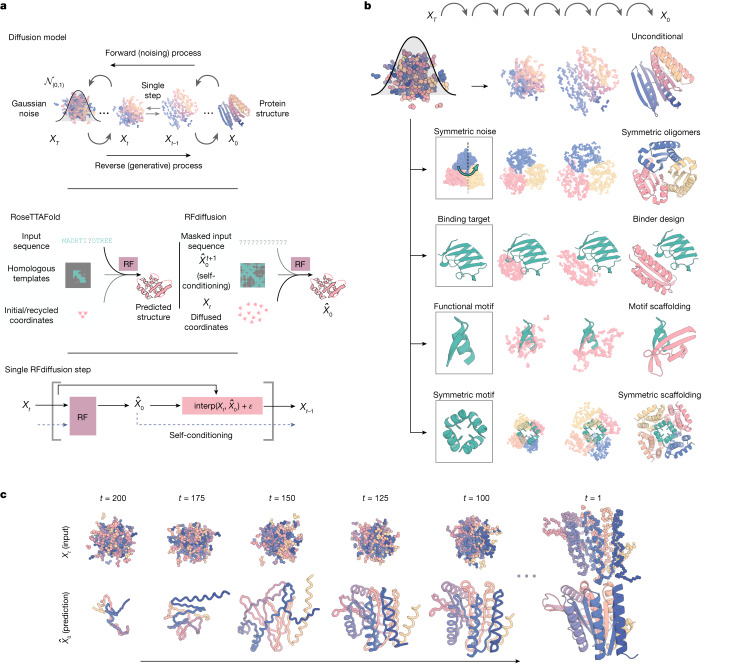
RFdiffusion fine-tunes the RoseTTAFold structure-prediction network as a denoising diffusion model to generate protein backbones for unconditional monomers, symmetric oligomers, functional-motif scaffolds, and de novo binders. The method solves 23 of 25 motif-scaffolding benchmark problems and yields experimentally validated binders, metal-binding assemblies, and a cryo-EM structure matching its design model at 0.63 Å.
Key findings
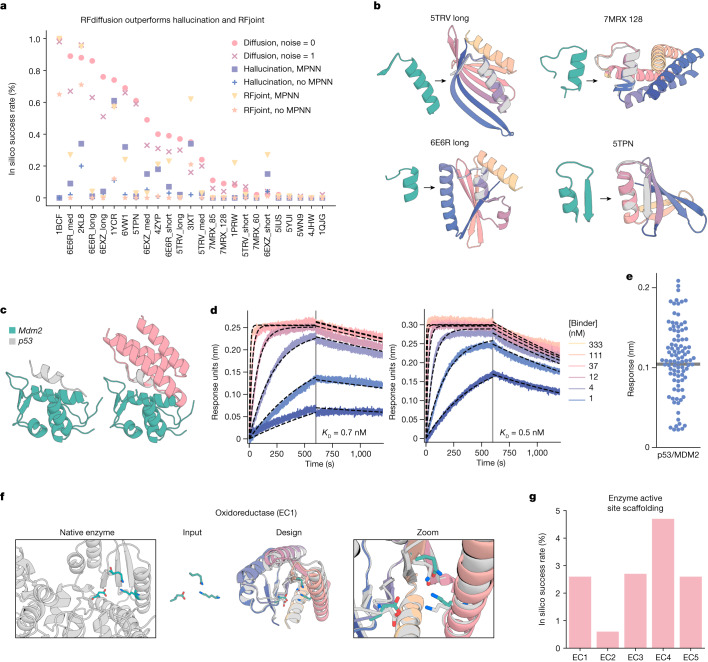
- RFdiffusion solves 23 of 25 motif-scaffolding benchmark problems, compared with 15 for Hallucination and 19 for RFjoint Inpainting; for 19 of 23 solved problems, its success fraction exceeds both baselines.
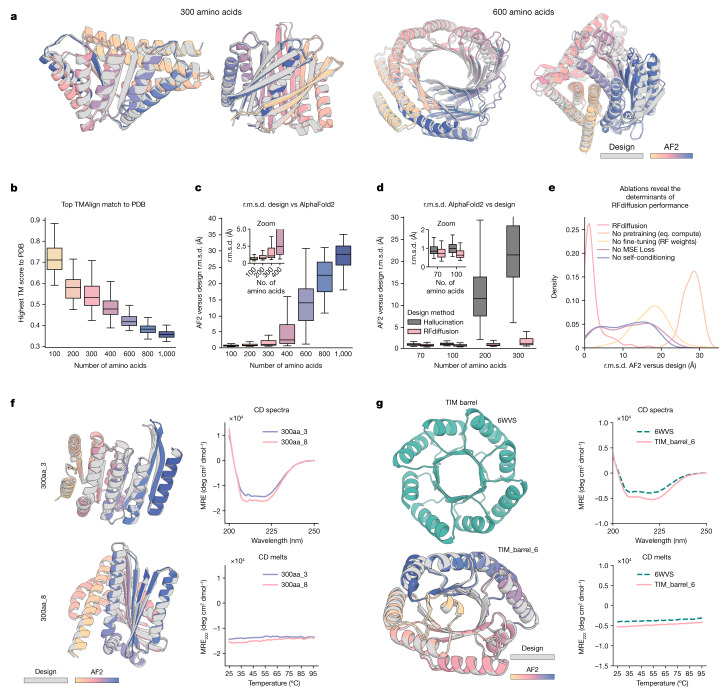
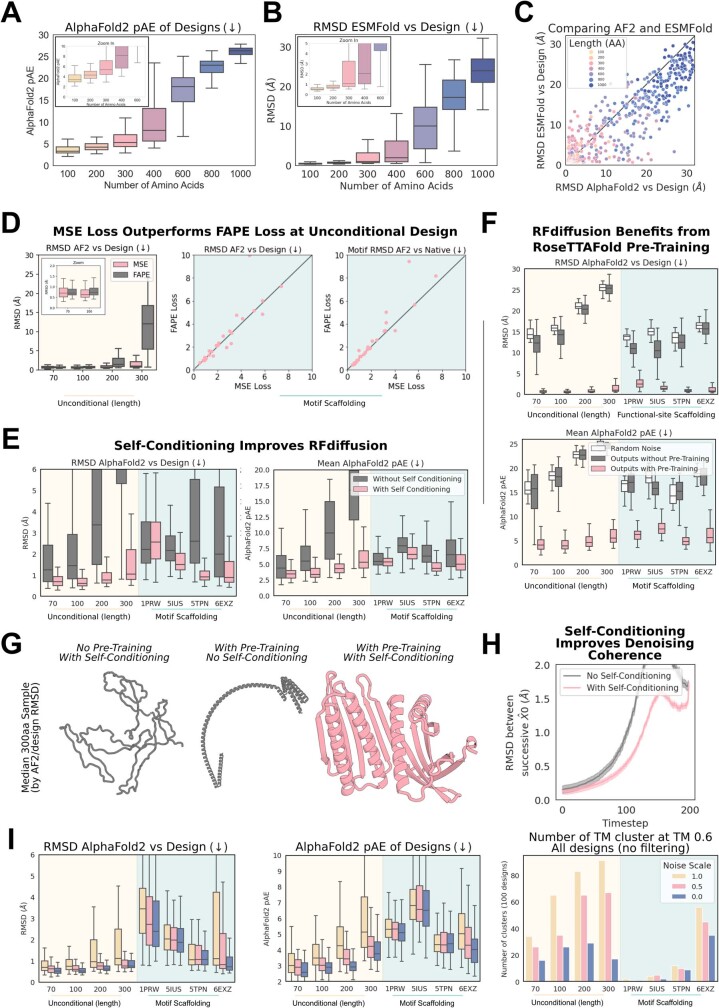
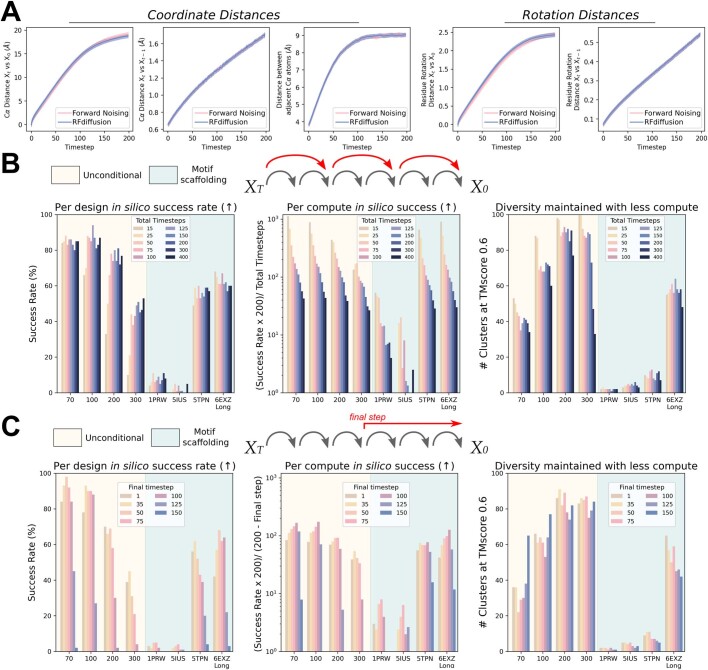
- It generates unconditional monomers up to 600 residues and outperforms RF Hallucination on in silico success (n = 400 designs per condition, z = 9.5, P = 1.6 × 10⁻²¹); a 100-residue protein can be generated in as little as 11 s versus about 8.5 min for RF Hallucination.
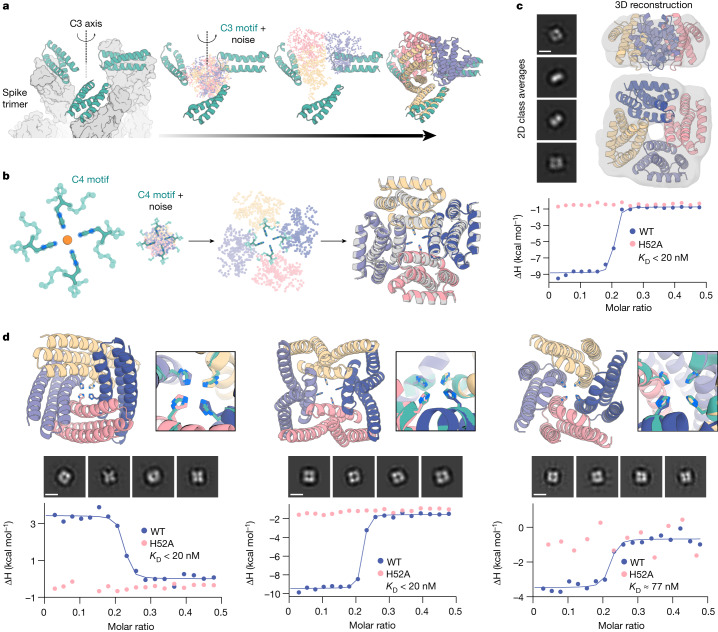
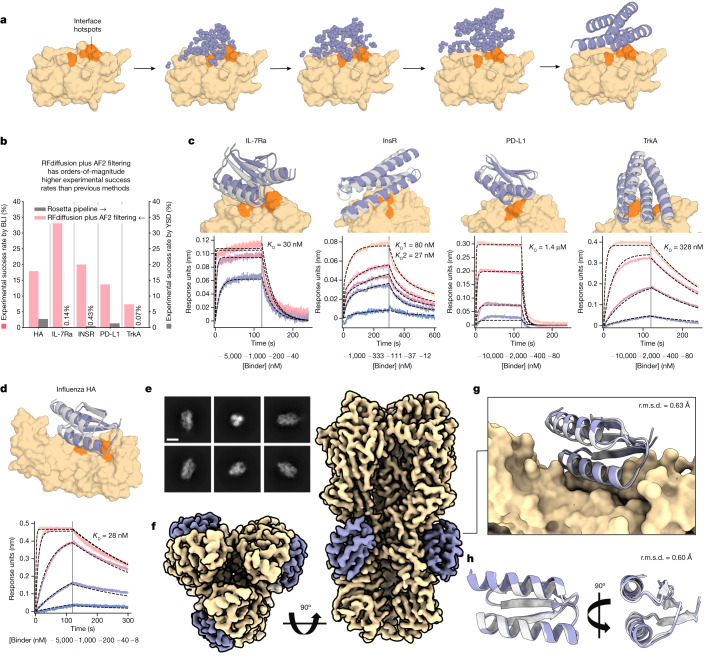
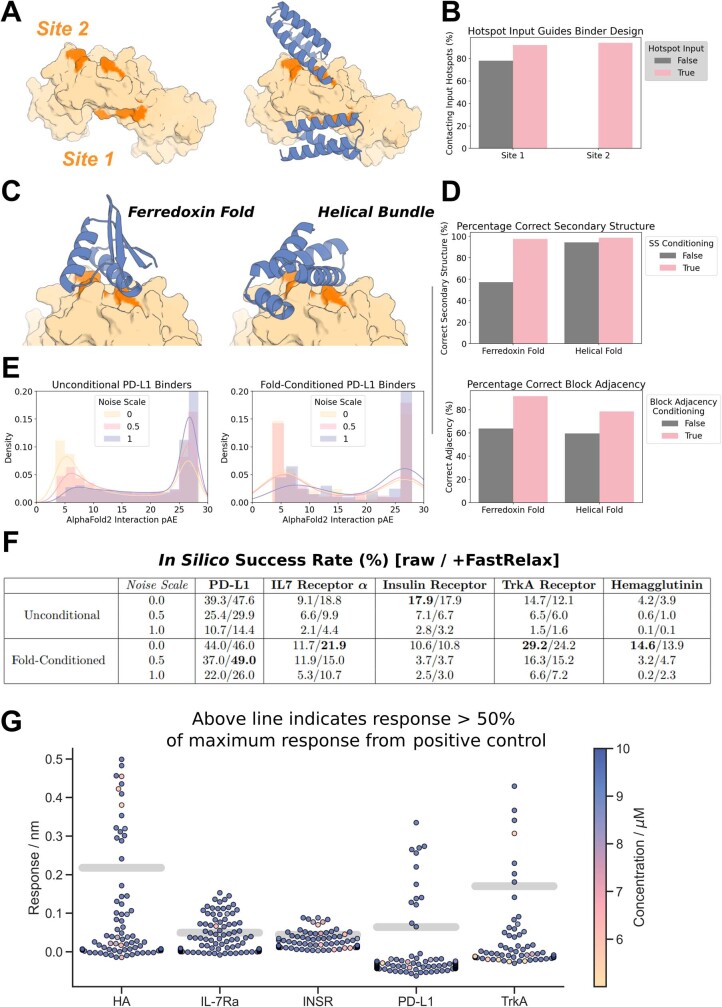
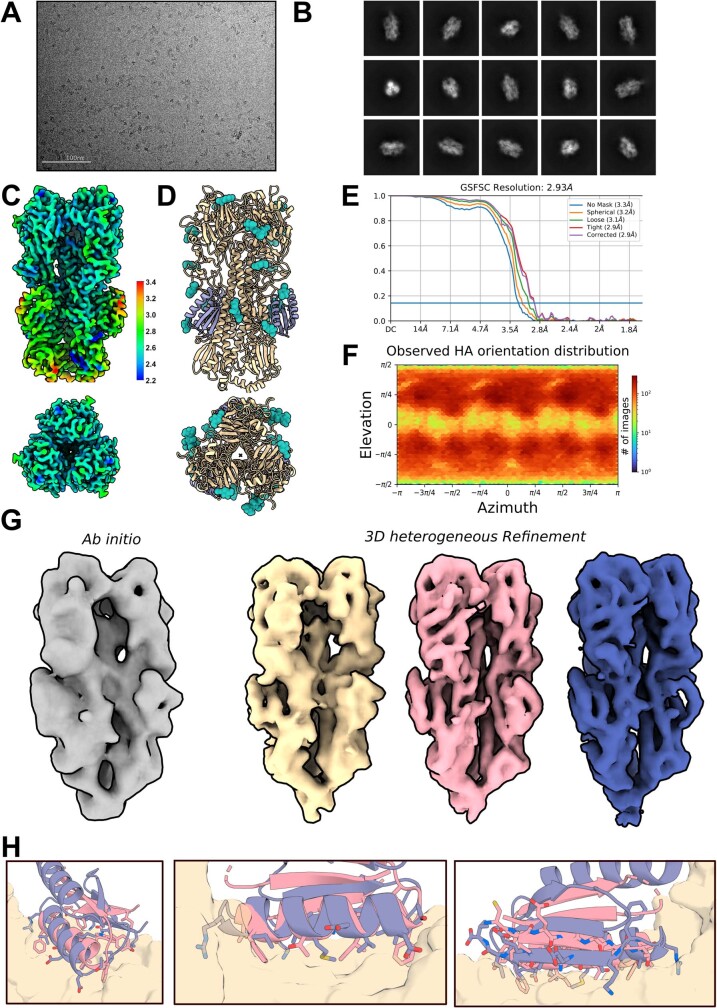
- For binder design against five targets, the overall experimental success rate was 19%, roughly two orders of magnitude above the previous Rosetta-based method; the highest-affinity HA binder, HA_20, bound with KD = 28 nM, and its cryo-EM complex structure matched the design model at 0.63 Å.
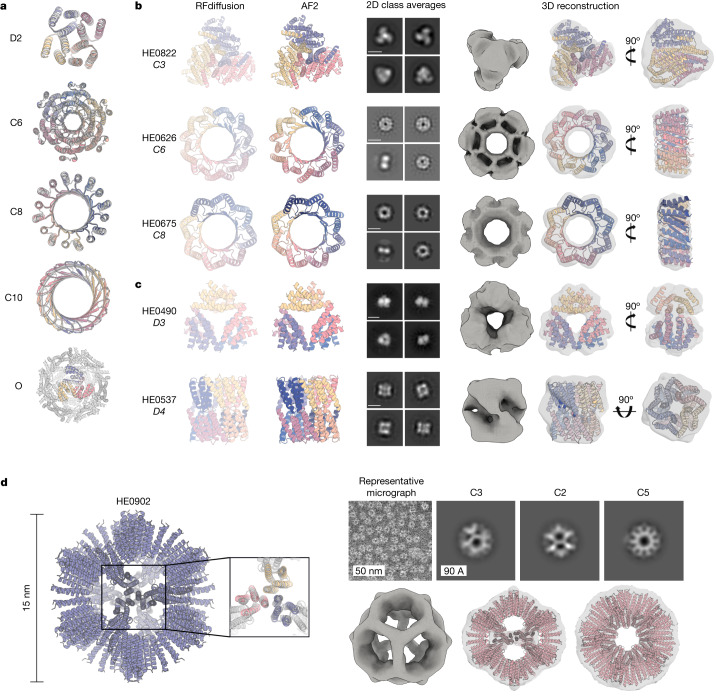
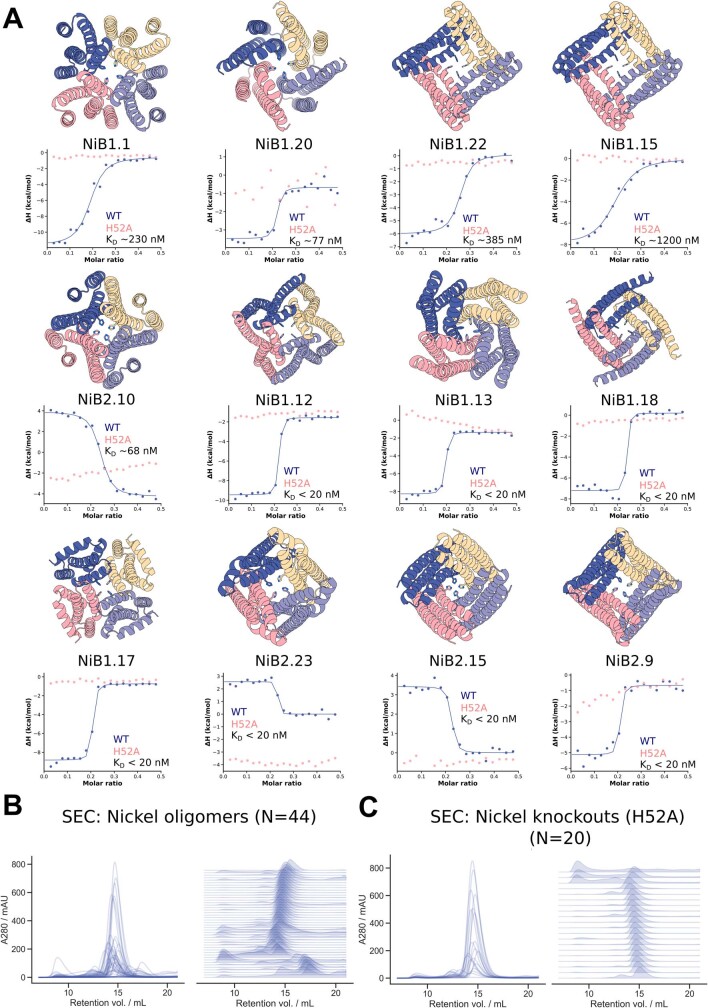
- Symmetric and functional designs were experimentally validated: at least 87 of 608 oligomer designs had SEC oligomerization states closely consistent with design models; 18 of 36 tested Ni²⁺-binding designs bound with dissociation constants from low nanomolar to low micromolar; MDM2 binders reached 0.5 and 0.7 nM versus 600 nM for the native p53 peptide.
Methods
- RFdiffusion uses the RoseTTAFold frame representation (Cα coordinate plus N-Cα-C rigid orientation per residue), trains by noising PDB structures for up to 200 steps, and minimizes mean-squared error between frame predictions and true structures; self-conditioning and fine-tuning from pretrained RF weights improved performance.
- For sequence design, ProteinMPNN was used to design sequences encoding RFdiffusion backbones, typically sampling eight sequences per design; in silico success was validated with AlphaFold2 using mean pAE < 5, global backbone r.m.s.d. < 2 Å, and scaffolded-site backbone r.m.s.d. < 1 Å.
- Experimental characterization included circular dichroism, size-exclusion chromatography, negative-stain EM, cryo-EM, biolayer interferometry, and isothermal titration calorimetry across designed monomers, oligomers, metal-binding proteins, and binders.
Limitations
- The paper states that RFdiffusion cannot explicitly model bound small molecules at present, though it can implicitly model substrates with an external potential; it also states that further studies are required to assess success rates on more polar target sites and sites without native binding partners, and that proteome-wide specificity remains to be fully characterized.
- The paper notes that very large proteins are difficult to validate in silico because they are probably beyond single-sequence prediction capabilities of AF2 and ESMFold, and that some binder designs had insufficient material to permit screening at 10 μM.
- Evident from the text: many conclusions rely on the AF2-based in silico success metric, experimental validation was performed on subsets of designs rather than all generated designs, and the authors did not extensively explore simultaneous structure-and-sequence design within RFdiffusion.
Model-written summary. Check it against the paper before relying on it.
Integrity signals
Registry
Cites
Statistics
Figures
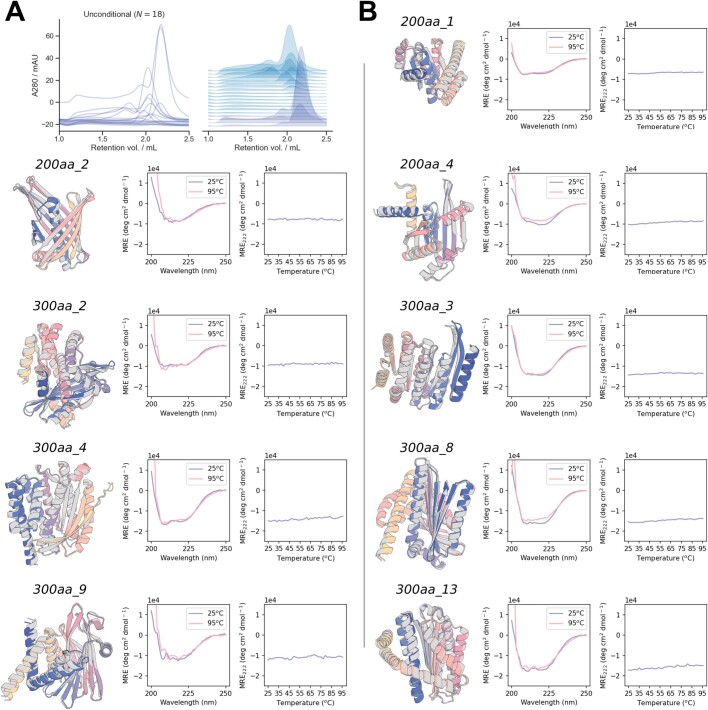
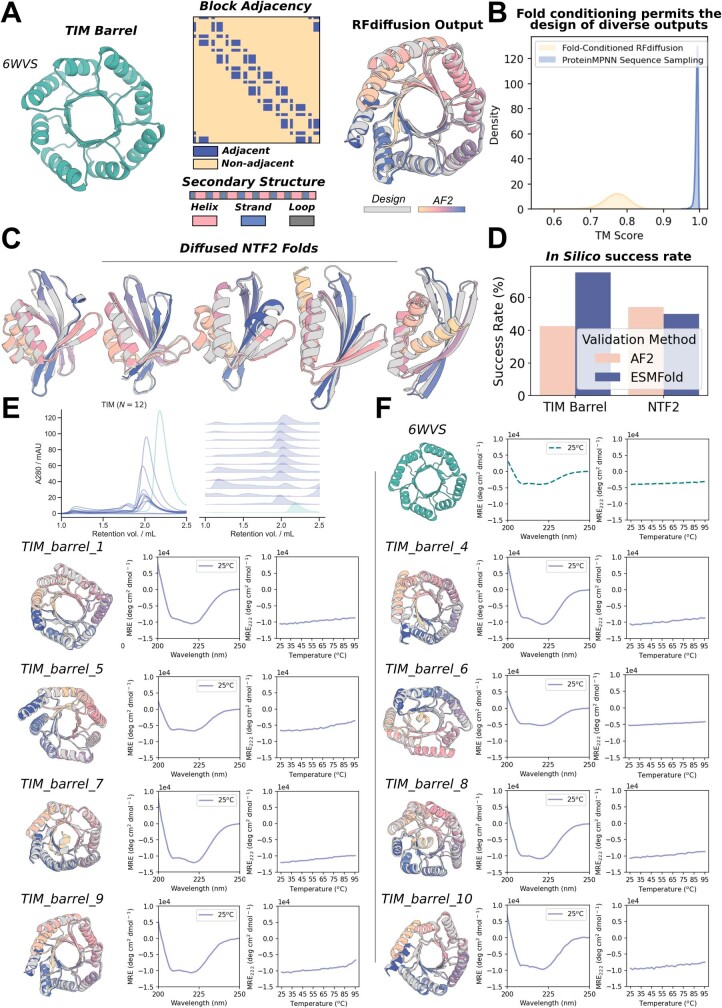
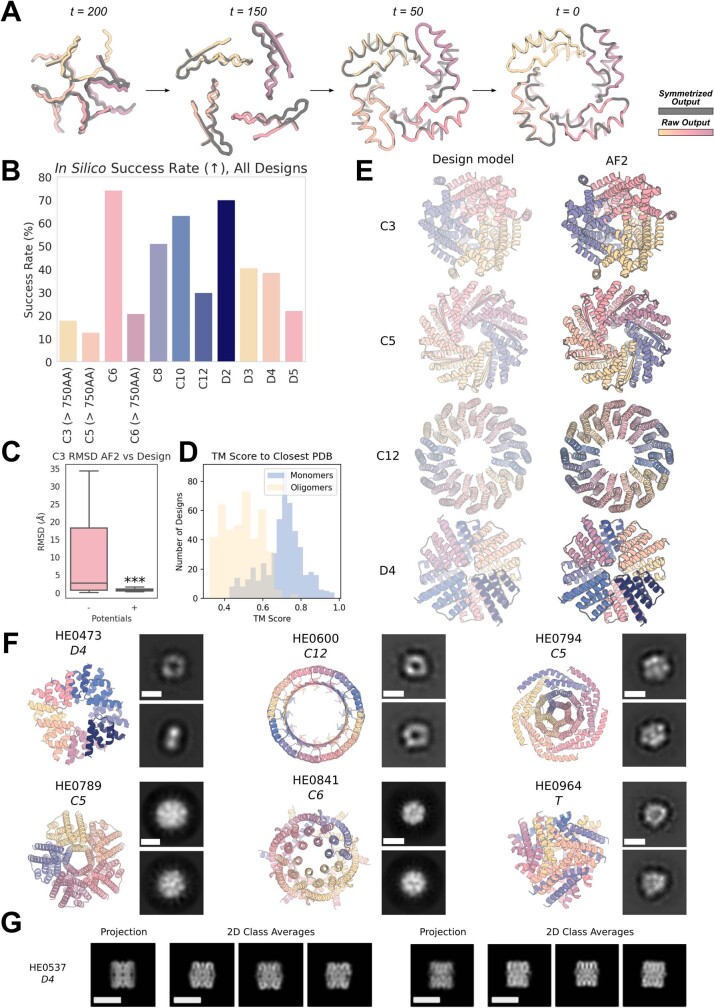
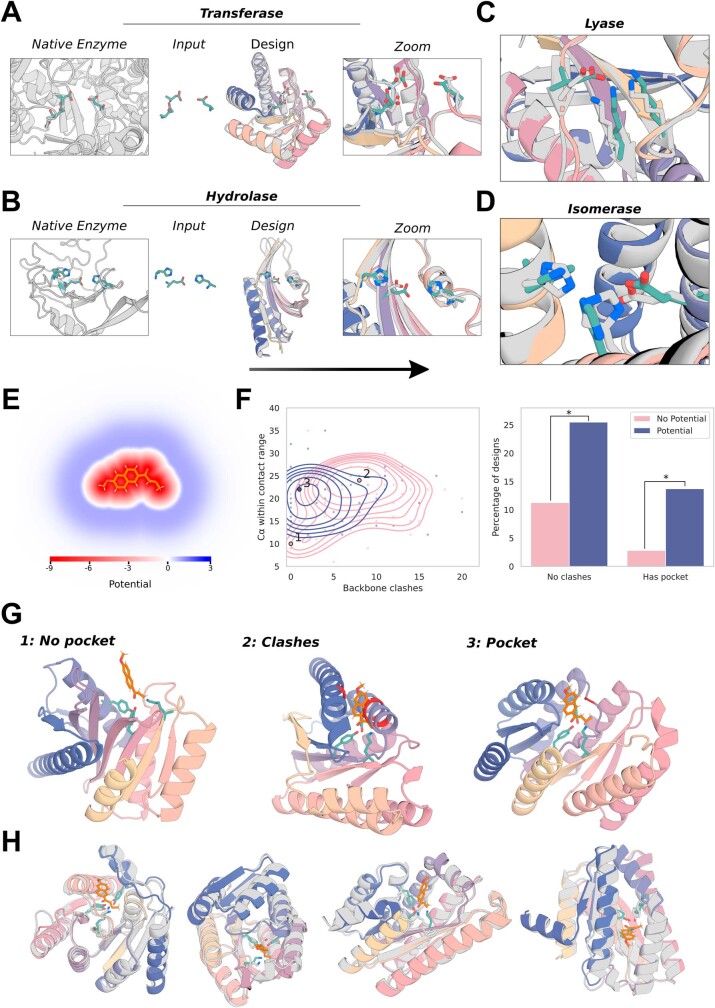
Verification
Claims the paper makes
17 Valid · 4 Not valid · 3 Not checked · 113 Own results and interpretations
Some cited sources support this claim and some don’t — read each source’s verdict below.
In the paper
“Recent work has adapted DDPMs for protein monomer design by conditioning on small protein ‘motifs’5,9 or on secondary structure and block-adjacency (‘fold’) information8.”
§ De novo design of protein structure and function with RFdiffusion > Main
What the sources say
- Supportedcites [5] Trippe, B. L. et al. Diffusion probabilistic modeling of protein backbones in 3D for the motif-scaffolding problem. in The EleventhInternational Conference on Learning Representations (2023). source
The Introduction (p. 1) describes ProtDiff as a diffusion probabilistic model for protein backbones and SMCDiff as its motif-conditioned sampling procedure. The Discussion (p. 9) confirms that the procedure generates scaffolds conditioned on a motif. The secondary-structure and block-adjacency clause is attached to a different citation, so it is not attributed to this source. (LLM, conf=0.93)
- Disputedcites [9] Luo, S. et al. Antigen-specific antibody design and optimization with diffusion-based generative models. in Adv. Neural Information Processing Systems Vol. 35 (eds Koyejo, S. et al) 9754–9767 (Curran Associates, 2022). sourceExperimental — accuracy not yet measured
Section 3.1 (page unavailable) says the paper designs antibody CDRs given an antigen structure and antibody framework, not protein monomers conditioned on small motifs. The Generative Model section likewise describes a diffusion model conditioned on the antigen and antibody framework; it does not describe secondary-structure or block-adjacency conditioning. (LLM, conf=0.87)
Checked by a reasoning model — may be wrong.
- Supportedcites [8] Anand, N. & Achim, T. Protein structure and sequence generation with equivariant denoising diffusion probabilistic models. Preprint at 10.48550/arXiv.2205.15019 (2022). source
Citation 8 is attached to the secondary-structure and block-adjacency (‘fold’) conditioning, not to the motif examples cited separately. Section 2.4 (p. 5) defines those constraints, and Section 3 (p. 6) states that the diffusion model conditions on their encoded output to generate protein structures. (LLM, conf=0.94)
plain- Asserted: passes — The authors put it forward as true.
- Checkable: passes — It can be checked against evidence.
- Load-bearing: unclear — It is unclear whether the paper’s conclusions depend on it.
- Based: passes — The paper gives a reason why it holds.
- Supported
The cited sources support only part of this claim — read each source’s verdict below.
In the paper
“Self-conditioning within RFdiffusion notably improved performance on in silico benchmarks encompassing both conditional and unconditional protein design tasks (Fig. 2e and Extended Data Fig. 1e).”
§ De novo design of protein structure and function with RFdiffusion > Main
What the sources say
- Partly supportedcites [25] Chen, T., Zhang, R. & Hinton, G. Analog bits: generating discrete data using diffusion models with self-conditioning. in The Eleventh International Conference on Learning Representations (2023). sourceExperimental — accuracy not yet measured
The Discrete Image Generation section (pp. 6–7) reports that self-conditioning improved results for image diffusion models. It does not report RFdiffusion results or in silico benchmarks for conditional and unconditional protein design, so the claimed improvement in that setting is not supported by this source. (LLM, conf=0.86)
plainstates a cause- Asserted: passes — The authors put it forward as true.
- Checkable: passes — It can be checked against evidence.
- Load-bearing: passes — The paper’s conclusions depend on it.
- Based: passes — The paper gives a reason why it holds.
- Partly supported
The cited sources support only part of this claim — read each source’s verdict below.
In the paper
“Experimental characterization showed that the method can scaffold a wide range of protein functional motifs with atomic accuracy19”
§ De novo design of protein structure and function with RFdiffusion > Main
What the sources say
- Partly supportedcites [4] Wang J Scaffolding protein functional sites using deep learning Science 2022 377 387 394 10.1126/science.abn2100 35862514 PMC9621694 sourceExperimental — accuracy not yet measured
The 'Generalized functional motif scaffolding' section reports designs spanning a wide range of motifs and says their activities were assessed experimentally. But its sub-angstrom motif accuracy is based on AlphaFold predictions, not experimental structural measurements; the sentence overstates what the experimental characterization established. (LLM, conf=0.88)
- Partly supportedcites [19] Watson, J. L., Bera, A., Juergens, D., Wang, J. & Baker, D. X-ray crystallographic validation of design from this paper. Science377, 387–394 (2022). sourceExperimental — accuracy not yet measured
The section “Generalized functional motif scaffolding by missing information recovery” (page unavailable) reports designs spanning a wide range of motifs, with motif RMSD typically below 1 Å in AlphaFold predictions. It separately reports experimental tests of the designs’ activities; those tests do not establish atomic structural accuracy. The paper also attributes the broad set of designs to both inpainting and constrained hallucination, rather than RFjoint inpainting alone. (LLM, conf=0.87)
plainstates a cause- Asserted: passes — The authors put it forward as true.
- Checkable: passes — It can be checked against evidence.
- Load-bearing: passes — The paper’s conclusions depend on it.
- Based: passes — The paper gives a reason why it holds.
- Partly supported
The cited sources support only part of this claim — read each source’s verdict below.
In the paper
“we established an in silico benchmark test (Supplementary Table 9) comprising 25 motif-scaffolding design problems addressed in six recent publications encompassing several design methodologies4,5,29,38–40”
§ De novo design of protein structure and function with RFdiffusion > Functional-motif scaffolding
What the sources say
- Could not verifycites [4] Wang J Scaffolding protein functional sites using deep learning Science 2022 377 387 394 10.1126/science.abn2100 35862514 PMC9621694 sourceExperimental — accuracy not yet measured
The 'Generalized functional motif scaffolding by missing information recovery' section describes in silico evaluation of the paper’s own designs, but does not describe establishing a benchmark of 25 problems drawn from six publications. Searches for the benchmark, the numbers, and Supplementary Table 9 found no passage in our copy that verifies those details. (LLM, conf=0.74)
- Supportedcites [5] Trippe, B. L. et al. Diffusion probabilistic modeling of protein backbones in 3D for the motif-scaffolding problem. in The EleventhInternational Conference on Learning Representations (2023). source
Section 5.2 (p. 7) reports motif-scaffolding tests using motifs from proteins 6exz and 5trv; Appendix H.1 (p. 24) describes another target, 5tpn. This supports citing the paper as one of the publications that addressed motif-scaffolding design problems. The citing authors describe the 25-problem benchmark as their own, not as something established by this source. (LLM, conf=0.88)
- Supportedcites [29] Lee, J. S. & Kim, P. M. ProteinSGM: Score-based generative modeling for de novo protein design. Preprint at bioRxiv10.1101/2022.07.13.499967 (2022). source
The citation identifies one of the publications whose design methodology informed the citing authors’ benchmark; it does not attribute the establishment of the 25-problem benchmark to ProteinSGM. In “Conditional generation” (page unavailable), ProteinSGM presents scaffold-inpainting design cases, including generation of scaffolds around the barstar functional site. (LLM, conf=0.88)
- Supportedcites [38] Sesterhenn F De novo protein design enables the precise induction of RSV-neutralizing antibodies Science 2020 368 eaay5051 10.1126/science.aay5051 32409444 PMC7391827 source
The citation identifies this paper as one of the motif-scaffolding publications used to assemble the citing authors’ benchmark; the benchmark’s size and establishment are the citing authors’ own statements. The Results section (page unavailable) describes TopoBuilder as a protocol for designing protein topologies around functional motifs, so the paper fits that role. (LLM, conf=0.88)
- Not checked — no full text of the sourcecites [39] Yang C Bottom-up de novo design of functional proteins with complex structural features Nat. Chem. Biol. 2021 17 492 500 10.1038/s41589-020-00699-x 33398169 source
- Partly supportedcites [40] Glasgow A Engineered ACE2 receptor traps potently neutralize SARS-CoV-2 Proc. Natl Acad. Sci. USA 2020 117 28046 28055 10.1073/pnas.2016093117 33093202 PMC7668070 sourceExperimental — accuracy not yet measured
The Results and Materials and Methods describe computational redesign of the ACE2–spike binding interface, so this is a publication addressing a protein-design problem. Our copy does not describe that work as motif scaffolding. The benchmark of 25 problems is the citing authors’ own work, not a finding attributed to this source. (LLM, conf=0.78)
plain- Asserted: passes — The authors put it forward as true.
- Checkable: passes — It can be checked against evidence.
- Load-bearing: passes — The paper’s conclusions depend on it.
- Based: passes — The paper gives a reason why it holds.
- Could not verify
Every source the paper cites for this claim was checked and supports it.
In the paper
“Vázquez Torres et al. demonstrate the ability of RFdiffusion to design picomolar affinity binders to flexible helical peptides54”
§ De novo design of protein structure and function with RFdiffusion > Discussion
What the sources say
- Supportedcites [54] Torres, S. V. et al. De novo design of high-affinity protein binders to bioactive helical peptides. Preprint at bioRxiv10.1101/2022.12.10.519862 (2022). source
The Peptide binder design with RFdiffusion section reports de novo RFdiffusion binders to the helical peptides Bim and PTH, with an estimated affinity of ~100 pM for Bim and an upper bound of 500 pM for PTH. The Main section explains that peptide targets are often partially or entirely unstructured in isolation, supporting the description of them as flexible. (LLM, conf=0.94)
boostedstates a cause- Asserted: passes — The authors put it forward as true.
- Checkable: passes — It can be checked against evidence.
- Load-bearing: unclear — It is unclear whether the paper’s conclusions depend on it.
- Based: passes — The paper gives a reason why it holds.
- Supported
82 more claims · 7 with their cited sources checked
Create a free account to see all 137 claims and every source verdict.
- It may state two separate claims as one. 48
- Probably not a substantial claim. 3
- The quote only partly states this claim. 1
Claims other papers make about this one
Each is checked against this paper’s own text: does it say what the citing paper says it does?
The source backs part of the claim, not all of it — or backs it for a different population, condition or comparison.
In the citing paper
“We also use Evo to generate genome-scale sequences with plausible high-level architecture more than1 megabase (Mb) in length, a scale that is orders of magnitude greater than previous methods (10, 13, 14).”
From Sequence modeling and design from molecular to genome scale with Evo (2024) · cites this paper as [10]
Experimental — accuracy not yet measured
Self-check
Percentages, sums and reported differences re-computed from the paper’s own numbers.
Each contradiction between two passages listed here was confirmed by an independent check.
Rated minor: it would not touch a result — a value no result rests on, a p-value that stays on the same side of the significance level, or a conflict that is clerical, resolved elsewhere in the paper, or outside its own findings.
In the paper
§ De novo design of protein structure and function with RFdiffusion > Functional-motif scaffolding
“e, Out of 95 designs, 55 showed binding to MDM2 (more than 50% of maximum response).”
§ De novo design of protein structure and function with RFdiffusion > Functional-motif scaffolding
“The overall success rate was quite high: out of the 96 designs, 55 showed some detectable binding at 10 μM (Fig. 4e and Supplementary Fig. 10h).”
Citations
Cites
Highly accurate protein structure prediction with AlphaFold
Jumper, J., Evans, R., Pritzel, A., Green, T., Figurnov, M., Ronneberger, O., Tunyasuvunakool, K., Bates, R., Žídek, A., Potapenko, A., et al. (2021) · Nature · doi:10.1038/s41586-021-03819-2 · Cited by 43,764
Berman, H. M. (2000) · Nucleic Acids Research · doi:10.1093/nar/28.1.235 · Cited by 40,196
Denoising Diffusion Probabilistic Models
Ho, J., Jain, A., & Abbeel, P. (2020) · arXiv · doi:10.48550/arxiv.2006.11239 · Cited by 8,712
Evolutionary-scale prediction of atomic level protein structure with a language model
Lin, Z., Akin, H., Rao, R., Hie, B., Zhu, Z., Lu, W., Smetanin, N., Verkuil, R., Kabeli, O., Shmueli, Y., et al. (2022) · doi:10.1101/2022.07.20.500902 · Cited by 5,990
Accurate prediction of protein structures and interactions using a 3-track network
Baek, M., DiMaio, F., Anishchenko, I., Dauparas, J., Ovchinnikov, S., Lee, G. R., Wang, J., Cong, Q., Kinch, L. N., Schaeffer, R. D., et al. (2021) · doi:10.1101/2021.06.14.448402 · Cited by 5,549
Self-citationDeep Unsupervised Learning using Nonequilibrium Thermodynamics
Sohl-Dickstein, J., Weiss, E. A., Maheswaranathan, N., & Ganguli, S. (2015) · arXiv · doi:10.48550/arxiv.1503.03585 · Cited by 2,637
Zero-shot text-to-image generation
Ramesh, A., Pavlov, M., Goh, G., Gray, S., Voss, C., Radford, A., Chen, M., & Sutskever, I. (2021) · arXiv · doi:10.48550/arxiv.2102.12092 · Cited by 2,417
THEORY OF PROTEIN FOLDING: The Energy Landscape Perspective
Onuchic, J. N., Luthey-Schulten, Z., & Wolynes, P. G. (1997) · Annual Review of Physical Chemistry · doi:10.1146/annurev.physchem.48.1.545 · Cited by 2,210
Robust deep learning–based protein sequence design using ProteinMPNN
Dauparas, J., Anishchenko, I., Bennett, N., Bai, H., Ragotte, R. J., Milles, L. F., Wicky, B. I. M., Courbet, A., de Haas, R. J., Bethel, N., et al. (2022) · Science · doi:10.1126/science.add2187 · Cited by 2,210 · cited 6×
“We explored two different strategies for training RFdiffusion: (1) in a manner akin to ‘canonical’ diffusion models, with predictions at each timestep independent of predictions at previous timesteps (as in previous work(5,8,9,16)), and (2) with self-conditioning(25), in which the model can condition on previous predi…”
InfluentialSelf-citationStructure of the MDM2 Oncoprotein Bound to the p53 Tumor Suppressor Transactivation Domain
Kussie, P. H., Gorina, S., Marechal, V., Elenbaas, B., Moreau, J., Levine, A. J., & Pavletich, N. P. (1996) · Science · doi:10.1126/science.274.5289.948 · Cited by 2,206
Research works printed but not linked: 1
- Watson, J. L., Bera, A., Juergens, D., Wang, J. & Baker, D. X-ray crystallographic validation of design from this paper. Science377, 387–394 (2022). · DOI · Paper page
Cited by
Items 1,501–1,600 of 2,479
Luzik, D. A., & Skrynnikov, N. R. (2025) · Proteins Structure Function and Bioinformatics · doi:10.1002/prot.70050 · Cited by 1
Alternate Geometric and Semantic Denoising Diffusion for Protein Inverse Folding
Wang, C., Zhou, Y., Wang, Z., Zhai, Z., Shen, J., & Zhang, K. (2025) · Lecture notes in computer science · doi:10.1007/978-3-032-06066-2_21 · Cited by 7
Gaillard, T. (2025) · The Journal of Physical Chemistry B · doi:10.1021/acs.jpcb.5c03662 · Cited by 1
Automated Deep Learning‐Based Pipelines for Multi‐Objective De Novo Protein Design
Nallathambi, A., & Kuhlman, B. A. (2025) · Current Protocols · doi:10.1002/cpz1.70208 · Cited by 2
“This integrated approach has demonstrated effectiveness in creating protein binders for diverse targets, with notable improvements in success rates compared to earlier techniques (Bennett et al., 2023; Watson et al., 2023).”
InfluentialProtein language model supervised motif-scaffolding design with GPDL
Zhang, B., Liu, K., Zheng, Z., Zhu, J., Li, Z., Liu, Y., Mu, J., Wei, T., & Chen, H. (2025) · International Journal of Biological Macromolecules · doi:10.1016/j.ijbiomac.2025.148441 · Cited by 4
Michielsen, C. M. S., Yan, J., Bergkamp, M. H., Lin, Y., Haenen, S. R. R., Lubken, R. M., Gräwe, A., Świetlikowska, A., de Jong, A. M., & Prins, M. W. J. (2025) · Angewandte Chemie · doi:10.1002/ange.202517725 · Cited by 1
Rewiring microbial metabolism through post-translational switches
Xu, X., Yang, L., Liu, J., Lv, X., & Liu, L. (2025) · Trends in biotechnology · doi:10.1016/j.tibtech.2025.10.002 · Cited by 3
Shaker, B., & Barakat, K. (2025) · Biomedical engineering · doi:10.5772/intechopen.1012747 · Cited by 2
Design of Specific Peptide Inhibitors of Toxin-Antitoxin-Mediated Antiphage Defense
Ghose, D. A., Swanson, S., Birnbaum, F., Britton, D., Gan, J. L., Mahoney, E. M., Laub, M. T., & Keating, A. E. (2025) · ACS Synthetic Biology · doi:10.1021/acssynbio.5c00498 · Cited by 2
Computational cyclic peptide design machine learning & Rosetta based methods
Sarmeili, F., Siegler, H., Powers, A. C., & Hosseinzadeh, P. (2025) · Methods in enzymology on CD-ROM/Methods in enzymology · doi:10.1016/bs.mie.2025.09.016 · Cited by 1
Wat, J. H., West, T., Pizzala, N. J., Alvarez, S., Wang, Y., Chen, M., & Reppert, M. (2025) · The Journal of Physical Chemistry B · doi:10.1021/acs.jpcb.5c06200 · Cited by 1
Abdulrahman, N. B., Ahmed, N. M., & Suleiman, A. A. (2025) · The Open Biotechnology Journal · doi:10.2174/0118740707424062251028072626 · Cited by 1
Yun, J., Yang, S., Kwon, J. H., Vecchietti, L. F., Choi, J. H., Choi, M., Ku, K. B., Ro, H., Kim, K., Cha, M., et al. (2025) · Advanced Science · doi:10.1002/advs.202506764 · Cited by 1
Chew, S. B., Harjabrata, E., Goh, C., & Ong, Q. (2025) · Biotechnology Advances · doi:10.1016/j.biotechadv.2025.108761 · Cited by 1
Artificial intelligence in structural biology: Preface
Phillips, G. N., Jr., & Carter, C. W. (2025) · Structural Dynamics · doi:10.1063/4.0001198 · Cited by 1
Energy landscapes in protein folding
Contessoto, V. G., & Onuchic, J. N. (2025) · Elsevier eBooks · doi:10.1016/b978-0-323-99507-8.00025-1 · Cited by 1
Azurin-based peptide p28 disrupts p53–HDM2 interactions: insights from in silico studies
Joy, A., Srivastava, A. K., & Biswas, R. (2026) · Physical Chemistry Chemical Physics · doi:10.1039/d5cp02358k · Cited by 1
Soft Robotic Sim2Real via Conditional Flow Matching
Shi, G., Wang, X., Farinha, A. T., Pinskier, J., Shen, X., Scalzo, R. A., & Howard, D. (2025) · Advanced Intelligent Systems · doi:10.1002/aisy.202500690 · Cited by 3
Synthetic protein strategies for modulating ethylene pathways in crops and postharvest systems
Durojaye, O. A., Gonlepa, M. K., Ofuonye, C. G., & Osotuyi, T. B. (2025) · Discover Plants. · doi:10.1007/s44372-025-00449-0 · Cited by 1
“A critical challenge in de novo design lies in the creation of functional sites, particularly binding pockets capable of recognizing small molecules or stabilizing transition states with high specificity [62].”
HuAbDiffusion: a discrete language diffusion model used for antibody humanization
Liu, D., Hao, X., & Fan, L. (2025) · Briefings in Bioinformatics · doi:10.1093/bib/bbaf658 · Cited by 3
Machine Learning Approaches for Interpretable Antibody Property Prediction Using Structural Data
Michalewicz, K., Barahona, M., & Bravi, B. (2026) · Methods in molecular biology · doi:10.1007/978-1-0716-5408-8_7 · Cited by 2
“[21, 22, 71, 72] learn state and pair embeddings, which correspond to per-residue and residue-residue properties of the protein structure, respectively (see Figure 2B).”
Dynamics-informed RFdiffusion for de novo design of binders against the KRAS conformational ensemble
Kırboğa, K. K. (2025) · Journal of Biomolecular Structure and Dynamics · doi:10.1080/07391102.2025.2609688 · Cited by 1
“These methods produce results with atomic-level precision, even in the design of complex molecules like antibodies, heralding a new era for rational protein engineering (Qin et al., 2025; Watson et al., 2023).”
Application and progress of artificial intelligence agents in drug development
Zhao, D., & Hsieh, C. (2026) · Journal of Zhejiang University (Medical Sciences) · doi:10.3724/zdxbyxb-2025-0697 · Cited by 2
AutoLoop is an autoregressive deep learning method for protein loop prediction with high accuracy
Wang, T., Zhang, X., Wang, L., Zhang, O., Wang, J., Wang, E., Wu, J., Hu, R., Ge, J., Li, S., et al. (2026) · Cell Reports Physical Science · doi:10.1016/j.xcrp.2025.103041 · Cited by 1
Self-citationMulti-objective optimization for designing structurally similar proteins with dissimilar sequences
Akiba, R., Moriwaki, Y., Ishitani, R., & Yoshikawa, N. (2026) · Science and Technology of Advanced Materials: Methods · doi:10.1080/27660400.2025.2611575 · Cited by 1
SLIT2 as a key regulator and therapeutic target in liver injury
Choi, Y. W., Choi, J. H., Lee, Y.-S., Jeong, J., Kang, E., Park, S. H., Lee, Y., Park, S. S., Kang, H. Y., Kim, Y. H., et al. (2026) · Molecular Therapy · doi:10.1016/j.ymthe.2026.01.010 · Cited by 1
The modular evolution of chitinases is governed by coevolution of auxiliary and catalytic domains
Pulsford, S. B., Dalton, J. A. T., Smith, O. B., Horton, J., Frkic, R. L., Chen, J. Z., Kaczmarski, J. A., & Jackson, C. J. (2026) · Nature Communications · doi:10.64898/2026.01.15.699799 · Cited by 2
Precision Editing of NLRS Improves Effector Recognition for Enhanced Disease Resistance
Kumar, V., Kumara, V. I. P. W. A., Bandaranayake, P. C. G., Yawen, D., Gao, Y., Liu, J., Hao, G., & Xin, X. (2026) · Advanced Science · doi:10.1002/advs.202511685 · Cited by 1
“Inpainting computationally scaffolds viable protein architectures around recognition domains with minimal structural distortion [ 171 ].”
How to address the anode dilemma and explore future prospects of microbial fuel cells
Liu, W., Zhou, Y., Yang, T., Xu, X., Lin, J., Zheng, Y., Guo, M., Huang, Y., Xie, Y., Liu, H., et al. (2026) · Renewable and Sustainable Energy Reviews · doi:10.1016/j.rser.2026.116745 · Cited by 2
Energy-driven innovations in computational de novo protein engineering
Kırboğa, K. K., & Küçüksille, E. U. (2026) · Progress in Biophysics and Molecular Biology · doi:10.1016/j.pbiomolbio.2026.01.005 · Cited by 1
Kırboğa, K. K., & Küçüksille, E. U. (2026) · Proteins Structure Function and Bioinformatics · doi:10.1002/prot.70114 · Cited by 1
“1.0 [29], one of the state- of- the-art deep learning (DL) models for de novo protein design.”
InfluentialModelCIF Update: Supporting Emerging Classes of Computational Macromolecular Models
Tauriello, G., Lill, Y., Sgrignani, J., Zoete, V., Singer, B., Vallat, B. K., Webb, B., Garello, T., Bienert, S., Feig, M., et al. (2026) · Journal of Molecular Biology · doi:10.1016/j.jmb.2026.169658 · Cited by 1
“Current protein design pipelines consist of the following in silico steps [6]: backbone generation [30–32]; inverse folding or sequence generation [33,34]; and validation, where protein structure prediction methods are mainly used to judge and rank the designs structurally [19,22,23].”
A stabilized tandem antigen chimera that elicits potent malaria transmission-reducing activity
Ivanochko, D., Miura, K., Hailemariam, S., Ravichandran, R., Song, Y., Huang, W., Stoter, R., Teelen, K., van Gemert, G., Leaf, E. M., et al. (2026) · Nature Communications · doi:10.1038/s41467-026-68761-1 · Cited by 1
“For Pfs48/45, two recent studies leveraged structural insights from D3 bound to the highly potent mAb TB31F to rationally design stabilizing mutations that conferred enhanced biochemical tractability, leading to increased potency of the antibody response in preclinical studies 42,43 .”
Wei, S., Zhang, J., Chen, Y., Tang, C., & Tan, J. (2026) · Bioinformatics · doi:10.1093/bioinformatics/btag042 · Cited by 3
“RFdiffusion (Watson et al. 2023) generated protein structures via a reverse denoising process grounded in diffusion model principles.”
THFlow: A Temporally Hierarchical Flow Matching Framework for 3D Peptide Design
黄登登, & Tu, S. (2025) · IEEE International Conference on Bioinformatics and Biomedicine (BIBM) · doi:10.1109/bibm66473.2025.11356413 · Cited by 1
“More recently, dynamic models such as diffusion and flow matching have gained prominence, simulating the physical docking process by generating trajectories for a peptide’s movement via time-dependent vector fields [5], [6].”
Design of novel enzymes with the incorporation of noncanonical amino acids
Cheng, L., Yang, L., Song, Z., & Yu, H. (2026) · Critical Reviews in Biotechnology · doi:10.1080/07388551.2025.2612060 · Cited by 1
“Furthermore, models such as Chroma and RFdiffusion specifically address the motif-to-scaffold challenge in protein design [14,113].”
QO-BRA: A Quantum Operator-Based Autoencoder for De Novo Molecular Design
Yu, Y., Calcagno, F., Li, H., & Batista, V. S. (2026) · Journal of Chemical Theory and Computation · doi:10.1021/acs.jctc.5c01704 · Cited by 1
AlphaFold2 ‐Guided Cyclic Peptide Stabilizer Design to Target Protein–Protein Interactions
Halbwedl, N., & Zacharias, M. (2026) · Proteins Structure Function and Bioinformatics · doi:10.1002/prot.70123 · Cited by 1
“Significant progress has been recently achieved in designing new protein and peptide binders employing AI-based structure and sequence prediction methods [14, 15, 18, 27, 65, 66].”
Unlocking the undruggable spliceosome: generative AI and structural dynamics in cancer therapy
Steuer, J., & Kahraman, A. (2026) · Frontiers in Cell and Developmental Biology · doi:10.3389/fcell.2026.1774239 · Cited by 1
“The recently introduced RFDpoly (RoseTTAFold Diffusion for Biopolymers) (Favor et al., 2025) addresses this gap, building on the RFdiffusion model to enable the simultaneous hallucination of nucleic acid backbones and protein binders (Watson et al., 2023).”
Bridging structure and function: artificial intelligence-based modelling of kidney proteins
Wu, S., Wang, W., Zhou, Z. H., Scalzo, F., & Kurtz, I. (2026) · Nature Reviews Nephrology · doi:10.1038/s41581-026-01060-6 · Cited by 1
“Its diffusion-based module, RFdiffusion, can design novel proteins and protein binders from scratch, and can be conditioned on functional motifs (for example, metal-binding or other predefined interaction motifs) during backbone generation 84 .”
Agile legged locomotion in reconfigurable modular robots
Yu, C., Matthews, D., Wang, J., Gu, J., Blackiston, D. J., Rubenstein, M., & Kriegman, S. (2026) · Proceedings of the National Academy of Sciences · doi:10.1073/pnas.2519129123 · Cited by 8
“This reconstruction loss may be partly due to the relatively simple nature of employed encoding, which could be improved to enable the system to generate a broader range of designs (49).”
Self-citationZhang, X. Y., Yao, Y., Zhang, L., Ye, W. A. N. G., Zhang, X., Duan, L., Shang, Y., & Ma, Y. (2026) · Bioresource Technology · doi:10.1016/j.biortech.2026.134364 · Cited by 1
Chen, S., Chen, Y., Zhang, Y., Yao, G., Cai, H., Chen, X., & Hu, Y. (2026) · Human Vaccines & Immunotherapeutics · doi:10.1080/21645515.2026.2639177 · Cited by 1
“For example, generative models like RFdiffusion 52,53 or other AI-driven protein design tools can be guided by these structural blueprints to generate de novo TNFR2-targeting antibodies or peptides with high affinity and desired agonistic or antagonistic activity.”
Manufacturing-aware generative models enable petascale synthesis of designed DNA
Weinstein, E. N., Gollub, M. G., Slabodkin, A., Dobbs, K., Cui, X.-B., Gardner, C. L., Grant, R. J., Gurung, K., Bailey, A., Amin, A. N., et al. (2026) · Nature Biotechnology · doi:10.1038/s41587-026-03020-8 · Cited by 5
Redesigning myoglobin via functional site scaffolding for enhanced catalytic functions
Zha, Z., Wang, Y., Teng, C., Xue, H., Su, B., Wang, H., Yu, Y., & Li, C. (2026) · Biochemical and Biophysical Research Communications · doi:10.1016/j.bbrc.2026.153642 · Cited by 1
De Novo Protein Design Enables Targeting of Intractable Oncogenic Protein–Protein Interfaces
Prakash, V., Najy, Y., Garrett, K., Edwards, B. F. P., & Kidder, B. L. (2026) · Biologics · doi:10.3390/biologics6010009 · Cited by 1
“RFdiffusion generates backbones that satisfy functional constraints while sampling diverse topologies, supporting binder, oligomer, and motif-scaffolding applications within a unified framework [25].”
Chemical biology approaches to study and target circadian clocks and their components
Rivera‐Iglesias, E. F., Elanany, M. A., & Farkas, M. E. (2026) · FEBS Letters · doi:10.1002/1873-3468.70330 · Cited by 2
“For instance, protein structures modeled with A LPHA F OLD [433] can be coupled with tools such as REINVENT 4 [434] for design and optimization of novel hits.”
Hemoglobin-based oxygen carrier: what we have learned and where we are heading?
Xiao, H., & Xia, W. (2026) · Protein & Cell · doi:10.1093/procel/pwag019 · Cited by 1
Evolutionary Assembly and Future Design of Gibberellin Signaling
Fan, W., Chen, X., Li, D., Gao, X., & Fu, X. (2026) · Advanced Science · doi:10.1002/advs.75049 · Cited by 1
“Generative approaches, including RFdiffusion and ProteinMPNN, further permit backbone generation or sequence optimization under defined structural constraints [ 12, 13 ].”
Rationally designed peptides relieve ischemic stroke by targeting TRPM2 intramolecular interactions
Yao, J., You, Q., Liu, X., Zhen, W., Fang, M., Luo, Y., Wu, J., Mai, Z., Yu, P., Yang, F., et al. (2026) · Pharmacological Research · doi:10.1016/j.phrs.2026.108180 · Cited by 1
Leveraging Auxiliary Potentials in RFDiffusion for the Design of NA-Binding Proteins
Geraseva, E., Bokov, G. V., Polovnikov, V., & Golovin, A. V. (2026) · Journal of Chemical Information and Modeling · doi:10.1021/acs.jcim.6c00109 · Cited by 1
AI-Driven De Novo Binder Design: From Structure Prediction to Closed-Loop Optimization
Li, X., Fan, Z., Yang, J., Jiang, R., Cao, F., Li, J., Xie, D., Meng, X., Sun, M., & Wang, L. (2026) · Computational and Structural Biotechnology Journal · doi:10.34133/csbj.0070 · Cited by 1
“Diffusion models, in particular, sample from a probability distribution over backbones that satisfy user-specified constraints, thereby dramatically expanding the accessible topology and interface-shape space [ 12 , 19 ].”
InfluentialFujinami, D., Ozawa, H., & Ito, S. (2026) · Chemistry - A European Journal · doi:10.1002/chem.70995 · Cited by 2
Shi, N., Wang, J., Xu, C., Jiang, X., Ren, C., Gao, X., & Luo, L. (2026) · ACS Pharmacology & Translational Science · doi:10.1021/acsptsci.6c00130 · Cited by 1
Self-citationFast and Distributed Equivariant Graph Neural Networks by Virtual Node Learning
Zhang, Y., Cen, J., Han, J., & Huang, W. (2026) · IEEE Transactions on Pattern Analysis and Machine Intelligence · doi:10.1109/tpami.2026.3684569 · Cited by 8
“In recent years, equivariant GNNs have achieved remarkable success in scientific applications, including physical dynamics simulation [11], [12], protein generation [13], [14], and many others.”
Progresses and trends in bio-manufacturing driven by artificial intelligence
Jiang, Y., Yang, L., Qiong, W. A. N. G., Liu, X., & Mao, K.-Y. (2026) · Shengming kexue · doi:10.3724/cbls.2026036 · Cited by 1
Advances in generative biology and bio-inspired artificial intelligence
Wen-Ye, Z. E. N. G., ZHENG, S.-Y., Xiao-Qin, Z. H. A. O., Zhu, W. A. N. G., ZHANG, Y.-J., & Zheng-Yuan, M. A. (2026) · Shengming kexue · doi:10.3724/cbls.2026038 · Cited by 2
Rahimzadeh, F., Khanli, L. M., Salehpour, P., & Golabi, F. (2026) · Expert Systems with Applications · doi:10.1016/j.eswa.2026.132559 · Cited by 1
Improving protein-ligand complex generation with force field guidance
Lai, H., Wang, T., Sirelkhatim, H., Eaton, J., Huang, H., Rees, B., Engkvist, O., Janet, J. P., Wang, X., & Tibo, A. (2026) · Journal of Cheminformatics · doi:10.1186/s13321-026-01198-2 · Cited by 1
“A related line of work is represented by RFdiffusion, adopts a more comprehensive conditioning framework that supports multiple types of constraints, including symmetry specification, motif scaffolding, binding target interactions, and topology-constrained design [44].”
Ueno, T., Minagawa, Y., Okada, Y., & Noji, H. (2026) · Nucleic Acids Research · doi:10.1093/nar/gkag431 · Cited by 2
“Deep learning-based protein design technologies have made remarkable progress, enabling the rapid generation of protein sequences with desired functions [ 1–3 ].”
Using generative AI to transform peptide hits into small molecule leads
Mills, J., & Lau, Y. H. (2026) · Beilstein Journal of Organic Chemistry · doi:10.3762/bjoc.22.51 · Cited by 1
The Significance of Angiopoietin Valency in Vascular Health and Disease
Zhao, Y. T., Ehnes, D. D., Mathieu, J., & Ruohola‐Baker, H. (2026) · Cells · doi:10.3390/cells15090820 · Cited by 3
“Artificial intelligence using RF diffusion has successfully generated fully synthetic de novo-designed binders [67,68].”
Wang, E., Kang, Y., Chen, D., Tian, R., Hu, Y., Wang, H., Liu, J., Zhou, Z., Tian, T., Xu, H., et al. (2026) · Biochemical Pharmacology · doi:10.1016/j.bcp.2026.118026 · Cited by 1
Patel, K., Ajith, R., Thapa, S., Adhikari, S., Tanveer, M., & Naseem, U. (2026) · Neural Networks · doi:10.1016/j.neunet.2026.109073 · Cited by 1
Discovery and engineering of polymerases and ligases for the synthesis of modified nucleic acids
Malca, S. H., Stockinger, P., Estévez‐Gay, M., & Buller, R. (2026) · Current Opinion in Chemical Biology · doi:10.1016/j.cbpa.2026.102697 · Cited by 4
The Shape of Things to Come: α-Helical Membrane Protein Folding on the Ribosome
Lambden, E., Lewis, B. R., Baker, Z. L. R., Dilworth, M. V., Johnston, E. C., Palacios‐Ortega, J., Patel, K., Pilkington, C. P., Findlay, H. E., Booth, P. J., et al. (2026) · Chemical Reviews · doi:10.1021/acs.chemrev.6c00236 · Cited by 1
The evolution of display technologies for antibody drug discovery
Rojo-Gallegos, J., Tang, J. Q., Yarmarkovich, M., & DeKosky, B. J. (2026) · Trends in biotechnology · doi:10.1016/j.tibtech.2026.04.021 · Cited by 2
Shi, N., Ren, C., Zhang, L., Wang, L., Wang, L., Li, X., Zhou, Y., Wang, J., Zhao, P., Yao, C., et al. (2026) · Research · doi:10.34133/research.1325 · Cited by 2
“On one hand, diffusion models (e.g., RFdiffusion and BindCraft) have revolutionized de novo design by rapidly exploring vast sequence spaces to generate novel binding interfaces [ 31 , 35 ].”
Self-citationDeep learning mechanism and its application in biomacromolecules
Li, H., Zhang, G., Yan, B., Ye, Z. P., Zhen, X., & Liu, Y. (2026) · RSC Advances · doi:10.1039/d6ra00550k · Cited by 2
Du, Q., Han, Z., Zhang, Y., Li, Y., Sun, A., Wang, B., Chen, Y. Q., & Wang, X. (2026) · Journal for ImmunoTherapy of Cancer · doi:10.1136/jitc-2025-014533 · Cited by 1
“26 27 First, the designed binding partners were subsequently compared with the three-dimensional structure library of the full mouse proteome to identify proteins that might interact with GSDMD with high binding energy.”
AI‐Designed Cyclic Peptides Enable Controllable Modulation of the CD28 Immune Checkpoint
Kuncewicz, K., Upadhyay, S., Zhu, R., Duan, H., & Gabr, M. T. (2026) · Advanced Science · doi:10.1002/advs.75892 · Cited by 2
Sachdev, S., & Cheloha, R. W. (2026) · British Journal of Pharmacology · doi:10.1111/bph.70519 · Cited by 1
“…deep-learning – based structure prediction tools such as AlphaFold and RoseTTAFold have been integrated with generative design engines, including RFdiffusion, to diversity and expand binder design (Abramson et al., 2024; Adolf-Bryfogle et al., 2018; Harvey et al., 2025; Watson et al., 2023).”
AI for battery-accelerated discovery of high-voltage electrolytes for advanced lithium batteries
Zhan, Y. Z., Chen, N., Li, L., Wu, F., & Chen, R. (2026) · Chemical Society Reviews · doi:10.1039/d4cs01250j · Cited by 1
Assessment of generative de novo peptide design methods for G protein-coupled receptors
Junker, H., & Schoeder, C. T. (2026) · PLoS ONE · doi:10.1371/journal.pone.0355549 · Cited by 2
“On the other hand, generative models such as RFdiffusion [11], BindCraft [12], RFdiffusion3 [13], Chai-2 [14] or BoltzGen [15] enable the generation of entirely new proteins with atomic precision.”
AI‐Physics‐Experiment Trinity for Integrated Protein Dynamics Modeling
Chen, S. T., Low, M., Xiu, P., Lindorff‐Larsen, K., & Wang, Y. (2026) · Advanced Science · doi:10.1002/advs.76023 · Cited by 3
“…networks (GANs)) have achieved promising accuracy in key tasks including protein structure prediction, protein–protein/ligand complex modeling, conformational ensemble generation, and de novo design (e.g., RFdiffusion [ 75 ], ProteinMPNN [ 76 ], and La-Proteina [ 77 ], Odesign [ 78 ], etc.).”
Singh, S., Singh, R., & Sharma, S. (2026) · BioData Mining · doi:10.1186/s13040-026-00577-7 · Cited by 3
“Generative models, such as RFdiffusion and RoseTTAFold All-Atom, demonstrate how AI can design new proteins and binders from scratch, with many de novo designs validated experimentally by crystallography and binding measurements [95, 137].”
Yu, X., Xia, J., Wang, M., Meng, J., Meng, X., Liu, B., Dai, D., Shen, Y., Cheng, Z., & Guo, C. (2026) · Acta Biomaterialia · doi:10.1016/j.actbio.2026.06.036 · Cited by 1
Cui, A., Du, Y., & Sun, L. (2026) · International Journal of Nanomedicine · doi:10.2147/ijn.s618076 · Cited by 1
“ProteinMPNN and RFdiffusion broaden the upstream design space, 14,15 and acoustic plate-reader screening provides an experimental route for selecting pressure-responsive variants.”
Guo, L., Yan, X., Lu, Y., Nie, S., Ge, M., Li, Y., Li, W., Zhang, X., Liang, D., Zhao, Y., et al. (2026) · Angewandte Chemie International Edition · doi:10.1002/anie.7768514 · Cited by 4
Kumar, A., & Lewis, J. C. (2026) · ACS Catalysis · doi:10.1021/acscatal.6c03394 · Cited by 1
Recent advances in protein engineering and synthetic applications of amino acid oxidases
Israr, M., Basheer, F., Zhou, Y., Zeeshan, M., Ali, F., & Wu, S. (2026) · Bioresource Technology · doi:10.1016/j.biortech.2026.135229 · Cited by 4
Veselková, B., Saikia, C., Affeldt, S., Barth, S., Rajak, M. K., Besa, F., Bezbakh, D., Hansen, G., Rümenapf, T., Ballmaier, M., et al. (2026) · Journal of General Virology · doi:10.1099/jgv.0.002284 · Cited by 1
Huang, Y., Ge, R., Wu, L., Sun, Y., Wang, Z., & Cao, M. (2026) · ACS Synthetic Biology · doi:10.1021/acssynbio.6c00199 · Cited by 1
Multi-dimensional orchestration of binders for improved CAR-T immunotherapy
Zhu, C., Jiang, Z. H., Jing, R., Guo, W., & Lu, Y. (2026) · Cancer Letters · doi:10.1016/j.canlet.2026.218699 · Cited by 1
Biophysical considerations for rational antibody and ADC design
Ocaña, A., & Espinosa, J. R. (2026) · Trends Open · doi:10.1016/j.treopn.2026.05.011 · Cited by 2
“…Outstanding Questions) A key advantage of physics-based platforms is their applicability to novel ADC architectures without reliance on prior training data—in contrast to purely machine learning–based approaches, whose performance depends heavily on dataset availability and representativeness 71 .”
Precision gene editing: From proof-of-concept to curative therapies
Cui, T., Li, B., Cai, B., Wang, H., & Li, W. (2026) · Trends in Molecular Medicine · doi:10.1016/j.molmed.2026.06.004 · Cited by 1
Zhang, K., Qiu, F., Lü, A., & Liang, C. (2026) · The Innovation Drug Discovery · doi:10.59717/j.xinn-drugdisc.2026.100024 · Cited by 1
Structure‐informed engineering of plant–microbe interactions
Lin, M.-H., Lange, T., & Förderer, A. (2026) · The Plant Journal · doi:10.1111/tpj.70986 · Cited by 1
“…protein design (e.g., RFdiffusion) offer powerful routes to generate bespoke protein binders with defined interfaces, symmetries, and functions (Watson et al., 2023 Engineering plant – microbe interactions 5 of 20 NLRs, potentially enabling highly diverse and tunable recognition specificities.”
AI-Driven Protein Research: From Prediction to Design
Min, G., & Peng, H. (2026) · Methods in molecular biology · doi:10.1007/978-1-0716-5249-7_13 · Cited by 1
AI-driven biomolecular design: Modalities, models, and translation
Azmat, M., & Li, W. (2026) · Biomaterials · doi:10.1016/j.biomaterials.2026.124431 · Cited by 1
Prakinee, K., Schlautmann, L., Slotman, C., & Kiefer, A. F. (2026) · Natural Product Reports · doi:10.1039/d6np00049e · Cited by 1
From First Principles to Function: How AI Is Reshaping Enzyme Design
Lindner, S., Hardy, F. J., & Hilvert, D. (2026) · Biochemistry · doi:10.1021/acs.biochem.6c00356 · Cited by 2
Xiao, Z., Wang, W., Long, X., Zhang, W., Zhang, W., Chen, D., Xu, S., Yu, Q., Zhang, X., Huang, S., et al. (2026) · Nucleic Acids Research · doi:10.1093/nar/gkag706 · Cited by 3
“Second, while diffusion models have shown impressive denoising capabilities in protein design [ 16 ], they are rarely adopted in single-cell transcriptomics, despite their natural advantage in mitigating noise and heterogeneity that are pervasive in single-cell data.”
Huang, B., Li, J., Li, Z., Jiang, H., Yang, M., Li, X., & Niu, X. (2026) · Information · doi:10.3390/info17070708 · Cited by 1
“While our framework offers robust exploration efficiency, alternative paradigms like ProteinMPNN [8], RFdiffusion [35], and EVOLVEpro [36] excel primarily at unconstrained global topology sampling.”
De Novo Designed Porphyrin-Binding Proteins Photocatalyze the Nitrogen Reduction Reaction
Liang, Y., Hu, D., Ma, J. H., Wu, C., Ye, Y., Zhou, J., Su, R., Qi, W. D., & Wang, Y. (2026) · ACS Applied Materials & Interfaces · doi:10.1021/acsami.6c05576 · Cited by 1
Plant synthetic biology: From modular design to artificial intelligence-driven engineering
Guo, Q., Kong, C., Zhang, J., Cao, P., Fu, S., & Wang, B. (2026) · Model Organisms Research · doi:10.1016/j.mores.2026.100008 · Cited by 2
Explainable AI reveals the allosteric blind spot in protein-ligand binding predictions
Parikh, V., Foley, B., Gatlin, W., Ludwick, M., Turano, L., & Verkhivker, G. M. (2026) · Cell Reports Physical Science · doi:10.1016/j.xcrp.2026.103448 · Cited by 1
“The RFdiffusion model 11 and deep-learning (DL) protein sequence design method ProteinMPNN 43 use a protein backbone diffusion model and enable de novo design of protein binders and small-molecule scaffolds that contain a wide range of ligand-binding pockets.”
AI-Powered Synthetic Biology: Current Situation, Challenges, and Future Perspectives
Şahin, İ. O., Gökçe, N., Yildirim, D. T., Yildirim, A. B., Akalin, H., Martin, D. K., Beccari, T., Vicente, O., Radecka, I., Tchuenbou-Magaia, F. L., et al. (2026) · The EuroBiotech Journal · doi:10.2478/ebtj-2026-0015 · Cited by 1
Qian, Z., Zhou, Y.-N., Lin, R.-T., Hong, Y., Xu, Y.-N., Li, S.-P., Gao, J., Zhu, Q.-R., & Zheng, H. (2026) · Journal of Artificial Intelligence Research and Innovation · doi:10.29328/journal.jairi.1001022 · Cited by 1
“Their ability to capture long-range dependencies is particularly bene(cid:976)icial for peptide design, where sequence-level interactions and residue co-evolution in(cid:976)luence activity and folding [75].”
PepEDiff: Out-of-Distribution Sampling Peptide Binder Design via Protein Embedding Diffusion
Liang, P.-Y., Duran, T., & Bai, J. (2026) · ACM International Conference on Bioinformatics, Computational Biology, and Health Informatics (ACM-BCB) · doi:10.1145/3807503.3819492 · Cited by 1
Metadata
- Authors
- Watson, J. L., Juergens, D., Bennett, N. R., Trippe, B. L., Yim, J., Eisenach, H. E., Ahern, W., Borst, A. J., Ragotte, R. J., Milles, L. F., Wicky, B. I. M., Hanikel, N., Pellock, S. J., Courbet, A., Sheffler, W., Wang, J., Venkatesh, P., Sappington, I., Torres, S. V., Lauko, A., De Bortoli, V., Mathieu, E., Ovchinnikov, S., Barzilay, R., Jaakkola, T. S., DiMaio, F., Baek, M., & Baker, D.
- Affiliations
- University of Washington (US)
- Centre National de la Recherche Scientifique (FR)
- Harvard University (US)
- Massachusetts Institute of Technology (US)
- Seoul National University (KR)
- Howard Hughes Medical Institute (US)
- Corresponding author
- Baker, David
- ORCID
- Watson, Joseph L.
- Juergens, David
- Bennett, Nathaniel R.
- Trippe, Brian L.
- Yim, Jason
- Eisenach, Helen E.
- Ahern, Woody
- Borst, Andrew J.
- Ragotte, Robert J.
- Milles, Lukas F.
- Wicky, Basile I. M.
- Hanikel, Nikita
- Pellock, Samuel J.
- Courbet, Alexis
- Sheffler, William
- Wang, Jue
- Venkatesh, Preetham
- Sappington, Isaac
- Torres, Susana Vázquez
- Lauko, Anna
- Ovchinnikov, Sergey
- Barzilay, Regina
- Jaakkola, Tommi S.
- DiMaio, Frank
- Baek, Minkyung
- Baker, David
- Venue
- Nature
- Published
- 2023-07-11
- Volume
- 620
- Issue
- 7976
- Pages
- 1089-1100
- ISSN
- 0028-0836 (ISSN-L)
- 1476-4687
- PMC
- PMC10468394
- OpenAlex
- W4383957026
- Semantic Scholar
- eb8c0df75993c1c19c51cde9345e45fc260f661c
- Cited by
- 3,506
- References
- 57
- Citations by year
- 2026: 1710 · 2025: 1040 · 2024: 591 · 2023: 160
- FWCI
- 234.58
- Type
- journal article
- Language
- en
- Open access
- hybrid
- doi.org
- Licence
- cc-by
- creativecommons.org/licenses/by/4.0 (tdm)
- creativecommons.org/licenses/by/4.0 (vor)
- Locations
- Nature (publishedVersion, cc-by)
- bioRxiv (Cold Spring Harbor Laboratory) (submittedVersion, cc-by-nd)
- PubMed Central (publishedVersion, cc-by)
- PubMed (publishedVersion)
- RePEc: Research Papers in Economics (submittedVersion)
- Apollo (University of Cambridge) (submittedVersion, cc-by)
- Funders
- National Science Foundation (HDTRA1-19-1-0003, 1918839)
- Howard Hughes Medical Institute
- U.S. Department of Energy (DESC0018940)
- Bill and Melinda Gates Foundation (INV-010680)
- Washington Research Foundation
- Amgen
- Sanofi
- Washington State University
- Open Philanthropy Project
- Defense Advanced Research Projects Agency
- Defense Threat Reduction Agency (HDTRA1-19-1-0003)
- Office of Science (DE-SC0018940 MOD03, DESC0018940)
- Engineering and Physical Sciences Research Council (EP/T005386/1)
- National Institute on Aging (U19AG065156)
- National Institute of General Medical Sciences (T32GM007250, T32GM008268, T32GM152319)
- Topics
- Life Sciences › Biochemistry, Genetics and Molecular Biology › Molecular Biology › Protein Structure and Dynamics
- Life Sciences › Biochemistry, Genetics and Molecular Biology › Molecular Biology › Machine Learning in Bioinformatics
- Life Sciences › Biochemistry, Genetics and Molecular Biology › Structural Biology › Enzyme Structure and Function
- Keywords
- protein design, de novo protein design, diffusion models, RoseTTAFold, protein binder design, metal-binding proteins, protein backbone, influenza haemagglutinin, therapeutic proteins
- MeSH terms
- Deep Learning, Protein Binding, Proteins, Hemagglutinin Glycoproteins, Influenza Virus, Catalytic Domain, Cryoelectron Microscopy
About these checks
Registry, retraction, Cites and statistics results are computed, not judged, with one exception: a printed reference that no index lists is read once by a model before it counts as a citation error. Claims are extracted by a model and kept only when their quote appears verbatim in the text; each cited source is then checked, with a model’s help, for whether it says what the claim relies on. Those verdicts can be wrong — read the claim’s quote and the cited source before relying on one.
The claim verdicts this report counts are experimental: their accuracy is not yet measured.
A language model drew the claims from the paper on 2026-10-05, under version 3 of the claim definition (model deepseek-v4.1-flash, prompt extract-v3).
A second model labelled each claim on 2026-10-05 (model jev-1.13-20260917, definition revision gold-guideline-v0.2).
Cited sources are checked with a language model’s help (gpt-6-sol).
Statistics and arithmetic are recomputed, not judged.
Confidence bands are shown only for fields calibrated on our annotated test set. None is calibrated yet, so no band is shown.
What counts as a claim ›How we measure confidence ›How we check this ›
Are you an author, or do you see a problem with this page? Request a review
Data sources
Bibliographic data: Semantic Scholar, OpenAlex, Crossref.
Contains information from the Semantic Scholar Academic Graph Datasets, made available under the ODC Attribution License (ODC-BY 1.0).
Semantic Scholar’s data is described in: Kinney, R., et al. (2023). The Semantic Scholar Open Data Platform. arXiv:2301.10140.
