

De novo design of protein structure and function with RFdiffusion
Open accessPublished version of a preprint
The DOI matches its Crossref record; 70 of the 70 references it cites were found in a registry or an index; 34 of the 40 sources its claims cite were checked for support.
Abstract
There has been considerable recent progress in designing new proteins using deep-learning methods 1–9 . Despite this progress, a general deep-learning framework for protein design that enables solution of a wide range of design challenges, including de novo binder design and design of higher-order symmetric architectures, has yet to be described. Diffusion models 10,11 have had considerable success in image and language generative modelling but limited success when applied to protein modelling, probably due to the complexity of protein backbone geometry and sequence–structure relationships. Here we show that by fine-tuning the RoseTTAFold structure prediction network on protein structure denoising tasks, we obtain a generative model of protein backbones that achieves outstanding performance on unconditional and topology-constrained protein monomer design, protein binder design, symmetric oligomer design, enzyme active site scaffolding and symmetric motif scaffolding for therapeutic and metal-binding protein design. We demonstrate the power and generality of the method, called RoseTTAFold diffusion (RFdiffusion), by experimentally characterizing the structures and functions of hundreds of designed symmetric assemblies, metal-binding proteins and protein binders. The accuracy of RFdiffusion is confirmed by the cryogenic electron microscopy structure of a designed binder in complex with influenza haemagglutinin that is nearly identical to the design model. In a manner analogous to networks that produce images from user-specified inputs, RFdiffusion enables the design of diverse functional proteins from simple molecular specifications.
Overview
CoChat Summary
TL;DR
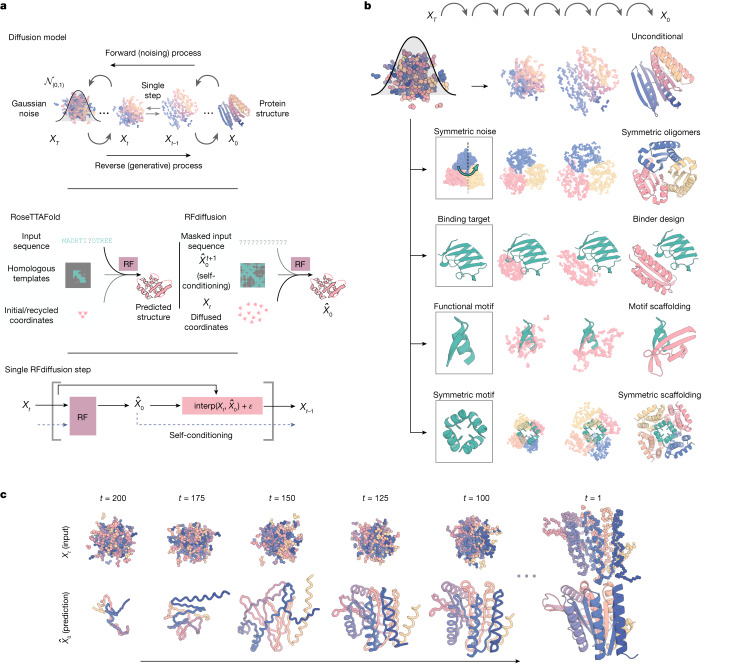
RFdiffusion fine-tunes the RoseTTAFold structure-prediction network as a denoising diffusion model to generate protein backbones for unconditional monomers, symmetric oligomers, functional-motif scaffolds, and de novo binders. The method solves 23 of 25 motif-scaffolding benchmark problems and yields experimentally validated binders, metal-binding assemblies, and a cryo-EM structure matching its design model at 0.63 Å.
Key findings
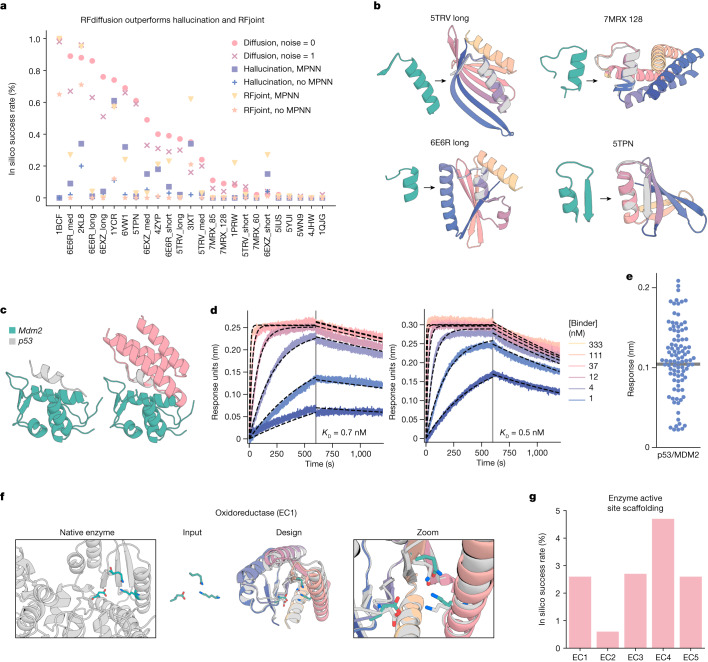
- RFdiffusion solves 23 of 25 motif-scaffolding benchmark problems, compared with 15 for Hallucination and 19 for RFjoint Inpainting; for 19 of 23 solved problems, its success fraction exceeds both baselines.
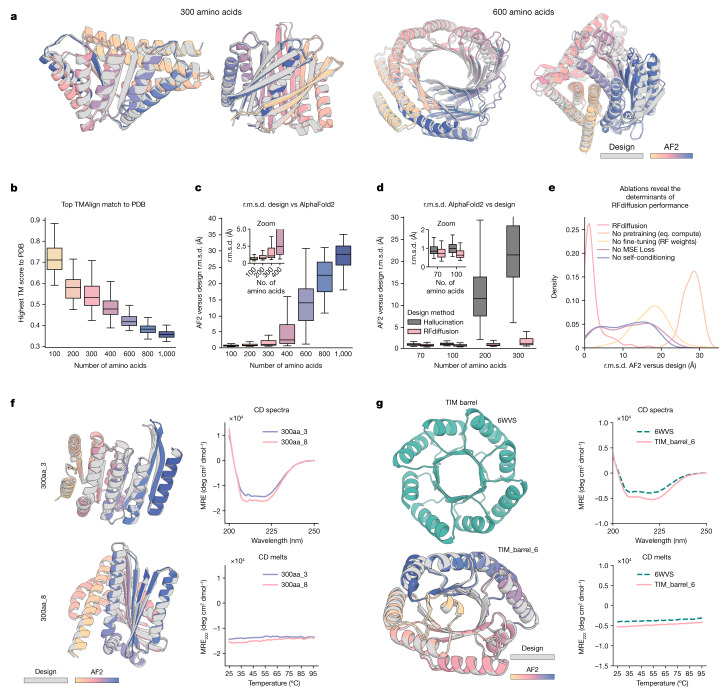
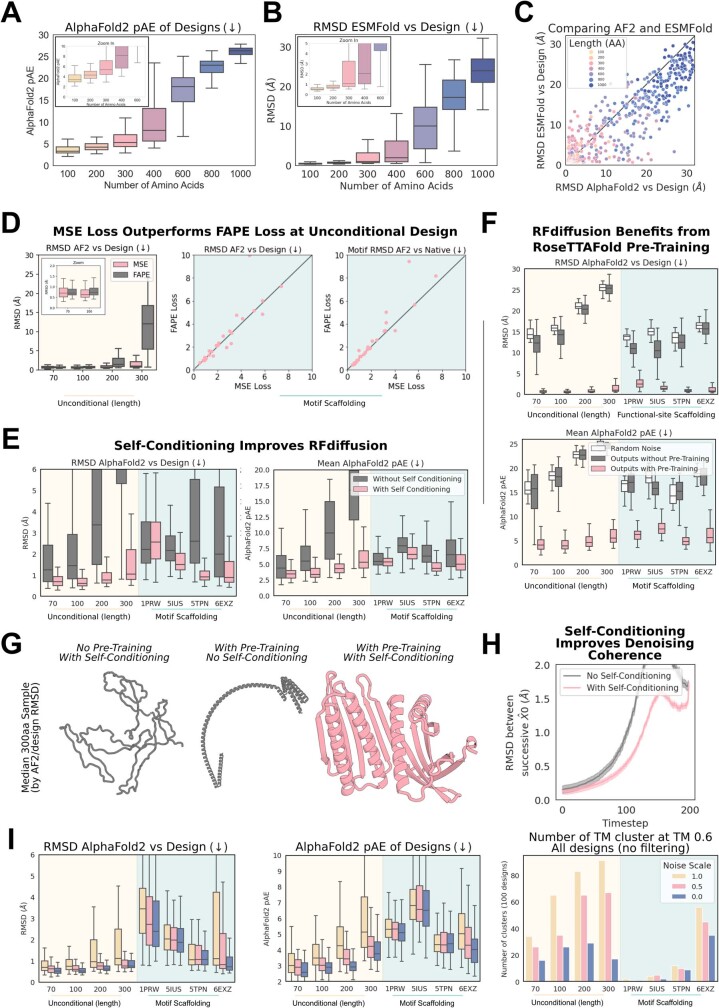
- It generates unconditional monomers up to 600 residues and outperforms RF Hallucination on in silico success (n = 400 designs per condition, z = 9.5, P = 1.6 × 10⁻²¹); a 100-residue protein can be generated in as little as 11 s versus about 8.5 min for RF Hallucination.
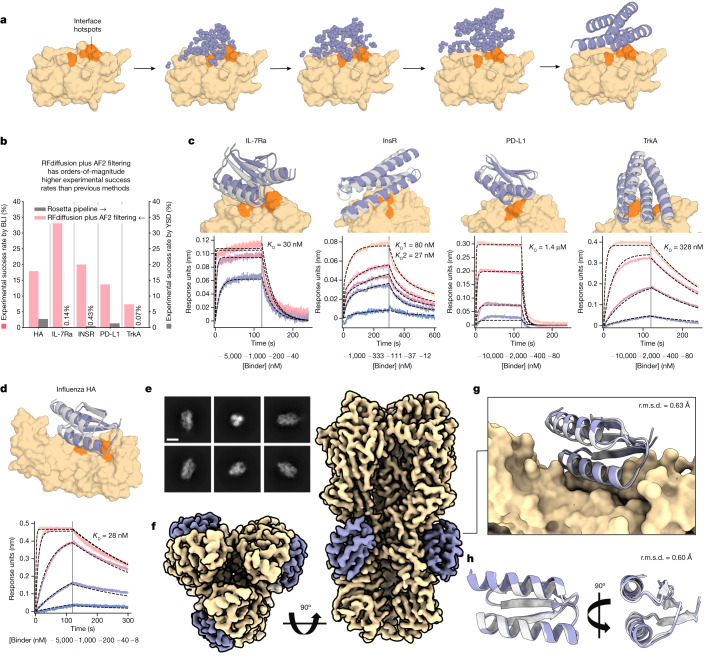
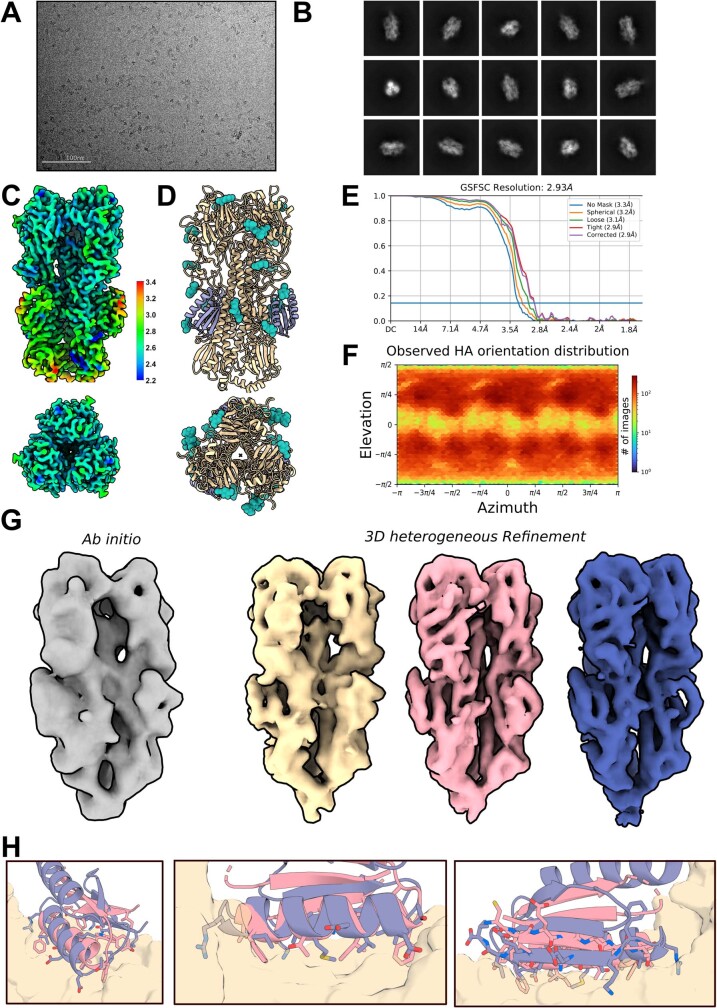
- For binder design against five targets, the overall experimental success rate was 19%, roughly two orders of magnitude above the previous Rosetta-based method; the highest-affinity HA binder, HA_20, bound with KD = 28 nM, and its cryo-EM complex structure matched the design model at 0.63 Å.
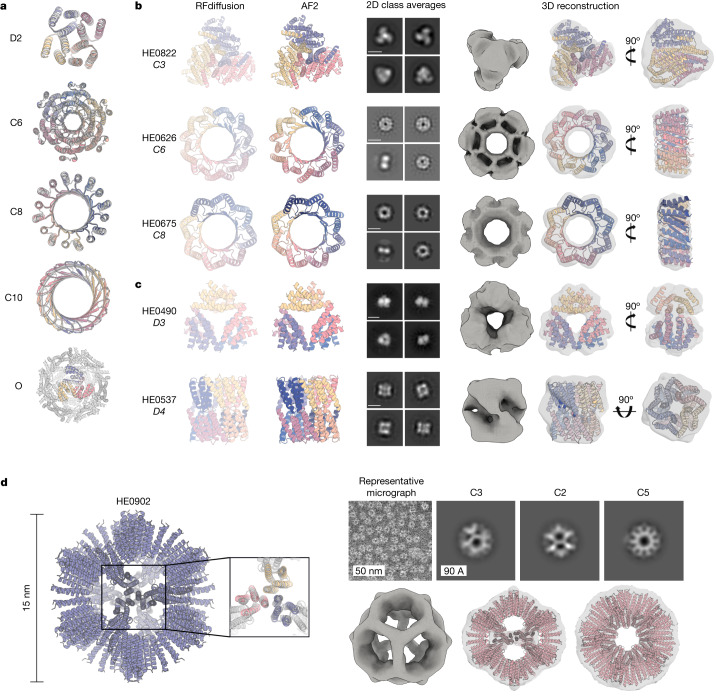
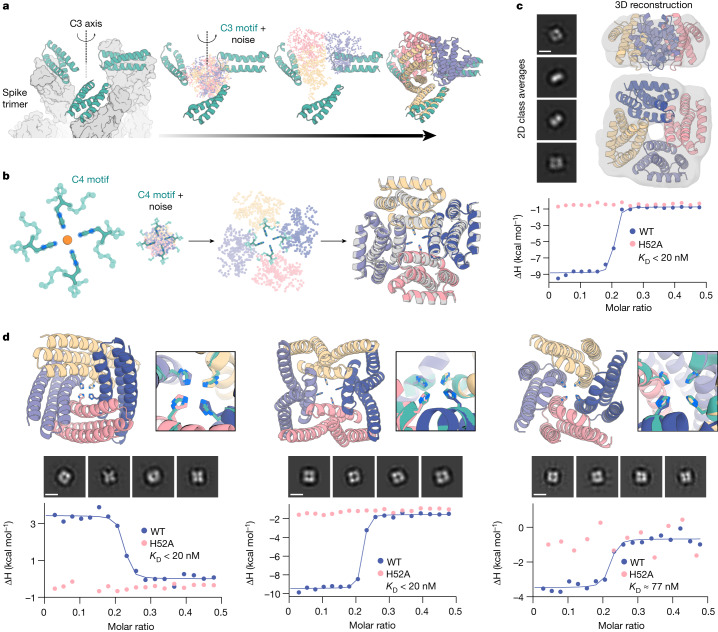
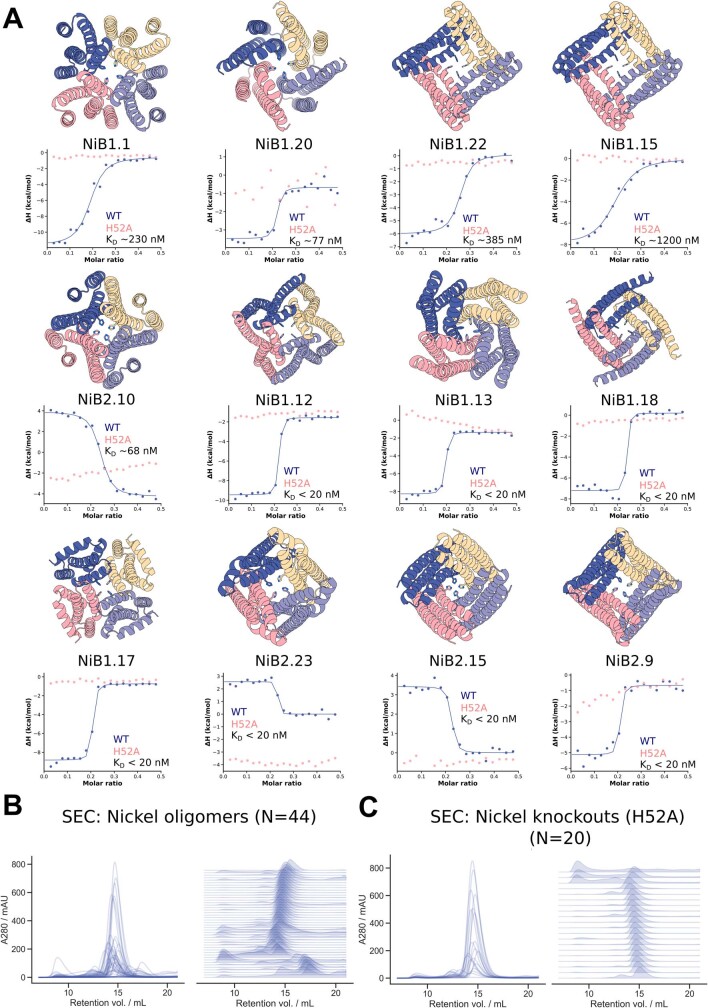
- Symmetric and functional designs were experimentally validated: at least 87 of 608 oligomer designs had SEC oligomerization states closely consistent with design models; 18 of 36 tested Ni²⁺-binding designs bound with dissociation constants from low nanomolar to low micromolar; MDM2 binders reached 0.5 and 0.7 nM versus 600 nM for the native p53 peptide.
Methods
- RFdiffusion uses the RoseTTAFold frame representation (Cα coordinate plus N-Cα-C rigid orientation per residue), trains by noising PDB structures for up to 200 steps, and minimizes mean-squared error between frame predictions and true structures; self-conditioning and fine-tuning from pretrained RF weights improved performance.
- For sequence design, ProteinMPNN was used to design sequences encoding RFdiffusion backbones, typically sampling eight sequences per design; in silico success was validated with AlphaFold2 using mean pAE < 5, global backbone r.m.s.d. < 2 Å, and scaffolded-site backbone r.m.s.d. < 1 Å.
- Experimental characterization included circular dichroism, size-exclusion chromatography, negative-stain EM, cryo-EM, biolayer interferometry, and isothermal titration calorimetry across designed monomers, oligomers, metal-binding proteins, and binders.
Limitations
- The paper states that RFdiffusion cannot explicitly model bound small molecules at present, though it can implicitly model substrates with an external potential; it also states that further studies are required to assess success rates on more polar target sites and sites without native binding partners, and that proteome-wide specificity remains to be fully characterized.
- The paper notes that very large proteins are difficult to validate in silico because they are probably beyond single-sequence prediction capabilities of AF2 and ESMFold, and that some binder designs had insufficient material to permit screening at 10 μM.
- Evident from the text: many conclusions rely on the AF2-based in silico success metric, experimental validation was performed on subsets of designs rather than all generated designs, and the authors did not extensively explore simultaneous structure-and-sequence design within RFdiffusion.
Model-written summary. Check it against the paper before relying on it.
Integrity signals
Registry
Cites
Statistics
Figures
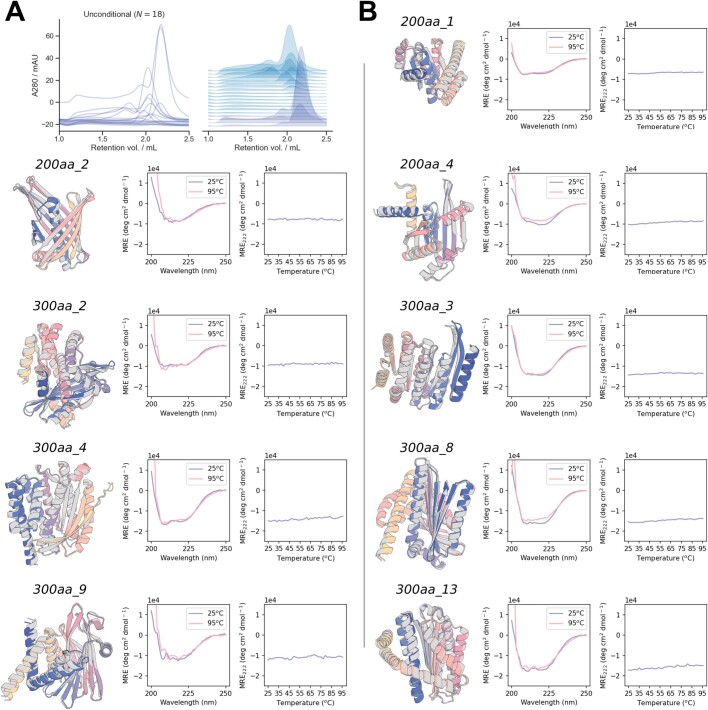
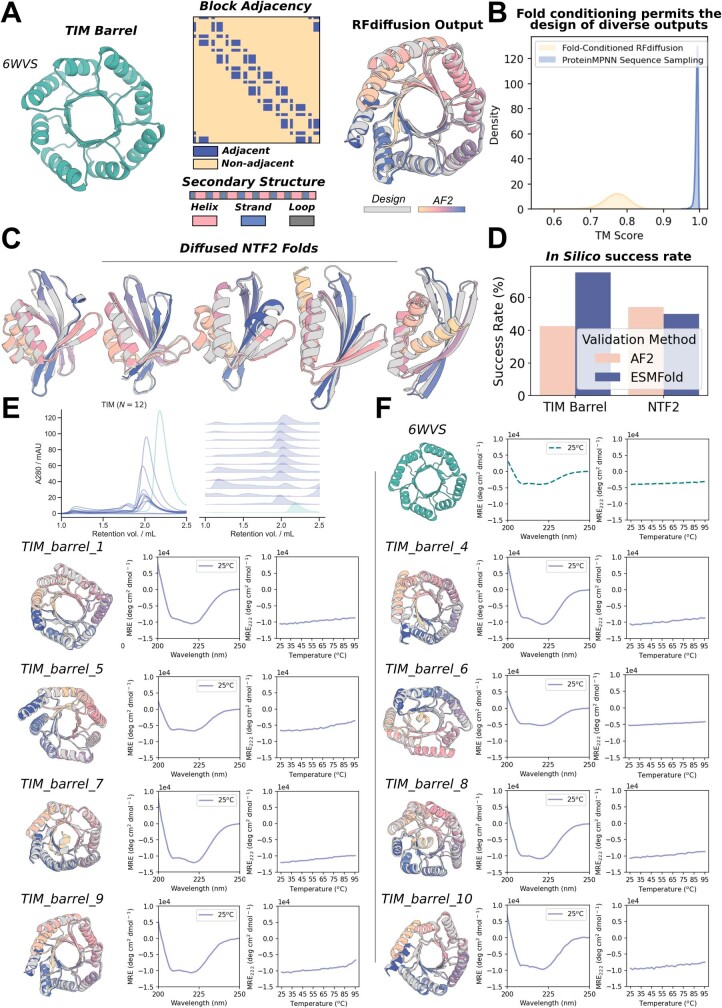
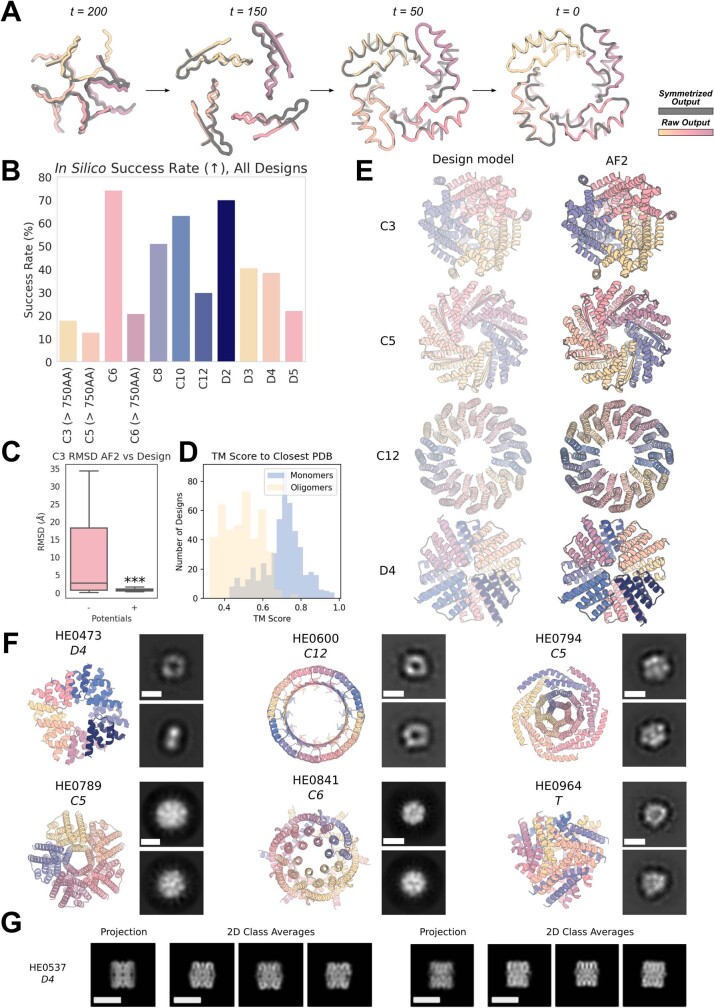
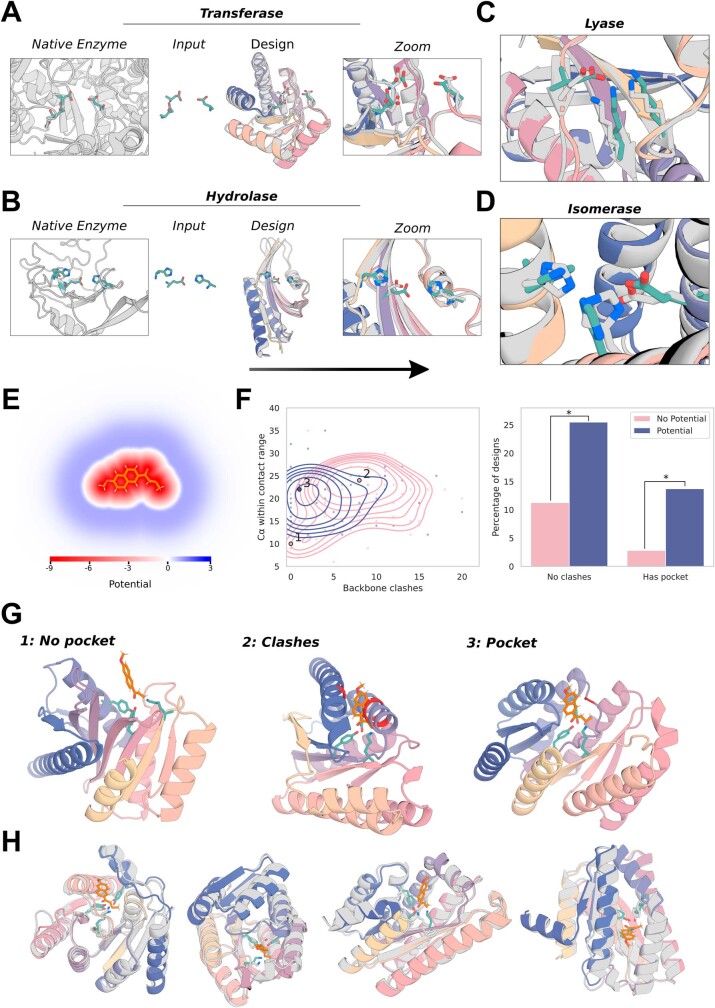
Verification
Claims the paper makes
17 Valid · 4 Not valid · 3 Not checked · 113 Own results and interpretations
Some cited sources support this claim and some don’t — read each source’s verdict below.
In the paper
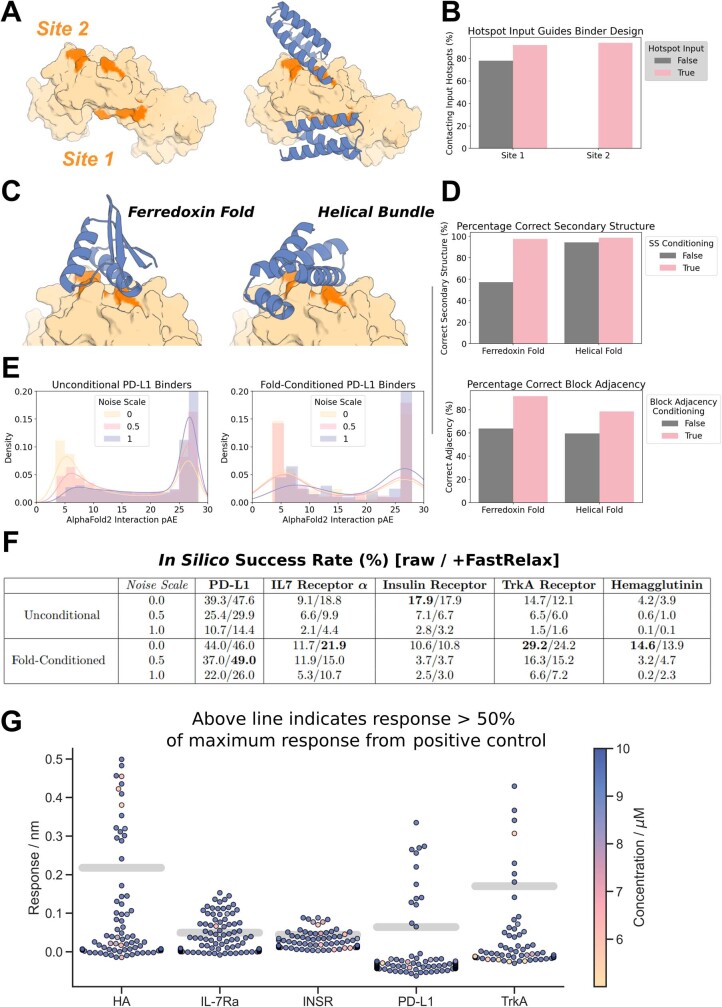
“Recent work has adapted DDPMs for protein monomer design by conditioning on small protein ‘motifs’5,9 or on secondary structure and block-adjacency (‘fold’) information8.”
§ De novo design of protein structure and function with RFdiffusion > Main
What the sources say
- Supportedcites [5] Trippe, B. L. et al. Diffusion probabilistic modeling of protein backbones in 3D for the motif-scaffolding problem. in The EleventhInternational Conference on Learning Representations (2023). source
The Introduction (p. 1) describes ProtDiff as a diffusion probabilistic model for protein backbones and SMCDiff as its motif-conditioned sampling procedure. The Discussion (p. 9) confirms that the procedure generates scaffolds conditioned on a motif. The secondary-structure and block-adjacency clause is attached to a different citation, so it is not attributed to this source. (LLM, conf=0.93)
- Disputedcites [9] Luo, S. et al. Antigen-specific antibody design and optimization with diffusion-based generative models. in Adv. Neural Information Processing Systems Vol. 35 (eds Koyejo, S. et al) 9754–9767 (Curran Associates, 2022). sourceExperimental — accuracy not yet measured
Section 3.1 (page unavailable) says the paper designs antibody CDRs given an antigen structure and antibody framework, not protein monomers conditioned on small motifs. The Generative Model section likewise describes a diffusion model conditioned on the antigen and antibody framework; it does not describe secondary-structure or block-adjacency conditioning. (LLM, conf=0.87)
Checked by a reasoning model — may be wrong.
- Supportedcites [8] Anand, N. & Achim, T. Protein structure and sequence generation with equivariant denoising diffusion probabilistic models. Preprint at 10.48550/arXiv.2205.15019 (2022). source
Citation 8 is attached to the secondary-structure and block-adjacency (‘fold’) conditioning, not to the motif examples cited separately. Section 2.4 (p. 5) defines those constraints, and Section 3 (p. 6) states that the diffusion model conditions on their encoded output to generate protein structures. (LLM, conf=0.94)
plain- Asserted: passes — The authors put it forward as true.
- Checkable: passes — It can be checked against evidence.
- Load-bearing: unclear — It is unclear whether the paper’s conclusions depend on it.
- Based: passes — The paper gives a reason why it holds.
- Supported
The cited sources support only part of this claim — read each source’s verdict below.
In the paper
“Self-conditioning within RFdiffusion notably improved performance on in silico benchmarks encompassing both conditional and unconditional protein design tasks (Fig. 2e and Extended Data Fig. 1e).”
§ De novo design of protein structure and function with RFdiffusion > Main
What the sources say
- Partly supportedcites [25] Chen, T., Zhang, R. & Hinton, G. Analog bits: generating discrete data using diffusion models with self-conditioning. in The Eleventh International Conference on Learning Representations (2023). sourceExperimental — accuracy not yet measured
The Discrete Image Generation section (pp. 6–7) reports that self-conditioning improved results for image diffusion models. It does not report RFdiffusion results or in silico benchmarks for conditional and unconditional protein design, so the claimed improvement in that setting is not supported by this source. (LLM, conf=0.86)
plainstates a cause- Asserted: passes — The authors put it forward as true.
- Checkable: passes — It can be checked against evidence.
- Load-bearing: passes — The paper’s conclusions depend on it.
- Based: passes — The paper gives a reason why it holds.
- Partly supported
The cited sources support only part of this claim — read each source’s verdict below.
In the paper
“Experimental characterization showed that the method can scaffold a wide range of protein functional motifs with atomic accuracy19”
§ De novo design of protein structure and function with RFdiffusion > Main
What the sources say
- Partly supportedcites [4] Wang J Scaffolding protein functional sites using deep learning Science 2022 377 387 394 10.1126/science.abn2100 35862514 PMC9621694 sourceExperimental — accuracy not yet measured
The 'Generalized functional motif scaffolding' section reports designs spanning a wide range of motifs and says their activities were assessed experimentally. But its sub-angstrom motif accuracy is based on AlphaFold predictions, not experimental structural measurements; the sentence overstates what the experimental characterization established. (LLM, conf=0.88)
- Partly supportedcites [19] Watson, J. L., Bera, A., Juergens, D., Wang, J. & Baker, D. X-ray crystallographic validation of design from this paper. Science377, 387–394 (2022). sourceExperimental — accuracy not yet measured
The section “Generalized functional motif scaffolding by missing information recovery” (page unavailable) reports designs spanning a wide range of motifs, with motif RMSD typically below 1 Å in AlphaFold predictions. It separately reports experimental tests of the designs’ activities; those tests do not establish atomic structural accuracy. The paper also attributes the broad set of designs to both inpainting and constrained hallucination, rather than RFjoint inpainting alone. (LLM, conf=0.87)
plainstates a cause- Asserted: passes — The authors put it forward as true.
- Checkable: passes — It can be checked against evidence.
- Load-bearing: passes — The paper’s conclusions depend on it.
- Based: passes — The paper gives a reason why it holds.
- Partly supported
The cited sources support only part of this claim — read each source’s verdict below.
In the paper
“we established an in silico benchmark test (Supplementary Table 9) comprising 25 motif-scaffolding design problems addressed in six recent publications encompassing several design methodologies4,5,29,38–40”
§ De novo design of protein structure and function with RFdiffusion > Functional-motif scaffolding
What the sources say
- Could not verifycites [4] Wang J Scaffolding protein functional sites using deep learning Science 2022 377 387 394 10.1126/science.abn2100 35862514 PMC9621694 sourceExperimental — accuracy not yet measured
The 'Generalized functional motif scaffolding by missing information recovery' section describes in silico evaluation of the paper’s own designs, but does not describe establishing a benchmark of 25 problems drawn from six publications. Searches for the benchmark, the numbers, and Supplementary Table 9 found no passage in our copy that verifies those details. (LLM, conf=0.74)
- Supportedcites [5] Trippe, B. L. et al. Diffusion probabilistic modeling of protein backbones in 3D for the motif-scaffolding problem. in The EleventhInternational Conference on Learning Representations (2023). source
Section 5.2 (p. 7) reports motif-scaffolding tests using motifs from proteins 6exz and 5trv; Appendix H.1 (p. 24) describes another target, 5tpn. This supports citing the paper as one of the publications that addressed motif-scaffolding design problems. The citing authors describe the 25-problem benchmark as their own, not as something established by this source. (LLM, conf=0.88)
- Supportedcites [29] Lee, J. S. & Kim, P. M. ProteinSGM: Score-based generative modeling for de novo protein design. Preprint at bioRxiv10.1101/2022.07.13.499967 (2022). source
The citation identifies one of the publications whose design methodology informed the citing authors’ benchmark; it does not attribute the establishment of the 25-problem benchmark to ProteinSGM. In “Conditional generation” (page unavailable), ProteinSGM presents scaffold-inpainting design cases, including generation of scaffolds around the barstar functional site. (LLM, conf=0.88)
- Supportedcites [38] Sesterhenn F De novo protein design enables the precise induction of RSV-neutralizing antibodies Science 2020 368 eaay5051 10.1126/science.aay5051 32409444 PMC7391827 source
The citation identifies this paper as one of the motif-scaffolding publications used to assemble the citing authors’ benchmark; the benchmark’s size and establishment are the citing authors’ own statements. The Results section (page unavailable) describes TopoBuilder as a protocol for designing protein topologies around functional motifs, so the paper fits that role. (LLM, conf=0.88)
- Not checked — no full text of the sourcecites [39] Yang C Bottom-up de novo design of functional proteins with complex structural features Nat. Chem. Biol. 2021 17 492 500 10.1038/s41589-020-00699-x 33398169 source
- Partly supportedcites [40] Glasgow A Engineered ACE2 receptor traps potently neutralize SARS-CoV-2 Proc. Natl Acad. Sci. USA 2020 117 28046 28055 10.1073/pnas.2016093117 33093202 PMC7668070 sourceExperimental — accuracy not yet measured
The Results and Materials and Methods describe computational redesign of the ACE2–spike binding interface, so this is a publication addressing a protein-design problem. Our copy does not describe that work as motif scaffolding. The benchmark of 25 problems is the citing authors’ own work, not a finding attributed to this source. (LLM, conf=0.78)
plain- Asserted: passes — The authors put it forward as true.
- Checkable: passes — It can be checked against evidence.
- Load-bearing: passes — The paper’s conclusions depend on it.
- Based: passes — The paper gives a reason why it holds.
- Could not verify
Every source the paper cites for this claim was checked and supports it.
In the paper
“Vázquez Torres et al. demonstrate the ability of RFdiffusion to design picomolar affinity binders to flexible helical peptides54”
§ De novo design of protein structure and function with RFdiffusion > Discussion
What the sources say
- Supportedcites [54] Torres, S. V. et al. De novo design of high-affinity protein binders to bioactive helical peptides. Preprint at bioRxiv10.1101/2022.12.10.519862 (2022). source
The Peptide binder design with RFdiffusion section reports de novo RFdiffusion binders to the helical peptides Bim and PTH, with an estimated affinity of ~100 pM for Bim and an upper bound of 500 pM for PTH. The Main section explains that peptide targets are often partially or entirely unstructured in isolation, supporting the description of them as flexible. (LLM, conf=0.94)
boostedstates a cause- Asserted: passes — The authors put it forward as true.
- Checkable: passes — It can be checked against evidence.
- Load-bearing: unclear — It is unclear whether the paper’s conclusions depend on it.
- Based: passes — The paper gives a reason why it holds.
- Supported
82 more claims · 7 with their cited sources checked
Create a free account to see all 137 claims and every source verdict.
- It may state two separate claims as one. 48
- Probably not a substantial claim. 3
- The quote only partly states this claim. 1
Claims other papers make about this one
Each is checked against this paper’s own text: does it say what the citing paper says it does?
The source backs part of the claim, not all of it — or backs it for a different population, condition or comparison.
In the citing paper
“We also use Evo to generate genome-scale sequences with plausible high-level architecture more than1 megabase (Mb) in length, a scale that is orders of magnitude greater than previous methods (10, 13, 14).”
From Sequence modeling and design from molecular to genome scale with Evo (2024) · cites this paper as [10]
Experimental — accuracy not yet measured
Self-check
Percentages, sums and reported differences re-computed from the paper’s own numbers.
Each contradiction between two passages listed here was confirmed by an independent check.
Rated minor: it would not touch a result — a value no result rests on, a p-value that stays on the same side of the significance level, or a conflict that is clerical, resolved elsewhere in the paper, or outside its own findings.
In the paper
§ De novo design of protein structure and function with RFdiffusion > Functional-motif scaffolding
“e, Out of 95 designs, 55 showed binding to MDM2 (more than 50% of maximum response).”
§ De novo design of protein structure and function with RFdiffusion > Functional-motif scaffolding
“The overall success rate was quite high: out of the 96 designs, 55 showed some detectable binding at 10 μM (Fig. 4e and Supplementary Fig. 10h).”
Citations
Cites
Highly accurate protein structure prediction with AlphaFold
Jumper, J., Evans, R., Pritzel, A., Green, T., Figurnov, M., Ronneberger, O., Tunyasuvunakool, K., Bates, R., Žídek, A., Potapenko, A., et al. (2021) · Nature · doi:10.1038/s41586-021-03819-2 · Cited by 43,764
Berman, H. M. (2000) · Nucleic Acids Research · doi:10.1093/nar/28.1.235 · Cited by 40,196
Denoising Diffusion Probabilistic Models
Ho, J., Jain, A., & Abbeel, P. (2020) · arXiv · doi:10.48550/arxiv.2006.11239 · Cited by 8,712
Evolutionary-scale prediction of atomic level protein structure with a language model
Lin, Z., Akin, H., Rao, R., Hie, B., Zhu, Z., Lu, W., Smetanin, N., Verkuil, R., Kabeli, O., Shmueli, Y., et al. (2022) · doi:10.1101/2022.07.20.500902 · Cited by 5,990
Accurate prediction of protein structures and interactions using a 3-track network
Baek, M., DiMaio, F., Anishchenko, I., Dauparas, J., Ovchinnikov, S., Lee, G. R., Wang, J., Cong, Q., Kinch, L. N., Schaeffer, R. D., et al. (2021) · doi:10.1101/2021.06.14.448402 · Cited by 5,549
Self-citationDeep Unsupervised Learning using Nonequilibrium Thermodynamics
Sohl-Dickstein, J., Weiss, E. A., Maheswaranathan, N., & Ganguli, S. (2015) · arXiv · doi:10.48550/arxiv.1503.03585 · Cited by 2,637
Zero-shot text-to-image generation
Ramesh, A., Pavlov, M., Goh, G., Gray, S., Voss, C., Radford, A., Chen, M., & Sutskever, I. (2021) · arXiv · doi:10.48550/arxiv.2102.12092 · Cited by 2,417
THEORY OF PROTEIN FOLDING: The Energy Landscape Perspective
Onuchic, J. N., Luthey-Schulten, Z., & Wolynes, P. G. (1997) · Annual Review of Physical Chemistry · doi:10.1146/annurev.physchem.48.1.545 · Cited by 2,210
Robust deep learning–based protein sequence design using ProteinMPNN
Dauparas, J., Anishchenko, I., Bennett, N., Bai, H., Ragotte, R. J., Milles, L. F., Wicky, B. I. M., Courbet, A., de Haas, R. J., Bethel, N., et al. (2022) · Science · doi:10.1126/science.add2187 · Cited by 2,210 · cited 6×
“We explored two different strategies for training RFdiffusion: (1) in a manner akin to ‘canonical’ diffusion models, with predictions at each timestep independent of predictions at previous timesteps (as in previous work(5,8,9,16)), and (2) with self-conditioning(25), in which the model can condition on previous predi…”
InfluentialSelf-citationStructure of the MDM2 Oncoprotein Bound to the p53 Tumor Suppressor Transactivation Domain
Kussie, P. H., Gorina, S., Marechal, V., Elenbaas, B., Moreau, J., Levine, A. J., & Pavletich, N. P. (1996) · Science · doi:10.1126/science.274.5289.948 · Cited by 2,206
Research works printed but not linked: 1
- Watson, J. L., Bera, A., Juergens, D., Wang, J. & Baker, D. X-ray crystallographic validation of design from this paper. Science377, 387–394 (2022). · DOI · Paper page
Cited by
Foundation models for generalist medical artificial intelligence
Moor, M., Banerjee, O., Abad, Z. S. H., Krumholz, H. M., Leskovec, J., Topol, E. J., & Rajpurkar, P. (2023) · Nature · doi:10.1038/s41586-023-05881-4 · Cited by 2,028
Generalized biomolecular modeling and design with RoseTTAFold All-Atom
Krishna, R., Wang, J., Ahern, W., Sturmfels, P., Venkatesh, P., Kalvet, I., Lee, G. R., Morey-Burrows, F. S., Anishchenko, I., Humphreys, I. R., et al. (2024) · Science · doi:10.1126/science.adl2528 · Cited by 978
“Diffusion-based methods can generate proteins in the context of a protein target that bind with considerable affinity and specificity ( 45 ) and can be trained to explicitly condition on structural features( 46 ).”
Self-citationSimulating 500 million years of evolution with a language model
Hayes, T., Rao, R., Akin, H., Sofroniew, N. J., Oktay, D., Lin, Z., Verkuil, R., Tran, V. Q., Deaton, J., Wiggert, M., et al. (2025) · Science · doi:10.1126/science.ads0018 · Cited by 937
Simulating 500 million years of evolution with a language model
(2024) · doi:10.1101/2024.07.01.600583 · Cited by 937
From nature to industry: Harnessing enzymes for biocatalysis
Buller, R., Lutz, S., Kazlauskas, R. J., Snajdrova, R., Moore, J. C., & Bornscheuer, U. T. (2023) · Science · doi:10.1126/science.adh8615 · Cited by 706
Self-Driving Laboratories for Chemistry and Materials Science
Tom, G., Schmid, S. P., Baird, S. G., Cao, Y., Darvish, K., Hao, H., Lo, S., Pablo-García, S., Rajaonson, E. M., Skreta, M., et al. (2024) · Chemical Reviews · doi:10.1021/acs.chemrev.4c00055 · Cited by 707
A Survey on Generative Diffusion Models
Cao, H., Tan, C., Gao, Z., Xu, Y., Chen, G., Heng, P.-A., & Li, S. Z. (2024) · IEEE Transactions on Knowledge and Data Engineering · doi:10.1109/tkde.2024.3361474 · Cited by 538
Sequence modeling and design from molecular to genome scale with Evo
Nguyen, E., Poli, M., Durrant, M. G., Thomas, A. W., Kang, B., Sullivan, J., Ng, M. Y., Lewis, A., Patel, A., Lou, A., et al. (2024) · doi:10.1101/2024.02.27.582234 · Cited by 592
Sequence modeling and design from molecular to genome scale with Evo
Nguyen, E., Poli, M., Durrant, M. G., Kang, B., Katrekar, D., Li, D. B., Bartie, L. J., Thomas, A. W., King, S. H., Brixi, G., et al. (2024) · Science · doi:10.1126/science.ado9336 · Cited by 898
Boltz-1 Democratizing Biomolecular Interaction Modeling
Wohlwend, J., Corso, G., Passaro, S., Getz, N., Reveiz, M., Leidal, K., Swiderski, W., Atkinson, L., Portnoi, T., Chinn, I., et al. (2024) · bioRxiv (Cold Spring Harbor Laboratory) · doi:10.1101/2024.11.19.624167 · Cited by 482
Self-citationA generative model for inorganic materials design
Zeni, C., Pinsler, R., Zügner, D., Fowler, A., Horton, M., Fu, X., Wang, Z., Shysheya, A., Crabbé, J., Ueda, S., et al. (2025) · Nature · doi:10.1038/s41586-025-08628-5 · Cited by 518
“Given the enormous impact of generative models in domains such as image generation 47 and protein design 48 , we believe that models such as Matter Gen will equally transform materials design in the coming years.”
Corso, G., Stark, H., Jegelka, S., Jaakkola, T., & Barzilay, R. (2024) · Nature Reviews Methods Primers · doi:10.1038/s43586-024-00294-7 · Cited by 454
“5b); or structures of novel proteins 92,93 (rational protein design).”
Self-citationIlluminating protein space with a programmable generative model
Ingraham, J. B., Baranov, M., Costello, Z., Barber, K. W., Wang, W., Ismail, A., Frappier, V., Lord, D. M., Ng-Thow-Hing, C., Van Vlack, E. R., et al. (2023) · Nature · doi:10.1038/s41586-023-06728-8 · Cited by 444
“16, 24–26, Supplementary Appendices N–”
Improving de novo protein binder design with deep learning
Bennett, N. R., Coventry, B., Goreshnik, I., Huang, B., Allen, A., Vafeados, D., Peng, Y. P., Dauparas, J., Baek, M., Stewart, L., et al. (2023) · Nature Communications · doi:10.1038/s41467-023-38328-5 · Cited by 402
Self-citationOne-shot design of functional protein binders with BindCraft
Pacesa, M., Nickel, L., Schellhaas, C., Schmidt, J., Pyatova, E., Kissling, L., Barendse, P., Choudhury, J., Kapoor, S., Alcaraz-Serna, A., et al. (2025) · Nature · doi:10.1038/s41586-025-09429-6 · Cited by 236
“The current state-of-the-art methods involve the use of RFdiffusion 5 for backbone generation coupled with ProteinMPNN sequence generation 6 .”
InfluentialSelf-citationDe novo protein design—From new structures to programmable functions
Kortemme, T. (2024) · Cell · doi:10.1016/j.cell.2023.12.028 · Cited by 344
“For example, given a motif geometry as input, both protein hallucination 67 and diffusion 53 can in principle generate a suitable scaffold around that motif for a range of scaffolding problems (Fig.”
InfluentialAtomically accurate de novo design of antibodies with RFdiffusion
(2025) · doi:10.1038/s41586-025-09721-5 · Cited by 324
Self-citationAtomically accurate de novo design of antibodies with RFdiffusion
Bennett, N. R., Watson, J. L., Ragotte, R. J., Borst, A. J., See, D. L., Weidle, C., Biswas, R., Yu, Y., Shrock, E. L., Ault, R., et al. (2024) · doi:10.1101/2024.03.14.585103 · Cited by 324
“There has been recent progress in designing binding proteins (not antibodies) using RFdiffusion 9,10 which, unlike previous methods, does not require pre-specification of the protein binder backbone, permitting the design of very diverse binders with inherent shape complementarity to the…”
Self-citationAtomic context-conditioned protein sequence design using LigandMPNN
Dauparas, J., Lee, G. R., Pecoraro, R., An, L., Anishchenko, I., Glasscock, C., & Baker, D. (2025) · Nature Methods · doi:10.1038/s41592-025-02626-1 · Cited by 279
“To facilitate the design of symmetric 9,16 and multistate proteins 10 , we use a random autoregressive decoding scheme to decode the amino-acid sequence as in the case of ProteinMPNN.”
Self-citationMachine learning for functional protein design
Notin, P., Rollins, N., Gal, Y., Sander, C., & Marks, D. (2024) · Nature Biotechnology · doi:10.1038/s41587-024-02127-0 · Cited by 270
De novo design of high-affinity binders of bioactive helical peptides
Vázquez Torres, S., Leung, P. J. Y., Venkatesh, P., Lutz, I. D., Hink, F., Huynh, H.-H., Becker, J., Yeh, A. H.-W., Juergens, D., Bennett, N. R., et al. (2024) · Nature · doi:10.1038/s41586-023-06953-1 · Cited by 239
“RFdiffusion was previously shown to be able to design binders to folded targets 8 ; here we demonstrate further that it can be used to improve starting designs by partial noising and denoising, and can generate binders to peptides starting from no information other than the target sequence.”
Self-citationTargeted genome-modification tools and their advanced applications in crop breeding
Li, B., Sun, C., Li, J., & Gao, C. (2024) · Nature Reviews Genetics · doi:10.1038/s41576-024-00720-2 · Cited by 233
Opportunities and Challenges for Machine Learning-Assisted Enzyme Engineering
Yang, J., Li, F.-Z., & Arnold, F. H. (2024) · ACS Central Science · doi:10.1021/acscentsci.3c01275 · Cited by 246
(2024) · doi:10.1038/s41467-024-45461-2 · Cited by 243
“Unlike the traditional protocolemployed in diffusion-based modeltraining,which generates decoys by perturbing the native state with Gaussian noise of varying magnitudes 28 – 32 , our method employs a morph-like transformation to produce protein decoys.”
Computational design of serine hydrolases
Lauko, A., Pellock, S. J., Sumida, K. H., Anishchenko, I., Juergens, D., Ahern, W., Jeung, J., Shida, A. F., Hunt, A., Kalvet, I., et al. (2025) · Science · doi:10.1126/science.adu2454 · Cited by 235
“Recent advances in scaffolding functional sites with RFdiffusion have yielded improved in silico and experimental success rates across a range of design tasks (36, 41, 42); we aimed to use the same approach to generate serine hydrolases starting from geometric descriptions of an active site (Fig.”
Self-citationMachine learning in preclinical drug discovery
Catacutan, D. B., Alexander, J., Arnold, A., & Stokes, J. M. (2024) · Nature Chemical Biology · doi:10.1038/s41589-024-01679-1 · Cited by 204
“Leveraging DGMs and building upon RoseTTAFold, RoseTTAFold diffusion (RFdiffusion) 79 is a generative model capable of designing functional proteins based on explicit specifications (Fig.”
InfluentialJablonka, K. M., Ai, Q., Al-Feghali, A., Badhwar, S., Bocarsly, J. D., Bran, A. M., Bringuier, S., Brinson, L. C., Choudhary, K., Circi, D., et al. (2023) · Digital Discovery · doi:10.1039/d3dd00113j · Cited by 218
Machine Learning-Guided Protein Engineering
Kouba, P., Kohout, P., Haddadi, F., Bushuiev, A., Samusevich, R., Sedlar, J., Damborsky, J., Pluskal, T., Sivic, J., & Mazurenko, S. (2023) · ACS Catalysis · doi:10.1021/acscatal.3c02743 · Cited by 209
Design of highly functional genome editors by modelling CRISPR–Cas sequences
Ruffolo, J. A., Nayfach, S., Gallagher, J. P., Bhatnagar, A., Beazer, J., Hussain, R., Russ, J., Yip, J., Hill, E., Pačesa, M., et al. (2025) · Nature · doi:10.1038/s41586-025-09298-z · Cited by 249
Protein structure generation via folding diffusion
Wu, K. E., Yang, K. K., van den Berg, R., Alamdari, S., Zou, J. Y., Lu, A. X., & Amini, A. P. (2024) · Nature Communications · doi:10.1038/s41467-024-45051-2 · Cited by 178
Machine learning-aided generative molecular design
Du, Y., Jamasb, A. R., Guo, J., Fu, T., Harris, C., Wang, Y., Duan, C., Liò, P., Schwaller, P., & Blundell, T. L. (2024) · Nature Machine Intelligence · doi:10.1038/s42256-024-00843-5 · Cited by 169
“The approaches discussed here may have broader applications for designing other richly structured materials, such as polysaccharides, proteins (in particular, antibodies), nucleic acids, crystal structures and polymers 121 .”
Protein structure generation via folding diffusion
Wu, K. E., Yang, K. K., Berg, R. V. D., Zou, J. Y., Lu, A. X., & Amini, A. P. (2022) · arXiv · doi:10.48550/arxiv.2209.15611 · Cited by 193
Opportunities and challenges in design and optimization of protein function
Listov, D., Goverde, C. A., Correia, B. E., & Fleishman, S. J. (2024) · Nature Reviews Molecular Cell Biology · doi:10.1038/s41580-024-00718-y · Cited by 180
“De novo-designed proteins have been further designed to generate new binders of proteins or small molecules 24,26,27 , thereby advancing towards the completely rational generation of new-to-nature protein activities.”
InfluentialModeling conformational states of proteins with AlphaFold
Sala, D., Engelberger, F., Mchaourab, H. S., & Meiler, J. (2023) · Current Opinion in Structural Biology · doi:10.1016/j.sbi.2023.102645 · Cited by 182
Goles, M., Daza, A., Cabas-Mora, G., Sarmiento-Varón, L., Sepúlveda-Yañez, J., Anvari-Kazemabad, H., Davari, M. D., Uribe-Paredes, R., Olivera-Nappa, Á., Navarrete, M. A., et al. (2024) · Briefings in Bioinformatics · doi:10.1093/bib/bbae275 · Cited by 168
De novo designed proteins neutralize lethal snake venom toxins
Vázquez Torres, S., Benard Valle, M., Mackessy, S. P., Menzies, S. K., Casewell, N. R., Ahmadi, S., Burlet, N. J., Muratspahić, E., Sappington, I., Overath, M. D., et al. (2025) · Nature · doi:10.1038/s41586-024-08393-x · Cited by 163
“Hence, we used the deep learning-based RFdif-fusion method 32 to design antivenoms for short-chain and long-chain α-neurotoxins and cytotoxins from the 3FTx snake venom toxin family.”
Self-citationComputational and artificial intelligence-based methods for antibody development
Kim, J., McFee, M., Fang, Q., Abdin, O., & Kim, P. M. (2023) · Trends in Pharmacological Sciences · doi:10.1016/j.tips.2022.12.005 · Cited by 178
State-specific protein–ligand complex structure prediction with a multiscale deep generative model
Qiao, Z., Nie, W., Vahdat, A., Miller, T. F., & Anandkumar, A. (2024) · Nature Machine Intelligence · doi:10.1038/s42256-024-00792-z · Cited by 156
“However, structure prediction models trained with invariant loss can cause inconsistency between integration steps when used for diffusion model sampling due to the arbitrariness of predicted global rotation, which is found to harm the generation quality in related works 30 .”
Artificial Intelligence in Point-of-Care Biosensing: Challenges and Opportunities
Flynn, C. D., & Chang, D. (2024) · Diagnostics · doi:10.3390/diagnostics14111100 · Cited by 195
Fully forward mode training for optical neural networks
Xue, Z., Zhou, T., Xu, Z., Yu, S., Dai, Q., & Fang, L. (2024) · Nature · doi:10.1038/s41586-024-07687-4 · Cited by 165
Multistate and functional protein design using RoseTTAFold sequence space diffusion
Lisanza, S. L., Gershon, J. M., Tipps, S. W. K., Sims, J. N., Arnoldt, L., Hendel, S. J., Simma, M. K., Liu, G., Yase, M., Wu, H., et al. (2025) · Nature Biotechnology · doi:10.1038/s41587-024-02395-w · Cited by 118
Self-citationBispecific antibody drug conjugates: Making 1+1>2
Gu, Y., Wang, Z., & Wang, Y. (2024) · Acta Pharmaceutica Sinica B · doi:10.1016/j.apsb.2024.01.009 · Cited by 159
Diffusion models in bioinformatics and computational biology
Guo, Z., Liu, J., Wang, Y., Chen, M., Wang, D., Xu, D., & Cheng, J. (2023) · Nature Reviews Bioengineering · doi:10.1038/s44222-023-00114-9 · Cited by 139
“RFdiffusion 105 , which integrates a conditional DDPM diffusion model with the pre-trained protein 3D structure prediction model RoseTTAFold 166 , can directly generate final 3D coordinates.”
Computational design of soluble and functional membrane protein analogues
Goverde, C. A., Pacesa, M., Goldbach, N., Dornfeld, L. J., Balbi, P. E. M., Georgeon, S., Rosset, S., Kapoor, S., Choudhury, J., Dauparas, J., et al. (2024) · Nature · doi:10.1038/s41586-024-07601-y · Cited by 137
“Interest to the broader readership of Nature would be increased by better describing potential applications of this technology in particular with regards to generating soluble membrane proteins.”
Self-citationUnsupervised evolution of protein and antibody complexes with a structure-informed language model
Shanker, V. R., Bruun, T. U. J., Hie, B. L., & Kim, P. S. (2024) · Science · doi:10.1126/science.adk8946 · Cited by 140
Protein generation with evolutionary diffusion: sequence is all you need
Alamdari, S., Thakkar, N., van den Berg, R., Tenenholtz, N., Strome, R., Moses, A. M., Lu, A. X., Fusi, N., Amini, A. P., & Yang, K. K. (2023) · doi:10.1101/2023.09.11.556673 · Cited by 154
Efficient and accurate prediction of protein structure using RoseTTAFold2
Baek, M., Anishchenko, I., Humphreys, I. R., Cong, Q., Baker, D., & DiMaio, F. (2023) · bioRxiv (Cold Spring Harbor Laboratory) · doi:10.1101/2023.05.24.542179 · Cited by 155
Self-citationThe JAK-STAT pathway: from structural biology to cytokine engineering
Lv, Y., Qi, J., Babon, J. J., Cao, L., Fan, G.-H., Lang, J., Zhang, J., Mi, P., Kobe, B., & Wang, F. (2024) · Signal Transduction and Targeted Therapy · doi:10.1038/s41392-024-01934-w · Cited by 178
Integrated biotechnological and AI innovations for crop improvement
Li, G., An, L., Yang, W., Yang, L., Wei, T., Shi, J., Wang, J., Doonan, J. H., Xie, K., Fernie, A. R., et al. (2025) · Nature · doi:10.1038/s41586-025-09122-8 · Cited by 166
“…may provide knowledge for developing drought-tolerant, disease-resistant and high-yield crops. i , Designed proteins show extreme thermostability 121 , which could be used to enhance heat tolerance of crops. j , Using alleles that enhance beneficial plant–microorganism interactions can promote…”
InfluentialSelf-citationOpportunities and challenges of diffusion models for generative AI
Chen, M.-S., Mei, S., Fan, J., & Wang, M.-D. (2024) · National Science Review · doi:10.1093/nsr/nwae348 · Cited by 93
Atom-level enzyme active site scaffolding using RFdiffusion2
Ahern, W., Yim, J., Tischer, D., Salike, S., Woodbury, S. M., Kim, D., Kalvet, I., Kipnis, Y., Coventry, B., Altae-Tran, H., et al. (2025) · Nature Methods · doi:10.1038/s41592-025-02975-x · Cited by 209
Self-citationA survey of generative AI for de novo drug design: new frontiers in molecule and protein generation
Tang, X., Dai, H., Knight, E., Wu, F., Li, Y., Li, T., & Gerstein, M. (2024) · Briefings in Bioinformatics · doi:10.1093/bib/bbae338 · Cited by 205
“Finally, RFDiffusion [141] combines the powerful structure prediction methods from RoseTTAFold with diffusion models to generate protein structures.”
Artificial intelligence for science in quantum, atomistic, and continuum systems
Zhang, X., Wang, L., Helwig, J., Luo, Y., Fu, C., Xie, Y., Liu, M., Lin, Y., Zhao, X., Yan, K., et al. (2025) · Foundations and Trends® in Machine Learning · doi:10.1561/2200000115 · Cited by 261
Self-citationGhafarollahi, A., & Buehler, M. J. (2024) · Digital Discovery · doi:10.1039/d4dd00013g · Cited by 106
Artificial Intelligence‐Driven Nanoarchitectonics for Smart Targeted Drug Delivery
Bae, H., Ji, H., Konstantinov, K., Sluyter, R., Ariga, K., Kim, Y. H., & Kim, J. H. (2025) · Advanced Materials · doi:10.1002/adma.202510239 · Cited by 150
Current and future directions in network biology
Žitnik, M., Li, M. M., Wells, A., Glass, K., Gysi, D. M., Krishnan, A., Murali, T. M., Radivojac, P., Roy, S., Baudot, A., et al. (2024) · Bioinformatics Advances · doi:10.1093/bioadv/vbae099 · Cited by 158
The generative era of medical AI
Fahrner, J., Chen, E., Topol, E. J., & Rajpurkar, P. (2025) · Cell · doi:10.1016/j.cell.2025.05.018 · Cited by 145
Design of intrinsically disordered region binding proteins
Wu, K., Jiang, H., Hicks, D. R., Liu, C., Muratspahić, E., Ramelot, T. A., Liu, Y., McNally, K. E., Kenny, S., Mihut, A., et al. (2025) · Science · doi:10.1126/science.adr8063 · Cited by 141
“S3).”
Self-citationSparks of function by de novo protein design
Chu, A. E., Lu, T., & Huang, P.-S. (2024) · Nature Biotechnology · doi:10.1038/s41587-024-02133-2 · Cited by 114
Markus, B., Gruber Christian, C., Andreas, K., Kummer, A., Stefan, L., Oberdorfer, G., Elina, S., & Šnajdrová, R. (2023) · ACS Catalysis · doi:10.1021/acscatal.3c03417 · Cited by 129
Noncanonical Amino Acids in Biocatalysis
Birch-Price, Z., Hardy, F. J., Lister, T. M., Kohn, A. R., & Green, A. P. (2024) · Chemical Reviews · doi:10.1021/acs.chemrev.4c00120 · Cited by 124
BoltzGen: Toward Universal Binder DesignPreprint
Stark, H., Faltings, F., Choi, M., Xie, Y., Hur, E., O’Donnell, T. J., Bushuiev, A., Uçar, T., Passaro, S., Mao, W., et al. (2025) · bioRxiv (Cold Spring Harbor Laboratory) · doi:10.1101/2025.11.20.689494 · Cited by 227
Self-citationA new age in protein design empowered by deep learning
Khakzad, H., Igashov, I., Schneuing, A., Goverde, C., Bronstein, M., & Correia, B. (2023) · Cell Systems · doi:10.1016/j.cels.2023.10.006 · Cited by 109
FireProt 2.0: web-based platform for the fully automated design of thermostable proteins
Musil, M., Jezik, A., Horackova, J., Borko, S., Kabourek, P., Damborský, J., & Bednář, D. (2023) · Briefings in Bioinformatics · doi:10.1093/bib/bbad425 · Cited by 124
A Comprehensive Survey of Foundation Models in Medicine
Khan, W., Leem, S., See, K. B., Wong, J. K., Zhang, S., & Fang, R. (2025) · IEEE Reviews in Biomedical Engineering · doi:10.1109/rbme.2025.3531360 · Cited by 218
Cao, D., Chen, M., Zhang, R., Wang, Z., Huang, M., Yu, J., Jiang, X., Fan, Z., Zhang, W., Zhou, H., et al. (2025) · Nature Methods · doi:10.1038/s41592-024-02516-y · Cited by 106
Generalized Biomolecular Modeling and Design with RoseTTAFold All-Atom
Krishna, R., Wang, J., Ahern, W., Sturmfels, P., Venkatesh, P., Kalvet, I., Lee, G. R., Morey-Burrows, F. S., Anishchenko, I., Humphreys, I. R., et al. (2023) · doi:10.1101/2023.10.09.561603 · Cited by 106
Self-citationCao, D., Chen, M., Zhang, R., Yu, J., Jiang, X., Fan, Z., Zhang, W., & Zheng, M. (2023) · doi:10.1101/2023.12.13.571408 · Cited by 106
Binding and sensing diverse small molecules using shape-complementary pseudocycles
An, L., Said, M., Tran, L., Majumder, S., Goreshnik, I., Lee, G. R., Juergens, D., Dauparas, J., Anishchenko, I., Coventry, B., et al. (2024) · Science · doi:10.1126/science.adn3780 · Cited by 94
Self-citationAccurate de novo design of high-affinity protein-binding macrocycles using deep learning
Rettie, S. A., Juergens, D., Adebomi, V., Bueso, Y. F., Zhao, Q., Leveille, A. N., Liu, A., Bera, A. K., Wilms, J. A., Üffing, A., et al. (2025) · Nature Chemical Biology · doi:10.1038/s41589-025-01929-w · Cited by 103
“Firstly, we expected the high experimental success rate of RFdiffusion 17,19 for protein binder design to carry over to macro-cycle binder design.”
InfluentialSelf-citationCyclic peptide structure prediction and design using AlphaFold2
Rettie, S. A., Campbell, K. V., Bera, A. K., Kang, A., Kozlov, S., Bueso, Y. F., De La Cruz, J., Ahlrichs, M., Cheng, S., Gerben, S. R., et al. (2025) · Nature Communications · doi:10.1038/s41467-025-59940-7 · Cited by 102
Self-citationQiu, X., Li, H., Steeg, G. V., & Godzik, A. (2024) · Biomolecules · doi:10.3390/biom14030339 · Cited by 118
Protein codes promote selective subcellular compartmentalization
Kilgore, H. R., Chinn, I., Mikhael, P. G., Mitnikov, I., Van Dongen, C., Zylberberg, G., Afeyan, L., Banani, S. F., Wilson-Hawken, S., Lee, T. I., et al. (2025) · Science · doi:10.1126/science.adq2634 · Cited by 99
Self-citationProtein codes promote selective subcellular compartmentalization
Kilgore, H. R., Chinn, I., Mikhael, P. G., Mitnikov, I., Van Dongen, C., Zylberberg, G., Afeyan, L., Banani, S., Wilson-Hawken, S., Lee, T. I., et al. (2024) · doi:10.1101/2024.04.15.589616 · Cited by 99
Self-citationKalvet, I., Ortmayer, M., Zhao, J., Crawshaw, R., Ennist, N. M., Levy, C., Roy, A., Green, A. P., & Baker, D. (2023) · Journal of the American Chemical Society · doi:10.1021/jacs.3c02742 · Cited by 96
Self-citationAdvancing Synthetic Hydrogels through Nature‐Inspired Materials Chemistry
Soliman, B. G., Nguyen, A. K., Gooding, J. J., & Kilian, K. A. (2024) · Advanced Materials · doi:10.1002/adma.202404235 · Cited by 112
Synthetic data in biomedicine via generative artificial intelligence
van Breugel, B., Liu, T., Oglić, D., & van der Schaar, M. (2024) · Nature Reviews Bioengineering · doi:10.1038/s44222-024-00245-7 · Cited by 152
“For example, the physics-based multicellular simulator PhysiCell 219 can simulate interacting cells in dynamic tissue microenvironments, and interacting physiological models can be applied to study whole-body responses to diseases and injuries 19 .”
Albanese, K. I., Barbe, S., Tagami, S., Woolfson, D. N., & Schiex, T. (2025) · Nature Reviews Methods Primers · doi:10.1038/s43586-025-00383-1 · Cited by 119
“In RFDiffusion 28 , beyond a generative P bb ( ) unconditional model, conditional models P bb properties ( | ) allow specific residues to be marked as fixed (for inpainting); sequence and side chain atomic details to be specified (for motif scaffolding); residues to be annotated as hotspots (for…”
InfluentialDe novo design of allosterically switchable protein assemblies
Pillai, A., Idris, A., Philomin, A., Weidle, C., Skotheim, R., Leung, P. J. Y., Broerman, A., Demakis, C., Borst, A. J., Praetorius, F., et al. (2024) · Nature · doi:10.1038/s41586-024-07813-2 · Cited by 96
“We used RFDiffusion 33 to build a short loop region connecting both hinges into a single chain.”
Self-citationKoh, H. Y., Zheng, Y., Yang, M., Arora, R., Webb, G. I., Pan, S., Li, L., & Church, G. M. (2025) · Nature Reviews Bioengineering · doi:10.1038/s44222-025-00349-8 · Cited by 147
Building Enzymes through Design and Evolution
Hossack, E. J., Hardy, F. J., & Green, A. P. (2023) · ACS Catalysis · doi:10.1021/acscatal.3c02746 · Cited by 111
Two for One: Diffusion Models and Force Fields for Coarse-Grained Molecular Dynamics
Arts, M., Garcia Satorras, V., Huang, C.-W., Zügner, D., Federici, M., Clementi, C., Noé, F., Pinsler, R., & van den Berg, R. (2023) · Journal of Chemical Theory and Computation · doi:10.1021/acs.jctc.3c00702 · Cited by 92
An all-atom protein generative model
Chu, A. E., Kim, J., Cheng, L., El Nesr, G., Xu, M., Shuai, R. W., & Huang, P.-S. (2024) · Proceedings of the National Academy of Sciences · doi:10.1073/pnas.2311500121 · Cited by 88
ProteinSGM: Score-based generative modeling for de novo protein design
Lee, J. S., Kim, J., & Kim, P. M. (2022) · doi:10.1101/2022.07.13.499967 · Cited by 94
Derraz, B., Breda, G., Kaempf, C., Baenke, F., Cotte, F., Reiche, K., Köhl, U., Kather, J. N., Eskenazy, D., & Gilbert, S. (2024) · npj Precision Oncology · doi:10.1038/s41698-024-00517-w · Cited by 94
Score-based generative modeling for de novo protein design
Lee, J. S., Kim, J., & Kim, P. M. (2023) · Nature Computational Science · doi:10.1038/s43588-023-00440-3 · Cited by 94
Generative artificial intelligence for de novo protein design
Winnifrith, A., Outeiral, C., & Hie, B. (2024) · Current Opinion in Structural Biology · doi:10.1016/j.sbi.2024.102794 · Cited by 115
Design of highly functional genome editors by modeling the universe of CRISPR-Cas sequences
Ruffolo, J. A., Nayfach, S., Gallagher, J., Bhatnagar, A., Beazer, J., Hussain, R., Russ, J., Yip, J., Hill, E., Pacesa, M., et al. (2024) · doi:10.1101/2024.04.22.590591 · Cited by 90
Automated in vivo enzyme engineering accelerates biocatalyst optimization
Orsi, E., von Borzyskowski, L. S., Noack, S., Nikel, P. I., & Lindner, S. N. (2024) · Nature Communications · doi:10.1038/s41467-024-46574-4 · Cited by 97
Zhang, X., Ibrahim, Z., Khaskheli, M. B., Raza, H., Zhou, F., & Shamsi, I. H. (2024) · Sustainability · doi:10.3390/su16177651 · Cited by 105
Vornholt, T., Leiss-Maier, F., Jeong, W. J., Zeymer, C., Song, W. J., Roelfes, G., & Ward, T. R. (2024) · Nature Reviews Methods Primers · doi:10.1038/s43586-024-00356-w · Cited by 99
“Nonetheless, several examples of ArMs based on de novo scaffolds have been reported, and further advances in computational ArM design are expected to come from the novel protein design algorithms developed over the past few years 16–18 .”
Large language models for drug discovery and development
Zheng, Y., Koh, H. Y., Ju, J., Yang, M., May, L. T., Webb, G. I., Li, L., Pan, S., & Church, G. M. (2025) · Patterns · doi:10.1016/j.patter.2025.101346 · Cited by 134
Ni, B., Kaplan, D. L., & Buehler, M. J. (2023) · Chem · doi:10.1016/j.chempr.2023.03.020 · Cited by 88
Targeting protein–ligand neosurfaces with a generalizable deep learning tool
Marchand, A., Buckley, S., Schneuing, A., Pačesa, M., Elia, M., Gaínza, P., Elizarova, E., Neeser, R. M., Lee, P., Reymond, L., et al. (2025) · Nature · doi:10.1038/s41586-024-08435-4 · Cited by 99
Chemistry Nobel goes to developers of AlphaFold AI that predicts protein structures
Callaway, E. (2024) · Nature · doi:10.1038/d41586-024-03214-7 · Cited by 88
Das, U. (2025) · Medicine in Drug Discovery · doi:10.1016/j.medidd.2025.100213 · Cited by 107
Unlocking de novo antibody design with generative artificial intelligence
Shanehsazzadeh, A., McPartlon, M., Kasun, G., Steiger, A. K., Sutton, J. M., Yassine, E., McCloskey, C., Haile, R., Shuai, R., Alverio, J., et al. (2023) · bioRxiv (Cold Spring Harbor Laboratory) · doi:10.1101/2023.01.08.523187 · Cited by 82
Comprehensive evaluation of the capacities of microbial cell factories
Kim, G. B., Kim, H. R., & Lee, S. Y. (2025) · Nature Communications · doi:10.1038/s41467-025-58227-1 · Cited by 96
A survey of geometric graph neural networks: data structures, models and applications
Han, J., Cen, J., Wu, L., Li, Z., Kong, X., Jiao, R., Yu, Z., Xu, T., Wu, F., Wang, Z., et al. (2025) · Frontiers of Computer Science · doi:10.1007/s11704-025-41426-w · Cited by 132
“…EigenFold [126], RFdiffusion [267], Chroma [110], ESMFold [157], HelixFold-Single [60] Protein Co-Design Generative Chroma [110], RFdiffusion [267], PROTSEED [226] Pretraining Mixed ProtTrans [57], ProtGPT2 [63], GearNet [303], PromptProtein [264], ProFSA [71], DrugCLIP [72], ESM-1b [208],…”
InfluentialBhat, S., Palepu, K., Hong, L., Mao, J., Ye, T., Iyer, R., Zhao, L., Chen, T., Vincoff, S., Watson, R., et al. (2025) · Science Advances · doi:10.1126/sciadv.adr8638 · Cited by 82
Metadata
- Authors
- Watson, J. L., Juergens, D., Bennett, N. R., Trippe, B. L., Yim, J., Eisenach, H. E., Ahern, W., Borst, A. J., Ragotte, R. J., Milles, L. F., Wicky, B. I. M., Hanikel, N., Pellock, S. J., Courbet, A., Sheffler, W., Wang, J., Venkatesh, P., Sappington, I., Torres, S. V., Lauko, A., De Bortoli, V., Mathieu, E., Ovchinnikov, S., Barzilay, R., Jaakkola, T. S., DiMaio, F., Baek, M., & Baker, D.
- Affiliations
- University of Washington (US)
- Centre National de la Recherche Scientifique (FR)
- Harvard University (US)
- Massachusetts Institute of Technology (US)
- Seoul National University (KR)
- Howard Hughes Medical Institute (US)
- Corresponding author
- Baker, David
- ORCID
- Watson, Joseph L.
- Juergens, David
- Bennett, Nathaniel R.
- Trippe, Brian L.
- Yim, Jason
- Eisenach, Helen E.
- Ahern, Woody
- Borst, Andrew J.
- Ragotte, Robert J.
- Milles, Lukas F.
- Wicky, Basile I. M.
- Hanikel, Nikita
- Pellock, Samuel J.
- Courbet, Alexis
- Sheffler, William
- Wang, Jue
- Venkatesh, Preetham
- Sappington, Isaac
- Torres, Susana Vázquez
- Lauko, Anna
- Ovchinnikov, Sergey
- Barzilay, Regina
- Jaakkola, Tommi S.
- DiMaio, Frank
- Baek, Minkyung
- Baker, David
- Venue
- Nature
- Published
- 2023-07-11
- Volume
- 620
- Issue
- 7976
- Pages
- 1089-1100
- ISSN
- 0028-0836 (ISSN-L)
- 1476-4687
- PMC
- PMC10468394
- OpenAlex
- W4383957026
- Semantic Scholar
- eb8c0df75993c1c19c51cde9345e45fc260f661c
- Cited by
- 3,506
- References
- 57
- Citations by year
- 2026: 1710 · 2025: 1040 · 2024: 591 · 2023: 160
- FWCI
- 234.58
- Type
- journal article
- Language
- en
- Open access
- hybrid
- doi.org
- Licence
- cc-by
- creativecommons.org/licenses/by/4.0 (tdm)
- creativecommons.org/licenses/by/4.0 (vor)
- Locations
- Nature (publishedVersion, cc-by)
- bioRxiv (Cold Spring Harbor Laboratory) (submittedVersion, cc-by-nd)
- PubMed Central (publishedVersion, cc-by)
- PubMed (publishedVersion)
- RePEc: Research Papers in Economics (submittedVersion)
- Apollo (University of Cambridge) (submittedVersion, cc-by)
- Funders
- National Science Foundation (HDTRA1-19-1-0003, 1918839)
- Howard Hughes Medical Institute
- U.S. Department of Energy (DESC0018940)
- Bill and Melinda Gates Foundation (INV-010680)
- Washington Research Foundation
- Amgen
- Sanofi
- Washington State University
- Open Philanthropy Project
- Defense Advanced Research Projects Agency
- Defense Threat Reduction Agency (HDTRA1-19-1-0003)
- Office of Science (DE-SC0018940 MOD03, DESC0018940)
- Engineering and Physical Sciences Research Council (EP/T005386/1)
- National Institute on Aging (U19AG065156)
- National Institute of General Medical Sciences (T32GM007250, T32GM008268, T32GM152319)
- Topics
- Life Sciences › Biochemistry, Genetics and Molecular Biology › Molecular Biology › Protein Structure and Dynamics
- Life Sciences › Biochemistry, Genetics and Molecular Biology › Molecular Biology › Machine Learning in Bioinformatics
- Life Sciences › Biochemistry, Genetics and Molecular Biology › Structural Biology › Enzyme Structure and Function
- Keywords
- protein design, de novo protein design, diffusion models, RoseTTAFold, protein binder design, metal-binding proteins, protein backbone, influenza haemagglutinin, therapeutic proteins
- MeSH terms
- Deep Learning, Protein Binding, Proteins, Hemagglutinin Glycoproteins, Influenza Virus, Catalytic Domain, Cryoelectron Microscopy
About these checks
Registry, retraction, Cites and statistics results are computed, not judged, with one exception: a printed reference that no index lists is read once by a model before it counts as a citation error. Claims are extracted by a model and kept only when their quote appears verbatim in the text; each cited source is then checked, with a model’s help, for whether it says what the claim relies on. Those verdicts can be wrong — read the claim’s quote and the cited source before relying on one.
The claim verdicts this report counts are experimental: their accuracy is not yet measured.
A language model drew the claims from the paper on 2026-10-05, under version 3 of the claim definition (model deepseek-v4.1-flash, prompt extract-v3).
A second model labelled each claim on 2026-10-05 (model jev-1.13-20260917, definition revision gold-guideline-v0.2).
Cited sources are checked with a language model’s help (gpt-6-sol).
Statistics and arithmetic are recomputed, not judged.
Confidence bands are shown only for fields calibrated on our annotated test set. None is calibrated yet, so no band is shown.
What counts as a claim ›How we measure confidence ›How we check this ›
Are you an author, or do you see a problem with this page? Request a review
Data sources
Bibliographic data: Semantic Scholar, OpenAlex, Crossref.
Contains information from the Semantic Scholar Academic Graph Datasets, made available under the ODC Attribution License (ODC-BY 1.0).
Semantic Scholar’s data is described in: Kinney, R., et al. (2023). The Semantic Scholar Open Data Platform. arXiv:2301.10140.
