

Detecting hallucinations in large language models using semantic entropy
Open accessThe DOI matches its Crossref record; 57 of the 60 references it cites were found in a registry or an index; 14 of the 21 sources its claims cite were checked for support.
Abstract
Abstract Large language model (LLM) systems, such as ChatGPT 1 or Gemini 2 , can show impressive reasoning and question-answering capabilities but often ‘hallucinate’ false outputs and unsubstantiated answers 3,4 . Answering unreliably or without the necessary information prevents adoption in diverse fields, with problems including fabrication of legal precedents 5 or untrue facts in news articles 6 and even posing a risk to human life in medical domains such as radiology 7 . Encouraging truthfulness through supervision or reinforcement has been only partially successful 8 . Researchers need a general method for detecting hallucinations in LLMs that works even with new and unseen questions to which humans might not know the answer. Here we develop new methods grounded in statistics, proposing entropy-based uncertainty estimators for LLMs to detect a subset of hallucinations—confabulations—which are arbitrary and incorrect generations. Our method addresses the fact that one idea can be expressed in many ways by computing uncertainty at the level of meaning rather than specific sequences of words. Our method works across datasets and tasks without a priori knowledge of the task, requires no task-specific data and robustly generalizes to new tasks not seen before. By detecting when a prompt is likely to produce a confabulation, our method helps users understand when they must take extra care with LLMs and opens up new possibilities for using LLMs that are otherwise prevented by their unreliability.
Overview
CoChat Summary
TL;DR
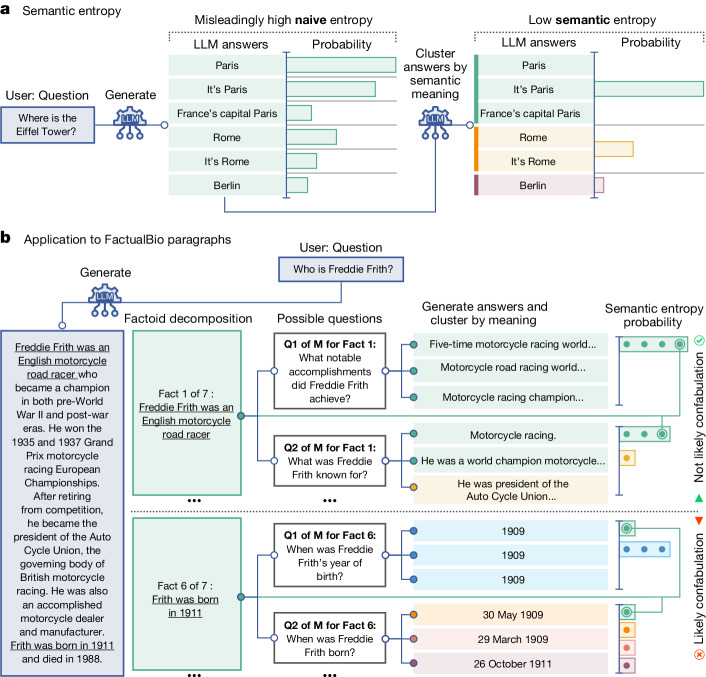
The paper introduces semantic entropy, an uncertainty estimator that clusters LLM generations by meaning via bidirectional entailment and computes entropy over those semantic clusters to detect confabulations. Across question-answering, math, and biography-generation tasks, semantic entropy outperforms naive entropy and supervised baselines without task-specific training data.
Key findings
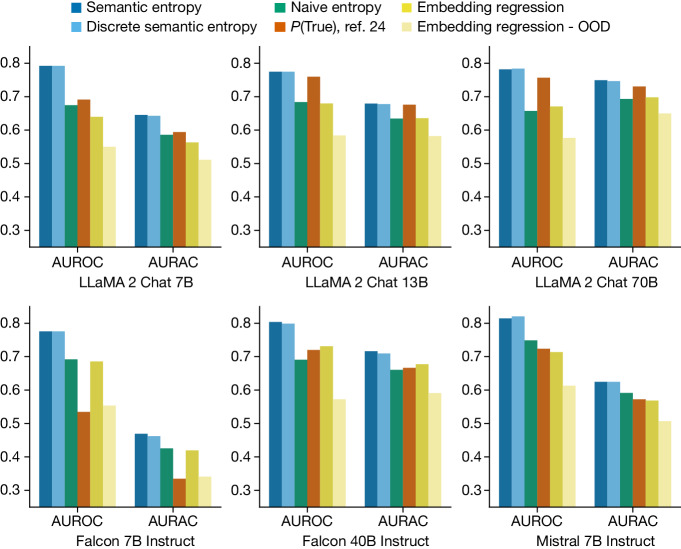
- Averaged across 30 task–model combinations, semantic entropy achieved the best AUROC of 0.790, compared with naive entropy (0.691), P(True) (0.698), and embedding regression (0.687); performance was stable between 0.78 and 0.81 across LLaMA, Falcon, and Mistral model families and scales from 7B to 70B parameters.
- Semantic entropy detects confabulations in sentence-length QA and math across TriviaQA, SQuAD 1.1, BioASQ, NQ-Open, and SVAMP, and its discrete variant performs similarly without requiring exact output probabilities.
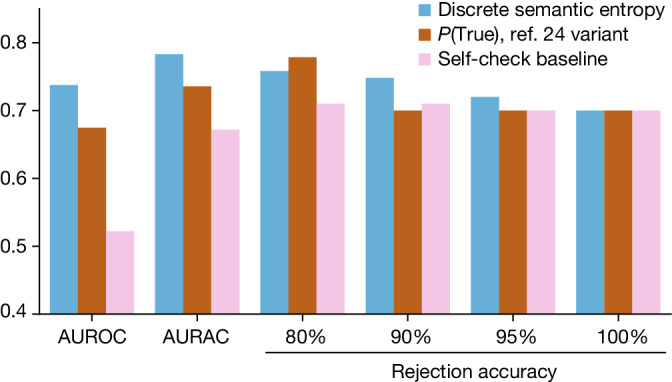
- On the GPT-4 biography dataset FactualBio—21 individuals, 150 factual claims, of which 45 were incorrect—the discrete semantic entropy variant outperformed a self-check baseline and an adapted P(True) baseline on AUROC and AURAC; P(True) had a narrow edge only after the top 20% of answers judged most likely to be confabulations were rejected.
- The method targets confabulations—arbitrary and incorrect generations sensitive to irrelevant details such as random seed—rather than all hallucinations, and it does not address systematically bad outputs.
Methods
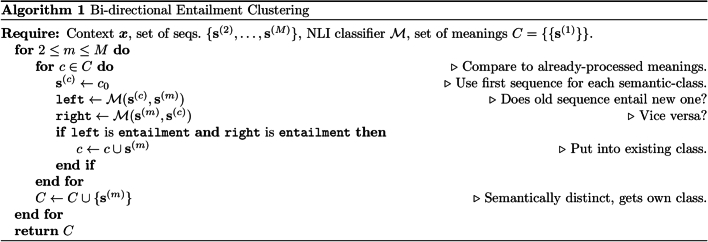
- For each question, the method samples multiple generations from the LLM, clusters them by semantic equivalence using bidirectional entailment, and estimates semantic entropy over the meaning clusters; a discrete variant approximates cluster probabilities from generation frequencies when token probabilities are unavailable.
- Sentence-length experiments used LLaMA 2 Chat (7B, 13B, 70B), Falcon Instruct (7B, 40B), and Mistral Instruct (7B) on BioASQ, SQuAD 1.1, TriviaQA, SVAMP, and NQ-Open, with 400 train and 400 test examples per dataset; GPT-4 (v.0613) was used for FactualBio.
- Evaluation metrics were AUROC, rejection accuracy, and AURAC; sentence-length correctness was assessed automatically with GPT-4 against reference answers, validated against human judgement in the Supplementary Information.
Limitations
- The paper states that semantic entropy does not guarantee factuality and does not help when LLM outputs are systematically bad, including confident errors from training objectives, systematic reasoning failures, or misleading behaviour.
- The paper notes that semantic clustering can be overly sensitive to context: in one example, it distinguished a precise date from a year and treated the model as uncertain, even though the distinction was probably irrelevant in context.
- For FactualBio, the paper states that automatically generated questions are the main source of errors, and that GPT-4 did not expose output probabilities at the time, preventing computation of naive entropy, standard semantic entropy, and the embedding regression baseline for GPT-4.
Model-written summary. Check it against the paper before relying on it.
Integrity signals
Registry
Cites
Statistics
Figures
Verification
Claims the paper makes
8 Valid · 6 Not valid · 5 Not checked · 60 Own results and interpretations
The cited sources support only part of this claim — read each source’s verdict below.
In the paper
“Large language model (LLM) systems, such as ChatGPT1 or Gemini2, can show impressive reasoning and question-answering capabilities but often ‘hallucinate’ false outputs and unsubstantiated answers3,4.”
§ Detecting hallucinations in large language models using semantic entropy > Abstract
What the sources say
- Partly supportedcites [3] Xiao, Y. & Wang, W. Y. On hallucination and predictive uncertainty in conditional language generation. In Proc. 16th Conference of the European Chapter of the Association for Computational Linguistics 2734–2744 (Association for Computational Linguistics, 2021). sourceExperimental — accuracy not yet measured
The Introduction (p. 1) says neural generation models can produce content unsupported by their inputs, and §2.1 (p. 2) defines hallucination as false information unsupported by the input. The paper studies conditional generation, including image captioning and data-to-text, rather than establishing how often LLM systems such as ChatGPT or Gemini give unsubstantiated answers. (LLM, conf=0.84)
- Partly supportedcites [4] Rohrbach, A., Hendricks, L. A., Burns, K., Darrell, T. & Saenko, K. Object hallucination in image captioning. In Proc. 2018 Conference on Empirical Methods in Natural Language Processing (eds Riloff, E., Chiang, D., Hockenmaier, J. & Tsujii, J.) 4035–4045 (Association for Computational Linguistics, 2018). sourceExperimental — accuracy not yet measured
The Introduction describes image-captioning models generating objects absent from an image, and Section 3.2 reports hallucinated objects in 7.4%–17.7% of tested captions. This supports the general point that generated outputs can be false, but the paper does not establish how often LLM systems such as ChatGPT or Gemini produce unsubstantiated answers. Page numbers were not available in our copy. (LLM, conf=0.86)
plain- Asserted: passes — The authors put it forward as true.
- Checkable: passes — It can be checked against evidence.
- Load-bearing: passes — The paper’s conclusions depend on it.
- Based: passes — The paper gives a reason why it holds.
- Partly supported
The cited sources support only part of this claim — read each source’s verdict below.
In the paper
“High entropy corresponds to high uncertainty23–25—so semantic entropy is one way to estimate semantic uncertainties.”
§ Detecting hallucinations in large language models using semantic entropy > Main
What the sources say
- Not checked — no full text of the sourcecites [23] MacKay, D. J. C. Information-based objective functions for active data selection. Neural Comput. 4, 590–604 (1992). source
- Partly supportedcites [24] Kadavath, S. et al. Language models (mostly) know what they know. Preprint at https://arxiv.org/abs/2207.05221 (2022). sourceExperimental — accuracy not yet measured
Section B.2 (p. 29) hypothesizes that an unsure model produces a high-entropy answer distribution, and reports that entropy has some predictive power. But it also finds that larger models can give diverse correct answers and concludes that answer-distribution entropy is not a robust measure of whether a model knows the answer. The unqualified correspondence in the claim overstates the paper's finding. (LLM, conf=0.87)
- Supportedcites [25] Lindley, D. V. On a measure of the information provided by an experiment. Ann. Math. Stat. 27, 986–1005 (1956). source
The discussion on p. 4 explains that the measure uses Shannon’s function with the sign reversed: information is greatest when the distribution is concentrated on one value and falls as it spreads. This supports the cited background point that higher Shannon entropy corresponds to greater uncertainty; the later claim about semantic entropy is not attributed to this source. (LLM, conf=0.88)
plainstates an association- Asserted: passes — The authors put it forward as true.
- Checkable: passes — It can be checked against evidence.
- Load-bearing: passes — The paper’s conclusions depend on it.
- Based: passes — The paper gives a reason why it holds.
A result the paper states — it cites no source for it, so there is none to check. The quote shows it is in the paper.
In the paper
“Nevertheless, we significantly improve question-answering accuracy for state-of-the-art LLMs, revealing that confabulations are a great source of error at present.”
§ Detecting hallucinations in large language models using semantic entropy > Main
boostedstates a cause- Asserted: passes — The authors put it forward as true.
- Checkable: passes — It can be checked against evidence.
- Load-bearing: passes — The paper’s conclusions depend on it.
- Based: passes — The paper gives a reason why it holds.
- Rests on an assumption not shown here.
A result the paper reports from its own data — it cites no other source for it, so there is none to check. The quote shows it is in the paper.
In the paper
“We further show that semantic uncertainty can be used to improve model accuracy by refusing to answer questions when semantic uncertainty is high.”
§ Detecting hallucinations in large language models using semantic entropy > Methods > Detecting confabulations in QA and math
plainstates a cause- Asserted: passes — The authors put it forward as true.
- Checkable: passes — It can be checked against evidence.
- Load-bearing: passes — The paper’s conclusions depend on it.
- Based: passes — The paper gives a reason why it holds.
A result the paper reports from its own data — it cites no other source for it, so there is none to check. The quote shows it is in the paper.
In the paper
“In our experiments, we use semantic uncertainty to predict model accuracy, demonstrating that confabulations make up a notable fraction of model mistakes.”
§ Detecting hallucinations in large language models using semantic entropy > Methods > Detecting confabulations in QA and math
boosted- Asserted: passes — The authors put it forward as true.
- Checkable: passes — It can be checked against evidence.
- Load-bearing: passes — The paper’s conclusions depend on it.
- Based: passes — The paper gives a reason why it holds.
36 more claims
Create a free account to see all 79 claims and every source verdict.
- Probably not a substantial claim. 30
- It may state two separate claims as one. 20
Claims other papers make about this one
Each is checked against this paper’s own text: does it say what the citing paper says it does?
The source backs part of the claim, not all of it — or backs it for a different population, condition or comparison.
In the citing paper
“However, LLMs exhibit hallucination and fabrication errors that are unacceptable for quantitative modeling [19, 20, 21].”
From Structured Schemas for Provenance‐Rich, LLM ‐Assisted QSP Model Calibration (2026) · cites this paper as [19]
Experimental — accuracy not yet measuredThe source backs part of the claim, not all of it — or backs it for a different population, condition or comparison.
In the citing paper
“Studies on hallucination, calibration, sycophancy, and cognitive bias indicate that failures often result not from a lack of capability but from unstable behavioral dispositions under uncertainty or pressure [8, 9, 10, 12, 15].”
From Machine Psychometrics: A Mathematical Psychology of Artificial Intelligence (2026) · cites this paper as [8]
Experimental — accuracy not yet measuredThe source backs part of the claim, not all of it — or backs it for a different population, condition or comparison.
In the citing paper
“AI-generated patient summaries also frequently contain errors that can be hard to detect12.”
From Multi-model assurance analysis showing large language models are highly vulnerable to adversarial hallucination attacks during clinical decision support (2025) · cites this paper as [12]
Experimental — accuracy not yet measuredThe source backs part of the claim, not all of it — or backs it for a different population, condition or comparison.
In the citing paper
“LLMs remain limited by the static knowledge encoded in their parameters.They are prone to hallucinations, factual inaccuracies, and out-of-date internal knowledge (Farquhar et al., 2024;Lewis et al., 2020).”
From Improving Amharic Information Retrieval with Translative and Multi-Agent Debate Retrieval Augmented Generation (2026) · cites this paper as Farquhar et al., 2024
Experimental — accuracy not yet measuredThe source backs part of the claim, not all of it — or backs it for a different population, condition or comparison.
In the citing paper
“This limitation can result in responses that lack coherence, contextual relevance, and even lead to hallucinations in extended dialogues or complex tasks [1], [2].”
From Memory-Augmented Architecture for Long-Term Context Handling in Large Language Models (2026) · cites this paper as [1]
Experimental — accuracy not yet measured
11 more claims about this paper
Create a free account to see every claim other papers make about this one.
Citations
Cites
Language Models are Few-Shot Learners
Brown, T. B., Mann, B., Ryder, N., Subbiah, M., Kaplan, J., Dhariwal, P., Neelakantan, A., Shyam, P., Sastry, G., Askell, A., et al. (2020) · arXiv · doi:10.48550/arxiv.2005.14165 · Cited by 23,372
SQuAD: 100,000+ Questions for Machine Comprehension of Text
Rajpurkar, P., Zhang, J., Lopyrev, K., & Liang, P. (2016) · Proceedings of the 2016 Conference on Empirical Methods in Natural Language Processing · doi:10.18653/v1/d16-1264 · Cited by 6,208
Survey of Hallucination in Natural Language Generation
Ji, Z., Lee, N., Frieske, R., Yu, T., Su, D., Xu, Y., Ishii, E., Bang, Y. J., Madotto, A., & Fung, P. (2023) · ACM Computing Surveys · doi:10.1145/3571730 · Cited by 5,025 · cited 2×
“Hallucinations are often defined as LLMs generating “content that is nonsensical or unfaithful to the provided source content” 9–11 but they have come to include a vast array of failures of faithfulness and factuality.”
A Broad-Coverage Challenge Corpus for Sentence Understanding through Inference
Williams, A., Nangia, N., & Bowman, S. (2018) · Proceedings of the 2018 Conference of the North American Chapter of the Association for Computational Linguistics: Human Language Technologies, Volume 1 (Long Papers) · doi:10.18653/v1/n18-1101 · Cited by 3,342 · cited 2×
“We rely on language models to predict entailment, such as DeBERTa-Large-MNLI 56 , which has been trained to predict entailment, or general-purpose LLMs such as GPT-3.”
Llama 2: Open Foundation and Fine-Tuned Chat Models
Touvron, H., Martin, L., Stone, K., Albert, P., Almahairi, A., Babaei, Y., Bashlykov, N., Batra, S., Bhargava, P., Bhosale, S., et al. (2023) · arXiv · doi:10.48550/arxiv.2307.09288 · Cited by 2,604 · cited 1×
“Our results for TriviaQA, SQuAD, BioASQ, NQ-Open and SVAMP are all evaluated context-free and involve sentence-length answers (96 ± 70 characters, mean ± s.d.) and use LLaMA 2 Chat (7B, 13B and 70B parameters) 38 , Falcon Instruct (7B and 40B) 39 and Mistral Instruct (7B) 40 .”
Aleatory or epistemic? Does it matter?
Kiureghian, A. D., & Ditlevsen, O. (2009) · Structural Safety · doi:10.1016/j.strusafe.2008.06.020 · Cited by 2,454 · cited 1×
“Researchers some-times separate aleatoric uncertainty (uncertainty in the underlying data distribution) from epistemic uncertainty (caused by having only limited information) 46 .”
Natural Questions: A benchmark for question answering research
Kwiatkowski, T., Palomaki, J., Redfield, O., Collins, M., Parikh, A., Alberti, C., Epstein, D., Polosukhin, I., Devlin, J., Lee, K., et al. (2019) · Transactions of the Association for Computational Linguistics · doi:10.1162/tacl_a_00276 · Cited by 2,069 · cited 2×
“33), life sciences (BioASQ 34 ) and open-domain natural questions (NQ-Open 35 ) derived from actual queries to Google Search 36 .”
TriviaQA: A Large Scale Distantly Supervised Challenge Dataset for Reading Comprehension
Joshi, M., Choi, E., Weld, D., & Zettlemoyer, L. (2017) · Proceedings of the 55th Annual Meeting of the Association for Computational Linguistics (Volume 1: Long Papers) · doi:10.18653/v1/p17-1147 · Cited by 1,690 · cited 5×
“TriviaQA is a trivia question-answering dataset.”
InfluentialTriviaQA: A Large Scale Distantly Supervised Challenge Dataset for Reading Comprehension
Joshi, M., Choi, E., Weld, D. S., & Zettlemoyer, L. (2017) · arXiv · doi:10.48550/arxiv.1705.03551 · Cited by 1,650
On a measure of the information provided by an experiment
Lindley, D. V. (1956) · The Annals of Mathematical Statistics · doi:10.1214/aoms/1177728069 · Cited by 1,509 · cited 2×
“High entropy corresponds to high uncertainty 23–25 —so semantic entropy is one way to estimate semantic uncertainties.”
Concrete Problems in AI Safety
Amodei, D., Olah, C., Steinhardt, J., Christiano, P., Schulman, J., & Mané, D. (2016) · arXiv · doi:10.48550/arxiv.1606.06565 · Cited by 1,314
Hierarchical Neural Story Generation
Fan, A., Lewis, M., & Dauphin, Y. (2018) · Proceedings of the 56th Annual Meeting of the Association for Computational Linguistics (Volume 1: Long Papers) · doi:10.18653/v1/p18-1082 · Cited by 1,266
Hierarchical Neural Story Generation
Fan, A., Lewis, M., & Dauphin, Y. (2018) · arXiv · doi:10.48550/arxiv.1805.04833 · Cited by 1,242
Information-based objective functions for active data selection
MacKay, D. J. C. (1992) · Neural Computation · doi:10.1162/neco.1992.4.4.590 · Cited by 1,221 · cited 1×
“High entropy corresponds to high uncertainty 23–25 —so semantic entropy is one way to estimate semantic uncertainties.”
On Faithfulness and Factuality in Abstractive Summarization
Maynez, J., Narayan, S., Bohnet, B., & McDonald, R. (2020) · Proceedings of the 58th Annual Meeting of the Association for Computational Linguistics · doi:10.18653/v1/2020.acl-main.173 · Cited by 1,185 · cited 1×
“Textual entailment has previously been shown to correlate with faithfulness 10 in the context of factual consistency 29 as well as being used to measure factuality in abstractive summarization 30 , especially when applied at the right granularity 31 .”
On Faithfulness and Factuality in Abstractive Summarization
Maynez, J., Narayan, S., Bohnet, B., & McDonald, R. (2020) · arXiv · doi:10.48550/arxiv.2005.00661 · Cited by 1,185 · cited 1×
“Textual entailment has previously been shown to correlate with faithfulness 10 in the context of factual consistency 29 as well as being used to measure factuality in abstractive summarization 30 , especially when applied at the right granularity 31 .”
ChatGPT and other large language models are double-edged swords
Shen, Y., Heacock, L., Elias, J., Hentel, K. D., Reig, B., Shih, G., & Moy, L. (2023) · Radiology · doi:10.1148/radiol.230163 · Cited by 1,008 · cited 8×
“In Supplementary Note 2, we carefully evaluate the benefits and drawbacks of these methods for entailment prediction.”
InfluentialGemini: A Family of Highly Capable Multimodal Models
Gemini Team, Anil, R., Borgeaud, S., Alayrac, J.-B., Yu, J., Soricut, R., Schalkwyk, J., Dai, A. M., Hauth, A., Millican, K., et al. (2023) · arXiv · doi:10.48550/arxiv.2312.11805 · Cited by 990
Latent retrieval for weakly supervised open domain question answering
Lee, K., Chang, M.-W., & Toutanova, K. (2019) · Proceedings of the 57th Annual Meeting of the Association for Computational Linguistics · doi:10.18653/v1/p19-1612 · Cited by 771 · cited 4×
“33), life sciences (BioASQ 34 ) and open-domain natural questions (NQ-Open 35 ) derived from actual queries to Google Search 36 .”
Influential(2000) · doi:10.1109/afgr.2000.840616 · Cited by 634 · cited 1×
“The term hallucination in the context of machine learning originally comes from filling in ungrounded details, either as a deliberate strategy 20 or as a reliability problem 4 .”
Tsatsaronis, G., Balikas, G., Malakasiotis, P., Partalas, I., Zschunke, M., Alvers, M. R., Weissenborn, D., Krithara, A., Petridis, S., Polychronopoulos, D., et al. (2015) · BMC Bioinformatics · doi:10.1186/s12859-015-0564-6 · Cited by 598 · cited 6×
“Examples of questions and answers from TriviaQA, SQuAD and BioASQ, for LLaMA 2 Chat 70B, are shown in Table 1.”
InfluentialSelfCheckGPT: Zero-Resource Black-Box Hallucination Detection for Generative Large Language Models
Manakul, P., Liusie, A., & Gales, M. (2023) · Proceedings of the 2023 Conference on Empirical Methods in Natural Language Processing · doi:10.18653/v1/2023.emnlp-main.557 · Cited by 557
Neural Text Generation from Structured Data with Application to the Biography Domain
Lebret, R., Grangier, D., & Auli, M. (2016) · Proceedings of the 2016 Conference on Empirical Methods in Natural Language Processing · doi:10.18653/v1/d16-1128 · Cited by 444 · cited 1×
“To generate the dataset, we randomly sampled 21 individuals from the WikiBio dataset 64 .”
Object Hallucination in Image Captioning
Rohrbach, A., Hendricks, L. A., Burns, K., Darrell, T., & Saenko, K. (2018) · Proceedings of the 2018 Conference on Empirical Methods in Natural Language Processing · doi:10.18653/v1/d18-1437 · Cited by 420
Talking about Large Language Models
Shanahan, M. (2024) · Communications of the ACM · doi:10.1145/3624724 · Cited by 381 · cited 1×
“Although we agree that metaphor must be used carefully with LLMs 22 , the widespread adoption of the term hallucination reflects the fact that it points to an important phenomenon.”
Jiang, A. Q., Sablayrolles, A., Mensch, A., Bamford, C., Chaplot, D. S., Casas, D. D. L., Bressand, F., Lengyel, G., Lample, G., Saulnier, L., et al. (2023) · arXiv · doi:10.48550/arxiv.2310.06825 · Cited by 340
Deep Learning for Answer Sentence Selection
Yu, L., Hermann, K. M., Blunsom, P., & Pulman, S. (2014) · arXiv (Cornell University) · doi:10.48550/arxiv.1412.1632 · Cited by 340
Are NLP Models really able to Solve Simple Math Word Problems?
Patel, A., Bhattamishra, S., & Goyal, N. (2021) · Proceedings of the 2021 Conference of the North American Chapter of the Association for Computational Linguistics: Human Language Technologies · doi:10.18653/v1/2021.naacl-main.168 · Cited by 307 · cited 4×
“In addition, semantic entropy detects confabulations in mathematical word problems (SVAMP 37 ) and in a biography-generation dataset, FactualBio, accompanying this paper.”
InfluentialFalke, T., Ribeiro, L. F. R., Utama, P. A., Dagan, I., & Gurevych, I. (2019) · Proceedings of the 57th Annual Meeting of the Association for Computational Linguistics · doi:10.18653/v1/p19-1213 · Cited by 265 · cited 1×
“Textual entailment has previously been shown to correlate with faithfulness 10 in the context of factual consistency 29 as well as being used to measure factuality in abstractive summarization 30 , especially when applied at the right granularity 31 .”
SummaC: Re-Visiting NLI-based Models for Inconsistency Detection in Summarization
Laban, P., Schnabel, T., Bennett, P. N., & Hearst, M. A. (2022) · Transactions of the Association for Computational Linguistics · doi:10.1162/tacl_a_00453 · Cited by 238 · cited 1×
“Textual entailment has previously been shown to correlate with faithfulness 10 in the context of factual consistency 29 as well as being used to measure factuality in abstractive summarization 30 , especially when applied at the right granularity 31 .”
Calibration of Pre-trained Transformers
Desai, S., & Durrett, G. (2020) · Proceedings of the 2020 Conference on Empirical Methods in Natural Language Processing (EMNLP) · doi:10.18653/v1/2020.emnlp-main.21 · Cited by 209
Trustworthy journalism through AI
Opdahl, A. L., Tessem, B., Dang‐Nguyen, D., Motta, E., Setty, V., Throndsen, E., Tverberg, A., & Trattner, C. (2023) · Data & Knowledge Engineering · doi:10.1016/j.datak.2023.102182 · Cited by 202 · cited 8×
“In Supplementary Note 2, we carefully evaluate the benefits and drawbacks of these methods for entailment prediction.”
InfluentialLanguage Models (Mostly) Know What They Know
Kadavath, S., Conerly, T., Askell, A., Henighan, T., Drain, D., Perez, E., Schiefer, N., Hatfield-Dodds, Z., DasSarma, N., Tran-Johnson, E., et al. (2022) · arXiv · doi:10.48550/arxiv.2207.05221 · Cited by 187
A Survey of Paraphrasing and Textual Entailment Methods
Androutsopoulos, I., & Malakasiotis, P. (2010) · Journal of Artificial Intelligence Research · doi:10.1613/jair.2985 · Cited by 178 · cited 1×
“We operationalize E ( ⋅ , ⋅ ) using the idea of bidirectional entailment, which has a long history in linguistics 52 and natural language processing 28,53,54 .”
Jiang, Z., Araki, J., Ding, H., & Neubig, G. (2021) · Transactions of the Association for Computational Linguistics · doi:10.1162/tacl_a_00407 · Cited by 177
Penedo, G., Malartic, Q., Hesslow, D., Cojocaru, R., Cappelli, A., Alobeidli, H., Pannier, B., Almazrouei, E., & Launay, J. (2023) · arXiv · doi:10.48550/arxiv.2306.01116 · Cited by 164 · cited 1×
“Our results for TriviaQA, SQuAD, BioASQ, NQ-Open and SVAMP are all evaluated context-free and involve sentence-length answers (96 ± 70 characters, mean ± s.d.) and use LLaMA 2 Chat (7B, 13B and 70B parameters) 38 , Falcon Instruct (7B and 40B) 39 and Mistral Instruct (7B) 40 .”
RealFormer: Transformer Likes Residual Attention
He, R., Ravula, A., Kanagal, B., & Ainslie, J. (2021) · Findings of the Association for Computational Linguistics: ACL (Findings of ACL) · doi:10.18653/v1/2021.findings-acl.81 · Cited by 162
Correcting Length Bias in Neural Machine Translation
Murray, K., & Chiang, D. (2018) · Proceedings of the Third Conference on Machine Translation: Research Papers · doi:10.18653/v1/w18-6322 · Cited by 133 · cited 1×
“Length normalization has some empirical success 48 , including in our own preliminary experiments, but little theoretical justification in the literature.”
Deep Deterministic Uncertainty: A New Simple Baseline
Mukhoti, J., Kirsch, A., van Amersfoort, J., Torr, P. H. S., & Gal, Y. (2023) · 2023 IEEE/CVF Conference on Computer Vision and Pattern Recognition (CVPR) · doi:10.1109/cvpr52729.2023.02336 · Cited by 116 · cited 1×
“…do not match the deployment distribution—which mirrors the common real-world case in which there is a distribution shift between training and deployment 42 —the plotted value is the average metric for embedding regression trained on one of the four ‘off-distribution’ datasets for that evaluation.”
Self-citationCharformer: Fast Character Transformers via Gradient-based Subword Tokenization
Tay, Y., Tran, V. Q., Ruder, S., Gupta, J., Chung, H. W., Bahri, D., Qin, Z., Baumgartner, S., Yu, C., & Metzler, D. (2021) · arXiv · doi:10.48550/arxiv.2106.12672 · Cited by 92 · cited 1×
“This builds on past work towards paraphrase identification based on embedding similarity 59,60 and BERT-style models 61,62 .”
TRUE: Re-evaluating Factual Consistency Evaluation
Honovich, O., Aharoni, R., Herzig, J., Taitelbaum, H., Kukliansy, D., Cohen, V., Scialom, T., Szpektor, I., Hassidim, A., & Matias, Y. (2022) · arXiv · doi:10.48550/arxiv.2204.04991 · Cited by 84 · cited 1×
“Textual entailment has previously been shown to correlate with faithfulness 10 in the context of factual consistency 29 as well as being used to measure factuality in abstractive summarization 30 , especially when applied at the right granularity 31 .”
Controlled Hallucinations: Learning to Generate Faithfully from Noisy Data
Filippova, K. (2020) · Findings of the Association for Computational Linguistics: EMNLP 2020 · doi:10.18653/v1/2020.findings-emnlp.76 · Cited by 79 · cited 1×
“Hallucinations are often defined as LLMs generating “content that is nonsensical or unfaithful to the provided source content” 9–11 but they have come to include a vast array of failures of faithfulness and factuality.”
On hallucination and predictive uncertainty in conditional language generation
Xiao, Y., & Wang, W. Y. (2021) · Proceedings of the 16th Conference of the European Chapter of the Association for Computational Linguistics: Main Volume · doi:10.18653/v1/2021.eacl-main.236 · Cited by 79 · cited 2×
“We measure entailment using both general-purpose LLMs and natural language inference (NLI) tools developed specifically for detecting entailment for which we show direct evaluations in Supplementary Tables 2 and 3 and Supplementary Fig.”
Irving, G., Christiano, P., & Amodei, D. (2018) · arXiv · doi:10.48550/arxiv.1805.00899 · Cited by 71
TRUE: Re-evaluating Factual Consistency Evaluation
Honovich, O., Aharoni, R., Herzig, J., Taitelbaum, H., Kukliansy, D., Cohen, V., Scialom, T., Szpektor, I., Hassidim, A., & Matias, Y. (2022) · Proceedings of the Second DialDoc Workshop on Document-grounded Dialogue and Conversational Question Answering · doi:10.18653/v1/2022.dialdoc-1.19 · Cited by 56 · cited 1×
“Textual entailment has previously been shown to correlate with faithfulness 10 in the context of factual consistency 29 as well as being used to measure factuality in abstractive summarization 30 , especially when applied at the right granularity 31 .”
Measuring machine translation quality as semantic equivalence: A metric based on entailment features
Padó, S., Cer, D., Galley, M., Jurafsky, D., & Manning, C. D. (2009) · Machine Translation · doi:10.1007/s10590-009-9060-y · Cited by 47 · cited 1×
“We operationalize E ( ⋅ , ⋅ ) using the idea of bidirectional entailment, which has a long history in linguistics 52 and natural language processing 28,53,54 .”
Confabulations: A Conceptual History
Berríos, G. E. (1998) · Journal of the History of the Neurosciences · doi:10.1076/jhin.7.3.225.1855 · Cited by 42
Truthful AI: Developing and governing AI that does not lie
Evans, O., Cotton-Barratt, O., Finnveden, L., Bales, A., Balwit, A., Wills, P., Righetti, L., & Saunders, W. (2021) · arXiv · doi:10.48550/arxiv.2110.06674 · Cited by 39 · cited 1×
“…in which a similar ‘symptom’ is caused by the following different mechanisms: when LLMs are consistently wrong as a result of being trained on erroneous data such as common misconceptions 13 ; when the LLM ‘lies’ in pursuit of a reward 14 ; or systematic failures of reasoning or generalization.”
SelfCheckGPT: Zero-Resource Black-Box Hallucination Detection for Generative Large Language Models
Manakul, P., Liusie, A., & Gales, M. J. F. (2023) · arXiv · doi:10.48550/arxiv.2303.08896 · Cited by 38
SummaC: Re-Visiting NLI-based Models for Inconsistency Detection in Summarization
Laban, P., Schnabel, T., Bennett, P. N., & Hearst, M. A. (2021) · arXiv · doi:10.48550/arxiv.2111.09525 · Cited by 38
The RefinedWeb Dataset for Falcon LLM: Outperforming Curated Corpora with Web Data Only
Penedo, G., Malartic, Q., Hesslow, D., Cojocaru, R., Alobeidli, H., Cappelli, A., Pannier, B., Almazrouei, E., & Launay, J. (2023) · Advances in Neural Information Processing Systems 36 · doi:10.52202/075280-3464 · Cited by 25
Uncertainty Estimation and Reduction of Pre-trained Models for Text Regression
Wang, Y., Beck, D., Baldwin, T., & Verspoor, K. (2022) · Transactions of the Association for Computational Linguistics · doi:10.1162/tacl_a_00483 · Cited by 23 · cited 1×
“Past work on uncertainty for LLMs has focused on simpler settings, such as classifiers 16,17 and regressors 18,19 , whereas the most exciting applications of LLMs relate to free-form generations.”
Uncertainty-Aware Machine Translation Evaluation
Glushkova, T., Zerva, C., Rei, R., & Martins, A. F. T. (2021) · Findings of the Association for Computational Linguistics: EMNLP 2021 · doi:10.18653/v1/2021.findings-emnlp.330 · Cited by 17 · cited 1×
“Past work on uncertainty for LLMs has focused on simpler settings, such as classifiers 16,17 and regressors 18,19 , whereas the most exciting applications of LLMs relate to free-form generations.”
Stretching Sentence-pair NLI Models to Reason over Long Documents and Clusters
Schuster, T., Chen, S., Buthpitiya, S., Fabrikant, A., & Metzler, D. (2022) · Findings of the Association for Computational Linguistics: EMNLP 2022 · doi:10.18653/v1/2022.findings-emnlp.28 · Cited by 17
jlko/semantic_uncertainty: Initial release v.1.0.0.
jlko (2024) · Zenodo (CERN European Organization for Nuclear Research) · doi:10.5281/zenodo.10964365 · Cited by 1
OpenAI, Achiam, J., Adler, S., Agarwal, S., Ahmad, L., Akkaya, I., Aleman, F. L., Almeida, D., Altenschmidt, J., Altman, S., et al. (2023) · arXiv · doi:10.48550/arxiv.2303.08774
jlko/semantic_uncertainty: Initial release v.1.0.0.
jlko (2024) · Zenodo · doi:10.5281/zenodo.10964366
Research works printed but not linked: 8
- Xiao, T. Z., Gomez, A. N. & Gal, Y. Wat zei je? Detecting out-of-distribution translations with variational transformers. In Workshop on Bayesian Deep Learning at the Conference on Neural Information Processing Systems (NeurIPS, Vancouver, 2019).
- Negri, M., Bentivogli, L., Mehdad, Y., Giampiccolo, D. & Marchetti, A. Divide and conquer: crowdsourcing the creation of cross-lingual textual entailment corpora. In Proc. 2011 Conference on Empirical Methods in Natural Language Processing 670–679 (Association for Computational Linguistics, 2011).
- Malinin, A. & Gales, M. Uncertainty estimation in autoregressive structured prediction. In Proceedings of the International Conference on Learning Representations https://openreview.net/forum?id=jN5y-zb5Q7m (2021).
- Holtzman, A., Buys, J., Du, L., Forbes, M. & Choi, Y. The curious case of neural text degeneration. In Proceedings of the International Conference on Learning Representations https://openreview.net/forum?id=rygGQyrFvH (2020).
- Culicover, P. W. Paraphrase generation and information retrieval from stored text. Mech. Transl. Comput. Linguist. 11, 78–88 (1968).
- He, P., Liu, X., Gao, J. & Chen, W. Deberta: decoding-enhanced BERT with disentangled attention. In International Conference on Learning Representations https://openreview.net/forum?id=XPZIaotutsD (2021).
- Socher, R., Huang, E., Pennin, J., Manning, C. D. & Ng, A. Dynamic pooling and unfolding recursive autoencoders for paraphrase detection. In Proceedings of the 24th Conference on Neural Information Processing Systems (eds Shawe-Taylor, J. et al.) (2011)
- Kane, H., Kocyigit, Y., Abdalla, A., Ajanoh, P. & Coulibali, M. Towards neural similarity evaluators. In Workshop on Document Intelligence at the 32nd conference on Neural Information Processing (2019).
Cited by
A framework to assess clinical safety and hallucination rates of LLMs for medical text summarisation
Asgari, E., Montaña-Brown, N., Dubois, M., Khalil, S., Balloch, J., Yeung, J. A., & Pimenta, D. (2025) · npj Digital Medicine · doi:10.1038/s41746-025-01670-7 · Cited by 423
What large language models know and what people think they know
Steyvers, M., Tejeda, H., Kumar, A., Belem, C., Karny, S., Hu, X., Mayer, L. W., & Smyth, P. (2025) · Nature Machine Intelligence · doi:10.1038/s42256-024-00976-7 · Cited by 209
“13,17).”
InfluentialMedical large language models are vulnerable to data-poisoning attacks
Alber, D. A., Yang, Z., Alyakin, A., Yang, E., Rai, S., Valliani, A. A., Zhang, J., Rosenbaum, G. R., Amend-Thomas, A. K., Kurland, D. B., et al. (2025) · Nature Medicine · doi:10.1038/s41591-024-03445-1 · Cited by 242
“There exist many approaches to detecting misinformation generated by LLMs 60 .”
The clinicians’ guide to large language models: a general perspective with a focus on hallucinations
Roustan, D., & Bastardot, F. (2025) · Interactive Journal of Medical Research · doi:10.2196/59823 · Cited by 191
“Measurement of semantic entropy [22], algorithmic approaches to address root causes of hallucinations [23], and more classical methods such as Retrieval-Augmented Generation [24] are some of the many techniques that have been proposed to identify and reduce hallucinations.”
Omar, M., Sorin, V., Collins, J. D., Reich, D., Freeman, R., Gavin, N., Charney, A., Stump, L., Bragazzi, N. L., Nadkarni, G. N., et al. (2025) · Communications Medicine · doi:10.1038/s43856-025-01021-3 · Cited by 204
Metadata
- Authors
- Farquhar, S., Kossen, J., Kuhn, L., & Gal, Y.
- Affiliations
- University of Oxford (GB)
- Corresponding author
- Farquhar, Sebastian
- Venue
- Nature
- Published
- 2024-06-19
- Volume
- 630
- Issue
- 8017
- Pages
- 625-630
- ISSN
- 0028-0836 (ISSN-L)
- 1476-4687
- PMC
- PMC11186750
- OpenAlex
- W4399803256
- Semantic Scholar
- f82f49c20c6acc69f884f05e3a9f1ceea91061ce
- Cited by
- 934
- References
- 60
- Citations by year
- 2026: 540 · 2025: 349 · 2024: 44
- FWCI
- 137.11
- Type
- journal article
- Language
- en
- Open access
- hybrid
- doi.org
- Licence
- cc-by
- creativecommons.org/licenses/by/4.0 (tdm)
- creativecommons.org/licenses/by/4.0 (vor)
- Locations
- Nature (publishedVersion, cc-by)
- PubMed Central (publishedVersion, cc-by)
- PubMed (publishedVersion)
- RePEc: Research Papers in Economics (submittedVersion)
- Funders
- Government of the United Kingdom
- UK Research and Innovation
- Topics
- Physical Sciences › Computer Science › Artificial Intelligence › Topic Modeling
- Physical Sciences › Computer Science › Artificial Intelligence › Adversarial Robustness in Machine Learning
- Physical Sciences › Computer Science › Artificial Intelligence › Natural Language Processing Techniques
- Keywords
- hallucination detection, large language models, semantic entropy, uncertainty estimation, confabulation, LLM reliability, generalization to unseen tasks, honesty
About these checks
Registry, retraction, Cites and statistics results are computed, not judged, with one exception: a printed reference that no index lists is read once by a model before it counts as a citation error. Claims are extracted by a model and kept only when their quote appears verbatim in the text; each cited source is then checked, with a model’s help, for whether it says what the claim relies on. Those verdicts can be wrong — read the claim’s quote and the cited source before relying on one.
The claim verdicts this report counts are experimental: their accuracy is not yet measured.
A language model drew the claims from the paper on 2026-10-10, under version 3 of the claim definition (model deepseek-v4.1-flash, prompt extract-v3).
A second model labelled each claim on 2026-10-10 (model jev-1.13-20260917, definition revision gold-guideline-v0.2).
Cited sources are checked with a language model’s help (gpt-6-sol).
Statistics and arithmetic are recomputed, not judged.
Confidence bands are shown only for fields calibrated on our annotated test set. None is calibrated yet, so no band is shown.
What counts as a claim ›How we measure confidence ›How we check this ›
Are you an author, or do you see a problem with this page? Request a review
Data sources
Bibliographic data: Semantic Scholar, OpenAlex, Crossref.
Contains information from the Semantic Scholar Academic Graph Datasets, made available under the ODC Attribution License (ODC-BY 1.0).
Semantic Scholar’s data is described in: Kinney, R., et al. (2023). The Semantic Scholar Open Data Platform. arXiv:2301.10140.
