

Detecting hallucinations in large language models using semantic entropy
Open accessThe DOI matches its Crossref record; 57 of the 60 references it cites were found in a registry or an index; 14 of the 21 sources its claims cite were checked for support.
Abstract
Abstract Large language model (LLM) systems, such as ChatGPT 1 or Gemini 2 , can show impressive reasoning and question-answering capabilities but often ‘hallucinate’ false outputs and unsubstantiated answers 3,4 . Answering unreliably or without the necessary information prevents adoption in diverse fields, with problems including fabrication of legal precedents 5 or untrue facts in news articles 6 and even posing a risk to human life in medical domains such as radiology 7 . Encouraging truthfulness through supervision or reinforcement has been only partially successful 8 . Researchers need a general method for detecting hallucinations in LLMs that works even with new and unseen questions to which humans might not know the answer. Here we develop new methods grounded in statistics, proposing entropy-based uncertainty estimators for LLMs to detect a subset of hallucinations—confabulations—which are arbitrary and incorrect generations. Our method addresses the fact that one idea can be expressed in many ways by computing uncertainty at the level of meaning rather than specific sequences of words. Our method works across datasets and tasks without a priori knowledge of the task, requires no task-specific data and robustly generalizes to new tasks not seen before. By detecting when a prompt is likely to produce a confabulation, our method helps users understand when they must take extra care with LLMs and opens up new possibilities for using LLMs that are otherwise prevented by their unreliability.
Overview
CoChat Summary
TL;DR
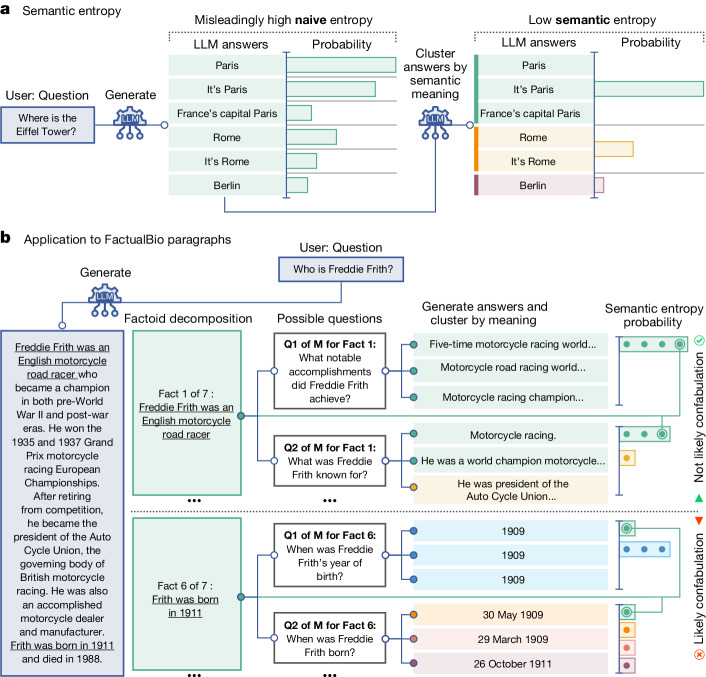
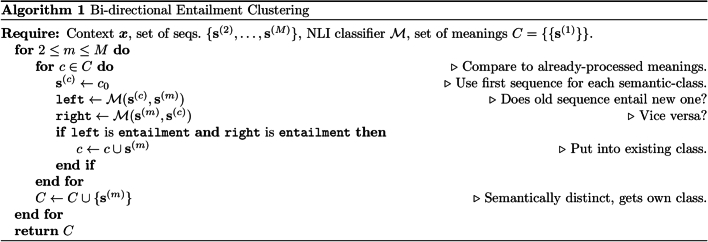
The paper introduces semantic entropy, an uncertainty estimator that clusters LLM generations by meaning via bidirectional entailment and computes entropy over those semantic clusters to detect confabulations. Across question-answering, math, and biography-generation tasks, semantic entropy outperforms naive entropy and supervised baselines without task-specific training data.
Key findings
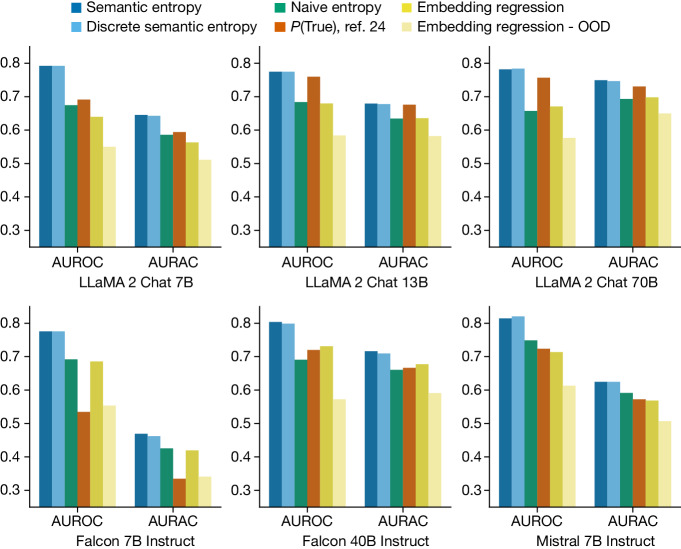
- Averaged across 30 task–model combinations, semantic entropy achieved the best AUROC of 0.790, compared with naive entropy (0.691), P(True) (0.698), and embedding regression (0.687); performance was stable between 0.78 and 0.81 across LLaMA, Falcon, and Mistral model families and scales from 7B to 70B parameters.
- Semantic entropy detects confabulations in sentence-length QA and math across TriviaQA, SQuAD 1.1, BioASQ, NQ-Open, and SVAMP, and its discrete variant performs similarly without requiring exact output probabilities.
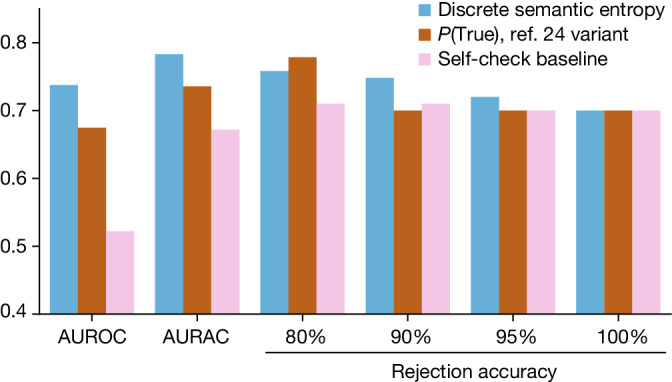
- On the GPT-4 biography dataset FactualBio—21 individuals, 150 factual claims, of which 45 were incorrect—the discrete semantic entropy variant outperformed a self-check baseline and an adapted P(True) baseline on AUROC and AURAC; P(True) had a narrow edge only after the top 20% of answers judged most likely to be confabulations were rejected.
- The method targets confabulations—arbitrary and incorrect generations sensitive to irrelevant details such as random seed—rather than all hallucinations, and it does not address systematically bad outputs.
Methods
- For each question, the method samples multiple generations from the LLM, clusters them by semantic equivalence using bidirectional entailment, and estimates semantic entropy over the meaning clusters; a discrete variant approximates cluster probabilities from generation frequencies when token probabilities are unavailable.
- Sentence-length experiments used LLaMA 2 Chat (7B, 13B, 70B), Falcon Instruct (7B, 40B), and Mistral Instruct (7B) on BioASQ, SQuAD 1.1, TriviaQA, SVAMP, and NQ-Open, with 400 train and 400 test examples per dataset; GPT-4 (v.0613) was used for FactualBio.
- Evaluation metrics were AUROC, rejection accuracy, and AURAC; sentence-length correctness was assessed automatically with GPT-4 against reference answers, validated against human judgement in the Supplementary Information.
Limitations
- The paper states that semantic entropy does not guarantee factuality and does not help when LLM outputs are systematically bad, including confident errors from training objectives, systematic reasoning failures, or misleading behaviour.
- The paper notes that semantic clustering can be overly sensitive to context: in one example, it distinguished a precise date from a year and treated the model as uncertain, even though the distinction was probably irrelevant in context.
- For FactualBio, the paper states that automatically generated questions are the main source of errors, and that GPT-4 did not expose output probabilities at the time, preventing computation of naive entropy, standard semantic entropy, and the embedding regression baseline for GPT-4.
Model-written summary. Check it against the paper before relying on it.
Integrity signals
Registry
Cites
Statistics
Figures
Verification
Claims the paper makes
8 Valid · 6 Not valid · 5 Not checked · 60 Own results and interpretations
The cited sources support only part of this claim — read each source’s verdict below.
In the paper
“Large language model (LLM) systems, such as ChatGPT1 or Gemini2, can show impressive reasoning and question-answering capabilities but often ‘hallucinate’ false outputs and unsubstantiated answers3,4.”
§ Detecting hallucinations in large language models using semantic entropy > Abstract
What the sources say
- Partly supportedcites [3] Xiao, Y. & Wang, W. Y. On hallucination and predictive uncertainty in conditional language generation. In Proc. 16th Conference of the European Chapter of the Association for Computational Linguistics 2734–2744 (Association for Computational Linguistics, 2021). sourceExperimental — accuracy not yet measured
The Introduction (p. 1) says neural generation models can produce content unsupported by their inputs, and §2.1 (p. 2) defines hallucination as false information unsupported by the input. The paper studies conditional generation, including image captioning and data-to-text, rather than establishing how often LLM systems such as ChatGPT or Gemini give unsubstantiated answers. (LLM, conf=0.84)
- Partly supportedcites [4] Rohrbach, A., Hendricks, L. A., Burns, K., Darrell, T. & Saenko, K. Object hallucination in image captioning. In Proc. 2018 Conference on Empirical Methods in Natural Language Processing (eds Riloff, E., Chiang, D., Hockenmaier, J. & Tsujii, J.) 4035–4045 (Association for Computational Linguistics, 2018). sourceExperimental — accuracy not yet measured
The Introduction describes image-captioning models generating objects absent from an image, and Section 3.2 reports hallucinated objects in 7.4%–17.7% of tested captions. This supports the general point that generated outputs can be false, but the paper does not establish how often LLM systems such as ChatGPT or Gemini produce unsubstantiated answers. Page numbers were not available in our copy. (LLM, conf=0.86)
plain- Asserted: passes — The authors put it forward as true.
- Checkable: passes — It can be checked against evidence.
- Load-bearing: passes — The paper’s conclusions depend on it.
- Based: passes — The paper gives a reason why it holds.
- Partly supported
The cited sources support only part of this claim — read each source’s verdict below.
In the paper
“High entropy corresponds to high uncertainty23–25—so semantic entropy is one way to estimate semantic uncertainties.”
§ Detecting hallucinations in large language models using semantic entropy > Main
What the sources say
- Not checked — no full text of the sourcecites [23] MacKay DJC Information-based objective functions for active data selection Neural Comput. 1992 4 590 604 10.1162/neco.1992.4.4.590 source
- Partly supportedcites [24] Kadavath, S. et al. Language models (mostly) know what they know. Preprint at https://arxiv.org/abs/2207.05221 (2022). sourceExperimental — accuracy not yet measured
Section B.2 (p. 29) hypothesizes that an unsure model produces a high-entropy answer distribution, and reports that entropy has some predictive power. But it also finds that larger models can give diverse correct answers and concludes that answer-distribution entropy is not a robust measure of whether a model knows the answer. The unqualified correspondence in the claim overstates the paper's finding. (LLM, conf=0.87)
- Supportedcites [25] Lindley DV On a measure of the information provided by an experiment Ann. Math. Stat. 1956 27 986 1005 10.1214/aoms/1177728069 source
The discussion on p. 4 explains that the measure uses Shannon’s function with the sign reversed: information is greatest when the distribution is concentrated on one value and falls as it spreads. This supports the cited background point that higher Shannon entropy corresponds to greater uncertainty; the later claim about semantic entropy is not attributed to this source. (LLM, conf=0.88)
plainstates an association- Asserted: passes — The authors put it forward as true.
- Checkable: passes — It can be checked against evidence.
- Load-bearing: passes — The paper’s conclusions depend on it.
- Based: passes — The paper gives a reason why it holds.
A result the paper states — it cites no source for it, so there is none to check. The quote shows it is in the paper.
In the paper
“Nevertheless, we significantly improve question-answering accuracy for state-of-the-art LLMs, revealing that confabulations are a great source of error at present.”
§ Detecting hallucinations in large language models using semantic entropy > Main
boostedstates a cause- Asserted: passes — The authors put it forward as true.
- Checkable: passes — It can be checked against evidence.
- Load-bearing: passes — The paper’s conclusions depend on it.
- Based: passes — The paper gives a reason why it holds.
- Rests on an assumption not shown here.
A result the paper reports from its own data — it cites no other source for it, so there is none to check. The quote shows it is in the paper.
In the paper
“We further show that semantic uncertainty can be used to improve model accuracy by refusing to answer questions when semantic uncertainty is high.”
§ Detecting hallucinations in large language models using semantic entropy > Methods > Detecting confabulations in QA and math
plainstates a cause- Asserted: passes — The authors put it forward as true.
- Checkable: passes — It can be checked against evidence.
- Load-bearing: passes — The paper’s conclusions depend on it.
- Based: passes — The paper gives a reason why it holds.
A result the paper reports from its own data — it cites no other source for it, so there is none to check. The quote shows it is in the paper.
In the paper
“In our experiments, we use semantic uncertainty to predict model accuracy, demonstrating that confabulations make up a notable fraction of model mistakes.”
§ Detecting hallucinations in large language models using semantic entropy > Methods > Detecting confabulations in QA and math
boosted- Asserted: passes — The authors put it forward as true.
- Checkable: passes — It can be checked against evidence.
- Load-bearing: passes — The paper’s conclusions depend on it.
- Based: passes — The paper gives a reason why it holds.
36 more claims
Create a free account to see all 79 claims and to verify the 2 references still open.
- Probably not a substantial claim. 30
- It may state two separate claims as one. 20
Claims other papers make about this one
Each is checked against this paper’s own text: does it say what the citing paper says it does?
The source backs part of the claim, not all of it — or backs it for a different population, condition or comparison.
In the citing paper
“However, LLMs exhibit hallucination and fabrication errors that are unacceptable for quantitative modeling [19, 20, 21].”
From Structured Schemas for Provenance‐Rich, LLM ‐Assisted QSP Model Calibration (2026) · cites this paper as [19]
Experimental — accuracy not yet measuredThe source backs part of the claim, not all of it — or backs it for a different population, condition or comparison.
In the citing paper
“Studies on hallucination, calibration, sycophancy, and cognitive bias indicate that failures often result not from a lack of capability but from unstable behavioral dispositions under uncertainty or pressure [8, 9, 10, 12, 15].”
From Machine Psychometrics: A Mathematical Psychology of Artificial Intelligence (2026) · cites this paper as [8]
Experimental — accuracy not yet measuredThe source backs part of the claim, not all of it — or backs it for a different population, condition or comparison.
In the citing paper
“AI-generated patient summaries also frequently contain errors that can be hard to detect12.”
From Multi-model assurance analysis showing large language models are highly vulnerable to adversarial hallucination attacks during clinical decision support (2025) · cites this paper as [12]
Experimental — accuracy not yet measuredThe source backs part of the claim, not all of it — or backs it for a different population, condition or comparison.
In the citing paper
“LLMs remain limited by the static knowledge encoded in their parameters.They are prone to hallucinations, factual inaccuracies, and out-of-date internal knowledge (Farquhar et al., 2024;Lewis et al., 2020).”
From Improving Amharic Information Retrieval with Translative and Multi-Agent Debate Retrieval Augmented Generation (2026) · cites this paper as Farquhar et al., 2024
Experimental — accuracy not yet measuredThe source backs part of the claim, not all of it — or backs it for a different population, condition or comparison.
In the citing paper
“This limitation can result in responses that lack coherence, contextual relevance, and even lead to hallucinations in extended dialogues or complex tasks [1], [2].”
From Memory-Augmented Architecture for Long-Term Context Handling in Large Language Models (2026) · cites this paper as [1]
Experimental — accuracy not yet measured
11 more claims about this paper
Create a free account to see every claim other papers make about this one.
Citations
Cites
Language Models are Few-Shot Learners
Brown, T. B., Mann, B., Ryder, N., Subbiah, M., Kaplan, J., Dhariwal, P., Neelakantan, A., Shyam, P., Sastry, G., Askell, A., et al. (2020) · arXiv · doi:10.48550/arxiv.2005.14165 · Cited by 23,372 · cited 1×
“57), which can predict entailment given suitable prompts.”
SQuAD: 100,000+ Questions for Machine Comprehension of Text
Rajpurkar, P., Zhang, J., Lopyrev, K., & Liang, P. (2016) · Proceedings of the 2016 Conference on Empirical Methods in Natural Language Processing · doi:10.18653/v1/d16-1264 · Cited by 6,208
Survey of Hallucination in Natural Language Generation
Ji, Z., Lee, N., Frieske, R., Yu, T., Su, D., Xu, Y., Ishii, E., Bang, Y. J., Madotto, A., & Fung, P. (2023) · ACM Computing Surveys · doi:10.1145/3571730 · Cited by 5,025 · cited 2×
“Hallucinations are often defined as LLMs generating “content that is nonsensical or unfaithful to the provided source content” 9–11 but they have come to include a vast array of failures of faithfulness and factuality.”
Survey of Hallucination in Natural Language Generation
Ji, Z., Lee, N., Frieske, R., Yu, T., Su, D., Xu, Y., Ishii, E., Bang, Y., Chen, D., Dai, W., et al. (2022) · arXiv · doi:10.48550/arxiv.2202.03629 · Cited by 4,981
A Broad-Coverage Challenge Corpus for Sentence Understanding through Inference
Williams, A., Nangia, N., & Bowman, S. (2018) · Proceedings of the 2018 Conference of the North American Chapter of the Association for Computational Linguistics: Human Language Technologies, Volume 1 (Long Papers) · doi:10.18653/v1/n18-1101 · Cited by 3,342 · cited 2×
“We rely on language models to predict entailment, such as DeBERTa-Large-MNLI 56 , which has been trained to predict entailment, or general-purpose LLMs such as GPT-3.”
Llama 2: Open Foundation and Fine-Tuned Chat Models
Touvron, H., Martin, L., Stone, K., Albert, P., Almahairi, A., Babaei, Y., Bashlykov, N., Batra, S., Bhargava, P., Bhosale, S., et al. (2023) · arXiv · doi:10.48550/arxiv.2307.09288 · Cited by 2,604 · cited 1×
“Our results for TriviaQA, SQuAD, BioASQ, NQ-Open and SVAMP are all evaluated context-free and involve sentence-length answers (96 ± 70 characters, mean ± s.d.) and use LLaMA 2 Chat (7B, 13B and 70B parameters) 38 , Falcon Instruct (7B and 40B) 39 and Mistral Instruct (7B) 40 .”
Aleatory or epistemic? Does it matter?
Kiureghian, A. D., & Ditlevsen, O. (2009) · Structural Safety · doi:10.1016/j.strusafe.2008.06.020 · Cited by 2,454 · cited 1×
“Researchers some-times separate aleatoric uncertainty (uncertainty in the underlying data distribution) from epistemic uncertainty (caused by having only limited information) 46 .”
Natural Questions: A benchmark for question answering research
Kwiatkowski, T., Palomaki, J., Redfield, O., Collins, M., Parikh, A., Alberti, C., Epstein, D., Polosukhin, I., Devlin, J., Lee, K., et al. (2019) · Transactions of the Association for Computational Linguistics · doi:10.1162/tacl_a_00276 · Cited by 2,069 · cited 2×
“33), life sciences (BioASQ 34 ) and open-domain natural questions (NQ-Open 35 ) derived from actual queries to Google Search 36 .”
TriviaQA: A Large Scale Distantly Supervised Challenge Dataset for Reading Comprehension
Joshi, M., Choi, E., Weld, D., & Zettlemoyer, L. (2017) · Proceedings of the 55th Annual Meeting of the Association for Computational Linguistics (Volume 1: Long Papers) · doi:10.18653/v1/p17-1147 · Cited by 1,690 · cited 5×
“TriviaQA is a trivia question-answering dataset.”
InfluentialTriviaQA: A Large Scale Distantly Supervised Challenge Dataset for Reading Comprehension
Joshi, M., Choi, E., Weld, D. S., & Zettlemoyer, L. (2017) · arXiv · doi:10.48550/arxiv.1705.03551 · Cited by 1,650
Research works printed but not linked: 8
- Xiao, T. Z., Gomez, A. N. & Gal, Y. Wat zei je? Detecting out-of-distribution translations with variational transformers. In Workshop on Bayesian Deep Learning at the Conference on Neural Information Processing Systems (NeurIPS, Vancouver, 2019).
- Negri, M., Bentivogli, L., Mehdad, Y., Giampiccolo, D. & Marchetti, A. Divide and conquer: crowdsourcing the creation of cross-lingual textual entailment corpora. In Proc. 2011 Conference on Empirical Methods in Natural Language Processing 670–679 (Association for Computational Linguistics, 2011).
- Malinin, A. & Gales, M. Uncertainty estimation in autoregressive structured prediction. In Proceedings of the International Conference on Learning Representations https://openreview.net/forum?id=jN5y-zb5Q7m (2021).
- Holtzman, A., Buys, J., Du, L., Forbes, M. & Choi, Y. The curious case of neural text degeneration. In Proceedings of the International Conference on Learning Representations https://openreview.net/forum?id=rygGQyrFvH (2020).
- Culicover PW Paraphrase generation and information retrieval from stored text Mech. Transl. Comput. Linguist. 1968 11 78 88
- He, P., Liu, X., Gao, J. & Chen, W. Deberta: decoding-enhanced BERT with disentangled attention. In International Conference on Learning Representations https://openreview.net/forum?id=XPZIaotutsD (2021).
- Socher, R., Huang, E., Pennin, J., Manning, C. D. & Ng, A. Dynamic pooling and unfolding recursive autoencoders for paraphrase detection. In Proceedings of the 24th Conference on Neural Information Processing Systems (eds Shawe-Taylor, J. et al.) (2011)
- Kane, H., Kocyigit, Y., Abdalla, A., Ajanoh, P. & Coulibali, M. Towards neural similarity evaluators. In Workshop on Document Intelligence at the 32nd conference on Neural Information Processing (2019).
Cited by
A framework to assess clinical safety and hallucination rates of LLMs for medical text summarisation
Asgari, E., Montaña-Brown, N., Dubois, M., Khalil, S., Balloch, J., Yeung, J. A., & Pimenta, D. (2025) · npj Digital Medicine · doi:10.1038/s41746-025-01670-7 · Cited by 423
What large language models know and what people think they know
Steyvers, M., Tejeda, H., Kumar, A., Belem, C., Karny, S., Hu, X., Mayer, L. W., & Smyth, P. (2025) · Nature Machine Intelligence · doi:10.1038/s42256-024-00976-7 · Cited by 209
“13,17).”
InfluentialMedical large language models are vulnerable to data-poisoning attacks
Alber, D. A., Yang, Z., Alyakin, A., Yang, E., Rai, S., Valliani, A. A., Zhang, J., Rosenbaum, G. R., Amend-Thomas, A. K., Kurland, D. B., et al. (2025) · Nature Medicine · doi:10.1038/s41591-024-03445-1 · Cited by 242
“There exist many approaches to detecting misinformation generated by LLMs 60 .”
The clinicians’ guide to large language models: a general perspective with a focus on hallucinations
Roustan, D., & Bastardot, F. (2025) · Interactive Journal of Medical Research · doi:10.2196/59823 · Cited by 191
“Measurement of semantic entropy [22], algorithmic approaches to address root causes of hallucinations [23], and more classical methods such as Retrieval-Augmented Generation [24] are some of the many techniques that have been proposed to identify and reduce hallucinations.”
Omar, M., Sorin, V., Collins, J. D., Reich, D., Freeman, R., Gavin, N., Charney, A., Stump, L., Bragazzi, N. L., Nadkarni, G. N., et al. (2025) · Communications Medicine · doi:10.1038/s43856-025-01021-3 · Cited by 204
Artificial intelligence for modelling infectious disease epidemics
Kraemer, M. U. G., Tsui, J. L.-H., Chang, S. Y., Lytras, S., Khurana, M. P., Vanderslott, S., Bajaj, S., Scheidwasser, N., Curran-Sebastian, J. L., Semenova, E., et al. (2025) · Nature · doi:10.1038/s41586-024-08564-w · Cited by 169
“Another risk relates to the propensity for LLMs to produce false information, often referred to as AI hallucinations 127 , but principled statistical approaches show promise in the systematic identification of these 128 .”
Generative AI in EU law: Liability, privacy, intellectual property, and cybersecurity
Novelli, C., Casolari, F., Hacker, P., Spedicato, G., & Floridi, L. (2024) · Computer Law & Security Review · doi:10.1016/j.clsr.2024.106066 · Cited by 124
Generative AI in EU Law: Liability, Privacy, Intellectual Property, and Cybersecurity
(2024) · doi:10.2139/ssrn.4694565 · Cited by 124
Foundation models in bioinformatics
Guo, F., Guan, R., Li, Y., Liu, Q., Wang, X., Yang, C., & Wang, J. (2025) · National Science Review · doi:10.1093/nsr/nwaf028 · Cited by 110
“Furthermore, LLMs can reason and answer questions impressively, but they tend to hallucinate false results and answer questions un-substantiated [108 ].”
Physician- and Large Language Model–Generated Hospital Discharge Summaries
Williams, C. Y. K., Subramanian, C. R., Ali, S. S., Apolinario, M., Askin, E., Barish, P., Cheng, M., Deardorff, W. J., Donthi, N., Ganeshan, S., et al. (2025) · JAMA Internal Medicine · doi:10.1001/jamainternmed.2025.0821 · Cited by 101
Reichenpfader, D., Müller, H., & Denecke, K. (2024) · npj Digital Medicine · doi:10.1038/s41746-024-01219-0 · Cited by 140
“Hallucinations include, among others, provision of wrong answers due to erroneous training data, lying in pursuit of a reward or errors related to reasoning and generalization 68 .”
Chatlaw: A Multi-Agent Legal Assistant based on a Role-Aligned Mixture-of-Experts Architecture
Cui, J., Ning, M., Li, Z., Li, H., Yang, Y., Chen, B., Ling, B., Tian, Y., & Yuan, L. (2026) · Fundamental Research · doi:10.1016/j.fmre.2026.03.026 · Cited by 94
Chatlaw: A Multi-Agent Legal Assistant based on a Role-Aligned Mixture-of-Experts Architecture
Cui, J., Ning, M., Li, Z., Chen, B., Yan, Y., Li, H., Ling, B., Tian, Y., & Yuan, L. (2023) · arXiv · doi:10.48550/arxiv.2306.16092 · Cited by 94
Large language models in biomedicine and health: current research landscape and future directions
Lu, Z., Peng, Y., Cohen, T., Ghassemi, M., Weng, C., & Tian, S. (2024) · Journal of the American Medical Informatics Association · doi:10.1093/jamia/ocae202 · Cited by 92
Why we need to be careful with LLMs in medicine
Bélisle-Pipon, J.-C. (2024) · Frontiers in Medicine · doi:10.3389/fmed.2024.1495582 · Cited by 91
AI hallucinations can’t be stopped — but these techniques can limit their damage
Jones, N. (2025) · Nature · doi:10.1038/d41586-025-00068-5 · Cited by 118
Automating construction contract review using knowledge graph-enhanced large language models
Zheng, C., Wong, S., Su, X., Tang, Y., Nawaz, A., & Kassem, M. (2025) · Automation in Construction · doi:10.1016/j.autcon.2025.106179 · Cited by 91
“Future work could explore techniques such as semantic entropy evaluation [63] to enhance reliability.”
A Survey on Uncertainty Quantification Methods for Deep Learning
He, W., Jiang, Z., Xiao, T., Xu, Z., & Li, Y. (2026) · ACM Computing Surveys · doi:10.1145/3786319 · Cited by 339
“For each problem, we discuss the following four perspectives, including the nature of the data on the application, the source of uncertainty , the challenges associated with uncertainty quantification, and the existing literature for the specific problems.”
Accelerating battery innovation: AI-powered molecular discovery
Gao, Y., Chen, X., Yuan, Y., Chen, Y., Niu, Y.-L., Yao, N., Gao, Y.-B., Li, W. Z., & Zhang, Q. (2025) · Chemical Society Reviews · doi:10.1039/d5cs00053j · Cited by 68
Jeon, J., Sim, Y., Lee, H., Han, C., Yun, D., Kim, E., Nagendra, S. L., Jun, M. B., Kim, Y. ‐., Lee, J., et al. (2025) · Journal of Manufacturing Systems · doi:10.1016/j.jmsy.2025.01.018 · Cited by 87
Rodger, D., Mann, S. P., Earp, B., Savulescu, J., Bobier, C., & Blackshaw, B. P. (2025) · Nurse Education in Practice · doi:10.1016/j.nepr.2025.104461 · Cited by 64
Toward large reasoning models: A survey of reinforced reasoning with large language models
Xu, F., Hao, Q., Shao, C., Zong, Z., Li, Y., Wang, J., Zhang, Y., Wang, J., Lan, X., Gong, J., et al. (2025) · Patterns · doi:10.1016/j.patter.2025.101370 · Cited by 656
“The generative intelligence is so mysterious that understanding LLMs also requires some tricks or special techniques such as new metrics for understanding hallucination in LLMs. 207 To understand the slow-reasoning abilities, we may need to also step into the theoretical analysis.”
Technological folie à deux: feedback loops between AI chatbots and mental health
Dohnány, S., Kurth-Nelson, Z., Spens, E., Luettgau, L., Reid, A., Gabriel, I., Summerfield, C., Shanahan, M., & Nour, M. M. (2026) · Nature Mental Health · doi:10.1038/s44220-026-00595-8 · Cited by 51
“Generation of false information, which is nevertheless presented with high apparent confidence and linguistic coherence 33,37,41,42 (sometimes termed “confabulations”).”
”My AI is Lying to Me”: User-reported LLM hallucinations in AI mobile apps reviews
Massenon, R., Gambo, I., Khan, J. A., Agbonkhese, C., & Alwadain, A. S. (2025) · Scientific Reports · doi:10.1038/s41598-025-15416-8 · Cited by 91
“This finding aligns with broader concerns about AI reliability’s effect on user adoption 27,38 and quantitatively demonstrates that users treat an AI that “lies” as a severe product defect.”
Why Language Models Hallucinate
Kalai, A. T., Nachum, O., Vempala, S. S., & Zhang, E. (2025) · arXiv · doi:10.48550/arxiv.2509.04664 · Cited by 45
Peykani, P., Ramezanlou, F., Tănăsescu, C. R., & Ghanidel, S. (2025) · Applied Sciences · doi:10.3390/app15148103 · Cited by 85
Rapp, A., Lodovico, C. D., & Di, L. (2025) · International Journal of Human-Computer Studies · doi:10.1016/j.ijhcs.2025.103471 · Cited by 79
Alba, C., Xue, B., Abraham, J., Kannampallil, T., & Lu, C. (2025) · npj Digital Medicine · doi:10.1038/s41746-025-01489-2 · Cited by 67
“We ran several broad case prompts to examine and ensure the safety [17, 29] of our foundation models.”
Li, H., Fu, J., & Python, A. (2025) · Journal of Medical Internet Research · doi:10.2196/71916 · Cited by 69
“Statistics-based semantic entropy [116] is a universal method for detecting illusions in LLMs even for new questions with unknown answers.”
Xu, H., Zhang, N., Yin, Z., & Njock, P. G. A. (2025) · Automation in Construction · doi:10.1016/j.autcon.2025.106257 · Cited by 51
Large language models hallucination: A comprehensive survey
Alansari, A., & Luqman, H. (2026) · Computer Science Review · doi:10.1016/j.cosrev.2026.100970 · Cited by 261
Large language model for knowledge synthesis and AI-enhanced biomanufacturing
Li, W., Mao, Z., Xiao, Z., Liao, X., Koffas, M. A. G., Chen, Y., Ma, H., & Tang, Y. (2025) · Trends in biotechnology · doi:10.1016/j.tibtech.2025.02.008 · Cited by 55
Challenges of Implementing LLMs in Clinical Practice: Perspectives
Artsi, Y., Sorin, V., Glicksberg, B. S., Korfiatis, P. D., Freeman, R., Nadkarni, G. N., & Klang, E. (2025) · Journal of Clinical Medicine · doi:10.3390/jcm14176169 · Cited by 68
“Farquhar et al. [53] introduced “semantic entropy,” a model-agnostic way to flag likely hallucinations by sampling multiple answers from an LLM, grouping them into semantically equivalent clusters using natural-language inference, and then measuring the entropy of that distribution.”
A Review of Large Language Models for Energy Systems: Applications, Challenges, and Future Prospects
Mirshekali, H., Shadi, M. R., Ladani, F. G., & Shaker, H. R. (2025) · IEEE Access · doi:10.1109/access.2025.3610994 · Cited by 101
“…free-form generation, semantic-entropy estimators can flag confabulations without task-specific tuning, improving answer triage across QA datasets [25]; these detection signals complement training-time contrastive objectives and decoding-time strategies that target hallucinations and grounding…”
Learning and actioning general principles of cancer cell drug sensitivity
Carli, F., Chiaro, P. D., Morelli, M., Arora, C., Bisceglia, L., Rosa, N. D. O., Cortesi, A., Franceschi, S., Lessi, F., Stefano, A. L. D., et al. (2025) · Nature Communications · doi:10.1038/s41467-025-56827-5 · Cited by 49
“33) will be critical to systematically assess the predicted outputs and reliably incorporate them in knowledgebase annotation procedures.”
Foundation model of ECG diagnosis: Diagnostics and explanations of any form and rhythm on ECG
Tian, Y., Li, Z., Jin, Y., Wang, M., Wei, X., Zhao, L., Liu, Y., Liu, J., & Liu, C. (2024) · Cell Reports Medicine · doi:10.1016/j.xcrm.2024.101875 · Cited by 92
“However, these models inherently possess hallucination issues, 39 which introduce unavoidable risks in KED.”
A novel large-language-model-driven framework for named entity recognition
Wang, Z., Chen, H., Xu, G., & Ren, M. (2024) · Information Processing & Management · doi:10.1016/j.ipm.2024.104054 · Cited by 47
Azzopardi, M., Ng, B., Logeswaran, A., Loizou, C., Cheong, R. C. T., Gireesh, P., Ting, D. S. J., & Chong, Y. J. (2024) · BMJ Open Ophthalmology · doi:10.1136/bmjophth-2024-001824 · Cited by 40
Rui-yu, X., Hong, Y., Zhang, F., & Xu, H. (2024) · Scientific Reports · doi:10.1038/s41598-024-81052-3 · Cited by 42
‘Fighting fire with fire’ — using LLMs to combat LLM hallucinations
Verspoor, K. (2024) · Nature · doi:10.1038/d41586-024-01641-0 · Cited by 33
Generative AI in Medicine and Healthcare: Moving Beyond the ‘Peak of Inflated Expectations’
Zhang, P., Shi, J., & Boulos, M. N. K. (2024) · Future Internet · doi:10.3390/fi16120462 · Cited by 44
Abdel‐Rehim, A., Zenil, H., Orhobor, O. I., Fisher, M., Collins, R. J., Bourne, E., Fearnley, G. W., Tate, E., Smith, H. X., Soldatova, L., et al. (2025) · Journal of The Royal Society Interface · doi:10.1098/rsif.2024.0674 · Cited by 55
LAMD: Context-Driven Android Malware Detection and Classification with LLMs
Qian, X., Zheng, X., He, Y., Yang, S., & Cavallaro, L. (2025) · IEEE Security and Privacy Workshops (SPW) · doi:10.1109/spw67851.2025.00017 · Cited by 87
“[42], producing facts inconsistent with instructions.”
Lee, Y. (2024) · Education and Information Technologies · doi:10.1007/s10639-024-13129-5 · Cited by 59
“…its responses from language patterns learned from vast training datasets, it is susceptible to producing contents that, while sound plausible, might be factually incorrect or entirely fabricated, which is often called “hallucination” (Farquhar et al., 2024; Weise & Metz, 2023; Xu et al., 2024).”
Personalized uncertainty quantification in artificial intelligence
Chakraborti, T., Banerji, C. R. S., Marandon, A., Hellon, V., Mitra, R., Lehmann, B., Bräuninger, L., McGough, S. F., Turkay, Ç., Frangi, A. F., et al. (2025) · Nature Machine Intelligence · doi:10.1038/s42256-025-01024-8 · Cited by 62
“The recent emergence of generative AI creates a new range of challenges for quantifying uncertainty 84 , such as the worrying propensity for large language models 85 to make highly plausible but factually incorrect statements with an apparently high degree of confidence.”
Davidson, T., & Karell, D. (2025) · Sociological Methods & Research · doi:10.1177/00491241251339184 · Cited by 58
Artificial intelligence for drug delivery: Yesterday, today and tomorrow
Wu, Y.-Y., Wang, N., Xiong, P., Wang, R., Deng, J.-Y., & Ouyang, D.-F. (2025) · Acta Pharmaceutica Sinica B · doi:10.1016/j.apsb.2025.09.022 · Cited by 37
“Successful implementation of LLMs will require careful validation and particular vigilance against the problem of LLM hallucinations 167,168 ― the tendency of LLMs to generate plausible but factually incorrect information, which could instead lead to additional risks in pharmaceutical research and…”
Human–large language model collaboration in clinical medicine: a systematic review and meta-analysis
Wang, G., Zhang, K., Jiang, J., Wang, C., Bi, H., Liang, H., Qi, Z., Huang, Y., Li, Y., & Yang, X. (2026) · npj Digital Medicine · doi:10.1038/s41746-026-02382-2 · Cited by 67
“…complex differential diagnosis), work fl ows must be deliberately engineered to support effective human – AI teaming, with interfaces that surface model uncertainty 61 , provide contrastive and trace-able evidence chains 62 , and embed mandatory veri fi cation protocols or secondary sign-offs 63 .”
Large language models for clinical decision support in gastroenterology and hepatology
Wiest, I. C., Bhat, M., Clusmann, J., Schneider, C. V., Jiang, X., & Kather, J. N. (2025) · Nature Reviews Gastroenterology & Hepatology · doi:10.1038/s41575-025-01108-1 · Cited by 50
“Similarly, new alignment techniques and in-model uncertainty estimation, described in a study published in Nature and in a study from OpenAI (a preprint), have shown paths to reduce the tendency of models to fabricate information 162,163 .”
ERG-AI: enhancing occupational ergonomics with uncertainty-aware ML and LLM feedback
Sen, S., Gonzalez-Sanchez, V. E., Husom, E. J., Tverdal, S., Tokas, S., & Tjøsvoll, S. O. (2024) · Applied Intelligence · doi:10.1007/s10489-024-05796-1 · Cited by 34
“[63] present an approach to detect hallucinations in LLMs like ChatGPT and Gem-ini using semantic entropy, which measures uncertainty in meaning rather than specific word sequences.”
Acut, D. P., Malabago, N. K., Malicoban, E. V., Galamiton, N. S., & Garcia, M. B. (2024) · Internet Reference Services Quarterly · doi:10.1080/10875301.2024.2426793 · Cited by 33
“AI hallucination is a well-documented phenomenon where AI systems, particularly language models, generate information that appears factual but is not grounded in reality (Farquhar et al., 2024; Kouzelis & Spantidi, 2024; Reddy et al., 2024).”
Technological folie à deux: Feedback Loops Between AI Chatbots and Mental Illness
Dohnány, S., Kurth-Nelson, Z., Spens, E., Luettgau, L., Reid, A., Gabriel, I., Summerfield, C., Shanahan, M., & Nour, M. M. (2025) · arXiv · doi:10.48550/arxiv.2507.19218 · Cited by 26
“In line with recent work, we argue that the psychological and mental health risks of chatbot use cannot be explained by a narrow consideration of chatbot limitations, such as falsehoods ( hallucinations, see Box 1 ), socially harmful biases, or failures in pragmatic language understanding 26–32 .”
Data Quality in the Age of AI: A Review of Governance, Ethics, and the FAIR Principles
Guillen-Aguinaga, M., Aguinaga-Ontoso, E., Guillen-Aguinaga, L., Guillen-Grima, F., & Aguinaga-Ontoso, I. (2025) · Data · doi:10.3390/data10120201 · Cited by 37
Perspectives and Experiences With Large Language Models in Health Care: Survey Study
Sumner, J., Wang, Y., Tan, S. Y., Chew, E. H. H., & Yip, A. W. (2025) · Journal of Medical Internet Research · doi:10.2196/67383 · Cited by 34
Kozlowski, A. C., & Evans, J. A. (2025) · Sociological Methods & Research · doi:10.1177/00491241251337316 · Cited by 72
Urban mobility foundation model: A literature review and hierarchical perspective
Zhou, Z., Gu, Z., Qu, X., Liu, P., Liu, Z., & Yu, W. (2024) · Transportation Research Part E Logistics and Transportation Review · doi:10.1016/j.tre.2024.103795 · Cited by 33
Guo, K., Wong, P. K.-Y., Cheng, J. C. P., Chan, C.-F., Leung, P.-H., & Tao, X. (2025) · Automation in Construction · doi:10.1016/j.autcon.2025.106490 · Cited by 57
The trust crisis in artificial intelligence: AI hallucinations and human-AI collaboration
Cheng, Q., Dai, Y., Liu, X., & Peng, S. (2026) · Technology in Society · doi:10.1016/j.techsoc.2026.103286 · Cited by 34
Hallucinations of large multimodal models: Problem and countermeasures
Sun, S., Lin, Z., & Wu, X. (2025) · Information Fusion · doi:10.1016/j.inffus.2025.102970 · Cited by 38
O’Connor, O., & McVeigh, T. P. (2025) · BJC Reports · doi:10.1038/s44276-025-00135-4 · Cited by 44
“…have a large impact on patient outcomes and carry a large risk of litigation, this decision is particularly important and the phenomenon of AI hallucination, when AI infers patterns which are non-existent in the training data to generate inaccurate outputs [60], can make AI an unreliable co-worker.”
ChatGPT turns two: how the AI chatbot has changed scientists’ lives
Lenharo, M. (2024) · Nature · doi:10.1038/d41586-024-03940-y · Cited by 22
Large language models and their big bullshit potential
Fisher, S. A. (2024) · Ethics and Information Technology · doi:10.1007/s10676-024-09802-5 · Cited by 35
“Verspoor ( 2024 ) discusses an emerging method of detecting false output, first developed by Farquhar et al. (2024 ), which deploys other language models to check whether the content produced by the first one appears (verbatim or paraphrased) in reference texts.”
MethodNguyen, O. N., Amin, D., Bennett, J. P., Hetlevik, Ø., Malik, S., Tout, A., Vornhagen, H., & Vellinga, A. (2025) · Journal of Antimicrobial Chemotherapy · doi:10.1093/jac/dkaf077 · Cited by 25
“33,34 Hallucination was evaluated with the BERTScore, which evaluates the responses from LLMs to their prompts for relevance and out-of-context answers.”
A Systematic Literature Review of Hallucinations in Large Language Models
Woesle, C., Fischer-Brandies, L., & Buettner, R. (2025) · IEEE Access · doi:10.1109/access.2025.3601206 · Cited by 40
“Hallucinations are formally defined as generated content that is nonsensical or unfaithful to the provided source content [9], [10].”
InfluentialChen, F., Li, Y., Chen, Y., Bian, Z., Duo, L., Zhou, Q., Zhang, L., & ADVANCED Working Group (2025) · Journal of Evidence-Based Medicine · doi:10.1111/jebm.70075 · Cited by 34
The perils of politeness: how large language models may amplify medical misinformation
Rosen, K. L., Sui, M., Heydari, K., Enichen, E. J., & Kvedar, J. C. (2025) · npj Digital Medicine · doi:10.1038/s41746-025-02135-7 · Cited by 41
AI agent in healthcare: applications, evaluations, and future directions
Zhao, L., Liu, S., Xin, T., Tan, J., Wang, X., Li, Y., Bian, Z., Chen, Y., Kong, F., Bian, J., et al. (2026) · npj Artificial Intelligence · doi:10.1038/s44387-026-00076-4 · Cited by 53
Natural Language Processing with Commonsense Knowledge: A SurveyPreprint
Xie, Y., Liu, Z., Ma, Z., Meng, F., Xiao, Y., Miao, F., & Pu, P. (2021) · arXiv (Cornell University) · doi:10.48550/arxiv.2108.04674 · Cited by 25
Liebenow, L. W., Schmidt, F. T. C., Meyer, J., & Fleckenstein, J. (2025) · Computers & Education · doi:10.1016/j.compedu.2025.105385 · Cited by 38
Ophthalmological Question Answering and Reasoning Using OpenAI o1 vs Other Large Language Models
Srinivasan, S., Ai, X., Zou, M., Zou, K., Kim, H., Lo, T. W. S., Pushpanathan, K., Yang, G. D., Goh, J. H. L., Kong, Y., et al. (2025) · JAMA Ophthalmology · doi:10.1001/jamaophthalmol.2025.2413 · Cited by 26
BioImage.IO Chatbot: a community-driven AI assistant for integrative computational bioimaging
Lei, W., Fuster-Barceló, C., Reder, G. K., Muñoz‐Barrutia, A., & Ouyang, W. (2024) · Nature Methods · doi:10.1038/s41592-024-02370-y · Cited by 28
Multimodal Artificial Intelligence in Medicine
Judge, C. S., Krewer, F., O'Donnell, M. J., Kiely, L., Sexton, D. J., Taylor, G. W., Skorburg, J. A., & Tripp, B. (2024) · Kidney360 · doi:10.34067/kid.0000000000000556 · Cited by 28
Huang, Y., Wang, W., Zhou, J., Zhang, L., Lin, J., Liu, H., Hu, X., Zhou, Z., & Dong, W. (2025) · Information Processing & Management · doi:10.1016/j.ipm.2025.104152 · Cited by 22
A survey on biomedical automatic text summarization with large language models
Huang, Z., Chen, X., Wang, Y., Huang, J., & Zhao, X. (2025) · Information Processing & Management · doi:10.1016/j.ipm.2025.104216 · Cited by 27
Evaluation of large language models within GenAI in qualitative research
Mehta, S. D., Paul, S., Awiti, E., Young, S., Zulaika, G., Otieno, F., Phillips‐Howard, P. A., Mason, L., & Bhaumik, R. (2025) · Scientific Reports · doi:10.1038/s41598-025-18969-w · Cited by 36
“Statistical approaches to detect hallucinations are emerging 46 ; while this can alert researchers to risk, Xu et al. demonstrate LLM hallucination is inevitable and unavoidable 47 .”
Xiong, Y., Zhan, Z., Zhong, C., Zeng, W., Guo, J. X., Tang, W., & Liu, C. (2025) · European Journal Of Dental Education · doi:10.1111/eje.13073 · Cited by 21
RAGing ahead in rheumatology: new language model architectures to tame artificial intelligence
Benavent, D., Venerito, V., & Vegas, X. M. (2025) · Therapeutic Advances in Musculoskeletal Disease · doi:10.1177/1759720x251331529 · Cited by 26
“20 The randomness of these errors is problematic in medical contexts, where clinical decisions rely on precise, evidence-based information.”
Shi, J., Wang, Z., Zhou, J., Liu, C., Sun, P. Z. H., Zhao, E., & Lü, L. (2025) · IEEE Journal of Biomedical and Health Informatics · doi:10.1109/jbhi.2025.3594133 · Cited by 31
“Hallucination is a common limitation of LLM, where they may generate unsubstantiated or irrelevant content during reasoning [45].”
Wulcan, J. M., Jacques, K. L., Lee, M. A., Kovacs, S. L., Dausend, N., Prince, L. E., Wulcan, J., Marsilio, S., & Keller, S. M. (2025) · Frontiers in Veterinary Science · doi:10.3389/fvets.2024.1490030 · Cited by 32
“However, LLMs can produce true-sounding falsehoods (hallucinations) or exhibit reasoning errors (6, 7).”
Best Practices for the Safe Use of Large Language Models and Other Generative AI in Radiology
Yi, P. H., Haver, H. L., Jeudy, J. J., Kim, W., Kitamura, F., Oluyemi, E. T., Smith, A. D., Moy, L. P., & Parekh, V. S. (2025) · Radiology · doi:10.1148/radiol.241516 · Cited by 25
Yang, Z., Yin, Y., Kong, C., Chi, T., Tao, W., Zhang, Y., & Xu, T. (2025) · Cell Discovery · doi:10.1038/s41421-025-00776-2 · Cited by 23
Niu, Q., Liu, J., Bi, Z., Feng, P., Peng, B., Chen, K., Li, M., Yan, L. K., Zhang, Y., Yin, C. H., et al. (2024) · arXiv · doi:10.48550/arxiv.2409.02387 · Cited by 16
SDoH-GPT: using large language models to extract social determinants of health
Consoli, B. S., Wang, H., Wu, X., Wang, S., Zhao, X., Wang, Y., Rousseau, J. F., Hartvigsen, T., Shen, L., Wu, H., et al. (2025) · Journal of the American Medical Informatics Association · doi:10.1093/jamia/ocaf094 · Cited by 27
Şalbaş, A., & Büyüktoka, R. E. (2025) · Diagnostics · doi:10.3390/diagnostics15151919 · Cited by 18
“It has been reported in the literature that LLM-based chatbots can introduce fictitious findings into radiology reports, potentially posing a threat to patient safety [25].”
Chakraborty, S., Chowdhury, R., Shuvo, S. R., Chatterjee, R., & Roy, S. (2025) · Scientific Reports · doi:10.1038/s41598-025-15203-5 · Cited by 26
Monks, T., Harper, A. L., & Heather, A. (2025) · Journal of the Operational Research Society · doi:10.1080/01605682.2025.2554751 · Cited by 21
“Another approach is to estimate model uncertainty statistics that can highlight LLM knowledge deficiencies (Farquhar et al., 2024).”
Amin, D., Salminen, J. O., Jansen, B. J. J., Shin, J., & Kim, D. H. (2025) · International Journal of Human-Computer Studies · doi:10.1016/j.ijhcs.2025.103657 · Cited by 26
“Persona developers without proper training may fail to critically validate GenAI outputs, accepting well-written but potentially flawed personas due to their surface-level fluency (Farquhar et al., 2024).”
LLMs outperform outsourced human coders on complex textual analysis
Bermejo, V. J., Gago, A., Gálvez, R. H., & Harari, N. (2025) · Scientific Reports · doi:10.1038/s41598-025-23798-y · Cited by 40
“Despite their many advantages, LLMs carry important reliability risks—most notably hallucinations (confident but incorrect outputs)—which are particularly pronounced in fine-grained, context-sensitive tasks like T4 and T5 88,89 .”
Sun, Z., Yim, W.-W., Uzuner, Ö., Xia, F., & Yetişgen, M. (2025) · Journal of Biomedical Informatics · doi:10.1016/j.jbi.2025.104866 · Cited by 26
“Advanced methods, such as using semantic entropy to detect confabulations, could improve detection by analyzing the stability of meaning across outputs [147].”
Alwashah, Z., Xiao, B., Liu, H., Mueller, S. T., & Shao, X. (2025) · Journal of Building Engineering · doi:10.1016/j.jobe.2025.113802 · Cited by 36
Generative AI as a Tool for Enhancing Reflective Learning in Students
Yuan, B., & Hu, J. (2025) · IEEE International Conference on Teaching, Assessment, and Learning for Engineering · doi:10.1109/tale66047.2025.11346600 · Cited by 26
“In addition, the risks of bias and hallucinations in AI-generated responses [22, 23], arising from limitations in training data and model architecture, may inadvertently shape student reflections in unintended or unproductive ways.”
Bentegeac, R., Guellec, B. L., Kuchcinski, G., Amouyel, P., & Hamroun, A. (2025) · Journal of Medical Internet Research · doi:10.2196/64348 · Cited by 40
“Recently, Farquhar et al [23] have also explored probabilistic approaches to detect hallucinations in LLMs’ responses.”
When cutting edge meets silver tongue: Understanding the word-of-machine effect on travel decisions
Sun, D., Wong, I. A., Xiong, X., & Li, S. (2025) · Tourism Management · doi:10.1016/j.tourman.2025.105271 · Cited by 23
Wang, S., Zhao, F., Bu, D., Lu, Y., Gong, M., Liu, H., Yang, Z., Zeng, X., Yuan, Z., Wan, B., et al. (2025) · Nature Communications · doi:10.1038/s41467-025-64142-2 · Cited by 23
“As we have mentioned, LLMs frequently fabricate medical evidence content or sources 6,7 .”
Large language models and global health equity: a roadmap for equitable adoption in LMICs
Chen, H., Zeng, D., Qin, Y., Fan, Z., Ci, F. N. Y., Klonoff, D. C., Ji, J. S., Zhang, S., Amissah-Arthur, K. N., Jiménez, M., et al. (2025) · The Lancet Regional Health - Western Pacific · doi:10.1016/j.lanwpc.2025.101707 · Cited by 47
“Specific attention must be given to LLMs’ hallucinations and inherent biases, 52,53 which should be systematically evaluated and addressed prior to broader implementation.”
Luo, X., Wang, A., Zhang, X., Huang, K., Wang, S., Chen, L., & Cui, Y. (2025) · Mathematics · doi:10.3390/math13213382 · Cited by 21
Bajestani, M. S., Mun, D., & Kim, D. B. (2026) · Journal of Manufacturing Systems · doi:10.1016/j.jmsy.2026.04.027 · Cited by 33
A Joint LLM-KG System for Disease Q&A
Sukhwal, P. C., Rajan, V., & Kankanhalli, A. (2024) · IEEE Journal of Biomedical and Health Informatics · doi:10.1109/jbhi.2024.3514659 · Cited by 21
Omar, M., Sorin, V., Collins, J. D., Reich, D., Freeman, R., Gavin, N. P., Charney, A. W., Stump, L. S., Bragazzi, N. L., Nadkarni, G. N., et al. (2025) · medRxiv · doi:10.1101/2025.03.18.25324184 · Cited by 13
From Illusion to Insight: A Taxonomic Survey of Hallucination Mitigation Techniques in LLMs
Kazlaris, I., Antoniou, E., Diamantaras, K., & Bratsas, C. (2025) · doi:10.20944/preprints202508.1942.v1 · Cited by 13
Metadata
- Authors
- Farquhar, S., Kossen, J., Kuhn, L., & Gal, Y.
- Affiliations
- University of Oxford (GB)
- Corresponding author
- Farquhar, Sebastian
- Venue
- Nature
- Published
- 2024-06-19
- Volume
- 630
- Issue
- 8017
- Pages
- 625-630
- ISSN
- 0028-0836 (ISSN-L)
- 1476-4687
- PMC
- PMC11186750
- OpenAlex
- W4399803256
- Semantic Scholar
- f82f49c20c6acc69f884f05e3a9f1ceea91061ce
- Cited by
- 934
- References
- 60
- Citations by year
- 2026: 540 · 2025: 349 · 2024: 44
- FWCI
- 137.11
- Type
- journal article
- Language
- en
- Open access
- hybrid
- doi.org
- Licence
- cc-by
- creativecommons.org/licenses/by/4.0 (tdm)
- creativecommons.org/licenses/by/4.0 (vor)
- Locations
- Nature (publishedVersion, cc-by)
- PubMed Central (publishedVersion, cc-by)
- PubMed (publishedVersion)
- RePEc: Research Papers in Economics (submittedVersion)
- Funders
- Government of the United Kingdom
- UK Research and Innovation
- Topics
- Physical Sciences › Computer Science › Artificial Intelligence › Topic Modeling
- Physical Sciences › Computer Science › Artificial Intelligence › Adversarial Robustness in Machine Learning
- Physical Sciences › Computer Science › Artificial Intelligence › Natural Language Processing Techniques
- Keywords
- hallucination detection, large language models, semantic entropy, uncertainty estimation, confabulation, LLM reliability, generalization to unseen tasks, honesty
About these checks
Registry, retraction, Cites and statistics results are computed, not judged, with one exception: a printed reference that no index lists is read once by a model before it counts as a citation error. Claims are extracted by a model and kept only when their quote appears verbatim in the text; each cited source is then checked, with a model’s help, for whether it says what the claim relies on. Those verdicts can be wrong — read the claim’s quote and the cited source before relying on one.
The claim verdicts this report counts are experimental: their accuracy is not yet measured.
A language model drew the claims from the paper on 2026-10-10, under version 3 of the claim definition (model deepseek-v4.1-flash, prompt extract-v3).
A second model labelled each claim on 2026-10-10 (model jev-1.13-20260917, definition revision gold-guideline-v0.2).
Cited sources are checked with a language model’s help (gpt-6-sol).
Statistics and arithmetic are recomputed, not judged.
Confidence bands are shown only for fields calibrated on our annotated test set. None is calibrated yet, so no band is shown.
What counts as a claim ›How we measure confidence ›How we check this ›
Are you an author, or do you see a problem with this page? Request a review
Data sources
Bibliographic data: Semantic Scholar, OpenAlex, Crossref.
Contains information from the Semantic Scholar Academic Graph Datasets, made available under the ODC Attribution License (ODC-BY 1.0).
Semantic Scholar’s data is described in: Kinney, R., et al. (2023). The Semantic Scholar Open Data Platform. arXiv:2301.10140.
