

Neural general circulation models for weather and climate
Open accessThe DOI matches its Crossref record; 54 of the 57 references it cites were found in a registry or an index; 14 of the 26 sources its claims cite were checked for support.
Abstract
General circulation models (GCMs) are the foundation of weather and climate prediction. GCMs are physics-based simulators that combine a numerical solver for large-scale dynamics with tuned representations for small-scale processes such as cloud formation. Recently, machine-learning models trained on reanalysis data have achieved comparable or better skill than GCMs for deterministic weather forecasting. However, these models have not demonstrated improved ensemble forecasts, or shown sufficient stability for long-term weather and climate simulations. Here we present a GCM that combines a differentiable solver for atmospheric dynamics with machine-learning components and show that it can generate forecasts of deterministic weather, ensemble weather and climate on par with the best machine-learning and physics-based methods. NeuralGCM is competitive with machine-learning models for one- to ten-day forecasts, and with the European Centre for Medium-Range Weather Forecasts ensemble prediction for one- to fifteen-day forecasts. With prescribed sea surface temperature, NeuralGCM can accurately track climate metrics for multiple decades, and climate forecasts with 140-kilometre resolution show emergent phenomena such as realistic frequency and trajectories of tropical cyclones. For both weather and climate, our approach offers orders of magnitude computational savings over conventional GCMs, although our model does not extrapolate to substantially different future climate…
Overview
CoChat Summary
## TL;DR
NeuralGCM is a fully differentiable hybrid general circulation model trained on ERA5 weather trajectories that combines a physical dynamical core with learned parameterizations. It achieves competitive performance for weather forecasting and multi-decade climate simulation, while the paper notes it does not extrapolate to substantially different future climates.
## Key findings
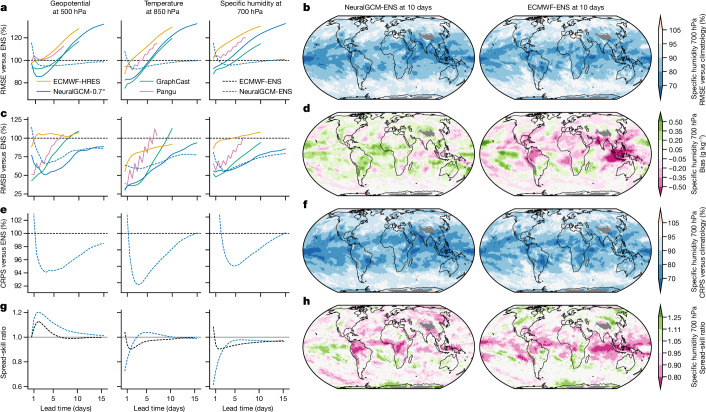
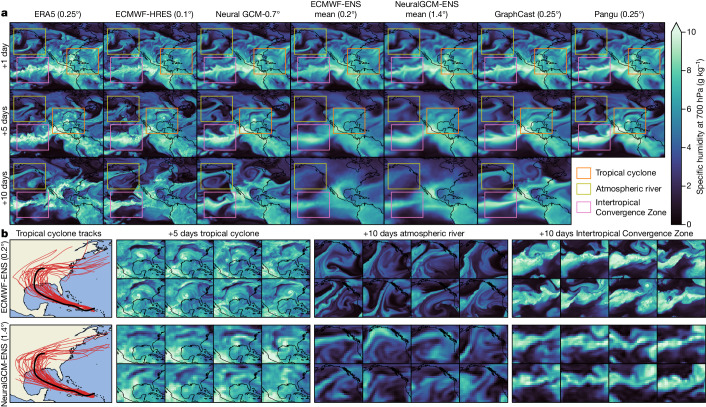
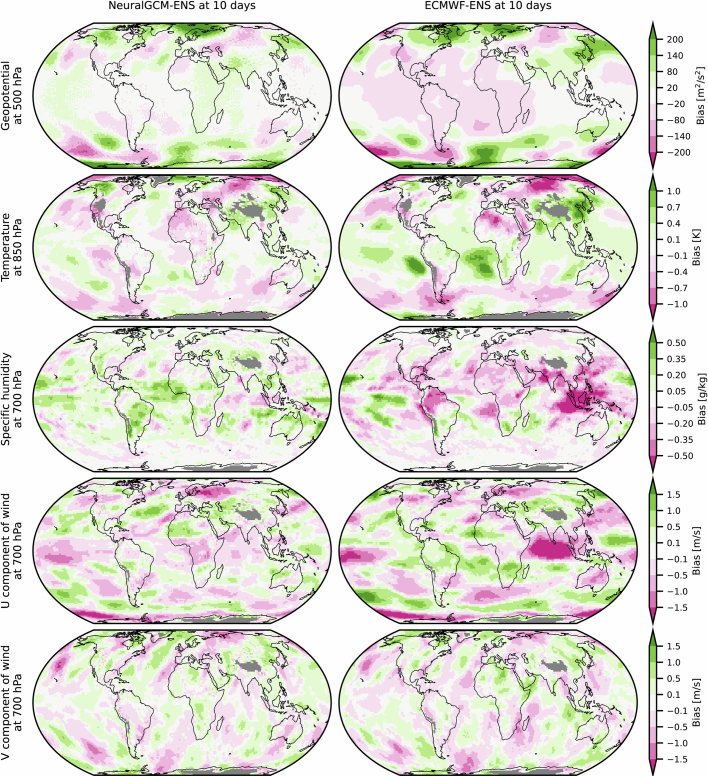
- On medium-range weather forecasting, NeuralGCM-0.7° and GraphCast achieved the best RMSE for the first 1–3 days (depending on variable), while NeuralGCM models compared favorably on persistent bias, including notably lower specific-humidity bias in the tropics.
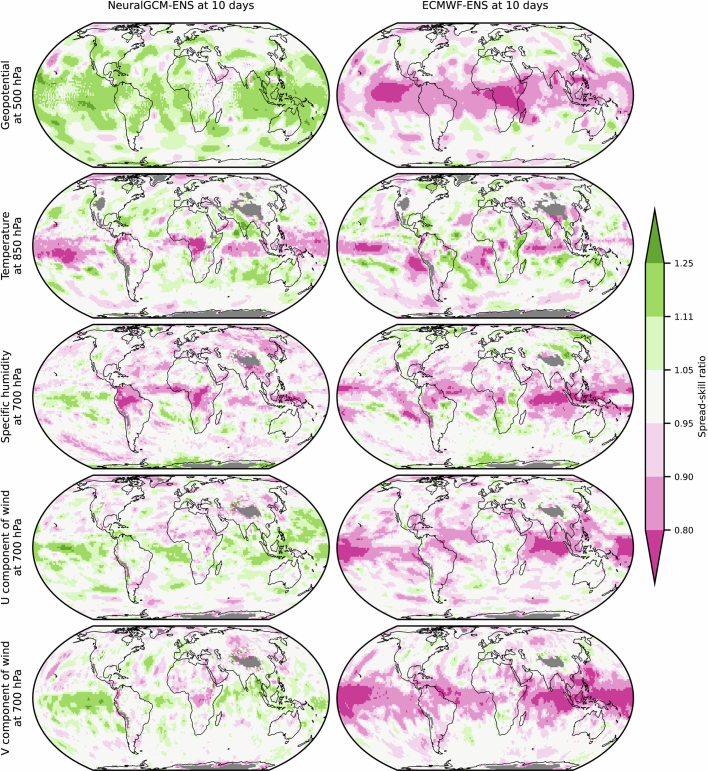
- The stochastic NeuralGCM-ENS at 1.4° had lower error than ECMWF-ENS across almost all variables, lead times, and vertical levels for ensemble-mean RMSE, RMSB, and CRPS; its spread-skill ratio was approximately 1.
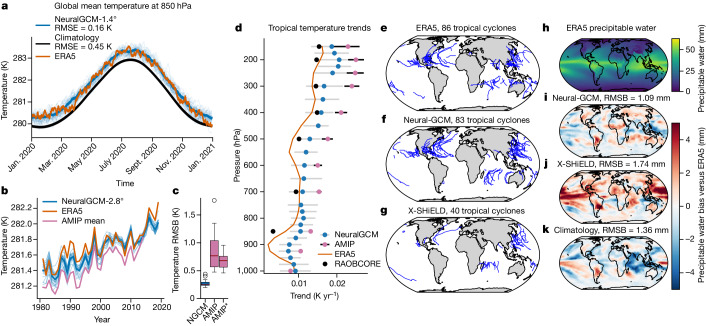
- In climate simulations with prescribed SST, NeuralGCM captured seasonal climate metrics and long-term warming trends: the ensemble-mean global temperature RMSE was 0.16 K versus 0.45 K for climatology, and all 22 stable 40-year NeuralGCM-2.8° runs had smaller spatial bias than the 22 CMIP6 AMIP runs.
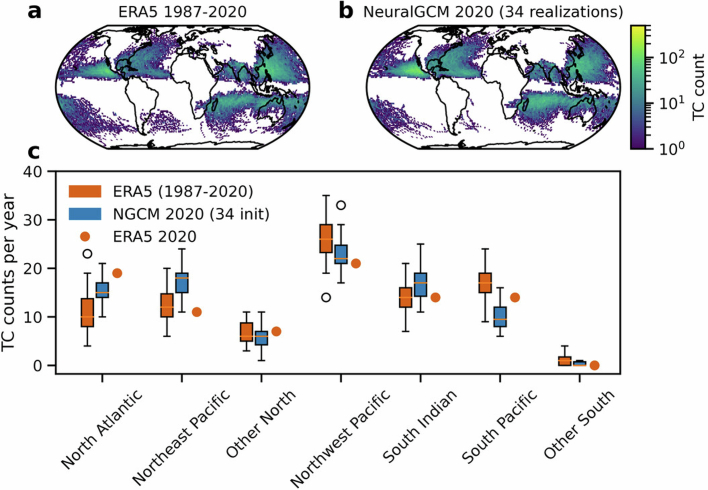
- For tropical cyclones, NeuralGCM at 1.4° produced 83 cyclones versus 86 in ERA5 for the corresponding period, while X-SHiELD produced 40 after regridding to 1.4°.
## Methods
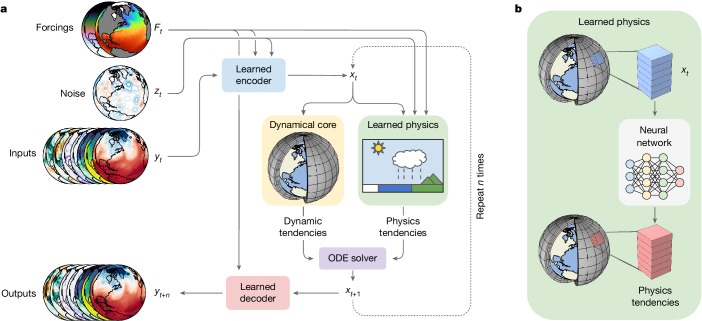
- The model is a fully differentiable hybrid GCM with a JAX-implemented dynamical core solving the hydrostatic primitive equations with moisture on sigma coordinates, plus a learned physics module that operates on single atmospheric columns.
- Weather evaluation used 732 forecasts from noon and midnight UTC in 2020 (held out from training for machine-learning models), regridded to 1.5°, with comparisons against ERA5 or ECMWF operational analysis depending on the baseline.
- Deterministic models were trained with a combination of losses for accuracy, spectral matching, and bias; stochastic models used CRPS and injected Gaussian random fields, with two ensemble members per forecast for training.
- Climate experiments used deterministic models at 2.8° and 1.4° with prescribed historical SST and sea ice, including 37 initial conditions for 2-year seasonal-cycle runs and 37 initial conditions for 40-year AMIP-like runs, of which 35 and 22 were stable, respectively.
## Limitations
- The paper explicitly states that NeuralGCM does not extrapolate to substantially different future climates.
- The authors note that for more substantial SST increases (+4 K), NeuralGCM’s response diverges from expectations, and that AMIP simulations with increased SST show climate drift.
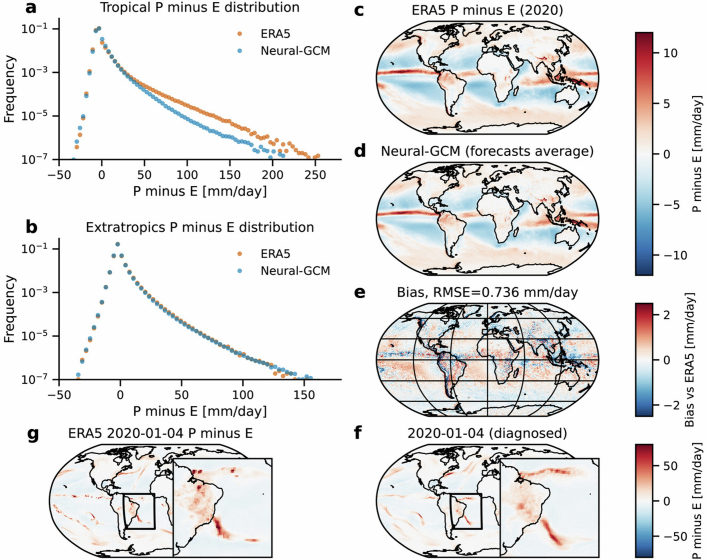
- The text makes evident that the current version cannot distinguish precipitation from evaporation because it directly predicts column tendencies; this is stated in the paper.
Model-written summary. Check it against the paper before relying on it.
Integrity signals
Registry
Cites
Statistics
Figures
Verification
Claims the paper makes
6 Valid · 2 Not valid · 9 Not checked · 53 Own results and interpretations
Some cited sources support this claim and some don’t — read each source’s verdict below.
In the paper
“Our results provide strong evidence for the disputed hypothesis37–39 that learning to predict short-term weather is an effective way to tune parameterizations for climate.”
§ Neural general circulation models for weather and climate > Discussion
What the sources say
- Partly supportedcites [37] Ruiz, J. J., Pulido, M. & Miyoshi, T. Estimating model parameters with ensemble-based data assimilation: a review. J. Meteorol. Soc. Jpn Ser. II 91, 79–99 (2013). 10.2151/jmsj.2013-201 sourceExperimental — accuracy not yet measured
The Conclusions (p. 98) do carry the substance attributed here — 'Parameter estimation also has the potential to improve model climatology... Model parameters can be trained during relatively short periods (i.e., a couple of years) using a data assimilation cycle, and then the estimated parameters can be used for climate simulations' — and the Introduction (p. 90) lists climate-model optimization among the applications of parameter estimation. But the source states this as a potential, not as demonstrated evidence: the Abstract (p. 89) and Section 3.4 (pp. 93-94) limit the paper's own results to a positive effect on short-to medium-range numerical weather prediction (RMSE/bias of 24-h precipitation, spread-error relationship), with no climate simulation performed, so 'strong evidence ... is an effective way to tune parameterizations for climate' overstates it, and nothing in our copy describes the hypothesis as disputed. (LLM, conf=0.75)
- Supportedcites [38] Schneider, T., Lan, S., Stuart, A. & Teixeira, J. Earth system modeling 2.0: a blueprint for models that learn from observations and targeted high-resolution simulations. Geophys. Res. Lett. 44, 12–396 (2017). 10.1002/2017GL076101 source
Section 2.1 (Information Sources for Parameterization Schemes) records that parameters in cloud, convection and precipitation schemes 'have been estimated by minimizing errors in short-term weather forecasts over time scales of hours or days', i.e. the hypothesis the citing sentence names. Section 2.3 (Objectives) shows it is indeed contested: 'This has given rise to hopes that it may suffice to evaluate objective functions by weather hindcasts over time scales of only hours ... But experience has shown that such short-term optimization may not always lead to the desired improvements in climate simulations (Schirber et al., 2013)', and the authors consequently choose accumulation windows wide compared with the O(10 days) forgetting time. The citation is attached only to the disputed hypothesis itself, not to the citing paper's claim that their results support it, so our copy supports what is attributed here. (LLM, conf=0.80)
- Disputedcites [39] Schneider, T., Leung, L. R. & Wills, R. C. J. Opinion: Optimizing climate models with process knowledge, resolution, and artificial intelligence. Atmos. Chem. Phys.24, 7041–7062 (2024). sourceExperimental — accuracy not yet measured
Our copy of Schneider et al. (2024) argues the opposite of what the claim attributes to it: in Sect. 5 ('AI for learning parameterizations') it states that supervised learning focused on the short-term residual has limitations, that 'focusing solely on minimizing the short-term residual ϵ' means the learned parameterization 'may not necessarily minimize the climate-relevant loss function... concerned with longer-term statistics,' and cites Schirber et al. (2013) as an example where 'short-term optimization over trajectories can lead to no improvement or even the degradation of the longer-term climate statistics.' The same section says holistic learning from data 'is more likely to be successful in weather prediction, where short-term accuracy is prioritized... In contrast, climate prediction faces two primary challenges,' and that learned parameterizations 'often struggle with conserving essential quantities such as energy and exhibit instabilities during extended integrations... because minimizing the short-term residual ϵ does not inherently ensure conservation or stability.' The paper also never frames this as a merely 'disputed hypothesis' but advocates process-based, online, climate-relevant-loss learning instead (Sect. 3 and Sect. 5). (LLM, conf=0.85)
Checked by a reasoning model — may be wrong.
boostedstates a cause- Asserted: passes — The authors put it forward as true.
- Checkable: passes — It can be checked against evidence.
- Load-bearing: passes — The paper’s conclusions depend on it.
- Based: passes — The paper gives a reason why it holds.
- Partly supported
The cited sources that could be checked couldn’t confirm or dispute this claim.
In the paper
“Overall, NeuralGCM demonstrates that incorporating machine learning is a viable alternative to building increasingly detailed physical models32 for improving GCMs.”
§ Neural general circulation models for weather and climate > Discussion
What the sources say
- Could not verifycites [32] Stevens, B. et al. DYAMOND: the dynamics of the atmospheric general circulation modeled on non-hydrostatic domains. Prog. Earth Planet. Sci. 6, 61 (2019). 10.1186/s40645-019-0304-z sourceExperimental — accuracy not yet measured
Our copy of DYAMOND (Stevens et al. 2019) never addresses machine learning: searches on 'machine learning', 'deep learning / neural network parameterization', and 'surrogate/emulator alternative to physical parameterization' returned only passages on global storm-resolving models, their grids, output volumes and diagnostics. The route to better GCMs that the paper does argue for is explicitly resolving convection at ~3 km to 'circumvent considerable, and seemingly intractable, problems arising from parameterizations' (Introduction, p. 2) and achieving higher throughput (Summary, p. 15) — a physical, not data-driven, alternative, and no passage credits or discusses ML methods, nor names a work to which the ML claim could be traced. Nothing in our copy either supports or contradicts the attributed claim, so it cannot be judged from this source. (LLM, conf=0.72)
boostedstates a cause- Asserted: passes — The authors put it forward as true.
- Checkable: passes — It can be checked against evidence.
- Load-bearing: passes — The paper’s conclusions depend on it.
- Based: passes — The paper gives a reason why it holds.
- Could not verify
The cited sources support only part of this claim — read each source’s verdict below.
In the paper
“Recently, machine-learning models trained on reanalysis data have achieved comparable or better skill than GCMs for deterministic weather forecasting3,4.”
§ Neural general circulation models for weather and climate > Abstract General circulation models (GCMs) are the foundation of weather and climate prediction1,2. GCMs are physics-based simulators that combine a numerical solver for large-scale dynamics with tuned representations for small-scale processes such as cloud formation. Recently, machine-learning models trained on reanalysis data have achieved comparable or better skill than GCMs for deterministic weather forecasting3,4. However, these models have not demonstrated improved ensemble forecasts, or shown sufficient stability for long-term weather and climate simulations. Here we present a GCM that combines a differentiable solver for atmospheric dynamics with machine-learning components and show that it can generate forecasts of deterministic weather, ensemble weather and climate on par with the best machine-learning and physics-based methods. NeuralGCM is competitive with machine-learning models for one- to ten-day forecasts, and with the European Centre for Medium-Range Weather Forecasts ensemble prediction for one- to fifteen-day forecasts. With prescribed sea surface temperature, NeuralGCM can accurately track climate metrics for multiple decades, and climate forecasts with 140-kilometre resolution show emergent phenomena such as realistic frequency and trajectories of tropical cyclones. For both weather and climate, our approach offers orders of magnitude computational savings over conventional GCMs, although our model does not extrapolate to substantially different future climates. Our results show that end-to-end deep learning is compatible with tasks performed by conventional GCMs and can enhance the large-scale physical simulations that are essential for understanding and predicting the Earth system.
What the sources say
- Supportedcites [3] Lam, R. et al. Learning skillful medium-range global weather forecasting. Science 382, 1416–1421 (2023). 37962497 10.1126/science.adi2336 source
The paper’s opening summary says GraphCast was trained on reanalysis data and significantly outperformed an operational deterministic forecasting system on 90% of 1,380 verification targets. The Conclusions also describe machine-learning weather prediction as competitive with traditional methods. The paper compares GraphCast specifically with HRES, rather than using the term “GCMs.” (LLM, conf=0.90)
- Partly supportedcites [4] Bi, K. et al. Accurate medium-range global weather forecasting with 3D neural networks. Nature 619, 533–538 (2023). 37407823 10.1038/s41586-023-06185-3 PMC10356604 sourceExperimental — accuracy not yet measured
The Discussion and Deterministic global weather forecast sections report that Pangu-Weather, trained on reanalysis data, achieved better deterministic forecast accuracy than ECMWF’s operational IFS. The paper identifies IFS as a numerical weather prediction system, however, and does not report a comparison with a system it calls a GCM. (LLM, conf=0.82)
plainstates an association- Asserted: passes — The authors put it forward as true.
- Checkable: passes — It can be checked against evidence.
- Load-bearing: passes — The paper’s conclusions depend on it.
- Based: passes — The paper gives a reason why it holds.
- Supported
Every source the paper cites for this claim was checked and supports it.
In the paper
“So far, hybrid models have mostly been limited to idealized scenarios such as aquaplanets22,23.”
§ Neural general circulation models for weather and climate > Main
What the sources say
- Supportedcites [22] Rasp, S., Pritchard, M. S. & Gentine, P. Deep learning to represent subgrid processes in climate models. Proc. Natl Acad. Sci. USA 115, 9684–9689 (2018). 30190437 10.1073/pnas.1810286115 PMC6166853 source
The Climate Model and Neural Network Setup section describes this hybrid model as using an aquaplanet setup. The Discussion calls its training climate idealized and says extending the method to a less idealized setup is an immediate follow-up task. The paper thus supports the cited example of the limitation, though it does not quantify how many hybrid models use such setups. (LLM, conf=0.87)
- Supportedcites [23] Yuval, J. & O’Gorman, P. A. Stable machine-learning parameterization of subgrid processes for climate modeling at a range of resolutions. Nat. Commun. 11, 3295 (2020). 32620769 10.1038/s41467-020-17142-3 PMC7335176 source
The Introduction describes earlier neural-network climate-model work in an aquaplanet configuration, and the Results state that this study also uses an aquaplanet configuration. The Discussion identifies training over land with topography as a challenge for future research, supporting the characterization of hybrid models as largely limited to idealized settings. (LLM, conf=0.86)
plain- Asserted: passes — The authors put it forward as true.
- Checkable: passes — It can be checked against evidence.
- Load-bearing: passes — The paper’s conclusions depend on it.
- Based: passes — The paper gives a reason why it holds.
- Supported
The cited sources support only part of this claim — read each source’s verdict below.
In the paper
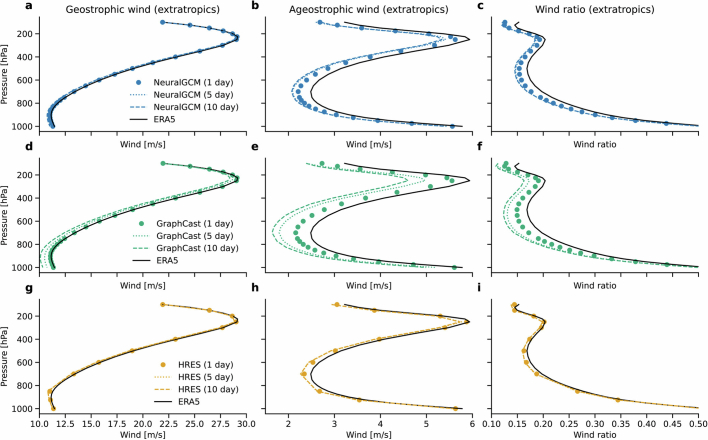
“Deterministic machine-learning models using a mean-squared-error loss are rewarded for averaging over uncertainty, producing unrealistically blurry predictions when optimized for multi-day forecasts3,13.”
§ Neural general circulation models for weather and climate > Main
What the sources say
- Supportedcites [3] Lam, R. et al. Learning skillful medium-range global weather forecasting. Science 382, 1416–1421 (2023). 37962497 10.1126/science.adi2336 source
The Conclusions (p. 10) state that GraphCast’s MSE objective encourages it to express uncertainty by spatially blurring predictions. The paper also reports that training for longer forecast horizons produces blurrier forecasts at longer lead times. This supports the citing sentence’s account of why MSE-optimized deterministic forecasts can become blurry. (LLM, conf=0.90)
- Partly supportedcites [13] Keisler, R. Forecasting global weather with graph neural networks. Preprint at https://arxiv.org/abs/2202.07575 (2022). sourceExperimental — accuracy not yet measured
Keisler (2022) supplies the empirical setting and the observation but not the claimed mechanism. Section 3.3.3 (p. 5) confirms the model is trained with a mean-squared-error loss, and Section 3.3.2 (p. 5) confirms it is optimized for multi-day forecasts via a multi-step rollout loss (4-, 8-, 12-step, i.e. 1-3 day rollouts). Section 4.2 (p. 6) reports that over a 12-step (3-day) rollout 'the data-driven forecast does become smoother over time' — but the paper nowhere says the model is 'rewarded for averaging over uncertainty', never frames the smoothing as a consequence of irreducible forecast uncertainty under MSE, and never calls the predictions 'unrealistically blurry' (it treats the 3-day output as generally tracking large-scale flows, and its only degradation past ~6 days is hexagon-patterned instability, Section 4.3, p. 6). So the blur/averaging-over-uncertainty causal claim attributed here exceeds what this source states. (LLM, conf=0.72)
plainstates a cause- Asserted: passes — The authors put it forward as true.
- Checkable: passes — It can be checked against evidence.
- Load-bearing: passes — The paper’s conclusions depend on it.
- Based: passes — The paper gives a reason why it holds.
- Supported
29 more claims
Create a free account to see all 70 claims and to verify the 10 references still open.
- It may state two separate claims as one. 31
- Probably not a substantial claim. 6
Claims other papers make about this one
Each is checked against this paper’s own text: does it say what the citing paper says it does?
The cited source says what the claim attributes to it.
In the citing paper
“An exception is NeuralGCM20, a hybrid NWP–MLWP method, which combines the dynamical core of a traditional NWP with local ML-based parameterizations and shows competitive performance with operational ensemble forecasts.”
From Probabilistic weather forecasting with machine learning (2025) · cites this paper as [20]
Citations
Cites
Hersbach, H., Bell, B., Berrisford, P., Hirahara, S., Horányi, A., Muñoz‐Sabater, J., Nicolas, J., Peubey, C., Radu, R., Schepers, D., et al. (2020) · Quarterly Journal of the Royal Meteorological Society · doi:10.1002/qj.3803 · Cited by 31,882 · cited 1×
“These models rely solely on machine-learning techniques, using roughly 40 years of historical data from the European Center for Medium-Range Weather Forecasts (ECMWF) reanalysis v5 (ERA5) 14 for model training and forecast initialization.”
MethodSequence to Sequence Learning with Neural Networks
Sutskever, I., Vinyals, O., & Le, Q. V. (2014) · arXiv · doi:10.48550/arxiv.1409.3215 · Cited by 17,766
Eyring, V., Bony, S., Meehl, G. A., Senior, C. A., Stevens, B., Stouffer, R. J., & Taylor, K. E. (2016) · Geoscientific Model Development · doi:10.5194/gmd-9-1937-2016 · Cited by 11,981 · cited 3×
“34 and Supplementary Table 6.”
MethodInfluential(2012) · doi:10.1017/cbo9781139177245 · Cited by 7,236 · cited 1×
“The difficulty of reducing uncertainty in long-term climate projections 9 and estimating distributions of extreme weather events 10 presents major challenges for climate mitigation and adaptation 11 .”
BackgroundStrictly Proper Scoring Rules, Prediction, and Estimation
Gneiting, T., & Raftery, A. E. (2007) · Journal of the American Statistical Association · doi:10.1198/016214506000001437 · Cited by 5,793 · cited 10×
“Our stochastic loss is based on the CRPS 28,48,49 .”
BackgroundMethodInfluentialDeep learning and process understanding for data-driven Earth system science
Reichstein, M., Camps-Valls, G., Stevens, B., Jung, M., Denzler, J., Carvalhais, N., & Prabhat (2019) · Nature · doi:10.1038/s41586-019-0912-1 · Cited by 5,673 · cited 1×
“…longer timescales 17,18 , these models have not demonstrated the ability to outperform existing GCMs. Hybrid models that combine GCMs with machine learning are appealing because they build on the interpretability, extensibility and successful track record of traditional atmospheric models 19,20 .”
BackgroundThe quiet revolution of numerical weather prediction
Bauer, P., Thorpe, A., & Brunet, G. (2015) · Nature · doi:10.1038/nature14956 · Cited by 2,729
Accurate medium-range global weather forecasting with 3D neural networks
Bi, K., Xie, L., Zhang, H., Chen, X., Gu, X., & Tian, Q. (2023) · Nature · doi:10.1038/s41586-023-06185-3 · Cited by 1,670 · cited 4×
“Recent advances in machine learning have presented an alternative for weather forecasting 3,4,12,13 .”
BackgroundMethodInfluentialLearning skillful medium-range global weather forecasting
Lam, R., Sanchez-Gonzalez, A., Willson, M., Wirnsberger, P., Fortunato, M., Alet, F., Ravuri, S., Ewalds, T., Eaton-Rosen, Z., Hu, W., et al. (2023) · Science · doi:10.1126/science.adi2336 · Cited by 1,466 · cited 5×
“Specifically, we diagnose precipitation minus evaporation (Supplementary Information section H.5) rather than directly predicting these as in machine-learning-based approaches 3 .”
BackgroundMethodInfluentialSelf-citationMarine boundary layer clouds at the heart of tropical cloud feedback uncertainties in climate models
Bony, S., & Dufresne, J. (2005) · Geophysical Research Letters · doi:10.1029/2005gl023851 · Cited by 1,302 · cited 1×
“Tuning GCMs to match historical data remains a manual process 5 , and GCMs retain many persistent errors and biases 6–8 .”
Background
Research works printed but not linked: 1
- Holton, J. R. An introduction to Dynamic Meteorology 5th edn (Elsevier, 2004).
Cited by
Probabilistic weather forecasting with machine learning
Price, I., Sanchez-Gonzalez, A., Alet, F., Andersson, T. R., El-Kadi, A., Masters, D., Ewalds, T., Stott, J., Mohamed, S., Battaglia, P., et al. (2025) · Nature · doi:10.1038/s41586-024-08252-9 · Cited by 434
Self-citationWeatherBench 2: A Benchmark for the Next Generation of Data‐Driven Global Weather Models
Rasp, S., Hoyer, S., Merose, A., Langmore, I., Battaglia, P., Russell, T., Sanchez‐Gonzalez, A., Yang, V., Carver, R., Agrawal, S., et al. (2024) · Journal of Advances in Modeling Earth Systems · doi:10.1029/2023ms004019 · Cited by 245
Self-citationInterpretable machine learning for weather and climate prediction: A review
Yang, R., Hu, J., Li, Z., Mu, J., Yu, T., Xia, J., Li, X., Dasgupta, A., & Xiong, H. (2024) · Atmospheric Environment · doi:10.1016/j.atmosenv.2024.120797 · Cited by 139
Early warning of complex climate risk with integrated artificial intelligence
Reichstein, M., Benson, V., Blunk, J., Camps‐Valls, G., Creutzig, F., Fearnley, C. J., Han, B., Kornhuber, K., Rahaman, N., Schölkopf, B., et al. (2025) · Nature Communications · doi:10.1038/s41467-025-57640-w · Cited by 243
Guo, Q., He, Z., Wang, Z., Qiao, S., Zhu, J., & Chen, J. (2024) · Water · doi:10.3390/w16192870 · Cited by 157
The potential for AI to revolutionize conservation: a horizon scan
Reynolds, S. A., Beery, S., Burgess, N. D., Burgman, M. A., Butchart, S. H. M., Cooke, S. J., Coomes, D. A., Danielsen, F., Minin, E. D., Durán, A. P., et al. (2024) · Trends in Ecology & Evolution · doi:10.1016/j.tree.2024.11.013 · Cited by 176
Machine Learning Methods for Weather Forecasting: A Survey
Zhang, H., Liu, Y., Zhang, C., & Li, N. (2025) · Atmosphere · doi:10.3390/atmos16010082 · Cited by 113
AI-empowered next-generation multiscale climate modelling for mitigation and adaptation
Eyring, V., Gentine, P., Camps‐Valls, G., Lawrence, D. M., & Reichstein, M. (2024) · Nature Geoscience · doi:10.1038/s41561-024-01527-w · Cited by 133
Machine learning for the physics of climate
Bracco, A., Brajard, J., Dijkstra, H. A., Hassanzadeh, P., Lessig, C., & Monteleoni, C. (2024) · Nature Reviews Physics · doi:10.1038/s42254-024-00776-3 · Cited by 79
“Two examples of ML emulators for weather forecasting are the hybrid NeuralGCM 72 and the local area model MetNet-3 103 , which extends earlier work 104,105 on precipitation nowcasting (that is, forecasting on a very short period of up to 2 hours) and produces kilometre-scale high-resolution…”
InfluentialEnhancing Regional Climate Downscaling through Advances in Machine Learning
Rampal, N., Hobeichi, S., Gibson, P. B., Baño‐Medina, J., Abramowitz, G., Beucler, T., González-Abad, J., Chapman, W. E., Harder, P., & Gutiérrez, J. M. (2024) · Artificial Intelligence for the Earth Systems · doi:10.1175/aies-d-23-0066.1 · Cited by 182
Deep learning for wildfire risk prediction: Integrating remote sensing and environmental data
Xu, Z., Li, J., Cheng, S. L., Xue, R., Zhao, Y., He, H., Guan, H., Sharma, A., Erxleben, M., Chang, R., et al. (2025) · ISPRS Journal of Photogrammetry and Remote Sensing · doi:10.1016/j.isprsjprs.2025.06.002 · Cited by 130
A Survey on Uncertainty Quantification Methods for Deep Learning
He, W., Jiang, Z., Xiao, T., Xu, Z., & Li, Y. (2026) · ACM Computing Surveys · doi:10.1145/3786319 · Cited by 339
Confronting Earth System Model trends with observations
Simpson, I. R., Shaw, T. A., Ceppi, P., Clement, A., Fischer, E. M., Grise, K. M., Pendergrass, A. G., Screen, J. A., Wills, R. C. J., Woollings, T. J., et al. (2025) · Science Advances · doi:10.1126/sciadv.adt8035 · Cited by 104
Chen, K., Han, T., Ling, F., Gong, J., Bai, L., Wang, X., Luo, J., Fei, B., Zhang, W., Chen, X., et al. (2025) · Communications Earth & Environment · doi:10.1038/s43247-025-02502-y · Cited by 120
“At the same time, We also note that there are several excellent models (such as FuXi 20 and NeuralGCM 19 ) that perform well in various forecasting tasks.”
InfluentialCan AI weather models predict out-of-distribution gray swan tropical cyclones?
Sun, Y. Q., Hassanzadeh, P., Zand, M., Chattopadhyay, A., Weare, J., & Abbot, D. S. (2025) · Proceedings of the National Academy of Sciences · doi:10.1073/pnas.2420914122 · Cited by 126
Modeling multivariable high-resolution 3D urban microclimate using localized Fourier neural operator
Qin, S., Zhan, D., Geng, D., Peng, W., Tian, G., Shi, Y., Gao, N., Liu, X., & Wang, L. L. (2025) · Building and Environment · doi:10.1016/j.buildenv.2025.112668 · Cited by 65
Scaling transformer neural networks for skillful and reliable medium-range weather forecasting
Nguyen, T., Shah, R., Bansal, H., Arcomano, T., Maulik, R., Kotamarthi, V., Foster, I., Madireddy, S., & Grover, A. (2023) · arXiv · doi:10.48550/arxiv.2312.03876 · Cited by 45
“In an orthogonal approach, NeuralGCM [25] proposed a hybrid forecasting system that combined a differentiable dynamical core with ML components for end-to-end training.”
Olivetti, L., & Messori, G. (2024) · Geoscientific model development · doi:10.5194/gmd-17-7915-2024 · Cited by 98
Shaw, T. A., & Stevens, B. (2025) · Nature · doi:10.1038/s41586-025-08680-1 · Cited by 37
Validating Deep Learning Weather Forecast Models on Recent High-Impact Extreme Events
Pasche, O. C., Wider, J., Zhang, Z., Zscheischler, J., & Engelke, S. (2024) · Artificial Intelligence for the Earth Systems · doi:10.1175/aies-d-24-0033.1 · Cited by 79
“…“ World Administrative Boundaries } Countries and Territories ” (Open Government License 3.0, https:// public.opendatasoft.com/explore/dataset/world-administrative-boundaries/information/) dataset by the World Food Programme, and for the India – Bangladesh region, we additionally use the ( 1976 –”
InfluentialACE2: accurately learning subseasonal to decadal atmospheric variability and forced responses
Watt‐Meyer, O., Henn, B., McGibbon, J., Clark, S. K., Kwa, A., Perkins, W. A., Wu, E., Harris, L., & Bretherton, C. S. (2025) · npj Climate and Atmospheric Science · doi:10.1038/s41612-025-01090-0 · Cited by 106
“(Kochkov et al., 2024) which showed some 30-year simulations with reasonable trends and low climate biases.”
InfluentialMachine Learning for Climate Physics and Simulations
Lai, C., Hassanzadeh, P., Sheshadri, A., Sonnewald, M., Ferrari, R., & Balaji, V. (2024) · Annual Review of Condensed Matter Physics · doi:10.1146/annurev-conmatphys-043024-114758 · Cited by 90
Yao, Z., Yao, M., Wang, C., Li, K., Guo, J., Xiao, Y., Yan, J., & Liu, J. (2025) · Molecular Plant · doi:10.1016/j.molp.2025.01.020 · Cited by 45
A Practical Probabilistic Benchmark for AI Weather Models
Brenowitz, N., Cohen, Y., Pathak, J., Mahesh, A., Bonev, B., Kurth, T., Durran, D. R., Harrington, P., & Pritchard, M. S. (2025) · Geophysical Research Letters · doi:10.1029/2024gl113656 · Cited by 69
Progress in research on the effects of environmental factors on natural forest regeneration
Liu, J. (2025) · Frontiers in Forests and Global Change · doi:10.3389/ffgc.2025.1525461 · Cited by 46
On the foundations of Earth foundation models
Zhu, X. X., Xiong, Z., Wang, Y., Stewart, A. J., Heidler, K., Wang, Y., Yuan, Z., Dujardin, T., Xu, Q., & Shi, Y. (2026) · Communications Earth & Environment · doi:10.1038/s43247-025-03127-x · Cited by 26
“Instead, works on weather and climate FMs often assess whether the models can capture speci fi c climate scenarios, such as tropical warming trends 84 , atmospheric rivers 74 , orthe tracks of tropical cyclones 74 .”
Predictability Study of Weather and Climate Events Related to Artificial Intelligence Models
Mu, M., Qin, B., & Dai, G. (2024) · Advances in Atmospheric Sciences · doi:10.1007/s00376-024-4372-7 · Cited by 40
Deep Learning for Ocean Forecasting: A Comprehensive Review of Methods, Applications, and Datasets
Hao, R., Zhao, Y., Zhang, S., & Deng, X. (2025) · IEEE Transactions on Cybernetics · doi:10.1109/tcyb.2025.3539990 · Cited by 35
“Theory-driven models are the current mainstream, which employs deep learning to represent physical processes [160], [170], alternative semi-empirical parameterization schemes [200], [201], assimilate observations [202], [203], and model correction [24], [42].”
A data-to-forecast machine learning system for global weather
Sun, X., Zhong, X., Xu, X., Huang, Y., Li, H., Neelin, J. D., Chen, D., Feng, J., Han, W., Wu, L., et al. (2025) · Nature Communications · doi:10.1038/s41467-025-62024-1 · Cited by 89
“While incorporating generative models or differentiable solvers for atmospheric dynamics could potentially enhance forecast activity without compromising accuracy 18,52,53 , anin-depthinvestigationof theseapproachesisbeyond the scope of this study.”
Global spatio-temporal ERA5 precipitation downscaling to km and sub-hourly scale using generative AI
Glawion, L., Polz, J., Kunstmann, H. G., Fersch, B., & Chwala, C. (2025) · npj Climate and Atmospheric Science · doi:10.1038/s41612-025-01103-y · Cited by 55
“In the last decade, such reanalyses have accelerated scienti fi c research in hydrological modeling 13,14 , fl ood prediction 15 , calculation of climate change-related costs 16,17 , or training data-driven weather forecasting models 18 – 21 .”
Krishnan, R., Dhara, C., Horinouchi, T., Gotangco, C. K., Dimri, A. P., Shrestha, M. S., Swapna, P., Roxy, M. K., Son, S., Ayantika, D. C., et al. (2025) · Frontiers in Climate · doi:10.3389/fclim.2024.1504475 · Cited by 34
Samudra: An AI Global Ocean Emulator for Climate
Dheeshjith, S., Subel, A., Adcroft, A., Busecke, J. J. M., Fernandez‐Granda, C., Gupta, S., & Zanna, L. (2025) · Geophysical Research Letters · doi:10.1029/2024gl114318 · Cited by 72
Niu, Z., Wang, D., Mu, M., Huang, W., Fan, X., Yang, M., & Qin, B. (2025) · Geophysical Research Letters · doi:10.1029/2025gl115926 · Cited by 29
Lang, S. T. K., Alexe, M., Clare, M., Roberts, C. D., Adewoyin, R. A., Bouallègue, Z. B., Chantry, M., Dramsch, J. S., Dueben, P. D., Hahner, S., et al. (2026) · npj Artificial Intelligence · doi:10.1038/s44387-026-00073-7 · Cited by 228
“30,31 and 24.”
Fang, J., & Gentine, P. (2024) · Journal of Advances in Modeling Earth Systems · doi:10.1029/2024ms004308 · Cited by 30
Are AI weather models learning atmospheric physics? A sensitivity analysis of cyclone Xynthia
Baño‐Medina, J., Sengupta, A., Doyle, J. D., Reynolds, C. A., Watson‐Parris, D., & Monache, L. D. (2025) · npj Climate and Atmospheric Science · doi:10.1038/s41612-025-00949-6 · Cited by 51
“AIdata-driven models are revolutionizing the fi eld of weather forecasting, showing competitive forecast skill with state-of-the-art dynamical (i.e., physics-based) models 6 – 12 , at a much lower real-time computational cost (after training).”
A GPU‐Based Ocean Dynamical Core for Routine Mesoscale‐Resolving Climate Simulations
Silvestri, S., Wagner, G. L., Constantinou, N. C., Hill, C., Campin, J., Souza, A. N., Bishnu, S., Churavy, V., Marshall, J. C., & Ferrari, R. (2025) · Journal of Advances in Modeling Earth Systems · doi:10.1029/2024ms004465 · Cited by 40
Foundation Models for Spatio-Temporal Data Science: A Tutorial and Survey
Liang, Y., Wen, H., Xia, Y., Jin, M., Yang, B., Salim, F. D., Wen, Q., Pan, S., & Cong, G. (2025) · ACM SIGKDD Conference on Knowledge Discovery and Data Mining (KDD) · doi:10.1145/3711896.3736552 · Cited by 51
Knowledge‐Guided Machine Learning for Global Change Ecology Research
Jin, Z., Liu, L., Yang, Q. L., Jia, X., Tao, S., Guo, Y., Ghosh, R., Wang, S., Zhu, Q., Jung, M., et al. (2026) · Global Change Biology · doi:10.1111/gcb.70742 · Cited by 30
Implementing digital twin technology of the earth system in Destination Earth
Wedi, N., Sandu, I., Bauer, P., Acosta, M., Andersen, R. C., Andrae, U., Auger, L., Balsamo, G., Baousis, V., Bennett, V., et al. (2025) · Journal of the European Meteorological Society. · doi:10.1016/j.jemets.2025.100015 · Cited by 26
Skilful global seasonal predictions from a machine learning weather model trained on reanalysis data
Kent, C., Scaife, A. A., Dunstone, N., Smith, D. M., Hardiman, S. C., Dunstan, T., & Watt‐Meyer, O. (2025) · npj Climate and Atmospheric Science · doi:10.1038/s41612-025-01198-3 · Cited by 37
“Recent studies suggest skilful fore-casts can be made covering several weeks 5,7 – 9 and very large ensembles can provide improved estimates of extreme events 10 .”
Liu, Z., Chen, H., Bai, L., Li, W., Ouyang, W., Zou, Z., & Shi, Z. (2024) · IEEE Transactions on Geoscience and Remote Sensing · doi:10.1109/tgrs.2024.3496895 · Cited by 34
“Traditional numerical weather prediction methods [3], which have been developed over many years, along with the rapidly advancing deep learning-based forecasting models [4]–[8] in recent years, have enabled increasingly accurate global-scale weather predictions.”
BackgroundWhat if? Numerical weather prediction at the crossroads
Bauer, P. (2024) · Journal of the European Meteorological Society. · doi:10.1016/j.jemets.2024.100002 · Cited by 38
Selected Topics in Time Series Forecasting: Statistical Models vs. Machine Learning
Tjøstheim, D. (2025) · Entropy · doi:10.3390/e27030279 · Cited by 26
Building hybrid AI models in chemical engineering: A tutorial review
Chakraborty, A., Taskiran, N. P., Kottooru, R., Mann, V., & Venkatasubramanian, V. (2025) · Computers & Chemical Engineering · doi:10.1016/j.compchemeng.2025.109236 · Cited by 23
A Deep Learning Earth System Model for Efficient Simulation of the Observed Climate
Cresswell‐Clay, N., Liu, B., Durran, D. R., Liu, Z., Espinosa, Z. I., Moreno, R. A., & Karlbauer, M. (2025) · AGU Advances · doi:10.1029/2025av001706 · Cited by 93
Bhakare, S., Gesso, S. D., Venturini, M., Zardi, D., Trentini, L., Matiu, M., & Petitta, M. (2024) · Atmosphere · doi:10.3390/atmos15091085 · Cited by 24
Liu, G., Jiang, S., Zheng, M., Lin, S., Kong, Y., & Zhan, P. (2025) · Scientific Data · doi:10.1038/s41597-025-05789-w · Cited by 31
Machine Learning Applications in Archaeological Practices: A Review
Bellat, M., Figueroa, J. D. O., Reeves, J. S., Taghizadeh-Mehrjardi, R., Tennie, C., & Scholten, T. (2025) · Journal of Computer Applications in Archaeology · doi:10.5334/jcaa.201 · Cited by 17
Improving global weather and ocean wave forecast with large artificial intelligence models
Ling, F., Ouyang, L., Boufeniza, R. L., Luo, J., Han, T., Zhong, X., & Bai, L. (2024) · Science China Earth Sciences · doi:10.1007/s11430-024-1452-3 · Cited by 31
Automatic Differentiation‐Based Full Waveform Inversion With Flexible Workflows
Liu, F., Li, H., Zou, G., & Li, J. (2025) · Journal of Geophysical Research Machine Learning and Computation · doi:10.1029/2024jh000542 · Cited by 43
“…extensively used in fluid dynamics (Rath et al., 2006; Bischof et al., 2007; Bezgin et al., 2024), atmospheric science (Carmichael et al., 1997; Kochkov et al., 2024; Xiao et al., 2024) and geophysical inverse problems (Sambridge et al., 2007; Abokhodair, 2009; Stanziola et al., 2023; F. Liu…”
Emulators of Climate Model Output
Tebaldi, C., Tebaldi, C., Selin, N. E., Ferrari, R., & Flierl, G. R. (2025) · Annual Review of Environment and Resources · doi:10.1146/annurev-environ-012125-085838 · Cited by 40
Toward a Learnable Climate Model in the Artificial Intelligence Era
Huang, G., Wang, Y., Ham, Y., Mu, B., Tao, W., & Xie, C. (2024) · Advances in Atmospheric Sciences · doi:10.1007/s00376-024-3305-9 · Cited by 24
Generative Diffusion for Regional Surrogate Models From Sea‐Ice Simulations
Finn, T. S., Durand, C., Farchi, A., Bocquet, M., Rampal, P., & Carrassi, A. (2024) · Journal of Advances in Modeling Earth Systems · doi:10.1029/2024ms004395 · Cited by 37
Liu, Y., & Wei, H. (2025) · Energy Economics · doi:10.1016/j.eneco.2025.108560 · Cited by 20
AI‐Driven Weather Forecasts to Accelerate Climate Change Attribution of Heatwaves
Jiménez‐Esteve, B., Barriopedro, D., Johnson, J. E., & García‐Herrera, R. (2025) · Earth s Future · doi:10.1029/2025ef006453 · Cited by 28
Assimilating Observed Surface Pressure Into ML Weather Prediction Models
Slivinski, L., Whitaker, J. S., Frolov, S., Smith, T. A., & Agarwal, N. (2025) · Geophysical Research Letters · doi:10.1029/2024gl114396 · Cited by 29
Data-driven global ocean modeling for seasonal to decadal prediction
Guo, Z., Lyu, P., Ling, F., Bai, L., Luo, J., Boers, N., Yamagata, T., Izumo, T., Cravatte, S., Capotondi, A. M., et al. (2025) · Science Advances · doi:10.1126/sciadv.adu2488 · Cited by 56
“Learning from atmospheric data, such models have achieved notable success in predicting global weather up to the medium range ( 20 – 23 ).”
Geer, A. (2024) · Journal of Advances in Modeling Earth Systems · doi:10.1029/2023ms004080 · Cited by 18
Online Learning of Entrainment Closures in a Hybrid Machine Learning Parameterization
Christopoulos, C., Lopez‐Gomez, I., Beucler, T., Cohen, Y., Kawczynski, C., Dunbar, O. R. A., & Schneider, T. (2024) · Journal of Advances in Modeling Earth Systems · doi:10.1029/2024ms004485 · Cited by 24
“These strategies have not yet overcome the problems of instability and extrapolation to warmer climates and remain difficult to interpret.”
Lockwood, J. W., Gori, A., & Gentine, P. (2024) · Journal of Geophysical Research Machine Learning and Computation · doi:10.1029/2024jh000375 · Cited by 32
Li, W., Wang, C., Guan, H., Wang, J., Yang, J., Zhang, C., & Tao, D. (2025) · Computers & Mathematics with Applications · doi:10.1016/j.camwa.2025.01.025 · Cited by 16
Reconstructing historical climate fields with deep learning
Bochow, N., Poltronieri, A., Rypdal, M. W., & Boers, N. (2025) · Science Advances · doi:10.1126/sciadv.adp0558 · Cited by 20
“Furthermore, there is a substantial ongoing effort to combine traditional numerical Earth system models with ML methods to leverage the advantages of both approaches ( 16 , 23 – 30 ).”
Statistical mechanics for networks of real neurons
Meshulam, L., & Bialek, W. (2025) · Reviews of Modern Physics · doi:10.1103/jcrn-3nrc · Cited by 32
Deep learning for air pollutant forecasting: opportunities, challenges, and future directions
Tao, C., Wang, Y., Wang, Y., Zheng, Z., & Zhang, H. (2025) · Frontiers of Environmental Science & Engineering · doi:10.1007/s11783-025-2092-6 · Cited by 20
“…applying DL techniques to model the highly non-linear, multi-scale spatiotemporal characteristics of meteorological dynamics for weather forecasting, as a way to break through the limits of tradi-tional numerical models (Bi et al., 2023; Lam et al., 2023; Kochkov et al., 2024; Price et al., 2025).”
Mu, B., Zhao, Z.-J., Yuan, S., Qin, B., Dai, G., & Zhou, G.-B. (2024) · Atmospheric Research · doi:10.1016/j.atmosres.2024.107306 · Cited by 13
Toward Calibrated Ensembles of Neural Weather Model Forecasts
Baño‐Medina, J., Sengupta, A., Watson‐Parris, D., Hu, W., & Monache, L. D. (2025) · Journal of Advances in Modeling Earth Systems · doi:10.1029/2024ms004734 · Cited by 18
Wang, J., Ju, Y., Dong, P., & Ju, T. (2025) · Applied Soft Computing · doi:10.1016/j.asoc.2025.113779 · Cited by 11
A Survey of Foundation Models for Environmental Science
Yu, R., Chen, S., Xie, Y., & Jia, X. (2025) · Lecture notes in computer science · doi:10.1007/978-981-96-8295-9_3 · Cited by 22
Has the unpredictability of geological disasters been increased by global warming?
Gao, H., Xu, C. B., Wu, S., Li, T., & Huang, Y. (2025) · npj natural hazards. · doi:10.1038/s44304-025-00108-0 · Cited by 17
“To tackle the disaster effects of extreme weather, monitoring and forecasting systems for weather have gradually been established and continue to experience breakthroughs with advancements in computer technology 14,15 .”
Wu, Y., Wang, N., Huang, X., & Wang, Z. (2025) · Reliability Engineering & System Safety · doi:10.1016/j.ress.2025.111284 · Cited by 12
Hu, A., Richter, I., Okumura, Y., Burls, N., Keenlyside, N. S., Parfitt, R., Bellomo, K., Bellucci, A., Farneti, R., Fedorov, A. V., et al. (2025) · Ocean-Land-Atmosphere Research · doi:10.34133/olar.0096 · Cited by 14
On scientific foundation models: Rigorous definitions, key applications, and a comprehensive survey
Menon, S. S., Mondal, T., Brahmachary, S., Panda, A., Joshi, S. M., Kalyanaraman, K., & Jagtap, A. D. (2026) · Neural Networks · doi:10.1016/j.neunet.2026.108567 · Cited by 12
Social limits to climate change adaptation: temporalities in behavioural responses to climate risks
Berkhout, F. (2024) · Current Opinion in Environmental Sustainability · doi:10.1016/j.cosust.2024.101471 · Cited by 17
Duncan, J., Wu, E., Golaz, J., Caldwell, P., Watt‐Meyer, O., Clark, S. K., McGibbon, J., Dresdner, G., Kashinath, K., Bonev, B., et al. (2024) · Journal of Geophysical Research Machine Learning and Computation · doi:10.1029/2024jh000136 · Cited by 25
Li, X., & Liu, F. (2025) · Information Geography · doi:10.1016/j.infgeo.2025.100001 · Cited by 16
Behrens, G., Beucler, T., Iglesias‐Suarez, F., Yu, S., Gentine, P., Pritchard, M. S., Schwabe, M., & Eyring, V. (2025) · Journal of Advances in Modeling Earth Systems · doi:10.1029/2024ms004272 · Cited by 31
Yuan, C., Li, C., Wang, C., Xiao, Y., Liu, T., Li, J., Teng, K., Cai, H., Xiao, Z., Zhou, H., et al. (2025) · Computers and Electronics in Agriculture · doi:10.1016/j.compag.2025.110429 · Cited by 9
Duan, S., Zhang, J., Bonfils, C., & Pallotta, G. (2025) · npj Climate and Atmospheric Science · doi:10.1038/s41612-025-01137-2 · Cited by 11
“NeuralGCM is a hybrid AI-based global climate model 8 that integrates differentiable dynamical cores and learnable physical schemes.”
InfluentialShen, B., Pielke, R. A., Zeng, X., & Zeng, X. (2024) · Atmosphere · doi:10.3390/atmos15070837 · Cited by 12
“Kochhov et al. (2024) [93] introduced a novel model that integrates PDEs and ML to generate ensemble weather forecasts Lorenz’s 1963 model is characterized by its limited scale and chaotic nature, while the Lorenz 1969 model is closure-based, physically multiscale, mathematically linear, and…”
BackgroundMethodMbuvha, R., Yaakoubi, Y., Bagiliko, J., Potes, S. H., Nammouchi, A., & Amrouche, S. (2024) · SSRN Electronic Journal · doi:10.2139/ssrn.4815919 · Cited by 20
Learning to Infer Weather States Using Partial Observations
Chao, J., Pan, B., Chen, Q., Yang, S., Wang, J., Nai, C., Zheng, Y., Li, X., Yuan, H., Chen, X., et al. (2025) · Journal of Geophysical Research Machine Learning and Computation · doi:10.1029/2024jh000260 · Cited by 17
Changes in the Regional Water Cycle and Their Impact on Societies
Lambert, F. H., Allan, R. P., Behrangi, A., Byrne, M. P., Ceppi, P., Chadwick, R. S., Durack, P. J., Fosser, G., Fowler, H. J., Greve, P., et al. (2025) · Wiley Interdisciplinary Reviews Climate Change · doi:10.1002/wcc.70005 · Cited by 15
Future climate projections in the global coastal ocean
Holt, J., Katavouta, A., Hopkins, J. E., Amoudry, L. O., Appendini, C. M., Arneborg, L., Arnold, A., Artioli, Y., Aucan, J. P., Berx, B., et al. (2025) · Progress In Oceanography · doi:10.1016/j.pocean.2025.103497 · Cited by 18
Utility of Graph Neural Networks in Short-to Medium-Range Weather Forecasting
Sun, X., Li, J., Zhao, Z., Jing, G., Chen, B., Hu, J., Wang, F., & Zhang, Y. (2025) · Computers, materials & continua/Computers, materials & continua (Print) · doi:10.32604/cmc.2025.063373 · Cited by 15
Hu, Z., Subramaniam, A., Kuang, Z., Lin, J. C. W., Yu, S., Hannah, W. M., Brenowitz, N., Romero, J., & Pritchard, M. S. (2025) · Journal of Advances in Modeling Earth Systems · doi:10.1029/2024ms004618 · Cited by 36
Dietrich, F., & Schilders, W. H. A. (2025) · Mathematische Semesterberichte · doi:10.1007/s00591-025-00399-4 · Cited by 20
“For example Google’s NeuralGCM architecture [99], which is effectively a hybrid modeling approach, has outperformed Google Graph Cast approach for weather and climate predictions [100].”
Abadía-Heredia, R., Corrochano, A., López‐Martín, M., & Clainche, S. L. (2025) · Physics of Fluids · doi:10.1063/5.0253876 · Cited by 18
Analyzing and Exploring Training Recipes for Large-Scale Transformer-Based Weather Prediction
Willard, J., Harrington, P., Subramanian, S., Mahesh, A., O'Brien, T. A., & Collins, W. D. (2025) · Artificial Intelligence for the Earth Systems · doi:10.1175/aies-d-24-0061.1 · Cited by 25
Machine learning-based forecasting of daily acute ischemic stroke admissions using weather data
Santhanam, N., Hee, K. E., Rügamer, D., Bender, A., Muthers, S., Cho, C. G., Alonso, A., Szabo, K., Centner, F.-S., Wenz, H., et al. (2025) · npj Digital Medicine · doi:10.1038/s41746-025-01619-w · Cited by 8
“…predictions from established numerical weather prediction (NWP) models 24 or novel deep learning-based weather forecasting systems 25 – 27 , which would provide weather feature inputs for the here proposed downstream ML models to predict upcoming clinical capacity requirements and…”
Crafting the Future: Machine learning for ocean forecasting
Heimbach, P., O’Donncha, F., Smith, T. A., García-Valdecasas, J. M., Arnaud, A., & Wan, L. (2025) · State of the Planet · doi:10.5194/sp-5-opsr-22-2025 · Cited by 30
Why Idealized Models Are More Important Than Ever in Earth System Science
Reed, K. A., Medeiros, B., Jablonowski, C., Simpson, I. R., Aiko Voigt, A., & Wing, A. A. (2025) · AGU Advances · doi:10.1029/2025av001716 · Cited by 14
Deep learning predicts real-world electric vehicle direct current charging profiles and durations
Li, S., Zhang, M., Doel, R., Ross, B., & Piggott, M. D. (2025) · Nature Communications · doi:10.1038/s41467-025-65970-y · Cited by 24
“…domains, such as computer vision 30 , natural language processing 31 , drug discovery 32,33 , wind energy 34 – 36 or climate and weather forecasting 37,38 , underscores the potential of these techniques to address complex predictive tasks when supported by large-scale, high-quality datasets.”
Advancing operational global aerosol forecasting with machine learning
Gui, K., Zhang, X., Che, H., Li, L., Zheng, Y., An, L., Miao, Y., Zhao, H., Dubovik, О., Holben, B., et al. (2026) · Nature · doi:10.1038/s41586-026-10234-y · Cited by 28
Royal Society and DeepMind host AI for Science Forum
Madhavapeddy, A. (2024) · doi:10.59350/0znpc-fw825 · Cited by 8
Forecasting high-dimensional spatio-temporal systems from sparse measurements
Song, J., Song, Z., Ren, P., Erichson, N. B., Mahoney, M. W., & Li, X. S. (2024) · Machine Learning Science and Technology · doi:10.1088/2632-2153/ad9883 · Cited by 17
Navigating the Noise: Bringing Clarity to ML Parameterization Design With O(100) Ensembles
Lin, J. C. W., Yu, S., Peng, L., Beucler, T., Wong‐Toi, E., Hu, Z., Gentine, P., Geleta, M., & Pritchard, M. S. (2025) · Journal of Advances in Modeling Earth Systems · doi:10.1029/2024ms004551 · Cited by 31
Predicting Sudden Stratospheric Warmings Using Video Prediction Methods
Du, Y., Zhang, J., Cheng, X., Lu, Y., Li, D., & Tian, W. (2025) · Geophysical Research Letters · doi:10.1029/2024gl113993 · Cited by 10
Chen, J., Zhang, M., Zhang, T., Lin, W., & Xue, W. (2025) · Journal of Advances in Modeling Earth Systems · doi:10.1029/2024ms004722 · Cited by 10
Tan, X., Peng, Z., Cheng, Y., Wang, Y., Chao, Q., Huang, X., Yan, H., & Chen, D. (2025) · Science Bulletin · doi:10.1016/j.scib.2025.06.035 · Cited by 18
Metadata
- Authors
- Kochkov, D., Yuval, J., Langmore, I., Norgaard, P., Smith, J., Mooers, G., Klöwer, M., Lottes, J., Rasp, S., Düben, P., Hatfield, S., Battaglia, P., Sanchez-Gonzalez, A., Willson, M., Brenner, M. P., & Hoyer, S.
- Affiliations
- Google (United States) (US)
- Massachusetts Institute of Technology (US)
- European Centre for Medium-Range Weather Forecasts (GB)
- Google DeepMind (United Kingdom) (GB)
- Corresponding author
- Kochkov, Dmitrii
- ORCID
- Venue
- Nature
- Published
- 2024-07-22
- Volume
- 632
- Issue
- 8027
- Pages
- 1060-1066
- ISSN
- 0028-0836 (ISSN-L)
- 1476-4687
- PMC
- PMC11357988
- OpenAlex
- W4400880443
- Cited by
- 454
- References
- 54
- Citations by year
- 2026: 188 · 2025: 209 · 2024: 57
- FWCI
- 82.79
- Type
- journal article
- Language
- en
- Open access
- hybrid
- doi.org
- Licence
- cc-by
- creativecommons.org/licenses/by/4.0 (tdm)
- creativecommons.org/licenses/by/4.0 (vor)
- Locations
- Nature (publishedVersion, cc-by)
- PubMed Central (publishedVersion, cc-by)
- PubMed (publishedVersion)
- arXiv (Cornell University) (submittedVersion)
- RePEc: Research Papers in Economics (submittedVersion)
- arXiv (Cornell University)
- Topics
- Physical Sciences › Earth and Planetary Sciences › Atmospheric Science › Meteorological Phenomena and Simulations
- Physical Sciences › Environmental Science › Global and Planetary Change › Climate variability and models
- Physical Sciences › Physics and Astronomy › Statistical and Nonlinear Physics › Model Reduction and Neural Networks
- Keywords
- weather forecasting, climate prediction, ensemble forecasting, tropical cyclones, long-term climate simulation, computational efficiency
About these checks
Registry, retraction, Cites and statistics results are computed, not judged, with one exception: a printed reference that no index lists is read once by a model before it counts as a citation error. Claims are extracted by a model and kept only when their quote appears verbatim in the text; each cited source is then checked, with a model’s help, for whether it says what the claim relies on. Those verdicts can be wrong — read the claim’s quote and the cited source before relying on one.
The claim verdicts this report counts are experimental: their accuracy is not yet measured.
A language model drew the claims from the paper on 2026-10-10, under version 3 of the claim definition (model deepseek-v4.1-flash, prompt extract-v3).
A second model labelled each claim on 2026-10-10 (model jev-1.13-20260917, definition revision gold-guideline-v0.2).
Cited sources are checked with a language model’s help (qwen3.8-omni-flash and gpt-6-sol).
Statistics and arithmetic are recomputed, not judged.
Confidence bands are shown only for fields calibrated on our annotated test set. None is calibrated yet, so no band is shown.
What counts as a claim ›How we measure confidence ›How we check this ›
Are you an author, or do you see a problem with this page? Request a review
Data sources
Bibliographic data: Semantic Scholar, OpenAlex, Crossref.
Contains information from the Semantic Scholar Academic Graph Datasets, made available under the ODC Attribution License (ODC-BY 1.0).
Semantic Scholar’s data is described in: Kinney, R., et al. (2023). The Semantic Scholar Open Data Platform. arXiv:2301.10140.
