

Neural general circulation models for weather and climate
Open accessThe DOI matches its Crossref record; 54 of the 57 references it cites were found in a registry or an index; 14 of the 26 sources its claims cite were checked for support.
Abstract
General circulation models (GCMs) are the foundation of weather and climate prediction. GCMs are physics-based simulators that combine a numerical solver for large-scale dynamics with tuned representations for small-scale processes such as cloud formation. Recently, machine-learning models trained on reanalysis data have achieved comparable or better skill than GCMs for deterministic weather forecasting. However, these models have not demonstrated improved ensemble forecasts, or shown sufficient stability for long-term weather and climate simulations. Here we present a GCM that combines a differentiable solver for atmospheric dynamics with machine-learning components and show that it can generate forecasts of deterministic weather, ensemble weather and climate on par with the best machine-learning and physics-based methods. NeuralGCM is competitive with machine-learning models for one- to ten-day forecasts, and with the European Centre for Medium-Range Weather Forecasts ensemble prediction for one- to fifteen-day forecasts. With prescribed sea surface temperature, NeuralGCM can accurately track climate metrics for multiple decades, and climate forecasts with 140-kilometre resolution show emergent phenomena such as realistic frequency and trajectories of tropical cyclones. For both weather and climate, our approach offers orders of magnitude computational savings over conventional GCMs, although our model does not extrapolate to substantially different future climate…
Overview
CoChat Summary
## TL;DR
NeuralGCM is a fully differentiable hybrid general circulation model trained on ERA5 weather trajectories that combines a physical dynamical core with learned parameterizations. It achieves competitive performance for weather forecasting and multi-decade climate simulation, while the paper notes it does not extrapolate to substantially different future climates.
## Key findings
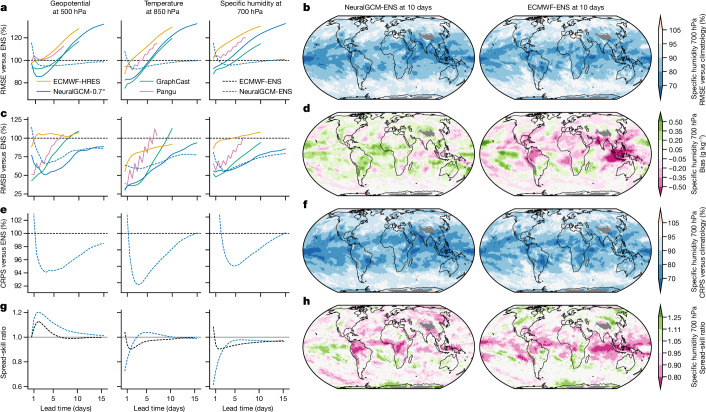
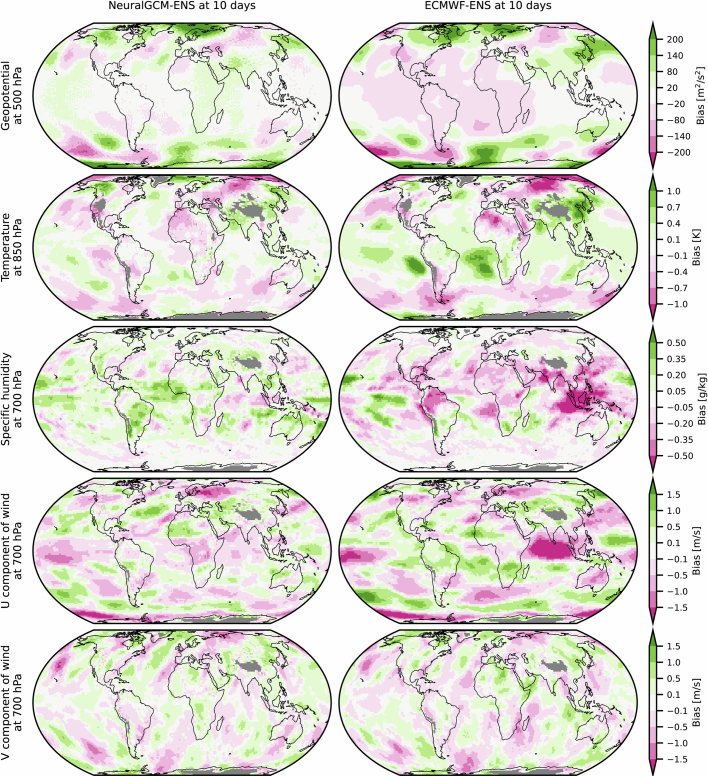
- On medium-range weather forecasting, NeuralGCM-0.7° and GraphCast achieved the best RMSE for the first 1–3 days (depending on variable), while NeuralGCM models compared favorably on persistent bias, including notably lower specific-humidity bias in the tropics.
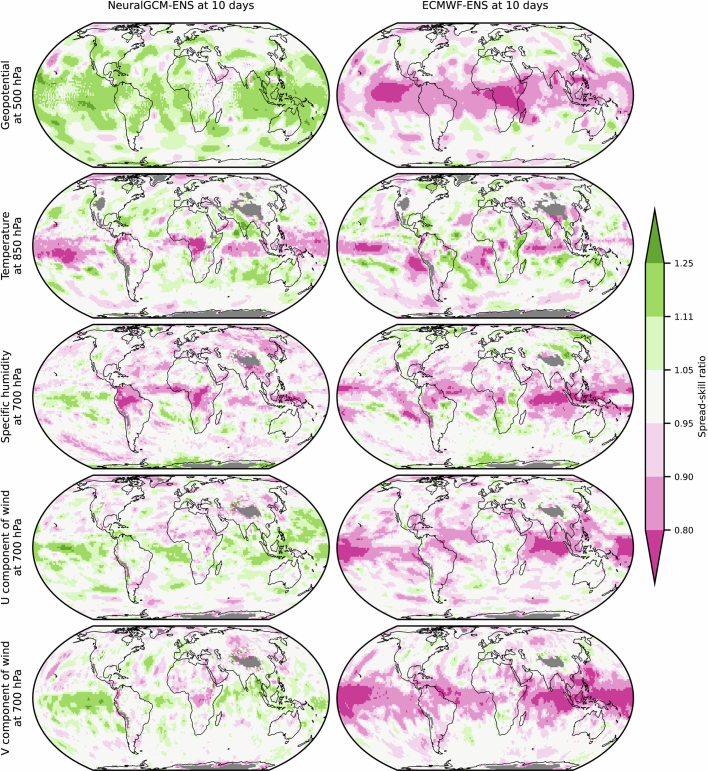
- The stochastic NeuralGCM-ENS at 1.4° had lower error than ECMWF-ENS across almost all variables, lead times, and vertical levels for ensemble-mean RMSE, RMSB, and CRPS; its spread-skill ratio was approximately 1.
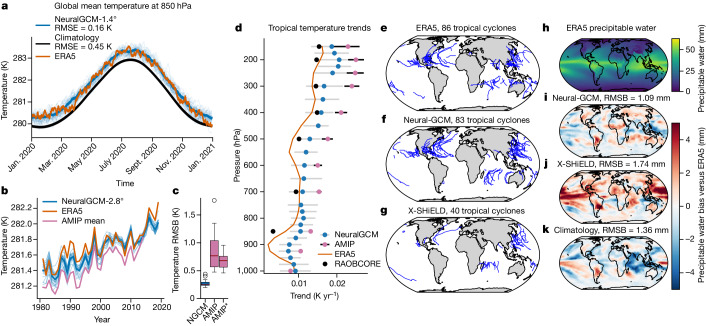
- In climate simulations with prescribed SST, NeuralGCM captured seasonal climate metrics and long-term warming trends: the ensemble-mean global temperature RMSE was 0.16 K versus 0.45 K for climatology, and all 22 stable 40-year NeuralGCM-2.8° runs had smaller spatial bias than the 22 CMIP6 AMIP runs.
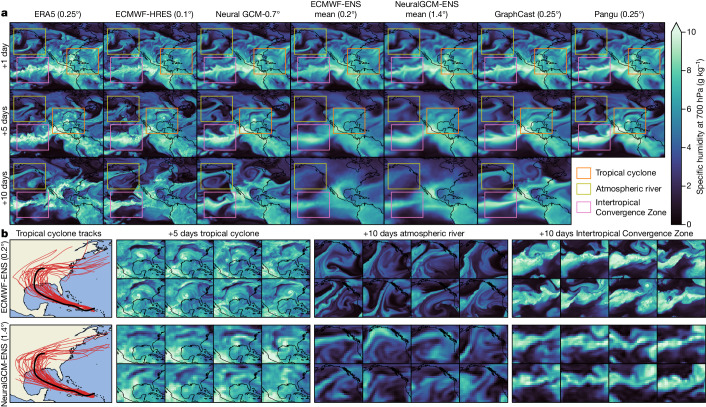
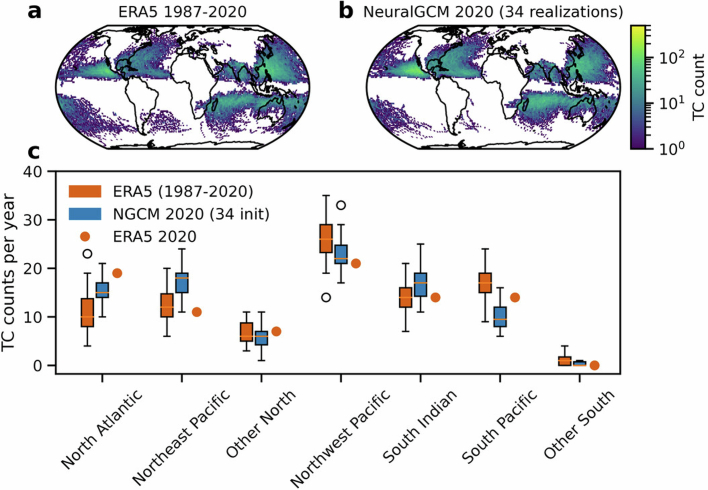
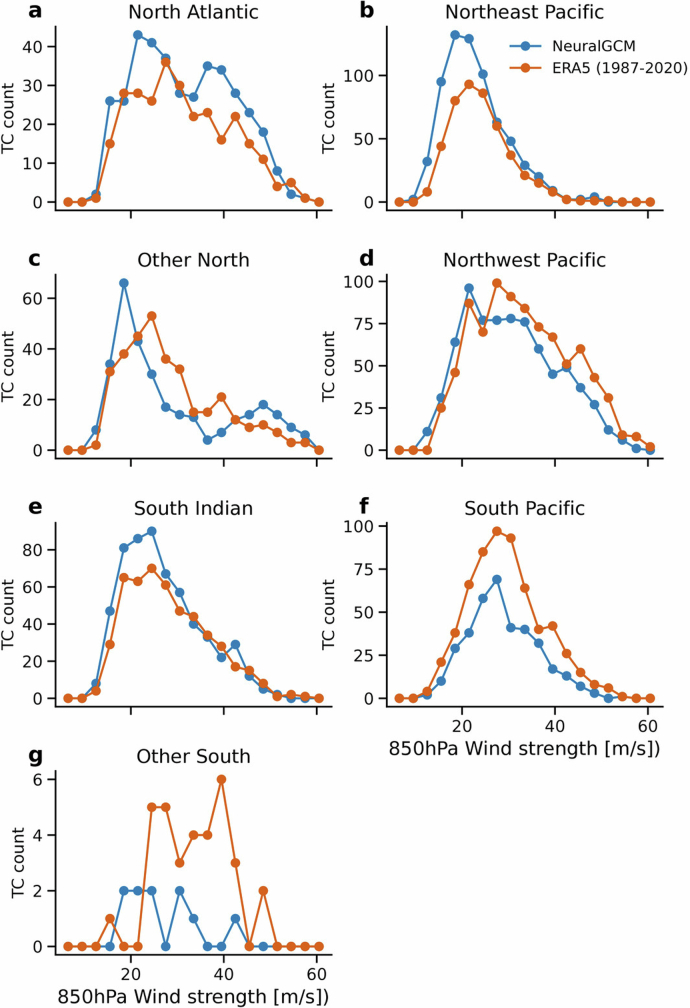
- For tropical cyclones, NeuralGCM at 1.4° produced 83 cyclones versus 86 in ERA5 for the corresponding period, while X-SHiELD produced 40 after regridding to 1.4°.
## Methods
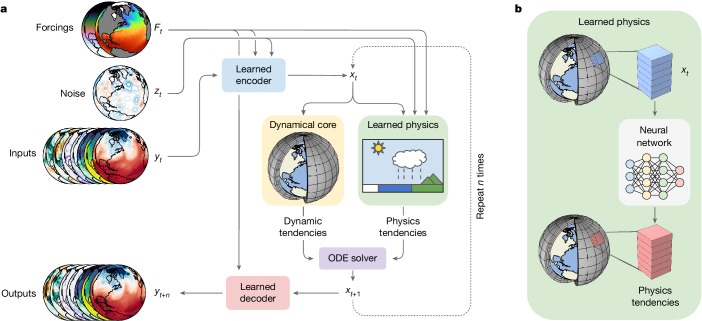
- The model is a fully differentiable hybrid GCM with a JAX-implemented dynamical core solving the hydrostatic primitive equations with moisture on sigma coordinates, plus a learned physics module that operates on single atmospheric columns.
- Weather evaluation used 732 forecasts from noon and midnight UTC in 2020 (held out from training for machine-learning models), regridded to 1.5°, with comparisons against ERA5 or ECMWF operational analysis depending on the baseline.
- Deterministic models were trained with a combination of losses for accuracy, spectral matching, and bias; stochastic models used CRPS and injected Gaussian random fields, with two ensemble members per forecast for training.
- Climate experiments used deterministic models at 2.8° and 1.4° with prescribed historical SST and sea ice, including 37 initial conditions for 2-year seasonal-cycle runs and 37 initial conditions for 40-year AMIP-like runs, of which 35 and 22 were stable, respectively.
## Limitations
- The paper explicitly states that NeuralGCM does not extrapolate to substantially different future climates.
- The authors note that for more substantial SST increases (+4 K), NeuralGCM’s response diverges from expectations, and that AMIP simulations with increased SST show climate drift.
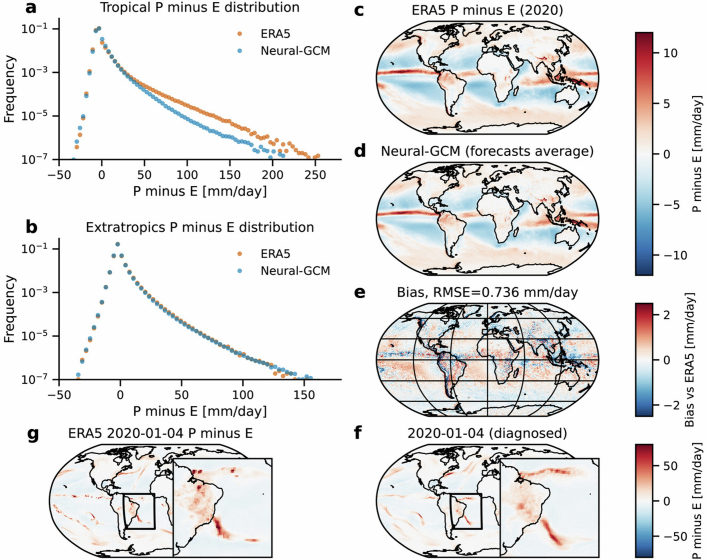
- The text makes evident that the current version cannot distinguish precipitation from evaporation because it directly predicts column tendencies; this is stated in the paper.
Model-written summary. Check it against the paper before relying on it.
Integrity signals
Registry
Cites
Statistics
Figures
Verification
Claims the paper makes
6 Valid · 2 Not valid · 9 Not checked · 53 Own results and interpretations
Some cited sources support this claim and some don’t — read each source’s verdict below.
In the paper
“Our results provide strong evidence for the disputed hypothesis37–39 that learning to predict short-term weather is an effective way to tune parameterizations for climate.”
§ Neural general circulation models for weather and climate > Discussion
What the sources say
- Partly supportedcites [37] Ruiz, J. J., Pulido, M. & Miyoshi, T. Estimating model parameters with ensemble-based data assimilation: a review. J. Meteorol. Soc. Jpn Ser. II 91, 79–99 (2013). 10.2151/jmsj.2013-201 sourceExperimental — accuracy not yet measured
The Conclusions (p. 98) do carry the substance attributed here — 'Parameter estimation also has the potential to improve model climatology... Model parameters can be trained during relatively short periods (i.e., a couple of years) using a data assimilation cycle, and then the estimated parameters can be used for climate simulations' — and the Introduction (p. 90) lists climate-model optimization among the applications of parameter estimation. But the source states this as a potential, not as demonstrated evidence: the Abstract (p. 89) and Section 3.4 (pp. 93-94) limit the paper's own results to a positive effect on short-to medium-range numerical weather prediction (RMSE/bias of 24-h precipitation, spread-error relationship), with no climate simulation performed, so 'strong evidence ... is an effective way to tune parameterizations for climate' overstates it, and nothing in our copy describes the hypothesis as disputed. (LLM, conf=0.75)
- Supportedcites [38] Schneider, T., Lan, S., Stuart, A. & Teixeira, J. Earth system modeling 2.0: a blueprint for models that learn from observations and targeted high-resolution simulations. Geophys. Res. Lett. 44, 12–396 (2017). 10.1002/2017GL076101 source
Section 2.1 (Information Sources for Parameterization Schemes) records that parameters in cloud, convection and precipitation schemes 'have been estimated by minimizing errors in short-term weather forecasts over time scales of hours or days', i.e. the hypothesis the citing sentence names. Section 2.3 (Objectives) shows it is indeed contested: 'This has given rise to hopes that it may suffice to evaluate objective functions by weather hindcasts over time scales of only hours ... But experience has shown that such short-term optimization may not always lead to the desired improvements in climate simulations (Schirber et al., 2013)', and the authors consequently choose accumulation windows wide compared with the O(10 days) forgetting time. The citation is attached only to the disputed hypothesis itself, not to the citing paper's claim that their results support it, so our copy supports what is attributed here. (LLM, conf=0.80)
- Disputedcites [39] Schneider, T., Leung, L. R. & Wills, R. C. J. Opinion: Optimizing climate models with process knowledge, resolution, and artificial intelligence. Atmos. Chem. Phys.24, 7041–7062 (2024). sourceExperimental — accuracy not yet measured
Our copy of Schneider et al. (2024) argues the opposite of what the claim attributes to it: in Sect. 5 ('AI for learning parameterizations') it states that supervised learning focused on the short-term residual has limitations, that 'focusing solely on minimizing the short-term residual ϵ' means the learned parameterization 'may not necessarily minimize the climate-relevant loss function... concerned with longer-term statistics,' and cites Schirber et al. (2013) as an example where 'short-term optimization over trajectories can lead to no improvement or even the degradation of the longer-term climate statistics.' The same section says holistic learning from data 'is more likely to be successful in weather prediction, where short-term accuracy is prioritized... In contrast, climate prediction faces two primary challenges,' and that learned parameterizations 'often struggle with conserving essential quantities such as energy and exhibit instabilities during extended integrations... because minimizing the short-term residual ϵ does not inherently ensure conservation or stability.' The paper also never frames this as a merely 'disputed hypothesis' but advocates process-based, online, climate-relevant-loss learning instead (Sect. 3 and Sect. 5). (LLM, conf=0.85)
Checked by a reasoning model — may be wrong.
boostedstates a cause- Asserted: passes — The authors put it forward as true.
- Checkable: passes — It can be checked against evidence.
- Load-bearing: passes — The paper’s conclusions depend on it.
- Based: passes — The paper gives a reason why it holds.
- Partly supported
The cited sources that could be checked couldn’t confirm or dispute this claim.
In the paper
“Overall, NeuralGCM demonstrates that incorporating machine learning is a viable alternative to building increasingly detailed physical models32 for improving GCMs.”
§ Neural general circulation models for weather and climate > Discussion
What the sources say
- Could not verifycites [32] Stevens, B. et al. DYAMOND: the dynamics of the atmospheric general circulation modeled on non-hydrostatic domains. Prog. Earth Planet. Sci. 6, 61 (2019). 10.1186/s40645-019-0304-z sourceExperimental — accuracy not yet measured
Our copy of DYAMOND (Stevens et al. 2019) never addresses machine learning: searches on 'machine learning', 'deep learning / neural network parameterization', and 'surrogate/emulator alternative to physical parameterization' returned only passages on global storm-resolving models, their grids, output volumes and diagnostics. The route to better GCMs that the paper does argue for is explicitly resolving convection at ~3 km to 'circumvent considerable, and seemingly intractable, problems arising from parameterizations' (Introduction, p. 2) and achieving higher throughput (Summary, p. 15) — a physical, not data-driven, alternative, and no passage credits or discusses ML methods, nor names a work to which the ML claim could be traced. Nothing in our copy either supports or contradicts the attributed claim, so it cannot be judged from this source. (LLM, conf=0.72)
boostedstates a cause- Asserted: passes — The authors put it forward as true.
- Checkable: passes — It can be checked against evidence.
- Load-bearing: passes — The paper’s conclusions depend on it.
- Based: passes — The paper gives a reason why it holds.
- Could not verify
The cited sources support only part of this claim — read each source’s verdict below.
In the paper
“Recently, machine-learning models trained on reanalysis data have achieved comparable or better skill than GCMs for deterministic weather forecasting3,4.”
§ Neural general circulation models for weather and climate > Abstract General circulation models (GCMs) are the foundation of weather and climate prediction1,2. GCMs are physics-based simulators that combine a numerical solver for large-scale dynamics with tuned representations for small-scale processes such as cloud formation. Recently, machine-learning models trained on reanalysis data have achieved comparable or better skill than GCMs for deterministic weather forecasting3,4. However, these models have not demonstrated improved ensemble forecasts, or shown sufficient stability for long-term weather and climate simulations. Here we present a GCM that combines a differentiable solver for atmospheric dynamics with machine-learning components and show that it can generate forecasts of deterministic weather, ensemble weather and climate on par with the best machine-learning and physics-based methods. NeuralGCM is competitive with machine-learning models for one- to ten-day forecasts, and with the European Centre for Medium-Range Weather Forecasts ensemble prediction for one- to fifteen-day forecasts. With prescribed sea surface temperature, NeuralGCM can accurately track climate metrics for multiple decades, and climate forecasts with 140-kilometre resolution show emergent phenomena such as realistic frequency and trajectories of tropical cyclones. For both weather and climate, our approach offers orders of magnitude computational savings over conventional GCMs, although our model does not extrapolate to substantially different future climates. Our results show that end-to-end deep learning is compatible with tasks performed by conventional GCMs and can enhance the large-scale physical simulations that are essential for understanding and predicting the Earth system.
What the sources say
- Supportedcites [3] Lam, R. et al. Learning skillful medium-range global weather forecasting. Science 382, 1416–1421 (2023). 37962497 10.1126/science.adi2336 source
The paper’s opening summary says GraphCast was trained on reanalysis data and significantly outperformed an operational deterministic forecasting system on 90% of 1,380 verification targets. The Conclusions also describe machine-learning weather prediction as competitive with traditional methods. The paper compares GraphCast specifically with HRES, rather than using the term “GCMs.” (LLM, conf=0.90)
- Partly supportedcites [4] Bi, K. et al. Accurate medium-range global weather forecasting with 3D neural networks. Nature 619, 533–538 (2023). 37407823 10.1038/s41586-023-06185-3 PMC10356604 sourceExperimental — accuracy not yet measured
The Discussion and Deterministic global weather forecast sections report that Pangu-Weather, trained on reanalysis data, achieved better deterministic forecast accuracy than ECMWF’s operational IFS. The paper identifies IFS as a numerical weather prediction system, however, and does not report a comparison with a system it calls a GCM. (LLM, conf=0.82)
plainstates an association- Asserted: passes — The authors put it forward as true.
- Checkable: passes — It can be checked against evidence.
- Load-bearing: passes — The paper’s conclusions depend on it.
- Based: passes — The paper gives a reason why it holds.
- Supported
Every source the paper cites for this claim was checked and supports it.
In the paper
“So far, hybrid models have mostly been limited to idealized scenarios such as aquaplanets22,23.”
§ Neural general circulation models for weather and climate > Main
What the sources say
- Supportedcites [22] Rasp, S., Pritchard, M. S. & Gentine, P. Deep learning to represent subgrid processes in climate models. Proc. Natl Acad. Sci. USA 115, 9684–9689 (2018). 30190437 10.1073/pnas.1810286115 PMC6166853 source
The Climate Model and Neural Network Setup section describes this hybrid model as using an aquaplanet setup. The Discussion calls its training climate idealized and says extending the method to a less idealized setup is an immediate follow-up task. The paper thus supports the cited example of the limitation, though it does not quantify how many hybrid models use such setups. (LLM, conf=0.87)
- Supportedcites [23] Yuval, J. & O’Gorman, P. A. Stable machine-learning parameterization of subgrid processes for climate modeling at a range of resolutions. Nat. Commun. 11, 3295 (2020). 32620769 10.1038/s41467-020-17142-3 PMC7335176 source
The Introduction describes earlier neural-network climate-model work in an aquaplanet configuration, and the Results state that this study also uses an aquaplanet configuration. The Discussion identifies training over land with topography as a challenge for future research, supporting the characterization of hybrid models as largely limited to idealized settings. (LLM, conf=0.86)
plain- Asserted: passes — The authors put it forward as true.
- Checkable: passes — It can be checked against evidence.
- Load-bearing: passes — The paper’s conclusions depend on it.
- Based: passes — The paper gives a reason why it holds.
- Supported
The cited sources support only part of this claim — read each source’s verdict below.
In the paper
“Deterministic machine-learning models using a mean-squared-error loss are rewarded for averaging over uncertainty, producing unrealistically blurry predictions when optimized for multi-day forecasts3,13.”
§ Neural general circulation models for weather and climate > Main
What the sources say
- Supportedcites [3] Lam, R. et al. Learning skillful medium-range global weather forecasting. Science 382, 1416–1421 (2023). 37962497 10.1126/science.adi2336 source
The Conclusions (p. 10) state that GraphCast’s MSE objective encourages it to express uncertainty by spatially blurring predictions. The paper also reports that training for longer forecast horizons produces blurrier forecasts at longer lead times. This supports the citing sentence’s account of why MSE-optimized deterministic forecasts can become blurry. (LLM, conf=0.90)
- Partly supportedcites [13] Keisler, R. Forecasting global weather with graph neural networks. Preprint at https://arxiv.org/abs/2202.07575 (2022). sourceExperimental — accuracy not yet measured
Keisler (2022) supplies the empirical setting and the observation but not the claimed mechanism. Section 3.3.3 (p. 5) confirms the model is trained with a mean-squared-error loss, and Section 3.3.2 (p. 5) confirms it is optimized for multi-day forecasts via a multi-step rollout loss (4-, 8-, 12-step, i.e. 1-3 day rollouts). Section 4.2 (p. 6) reports that over a 12-step (3-day) rollout 'the data-driven forecast does become smoother over time' — but the paper nowhere says the model is 'rewarded for averaging over uncertainty', never frames the smoothing as a consequence of irreducible forecast uncertainty under MSE, and never calls the predictions 'unrealistically blurry' (it treats the 3-day output as generally tracking large-scale flows, and its only degradation past ~6 days is hexagon-patterned instability, Section 4.3, p. 6). So the blur/averaging-over-uncertainty causal claim attributed here exceeds what this source states. (LLM, conf=0.72)
plainstates a cause- Asserted: passes — The authors put it forward as true.
- Checkable: passes — It can be checked against evidence.
- Load-bearing: passes — The paper’s conclusions depend on it.
- Based: passes — The paper gives a reason why it holds.
- Supported
29 more claims
Create a free account to see all 70 claims and to verify the 10 references still open.
- It may state two separate claims as one. 31
- Probably not a substantial claim. 6
Claims other papers make about this one
Each is checked against this paper’s own text: does it say what the citing paper says it does?
The cited source says what the claim attributes to it.
In the citing paper
“An exception is NeuralGCM20, a hybrid NWP–MLWP method, which combines the dynamical core of a traditional NWP with local ML-based parameterizations and shows competitive performance with operational ensemble forecasts.”
From Probabilistic weather forecasting with machine learning (2025) · cites this paper as [20]
Citations
Cites
Hersbach, H., Bell, B., Berrisford, P., Hirahara, S., Horányi, A., Muñoz‐Sabater, J., Nicolas, J., Peubey, C., Radu, R., Schepers, D., et al. (2020) · Quarterly Journal of the Royal Meteorological Society · doi:10.1002/qj.3803 · Cited by 31,882 · cited 1×
“These models rely solely on machine-learning techniques, using roughly 40 years of historical data from the European Center for Medium-Range Weather Forecasts (ECMWF) reanalysis v5 (ERA5) 14 for model training and forecast initialization.”
MethodSequence to Sequence Learning with Neural Networks
Sutskever, I., Vinyals, O., & Le, Q. V. (2014) · arXiv · doi:10.48550/arxiv.1409.3215 · Cited by 17,766
Eyring, V., Bony, S., Meehl, G. A., Senior, C. A., Stevens, B., Stouffer, R. J., & Taylor, K. E. (2016) · Geoscientific Model Development · doi:10.5194/gmd-9-1937-2016 · Cited by 11,981 · cited 3×
“34 and Supplementary Table 6.”
MethodInfluential(2012) · doi:10.1017/cbo9781139177245 · Cited by 7,236 · cited 1×
“The difficulty of reducing uncertainty in long-term climate projections 9 and estimating distributions of extreme weather events 10 presents major challenges for climate mitigation and adaptation 11 .”
BackgroundStrictly Proper Scoring Rules, Prediction, and Estimation
Gneiting, T., & Raftery, A. E. (2007) · Journal of the American Statistical Association · doi:10.1198/016214506000001437 · Cited by 5,793 · cited 10×
“Our stochastic loss is based on the CRPS 28,48,49 .”
BackgroundMethodInfluentialDeep learning and process understanding for data-driven Earth system science
Reichstein, M., Camps-Valls, G., Stevens, B., Jung, M., Denzler, J., Carvalhais, N., & Prabhat (2019) · Nature · doi:10.1038/s41586-019-0912-1 · Cited by 5,673 · cited 1×
“…longer timescales 17,18 , these models have not demonstrated the ability to outperform existing GCMs. Hybrid models that combine GCMs with machine learning are appealing because they build on the interpretability, extensibility and successful track record of traditional atmospheric models 19,20 .”
BackgroundThe quiet revolution of numerical weather prediction
Bauer, P., Thorpe, A., & Brunet, G. (2015) · Nature · doi:10.1038/nature14956 · Cited by 2,729
Accurate medium-range global weather forecasting with 3D neural networks
Bi, K., Xie, L., Zhang, H., Chen, X., Gu, X., & Tian, Q. (2023) · Nature · doi:10.1038/s41586-023-06185-3 · Cited by 1,670 · cited 4×
“Recent advances in machine learning have presented an alternative for weather forecasting 3,4,12,13 .”
BackgroundMethodInfluentialLearning skillful medium-range global weather forecasting
Lam, R., Sanchez-Gonzalez, A., Willson, M., Wirnsberger, P., Fortunato, M., Alet, F., Ravuri, S., Ewalds, T., Eaton-Rosen, Z., Hu, W., et al. (2023) · Science · doi:10.1126/science.adi2336 · Cited by 1,466 · cited 5×
“Specifically, we diagnose precipitation minus evaporation (Supplementary Information section H.5) rather than directly predicting these as in machine-learning-based approaches 3 .”
BackgroundMethodInfluentialSelf-citationMarine boundary layer clouds at the heart of tropical cloud feedback uncertainties in climate models
Bony, S., & Dufresne, J. (2005) · Geophysical Research Letters · doi:10.1029/2005gl023851 · Cited by 1,302 · cited 1×
“Tuning GCMs to match historical data remains a manual process 5 , and GCMs retain many persistent errors and biases 6–8 .”
Background
Research works printed but not linked: 1
- Holton, J. R. An introduction to Dynamic Meteorology 5th edn (Elsevier, 2004).
Cited by
Items 101–200 of 434
Li, S., & Xing, J. (2025) · Environment International · doi:10.1016/j.envint.2025.109689 · Cited by 8
Physics-Guided Learning of Meteorological Dynamics for Weather Downscaling and Forecasting
Luo, Y., Fang, S., Wu, B., Wen, Q., & Sun, L. (2025) · ACM SIGKDD Conference on Knowledge Discovery and Data Mining (KDD) · doi:10.1145/3711896.3737081 · Cited by 20
Improving Indian summer monsoon rainfall prediction using deep learning up to two years in advance
Sharma, D., Das, S., Chakraborty, D., Mitra, A., & Goswami, B. N. (2025) · Quarterly Journal of the Royal Meteorological Society · doi:10.1002/qj.70023 · Cited by 10
Horowitz, B., & Lukić, Z. (2025) · Monthly Notices of the Royal Astronomical Society · doi:10.1093/mnras/staf1785 · Cited by 27
Ullrich, P. A., Barnes, E. A., Collins, W. D., Dagon, K., Duan, S., Elms, J., Lee, J., Leung, L.-Y. R., Lu, D., Molina, M. J., et al. (2025) · Journal of Geophysical Research Machine Learning and Computation · doi:10.1029/2024jh000496 · Cited by 26
Early warning of complex climate risk with integrated artificial intelligencePreprint
Reichstein, M., Frank, D., Benson, V., Camps‐Valls, G., Denzler, J., Kornhuber, K., Schölkopf, B., Vinuesa, R., Han, B., Fearnley, C. J., et al. (2024) · Research Square · doi:10.21203/rs.3.rs-4248340/v1 · Cited by 7
Zhang, Q., Cheng, S., Liu, L., Zhang, L., Xu, J., She, D., & Yuan, Z. (2025) · Environmental Research Letters · doi:10.1088/1748-9326/adb1f7 · Cited by 10
Physically consistent global atmospheric data assimilation with machine learning in latent space
Fan, H., Bai, L., Fei, B., Xiao, Y., Chen, K., Liu, Y., Qu, Y., Ling, F., & Gentine, P. (2026) · Science Advances · doi:10.1126/sciadv.aea4248 · Cited by 35
Agarwal, N., Amrhein, D. E., & Grooms, I. G. (2025) · Geophysical Research Letters · doi:10.1029/2024gl110472 · Cited by 7
Li, W., He, Y., Tao, L., Chen, J., Wang, X., Ge, Y., & Lin, H. (2025) · International Journal of Geographical Information Systems · doi:10.1080/13658816.2025.2479183 · Cited by 8
Learning spatiotemporal dynamics from sparse data via a high-order physics-encoded network
Ren, P., Song, J., Rao, C., Wang, Q., Guo, Y., Sun, H., & Liu, Y. (2025) · Computer Physics Communications · doi:10.1016/j.cpc.2025.109582 · Cited by 8
XAI Helps in Storm Surge Forecasts: A Case Study for the Southeastern Chinese Coasts
Han, L., Lu, W., & Dong, C. (2025) · Journal of Marine Science and Engineering · doi:10.3390/jmse13050896 · Cited by 11
A GPU parallelization of the neXtSIM-DG dynamical core (v0.3.1)
Jendersie, R., Lessig, C., & Richter, T. (2025) · Geoscientific model development · doi:10.5194/gmd-18-3017-2025 · Cited by 11
Long, Z., Zha, J., Zhang, H., Chuan, T., Lu, W., Yan, Y., Xia, L., Fan, W., Jiang, H., Zhao, D., et al. (2025) · Geophysical Research Letters · doi:10.1029/2025gl116108 · Cited by 8
Machine learning and partial differential equations: benchmark, simplify, and discover
Koumoutsakos, P. (2025) · Data-Centric Engineering · doi:10.1017/dce.2025.15 · Cited by 8
“A fresh look that may completely bypass PDEs and the usual scientific computing ideas may be a much more powerful approach, as we have already seen in successful applications of data-driven teaching techniques to weather forecasting and ocean dynamics (Kochkov et al., 2024; Price et al., 2024).”
Clark, S. K., Watt‐Meyer, O., Kwa, A., McGibbon, J., Henn, B., Perkins, W. A., Wu, E., Harris, L., & Bretherton, C. S. (2025) · Journal of Geophysical Research Machine Learning and Computation · doi:10.1029/2024jh000575 · Cited by 41
Meteorological Tsunamis: From Local Hazard to Global Relevance
Vilibić, I., Zemunik, P., & Šepić, J. (2025) · Reviews of Geophysics · doi:10.1029/2024rg000867 · Cited by 15
Grundner, A., Beucler, T., Savre, J., Lauer, A., Schlund, M., & Eyring, V. (2025) · Scientific Reports · doi:10.1038/s41598-025-29155-3 · Cited by 17
“To assess the applicability of ICON-A-MLe to a warmer climate, we increase the SST uniformly by 4 K, following a common proxy for global warming scenarios [8, 48, 49].”
Neural general circulation models for modeling precipitation
Yuval, J., Langmore, I., Kochkov, D., & Hoyer, S. (2026) · Science Advances · doi:10.1126/sciadv.adv6891 · Cited by 39
“The original version of NeuralGCM ( 31 ) does not explicitly represent precipitation and evaporation.”
InfluentialSelf-citationAI for atmosphere–ocean sciences: advancements, challenges and ways forward
Luo, J., Xia, J., Pan, B., Ham, Y.-G., Li, X., Shangguan, W., Xue, W., Wang, Y., Mu, B., Hong, Y., et al. (2026) · National Science Review · doi:10.1093/nsr/nwag063 · Cited by 25
“AI-based global models typically adopt an autoregressive forecasting approach that performs iterative predictions at intervals ranging from as short as 1 h to as long as 1 month [11 ,13 ,100 ,135 ].”
InfluentialChen, J., Zhou, P., Hua, Y., Chong, D., Cao, M., Li, Y., Chen, W., Zhu, B., Liang, J., & Yuan, Z. (2025) · ACM SIGKDD Conference on Knowledge Discovery and Data Mining (KDD) · doi:10.1145/3711896.3737406 · Cited by 29
A predictive model for the estimation of industrial PM2.5 emissions for IoT-based devices
Kychkin, A. V., Леонидовна, В. О., Mylnikov, L., & Chernitsin, I. (2024) · Computers & Industrial Engineering · doi:10.1016/j.cie.2024.110662 · Cited by 9
Kotsuki, S., Shiraishi, K., & Okazaki, A. (2025) · Geoscientific model development · doi:10.5194/gmd-18-7215-2025 · Cited by 16
MQGeometry-1.0: a multi-layer quasi-geostrophic solver on non-rectangular geometries
Thiry, L., Li, L., Roullet, G., et al. (2024) · Geoscientific model development · doi:10.5194/gmd-17-1749-2024 · Cited by 6
Hu, Y., Zhang, W., Yin, F., & Wu, J. (2025) · Neural Networks · doi:10.1016/j.neunet.2025.107649 · Cited by 9
A dual-core model for ENSO diversity: unifying model hierarchies for realistic simulations
Wang, J., Fang, X., Chen, N., Qin, B., Mu, M., & Ji, C. (2025) · npj Climate and Atmospheric Science · doi:10.1038/s41612-025-01164-z · Cited by 9
Deep Learning Atmospheric Models Reliably Simulate Out‐of‐Sample Land Heat and Cold Wave Frequencies
Meng, Z., Hakim, G. J., Yang, W., & Vecchi, G. A. (2026) · Geophysical Research Letters · doi:10.1029/2025gl117990 · Cited by 13
“…learning–based GCM (Cresswell‐Clay et al., 2024); Neural‐GCM (NGCM) a physics–DL hybrid model that blends numerical dynamics with learned subgrid processes (Kochkov et al., 2024b); and High Resolution At-mospheric Model (HiRAM), a conventional high‐resolution physical model (Zhao et al., 2009).”
InfluentialCoupling human dynamics with the physics of climate: a path towards Human Earth Systems Models
Tapiador, F. J., & Navarro, A. (2024) · Environmental Research Climate · doi:10.1088/2752-5295/ad7974 · Cited by 6
Online calibration of deep learning sub-models for hybrid numerical modeling systems
Ouala, S., Chapron, B., Collard, F., Gaultier, L., & Fablet, R. (2024) · Communications Physics · doi:10.1038/s42005-024-01880-7 · Cited by 16
“The design of hybrid modeling approaches, based on the combination of a physical core and a deep learning sub-model is under active development 4 – 12 .”
InfluentialMachine learning for stochastic parametrization
Christensen, H. M., Kouhen, S., Miller, G., & Parthipan, R. (2024) · Environmental Data Science · doi:10.1017/eds.2024.45 · Cited by 12
“For example, the Neural GCM NWP emulator (Kochkov et al., 2024) uses spatio-temporally correlated fields much like those used in operational models to perturb the learnt physics module.”
Spatio-temporal Causal Learning for Streamflow Forecasting
Wan, S., Shah, R. D., Deng, Q., Sabo, J. L., Liu, H., & Candan, K. S. (2024) · IEEE International Conference on Big Data (BigData) · doi:10.1109/bigdata62323.2024.10826120 · Cited by 10
Fan, Y., Deng, X., Yang, X., Long, Y., & Bai, F. (2025) · IEEE Aerospace and Electronic Systems Magazine · doi:10.1109/maes.2025.3547284 · Cited by 5
“Nowadays, neural network-based approaches have been extensively developed for medium-range global fore-casts [24], [25], [26], [27], nowcasting [28], [29], [30], and wind power predictions [31], offering shorter inference times and improved accuracy with increasing historical data.”
Zhang, T., Morcrette, C. J., Zhang, M., Lin, W., Xie, S., Liu, Y., Weverberg, K. V., & Rodrigues, J. (2025) · Geoscientific model development · doi:10.5194/gmd-18-1917-2025 · Cited by 14
“When a trained ML model is incorporated into ESMs, it is frozen and cannot be updated during runtime Recently, Kochkov et al. (2024) introduced the NeuralGCM, an innovative approach that enables the ML model to be updated during runtime with a differentiable dynamical core.”
Li, H., Li, J., Wu, Z., Wang, M., Liu, G., Sun, R., Li, R., Wang, N., Song, H., & Zhen, S. (2025) · Machine Learning Science and Technology · doi:10.1088/2632-2153/adc53b · Cited by 9
Zhang, L., Song, Y., Cui, H., Lu, M., Li, C., Yuan, B., Wang, B., Lall, U., & Yang, J. (2025) · Water Resources Research · doi:10.1029/2024wr039553 · Cited by 14
Zhao, C., Ye, A., Wu, L., & Zhan, S. (2025) · Atmospheric Research · doi:10.1016/j.atmosres.2025.108319 · Cited by 6
Evaluating station, satellite, & combined data for XGBoost-based visibility forecast
Schütz, M., Schütz, A., Bendix, J., & Thies, J. M. U. B. (2025) · Atmospheric Research · doi:10.1016/j.atmosres.2025.108395 · Cited by 13
Mu, M., Qin, B., & Dai, G. (2024) · Fundamental Research · doi:10.1016/j.fmre.2024.03.006 · Cited by 6
Current progress in subseasonal-to-decadal prediction based on machine learning
Shen, Z., Sun, Q., Lu, X., Ling, F., Li, Y., Wu, J., Luo, J., & Yuan, C. (2024) · Applied Computing and Geosciences · doi:10.1016/j.acags.2024.100201 · Cited by 11
DeepMind AI weather forecaster beats world-class system
Soliman, A. (2024) · Nature · doi:10.1038/d41586-024-03957-3 · Cited by 5
Atmospheric Transport Modeling of CO2 With Neural Networks
Benson, V., Bastos, A., Reimers, C., Winkler, A. J., Yang, F., & Reichstein, M. (2025) · Journal of Advances in Modeling Earth Systems · doi:10.1029/2024ms004655 · Cited by 9
Spatio-temporal graph neural networks to improve precipitation forecasts from numerical models
Yousaf, U., Rango, A. D., Furnari, L., D’Ambrosio, D., Senatore, A., & Mendicino, G. (2025) · Soft Computing · doi:10.1007/s00500-025-10635-7 · Cited by 9
Advancing seasonal prediction of tropical cyclone activity with a hybrid AI-physics climate model
Zhang, G., Rao, M., Yuval, J., & Zhao, M. (2025) · Environmental Research Letters · doi:10.1088/1748-9326/adf864 · Cited by 19
Self-citationAn extension of WeatherBench 2 to binary hydroclimatic forecasts
Zhao, T., Li, Q., Tu, T., & Chen, X. (2025) · Geoscientific model development · doi:10.5194/gmd-18-5781-2025 · Cited by 10
Liu, F., Wang, X., Wang, H., & Lv, T. (2025) · Energy · doi:10.1016/j.energy.2025.138759 · Cited by 5
Boosting weather forecast via generative superensemble
Nai, C., Chen, X., Yang, S., Xiao, Z., & Pan, B. (2025) · npj Climate and Atmospheric Science · doi:10.1038/s41612-025-01255-x · Cited by 27
“Additionally, we included NeuralGCM 53 , which represents an emerging hybrid approach that integrates deep learning with traditional numerical methods.”
Hachimi, C. E., Belaqziz, S., KHABBA, S., Karjoun, H., Kharrou, M. H., Hssaine, B. A., Er‐Raki, S., Daccache, A., Chehbouni, A., & Weng, Q. (2025) · Energy Nexus · doi:10.1016/j.nexus.2025.100599 · Cited by 8
Humphries, U. W., Waqas, M., & Ahmad, S. (2025) · Results in Engineering · doi:10.1016/j.rineng.2025.108616 · Cited by 8
Embedding machine-learnt sub-grid variability improves climate model precipitation patterns
Giles, D., Briant, J., Morcrette, C. J., & Guillas, S. (2024) · Communications Earth & Environment · doi:10.1038/s43247-024-01885-8 · Cited by 9
“Kochkov et al. 20 have consolidated and built upon these hybrid approaches by developinganatmosphericGCMwhichenablestheintegrationofmachine-learnedparameterisationschemeswithinanauto-differentialdynamical core.”
Christakis, N., Drikakis, D., & Tirchas, P. (2025) · Physics of Fluids · doi:10.1063/5.0260592 · Cited by 4
Chen, M., Zhang, J., Dong, R., Xu, Y., Liang, H., Zheng, J., Wang, L., & Fu, H. (2025) · Geophysical Research Letters · doi:10.1029/2024gl114310 · Cited by 7
Adjoint‐Based Online Learning of Two‐Layer Quasi‐Geostrophic Baroclinic Turbulence
Yan, F. E., Frezat, H., Sommer, J. L., Mak, J., & Otness, K. (2025) · Journal of Advances in Modeling Earth Systems · doi:10.1029/2024ms004857 · Cited by 10
“As a reminder, the models here are trained via a curriculum (e.g., Frezat et al., 2022; Kochkov et al., 2024; List et al., 2022; Ouala et al., 2024), in that a mapping is first learned from a window with restricted size, and that mapping is then used as the initial mapping for learning at the next…”
InfluentialLoon, S. V., Rugenstein, M. A. A., & Barnes, E. A. (2025) · Geophysical Research Letters · doi:10.1029/2025gl115432 · Cited by 18
“Recent advances in machine learning (ML) have made it possible to emulate the physical processes in the atmosphere in a computationally efficient way (e.g., Cachay et al., 2024; Cresswell‐Clay et al., 2024; Guan et al., 2024; Kochkov et al., 2024; Watt‐Meyer et al., 2023; Watt‐Meyer et al., 2024).”
He, H., Shi, B., Zhu, Y., Feng, L., Ge, C., Tan, Q., Peng, Y., Liu, Y., Ling, Z., & Li, S. (2024) · Remote Sensing · doi:10.3390/rs16203793 · Cited by 4
Multimodal Deep Learning for Two-Year ENSO Forecast
Naisipour, M., Saeedpanah, I., & Adib, A. (2025) · Water Resources Management · doi:10.1007/s11269-025-04128-3 · Cited by 11
“In contrast, the advent of artificial intelligence presents a promising alternative, prompting researchers to investigate AI-driven predictive models (Mooers et al. 2024; Naisipour et al. 2024) and hybrid methodologies (Beucler et al. 2024; Kochkov et al. 2024).”
Goulioti, E. G., Nikou, T. Μ., Kontargyri, V. T., & Christodoulou, C. A. (2025) · Energies · doi:10.3390/en18112793 · Cited by 5
Case Studies: Successful Applications of AI and AR in Research
Kayyali, M. (2025) · Advances in computational intelligence and robotics book series · doi:10.4018/979-8-3373-1414-3.ch011 · Cited by 4
Niu, Z., Huang, W., Yang, Y., Yang, M., Deng, L., Wang, H., Li, H., & Zhang, X. (2025) · Advances in Atmospheric Sciences · doi:10.1007/s00376-025-5464-8 · Cited by 7
A dual-stage spatiotemporal information fusion network for video prediction
Yuan, J., Wu, F., Zhao, L., & Tang, L. (2025) · Expert Systems with Applications · doi:10.1016/j.eswa.2025.127189 · Cited by 3
U‐Net Kalman Filter (UNetKF): An Example of Machine Learning‐Assisted Data Assimilation
Lu, F. (2025) · Journal of Advances in Modeling Earth Systems · doi:10.1029/2023ms003979 · Cited by 7
“The rapid advancement of ML‐based weather and climate models (Bi et al., 2023; Kochkov et al., 2024; Lam et al., 2023) points to an exciting future where very large ensembles can be efficiently generated for ensemble data assimilation using these data‐driven models.”
AI Merged With Human Knowledge Produces the Best Possible Weather Forecasts
Penny, S. G. (2025) · Geophysical Research Letters · doi:10.1029/2025gl116465 · Cited by 3
Benke, R., Han, L., Garland-Campbell, K. A., & Li, X. (2025) · Computers and Electronics in Agriculture · doi:10.1016/j.compag.2025.110665 · Cited by 3
Constructing extreme heatwave storylines with differentiable climate models
Whittaker, T., & Luca, A. D. (2026) · Weather and Climate Dynamics · doi:10.5194/wcd-7-393-2026 · Cited by 14
“Although direct visualization of the perturbations is challenging due to their high dimensionality, their spatial spectra provide useful insight and are presented in Sect 3.5”
InfluentialSeasonal forecasting using the GenCast probabilistic machine learning model
Antonio, B., Strømmen, K., & Christensen, H. M. (2026) · Climate Dynamics · doi:10.1007/s00382-026-08077-4 · Cited by 10
“Zhang et al. (2025) perform seasonal hindcasts with NeuralGCM (Kochkov et al. 2024), similarly using persisted SST and sea ice anomalies, with a focus on forecasting tropical cyclone activity, and creating ensembles using initial condition perturbations.”
InfluentialAdvances in atmospheric, oceanic, and coupled models for meteorological forecasting
Waqas, M., Humphries, U. W., & Wangwongchai, A. (2025) · Natural Hazards Research · doi:10.1016/j.nhres.2025.10.003 · Cited by 6
PseudospectralNet: Toward Hybrid Atmospheric Models for Climate Simulations
Gelbrecht, M., Klöwer, M., & Boers, N. (2025) · Journal of Advances in Modeling Earth Systems · doi:10.1029/2025ms004969 · Cited by 7
Self-citationLi, F., Fu, L., Du, X., Zhang, X., Cheng, H., Tong, N., & Xu, F. (2025) · Ocean Engineering · doi:10.1016/j.oceaneng.2025.123560 · Cited by 7
Fostering tropical cyclone research and applications with Synthetic Aperture Radar
Mouche, A. A., Avenas, A., Chang, P. C., Chapron, B., Cévaër, T., Combot, C., Courtney, J. B., Febvre, Q., Foster, R. C., Grouazel, A., et al. (2025) · Remote Sensing of Environment · doi:10.1016/j.rse.2025.115139 · Cited by 10
Advancing AI for science: From the revolution of tools to the tools for revolution
Zhou, B., Ding, N., Bai, L., & Zhou, H. (2025) · AI Open · doi:10.1016/j.aiopen.2025.11.002 · Cited by 7
Accurate Mediterranean Sea forecasting via graph-based deep learning
Holmberg, D., Clementi, E., Epicoco, I., & Roos, T. (2025) · Scientific Reports · doi:10.1038/s41598-025-31177-w · Cited by 18
“While SeaCast takes as input lateral boundary forcing from MedFS, leveraging its existing regridded connection to the global ocean, early studies in limited area weather modeling with machine learning provide interesting alternative ways for handling boundary conditions, such as using a globally…”
Causes and consequences of Arctic amplification elucidated by coordinated multimodel experiments
Screen, J. A., Audette, A., Blackport, R., Deser, C., England, M., Feldl, N., Gervais, M., Hay, S., Kushner, P. J., Liang, Y.-C., et al. (2025) · Communications Earth & Environment · doi:10.1038/s43247-025-03052-z · Cited by 18
“More recently, Arti fi cial Intelligence and machine learning-based climate models 103 offer new avenues to simulate complex climate dynamics with enhanced computational ef fi ciency, although their capacity to fully capture sea-ice thermodynamics and large-scale coupling remains under assessment.”
NoahPy: a differentiable Noah land surface model for simulating permafrost thermo-hydrology
Tian, W., Yu, H., Zhao, S., Cao, Y., Yi, W., Xu, J., & Nan, Z. (2026) · Geoscientific model development · doi:10.5194/gmd-19-57-2026 · Cited by 9
“5), indicating that the Adam optimizer finds a robust solution more consistently across repeated runs.”
Wang, X., Chen, J., Juntao, Y., Adie, J., See, S. C. W., Furtado, K., Chen, C., Arcomano, T., Maulik, R., Xue, W., et al. (2026) · npj Climate and Atmospheric Science · doi:10.1038/s41612-025-01269-5 · Cited by 13
“Another promising approach used differentiable dynamics to integrate neural networks with numerical methods, improving stability and prediction [25], without directly enforcing physical constraints.”
Zeng, Y., Liu, H., Zeng, G.-Z., Ni, Y.-Q., Chen, Z., & Chan, P. W. (2026) · Physics of Fluids · doi:10.1063/5.0303579 · Cited by 6
Logothetis, I., Koukouli, M.-E., Kerchoulas, A., Kourkoumpas, D., Mitsotakis, A., Grammelis, P., Tourpali, K., & Melas, D. S. (2026) · Climate · doi:10.3390/cli14030064 · Cited by 3
Yam, H., Li, S., Wang, S., Fang, K., & Liu, D. (2026) · Reliability Engineering & System Safety · doi:10.1016/j.ress.2026.112595 · Cited by 3
Multi‐Stability of the Present‐Day Atlantic Meridional Overturning Circulation
Dijkstra, H. A., van Westen, R. M., Boot, A., Soons, J., Smolders, E., Vanderborght, E., Abe‐Ouchi, A., Arumí‐Planas, C., Ben‐Yami, M., Boers, N., et al. (2026) · Wiley Interdisciplinary Reviews Climate Change · doi:10.1002/wcc.70049 · Cited by 12
Couairon, G., Singh, R., Charantonis, A., Lessig, C., & Monteleoni, C. (2026) · Science Advances · doi:10.1126/sciadv.adx2372 · Cited by 76
Fan, Y., Deng, X., Yang, X., Long, Y., & Bai, F. (2024) · Electronics · doi:10.3390/electronics13204032 · Cited by 5
“These techniques have been successfully employed in medium-range global forecasts [8–10], nowcasting [11–13], and wind power prediction [14,15].”
Diagnosing lateral boundary spin‐up in regional models using an age‐of‐air diagnostic
Warner, J., Franklin, C. N., Roux, B., Cooper, S., Rennie, S. J., & Kumar, V. (2025) · Quarterly Journal of the Royal Meteorological Society · doi:10.1002/qj.4971 · Cited by 3
“…against the rapid development of machine learning, and while they currently lack physical realism compared to dynamical models (Bonavita, 2024; Selz & Craig, 2023), they produce competitive forecast skill for significantly less computing time after training (Bi et al., 2022; Kochkov et al., 2024).”
Solvik, K. K., Penny, S. G., & Hoyer, S. (2025) · Journal of Advances in Modeling Earth Systems · doi:10.1029/2024ms004608 · Cited by 10
Self-citationMachine learning for subseasonal-to-seasonal prediction
Mayer, K. J., Lerch, S., de Burgh-Day, C., & Arcodia, M. C. (2025) · Elsevier eBooks · doi:10.1016/b978-0-443-31538-1.00003-8 · Cited by 4
R2RNet: A deep spatiotemporal RaintoRiverNetwork for water level prediction and flood forecasting
Dhankhar, S., Wittek, S., Eivazi, H., & Rausch, A. (2025) · Journal of Hydrology Regional Studies · doi:10.1016/j.ejrh.2025.102571 · Cited by 7
Learning Physically Interpretable Atmospheric Models From Data With WSINDy
Minor, S., Messenger, D. A., Dukić, V., & Bortz, D. M. (2025) · Journal of Geophysical Research Machine Learning and Computation · doi:10.1029/2025jh000602 · Cited by 12
“…GraphCast (Lam et al., 2023), which uses graph neural networks to predict and relate weather dynamics on a range of length scales, and NeuralGCM (Kochkov et al., 2024), which uses a hybrid neural network architecture to represent parameterized physical processes included within an explicit base…”
Discovery of interpretable patterning rules by integrating mechanistic modeling and deep learningPreprint
Lu, J. G., Luo, N., Liu, S., Sahu, K., Maddamsetti, R., Baig, Y., & You, L. (2024) · bioRxiv (Cold Spring Harbor Laboratory) · doi:10.1101/2024.09.02.610872 · Cited by 8
“In general, any generative AI models, such as GANs, LSTM 30 , and transformers 50 , or other sophisticated algorithms for solving PDEs 51,52 , can be used for similar tasks 53,54 .”
MethodMorcrette, C. J., Cave, T., Reid, H., Rodrigues, J., Deveney, T., Kreußer, L. M., Weverberg, K. V., & Budd, C. J. (2025) · Journal of Advances in Modeling Earth Systems · doi:10.1029/2024ms004651 · Cited by 10
The rise of machine learning in climate modelling
Jordan, G. (2025) · Weather · doi:10.1002/wea.7717 · Cited by 3
Gui, S., Yang, Z., Wu, H., Yang, R., Dong, Z., Yang, Y., & Lian, Y. (2025) · Climate Dynamics · doi:10.1007/s00382-025-07781-x · Cited by 3
“For example, the NeuralGCM integrates the differentiable dynamical core with ML components, enabling end-to-end training that minimizes climate drift (Kochkov et al. 2024).”
Lin, Z., Wang, S., Xu, J., Shi, P., Ma, Y., Wang, Y., & Zhang, G. (2025) · Environmental Research Communications · doi:10.1088/2515-7620/ae0012 · Cited by 2
Projecting U.S. coastal storm surge risks and impacts with deep learning
Rice, J. R., Balaguru, K., Rollano, F. T., Wilson, J., Daniel, W. B., Judi, D. R., Sun, N., & Leung, L.-Y. R. (2025) · Environmental Research Letters · doi:10.1088/1748-9326/adfd74 · Cited by 4
“In contrast, we propose a ‘point-based’ approach, which enables our model to be highly flexible, parallelizable, and capable of learning more complete and generalized physics of storm surge across all locations.”
Physically Interpretable Emulation of a Moist Convecting Atmosphere With a Recurrent Neural Network
Song, Q., & Kuang, Z. (2025) · Geophysical Research Letters · doi:10.1029/2025gl114794 · Cited by 5
“Previous studies have trained various model architectures with global CRM/MMF simulations (Bre-nowitz & Bretherton, 2018; Brenowitz et al., 2020; Gentine et al., 2018; Rasp et al., 2018; Yuval et al., 2021) or reanalysis data sets (Kochkov et al., 2024).”
Electron neural closure for turbulent magnetosheath simulations: Energy channels
Miloshevich, G., Vranckx, L., Lopes, F. N. D. O., Dazzi, P., Arrò, G., & Lapenta, G. (2026) · Physics of Plasmas · doi:10.1063/5.0300009 · Cited by 7
Metrics matters: A deep assessment of deep learning CNN method for ENSO forecast
Naisipour, M., Saeedpanah, I., & Adib, A. (2025) · Atmospheric Research · doi:10.1016/j.atmosres.2025.108545 · Cited by 4
Zhou, L., Xue, W., & Shen, X. (2025) · Geoscientific model development · doi:10.5194/gmd-18-8175-2025 · Cited by 5
“NeuralGCM (Kochkov et al., 2023) exemplifies this hybrid approach by combining a spectral numerical dynamical core with NN-based physical parameterizations.”
LUCIE: A Lightweight Uncoupled Climate Emulator With Long‐Term Stability and Physical Consistency
Guan, H., Arcomano, T., Chattopadhyay, A., & Maulik, R. (2025) · Journal of Advances in Modeling Earth Systems · doi:10.1029/2025ms005152 · Cited by 46
“Hybrid models have successfully demonstrated stable, decades‐long simulations with a significant reduction of biases and improved variability (Arcomano et al., 2022; Kochkov et al., 2024; Patel et al., 2024; Watt‐Meyer et al., 2021).”
Global performance benchmarking of artificial intelligence models in atmospheric river forecasting
Zhang, L., Lu, M., Bao, Q., Zhao, Y., & Yang, J. (2025) · Communications Earth & Environment · doi:10.1038/s43247-025-02823-y · Cited by 8
“NeuralGCM adopts a hybrid architecture, integrating a differentiable atmospheric dynamics solver with machine-learning parameterizations of physical processes 8 .”
A mechanism-learning deeply coupled model for single-channel land surface temperature retrieval
Xie, T., Shen, H., Jiang, M., Li, H., Zeng, C., Jiménez-Muñoz, J. C., Sobrino, J. A., Ma, J., Zhang, G., & Zhang, L. (2026) · Remote Sensing of Environment · doi:10.1016/j.rse.2026.115350 · Cited by 4
Falasca, F. (2025) · Physical Review Research · doi:10.1103/2f4r-k8lr · Cited by 16
Exploring the Intersection of Artificial Intelligence and Climate Change Action
Jose, M. M., Gupta, B., & Aggarwal, S. (2026) · Springer eBooks · doi:10.1007/978-981-95-3767-9_7 · Cited by 3
Rewiring climate modeling with machine learning emulators
Katwyk, P. V., Fox‐Kemper, B., Hewitt, H. T., & Bergen, K. J. (2026) · Communications Earth & Environment · doi:10.1038/s43247-026-03238-z · Cited by 10
“For the purpose of this work, we differentiate climate emulators from weather emulators, which typically model only the atmosphere after training on a weather reanalysis system to incorporate observations (e.g., ERA5) 69,77 – 79 .”
Metadata
- Authors
- Kochkov, D., Yuval, J., Langmore, I., Norgaard, P., Smith, J., Mooers, G., Klöwer, M., Lottes, J., Rasp, S., Düben, P., Hatfield, S., Battaglia, P., Sanchez-Gonzalez, A., Willson, M., Brenner, M. P., & Hoyer, S.
- Affiliations
- Google (United States) (US)
- Massachusetts Institute of Technology (US)
- European Centre for Medium-Range Weather Forecasts (GB)
- Google DeepMind (United Kingdom) (GB)
- Corresponding author
- Kochkov, Dmitrii
- ORCID
- Venue
- Nature
- Published
- 2024-07-22
- Volume
- 632
- Issue
- 8027
- Pages
- 1060-1066
- ISSN
- 0028-0836 (ISSN-L)
- 1476-4687
- PMC
- PMC11357988
- OpenAlex
- W4400880443
- Cited by
- 454
- References
- 54
- Citations by year
- 2026: 188 · 2025: 209 · 2024: 57
- FWCI
- 82.79
- Type
- journal article
- Language
- en
- Open access
- hybrid
- doi.org
- Licence
- cc-by
- creativecommons.org/licenses/by/4.0 (tdm)
- creativecommons.org/licenses/by/4.0 (vor)
- Locations
- Nature (publishedVersion, cc-by)
- PubMed Central (publishedVersion, cc-by)
- PubMed (publishedVersion)
- arXiv (Cornell University) (submittedVersion)
- RePEc: Research Papers in Economics (submittedVersion)
- arXiv (Cornell University)
- Topics
- Physical Sciences › Earth and Planetary Sciences › Atmospheric Science › Meteorological Phenomena and Simulations
- Physical Sciences › Environmental Science › Global and Planetary Change › Climate variability and models
- Physical Sciences › Physics and Astronomy › Statistical and Nonlinear Physics › Model Reduction and Neural Networks
- Keywords
- weather forecasting, climate prediction, ensemble forecasting, tropical cyclones, long-term climate simulation, computational efficiency
About these checks
Registry, retraction, Cites and statistics results are computed, not judged, with one exception: a printed reference that no index lists is read once by a model before it counts as a citation error. Claims are extracted by a model and kept only when their quote appears verbatim in the text; each cited source is then checked, with a model’s help, for whether it says what the claim relies on. Those verdicts can be wrong — read the claim’s quote and the cited source before relying on one.
The claim verdicts this report counts are experimental: their accuracy is not yet measured.
A language model drew the claims from the paper on 2026-10-10, under version 3 of the claim definition (model deepseek-v4.1-flash, prompt extract-v3).
A second model labelled each claim on 2026-10-10 (model jev-1.13-20260917, definition revision gold-guideline-v0.2).
Cited sources are checked with a language model’s help (qwen3.8-omni-flash and gpt-6-sol).
Statistics and arithmetic are recomputed, not judged.
Confidence bands are shown only for fields calibrated on our annotated test set. None is calibrated yet, so no band is shown.
What counts as a claim ›How we measure confidence ›How we check this ›
Are you an author, or do you see a problem with this page? Request a review
Data sources
Bibliographic data: Semantic Scholar, OpenAlex, Crossref.
Contains information from the Semantic Scholar Academic Graph Datasets, made available under the ODC Attribution License (ODC-BY 1.0).
Semantic Scholar’s data is described in: Kinney, R., et al. (2023). The Semantic Scholar Open Data Platform. arXiv:2301.10140.
