

Neural general circulation models for weather and climate
Open accessThe DOI matches its Crossref record; 54 of the 57 references it cites were found in a registry or an index; 14 of the 26 sources its claims cite were checked for support.
Abstract
General circulation models (GCMs) are the foundation of weather and climate prediction. GCMs are physics-based simulators that combine a numerical solver for large-scale dynamics with tuned representations for small-scale processes such as cloud formation. Recently, machine-learning models trained on reanalysis data have achieved comparable or better skill than GCMs for deterministic weather forecasting. However, these models have not demonstrated improved ensemble forecasts, or shown sufficient stability for long-term weather and climate simulations. Here we present a GCM that combines a differentiable solver for atmospheric dynamics with machine-learning components and show that it can generate forecasts of deterministic weather, ensemble weather and climate on par with the best machine-learning and physics-based methods. NeuralGCM is competitive with machine-learning models for one- to ten-day forecasts, and with the European Centre for Medium-Range Weather Forecasts ensemble prediction for one- to fifteen-day forecasts. With prescribed sea surface temperature, NeuralGCM can accurately track climate metrics for multiple decades, and climate forecasts with 140-kilometre resolution show emergent phenomena such as realistic frequency and trajectories of tropical cyclones. For both weather and climate, our approach offers orders of magnitude computational savings over conventional GCMs, although our model does not extrapolate to substantially different future climate…
Overview
CoChat Summary
## TL;DR
NeuralGCM is a fully differentiable hybrid general circulation model trained on ERA5 weather trajectories that combines a physical dynamical core with learned parameterizations. It achieves competitive performance for weather forecasting and multi-decade climate simulation, while the paper notes it does not extrapolate to substantially different future climates.
## Key findings
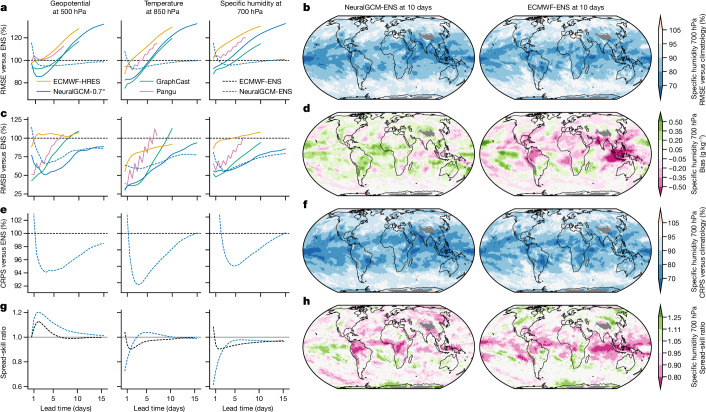
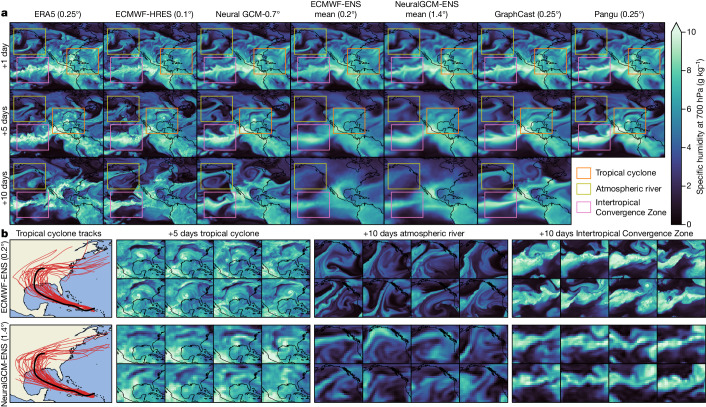
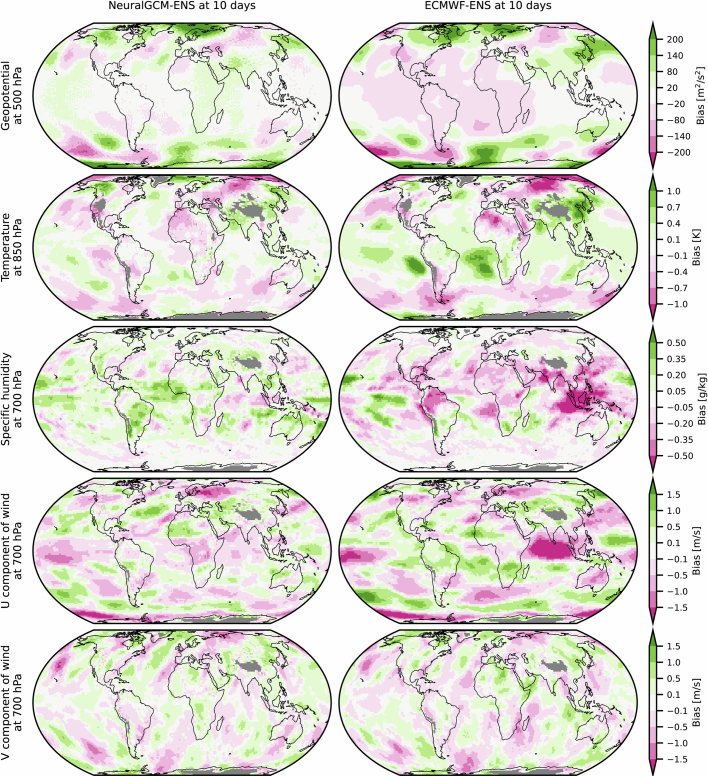
- On medium-range weather forecasting, NeuralGCM-0.7° and GraphCast achieved the best RMSE for the first 1–3 days (depending on variable), while NeuralGCM models compared favorably on persistent bias, including notably lower specific-humidity bias in the tropics.
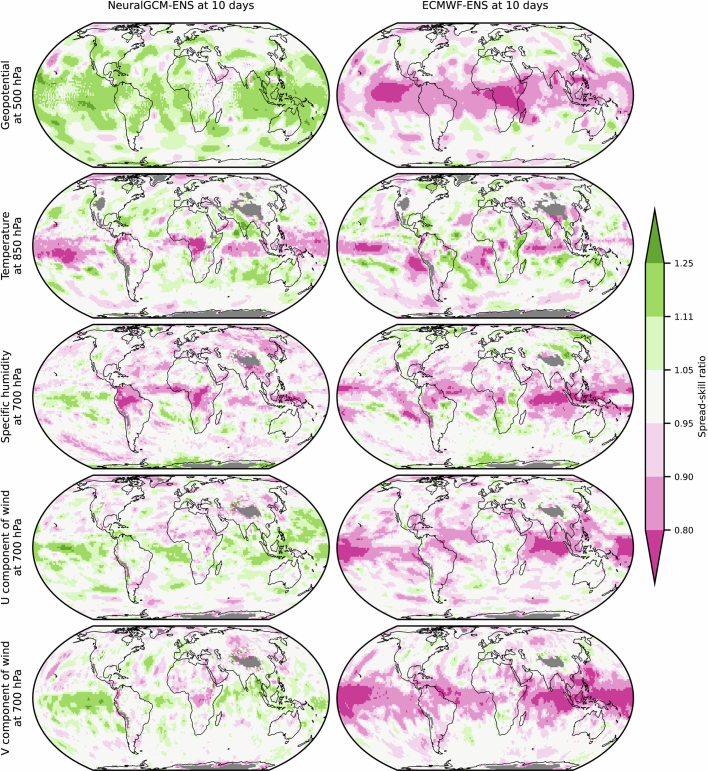
- The stochastic NeuralGCM-ENS at 1.4° had lower error than ECMWF-ENS across almost all variables, lead times, and vertical levels for ensemble-mean RMSE, RMSB, and CRPS; its spread-skill ratio was approximately 1.
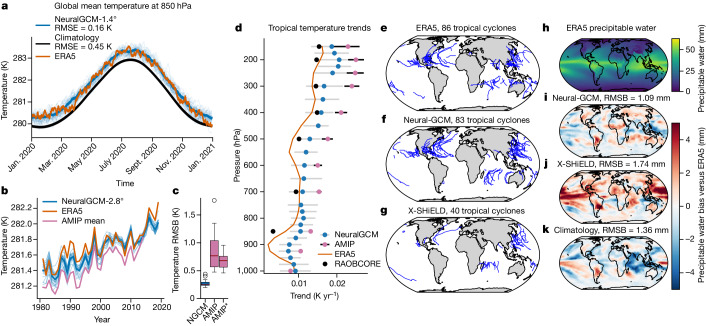
- In climate simulations with prescribed SST, NeuralGCM captured seasonal climate metrics and long-term warming trends: the ensemble-mean global temperature RMSE was 0.16 K versus 0.45 K for climatology, and all 22 stable 40-year NeuralGCM-2.8° runs had smaller spatial bias than the 22 CMIP6 AMIP runs.
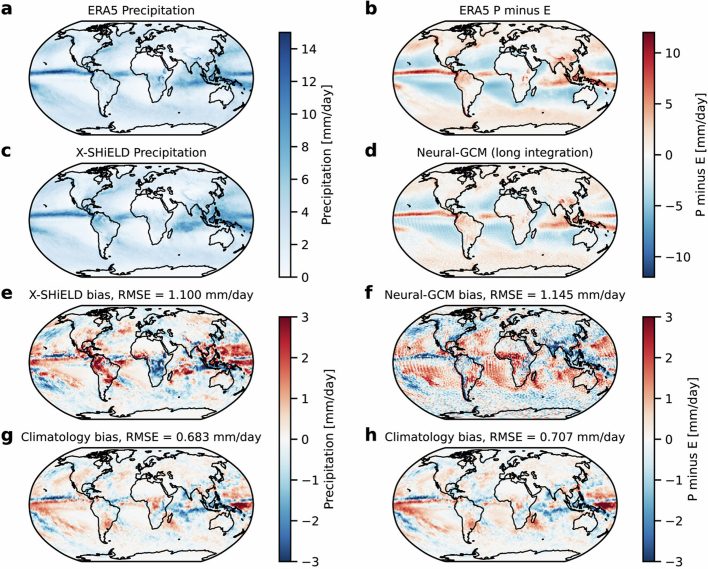
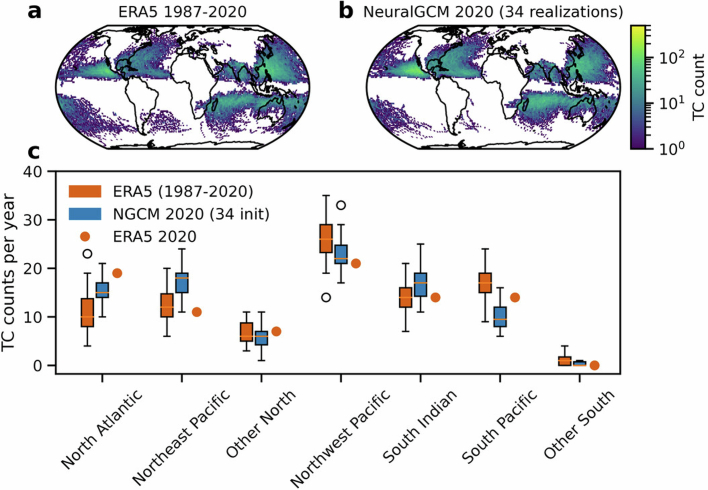
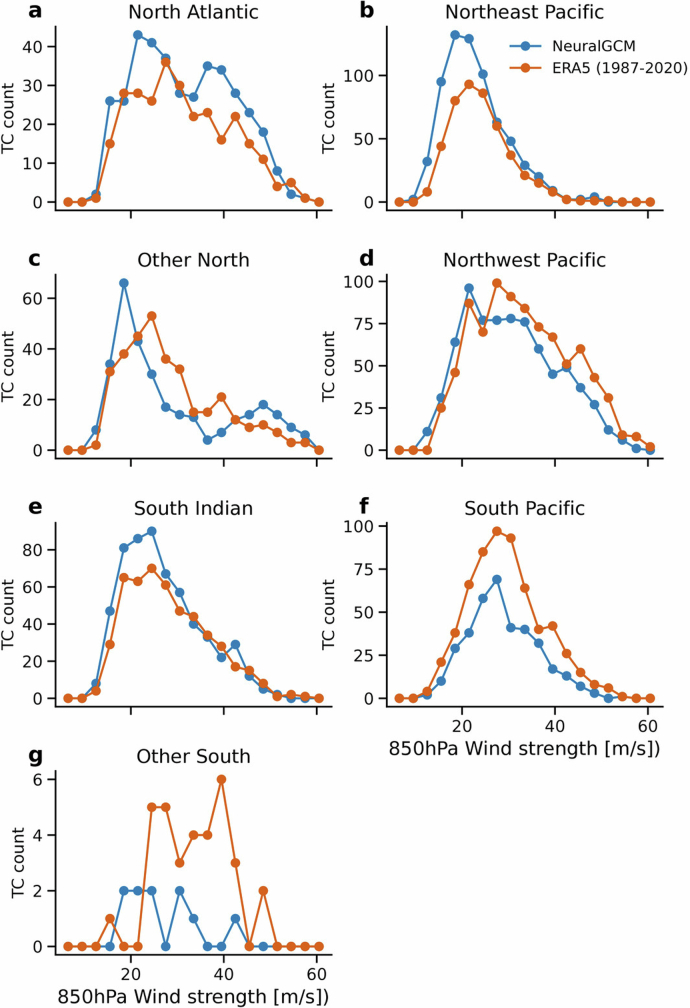
- For tropical cyclones, NeuralGCM at 1.4° produced 83 cyclones versus 86 in ERA5 for the corresponding period, while X-SHiELD produced 40 after regridding to 1.4°.
## Methods
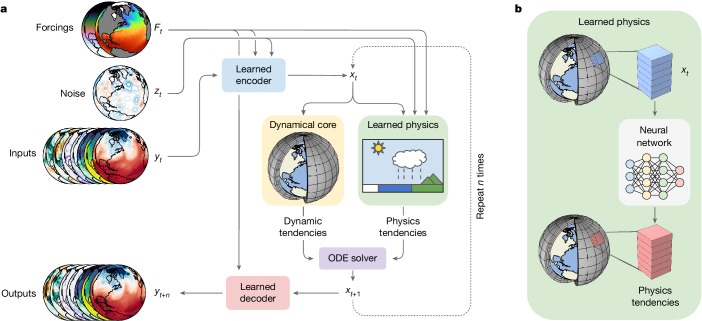
- The model is a fully differentiable hybrid GCM with a JAX-implemented dynamical core solving the hydrostatic primitive equations with moisture on sigma coordinates, plus a learned physics module that operates on single atmospheric columns.
- Weather evaluation used 732 forecasts from noon and midnight UTC in 2020 (held out from training for machine-learning models), regridded to 1.5°, with comparisons against ERA5 or ECMWF operational analysis depending on the baseline.
- Deterministic models were trained with a combination of losses for accuracy, spectral matching, and bias; stochastic models used CRPS and injected Gaussian random fields, with two ensemble members per forecast for training.
- Climate experiments used deterministic models at 2.8° and 1.4° with prescribed historical SST and sea ice, including 37 initial conditions for 2-year seasonal-cycle runs and 37 initial conditions for 40-year AMIP-like runs, of which 35 and 22 were stable, respectively.
## Limitations
- The paper explicitly states that NeuralGCM does not extrapolate to substantially different future climates.
- The authors note that for more substantial SST increases (+4 K), NeuralGCM’s response diverges from expectations, and that AMIP simulations with increased SST show climate drift.
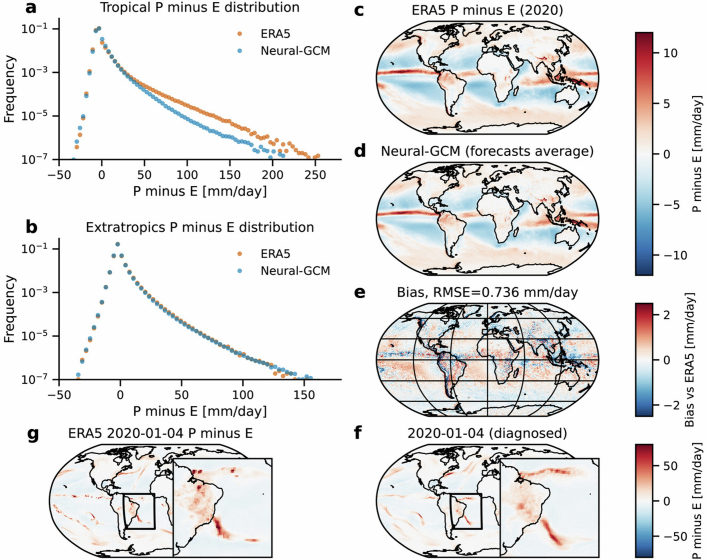
- The text makes evident that the current version cannot distinguish precipitation from evaporation because it directly predicts column tendencies; this is stated in the paper.
Model-written summary. Check it against the paper before relying on it.
Integrity signals
Registry
Cites
Statistics
Figures
Verification
Claims the paper makes
6 Valid · 2 Not valid · 9 Not checked · 53 Own results and interpretations
Some cited sources support this claim and some don’t — read each source’s verdict below.
In the paper
“Our results provide strong evidence for the disputed hypothesis37–39 that learning to predict short-term weather is an effective way to tune parameterizations for climate.”
§ Neural general circulation models for weather and climate > Discussion
What the sources say
- Partly supportedcites [37] Ruiz, J. J., Pulido, M. & Miyoshi, T. Estimating model parameters with ensemble-based data assimilation: a review. J. Meteorol. Soc. Jpn Ser. II 91, 79–99 (2013). 10.2151/jmsj.2013-201 sourceExperimental — accuracy not yet measured
The Conclusions (p. 98) do carry the substance attributed here — 'Parameter estimation also has the potential to improve model climatology... Model parameters can be trained during relatively short periods (i.e., a couple of years) using a data assimilation cycle, and then the estimated parameters can be used for climate simulations' — and the Introduction (p. 90) lists climate-model optimization among the applications of parameter estimation. But the source states this as a potential, not as demonstrated evidence: the Abstract (p. 89) and Section 3.4 (pp. 93-94) limit the paper's own results to a positive effect on short-to medium-range numerical weather prediction (RMSE/bias of 24-h precipitation, spread-error relationship), with no climate simulation performed, so 'strong evidence ... is an effective way to tune parameterizations for climate' overstates it, and nothing in our copy describes the hypothesis as disputed. (LLM, conf=0.75)
- Supportedcites [38] Schneider, T., Lan, S., Stuart, A. & Teixeira, J. Earth system modeling 2.0: a blueprint for models that learn from observations and targeted high-resolution simulations. Geophys. Res. Lett. 44, 12–396 (2017). 10.1002/2017GL076101 source
Section 2.1 (Information Sources for Parameterization Schemes) records that parameters in cloud, convection and precipitation schemes 'have been estimated by minimizing errors in short-term weather forecasts over time scales of hours or days', i.e. the hypothesis the citing sentence names. Section 2.3 (Objectives) shows it is indeed contested: 'This has given rise to hopes that it may suffice to evaluate objective functions by weather hindcasts over time scales of only hours ... But experience has shown that such short-term optimization may not always lead to the desired improvements in climate simulations (Schirber et al., 2013)', and the authors consequently choose accumulation windows wide compared with the O(10 days) forgetting time. The citation is attached only to the disputed hypothesis itself, not to the citing paper's claim that their results support it, so our copy supports what is attributed here. (LLM, conf=0.80)
- Disputedcites [39] Schneider, T., Leung, L. R. & Wills, R. C. J. Opinion: Optimizing climate models with process knowledge, resolution, and artificial intelligence. Atmos. Chem. Phys.24, 7041–7062 (2024). sourceExperimental — accuracy not yet measured
Our copy of Schneider et al. (2024) argues the opposite of what the claim attributes to it: in Sect. 5 ('AI for learning parameterizations') it states that supervised learning focused on the short-term residual has limitations, that 'focusing solely on minimizing the short-term residual ϵ' means the learned parameterization 'may not necessarily minimize the climate-relevant loss function... concerned with longer-term statistics,' and cites Schirber et al. (2013) as an example where 'short-term optimization over trajectories can lead to no improvement or even the degradation of the longer-term climate statistics.' The same section says holistic learning from data 'is more likely to be successful in weather prediction, where short-term accuracy is prioritized... In contrast, climate prediction faces two primary challenges,' and that learned parameterizations 'often struggle with conserving essential quantities such as energy and exhibit instabilities during extended integrations... because minimizing the short-term residual ϵ does not inherently ensure conservation or stability.' The paper also never frames this as a merely 'disputed hypothesis' but advocates process-based, online, climate-relevant-loss learning instead (Sect. 3 and Sect. 5). (LLM, conf=0.85)
Checked by a reasoning model — may be wrong.
boostedstates a cause- Asserted: passes — The authors put it forward as true.
- Checkable: passes — It can be checked against evidence.
- Load-bearing: passes — The paper’s conclusions depend on it.
- Based: passes — The paper gives a reason why it holds.
- Partly supported
The cited sources that could be checked couldn’t confirm or dispute this claim.
In the paper
“Overall, NeuralGCM demonstrates that incorporating machine learning is a viable alternative to building increasingly detailed physical models32 for improving GCMs.”
§ Neural general circulation models for weather and climate > Discussion
What the sources say
- Could not verifycites [32] Stevens, B. et al. DYAMOND: the dynamics of the atmospheric general circulation modeled on non-hydrostatic domains. Prog. Earth Planet. Sci. 6, 61 (2019). 10.1186/s40645-019-0304-z sourceExperimental — accuracy not yet measured
Our copy of DYAMOND (Stevens et al. 2019) never addresses machine learning: searches on 'machine learning', 'deep learning / neural network parameterization', and 'surrogate/emulator alternative to physical parameterization' returned only passages on global storm-resolving models, their grids, output volumes and diagnostics. The route to better GCMs that the paper does argue for is explicitly resolving convection at ~3 km to 'circumvent considerable, and seemingly intractable, problems arising from parameterizations' (Introduction, p. 2) and achieving higher throughput (Summary, p. 15) — a physical, not data-driven, alternative, and no passage credits or discusses ML methods, nor names a work to which the ML claim could be traced. Nothing in our copy either supports or contradicts the attributed claim, so it cannot be judged from this source. (LLM, conf=0.72)
boostedstates a cause- Asserted: passes — The authors put it forward as true.
- Checkable: passes — It can be checked against evidence.
- Load-bearing: passes — The paper’s conclusions depend on it.
- Based: passes — The paper gives a reason why it holds.
- Could not verify
The cited sources support only part of this claim — read each source’s verdict below.
In the paper
“Recently, machine-learning models trained on reanalysis data have achieved comparable or better skill than GCMs for deterministic weather forecasting3,4.”
§ Neural general circulation models for weather and climate > Abstract General circulation models (GCMs) are the foundation of weather and climate prediction1,2. GCMs are physics-based simulators that combine a numerical solver for large-scale dynamics with tuned representations for small-scale processes such as cloud formation. Recently, machine-learning models trained on reanalysis data have achieved comparable or better skill than GCMs for deterministic weather forecasting3,4. However, these models have not demonstrated improved ensemble forecasts, or shown sufficient stability for long-term weather and climate simulations. Here we present a GCM that combines a differentiable solver for atmospheric dynamics with machine-learning components and show that it can generate forecasts of deterministic weather, ensemble weather and climate on par with the best machine-learning and physics-based methods. NeuralGCM is competitive with machine-learning models for one- to ten-day forecasts, and with the European Centre for Medium-Range Weather Forecasts ensemble prediction for one- to fifteen-day forecasts. With prescribed sea surface temperature, NeuralGCM can accurately track climate metrics for multiple decades, and climate forecasts with 140-kilometre resolution show emergent phenomena such as realistic frequency and trajectories of tropical cyclones. For both weather and climate, our approach offers orders of magnitude computational savings over conventional GCMs, although our model does not extrapolate to substantially different future climates. Our results show that end-to-end deep learning is compatible with tasks performed by conventional GCMs and can enhance the large-scale physical simulations that are essential for understanding and predicting the Earth system.
What the sources say
- Supportedcites [3] Lam, R. et al. Learning skillful medium-range global weather forecasting. Science 382, 1416–1421 (2023). 37962497 10.1126/science.adi2336 source
The paper’s opening summary says GraphCast was trained on reanalysis data and significantly outperformed an operational deterministic forecasting system on 90% of 1,380 verification targets. The Conclusions also describe machine-learning weather prediction as competitive with traditional methods. The paper compares GraphCast specifically with HRES, rather than using the term “GCMs.” (LLM, conf=0.90)
- Partly supportedcites [4] Bi, K. et al. Accurate medium-range global weather forecasting with 3D neural networks. Nature 619, 533–538 (2023). 37407823 10.1038/s41586-023-06185-3 PMC10356604 sourceExperimental — accuracy not yet measured
The Discussion and Deterministic global weather forecast sections report that Pangu-Weather, trained on reanalysis data, achieved better deterministic forecast accuracy than ECMWF’s operational IFS. The paper identifies IFS as a numerical weather prediction system, however, and does not report a comparison with a system it calls a GCM. (LLM, conf=0.82)
plainstates an association- Asserted: passes — The authors put it forward as true.
- Checkable: passes — It can be checked against evidence.
- Load-bearing: passes — The paper’s conclusions depend on it.
- Based: passes — The paper gives a reason why it holds.
- Supported
Every source the paper cites for this claim was checked and supports it.
In the paper
“So far, hybrid models have mostly been limited to idealized scenarios such as aquaplanets22,23.”
§ Neural general circulation models for weather and climate > Main
What the sources say
- Supportedcites [22] Rasp, S., Pritchard, M. S. & Gentine, P. Deep learning to represent subgrid processes in climate models. Proc. Natl Acad. Sci. USA 115, 9684–9689 (2018). 30190437 10.1073/pnas.1810286115 PMC6166853 source
The Climate Model and Neural Network Setup section describes this hybrid model as using an aquaplanet setup. The Discussion calls its training climate idealized and says extending the method to a less idealized setup is an immediate follow-up task. The paper thus supports the cited example of the limitation, though it does not quantify how many hybrid models use such setups. (LLM, conf=0.87)
- Supportedcites [23] Yuval, J. & O’Gorman, P. A. Stable machine-learning parameterization of subgrid processes for climate modeling at a range of resolutions. Nat. Commun. 11, 3295 (2020). 32620769 10.1038/s41467-020-17142-3 PMC7335176 source
The Introduction describes earlier neural-network climate-model work in an aquaplanet configuration, and the Results state that this study also uses an aquaplanet configuration. The Discussion identifies training over land with topography as a challenge for future research, supporting the characterization of hybrid models as largely limited to idealized settings. (LLM, conf=0.86)
plain- Asserted: passes — The authors put it forward as true.
- Checkable: passes — It can be checked against evidence.
- Load-bearing: passes — The paper’s conclusions depend on it.
- Based: passes — The paper gives a reason why it holds.
- Supported
The cited sources support only part of this claim — read each source’s verdict below.
In the paper
“Deterministic machine-learning models using a mean-squared-error loss are rewarded for averaging over uncertainty, producing unrealistically blurry predictions when optimized for multi-day forecasts3,13.”
§ Neural general circulation models for weather and climate > Main
What the sources say
- Supportedcites [3] Lam, R. et al. Learning skillful medium-range global weather forecasting. Science 382, 1416–1421 (2023). 37962497 10.1126/science.adi2336 source
The Conclusions (p. 10) state that GraphCast’s MSE objective encourages it to express uncertainty by spatially blurring predictions. The paper also reports that training for longer forecast horizons produces blurrier forecasts at longer lead times. This supports the citing sentence’s account of why MSE-optimized deterministic forecasts can become blurry. (LLM, conf=0.90)
- Partly supportedcites [13] Keisler, R. Forecasting global weather with graph neural networks. Preprint at https://arxiv.org/abs/2202.07575 (2022). sourceExperimental — accuracy not yet measured
Keisler (2022) supplies the empirical setting and the observation but not the claimed mechanism. Section 3.3.3 (p. 5) confirms the model is trained with a mean-squared-error loss, and Section 3.3.2 (p. 5) confirms it is optimized for multi-day forecasts via a multi-step rollout loss (4-, 8-, 12-step, i.e. 1-3 day rollouts). Section 4.2 (p. 6) reports that over a 12-step (3-day) rollout 'the data-driven forecast does become smoother over time' — but the paper nowhere says the model is 'rewarded for averaging over uncertainty', never frames the smoothing as a consequence of irreducible forecast uncertainty under MSE, and never calls the predictions 'unrealistically blurry' (it treats the 3-day output as generally tracking large-scale flows, and its only degradation past ~6 days is hexagon-patterned instability, Section 4.3, p. 6). So the blur/averaging-over-uncertainty causal claim attributed here exceeds what this source states. (LLM, conf=0.72)
plainstates a cause- Asserted: passes — The authors put it forward as true.
- Checkable: passes — It can be checked against evidence.
- Load-bearing: passes — The paper’s conclusions depend on it.
- Based: passes — The paper gives a reason why it holds.
- Supported
29 more claims
Create a free account to see all 70 claims and to verify the 10 references still open.
- It may state two separate claims as one. 31
- Probably not a substantial claim. 6
Claims other papers make about this one
Each is checked against this paper’s own text: does it say what the citing paper says it does?
The cited source says what the claim attributes to it.
In the citing paper
“An exception is NeuralGCM20, a hybrid NWP–MLWP method, which combines the dynamical core of a traditional NWP with local ML-based parameterizations and shows competitive performance with operational ensemble forecasts.”
From Probabilistic weather forecasting with machine learning (2025) · cites this paper as [20]
Citations
Cites
Hersbach, H., Bell, B., Berrisford, P., Hirahara, S., Horányi, A., Muñoz‐Sabater, J., Nicolas, J., Peubey, C., Radu, R., Schepers, D., et al. (2020) · Quarterly Journal of the Royal Meteorological Society · doi:10.1002/qj.3803 · Cited by 31,882 · cited 1×
“These models rely solely on machine-learning techniques, using roughly 40 years of historical data from the European Center for Medium-Range Weather Forecasts (ECMWF) reanalysis v5 (ERA5) 14 for model training and forecast initialization.”
MethodSequence to Sequence Learning with Neural Networks
Sutskever, I., Vinyals, O., & Le, Q. V. (2014) · arXiv · doi:10.48550/arxiv.1409.3215 · Cited by 17,766
Eyring, V., Bony, S., Meehl, G. A., Senior, C. A., Stevens, B., Stouffer, R. J., & Taylor, K. E. (2016) · Geoscientific Model Development · doi:10.5194/gmd-9-1937-2016 · Cited by 11,981 · cited 3×
“34 and Supplementary Table 6.”
MethodInfluential(2012) · doi:10.1017/cbo9781139177245 · Cited by 7,236 · cited 1×
“The difficulty of reducing uncertainty in long-term climate projections 9 and estimating distributions of extreme weather events 10 presents major challenges for climate mitigation and adaptation 11 .”
BackgroundStrictly Proper Scoring Rules, Prediction, and Estimation
Gneiting, T., & Raftery, A. E. (2007) · Journal of the American Statistical Association · doi:10.1198/016214506000001437 · Cited by 5,793 · cited 10×
“Our stochastic loss is based on the CRPS 28,48,49 .”
BackgroundMethodInfluentialDeep learning and process understanding for data-driven Earth system science
Reichstein, M., Camps-Valls, G., Stevens, B., Jung, M., Denzler, J., Carvalhais, N., & Prabhat (2019) · Nature · doi:10.1038/s41586-019-0912-1 · Cited by 5,673 · cited 1×
“…longer timescales 17,18 , these models have not demonstrated the ability to outperform existing GCMs. Hybrid models that combine GCMs with machine learning are appealing because they build on the interpretability, extensibility and successful track record of traditional atmospheric models 19,20 .”
BackgroundThe quiet revolution of numerical weather prediction
Bauer, P., Thorpe, A., & Brunet, G. (2015) · Nature · doi:10.1038/nature14956 · Cited by 2,729
Accurate medium-range global weather forecasting with 3D neural networks
Bi, K., Xie, L., Zhang, H., Chen, X., Gu, X., & Tian, Q. (2023) · Nature · doi:10.1038/s41586-023-06185-3 · Cited by 1,670 · cited 4×
“Recent advances in machine learning have presented an alternative for weather forecasting 3,4,12,13 .”
BackgroundMethodInfluentialLearning skillful medium-range global weather forecasting
Lam, R., Sanchez-Gonzalez, A., Willson, M., Wirnsberger, P., Fortunato, M., Alet, F., Ravuri, S., Ewalds, T., Eaton-Rosen, Z., Hu, W., et al. (2023) · Science · doi:10.1126/science.adi2336 · Cited by 1,466 · cited 5×
“Specifically, we diagnose precipitation minus evaporation (Supplementary Information section H.5) rather than directly predicting these as in machine-learning-based approaches 3 .”
BackgroundMethodInfluentialSelf-citationMarine boundary layer clouds at the heart of tropical cloud feedback uncertainties in climate models
Bony, S., & Dufresne, J. (2005) · Geophysical Research Letters · doi:10.1029/2005gl023851 · Cited by 1,302 · cited 1×
“Tuning GCMs to match historical data remains a manual process 5 , and GCMs retain many persistent errors and biases 6–8 .”
Background
Research works printed but not linked: 1
- Holton, J. R. An introduction to Dynamic Meteorology 5th edn (Elsevier, 2004).
Cited by
Items 301–400 of 434
Computation of simple invariant solutions in fluid turbulence with the aid of deep learning
Page, J. (2025) · Nonlinear Dynamics · doi:10.1007/s11071-025-11773-1 · Cited by 6
A light multimodal neural network for tropical cyclone path prediction with single time step
Tian, X., Yang, L., Bi, C., & Yu, C. (2025) · Journal of Visualization · doi:10.1007/s12650-025-01084-3
“Kochkov et al. (2024) proposed the NeuralGCM model, which combines numerical simulation methods, such as General Circulation Models (GCMs), with AI-based forecasting.”
What are the most informative data points for predicting extreme events?
Champenois, B., & Sapsis, T. P. (2025) · Nonlinear Dynamics · doi:10.1007/s11071-025-11825-6 · Cited by 1
Zhang, W., & Chen, X. (2025) · Journal of Advances in Modeling Earth Systems · doi:10.1029/2025ms005056
Accelerating Weather Forecasting: A Neural Network-Based Emulation of ISORROPIA
Evangelopoulos, G., Hoshyaripour, G. A., Meyer, J., Kumar, P., Bruckert, J., & Streit, A. (2025) · IEEE International Conference on eScience · doi:10.1109/escience65000.2025.00017
“This philosophy was used in NeuralGCM (Neural General Circulation Model) [20] that uses a differentiable dynamical core for the dynamical equations and a learned physics module multi-layer perceptron, which follows the encode-process-decode pipeline.”
A trio of papers I read on biodiversity and forests this week
Madhavapeddy, A. (2025) · doi:10.59350/t7ekw-e7y39
A trio of papers I read on biodiversity and forests this week
Madhavapeddy, A. (2025) · doi:10.59350/e726y-45s91
Matlani, P., & Shukla, B. (2025) · SSRN Electronic Journal · doi:10.2139/ssrn.5658908
Du, S., Zhang, R.-H., & Gao, C. (2025) · Journal of Oceanology and Limnology · doi:10.1007/s00343-025-5166-1
“For instance, Kochkov et al. (2024) developed a general circulation model (GCM) that integrates differentiable atmospheric dynamics solvers with deep learning components for ensemble weather forecasts.”
Global historical perspectives on environmental movements and science of net zero
Sarkar, S. (2025) · Elsevier eBooks · doi:10.1016/b978-0-443-36426-6.00020-4
Contextualising seasonal forecasts to accelerate their uptake for agricultural decision-making
Gonzatti, I. S., Smolenaars, W. J., Siderius, C., et al. (2025) · Environmental Research Letters · doi:10.1088/1748-9326/ae2a52
A Potential Threat on Global Warming Analyzed by XGBoost
Chowdhury, S., Marry, M. S., & Das, D. K. (2025) · International Conference on Innovative Data Communication Technologies and Application (ICIDCA) · doi:10.1109/icidca66325.2025.11280333
“ML also forecasts sea level rise [12], storms [13], and droughts [14], often outperforming traditional models [15], while aiding evaluation of mitigation strategies [16-19].”
de Diego, G. G., & Stadler, G. (2025) · Physical Review Fluids · doi:10.1103/j4qf-s1th · Cited by 2
HybridFlow: A Hybrid Velocity Generation Framework for Precipitation Nowcasting
Ling, X., Duan, G., Li, C., Huang, T., & He, T. (2025) · IEEE Transactions on Geoscience and Remote Sensing · doi:10.1109/tgrs.2025.3646177 · Cited by 2
“Kochkov et al. [23] introduced NeuralGCM, showing that neural general circulation models can achieve results comparable to traditional physics-based models while using substantially less computational power, but the model cannot extrapolate to substantially di ff erent future climates and lacks…”
Yildiz, I., Stanev, E. V., & Staneva, J. V. (2025) · Scientific Reports · doi:10.1038/s41598-025-31670-2 · Cited by 2
“This exercise may appear didactic and not entirely consistent with the numerous applications of ML in geophysics, where scientists use this new technique to solve very complex problems 22,23 .”
Thakur, A., & Chakraborty, S. (2025) · Journal of Engineering Mechanics · doi:10.1061/jenmdt.emeng-8613 · Cited by 2
The Fourier Spectral Transformer for efficient and generalizable nonlinear PDEs
Li, B. (2026) · Journal of Computational Physics · doi:10.1016/j.jcp.2025.114648
Pollinger, T., & Domke, J. (2026) · International Conference on High Performance Computing in Asia-Pacific Region (HPC Asia) · doi:10.1145/3773656.3773664
Ouala, S., Hidaoui, O., & Lachkar, Z. (2026) · Earth system science data · doi:10.5194/essd-18-287-2026 · Cited by 7
“Making these reconstructions and using them to identify and explain variability on different scales is a very important goal and the link with PDO looks promising.”
AI-based assessment of climate change impacts on water requirements in Egypt’s New Delta
El-Tantawi, A. M., Moursy, F. I., Al-Metwaly, W. M., & El-Mahdy, M. E.-S. (2026) · Scientific African · doi:10.1016/j.sciaf.2026.e03182
Data-driven seasonal climate predictions via variational inference and transformers
Palma, L., Peraza, A., Civantos, D., Duarte, A., Materia, S., Muñoz, Á. G., Peña‐Izquierdo, J., Romero, L., Soret, A., & Donat, M. G. (2026) · npj Climate and Atmospheric Science · doi:10.1038/s41612-026-01320-z · Cited by 10
“This limitation partly explains the explosion in studies applying large deep learning models to weather forecasting 22 – 26 , contrasting with the few works tackling seasonal climate predictions.”
A theoretical framework to understand sources of error in Earth System Model emulation
Womack, C. B., Flierl, G. R., Bouabid, S., Souza, A. N., Giani, P., Eastham, S. D., & Selin, N. E. (2026) · Earth System Dynamics · doi:10.5194/esd-17-107-2026 · Cited by 4
“We also do not examine ML emulators such as FourCastNet and NeuralGCM – while these techniques are promising for weather prediction, they currently lack the stability required for reliable climate prediction (Pathak et al., 2022; Kochkov et al., 2024).”
Jendersie, R., Margenberg, N., Lessig, C., et al. (2026) · SSRN Electronic Journal · doi:10.2139/ssrn.6203563
Bora, A., Zhang, S., Shukla, K., et al. (2026) · SSRN Electronic Journal · doi:10.2139/ssrn.6203458
Physics-Informed spatiotemporal deep learning for multivariate atmospheric forecasting
Yu, H., Lin, L., Zhang, Z., Gao, S., Wang, J., & Zhao, H. (2026) · Expert Systems with Applications · doi:10.1016/j.eswa.2026.131721 · Cited by 1
Luo, S., Yu, R., Qiu, C., Ghosh, R., Ladwig, R., Hanson, P. O., Xie, Y., & Jia, X. (2025) · Proceedings · doi:10.1109/icdm65498.2025.00060 · Cited by 7
“Modern architectures, including recurrent and attention-based networks, often outperform traditional process-based methods when ample observations are available [48], [49].”
Li, Q., Wu, M., Zhang, C., et al. (2026) · SSRN Electronic Journal · doi:10.2139/ssrn.6310369
Assessing seasonal climate predictability using a deep learning application: NN4CAST
Fraile, V. G., Rodríguez‐Fonseca, B., Polo, I., Martín‐Rey, M., & Moreno-García, M. N. (2026) · Geoscientific model development · doi:10.5194/gmd-19-1917-2026 · Cited by 5
Dynamic Graph Contrastive Learning Neural Network for Sea Surface Temperature Prediction
Zhao, H., He, X., & Li, W. X. (2026) · IEEE Geoscience and Remote Sensing Letters · doi:10.1109/lgrs.2026.3672297
“Numerical models simulate the complex spatiotemporal evolution of the ocean using physical equations from thermodynamics and fluid dynamics (e.g., GCMs [3]).”
王, 悟., 倪, 维., 袁, 太., 黄, 丽., 韩, 滔., 段博恒, 李, 小., 赵延来, 费, 奔., 白, 磊., et al. (2026) · SCIENTIA SINICA Terrae · doi:10.1360/n072025-0199
Targeted Calibration to Adjust Stability Biases in Complex Dynamical System Models
Pals, D., Bathiany, S., Küttel, J., Wood, R., & Boers, N. (2026) · Physical Review X · doi:10.1103/624z-1p1s · Cited by 1
“Recently, atmospheric models that are purely based on machine learning [33–35] and a differentiable hybrid model [36] have been developed, but such models struggle to show a physically realistic response to forcing [37].”
Wang, W., Ni, W., Yuan, T., Huang, L., Han, T., Duan, B., Li, X., Zhao, Y., Fei, B., Bai, L., et al. (2026) · Science China Earth Sciences · doi:10.1007/s11430-025-1807-8 · Cited by 2
Hao, R., Zhao, Y., & Deng, X. (2026) · Remote Sensing · doi:10.3390/rs18070997
Li, H., Zhao, Q., Yao, Y., Liang, H., Zeng, Z., Guo, H., Wu, A., Liu, M., Bai, J., Zhao, Y., et al. (2026) · Advances in Space Research · doi:10.1016/j.asr.2026.03.089
AI-Based Anomaly Detection for Extreme Event Attribution: An Analysis of European Heatwaves
Zaninelli, P. G., Barriopedro, D., Pérez-Aracil, J., & Drouard, M. (2026) · Earth Systems and Environment · doi:10.1007/s41748-026-01122-6 · Cited by 1
“…ahead, the integration of our framework with climate emulators and fast hybrid GCMs capable of running stable long-term simulations (e.g., ACE2 Watt-Meyer et al. (2025) and NeuralGCM Kochkov et al. ( 2024 )) could accel - erate the production of large ensembles under single and multiple forcings.”
Brolly, M. T. (2026) · Proceedings of the National Academy of Sciences · doi:10.1073/pnas.2609143123 · Cited by 2
“This issue of oversmoothing has been widely observed in the emulation of weather models (14, 35–37) and in parameterization in atmospheric and oceanic modeling (17, 29).”
The matrix-vector differential-form Muskingum method for river network routing
Zhao, J., Ding, Z., Chen, B., Li, B., Hu, Y., wang, J., & Liang, Z. (2026) · Advances in Water Resources · doi:10.1016/j.advwatres.2026.105300
Perspective on measurements and modeling of Earth’s climate
Coppa, G., & Massano, L. T. T. (2026) · Measurement Science and Technology · doi:10.1088/1361-6501/ae5c28
Latent space data assimilation by using deep learning
Peyron, M. (2024) · theses.fr (ABES) · doi:10.70675/ac16da6fzf5d5z4363z9dedz0d310eec5554 · Cited by 1
Machine-Learning Source Apportionment of Particulate Pollution Aids Urban Emission Regulations
Peng, X., Ma, H.-N., He, L.-Y., Cao, L., Tang, M.-X., Wang, Y., Chen, D.-H., Zhou, Y., Tang, K.-J., He, L., et al. (2026) · Environmental Science & Technology · doi:10.1021/acs.est.5c14501 · Cited by 3
Machine learning models for predicting daily temperature extremes
Topcu, A. E., AlQallaf, M. K. I., Alzoubi, Y. I., & Α, E. E. (2026) · European Journal of Sustainable Development Research · doi:10.29333/ejosdr/18318 · Cited by 1
“…regression neural networks (GRNN), backpropagation neural networks (BPNN), random forest (RF), long short-term memory neural network (LSTM), and support vector machines (SVM), in predicting temperature (Kochkov et al., 2024; Lv et al., 2024; Manwal et al., 2024; Votarikari et al., 2024).”
Fast prediction of oceanic nearshore circulation (FPOCH) system with multi-model fusion strategies
Feng, X., Jiang, Y., Huang, H., Hu, Z., Liu, M., Gao, S., Pei, S., Zheng, G., & Feng, W. (2026) · Applied Ocean Research · doi:10.1016/j.apor.2026.105059
Yuan, W., Yu, R., & Chen, H. (2026) · Climate Dynamics · doi:10.1007/s00382-026-08167-3
“Purely data-driven frameworks may circumvent thermodynamic limits, such as the Clausius-Clapeyron relationship, or fail to capture non-linear tipping points essential for convective intensification (Kochkov et al. 2024 ; Sha et al. 2025 ).”
Machine learning advances and data model coevolution in geoscience
Eltijani, A., & Mohammed, M. A. A. (2026) · Discover Geoscience · doi:10.1007/s44288-026-00524-3
Sun, D., Huang, W., Tian, Z., Yang, Z., Luo, Y., Jingjia, L., Fu, H., & Wang, B. (2026) · Ocean Dynamics · doi:10.1007/s10236-026-01807-6
“Compared to purely data-driven approaches, the combination of deep learning with numerical wave models adheres more closely to physical conservation principles, offering greater potential for extending lead times and enhancing forecast accuracy (Dong et al. 2022; Kochkov et al. 2024).”
Huo, X., Hou, L., Yang, L., & Zhou, Z. (2026) · Applied Energy · doi:10.1016/j.apenergy.2026.127915
Lagrangian-Based Motion-Capture Model for Continuous Weather Forecasting
Chen, K., Fei, B., Ling, F., Li, Z., Liu, L., Li, B., & Bai, L. (2026) · IEEE International Conference on Acoustics Speech and Signal Processing · doi:10.1109/icassp55912.2026.11462035 · Cited by 1
何秉亮, Wang, C., Zhang, H., Song, H., Tan, Y., Da, C., & Tian, X. (2026) · Atmospheric and Oceanic Science Letters · doi:10.1016/j.aosl.2026.100831 · Cited by 1
Prevezianos, A., Emmanouil, S., & Anagnostou, E. N. (2026) · Reliability Engineering & System Safety · doi:10.1016/j.ress.2026.112794 · Cited by 2
The state of macroalgae carbon dioxide removal: insights from a methodology development team
Martocello, D. E., Storwick, T., & Buchwald, C. (2026) · Frontiers in Climate · doi:10.3389/fclim.2026.1761760
Wenyue, 曹. C., Jiang, Y., Ge, H., & Cao, J. (2026) · Chinese Physics B · doi:10.1088/1674-1056/ae6b40
Zou, J., Yan, S., Kong, J., Gaur, A., Wang, L., Yan, D. D., & Tan, Z. (2026) · Building and Environment · doi:10.1016/j.buildenv.2026.115142
Data-driven subgrid-scale turbulence parameterization: methods for improving model efficiency
Zhu, X., Qu, Y., Wu, N., Zhang, H., & Shi, X. (2026) · Machine Learning Earth · doi:10.1088/3049-4753/ae6dbe
Advances and Perspectives in Atmospheric Environment Modeling in China
Wang, Z., Li, X., Gao, M., 葛宝珠, Tang, X., Chen, X., Wu, L., Wu, L., Wang, Z., Yang, T., et al. (2026) · Advances in Atmospheric Sciences · doi:10.1007/s00376-026-5677-5 · Cited by 1
“Neural-GCM (General circulation models) demonstrates a competitive performance by coupling differentiable dynamics with ML (Kochkov et al., 2024).”
Li, S., Dias, J., Moore, B., & Quinting, J. (2026) · Weather and Climate Dynamics · doi:10.5194/wcd-7-787-2026
“…version of the National Oceanic and Atmospheric Administration (NOAA) UFS, a state-of-the-art NWP model (Jacobs, 2021), (2) Neu-ralGCM, a hybrid neural network-based general circulation model (Kochkov et al., 2024), and (3) Pangu-Weather, a purely data-driven MLWP model (Bi et al., 2022).”
Forecast-based attribution of extratropical cyclones using AI weather models
Jiménez‐Esteve, B., Barriopedro, D., & García‐Herrera, R. (2026) · Environmental Research Climate · doi:10.1088/2752-5295/ae714b
Lu, Y., Mo, X., & Li, H. (2026) · Journal of King Saud University - Computer and Information Sciences · doi:10.1007/s44443-026-00823-2
“A conservation-related diagnostic is conducted for GCODS (Kochkov et al. 2024).”
Kim, J., Yang, S., & Kang, N. (2026) · Neural Networks · doi:10.1016/j.neunet.2026.109186 · Cited by 2
Seasonal forecast of sea surface temperatures via Neural ODEs
Lee, J., Moon, W., & Ham, Y. (2026) · Machine Learning Earth · doi:10.1088/3049-4753/ae7447
Improving 10 m Wind Speed Forecasts over the Northwest Pacific Using a Deep Learning Network
Xiao, J., Chen, X., Wang, B., & Pan, X. (2026) · Atmosphere · doi:10.3390/atmos17060549
“Direct prediction of absolute wind fields by a deep learning model is prone to disrupting the inherent atmospheric dynamical balance of the NWP, potentially leading to physical distortions [56].”
Johnston, D. J. (2026) · Open Library of Humanities · doi:10.16995/olh.28617
Three-dimensional canopy morphology and wind dynamics govern global rainfall interception
Li, Q., Jin, X., Wei, Z., Cheng, 张. Z., Shangguan, W., Zhu, J., Zhang, Z., Li, X., Yan, Y., Wang, J., et al. (2026) · Communications Earth & Environment · doi:10.1038/s43247-026-03694-7
“Machinelearninghasprovenadeptatmodelingnonlineardynamicsin Earth-system processes 26 – 28 , yet translating these insights into explicit, transferable equations, instead of black-box predictors 29,30 remains a persistent challenge 31 .”
Forecasts of Hurricane Helene Using AI Machine Learning Models
Lou, K. J., & Ballard, T. C. (2026) · IEEE International Conference on Computing and Machine Intelligence (ICMI) · doi:10.1109/icmi68585.2026.11539875
Xie, M., Sun, W., Han, Y., & Dong, C. (2026) · Journal of Ocean Engineering and Science · doi:10.1016/j.joes.2026.06.002 · Cited by 1
High-resolution large ensemble for extreme precipitation forecasting with multiple AI weather modelsPreprint
Nie, Y., Sengupta, A., Steinhoff, D. F., Baño‐Medina, J., & Monache, L. D. (2026) · Research Square · doi:10.21203/rs.3.rs-9889566/v1
Navigating maritime emergencies with large models: A lifecycle-oriented review
Xu, J., Yang, Q., Yang, Z., Gao, Y., Yang, K., & Jiang, J. (2026) · Engineering applications of artificial intelligence · doi:10.1016/j.engappai.2026.115411
Threshold-Consistent Ordinal Evidence for Probabilistic Multi-Step Ocean Wind–Wave Risk WarningPreprint
Ji, S., Lyu, H., Law, S., Yin, Y., & Gao, X. (2026) · SSRN Electronic Journal · doi:10.2139/ssrn.6996457
Machine learning is revolutionizing weather forecasting - the next step is a change in how we work
Dueben, P. D., Bauer, P., Fuhrer, O., Koldunov, N., & Kristiansen, J. (2026) · Journal of the European Meteorological Society. · doi:10.1016/j.jemets.2026.100050
Wu, Y., Huang, H., Liu, X. L., & Jin, Z. (2026) · Journal of Cleaner Production · doi:10.1016/j.jclepro.2026.148901
Deep Learning Based Data Driven Models: A Hybrid Approach for Time Series Weather Prediction
Chanekar, A., Kulkarni, R. A., Joshi, P. P., & Takalikar, M. S. (2026) · Lecture notes in networks and systems · doi:10.1007/978-3-032-20612-1_50
Subseasonal 2-m Temperature Prediction over East Asia Based on SwinUNet-AR
Ding, J., Wu, H., & Zhang, Q. (2026) · Applied Sciences · doi:10.3390/app16147162
Neural advection-diffusion equation for long-term climate dynamics
Cho, N., Cho, S. W., Hong, Y., Hwang, H. J., Lee, J. Y., & Son, H. (2026) · Neurocomputing · doi:10.1016/j.neucom.2026.134500
Xu, P., & Xu, X. (2026) · Building and Environment · doi:10.1016/j.buildenv.2026.115009
JCM v1.1: a differentiable, intermediate-complexity atmospheric model
Davenport, E., Madan, J. V., Gjini, R., Brzenski, J., Crawford, B., Ho, N., Hsu, T., Liang, Y., Liu, Z., Manivannan, V., et al. (2026) · Geoscientific model development · doi:10.5194/gmd-19-6451-2026 · Cited by 10
“DYnam-ics) version 41, which have been translated from Fortran90 to JAX.”
Self-citationNeuralGCM-En4DVar: A Differentiable Hybrid Ensemble 4D-Var Data Assimilation Framework
Guo, Y. (2026) · Lecture notes in computer science · doi:10.1007/978-981-92-3410-3_17
Li, Y., Wang, H., Zeng, Y., Liang, D., Ji, P., & Yan, Y. (2026) · Environmental Science & Technology · doi:10.1021/acs.est.6c05904
Observing and monitoring global runoff
Brinkerhoff, C. (2026) · Elsevier eBooks · doi:10.1016/b978-0-443-15748-6.00047-2
Remote sensing of the Earth system
Su, H., & Xu, L. Q. (2026) · Elsevier eBooks · doi:10.1016/b978-0-443-15748-6.00044-7
Towards a political ecology of Earth System Modelling
Wickberg, A., & Turnbull, T. M. (2026) · The Anthropocene Review · doi:10.1177/20530196261472819 · Cited by 2
“It uses AI neural networks to replace physics-derived parameters, was trained on ECMWF data, and is more efficient than competitors: it can be run on a laptop (Kochkov et al., 2024).”
Diffusion model-based ensemble generation for highly nonlinear systems with limited ensemble size
Anonymous (2026) · Physical review. E · doi:10.1103/xq7z-9cg5
Chien, M.-T., Yang, W., Maloney, E. D., Vecchi, G. A., & Barnes, E. A. (2026) · npj Climate and Atmospheric Science · doi:10.21203/rs.3.rs-10358405/v1
Foundational and World Models in SciML
Bhuyan, B. P., Saadi, A. A., Meraihi, Y., & Ramdane-Chérif, A. (2026) · Springer eBooks · doi:10.1007/978-981-95-7856-6_9
Optimal Lattice Boltzmann Closures through Multi-Agent Reinforcement Learning
Fischer, P., Kaltenbach, S., Litvinov, S., Succi, S., & Koumoutsakos, P. (2026) · ACM Transactions on AI for Science · doi:10.1145/3822504 · Cited by 11
Storcks, L., Thuerey, N., & Buck, T. (2026) · SSRN Electronic Journal · doi:10.2139/ssrn.7191671
Dai, G., Li, H., Mu, M., Wang, G., Qin, B., Zhong, X., Zhang, F., & Liang, X. S. (2026) · Advances in Atmospheric Sciences · doi:10.1007/s00376-026-6149-7
“NeuralGCM represents a pioneering effort in this direction, demonstrating the feasibility of such physics–AI integration (Kochkov et al., 2024).”
Jendersie, R., Margenberg, N., Lessig, C., & Richter, T. (2026) · Computer Methods in Applied Mechanics and Engineering · doi:10.1016/j.cma.2026.119254
“In a hybrid setting, a fully differentiable code makes it possible to use backpropagation-through-time to this end by rolling out the simulation for multiple time-steps [29].”
InfluentialASTAFN: Bridging the Gap Between Weather Foundation Models and Accurate Station-Level Forecasting
Xu, B., Yan, Z., Li, Q., Guo, Z., Zheng, D., Yao, W., Wang, B., Wang, Z., & Geng, Y.-A. (2026) · ACM SIGKDD Conference on Knowledge Discovery and Data Mining (KDD) · doi:10.1145/3770854.3783935 · Cited by 2
Artificial Intelligence and Sustainable Transformation
Li, S. (2026) · Business, management and economics · doi:10.5772/intechopen.1016445 · Cited by 1
Dynamical-bridge fidelity as a pre-release standard for hybrid seasonal tropical-cyclone forecasts
Li, Z. (2026) · Environmental Research Communications · doi:10.1088/2515-7620/ae9468
Maschinelles Lernen – Eine Zukunft für die Klimamodellierung?
Ellerhoff, B. M., & Layritz, L. S. (2026) · Springer eBooks · doi:10.1007/978-3-662-72801-7_4
Li, Z., Qin, J., Ma, X., Sun, D., & Ma, H. (2026) · IEEE Journal of Selected Topics in Applied Earth Observations and Remote Sensing · doi:10.1109/jstars.2026.3720640
“Furthermore, Kochkov et al. [11] highlighted in Neural-GCM that the deep integration of physical mechanisms with neural modules is a crucial direction for improving climate model generalization.”
Bailie, T., Mukkavilli, S. K., Vetrova, V. V., & Koh, Y. S. (2026) · ACM SIGKDD Conference on Knowledge Discovery and Data Mining (KDD) · doi:10.1145/3770855.3818890
RainCast: A High-Resolution 72-Hour Short-Term Precipitation Forecasting Model
Ma, G., Chen, W., Zhao, Y., Yuan, H., & Sun, L. (2026) · ACM SIGKDD Conference on Knowledge Discovery and Data Mining (KDD) · doi:10.1145/3770855.3818880
OceanVerse: Evaluable 4D Ocean Element Reconstruction Dataset under Realistic Sparsity
Lü, B., Shen, J., Zhao, Z., Zhou, J., Qi, H., Han, L., Gan, X., Jin, M., Zhou, L., Fu, L., et al. (2026) · ACM SIGKDD Conference on Knowledge Discovery and Data Mining (KDD) · doi:10.1145/3770855.3817534 · Cited by 1
Skillful Kilometer-Scale Regional Weather Forecasting via Global and Regional Coupling
Wang, W., Chen, W., Yuan, Q., Shen, L., Peng, B., Chen, J., Wu, B., & Sun, L. (2026) · ACM SIGKDD Conference on Knowledge Discovery and Data Mining (KDD) · doi:10.1145/3770855.3818855
Li, Q., Wu, M., Zhang, C., Wei, Z., Shangguan, W., Zhu, J., Wang, J., Li, X., Yan, Y., Zhang, Z., et al. (2026) · Journal of Hydrology · doi:10.1016/j.jhydrol.2026.136201
Jiang, J., Wu, J., Peng, Q., & Zhang, L. (2026) · The Journal of the Acoustical Society of America · doi:10.1121/10.0044872
Zhou, H., Ji, T., Zheng, C., & Xie, F. (2026) · Physics of Fluids · doi:10.1063/5.0333989
FengYuan: An End-to-End Global Weather Forecasting Model Driven by Multi-Source Observational Data
Liang, Z., Li, Y., Wang, Y., Shi, Y., Chen, J., Ling, F., Zhu, E., Wang, H., Bai, L., Ke, H., et al. (2026) · 气象学报:英文版 · doi:10.1007/s13351-026-6042-4 · Cited by 1
Bora, A., Zhang, S., Shukla, K., Harrop, B. E., Karniadakis, G. E., & Leung, L. R. (2026) · Journal of Computational Physics · doi:10.1016/j.jcp.2026.115294 · Cited by 1
Metadata
- Authors
- Kochkov, D., Yuval, J., Langmore, I., Norgaard, P., Smith, J., Mooers, G., Klöwer, M., Lottes, J., Rasp, S., Düben, P., Hatfield, S., Battaglia, P., Sanchez-Gonzalez, A., Willson, M., Brenner, M. P., & Hoyer, S.
- Affiliations
- Google (United States) (US)
- Massachusetts Institute of Technology (US)
- European Centre for Medium-Range Weather Forecasts (GB)
- Google DeepMind (United Kingdom) (GB)
- Corresponding author
- Kochkov, Dmitrii
- ORCID
- Venue
- Nature
- Published
- 2024-07-22
- Volume
- 632
- Issue
- 8027
- Pages
- 1060-1066
- ISSN
- 0028-0836 (ISSN-L)
- 1476-4687
- PMC
- PMC11357988
- OpenAlex
- W4400880443
- Cited by
- 454
- References
- 54
- Citations by year
- 2026: 188 · 2025: 209 · 2024: 57
- FWCI
- 82.79
- Type
- journal article
- Language
- en
- Open access
- hybrid
- doi.org
- Licence
- cc-by
- creativecommons.org/licenses/by/4.0 (tdm)
- creativecommons.org/licenses/by/4.0 (vor)
- Locations
- Nature (publishedVersion, cc-by)
- PubMed Central (publishedVersion, cc-by)
- PubMed (publishedVersion)
- arXiv (Cornell University) (submittedVersion)
- RePEc: Research Papers in Economics (submittedVersion)
- arXiv (Cornell University)
- Topics
- Physical Sciences › Earth and Planetary Sciences › Atmospheric Science › Meteorological Phenomena and Simulations
- Physical Sciences › Environmental Science › Global and Planetary Change › Climate variability and models
- Physical Sciences › Physics and Astronomy › Statistical and Nonlinear Physics › Model Reduction and Neural Networks
- Keywords
- weather forecasting, climate prediction, ensemble forecasting, tropical cyclones, long-term climate simulation, computational efficiency
About these checks
Registry, retraction, Cites and statistics results are computed, not judged, with one exception: a printed reference that no index lists is read once by a model before it counts as a citation error. Claims are extracted by a model and kept only when their quote appears verbatim in the text; each cited source is then checked, with a model’s help, for whether it says what the claim relies on. Those verdicts can be wrong — read the claim’s quote and the cited source before relying on one.
The claim verdicts this report counts are experimental: their accuracy is not yet measured.
A language model drew the claims from the paper on 2026-10-10, under version 3 of the claim definition (model deepseek-v4.1-flash, prompt extract-v3).
A second model labelled each claim on 2026-10-10 (model jev-1.13-20260917, definition revision gold-guideline-v0.2).
Cited sources are checked with a language model’s help (qwen3.8-omni-flash and gpt-6-sol).
Statistics and arithmetic are recomputed, not judged.
Confidence bands are shown only for fields calibrated on our annotated test set. None is calibrated yet, so no band is shown.
What counts as a claim ›How we measure confidence ›How we check this ›
Are you an author, or do you see a problem with this page? Request a review
Data sources
Bibliographic data: Semantic Scholar, OpenAlex, Crossref.
Contains information from the Semantic Scholar Academic Graph Datasets, made available under the ODC Attribution License (ODC-BY 1.0).
Semantic Scholar’s data is described in: Kinney, R., et al. (2023). The Semantic Scholar Open Data Platform. arXiv:2301.10140.
